

Gyeongju

Encyclopedia
Gyeongju is a coastal city in the far southeastern corner of North Gyeongsang province in South Korea
. It is the second largest city by area in the province after Andong
, covering 1324 km² (511.2 sq mi) with a population of 269,343 people according to the 2008 census. Gyeongju is 370 km (229.9 mi) southeast of Seoul
, and 55 km (34.2 mi) east of the provincial capital, Daegu
. The city borders Cheongdo and Yeongcheon
to the west, Ulsan
to the south and Pohang
to the north, while to the east lies the coast of the Sea of Japan
(East Sea)
. Numerous low mountains—outliers of the Taebaek range
—are scattered around the city.
Gyeongju was the capital of the ancient kingdom of Silla
(57 BC – 935 AD) which ruled most of the Korean Peninsula
between the 7th and 9th centuries. A vast number of archaeological sites and cultural properties from this period remain in the city. Gyeongju is often referred to as "the museum without walls". Among such historical treasures, Seokguram
grotto, Bulguksa
temple, Gyeongju Historic Areas
and Yangdong Folk Village are designated as World Heritage Sites by UNESCO
. The many major historical sites have helped Gyeongju become one of the most popular tourist destinations in South Korea
.
The city of Gyeongju was united with the nearby rural Gyeongju County in 1995 and is now an urban–rural complex. It is similar to 53 other small- and medium-sized cities with a population under 300,000 people in South Korea. As well as its rich historical heritage, Gyeongju today is affected by the economic, demographic, and social trends that have shaped modern South Korean culture. Tourism remains the major economic driver, but manufacturing activities have developed due to its proximity to major industrial centers such as Ulsan and Pohang. Gyeongju is connected to the nationwide rail and highway networks, which facilitate industrial and tourist traffic.
 The early history of Gyeongju is closely tied to that of the Silla
kingdom, of which it was the capital. Gyeongju first enters non-Korean records as Saro-guk, during the Samhan
period in the early Common Era
. Korean records, probably based on the dynastic chronicles of Silla, record that Saro-guk was established in 57 BCE, when six small villages in the Gyeongju area united under Bak Hyeokgeose
. As the kingdom expanded, it changed its name to Silla. During the Silla period, the city was called "Seorabeol" (lit. Capital), "Gyerim" (lit. Rooster's forest) or "Geumseong" (lit. City of Gold).
After the unification of the peninsula up to Taedong River
in 668 AD, Gyeongju became the center of Korean political and cultural life. The city was home to the Silla court and the great majority of the kingdom's elite. Its prosperity became legendary, and was reported as far away as Persia according to the 9th century book, The Book of Roads and Kingdoms
. Records of Samguk Yusa
give the city's population in its peak period as 178,936 households, suggesting that the total population was almost one million. Many of Gyeongju's most famous sites date from this Unified Silla
period, which ended in the late 9th century by Goryeo
(918–1392).
In 940, the founder of Goryeo, King Taejo
, changed the city's name to "Gyeongju", which literally means "Congratulatory district". In 987, as Goryeo adopted a system of having three additional capitals in politically important provinces outside Gaegyeong (nowadays Kaesong
), Gyeongju was designated as "Donggyeong" ("East Capital"). However, that title was removed in 1012, the 3rd year of King Hyeongjong
, due to political rivalries at that time, though Gyeongju was later made the seat of Yeongnam
Province. It had jurisdiction over a wide area, including much of east-central Yeongnam, although this area was greatly reduced in the 13th century. Under the subsequent Joseon
(1392–1910) dynasties, Gyeongju was no longer of national importance, but remained a regional center. In 1601, the city ceased to be the provincial capital.
 Over these centuries, the city's relics suffered numerous assaults. In the 13th century, Mongol forces destroyed a nine-story wooden pagoda at Hwangnyongsa
. During the Japanese invasions of Korea, the Gyeongju area became a heated battlefield, and Japanese forces burned the wooden structures at Bulguksa
. Not all damage was due to invasions, however. In the early Joseon period, a great deal of damage was done to Buddhist sculptures on Namsan
by Neo-Confucian radicals, who hacked arms and heads off statuary.
In the 20th century, the city had remained relatively small, no longer ranking among the major cities of Korea. During the early 20th century, many archaeological excavations were conducted, particularly inside the tombs which had remained largely intact over the centuries. A museum, the forerunner of the present-day Gyeongju National Museum
, was inaugurated in 1915 to exhibit the excavated artifacts.
Gyeongju emerged as a railroad junction in the later years of the Japanese Occupation
, as the Donghae Nambu Line
and Jungang Line
were established to prepare for Second Sino-Japanese War
and to exploit rich resources of the eastern Korean peninsula. Following liberation in 1945, Korea was plunged into turmoil, and Gyeongju was no exception. Returnees from abroad were numerous; a village for them was constructed in present-day Dongcheon-dong
. In a period marked by widespread conflict and unrest, the Gyeongju area became particularly notorious for the level of guerrilla activity in the mountains.
Although the Korean War
broke out in 1950, most of Gyeongju was spared from the fighting, and remained under South Korean control throughout the conflict. However, for a brief time in late 1950 portions of the city stood on the front lines, as North Korea
n forces pushed the Pusan Perimeter southward from Pohang.
In the 1970s, Korea saw substantial industrial development, much of it centered in the Yeongnam region of which Gyeongju is a part. The POSCO
steel mill in neighboring Pohang commenced operations in 1973, and the chemical manufacturing complex in Ulsan emerged in the same year. These developments helped to support the emergence of Gyeongju's manufacturing sector.
 Gyeongju lies in the southeastern corner of North Gyeongsang Province, and is bounded by the metropolitan city of Ulsan
on the south. Within the province, its neighbors include Pohang
on the north, Cheongdo County
on the southwest, and Yeongcheon
on the northwest. Gyeongju is located about 50 kilometres (31.1 mi) north of Busan
. To the east, it has no neighbor but the sea.
Most of Gyeongju lies in the Gyeongsang Basin, but a few areas of the city belong to the Pohang Basin, such as Eoil-ri and Beomgok-ri in Yangbuk-myeon
, and part of Cheonbuk-myeon
. The Gyeongsang Basin areas consist of Bulguksa intrusive rock penetrating layers of sedimentary rock
s, mainly granite
and porphyry
. By contrast, the Pohang Basin areas are made up of stratum
that formed in the Tertiary
period of the Cenozoic era, which consist of igneous rock
, aqueous rock, porphyry, sandstone
, and tuff
.
Low mountains are widespread throughout Gyeongju. The highest of these are the Taebaek Mountains
, which run along the city's western border. Gyeongju's highest point, Munbok Mountain (文福山), is 1014 metres (3,326.8 ft) above sea level
. This peak lies in Sannae-myeon
, on the border with Cheongdo
. East of the Taebaek range, other western peaks such as Danseok Mountain lie within the Jusa
subrange. The city's eastern peaks, including Toham Mountain, belong to the Haean Mountains and Dongdae Mountains
.
Gyeongju's drainage patterns are shaped by these lines of mountains. The Dongdae Mountains divide a narrow foothills area on their east, and various internal river systems to the west. Most of the city's interior is drained by the small Hyeongsan River
, which flows north from Ulsan and meets the sea at Pohang Harbor. The Hyeongsan's chief tributaries include the Bukcheon and Namcheon, which join it in Gyeongju Basin
.
The southwestern corner of Gyeongju, on the far side of the Taebaek range, drains into the Geumho River
, which then flows into the Nakdong
. A small area of the south, just west of the Dongdae range, drains into the Taehwa River
, which flows into the Bay of Ulsan.
The Gyeongju coastline runs for 36.1 kilometres (22.4 mi) between Pohang
in the north and Ulsan
in the south. There are no islands or large bays, only the small indentation
s made by the small streams flowing off the Dongdae ridgeline. Because of this, the city has no significant ports, though there are 12 small harbors. One such harbor in Gyeongju's southeast corner is home to the Ulsan base of the National Maritime Police. This base is responsible for security over a wide area of South Korea's east-central coast.
season between late June and early August. As on the rest of Korea's east coast, autumn typhoons are not uncommon. The average annual rainfall is 1091 millimetres (43 in), and the average annual temperature is 12.2 °C (54 °F).
Gyeongju's historic city center lies on the banks of the Hyeongsan in Gyeongju Basin. This lowlying area has been subject to repeated flood
ing throughout recorded history, often as a result of typhoons. On average, chronicles report a major flood every 27.9 years, beginning in the 1st century. Modern flood control mechanisms brought about a dramatic reduction in flooding in the later 20th century. The last major flood occurred in 1991, when the Deokdong Lake reservoir overflowed due to Typhoon Gladys.
region, he is a member of the conservative Grand National Party
.
The legislative branch consists of the Gyeongju City Council, with 21 members as of 2009. The present City Council was formed from the merger of the old Gyeongju City Council with the Wolseong County Council in 1991. Most subdivisions of Gyeongju elect a single member to represent them in the Council, but Angang-eup
is represented by two members because of its large population, and two of the representatives serve combined districts composed of two dong. Like the mayor, the council members were last elected in 2006, except for a small number elected in more recent by-election
s.
The central administration is composed of a City Council committee, five departments, two subsidiary organs, a chamber (the auditor), and six business offices. The five departments are the departments of Planning and Culture, Autonomous Administration, Industry and Environment, Construction and Public Works, and the National Enterprise Committee; these oversee a total of 29 subdivisions. The two subsidiary organs are the Health Care Center and Agro-technology Center; these belong directly to the central administration and have a total of 4 subdivisions. In addition, there are 23 local administrative subdivisions. Each of these subdivisions has a local office with a small administrative staff. As of December 2008, the city government employed 1,462 people.
, 8 myeon
, and 11 dong
. These are the standard subdivisions of cities and counties in South Korea. The dong or neighborhood units occupy the area of the city center, which was formerly occupied by Gyeongju-eup. Eup are typically substantial villages, whereas myeon are more rural.
The city's boundaries and designation changed several times in the 20th century. From 1895 to 1955, the area was known as Gyeongju-gun ("Gyeongju County"). In the first decades of the century, the city center was known as Gyeongju-myeon, signifying a relatively rural rea. In 1931, the downtown area was designated Gyeongju-eup, in recognition of its increasingly urban nature. In 1955, Gyeongju-eup became Gyeongju-si ("Gyeongju City"), the same name as today, but with a much smaller area. The remainder of Gyeongju-gun became "Wolseong County." The county and city were reunited in 1995, creating Gyeongju City as we know it today.
In recent years, Gyeongju has followed the same trends that have affected the rest of South Korea. Like the country as a whole, Gyeongju has seen its population age and the size of families shrink. For instance, the mean household size is 2.8 people. Because this has fallen in recent years, there are more households in the city as of 2008 (105,009) than there were in 2003, even though the population has fallen.
Like most of South Korea's smaller cities, Gyeongju has seen a steady drop in population in recent years. From 2002 to 2008, the city lost 16,557 people. This is primarily due to the migration of workers seeking employment in the major South Korean cities. In 2007, about 1,975 more people moved away from the city each year than moved in. During the same period, births exceeded deaths by roughly 450 per year, a significant number but not enough to offset the losses due to migration.
Gyeongju has a small but growing population of non-Koreans. In 2007, there were 4,671 foreigners living in Gyeongju. This number corresponds to 1.73% of the total population, more than double the figure from 2003. The growth was largely in immigrants from other Asian countries, many of whom are employed in the automotive parts industry. Countries of origin whose numbers have risen include the Philippines
, China, Taiwan
, Indonesia
, and Vietnam
. The number of residents from Japan, the United States, and Canada fell significantly in the 2003–2007 period.
which it shares with northern portions of Ulsan
. This dialect is similar to the general Gyeongsang dialect
, but retains distinctive features of its own. Some linguists have treated the distinctive characteristics of the Gyeongju dialect as vestiges of the Silla language
. For instance, the contrast between the local dialect form "소내기" (sonaegi) and the standard "소나기" (sonagi, meaning "rainshower"), has been seen as reflecting the ancient phonemic
character of the Silla language.
(1392–1910). The city has 31 National Treasures
, and Gyeongju National Museum
houses 16,333 artifacts. There are four broad categories of relics and historical sites: tumuli and their artifacts; Buddhist sites and objects; fortresses and palace sites; and ancient architecture. Prehistoric remains including Mumun pottery have been excavated in central Gyeongju, in the Moa-ri and Oya-ri villages of the Cheonbuk-myeon
district, and in the Jukdong-ri village of the Oedong-eup
district.
Dolmen
s are found in several places, especially in Gangdong-myeon and Moa-ri. Bronze Age
relics found in Angye-ri village of Gangdong-myeon, Jukdong-ri and Ipsil-ri villages of Oedong-eup and graveyards in the Joyang-dong district represent the Samhan
confederacy period of around the 1st century BC to the 3rd century AD.
There are 35 royal tombs and 155 tumuli in central Gyeongju, and 421 tumuli in the outskirts of the city. Silla burial mounds built after the period of the Three Kingdoms
are found in central Gyeongju, including tumuli in the districts of Noseo-dong, Nodong-dong, Hwangnam-dong, Hwango-dong and Inwang-dong. Western Gyeongju has the tomb of King Muyeol in Seoak-dong, nearby tumuli in Chunghyo-dong and the tomb of Kim Yu-sin. The tombs of Queen Seondeok, King Sinmun, King Hyogong and King Sinmu are at the base of Namsan
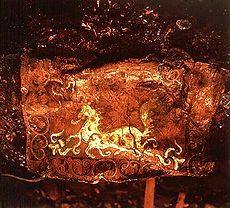
mountain while the tombs of King Heongang, King Jeonggang, King Gyeongmyeong and King Gyeongae are on the slopes of the mountain. In addition to the tombs, tumuli have been found surrounding Namsan mountain and in the western part of Geumgang mountain. Artifacts excavated from the tombs of Geumgwanchong (gold crown tomb), Seobongchong (western phoenix tomb), Cheonmachong (heavenly horse tomb) and northern and southern parts of Tomb No. 98 are good examples of Silla culture.
period included most of the kingdom's leading figures, not only rulers but scholars such as Seol Chong
and Choe Chi-won, and generals like Kim Yusin, the leader of the Hwarang
warriors. The city continued to contribute to traditional Korean thought
in subsequent dynasties. Relatives of Choe Chi-won such as Choe Eon-wui
and Choe Hang
played an important role in establishing the structures of early Goryeo. In the Joseon
period, Gyeongju joined the rest of Gyeongsang
in becoming a hotbed of the conservative Sarim
faction. Notable Gyeongju members of this faction included the 15th century intellectual Yi Eon-jeok
. He has been enshrined in the Oksan Seowon
since 1572. In modern times, the city produced writers such as Kim Dong-ni
and Park Mok-wol
, both of whom did a great deal to popularize the region's culture, as well as Choe Jun
, a wealthy businessman who established the Yeungnam University
Foundation.
Many Korean family clans trace their origins to Gyeongju, often to the ruling elites of Silla. For example, the Gyeongju Kim
clan claims descent from the rulers of later Silla. The Gyeongju Park
and Gyeongju Seok
clans trace their ancestry to Silla's earlier ruling families. These three royal clans played a strong role in preserving the historical precincts of Gyeongju into modern times. The Gyeongju Choe and Lee
clans also trace their ancestry to the Silla elites. Prominent members of the Gyeongju Lee clan include Goryeo period scholar Yi Je-hyeon, and Joseon period scholars Yi Hwang
and Yi Hang-bok. A contemporary notable figure from the Gyeongju Lee clan is Lee Byung-chull, the founder of Samsung Group
. However, not all Gyeongju clans date to the Silla period; for instance, the Gyeongju Bing clan was founded in the early Joseon Dynasty
.
. East of the downtown area lies Bulguksa
, one of South Korea's largest Buddhist temples; nearby is Seokguram
, a famed Buddhist shrine. Traditional prayer locations are found on mountains throughout Gyeongju. Such mountains include Namsan
near the city center, Danseok-san and Obong-san in the west, and the low peak of Hyeong-san on the Gyeongju-Pohang border. Namsan in particular is often referred to as "the sacred mountain" due to the Buddhist shrines and statues which cover its slopes. In addition, Gyeongju is the birthplace of Cheondoism
, an indigenous religion to Korea based on Korean shamanism
, Taoism
and Korean Buddhism, with elements drawn from Christianity
. The religion has been evolved from Donghak
(lit. East learning) disciplines established by Choe Je-u
. His birthplace of Yongdamjeong
, located in Hyeongok-myeon
, is regarded as a sacred place to followers of Cheondogyo.
 The cuisine of Gyeongju is generally typical of the cuisine elsewhere in Gyeongsang
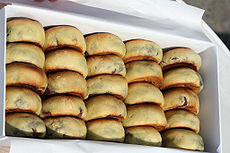
province: spicy and salty. However, it has distinctive tastes according to region and several local specialties known nationwide. The most famous of these is "Gyeongju bread
" or "Hwangnam bread", a red-bean pastry first baked in 1939 and now sold throughout the country. Chalboribbang
, made with locally produced glutinous barley, is also a pastry with a filling of red bean paste
. Local specialties with a somewhat longer pedigree include beopju
, a traditional Korean liquor produced by the Gyeongju Choe in Gyo-dong
. The brewing skill and distill master were designated as Important Intangible Cultural Properties by South Korea government.
Other local specialities include ssambap, haejangguk
, and muk
. Ssambap refers to a rice dish served with vegetable leaves, various banchan
(small side dishes) and condiments such as gochujang
(chili pepper paste) or ssamjang
(a mixture of soybean paste
and gochujang) to wrap them together. Most ssambap restaurants in Gyeongju are gathered in the area of Daenuengwon or Grand Tumuli Park. Haejangguk is a kind of soup
eaten as a hangover
cure, and means "soup to chase a hangover". A street dedicated to haejangguk is located near Gyeongju National Museum
, where 20 haejangguk restaurants are gathered to serve the Gyeongju-style haejangguk. The soup is made by boiling soybean sprout
, sliced memilmuk
(buckwheat starch jelly), sour kimchi
(pickled vegetables) and gulfweed in a clear broth of dried anchovy and Alaska pollack.
The east district of Gyeongju, Gampo-eup
town, is adjacent to the sea, so fresh seafood and jeotgal
(fermented salted seafood) are abundant. There are over 240 seafood restaurants in Gampo Harbor offering various dishes made with seafood caught in the sea, such as hoe
(raw fish dishes), jeonboktang (an abalone soup), grilled seafood and others.
with an area of 1022350 m² (11,004,483.8 sq ft) including a luxuriant pine trees forest. The site was originally the location of the artificial forest of Doksan which was established for feng shui
purposes during the Silla
period. It was also used as a training ground for hwarang
warriors and hunting spot for Silla kings, and was reported to be King Jinpyeong
's favorite location. Since 1975, Hwangseong Park has been designated as "city neighborhood park" and currently consists of multi-purposed Gyeongju Public Stadium, Football Park with 7 football fields and one futsal field, and one gym
nasium, as well as Horimjang field for gukgung or Korean traditional archery
and a ssireum
wrestling ring. In addition, it contains a gateball field, an inline skating rink, jogging courses, and cycling roads. The Gyeongju Public Stadium was completed in 1982 and can accommodate 20,000 people at capacity.
Angang Field Hockey Stadium, located in the district of Angang-eup
, is home to Gyeongju City Hockey, which is one of four professional women's field hockey
teams in South Korea. The team was formed in 1994, and is governed by the Sport and Youth Division of Gyeongju City. Although not an initial successful team, Gyeongju City Hockey won the first trophies both at National Division Hockey Championships and National Sports Festival in 2000. In 2002, Gyeongju City Hockey took a first prize and three second prizes, and in 2008, the team won the first prize at the 51st National Division Hockey Championships.
The city plays host to two annual marathon
events. The Gyeongju International Marathon
, held in October, garners elite level competition while the larger Gyeongju Cherry Blossom Marathon caters more for amateur fun run
ners. The Cherry Blossom Marathon has been held each year in Gyeongju since 1992, usually in April, to improve relations with Japan
(a country with a long history of marathon running). The race, mainly sponsored by Gyeongju city and the district, attracted 13,600 participants in 2009 including about 1,600 foreigners.
 The economy of Gyeongju is more diverse than the city's image as a tourist haven would suggest. Although tourism is important to the economy, most residents work in other fields. Over 27,000 are employed in manufacturing compared to roughly 13,500 in the hospitality industry.
The number involved in tourism has remained constant over recent years, while the manufacturing sector added about 6,000 jobs from 1999 to 2003.
The manufacturing sector is closely tied to nearby cities, utilizing Gyeongju's transit links with Ulsan
, Pohang
, and Daegu
.
As in Ulsan and Daegu the automotive parts industry plays an important role. Of the 1,221 businesses incorporated in Gyeongju almost a third are involved in auto-parts manufacture.
Fishing takes place in coastal towns, especially in Gampo-eup
in the city's northeast, with 436 registered fishing craft in the city. Fishing industry in Gyeongju is generally in a declined status due to relatively inconvenient transport conditions and lacks of subordinate facilities. Much of the catch from these boats goes direct from the harbor to Gyeongju's many seafood restaurants. Mainly, sauries, anchovies, rays
are harvested and a small number of abalone
and wakame
farming takes place. Local specialties include myeolchijeot
(fermented anchovy), abalone, wakame, and squid.
Agriculture is still important, particularly in the outlying regions of Gyeongju. According to the 2006 statistical yearbook of Gyeongju, rice fields occupy an area of 169.57 km² (65.5 sq mi), which is 70% of the total cultivated acreage of 24359 km² (9,405.1 sq mi). The remaining 74.02 km² (28.6 sq mi) consists of fields under other crops and farmsteads. Crop production is centered in the fertile river basins near the Hyeongsan River
. The main crops are rice, barley, beans and corn. Vegetables such as daikon
and napa cabbage
and fruits are also important crops. Apples are mainly produced in the districts of Geoncheon-eup
, Gangdong-myeon and Cheonbuk-myeon
and Korean pear are cultivated in Geoncheon-eup and Angang-eup
. The city plays a leading role in the domestic production of beef
and mushroom
s. Button mushroom
s harvested in Geoncheon-eup are canned and exported. The cultivated acreage and the number of households engaging in agriculture is however declining.
A small amount of quarry
ing activity takes place in the city, with 46 active mines and quarries in Gyeongju. Most are engaged in the extraction of kaolin, fluorspar and Agalmatolite and Kaolin is exported.
As the capital of Silla, commerce and trading in Gyeongju developed early on. Samguk Sagi
has records on the establishment of Gyeongdosi (capital area market) in March, 490 during King Soji
's reign, and Dongsi (East Market) in 509, during King Jijeung
's reign. In the 1830s, Gyeongju had five five-day markets which remained very active until the late 1920s. Due to its size Gyeongju Bunaejang (Gyeongju village market) was referred to as one of the two leading markets in the Yeongnam
area, along with Daegu
Bunaejang. Transportation developed in the late period of the Japanese occupation
, as the Jungang Line
and the Daegu Line
and the connecting route between Pohang
and the northwestern part of Japan were set up, leading to increasing population and developing commerce. After the 1960s, traditional periodic markets gradually transformed into regular markets as the city was flourishing. In periodic markets, agricultural and marine products, industrial products, living necessaries, wild edible greens, herbs, and cattle are mainly traded. As of 2006, Gyeongju had eight regular markets, nine periodic markets and the Gyeongju department store. Traditional periodic markets declined and have become token affairs these days.
Many Silla sites are located in Gyeongju National Park
such as the Royal Tomb Complex, the Cheomseongdae
observatory that is one of the oldest surviving astronomical observatories in
East Asia
, the Anapji
royal pond garden, and the Gyerim
forest. Gyeongju National Museum
hosts many important artifacts and national treasures that have been excavated from sites within the city and surrounding areas.
Much of Gyeongju's heritage are related to the Silla kingdom's patronage of Buddhism
. The grotto of Seokguram
and the temple of Bulguksa
were the first Korean sites to be included on the UNESCO World Heritage List in 1995. In addition, the ruins of the old Hwangnyongsa
temple, said to have been Korean's largest, are preserved on the slopes of Toham Mountain. Various Silla-era stone carvings of Buddhas and Bodhisattva
s are found on mountainsides throughout the city, particularly on Namsan
.
A significant portion of Gyeongju's tourist traffic is due to the city's promotion of itself as a site for various festivals, conferences, and competitions. Every year since 1962, the Silla cultural festival has been held in October to celebrate and honour the dynasty's history and culture. It is one of the major festivals of Korea. It features athletic events, folk games, music, dance, literary contests and Buddhist religious ceremonies. Other festivals include the Cherry Blossom Marathon in April, the Korean Traditional Liquor and Cake festival in March, and memorial ceremonies for the founders of the Silla Dynasty and General Kim Yu-sin.
There were 15 hotels including Hilton Hotel, Gyeognju Chosun Hotel, and 276 lodging facilities, and 2,817 restaurants in Gyeongju in 2006.
and the Seorabeol Sinmun. Both are weekly newspapers providing news via online as well and their headquarters are located in the neighborhood of Dongcheon-dong. The Gyeongju Sinmun was founded in 1989 and provides various news and critics on anything concerning Gyeongju. Its online newspaper, Digital Gyeongju Sinmun opened in December, 2000 to provide live local news out of the limit as a weekly newspaper and to establish mutual information exchanges from Gyeongju locals. In 2001, Gyeongju Sinmun started to present Gyeongju Citizen Awards to people who try to develop the local industry and economy, culture and education, and welfare service. Since 2003, the Wolseong Nuclear Power Plant
headquarter co-hosts the awards with Gyeongju Sinmun.
The Seorabeol Sinmun was established in 1993, however, from November 15, 2000 to November 10, 2005, its publication was stopped for financial difficulties after the 1997 Asian economic crisis had left a strong impact on the nationwide economy. Since 2006, Seorabeol Sinmun presents Serabeol Awards to people having devouring to develop Gyeongju.
Several major feature films have been filmed in the city, including Kick the Moon
, On the Occasion of Remembering the Turning Gate
, Taegukgi
, Chwihwaseon and others. In 2009, the filming of the Queen Seondeok
, a popular MBC
TV series took place in a studio at Silla Millennium Park located in Bomun Lake Resort
.
, a military cadet of youths from the aristocratic class. The training equally emphasized on practicing academic and martial arts based on Buddhism and patriotism. A number of Silla's greatest generals and military leaders such as Kim Yu-sin were Hwarang who played a central role in Silla unification of the Korean peninsula. As Silla was integrated into the next ruling dynasty, Goryeo
, the system got declined and was officially disbanded in the Joseon dynasty
. However, the spirit and discipline were revived in the second half of the 20th century as a form of Korean martial arts with the same name.
Formal education has a longer history in Gyeongju than anywhere else in South Korea. The Gukhak
, or national academy, was established here in 682, at the beginning of the Unified Silla
period. Its curriculum focused on the Confucian classics for local officials. After the fall of Silla
in the 10th century, the Gukhak
closed. However, due to Gyeongju's role as a provincial center under the Goryeo
and early Joseon
dynasties, the city was home to state-sponsored provincial schools (hyanggyo
) under both dynasties such as Gyeongju Hyanggyo
. During the later Joseon dynasty there were several seowon
, or private Confucian academies, were set up in the city such as Oksan Seowon
and Seoak Seowon
.
The educational system of Gyeongju is the same as elsewhere in the country. Schooling begins with preschools, of which there are 65 in the city. This is followed by 6 years in elementary school
s, of which Gyeongju has 46. Subsequently students pass through 3 years of middle school
. There are 19 middle schools in Gyeongju. High-school education, which lasts for three years, is not compulsory
, but the most students do attend and graduate from high school. Gyeongju is home to 21 high schools, of which 11 provide specialized technical training. At each of these levels, there is a mix of public and private institutions. All are overseen by the Gyeongju bureau of North Gyeongsang's Provincial Office of Education. Gyeongju is also home to a school for the mentally disabled, which provides education to students from preschool to adult age.
Gyeongju is also home to four institutions of tertiary education
. Sorabol College, is a technical college located in the district of Chunghyo-dong that offers majors specializing in tourism, leisure, health care and cosmetic treatments. Each of Gyeongju's three universities reflects the city's unique role.
Dongguk
and Uiduk
universities are Buddhist institutions, reflecting that religion's link to the city. Gyeongju University
, formerly Korea Tourism University, is strongly focused on tourism, reflecting the importance of tourism in the region.
The two general hospitals are associated with two major universities in Gyeongju and nearby Daegu
. One is the Dongguk University
Gyeongju Hospital, located in the district of Seokjang-dong, which is affiliated with Dongguk University Medical School and Center. The Gyeongju Hospital was opened in a seven-story building in 1991 to provide Gyeongju locals with a quality medical service and train medical specialists in the region. After various renovations the hospital currently has 24 departments including a radiation
oncology
center and 438 beds. It is also assigned as a teaching and learning hospital and in partnership with Dongguk University Oriental Hospital. The other general hospital is a branch of Keimyung University
, Dongsan Medical Hospital in Daegu. It is the successor of Gyeongju Christianity Hospital founded in 1962, and was reborn as the current general hospital in 1991. The Gyeongju Dongsan Hospital is located in the district of Seobu-dong and has 12 departments in a three-story building.
, the multi-purpose Deokdong Dam and several streams. The city is divided into seven water districts, with eight filtration plants and seven sewage treatment plants. One of the sewage treatment plants, Angang Sewage Disposal Plant
began operating in April 2005 by the co-investment of the Government of North Gyeongsang and Gyeongju City with a fund of 44,300,000,000 won
to install facilities to prevent the pollution of the Hyeongsan River
, which is a main water source for Gyeongju and Pohang
residents. The plant is located on a spacious site with 39000 m² (419,792.5 sq ft) in Homyeong-ri, Gangdong-myeon in Gyeongju where nature friendly facilities provide recreational venues for the locals. Through 56.1 km (34.9 mi) of sewer pipes and 14 pumping station
s, the plant has a capacity of 18,000 tonnes of domestic sewage per day that comes from Angang-eup
, and Gangdong-myeon. The facilities have high-powered disposal equipment developed by related industrial companies to maintain the discharged water at the first or second degree in quality, so that it is used as river maintenance flow and agricultural water in case a drought
occurs.
The city had managed its own recycling service, but privatized it since July 1, 2009.
Other utilities are provided by private entities or South Korean government-owned companies. Seorabeol City Gas, an affiliate of GS Group
, provides gas to the Gyeongju residents, while, electrical power is supplied by the public enterprises, Korea Hydro & Nuclear Power
via the Wolseong Nuclear Power Plant
. The plant is known for the only nuclear power plant operating PHWRs (Pressurized Heavy Water Reactor) in South Korea and supplies about 5% of South Korea's electricity. The owner, Korea Hydro & Nuclear Power began to build the Wolseong 1 in the districts of Yangnam-myeon
, Yangbuk-myeon
and Gampo-eup
in 1976. Since 1983, the power plant has been providing commercial service and operating with the PHWRs that has a capacity of 678,000 kW. As the construction of each Wolseong 2, 3 and 4 with a capacity of 70,000 kW were completed respectively in 1997, 1998 and 1999, Wolseong Nuclear Power plant site has been successfully operating the four PHWRs plants. New project, Sinwolseong No. 1 and No. 2 are currently under construction which is estimated to be completed until 2011–12.
 The city lies at the junction of two minor lines operated by the Korean National Railroad. The Jungang Line
runs from Seoul to Gyeongju and carries trains from the Daegu Line
, which originates in Dongdaegu
. In Gyeongju, the Jungang line connects to the Donghae Nambu Line
which runs between Pohang
and Busan
. The Gyeongbu Expressway
, which runs from Seoul to Busan, passes through Gyeongju, and Provincial highway 68, aided by the South Korean government, connects Seocheon in the South Chungcheong province to Gyeongju. Additionally national highways such as Route 4, 7, 14, 20, 28, 31, and 35 crisscross the city. Since the city is a popular tourist destination, nonstop bus services are available from most major cities in South Korea.
High-speed rail
does not serve Gyeongju, in part because the KTX Gyeongbu Line
does not pass through the city. However, high-speed service is available after the completion of the Daegu-Busan portion of the KTX line in 2010. The trains stop at Singyeongju Station
, in Geoncheon-eup
, south of Gyeongju's city center.
, China (1994) Versailles
, France
Pompeii
, Italy
Nara, Nara
, Japan
(1970) Obama, Fukui
, Japan
(1977) Iksan
, South Korea
(1998) Inglewood, California
United States
(1990) Huế
, Vietnam
.
South Korea
The Republic of Korea , , is a sovereign state in East Asia, located on the southern portion of the Korean Peninsula. It is neighbored by the People's Republic of China to the west, Japan to the east, North Korea to the north, and the East China Sea and Republic of China to the south...
. It is the second largest city by area in the province after Andong
Andong
Andong is a city in Gyeongsangbuk-do Province, South Korea. It is the largest city in the northern part of the province with a population of 167,821 in October 2010. The Nakdong River flows through the city...
, covering 1324 km² (511.2 sq mi) with a population of 269,343 people according to the 2008 census. Gyeongju is 370 km (229.9 mi) southeast of Seoul
Seoul
Seoul , officially the Seoul Special City, is the capital and largest metropolis of South Korea. A megacity with a population of over 10 million, it is the largest city proper in the OECD developed world...
, and 55 km (34.2 mi) east of the provincial capital, Daegu
Daegu
Daegu , also known as Taegu, and officially the Daegu Metropolitan City, is a city in South Korea, the fourth largest after Seoul, Busan, and Incheon, and the third largest metropolitan area in the country with over 2.5 million residents. The city is the capital and principal city of the...
. The city borders Cheongdo and Yeongcheon
Yeongcheon
Yeongcheon is a city in North Gyeongsang Province, South Korea.Yeongcheon is located 350 km southeast of Seoul, in the southeast of North Gyeongsang Province...
to the west, Ulsan
Ulsan
Ulsan , officially the Ulsan Metropolitan City, is South Korea's seventh largest metropolis with a population of over 1.1 million. It is located in the south-east of the country, neighboring Busan to the south and facing Gyeongju to the north and the Sea of Japan to the east.Ulsan is the...
to the south and Pohang
Pohang
Pohang is a city in North Gyeongsang Province, South Korea, and a main seaport in the Daegu-Gyeongbuk region. The built-up area of Pohang is located on the alluvium of the mouth of the Hyeongsan River...
to the north, while to the east lies the coast of the Sea of Japan
Sea of Japan
The Sea of Japan is a marginal sea of the western Pacific Ocean, between the Asian mainland, the Japanese archipelago and Sakhalin. It is bordered by Japan, North Korea, Russia and South Korea. Like the Mediterranean Sea, it has almost no tides due to its nearly complete enclosure from the Pacific...
(East Sea)
Sea of Japan naming dispute
The international name for the body of water which is bordered by Japan, North Korea, Russia, and South Korea is disputed. The Japanese government supports the use of the name "Sea of Japan", while South Korea supports the name "East Sea", and North Korea supports the name "East Sea of Korea"...
. Numerous low mountains—outliers of the Taebaek range
Taebaek Mountains
The Taebaek Mountains are a mountain range in both North Korea and South Korea. They form the main ridge of the Korean peninsula.-Geography:...
—are scattered around the city.
Gyeongju was the capital of the ancient kingdom of Silla
Silla
Silla was one of the Three Kingdoms of Korea, and one of the longest sustained dynasties in...
(57 BC – 935 AD) which ruled most of the Korean Peninsula
Korean Peninsula
The Korean Peninsula is a peninsula in East Asia. It extends southwards for about 684 miles from continental Asia into the Pacific Ocean and is surrounded by the Sea of Japan to the south, and the Yellow Sea to the west, the Korea Strait connecting the first two bodies of water.Until the end of...
between the 7th and 9th centuries. A vast number of archaeological sites and cultural properties from this period remain in the city. Gyeongju is often referred to as "the museum without walls". Among such historical treasures, Seokguram
Seokguram
The Seokguram Grotto is a hermitage and part of the Bulguksa temple complex. It lies four kilometers east of the temple on Mt. Tohamsan, in Gyeongju, South Korea. It is classified as National Treasure No. 24 by the South Korean government and is located at 994, Jinhyeon-dong, Gyeongju-si,...
grotto, Bulguksa
Bulguksa
Bulguksa is a head temple of the Jogye Order of Korean Buddhism in the North Gyeongsang province in South Korea. It is home to seven National treasures of South Korea, including Dabotap and Seokgatap stone pagodas, Cheongun-gyo , and two gilt-bronze statues of Buddha. The temple is classified as...
temple, Gyeongju Historic Areas
Gyeongju Historic Areas
The Gyeongju Historic Areas of South Korea were designated as a World Heritage Site by UNESCO in 2000 CE. The protected areas encompass the ruins of temples and palaces, outdoor pagodas and statuary, and other cultural artifacts left by the Silla Kingdom...
and Yangdong Folk Village are designated as World Heritage Sites by UNESCO
UNESCO
The United Nations Educational, Scientific and Cultural Organization is a specialized agency of the United Nations...
. The many major historical sites have helped Gyeongju become one of the most popular tourist destinations in South Korea
Tourism in South Korea
Tourism in South Korea refers to the tourist industry in the Republic of Korea. In 2007, 6.4 million foreign tourists visited South Korea, making it the 36th most visited country in the world, and this number is expected to exceed 8.5 million in 2010. Most non-Korean tourists come from Japan,...
.
The city of Gyeongju was united with the nearby rural Gyeongju County in 1995 and is now an urban–rural complex. It is similar to 53 other small- and medium-sized cities with a population under 300,000 people in South Korea. As well as its rich historical heritage, Gyeongju today is affected by the economic, demographic, and social trends that have shaped modern South Korean culture. Tourism remains the major economic driver, but manufacturing activities have developed due to its proximity to major industrial centers such as Ulsan and Pohang. Gyeongju is connected to the nationwide rail and highway networks, which facilitate industrial and tourist traffic.
History
Silla
Silla was one of the Three Kingdoms of Korea, and one of the longest sustained dynasties in...
kingdom, of which it was the capital. Gyeongju first enters non-Korean records as Saro-guk, during the Samhan
Samhan
The Samhan period of Korean history comprises confederacies of Mahan, Jinhan, and Byeonhan in central and southern Korean peninsula, during the final century BCE and the early centuries CE....
period in the early Common Era
Common Era
Common Era ,abbreviated as CE, is an alternative designation for the calendar era originally introduced by Dionysius Exiguus in the 6th century, traditionally identified with Anno Domini .Dates before the year 1 CE are indicated by the usage of BCE, short for Before the Common Era Common Era...
. Korean records, probably based on the dynastic chronicles of Silla, record that Saro-guk was established in 57 BCE, when six small villages in the Gyeongju area united under Bak Hyeokgeose
Bak Hyeokgeose of Silla
Hyeokgeose of Silla , commonly called Bak Hyeokgeose, was the founding monarch of Silla, one of the Three Kingdoms of Korea...
. As the kingdom expanded, it changed its name to Silla. During the Silla period, the city was called "Seorabeol" (lit. Capital), "Gyerim" (lit. Rooster's forest) or "Geumseong" (lit. City of Gold).
After the unification of the peninsula up to Taedong River
Taedong River
The Taedong River is a large river in North Korea. It rises in the Rangrim Mountains of the country's north. It then flows southwest into Korea Bay at Namp'o. In between, it runs through the country's capital, Pyongyang. Along the river are landmarks such as the Juche Tower and Kim Il-sung...
in 668 AD, Gyeongju became the center of Korean political and cultural life. The city was home to the Silla court and the great majority of the kingdom's elite. Its prosperity became legendary, and was reported as far away as Persia according to the 9th century book, The Book of Roads and Kingdoms
Book of Roads and Kingdoms (ibn Khordadbeh)
The Book of Roads and Kingdoms is a 9th-century geography text by the Persian geographer Ibn Khordadbeh. It maps and describes the major trade routes of the time within the Muslim world, and discusses distant trading regions such as Japan, Korea, and China...
. Records of Samguk Yusa
Samguk Yusa
Samguk Yusa, or Memorabilia of the Three Kingdoms, is a collection of legends, folktales, and historical accounts relating to the Three Kingdoms of Korea , as well as to other periods and states before, during, and after the Three Kingdoms period.The text was written in Classical Chinese, which was...
give the city's population in its peak period as 178,936 households, suggesting that the total population was almost one million. Many of Gyeongju's most famous sites date from this Unified Silla
Unified Silla
Unified Silla or Later Silla is the name often applied to the Korean kingdom of Silla, one of the Three Kingdoms of Korea, when it conquered Baekje in 660 and Goguryeo in 668, unifying the southern portion of the Korean peninsula...
period, which ended in the late 9th century by Goryeo
Goryeo
The Goryeo Dynasty or Koryŏ was a Korean dynasty established in 918 by Emperor Taejo. Korea gets its name from this kingdom which came to be pronounced Korea. It united the Later Three Kingdoms in 936 and ruled most of the Korean peninsula until it was removed by the Joseon dynasty in 1392...
(918–1392).
In 940, the founder of Goryeo, King Taejo
Taejo of Goryeo
Taejo of Goryeo was the founder of the Goryeo Dynasty, which ruled Korea from the 10th to the 14th century. Taejo ruled from 918 to 943.-Background:...
, changed the city's name to "Gyeongju", which literally means "Congratulatory district". In 987, as Goryeo adopted a system of having three additional capitals in politically important provinces outside Gaegyeong (nowadays Kaesong
Kaesong
Kaesŏng is a city in North Hwanghae Province, southern North Korea , a former Directly Governed City, and the capital of Korea during the Koryo Dynasty. The city is near Kaesŏng Industrial Region and it contains the remains of the Manwoldae palace. It was formally named Songdo while it was the...
), Gyeongju was designated as "Donggyeong" ("East Capital"). However, that title was removed in 1012, the 3rd year of King Hyeongjong
Hyeonjong of Goryeo
Hyeonjong of Goryeo was the 8th ruler of the Goryeo dynasty of Korea. He was a grandson of Emperor Taejo. He was appointed by the military leader Gang Jo, whom the previous Emperor Mokjong had called upon to destroy a plot by Kim Chi-yang.In 1010, The Khitan attacked again during an internal...
, due to political rivalries at that time, though Gyeongju was later made the seat of Yeongnam
Yeongnam
Yeongnam is the name of a region that coincides with the former Gyeongsang Province in what is now South Korea....
Province. It had jurisdiction over a wide area, including much of east-central Yeongnam, although this area was greatly reduced in the 13th century. Under the subsequent Joseon
Joseon Dynasty
Joseon , was a Korean state founded by Taejo Yi Seong-gye that lasted for approximately five centuries. It was founded in the aftermath of the overthrow of the Goryeo at what is today the city of Kaesong. Early on, Korea was retitled and the capital was relocated to modern-day Seoul...
(1392–1910) dynasties, Gyeongju was no longer of national importance, but remained a regional center. In 1601, the city ceased to be the provincial capital.
Hwangnyongsa
Hwangnyongsa, or Hwangnyong Temple, is the name of a former Buddhist temple in the city of Gyeongju, South Korea. Built in the 6th century, it was the center of state-sponsored Buddhism during the Silla and Unified Silla eras...
. During the Japanese invasions of Korea, the Gyeongju area became a heated battlefield, and Japanese forces burned the wooden structures at Bulguksa
Bulguksa
Bulguksa is a head temple of the Jogye Order of Korean Buddhism in the North Gyeongsang province in South Korea. It is home to seven National treasures of South Korea, including Dabotap and Seokgatap stone pagodas, Cheongun-gyo , and two gilt-bronze statues of Buddha. The temple is classified as...
. Not all damage was due to invasions, however. In the early Joseon period, a great deal of damage was done to Buddhist sculptures on Namsan
Namsan (Gyeongju)
Namsan is a 494-meter peak in the heart of Gyeongju National Park, just south of Gyeongju, South Korea. The mountain is within easy reach from the city and attracts a large number of national tourists. Namsan covers an area of about 8 km by 12 km...
by Neo-Confucian radicals, who hacked arms and heads off statuary.
In the 20th century, the city had remained relatively small, no longer ranking among the major cities of Korea. During the early 20th century, many archaeological excavations were conducted, particularly inside the tombs which had remained largely intact over the centuries. A museum, the forerunner of the present-day Gyeongju National Museum
Gyeongju National Museum
The Gyeongju National Museum is a museum in Gyeongju, North Gyeongsang Province, South Korea. Its holdings are largely devoted to relics of the Silla kingdom, of which Gyeongju was the capital....
, was inaugurated in 1915 to exhibit the excavated artifacts.
Gyeongju emerged as a railroad junction in the later years of the Japanese Occupation
Korea under Japanese rule
Korea was under Japanese rule as part of Japan's 35-year imperialist expansion . Japanese rule ended in 1945 shortly after the Japanese defeat in World War II....
, as the Donghae Nambu Line
Donghae Nambu Line
The Donghae Nambu Line is a railway line connecting Busan to Pohang in South Korea.The line runs along South Korea's east coast.-History:...
and Jungang Line
Jungang Line
The Jungang Line is a railway line connecting Cheongnyangni in Seoul to Gyeongju in South Korea, traversing central South Korea from the northwest to the southeast.-History:...
were established to prepare for Second Sino-Japanese War
Second Sino-Japanese War
The Second Sino-Japanese War was a military conflict fought primarily between the Republic of China and the Empire of Japan. From 1937 to 1941, China fought Japan with some economic help from Germany , the Soviet Union and the United States...
and to exploit rich resources of the eastern Korean peninsula. Following liberation in 1945, Korea was plunged into turmoil, and Gyeongju was no exception. Returnees from abroad were numerous; a village for them was constructed in present-day Dongcheon-dong
Dongcheon-dong, Gyeongju
Dongcheon-dong is both an administrative and legal dong or a neighbourhood of the Gyeongju City, North Gyeongsang province, South Korea. It is bordered by Bodeok-dong on the east, Yonggang-dong and Seongdong-dong on the west, Bohwang-dong on the south and Cheonbuk-myeon on the north. Its 5.26...
. In a period marked by widespread conflict and unrest, the Gyeongju area became particularly notorious for the level of guerrilla activity in the mountains.
Although the Korean War
Korean War
The Korean War was a conventional war between South Korea, supported by the United Nations, and North Korea, supported by the People's Republic of China , with military material aid from the Soviet Union...
broke out in 1950, most of Gyeongju was spared from the fighting, and remained under South Korean control throughout the conflict. However, for a brief time in late 1950 portions of the city stood on the front lines, as North Korea
North Korea
The Democratic People’s Republic of Korea , , is a country in East Asia, occupying the northern half of the Korean Peninsula. Its capital and largest city is Pyongyang. The Korean Demilitarized Zone serves as the buffer zone between North Korea and South Korea...
n forces pushed the Pusan Perimeter southward from Pohang.
In the 1970s, Korea saw substantial industrial development, much of it centered in the Yeongnam region of which Gyeongju is a part. The POSCO
POSCO
POSCO is a multinational steel-making company headquartered in Pohang, South Korea. It is the world's third-largest steelmaker by market value and the most profitable Asia-based steelmaker....
steel mill in neighboring Pohang commenced operations in 1973, and the chemical manufacturing complex in Ulsan emerged in the same year. These developments helped to support the emergence of Gyeongju's manufacturing sector.
Geography and climate
Ulsan
Ulsan , officially the Ulsan Metropolitan City, is South Korea's seventh largest metropolis with a population of over 1.1 million. It is located in the south-east of the country, neighboring Busan to the south and facing Gyeongju to the north and the Sea of Japan to the east.Ulsan is the...
on the south. Within the province, its neighbors include Pohang
Pohang
Pohang is a city in North Gyeongsang Province, South Korea, and a main seaport in the Daegu-Gyeongbuk region. The built-up area of Pohang is located on the alluvium of the mouth of the Hyeongsan River...
on the north, Cheongdo County
Cheongdo County
Cheongdo County is an county in North Gyeongsang Province, South Korea. It is connected to the national transportation grid by the Gyeongbu Line railroad and the Daegu-Busan Expressway. The seat of government is located in the center of the county, in Hwayang-eup.In the Samhan period, Cheongdo...
on the southwest, and Yeongcheon
Yeongcheon
Yeongcheon is a city in North Gyeongsang Province, South Korea.Yeongcheon is located 350 km southeast of Seoul, in the southeast of North Gyeongsang Province...
on the northwest. Gyeongju is located about 50 kilometres (31.1 mi) north of Busan
Busan
Busan , formerly spelled Pusan is South Korea's second largest metropolis after Seoul, with a population of around 3.6 million. The Metropolitan area population is 4,399,515 as of 2010. It is the largest port city in South Korea and the fifth largest port in the world...
. To the east, it has no neighbor but the sea.
Most of Gyeongju lies in the Gyeongsang Basin, but a few areas of the city belong to the Pohang Basin, such as Eoil-ri and Beomgok-ri in Yangbuk-myeon
Yangbuk-myeon
Yangbuk-myeon is a myeon or a township in the administrative subdivisions of the Gyeongju City, North Gyeongsang province, South Korea. It is bordered by Gampo-eup and Sea of Japan on the east, Yangnam-myeon on the south, Bulguk-dong, Bodeok-dong and Oedong-eup on the west and Ocheon-eup and...
, and part of Cheonbuk-myeon
Cheonbuk-myeon, Gyeongju
Cheonbuk-myeon is a myeon or a township in the administrative subdivisions of the Gyeongju City, North Gyeongsang province, South Korea. It is bordered by Pohang city on the east, Bodeok-dong on the south, Angang-eup and Hyeongok-myeon to the boundary Hyeongsan River on the west and Gangdong-myeon...
. The Gyeongsang Basin areas consist of Bulguksa intrusive rock penetrating layers of sedimentary rock
Sedimentary rock
Sedimentary rock are types of rock that are formed by the deposition of material at the Earth's surface and within bodies of water. Sedimentation is the collective name for processes that cause mineral and/or organic particles to settle and accumulate or minerals to precipitate from a solution....
s, mainly granite
Granite
Granite is a common and widely occurring type of intrusive, felsic, igneous rock. Granite usually has a medium- to coarse-grained texture. Occasionally some individual crystals are larger than the groundmass, in which case the texture is known as porphyritic. A granitic rock with a porphyritic...
and porphyry
Porphyry (geology)
Porphyry is a variety of igneous rock consisting of large-grained crystals, such as feldspar or quartz, dispersed in a fine-grained feldspathic matrix or groundmass. The larger crystals are called phenocrysts...
. By contrast, the Pohang Basin areas are made up of stratum
Stratum
In geology and related fields, a stratum is a layer of sedimentary rock or soil with internally consistent characteristics that distinguish it from other layers...
that formed in the Tertiary
Tertiary
The Tertiary is a deprecated term for a geologic period 65 million to 2.6 million years ago. The Tertiary covered the time span between the superseded Secondary period and the Quaternary...
period of the Cenozoic era, which consist of igneous rock
Igneous rock
Igneous rock is one of the three main rock types, the others being sedimentary and metamorphic rock. Igneous rock is formed through the cooling and solidification of magma or lava...
, aqueous rock, porphyry, sandstone
Sandstone
Sandstone is a sedimentary rock composed mainly of sand-sized minerals or rock grains.Most sandstone is composed of quartz and/or feldspar because these are the most common minerals in the Earth's crust. Like sand, sandstone may be any colour, but the most common colours are tan, brown, yellow,...
, and tuff
Tuff
Tuff is a type of rock consisting of consolidated volcanic ash ejected from vents during a volcanic eruption. Tuff is sometimes called tufa, particularly when used as construction material, although tufa also refers to a quite different rock. Rock that contains greater than 50% tuff is considered...
.
Low mountains are widespread throughout Gyeongju. The highest of these are the Taebaek Mountains
Taebaek Mountains
The Taebaek Mountains are a mountain range in both North Korea and South Korea. They form the main ridge of the Korean peninsula.-Geography:...
, which run along the city's western border. Gyeongju's highest point, Munbok Mountain (文福山), is 1014 metres (3,326.8 ft) above sea level
Sea level
Mean sea level is a measure of the average height of the ocean's surface ; used as a standard in reckoning land elevation...
. This peak lies in Sannae-myeon
Sannae-myeon, Gyeongju
Sannae-myeon is a myeon or a township in the subdivision of the Gyeongju City, North Gyeongsang province, South Korea. Its 142.64 square kilometers are home to about 3,624 people...
, on the border with Cheongdo
Cheongdo County
Cheongdo County is an county in North Gyeongsang Province, South Korea. It is connected to the national transportation grid by the Gyeongbu Line railroad and the Daegu-Busan Expressway. The seat of government is located in the center of the county, in Hwayang-eup.In the Samhan period, Cheongdo...
. East of the Taebaek range, other western peaks such as Danseok Mountain lie within the Jusa
Jusa Mountains
The Jusa Mountains are a minor range in southeastern South Korea. They run parallel to and immediately west of the Taebaek Mountains. Notable peaks include Danseok Mountain, which is part of Gyeongju National Park...
subrange. The city's eastern peaks, including Toham Mountain, belong to the Haean Mountains and Dongdae Mountains
Dongdae Mountains
The Dongdae Mountains are a small outlying range of the Taebaek Mountains. They run along the east coast of South Korea through the cities of Pohang, Gyeongju, and Ulsan. Notable peaks include Toham Mountain in Gyeongju National Park, as well as Dongdae Mountain itself in Ulsan...
.
Gyeongju's drainage patterns are shaped by these lines of mountains. The Dongdae Mountains divide a narrow foothills area on their east, and various internal river systems to the west. Most of the city's interior is drained by the small Hyeongsan River
Hyeongsan River
The Hyeongsan River is a river in southeastern South Korea. It flows from Doseo-myeon, Ulju-gun in Ulsan to the Sea of Japan , covering a distance of about 62 km...
, which flows north from Ulsan and meets the sea at Pohang Harbor. The Hyeongsan's chief tributaries include the Bukcheon and Namcheon, which join it in Gyeongju Basin
Gyeongju Basin
The Gyeongju Basin is a landform in Gyeongju city, North Gyeongsang province, South Korea. It forms part of the watershed of the Hyeongsan River, which flows north through the basin where it is joined by the Bukcheon, Namcheon, Daecheon, and Sogyeon-cheon streams.The basin is surrounded by low...
.
The southwestern corner of Gyeongju, on the far side of the Taebaek range, drains into the Geumho River
Geumho River
The Geumho River flows through North Gyeongsang Province, South Korea, and drains into the Nakdong River. It rises in the hilly area of western Pohang, flows west for 116 kilometers before its meeting with the Nakdong in western Daegu. It drains an area of more than 2,000 square kilometers. ...
, which then flows into the Nakdong
Nakdong River
The Nakdong River is the longest river in South Korea, and passes through major cities such as Daegu and Busan.-Geography:...
. A small area of the south, just west of the Dongdae range, drains into the Taehwa River
Taehwa River
The Taehwa River flows into the Ulsan Bay in the Sea of Japan . The river's entire 46-kilometer course lies in the within the metropolitan city of Ulsan. The Taehwa drains an area of nearly 645 km²; much of this lies within Ulsan, but portions of it lie in neighboring cities such as Gyeongju....
, which flows into the Bay of Ulsan.
The Gyeongju coastline runs for 36.1 kilometres (22.4 mi) between Pohang
Pohang
Pohang is a city in North Gyeongsang Province, South Korea, and a main seaport in the Daegu-Gyeongbuk region. The built-up area of Pohang is located on the alluvium of the mouth of the Hyeongsan River...
in the north and Ulsan
Ulsan
Ulsan , officially the Ulsan Metropolitan City, is South Korea's seventh largest metropolis with a population of over 1.1 million. It is located in the south-east of the country, neighboring Busan to the south and facing Gyeongju to the north and the Sea of Japan to the east.Ulsan is the...
in the south. There are no islands or large bays, only the small indentation
Indentation
An indentation may refer to:* A notch, or deep recesses; for instance in a coastline, or a carving in rock* The placement of text farther to the right to separate it from surrounding text....
s made by the small streams flowing off the Dongdae ridgeline. Because of this, the city has no significant ports, though there are 12 small harbors. One such harbor in Gyeongju's southeast corner is home to the Ulsan base of the National Maritime Police. This base is responsible for security over a wide area of South Korea's east-central coast.
Climate
Due to its coastal location, Gyeongju has a slightly milder and wetter climate than the more inland regions of Korea. In general, however, the city's climate is typical of South Korea. It has hot summers and cool winters, with a monsoonMonsoon
Monsoon is traditionally defined as a seasonal reversing wind accompanied by corresponding changes in precipitation, but is now used to describe seasonal changes in atmospheric circulation and precipitation associated with the asymmetric heating of land and sea...
season between late June and early August. As on the rest of Korea's east coast, autumn typhoons are not uncommon. The average annual rainfall is 1091 millimetres (43 in), and the average annual temperature is 12.2 °C (54 °F).
Gyeongju's historic city center lies on the banks of the Hyeongsan in Gyeongju Basin. This lowlying area has been subject to repeated flood
Flood
A flood is an overflow of an expanse of water that submerges land. The EU Floods directive defines a flood as a temporary covering by water of land not normally covered by water...
ing throughout recorded history, often as a result of typhoons. On average, chronicles report a major flood every 27.9 years, beginning in the 1st century. Modern flood control mechanisms brought about a dramatic reduction in flooding in the later 20th century. The last major flood occurred in 1991, when the Deokdong Lake reservoir overflowed due to Typhoon Gladys.
Government
The executive branch of the government is headed by a mayor and vice-mayor. As in other South Korean cities and counties, the mayor is elected directly, while the vice-mayor is appointed. As of 2010, the mayor is Cho Yang-sik, who was appointed to the position on July, 1, 2010 after winng the local election held on June 2 of the same year. He is Gyeongju's fifth mayor to be directly elected, the sixth to preside over the city in its present form, and the 31st mayor since 1955. Like most heads of government in the YeongnamYeongnam
Yeongnam is the name of a region that coincides with the former Gyeongsang Province in what is now South Korea....
region, he is a member of the conservative Grand National Party
Grand National Party
The Grand National Party is a conservative political party in South Korea. Its Korean name, Hannara, has a double meaning as "Great National" and "Korean National." The GNP holds a majority of seats in the 18th Assembly, lasting from 2008 to 2012....
.
The legislative branch consists of the Gyeongju City Council, with 21 members as of 2009. The present City Council was formed from the merger of the old Gyeongju City Council with the Wolseong County Council in 1991. Most subdivisions of Gyeongju elect a single member to represent them in the Council, but Angang-eup
Angang-eup
Angang-eup is an eup or a town and is the second-largest subdivision of Gyeongju City. Its 139 square kilometers are home to about 33,300 people, served by six elementary schools and two joint middle-high schools. Situated next to Gangdong-myeon in the city's northern tip, it is a significant town...
is represented by two members because of its large population, and two of the representatives serve combined districts composed of two dong. Like the mayor, the council members were last elected in 2006, except for a small number elected in more recent by-election
By-election
A by-election is an election held to fill a political office that has become vacant between regularly scheduled elections....
s.
The central administration is composed of a City Council committee, five departments, two subsidiary organs, a chamber (the auditor), and six business offices. The five departments are the departments of Planning and Culture, Autonomous Administration, Industry and Environment, Construction and Public Works, and the National Enterprise Committee; these oversee a total of 29 subdivisions. The two subsidiary organs are the Health Care Center and Agro-technology Center; these belong directly to the central administration and have a total of 4 subdivisions. In addition, there are 23 local administrative subdivisions. Each of these subdivisions has a local office with a small administrative staff. As of December 2008, the city government employed 1,462 people.
Subdivisions
The city is divided into 23 administrative districts: 4 eupEup (administrative division)
An eup or ŭp is an administrative unit in both North Korea and South Korea similar to the unit of town.-In South Korea:Along with "myeon", an "eup" is one of the divisions of a county , and of some cities with a population of less than 500,000...
, 8 myeon
Myeon (administrative division)
A myeon, myŏn or myon is an administrative unit in both North Korea and South Korea similar to the unit of town.-In South Korea:...
, and 11 dong
Dong (administrative division)
A dong is the lowest administrative unit of districts and of those cities which are not divided into wards throughout Korea...
. These are the standard subdivisions of cities and counties in South Korea. The dong or neighborhood units occupy the area of the city center, which was formerly occupied by Gyeongju-eup. Eup are typically substantial villages, whereas myeon are more rural.
The city's boundaries and designation changed several times in the 20th century. From 1895 to 1955, the area was known as Gyeongju-gun ("Gyeongju County"). In the first decades of the century, the city center was known as Gyeongju-myeon, signifying a relatively rural rea. In 1931, the downtown area was designated Gyeongju-eup, in recognition of its increasingly urban nature. In 1955, Gyeongju-eup became Gyeongju-si ("Gyeongju City"), the same name as today, but with a much smaller area. The remainder of Gyeongju-gun became "Wolseong County." The county and city were reunited in 1995, creating Gyeongju City as we know it today.
| Map | # | Place | Population (2007) |
House hold |
Area ㎢ |
# | Place | Population |
House hold |
Area ㎢ |
|---|---|---|---|---|---|---|---|---|---|---|
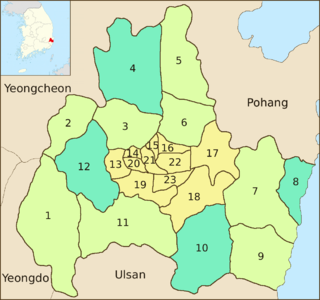 |
||||||||||
| 1 | Sannae-myeon Sannae-myeon, Gyeongju Sannae-myeon is a myeon or a township in the subdivision of the Gyeongju City, North Gyeongsang province, South Korea. Its 142.64 square kilometers are home to about 3,624 people... |
3,561 | 1,779 | 142.6 | 13 | Seondo-dong Seondo-dong Seondo-dong is an administrative dong or a neighbourhood in the administrative subdivisions of the Gyeongju City, North Gyeongsang province, South Korea. It consists of four legal dongs such as Seoak-dong, Chunghyo-dong, Hyohyeon-dong, and Gwangmyeong-dong... |
13,813 | 2,831 | 28.0 | |
| 2 | Seo-myeon Seo-myeon, Gyeongju Seo-myeon is a myeon or a township in the subdivision of the Gyeongju City, North Gyeongsang province, South Korea. It is bordered by its neighborhoods including Hyeongok-myeon and Geoncheon-eup on the east, Sannae-myeon on the south and Yeongcheon City on the west and north. Its 52.12 square... |
4,773 | 1,779 | 52.1 | 14 | Seonggeon-dong Seonggeon-dong Seonggeon-dong is an administrative dong or a neighbourhood in the administrative subdivisions of the Gyeongju City, North Gyeongsang province, South Korea. It consists of four legal dongs including Seonggeon-dong and Seokjang-dong. It is bordered by Dongcheon-dong on the east, Geoncheon-eup on the... |
18,378 | 7,562 | 6.4 | |
| 3 | Hyeongok-myeon Hyeongok-myeon Hyeongok-myeon is a myeon or a township in the administrative subdivisions of the Gyeongju City, North Gyeongsang province, South Korea. It is bordered by Hyeongsan River, Cheonbuk-myeon and Yonghwang-dong on the east, Bodeok-dong on the south and Geoncheon-eup on the southwest, Seo-myeon on the... |
16,829 | 5,726 | 55.7 | 15 | Hwangseong-dong Hwangseong-dong, Gyeongju Hwangseong-dong is both an administrative and legal dong or a neighbourhood in the administrative subdivisions of the Gyeongju City, North Gyeongsang province, South Korea. It is bordered by Yonggang-dong on the east, Hyeongok-myeon on the west and north and Seongnae-dong on the south. Its 3.84... |
29,660 | 9,415 | 3.8 | |
| 4 | Angang-eup Angang-eup Angang-eup is an eup or a town and is the second-largest subdivision of Gyeongju City. Its 139 square kilometers are home to about 33,300 people, served by six elementary schools and two joint middle-high schools. Situated next to Gangdong-myeon in the city's northern tip, it is a significant town... |
33,802 | 12,641 | 138.6 | 16 | Yonggang-dong Yonggang-dong, Gyeongju Yonggang-dong is both an administrative and legal dong or a neighbourhood in the administrative subdivisions of the Gyeongju City, North Gyeongsang province, South Korea. It is bordered by Bukgun-dong on the east, Deoksan-ri of Cheonbuk-myeon on the northeast, Hwangseong-dong and Dongcheon-dong on... |
15,959 | 5,244 | 5.1 | |
| 5 | Gangdong-myeon | 8,834 | 3,659 | 81.4 | 17 | Bodeok-dong Bodeok-dong Bodeok-dong is an administrative dong or a neighbourhood in the administrative subdivisions of the Gyeongju City, North Gyeongsang province, South Korea... |
2,296 | 977 | 81.0 | |
| 6 | Cheonbuk-myeon Cheonbuk-myeon, Gyeongju Cheonbuk-myeon is a myeon or a township in the administrative subdivisions of the Gyeongju City, North Gyeongsang province, South Korea. It is bordered by Pohang city on the east, Bodeok-dong on the south, Angang-eup and Hyeongok-myeon to the boundary Hyeongsan River on the west and Gangdong-myeon... |
6,185 | 2,328 | 58.2 | 18 | Bulguk-dong Bulguk-dong Bulguk-dong is an administrative dong or a neighbourhood in the administrative subdivisions of the Gyeongju City, North Gyeongsang province, South Korea... |
9,001 | 3,722 | 37.4 | |
| 7 | Yangbuk-myeon Yangbuk-myeon Yangbuk-myeon is a myeon or a township in the administrative subdivisions of the Gyeongju City, North Gyeongsang province, South Korea. It is bordered by Gampo-eup and Sea of Japan on the east, Yangnam-myeon on the south, Bulguk-dong, Bodeok-dong and Oedong-eup on the west and Ocheon-eup and... |
4,535 | 2,026 | 120.1 | 19 | Hwangnam-dong Hwangnam-dong Hwangnam-dong is a dong or a neighbourhood of the Gyeongju City, North Gyeongsang province, South Korea. It is bordered by Dodong-dong on the east, Tapjeong-dong on the west, Naenam-myeon on the south and Jungang-dong on the north. Its 20.5 square kilometers are home to about 8,885 people... * |
8,885 | 3,875 | 20.5 | |
| 8 | Gampo-eup Gampo-eup Gampo-eup is an eup or a town of Gyeongju in South Korea. It contains part of Gyeongju National Park: the Daebon section which covers the shoreline near Daewangnueng, the watery grave of King Munmu of the Silla kingdom. 7,132 people live in Gampo-eup, served by two elementary schools and a joint... |
7,099 | 3,084 | 44.9 | 20 | Jungbu-dong Jungbu-dong, Gyeongju Jungbu-dong is a dong or a neighbourhood of the Gyeongju City, North Gyeongsang province, South Korea. It is bordered by Songdong-dong and Hwango-dong on the east, Seonggeon-dong on the west, Hwangnam-dong on the south and Hwangseong-dong on the north. Its 0.93 square kilometers are home to about... |
7,003 | 3,022 | 0.9 | |
| 9 | Yangnam-myeon Yangnam-myeon Yangnam-myeon is a myeon or a township in the administrative subdivisions of the Gyeongju City, North Gyeongsang province, South Korea. It is bordered by Sea of Japan on the east, the Ulju County of Ulsan Metropolitan City on the south, Oedong-eup on the west and Yangbuk-myeon on the north. Its... |
7,131 | 2,941 | 85.1 | 21 | Hwango-dong Hwango-dong Hwango-dong is a dong or a neighbourhood of the Gyeongju City, North Gyeongsang province, South Korea. It is located in the central Gyeongju and is bordered by Bohwang-dong on the east, Jangang-dong on the west, Hwangnam-dong on the south and Seongdong-dong on the north. Its 1.5 square kilometers... * |
10,225 | 4283 | 1.5 | |
| 10 | Oedong-eup Oedong-eup Oedong-eup is an eup or a town in the subdivision of the Gyeongju City, North Gyeongsang province, South Korea. Its 139 square kilometers are home to about 17, 500 people. It is linked by road and rail to the neighboring metropolis of Ulsan. Due to the feature, the town has been a center of the... |
19,006 | 6,965 | 109.8 | 22 | Dongcheon-dong Dongcheon-dong, Gyeongju Dongcheon-dong is both an administrative and legal dong or a neighbourhood of the Gyeongju City, North Gyeongsang province, South Korea. It is bordered by Bodeok-dong on the east, Yonggang-dong and Seongdong-dong on the west, Bohwang-dong on the south and Cheonbuk-myeon on the north. Its 5.26... |
26,721 | 9,228 | 5.3 | |
| 11 | Naenam-myeon Naenam-myeon Naenam-myeon is a myeon or a township in the administrative subdivisions of the Gyeongju City, North Gyeongsang province, South Korea. It is bordered by Geumo Mountains on the east, Jusa Mountains on the south. Its 122.05 square kilometers are home to about 6,142 people... |
6,142 | 2,526 | 122.1 | 23 | Wolseong-dong Wolseong-dong, Gyeongju Wolseong-dong is an administrative dong or a neighbourhood in the administrative subdivisions of the Gyeongju City, North Gyeongsang province, South Korea... |
6,522 | 4,842 | 31.4 | |
| 12 | Geoncheon-eup Geoncheon-eup Geoncheon-eup is an eup or a town in the subdivision of the Gyeongju City, North Gyeongsang province, South Korea. Its 90.46 square kilometers are home to about 10,844 people... |
11,217 | 4,533 | 92.4 |
EWLINE
|
*Figures based on resident registration figures made available by local government offices. For more detailed source information, see Subdivisions of Gyeongju Subdivisions of Gyeongju The primary subdivisions of Gyeongju in South Korea consist of 4 eup, 8 myeon, and 11 dong. These units are the same into which all of the cities and counties of South Korea are divided. The dong units occupy the area of the city center, which was formerly occupied by Gyeongju-eup. Eup refers to... . |
Demographics
When the Silla kingdom reached the peak of its development, Gyeongju was estimated to have a million residents, four times the city's population in 2008.In recent years, Gyeongju has followed the same trends that have affected the rest of South Korea. Like the country as a whole, Gyeongju has seen its population age and the size of families shrink. For instance, the mean household size is 2.8 people. Because this has fallen in recent years, there are more households in the city as of 2008 (105,009) than there were in 2003, even though the population has fallen.
Like most of South Korea's smaller cities, Gyeongju has seen a steady drop in population in recent years. From 2002 to 2008, the city lost 16,557 people. This is primarily due to the migration of workers seeking employment in the major South Korean cities. In 2007, about 1,975 more people moved away from the city each year than moved in. During the same period, births exceeded deaths by roughly 450 per year, a significant number but not enough to offset the losses due to migration.
Gyeongju has a small but growing population of non-Koreans. In 2007, there were 4,671 foreigners living in Gyeongju. This number corresponds to 1.73% of the total population, more than double the figure from 2003. The growth was largely in immigrants from other Asian countries, many of whom are employed in the automotive parts industry. Countries of origin whose numbers have risen include the Philippines
Philippines
The Philippines , officially known as the Republic of the Philippines , is a country in Southeast Asia in the western Pacific Ocean. To its north across the Luzon Strait lies Taiwan. West across the South China Sea sits Vietnam...
, China, Taiwan
Taiwan
Taiwan , also known, especially in the past, as Formosa , is the largest island of the same-named island group of East Asia in the western Pacific Ocean and located off the southeastern coast of mainland China. The island forms over 99% of the current territory of the Republic of China following...
, Indonesia
Indonesia
Indonesia , officially the Republic of Indonesia , is a country in Southeast Asia and Oceania. Indonesia is an archipelago comprising approximately 13,000 islands. It has 33 provinces with over 238 million people, and is the world's fourth most populous country. Indonesia is a republic, with an...
, and Vietnam
Vietnam
Vietnam – sometimes spelled Viet Nam , officially the Socialist Republic of Vietnam – is the easternmost country on the Indochina Peninsula in Southeast Asia. It is bordered by China to the north, Laos to the northwest, Cambodia to the southwest, and the South China Sea –...
. The number of residents from Japan, the United States, and Canada fell significantly in the 2003–2007 period.
Dialect
The city has a distinctive dialectDialect
The term dialect is used in two distinct ways, even by linguists. One usage refers to a variety of a language that is a characteristic of a particular group of the language's speakers. The term is applied most often to regional speech patterns, but a dialect may also be defined by other factors,...
which it shares with northern portions of Ulsan
Ulsan
Ulsan , officially the Ulsan Metropolitan City, is South Korea's seventh largest metropolis with a population of over 1.1 million. It is located in the south-east of the country, neighboring Busan to the south and facing Gyeongju to the north and the Sea of Japan to the east.Ulsan is the...
. This dialect is similar to the general Gyeongsang dialect
Gyeongsang dialect
The Gyeongsang dialect is a dialect of the Korean language which is widely used in the Yeongnam region, which includes North and South Gyeongsang provinces. The Gyeongsang Dialect is considered the direct descendant of the Silla language by Korean linguists...
, but retains distinctive features of its own. Some linguists have treated the distinctive characteristics of the Gyeongju dialect as vestiges of the Silla language
Silla language
The Silla language, was spoken in the ancient kingdom of Silla , one of the Three Kingdoms of Korea.It is unclear if Silla was related to other languages of the Korean peninsula, such as Baekje and Goguryeo, which are sometimes grouped together as the Buyeo languages...
. For instance, the contrast between the local dialect form "소내기" (sonaegi) and the standard "소나기" (sonagi, meaning "rainshower"), has been seen as reflecting the ancient phonemic
Phoneme
In a language or dialect, a phoneme is the smallest segmental unit of sound employed to form meaningful contrasts between utterances....
character of the Silla language.
Cultural properties
Gyeongju is the main destination in South Korea for visitors interested in the cultural heritage of Silla and the architecture of the Joseon DynastyJoseon Dynasty
Joseon , was a Korean state founded by Taejo Yi Seong-gye that lasted for approximately five centuries. It was founded in the aftermath of the overthrow of the Goryeo at what is today the city of Kaesong. Early on, Korea was retitled and the capital was relocated to modern-day Seoul...
(1392–1910). The city has 31 National Treasures
National treasures of South Korea
The National Treasures of Korea are a numbered set of tangible treasures, artifacts, sites, and buildings which are recognized by South Korea as having exceptional artistic, cultural and historical value...
, and Gyeongju National Museum
Gyeongju National Museum
The Gyeongju National Museum is a museum in Gyeongju, North Gyeongsang Province, South Korea. Its holdings are largely devoted to relics of the Silla kingdom, of which Gyeongju was the capital....
houses 16,333 artifacts. There are four broad categories of relics and historical sites: tumuli and their artifacts; Buddhist sites and objects; fortresses and palace sites; and ancient architecture. Prehistoric remains including Mumun pottery have been excavated in central Gyeongju, in the Moa-ri and Oya-ri villages of the Cheonbuk-myeon
Cheonbuk-myeon, Gyeongju
Cheonbuk-myeon is a myeon or a township in the administrative subdivisions of the Gyeongju City, North Gyeongsang province, South Korea. It is bordered by Pohang city on the east, Bodeok-dong on the south, Angang-eup and Hyeongok-myeon to the boundary Hyeongsan River on the west and Gangdong-myeon...
district, and in the Jukdong-ri village of the Oedong-eup
Oedong-eup
Oedong-eup is an eup or a town in the subdivision of the Gyeongju City, North Gyeongsang province, South Korea. Its 139 square kilometers are home to about 17, 500 people. It is linked by road and rail to the neighboring metropolis of Ulsan. Due to the feature, the town has been a center of the...
district.
Dolmen
Dolmen
A dolmen—also known as a portal tomb, portal grave, dolmain , cromlech , anta , Hünengrab/Hünenbett , Adamra , Ispun , Hunebed , dös , goindol or quoit—is a type of single-chamber megalithic tomb, usually consisting of...
s are found in several places, especially in Gangdong-myeon and Moa-ri. Bronze Age
Bronze Age
The Bronze Age is a period characterized by the use of copper and its alloy bronze as the chief hard materials in the manufacture of some implements and weapons. Chronologically, it stands between the Stone Age and Iron Age...
relics found in Angye-ri village of Gangdong-myeon, Jukdong-ri and Ipsil-ri villages of Oedong-eup and graveyards in the Joyang-dong district represent the Samhan
Samhan
The Samhan period of Korean history comprises confederacies of Mahan, Jinhan, and Byeonhan in central and southern Korean peninsula, during the final century BCE and the early centuries CE....
confederacy period of around the 1st century BC to the 3rd century AD.
There are 35 royal tombs and 155 tumuli in central Gyeongju, and 421 tumuli in the outskirts of the city. Silla burial mounds built after the period of the Three Kingdoms
Three Kingdoms of Korea
The Three Kingdoms of Korea refer to the ancient Korean kingdoms of Goguryeo, Baekje and Silla, which dominated the Korean peninsula and parts of Manchuria for much of the 1st millennium...
are found in central Gyeongju, including tumuli in the districts of Noseo-dong, Nodong-dong, Hwangnam-dong, Hwango-dong and Inwang-dong. Western Gyeongju has the tomb of King Muyeol in Seoak-dong, nearby tumuli in Chunghyo-dong and the tomb of Kim Yu-sin. The tombs of Queen Seondeok, King Sinmun, King Hyogong and King Sinmu are at the base of Namsan
Namsan (Gyeongju)
Namsan is a 494-meter peak in the heart of Gyeongju National Park, just south of Gyeongju, South Korea. The mountain is within easy reach from the city and attracts a large number of national tourists. Namsan covers an area of about 8 km by 12 km...
mountain while the tombs of King Heongang, King Jeonggang, King Gyeongmyeong and King Gyeongae are on the slopes of the mountain. In addition to the tombs, tumuli have been found surrounding Namsan mountain and in the western part of Geumgang mountain. Artifacts excavated from the tombs of Geumgwanchong (gold crown tomb), Seobongchong (western phoenix tomb), Cheonmachong (heavenly horse tomb) and northern and southern parts of Tomb No. 98 are good examples of Silla culture.
Notable people
Gyeongju has produced notable individuals throughout its history. As the capital of Silla, Gyeongju was a center of culture in its heyday. Notable Gyeongju residents in the SillaSilla
Silla was one of the Three Kingdoms of Korea, and one of the longest sustained dynasties in...
period included most of the kingdom's leading figures, not only rulers but scholars such as Seol Chong
Seol Chong
Seol Chong was a leading scholar of the Unified Silla period. He studied Confucian writings and the related Chinese classics. He is also known by the courtesy name Chongji and the pen name Bingwoldang....
and Choe Chi-won, and generals like Kim Yusin, the leader of the Hwarang
Hwarang
The Hwarang, or "Flower Boys"., were an elite group of male youth in Silla, an ancient Korean kingdom that lasted until the 10th century. There were educational institutions as well as social clubs where members gathered for all aspects of study, originally for arts and culture steeped mainly in...
warriors. The city continued to contribute to traditional Korean thought
Traditional Korean thought
Traditional Korean thought has been influenced by a number of religious and philosophical thought-systems over the years. As the main influences on life in Korea, often Korean Shamanism, Buddhism, and Confucianism. These movements have shaped Korean life and thought...
in subsequent dynasties. Relatives of Choe Chi-won such as Choe Eon-wui
Choe Eon-wui
Choe Eon-ui was a Korean civil minister and calligrapher from the Gyeongju Choe clan during the end of Silla and the next ruling state, Goryeo. He was referred to as "the tree Choe" along with Choe Chi-won, a renowned scholar, and Choe Seung-u. In 885, he went to Tang China to study, and passed a...
and Choe Hang
Choe Hang (Goryeo civil minister)
Choe Hang was a civil minister of the Gyeongju Choe clan during the Goryeo dynasty. In 991, the 10th year of King Seongjong's reign, as he passed gwageo or civil minister exam, with the highest point, he entered to the court...
played an important role in establishing the structures of early Goryeo. In the Joseon
Joseon Dynasty
Joseon , was a Korean state founded by Taejo Yi Seong-gye that lasted for approximately five centuries. It was founded in the aftermath of the overthrow of the Goryeo at what is today the city of Kaesong. Early on, Korea was retitled and the capital was relocated to modern-day Seoul...
period, Gyeongju joined the rest of Gyeongsang
Gyeongsang
Gyeongsang was one of the eight provinces of Korea during the Joseon Dynasty. Gyeongsang was located in the southeast of Korea....
in becoming a hotbed of the conservative Sarim
Sarim
The Sarim , or "forest of scholars," was a powerful faction of literati that dominated Middle and Late Joseon politics.-Early beginning:...
faction. Notable Gyeongju members of this faction included the 15th century intellectual Yi Eon-jeok
Yi Eon-jeok
Yi Eon-jeok , sometimes known by his pen name Hoejae, was a public official and intellectual of the middle Joseon Dynasty of Korea. He was born and died in Gyeongju, then the capital of Gyeongsang province. Like most intellectuals from Gyeongsang in this period, he was a member of the Sarim faction...
. He has been enshrined in the Oksan Seowon
Oksan Seowon, Gyeongju
The Oksan Seowon is a seowon located at Oksan-ri, Angang-eup in the city of Gyeongju, North Gyeongsang Province, South Korea. Seowon is a type of local academy during the Joseon Dynasty...
since 1572. In modern times, the city produced writers such as Kim Dong-ni
Kim Dong-ni
Kim Dong-ni was a Korean writer.He was born in Gyeongju, Gyeongsangbuk-do, Korea. At the age of 16 he started his literary career by publishing poems in various newspapers. He made his fame in the Korean literary world with his short stories...
and Park Mok-wol
Park Mok-wol
Park Mok-Wol was a Korean writer. He was born in Gyeongju, North Gyeongsang Province, in present-day South Korea. He was a professor at Hanyang University beginning in 1961. He became president of the Korean Poetry Association in 1968...
, both of whom did a great deal to popularize the region's culture, as well as Choe Jun
Choe Jun
Choi Jun was a businessman and philanthropist in early 20th-century Korea. He was born in Gyeongju, in present-day South Korea. His family, known as the "Choi Bujatjip," had been known since the 17th century for their wealth and public-spiritedness. After the liberation of Korea in 1945, he...
, a wealthy businessman who established the Yeungnam University
Yeungnam University
Yeungnam University is one of the largest universities in South Korea outside of Seoul. The university's predecessors, Taegu College and Chunggu College, were founded in Daegu in 1947 and 1950 respectively. In 1967, the two colleges merged to form the degree-granting Yeungnam University. In...
Foundation.
Many Korean family clans trace their origins to Gyeongju, often to the ruling elites of Silla. For example, the Gyeongju Kim
Kim (Korean name)
Kim, sometimes spelled Gim, is the most common family name in Korea. The name is common in both modern-day North Korea and South Korea. The hanja used for the name means "gold," and although the character is usually pronounced 금 geum, it is pronounced 김 gim when used for the family name and...
clan claims descent from the rulers of later Silla. The Gyeongju Park
Park (Korean name)
Park is a common and time-honoured Korean surname, founded by King Hyeokgeose. All Parks are descendants of him in principle except naturalized people...
and Gyeongju Seok
Seok
Seok is an international term for a clan used in Eurasia from the Middle Asia to the Far East. Seok is usually a distinct member of the community, the name implies that its size is smaller than that of a distinct tribe.-Korean:...
clans trace their ancestry to Silla's earlier ruling families. These three royal clans played a strong role in preserving the historical precincts of Gyeongju into modern times. The Gyeongju Choe and Lee
Lee (Korean name)
Lee is the common English spelling of 이 , a common Korean family name. The proper pronunciation in South Korea is like the English letter "E", although in North Korea the name is still written as "리" and pronounced "Lee". Many times South Koreans will knowingly introduce themselves as "Lee" to...
clans also trace their ancestry to the Silla elites. Prominent members of the Gyeongju Lee clan include Goryeo period scholar Yi Je-hyeon, and Joseon period scholars Yi Hwang
Yi Hwang
Yi Hwang is one of the two most prominent Korean Confucian scholars of the Joseon Dynasty, the other being his younger contemporary Yi I . A key figure of the Neo-Confucian literati, he established the Yeongnam School and set up the Dosan Seowon, a private Confucian academy. Yi Hwang is often...
and Yi Hang-bok. A contemporary notable figure from the Gyeongju Lee clan is Lee Byung-chull, the founder of Samsung Group
Samsung Group
The Samsung Group is a South Korean multinational conglomerate corporation headquartered in Samsung Town, Seoul, South Korea...
. However, not all Gyeongju clans date to the Silla period; for instance, the Gyeongju Bing clan was founded in the early Joseon Dynasty
Joseon Dynasty
Joseon , was a Korean state founded by Taejo Yi Seong-gye that lasted for approximately five centuries. It was founded in the aftermath of the overthrow of the Goryeo at what is today the city of Kaesong. Early on, Korea was retitled and the capital was relocated to modern-day Seoul...
.
Religion
The city remains an important centre of Korean BuddhismKorean Buddhism
Korean Buddhism is distinguished from other forms of Buddhism by its attempt to resolve what it sees as inconsistencies in Mahayana Buddhism. Early Korean monks believed that the traditions they received from foreign countries were internally inconsistent. To address this, they developed a new...
. East of the downtown area lies Bulguksa
Bulguksa
Bulguksa is a head temple of the Jogye Order of Korean Buddhism in the North Gyeongsang province in South Korea. It is home to seven National treasures of South Korea, including Dabotap and Seokgatap stone pagodas, Cheongun-gyo , and two gilt-bronze statues of Buddha. The temple is classified as...
, one of South Korea's largest Buddhist temples; nearby is Seokguram
Seokguram
The Seokguram Grotto is a hermitage and part of the Bulguksa temple complex. It lies four kilometers east of the temple on Mt. Tohamsan, in Gyeongju, South Korea. It is classified as National Treasure No. 24 by the South Korean government and is located at 994, Jinhyeon-dong, Gyeongju-si,...
, a famed Buddhist shrine. Traditional prayer locations are found on mountains throughout Gyeongju. Such mountains include Namsan
Namsan (Gyeongju)
Namsan is a 494-meter peak in the heart of Gyeongju National Park, just south of Gyeongju, South Korea. The mountain is within easy reach from the city and attracts a large number of national tourists. Namsan covers an area of about 8 km by 12 km...
near the city center, Danseok-san and Obong-san in the west, and the low peak of Hyeong-san on the Gyeongju-Pohang border. Namsan in particular is often referred to as "the sacred mountain" due to the Buddhist shrines and statues which cover its slopes. In addition, Gyeongju is the birthplace of Cheondoism
Cheondoism
Cheondoism or Chondoism is a 20th-century Korean religious movement, based on the 19th century Donghak movement founded by Choe Je-u that had its origins in the peasant rebellions which arose starting in 1812 during the Joseon Dynasty...
, an indigenous religion to Korea based on Korean shamanism
Korean shamanism
Korean shamanism, today known as Muism or sometimes Sinism , encompasses a variety of indigenous religious beliefs and practices of the Korean people and the Korean area...
, Taoism
Taoism
Taoism refers to a philosophical or religious tradition in which the basic concept is to establish harmony with the Tao , which is the mechanism of everything that exists...
and Korean Buddhism, with elements drawn from Christianity
Christianity
Christianity is a monotheistic religion based on the life and teachings of Jesus as presented in canonical gospels and other New Testament writings...
. The religion has been evolved from Donghak
Donghak
Donghak is a Korean religion founded in 1860 by Choe Je-u. Donghak venerated the god Haneullim and believed that man is not created by a supernatural god but man is instead caused by an innate god...
(lit. East learning) disciplines established by Choe Je-u
Choe Je-u
Choe Je-u was the founder of Donghak, a Korean religious movement against foreign invasions and critical of Joseon Dynasty government policies of the time. He was from Gyeongju and his pen name was 'Suun'. He was martyred March 10, 1864 by order of the Daewongun.-External links:*...
. His birthplace of Yongdamjeong
Yongdamjeong
Yongdamjeong is a sacred place to Cheondoism, located on Mt. Gumi in Gajeong-ri, Hyeongok-myeon, Gyeongju, South Korea.- Religious Significance:...
, located in Hyeongok-myeon
Hyeongok-myeon
Hyeongok-myeon is a myeon or a township in the administrative subdivisions of the Gyeongju City, North Gyeongsang province, South Korea. It is bordered by Hyeongsan River, Cheonbuk-myeon and Yonghwang-dong on the east, Bodeok-dong on the south and Geoncheon-eup on the southwest, Seo-myeon on the...
, is regarded as a sacred place to followers of Cheondogyo.
Cuisine
Gyeongsang
Gyeongsang was one of the eight provinces of Korea during the Joseon Dynasty. Gyeongsang was located in the southeast of Korea....
province: spicy and salty. However, it has distinctive tastes according to region and several local specialties known nationwide. The most famous of these is "Gyeongju bread
Gyeongju bread
Hwangnam bread , also commonly called Gyeongju bread, is a local specialty of Gyeongju City, South Korea. It is a small pastry with a filling of red bean paste. Gyeongju bread was first baked in 1939 at a bakery in Hwangnam-dong in central Gyeongju...
" or "Hwangnam bread", a red-bean pastry first baked in 1939 and now sold throughout the country. Chalboribbang
Chalboribbang
Chalboribbang is a type of small and sweet pancakes made from glutinous barley flour. It consists of two layers of pancake, and a spread made from azuki bean. It is translated as "glutinous barley bread" or "sticky barley bread" into English...
, made with locally produced glutinous barley, is also a pastry with a filling of red bean paste
Red bean paste
Red bean paste or Azuki bean paste is a sweet, dark red bean paste originating from China. It is used in Chinese cuisine, Japanese confectionery, and Korean cuisine. It is prepared by boiling and mashing azuki beans and then sweetening the paste with sugar or honey...
. Local specialties with a somewhat longer pedigree include beopju
Beopju
Beopju is a traditional Korean rice liquor, of the cheongju family of liquors. It is made chiefly from glutinous rice, and has an alcohol content of about 15%.Beopju first appears in historical records in the Goryeo Dynasty...
, a traditional Korean liquor produced by the Gyeongju Choe in Gyo-dong
Gyo-dong, Gyeongju
Gyo-dong is a dong or neighborhood in the city of Gyeongju, North Gyeongsang province, South Korea. It is one of legal dong under its administrative dong, Wolseong-dong's jurisdiction. The name, Gyo-dong originates from the fact that the area has had a hyanggyo, government-managed Confucian...
. The brewing skill and distill master were designated as Important Intangible Cultural Properties by South Korea government.
Other local specialities include ssambap, haejangguk
Haejangguk
Haejangguk refers to all kinds of guk eaten as a hangover cure in Korean cuisine. It means "soup to chase a hangover" and also called sulguk in pure Korean...
, and muk
Muk (food)
Muk or mook is a generic term referring to Korean dishes made from grains, beans, or nut starch such as buckwheat, sesame, and acorns, which have a jelly-like consistency...
. Ssambap refers to a rice dish served with vegetable leaves, various banchan
Banchan
Banchan refers to small dishes of food served along with cooked rice in Korean cuisine. This word is used both in the singular and plural....
(small side dishes) and condiments such as gochujang
Gochujang
Gochujang is a savory and pungent fermented Korean condiment. Traditionally, it has been naturally fermented over years in large earthen pots outdoors, more often on an elevated stone platform, called jangdokdae in the backyard...
(chili pepper paste) or ssamjang
Ssamjang
Ssamjang is a thick, spicy paste used with food wrapped in a leaf in Korean cuisine. The sauce is made of doenjang, gochujang, sesame oil, onion, garlic, green onions, and optionally brown sugar.-Use:...
(a mixture of soybean paste
Doenjang
Doenjang is a traditional Korean fermented soybean paste. Its name literally means "thick paste" in Korean.-Production:...
and gochujang) to wrap them together. Most ssambap restaurants in Gyeongju are gathered in the area of Daenuengwon or Grand Tumuli Park. Haejangguk is a kind of soup
Guk
Guk , also sometimes known as Tang , is a class of soup-like dishes in Korean cuisine. Guk and tang are commonly grouped together and regarded as the same type of dish, although guk is more watery and a basic dish for the Korean table setting, and is usually eaten at home...
eaten as a hangover
Hangover
A hangover describes the sum of unpleasant physiological effects following heavy consumption of alcoholic beverages. The most commonly reported characteristics of a hangover include headache, nausea, sensitivity to light and noise, lethargy, dysphoria, diarrhea and thirst, typically after the...
cure, and means "soup to chase a hangover". A street dedicated to haejangguk is located near Gyeongju National Museum
Gyeongju National Museum
The Gyeongju National Museum is a museum in Gyeongju, North Gyeongsang Province, South Korea. Its holdings are largely devoted to relics of the Silla kingdom, of which Gyeongju was the capital....
, where 20 haejangguk restaurants are gathered to serve the Gyeongju-style haejangguk. The soup is made by boiling soybean sprout
Kongnamul
Kongnamul, an example of Korean cuisine, refers to a seasoned banchan made from soybean sprouts, as well as being a term for the sprouts themselves in the Korean language...
, sliced memilmuk
Memilmuk
Memilmuk is a Korean food that is a variety of muk made from buckwheat starch, which has a jelly-like consistency. It is light gray-brown in color and is most commonly eaten as memilmuk muchim , a banchan in which chunks of memilmuk are mixed with kimchi, ground sesame seeds, and soy...
(buckwheat starch jelly), sour kimchi
Kimchi
Kimchi , also spelled gimchi, kimchee, or kim chee, is a traditional fermented Korean dish made of vegetables with varied seasonings. There are hundreds of varieties of kimchi made with a main vegetable ingredient such as napa cabbage, radish, green onions or cucumber. It is the most common...
(pickled vegetables) and gulfweed in a clear broth of dried anchovy and Alaska pollack.
The east district of Gyeongju, Gampo-eup
Gampo-eup
Gampo-eup is an eup or a town of Gyeongju in South Korea. It contains part of Gyeongju National Park: the Daebon section which covers the shoreline near Daewangnueng, the watery grave of King Munmu of the Silla kingdom. 7,132 people live in Gampo-eup, served by two elementary schools and a joint...
town, is adjacent to the sea, so fresh seafood and jeotgal
Jeotgal
Jeotgal or jeot is a salted fermented food in Korean cuisine. It is made with various seafood, such as shrimp, oysters, shellfish, fish, fish eggs, and fish intestines....
(fermented salted seafood) are abundant. There are over 240 seafood restaurants in Gampo Harbor offering various dishes made with seafood caught in the sea, such as hoe
Hoe (dish)
Hoe may refer to various raw food dishes in Korean cuisine. Saengseon hoe or "Hwal-eo hoe" is thinly sliced raw fish or other raw seafood ; yukhoe is hoe made with a raw beef and seasoned with soy sauce, sesame oil, and rice wine; and gan hoe is raw beef liver with a sauce of sesame oil and...
(raw fish dishes), jeonboktang (an abalone soup), grilled seafood and others.
Sports
As of 2007, Gyeongju city had two stadiums, two gymnasiums, two tennis courts, one swimming pool and others as public sport facilities as well as various registered private sports venues. Many of public sport facilities are located in Hwangseong ParkHwangseong Park
The Hwangseong Park is a park located in the neighborhood of Hwangseong-dong, Gyeongju, North Gyeongsang province, South Korea. Many of public sport facilities are located in the park with an area of 1,022,350㎡ including a luxuriant pine trees forest. The site is originally where Doksan was...
with an area of 1022350 m² (11,004,483.8 sq ft) including a luxuriant pine trees forest. The site was originally the location of the artificial forest of Doksan which was established for feng shui
Feng shui
Feng shui ' is a Chinese system of geomancy believed to use the laws of both Heaven and Earth to help one improve life by receiving positive qi. The original designation for the discipline is Kan Yu ....
purposes during the Silla
Silla
Silla was one of the Three Kingdoms of Korea, and one of the longest sustained dynasties in...
period. It was also used as a training ground for hwarang
Hwarang
The Hwarang, or "Flower Boys"., were an elite group of male youth in Silla, an ancient Korean kingdom that lasted until the 10th century. There were educational institutions as well as social clubs where members gathered for all aspects of study, originally for arts and culture steeped mainly in...
warriors and hunting spot for Silla kings, and was reported to be King Jinpyeong
Jinpyeong of Silla
Jinpyeong of Silla is the 26th king of the Silla Dynasty, one of the Three Kingdoms of Korea. King Jinpyeong followed in the footsteps of King Jinheung by reorganizing the central ruling system, and as many conflicts with Baekje and Goguryeo arose, sent emissaries to improve relations and...
's favorite location. Since 1975, Hwangseong Park has been designated as "city neighborhood park" and currently consists of multi-purposed Gyeongju Public Stadium, Football Park with 7 football fields and one futsal field, and one gym
Gym
The word γυμνάσιον was used in Ancient Greece, that mean a locality for both physical and intellectual education of young men...
nasium, as well as Horimjang field for gukgung or Korean traditional archery
Archery
Archery is the art, practice, or skill of propelling arrows with the use of a bow, from Latin arcus. Archery has historically been used for hunting and combat; in modern times, however, its main use is that of a recreational activity...
and a ssireum
Ssireum
Historically, there have been other terms for "wrestling" in Korean used alongside ssireum, such as gakjeo , gakhui , gakryeok , gakgii , chiuhui , sangbak , jaenggyo ....
wrestling ring. In addition, it contains a gateball field, an inline skating rink, jogging courses, and cycling roads. The Gyeongju Public Stadium was completed in 1982 and can accommodate 20,000 people at capacity.
Angang Field Hockey Stadium, located in the district of Angang-eup
Angang-eup
Angang-eup is an eup or a town and is the second-largest subdivision of Gyeongju City. Its 139 square kilometers are home to about 33,300 people, served by six elementary schools and two joint middle-high schools. Situated next to Gangdong-myeon in the city's northern tip, it is a significant town...
, is home to Gyeongju City Hockey, which is one of four professional women's field hockey
Field hockey
Field Hockey, or Hockey, is a team sport in which a team of players attempts to score goals by hitting, pushing or flicking a ball into an opposing team's goal using sticks...
teams in South Korea. The team was formed in 1994, and is governed by the Sport and Youth Division of Gyeongju City. Although not an initial successful team, Gyeongju City Hockey won the first trophies both at National Division Hockey Championships and National Sports Festival in 2000. In 2002, Gyeongju City Hockey took a first prize and three second prizes, and in 2008, the team won the first prize at the 51st National Division Hockey Championships.
The city plays host to two annual marathon
Marathon
The marathon is a long-distance running event with an official distance of 42.195 kilometres , that is usually run as a road race...
events. The Gyeongju International Marathon
Gyeongju International Marathon
The Gyeongju International Marathon is an annual road running event over the marathon distance which takes place in mid-October in Gyeongju, South Korea. It gained IAAF Silver Label Road Race status in 2010....
, held in October, garners elite level competition while the larger Gyeongju Cherry Blossom Marathon caters more for amateur fun run
Fun run
A fun run is a friendly race that involves either road running or cross country running with participants taking part for their own enjoyment rather than competition. A fun run will usually be held to raise funds for a charity, with sponsors providing the revenue to cover organisational costs...
ners. The Cherry Blossom Marathon has been held each year in Gyeongju since 1992, usually in April, to improve relations with Japan
Japan
Japan is an island nation in East Asia. Located in the Pacific Ocean, it lies to the east of the Sea of Japan, China, North Korea, South Korea and Russia, stretching from the Sea of Okhotsk in the north to the East China Sea and Taiwan in the south...
(a country with a long history of marathon running). The race, mainly sponsored by Gyeongju city and the district, attracted 13,600 participants in 2009 including about 1,600 foreigners.
Economy
The number involved in tourism has remained constant over recent years, while the manufacturing sector added about 6,000 jobs from 1999 to 2003.
The manufacturing sector is closely tied to nearby cities, utilizing Gyeongju's transit links with Ulsan
Ulsan
Ulsan , officially the Ulsan Metropolitan City, is South Korea's seventh largest metropolis with a population of over 1.1 million. It is located in the south-east of the country, neighboring Busan to the south and facing Gyeongju to the north and the Sea of Japan to the east.Ulsan is the...
, Pohang
Pohang
Pohang is a city in North Gyeongsang Province, South Korea, and a main seaport in the Daegu-Gyeongbuk region. The built-up area of Pohang is located on the alluvium of the mouth of the Hyeongsan River...
, and Daegu
Daegu
Daegu , also known as Taegu, and officially the Daegu Metropolitan City, is a city in South Korea, the fourth largest after Seoul, Busan, and Incheon, and the third largest metropolitan area in the country with over 2.5 million residents. The city is the capital and principal city of the...
.
As in Ulsan and Daegu the automotive parts industry plays an important role. Of the 1,221 businesses incorporated in Gyeongju almost a third are involved in auto-parts manufacture.
Fishing takes place in coastal towns, especially in Gampo-eup
Gampo-eup
Gampo-eup is an eup or a town of Gyeongju in South Korea. It contains part of Gyeongju National Park: the Daebon section which covers the shoreline near Daewangnueng, the watery grave of King Munmu of the Silla kingdom. 7,132 people live in Gampo-eup, served by two elementary schools and a joint...
in the city's northeast, with 436 registered fishing craft in the city. Fishing industry in Gyeongju is generally in a declined status due to relatively inconvenient transport conditions and lacks of subordinate facilities. Much of the catch from these boats goes direct from the harbor to Gyeongju's many seafood restaurants. Mainly, sauries, anchovies, rays
Batoidea
Batoidea is a superorder of cartilaginous fish commonly known as rays and skates, containing more than 500 described species in thirteen families...
are harvested and a small number of abalone
Abalone
Abalone , from aulón, are small to very large-sized edible sea snails, marine gastropod molluscs in the family Haliotidae and the genus Haliotis...
and wakame
Wakame
, Undaria pinnatifida, or Miyeok in Korean, is a sea vegetable, or edible seaweed. It has a subtly sweet flavour and is most often served in soups and salads....
farming takes place. Local specialties include myeolchijeot
Myeolchijeot
Myeolchijeot or myeolchi jeot is a variety of jeotgal, a salted fermented dish made with anchovies in Korean cuisine. It is the most frequently consumed variety of jeotgal, along with saeujeot in South Korea. The name consists of the two Korean words, myeolchi and jeot...
(fermented anchovy), abalone, wakame, and squid.
Agriculture is still important, particularly in the outlying regions of Gyeongju. According to the 2006 statistical yearbook of Gyeongju, rice fields occupy an area of 169.57 km² (65.5 sq mi), which is 70% of the total cultivated acreage of 24359 km² (9,405.1 sq mi). The remaining 74.02 km² (28.6 sq mi) consists of fields under other crops and farmsteads. Crop production is centered in the fertile river basins near the Hyeongsan River
Hyeongsan River
The Hyeongsan River is a river in southeastern South Korea. It flows from Doseo-myeon, Ulju-gun in Ulsan to the Sea of Japan , covering a distance of about 62 km...
. The main crops are rice, barley, beans and corn. Vegetables such as daikon
Daikon
Daikon , Raphanus sativus var. longipinnatus, also called White Radish, Japanese radish, Oriental radish, Chinese radish, lo bok and Mooli , is a mild flavoured, very large, white East Asian radish...
and napa cabbage
Napa cabbage
Napa cabbage , also known as celery cabbage, is a type of Chinese cabbage originating near the Beijing region of China, and is widely used in East Asian cuisine. In much of the world, this is the vegetable referred to as "Chinese cabbage"...
and fruits are also important crops. Apples are mainly produced in the districts of Geoncheon-eup
Geoncheon-eup
Geoncheon-eup is an eup or a town in the subdivision of the Gyeongju City, North Gyeongsang province, South Korea. Its 90.46 square kilometers are home to about 10,844 people...
, Gangdong-myeon and Cheonbuk-myeon
Cheonbuk-myeon, Gyeongju
Cheonbuk-myeon is a myeon or a township in the administrative subdivisions of the Gyeongju City, North Gyeongsang province, South Korea. It is bordered by Pohang city on the east, Bodeok-dong on the south, Angang-eup and Hyeongok-myeon to the boundary Hyeongsan River on the west and Gangdong-myeon...
and Korean pear are cultivated in Geoncheon-eup and Angang-eup
Angang-eup
Angang-eup is an eup or a town and is the second-largest subdivision of Gyeongju City. Its 139 square kilometers are home to about 33,300 people, served by six elementary schools and two joint middle-high schools. Situated next to Gangdong-myeon in the city's northern tip, it is a significant town...
. The city plays a leading role in the domestic production of beef
Beef
Beef is the culinary name for meat from bovines, especially domestic cattle. Beef can be harvested from cows, bulls, heifers or steers. It is one of the principal meats used in the cuisine of the Middle East , Australia, Argentina, Brazil, Europe and the United States, and is also important in...
and mushroom
Mushroom
A mushroom is the fleshy, spore-bearing fruiting body of a fungus, typically produced above ground on soil or on its food source. The standard for the name "mushroom" is the cultivated white button mushroom, Agaricus bisporus; hence the word "mushroom" is most often applied to those fungi that...
s. Button mushroom
Button mushroom
Agaricus bisporus—known variously as the common mushroom, button mushroom, white mushroom, table mushroom, champignon mushroom, crimini mushroom, Swiss brown mushroom, Roman brown mushroom, Italian brown, Italian mushroom, cultivated mushroom, or when mature, the Portobello mushroom—is an edible...
s harvested in Geoncheon-eup are canned and exported. The cultivated acreage and the number of households engaging in agriculture is however declining.
A small amount of quarry
Quarry
A quarry is a type of open-pit mine from which rock or minerals are extracted. Quarries are generally used for extracting building materials, such as dimension stone, construction aggregate, riprap, sand, and gravel. They are often collocated with concrete and asphalt plants due to the requirement...
ing activity takes place in the city, with 46 active mines and quarries in Gyeongju. Most are engaged in the extraction of kaolin, fluorspar and Agalmatolite and Kaolin is exported.
As the capital of Silla, commerce and trading in Gyeongju developed early on. Samguk Sagi
Samguk Sagi
Samguk Sagi is a historical record of the Three Kingdoms of Korea: Goguryeo, Baekje and Silla. The Samguk Sagi is written in Classical Chinese and its compilation was ordered by Goryeo's King Injong Samguk Sagi (History of the Three Kingdoms) is a historical record of the Three Kingdoms of...
has records on the establishment of Gyeongdosi (capital area market) in March, 490 during King Soji
Soji of Silla
Soji of Silla was King of Silla . He was preceded by Jabi Maripgan and succeeded by King Jijeung .-See also:*Three Kingdoms of Korea*List of Korean monarchs*List of Silla people...
's reign, and Dongsi (East Market) in 509, during King Jijeung
Jijeung of Silla
Jijeung of Silla was the 22nd ruler of the Korean kingdom of Silla. He is remembered for strengthening royal authority and building Silla into a centralized kingdom....
's reign. In the 1830s, Gyeongju had five five-day markets which remained very active until the late 1920s. Due to its size Gyeongju Bunaejang (Gyeongju village market) was referred to as one of the two leading markets in the Yeongnam
Yeongnam
Yeongnam is the name of a region that coincides with the former Gyeongsang Province in what is now South Korea....
area, along with Daegu
Daegu
Daegu , also known as Taegu, and officially the Daegu Metropolitan City, is a city in South Korea, the fourth largest after Seoul, Busan, and Incheon, and the third largest metropolitan area in the country with over 2.5 million residents. The city is the capital and principal city of the...
Bunaejang. Transportation developed in the late period of the Japanese occupation
Korea under Japanese rule
Korea was under Japanese rule as part of Japan's 35-year imperialist expansion . Japanese rule ended in 1945 shortly after the Japanese defeat in World War II....
, as the Jungang Line
Jungang Line
The Jungang Line is a railway line connecting Cheongnyangni in Seoul to Gyeongju in South Korea, traversing central South Korea from the northwest to the southeast.-History:...
and the Daegu Line
Daegu Line
The Daegu Line is a railway line in South Korea. The line connects Dongdaegu Station on the Gyeongbu Line in Daegu to Yeongcheon on the Jungang Line...
and the connecting route between Pohang
Pohang
Pohang is a city in North Gyeongsang Province, South Korea, and a main seaport in the Daegu-Gyeongbuk region. The built-up area of Pohang is located on the alluvium of the mouth of the Hyeongsan River...
and the northwestern part of Japan were set up, leading to increasing population and developing commerce. After the 1960s, traditional periodic markets gradually transformed into regular markets as the city was flourishing. In periodic markets, agricultural and marine products, industrial products, living necessaries, wild edible greens, herbs, and cattle are mainly traded. As of 2006, Gyeongju had eight regular markets, nine periodic markets and the Gyeongju department store. Traditional periodic markets declined and have become token affairs these days.
Tourism
Gyeongju is a major tourist destination for South Koreans as well as foreign visitors. It boasts the 1000 years of Silla heritage with vast number of ancient ruins and archaeological sites found throughout the city, which help to attract 6 million visiting tourists including 750,000 foreigners per year. The city government has parlayed its historic status into a basis for other tourism-related developments such as conferences, festivals, and resorts.Many Silla sites are located in Gyeongju National Park
Gyeongju National Park
Gyeongju National Park is located in the providence of Gyeongsangbuk-do, South Korea, and is the country's only historical national park. It was first designated a national park in 1968. The park covers many of the principal Silla historical sites in Gyeongju City...
such as the Royal Tomb Complex, the Cheomseongdae
Cheomseongdae
Cheomseongdae is an astronomical observatory in Gyeongju, South Korea. Cheomseongdae means star-gazing tower in Korean. Cheomseongdae is the oldest surviving observatory in East Asia, and one of the oldest scientific installations on Earth. It dates to the 7th century to the time of kingdom of...
observatory that is one of the oldest surviving astronomical observatories in
East Asia
East Asia
East Asia or Eastern Asia is a subregion of Asia that can be defined in either geographical or cultural terms...
, the Anapji
Anapji
Anapji, or Anap Pond is an artificial pond in Gyeongju National Park, South Korea. It was part of the palace complex of ancient Silla . It was constructed by order of King Munmu in 674 CE. The pond is situated at the northeast edge of the Banwolseong palace site, in central Gyeongju. It is an...
royal pond garden, and the Gyerim
Gyerim
The Gyerim is a small woodland in Gyeongju National Park, Gyeongju, South Korea. The name literally means "rooster forest." The grove lies near the old site of the Silla kingdom palace in central Gyeongju. Nearby landmarks include the Banwolseong fortress, Cheomseongdae, the Gyeongju National...
forest. Gyeongju National Museum
Gyeongju National Museum
The Gyeongju National Museum is a museum in Gyeongju, North Gyeongsang Province, South Korea. Its holdings are largely devoted to relics of the Silla kingdom, of which Gyeongju was the capital....
hosts many important artifacts and national treasures that have been excavated from sites within the city and surrounding areas.
Much of Gyeongju's heritage are related to the Silla kingdom's patronage of Buddhism
Buddhism
Buddhism is a religion and philosophy encompassing a variety of traditions, beliefs and practices, largely based on teachings attributed to Siddhartha Gautama, commonly known as the Buddha . The Buddha lived and taught in the northeastern Indian subcontinent some time between the 6th and 4th...
. The grotto of Seokguram
Seokguram
The Seokguram Grotto is a hermitage and part of the Bulguksa temple complex. It lies four kilometers east of the temple on Mt. Tohamsan, in Gyeongju, South Korea. It is classified as National Treasure No. 24 by the South Korean government and is located at 994, Jinhyeon-dong, Gyeongju-si,...
and the temple of Bulguksa
Bulguksa
Bulguksa is a head temple of the Jogye Order of Korean Buddhism in the North Gyeongsang province in South Korea. It is home to seven National treasures of South Korea, including Dabotap and Seokgatap stone pagodas, Cheongun-gyo , and two gilt-bronze statues of Buddha. The temple is classified as...
were the first Korean sites to be included on the UNESCO World Heritage List in 1995. In addition, the ruins of the old Hwangnyongsa
Hwangnyongsa
Hwangnyongsa, or Hwangnyong Temple, is the name of a former Buddhist temple in the city of Gyeongju, South Korea. Built in the 6th century, it was the center of state-sponsored Buddhism during the Silla and Unified Silla eras...
temple, said to have been Korean's largest, are preserved on the slopes of Toham Mountain. Various Silla-era stone carvings of Buddhas and Bodhisattva
Bodhisattva
In Buddhism, a bodhisattva is either an enlightened existence or an enlightenment-being or, given the variant Sanskrit spelling satva rather than sattva, "heroic-minded one for enlightenment ." The Pali term has sometimes been translated as "wisdom-being," although in modern publications, and...
s are found on mountainsides throughout the city, particularly on Namsan
Namsan (Gyeongju)
Namsan is a 494-meter peak in the heart of Gyeongju National Park, just south of Gyeongju, South Korea. The mountain is within easy reach from the city and attracts a large number of national tourists. Namsan covers an area of about 8 km by 12 km...
.
A significant portion of Gyeongju's tourist traffic is due to the city's promotion of itself as a site for various festivals, conferences, and competitions. Every year since 1962, the Silla cultural festival has been held in October to celebrate and honour the dynasty's history and culture. It is one of the major festivals of Korea. It features athletic events, folk games, music, dance, literary contests and Buddhist religious ceremonies. Other festivals include the Cherry Blossom Marathon in April, the Korean Traditional Liquor and Cake festival in March, and memorial ceremonies for the founders of the Silla Dynasty and General Kim Yu-sin.
There were 15 hotels including Hilton Hotel, Gyeognju Chosun Hotel, and 276 lodging facilities, and 2,817 restaurants in Gyeongju in 2006.
Media
Gyeongju has two main local newspapers; the Gyeongju SinmunGyeongju Sinmun
The Gyeongju Sinmun is a weekly newspaper published in the city of Gyeongju, North Gyeongsang province, South Korea. It was founded in the district of Dongcheon-dong on November 15, 1989 and publishes about 11,000 prints per week. It provides various news and critics on anything concerning Gyeongju...
and the Seorabeol Sinmun. Both are weekly newspapers providing news via online as well and their headquarters are located in the neighborhood of Dongcheon-dong. The Gyeongju Sinmun was founded in 1989 and provides various news and critics on anything concerning Gyeongju. Its online newspaper, Digital Gyeongju Sinmun opened in December, 2000 to provide live local news out of the limit as a weekly newspaper and to establish mutual information exchanges from Gyeongju locals. In 2001, Gyeongju Sinmun started to present Gyeongju Citizen Awards to people who try to develop the local industry and economy, culture and education, and welfare service. Since 2003, the Wolseong Nuclear Power Plant
Wolseong Nuclear Power Plant
The Wolseong Nuclear Power Plant is a nuclear power plant located on the coast near Nae-ri, Yangnm-myeon, Gyeongju, North Gyeongsang province, South Korea. It is famous as the only South Korean nuclear power plant operating CANDU-type PHWR...
headquarter co-hosts the awards with Gyeongju Sinmun.
The Seorabeol Sinmun was established in 1993, however, from November 15, 2000 to November 10, 2005, its publication was stopped for financial difficulties after the 1997 Asian economic crisis had left a strong impact on the nationwide economy. Since 2006, Seorabeol Sinmun presents Serabeol Awards to people having devouring to develop Gyeongju.
Several major feature films have been filmed in the city, including Kick the Moon
Kick the Moon
Kick the Moon is a 2001 South Korean film directed by Kim Sang-Jin.-Plot:Kick the Moon is about two high school students from a seoul city high-school...
, On the Occasion of Remembering the Turning Gate
On the Occasion of Remembering the Turning Gate
On the Occasion of Remembering the Turning Gate is the fourth film by critically acclaimed South Korean director Hong Sang-soo.-External links:...
, Taegukgi
Taegukgi (film)
Taegukgi Hwinallimyo is a 2004 South Korean war film directed by Kang Je-gyu. It tells the story about the effect of the Korean War on two brothers. The film's title is the name of the pre-war Flag of Korea as well as the postwar Flag of South Korea...
, Chwihwaseon and others. In 2009, the filming of the Queen Seondeok
Queen Seondeok (TV series)
Queen Seondeok is a South Korean historical drama aired on MBC. It chronicles the life of Queen Seondeok of Silla.-MBC official synopsis:...
, a popular MBC
Munhwa Broadcasting Corporation
Munhwa Broadcasting Corporation Munhwa Broadcasting Corporation Munhwa Broadcasting Corporation (MBC (Hangul : 문화방송주식회사, Munhwa Bangsong Jushikoesa) is one of four major national South Korean television and radio networks. Munhwa is the Korean word for "culture". Its flagship terrestrial television...
TV series took place in a studio at Silla Millennium Park located in Bomun Lake Resort
Bomun Lake Resort
The Bomun Lake Resort is a large tourist complex around Bomun Lake in the city of Gyeongju, South Korea. The resort covers the districts of Bomun-dong, Sinpyeong-dong, Amgok-dong and Cheongun-dong. It is situated under the ruin of the old fortress on Myeonghwal mountain, 6.5 km east of the central...
.
Education
Gyeongju is strongly associated with the educational tradition of Hwarangdo ("Way of the Flower of Young Men") which was established and flourished during the Silla period. It is a military and philosophical code that offered the basis of training to HwarangHwarang
The Hwarang, or "Flower Boys"., were an elite group of male youth in Silla, an ancient Korean kingdom that lasted until the 10th century. There were educational institutions as well as social clubs where members gathered for all aspects of study, originally for arts and culture steeped mainly in...
, a military cadet of youths from the aristocratic class. The training equally emphasized on practicing academic and martial arts based on Buddhism and patriotism. A number of Silla's greatest generals and military leaders such as Kim Yu-sin were Hwarang who played a central role in Silla unification of the Korean peninsula. As Silla was integrated into the next ruling dynasty, Goryeo
Goryeo
The Goryeo Dynasty or Koryŏ was a Korean dynasty established in 918 by Emperor Taejo. Korea gets its name from this kingdom which came to be pronounced Korea. It united the Later Three Kingdoms in 936 and ruled most of the Korean peninsula until it was removed by the Joseon dynasty in 1392...
, the system got declined and was officially disbanded in the Joseon dynasty
Joseon Dynasty
Joseon , was a Korean state founded by Taejo Yi Seong-gye that lasted for approximately five centuries. It was founded in the aftermath of the overthrow of the Goryeo at what is today the city of Kaesong. Early on, Korea was retitled and the capital was relocated to modern-day Seoul...
. However, the spirit and discipline were revived in the second half of the 20th century as a form of Korean martial arts with the same name.
Formal education has a longer history in Gyeongju than anywhere else in South Korea. The Gukhak
Gukhak
The Gukhak, was the sole recorded institution of higher learning in the Silla period of medieval Korean history. It provided training in the Chinese classics. An earier institution, the Taehak, had been founded in 372....
, or national academy, was established here in 682, at the beginning of the Unified Silla
Unified Silla
Unified Silla or Later Silla is the name often applied to the Korean kingdom of Silla, one of the Three Kingdoms of Korea, when it conquered Baekje in 660 and Goguryeo in 668, unifying the southern portion of the Korean peninsula...
period. Its curriculum focused on the Confucian classics for local officials. After the fall of Silla
Silla
Silla was one of the Three Kingdoms of Korea, and one of the longest sustained dynasties in...
in the 10th century, the Gukhak
Gukhak
The Gukhak, was the sole recorded institution of higher learning in the Silla period of medieval Korean history. It provided training in the Chinese classics. An earier institution, the Taehak, had been founded in 372....
closed. However, due to Gyeongju's role as a provincial center under the Goryeo
Goryeo
The Goryeo Dynasty or Koryŏ was a Korean dynasty established in 918 by Emperor Taejo. Korea gets its name from this kingdom which came to be pronounced Korea. It united the Later Three Kingdoms in 936 and ruled most of the Korean peninsula until it was removed by the Joseon dynasty in 1392...
and early Joseon
Joseon Dynasty
Joseon , was a Korean state founded by Taejo Yi Seong-gye that lasted for approximately five centuries. It was founded in the aftermath of the overthrow of the Goryeo at what is today the city of Kaesong. Early on, Korea was retitled and the capital was relocated to modern-day Seoul...
dynasties, the city was home to state-sponsored provincial schools (hyanggyo
Hyanggyo
The Hyanggyo were government-run provincial schools established separately during the Goryeo Dynasty and Joseon Dynasty , but did not meet with widespread success in either dynasty...
) under both dynasties such as Gyeongju Hyanggyo
Gyeongju Hyanggyo
The Gyeongju Hyanggyo is a hyanggyo or government-run provincial school during the Goryeo and Joseon periods, which is located the neighborhood of Gyo-dong, Gyeongju, North Gyeongsang province, South Korea...
. During the later Joseon dynasty there were several seowon
Seowon
Seowon were the most common educational institution of Korea during the mid- to late Joseon Dynasty. They were private institutions, and combined the functions of a Confucian shrine and a preparatory school. In educational terms, the seowon were primarily occupied with preparing students for the...
, or private Confucian academies, were set up in the city such as Oksan Seowon
Oksan Seowon, Gyeongju
The Oksan Seowon is a seowon located at Oksan-ri, Angang-eup in the city of Gyeongju, North Gyeongsang Province, South Korea. Seowon is a type of local academy during the Joseon Dynasty...
and Seoak Seowon
Seoak Seowon
The Seoak Seowon is a seowon located in the neighborhood of Seoak-dong, Gyeongju, North Gyeongsang Province, South Korea. Seowon is a type of local academy during the Joseon Dynasty...
.
The educational system of Gyeongju is the same as elsewhere in the country. Schooling begins with preschools, of which there are 65 in the city. This is followed by 6 years in elementary school
Elementary school
An elementary school or primary school is an institution where children receive the first stage of compulsory education known as elementary or primary education. Elementary school is the preferred term in some countries, particularly those in North America, where the terms grade school and grammar...
s, of which Gyeongju has 46. Subsequently students pass through 3 years of middle school
Middle school
Middle School and Junior High School are levels of schooling between elementary and high schools. Most school systems use one term or the other, not both. The terms are not interchangeable...
. There are 19 middle schools in Gyeongju. High-school education, which lasts for three years, is not compulsory
Compulsory education
Compulsory education refers to a period of education that is required of all persons.-Antiquity to Medieval Era:Although Plato's The Republic is credited with having popularized the concept of compulsory education in Western intellectual thought, every parent in Judea since Moses's Covenant with...
, but the most students do attend and graduate from high school. Gyeongju is home to 21 high schools, of which 11 provide specialized technical training. At each of these levels, there is a mix of public and private institutions. All are overseen by the Gyeongju bureau of North Gyeongsang's Provincial Office of Education. Gyeongju is also home to a school for the mentally disabled, which provides education to students from preschool to adult age.
Gyeongju is also home to four institutions of tertiary education
Tertiary education
Tertiary education, also referred to as third stage, third level, and post-secondary education, is the educational level following the completion of a school providing a secondary education, such as a high school, secondary school, university-preparatory school...
. Sorabol College, is a technical college located in the district of Chunghyo-dong that offers majors specializing in tourism, leisure, health care and cosmetic treatments. Each of Gyeongju's three universities reflects the city's unique role.
Dongguk
Dongguk University
Dongguk University is a private, coeducational university in South Korea. It operates campuses in Seoul, in Gyeongju City, North Gyeongsang province and in Los Angeles, United States...
and Uiduk
Uiduk University
Uiduk University is located in Kyungju, Gyeongsangbuk-do, South Korea. It is situated midway between Pohang and Kyungju near the village of Gangdong-myeon...
universities are Buddhist institutions, reflecting that religion's link to the city. Gyeongju University
Gyeongju University
Gyeongju University is a privately run, 4-year university located in Gyeongju, North Gyeongsang province, South Korea.-History:...
, formerly Korea Tourism University, is strongly focused on tourism, reflecting the importance of tourism in the region.
Healthcare
According to the 2008 yearbook of Gyeongju, the total number of medical institutions was 224 with 3,345 beds, including two general hospitals, thirteen hospitals, 109 clinics, five nursing homes, forty two dental hospitals, two Korean traditional medicine hospitals and 50 Korean traditional medicine clinics. There are also twenty eight medical institutions related to Gyeongju Health Center affiliated to the Gyeongju City government.The two general hospitals are associated with two major universities in Gyeongju and nearby Daegu
Daegu
Daegu , also known as Taegu, and officially the Daegu Metropolitan City, is a city in South Korea, the fourth largest after Seoul, Busan, and Incheon, and the third largest metropolitan area in the country with over 2.5 million residents. The city is the capital and principal city of the...
. One is the Dongguk University
Dongguk University
Dongguk University is a private, coeducational university in South Korea. It operates campuses in Seoul, in Gyeongju City, North Gyeongsang province and in Los Angeles, United States...
Gyeongju Hospital, located in the district of Seokjang-dong, which is affiliated with Dongguk University Medical School and Center. The Gyeongju Hospital was opened in a seven-story building in 1991 to provide Gyeongju locals with a quality medical service and train medical specialists in the region. After various renovations the hospital currently has 24 departments including a radiation
Radiation
In physics, radiation is a process in which energetic particles or energetic waves travel through a medium or space. There are two distinct types of radiation; ionizing and non-ionizing...
oncology
Oncology
Oncology is a branch of medicine that deals with cancer...
center and 438 beds. It is also assigned as a teaching and learning hospital and in partnership with Dongguk University Oriental Hospital. The other general hospital is a branch of Keimyung University
Keimyung University
Keimyung University is a private university in South Korea. The university was founded in 1954 by the leaders of the Northern Presbyterian Church of the U.S. as a Christian university. Its motto is 'For the Kingdom of Truth, Justice and Love'. KMU is composed of three campuses in the city of...
, Dongsan Medical Hospital in Daegu. It is the successor of Gyeongju Christianity Hospital founded in 1962, and was reborn as the current general hospital in 1991. The Gyeongju Dongsan Hospital is located in the district of Seobu-dong and has 12 departments in a three-story building.
Utilities
Water supply and sewage disposal are municipal services which are respectively handled by the Water Supply Office and Water Quality and Environment Office. Water comes from the Hyeongsan RiverHyeongsan River
The Hyeongsan River is a river in southeastern South Korea. It flows from Doseo-myeon, Ulju-gun in Ulsan to the Sea of Japan , covering a distance of about 62 km...
, the multi-purpose Deokdong Dam and several streams. The city is divided into seven water districts, with eight filtration plants and seven sewage treatment plants. One of the sewage treatment plants, Angang Sewage Disposal Plant
Angang Sewage Disposal Plant
The Angang Sewage Disposal Plant is a sewage treatment plant located in the city of Gyeongju, North Gyeongsang province, South Korea. It began operating in April, 2005 by the co-investment of the Government of North Gyeongsang and Gyeongju City with a fund of 44,300,000,000 won to install the...
began operating in April 2005 by the co-investment of the Government of North Gyeongsang and Gyeongju City with a fund of 44,300,000,000 won
South Korean won
The won is the currency of South Korea. A single won is divided into 100 jeon, the monetary subunit. The jeon is no longer used for everyday transactions, and appears only in foreign exchange rates...
to install facilities to prevent the pollution of the Hyeongsan River
Hyeongsan River
The Hyeongsan River is a river in southeastern South Korea. It flows from Doseo-myeon, Ulju-gun in Ulsan to the Sea of Japan , covering a distance of about 62 km...
, which is a main water source for Gyeongju and Pohang
Pohang
Pohang is a city in North Gyeongsang Province, South Korea, and a main seaport in the Daegu-Gyeongbuk region. The built-up area of Pohang is located on the alluvium of the mouth of the Hyeongsan River...
residents. The plant is located on a spacious site with 39000 m² (419,792.5 sq ft) in Homyeong-ri, Gangdong-myeon in Gyeongju where nature friendly facilities provide recreational venues for the locals. Through 56.1 km (34.9 mi) of sewer pipes and 14 pumping station
Pumping station
Pumping stations are facilities including pumps and equipment for pumping fluids from one place to another. They are used for a variety of infrastructure systems, such as the supply of water to canals, the drainage of low-lying land, and the removal of sewage to processing sites.A pumping station...
s, the plant has a capacity of 18,000 tonnes of domestic sewage per day that comes from Angang-eup
Angang-eup
Angang-eup is an eup or a town and is the second-largest subdivision of Gyeongju City. Its 139 square kilometers are home to about 33,300 people, served by six elementary schools and two joint middle-high schools. Situated next to Gangdong-myeon in the city's northern tip, it is a significant town...
, and Gangdong-myeon. The facilities have high-powered disposal equipment developed by related industrial companies to maintain the discharged water at the first or second degree in quality, so that it is used as river maintenance flow and agricultural water in case a drought
Drought
A drought is an extended period of months or years when a region notes a deficiency in its water supply. Generally, this occurs when a region receives consistently below average precipitation. It can have a substantial impact on the ecosystem and agriculture of the affected region...
occurs.
The city had managed its own recycling service, but privatized it since July 1, 2009.
Other utilities are provided by private entities or South Korean government-owned companies. Seorabeol City Gas, an affiliate of GS Group
GS Group
GS Group is a Korean conglomerate. GS comprises GS Holdings and subsidiaries & affiliates including GS Caltex, GS Retail, GS Shop, GS EPS, GS Global, GS Sports and GS E&C among others. The asset size is at 31.1 trillion KRW as the end of 2007 placing GS at the 6th largest in Korea excluding the...
, provides gas to the Gyeongju residents, while, electrical power is supplied by the public enterprises, Korea Hydro & Nuclear Power
Korea Hydro & Nuclear Power
Korea Hydro & Nuclear Power is a subsidiary of the Korea Electric Power Corporation . It operates large nuclear and hydroelectric plants in South Korea, which are responsible for about 40% of the country's electric power supply...
via the Wolseong Nuclear Power Plant
Wolseong Nuclear Power Plant
The Wolseong Nuclear Power Plant is a nuclear power plant located on the coast near Nae-ri, Yangnm-myeon, Gyeongju, North Gyeongsang province, South Korea. It is famous as the only South Korean nuclear power plant operating CANDU-type PHWR...
. The plant is known for the only nuclear power plant operating PHWRs (Pressurized Heavy Water Reactor) in South Korea and supplies about 5% of South Korea's electricity. The owner, Korea Hydro & Nuclear Power began to build the Wolseong 1 in the districts of Yangnam-myeon
Yangnam-myeon
Yangnam-myeon is a myeon or a township in the administrative subdivisions of the Gyeongju City, North Gyeongsang province, South Korea. It is bordered by Sea of Japan on the east, the Ulju County of Ulsan Metropolitan City on the south, Oedong-eup on the west and Yangbuk-myeon on the north. Its...
, Yangbuk-myeon
Yangbuk-myeon
Yangbuk-myeon is a myeon or a township in the administrative subdivisions of the Gyeongju City, North Gyeongsang province, South Korea. It is bordered by Gampo-eup and Sea of Japan on the east, Yangnam-myeon on the south, Bulguk-dong, Bodeok-dong and Oedong-eup on the west and Ocheon-eup and...
and Gampo-eup
Gampo-eup
Gampo-eup is an eup or a town of Gyeongju in South Korea. It contains part of Gyeongju National Park: the Daebon section which covers the shoreline near Daewangnueng, the watery grave of King Munmu of the Silla kingdom. 7,132 people live in Gampo-eup, served by two elementary schools and a joint...
in 1976. Since 1983, the power plant has been providing commercial service and operating with the PHWRs that has a capacity of 678,000 kW. As the construction of each Wolseong 2, 3 and 4 with a capacity of 70,000 kW were completed respectively in 1997, 1998 and 1999, Wolseong Nuclear Power plant site has been successfully operating the four PHWRs plants. New project, Sinwolseong No. 1 and No. 2 are currently under construction which is estimated to be completed until 2011–12.
Transportation
Jungang Line
The Jungang Line is a railway line connecting Cheongnyangni in Seoul to Gyeongju in South Korea, traversing central South Korea from the northwest to the southeast.-History:...
runs from Seoul to Gyeongju and carries trains from the Daegu Line
Daegu Line
The Daegu Line is a railway line in South Korea. The line connects Dongdaegu Station on the Gyeongbu Line in Daegu to Yeongcheon on the Jungang Line...
, which originates in Dongdaegu
Dongdaegu Station
Dongdaegu Station, meaning "East Daegu Station", is a railway station in Daegu, South Korea. It is on the national high-speed KTX railway network, 282 km south of Seoul Station.-History:...
. In Gyeongju, the Jungang line connects to the Donghae Nambu Line
Donghae Nambu Line
The Donghae Nambu Line is a railway line connecting Busan to Pohang in South Korea.The line runs along South Korea's east coast.-History:...
which runs between Pohang
Pohang
Pohang is a city in North Gyeongsang Province, South Korea, and a main seaport in the Daegu-Gyeongbuk region. The built-up area of Pohang is located on the alluvium of the mouth of the Hyeongsan River...
and Busan
Busan
Busan , formerly spelled Pusan is South Korea's second largest metropolis after Seoul, with a population of around 3.6 million. The Metropolitan area population is 4,399,515 as of 2010. It is the largest port city in South Korea and the fifth largest port in the world...
. The Gyeongbu Expressway
Gyeongbu Expressway
The Gyeongbu Expressway is the second oldest and most heavily travelled expressway in South Korea, connecting Seoul to Suwon, Daejeon, Gumi, Daegu, and Busan. It has the route number 1, signifying its role as South Korea's most important expressway...
, which runs from Seoul to Busan, passes through Gyeongju, and Provincial highway 68, aided by the South Korean government, connects Seocheon in the South Chungcheong province to Gyeongju. Additionally national highways such as Route 4, 7, 14, 20, 28, 31, and 35 crisscross the city. Since the city is a popular tourist destination, nonstop bus services are available from most major cities in South Korea.
High-speed rail
High-speed rail
High-speed rail is a type of passenger rail transport that operates significantly faster than the normal speed of rail traffic. Specific definitions by the European Union include for upgraded track and or faster for new track, whilst in the United States, the U.S...
does not serve Gyeongju, in part because the KTX Gyeongbu Line
Gyeongbu Line
The Gyeongbu Line is the most important railway line in South Korea and one of the oldest. It was constructed by Japan in 1905, connecting Seoul to Suwon, Daejeon, Daegu, and Busan. The Gyeongbu Line is by far the most heavily travelled rail line in South Korea...
does not pass through the city. However, high-speed service is available after the completion of the Daegu-Busan portion of the KTX line in 2010. The trains stop at Singyeongju Station
Singyeongju Station
Singyeongju Station is a new station near the city of Gyeongju. It is on the Gyeongbu KTX Line. Singyeongju Station means "new Gyeongju Station." It should not be confused with Gyeongju Station, which does not serve high speed trains....
, in Geoncheon-eup
Geoncheon-eup
Geoncheon-eup is an eup or a town in the subdivision of the Gyeongju City, North Gyeongsang province, South Korea. Its 90.46 square kilometers are home to about 10,844 people...
, south of Gyeongju's city center.
Sister cities
Xi'anXi'an
Xi'an is the capital of the Shaanxi province, and a sub-provincial city in the People's Republic of China. One of the oldest cities in China, with more than 3,100 years of history, the city was known as Chang'an before the Ming Dynasty...
, China (1994) Versailles
Versailles
Versailles , a city renowned for its château, the Palace of Versailles, was the de facto capital of the kingdom of France for over a century, from 1682 to 1789. It is now a wealthy suburb of Paris and remains an important administrative and judicial centre...
, France
France
The French Republic , The French Republic , The French Republic , (commonly known as France , is a unitary semi-presidential republic in Western Europe with several overseas territories and islands located on other continents and in the Indian, Pacific, and Atlantic oceans. Metropolitan France...
Pompeii
Pompeii
The city of Pompeii is a partially buried Roman town-city near modern Naples in the Italian region of Campania, in the territory of the comune of Pompei. Along with Herculaneum, Pompeii was destroyed and completely buried during a long catastrophic eruption of the volcano Mount Vesuvius spanning...
, Italy
Italy
Italy , officially the Italian Republic languages]] under the European Charter for Regional or Minority Languages. In each of these, Italy's official name is as follows:;;;;;;;;), is a unitary parliamentary republic in South-Central Europe. To the north it borders France, Switzerland, Austria and...
Nara, Nara
Nara, Nara
is the capital city of Nara Prefecture in the Kansai region of Japan. The city occupies the northern part of Nara Prefecture, directly bordering Kyoto Prefecture...
, Japan
Japan
Japan is an island nation in East Asia. Located in the Pacific Ocean, it lies to the east of the Sea of Japan, China, North Korea, South Korea and Russia, stretching from the Sea of Okhotsk in the north to the East China Sea and Taiwan in the south...
(1970) Obama, Fukui
Obama, Fukui
is a city located in Fukui Prefecture, Japan.It faces Wakasa Bay due north of Kyoto, and is about four to five hours by train from Tokyo. As of October 1, 2005, the city had an estimated population of 32,185 and a population density of 138.22 persons per square kilometer...
, Japan
Japan
Japan is an island nation in East Asia. Located in the Pacific Ocean, it lies to the east of the Sea of Japan, China, North Korea, South Korea and Russia, stretching from the Sea of Okhotsk in the north to the East China Sea and Taiwan in the south...
(1977) Iksan
Iksan
Iksan is a city and major railway junction in North Jeolla Province, South Korea.The city center and railway junction was formerly called "Iri" , but merged with Iksan County in 1995....
, South Korea
South Korea
The Republic of Korea , , is a sovereign state in East Asia, located on the southern portion of the Korean Peninsula. It is neighbored by the People's Republic of China to the west, Japan to the east, North Korea to the north, and the East China Sea and Republic of China to the south...
(1998) Inglewood, California
Inglewood, California
Inglewood is a city in southwestern Los Angeles County, California, southwest of downtown Los Angeles. It was incorporated on February 14, 1908. Its population stood at 109,673 as of the 2010 Census...
United States
United States
The United States of America is a federal constitutional republic comprising fifty states and a federal district...
(1990) Huế
Hue
Hue is one of the main properties of a color, defined technically , as "the degree to which a stimulus can be describedas similar to or different from stimuli that are described as red, green, blue, and yellow,"...
, Vietnam
Vietnam
Vietnam – sometimes spelled Viet Nam , officially the Socialist Republic of Vietnam – is the easternmost country on the Indochina Peninsula in Southeast Asia. It is bordered by China to the north, Laos to the northwest, Cambodia to the southwest, and the South China Sea –...
.
See also
- Geography of South KoreaGeography of South KoreaSouth Korea is located in East Asia, on the southern half of the Korean Peninsula jutting out from the far east of the Asian land mass. The only country with a land border to South Korea is North Korea, lying to the north with of border running along the DMZ. South Korea is mostly surrounded by...
- List of cities in South Korea
- Southeastern Maritime Industrial RegionSoutheastern Maritime Industrial RegionThe Southeastern Maritime Industrial Region, centered around the harbor cities of Busan and Ulsan, is the Republic of Korea's second largest metropolitan area in terms of population and is the second-most developed region as well...
- World Heritage SiteWorld Heritage SiteA UNESCO World Heritage Site is a place that is listed by the UNESCO as of special cultural or physical significance...