
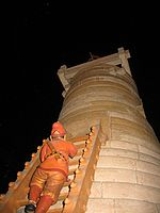
Cheomseongdae is an astronomical observatory in
GyeongjuGyeongju is a coastal city in the far southeastern corner of North Gyeongsang province in South Korea. It is the second largest city by area in the province after Andong, covering with a population of 269,343 people according to the 2008 census. Gyeongju is southeast of Seoul, and east of the...
,
South KoreaThe Republic of Korea , , is a sovereign state in East Asia, located on the southern portion of the Korean Peninsula. It is neighbored by the People's Republic of China to the west, Japan to the east, North Korea to the north, and the East China Sea and Republic of China to the south...
. Cheomseongdae means
star-gazing tower in
KoreanKorean is the official language of the country Korea, in both South and North. It is also one of the two official languages in the Yanbian Korean Autonomous Prefecture in People's Republic of China. There are about 78 million Korean speakers worldwide. In the 15th century, a national writing...
. Cheomseongdae is the oldest surviving observatory in
East AsiaEast Asia or Eastern Asia is a subregion of Asia that can be defined in either geographical or cultural terms...
, and one of the oldest scientific installations on Earth. It dates to the 7th century to the time of kingdom of
SillaSilla was one of the Three Kingdoms of Korea, and one of the longest sustained dynasties in...
, which had its capital in Gyeongju. Cheomseongdae was designated as the country's 31st national treasure on December 20, 1962.
Overview
According to
Samguk YusaSamguk Yusa, or Memorabilia of the Three Kingdoms, is a collection of legends, folktales, and historical accounts relating to the Three Kingdoms of Korea , as well as to other periods and states before, during, and after the Three Kingdoms period.The text was written in Classical Chinese, which was...
, Cheomseongdae was constructed under the reign of
Queen SeondeokQueen Seondeok of Silla reigned as Queen of Silla, one of the Three Kingdoms of Korea, from 632 to 647. She was Silla's twenty-seventh ruler, and its first reigning queen...
(632-647) near the capital of the kingdom.
Cheomseongdae means "star gazing platform". The tower is built out of 362 pieces of cut
graniteGranite is a common and widely occurring type of intrusive, felsic, igneous rock. Granite usually has a medium- to coarse-grained texture. Occasionally some individual crystals are larger than the groundmass, in which case the texture is known as porphyritic. A granitic rock with a porphyritic...
which some claim represent the 362 days of the
lunar yearThe Moon is Earth's only known natural satellite,There are a number of near-Earth asteroids including 3753 Cruithne that are co-orbital with Earth: their orbits bring them close to Earth for periods of time but then alter in the long term . These are quasi-satellites and not true moons. For more...
. Some surveys of the site have indicated that there are 366 blocks. It has 27 circular layers of stones (some associate it with the fact that Queen Seondeok was considered to be the 27th ruler of Silla or the constellation of stars) surmounted by a square structure. 12 of the layers are below the window level and 12 are above. There are 12 large base stones set in a square, with three stones on each side. These sets of 12 may symbolize the
monthA month is a unit of time, used with calendars, which was first used and invented in Mesopotamia, as a natural period related to the motion of the Moon; month and Moon are cognates. The traditional concept arose with the cycle of moon phases; such months are synodic months and last approximately...
s of the year.
The tower is 5.7 meters wide at the base and 9.4 meters tall, and filled with earth up to the level of the window. Its construction style parallels that used at the
Bunhwangsa TempleBunhwangsa is a temple complex from the Old Silla era of Korea. It is located in Gyeongju. The temple is recorded to have been built in 634 under the auspices of Queen Seondeok...
in Gyeongju.
The Cheomseongdae is the oldest surviving observatory in
East AsiaEast Asia or Eastern Asia is a subregion of Asia that can be defined in either geographical or cultural terms...
, though some claim that Cheomseongdae was not suitable for astronomical observation. Others posit that it was used for astrology rather than astronomy, though during that era there was little differentiation between the two. Some scholars have argued that the Cheomsongdae's design was heavily influenced by
BuddhismBuddhism is a religion and philosophy encompassing a variety of traditions, beliefs and practices, largely based on teachings attributed to Siddhartha Gautama, commonly known as the Buddha . The Buddha lived and taught in the northeastern Indian subcontinent some time between the 6th and 4th...
, noting similarities between its design and Mount Sumeru, the center of the world according to
BuddhistBuddhism is a religion and philosophy encompassing a variety of traditions, beliefs and practices, largely based on teachings attributed to Siddhartha Gautama, commonly known as the Buddha . The Buddha lived and taught in the northeastern Indian subcontinent some time between the 6th and 4th...
mythology.
External links