

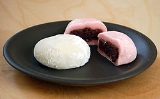
Red bean paste

Encyclopedia
Red bean paste or Azuki bean paste is a sweet, dark red bean
paste originating from China
. It is used in Chinese cuisine
, Japanese confectionery
, and Korean cuisine. It is prepared by boiling and mashing azuki bean
s and then sweetening the paste with sugar or honey. The husk of the beans may be removed by sieving before sweetening, which leads to a smoother and more homogeneous paste.
In Chinese cuisine
, the most common types are:
In Japanese cuisine
, the most common types are:
, a number of names are used to refer to red bean paste; these include , , and . Strictly speaking, the term an can refer to almost any sweet, edible, mashed paste, although without qualifiers red beans are assumed. Common alternatives include shiroan , made from , and kurian , made from chestnut
s.
Similarly, the Chinese term dòu shā , applies to red bean paste when used without qualifiers, although hóngdòu shā (紅豆沙) explicitly means "red bean paste."
Red bean
Red bean may refer to:* Azuki bean, commonly used in Japanese and Chinese cuisine, particularly as red bean paste* Kidney bean, commonly used in Indian and North American cuisine, such as chili con carne and red beans and rice...
paste originating from China
China
Chinese civilization may refer to:* China for more general discussion of the country.* Chinese culture* Greater China, the transnational community of ethnic Chinese.* History of China* Sinosphere, the area historically affected by Chinese culture...
. It is used in Chinese cuisine
Chinese cuisine
Chinese cuisine is any of several styles originating in the regions of China, some of which have become highly popular in other parts of the world – from Asia to the Americas, Australia, Western Europe and Southern Africa...
, Japanese confectionery
Wagashi
is a traditional Japanese confectionery which is often served with tea, especially the types made of mochi, azuki bean paste, and fruits.Wagashi is typically made from natural ingredients...
, and Korean cuisine. It is prepared by boiling and mashing azuki bean
Azuki bean
The is an annual vine, Vigna angularis, widely grown throughout East Asia and the Himalayas for its small bean. The cultivars most familiar in north-east Asia have a uniform red color, but white, black, gray and variously mottled varieties are also known. Scientists presume Vigna angularis var...
s and then sweetening the paste with sugar or honey. The husk of the beans may be removed by sieving before sweetening, which leads to a smoother and more homogeneous paste.
Types
Red bean paste is graded according to its consistency.In Chinese cuisine
Chinese cuisine
Chinese cuisine is any of several styles originating in the regions of China, some of which have become highly popular in other parts of the world – from Asia to the Americas, Australia, Western Europe and Southern Africa...
, the most common types are:
- Mashed: Azuki beans are boiled with sugar and mashed. The paste is smooth with bits of broken beans and bean husk. Depending on the intended texture, the beans can be vigorously or lightly mashed. Some unmashed beans can also be added back into the bean paste for additional texture. This is the most common and popular type of red bean paste eaten in Chinese confections. Can also be eaten on its own or in sweet soups.
- Smooth: Azuki beans are boiled without sugar, mashed, and diluted into a slurry. The slurry is then strained through a sieve to remove the husk, filtered, and squeezed dry using cheeseclothCheeseclothCheesecloth is a loosewoven gauze-like cotton cloth used primarily in cheese making and cooking.Cheesecloth is available in at least seven different grades, from open to extra-fine weave. Grades are distinguished by the number of threads per inch in each direction.- Uses :The primary use of...
. Although, the dry paste can be directly sweetened and used, Oil, either vegetable oil or lardLardLard is pig fat in both its rendered and unrendered forms. Lard was commonly used in many cuisines as a cooking fat or shortening, or as a spread similar to butter. Its use in contemporary cuisine has diminished because of health concerns posed by its saturated-fat content and its often negative...
, is usually used to cook the dry paste and improve its texture and mouth feel. Smooth bean paste is mainly found as fillings for Chinese pastries.
In Japanese cuisine
Japanese cuisine
Japanese cuisine has developed over the centuries as a result of many political and social changes throughout Japan. The cuisine eventually changed with the advent of the Medieval age which ushered in a shedding of elitism with the age of shogun rule...
, the most common types are:
- Tsubuan , whole red beans boiled with sugar but otherwise untreated
- Tsubushian , where the beans are mashed after boiling
- Koshian , which has been passed through a sieve to remove bean skins; the most common type
- Sarashian , which has been dried and reconstituted with water
Etymology
In JapaneseJapanese language
is a language spoken by over 130 million people in Japan and in Japanese emigrant communities. It is a member of the Japonic language family, which has a number of proposed relationships with other languages, none of which has gained wide acceptance among historical linguists .Japanese is an...
, a number of names are used to refer to red bean paste; these include , , and . Strictly speaking, the term an can refer to almost any sweet, edible, mashed paste, although without qualifiers red beans are assumed. Common alternatives include shiroan , made from , and kurian , made from chestnut
Chestnut
Chestnut , some species called chinkapin or chinquapin, is a genus of eight or nine species of deciduous trees and shrubs in the beech family Fagaceae, native to temperate regions of the Northern Hemisphere. The name also refers to the edible nuts they produce.-Species:The chestnut belongs to the...
s.
Similarly, the Chinese term dòu shā , applies to red bean paste when used without qualifiers, although hóngdòu shā (紅豆沙) explicitly means "red bean paste."
Uses
Chinese
Red bean paste is used in many Chinese foods, such as:- Red bean soupOshirukoRed bean soup refers to a number of traditional Asian soups, all made with azuki beans.-China:In China, red bean soup is a popular dish. The soup is commonly thinner than the Japanese oshiruko version. It is categorized as a tang shui糖水, , or sweet soup...
' onMouseout='HidePop("49029")' href="/topics/Pinyin">pinyinPinyinPinyin is the official system to transcribe Chinese characters into the Roman alphabet in China, Malaysia, Singapore and Taiwan. It is also often used to teach Mandarin Chinese and spell Chinese names in foreign publications and used as an input method to enter Chinese characters into...
: hóng dòu tāng / hóng dòu shā): Red bean paste with more water added to form a tong suiTong SuiTong sui, also known as tim tong, is a collective term for any sweet, warm soup or custard served as a dessert at the end of a meal in Cantonese cuisine. Tong sui are a Cantonese specialty and are rarely found in other regional cuisines of China...
, or thick, sweet soup. Often cooked and eaten with tangyuan and lotus seedLotus seedLotus seeds or lotus nuts are the seeds of plants in the genus Nelumbo, particularly the species Nelumbo nucifera. The seeds are of great importance to East Asian cuisine and are used extensively in traditional Chinese medicine and in Chinese desserts. The seeds are most commonly sold in the...
s. This is almost always a dessert. - Tangyuan ' onMouseout='HidePop("914")' href="/topics/Pinyin">pinyinPinyinPinyin is the official system to transcribe Chinese characters into the Roman alphabet in China, Malaysia, Singapore and Taiwan. It is also often used to teach Mandarin Chinese and spell Chinese names in foreign publications and used as an input method to enter Chinese characters into...
: tāng yúan): Glutinous rice balls filled with sweet fillings such as red bean paste and boiled in plain or sweetened water. - ZongziZongziZongzi is a traditional Chinese food, made of glutinous rice stuffed with different fillings and wrapped in bamboo or reed leaves. They are cooked by steaming or boiling. Laotians, Thais, and Cambodians also have similar traditional dishes. In the Western world, they are also known as rice...
' onMouseout='HidePop("76856")' href="/topics/Pinyin">pinyinPinyinPinyin is the official system to transcribe Chinese characters into the Roman alphabet in China, Malaysia, Singapore and Taiwan. It is also often used to teach Mandarin Chinese and spell Chinese names in foreign publications and used as an input method to enter Chinese characters into...
: zòng zĭ): Glutinous rice and red bean paste wrapped with bambooBambooBamboo is a group of perennial evergreens in the true grass family Poaceae, subfamily Bambusoideae, tribe Bambuseae. Giant bamboos are the largest members of the grass family....
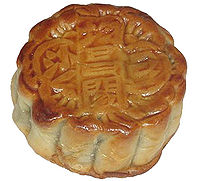
leaves and steamed or boiled. The glutinous rice used to make zongzi is usually specially prepared and appears yellow. - MooncakeMooncakeMooncake is a Chinese bakery product traditionally eaten during the Mid-Autumn Festival / Zhongqiu Festival. The festival is for lunar worship and moon watching; mooncakes are regarded as an indispensable delicacy on this occasion. Mooncakes are offered between friends or on family gatherings...
s : A baked pastry consisting of thin dough surrounding a filling. The filling is traditionally made from various ingredients, including mashed lotus seeds, red bean paste, or other fillings. The texture of this filling is quite similar to straight red bean paste. - BaoziBaoziA bāozi or simply known as bao, bau, humbow, nunu, bausak, pow or pau is a type of steamed, filled bun or bread-like item in various Chinese cuisines, as there is much variation as to the fillings and the preparations...
' onMouseout='HidePop("78113")' href="/topics/Pinyin">pinyinPinyinPinyin is the official system to transcribe Chinese characters into the Roman alphabet in China, Malaysia, Singapore and Taiwan. It is also often used to teach Mandarin Chinese and spell Chinese names in foreign publications and used as an input method to enter Chinese characters into...
: dòu shā bāo): Steamed leavened bread filled with a variety of savoury or sweet fillings. - Red bean cakeRed bean cakeRed bean cake is a type of Asian cake with a sweet red bean paste filling. It is made primarily with azuki beans.-Japanese cuisine:Mizuyokan is made without the outer shell of steamed dough, and instead of a paste, the mashed beans are mixed with gelatin, cooled for an extended period of time, and...
- Red bean pancake
Japanese
Red bean paste is used in many Japanese sweets.- AnmitsuAnmitsuis a Japanese dessert that has been popular for many decades.It is made of small cubes of agar jelly, a white translucent jelly made from red algae or seaweed. The agar is dissolved with water to make the jelly...
, a dessert consisting of red bean paste, small cubes of agarAgarAgar or agar-agar is a gelatinous substance derived from a polysaccharide that accumulates in the cell walls of agarophyte red algae. Throughout history into modern times, agar has been chiefly used as an ingredient in desserts throughout Asia and also as a solid substrate to contain culture medium...
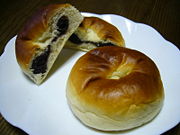
jelly, and pieces of fruit served with syrup. - AnpanAnpanis a Japanese sweet bun most commonly filled with red bean paste. Anpan can also be prepared with other fillings, including white beans , sesame and chestnut .- History :...
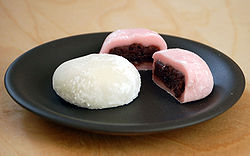
, a sweet bun filled with red bean paste. - DaifukuDaifuku', or ' , is a Japanese confection consisting of a small round mochi stuffed with sweet filling, most commonly anko, sweetened red bean paste made from azuki beans....
, a confection consisting of a small round rice cake stuffed with red bean paste. - DangoDangois a Japanese dumpling made from mochiko , related to mochi. It is often served with green tea.Dango are eaten year-round, but the different varieties are traditionally eaten in given seasons...
, a dumpling made from rice flour topped with red bean paste. - DorayakiDorayakiis a type of Japanese confection, а red bean pancake which consists of two small pancake-like patties made from castella wrapped around a filling of sweet red bean paste....
, a confection consisting of two small pancake-like patties made from castellaCastellais a popular Japanese sponge cake made of sugar, flour, eggs, and starch syrup, very common at festivals and as a street food.Now a specialty of Nagasaki, the cake was brought by way of Portuguese merchants in the 16th century. The name is derived from Portuguese Pão de Castela, meaning "bread from...
wrapped around a filling of red bean paste. - ManjūManjuManju is a Sanskrit word with following associated meanings - pleasant, sweet, snow, beautiful, Lord Shiva's name, clouds, morning dew and is predominantly an Indian male/female/given name.Manju, means a language of clouds.That is Rain...
, a steamed cake filled with red bean paste. - OshirukoOshirukoRed bean soup refers to a number of traditional Asian soups, all made with azuki beans.-China:In China, red bean soup is a popular dish. The soup is commonly thinner than the Japanese oshiruko version. It is categorized as a tang shui糖水, , or sweet soup...
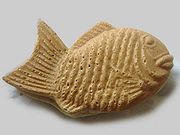
or Zenzai, azuki bean soup, commonly served with rice cake. - TaiyakiTaiyakiis a Japanese fish-shaped cake. The most common filling is red bean paste that is made from sweetened azuki beans. Other common fillings may be custard, chocolate, or cheese. Some shops even sell taiyaki with okonomiyaki, gyoza filling, or a sausage inside....
, a fish-shaped cake stuffed with red bean paste. - YōkanYokanis a thick jellied dessert made of red bean paste, agar, and sugar. It is usually sold in a block form, and eaten in slices. There are two main types: neri yōkan and mizu yōkan. "Mizu" means "water", and indicates that it is made with more water than usual...
, a thick jellied dessert made of red bean paste, agar, and sugar.
Korean
Red bean paste is used in various Korean snack foods and desserts; including:- Baram tteokBaram tteokBaram tteok is a Korean dessert made from Azuki bean paste and rice. The “tteok”, pronounced ‘duk’, means rice cake. Baram rice cakes look like Japanese daifuku, their hollowed out centers filled with red bean paste but these brightly colored tidbits have a flavor all their own.It is a traditional...
- BungeoppangBungeoppangBungeoppang is the Korean name of a pastryBungeoppangs are made using an appliance similar to a waffle iron. The batter is poured into a fish-shaped mold, red bean paste is added, then more batter to encase the red bean paste...
- ChalboribbangChalboribbangChalboribbang is a type of small and sweet pancakes made from glutinous barley flour. It consists of two layers of pancake, and a spread made from azuki bean. It is translated as "glutinous barley bread" or "sticky barley bread" into English...
, a type of small and sweet pancakes made from glutinous barley flour. It consists of two layers of pancake filled with red bean paste. It is translated as "glutinous barley bread" or "sticky barley bread" into English. - HobbangHobbangHobbang is a hot snack sold throughout South Korea. It is a pre-cooked ball of rice flour filled with something such as red bean paste, similar to Chinese Doushabao...
- Gyeongju breadGyeongju breadHwangnam bread , also commonly called Gyeongju bread, is a local specialty of Gyeongju City, South Korea. It is a small pastry with a filling of red bean paste. Gyeongju bread was first baked in 1939 at a bakery in Hwangnam-dong in central Gyeongju...
- Patbingsu
- Patdanja (팥단자)
- Patjuk, red bean soup, commonly eaten during the Winter Solstice festival
- Pattteok (팥떡)
- Patt sirutteok
- SongpyeonSongpyeonSongpyeon is a traditional Korean food made of glutinous rice. It is a variation of tteok, consisting of small rice cakes traditionally eaten during the Korean autumn harvest festival, Chuseok. They have become a popular symbol of traditional Korean culture...
, a variety of tteokTteokTteok is a class of Korean rice cakes made with glutinous rice flour , by steaming. Normal rice flour can be used for some kinds of tteok. There are hundreds of different kinds of tteok eaten year round...
(Korean rice cake) eaten in Hangawi (a harvest festivalHarvest festivalA Harvest Festival is an annual celebration which occurs around the time of the main harvest of a given region. Given the differences in climate and crops around the world, harvest festivals can be found at various times throughout the world...
). Some variants of songpyeon are filled with patso.
Cultural use
- The NarutoNarutois an ongoing Japanese manga series written and illustrated by Masashi Kishimoto. The plot tells the story of Naruto Uzumaki, an adolescent ninja who constantly searches for recognition and aspires to become the Hokage, the ninja in his village who is acknowledged as the leader and the strongest of...
character Anko Mitarashi is derived from Anko, meaning sweetened red bean paste and mitarashi dango, which happens to be her favorite food. - The cartoon hero AnpanmanAnpanmanis one of the most popular anime cartoon series for young children in Japan. , the titular Anpanman is the most popular fictional character among people age 0 to 12 years in Japan in 10 consective years, according to research by Bandai. The series is written by Takashi Yanase, a Japanese writer of...
is an anthropomorphic anpanAnpanis a Japanese sweet bun most commonly filled with red bean paste. Anpan can also be prepared with other fillings, including white beans , sesame and chestnut .- History :...
bun filled with azuki bean paste. - In Natsume SōsekiNatsume Soseki, born ', is widely considered to be the foremost Japanese novelist of the Meiji period . He is best known for his novels Kokoro, Botchan, I Am a Cat and his unfinished work Light and Darkness. He was also a scholar of British literature and composer of haiku, Chinese-style poetry, and fairy tales...
's classic novel I Am a CatI Am a Catis a satirical novel written in 1905–1906 by Natsume Sōseki, about Japanese society during the Meiji Period; particularly, the uneasy mix of Western culture and Japanese traditions, and the aping of Western customs....
, Prof. Sneeze is addicted to red bean jam, on which his wife blames both his dyspepsiaDyspepsiaDyspepsia , also known as upset stomach or indigestion, refers to a condition of impaired digestion. It is a medical condition characterized by chronic or recurrent pain in the upper abdomen, upper abdominal fullness and feeling full earlier than expected when eating...
and the family's unaffordable food bills.
See also
- Sweet bean pasteSweet bean pasteSweet bean paste is a food ingredient used in several Asian cuisines. Within Chinese cuisine, it is primarily used as a filling for sweet desserts and Chinese pastry.- Production :...
- Azuki beanAzuki beanThe is an annual vine, Vigna angularis, widely grown throughout East Asia and the Himalayas for its small bean. The cultivars most familiar in north-east Asia have a uniform red color, but white, black, gray and variously mottled varieties are also known. Scientists presume Vigna angularis var...
- Black bean pasteBlack bean pasteNot to be confused with Black bean sauce.Black bean paste, commonly called dòu shā or hěi dóu shā , is a sweet bean paste often used as a filling in cakes such as mooncakes or doushabao in many Chinese and Taiwanese cuisines....