


Joe Lieberman

Encyclopedia
Joseph Isadore "Joe" Lieberman (born February 24, 1942) is the senior United States Senator
from Connecticut
. A former member of the Democratic Party
, he was the party's nominee for Vice President
in the 2000 election. Currently an independent, he remains closely affiliated with the party.
Born in Stamford, Connecticut
, Lieberman is a graduate of Yale University
and Yale Law School
. He was elected as a "reform Democrat" in 1970 to the Connecticut Senate
, where he served three terms as Majority Leader. After an unsuccessful bid for the U.S. House of Representatives
in 1980, he served as state Attorney General
from 1983 to 1989. Lieberman defeated moderate Republican Lowell Weicker
in 1988 to win election to the United States Senate
and was re-elected in 1994 and 2000. In the 2000 United States presidential election
, Lieberman was the Democratic
nominee for Vice President, running with presidential
nominee Al Gore
, becoming the first Jewish candidate on a major
American political party presidential ticket. He was an unsuccessful candidate for the Democratic presidential nomination in the 2004 presidential election
.
During his re-election bid in 2006, he lost the Democratic Party primary election but won re-election in the general election as a third party
candidate under the party label "Connecticut for Lieberman
". Lieberman himself is not a member of the Connecticut for Lieberman
party; he is a registered Democrat.
Lieberman was officially listed in Senate records for the 110th
and 111th Congresses
as an "Independent Democrat
" and sits as part of the Senate Democratic Caucus. But since his speech at the 2008 Republican National Convention in which he endorsed John McCain
for president, Lieberman no longer attends Democratic Caucus leadership strategy meetings or policy lunches. On November 5, 2008, Lieberman met with Senate Majority Leader Harry Reid
to discuss his future role with the Democratic Party. Ultimately, the Senate Democratic Caucus voted to allow Lieberman to keep chairmanship of the Senate Committee on Homeland Security and Governmental Affairs. Subsequently, Lieberman announced that he will continue to caucus with the Democrats.
Lieberman announced in January 2011 that he will not seek re-election in 2012.
, the son of Marcia (née Manger) and Henry Lieberman. His paternal grandparents immigrated from Poland
and his maternal grandparents were from Austria
. He received an A.B.
in both political science
and economics
from Yale University
in 1964 and was the first member of his family to graduate from college. At Yale he was editor of the Yale Daily News
and a member of the Elihu Club
. He later attended Yale Law School
, receiving his law degree in 1967. After graduation from law school, Lieberman worked as a lawyer for the New Haven-based law firm Wiggin & Dana LLP.
A spokesperson told The Hartford Courant
in 1994 that Lieberman received an educational deferment from the Vietnam War
draft
when he was an undergraduate and law student from 1960 to 1967. Upon graduating from law school at age 25, Lieberman qualified for a family deferment because he was already married and had one child, Matt.
er. In 1981, the couple divorced. When asked about the divorce in an interview with New York Magazine, Lieberman said, "one of the differences we had was in levels of religious observance," adding, "I'm convinced if that was the only difference, we wouldn't have gotten divorced."
In 1982, he met his second wife, Hadassah Freilich Tucker
, while he was running for Attorney General of Connecticut. Hadassah Lieberman is the child of a Holocaust survivor. According to Washington Jewish Week, Lieberman called her for a date because he thought it would be interesting to go out with someone named Hadassah. (Hadassah
is the name of the Women's Zionist Organization of America
). Since March 2005, Hadassah Lieberman has worked for Hill & Knowlton
, a lobbying firm based in New York City, as a senior counselor in its health and pharmaceuticals practice. She has held senior positions at the Hospital of Saint Raphael
in New Haven, the American Committee for Shaare Zedek Medical Center in Jerusalem, Association of Public-Safety Communications Officials-International
(APCO), Pfizer
, National Research Council
, Hoffmann-La Roche
, and Lehman Brothers
.
Joe and Hadassah Lieberman have a daughter, Hani. Lieberman also has a stepson from Hadassah's previous marriage, Ethan Tucker. Matt Lieberman graduated from Yale University
in 1989, and from Yale Law School
in 1994. He is former Head of School of Greenfield Hebrew Academy in Atlanta, GA. Rebecca Lieberman graduated from Barnard College
in 1991, and from the University of Pennsylvania Law School
in 1997. She is married to Jacob Wisse. Ethan Tucker, son of Gordon Tucker
, graduated from Harvard College
in 1997 and received his rabbinic ordination from the Chief Rabbinate of Israel. Lieberman is also related to Disney Channel
star Raviv Ullman of Phil of the Future
.
Lieberman describes himself as an "observant" Jew. In 1965 he married Betty Haas, a Reform Jew. Since the death in 1967 of Lieberman's grandmother, a deeply religious immigrant, he found renewed interest in religious observance. His second wife, Hadassah, is also an observant Orthodox Jew. "Hadassah calls herself my right wing," says Lieberman. In Lieberman's 1988 upset of Republican Party
incumbent Senator Lowell Weicker, his religious observance was mostly viewed in terms of inability to campaign on Shabbat
. This changed when Gore chose Lieberman as the running mate; a Lieberman press officer who spoke on condition of anonymity said:
The Liebermans keep a kosher home and observe Shabbat
.
Lieberman has said that there is currently "a constitutional place for faith in our public life", and that the Constitution does not provide for "freedom from religion." He attends Kesher Israel
Congregation in Georgetown, Washington, D.C.
and Beth Hamedrosh Hagodol – B'nai Israel, The Westville Synagogue, New Haven, Connecticut. He also attends Congregation Agudath Sholom in Stamford.
He was the first observant Jew to run on a major party Presidential ticket. (1964 Presidential candidate Barry Goldwater
's father was Jewish, but Sen. Goldwater's mother was an Episcopalian, and the Senator practiced his mother's faith.)
in 1970, where he served for 10 years, including the last six as Majority Leader. He suffered his first defeat in Connecticut elections in the Reagan
landslide year of 1980, losing the race for the Third District Congressional seat to Republican Lawrence Joseph DeNardis
, a state senator from suburban Hamden
with whom he had worked closely on bipartisan legislative efforts. In 1981 he wrote an admiring biography of long-time Connecticut and national Democratic leader John Moran Bailey
, reviewing also in the book the previous 50 years of Connecticut political history. From 1983 to 1989, he served as Connecticut Attorney General
. In the 1986 general election, Lieberman won more votes than any other Democrat on the statewide ticket, including Governor William O'Neill
. As Attorney General, Lieberman emphasized consumer protection and environmental enforcement.
to win election to the United States Senate
and was re-elected in 1994 and 2000. Like Bill Clinton
and Dick Gephardt
, Lieberman served as chair of the Democratic Leadership Council
.
Lieberman was first elected to the United States Senate
as a Democrat in the 1988 election, by a margin of 10,000 votes. He scored the nation's biggest political upset that year, after being backed by a coalition of Democrats and unaffiliated voters with support from conservative Republicans
, who were disappointed in three-term Republican incumbent Lowell Weicker's moderate voting record and personal style. During the campaign, he received support from the Connecticut's Cuban-American community which was unhappy with Weicker. Lieberman has since remained firmly anti-Castro. Six years later, Lieberman made history by winning by the largest landslide ever in a Connecticut Senate race, drawing 67 percent of the vote and beating his opponent by more than 350,000 votes.
In 1998, Lieberman was the first prominent Democrat to publicly challenge Bill Clinton
for the judgment exercised in his affair
with Monica Lewinsky
. However, he voted against removing Clinton from office by impeachment. In 2000, while concurrently running for the vice presidency, Lieberman was elected to a third Senate term with 64 percent of the vote easily defeating the Republican Philip Giordano
.
When control of the Senate switched from Republicans to Democrats in June 2001, Lieberman became Chairman of the Homeland Security and Governmental Affairs Committee
, with oversight responsibilities for a broad range of government activities. He was also a member of the Environment and Public Works Committee
and chair of its Subcommittee Clean Air, Wetlands and Private Property
; the Armed Services Committee
, where he chaired the Airland Subcommittee
and sat on the Subcommittee on Emerging Threats and Capabilities
; and the Small Business Committee
. When Republicans gained control of the Senate in January 2003, Lieberman resumed his role as ranking minority member of the committees he had once chaired.
In the 110th Congress, Lieberman is Chairman of the Homeland Security and Governmental Affairs Committee, which is responsible for assuring the efficiency and effectiveness of the Federal Government. In addition, he is a member of the Environment and Public Works Committee; Senate Armed Services Committee, where he is Chairman of the Subcommittee on Air Land Forces and sits on the Subcommittee on Emerging Threats and Capabilities; and the Small Business Committee.
, the Democratic Party nominee for President. Lieberman was the first Jewish candidate on a major political party ticket. The announcement of Lieberman's selection was unusual in that it did not cause a positive "bump" in the Gore campaign's poll numbers according to a Newsweek
poll done at the time. Polling also indicated that Lieberman had badly lost his televised debate against Dick Cheney
, leading some to suggest later that Gore had lost the election due to choosing Lieberman as his running mate.
The Gore/Lieberman ticket won a plurality of the popular vote, with over half a million more votes than the Republican ticket of George W. Bush
and Dick Cheney
, but they were defeated in the Electoral College
by a vote of 271 to 266.
Like Democratic VP candidates Lyndon B. Johnson
in 1960, Lloyd Bentsen
in 1988, John Edwards
in 2004, and Joe Biden
in 2008, Lieberman's Senate term was due to expire during the election cycle. He decided to run for reelection to maintain his seat, as Johnson, Bentsen and Biden did. All four won, but since Johnson and Biden were also elected Vice-President, they gave up their seats.
as a candidate in the 2004 presidential election
.
Describing his Presidential hopes, Lieberman opined that his historically hawkish stance would appeal to voters. Indeed he initially led in polls of primaries, but due to his political positions he failed to win a support of liberal
Democratic voters, who dominated the primaries.
Prior to his defeat in New Hampshire
, Lieberman famously declared his campaign was picking up "Joementum"; however, he failed to provide such momentum during the New Hampshire primary
debates, held at Saint Anselm College
days before the primary. On February 3, 2004, Lieberman withdrew his candidacy after failing to win any of the five primaries or two caucuses held that day. He acknowledged to the Hartford Courant that his support for the war in Iraq was a large part of his undoing with voters.
Lieberman's former running candidate Al Gore did not support Lieberman's Presidential run, and in December 2003 endorsed Howard Dean
's candidacy, saying "This is about all of us and all of us need to get behind the strongest candidate [Dean]."
Finally Lieberman withdrew from the race without winning a single contest. In total popular vote he placed 7th behind eventual nominee, Massachusetts
senator John Kerry
, future Vice Presidential nominee, North Carolina
Senator John Edwards
, former Governor of Vermont
Howard Dean
, Ohio
Representative Dennis Kucinich
, retired General Wesley Clark
and Reverend Al Sharpton
.
Senator John McCain
for president in 2008, contradicting his stance in July 2006 where he stated "I want Democrats to be back in the majority in Washington and elect a Democratic president in 2008." Lieberman cited his agreement with McCain's stance on the War on Terrorism
as the primary reason for the endorsement.
On June 5, Lieberman launched "Citizens for McCain," hosted on the McCain campaign website, to recruit Democratic support for John McCain's candidacy. He emphasized the group's outreach to supporters of Hillary Clinton, who was at that time broadly expected to lose the Democratic presidential nomination to Barack Obama.
Citizens for McCain was prominently featured in McCain team efforts to attract disgruntled Hillary Clinton supporters such as Debra Bartoshevich.
Lieberman spoke at the 2008 Republican National Convention
on behalf of McCain and his running mate, Alaska Governor Sarah Palin
. Lieberman was alongside McCain and Senator Lindsey Graham
during a visit to French president Nicolas Sarkozy
on March 21, 2008.
Lieberman was mentioned as a possible Vice Presidential nominee on a McCain ticket, although Lieberman had denied interest. ABC News
reported that Lieberman was McCain's first choice for Vice President until several days before the selection, when McCain had decided that picking Lieberman would alienate the conservative base of the Republican Party. Lieberman had been mentioned as a possible Secretary of State
under a McCain administration.
Many Democrats wanted Lieberman to be stripped of his chairmanship of the Senate Committee on Homeland Security and Governmental Affairs due to his support for John McCain. Republican Minority Leader Mitch McConnell
reached out to Lieberman, asking him to caucus with the Republicans. Ultimately, the Senate Democratic Caucus voted 42 to 13 to allow Lieberman to keep chairmanship (although he did lose his membership for the Environment and Public Works Committee
). Subsequently, Lieberman announced that he will continue to caucus with the Democrats. Lieberman credited President-elect
Barack Obama
for helping him keep his chairmanship. Obama had privately urged Democratic Senate Majority Leader Harry Reid
not to remove Lieberman from his position. Reid stated that Lieberman's criticism of Obama during the election angered him, but that "if you look at the problems we face as a nation, is this a time we walk out of here saying, 'Boy did we get even'?" Senator Tom Carper of Delaware
also credited the Democrats' decision on Lieberman to Obama's support, stating that "If Barack can move on, so can we."
Liberal members of the Democratic caucus were reportedly angry at the decision to not punish Lieberman more severely. Senator Bernie Sanders
of Vermont
(who is also an Independent who caucuses with the Democrats) stated that he voted against Lieberman "because while millions of people worked hard for Obama, Lieberman actively worked for four more years of President Bush's policies."
Lieberman's embrace of certain conservative policies and in particular his endorsement of John McCain have been cited as factors for his high approval rating among Republicans in Connecticut with 66% of Republicans approving of him along with 52% of independants also approving of his job performance, this however is also cited for his low approval rating among Democrats: 44% approving and 46% disapproving. Currentlly 51% of voters approve of his performance along with 40% disapproving.
Lieberman sought the Democratic Party's renomination for U.S. Senate from Connecticut in 2006 but lost to Ned Lamont
, a Greenwich
businessman and antiwar candidate.
Lieberman was officially endorsed by the Connecticut Democratic Convention, which met in May. However, Lamont received 33 percent of the delegates' votes, forcing an August primary.
In July, Lieberman announced that he would file papers to appear on the November ballot should he lose the primary, stating, "I'm a loyal Democrat, but I have loyalties that are greater than those to my party, and that's my loyalty to my state and my country." He stated that he would continue to sit as a Democrat in the Senate even if he was defeated in the primary and elected on an unaffiliated line, and expressed concern for a potentially low turnout. On July 10, the Lieberman campaign officially filed paperwork allowing him to collect signatures for the newly formed Connecticut for Lieberman
party ballot line.
On August 8, 2006, Lieberman conceded
the Democratic
primary election to Ned Lamont, saying, "For the sake of our state, our country and my party, I cannot and will not let that result stand," and announced he would run in the 2006 November election
as an independent candidate on the Connecticut for Lieberman
ticket, against both Lamont and the Republican candidate, Alan Schlesinger
.
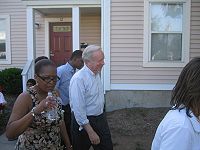 Polls after the primary showed Lieberman ahead of Ned Lamont
by 5 points. Later polls showed Lieberman leading by varying margins. Alan Schlesinger
barely registered support and his campaign had run into problems based on alleged gambling debts. Thus, "Lieberman was able to run in the general election as the de facto Republican candidate – every major Republican office-holder in the state endorsed him – and to supplement that GOP base with strong support from independents."
On August 9, 2006, Hillary Clinton affirmed her pledge to support the primary winner, saying "voters of Connecticut have made their decision and I think that decision should be respected", and Howard Dean
called for Lieberman to quit the race, saying he was being "disrespectful of Democrats and disrespectful of the Democratic Party".
On August 10, in his first campaign appearance since losing the Democratic primary, referencing the 2006 transatlantic aircraft plot
, Lieberman criticized Lamont, saying:
Lamont noted Lieberman's position was similar to George W. Bush
's and Dick Cheney
's position. Lamont said, “That comment sounds an awful lot like Vice President Cheney’s comment on Wednesday. Both of them believe our invasion of Iraq has a lot to do with 9/11. That’s a false premise.” Lieberman's communications director replied that Lamont was politicizing national security by "portraying [Lieberman] as a soul mate of President Bush on Iraq".
On August 17, 2006 the National Republican Senatorial Committee
stated that they would favor a Lieberman victory in the November election over Democratic nominee Ned Lamont. The NRSC did state, however, that they were not going so far as to actually support Lieberman.
Former New York Mayor Rudy Giuliani
praised Lieberman at a South Carolina
campaign stop on August 18, saying he was "a really exceptional senator." Other Republican supporters of Lieberman included Mayor of New York City
Michael Bloomberg
, former Representative and Republican Vice Presidential candidate Jack Kemp
, former Speaker of the House
Newt Gingrich
and Senator
Susan Collins
of Maine
.
Five Democratic Senators maintained their support for Lieberman, and Lieberman also received the strong support of former Senator and Democratic stalwart Bob Kerrey
, who offered to stump for him. Democratic minority leader Harry Reid, while endorsing Lamont, promised Lieberman that he would retain his committee positions and seniority if he prevailed in the general election.
On August 28, Lieberman campaigned at the same motorcycle rally as Republican Congressman Christopher Shays
. Shays told a crowd of motorcycle enthusiasts, "We have a national treasure in Joe Lieberman."
Mel Sembler
, a former Republican National Committee
finance chairman, helped organize a reception that raised a "couple hundred thousand dollars" for Lieberman, who was personally in attendance. Sembler is a prominent Republican who chaired I. Lewis 'Scooter' Libby's legal defense fund. New York Mayor Michael Bloomberg
held a fundraiser for Lieberman at his home in November, co-hosted by former mayor Ed Koch
and former Senator Alfonse M. D'Amato. Koch called Lieberman "one of the greatest Senators we've ever had in the Senate."
Despite still considering himself a Democrat, Lieberman was endorsed by numerous Republicans who actively spoke out in favor of his candidacy. Lieberman was also the focus of websites such as ConservativesforLieberman06.com.
On November 7, Lieberman won re-election with 49.7% of the vote. Ned Lamont
garnered 40% of ballots cast and Alan Schlesinger
won 10%. Lieberman received support from 33% of Democrats, 54% of independents and 70% of Republicans.
Following the election, Lieberman struck a deal with Democratic leadership allowing him to keep his seniority and chairmanship of the Governmental Affairs Committee. In return, he agreed to vote with the Democrats on all procedural matters unless he asked permission of Majority Whip Richard Durbin. He is free to vote as he pleases on policy matters. Along with Bernie Sanders
, Lieberman's caucusing with the Democrats gave them a 51–49 majority in the Senate, leaving a slim one Senator majority to control the Senate in the 110th Congress
.
as ambassador to Belgium
. Fox, a prominent Republican businessman and political donor, was a contributor to the Swift Boat Veterans for Truth campaign in 2004.
Fox is also reported to have donated to Lieberman's 2006 Senate campaign. Critics claim Lieberman was a favorite of Fox News , since he was willing to go on the conservative channel and play the role of someone in the “opposition” party who criticised fellow Democrats.
Lieberman was a supporter of the Iraq War and has urged action against Iran. In July 2008, Lieberman spoke at the annual conference of Christians United for Israel
(CUFI) then later, in July 2009, accepted from John Hagee CUFI's "Defender of Israel Award". Pastor Hagee
, CUFI's founder and leader, has made a number of controversial remarks, including a statement that the Catholic Church is "the great whore" and a suggestion that God sent Adolf Hitler
to bring the Jews to Israel
.
In May 2010, while favoring the filibuster
and threatening to use it in 2009 to eliminate a public health option as part of the healthcare proposal, Lieberman once strongly opposed it. In 1995, he joined with Senator Tom Harkin
to co-sponsor an amendment to kill the filibuster. “The filibuster hurts the credibility of the entire Senate and impedes progress,” Lieberman told the Hartford Courant (Jan 6, 1995).
In April 2010, Lieberman blasted President Obama for stripping terms like "Islamic extremism" from a key national security document, calling the move dishonest, wrong-headed and disrespectful to the majority of Muslims who are not terrorists.
Lieberman has favoured greater use of surveillance cameras by the federal government and referred to attempts by Congress to investigate illegal wire-tapping as "partisan gridlock". On June 19, 2010, Lieberman introduced a bill called "Protecting Cyberspace as a National Asset Act of 2010", which he co-wrote with Senator Susan Collins
(R-ME) and Senator Thomas Carper (D-DE). If signed into law, this controversial bill, which the American media dubbed the "Kill switch bill
", would grant the President
emergency powers over the Internet. However, all three co-authors of the bill issued a statement claiming that instead, the bill "[narrowed] existing broad Presidential authority to take over telecommunications networks". American computer security
specialist and author Bruce Schneier
objected to the "kill switch" proposal on the basis that it rests on several faulty assumptions and that it's "too coarse a hammer". Schneier wrote:
Sen. Lieberman has been a major opponent of the whistle-blowing website WikiLeaks
. His staff "made inquiries" of Amazon.com
and other internet companies such as Paypal
, Visa, and Mastercard
which resulted in them suspending service to WikiLeaks. Blogger Glenn Greenwald
called Lieberman's actions "one of the most pernicious acts by a U.S. Senator in quite some time," and accused Lieberman of "emulat[ing] Chinese dictators
" by "abusing his position as Homeland Security
Chairman to thuggishly dictate to private companies which websites they should and should not host—and, more important, what you can and cannot read on the Internet." Lieberman has also suggested that "the New York Times and other news organisations publishing the US embassy cables being released by WikiLeaks could be investigated for breaking US espionage laws
."
Along with Senators John Ensign
and Scott Brown
, Lieberman "introduced a bill to amend the Espionage Act
in order to facilitate the prosecution of folks like Wikileaks." Critics have noted that "[l]eaking [classified] information in the first place is already a crime, so the measure is aimed squarely at publishers," and that "Lieberman’s proposed solution to WikiLeaks could have implications for journalists reporting on some of the more unsavory practices of the intelligence community." Legal analyst Benjamin Wittes
has called the proposed legislation "the worst of both worlds," saying:
As a result of these statements and actions, Lieberman has been perceived as an opponent of Internet Free Speech and become the target of Anonymous
attacks under Operation Payback
.
relationship. On domestic issues, he strongly supports free trade
economics while reliably voting for pro-trade union
legislation. He has also opposed filibustering Republican judicial appointments. With Lynne Cheney
and others, Lieberman co-founded American Council of Trustees and Alumni
in 1995. Lieberman is a supporter of abortion rights and of the rights of gays and lesbians to adopt children, to be protected with hatecrime legislation, and to serve openly in the military. Lieberman is one of the Senate's leading opponents of violence in video games and on television. Lieberman describes himself as being "genuinely an Independent," saying "I agree more often than not with Democrats on domestic policy
. I agree more often than not with Republicans on foreign
and defense policy
." Senator Lieberman is also famous for championing, authoring and leading the effort that led to the repeal of Don't ask don't tell.
Senator Lieberman was an integral part in attempting to stop WikiLeaks
from publishing further material using US-based corporations in the United States diplomatic cables leak
of 2010.
; The Scorpion and the Tarantula (1970), a study of early efforts to control nuclear proliferation
; The Legacy (1981), a history of Connecticut
politics from 1930 to 1980; Child Support in America (1986), a guidebook on methods to increase the collection of child support
from delinquent fathers; In Praise of Public Life (2000); An Amazing Adventure (2003), reflecting on his 2000 vice presidential run; and The Gift of Rest: Rediscovering the Beauty of the Sabbath (2011), written with David Klinghoffer
.
Directories and databases
Interviews
Miscellaneous
United States Senate
The United States Senate is the upper house of the bicameral legislature of the United States, and together with the United States House of Representatives comprises the United States Congress. The composition and powers of the Senate are established in Article One of the U.S. Constitution. Each...
from Connecticut
Connecticut
Connecticut is a state in the New England region of the northeastern United States. It is bordered by Rhode Island to the east, Massachusetts to the north, and the state of New York to the west and the south .Connecticut is named for the Connecticut River, the major U.S. river that approximately...
. A former member of the Democratic Party
Democratic Party (United States)
The Democratic Party is one of two major contemporary political parties in the United States, along with the Republican Party. The party's socially liberal and progressive platform is largely considered center-left in the U.S. political spectrum. The party has the lengthiest record of continuous...
, he was the party's nominee for Vice President
Vice President of the United States
The Vice President of the United States is the holder of a public office created by the United States Constitution. The Vice President, together with the President of the United States, is indirectly elected by the people, through the Electoral College, to a four-year term...
in the 2000 election. Currently an independent, he remains closely affiliated with the party.
Born in Stamford, Connecticut
Stamford, Connecticut
Stamford is a city in Fairfield County, Connecticut, United States. According to the 2010 census, the population of the city is 122,643, making it the fourth largest city in the state and the eighth largest city in New England...
, Lieberman is a graduate of Yale University
Yale University
Yale University is a private, Ivy League university located in New Haven, Connecticut, United States. Founded in 1701 in the Colony of Connecticut, the university is the third-oldest institution of higher education in the United States...
and Yale Law School
Yale Law School
Yale Law School, or YLS, is the law school of Yale University in New Haven, Connecticut, United States. Established in 1824, it offers the J.D., LL.M., J.S.D. and M.S.L. degrees in law. It also hosts visiting scholars, visiting researchers and a number of legal research centers...
. He was elected as a "reform Democrat" in 1970 to the Connecticut Senate
Connecticut Senate
The Connecticut State Senate is the upper house of the Connecticut General Assembly, the state legislature of the U.S. state of Connecticut. The state senate comprises 36 members, each representing a district with around 94,600 inhabitants. Senators are elected to two-year terms without term limits...
, where he served three terms as Majority Leader. After an unsuccessful bid for the U.S. House of Representatives
United States House of Representatives
The United States House of Representatives is one of the two Houses of the United States Congress, the bicameral legislature which also includes the Senate.The composition and powers of the House are established in Article One of the Constitution...
in 1980, he served as state Attorney General
Attorney General
In most common law jurisdictions, the attorney general, or attorney-general, is the main legal advisor to the government, and in some jurisdictions he or she may also have executive responsibility for law enforcement or responsibility for public prosecutions.The term is used to refer to any person...
from 1983 to 1989. Lieberman defeated moderate Republican Lowell Weicker
Lowell P. Weicker, Jr.
Lowell Palmer Weicker, Jr. is an American politician who served as a U.S. Representative, U.S. Senator, and the 85th Governor of Connecticut, and unsuccessfully sought the Republican nomination for President in 1980...
in 1988 to win election to the United States Senate
United States Senate
The United States Senate is the upper house of the bicameral legislature of the United States, and together with the United States House of Representatives comprises the United States Congress. The composition and powers of the Senate are established in Article One of the U.S. Constitution. Each...
and was re-elected in 1994 and 2000. In the 2000 United States presidential election
United States presidential election, 2000
The United States presidential election of 2000 was a contest between Republican candidate George W. Bush, then-governor of Texas and son of former president George H. W. Bush , and Democratic candidate Al Gore, then-Vice President....
, Lieberman was the Democratic
Democratic Party (United States)
The Democratic Party is one of two major contemporary political parties in the United States, along with the Republican Party. The party's socially liberal and progressive platform is largely considered center-left in the U.S. political spectrum. The party has the lengthiest record of continuous...
nominee for Vice President, running with presidential
President of the United States
The President of the United States of America is the head of state and head of government of the United States. The president leads the executive branch of the federal government and is the commander-in-chief of the United States Armed Forces....
nominee Al Gore
Al Gore
Albert Arnold "Al" Gore, Jr. served as the 45th Vice President of the United States , under President Bill Clinton. He was the Democratic Party's nominee for President in the 2000 U.S. presidential election....
, becoming the first Jewish candidate on a major
Major party
A major party is a political party that holds substantial influence in a country's politics, standing in contrast to a minor party. It should not be confused with majority party.According to the Merriam-Webster Dictionary:...
American political party presidential ticket. He was an unsuccessful candidate for the Democratic presidential nomination in the 2004 presidential election
United States presidential election, 2004
The United States presidential election of 2004 was the United States' 55th quadrennial presidential election. It was held on Tuesday, November 2, 2004. Republican Party candidate and incumbent President George W. Bush defeated Democratic Party candidate John Kerry, the then-junior U.S. Senator...
.
During his re-election bid in 2006, he lost the Democratic Party primary election but won re-election in the general election as a third party
Third party (politics)
In a two-party system of politics, the term third party is sometimes applied to a party other than the two dominant ones. While technically the term is limited to the third largest party or third oldest party, it is common, though innumerate, shorthand for any smaller party.For instance, in the...
candidate under the party label "Connecticut for Lieberman
Connecticut for Lieberman
Connecticut for Lieberman is a Connecticut political party created by twenty-five supporters of Senator Joe Lieberman. The party was created to enable Lieberman to run for re-election following his defeat in the 2006 Connecticut Democratic primary...
". Lieberman himself is not a member of the Connecticut for Lieberman
Connecticut for Lieberman
Connecticut for Lieberman is a Connecticut political party created by twenty-five supporters of Senator Joe Lieberman. The party was created to enable Lieberman to run for re-election following his defeat in the 2006 Connecticut Democratic primary...
party; he is a registered Democrat.
Lieberman was officially listed in Senate records for the 110th
110th United States Congress
The One Hundred Tenth United States Congress was the meeting of the legislative branch of the United States federal government, between January 3, 2007, and January 3, 2009, during the last two years of the second term of President George W. Bush. It was composed of the Senate and the House of...
and 111th Congresses
111th United States Congress
The One Hundred Eleventh United States Congress was the meeting of the legislative branch of the United States federal government from January 3, 2009 until January 3, 2011. It began during the last two weeks of the George W. Bush administration, with the remainder spanning the first two years of...
as an "Independent Democrat
Independent Democrat
Independent Democrat is a term occasionally adopted by American politicians to refer to their party affiliation. Several elected officials, including members of Congress, have identified as " Independent Democrats."...
" and sits as part of the Senate Democratic Caucus. But since his speech at the 2008 Republican National Convention in which he endorsed John McCain
John McCain
John Sidney McCain III is the senior United States Senator from Arizona. He was the Republican nominee for president in the 2008 United States election....
for president, Lieberman no longer attends Democratic Caucus leadership strategy meetings or policy lunches. On November 5, 2008, Lieberman met with Senate Majority Leader Harry Reid
Harry Reid
Harry Mason Reid is the senior United States Senator from Nevada, serving since 1987. A member of the Democratic Party, he has been the Senate Majority Leader since January 2007, having previously served as Minority Leader and Minority and Majority Whip.Previously, Reid was a member of the U.S...
to discuss his future role with the Democratic Party. Ultimately, the Senate Democratic Caucus voted to allow Lieberman to keep chairmanship of the Senate Committee on Homeland Security and Governmental Affairs. Subsequently, Lieberman announced that he will continue to caucus with the Democrats.
Lieberman announced in January 2011 that he will not seek re-election in 2012.
Early life
Lieberman was born in Stamford, ConnecticutStamford, Connecticut
Stamford is a city in Fairfield County, Connecticut, United States. According to the 2010 census, the population of the city is 122,643, making it the fourth largest city in the state and the eighth largest city in New England...
, the son of Marcia (née Manger) and Henry Lieberman. His paternal grandparents immigrated from Poland
Poland
Poland , officially the Republic of Poland , is a country in Central Europe bordered by Germany to the west; the Czech Republic and Slovakia to the south; Ukraine, Belarus and Lithuania to the east; and the Baltic Sea and Kaliningrad Oblast, a Russian exclave, to the north...
and his maternal grandparents were from Austria
Austria
Austria , officially the Republic of Austria , is a landlocked country of roughly 8.4 million people in Central Europe. It is bordered by the Czech Republic and Germany to the north, Slovakia and Hungary to the east, Slovenia and Italy to the south, and Switzerland and Liechtenstein to the...
. He received an A.B.
Bachelor of Arts
A Bachelor of Arts , from the Latin artium baccalaureus, is a bachelor's degree awarded for an undergraduate course or program in either the liberal arts, the sciences, or both...
in both political science
Political science
Political Science is a social science discipline concerned with the study of the state, government and politics. Aristotle defined it as the study of the state. It deals extensively with the theory and practice of politics, and the analysis of political systems and political behavior...
and economics
Economics
Economics is the social science that analyzes the production, distribution, and consumption of goods and services. The term economics comes from the Ancient Greek from + , hence "rules of the house"...
from Yale University
Yale University
Yale University is a private, Ivy League university located in New Haven, Connecticut, United States. Founded in 1701 in the Colony of Connecticut, the university is the third-oldest institution of higher education in the United States...
in 1964 and was the first member of his family to graduate from college. At Yale he was editor of the Yale Daily News
Yale Daily News
The Yale Daily News is an independent student newspaper published by Yale University students in New Haven, Connecticut since January 28, 1878...
and a member of the Elihu Club
Elihu (secret society)
Elihu, founded in 1903, is the sixth oldest secret society at Yale University, New Haven, CT. While similar to Skull and Bones, Scroll and Key and Wolf's Head societies in charter and function, Elihu favors privacy over overt secrecy...
. He later attended Yale Law School
Yale Law School
Yale Law School, or YLS, is the law school of Yale University in New Haven, Connecticut, United States. Established in 1824, it offers the J.D., LL.M., J.S.D. and M.S.L. degrees in law. It also hosts visiting scholars, visiting researchers and a number of legal research centers...
, receiving his law degree in 1967. After graduation from law school, Lieberman worked as a lawyer for the New Haven-based law firm Wiggin & Dana LLP.
A spokesperson told The Hartford Courant
The Hartford Courant
The Hartford Courant is the largest daily newspaper in the U.S. state of Connecticut, and is a morning newspaper for most of the state north of New Haven and east of Waterbury...
in 1994 that Lieberman received an educational deferment from the Vietnam War
Vietnam War
The Vietnam War was a Cold War-era military conflict that occurred in Vietnam, Laos, and Cambodia from 1 November 1955 to the fall of Saigon on 30 April 1975. This war followed the First Indochina War and was fought between North Vietnam, supported by its communist allies, and the government of...
draft
Conscription
Conscription is the compulsory enlistment of people in some sort of national service, most often military service. Conscription dates back to antiquity and continues in some countries to the present day under various names...
when he was an undergraduate and law student from 1960 to 1967. Upon graduating from law school at age 25, Lieberman qualified for a family deferment because he was already married and had one child, Matt.
Personal life
Lieberman met his first wife, Betty Haas, at the congressional office of Senator Abraham Ribicoff (D-CT), where they worked as summer student interns. They married in 1965 while Joe Lieberman was in law school. They had two children – Matt and Rebecca. Betty, who is also Jewish, later worked as a psychiatric social workSocial work
Social Work is a professional and academic discipline that seeks to improve the quality of life and wellbeing of an individual, group, or community by intervening through research, policy, community organizing, direct practice, and teaching on behalf of those afflicted with poverty or any real or...
er. In 1981, the couple divorced. When asked about the divorce in an interview with New York Magazine, Lieberman said, "one of the differences we had was in levels of religious observance," adding, "I'm convinced if that was the only difference, we wouldn't have gotten divorced."
In 1982, he met his second wife, Hadassah Freilich Tucker
Hadassah Lieberman
Hadassah Lieberman is the wife of United States Senator Joseph Lieberman .-Biography:She was born Hadassah Freilich in a refugee camp in Prague, Czechoslovakia. Her parents were both Holocaust survivors. Her father was Samuel Freilich, a lawyer and rabbi from Munkács, in the Carpathian Ruthenia...
, while he was running for Attorney General of Connecticut. Hadassah Lieberman is the child of a Holocaust survivor. According to Washington Jewish Week, Lieberman called her for a date because he thought it would be interesting to go out with someone named Hadassah. (Hadassah
Hadassah
Hadassah, the Women's Zionist Organization of America is an American Jewish volunteer women's organization. Founded in 1912 by Henrietta Szold, it is one of the largest international Jewish organizations, with around...
is the name of the Women's Zionist Organization of America
Zionist Organization of America
The Zionist Organization of America , founded in 1897, was one of the first official Zionist organizations in the United States, and, especially early in the 20th century, the primary representative of Jewish Americans to the World Zionist Organization, espousing primarily Political Zionism.Today,...
). Since March 2005, Hadassah Lieberman has worked for Hill & Knowlton
Hill & Knowlton
Hill & Knowlton is a global public relations company, headquartered in New York City, United States, with 79 offices in 44 countries. Hill & Knowlton was founded in Cleveland, Ohio in 1927 by John W. Hill and is today led by Chairman & CEO, Paul Taaffe...
, a lobbying firm based in New York City, as a senior counselor in its health and pharmaceuticals practice. She has held senior positions at the Hospital of Saint Raphael
Hospital of Saint Raphael
The Hospital of Saint Raphael or Saint Raphael Hospital, located in New Haven, Connecticut, USA, is a 511-bed community teaching hospital and an academic health center affiliated with Yale University School of Medicine. It was founded by the Sisters of Charity of Saint Elizabeth in 1907...
in New Haven, the American Committee for Shaare Zedek Medical Center in Jerusalem, Association of Public-Safety Communications Officials-International
Association of Public-Safety Communications Officials-International
The Association of Public-Safety Communications Officials-International was founded in 1935 and is the world's largest organization dedicated to public safety telecommunications.APCO has developed several standards that bear its name...
(APCO), Pfizer
Pfizer
Pfizer, Inc. is an American multinational pharmaceutical corporation. The company is based in New York City, New York with its research headquarters in Groton, Connecticut, United States...
, National Research Council
United States National Research Council
The National Research Council of the USA is the working arm of the United States National Academies, carrying out most of the studies done in their names.The National Academies include:* National Academy of Sciences...
, Hoffmann-La Roche
Hoffmann-La Roche
F. Hoffmann-La Roche Ltd. is a Swiss global health-care company that operates worldwide under two divisions: Pharmaceuticals and Diagnostics. Its holding company, Roche Holding AG, has shares listed on the SIX Swiss Exchange....
, and Lehman Brothers
Lehman Brothers
Lehman Brothers Holdings Inc. was a global financial services firm. Before declaring bankruptcy in 2008, Lehman was the fourth largest investment bank in the USA , doing business in investment banking, equity and fixed-income sales and trading Lehman Brothers Holdings Inc. (former NYSE ticker...
.
Joe and Hadassah Lieberman have a daughter, Hani. Lieberman also has a stepson from Hadassah's previous marriage, Ethan Tucker. Matt Lieberman graduated from Yale University
Yale University
Yale University is a private, Ivy League university located in New Haven, Connecticut, United States. Founded in 1701 in the Colony of Connecticut, the university is the third-oldest institution of higher education in the United States...
in 1989, and from Yale Law School
Yale Law School
Yale Law School, or YLS, is the law school of Yale University in New Haven, Connecticut, United States. Established in 1824, it offers the J.D., LL.M., J.S.D. and M.S.L. degrees in law. It also hosts visiting scholars, visiting researchers and a number of legal research centers...
in 1994. He is former Head of School of Greenfield Hebrew Academy in Atlanta, GA. Rebecca Lieberman graduated from Barnard College
Barnard College
Barnard College is a private women's liberal arts college and a member of the Seven Sisters. Founded in 1889, Barnard has been affiliated with Columbia University since 1900. The campus stretches along Broadway between 116th and 120th Streets in the Morningside Heights neighborhood in the borough...
in 1991, and from the University of Pennsylvania Law School
University of Pennsylvania Law School
The University of Pennsylvania Law School, located in Philadelphia, Pennsylvania, is the law school of the University of Pennsylvania. A member of the Ivy League, it is among the oldest and most selective law schools in the nation. It is currently ranked 7th overall by U.S. News & World Report,...
in 1997. She is married to Jacob Wisse. Ethan Tucker, son of Gordon Tucker
Gordon Tucker
Gordon Tucker is a prominent rabbi, with a reputation as both a political and a theological liberal in Conservative Judaism. He currently has a position as senior rabbi of Temple Israel Center in White Plains, New York.-Education and career:...
, graduated from Harvard College
Harvard College
Harvard College, in Cambridge, Massachusetts, is one of two schools within Harvard University granting undergraduate degrees...
in 1997 and received his rabbinic ordination from the Chief Rabbinate of Israel. Lieberman is also related to Disney Channel
Disney Channel
Disney Channel is an American basic cable and satellite television network, owned by the Disney-ABC Television Group division of The Walt Disney Company. It is under the direction of Disney-ABC Television Group President Anne Sweeney. The channel's headquarters is located on West Alameda Ave. in...
star Raviv Ullman of Phil of the Future
Phil of the Future
Phil of the Future is an American situation comedy that originally aired on Disney Channel from June 18, 2004, to August 19, 2006 for a total of two seasons. The series was created by Tim Maile and Douglas Tuber and produced by 2121 Productions, a part of Brookwell McNamara Entertainment...
.
Lieberman describes himself as an "observant" Jew. In 1965 he married Betty Haas, a Reform Jew. Since the death in 1967 of Lieberman's grandmother, a deeply religious immigrant, he found renewed interest in religious observance. His second wife, Hadassah, is also an observant Orthodox Jew. "Hadassah calls herself my right wing," says Lieberman. In Lieberman's 1988 upset of Republican Party
Republican Party (United States)
The Republican Party is one of the two major contemporary political parties in the United States, along with the Democratic Party. Founded by anti-slavery expansion activists in 1854, it is often called the GOP . The party's platform generally reflects American conservatism in the U.S...
incumbent Senator Lowell Weicker, his religious observance was mostly viewed in terms of inability to campaign on Shabbat
Shabbat
Shabbat is the seventh day of the Jewish week and a day of rest in Judaism. Shabbat is observed from a few minutes before sunset on Friday evening until a few minutes after when one would expect to be able to see three stars in the sky on Saturday night. The exact times, therefore, differ from...
. This changed when Gore chose Lieberman as the running mate; a Lieberman press officer who spoke on condition of anonymity said:
The Liebermans keep a kosher home and observe Shabbat
Shabbat
Shabbat is the seventh day of the Jewish week and a day of rest in Judaism. Shabbat is observed from a few minutes before sunset on Friday evening until a few minutes after when one would expect to be able to see three stars in the sky on Saturday night. The exact times, therefore, differ from...
.
Lieberman has said that there is currently "a constitutional place for faith in our public life", and that the Constitution does not provide for "freedom from religion." He attends Kesher Israel
Kesher Israel
Kesher Israel is an Orthodox synagogue located in the Georgetown neighborhood of Washington, D.C. Writer and professor Barry Freundel is the Congregation's rabbi.-History:...
Congregation in Georgetown, Washington, D.C.
Georgetown, Washington, D.C.
Georgetown is a neighborhood located in northwest Washington, D.C., situated along the Potomac River. Founded in 1751, the port of Georgetown predated the establishment of the federal district and the City of Washington by 40 years...
and Beth Hamedrosh Hagodol – B'nai Israel, The Westville Synagogue, New Haven, Connecticut. He also attends Congregation Agudath Sholom in Stamford.
He was the first observant Jew to run on a major party Presidential ticket. (1964 Presidential candidate Barry Goldwater
Barry Goldwater
Barry Morris Goldwater was a five-term United States Senator from Arizona and the Republican Party's nominee for President in the 1964 election. An articulate and charismatic figure during the first half of the 1960s, he was known as "Mr...
's father was Jewish, but Sen. Goldwater's mother was an Episcopalian, and the Senator practiced his mother's faith.)
Early political career
Lieberman was elected as a "reform Democrat" to the Connecticut SenateConnecticut Senate
The Connecticut State Senate is the upper house of the Connecticut General Assembly, the state legislature of the U.S. state of Connecticut. The state senate comprises 36 members, each representing a district with around 94,600 inhabitants. Senators are elected to two-year terms without term limits...
in 1970, where he served for 10 years, including the last six as Majority Leader. He suffered his first defeat in Connecticut elections in the Reagan
Ronald Reagan
Ronald Wilson Reagan was the 40th President of the United States , the 33rd Governor of California and, prior to that, a radio, film and television actor....
landslide year of 1980, losing the race for the Third District Congressional seat to Republican Lawrence Joseph DeNardis
Lawrence Joseph DeNardis
Lawrence Joseph DeNardis is a former U.S. Congressman and university president.-Early life and education:DeNardis was born in New Haven, Connecticut, on March 18, 1938; graduated from Hamden High School, Hamden, Connecticut, in 1956 and received a B.A. from Holy Cross College in 1960, an M.A. and...
, a state senator from suburban Hamden
Hamden, Connecticut
Hamden is a town in New Haven County, Connecticut, United States. The town's nickname is "The Land of the Sleeping Giant." Hamden is home to Quinnipiac University. The population was 58,180 according to the Census Bureau's 2005 estimates...
with whom he had worked closely on bipartisan legislative efforts. In 1981 he wrote an admiring biography of long-time Connecticut and national Democratic leader John Moran Bailey
John Moran Bailey
John Moran Bailey was a U.S. political figure.He dominated Connecticut Democratic politics as a party boss for many years. He served as the chairman of the Democratic National Committee from 1961 until 1968, and was generally seen as one of the main behind-the-scenes backers of John F...
, reviewing also in the book the previous 50 years of Connecticut political history. From 1983 to 1989, he served as Connecticut Attorney General
Attorney General
In most common law jurisdictions, the attorney general, or attorney-general, is the main legal advisor to the government, and in some jurisdictions he or she may also have executive responsibility for law enforcement or responsibility for public prosecutions.The term is used to refer to any person...
. In the 1986 general election, Lieberman won more votes than any other Democrat on the statewide ticket, including Governor William O'Neill
William O'Neill (Connecticut politician)
William Atchison O'Neill was a twentieth century U.S. political figure, most notably as the 84th Governor of Connecticut from 1980 to 1991....
. As Attorney General, Lieberman emphasized consumer protection and environmental enforcement.
Tenure
In 1988, Lieberman defeated moderate Republican Lowell WeickerLowell P. Weicker, Jr.
Lowell Palmer Weicker, Jr. is an American politician who served as a U.S. Representative, U.S. Senator, and the 85th Governor of Connecticut, and unsuccessfully sought the Republican nomination for President in 1980...
to win election to the United States Senate
United States Senate
The United States Senate is the upper house of the bicameral legislature of the United States, and together with the United States House of Representatives comprises the United States Congress. The composition and powers of the Senate are established in Article One of the U.S. Constitution. Each...
and was re-elected in 1994 and 2000. Like Bill Clinton
Bill Clinton
William Jefferson "Bill" Clinton is an American politician who served as the 42nd President of the United States from 1993 to 2001. Inaugurated at age 46, he was the third-youngest president. He took office at the end of the Cold War, and was the first president of the baby boomer generation...
and Dick Gephardt
Dick Gephardt
Richard Andrew "Dick" Gephardt is a lobbyist and former prominent American politician of the Democratic Party. Gephardt served as a U.S. Representative from Missouri from January 3, 1977, until January 3, 2005, serving as House Majority Leader from 1989 to 1995, and as Minority Leader from 1995 to...
, Lieberman served as chair of the Democratic Leadership Council
Democratic Leadership Council
The Democratic Leadership Council was a non-profit 501 corporation that, upon its formation, argued the United States Democratic Party should shift away from the leftward turn it took in the late 1960s, 1970s, and 1980s...
.
Lieberman was first elected to the United States Senate
United States Senate
The United States Senate is the upper house of the bicameral legislature of the United States, and together with the United States House of Representatives comprises the United States Congress. The composition and powers of the Senate are established in Article One of the U.S. Constitution. Each...
as a Democrat in the 1988 election, by a margin of 10,000 votes. He scored the nation's biggest political upset that year, after being backed by a coalition of Democrats and unaffiliated voters with support from conservative Republicans
Republican Party (United States)
The Republican Party is one of the two major contemporary political parties in the United States, along with the Democratic Party. Founded by anti-slavery expansion activists in 1854, it is often called the GOP . The party's platform generally reflects American conservatism in the U.S...
, who were disappointed in three-term Republican incumbent Lowell Weicker's moderate voting record and personal style. During the campaign, he received support from the Connecticut's Cuban-American community which was unhappy with Weicker. Lieberman has since remained firmly anti-Castro. Six years later, Lieberman made history by winning by the largest landslide ever in a Connecticut Senate race, drawing 67 percent of the vote and beating his opponent by more than 350,000 votes.
In 1998, Lieberman was the first prominent Democrat to publicly challenge Bill Clinton
Bill Clinton
William Jefferson "Bill" Clinton is an American politician who served as the 42nd President of the United States from 1993 to 2001. Inaugurated at age 46, he was the third-youngest president. He took office at the end of the Cold War, and was the first president of the baby boomer generation...
for the judgment exercised in his affair
Lewinsky scandal
The Lewinsky scandal was a political sex scandal emerging in 1998 from a sexual relationship between United States President Bill Clinton and a 25-year-old White House intern, Monica Lewinsky. The news of this extra-marital affair and the resulting investigation eventually led to the impeachment of...
with Monica Lewinsky
Monica Lewinsky
Monica Samille Lewinsky is an American woman with whom United States President Bill Clinton admitted to having had an "improper relationship" while she worked at the White House in 1995 and 1996...
. However, he voted against removing Clinton from office by impeachment. In 2000, while concurrently running for the vice presidency, Lieberman was elected to a third Senate term with 64 percent of the vote easily defeating the Republican Philip Giordano
Philip Giordano
Philip Giordano is the former Republican mayor of Waterbury, Connecticut, and a convicted sex offender. He was born in Caracas, Venezuela, to Italian parents and his family moved to the United States when he was two years old....
.
When control of the Senate switched from Republicans to Democrats in June 2001, Lieberman became Chairman of the Homeland Security and Governmental Affairs Committee
United States Senate Committee on Homeland Security and Governmental Affairs
The United States Senate Committee on Homeland Security and Governmental Affairs has jurisdiction over matters related to the Department of Homeland Security and other homeland security concerns, as well as the functioning of the government itself, including the National Archives, budget and...
, with oversight responsibilities for a broad range of government activities. He was also a member of the Environment and Public Works Committee
United States Senate Committee on Environment and Public Works
The United States Senate Committee on Environment and Public Works is responsible for dealing with matters related to the environment and infrastructure.-Members, 112th Congress:...
and chair of its Subcommittee Clean Air, Wetlands and Private Property
United States Senate Environment and Public Works Subcommittee on Clean Air and Nuclear Safety
The U.S. Senate Environment and Public Works Subcommittee on Clean Air and Nuclear Safety is one of seven subcommittees of the U.S. Senate Committee on Environment and Public Works...
; the Armed Services Committee
United States Senate Committee on Armed Services
The Committee on Armed Services is a committee of the United States Senate empowered with legislative oversight of the nation's military, including the Department of Defense, military research and development, nuclear energy , benefits for members of the military, the Selective Service System and...
, where he chaired the Airland Subcommittee
United States Senate Armed Services Subcommittee on Airland
The Senate Armed Services Subcommittee on Airland is one of six subcommittees within the Senate Armed Services Committee.-Jurisdiction:The Airland Subcommittee has primary jurisdiction over all issues related to the U.S. Army, U.S. Air Force, and U.S...
and sat on the Subcommittee on Emerging Threats and Capabilities
United States Senate Armed Services Subcommittee on Emerging Threats and Capabilities
The Senate Armed Services Subcommittee on Emerging Threats and Capabilities is one of six subcommittees within the Senate Armed Services Committee.-Jurisdiction:...
; and the Small Business Committee
United States Senate Committee on Small Business and Entrepreneurship
The U.S. Senate Committee on Small Business and Entrepreneurship is a standing committee of the United States Senate. It has jurisdiction over the Small Business Administration and is also charged with researching and investigating all problems of American small business enterprises.-History:The...
. When Republicans gained control of the Senate in January 2003, Lieberman resumed his role as ranking minority member of the committees he had once chaired.
In the 110th Congress, Lieberman is Chairman of the Homeland Security and Governmental Affairs Committee, which is responsible for assuring the efficiency and effectiveness of the Federal Government. In addition, he is a member of the Environment and Public Works Committee; Senate Armed Services Committee, where he is Chairman of the Subcommittee on Air Land Forces and sits on the Subcommittee on Emerging Threats and Capabilities; and the Small Business Committee.
Fundraising
Since 1989, Lieberman has received more than $31.4 million in campaign donations from specific industries and sectors. His largest donors have represented the securities and investment ($3.7 million), legal ($3.6 million), real estate ($3.1 million) and health professional ($1.1 million) industries.Committee assignments
- Committee on Armed ServicesUnited States Senate Committee on Armed ServicesThe Committee on Armed Services is a committee of the United States Senate empowered with legislative oversight of the nation's military, including the Department of Defense, military research and development, nuclear energy , benefits for members of the military, the Selective Service System and...
- Subcommittee on AirlandUnited States Senate Armed Services Subcommittee on AirlandThe Senate Armed Services Subcommittee on Airland is one of six subcommittees within the Senate Armed Services Committee.-Jurisdiction:The Airland Subcommittee has primary jurisdiction over all issues related to the U.S. Army, U.S. Air Force, and U.S...
(Chairman) - Subcommittee on PersonnelUnited States Senate Armed Services Subcommittee on PersonnelThe Senate Armed Services Subcommittee on Personnel is one of six subcommittees within the Senate Armed Services Committee.-Jurisdiction:The Personnel Subcommittee has jurisdiction over all matters relating to active and reserve military personnel, including pay rates, military health care and...
- Subcommittee on SeaPowerUnited States Senate Armed Services Subcommittee on SeaPowerThe Senate Armed Services Subcommittee on Seapower is one of six subcommittees within the Senate Armed Services Committee.-Jurisdiction:The Seapower Subcommittee has jurisdiction over all U.S. Navy, U.S. Marine Corps, including non-tactical air programs, and the Naval Reserve forces.-Members, 112th...
- Subcommittee on Airland
- Committee on Homeland Security and Governmental AffairsUnited States Senate Committee on Homeland Security and Governmental AffairsThe United States Senate Committee on Homeland Security and Governmental Affairs has jurisdiction over matters related to the Department of Homeland Security and other homeland security concerns, as well as the functioning of the government itself, including the National Archives, budget and...
(Chairman) - Committee on Small Business and EntrepreneurshipUnited States Senate Committee on Small Business and EntrepreneurshipThe U.S. Senate Committee on Small Business and Entrepreneurship is a standing committee of the United States Senate. It has jurisdiction over the Small Business Administration and is also charged with researching and investigating all problems of American small business enterprises.-History:The...
Caucus memberships
- Senate Caucus on Global Internet Freedom (Co-Chair)
- Congressional Fire Services Caucus (Co-Chair)
- Congressional Public Service Caucus (Co-Chair)
- International Conservation CaucusUnited States Congressional International Conservation CaucusThe U.S. Congressional International Conservation Caucus is a bipartisan congressional organization that was founded in September 2003 with the conviction that “the United States of America has the opportunity, the obligation and the interests to advance the conservation of natural resources for...
Retirement
Senator Lieberman announced on January 19, 2011 that he would retire from the Senate at the end of his fourth term.2000 VP campaign
In August 2000, Lieberman was selected as the nominee for Vice President of the United States by Al GoreAl Gore
Albert Arnold "Al" Gore, Jr. served as the 45th Vice President of the United States , under President Bill Clinton. He was the Democratic Party's nominee for President in the 2000 U.S. presidential election....
, the Democratic Party nominee for President. Lieberman was the first Jewish candidate on a major political party ticket. The announcement of Lieberman's selection was unusual in that it did not cause a positive "bump" in the Gore campaign's poll numbers according to a Newsweek
Newsweek
Newsweek is an American weekly news magazine published in New York City. It is distributed throughout the United States and internationally. It is the second-largest news weekly magazine in the U.S., having trailed Time in circulation and advertising revenue for most of its existence...
poll done at the time. Polling also indicated that Lieberman had badly lost his televised debate against Dick Cheney
Dick Cheney
Richard Bruce "Dick" Cheney served as the 46th Vice President of the United States , under George W. Bush....
, leading some to suggest later that Gore had lost the election due to choosing Lieberman as his running mate.
The Gore/Lieberman ticket won a plurality of the popular vote, with over half a million more votes than the Republican ticket of George W. Bush
George W. Bush
George Walker Bush is an American politician who served as the 43rd President of the United States, from 2001 to 2009. Before that, he was the 46th Governor of Texas, having served from 1995 to 2000....
and Dick Cheney
Dick Cheney
Richard Bruce "Dick" Cheney served as the 46th Vice President of the United States , under George W. Bush....
, but they were defeated in the Electoral College
United States Electoral College
The Electoral College consists of the electors appointed by each state who formally elect the President and Vice President of the United States. Since 1964, there have been 538 electors in each presidential election...
by a vote of 271 to 266.
Like Democratic VP candidates Lyndon B. Johnson
Lyndon B. Johnson
Lyndon Baines Johnson , often referred to as LBJ, was the 36th President of the United States after his service as the 37th Vice President of the United States...
in 1960, Lloyd Bentsen
Lloyd Bentsen
Lloyd Millard Bentsen, Jr. was a four-term United States senator from Texas and the Democratic Party nominee for Vice President in 1988 on the Michael Dukakis ticket. He also served in the House of Representatives from 1949 to 1955. In his later political life, he was Chairman of the Senate...
in 1988, John Edwards
John Edwards
Johnny Reid "John" Edwards is an American politician, who served as a U.S. Senator from North Carolina. He was the Democratic nominee for Vice President in 2004, and was a candidate for the Democratic presidential nomination in 2004 and 2008.He defeated incumbent Republican Lauch Faircloth in...
in 2004, and Joe Biden
Joe Biden
Joseph Robinette "Joe" Biden, Jr. is the 47th and current Vice President of the United States, serving under President Barack Obama...
in 2008, Lieberman's Senate term was due to expire during the election cycle. He decided to run for reelection to maintain his seat, as Johnson, Bentsen and Biden did. All four won, but since Johnson and Biden were also elected Vice-President, they gave up their seats.
2004 primaries
On January 13, 2003, Lieberman announced his intention to seek the Democratic nominationDemocratic Party (United States) presidential primaries, 2004
The 2004 Democratic presidential primaries were the selection process by which voters of the Democratic Party chose its nominee for President of the United States in the 2004 U.S. presidential election...
as a candidate in the 2004 presidential election
United States presidential election, 2004
The United States presidential election of 2004 was the United States' 55th quadrennial presidential election. It was held on Tuesday, November 2, 2004. Republican Party candidate and incumbent President George W. Bush defeated Democratic Party candidate John Kerry, the then-junior U.S. Senator...
.
Describing his Presidential hopes, Lieberman opined that his historically hawkish stance would appeal to voters. Indeed he initially led in polls of primaries, but due to his political positions he failed to win a support of liberal
Liberalism in the United States
Liberalism in the United States is a broad political philosophy centered on the unalienable rights of the individual. The fundamental liberal ideals of freedom of speech, freedom of the press, freedom of religion for all belief systems, and the separation of church and state, right to due process...
Democratic voters, who dominated the primaries.
Prior to his defeat in New Hampshire
New Hampshire
New Hampshire is a state in the New England region of the northeastern United States of America. The state was named after the southern English county of Hampshire. It is bordered by Massachusetts to the south, Vermont to the west, Maine and the Atlantic Ocean to the east, and the Canadian...
, Lieberman famously declared his campaign was picking up "Joementum"; however, he failed to provide such momentum during the New Hampshire primary
New Hampshire primary
The New Hampshire primary is the first in a series of nationwide political party primary elections held in the United States every four years , as part of the process of choosing the Democratic and Republican nominees for the presidential elections to be held the subsequent November.Although only a...
debates, held at Saint Anselm College
Saint Anselm College
Saint Anselm College is a nationally ranked, private, Benedictine, Catholic liberal arts college in Goffstown, New Hampshire. Founded in 1889 by Abbot Hilary Pfrängle, O.S.B. of Saint Mary's Abbey in Newark, New Jersey, at the request of Bishop Denis M. Bradley of Manchester, New Hampshire, the...
days before the primary. On February 3, 2004, Lieberman withdrew his candidacy after failing to win any of the five primaries or two caucuses held that day. He acknowledged to the Hartford Courant that his support for the war in Iraq was a large part of his undoing with voters.
Lieberman's former running candidate Al Gore did not support Lieberman's Presidential run, and in December 2003 endorsed Howard Dean
Howard Dean
Howard Brush Dean III is an American politician and physician from Vermont. He served six terms as the 79th Governor of Vermont and ran unsuccessfully for the 2004 Democratic presidential nomination. He was chairman of the Democratic National Committee from 2005 to 2009. Although his U.S...
's candidacy, saying "This is about all of us and all of us need to get behind the strongest candidate [Dean]."
Finally Lieberman withdrew from the race without winning a single contest. In total popular vote he placed 7th behind eventual nominee, Massachusetts
Massachusetts
The Commonwealth of Massachusetts is a state in the New England region of the northeastern United States of America. It is bordered by Rhode Island and Connecticut to the south, New York to the west, and Vermont and New Hampshire to the north; at its east lies the Atlantic Ocean. As of the 2010...
senator John Kerry
John Kerry
John Forbes Kerry is the senior United States Senator from Massachusetts, the 10th most senior U.S. Senator and chairman of the Senate Foreign Relations Committee. He was the presidential nominee of the Democratic Party in the 2004 presidential election, but lost to former President George W...
, future Vice Presidential nominee, North Carolina
North Carolina
North Carolina is a state located in the southeastern United States. The state borders South Carolina and Georgia to the south, Tennessee to the west and Virginia to the north. North Carolina contains 100 counties. Its capital is Raleigh, and its largest city is Charlotte...
Senator John Edwards
John Edwards
Johnny Reid "John" Edwards is an American politician, who served as a U.S. Senator from North Carolina. He was the Democratic nominee for Vice President in 2004, and was a candidate for the Democratic presidential nomination in 2004 and 2008.He defeated incumbent Republican Lauch Faircloth in...
, former Governor of Vermont
Governor of Vermont
The Governor of Vermont is the governor of the U.S. state of Vermont. The governor is elected in even numbered years by direct voting for a term of two years; Vermont and bordering New Hampshire are the only states to hold gubernatorial elections every two years, instead of every four...
Howard Dean
Howard Dean
Howard Brush Dean III is an American politician and physician from Vermont. He served six terms as the 79th Governor of Vermont and ran unsuccessfully for the 2004 Democratic presidential nomination. He was chairman of the Democratic National Committee from 2005 to 2009. Although his U.S...
, Ohio
Ohio
Ohio is a Midwestern state in the United States. The 34th largest state by area in the U.S.,it is the 7th‑most populous with over 11.5 million residents, containing several major American cities and seven metropolitan areas with populations of 500,000 or more.The state's capital is Columbus...
Representative Dennis Kucinich
Dennis Kucinich
Dennis John Kucinich is the U.S. Representative for , serving since 1997. He was furthermore a candidate for the Democratic nomination for President of the United States in the 2004 and 2008 presidential elections....
, retired General Wesley Clark
Wesley Clark
Wesley Kanne Clark, Sr., is a retired general of the United States Army. Graduating as valedictorian of the class of 1966 at West Point, he was awarded a Rhodes Scholarship to the University of Oxford where he obtained a degree in Philosophy, Politics and Economics, and later graduated from the...
and Reverend Al Sharpton
Al Sharpton
Alfred Charles "Al" Sharpton, Jr. is an American Baptist minister, civil rights activist, and television/radio talk show host. In 2004, he was a candidate for the Democratic nomination for the U.S. presidential election...
.
2008 activism
On December 17, 2007, Lieberman endorsed RepublicanRepublican Party (United States)
The Republican Party is one of the two major contemporary political parties in the United States, along with the Democratic Party. Founded by anti-slavery expansion activists in 1854, it is often called the GOP . The party's platform generally reflects American conservatism in the U.S...
Senator John McCain
John McCain
John Sidney McCain III is the senior United States Senator from Arizona. He was the Republican nominee for president in the 2008 United States election....
for president in 2008, contradicting his stance in July 2006 where he stated "I want Democrats to be back in the majority in Washington and elect a Democratic president in 2008." Lieberman cited his agreement with McCain's stance on the War on Terrorism
War on Terrorism
The War on Terror is a term commonly applied to an international military campaign led by the United States and the United Kingdom with the support of other North Atlantic Treaty Organisation as well as non-NATO countries...
as the primary reason for the endorsement.
On June 5, Lieberman launched "Citizens for McCain," hosted on the McCain campaign website, to recruit Democratic support for John McCain's candidacy. He emphasized the group's outreach to supporters of Hillary Clinton, who was at that time broadly expected to lose the Democratic presidential nomination to Barack Obama.
Citizens for McCain was prominently featured in McCain team efforts to attract disgruntled Hillary Clinton supporters such as Debra Bartoshevich.
Lieberman spoke at the 2008 Republican National Convention
2008 Republican National Convention
The United States 2008 Republican National Convention took place at the Xcel Energy Center in Saint Paul, Minnesota, from September 1, through September 4, 2008...
on behalf of McCain and his running mate, Alaska Governor Sarah Palin
Sarah Palin
Sarah Louise Palin is an American politician, commentator and author. As the Republican Party nominee for Vice President in the 2008 presidential election, she was the first Alaskan on the national ticket of a major party and first Republican woman nominated for the vice-presidency.She was...
. Lieberman was alongside McCain and Senator Lindsey Graham
Lindsey Graham
Lindsey Olin Graham is the senior U.S. Senator from South Carolina and a member of the Republican Party. Previously he served as the U.S. Representative for .-Early life, education and career:...
during a visit to French president Nicolas Sarkozy
Nicolas Sarkozy
Nicolas Sarkozy is the 23rd and current President of the French Republic and ex officio Co-Prince of Andorra. He assumed the office on 16 May 2007 after defeating the Socialist Party candidate Ségolène Royal 10 days earlier....
on March 21, 2008.
Lieberman was mentioned as a possible Vice Presidential nominee on a McCain ticket, although Lieberman had denied interest. ABC News
ABC News
ABC News is the news gathering and broadcasting division of American broadcast television network ABC, a subsidiary of The Walt Disney Company...
reported that Lieberman was McCain's first choice for Vice President until several days before the selection, when McCain had decided that picking Lieberman would alienate the conservative base of the Republican Party. Lieberman had been mentioned as a possible Secretary of State
United States Secretary of State
The United States Secretary of State is the head of the United States Department of State, concerned with foreign affairs. The Secretary is a member of the Cabinet and the highest-ranking cabinet secretary both in line of succession and order of precedence...
under a McCain administration.
Many Democrats wanted Lieberman to be stripped of his chairmanship of the Senate Committee on Homeland Security and Governmental Affairs due to his support for John McCain. Republican Minority Leader Mitch McConnell
Mitch McConnell
Addison Mitchell "Mitch" McConnell, Jr. is the senior United States Senator from Kentucky and the Republican Minority Leader.- Early life, education, and military service :...
reached out to Lieberman, asking him to caucus with the Republicans. Ultimately, the Senate Democratic Caucus voted 42 to 13 to allow Lieberman to keep chairmanship (although he did lose his membership for the Environment and Public Works Committee
United States Senate Committee on Environment and Public Works
The United States Senate Committee on Environment and Public Works is responsible for dealing with matters related to the environment and infrastructure.-Members, 112th Congress:...
). Subsequently, Lieberman announced that he will continue to caucus with the Democrats. Lieberman credited President-elect
President-elect of the United States
President-elect of the United States is the title used for an incoming President of the United States in the period between the general election on Election Day in November and noon eastern standard time on Inauguration Day, January 20, during which he is not in office yet...
Barack Obama
Barack Obama
Barack Hussein Obama II is the 44th and current President of the United States. He is the first African American to hold the office. Obama previously served as a United States Senator from Illinois, from January 2005 until he resigned following his victory in the 2008 presidential election.Born in...
for helping him keep his chairmanship. Obama had privately urged Democratic Senate Majority Leader Harry Reid
Harry Reid
Harry Mason Reid is the senior United States Senator from Nevada, serving since 1987. A member of the Democratic Party, he has been the Senate Majority Leader since January 2007, having previously served as Minority Leader and Minority and Majority Whip.Previously, Reid was a member of the U.S...
not to remove Lieberman from his position. Reid stated that Lieberman's criticism of Obama during the election angered him, but that "if you look at the problems we face as a nation, is this a time we walk out of here saying, 'Boy did we get even'?" Senator Tom Carper of Delaware
Delaware
Delaware is a U.S. state located on the Atlantic Coast in the Mid-Atlantic region of the United States. It is bordered to the south and west by Maryland, and to the north by Pennsylvania...
also credited the Democrats' decision on Lieberman to Obama's support, stating that "If Barack can move on, so can we."
Liberal members of the Democratic caucus were reportedly angry at the decision to not punish Lieberman more severely. Senator Bernie Sanders
Bernie Sanders
Bernard "Bernie" Sanders is the junior United States Senator from Vermont. He previously represented Vermont's at-large district in the United States House of Representatives...
of Vermont
Vermont
Vermont is a state in the New England region of the northeastern United States of America. The state ranks 43rd in land area, , and 45th in total area. Its population according to the 2010 census, 630,337, is the second smallest in the country, larger only than Wyoming. It is the only New England...
(who is also an Independent who caucuses with the Democrats) stated that he voted against Lieberman "because while millions of people worked hard for Obama, Lieberman actively worked for four more years of President Bush's policies."
Lieberman's embrace of certain conservative policies and in particular his endorsement of John McCain have been cited as factors for his high approval rating among Republicans in Connecticut with 66% of Republicans approving of him along with 52% of independants also approving of his job performance, this however is also cited for his low approval rating among Democrats: 44% approving and 46% disapproving. Currentlly 51% of voters approve of his performance along with 40% disapproving.
Primary
| Candidate | Votes | Percentage |
|---|---|---|
| Ned Lamont Ned Lamont Edward Miner "Ned" Lamont, Jr. is a businessman and heir and most recently an unsuccessful candidate for the 2010 Democratic nomination for Governor of Connecticut. On May 22, 2010, Lamont received more than fifteen percent of the vote at the state Democratic convention, and appeared on the... |
146,587 | 52% |
| Joe Lieberman | 136,468 | 48% |
Lieberman sought the Democratic Party's renomination for U.S. Senate from Connecticut in 2006 but lost to Ned Lamont
Ned Lamont
Edward Miner "Ned" Lamont, Jr. is a businessman and heir and most recently an unsuccessful candidate for the 2010 Democratic nomination for Governor of Connecticut. On May 22, 2010, Lamont received more than fifteen percent of the vote at the state Democratic convention, and appeared on the...
, a Greenwich
Greenwich
Greenwich is a district of south London, England, located in the London Borough of Greenwich.Greenwich is best known for its maritime history and for giving its name to the Greenwich Meridian and Greenwich Mean Time...
businessman and antiwar candidate.
Lieberman was officially endorsed by the Connecticut Democratic Convention, which met in May. However, Lamont received 33 percent of the delegates' votes, forcing an August primary.
In July, Lieberman announced that he would file papers to appear on the November ballot should he lose the primary, stating, "I'm a loyal Democrat, but I have loyalties that are greater than those to my party, and that's my loyalty to my state and my country." He stated that he would continue to sit as a Democrat in the Senate even if he was defeated in the primary and elected on an unaffiliated line, and expressed concern for a potentially low turnout. On July 10, the Lieberman campaign officially filed paperwork allowing him to collect signatures for the newly formed Connecticut for Lieberman
Connecticut for Lieberman
Connecticut for Lieberman is a Connecticut political party created by twenty-five supporters of Senator Joe Lieberman. The party was created to enable Lieberman to run for re-election following his defeat in the 2006 Connecticut Democratic primary...
party ballot line.
On August 8, 2006, Lieberman conceded
Concession (politics)
In politics, a concession is the act of a losing candidate publicly yielding to a winning candidate after an election, when the overall result of the vote has become clear.-Refusal to concede:...
the Democratic
Democratic Party (United States)
The Democratic Party is one of two major contemporary political parties in the United States, along with the Republican Party. The party's socially liberal and progressive platform is largely considered center-left in the U.S. political spectrum. The party has the lengthiest record of continuous...
primary election to Ned Lamont, saying, "For the sake of our state, our country and my party, I cannot and will not let that result stand," and announced he would run in the 2006 November election
Connecticut United States Senate election, 2006
The 2006 United States Senate election in Connecticut was held on November 7, 2006. Incumbent Democratic U.S. Senator Joe Lieberman lost the August 8th Democratic primary to Ned Lamont. Lieberman formed his own third party and won in the general election to a fourth term.-Democratic primary:The...
as an independent candidate on the Connecticut for Lieberman
Connecticut for Lieberman
Connecticut for Lieberman is a Connecticut political party created by twenty-five supporters of Senator Joe Lieberman. The party was created to enable Lieberman to run for re-election following his defeat in the 2006 Connecticut Democratic primary...
ticket, against both Lamont and the Republican candidate, Alan Schlesinger
Alan Schlesinger
Alan Schlesinger is an attorney, former Derby, Connecticut mayor, former Connecticut State Representative, and three-time unsuccessful Congressional candidate who received the Republican nomination for the seat representing Connecticut that is currently held by U.S...
.
General election
Ned Lamont
Edward Miner "Ned" Lamont, Jr. is a businessman and heir and most recently an unsuccessful candidate for the 2010 Democratic nomination for Governor of Connecticut. On May 22, 2010, Lamont received more than fifteen percent of the vote at the state Democratic convention, and appeared on the...
by 5 points. Later polls showed Lieberman leading by varying margins. Alan Schlesinger
Alan Schlesinger
Alan Schlesinger is an attorney, former Derby, Connecticut mayor, former Connecticut State Representative, and three-time unsuccessful Congressional candidate who received the Republican nomination for the seat representing Connecticut that is currently held by U.S...
barely registered support and his campaign had run into problems based on alleged gambling debts. Thus, "Lieberman was able to run in the general election as the de facto Republican candidate – every major Republican office-holder in the state endorsed him – and to supplement that GOP base with strong support from independents."
On August 9, 2006, Hillary Clinton affirmed her pledge to support the primary winner, saying "voters of Connecticut have made their decision and I think that decision should be respected", and Howard Dean
Howard Dean
Howard Brush Dean III is an American politician and physician from Vermont. He served six terms as the 79th Governor of Vermont and ran unsuccessfully for the 2004 Democratic presidential nomination. He was chairman of the Democratic National Committee from 2005 to 2009. Although his U.S...
called for Lieberman to quit the race, saying he was being "disrespectful of Democrats and disrespectful of the Democratic Party".
On August 10, in his first campaign appearance since losing the Democratic primary, referencing the 2006 transatlantic aircraft plot
2006 transatlantic aircraft plot
The 2006 transatlantic aircraft plot was a terrorist plot to detonate liquid explosives carried on board at least 10 airliners travelling from the United Kingdom to the United States and Canada...
, Lieberman criticized Lamont, saying:
Lamont noted Lieberman's position was similar to George W. Bush
George W. Bush
George Walker Bush is an American politician who served as the 43rd President of the United States, from 2001 to 2009. Before that, he was the 46th Governor of Texas, having served from 1995 to 2000....
's and Dick Cheney
Dick Cheney
Richard Bruce "Dick" Cheney served as the 46th Vice President of the United States , under George W. Bush....
's position. Lamont said, “That comment sounds an awful lot like Vice President Cheney’s comment on Wednesday. Both of them believe our invasion of Iraq has a lot to do with 9/11. That’s a false premise.” Lieberman's communications director replied that Lamont was politicizing national security by "portraying [Lieberman] as a soul mate of President Bush on Iraq".
On August 17, 2006 the National Republican Senatorial Committee
National Republican Senatorial Committee
The National Republican Senatorial Committee is the Republican Hill committee for the United States Senate, working to elect Republicans to that body. The NRSC was founded in 1916 as the Republican Senatorial Campaign Committee...
stated that they would favor a Lieberman victory in the November election over Democratic nominee Ned Lamont. The NRSC did state, however, that they were not going so far as to actually support Lieberman.
Former New York Mayor Rudy Giuliani
Rudy Giuliani
Rudolph William Louis "Rudy" Giuliani KBE is an American lawyer, businessman, and politician from New York. He served as Mayor of New York City from 1994 to 2001....
praised Lieberman at a South Carolina
South Carolina
South Carolina is a state in the Deep South of the United States that borders Georgia to the south, North Carolina to the north, and the Atlantic Ocean to the east. Originally part of the Province of Carolina, the Province of South Carolina was one of the 13 colonies that declared independence...
campaign stop on August 18, saying he was "a really exceptional senator." Other Republican supporters of Lieberman included Mayor of New York City
Mayor of New York City
The Mayor of the City of New York is head of the executive branch of New York City's government. The mayor's office administers all city services, public property, police and fire protection, most public agencies, and enforces all city and state laws within New York City.The budget overseen by the...
Michael Bloomberg
Michael Bloomberg
Michael Rubens Bloomberg is the current Mayor of New York City. With a net worth of $19.5 billion in 2011, he is also the 12th-richest person in the United States...
, former Representative and Republican Vice Presidential candidate Jack Kemp
Jack Kemp
Jack French Kemp was an American politician and a collegiate and professional football player. A Republican, he served as Housing Secretary in the administration of President George H. W. Bush from 1989 to 1993, having previously served nine terms as a congressman for Western New York's 31st...
, former Speaker of the House
Speaker of the United States House of Representatives
The Speaker of the United States House of Representatives, or Speaker of the House, is the presiding officer of the United States House of Representatives...
Newt Gingrich
Newt Gingrich
Newton Leroy "Newt" Gingrich is a U.S. Republican Party politician who served as the House Minority Whip from 1989 to 1995 and as the 58th Speaker of the U.S. House of Representatives from 1995 to 1999....
and Senator
United States Senate
The United States Senate is the upper house of the bicameral legislature of the United States, and together with the United States House of Representatives comprises the United States Congress. The composition and powers of the Senate are established in Article One of the U.S. Constitution. Each...
Susan Collins
Susan Collins
Susan Margaret Collins is the junior United States Senator from Maine and a member of the Republican Party. First elected to the Senate in 1996, she is the ranking member of the Senate Committee on Homeland Security and Governmental Affairs...
of Maine
Maine
Maine is a state in the New England region of the northeastern United States, bordered by the Atlantic Ocean to the east and south, New Hampshire to the west, and the Canadian provinces of Quebec to the northwest and New Brunswick to the northeast. Maine is both the northernmost and easternmost...
.
Five Democratic Senators maintained their support for Lieberman, and Lieberman also received the strong support of former Senator and Democratic stalwart Bob Kerrey
Bob Kerrey
Joseph Robert "Bob" Kerrey was the 35th Governor of Nebraska from 1983 to 1987 and a U.S. Senator from Nebraska . Having served in the Vietnam War, earning the Medal of Honor for his actions, he moved into politics. He was an unsuccessful candidate for the Democratic presidential nomination in 1992...
, who offered to stump for him. Democratic minority leader Harry Reid, while endorsing Lamont, promised Lieberman that he would retain his committee positions and seniority if he prevailed in the general election.
On August 28, Lieberman campaigned at the same motorcycle rally as Republican Congressman Christopher Shays
Christopher Shays
Christopher H. Shays is an American politician. He was a Republican member of the United States House of Representatives and represented the 4th District of Connecticut....
. Shays told a crowd of motorcycle enthusiasts, "We have a national treasure in Joe Lieberman."
Mel Sembler
Mel Sembler
Melvin Floyd Sembler is former United States Ambassador to Italy , and former Ambassador to Australia and Nauru . He has also served as Chairman of the Board of the Sembler Company, which develops and manages shopping centers, and co-founder of Straight, Inc., a controversial drug-treatment center...
, a former Republican National Committee
Republican National Committee
The Republican National Committee is an American political committee that provides national leadership for the Republican Party of the United States. It is responsible for developing and promoting the Republican political platform, as well as coordinating fundraising and election strategy. It is...
finance chairman, helped organize a reception that raised a "couple hundred thousand dollars" for Lieberman, who was personally in attendance. Sembler is a prominent Republican who chaired I. Lewis 'Scooter' Libby's legal defense fund. New York Mayor Michael Bloomberg
Michael Bloomberg
Michael Rubens Bloomberg is the current Mayor of New York City. With a net worth of $19.5 billion in 2011, he is also the 12th-richest person in the United States...
held a fundraiser for Lieberman at his home in November, co-hosted by former mayor Ed Koch
Ed Koch
Edward Irving "Ed" Koch is an American lawyer, politician, and political commentator. He served in the United States House of Representatives from 1969 to 1977 and three terms as mayor of New York City from 1978 to 1989...
and former Senator Alfonse M. D'Amato. Koch called Lieberman "one of the greatest Senators we've ever had in the Senate."
Despite still considering himself a Democrat, Lieberman was endorsed by numerous Republicans who actively spoke out in favor of his candidacy. Lieberman was also the focus of websites such as ConservativesforLieberman06.com.
On November 7, Lieberman won re-election with 49.7% of the vote. Ned Lamont
Ned Lamont
Edward Miner "Ned" Lamont, Jr. is a businessman and heir and most recently an unsuccessful candidate for the 2010 Democratic nomination for Governor of Connecticut. On May 22, 2010, Lamont received more than fifteen percent of the vote at the state Democratic convention, and appeared on the...
garnered 40% of ballots cast and Alan Schlesinger
Alan Schlesinger
Alan Schlesinger is an attorney, former Derby, Connecticut mayor, former Connecticut State Representative, and three-time unsuccessful Congressional candidate who received the Republican nomination for the seat representing Connecticut that is currently held by U.S...
won 10%. Lieberman received support from 33% of Democrats, 54% of independents and 70% of Republicans.
Following the election, Lieberman struck a deal with Democratic leadership allowing him to keep his seniority and chairmanship of the Governmental Affairs Committee. In return, he agreed to vote with the Democrats on all procedural matters unless he asked permission of Majority Whip Richard Durbin. He is free to vote as he pleases on policy matters. Along with Bernie Sanders
Bernie Sanders
Bernard "Bernie" Sanders is the junior United States Senator from Vermont. He previously represented Vermont's at-large district in the United States House of Representatives...
, Lieberman's caucusing with the Democrats gave them a 51–49 majority in the Senate, leaving a slim one Senator majority to control the Senate in the 110th Congress
110th United States Congress
The One Hundred Tenth United States Congress was the meeting of the legislative branch of the United States federal government, between January 3, 2007, and January 3, 2009, during the last two years of the second term of President George W. Bush. It was composed of the Senate and the House of...
.
Criticism
While he officially considers himself a member of the Democratic party, Lieberman has been accused of being more conservative than many Republicans. His own party refused to nominate him as a candidate in the 2006 election, so he ran as an independent candidate to retain his senate seat. In February 2007, Lieberman spoke before the Senate Foreign Relations Committee in support of the confirmation of Sam FoxSam Fox
Sam Fox is an American businessman in St. Louis. He was the United States Ambassador to Belgium from April 11, 2007 until January 2, 2009. President George W...
as ambassador to Belgium
Belgium
Belgium , officially the Kingdom of Belgium, is a federal state in Western Europe. It is a founding member of the European Union and hosts the EU's headquarters, and those of several other major international organisations such as NATO.Belgium is also a member of, or affiliated to, many...
. Fox, a prominent Republican businessman and political donor, was a contributor to the Swift Boat Veterans for Truth campaign in 2004.
Fox is also reported to have donated to Lieberman's 2006 Senate campaign. Critics claim Lieberman was a favorite of Fox News , since he was willing to go on the conservative channel and play the role of someone in the “opposition” party who criticised fellow Democrats.
Lieberman was a supporter of the Iraq War and has urged action against Iran. In July 2008, Lieberman spoke at the annual conference of Christians United for Israel
Christians United For Israel
Christians United for Israel is an American pro-Israel Christian organization that defines itself as "a national grassroots movement focused on the support of Israel." It is the "largest" pro-Israel organization in the United States....
(CUFI) then later, in July 2009, accepted from John Hagee CUFI's "Defender of Israel Award". Pastor Hagee
John Hagee
John Charles Hagee is an American founder and senior pastor of Cornerstone Church in San Antonio, Texas, a non-denominational charismatic megachurch with more than 19,000 active members...
, CUFI's founder and leader, has made a number of controversial remarks, including a statement that the Catholic Church is "the great whore" and a suggestion that God sent Adolf Hitler
Adolf Hitler
Adolf Hitler was an Austrian-born German politician and the leader of the National Socialist German Workers Party , commonly referred to as the Nazi Party). He was Chancellor of Germany from 1933 to 1945, and head of state from 1934 to 1945...
to bring the Jews to Israel
Israel
The State of Israel is a parliamentary republic located in the Middle East, along the eastern shore of the Mediterranean Sea...
.
In May 2010, while favoring the filibuster
Filibuster
A filibuster is a type of parliamentary procedure. Specifically, it is the right of an individual to extend debate, allowing a lone member to delay or entirely prevent a vote on a given proposal...
and threatening to use it in 2009 to eliminate a public health option as part of the healthcare proposal, Lieberman once strongly opposed it. In 1995, he joined with Senator Tom Harkin
Tom Harkin
Thomas Richard "Tom" Harkin is the junior United States Senator from Iowa and a member of the Democratic Party. He previously served in the United States House of Representatives ....
to co-sponsor an amendment to kill the filibuster. “The filibuster hurts the credibility of the entire Senate and impedes progress,” Lieberman told the Hartford Courant (Jan 6, 1995).
In April 2010, Lieberman blasted President Obama for stripping terms like "Islamic extremism" from a key national security document, calling the move dishonest, wrong-headed and disrespectful to the majority of Muslims who are not terrorists.
Lieberman has favoured greater use of surveillance cameras by the federal government and referred to attempts by Congress to investigate illegal wire-tapping as "partisan gridlock". On June 19, 2010, Lieberman introduced a bill called "Protecting Cyberspace as a National Asset Act of 2010", which he co-wrote with Senator Susan Collins
Susan Collins
Susan Margaret Collins is the junior United States Senator from Maine and a member of the Republican Party. First elected to the Senate in 1996, she is the ranking member of the Senate Committee on Homeland Security and Governmental Affairs...
(R-ME) and Senator Thomas Carper (D-DE). If signed into law, this controversial bill, which the American media dubbed the "Kill switch bill
Internet kill switch
The Internet kill switch is a subset of the article kill switch which deals with mechanical and electronic switching mechanisms. This article is about Cybercrime and Countermeasures and the concept of activating a single shut off mechanism for all Internet traffic...
", would grant the President
President of the United States
The President of the United States of America is the head of state and head of government of the United States. The president leads the executive branch of the federal government and is the commander-in-chief of the United States Armed Forces....
emergency powers over the Internet. However, all three co-authors of the bill issued a statement claiming that instead, the bill "[narrowed] existing broad Presidential authority to take over telecommunications networks". American computer security
Computer security
Computer security is a branch of computer technology known as information security as applied to computers and networks. The objective of computer security includes protection of information and property from theft, corruption, or natural disaster, while allowing the information and property to...
specialist and author Bruce Schneier
Bruce Schneier
Bruce Schneier is an American cryptographer, computer security specialist, and writer. He is the author of several books on general security topics, computer security and cryptography, and is the founder and chief technology officer of BT Managed Security Solutions, formerly Counterpane Internet...
objected to the "kill switch" proposal on the basis that it rests on several faulty assumptions and that it's "too coarse a hammer". Schneier wrote:
Defending his proposal, Sen. Lieberman pointed out that ChinaInternet censorship in the People's Republic of ChinaInternet censorship in the People's Republic of China is conducted under a wide variety of laws and administrative regulations. There are no specific laws or regulations which the censorship follows...
has this capability. It's debatable whether or not it actually does, but it's actively pursuing the capability because the country cares less about its citizens. Here in the U.S., it is both wrong and dangerous to give the president the power and ability to commit Internet suicide and terrorize Americans in this way.
Sen. Lieberman has been a major opponent of the whistle-blowing website WikiLeaks
Wikileaks
WikiLeaks is an international self-described not-for-profit organisation that publishes submissions of private, secret, and classified media from anonymous news sources, news leaks, and whistleblowers. Its website, launched in 2006 under The Sunshine Press organisation, claimed a database of more...
. His staff "made inquiries" of Amazon.com
Amazon.com
Amazon.com, Inc. is a multinational electronic commerce company headquartered in Seattle, Washington, United States. It is the world's largest online retailer. Amazon has separate websites for the following countries: United States, Canada, United Kingdom, Germany, France, Italy, Spain, Japan, and...
and other internet companies such as Paypal
PayPal
PayPal is an American-based global e-commerce business allowing payments and money transfers to be made through the Internet. Online money transfers serve as electronic alternatives to paying with traditional paper methods, such as checks and money orders....
, Visa, and Mastercard
MasterCard
Mastercard Incorporated or MasterCard Worldwide is an American multinational financial services corporation with its headquarters in the MasterCard International Global Headquarters, Purchase, Harrison, New York, United States...
which resulted in them suspending service to WikiLeaks. Blogger Glenn Greenwald
Glenn Greenwald
Glenn Greenwald is an American lawyer, columnist, blogger, and author. Greenwald worked as a constitutional and civil rights litigator before becoming a contributor to Salon.com, where he focuses on political and legal topics...
called Lieberman's actions "one of the most pernicious acts by a U.S. Senator in quite some time," and accused Lieberman of "emulat[ing] Chinese dictators
Internet censorship in the People's Republic of China
Internet censorship in the People's Republic of China is conducted under a wide variety of laws and administrative regulations. There are no specific laws or regulations which the censorship follows...
" by "abusing his position as Homeland Security
United States Senate Committee on Homeland Security and Governmental Affairs
The United States Senate Committee on Homeland Security and Governmental Affairs has jurisdiction over matters related to the Department of Homeland Security and other homeland security concerns, as well as the functioning of the government itself, including the National Archives, budget and...
Chairman to thuggishly dictate to private companies which websites they should and should not host—and, more important, what you can and cannot read on the Internet." Lieberman has also suggested that "the New York Times and other news organisations publishing the US embassy cables being released by WikiLeaks could be investigated for breaking US espionage laws
Espionage Act of 1917
The Espionage Act of 1917 is a United States federal law passed on June 15, 1917, shortly after the U.S. entry into World War I. It has been amended numerous times over the years. It was originally found in Title 50 of the U.S. Code but is now found under Title 18, Crime...
."
Along with Senators John Ensign
John Ensign
John Eric Ensign is a former United States Senator from Nevada, serving from January 2001 until he resigned amid an investigation of an ethics violation in May 2011...
and Scott Brown
Scott Brown
Scott Brown is a United States senator.Scott Brown may also refer to:-Sportsmen:*Scott Brown , American college football coach of Kentucky State...
, Lieberman "introduced a bill to amend the Espionage Act
Espionage Act of 1917
The Espionage Act of 1917 is a United States federal law passed on June 15, 1917, shortly after the U.S. entry into World War I. It has been amended numerous times over the years. It was originally found in Title 50 of the U.S. Code but is now found under Title 18, Crime...
in order to facilitate the prosecution of folks like Wikileaks." Critics have noted that "[l]eaking [classified] information in the first place is already a crime, so the measure is aimed squarely at publishers," and that "Lieberman’s proposed solution to WikiLeaks could have implications for journalists reporting on some of the more unsavory practices of the intelligence community." Legal analyst Benjamin Wittes
Benjamin Wittes
Benjamin Wittes is a fellow at the Brookings Institution, where he is Research Director in Public Law. Wittes is also a member of the Hoover Institution's Task Force on National Security and Law...
has called the proposed legislation "the worst of both worlds," saying:
"It leaves intact the current World War IWorld War IWorld War I , which was predominantly called the World War or the Great War from its occurrence until 1939, and the First World War or World War I thereafter, was a major war centred in Europe that began on 28 July 1914 and lasted until 11 November 1918...
-era Espionage ActEspionage Act of 1917The Espionage Act of 1917 is a United States federal law passed on June 15, 1917, shortly after the U.S. entry into World War I. It has been amended numerous times over the years. It was originally found in Title 50 of the U.S. Code but is now found under Title 18, Crime...
provision, 18 U.S.C. 793(e), a law [with] many problems . . . and then takes a currently well-drawn law and expands its scope to the point that it covers a lot more than the most reckless of media excesses. A lot of good journalism would be a crime under this provision; after all, knowingly and willfully publishing material 'concerning the human intelligence activities of the United States or any foreign government' is no small part of what a good newspaper does."
As a result of these statements and actions, Lieberman has been perceived as an opponent of Internet Free Speech and become the target of Anonymous
Anonymous (group)
Anonymous is an international hacking group, spread through the Internet, initiating active civil disobedience, while attempting to maintain anonymity. Originating in 2003 on the imageboard 4chan, the term refers to the concept of many online community users simultaneously existing as an anarchic,...
attacks under Operation Payback
Operation Payback
Operation Payback is a coordinated, decentralized group of attacks on opponents of Internet piracy by Internet activists using the "Anonymous" moniker - a group sometimes affiliated with the website 4chan. Operation Payback started as retaliation to distributed denial of service attacks on torrent...
.
Political positions
Lieberman is one of the Senate's strongest advocates for continued prosecution of the war in Iraq. He is also an outspoken supporter of the U.S.-IsraelIsrael
The State of Israel is a parliamentary republic located in the Middle East, along the eastern shore of the Mediterranean Sea...
relationship. On domestic issues, he strongly supports free trade
Free trade
Under a free trade policy, prices emerge from supply and demand, and are the sole determinant of resource allocation. 'Free' trade differs from other forms of trade policy where the allocation of goods and services among trading countries are determined by price strategies that may differ from...
economics while reliably voting for pro-trade union
Trade union
A trade union, trades union or labor union is an organization of workers that have banded together to achieve common goals such as better working conditions. The trade union, through its leadership, bargains with the employer on behalf of union members and negotiates labour contracts with...
legislation. He has also opposed filibustering Republican judicial appointments. With Lynne Cheney
Lynne Cheney
Lynne Ann Cheney is the wife of former United States Vice President Dick Cheney and served as the Second Lady of the United States from 2001 to 2009...
and others, Lieberman co-founded American Council of Trustees and Alumni
American Council of Trustees and Alumni
The American Council of Trustees and Alumni is a non-profit organization whose stated mission is to "support liberal arts education, uphold high academic standards, safeguard the free exchange of ideas on campus, and ensure that the next generation receives a philosophically rich, high-quality...
in 1995. Lieberman is a supporter of abortion rights and of the rights of gays and lesbians to adopt children, to be protected with hatecrime legislation, and to serve openly in the military. Lieberman is one of the Senate's leading opponents of violence in video games and on television. Lieberman describes himself as being "genuinely an Independent," saying "I agree more often than not with Democrats on domestic policy
Domestic policy
Domestic policy, also known as public policy, presents decisions, laws, and programs made by the government which are directly related to all issues and activity within the country....
. I agree more often than not with Republicans on foreign
Foreign policy
A country's foreign policy, also called the foreign relations policy, consists of self-interest strategies chosen by the state to safeguard its national interests and to achieve its goals within international relations milieu. The approaches are strategically employed to interact with other countries...
and defense policy
Defense (military)
Defense has several uses in the sphere of military application.Personal defense implies measures taken by individual soldiers in protecting themselves whether by use of protective materials such as armor, or field construction of trenches or a bunker, or by using weapons that prevent the enemy...
." Senator Lieberman is also famous for championing, authoring and leading the effort that led to the repeal of Don't ask don't tell.
Senator Lieberman was an integral part in attempting to stop WikiLeaks
Wikileaks
WikiLeaks is an international self-described not-for-profit organisation that publishes submissions of private, secret, and classified media from anonymous news sources, news leaks, and whistleblowers. Its website, launched in 2006 under The Sunshine Press organisation, claimed a database of more...
from publishing further material using US-based corporations in the United States diplomatic cables leak
United States diplomatic cables leak
The United States diplomatic cables leak, widely known as Cablegate, began in February 2010 when WikiLeaks—a non-profit organization that publishes submissions from anonymous whistleblowers—began releasing classified cables that had been sent to the U.S. State Department by 274 of its consulates,...
of 2010.
Published works
Lieberman is the author of seven books: The Power Broker (1966), a biography of the late Democratic Party chairman, John M. BaileyJohn Moran Bailey
John Moran Bailey was a U.S. political figure.He dominated Connecticut Democratic politics as a party boss for many years. He served as the chairman of the Democratic National Committee from 1961 until 1968, and was generally seen as one of the main behind-the-scenes backers of John F...
; The Scorpion and the Tarantula (1970), a study of early efforts to control nuclear proliferation
Nuclear proliferation
Nuclear proliferation is a term now used to describe the spread of nuclear weapons, fissile material, and weapons-applicable nuclear technology and information, to nations which are not recognized as "Nuclear Weapon States" by the Treaty on the Nonproliferation of Nuclear Weapons, also known as the...
; The Legacy (1981), a history of Connecticut
Connecticut
Connecticut is a state in the New England region of the northeastern United States. It is bordered by Rhode Island to the east, Massachusetts to the north, and the state of New York to the west and the south .Connecticut is named for the Connecticut River, the major U.S. river that approximately...
politics from 1930 to 1980; Child Support in America (1986), a guidebook on methods to increase the collection of child support
Child support
In family law and public policy, child support is an ongoing, periodic payment made by a parent for the financial benefit of a child following the end of a marriage or other relationship...
from delinquent fathers; In Praise of Public Life (2000); An Amazing Adventure (2003), reflecting on his 2000 vice presidential run; and The Gift of Rest: Rediscovering the Beauty of the Sabbath (2011), written with David Klinghoffer
David Klinghoffer
David Klinghoffer is an author and essayist, and a proponent of intelligent design. He is a Senior Fellow of the Discovery Institute, the organization that is the driving force behind the intelligent design movement...
.
External links
Official siteDirectories and databases
- Profile on SourceWatchSourceWatchSourceWatch is an internet wiki site that is a collaborative project of the liberal Center for Media and Democracy...
- Profile on OpenCongress, formerly CongresspediaCongresspediaCongresspedia was a wiki that ran from April 2006 to March 2009, designed to hold information on the workings of the U.S. Congress. It was fully contained within SourceWatch, a larger wiki meant to document the people, organizations and issues shaping the public agenda. The Congresspedia portion of...
- Lieberman's Senate Voting Record 1989–2000 from CounterPunchCounterpunchCounterpunch can refer to:* Counterpunch , a punch in boxing* CounterPunch, a bi-weekly political newsletter* Counterpunch , a type of punch used in traditional typography* Punch-Counterpunch, a Transformers character...
Interviews
Miscellaneous
- Watch: Joe Lieberman visits the Warner Theatre in Torrington, CT
- http://www.youtube.com/watch?v=mjMRgT5o-IgJoe Lieberman speaks at "Christian-Zionist" meeting, praising John HageeJohn HageeJohn Charles Hagee is an American founder and senior pastor of Cornerstone Church in San Antonio, Texas, a non-denominational charismatic megachurch with more than 19,000 active members...
] (Lieberman appears at approx. 5:30)