


Antiquities Act

Encyclopedia
United States Code
The Code of Laws of the United States of America is a compilation and codification of the general and permanent federal laws of the United States...
431–433), is an act
Act of Congress
An Act of Congress is a statute enacted by government with a legislature named "Congress," such as the United States Congress or the Congress of the Philippines....
passed by the United States Congress
United States Congress
The United States Congress is the bicameral legislature of the federal government of the United States, consisting of the Senate and the House of Representatives. The Congress meets in the United States Capitol in Washington, D.C....
and signed into law by Theodore Roosevelt
Theodore Roosevelt
Theodore "Teddy" Roosevelt was the 26th President of the United States . He is noted for his exuberant personality, range of interests and achievements, and his leadership of the Progressive Movement, as well as his "cowboy" persona and robust masculinity...
on June 8, 1906, giving the President of the United States
President of the United States
The President of the United States of America is the head of state and head of government of the United States. The president leads the executive branch of the federal government and is the commander-in-chief of the United States Armed Forces....
authority to, by executive order, restrict the use of particular public land
Public land
In all modern states, some land is held by central or local governments. This is called public land. The system of tenure of public land, and the terminology used, varies between countries...
owned by the federal government. The Act has been used over a hundred times since its passage. Its use frequently creates significant controversy.
History
The Antiquities Act resulted from concerns about protecting mostly prehistoric Indian ruins and artifacts – collectively termed "antiquitiesAntiquities
Antiquities, nearly always used in the plural in this sense, is a term for objects from Antiquity, especially the civilizations of the Mediterranean: the Classical antiquity of Greece and Rome, Ancient Egypt and the other Ancient Near Eastern cultures...
" – on federal lands in the West, such as at Chaco Canyon, New Mexico
Chaco Culture National Historical Park
Chaco Culture National Historical Park is a United States National Historical Park hosting the densest and most exceptional concentration of pueblos in the American Southwest. The park is located in northwestern New Mexico, between Albuquerque and Farmington, in a remote canyon cut by the Chaco Wash...
. Removal of artifacts from these lands by private collectors – "pot hunters," in the language of the time – had become a serious problem by the end of the 19th century. In 1902, Iowa
Iowa
Iowa is a state located in the Midwestern United States, an area often referred to as the "American Heartland". It derives its name from the Ioway people, one of the many American Indian tribes that occupied the state at the time of European exploration. Iowa was a part of the French colony of New...
Congressman John F. Lacey
John F. Lacey
John Fletcher Lacey was an eight-term Republican United States congressman from Iowa's 6th congressional district. He was also the author of the Lacey Act of 1900, which made it a crime to ship illegal game across state lines, and the Lacey Act of 1907, which further regulated the handling of...
, who chaired the House Committee on the Public Lands, traveled to the Southwest with the rising anthropologist
Anthropology
Anthropology is the study of humanity. It has origins in the humanities, the natural sciences, and the social sciences. The term "anthropology" is from the Greek anthrōpos , "man", understood to mean mankind or humanity, and -logia , "discourse" or "study", and was first used in 1501 by German...
Edgar Lee Hewett
Edgar Lee Hewett
Edgar Lee Hewett, D.Sc., was an archaeologist/anthropologist active in work on the Native American communities of New Mexico and the southwestern United States, and most famous for his role in bringing about the Antiquities Act, a pioneering piece of legislation for the conservation movement...
, to see for himself the extent of the pot hunters' impact. His findings, supported by an exhaustive report by Hewett to Congress detailing the archaeological resources of the region, provided the necessary impetus for the passage of the legislation.
Intended use
The Act was intended to allow the President to set aside certain valuable public natural areas as park and conservation land. The 1906 act stated that it was intended for: "... the protection of objects of historic and scientific interest." These areas are given the title of "National MonumentsU.S. National Monument
A National Monument in the United States is a protected area that is similar to a National Park except that the President of the United States can quickly declare an area of the United States to be a National Monument without the approval of Congress. National monuments receive less funding and...
." It also allows the President to reserve or accept private lands for that purpose. The aim is to protect all historic and prehistoric sites on United States federal lands and to prohibit excavation or destruction of these antiquities. With this act, this can be done much more quickly than going through the Congressional process of creating a National Park
National park
A national park is a reserve of natural, semi-natural, or developed land that a sovereign state declares or owns. Although individual nations designate their own national parks differently A national park is a reserve of natural, semi-natural, or developed land that a sovereign state declares or...
. The Act states that areas of the monuments are to be confined to the smallest area compatible with the proper care and management of the objects to be protected.
Some areas designated as National Monuments have later been converted into National Parks, or incorporated into existing National Parks.
Actual uses
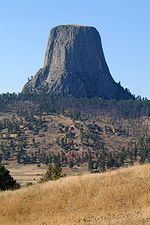
Although the intended use was for small historic sites, the first use of the Act actually protected a large geographic feature – President Roosevelt proclaimed Devils Tower National MonumentDevils Tower National Monument
Devils Tower is an igneous intrusion or laccolith located in the Black Hills near Hulett and Sundance in Crook County, northeastern Wyoming, above the Belle Fourche River...
on September 24, 1906. President Roosevelt also used it to create the Grand Canyon National Monument – the first step in protecting that place of great historic and scientific interest. The most recent proclamations was the establishment of Fort Monroe National Monument in Virginia by Barack Obama
Barack Obama
Barack Hussein Obama II is the 44th and current President of the United States. He is the first African American to hold the office. Obama previously served as a United States Senator from Illinois, from January 2005 until he resigned following his victory in the 2008 presidential election.Born in...
on November 1, 2011.
At 140000 square miles (362,598.3 km²), Papahānaumokuākea Marine National Monument is the largest protected area proclaimed. The smallest, Father Millet Cross National Monument, was a mere 0.0074 acres (29.9 m²).
For any excavation, the Act requires that a permit (Antiquities Permit) be obtained from the Secretary of the department which has jurisdiction over those lands.
Reduction of powers
Presidential powers under the Act have been reduced twice. The first time followed the unpopular proclamation of Jackson Hole National MonumentJackson Hole National Monument
Jackson Hole National Monument was a wildlife reserve in Jackson Hole, the majority of which is now a part of Grand Teton National Park in Wyoming, United States. It was created by executive order by Franklin Delano Roosevelt in 1943, and met with considerable opposition from Wyoming legislators....
in 1943. The 1950 law that incorporated Jackson Hole into an enlarged Grand Teton National Park
Grand Teton National Park
Grand Teton National Park is a United States National Park located in northwestern Wyoming, U.S. The Park consists of approximately and includes the major peaks of the long Teton Range as well as most of the northern sections of the valley known as Jackson Hole. Only south of Yellowstone...
also amended the Antiquities Act, requiring Congressional consent for any future creation or enlargement of National Monuments in Wyoming
Wyoming
Wyoming is a state in the mountain region of the Western United States. The western two thirds of the state is covered mostly with the mountain ranges and rangelands in the foothills of the Eastern Rocky Mountains, while the eastern third of the state is high elevation prairie known as the High...
. The second time followed Jimmy Carter
Jimmy Carter
James Earl "Jimmy" Carter, Jr. is an American politician who served as the 39th President of the United States and was the recipient of the 2002 Nobel Peace Prize, the only U.S. President to have received the Prize after leaving office...
's use of the Act to create fifty-six million acres (230,000 km²) of National Monuments in Alaska
Alaska
Alaska is the largest state in the United States by area. It is situated in the northwest extremity of the North American continent, with Canada to the east, the Arctic Ocean to the north, and the Pacific Ocean to the west and south, with Russia further west across the Bering Strait...
. The Alaska National Interest Lands Conservation Act
Alaska National Interest Lands Conservation Act
The Alaska National Interest Lands Conservation Act was a United States federal law passed in 1980 by the U.S. Congress and signed into law by President Jimmy Carter on December 2 of that year....
requires Congressional ratification of the use of the Antiquities Act in Alaska for withdrawals of greater than 5,000 acres (20.2 km²).
Codification
The Antiquities Act is codified at to .See also
- Timeline of environmental eventsTimeline of environmental eventsThe timeline lists geological, astronomical, and climatological events in relation to events in human history which they influenced. For the history of humanity's perspective on these events, see timeline of the history of environmentalism...
External links
- Richard West Sellars, "A Very Large Array: Early Federal Historic Preservation--The Antiquities Act, Mesa Verde, and the National Park Service Act"(background and legislative history) published by the University of New Mexico School of Law, 2007.
- The Story of the Antiquities Act, by Ronald F. Lee
- Antiquities Act 1906–2006
- The National Park Service
- Almanac of Theodore Roosevelt
- Archeology.org
- The Antiquities Act: A Century of American Archaeology, Historic Preservation, and Nature Conservation, ed. by David Harmon, Frank P. McManamon, and Dwight T. Pitcaithley
- The Highs and Lows of the Antiquities Act