


Union Army Balloon Corps

Encyclopedia
The Union Army Balloon Corps was a branch of the Union Army
during the American Civil War
, established by presidential appointee Thaddeus S. C. Lowe
. It was organized as a civilian operation, which employed a group of prominent American aeronauts and seven specially built, gas-filled balloons
to perform aerial reconnaissance
on the Confederate States Army
.
Lowe was one of few veteran balloonists who was working on an attempt to make a transatlantic
crossing by balloon. His efforts were interrupted by the onset of the Civil War, which broke out one week before one of his most important test flights. Subsequently he offered his aviation expertise to the development of an air-war mechanism through the use of aerostat
s for reconnaissance
purposes. Lowe met with U.S. President
Abraham Lincoln
on July 11, 1861, and proposed a demonstration with his own balloon, the Enterprise
, from the lawn of the armory directly across the street from the White House
. From a height of 500 foot he telegraphed a message to the President describing his view of the Washington, D.C.
, countryside. Eventually he was chosen over other candidates to be chief aeronaut of the newly formed Union Army Balloon Corps.
The Balloon Corps with a hand-selected team of expert aeronauts served at Yorktown, Seven Pines
, Antietam
, Fredericksburg
, and other major battles of the Potomac River
and the Virginia Peninsula
. The Balloon Corps served the Union Army from October 1861 until the summer of 1863, when it was disbanded following the resignation of Lowe.
at the Battle of Fleurus
in 1794. U. S. President Abraham Lincoln
became interested in an air-war mechanism for reconnaissance purposes. This created a notion at the War Department and at the Treasury that some sort of balloon aviation unit need be established and headed by a "Chief Aeronaut". Several top American balloonists traveled to Washington in hopes of obtaining just such a position. However, there were no proposed details to the establishment of such a unit, or whether it would even be a military or civilian operation. Nor was there any set method to the process of selecting a Chief Aeronaut, rather it became a free-for-all in attempts to attract the attention of any officials in either the government or the military. In actuality the use of balloons was left to the discretion of the commanding generals through a process of trial and error based on the best recommendations of the balloonists themselves. Of those seeking the position, only two were given actual opportunities to perform combat aerial reconnaissance, Prof. Thaddeus Lowe and Mr. John LaMountain
.
of the Smithsonian Institution
, who became his greatest benefactor.
On Henry's and others' recommendations, Lowe was contacted by Secretary of the Treasury Salmon P. Chase
, who invited him to Washington for an audience with Secretary of War
Simon Cameron
and the President. On 11 June 1861, Lowe was received by Lincoln and immediately offered to give the President a live demonstration with the balloon.
On Saturday, 16 June, with his own balloon, the Enterprise, Lowe ascended some 500 foot above the Columbian Armory with a telegraph key and operator, and a wire following a tether line to the White House across the street. From aloft he transmitted the message:
Lowe's first assignment was with the Topographical Engineers, where his balloon was used for aerial observations and map making. Eventually he worked with Major General Irvin McDowell
, who rode along with Lowe making preliminary observations over the battlefield at Bull Run
. McDowell became impressed with Lowe and his balloon, and a good word reached the President, who personally introduced Lowe to Union General-in-Chief Winfield Scott
. "General, this is my friend Professor Lowe who is organizing an aeronautics corps and who is to be its chief. I wish you would facilitate his work in every way." This introduction fairly well settled the selection of Lowe as Chief Aeronaut. The details of establishing the corps and its method of operation were left up to Lowe. The misunderstanding that the Balloon Corps would remain a civilian contract lasted its duration, and neither Lowe nor any of his men ever received commissions.
was an early pioneer of American ballooning born in 1808. Although he made great contributions to the then newborn science of aeronautics, he was more a showman than a scientist. His attempts at free flight in preparation for a transatlantic crossing were less than successful, and he did not receive the same type of financial support from the patrons of the sciences, nor did he carry the overall scientific credibility of Lowe.
Wise was, however, taken seriously enough by the Topographical Engineers
to be asked to build a balloon. Mary Hoehling indicated that Captain Whipple of the Topographical Engineers told Lowe that Wise was preparing to bring up his own balloon, supposedly the Atlantic. Other accounts state that John LaMountain had taken possession of the Atlantic after a failed flight he had made with Wise in 1859. Lowe's report says that Captain Whipple indicated they had instructed Mr. Wise to construct a new balloon. He also proposed that Lowe pilot the new balloon. Prof. Lowe was vehemently opposed to flying one of Wise's old-style balloons. Historical accounts have already placed the Atlantic with John LaMountain at Fort Monroe.
The engineers waited the whole month of July for Wise to arrive on scene. By 19 July 1861, McDowell started calling for a balloon to be brought to the front at First Bull Run
(Centreville
). As Wise was not to be found, Whipple sent Lowe out to inflate his balloon and prepare to set out for Falls Church
. Mary Hoehling tells of the sudden appearance of John Wise who demanded that Lowe stop his inflating of the Enterprise and let him inflate his balloon instead. Wise had legal papers upholding his purported authority. Although Wise's arrival on the scene was tardy, he did inflate his balloon and proceeded toward the battlefield. On the way the balloon became caught in the brush and was permanently disabled. This ended Wise's bid for the position, and Lowe was at last unencumbered from taking up the task.
Lowe describes the inflation incident in his official report less dramatically, saying that he was told by the gas plant supervisor to disconnect and let another balloon go first. Lowe did not name names, but it is not likely that it was anyone other than Wise. Lowe's report about a new balloon has to be considered over Hoehling's account of the Atlantic.
LaMountain's contributions and successes were minimal. However, he did attract the attention of General Benjamin Butler
at Fort Monroe
. LaMountain operated at Fort Monroe for a while with the battered Atlantic and was actually accredited with having made the first effective wartime observations from an aerial position. He also obtained use of a balloon, the Saratoga, which he soon lost in a windstorm. LaMountain advocated free flight balloon reconnaissance, whereas Lowe used captive or tethered flight, remaining always attached to a ground crew who could reel him in.
Wise and LaMountain had been longtime detractors of Prof. Lowe, but LaMountain maintained a vitriolic campaign against Lowe to discredit him and usurp his position as Chief Aeronaut. He used the arena of public opinion to revile Lowe. But as Gen. Butler was replaced at Fort Monroe, LaMountain was assigned to the Balloon Corps under Lowe's command. LaMountain continued his public derogation of Lowe as well as creating ill-will among the other men in the Corps. Lowe lodged a formal complaint to Gen. George B. McClellan
, and by February 1862 LaMountain was discharged from military service.
LaMountain and Lowe had long argued over free flight and captive flight. In Lowe's first instance of demonstration at Bull Run, he made a free flight which caught him hovering over Union encampments who could not properly identify him. As a civilian he wore no uniform nor insignias. With each descent came the threat of being fired on, and to make each descent Lowe needed to release gas. In one instance Lowe was forced to land behind enemy lines and await being rescued overnight. After this incident he remained tethered to the ground by which he could be reeled in at a moment's notice. Besides, his use of the telegraph from the balloon car required a wire be run along the tether.
LaMountain, from his position at Fort Monroe, had the luxury of flying free. When he was enjoined with the Balloon Corps, he began insisting that his reconnaissance flights be made free. Lowe strictly instructed his men against free flight as a matter of policy and procedure. Eventually the two men agreed to a showdown in which LaMountain made one of his free flights. The flight was a success as a reconnaissance flight with LaMountain being able to go where he would. But on his return he was threatened by Union troops who could not identify him. His balloon was shot down, and LaMountain was treated harshly until he was clearly identified.
Lowe considered the incident an argument against free flight. LaMountain insisted that the flight was highly successful despite the unfortunate incident. The showdown did nothing to settle the argument, but Lowe's position as Chief Aeronaut allowed him to prevail.
supply stations and were towed inflated by ground crews to the field. Lowe recognized the need for the development of portable hydrogen gas generators, by which the balloons could be filled in the field. Lowe had to deal with administrative officers who usually held ranks lower than major and had more interest in accounting than providing for a proper war effort. This caused hold ups in funding of materials.
Lowe was called out for another demonstration mission that would change the effective use of field artillery. On 24 September 1861, he was directed to position himself at Fort Corcoran
, south of Washington, to ascend and overlook the Confederate encampments at Falls Church, Virginia, at a distance further south. A concealed Union artillery battery was remotely located at Camp Advance. Lowe was to give flag signal directions to the artillery who would fire blindly on Falls Church. Each signal would indicate adjustments to the left, to the right, long or short. Simultaneously reports were telegraphed down to headquarters at the fort. With only a few corrections, the battery was soon landing rounds right on target. This was the precursor to the use of the artillery forward observer
(FO).
The next day, Lowe received orders to build four proper balloons with hydrogen gas generators. Lowe went to work at his Philadelphia facility. He was given funding to order India silk
and cotton cording he had proposed for their construction. Along with that came Lowe's undisclosed recipe for a varnish
that would render the balloon envelopes leakproof.
The generators were built at the Washington Navy Yard
by master joiners who fashioned a contraption of copper plumbing and tanks which, when filled with sulfuric acid
and iron filings, would yield hydrogen gas. The generators were Lowe's own design and were considered a marvel of engineering. They were designed to be loaded into box crates that could easily fit on a standard buckboard
. The generators took more time to build than the balloons and were not as readily available as the first balloon.
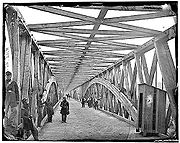
By 1 October 1861, the first balloon, the Union, was ready for action. Though it lacked a portable gas generator, it was called into immediate service. It was gassed up in Washington and towed overnight to Lewinsville via Chain Bridge. The fully covered and trellised bridge required that the towing handlers crawl over the bridge beams and stringers to cross the upper Potomac River
into Fairfax County
. The balloon and crew arrived by daylight, exhausted from the nine-hour overnight ordeal, when a gale-force wind took the balloon away. It was later recovered, but not before Lowe, who was humiliated by the incident, went on a tirade about the delays in providing proper equipment.
 Lowe built seven balloons, six of which were put into service. Each balloon was accompanied by two gas generating sets. The smaller balloons were used in windier weather, or for quick, one-man, low altitude ascents. They inflated quickly since they required less gas. They were:
The larger balloons were used for carrying more weight, such as a telegraph key set and an additional man as an operator. They could also ascend higher. They were:
The latter two balloons were held in storage in a Washington warehouse. Eventually the Excelsior was sent to Camp Lowe, a high altitude observation point, as a back-up balloon to the Intrepid during harsh winter weather, but the United States was never put into service. LaMountain made reference to these two balloons in his diatribes against Lowe as "being hoarded" by Lowe so he could buy them unused at the end of the war.
Lowe set up several locations for the balloons—Fort Monroe, Washington D.C., Camp Lowe near Harpers Ferry—but always kept himself at the battle front. He served General McClellan at Yorktown
until the Confederates
retreated toward Richmond
. The heavily forested Virginia Peninsula
forced him to take to the waterways. Balloon service was requested at more remote locations as well. Eben Seaver was assigned to take the Eagle to the Mississippi River
to assist in battlefronts there. Mr. Starkweather was sent to Port Royal
with the Washington just prior to the Peninsula Campaign.
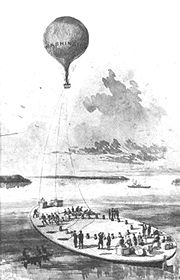 The General Washington Parke Custis, a converted coal barge, had its deck cleared of all items that could entangle the ropes and nets of the balloons, and it was used as a river transport for the Corps. Lowe had two gas generators and a balloon loaded aboard and later reported:
 The battlefront turned toward Richmond
in the Peninsula Campaign
. The heavy forestation inhibited the use of balloons, so Lowe and his Balloon Corps, with the use of three of his balloons, the Constitution, the Washington, and the larger Intrepid, used the waterways to make its way inland. In mid May 1862, Lowe arrived at the White House on the Pamunkey River
. This is the first home of George
and Martha Washington
, after which the Washington presidential residence is named. At this time, it was the home of the son of Robert E. Lee
, whose family fled at the arrival of Lowe. Lowe was met by McClellan's Army a few days later, and by 18 May, he had set up a balloon camp at Gaines' Farm across the Chickahominy River
north of Richmond, and another at Mechanicsville
. From these vantage points, Lowe, his assistant James Allen, and his father Clovis were able to overlook the Battle of Seven Pines
.
 A small contingent from Gen. Samuel P. Heintzelman
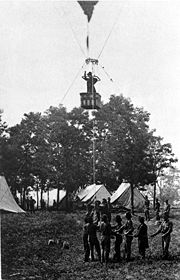
's corps crossed the river toward Richmond and was slowly being surrounded by elements of the Confederate Army. McClellan felt that the Confederates were simply feigning an attack. Lowe could see, from his better vantage point, that they were converging on Heintzelman's position. Heintzelman was cut off from the main body because the swollen river had taken out all the bridges. Lowe sent urgent word of Heintzelman's predicament and recommended immediate repair of New Bridge and reinforcements for him.
At the same time, he sent over an order for the inflation of the Intrepid, a larger balloon that could take him higher with telegraph equipment, in order to oversee the imminent battle. When Lowe arrived from Mechanicsville to the site of the Intrepid at Gaines' Mill, he saw that the aerostat's envelope was an hour away from being fully inflated. He then called for a camp kettle to have the bottom cut out of it, and he hooked the valve ends of the Intrepid and the Constitution together. He had the gas of the Constitution transferred to the Intrepid and was up in the air in 15 minutes. From this new vantage point, Lowe was able to report on all the Confederate movements. McClellan took Lowe's advice, repaired the bridge, and had reinforcements sent to Heintzelman's aid. An account of the battle was being witnessed by the visiting Count de Joinville who at day's end addressed Lowe with: "You, sir, have saved the day!"
Attempts at making gas-filled silk
balloons were hampered by the South's inability to obtain any imports at all. They did fashion a balloon from dress silk. Evans cites excerpts from Confederate letters that stated their balloons were made from dress-making silk and not dresses themselves. As it was put: "... not a single Southern Belle
was asked to give up her Sunday best for the cause." Eugene Block quotes a letter that Lowe received from Confederate Major General James Longstreet
asserting that they were sent out to gather up all the silk dresses to be found to fashion a balloon:
The patchwork silk was given to Lowe who had no use for it but to cut it up and distribute it to Congress as souvenirs. The inflated spheres appeared as multi-colored orbs over Richmond and were piloted by Captain Landon Cheeves. Before the first balloon could be used, it was captured by the crew of the USS Monitor
during transportation on the James River. A second balloon was put into action in the summer of 1863, when it was blown from its mooring and taken by Union forces and divided up as souvenirs for members of the Federal Congress. As the Union Army reduced its use of balloons, so did the Confederates.
in the swampy conditions and was out of service for a little more than a month. When he returned to duty, he found that all his wagons, mules, and service equipment had been returned to the Army Quartermaster. He was essentially out of a job. Lowe was ordered to join the Army for the Battle of Antietam
, but he did not reach the battlefield until after the Confederates began their retreat to Virginia. Lowe had to reintroduce himself to the new commanding general of the Army of the Potomac, Ambrose Burnside
, who activated Lowe at the Battle of Fredericksburg
.
For all its success, the Balloon Corps was never fully appreciated by the military community. They were still regarded as carnival showmen. Others had little respect for their break-neck operation. The only ones who found any value in them were the generals whose jobs and reputations were on the line. Lower-ranking administrators looked with disdain on this band of civilians who, as they perceived them, had no place in the military. Furthermore, none of the corps ever received a military commission, leaving them facing the dangers of being captured and treated as spies, summarily punishable by death.
The Balloon Corps was eventually assigned to the Army Corps of Engineers and put under the administrative purview of one Captain C. B. Comstock, who did not appreciate a civilian (Lowe) being paid more than he. He reduced Lowe's pay from $10 gold to $6 currency (equal to $3 gold) per day. Lowe posted a letter of outrage and threatened to resign his position. No one came to his support, and Comstock remained unyielding. On 8 April 1863, Lowe left the military service and returned to the private sector. Direction of the Balloon Corps defaulted to the Allen brothers, but they were not as competent as Lowe. By 1 August 1863, the Corps was no longer used.
(a dirigible, blimp
, or zeppelin
) came into existence with their motorized propulsion and mechanical means of steering. The United States Army Signal Corps
established a War Balloon Company in 1893 at Fort Riley
, Kansas
(at the time, home of the Signal School), and the next year at Fort Logan, Colorado, using a single balloon (the General Myer) purchased in France. When that balloon deteriorated, members of the company sewed together a silk replacement in 1897. The balloon, dubbed the Santiago, saw limited use in combat in 1898 during the Spanish-American War
.
Reports of Lowe's work in aeronautics and aerial reconnaissance were heard abroad. In 1864, Lowe was offered a Major-General position with the Brazilian Army
, which was at war with Paraguay
, but he turned it down. Not long thereafter, the German Count Ferdinand von Zeppelin
visited Lowe to look into his aeronautic methods. Von Zeppelin’s dirigible revolutionized aviation of the day.
In the 19th century, the idea of dropping ordnance on the enemy from an aerial station was not seriously considered, although there was a patent issued to a Charles Perley in February 1863 for a bomb-dropping device that could be floated aloft by balloon. The balloon bomb was to be unmanned, and the plan was a theory which had no effective way of assuring that a bomb could be delivered and dropped remotely on the enemy. Also, as a civilian operation the Balloon Corps would have never been expected to drop ordnance.
Union Army
The Union Army was the land force that fought for the Union during the American Civil War. It was also known as the Federal Army, the U.S. Army, the Northern Army and the National Army...
during the American Civil War
American Civil War
The American Civil War was a civil war fought in the United States of America. In response to the election of Abraham Lincoln as President of the United States, 11 southern slave states declared their secession from the United States and formed the Confederate States of America ; the other 25...
, established by presidential appointee Thaddeus S. C. Lowe
Thaddeus S. C. Lowe
Thaddeus Sobieski Coulincourt Lowe , also known as Professor T. S. C. Lowe, was an American Civil War aeronaut, scientist and inventor, mostly self-educated in the fields of chemistry, meteorology, and aeronautics, and the father of military aerial reconnaissance in the United States...
. It was organized as a civilian operation, which employed a group of prominent American aeronauts and seven specially built, gas-filled balloons
Balloon (aircraft)
A balloon is a type of aircraft that remains aloft due to its buoyancy. A balloon travels by moving with the wind. It is distinct from an airship, which is a buoyant aircraft that can be propelled through the air in a controlled manner....
to perform aerial reconnaissance
Reconnaissance
Reconnaissance is the military term for exploring beyond the area occupied by friendly forces to gain information about enemy forces or features of the environment....
on the Confederate States Army
Confederate States Army
The Confederate States Army was the army of the Confederate States of America while the Confederacy existed during the American Civil War. On February 8, 1861, delegates from the seven Deep South states which had already declared their secession from the United States of America adopted the...
.
Lowe was one of few veteran balloonists who was working on an attempt to make a transatlantic
Transatlantic
Transatlantic crossings are passages of passengers and cargo across the Atlantic Ocean between the Americas and Europe. Prior to the 19th century, transatlantic crossings were undertaken in sailing ships, which was a time consuming and often perilous journey. Transatlantic crossings became faster,...
crossing by balloon. His efforts were interrupted by the onset of the Civil War, which broke out one week before one of his most important test flights. Subsequently he offered his aviation expertise to the development of an air-war mechanism through the use of aerostat
Aerostat
An aerostat is a craft that remains aloft primarily through the use of buoyant lighter than air gases, which impart lift to a vehicle with nearly the same overall density as air. Aerostats include free balloons, airships, and moored balloons...
s for reconnaissance
Reconnaissance
Reconnaissance is the military term for exploring beyond the area occupied by friendly forces to gain information about enemy forces or features of the environment....
purposes. Lowe met with U.S. President
President of the United States
The President of the United States of America is the head of state and head of government of the United States. The president leads the executive branch of the federal government and is the commander-in-chief of the United States Armed Forces....
Abraham Lincoln
Abraham Lincoln
Abraham Lincoln was the 16th President of the United States, serving from March 1861 until his assassination in April 1865. He successfully led his country through a great constitutional, military and moral crisis – the American Civil War – preserving the Union, while ending slavery, and...
on July 11, 1861, and proposed a demonstration with his own balloon, the Enterprise
Enterprise (balloon)
The Enterprise was a gas inflated aerostat built by Prof. Thaddeus S. C. Lowe along with his father Clovis Lowe in 1858. It was the second balloon built by Lowe at his Hoboken, N.J. facility and named with the express approval of his wife Leontine because of the money and time they put into...
, from the lawn of the armory directly across the street from the White House
White House
The White House is the official residence and principal workplace of the president of the United States. Located at 1600 Pennsylvania Avenue NW in Washington, D.C., the house was designed by Irish-born James Hoban, and built between 1792 and 1800 of white-painted Aquia sandstone in the Neoclassical...
. From a height of 500 foot he telegraphed a message to the President describing his view of the Washington, D.C.
Washington, D.C.
Washington, D.C., formally the District of Columbia and commonly referred to as Washington, "the District", or simply D.C., is the capital of the United States. On July 16, 1790, the United States Congress approved the creation of a permanent national capital as permitted by the U.S. Constitution....
, countryside. Eventually he was chosen over other candidates to be chief aeronaut of the newly formed Union Army Balloon Corps.
The Balloon Corps with a hand-selected team of expert aeronauts served at Yorktown, Seven Pines
Battle of Seven Pines
The Battle of Seven Pines, also known as the Battle of Fair Oaks or Fair Oaks Station, took place on May 31 and June 1, 1862, in Henrico County, Virginia, as part of the Peninsula Campaign of the American Civil War. It was the culmination of an offensive up the Virginia Peninsula by Union Maj. Gen....
, Antietam
Battle of Antietam
The Battle of Antietam , fought on September 17, 1862, near Sharpsburg, Maryland, and Antietam Creek, as part of the Maryland Campaign, was the first major battle in the American Civil War to take place on Northern soil. It was the bloodiest single-day battle in American history, with about 23,000...
, Fredericksburg
Battle of Fredericksburg
The Battle of Fredericksburg was fought December 11–15, 1862, in and around Fredericksburg, Virginia, between General Robert E. Lee's Confederate Army of Northern Virginia and the Union Army of the Potomac, commanded by Maj. Gen. Ambrose E. Burnside...
, and other major battles of the Potomac River
Potomac River
The Potomac River flows into the Chesapeake Bay, located along the mid-Atlantic coast of the United States. The river is approximately long, with a drainage area of about 14,700 square miles...
and the Virginia Peninsula
Virginia Peninsula
The Virginia Peninsula is a peninsula in southeast Virginia, USA, bounded by the York River, James River, Hampton Roads and Chesapeake Bay.Hampton Roads is the common name for the metropolitan area that surrounds the body of water of the same name...
. The Balloon Corps served the Union Army from October 1861 until the summer of 1863, when it was disbanded following the resignation of Lowe.
Selecting a Chief Aeronaut
The use of balloons as an air-war mechanism was first recorded in France by the French Aerostatic CorpsFrench Aerostatic Corps
The French Aerostatic Corps or Company of Aeronauts was the world's first air force, founded in 1794 to use balloons, primarily for reconnaissance.-Experimentation:...
at the Battle of Fleurus
Battle of Fleurus (1794)
In the Battle of Fleurus on 26 June 1794, the army of the First French Republic under General Jean-Baptiste Jourdan faced the Coalition Army commanded by Prince Josias of Coburg in the most decisive battle of the Flanders Campaign in the Low Countries during the French Revolutionary Wars...
in 1794. U. S. President Abraham Lincoln
Abraham Lincoln
Abraham Lincoln was the 16th President of the United States, serving from March 1861 until his assassination in April 1865. He successfully led his country through a great constitutional, military and moral crisis – the American Civil War – preserving the Union, while ending slavery, and...
became interested in an air-war mechanism for reconnaissance purposes. This created a notion at the War Department and at the Treasury that some sort of balloon aviation unit need be established and headed by a "Chief Aeronaut". Several top American balloonists traveled to Washington in hopes of obtaining just such a position. However, there were no proposed details to the establishment of such a unit, or whether it would even be a military or civilian operation. Nor was there any set method to the process of selecting a Chief Aeronaut, rather it became a free-for-all in attempts to attract the attention of any officials in either the government or the military. In actuality the use of balloons was left to the discretion of the commanding generals through a process of trial and error based on the best recommendations of the balloonists themselves. Of those seeking the position, only two were given actual opportunities to perform combat aerial reconnaissance, Prof. Thaddeus Lowe and Mr. John LaMountain
John La Mountain
John LaMountain was a ballooning pioneer. He was privately contracted as an aerial observer by General Butler at Fortress Monroe during the American Civil War and is accredited with having made the first report of useful intelligence on enemy activity...
.
Thaddeus Lowe
Professor Thaddeus S. C. Lowe was one of the top American balloonists who sought the position of Chief Aeronaut for the Union Army. Also vying for the position were Prof. John Wise, Prof. John LaMountain, and Ezra and James Allen. All these men were aeronauts of extraordinary qualification in aviation of the day. Among them Lowe stood out as the most successful in balloon building and the closest to making a transatlantic flight. His scientific record was held in high regard among colleagues of the day, to include one Prof. Joseph HenryJoseph Henry
Joseph Henry was an American scientist who served as the first Secretary of the Smithsonian Institution, as well as a founding member of the National Institute for the Promotion of Science, a precursor of the Smithsonian Institution. During his lifetime, he was highly regarded...
of the Smithsonian Institution
Smithsonian Institution
The Smithsonian Institution is an educational and research institute and associated museum complex, administered and funded by the government of the United States and by funds from its endowment, contributions, and profits from its retail operations, concessions, licensing activities, and magazines...
, who became his greatest benefactor.
On Henry's and others' recommendations, Lowe was contacted by Secretary of the Treasury Salmon P. Chase
Salmon P. Chase
Salmon Portland Chase was an American politician and jurist who served as U.S. Senator from Ohio and the 23rd Governor of Ohio; as U.S. Treasury Secretary under President Abraham Lincoln; and as the sixth Chief Justice of the United States Supreme Court.Chase was one of the most prominent members...
, who invited him to Washington for an audience with Secretary of War
United States Secretary of War
The Secretary of War was a member of the United States President's Cabinet, beginning with George Washington's administration. A similar position, called either "Secretary at War" or "Secretary of War," was appointed to serve the Congress of the Confederation under the Articles of Confederation...
Simon Cameron
Simon Cameron
Simon Cameron was an American politician who served as United States Secretary of War for Abraham Lincoln at the start of the American Civil War. After making his fortune in railways and banking, he turned to a life of politics. He became a U.S. senator in 1845 for the state of Pennsylvania,...
and the President. On 11 June 1861, Lowe was received by Lincoln and immediately offered to give the President a live demonstration with the balloon.
On Saturday, 16 June, with his own balloon, the Enterprise, Lowe ascended some 500 foot above the Columbian Armory with a telegraph key and operator, and a wire following a tether line to the White House across the street. From aloft he transmitted the message:
- Balloon Enterprise
- Washington, D. C. 16 June 1861
- To President United States:
- This point of observation commands an area nearly fifty miles in diameter. The city with its girdle of encampments presents a superb scene. I have pleasure in sending you this first dispatch ever telegraphed from an aerial station and in acknowledging indebtedness to your encouragement for the opportunity of demonstrating the availability of the science of aeronautics in the service of the country. T.S.C. Lowe.
Lowe's first assignment was with the Topographical Engineers, where his balloon was used for aerial observations and map making. Eventually he worked with Major General Irvin McDowell
Irvin McDowell
Irvin McDowell was a career American army officer. He is best known for his defeat in the First Battle of Bull Run, the first large-scale battle of the American Civil War.-Early life:...
, who rode along with Lowe making preliminary observations over the battlefield at Bull Run
Bull Run (Occoquan River)
Bull Run is a free-flowing tributary stream of the Potomac River that originates from a spring in the Bull Run Mountains in Loudoun County, Virginia, and flows south to the Occoquan River...
. McDowell became impressed with Lowe and his balloon, and a good word reached the President, who personally introduced Lowe to Union General-in-Chief Winfield Scott
Winfield Scott
Winfield Scott was a United States Army general, and unsuccessful presidential candidate of the Whig Party in 1852....
. "General, this is my friend Professor Lowe who is organizing an aeronautics corps and who is to be its chief. I wish you would facilitate his work in every way." This introduction fairly well settled the selection of Lowe as Chief Aeronaut. The details of establishing the corps and its method of operation were left up to Lowe. The misunderstanding that the Balloon Corps would remain a civilian contract lasted its duration, and neither Lowe nor any of his men ever received commissions.
John Wise
John WiseJohn Wise (balloonist)
John Wise was a pioneer in the field of ballooning. He made over 400 flights during his lifetime and was responsible for several innovations in balloon design...
was an early pioneer of American ballooning born in 1808. Although he made great contributions to the then newborn science of aeronautics, he was more a showman than a scientist. His attempts at free flight in preparation for a transatlantic crossing were less than successful, and he did not receive the same type of financial support from the patrons of the sciences, nor did he carry the overall scientific credibility of Lowe.
Wise was, however, taken seriously enough by the Topographical Engineers
United States Army Corps of Engineers
The United States Army Corps of Engineers is a federal agency and a major Army command made up of some 38,000 civilian and military personnel, making it the world's largest public engineering, design and construction management agency...
to be asked to build a balloon. Mary Hoehling indicated that Captain Whipple of the Topographical Engineers told Lowe that Wise was preparing to bring up his own balloon, supposedly the Atlantic. Other accounts state that John LaMountain had taken possession of the Atlantic after a failed flight he had made with Wise in 1859. Lowe's report says that Captain Whipple indicated they had instructed Mr. Wise to construct a new balloon. He also proposed that Lowe pilot the new balloon. Prof. Lowe was vehemently opposed to flying one of Wise's old-style balloons. Historical accounts have already placed the Atlantic with John LaMountain at Fort Monroe.
The engineers waited the whole month of July for Wise to arrive on scene. By 19 July 1861, McDowell started calling for a balloon to be brought to the front at First Bull Run
First Battle of Bull Run
First Battle of Bull Run, also known as First Manassas , was fought on July 21, 1861, in Prince William County, Virginia, near the City of Manassas...
(Centreville
Centreville, Virginia
Centreville is an unincorporated community in Fairfax County, Virginia, United States. Recognized by the U.S. Census Bureau as a Census Designated Place , the community population was 71,135 as of the 2010 census and is approximately west of Washington, DC.-Colonial Period:Beginning in the 1760s,...
). As Wise was not to be found, Whipple sent Lowe out to inflate his balloon and prepare to set out for Falls Church
Falls Church, Virginia
The City of Falls Church is an independent city in Virginia, United States, in the Washington Metropolitan Area. The city population was 12,332 in 2010, up from 10,377 in 2000. Taking its name from The Falls Church, an 18th-century Anglican parish, Falls Church gained township status within...
. Mary Hoehling tells of the sudden appearance of John Wise who demanded that Lowe stop his inflating of the Enterprise and let him inflate his balloon instead. Wise had legal papers upholding his purported authority. Although Wise's arrival on the scene was tardy, he did inflate his balloon and proceeded toward the battlefield. On the way the balloon became caught in the brush and was permanently disabled. This ended Wise's bid for the position, and Lowe was at last unencumbered from taking up the task.
Lowe describes the inflation incident in his official report less dramatically, saying that he was told by the gas plant supervisor to disconnect and let another balloon go first. Lowe did not name names, but it is not likely that it was anyone other than Wise. Lowe's report about a new balloon has to be considered over Hoehling's account of the Atlantic.
John LaMountain
John LaMountain, born in 1830, had accrued quite a reputation in the field of aeronautics. He had joined company with Wise at one time to help with the plans for a transatlantic flight. Their attempt failed miserably, wrecked their balloon, the Atlantic, and ended their partnership. LaMountain took possession of the balloon.LaMountain's contributions and successes were minimal. However, he did attract the attention of General Benjamin Butler
Benjamin Franklin Butler (politician)
Benjamin Franklin Butler was an American lawyer and politician who represented Massachusetts in the United States House of Representatives and later served as the 33rd Governor of Massachusetts....
at Fort Monroe
Fort Monroe
Fort Monroe was a military installation in Hampton, Virginia—at Old Point Comfort, the southern tip of the Virginia Peninsula...
. LaMountain operated at Fort Monroe for a while with the battered Atlantic and was actually accredited with having made the first effective wartime observations from an aerial position. He also obtained use of a balloon, the Saratoga, which he soon lost in a windstorm. LaMountain advocated free flight balloon reconnaissance, whereas Lowe used captive or tethered flight, remaining always attached to a ground crew who could reel him in.
Wise and LaMountain had been longtime detractors of Prof. Lowe, but LaMountain maintained a vitriolic campaign against Lowe to discredit him and usurp his position as Chief Aeronaut. He used the arena of public opinion to revile Lowe. But as Gen. Butler was replaced at Fort Monroe, LaMountain was assigned to the Balloon Corps under Lowe's command. LaMountain continued his public derogation of Lowe as well as creating ill-will among the other men in the Corps. Lowe lodged a formal complaint to Gen. George B. McClellan
George B. McClellan
George Brinton McClellan was a major general during the American Civil War. He organized the famous Army of the Potomac and served briefly as the general-in-chief of the Union Army. Early in the war, McClellan played an important role in raising a well-trained and organized army for the Union...
, and by February 1862 LaMountain was discharged from military service.
Free flight vs. captive flight
There were two methods of piloting balloons: free flight or captive. Free flight means that the balloon was able to travel in any direction or distance for as long or as far as the pilot was able to fly it. Captive flight means that the balloon was retained by a tether or series of tethers manned by ground crews. Free flight requires that the pilot ascend and return by his own control. Captive flight used ground crews to assist in altitude control and speedy return to the exact starting point. Tethers also allowed for the stringing of telegraph wires back to the ground. Information gathered from balloon observation was relayed to the ground by various means of signaling. From high altitudes the telegraph was almost always necessary. At closer altitudes a series of prepared flag signals, hand signals, or even a megaphone could be used to communicate with the ground. At night either the telegraph or lamps could be used. In the later battles of Lowe's tenure, all reports and communications were ordered to be made orally by ascending and descending with the balloon. This is notable in Lowe's Official Report II to the Secretary where his usual transcriptions of messages were lacking. Free flight would almost always require the aeronaut to return and make a report. This would be an obvious detriment to timely reporting.LaMountain and Lowe had long argued over free flight and captive flight. In Lowe's first instance of demonstration at Bull Run, he made a free flight which caught him hovering over Union encampments who could not properly identify him. As a civilian he wore no uniform nor insignias. With each descent came the threat of being fired on, and to make each descent Lowe needed to release gas. In one instance Lowe was forced to land behind enemy lines and await being rescued overnight. After this incident he remained tethered to the ground by which he could be reeled in at a moment's notice. Besides, his use of the telegraph from the balloon car required a wire be run along the tether.
LaMountain, from his position at Fort Monroe, had the luxury of flying free. When he was enjoined with the Balloon Corps, he began insisting that his reconnaissance flights be made free. Lowe strictly instructed his men against free flight as a matter of policy and procedure. Eventually the two men agreed to a showdown in which LaMountain made one of his free flights. The flight was a success as a reconnaissance flight with LaMountain being able to go where he would. But on his return he was threatened by Union troops who could not identify him. His balloon was shot down, and LaMountain was treated harshly until he was clearly identified.
Lowe considered the incident an argument against free flight. LaMountain insisted that the flight was highly successful despite the unfortunate incident. The showdown did nothing to settle the argument, but Lowe's position as Chief Aeronaut allowed him to prevail.
Building military balloons
Lowe believed that balloons used for military purposes had to be better constructed than the common balloons used by civilian aeronauts. They also required special handling and care for use on the battlefield. At first the balloons of the day were inflated at municipal coke gasWood gas
Wood gas is a syngas fuel which can be used as a fuel for furnaces, stoves and vehicles in place of petrol, diesel or other fuels. During the production process biomass or other carbon-containing materials is gasified within the oxygen-limited environment of a wood gas generator to produce hydrogen...
supply stations and were towed inflated by ground crews to the field. Lowe recognized the need for the development of portable hydrogen gas generators, by which the balloons could be filled in the field. Lowe had to deal with administrative officers who usually held ranks lower than major and had more interest in accounting than providing for a proper war effort. This caused hold ups in funding of materials.
Lowe was called out for another demonstration mission that would change the effective use of field artillery. On 24 September 1861, he was directed to position himself at Fort Corcoran
Fort Corcoran
Fort Corcoran was a wood-and-earthwork fortification constructed by the Union Army in northern Virginia as part of the defenses of Washington, D.C. during the American Civil War...
, south of Washington, to ascend and overlook the Confederate encampments at Falls Church, Virginia, at a distance further south. A concealed Union artillery battery was remotely located at Camp Advance. Lowe was to give flag signal directions to the artillery who would fire blindly on Falls Church. Each signal would indicate adjustments to the left, to the right, long or short. Simultaneously reports were telegraphed down to headquarters at the fort. With only a few corrections, the battery was soon landing rounds right on target. This was the precursor to the use of the artillery forward observer
Artillery observer
A military artillery observer or spotter is responsible for directing artillery fire and close air support onto enemy positions. Because artillery is an indirect fire weapon system, the guns are rarely in line-of-sight of their target, often located tens of miles away...
(FO).
The next day, Lowe received orders to build four proper balloons with hydrogen gas generators. Lowe went to work at his Philadelphia facility. He was given funding to order India silk
Silk
Silk is a natural protein fiber, some forms of which can be woven into textiles. The best-known type of silk is obtained from the cocoons of the larvae of the mulberry silkworm Bombyx mori reared in captivity...
and cotton cording he had proposed for their construction. Along with that came Lowe's undisclosed recipe for a varnish
Varnish
Varnish is a transparent, hard, protective finish or film primarily used in wood finishing but also for other materials. Varnish is traditionally a combination of a drying oil, a resin, and a thinner or solvent. Varnish finishes are usually glossy but may be designed to produce satin or semi-gloss...
that would render the balloon envelopes leakproof.
The generators were built at the Washington Navy Yard
Washington Navy Yard
The Washington Navy Yard is the former shipyard and ordnance plant of the United States Navy in Southeast Washington, D.C. It is the oldest shore establishment of the U.S. Navy...
by master joiners who fashioned a contraption of copper plumbing and tanks which, when filled with sulfuric acid
Sulfuric acid
Sulfuric acid is a strong mineral acid with the molecular formula . Its historical name is oil of vitriol. Pure sulfuric acid is a highly corrosive, colorless, viscous liquid. The salts of sulfuric acid are called sulfates...
and iron filings, would yield hydrogen gas. The generators were Lowe's own design and were considered a marvel of engineering. They were designed to be loaded into box crates that could easily fit on a standard buckboard
Buckboard
A buckboard is a four-wheeled wagon of simple construction meant to be drawn by a horse or other large animal. The "buckboard" is the front-most board on the wagon that could act as both a footrest for the driver and protection for the driver from the horse's rear hooves in case of a "buck". The...
. The generators took more time to build than the balloons and were not as readily available as the first balloon.
By 1 October 1861, the first balloon, the Union, was ready for action. Though it lacked a portable gas generator, it was called into immediate service. It was gassed up in Washington and towed overnight to Lewinsville via Chain Bridge. The fully covered and trellised bridge required that the towing handlers crawl over the bridge beams and stringers to cross the upper Potomac River
Potomac River
The Potomac River flows into the Chesapeake Bay, located along the mid-Atlantic coast of the United States. The river is approximately long, with a drainage area of about 14,700 square miles...
into Fairfax County
Fairfax County, Virginia
Fairfax County is a county in Virginia, in the United States. Per the 2010 Census, the population of the county is 1,081,726, making it the most populous jurisdiction in the Commonwealth of Virginia, with 13.5% of Virginia's population...
. The balloon and crew arrived by daylight, exhausted from the nine-hour overnight ordeal, when a gale-force wind took the balloon away. It was later recovered, but not before Lowe, who was humiliated by the incident, went on a tirade about the delays in providing proper equipment.
- Eagle
- Constitution
- Washington
The larger balloons were used for carrying more weight, such as a telegraph key set and an additional man as an operator. They could also ascend higher. They were:
- Union
- IntrepidIntrepid (balloon aircraft)The Intrepid was a hydrogen gas balloon or aerostat built for use by the Union Army Balloon Corps for aerial reconnaissance purposes during the American Civil War. It was one of seven balloons constructed for the Balloon Corps and was one of the four larger balloons designed to make ascensions to...
(Lowe's favorite balloon) - Excelsior
- United States
The latter two balloons were held in storage in a Washington warehouse. Eventually the Excelsior was sent to Camp Lowe, a high altitude observation point, as a back-up balloon to the Intrepid during harsh winter weather, but the United States was never put into service. LaMountain made reference to these two balloons in his diatribes against Lowe as "being hoarded" by Lowe so he could buy them unused at the end of the war.
Establishing the Corps
Initially, Lowe was offered $30 per day for each day his balloon was in use. Lowe offered to accept $10 gold per day (colonel's pay) if he were to be allowed to build more suitable balloons. He was also allowed to hire as many men as he needed for $3 currency per day. Lowe was able to enlist his father, Clovis Lowe, an accomplished balloonist; Captain Dickinson, a seafaring volunteer from his days of transatlantic attempts; the Allen brothers, who had lost their own balloon when they were vying for the top job; two men the Allen brothers recommended, Eben Seaver and J. B. Starkweather; William Paullin, an older Philadelphia colleague; German balloonist John Steiner; and Ebenezer Mason, Lowe's construction supervisor, who requested active duty.Lowe set up several locations for the balloons—Fort Monroe, Washington D.C., Camp Lowe near Harpers Ferry—but always kept himself at the battle front. He served General McClellan at Yorktown
Yorktown, Virginia
Yorktown is a census-designated place in York County, Virginia, United States. The population was 220 in the 2000 census. It is the county seat of York County, one of the eight original shires formed in colonial Virginia in 1634....
until the Confederates
Confederate States Army
The Confederate States Army was the army of the Confederate States of America while the Confederacy existed during the American Civil War. On February 8, 1861, delegates from the seven Deep South states which had already declared their secession from the United States of America adopted the...
retreated toward Richmond
Richmond, Virginia
Richmond is the capital of the Commonwealth of Virginia, in the United States. It is an independent city and not part of any county. Richmond is the center of the Richmond Metropolitan Statistical Area and the Greater Richmond area...
. The heavily forested Virginia Peninsula
Virginia Peninsula
The Virginia Peninsula is a peninsula in southeast Virginia, USA, bounded by the York River, James River, Hampton Roads and Chesapeake Bay.Hampton Roads is the common name for the metropolitan area that surrounds the body of water of the same name...
forced him to take to the waterways. Balloon service was requested at more remote locations as well. Eben Seaver was assigned to take the Eagle to the Mississippi River
Mississippi River
The Mississippi River is the largest river system in North America. Flowing entirely in the United States, this river rises in western Minnesota and meanders slowly southwards for to the Mississippi River Delta at the Gulf of Mexico. With its many tributaries, the Mississippi's watershed drains...
to assist in battlefronts there. Mr. Starkweather was sent to Port Royal
Port Royal, Virginia
Port Royal is an incorporated town in Caroline County, Virginia, United States. The population was 170 at the 2000 census.Port Royal was established in the mid-17th century in the Colony of Virginia primary as a port on a navigable portion of the Rappahannock River for export of tobacco, Virginia's...
with the Washington just prior to the Peninsula Campaign.
First aircraft carrier
- I have the pleasure of reporting the complete success of the first balloon expedition by water ever attempted. I left the Navy yard early Sunday morning ... having on board competent assistant aeronauts, together with my new gas generating apparatus, which, though used for the first time, worked admirably.
Peninsula Campaign
Richmond, Virginia
Richmond is the capital of the Commonwealth of Virginia, in the United States. It is an independent city and not part of any county. Richmond is the center of the Richmond Metropolitan Statistical Area and the Greater Richmond area...
in the Peninsula Campaign
Peninsula Campaign
The Peninsula Campaign of the American Civil War was a major Union operation launched in southeastern Virginia from March through July 1862, the first large-scale offensive in the Eastern Theater. The operation, commanded by Maj. Gen. George B...
. The heavy forestation inhibited the use of balloons, so Lowe and his Balloon Corps, with the use of three of his balloons, the Constitution, the Washington, and the larger Intrepid, used the waterways to make its way inland. In mid May 1862, Lowe arrived at the White House on the Pamunkey River
Pamunkey River
The Pamunkey River is a tributary of the York River, about long, in eastern Virginia in the United States. Via the York River it is part of the watershed of Chesapeake Bay.-Course:...
. This is the first home of George
George Washington
George Washington was the dominant military and political leader of the new United States of America from 1775 to 1799. He led the American victory over Great Britain in the American Revolutionary War as commander-in-chief of the Continental Army from 1775 to 1783, and presided over the writing of...
and Martha Washington
Martha Washington
Martha Dandridge Custis Washington was the wife of George Washington, the first president of the United States. Although the title was not coined until after her death, Martha Washington is considered to be the first First Lady of the United States...
, after which the Washington presidential residence is named. At this time, it was the home of the son of Robert E. Lee
Robert E. Lee
Robert Edward Lee was a career military officer who is best known for having commanded the Confederate Army of Northern Virginia in the American Civil War....
, whose family fled at the arrival of Lowe. Lowe was met by McClellan's Army a few days later, and by 18 May, he had set up a balloon camp at Gaines' Farm across the Chickahominy River
Chickahominy River
The Chickahominy is an river in the eastern portion of the U.S. state of Virginia. The river rises about northwest of Richmond and flows southeast and south to the James River...
north of Richmond, and another at Mechanicsville
Mechanicsville, Virginia
Mechanicsville is the name of four places in the Commonwealth of Virginia in the United States of America:*Mechanicsville, Hanover County, Virginia*Mechanicsville, Loudoun County, Virginia*Mechanicsville, Rockbridge County, Virginia...
. From these vantage points, Lowe, his assistant James Allen, and his father Clovis were able to overlook the Battle of Seven Pines
Battle of Seven Pines
The Battle of Seven Pines, also known as the Battle of Fair Oaks or Fair Oaks Station, took place on May 31 and June 1, 1862, in Henrico County, Virginia, as part of the Peninsula Campaign of the American Civil War. It was the culmination of an offensive up the Virginia Peninsula by Union Maj. Gen....
.
Samuel P. Heintzelman
Samuel Peter Heintzelman was a United States Army General. He served in the Seminole War, the Mexican-American War, the Yuma War, the Cortina Troubles, and the American Civil War, rising to the command of a corps....
's corps crossed the river toward Richmond and was slowly being surrounded by elements of the Confederate Army. McClellan felt that the Confederates were simply feigning an attack. Lowe could see, from his better vantage point, that they were converging on Heintzelman's position. Heintzelman was cut off from the main body because the swollen river had taken out all the bridges. Lowe sent urgent word of Heintzelman's predicament and recommended immediate repair of New Bridge and reinforcements for him.
At the same time, he sent over an order for the inflation of the Intrepid, a larger balloon that could take him higher with telegraph equipment, in order to oversee the imminent battle. When Lowe arrived from Mechanicsville to the site of the Intrepid at Gaines' Mill, he saw that the aerostat's envelope was an hour away from being fully inflated. He then called for a camp kettle to have the bottom cut out of it, and he hooked the valve ends of the Intrepid and the Constitution together. He had the gas of the Constitution transferred to the Intrepid and was up in the air in 15 minutes. From this new vantage point, Lowe was able to report on all the Confederate movements. McClellan took Lowe's advice, repaired the bridge, and had reinforcements sent to Heintzelman's aid. An account of the battle was being witnessed by the visiting Count de Joinville who at day's end addressed Lowe with: "You, sir, have saved the day!"
Confederate Army's counter
Because of the effectiveness of the Union Army Balloon Corps, the Confederates felt compelled to incorporate balloons as well. Since coke gas was not readily available in Richmond, the first balloons were made of the Montgolfier rigid style: cotton stretched over wood framing and filled with hot smoke from fires made of oil-soaked pine cones. They were piloted by Captain John R. Bryan for use at Yorktown. Bryan's handlers were poorly experienced, and his balloon began spinning in the air. In another incident, one of the handlers became entangled in the ascending tether rope which had to be chopped loose, leaving the captain free-flying over his own Confederate positions whose troops threatened to shoot him down.Attempts at making gas-filled silk
Silk
Silk is a natural protein fiber, some forms of which can be woven into textiles. The best-known type of silk is obtained from the cocoons of the larvae of the mulberry silkworm Bombyx mori reared in captivity...
balloons were hampered by the South's inability to obtain any imports at all. They did fashion a balloon from dress silk. Evans cites excerpts from Confederate letters that stated their balloons were made from dress-making silk and not dresses themselves. As it was put: "... not a single Southern Belle
Southern belle
A southern belle is an archetype for a young woman of the American Old South's upper class....
was asked to give up her Sunday best for the cause." Eugene Block quotes a letter that Lowe received from Confederate Major General James Longstreet
James Longstreet
James Longstreet was one of the foremost Confederate generals of the American Civil War and the principal subordinate to General Robert E. Lee, who called him his "Old War Horse." He served under Lee as a corps commander for many of the famous battles fought by the Army of Northern Virginia in the...
asserting that they were sent out to gather up all the silk dresses to be found to fashion a balloon:
- While we were longing for balloons that poverty denied us, a genius arose and suggested that we send out and get every silk dress in the Confederacy to make a balloon. It was done and soon we had a great patchwork ship ... for use in the Seven Days campaignSeven Days BattlesThe Seven Days Battles was a series of six major battles over the seven days from June 25 to July 1, 1862, near Richmond, Virginia during the American Civil War. Confederate General Robert E. Lee drove the invading Union Army of the Potomac, commanded by Maj. Gen. George B. McClellan, away from...
. One day it was on a steamer down the James RiverJames RiverThe James River may refer to:Rivers in the United States and their namesakes* James River * James River , North Dakota, South Dakota* James River * James River * James River...
when the tide went out and left it high and dry on a [sand]bar. The Federals gathered it in, and with it the last silk dress in the Confederacy. This was the meanest trick of the war ...
The patchwork silk was given to Lowe who had no use for it but to cut it up and distribute it to Congress as souvenirs. The inflated spheres appeared as multi-colored orbs over Richmond and were piloted by Captain Landon Cheeves. Before the first balloon could be used, it was captured by the crew of the USS Monitor
USS Monitor
USS Monitor was the first ironclad warship commissioned by the United States Navy during the American Civil War. She is most famous for her participation in the Battle of Hampton Roads on March 9, 1862, the first-ever battle fought between two ironclads...
during transportation on the James River. A second balloon was put into action in the summer of 1863, when it was blown from its mooring and taken by Union forces and divided up as souvenirs for members of the Federal Congress. As the Union Army reduced its use of balloons, so did the Confederates.
Troubled Balloon Corps
During the Seven Days Battles in late June, McClellan's army was forced to retreat from the outskirts of Richmond. Lowe returned to Washington and he contracted malariaMalaria
Malaria is a mosquito-borne infectious disease of humans and other animals caused by eukaryotic protists of the genus Plasmodium. The disease results from the multiplication of Plasmodium parasites within red blood cells, causing symptoms that typically include fever and headache, in severe cases...
in the swampy conditions and was out of service for a little more than a month. When he returned to duty, he found that all his wagons, mules, and service equipment had been returned to the Army Quartermaster. He was essentially out of a job. Lowe was ordered to join the Army for the Battle of Antietam
Battle of Antietam
The Battle of Antietam , fought on September 17, 1862, near Sharpsburg, Maryland, and Antietam Creek, as part of the Maryland Campaign, was the first major battle in the American Civil War to take place on Northern soil. It was the bloodiest single-day battle in American history, with about 23,000...
, but he did not reach the battlefield until after the Confederates began their retreat to Virginia. Lowe had to reintroduce himself to the new commanding general of the Army of the Potomac, Ambrose Burnside
Ambrose Burnside
Ambrose Everett Burnside was an American soldier, railroad executive, inventor, industrialist, and politician from Rhode Island, serving as governor and a U.S. Senator...
, who activated Lowe at the Battle of Fredericksburg
Battle of Fredericksburg
The Battle of Fredericksburg was fought December 11–15, 1862, in and around Fredericksburg, Virginia, between General Robert E. Lee's Confederate Army of Northern Virginia and the Union Army of the Potomac, commanded by Maj. Gen. Ambrose E. Burnside...
.
For all its success, the Balloon Corps was never fully appreciated by the military community. They were still regarded as carnival showmen. Others had little respect for their break-neck operation. The only ones who found any value in them were the generals whose jobs and reputations were on the line. Lower-ranking administrators looked with disdain on this band of civilians who, as they perceived them, had no place in the military. Furthermore, none of the corps ever received a military commission, leaving them facing the dangers of being captured and treated as spies, summarily punishable by death.
The Balloon Corps was eventually assigned to the Army Corps of Engineers and put under the administrative purview of one Captain C. B. Comstock, who did not appreciate a civilian (Lowe) being paid more than he. He reduced Lowe's pay from $10 gold to $6 currency (equal to $3 gold) per day. Lowe posted a letter of outrage and threatened to resign his position. No one came to his support, and Comstock remained unyielding. On 8 April 1863, Lowe left the military service and returned to the private sector. Direction of the Balloon Corps defaulted to the Allen brothers, but they were not as competent as Lowe. By 1 August 1863, the Corps was no longer used.
After the Civil War
Manned air-war mechanisms became important again to the Army when the airshipAirship
An airship or dirigible is a type of aerostat or "lighter-than-air aircraft" that can be steered and propelled through the air using rudders and propellers or other thrust mechanisms...
(a dirigible, blimp
Blimp
A blimp, or non-rigid airship, is a floating airship without an internal supporting framework or keel. A non-rigid airship differs from a semi-rigid airship and a rigid airship in that it does not have any rigid structure, neither a complete framework nor a partial keel, to help the airbag...
, or zeppelin
Zeppelin
A Zeppelin is a type of rigid airship pioneered by the German Count Ferdinand von Zeppelin in the early 20th century. It was based on designs he had outlined in 1874 and detailed in 1893. His plans were reviewed by committee in 1894 and patented in the United States on 14 March 1899...
) came into existence with their motorized propulsion and mechanical means of steering. The United States Army Signal Corps
United States Army Signal Corps
The United States Army Signal Corps develops, tests, provides, and manages communications and information systems support for the command and control of combined arms forces. It was established in 1860, the brainchild of United States Army Major Albert J. Myer, and has had an important role from...
established a War Balloon Company in 1893 at Fort Riley
Fort Riley
Fort Riley is a United States Army installation located in Northeast Kansas, on the Kansas River, between Junction City and Manhattan. The Fort Riley Military Reservation covers 100,656 acres in Geary and Riley counties and includes two census-designated places: Fort Riley North and Fort...
, Kansas
Kansas
Kansas is a US state located in the Midwestern United States. It is named after the Kansas River which flows through it, which in turn was named after the Kansa Native American tribe, which inhabited the area. The tribe's name is often said to mean "people of the wind" or "people of the south...
(at the time, home of the Signal School), and the next year at Fort Logan, Colorado, using a single balloon (the General Myer) purchased in France. When that balloon deteriorated, members of the company sewed together a silk replacement in 1897. The balloon, dubbed the Santiago, saw limited use in combat in 1898 during the Spanish-American War
Spanish-American War
The Spanish–American War was a conflict in 1898 between Spain and the United States, effectively the result of American intervention in the ongoing Cuban War of Independence...
.
Reports of Lowe's work in aeronautics and aerial reconnaissance were heard abroad. In 1864, Lowe was offered a Major-General position with the Brazilian Army
Brazilian Army
The Brazilian Army is the land arm of the Brazilian Military. The Brazilian Army has fought in several international conflicts, mostly in South America and during the 19th century, such as the Brazilian War of Independence , Argentina-Brazil War , War of the Farrapos , Platine War , Uruguayan War ...
, which was at war with Paraguay
Paraguay
Paraguay , officially the Republic of Paraguay , is a landlocked country in South America. It is bordered by Argentina to the south and southwest, Brazil to the east and northeast, and Bolivia to the northwest. Paraguay lies on both banks of the Paraguay River, which runs through the center of the...
, but he turned it down. Not long thereafter, the German Count Ferdinand von Zeppelin
Ferdinand von Zeppelin
Ferdinand Adolf Heinrich August Graf von Zeppelin was a German general and later aircraft manufacturer. He founded the Zeppelin Airship company...
visited Lowe to look into his aeronautic methods. Von Zeppelin’s dirigible revolutionized aviation of the day.
In the 19th century, the idea of dropping ordnance on the enemy from an aerial station was not seriously considered, although there was a patent issued to a Charles Perley in February 1863 for a bomb-dropping device that could be floated aloft by balloon. The balloon bomb was to be unmanned, and the plan was a theory which had no effective way of assuring that a bomb could be delivered and dropped remotely on the enemy. Also, as a civilian operation the Balloon Corps would have never been expected to drop ordnance.