

Fort Sumter

Encyclopedia
Fort Sumter is a Third System masonry coastal fortification located in Charleston
Harbor, South Carolina
. The fort is best known as the site upon which the shots initiating the American Civil War
were fired, at the Battle of Fort Sumter
.
, Revolutionary War
hero, Fort Sumter was built following the War of 1812
, as one of a series of fortifications on the southern U.S. coast. Construction began in 1827, and the structure was still unfinished in 1861, when the Civil War began. Seventy thousand tons of granite were imported from New England
to build up a sand bar in the entrance to Charleston Harbor
, which the site dominates. The fort was a five-sided brick structure, 170 to 190 feet (57.9 m) long, with walls five feet thick, standing 50 feet (15.2 m) over the low tide mark. It was designed to house 650 men and 135 guns in three tiers of gun emplacements, although it was never filled near its full capacity.
abandoned the indefensible Fort Moultrie and secretly relocated companies E and H (127 men, 13 of them musicians) of the 1st U.S. Artillery to Fort Sumter on his own initiative, without orders from Washington. He thought that providing a stronger defense would delay an attack by South Carolina militia. The fort was not yet complete at the time and fewer than half of the cannon
s that should have been available were in place, due to military downsizing by President James Buchanan
. Over the next few months repeated calls for evacuation of Fort Sumter from the government of South Carolina and then from Confederate
Brigadier General
P. G. T. Beauregard
were ignored. Union attempts to resupply and reinforce the garrison were repulsed on January 9, 1861 when the first shots of the war, fired by cadets from The Citadel, The Military College of South Carolina, prevented the steamer Star of the West
, hired to transport troops and supplies to Fort Sumter, from completing the task. After realizing that Anderson's command would run out of food by April 15, 1861, President Lincoln
ordered a fleet of ships, under the command of Gustavus V. Fox
, to attempt entry into Charleston Harbor and support Fort Sumter. The ships assigned were the steam sloop-of-war USS Pawnee
, steam sloop-of-war USS Powhatan, transporting motorized launches and about 300 sailors (secretly removed from the Charleston fleet to join in the forced reinforcement of Fort Pickens
, Pensacola, Fla.), armed screw steamer USS Pocahontas
, Revenue Cutter
USRC Harriet Lane, steamer Baltic transporting about 200 troops, composed of companies C and D of the 2nd U.S. Artillery, and three hired tug boats with added protection against small arms fire to be used to tow troop and supply barges directly to Fort Sumter. By April 6, 1861 the first ships began to set sail for their rendezvous off the Charleston Bar
. The first to arrive was the Harriet Lane, before midnight of April 11, 1861.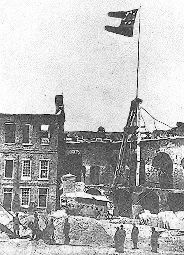
, Captain Stephen D. Lee
, and Lieutenant A. R. Chisolm to demand the surrender of the fort. Anderson declined, and the aides returned to report to Beauregard. After Beauregard had consulted the Secretary of War, Leroy Walker
, he sent the aides back to the fort and authorized Chesnut to decide whether the fort should be taken by force. The aides waited for hours while Anderson considered his alternatives and played for time. At about 3 a.m., when Anderson finally announced his conditions, Colonel Chesnut, after conferring with the other aides, decided that they were "manifestly futile and not within the scope of the instructions verbally given to us". The aides then left the fort and proceeded to the nearby Fort Johnson. There, Chesnut ordered the fort to open fire on Fort Sumter.
On Friday, April 12, 1861, at 4:30 a.m., Confederate batteries opened fire, firing for 34 straight hours, on the fort. Edmund Ruffin
, noted Virginian agronomist and secessionist, claimed that he fired the first shot on Fort Sumter. His story has been widely believed, but Lieutenant Henry S. Farley, commanding a battery of two mortars on James Island
fired the first shot at 4:30 A.M. . No attempt was made to return the fire for more than two hours. The fort's supply of ammunition was not suited for the task, also there were no fuses for their explosive shells, only solid balls could be used against the Rebel batteries. At about 7:00 A.M., Captain Abner Doubleday
, the fort's second in command, was given the honor of firing the first shot in defense of the fort. The shot was ineffective, in part because Major Anderson did not use the guns mounted on the highest tier, the barbette tier, where the gun detachments would be more exposed to Confederate fire. The firing continued all day, the Union fired slowly to conserve ammunition. At night the fire from the fort stopped, but the Confederates still lobbed an occasional shell in Sumter. On Saturday, April 13, the fort was surrendered and evacuated. During the attack, the Union colors fell. Lt.Norman J. Hall
risked life and limb to put them back up, burning off his eyebrows permanently. No Union soldiers died in the actual battle though a Confederate soldier bled to death having been wounded by a misfiring cannon. One Union soldier died and another was mortally wounded during the 47th shot of a 100 shot salute, allowed by the Confederacy. Afterwords the salute was shortened to 50 shots. Accounts, such as in the famous diary of Mary Chesnut, describe Charleston residents along what is now known as The Battery, sitting on balconies and drinking salutes to the start of the hostilities.
The Fort Sumter Flag
became a popular patriotic symbol after Major Anderson returned North with it. The flag is still displayed in the fort's museum. A supply ship Star of the West took all the Union soldiers to New York City. There they were welcomed and honored with a parade on Broadway.
 Union efforts to retake Charleston Harbor began on April 7, 1863, when Rear Admiral
Samuel Francis Du Pont
, commander of the South Atlantic Blockading Squadron
, led the ironclad
frigate New Ironsides
, the tower ironclad Keokuk
, and the monitors
Weehawken
, Pasaic
. Montauk
, Patapsco
, Nantucket
, Catskill
, and Nahant
in an attack against the harbor’s defenses. The attack was unsuccessful, the New Ironsides never effectively engaged, and the ironclads fired only 154 rounds, while receiving 2,209 from the Confederate defenders . Due to damage received in the attack, the Keokuk sank the next day, 1400 yards (1,280.2 m) off the southern tip of Morris Island
. Over the next month, working at night to avoid the attention of the Federal squadron, the Confederates salvaged the Keokuk’s two XI-inch Dahlgren gun
s . One of the Dahlgren guns was placed in Fort Sumter.
The Confederates, in the meantime, were strengthening Fort Sumter. A workforce of just under 500 slaves, under the supervision of Confederate army engineers, were filling casemates with sand, protecting the gorge wall with sandbags, and building new traverse, blindages, and bombproofs. Some of Fort Sumter’s artillery had been removed, but 40 pieces still were mounted. Fort Sumter’s heaviest guns were mounted on the barbette, the fort’s highest level, where they had wide angles of fire and could fire down on approaching ships. The barbette was also more exposed to enemy gunfire than the casemate
s in the two lower levels of the fort.
A special military decoration, known as the Gillmore Medal
, was later issued to all Union service members who had performed duty at Fort Sumter under the command of Major-General Quincy Adams Gillmore
.
Fort Sumter Armaments, August 17, 1863
After the devastating bombardment, both General Quincy A. Gillmore and Rear Admiral
John A. Dahlgren
, now commanding the South Atlantic Blockading Squadron
, determined to launch a boat assault on Fort Sumter for the night of September 8–9, 1863. Cooperation between the Army and Navy was poor, Dahlgren refusing to place his sailors and marines
under the command of an army officer. So two flotillas set out towards Fort Sumter that night. The army flotilla was detained off Morris Island
by the low tide. By the time they could proceed, the navy assault had already been defeated and the army flotilla returned to shore.
The Navy’s assault involved 400 sailors and marines in 25 boats. The operation was a fiasco from beginning to end. Poor reconnaissance, planning and communication all characterized the operation. Commander
Thomas H. Stevens, commanding the monitor
Patapsco
, was placed in charge of the assault. When Commander Stevens protested that he “knew nothing of [the assault’s] organization “ and “made some remonstrances on this grounds and others.” Dahlgren replied “There is nothing but a corporal’s guard [about 6–10 men] in the fort, and all we have to do is go and take possession.” . This underestimation of the Confederate forces on Dahlgren’s part may explain why he was hostile to a joint operation wishing to reserve the credit for the victory to the Navy. Less than half of the boats landed. Most of the boats that did land landed on the right flank or right gorge angle, rather than on the gorge where there was a passable breach. The Union sailors and marines who did land could not scale the wall. The Confederates fired upon the landing party and as well as throwing hand grenades and masonry. The men in the boats that had not landed fired muskets and revolvers blindly at the fort, endangering the landing party more than the garrison. The landing party took shelter in shell holes in the wall of the fort. In response to a signal rocket fired by the garrison, Fort Johnson and the Confederate warship Chicora
opened fire upon the boats and landing party. The boats that could withdraw withdrew, and the landing party surrendered. The Union casualties were 8 killed, 19 wounded, and 105 captured (including 15 of the wounded). The Confederates did not suffer any casualties in the assault.
After the unsuccessful boat assault, the bombardment recommenced and proceeded with varying degree of intensity, doing more damage to Fort Sumter until the end of the war. The garrison continued to suffer casualties. The Confederates continued to salvage guns and other material from the ruins and harassed the Union batteries on Morris Island
with sharpshooters. The Confederates mounted four 10 inches (254 mm) columbiad
s, one 8 inches (203.2 mm) columbiad rifled, and two rifled 42-pounders, in the left face, bottom tier casemates. The last Confederate Commander, Major Thomas A. Huguenin, a graduate from The Citadel, The Military College of South Carolina, never surrendered Fort Sumter, but General William T. Sherman’s advance through South Carolina finally forced the Confederates to evacuate Charleston on February 17, 1865 and abandon Fort Sumter. The Federal government formally took possession of Fort Sumter on February 22, 1865 with a flag raising ceremony. One Union soldier was killed and another Union soldier was mortally wounded during the surrender ceremony (see above). Fifty two Confederate soldiers were killed there during the remainder of the war. While a number of slaves were killed while working at the fort, the exact number is unknown.
s.
From 1876 to 1897, Fort Sumter was used only as an unmanned lighthouse station. The start of the Spanish-American War
prompted renewed interest in its military use and reconstruction commenced on the facilities that had further eroded over time. A new massive concrete blockhouse-style installation was built in 1898 inside the original walls. Named "Battery Huger" in honor of Revolutionary War General Isaac Huger
, it never saw combat.
: the original Fort Sumter, the Fort Sumter Visitor Education Center, and the Fort Moultrie on Sullivan's Island. Access to Fort Sumter itself is by a 30 minute ferry ride from the Fort Sumter Visitor Education Center or Patriots Point.
The Visitor Education Center's museum features exhibits about the disagreements between the North and South that led to the incidents at Fort Sumter. The museum at Fort Sumter focuses on the activities at the fort, including its construction and role during the Civil War.
April 12, 2011 marked the 150th Anniversary of the start of the Civil War. There was a commemoration of the events by thousands of Civil War reenactors with encampments in the area. A United States stamp of Fort Sumter, and first day cover
, was issued that day.
Charleston, South Carolina
Charleston is the second largest city in the U.S. state of South Carolina. It was made the county seat of Charleston County in 1901 when Charleston County was founded. The city's original name was Charles Towne in 1670, and it moved to its present location from a location on the west bank of the...
Harbor, South Carolina
South Carolina
South Carolina is a state in the Deep South of the United States that borders Georgia to the south, North Carolina to the north, and the Atlantic Ocean to the east. Originally part of the Province of Carolina, the Province of South Carolina was one of the 13 colonies that declared independence...
. The fort is best known as the site upon which the shots initiating the American Civil War
American Civil War
The American Civil War was a civil war fought in the United States of America. In response to the election of Abraham Lincoln as President of the United States, 11 southern slave states declared their secession from the United States and formed the Confederate States of America ; the other 25...
were fired, at the Battle of Fort Sumter
Battle of Fort Sumter
The Battle of Fort Sumter was the bombardment and surrender of Fort Sumter, near Charleston, South Carolina, that started the American Civil War. Following declarations of secession by seven Southern states, South Carolina demanded that the U.S. Army abandon its facilities in Charleston Harbor. On...
.
Construction
Named after General Thomas SumterThomas Sumter
Thomas Sumter nicknamed the "Carolina Gamecock" , was a hero of the American Revolution and went on to become a longtime member of the Congress of the United States.-Early life:Thomas Sumter was born near Charlottesville in Hanover County, Virginia in 1734...
, Revolutionary War
American Revolutionary War
The American Revolutionary War , the American War of Independence, or simply the Revolutionary War, began as a war between the Kingdom of Great Britain and thirteen British colonies in North America, and ended in a global war between several European great powers.The war was the result of the...
hero, Fort Sumter was built following the War of 1812
War of 1812
The War of 1812 was a military conflict fought between the forces of the United States of America and those of the British Empire. The Americans declared war in 1812 for several reasons, including trade restrictions because of Britain's ongoing war with France, impressment of American merchant...
, as one of a series of fortifications on the southern U.S. coast. Construction began in 1827, and the structure was still unfinished in 1861, when the Civil War began. Seventy thousand tons of granite were imported from New England
New England
New England is a region in the northeastern corner of the United States consisting of the six states of Maine, New Hampshire, Vermont, Massachusetts, Rhode Island, and Connecticut...
to build up a sand bar in the entrance to Charleston Harbor
Charleston Harbor
The Charleston Harbor is an inlet of the Atlantic Ocean at Charleston, South Carolina. The inlet is formed by the junction of Ashley and Cooper rivers at . Morris and Sullivan's Island, shelter the entrance...
, which the site dominates. The fort was a five-sided brick structure, 170 to 190 feet (57.9 m) long, with walls five feet thick, standing 50 feet (15.2 m) over the low tide mark. It was designed to house 650 men and 135 guns in three tiers of gun emplacements, although it was never filled near its full capacity.
Civil War
On December 26, 1860, six days after South Carolina declared its secession, U.S. Army Major Robert AndersonMajor Robert Anderson
Robert Anderson was an American military leader. He served as a Union Army officer in the American Civil War, known for his command of Fort Sumter at the start of the war. He is often referred to as Major Robert Anderson, referring to his rank at Fort Sumter...
abandoned the indefensible Fort Moultrie and secretly relocated companies E and H (127 men, 13 of them musicians) of the 1st U.S. Artillery to Fort Sumter on his own initiative, without orders from Washington. He thought that providing a stronger defense would delay an attack by South Carolina militia. The fort was not yet complete at the time and fewer than half of the cannon
Cannon
A cannon is any piece of artillery that uses gunpowder or other usually explosive-based propellents to launch a projectile. Cannon vary in caliber, range, mobility, rate of fire, angle of fire, and firepower; different forms of cannon combine and balance these attributes in varying degrees,...
s that should have been available were in place, due to military downsizing by President James Buchanan
James Buchanan
James Buchanan, Jr. was the 15th President of the United States . He is the only president from Pennsylvania, the only president who remained a lifelong bachelor and the last to be born in the 18th century....
. Over the next few months repeated calls for evacuation of Fort Sumter from the government of South Carolina and then from Confederate
Confederate States of America
The Confederate States of America was a government set up from 1861 to 1865 by 11 Southern slave states of the United States of America that had declared their secession from the U.S...
Brigadier General
Brigadier General
Brigadier general is a senior rank in the armed forces. It is the lowest ranking general officer in some countries, usually sitting between the ranks of colonel and major general. When appointed to a field command, a brigadier general is typically in command of a brigade consisting of around 4,000...
P. G. T. Beauregard
P. G. T. Beauregard
Pierre Gustave Toutant Beauregard was a Louisiana-born American military officer, politician, inventor, writer, civil servant, and the first prominent general of the Confederate States Army during the American Civil War. Today he is commonly referred to as P. G. T. Beauregard, but he rarely used...
were ignored. Union attempts to resupply and reinforce the garrison were repulsed on January 9, 1861 when the first shots of the war, fired by cadets from The Citadel, The Military College of South Carolina, prevented the steamer Star of the West
Star of the West
The Star of the West was a civilian steamship hired by the United States government to transport military supplies and reinforcements to the garrison of Fort Sumter, but was fired on by Confederates in its effort to do so at the dawning of the American Civil War...
, hired to transport troops and supplies to Fort Sumter, from completing the task. After realizing that Anderson's command would run out of food by April 15, 1861, President Lincoln
Abraham Lincoln
Abraham Lincoln was the 16th President of the United States, serving from March 1861 until his assassination in April 1865. He successfully led his country through a great constitutional, military and moral crisis – the American Civil War – preserving the Union, while ending slavery, and...
ordered a fleet of ships, under the command of Gustavus V. Fox
Gustavus Fox
Gustavus Vasa Fox was an officer of the United States Navy, who served during the Mexican-American War, and as Assistant Secretary of the Navy during the Civil War.-Biography:...
, to attempt entry into Charleston Harbor and support Fort Sumter. The ships assigned were the steam sloop-of-war USS Pawnee
USS Pawnee (1859)
The first USS Pawnee was a sloop-of-war in the United States Navy during the American Civil War. She was named for the Pawnee Indian tribe....
, steam sloop-of-war USS Powhatan, transporting motorized launches and about 300 sailors (secretly removed from the Charleston fleet to join in the forced reinforcement of Fort Pickens
Fort Pickens
Fort Pickens is a pentagonal historic United States military fort on Santa Rosa Island in the Pensacola, Florida, area. It is named after American Revolutionary War hero Andrew Pickens. The fort was completed in 1834 and remained in use until 1947...
, Pensacola, Fla.), armed screw steamer USS Pocahontas
USS Pocahontas (1852)
The first USS Pocahontas, a screw steamer built at Medford, Massachusetts in 1852 as City of Boston, and purchased by the Navy at Boston, Massachusetts on 20 March 1855, was the first United States Navy ship to be named for Pocahontas, the Algonquian wife of Virginia colonist John Rolfe. She was...
, Revenue Cutter
United States Revenue Cutter Service
The United States Revenue Cutter Service was established by Secretary of the Treasury Alexander Hamilton in 1790 as an armed maritime law enforcement service. Throughout its entire existence the Revenue Cutter Service operated under the authority of the United States Department of the Treasury...
USRC Harriet Lane, steamer Baltic transporting about 200 troops, composed of companies C and D of the 2nd U.S. Artillery, and three hired tug boats with added protection against small arms fire to be used to tow troop and supply barges directly to Fort Sumter. By April 6, 1861 the first ships began to set sail for their rendezvous off the Charleston Bar
Charleston Bar
Charleston Bar is a series of submerged shoals lying about eight miles southeast of Charleston, South Carolina, United States.-See also:* Battle of Sullivan's Island...
. The first to arrive was the Harriet Lane, before midnight of April 11, 1861.
First Battle of Fort Sumter
On Thursday, April 11, 1861, Beauregard sent three aides, Colonel James Chesnut, Jr.James Chesnut, Jr.
James Chesnut, Jr. of Camden, South Carolina, was a planter, lawyer, United States Senator, a signatory of the Constitution of the Confederate States of America, and a Confederate States Army general...
, Captain Stephen D. Lee
Stephen D. Lee
Stephen Dill Lee was an American soldier, planter, legislator, and author. He was the youngest Confederate lieutenant general during the American Civil War, and later served as the first president of Mississippi A&M College...
, and Lieutenant A. R. Chisolm to demand the surrender of the fort. Anderson declined, and the aides returned to report to Beauregard. After Beauregard had consulted the Secretary of War, Leroy Walker
LeRoy Pope Walker
LeRoy Pope Walker was the first Confederate States Secretary of War.-Early life and career:Walker was born near Huntsville, Alabama in 1817, the son of John Williams Walker and Matilda Pope, and a grandson of LeRoy Pope. He was educated by private tutors, then attended universities in Alabama and...
, he sent the aides back to the fort and authorized Chesnut to decide whether the fort should be taken by force. The aides waited for hours while Anderson considered his alternatives and played for time. At about 3 a.m., when Anderson finally announced his conditions, Colonel Chesnut, after conferring with the other aides, decided that they were "manifestly futile and not within the scope of the instructions verbally given to us". The aides then left the fort and proceeded to the nearby Fort Johnson. There, Chesnut ordered the fort to open fire on Fort Sumter.
On Friday, April 12, 1861, at 4:30 a.m., Confederate batteries opened fire, firing for 34 straight hours, on the fort. Edmund Ruffin
Edmund Ruffin
Edmund Ruffin was a farmer and slaveholder, a Confederate soldier, and an 1850s political activist. He advocated states' rights, secession, and slavery and was described by opponents as one of the Fire-Eaters. He was an ardent supporter of the Confederacy and a longstanding enemy of the North...
, noted Virginian agronomist and secessionist, claimed that he fired the first shot on Fort Sumter. His story has been widely believed, but Lieutenant Henry S. Farley, commanding a battery of two mortars on James Island
James Island, South Carolina
James Island is a former town in Charleston County, South Carolina, United States. It is located in the central and southern parts of James Island. As defined by the U.S. Office of Management and Budget, and used by the U.S...
fired the first shot at 4:30 A.M. . No attempt was made to return the fire for more than two hours. The fort's supply of ammunition was not suited for the task, also there were no fuses for their explosive shells, only solid balls could be used against the Rebel batteries. At about 7:00 A.M., Captain Abner Doubleday
Abner Doubleday
Abner Doubleday was a career United States Army officer and Union general in the American Civil War. He fired the first shot in defense of Fort Sumter, the opening battle of the war, and had a pivotal role in the early fighting at the Battle of Gettysburg. Gettysburg was his finest hour, but his...
, the fort's second in command, was given the honor of firing the first shot in defense of the fort. The shot was ineffective, in part because Major Anderson did not use the guns mounted on the highest tier, the barbette tier, where the gun detachments would be more exposed to Confederate fire. The firing continued all day, the Union fired slowly to conserve ammunition. At night the fire from the fort stopped, but the Confederates still lobbed an occasional shell in Sumter. On Saturday, April 13, the fort was surrendered and evacuated. During the attack, the Union colors fell. Lt.Norman J. Hall
Norman J. Hall
Norman Jonathan Hall was an officer in the United States Army during the American Civil War, perhaps most noted for his defense of his sector of the Union line against Pickett's Charge during the Battle of Gettysburg.-Early life:...
risked life and limb to put them back up, burning off his eyebrows permanently. No Union soldiers died in the actual battle though a Confederate soldier bled to death having been wounded by a misfiring cannon. One Union soldier died and another was mortally wounded during the 47th shot of a 100 shot salute, allowed by the Confederacy. Afterwords the salute was shortened to 50 shots. Accounts, such as in the famous diary of Mary Chesnut, describe Charleston residents along what is now known as The Battery, sitting on balconies and drinking salutes to the start of the hostilities.
The Fort Sumter Flag
Fort Sumter Flag
The Fort Sumter Flag is a historic United States flag with a distinctive, diamond-shaped pattern of 33 stars. The flag was lowered by Major Robert Anderson on April 14, 1861 when he surrendered Fort Sumter, in the harbor of Charleston, South Carolina, at the outset of the American Civil...
became a popular patriotic symbol after Major Anderson returned North with it. The flag is still displayed in the fort's museum. A supply ship Star of the West took all the Union soldiers to New York City. There they were welcomed and honored with a parade on Broadway.
Union Siege of Fort Sumter
Rear Admiral
Rear admiral is a naval commissioned officer rank above that of a commodore and captain, and below that of a vice admiral. It is generally regarded as the lowest of the "admiral" ranks, which are also sometimes referred to as "flag officers" or "flag ranks"...
Samuel Francis Du Pont
Samuel Francis du Pont
Samuel Francis Du Pont was an American naval officer who achieved the rank of Rear Admiral in the United States Navy, and a member of the prominent Du Pont family; he was the only member of his generation to use a capital D...
, commander of the South Atlantic Blockading Squadron
Union blockade
The Union Blockade, or the Blockade of the South, took place between 1861 and 1865, during the American Civil War, when the Union Navy maintained a strenuous effort on the Atlantic and Gulf Coast of the Confederate States of America designed to prevent the passage of trade goods, supplies, and arms...
, led the ironclad
Ironclad warship
An ironclad was a steam-propelled warship in the early part of the second half of the 19th century, protected by iron or steel armor plates. The ironclad was developed as a result of the vulnerability of wooden warships to explosive or incendiary shells. The first ironclad battleship, La Gloire,...
frigate New Ironsides
USS New Ironsides (1862)
USS New Ironsides was a wooden-hulled broadside ironclad built for the United States Navy during the American Civil War. The ship spent most of her career blockading the Confederate ports of Charleston, South Carolina, and Wilmington, North Carolina in 1863–65...
, the tower ironclad Keokuk
USS Keokuk (1862)
USS Keokuk was an experimental ironclad steamer of the United States Navy named for the city of Keokuk, Iowa. Her keel was laid down at New York City by Charles W. Whitney, with the name Moodna . She was renamed while under construction, launched in December 1862 sponsored by Mrs. C. W...
, and the monitors
Monitor (warship)
A monitor was a class of relatively small warship which was neither fast nor strongly armoured but carried disproportionately large guns. They were used by some navies from the 1860s until the end of World War II, and saw their final use by the United States Navy during the Vietnam War.The monitors...
Weehawken
USS Weehawken (1862)
The first USS Weehawken was a Passaic-class ironclad monitor in the United States Navy during the American Civil War.Weehawken was launched on 5 November 1862 at Jersey City, New Jersey by Zeno Secor & Company; sponsored by Ms. Nellie Cornstock; and commissioned on 18 January 1863, Captain John...
, Pasaic
USS Passaic (1862)
- External links :***...
. Montauk
USS Montauk (1862)
The first USS Montauk was a single-turreted monitor in the United States Navy during the American Civil War.It saw action throughout the war and was used as the floating prison for the conspirators in the Abraham Lincoln assassination and was the site of the autopsy and identification of assassin...
, Patapsco
USS Patapsco (1862)
USS Patapsco was a Passaic-class ironclad monitor in the United States Navy during the American Civil War. She was named for the Patapsco River in Maryland.-Built in Wilmington, Delaware:...
, Nantucket
USS Nantucket (1862)
- External links :*...
, Catskill
USS Catskill (1862)
USS Catskill was a monitor that served the United States Navy during the American Civil War in the Union blockade of the Confederate States of America...
, and Nahant
USS Nahant (1862)
The first USS Nahant was a Passaic-class ironclad monitor of the United States Navy that saw service in the American Civil War and the Spanish-American War....
in an attack against the harbor’s defenses. The attack was unsuccessful, the New Ironsides never effectively engaged, and the ironclads fired only 154 rounds, while receiving 2,209 from the Confederate defenders . Due to damage received in the attack, the Keokuk sank the next day, 1400 yards (1,280.2 m) off the southern tip of Morris Island
Morris Island
Morris Island is an 840 acre uninhabited island in Charleston Harbor in South Carolina, accessible only by boat. The island lies in the outer reaches of the harbor and was thus a strategic location in the American Civil War.-History:...
. Over the next month, working at night to avoid the attention of the Federal squadron, the Confederates salvaged the Keokuk’s two XI-inch Dahlgren gun
Dahlgren gun
Dahlgren guns were muzzle loading naval artillery designed by Rear Admiral John A. Dahlgren USN, mostly used in the period of the American Civil War. Dahlgren's design philosophy evolved from an accidental explosion in 1849 of a 32-pounder being tested for accuracy, killing a gunner...
s . One of the Dahlgren guns was placed in Fort Sumter.
The Confederates, in the meantime, were strengthening Fort Sumter. A workforce of just under 500 slaves, under the supervision of Confederate army engineers, were filling casemates with sand, protecting the gorge wall with sandbags, and building new traverse, blindages, and bombproofs. Some of Fort Sumter’s artillery had been removed, but 40 pieces still were mounted. Fort Sumter’s heaviest guns were mounted on the barbette, the fort’s highest level, where they had wide angles of fire and could fire down on approaching ships. The barbette was also more exposed to enemy gunfire than the casemate
Casemate
A casemate, sometimes rendered casement, is a fortified gun emplacement or armored structure from which guns are fired. originally a vaulted chamber in a fortress.-Origin of the term:...
s in the two lower levels of the fort.
A special military decoration, known as the Gillmore Medal
Gillmore Medal
The Gillmore Medal is a military decoration of the United States Army which was first issued on October 28, 1863. The medal is named after Maj. Gen. Quincy A...
, was later issued to all Union service members who had performed duty at Fort Sumter under the command of Major-General Quincy Adams Gillmore
Quincy Adams Gillmore
Quincy Adams Gillmore was an American civil engineer, author, and a general in the Union Army during the American Civil War. He was noted for his actions in the Union victory at Fort Pulaski, where his modern rifled artillery readily pounded the fort's exterior stone walls, an action that...
.
| Location | Armament |
|---|---|
| Left flank barbette | Two 10 inches (254 mm) columbiad Columbiad The Columbiad was a large caliber, smoothbore, muzzle loading cannon able to fire heavy projectiles at both high and low trajectories. This feature enabled the columbiad to fire solid shot or shell to long ranges, making it an excellent seacoast defense weapon for its day... s |
| Left face barbette | Two 10 inches (254 mm) columbiad Columbiad The Columbiad was a large caliber, smoothbore, muzzle loading cannon able to fire heavy projectiles at both high and low trajectories. This feature enabled the columbiad to fire solid shot or shell to long ranges, making it an excellent seacoast defense weapon for its day... s, two 8 inches (203.2 mm) columbiad Columbiad The Columbiad was a large caliber, smoothbore, muzzle loading cannon able to fire heavy projectiles at both high and low trajectories. This feature enabled the columbiad to fire solid shot or shell to long ranges, making it an excellent seacoast defense weapon for its day... s, four 42-pounders |
| Left face, first tier casemates | Two 8 inches (203.2 mm) shell guns |
| Right face barbette | Two 10 inches (254 mm) columbiad Columbiad The Columbiad was a large caliber, smoothbore, muzzle loading cannon able to fire heavy projectiles at both high and low trajectories. This feature enabled the columbiad to fire solid shot or shell to long ranges, making it an excellent seacoast defense weapon for its day... s, five rifled and banded 42-pounders |
| Right face, first tier casemates | Two 32-pounders |
| Right flank barbette | One XI-inch Dahlgren, four 10 inches (254 mm) columbiad Columbiad The Columbiad was a large caliber, smoothbore, muzzle loading cannon able to fire heavy projectiles at both high and low trajectories. This feature enabled the columbiad to fire solid shot or shell to long ranges, making it an excellent seacoast defense weapon for its day... s, one 8 inches (203.2 mm) Columbiad Columbiad The Columbiad was a large caliber, smoothbore, muzzle loading cannon able to fire heavy projectiles at both high and low trajectories. This feature enabled the columbiad to fire solid shot or shell to long ranges, making it an excellent seacoast defense weapon for its day... , one rifled 42-pounder, one 8 inches (203.2 mm) Brooke |
| Gorge barbette | Five rifled and banded 42-pounders, one 24-pounder |
| Salient, second tier casemates | Three rifled and banded 42-pounders |
| Parade | Two 10 inches (254 mm) seacoast mortars |
After the devastating bombardment, both General Quincy A. Gillmore and Rear Admiral
Rear Admiral
Rear admiral is a naval commissioned officer rank above that of a commodore and captain, and below that of a vice admiral. It is generally regarded as the lowest of the "admiral" ranks, which are also sometimes referred to as "flag officers" or "flag ranks"...
John A. Dahlgren
John A. Dahlgren
John Adolphus Bernard Dahlgren was a United States Navy leader. He headed the Union Navy's ordnance department during the American Civil War and designed several different kinds of guns and cannons that were considered part of the reason the Union won the war...
, now commanding the South Atlantic Blockading Squadron
Union blockade
The Union Blockade, or the Blockade of the South, took place between 1861 and 1865, during the American Civil War, when the Union Navy maintained a strenuous effort on the Atlantic and Gulf Coast of the Confederate States of America designed to prevent the passage of trade goods, supplies, and arms...
, determined to launch a boat assault on Fort Sumter for the night of September 8–9, 1863. Cooperation between the Army and Navy was poor, Dahlgren refusing to place his sailors and marines
United States Marine Corps
The United States Marine Corps is a branch of the United States Armed Forces responsible for providing power projection from the sea, using the mobility of the United States Navy to deliver combined-arms task forces rapidly. It is one of seven uniformed services of the United States...
under the command of an army officer. So two flotillas set out towards Fort Sumter that night. The army flotilla was detained off Morris Island
Morris Island
Morris Island is an 840 acre uninhabited island in Charleston Harbor in South Carolina, accessible only by boat. The island lies in the outer reaches of the harbor and was thus a strategic location in the American Civil War.-History:...
by the low tide. By the time they could proceed, the navy assault had already been defeated and the army flotilla returned to shore.
The Navy’s assault involved 400 sailors and marines in 25 boats. The operation was a fiasco from beginning to end. Poor reconnaissance, planning and communication all characterized the operation. Commander
Commander
Commander is a naval rank which is also sometimes used as a military title depending on the individual customs of a given military service. Commander is also used as a rank or title in some organizations outside of the armed forces, particularly in police and law enforcement.-Commander as a naval...
Thomas H. Stevens, commanding the monitor
Monitor (warship)
A monitor was a class of relatively small warship which was neither fast nor strongly armoured but carried disproportionately large guns. They were used by some navies from the 1860s until the end of World War II, and saw their final use by the United States Navy during the Vietnam War.The monitors...
Patapsco
USS Patapsco (1862)
USS Patapsco was a Passaic-class ironclad monitor in the United States Navy during the American Civil War. She was named for the Patapsco River in Maryland.-Built in Wilmington, Delaware:...
, was placed in charge of the assault. When Commander Stevens protested that he “knew nothing of [the assault’s] organization “ and “made some remonstrances on this grounds and others.” Dahlgren replied “There is nothing but a corporal’s guard [about 6–10 men] in the fort, and all we have to do is go and take possession.” . This underestimation of the Confederate forces on Dahlgren’s part may explain why he was hostile to a joint operation wishing to reserve the credit for the victory to the Navy. Less than half of the boats landed. Most of the boats that did land landed on the right flank or right gorge angle, rather than on the gorge where there was a passable breach. The Union sailors and marines who did land could not scale the wall. The Confederates fired upon the landing party and as well as throwing hand grenades and masonry. The men in the boats that had not landed fired muskets and revolvers blindly at the fort, endangering the landing party more than the garrison. The landing party took shelter in shell holes in the wall of the fort. In response to a signal rocket fired by the garrison, Fort Johnson and the Confederate warship Chicora
CSS Chicora
CSS Chicora was a Confederate ironclad ram that fought in the American Civil War. She was built under contract at Charleston, South Carolina in 1862. James M. Eason built her to John L...
opened fire upon the boats and landing party. The boats that could withdraw withdrew, and the landing party surrendered. The Union casualties were 8 killed, 19 wounded, and 105 captured (including 15 of the wounded). The Confederates did not suffer any casualties in the assault.
After the unsuccessful boat assault, the bombardment recommenced and proceeded with varying degree of intensity, doing more damage to Fort Sumter until the end of the war. The garrison continued to suffer casualties. The Confederates continued to salvage guns and other material from the ruins and harassed the Union batteries on Morris Island
Morris Island
Morris Island is an 840 acre uninhabited island in Charleston Harbor in South Carolina, accessible only by boat. The island lies in the outer reaches of the harbor and was thus a strategic location in the American Civil War.-History:...
with sharpshooters. The Confederates mounted four 10 inches (254 mm) columbiad
Columbiad
The Columbiad was a large caliber, smoothbore, muzzle loading cannon able to fire heavy projectiles at both high and low trajectories. This feature enabled the columbiad to fire solid shot or shell to long ranges, making it an excellent seacoast defense weapon for its day...
s, one 8 inches (203.2 mm) columbiad rifled, and two rifled 42-pounders, in the left face, bottom tier casemates. The last Confederate Commander, Major Thomas A. Huguenin, a graduate from The Citadel, The Military College of South Carolina, never surrendered Fort Sumter, but General William T. Sherman’s advance through South Carolina finally forced the Confederates to evacuate Charleston on February 17, 1865 and abandon Fort Sumter. The Federal government formally took possession of Fort Sumter on February 22, 1865 with a flag raising ceremony. One Union soldier was killed and another Union soldier was mortally wounded during the surrender ceremony (see above). Fifty two Confederate soldiers were killed there during the remainder of the war. While a number of slaves were killed while working at the fort, the exact number is unknown.
After the war
When the Civil War ended, Fort Sumter was in ruins. The U.S. Army worked to restore it as a useful military installation. The damaged walls were re-leveled to a lower height and partially rebuilt. The third tier of gun emplacements was removed. Eleven of the original first-tier gun rooms were restored with 100-pounder Parrott rifleParrott rifle
The Parrott rifle was a type of muzzle loading rifled artillery weapon used extensively in the American Civil War.-Parrott Rifle:The gun was invented by Robert Parker Parrott, a West Point graduate. He resigned from the service in 1836 and became the superintendent of the West Point Foundry in Cold...
s.
From 1876 to 1897, Fort Sumter was used only as an unmanned lighthouse station. The start of the Spanish-American War
Spanish-American War
The Spanish–American War was a conflict in 1898 between Spain and the United States, effectively the result of American intervention in the ongoing Cuban War of Independence...
prompted renewed interest in its military use and reconstruction commenced on the facilities that had further eroded over time. A new massive concrete blockhouse-style installation was built in 1898 inside the original walls. Named "Battery Huger" in honor of Revolutionary War General Isaac Huger
Isaac Huger
Isaac Huger was a planter and Continental Army general during the American Revolutionary War.-Life and work:...
, it never saw combat.
Fort Sumter National Monument
Fort Sumter National Monument encompasses three sites in CharlestonCharleston, South Carolina
Charleston is the second largest city in the U.S. state of South Carolina. It was made the county seat of Charleston County in 1901 when Charleston County was founded. The city's original name was Charles Towne in 1670, and it moved to its present location from a location on the west bank of the...
: the original Fort Sumter, the Fort Sumter Visitor Education Center, and the Fort Moultrie on Sullivan's Island. Access to Fort Sumter itself is by a 30 minute ferry ride from the Fort Sumter Visitor Education Center or Patriots Point.
The Visitor Education Center's museum features exhibits about the disagreements between the North and South that led to the incidents at Fort Sumter. The museum at Fort Sumter focuses on the activities at the fort, including its construction and role during the Civil War.
April 12, 2011 marked the 150th Anniversary of the start of the Civil War. There was a commemoration of the events by thousands of Civil War reenactors with encampments in the area. A United States stamp of Fort Sumter, and first day cover
First day of issue
A First Day of Issue Cover or First Day Cover is a postage stamp on a cover, postal card or stamped envelope franked on the first day the issue is authorized for use within the country or territory of the stamp-issuing authority. Sometimes the issue is made from a temporary or permanent foreign or...
, was issued that day.
External links
- National Park Service's Official Website for Fort Sumter
- Historic Charleston's Religious and Community Buildings, a National Park Service Discover Our Shared Heritage Travel Itinerary
- Battle of Fort Sumter: Maps, histories, photos, and preservation news (CWPT)
- Timeline and narrative of the battle of Fort Sumter
- Major Robert Anderson's telegram announcing the surrender of Fort Sumter — Image of original telegram
- Battle of Fort Sumter — Historical Preservation Site
- Crisis at Fort Sumter — Multimedia teaching tool from Tulane University including text from historical documents
- Charleston, SC Insider's Guide — Short article about Ft. Sumter for travelers
- Extensive collection of photos and drawings from The Library of Congress
- The Civil War Field Fortifications Website
- Charleston SC Real Estate — Webcam provides live streaming video of Fort Sumter
- Letters associated with the first battle of Ft. Sumter