


Nokia

Encyclopedia
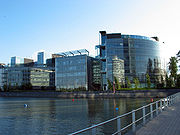
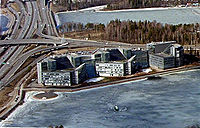
Nokia Corporation (ˈnɔkiɑ) is a Finnish multinational
communications corporation that is headquartered in Keilaniemi
, Espoo
, a city neighbouring Finland's capital Helsinki
. Nokia is engaged in the manufacturing of mobile devices and in converging Internet and communications industries, with over 132,000 employees in 120 countries, sales in more than 150 countries and global annual revenue of over €42 billion and operating profit of €2 billion as of 2010. It is the world's largest manufacturer of mobile phones: its global device market share
was 23% in the second quarter 2011. Nokia's estimated share of the converged
mobile device market was 31% in the fourth quarter, compared with 38% in the third quarter 2010. Nokia produces mobile devices for every major market segment
and protocol
, including GSM, CDMA
, and W-CDMA
(UMTS
). Nokia offers Internet services such as applications
, games
, music, maps, media
and messaging
through its Ovi
platform. Nokia's joint venture with Siemens
, Nokia Siemens Networks
produces telecommunications network
equipment, solutions and services. Nokia is also engaged in providing free digital map information and navigation
services through its wholly owned subsidiary Navteq
.
Nokia has sites for research and development
, manufacture
and sales in several countries; as of December 2010, Nokia had R&D presence in 16 countries and employed 35,870 people in research and development, representing approximately 27% of the group's total workforce
. The Nokia Research Center, founded in 1986, is Nokia's industrial research unit consisting of about 500 researchers, engineers and scientists; it has sites in seven countries: Finland
, China
, India
, Kenya
, Switzerland
, the United Kingdom
and the United States
. Besides its research centers, in 2001 Nokia founded (and owns) INdT
– Nokia Institute of Technology, a R&D institute located in Brazil. Nokia operates a total of 9 manufacturing facilities located at Salo
, Finland; Manaus
, Brazil; Cluj
, Romania; Beijing and Dongguan
, China; Komárom
, Hungary; Chennai
, India; Reynosa, Mexico; and Masan
, South Korea. Nokia's factory in Cluj was seized by the Romanian government in November 2011 to prevent a sale of the assets, after Nokia had accumulated a tax liability
of US$ 10 million. Nokia's industrial design department is headquartered in Soho
in London, UK with significant satellite offices in Helsinki, Finland and Calabasas
, California in the US.
Nokia is a public limited-liability company
listed on the Helsinki
, Frankfurt
, and New York
stock exchanges. Nokia plays a very large role in the economy of Finland
; it is by far the largest Finnish company, accounting for about a third of the market capitalization
of the Helsinki Stock Exchange (OMX Helsinki) as of 2007, a unique situation for an industrialized country
. It is an important employer in Finland and several small companies have grown into large ones as its partners
and subcontractor
s. In 2009, Nokia contributed 1.6% to Finland's GDP, and accounted for about 16% of Finland's exports in 2006.
The Nokia brand, valued at $25 billion, is listed as the 14th most valuable global brand in the Interbrand
/BusinessWeek
Best Global Brands list of 2011. It is the 14th ranked brand corporation in Europe (as of 2011), the 8th most admirable Network and Other Communications Equipment company worldwide in Fortune
's World's Most Admired Companies list of 2011 , and the world's 143th largest company as measured by revenue in Fortune Global 500
list of 2011. In July 2010, Nokia reported a drop in profits by 40%, which turned into an operating loss of EUR 487 million in Q2 2011. In the global smartphone
rivalry, Nokia held the 3rd place in 2Q2011, trailing behind Samsung
and Apple.
On 11 February 2011, Nokia announced a partnership with Microsoft
where all future Nokia smartphones will be powered by the Windows Phone 7
(WP7) operating system
. On 26 October 2011, Nokia unveiled its first WP7.5 powered handsets Lumia 710
and 800
.
(Suomen Gummitehdas Oy) and Finnish Cable Works Ltd
(Suomen Kaapelitehdas Oy).
Nokia's history starts in 1865 when mining engineer Fredrik Idestam
established a groundwood pulp mill
on the banks of the Tammerkoski
rapids in the town of Tampere
, in southwestern Finland in Russian Empire
and started manufacturing paper
. In 1868, Idestam built a second mill near the town of Nokia
, fifteen kilometres (nine miles) west of Tampere by the Nokianvirta river, which had better resources for hydropower
production. In 1871, Idestam, with the help of his close friend statesman Leo Mechelin
, renamed and transformed his firm into a share company, thereby founding the Nokia Company, the name it is still known by today.
Toward the end of the 19th century, Mechelin's wishes to expand into the electricity business were at first thwarted by Idestam's opposition. However, Idestam's retirement from the management of the company in 1896 allowed Mechelin to become the company's chairman (from 1898 until 1914) and sell most shareholders on his plans, thus realizing his vision. In 1902, Nokia added electricity generation
to its business activities.
, manufacturer of galoshes
and other rubber products, which later became Nokia's rubber business. At the beginning of the 20th century, Finnish Rubber Works established its factories near the town of Nokia and they began using Nokia as its product brand. In 1912, Arvid Wickström founded Finnish Cable Works
, producer of telephone, telegraph
and electrical cables and the foundation of Nokia's cable and electronics businesses. At the end of the 1910s, shortly after World War I, the Nokia Company was nearing bankruptcy. To ensure the continuation of electricity supply from Nokia's generators
, Finnish Rubber Works acquired the business of the insolvent company. In 1922, Finnish Rubber Works acquired Finnish Cable Works. In 1937, Verner Weckman
, a sport wrestler and Finland's first Olympic Gold medalist, became President of Finnish Cable Works, after 16 years as its Technical Director. After World War II
, Finnish Cable Works supplied cables to the Soviet Union
as part of Finland's war reparations
. This gave the company a good foothold for later trade.
The three companies, which had been jointly owned since 1922, were merged to form a new industrial conglomerate, Nokia Corporation in 1967 and paved the way for Nokia's future as a global corporation. The new company was involved in many industries, producing at one time or another paper products, car and bicycle tires, footwear (including rubber boots
), communications cables, televisions and other consumer electronics, personal computers, electricity generation machinery, robotics, capacitor
s, military communications and equipment (such as the SANLA M/90
device and the M61 gas mask
for the Finnish Army
), plastics, aluminium and chemicals
. Each business unit had its own director who reported to the first Nokia Corporation President, Björn Westerlund
. As the president of the Finnish Cable Works, he had been responsible for setting up the company’s first electronics department in 1960, sowing the seeds of Nokia’s future in telecommunications.
Eventually, the company decided to leave consumer electronics behind in the 1990s and focused solely on the fastest growing segments in telecommunications. Nokian Tyres, manufacturer of tires, split from Nokia Corporation to form its own company in 1988 and two years later Nokian Footwear
, manufacturer of rubber boots, was founded. During the rest of the 1990s, Nokia divested itself of all of its non-telecommunications businesses.
Björn "Nalle" Westerlund
(1912–2009), who founded the electronics department and let it run at a loss for 15 years.
network was started.
For a while in the 1970s, Nokia's network equipment production was separated into Telefenno, a company jointly owned by the parent corporation and by a company owned by the Finnish state. In 1987, the state sold its shares to Nokia and in 1992 the name was changed to Nokia Telecommunications.
In the 1970s and 1980s, Nokia developed the Sanomalaitejärjestelmä ("Message device system"), a digital, portable and encrypted text-based communications device for the Finnish Defence Forces
. The current main unit used by the Defence Forces is the Sanomalaite M/90
(SANLA M/90).
radio simultaneously with Salora Oy. In 1966, Nokia and Salora started developing the ARP
standard (which stands for Autoradiopuhelin, or car radio phone in English), a car-based mobile radio telephony system and the first commercially operated public mobile phone network in Finland. It went online in 1971 and offered 100% coverage in 1978.
In 1979, the merger of Nokia and Salora resulted in the establishment of Mobira Oy. Mobira began developing mobile phones for the NMT
(Nordic Mobile Telephony) network standard, the first-generation
, first fully automatic cellular phone system that went online in 1981. In 1982, Mobira introduced its first car phone
, the Mobira Senator for NMT-450 networks.
Nokia bought Salora Oy in 1984 and now owning 100% of the company, changed the company's telecommunications branch name to Nokia-Mobira Oy.
The Mobira Talkman, launched in 1984, was one of the world's first transportable phones. In 1987, Nokia introduced one of the world's first handheld phones, the Mobira Cityman 900 for NMT-900 networks (which, compared to NMT-450, offered a better signal, yet a shorter roam). While the Mobira Senator of 1982 had weighed 9.8 kg (21.6 lb) and the Talkman just under 5 kg (11 lb), the Mobira Cityman weighed only 800 g (28.2 oz) with the battery and had a price tag of 24,000 Finnish marks (approximately €4,560). Despite the high price, the first phones were almost snatched from the sales assistants’ hands. Initially, the mobile phone was a "yuppie
" product and a status symbol
.
Nokia's mobile phones got a big publicity boost in 1987, when Soviet
leader Mikhail Gorbachev
was pictured using a Mobira Cityman to make a call from Helsinki
to his communications minister in Moscow. This led to the phone's nickname of the "Gorba".
In 1988, Jorma Nieminen, resigning from the post of CEO of the mobile phone unit, along with two other employees from the unit, started a notable mobile phone company of their own, Benefon Oy (since renamed to GeoSentric). One year later, Nokia-Mobira Oy became Nokia Mobile Phones.
mobile technology which could carry data as well as voice traffic. NMT
(Nordic Mobile Telephony), the world's first mobile telephony standard that enabled international roaming
, provided valuable experience for Nokia for its close participation in developing GSM, which was adopted in 1987 as the new European standard for digital mobile technology.
Nokia delivered its first GSM network to the Finnish operator Radiolinja
in 1989. The world's first commercial GSM call was made on July 1, 1991 in Helsinki
, Finland over a Nokia-supplied network, by then Prime Minister of Finland
Harri Holkeri, using a prototype Nokia GSM phone. In 1992, the first GSM phone, the Nokia 1011
, was launched. The model number refers to its launch date, 10 November. The Nokia 1011 did not yet employ Nokia's characteristic ringtone, the Nokia tune
. It was introduced as a ringtone in 1994 with the Nokia 2100 series.
GSM's high-quality voice calls, easy international roaming and support for new services like text messaging (SMS) laid the foundations for a worldwide boom in mobile phone use. GSM came to dominate the world of mobile telephony in the 1990s, in mid-2008 accounting for about three billion mobile telephone subscribers in the world, with more than 700 mobile operators
across 218 countries and territories. New connections are added at the rate of 15 per second, or 1.3 million per day.
. MikroMikko was Nokia Data's attempt to enter the business computer market. The first model in the line, MikroMikko 1, was released on September 29, 1981, around the same time as the first IBM PC. However, the personal computer division was sold to the British ICL (International Computers Limited) in 1991, which later became part of Fujitsu
. MikroMikko remained a trademark of ICL and later Fujitsu. Internationally the MikroMikko line was marketed by Fujitsu as the ErgoPro.
Fujitsu later transferred its personal computer operations to Fujitsu Siemens Computers
, which shut down its only factory in Espoo
, Finland (in the Kilo
district, where computers had been produced since the 1960s) at the end of March 2000, thus ending large-scale PC manufacturing in the country. Nokia was also known for producing very high quality CRT
and early TFT LCD displays for PC and larger systems application. The Nokia Display Products' branded business was sold to ViewSonic
in 2000. In addition to personal computers and displays, Nokia used to manufacture DSL modems and digital set-top box
es.
Nokia re-entered the PC market in August 2009 with the introduction of the Nokia Booklet 3G
mini laptop.
, Nokia expanded into new fields, mostly by acquisitions. In the late 1980s and early 1990s, the corporation ran into serious financial problems, a major reason being its heavy losses by the television manufacturing division and businesses that were just too diverse. These problems, and a suspected total burnout
, probably contributed to Kairamo taking his own life in 1988. After Kairamo's death, Simo Vuorilehto
became Nokia's Chairman and CEO. In 1990–1993, Finland underwent severe economic depression, which also struck Nokia. Under Vuorilehto's management, Nokia was severely overhauled. The company responded by streamlining its telecommunications divisions, and by divesting itself of the television and PC divisions.
Probably the most important strategic change in Nokia's history was made in 1992, however, when the new CEO Jorma Ollila
made a crucial strategic decision to concentrate solely on telecommunications. Thus, during the rest of the 1990s, the rubber, cable and consumer electronics divisions were gradually sold as Nokia continued to divest itself of all of its non-telecommunications businesses.
As late as 1991, more than a quarter of Nokia's turnover still came from sales in Finland. However, after the strategic change of 1992, Nokia saw a huge increase in sales to North America, South America and Asia. The exploding worldwide popularity of mobile telephones, beyond even Nokia's most optimistic predictions, caused a logistics
crisis in the mid-1990s. This prompted Nokia to overhaul its entire logistics operation. By 1998, Nokia’s focus on telecommunications and its early investment in GSM technologies had made the company the world's largest mobile phone manufacturer. Between 1996 and 2001, Nokia’s turnover increased almost fivefold from 6.5 billion euros to 31 billion euros. Logistics continues to be one of Nokia's major advantages over its rivals, along with greater economies of scale.
handset, launched in 2003, with over 200 million units shipped, was the best-selling mobile phone of all time and the world's top-selling consumer electronics
product.
In November 2007, Nokia announced and released the Nokia N82
, its first Nseries phone with Xenon flash
. At the Nokia World conference in December 2007, Nokia announced their "Comes With Music" program: Nokia device buyers are to receive a year of complimentary access to music downloads. The service became commercially available in the second half of 2008.
Nokia Productions was the first ever mobile filmmaking project directed by Spike Lee
. Work began in April 2008, and the film premiered in October 2008.
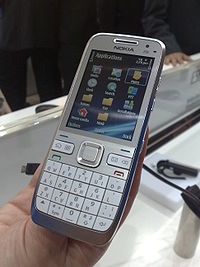
In 2008, Nokia released the Nokia E71
which was marketed to directly compete with the other BlackBerry
-type devices offering a full "qwerty" keyboard and cheaper prices. Nokia announced in August 2009 that they will be selling a high-end Windows
-based mini laptop
called the Nokia Booklet 3G
. On September 2, 2009, Nokia launched two new music and social networking phones, the X6 and X3. The Nokia X6 features 32GB of on-board memory with a 3.2" finger touch interface and comes with a music playback time of 35 hours. The Nokia X3 is a first series 40 Ovi Store-enabled device. The X3 is a music device that comes with stereo speakers, built-in FM radio, and a 3.2 megapixel camera. On September 10, 2009, Nokia unveiled a new handset, the 7705 Twist, a phone with a sports square shape that swivels open to reveal a full QWERTY keypad. The new mobile, which will be available exclusively through Verizon Wireless, features a 3 megapixel camera, web browsing, voice commands and weighs around 3.44 ounces (97.5 g).
, Hungary mobile phone factory on May 5, 2000.
In March 2007, Nokia signed a memorandum with Cluj County
Council, Romania
to open a new plant near the city in Jucu
commune. Moving the production from the Bochum
, Germany factory to a low wage country created an uproar in Germany. Nokia recently moved its North American Headquarters to Sunnyvale.
s and organizational restructuring. This diminished Nokia's public image in Finland, and produced a number of court cases and an episode of a documentary television show critical of Nokia.
On February 2006, Nokia and Sanyo
announced a memorandum of understanding
to create a joint venture addressing the CDMA
handset business. But in June, they announced ending negotiations without agreement. Nokia also stated its decision to pull out of CDMA research and development, to continue CDMA business in selected markets.
In June 2006, Jorma Ollila left his position as CEO to become the chairman of Royal Dutch Shell
and to give way for Olli-Pekka Kallasvuo
.
In May 2008, Nokia announced on their annual stockholder meeting that they want to shift to the Internet business as a whole. Nokia no longer wants to be seen as the telephone company. Google
, Apple and Microsoft
are not seen as natural competition for their new image but they are considered as major important players to deal with.
In November 2008, Nokia announced it was ceasing mobile phone distribution in Japan. Following early December, distribution of Nokia E71
is cancelled, both from NTT docomo
and SoftBank Mobile. Nokia Japan retains global research & development programs, sourcing business, and an MVNO venture of Vertu
luxury phones, using docomo's telecommunications network.
 On September 22, 2003, Nokia acquired Sega.com, a branch of Sega
which became the major basis to develop the Nokia N-Gage
device.
On November 16, 2005, Nokia and Intellisync Corporation
, a provider of data and PIM synchronization software, signed a definitive agreement for Nokia to acquire Intellisync. Nokia completed the acquisition on February 10, 2006.
On June 19, 2006, Nokia and Siemens AG
announced the companies would merge their mobile and fixed-line phone network equipment businesses to create one of the world's largest network firms, Nokia Siemens Networks
. Each company has a 50% stake in the infrastructure company, and it is headquartered in Espoo
, Finland. The companies predicted annual sales of €16 bn
and cost savings of €1.5 bn a year by 2010. About 20,000 Nokia employees were transferred to this new company.
On August 8, 2006, Nokia and Loudeye Corp. announced that they had signed an agreement for Nokia to acquire online music distributor Loudeye Corporation for approximately US $60 million. The company has been developing this into an online music service in the hope of using it to generate handset sales. The service, launched on August 29, 2007, is aimed to rival iTunes
. Nokia completed the acquisition on October 16, 2006.
In July 2007, Nokia acquired all assets of Twango
, the comprehensive media sharing solution for organizing and sharing photos, videos and other personal media.
In September 2007, Nokia announced its intention to acquire Enpocket
, a supplier of mobile advertising technology and services.
In October 2007, pending shareholder and regulatory approval, Nokia bought Navteq
, a U.S.-based supplier of digital mapping data, for a price of $8.1 billion. Nokia finalized the acquisition on July 10, 2008.
In September, 2008, Nokia acquired OZ Communications, a privately held company with approximately 220 employees headquartered in Montreal, Canada.
On July 24, 2009, Nokia announced that it will acquire certain assets of cellity, a privately owned mobile software company which employs 14 people in Hamburg, Germany. The acquisition of cellity was completed on August 5, 2009.
On September 11, 2009, Nokia announced the acquisition of "certain assets of Plum Ventures, Inc, a privately held company which employed approximately 10 people with main offices in Boston, Massachusetts. Plum will complement Nokia’s Social Location services".
On March 28, 2010, Nokia announced the acquisition of Novarra, the mobile web browser firm from Chicago. Terms of the deal were not disclosed.Novarra is a privately held company based in Chicago, IL and provider of a mobile browser and service platform and has more than 100 employees.
On April 10, 2010, Nokia announced its acquisition of MetaCarta
, whose technology was planned to be used in the area of local search, particularly involving location and other services. Financial details of acquisition were not disclosed.
factory in Romania
.
The first Nseries device, the N90, utilised the older Symbian OS 8.1 mobile operating system
, as did the N70. Subsequently Nokia switched to using SymbianOS 9 for all later Nseries devices (except the N72, which was based on the N70). Newer Nseries devices incorporate newer revisions of SymbianOS 9 that include Feature Packs. The N800, N810 and N900 are as of July 2010 the only Nseries devices to not use Symbian OS. They use the Linux
-based Maemo.
Nokia stated that Maemo would be developed alongside Symbian.
Maemo has since (Maemo "6" and beyond) merged with Intel's Moblin, and become MeeGo
, which will continue to be developed for mobile devices.
The Nokia N8
is the first device to function on the Symbian^3 mobile operating system
.
Nokia revealed that the N8 will be the last device in its flagship N-series devices to ship with Symbian OS.
Instead, Nokia will use Microsoft Windows Phone 7
for its high-end flagship devices, and revealed the Nokia N9
will function on the MeeGo
mobile operating system
.
, a former Microsoft
employee, unveiled a new strategic alliance with Microsoft
, and announced it would replace Symbian
and MeeGo
with Windows Phone 7
. Nokia will, however, retain Symbian
for use in mid-to-low-end devices. It will also invest into the Series 40 platform and release a single MeeGo product in 2011.
This news has not been well-received by consumers, and has contributed to the decline in the stock price by 11%.http://www.tomshw.it/cont/news/nokia-crolla-in-borsa-a-vincere-e-microsoft/29696/3.html
As part of the restructuring plan, Nokia plan to reduce spending on research and development, instead refocusing on customising and enhancing the software line for Windows Phone 7. Nokia's "applications and content store" (Ovi) will be integrated into the Windows Phone Marketplace
, while Nokia Maps will be at the heart of Microsoft's Bing and AdCenter. Microsoft will provide developer tools to Nokia, to replace the Qt framework which will not be supported by Windows Phone 7 devices.
Symbian is now described as a "franchise platform" with Nokia planning to sell 150 million Symbian devices into the future. MeeGo emphasis will be on longer-term exploration with plans to ship "a MeeGo-related product" later this year. Microsoft's search engine, Bing
, will be the search engine for all Nokia phones. Nokia also will get some level of customisation on WP7. After this announcement, Nokia's share price fell about 14%, its biggest drop since July 2009.
As Nokia is the largest mobile phone manufacturer worldwide it is suggested the alliance will make Microsoft's Windows Phone 7 a stronger contender against Android and iOS. In June 2011, Nokia was overtaken by Apple as the world's biggest smartphone maker by volume. In August 2011, Chris Weber, head of Nokia's subsidiary in the U.S., stated "The reality is if we are not successful with Windows Phone, it doesn’t matter what we do (elsewhere)." He further added "North America is a priority for Nokia (...) because it is a key market for Microsoft."
On April 1, 2007, Nokia’s Networks business group was combined with Siemens
’ carrier-related operations for fixed and mobile networks to form Nokia Siemens Networks
, jointly owned by Nokia and Siemens and consolidated by Nokia.
Mobile Solutions is responsible for Nokia's portfolio of smartphone
s and mobile computers, including the more expensive multimedia and enterprise-class devices. The team is also responsible for a suite of internet services under the Ovi
brand, with a strong focus on map
s and navigation
, music, messaging
and media
. This unit is led by Anssi Vanjoki, along with Tero Ojanperä (for Services) and Alberto Torres (for MeeGo
Computers).
Alberto Torres has stepped down.
Mobile Phones is responsible for Nokia's portfolio of affordable mobile phones, as well as a range of services that people can access with them, headed by Mary T. McDowell
. This unit provides the general public with mobile voice and data products across a range of devices, including high-volume, consumer oriented mobile phones. The devices are based on GSM/EDGE
, 3G
/W-CDMA
and CDMA
cellular technologies.
In the first quarter of 2006 Nokia sold over 15 million MP3 capable mobile phones, which means that Nokia is not only the world's leading supplier of mobile phones and digital camera
s (as most of Nokia's mobile telephones feature digital cameras, it is also believed that Nokia has recently overtaken Kodak
in camera production making it the largest in the world), Nokia is now also the leading supplier of digital audio players (MP3 players), outpacing sales of devices such as the iPod
from Apple. At the end of the year 2007, Nokia managed to sell almost 440 million mobile phones which accounted for 40% of all global mobile phones sales. By 2010, Nokia's market share in the mobile phone market had dropped to 32.6% (453 million phones).
Anssi Vanjoki resigned a few days before Nokia World 2010 and under new leadership team Jo Harlow will look into the affairs of Smartphones portfolio.
On 27 April 2011, The Register reported that Nokia is secretly developing a new operating system called Meltemi aiming at the low-end market. It is believed it will be replacing the S30 and S40 operating systems. Due to low-end market customers' demand of having smartphone features in their feature phone, the OS will include some features exclusive to high-end smartphones.
Markets is responsible for Nokia's supply chain
s, sales channels, brand and marketing functions of the company, and is responsible for delivering mobile solutions and mobile phones to the market. The unit is headed by Niklas Savander
.
and Navteq
. Other notable subsidiaries include, but are not limited to Vertu
, a British-based manufacturer and retailer of luxury mobile phones; Qt Software, a Norwegian-based software company, and OZ Communications, a consumer e-mail and instant messaging provider.
Until 2008 Nokia was the major shareholder in Symbian Limited
, a software development and licensing company that produced Symbian OS, a smartphone operating system used by Nokia and other manufacturers. In 2008 Nokia acquired Symbian Ltd and, along with a number of other companies, created the Symbian Foundation to distribute the Symbian platform royalty free and as open source
.
Nokia Siemens Networks (previously Nokia Networks) provides wireless and fixed network infrastructure, communications and networks service platforms, as well as professional services to operators and service providers. Nokia Siemens Networks focuses in GSM, EDGE
, 3G
/W-CDMA
and WiMAX
radio access networks; core networks with increasing IP and multiaccess capabilities; and services.
On June 19, 2006 Nokia and Siemens AG
announced the companies are to merge their mobile and fixed-line phone network equipment businesses to create one of the world's largest network firms, called Nokia Siemens Networks
. The Nokia Siemens Networks brand identity was subsequently launched at the 3GSM World Congress in Barcelona in February 2007.
On Aug 22, 2011 Nokia Siemens became embroiled in a scandal related to the use and abuse of surveillance systems delivered to the Bahrain government by one of its former business units, Nokia Siemens Intelligence Solutions (NSIS). The spy gear in Bahrain was sold by Siemens AG (SIE), and maintained by Nokia Siemens Networks and NSN’s divested unit, Trovicor GmbH. The sale and maintenance contracts were also confirmed by Ben Roome, a Nokia Siemens spokesman based in Farnborough, England. The system was reportedly used as the investigative tool of choice to gather information about political dissidents—and silence them. Companies such as Nokia and Nokia Siemens are free to sell such equipment almost anywhere. For the most part, the U.S. and European countries lack export controls to deter the use of such systems for repression, as was the case in Bahrain were at least 30 people were killed during the 2011 uprising. Many Western nations actively support the export of these systems of repression, e.g. to countries that are home to some of the U.S. Navy’s Fleet. Monitoring centers, as the systems are called, are sold around the globe by Nokia Siemens and its competitors, such as Israel-based Nice Systems Ltd. (NICE), and Verint Systems Inc. (VRNT), headquartered in Melville, New York. They form the heart of so-called lawful interception surveillance systems. By the end of 2007, the Nokia Siemens Intelligence Solutions unit had more than 90 systems installed in 60 countries. Besides Bahrain, several other Middle Eastern nations that cracked down on uprisings this year—including Egypt, Syria and Yemen—also purchased monitoring centers from the chain of businesses now known as Trovicor. Trovicor equipment plays a surveillance role in at least 12 Middle Eastern and North African nations. Trovicor’s precursor, which started in 1993 as the voice- and data-recording unit of Siemens, in 2007 became part of Nokia Siemens Networks, the world’s second biggest maker of wireless communications equipment. NSN, a 50-50 joint venture with Espoo, Finland-based Nokia Oyj (NOK1V), sold the unit, known as Intelligence Solutions, in March 2009. The new owners, Guernsey-based Perusa Partners Fund 1 LP, renamed the business Trovicor, coined from the Latin and Esperanto words for find and heart, according to the company’s website. According to NSN the elevated risk of human rights abuses was a major reason for NSN’s exiting the monitoring-center business. In Bahrain, officials routinely used the NSIS surveillance systems as a basis for the arrest and torture of political opponents; legally the monitoring technology is to be only used by order of legal authorities such as judges and prosecutors. According to local regulations, every Bahraini phone and Internet operator must provide the state with the ability to monitor communications. Phone companies also must track the location of phones within a 164-foot (50-meter) radius, the rules say. NSN and Trovicor’s status as exclusive provider in Bahrain continued at least through 2009. That period of more than two years coincides with the dates of text messages used to interrogate scores of political detainees. Authorities used messages that dated as far back as the mid-2000s, even in recent interrogations.
As of March 2009, Nokia Siemens Networks serves more than 600 operator customers in more than 150 countries, with over 1.5 billion people connected through its networks.
Navteq is a Chicago, Illinois-based provider of digital map data and location-based content and services for automotive navigation systems, mobile navigation devices, Internet-based mapping applications, and government and business solutions. Navteq was acquired by Nokia on October 1, 2007. Navteq’s map data is part of the Nokia Maps
online service where users can download maps, use voice-guided navigation and other context-aware web services. Nokia Maps is part of the Ovi
brand of Nokia's Internet based online services.
The operations of the company are managed within the framework set by the Finnish Companies Act, Nokia's Articles of Association and Corporate Governance Guidelines, and related Board of Directors adopted charters.
, is the oldest company listed under the same name on the Helsinki Stock Exchange
(since 1915). Nokia’s shares are also listed on the Frankfurt Stock Exchange
(since 1988) and New York Stock Exchange
(since 1994).
In June 1, 2011 Nokia shares dropped to their lowest in more than 13 years. Nokia shares fell as much as 10 percent, extending their previous day's by 18 percent fall.
For fiscal Q2 2011 ending in June 2011, Nokia reported a net loss of 492 million EUR, despite a 430 million EUR payment from Apple. Nokia cited decline in its mobile phone business as the primary cause of the loss.
 Nokia's official corporate culture
manifesto, The Nokia Way, emphasises the speed and flexibility of decision-making in a flat, networked organization
, although the corporation's size necessarily imposes a certain amount of bureaucracy
.
The official business language of Nokia is English. All documentation is written in English, and is used in official intra-company spoken communication and e-mail.
Until May 2007, the Nokia Values were Customer Satisfaction
, Respect
, Achievement, and Renewal. In May 2007, Nokia redefined its values after initiating a series of discussions worldwide as to what the new values of the company should be. Based on the employee suggestions, the new values were defined as: Engaging You, Achieving Together, Passion for Innovation and Very Human.
and, as a result, was instrumental in the launch of the .mobi
domain name extension in September 2006 as an official backer. Since then, Nokia has launched the largest mobile portal, Nokia.mobi, which receives over 100 million visits a month. It followed that with the launch of a mobile Ad Service to cater to the growing demand for mobile advertisement.
 Ovi
Ovi
, announced on August 29, 2007, is the name for Nokia's "umbrella concept" Internet services. Centered on Ovi.com, it is marketed as a "personal dashboard" where users can share photos with friends, download music, maps and games directly to their phones and access third-party services like Yahoo's Flickr
photo site. It has some significance in that Nokia is moving deeper into the world of Internet services, where head-on competition with Microsoft
, Google
and Apple is inevitable.
The services offered through Ovi include the Ovi Store (Nokia's application store), the Nokia Music Store, Nokia Maps
, Ovi Mail, the N-Gage mobile gaming platform available for several S60
smartphone
s, Ovi Share, Ovi Files, and Contacts and Calendar. The Ovi Store, the Ovi application store was launched in May 2009. Prior to opening the Ovi Store, Nokia integrated its software Download! store, the stripped-down MOSH
repository and the widget service WidSets
into it.
On March 23, 2010, Nokia announced launch of its online magazine called the Nokia Ovi. The 44-page magazine contains articles on products by Nokia, what Ovi stands for , tips and tricks on the usage of Nokia mini laptop Booklet 3G, latest reviews of mobile applications, news about the mobile maker's services and apps such as Ovi maps, files and mail. Users can download the magazine as a PDF or view it online from the Nokia website.
, Sony BMG, Warner Music Group, and EMI as well as hundreds of Independent labels and music aggregators to bundle 12, 18, or 24 months worth of unlimited free music downloads with the purchase of a Nokia Comes With Music edition phone. Following the termination of the year of free downloads, tracks can be kept without having to renew the subscription. Downloads are both PC and mobile-based.
On January 18, 2011, Nokia decided to withdraw its "Comes With Music" program in 27 countries, due to its failure to gain traction with customers or mobile network operators. The service will still be offered in China, India, Indonesia, Brazil, Turkey and South Africa where take-up has been better.
Nokia Messaging operates as a centralised, hosted service that acts as a proxy between the Nokia Messaging client and the user's e-mail server. It does not allow for a direct connection between the phone and the e-mail server, and is therefore required to send e-mail credentials to Nokia's servers. IMAP is used as the protocol to transfer emails between the client and the server.
, a joint venture between Nokia and Siemens AG
, reportedly provided Iran
's monopoly telecom company with technology that allowed it to intercept the Internet communications of its citizens to an unprecedented degree. The technology reportedly allowed it to use deep packet inspection
to read and even change the content of everything from "e-mails and Internet phone calls to images and messages on social-networking sites such as Facebook and Twitter". The technology "enables authorities to not only block communication but to monitor it to gather information about individuals, as well as alter it for disinformation purposes," expert insiders told The Wall Street Journal
. During the post-election protests in Iran in June 2009, Iran's Internet access was reported to have slowed to less than a tenth of its normal speeds, and experts suspected this was due to the use of the interception technology.
The joint venture company, Nokia Siemens Networks, asserted in a press release that it provided Iran only with a 'lawful intercept capability' "solely for monitoring of local voice calls". "Nokia Siemens Networks has not provided any deep packet inspection, web censorship or Internet filtering capability to Iran," it said.
In July 2009, Nokia began to experience a boycott
of their products and services in Iran
. The boycott was led by consumers sympathetic to the post-election protest movement and targeted at those companies deemed to be collaborating with the Islamic regime. Demand for handsets fell and users began shunning SMS messaging.
were not changed. The law was enacted, but with strict requirements for implementation of its provisions. As of 2010, the law has become a dead letter; no corporation has implemented it. The Finnish media dubbed the name Lex Nokia for this law, named after the Finnish copyright law (the so-called Lex Karpela) a few years back.
citing Apple infringed on 10 of its patents related to wireless communication including data transfer. Apple was quick to respond with a countersuit filed in December 2009 accusing Nokia of 11 patent infringements. Apple’s General Counsel, Bruce Sewell went a step further by stating, "Other companies must compete with us by inventing their own technologies, not just by stealing ours." This resulted in an ugly spat between the two telecom majors with Nokia filing another suit, this time with the U.S. International Trade Commission
(ITC), alleging Apple of infringing its patents in "virtually all of its mobile phones, portable music players, and computers." Nokia went on to ask the court to bar all U.S. imports of the Apple products including the iPhone, Mac and the iPod. Apple countersued by filing a complaint with the ITC in January 2010, the details of which are yet to be confirmed.
In June 2011, Apple settled with Nokia and agreed to an estimated one time payment of $600 million and royalties to Nokia. The two companies also agreed on a cross-licensing patents for some of their patented technologies.
. Nokia is listed in Greenpeace
’s Guide to Greener Electronics that scores leading electronics manufacturers according to their policies on sustainability, climate and energy and how green their products are. In November 2011 Nokia ranked 3rd out of 15 listed electronics companies, falling two places due to its weaker performance on the Energy criteria and scoring 4.9/10.
All of Nokia’s mobile phones are free of toxic polyvinyl chloride (PVC) since the end of 2005 and all new models of mobile phones and accessories launched in 2010 are on track to be free of brominated compounds, chlorinated flame retardants and antimony trioxide.
Nokia’s voluntary take-back programme to recycle old mobile phones spans 84 countries with almost 5,000 collection points. However, the recycling rate of Nokia phones was only 3–5% in 2008, according to a global consumer survey released by Nokia. The majority of old mobile phones are simply lying in drawers at home and very few old devices, about 4%, are being thrown into landfill and not recycled.
All of Nokia’s new models of chargers meet or exceed the Energy Star
requirements. Nokia aims to reduce its carbon dioxide emissions by at least 18 percent in 2010 from a baseline year of 2006 and cover 50 percent of its energy needs through renewable energy sources. Greenpeace is challenging the company to use its influence at the political level as number 85 on the Fortune 500 to advocate for climate legislation and call for global greenhouse gas emissions to peak by 2015.
Nokia is researching the use of recycled plastics in its products, which are currently used only in packaging but not yet in mobile phones.
Since 2001, Nokia has provided eco declarations of all its products and since May 2010 provides Eco profiles for all its new products. In an effort to further reduce their environmental impact
in the future, Nokia released a new phone concept, Remade, in February 2008. The phone has been constructed of solely recyclable materials. The outer part of the phone is made from recycled materials such as aluminium cans, plastic bottles, and used car tires. The screen is constructed of recycled glass, and the hinges have been created from rubber tires. The interior of the phone is entirely constructed with refurbished phone parts, and there is a feature that encourages energy saving habits by reducing the backlight to the ideal level, which then allows the battery to last longer without frequent charges.
through selective research collaborations with major universities and institutions by sharing resources and leveraging ideas. Major research collaboration is with Tampere University of Technology based in Finland. Current collaborations include:
published by Trust Research Advisory has ranked Nokia in the 1st position among the brands in India.
General
Other
Multinational corporation
A multi national corporation or enterprise , is a corporation or an enterprise that manages production or delivers services in more than one country. It can also be referred to as an international corporation...
communications corporation that is headquartered in Keilaniemi
Keilaniemi
Keilaniemi is a district in the south-eastern part of Espoo, Finland. Keilaniemi is bordered by the university district of Otaniemi to the north, the commercial/residential district of Tapiola to the west, the Keilalahti bay separating Espoo and Helsinki to the east, and the Gulf of Finland to the...
, Espoo
Espoo
Espoo is the second largest city and municipality in Finland. The population of the city of Espoo is . It is part of the Helsinki Metropolitan Area along with the cities of Helsinki, Vantaa, and Kauniainen. Espoo shares its eastern border with Helsinki and Vantaa, while enclosing Kauniainen....
, a city neighbouring Finland's capital Helsinki
Helsinki
Helsinki is the capital and largest city in Finland. It is in the region of Uusimaa, located in southern Finland, on the shore of the Gulf of Finland, an arm of the Baltic Sea. The population of the city of Helsinki is , making it by far the most populous municipality in Finland. Helsinki is...
. Nokia is engaged in the manufacturing of mobile devices and in converging Internet and communications industries, with over 132,000 employees in 120 countries, sales in more than 150 countries and global annual revenue of over €42 billion and operating profit of €2 billion as of 2010. It is the world's largest manufacturer of mobile phones: its global device market share
Market share
Market share is the percentage of a market accounted for by a specific entity. In a survey of nearly 200 senior marketing managers, 67 percent responded that they found the "dollar market share" metric very useful, while 61% found "unit market share" very useful.Marketers need to be able to...
was 23% in the second quarter 2011. Nokia's estimated share of the converged
Technological convergence
Technological convergence is the tendency for different technological systems to evolve towards performing similar tasks. Convergence can refer to previously separate technologies such as voice , data , and video that now share resources and interact with each other synergistically.The rise of...
mobile device market was 31% in the fourth quarter, compared with 38% in the third quarter 2010. Nokia produces mobile devices for every major market segment
Market segment
Market segmentation is a concept in economics and marketing. A market segment is a sub-set of a market made up of people or organizations with one or more characteristics that cause them to demand similar product and/or services based on qualities of those products such as price or function...
and protocol
Communications protocol
A communications protocol is a system of digital message formats and rules for exchanging those messages in or between computing systems and in telecommunications...
, including GSM, CDMA
Code division multiple access
Code division multiple access is a channel access method used by various radio communication technologies. It should not be confused with the mobile phone standards called cdmaOne, CDMA2000 and WCDMA , which are often referred to as simply CDMA, and use CDMA as an underlying channel access...
, and W-CDMA
W-CDMA (UMTS)
W-CDMA , UMTS-FDD, UTRA-FDD, or IMT-2000 CDMA Direct Spread is an air interface standard found in 3G mobile telecommunications networks. It is the basis of Japan's NTT DoCoMo's FOMA service and the most-commonly used member of the UMTS family and sometimes used as a synonym for UMTS...
(UMTS
Universal Mobile Telecommunications System
Universal Mobile Telecommunications System is a third generation mobile cellular technology for networks based on the GSM standard. Developed by the 3GPP , UMTS is a component of the International Telecommunications Union IMT-2000 standard set and compares with the CDMA2000 standard set for...
). Nokia offers Internet services such as applications
Application software
Application software, also known as an application or an "app", is computer software designed to help the user to perform specific tasks. Examples include enterprise software, accounting software, office suites, graphics software and media players. Many application programs deal principally with...
, games
Mobile game
A mobile game is a video game played on a mobile phone, smartphone, PDA, tablet computer or portable media player. This does not include games played on handheld video game systems such as Nintendo DS or PlayStation Portable....
, music, maps, media
Digital media
Digital media is a form of electronic media where data is stored in digital form. It can refer to the technical aspect of storage and transmission Digital media is a form of electronic media where data is stored in digital (as opposed to analog) form. It can refer to the technical aspect of...
and messaging
Message
A message in its most general meaning is an object of communication. It is a vessel which provides information. Yet, it can also be this information. Therefore, its meaning is dependent upon the context in which it is used; the term may apply to both the information and its form...
through its Ovi
Ovi (Nokia)
Ovi by Nokia is the brand for Nokia's Internet services. The Ovi services can be used from a mobile device, computer or via the web. Nokia focuses on five key service areas: Games, Maps, Media, Messaging and Music. Nokia's aim with Ovi is to include third party developers, such as operators and...
platform. Nokia's joint venture with Siemens
Siemens
Siemens may refer toSiemens, a German family name carried by generations of telecommunications industrialists, including:* Werner von Siemens , inventor, founder of Siemens AG...
, Nokia Siemens Networks
Nokia Siemens Networks
Nokia Siemens Networks is a global data networking and telecommunications equipment company headquartered in Espoo, Finland. It is a joint venture between Nokia of Finland and Siemens of Germany...
produces telecommunications network
Telecommunications network
A telecommunications network is a collection of terminals, links and nodes which connect together to enable telecommunication between users of the terminals. Networks may use circuit switching or message switching. Each terminal in the network must have a unique address so messages or connections...
equipment, solutions and services. Nokia is also engaged in providing free digital map information and navigation
Navigation
Navigation is the process of monitoring and controlling the movement of a craft or vehicle from one place to another. It is also the term of art used for the specialized knowledge used by navigators to perform navigation tasks...
services through its wholly owned subsidiary Navteq
NAVTEQ
Navteq is a Chicago, Illinois-based provider of Geographic Information Systems data and is a dominant company in providing the base electronic navigable maps...
.
Nokia has sites for research and development
Research and development
The phrase research and development , according to the Organization for Economic Co-operation and Development, refers to "creative work undertaken on a systematic basis in order to increase the stock of knowledge, including knowledge of man, culture and society, and the use of this stock of...
, manufacture
Manufacturing
Manufacturing is the use of machines, tools and labor to produce goods for use or sale. The term may refer to a range of human activity, from handicraft to high tech, but is most commonly applied to industrial production, in which raw materials are transformed into finished goods on a large scale...
and sales in several countries; as of December 2010, Nokia had R&D presence in 16 countries and employed 35,870 people in research and development, representing approximately 27% of the group's total workforce
Workforce
The workforce is the labour pool in employment. It is generally used to describe those working for a single company or industry, but can also apply to a geographic region like a city, country, state, etc. The term generally excludes the employers or management, and implies those involved in...
. The Nokia Research Center, founded in 1986, is Nokia's industrial research unit consisting of about 500 researchers, engineers and scientists; it has sites in seven countries: Finland
Finland
Finland , officially the Republic of Finland, is a Nordic country situated in the Fennoscandian region of Northern Europe. It is bordered by Sweden in the west, Norway in the north and Russia in the east, while Estonia lies to its south across the Gulf of Finland.Around 5.4 million people reside...
, China
China
Chinese civilization may refer to:* China for more general discussion of the country.* Chinese culture* Greater China, the transnational community of ethnic Chinese.* History of China* Sinosphere, the area historically affected by Chinese culture...
, India
India
India , officially the Republic of India , is a country in South Asia. It is the seventh-largest country by geographical area, the second-most populous country with over 1.2 billion people, and the most populous democracy in the world...
, Kenya
Kenya
Kenya , officially known as the Republic of Kenya, is a country in East Africa that lies on the equator, with the Indian Ocean to its south-east...
, Switzerland
Switzerland
Switzerland name of one of the Swiss cantons. ; ; ; or ), in its full name the Swiss Confederation , is a federal republic consisting of 26 cantons, with Bern as the seat of the federal authorities. The country is situated in Western Europe,Or Central Europe depending on the definition....
, the United Kingdom
United Kingdom
The United Kingdom of Great Britain and Northern IrelandIn the United Kingdom and Dependencies, other languages have been officially recognised as legitimate autochthonous languages under the European Charter for Regional or Minority Languages...
and the United States
United States
The United States of America is a federal constitutional republic comprising fifty states and a federal district...
. Besides its research centers, in 2001 Nokia founded (and owns) INdT
Instituto Nokia de Tecnologia
Instituto Nokia de Tecnologia , also usually referred to as INdT, is a non-profit organization aimed on research and development of mobile software and telecommunication technology. INdT was founded in Brazil by Nokia in October 2001 with incentive funds from the Brazilian Law on Information...
– Nokia Institute of Technology, a R&D institute located in Brazil. Nokia operates a total of 9 manufacturing facilities located at Salo
Salo, Finland
Salo is a town and municipality of Finland.It is located in the province of Western Finland and is part of the Finland Proper region. The municipality has a population of and covers an area of of which is water. The population density is ....
, Finland; Manaus
Manaus
Manaus is a city in Brazil, the capital of the state of Amazonas. It is situated at the confluence of the Negro and Solimões rivers. It is the most populous city of Amazonas, according to the statistics of Brazilian Institute of Geography and Statistics, and is a popular ecotourist destination....
, Brazil; Cluj
Cluj
Cluj may refer to*Cluj-Napoca, county seat of Cluj County, named Cluj until 1974*Cluj County, Romania*Cluj-Napoca International Airport*U Cluj, a Romanian sports club*U Cluj, a Romanian football club*CFR Cluj, a Romanian football club...
, Romania; Beijing and Dongguan
Dongguan
Dongguan is a prefecture-level city in central Guangdong province, People's Republic of China.An important industrial city located in the Pearl River Delta, Dongguan borders the provincial capital of Guangzhou to the north, Huizhou to the northeast, Shenzhen to the south, and the Pearl River to...
, China; Komárom
Komárom
Komárom is a city in Hungary on the right bank of the Danube in Komárom-Esztergom county.The city of Komárom was formerly a separate suburban village called...
, Hungary; Chennai
Chennai
Chennai , formerly known as Madras or Madarasapatinam , is the capital city of the Indian state of Tamil Nadu, located on the Coromandel Coast off the Bay of Bengal. Chennai is the fourth most populous metropolitan area and the sixth most populous city in India...
, India; Reynosa, Mexico; and Masan
Masan
Masan was a formerly a municipal city in South Gyeongsang Province, South Korea. The city was situated on Masan Bay , approximately 35 km west of Busan. It was known for its textile industry, and it was the site of Hite Brewery's production facilities.During the control of the Mongolians, the...
, South Korea. Nokia's factory in Cluj was seized by the Romanian government in November 2011 to prevent a sale of the assets, after Nokia had accumulated a tax liability
Tax evasion
Tax evasion is the general term for efforts by individuals, corporations, trusts and other entities to evade taxes by illegal means. Tax evasion usually entails taxpayers deliberately misrepresenting or concealing the true state of their affairs to the tax authorities to reduce their tax liability,...
of US$ 10 million. Nokia's industrial design department is headquartered in Soho
Soho
Soho is an area of the City of Westminster and part of the West End of London. Long established as an entertainment district, for much of the 20th century Soho had a reputation for sex shops as well as night life and film industry. Since the early 1980s, the area has undergone considerable...
in London, UK with significant satellite offices in Helsinki, Finland and Calabasas
Calabasas, California
Calabasas is an affluent city in Los Angeles County, California in the western United States. It is located in the hills in the southwestern San Fernando Valley and the Santa Monica Mountains between Woodland Hills, Agoura Hills, West Hills, and Malibu, California. As of the 2010 census, the city...
, California in the US.
Nokia is a public limited-liability company
Public limited company
A public limited company is a limited liability company that sells shares to the public in United Kingdom company law, in the Republic of Ireland and Commonwealth jurisdictions....
listed on the Helsinki
Helsinki Stock Exchange
The Helsinki Stock Exchange is a stock exchange located in Helsinki, Finland. Since 3 September 2003 it has been part of OMX, referred to as OMX Helsinki . Since NASDAQ's acquisition of OMX in February 2008, the official name of the Helsinki exchange has been NASDAQ OMX Helsinki.- History :The...
, Frankfurt
Frankfurt Stock Exchange
The Frankfurt Stock Exchange is the world's 12th largest stock exchange by market capitalization. Located in Frankfurt am Main, Germany, the Frankfurt Stock Exchange is owned and operated by Deutsche Börse, which also owns the European futures exchange Eurex and the clearing company...
, and New York
New York Stock Exchange
The New York Stock Exchange is a stock exchange located at 11 Wall Street in Lower Manhattan, New York City, USA. It is by far the world's largest stock exchange by market capitalization of its listed companies at 13.39 trillion as of Dec 2010...
stock exchanges. Nokia plays a very large role in the economy of Finland
Economy of Finland
Finland has a highly industrialised, mixed economy with a per capita output equal to that of other western economies such as France, Germany, Sweden or the United Kingdom. The largest sector of the economy is services at 65.7 percent, followed by manufacturing and refining at 31.4 percent. Primary...
; it is by far the largest Finnish company, accounting for about a third of the market capitalization
Market capitalization
Market capitalization is a measurement of the value of the ownership interest that shareholders hold in a business enterprise. It is equal to the share price times the number of shares outstanding of a publicly traded company...
of the Helsinki Stock Exchange (OMX Helsinki) as of 2007, a unique situation for an industrialized country
Developed country
A developed country is a country that has a high level of development according to some criteria. Which criteria, and which countries are classified as being developed, is a contentious issue...
. It is an important employer in Finland and several small companies have grown into large ones as its partners
Business partner
Business partner is a term used to denote a commercial entity with which another commercial entity has some form of alliance. This relationship may be a highly contractual, exclusive bond in which both entities commit not to ally with third parties...
and subcontractor
Subcontractor
A subcontractor is an individual or in many cases a business that signs a contract to perform part or all of the obligations of another's contract....
s. In 2009, Nokia contributed 1.6% to Finland's GDP, and accounted for about 16% of Finland's exports in 2006.
The Nokia brand, valued at $25 billion, is listed as the 14th most valuable global brand in the Interbrand
Interbrand
Interbrand, a division of Omnicom, is a global branding consultancy, specializing in vast brand services, including brand analytics, brand strategy, brand valuation, corporate design, digital brand management, and naming...
/BusinessWeek
BusinessWeek
Bloomberg Businessweek, commonly and formerly known as BusinessWeek, is a weekly business magazine published by Bloomberg L.P. It is currently headquartered in New York City.- History :...
Best Global Brands list of 2011. It is the 14th ranked brand corporation in Europe (as of 2011), the 8th most admirable Network and Other Communications Equipment company worldwide in Fortune
Fortune (magazine)
Fortune is a global business magazine published by Time Inc. Founded by Henry Luce in 1930, the publishing business, consisting of Time, Life, Fortune, and Sports Illustrated, grew to become Time Warner. In turn, AOL grew as it acquired Time Warner in 2000 when Time Warner was the world's largest...
's World's Most Admired Companies list of 2011 , and the world's 143th largest company as measured by revenue in Fortune Global 500
Fortune Global 500
The Fortune Global 500 is a ranking of the top 500 corporations worldwide as measured by revenue. The list is compiled and published annually by Fortune magazine....
list of 2011. In July 2010, Nokia reported a drop in profits by 40%, which turned into an operating loss of EUR 487 million in Q2 2011. In the global smartphone
Smartphone
A smartphone is a high-end mobile phone built on a mobile computing platform, with more advanced computing ability and connectivity than a contemporary feature phone. The first smartphones were devices that mainly combined the functions of a personal digital assistant and a mobile phone or camera...
rivalry, Nokia held the 3rd place in 2Q2011, trailing behind Samsung
Samsung
The Samsung Group is a South Korean multinational conglomerate corporation headquartered in Samsung Town, Seoul, South Korea...
and Apple.
On 11 February 2011, Nokia announced a partnership with Microsoft
Microsoft
Microsoft Corporation is an American public multinational corporation headquartered in Redmond, Washington, USA that develops, manufactures, licenses, and supports a wide range of products and services predominantly related to computing through its various product divisions...
where all future Nokia smartphones will be powered by the Windows Phone 7
Windows Phone 7
Windows Phone is a mobile operating system developed by Microsoft, and is the successor to its Windows Mobile platform, although incompatible with it. Unlike its predecessor, it is primarily aimed at the consumer market rather than the enterprise market...
(WP7) operating system
Operating system
An operating system is a set of programs that manage computer hardware resources and provide common services for application software. The operating system is the most important type of system software in a computer system...
. On 26 October 2011, Nokia unveiled its first WP7.5 powered handsets Lumia 710
Nokia Lumia 710
Nokia Lumia 710 is a Windows Phone smartphone. Its release is part of a change in company's direction which has resulted in a move around from the Symbian platform towards windows phone for premium devices...
and 800
Nokia Lumia 800
Nokia Lumia 800 is a Windows Phone OS powered smartphone, first unveiled by the company's CEO Stephen Elop, on 26 October 2011 at the Nokia World 2011 event...
.
Pre-telecommunications era
The predecessors of the modern Nokia were the Nokia Company (Nokia Aktiebolag), Finnish Rubber Works LtdNokian Footwear
Nokian Footwear is a Finnish manufacturer of boots, today part of the Finnish company Berner. Nokian Footwear was founded in 1990, but its history extends back to 1898, when Eduard Polón and a group of other Finnish businessmen decided to establish the company Suomen Gummitehdas Oy in Helsinki...
(Suomen Gummitehdas Oy) and Finnish Cable Works Ltd
Kaapelitehdas
Kaapelitehdas is a famous building in Ruoholahti, Helsinki, near the bridge to Lauttasaari....
(Suomen Kaapelitehdas Oy).
Nokia's history starts in 1865 when mining engineer Fredrik Idestam
Fredrik Idestam
Knut Fredrik Idestam was a Finnish mining engineer and businessman, best known as a founder of Nokia....
established a groundwood pulp mill
Pulp mill
A pulp mill is a manufacturing facility that converts wood chips or other plant fibre source into a thick fibre board which can be shipped to a paper mill for further processing. Pulp can be manufactured using mechanical, semi-chemical or fully chemical methods...
on the banks of the Tammerkoski
Tammerkoski
Tammerkoski is a channel of rapids in Tampere, Finland. The city of Tampere is located between two lakes, Näsijärvi and Pyhäjärvi. The difference in altitude between these two is 18 metres and the water flows from Näsijärvi to Pyhäjärvi through the Tammerkoski rapids.The banks of the Tammerkoski...
rapids in the town of Tampere
Tampere
Tampere is a city in southern Finland. It is the most populous inland city in any of the Nordic countries. The city has a population of , growing to approximately 300,000 people in the conurbation and over 340,000 in the metropolitan area. Tampere is the third most-populous municipality in...
, in southwestern Finland in Russian Empire
Russian Empire
The Russian Empire was a state that existed from 1721 until the Russian Revolution of 1917. It was the successor to the Tsardom of Russia and the predecessor of the Soviet Union...
and started manufacturing paper
Pulp and paper industry
The global pulp and paper industry is dominated by North American , northern European and East Asian countries...
. In 1868, Idestam built a second mill near the town of Nokia
Nokia, Finland
Nokia, Finland is a town and a municipality on the banks of the Nokianvirta River in the region of Pirkanmaa, some west of Tampere. As of it has a population of .-History:...
, fifteen kilometres (nine miles) west of Tampere by the Nokianvirta river, which had better resources for hydropower
Hydropower
Hydropower, hydraulic power, hydrokinetic power or water power is power that is derived from the force or energy of falling water, which may be harnessed for useful purposes. Since ancient times, hydropower has been used for irrigation and the operation of various mechanical devices, such as...
production. In 1871, Idestam, with the help of his close friend statesman Leo Mechelin
Leo Mechelin
Leopold Henrik Stanislaus Mechelin was a Finnish professor, statesman, senator and liberal reformer...
, renamed and transformed his firm into a share company, thereby founding the Nokia Company, the name it is still known by today.
Toward the end of the 19th century, Mechelin's wishes to expand into the electricity business were at first thwarted by Idestam's opposition. However, Idestam's retirement from the management of the company in 1896 allowed Mechelin to become the company's chairman (from 1898 until 1914) and sell most shareholders on his plans, thus realizing his vision. In 1902, Nokia added electricity generation
Electricity generation
Electricity generation is the process of generating electric energy from other forms of energy.The fundamental principles of electricity generation were discovered during the 1820s and early 1830s by the British scientist Michael Faraday...
to its business activities.
Industrial conglomerate
In 1898, Eduard Polón founded Finnish Rubber WorksNokian Footwear
Nokian Footwear is a Finnish manufacturer of boots, today part of the Finnish company Berner. Nokian Footwear was founded in 1990, but its history extends back to 1898, when Eduard Polón and a group of other Finnish businessmen decided to establish the company Suomen Gummitehdas Oy in Helsinki...
, manufacturer of galoshes
Galoshes
Galoshes , also known as boat shoes, dickersons, or overshoes, are a type of rubber boot that is slipped over shoes to keep them from getting muddy or wet. The word galoshes might be used interchangeably with boot, especially a rubberized boot...
and other rubber products, which later became Nokia's rubber business. At the beginning of the 20th century, Finnish Rubber Works established its factories near the town of Nokia and they began using Nokia as its product brand. In 1912, Arvid Wickström founded Finnish Cable Works
Kaapelitehdas
Kaapelitehdas is a famous building in Ruoholahti, Helsinki, near the bridge to Lauttasaari....
, producer of telephone, telegraph
Telegraphy
Telegraphy is the long-distance transmission of messages via some form of signalling technology. Telegraphy requires messages to be converted to a code which is known to both sender and receiver...
and electrical cables and the foundation of Nokia's cable and electronics businesses. At the end of the 1910s, shortly after World War I, the Nokia Company was nearing bankruptcy. To ensure the continuation of electricity supply from Nokia's generators
Electrical generator
In electricity generation, an electric generator is a device that converts mechanical energy to electrical energy. A generator forces electric charge to flow through an external electrical circuit. It is analogous to a water pump, which causes water to flow...
, Finnish Rubber Works acquired the business of the insolvent company. In 1922, Finnish Rubber Works acquired Finnish Cable Works. In 1937, Verner Weckman
Verner Weckman
Johan Verner Weckman was a Finnish sport wrestler who competed in the 1906 Summer Olympics and in the 1908 Summer Olympics.He was born in Loviisa in a family of farmer. He took Abitur in Helsinki 1902...
, a sport wrestler and Finland's first Olympic Gold medalist, became President of Finnish Cable Works, after 16 years as its Technical Director. After World War II
World War II
World War II, or the Second World War , was a global conflict lasting from 1939 to 1945, involving most of the world's nations—including all of the great powers—eventually forming two opposing military alliances: the Allies and the Axis...
, Finnish Cable Works supplied cables to the Soviet Union
Soviet Union
The Soviet Union , officially the Union of Soviet Socialist Republics , was a constitutionally socialist state that existed in Eurasia between 1922 and 1991....
as part of Finland's war reparations
War reparations
War reparations are payments intended to cover damage or injury during a war. Generally, the term war reparations refers to money or goods changing hands, rather than such property transfers as the annexation of land.- History :...
. This gave the company a good foothold for later trade.
The three companies, which had been jointly owned since 1922, were merged to form a new industrial conglomerate, Nokia Corporation in 1967 and paved the way for Nokia's future as a global corporation. The new company was involved in many industries, producing at one time or another paper products, car and bicycle tires, footwear (including rubber boots
Wellington boot
The Wellington boot, also known as rubber-boots, wellies, wellingtons, topboots, billy-boots, gumboots, gummies, barnboots, wellieboots, muckboots, sheepboots, shitkickers, or rainboots are a type of boot based upon leather Hessian boots...
), communications cables, televisions and other consumer electronics, personal computers, electricity generation machinery, robotics, capacitor
Capacitor
A capacitor is a passive two-terminal electrical component used to store energy in an electric field. The forms of practical capacitors vary widely, but all contain at least two electrical conductors separated by a dielectric ; for example, one common construction consists of metal foils separated...
s, military communications and equipment (such as the SANLA M/90
Sanomalaite M/90
Sanomalaite M/90 is a digital, portable and encrypted text-based communications device developed by Nokia and used by all branches of Finnish Defence Forces.-History:...
device and the M61 gas mask
M61 gas mask
The M-61 is a Finnish gas mask manufactured by Nokia since the 1960s up to the 1980s. It was the standard issue gas mask for the Finnish Defense Forces, but was replaced by the updated M-95 in the 1990s. It is a side loading mask It uses 60 millimeter threads, but adapters are available to convert...
for the Finnish Army
Finnish Army
The Finnish Army is the land forces branch of the Finnish Defence Forces.Today's Army is divided into six branches: the infantry , field artillery, anti-aircraft artillery, engineers, signals, and materiel troops.-History of the Finnish Army:Between 1809 and 1917 Finland was an autonomous part of...
), plastics, aluminium and chemicals
Chemical substance
In chemistry, a chemical substance is a form of matter that has constant chemical composition and characteristic properties. It cannot be separated into components by physical separation methods, i.e. without breaking chemical bonds. They can be solids, liquids or gases.Chemical substances are...
. Each business unit had its own director who reported to the first Nokia Corporation President, Björn Westerlund
Björn Westerlund
Björn Westerlund, titled Vuorineuvos , was a Finnish businessman and a short-time minister in the government of Finland. He was the former and first President and CEO of Nokia Corporation that was formed in a 1967 merger between the three Finnish companies Nokia Company, Finnish Rubber Works and...
. As the president of the Finnish Cable Works, he had been responsible for setting up the company’s first electronics department in 1960, sowing the seeds of Nokia’s future in telecommunications.
Eventually, the company decided to leave consumer electronics behind in the 1990s and focused solely on the fastest growing segments in telecommunications. Nokian Tyres, manufacturer of tires, split from Nokia Corporation to form its own company in 1988 and two years later Nokian Footwear
Nokian Footwear
Nokian Footwear is a Finnish manufacturer of boots, today part of the Finnish company Berner. Nokian Footwear was founded in 1990, but its history extends back to 1898, when Eduard Polón and a group of other Finnish businessmen decided to establish the company Suomen Gummitehdas Oy in Helsinki...
, manufacturer of rubber boots, was founded. During the rest of the 1990s, Nokia divested itself of all of its non-telecommunications businesses.
Telecommunications era
The seeds of the current incarnation of Nokia were planted with the founding of the electronics section of the cable division in 1960 and the production of its first electronic device in 1962: a pulse analyzer designed for use in nuclear power plants. In the 1967 fusion, that section was separated into its own division, and began manufacturing telecommunications equipment. A key CEO and subsequent Chairman of the Board was vuorineuvosVuorineuvos
Vuorineuvos is a Finnish honorary title granted by the President of Finland to leading industry figures. The title is honorary and has no responsibilities and no privileges. All Finnish titles are non-hereditary. The only title of equal rank is valtioneuvos.There is no official or established...
Björn "Nalle" Westerlund
Björn Westerlund
Björn Westerlund, titled Vuorineuvos , was a Finnish businessman and a short-time minister in the government of Finland. He was the former and first President and CEO of Nokia Corporation that was formed in a 1967 merger between the three Finnish companies Nokia Company, Finnish Rubber Works and...
(1912–2009), who founded the electronics department and let it run at a loss for 15 years.
Networking equipment
In the 1970s, Nokia became more involved in the telecommunications industry by developing the Nokia DX 200, a digital switch for telephone exchanges. The DX 200 became the workhorse of the network equipment division. Its modular and flexible architecture enabled it to be developed into various switching products. In 1984, development of a version of the exchange for the Nordic Mobile TelephonyNordic Mobile Telephone
NMT is the first fully automatic cellular phone system...
network was started.
For a while in the 1970s, Nokia's network equipment production was separated into Telefenno, a company jointly owned by the parent corporation and by a company owned by the Finnish state. In 1987, the state sold its shares to Nokia and in 1992 the name was changed to Nokia Telecommunications.
In the 1970s and 1980s, Nokia developed the Sanomalaitejärjestelmä ("Message device system"), a digital, portable and encrypted text-based communications device for the Finnish Defence Forces
Finnish Defence Forces
The Finnish Defence Forces are responsible for the defence of Finland. It is a cadre army of 15,000, of which 8,900 are professional soldiers , extended with conscripts and reservists such that the standard readiness strength is 34,700 people in uniform...
. The current main unit used by the Defence Forces is the Sanomalaite M/90
Sanomalaite M/90
Sanomalaite M/90 is a digital, portable and encrypted text-based communications device developed by Nokia and used by all branches of Finnish Defence Forces.-History:...
(SANLA M/90).
First mobile phones
The technologies that preceded modern cellular mobile telephony systems were the various "0G" pre-cellular mobile radio telephony standards. Nokia had been producing commercial and some military mobile radio communications technology since the 1960s, although this part of the company was sold some time before the later company rationalization. Since 1964, Nokia had developed VHFVery high frequency
Very high frequency is the radio frequency range from 30 MHz to 300 MHz. Frequencies immediately below VHF are denoted High frequency , and the next higher frequencies are known as Ultra high frequency...
radio simultaneously with Salora Oy. In 1966, Nokia and Salora started developing the ARP
Autoradiopuhelin
ARP was the first commercially operated public mobile phone network in Finland. The technology is zero-generation , since although it had cells, moving between them was not seamless. The network was proposed in 1968 and building began in 1969. It was launched in 1971, and reached 100% geographic...
standard (which stands for Autoradiopuhelin, or car radio phone in English), a car-based mobile radio telephony system and the first commercially operated public mobile phone network in Finland. It went online in 1971 and offered 100% coverage in 1978.
In 1979, the merger of Nokia and Salora resulted in the establishment of Mobira Oy. Mobira began developing mobile phones for the NMT
Nordic Mobile Telephone
NMT is the first fully automatic cellular phone system...
(Nordic Mobile Telephony) network standard, the first-generation
1G
1G refers to the first-generation of wireless telephone technology, mobile telecommunications. These are the analog telecommunications standards that were introduced in the 1980s and continued until being replaced by 2G digital telecommunications...
, first fully automatic cellular phone system that went online in 1981. In 1982, Mobira introduced its first car phone
Car phone
A car phone is a mobile phone device specifically designed for and fitted into an automobile.In the late 1970s and 1980s, the car phone was more popular than the regular mobile phone...
, the Mobira Senator for NMT-450 networks.
Nokia bought Salora Oy in 1984 and now owning 100% of the company, changed the company's telecommunications branch name to Nokia-Mobira Oy.
The Mobira Talkman, launched in 1984, was one of the world's first transportable phones. In 1987, Nokia introduced one of the world's first handheld phones, the Mobira Cityman 900 for NMT-900 networks (which, compared to NMT-450, offered a better signal, yet a shorter roam). While the Mobira Senator of 1982 had weighed 9.8 kg (21.6 lb) and the Talkman just under 5 kg (11 lb), the Mobira Cityman weighed only 800 g (28.2 oz) with the battery and had a price tag of 24,000 Finnish marks (approximately €4,560). Despite the high price, the first phones were almost snatched from the sales assistants’ hands. Initially, the mobile phone was a "yuppie
Yuppie
Yuppie is a term that refers to a member of the upper middle class or upper class in their 20s or 30s. It first came into use in the early-1980s and largely faded from American popular culture in the late-1980s, due to the 1987 stock market crash and the early 1990s recession...
" product and a status symbol
Status symbol
A status symbol is a perceived visible, external denotation of one's social position and perceived indicator of economic or social status. Many luxury goods are often considered status symbols...
.
Nokia's mobile phones got a big publicity boost in 1987, when Soviet
Soviet Union
The Soviet Union , officially the Union of Soviet Socialist Republics , was a constitutionally socialist state that existed in Eurasia between 1922 and 1991....
leader Mikhail Gorbachev
Mikhail Gorbachev
Mikhail Sergeyevich Gorbachev is a former Soviet statesman, having served as General Secretary of the Communist Party of the Soviet Union from 1985 until 1991, and as the last head of state of the USSR, having served from 1988 until its dissolution in 1991...
was pictured using a Mobira Cityman to make a call from Helsinki
Helsinki
Helsinki is the capital and largest city in Finland. It is in the region of Uusimaa, located in southern Finland, on the shore of the Gulf of Finland, an arm of the Baltic Sea. The population of the city of Helsinki is , making it by far the most populous municipality in Finland. Helsinki is...
to his communications minister in Moscow. This led to the phone's nickname of the "Gorba".
In 1988, Jorma Nieminen, resigning from the post of CEO of the mobile phone unit, along with two other employees from the unit, started a notable mobile phone company of their own, Benefon Oy (since renamed to GeoSentric). One year later, Nokia-Mobira Oy became Nokia Mobile Phones.
Involvement in GSM
Nokia was one of the key developers of GSM (Global System for Mobile Communications), the second-generation2G
2G is short for second-generation wireless telephone technology. Second generation 2G cellular telecom networks were commercially launched on the GSM standard in Finland by Radiolinja in 1991...
mobile technology which could carry data as well as voice traffic. NMT
Nordic Mobile Telephone
NMT is the first fully automatic cellular phone system...
(Nordic Mobile Telephony), the world's first mobile telephony standard that enabled international roaming
Roaming
In wireless telecommunications, roaming is a general term referring to the extension of connectivity service in a location that is different from the home location where the service was registered. Roaming ensures that the wireless device is kept connected to the network, without losing the...
, provided valuable experience for Nokia for its close participation in developing GSM, which was adopted in 1987 as the new European standard for digital mobile technology.
Nokia delivered its first GSM network to the Finnish operator Radiolinja
Radiolinja
Radiolinja was a Finnish GSM operator founded on September 19, 1988. On March 27, 1991, the world's first GSM phone call was made on Radiolinja's network...
in 1989. The world's first commercial GSM call was made on July 1, 1991 in Helsinki
Helsinki
Helsinki is the capital and largest city in Finland. It is in the region of Uusimaa, located in southern Finland, on the shore of the Gulf of Finland, an arm of the Baltic Sea. The population of the city of Helsinki is , making it by far the most populous municipality in Finland. Helsinki is...
, Finland over a Nokia-supplied network, by then Prime Minister of Finland
Prime Minister of Finland
The Prime Minister is the Head of Government of Finland. The Prime Minister is appointed by the President, who is the Head of State. The current Prime Minister is Jyrki Katainen of the National Coalition Party.-Overview:...
Harri Holkeri, using a prototype Nokia GSM phone. In 1992, the first GSM phone, the Nokia 1011
Nokia 1011
The Nokia 1011 was the first mass-produced GSM phone. It was sold also as Mobira Cityman 2000. The typenumber refers to the launch date, 10 November 1992....
, was launched. The model number refers to its launch date, 10 November. The Nokia 1011 did not yet employ Nokia's characteristic ringtone, the Nokia tune
Nokia tune
The Nokia tune is a phrase from a composition for solo guitar, Gran Vals, by the Spanish classical guitarist and composer Francisco Tárrega, written in 1902....
. It was introduced as a ringtone in 1994 with the Nokia 2100 series.
GSM's high-quality voice calls, easy international roaming and support for new services like text messaging (SMS) laid the foundations for a worldwide boom in mobile phone use. GSM came to dominate the world of mobile telephony in the 1990s, in mid-2008 accounting for about three billion mobile telephone subscribers in the world, with more than 700 mobile operators
Mobile network operator
A mobile network operator , also known as mobile phone operator , carrier service provider , wireless service provider, wireless carrier, or cellular company, or mobile network carrier is a telephone company that provides services for mobile phone subscribers.One essential...
across 218 countries and territories. New connections are added at the rate of 15 per second, or 1.3 million per day.
Personal computers and IT equipment
In the 1980s, Nokia's computer division Nokia Data produced a series of personal computers called MikroMikkoMikroMikko
MikroMikko was a Finnish line of microcomputers released by Nokia Corporation's computer division Nokia Data from 1981 through 1987. MikroMikko was Nokia Data's attempt to enter the business computer market...
. MikroMikko was Nokia Data's attempt to enter the business computer market. The first model in the line, MikroMikko 1, was released on September 29, 1981, around the same time as the first IBM PC. However, the personal computer division was sold to the British ICL (International Computers Limited) in 1991, which later became part of Fujitsu
Fujitsu
is a Japanese multinational information technology equipment and services company headquartered in Tokyo, Japan. It is the world's third-largest IT services provider measured by revenues....
. MikroMikko remained a trademark of ICL and later Fujitsu. Internationally the MikroMikko line was marketed by Fujitsu as the ErgoPro.
Fujitsu later transferred its personal computer operations to Fujitsu Siemens Computers
Fujitsu Siemens Computers
Fujitsu Siemens Computers B.V. was a Japanese and German IT vendor. The company was founded in 1999 as a 50/50 joint venture between Fujitsu Limited of Japan and Siemens AG of Germany...
, which shut down its only factory in Espoo
Espoo
Espoo is the second largest city and municipality in Finland. The population of the city of Espoo is . It is part of the Helsinki Metropolitan Area along with the cities of Helsinki, Vantaa, and Kauniainen. Espoo shares its eastern border with Helsinki and Vantaa, while enclosing Kauniainen....
, Finland (in the Kilo
Kilo, Espoo
Kilo is a district of Espoo, a city in Finland. Kilo is a place of homes and small industry. The head police station of Espoo is located in Kilo....
district, where computers had been produced since the 1960s) at the end of March 2000, thus ending large-scale PC manufacturing in the country. Nokia was also known for producing very high quality CRT
Cathode ray tube
The cathode ray tube is a vacuum tube containing an electron gun and a fluorescent screen used to view images. It has a means to accelerate and deflect the electron beam onto the fluorescent screen to create the images. The image may represent electrical waveforms , pictures , radar targets and...
and early TFT LCD displays for PC and larger systems application. The Nokia Display Products' branded business was sold to ViewSonic
ViewSonic
ViewSonic Corporation is a manufacturer and provider of visual technology, specifically CRT monitors, liquid crystal displays, projectors, plasma displays, HDTV technology, and mobile products, including Mini and All-in-One PCs and wireless monitors....
in 2000. In addition to personal computers and displays, Nokia used to manufacture DSL modems and digital set-top box
Set-top box
A set-top box or set-top unit is an information appliance device that generally contains a tuner and connects to a television set and an external source of signal, turning the signal into content which is then displayed on the television screen or other display device.-History:Before the...
es.
Nokia re-entered the PC market in August 2009 with the introduction of the Nokia Booklet 3G
Nokia Booklet 3G
The Nokia Booklet 3G is a netbook announced by the Finnish company Nokia on 24 August 2009.-History:The Booklet 3G is Nokia's first netbook. The company produced a series of personal computers in the 1980s called MikroMikko, but sold that business in 1991 to focus on mobile phone production...
mini laptop.
Challenges of growth
In the 1980s, during the era of its CEO Kari KairamoKari Kairamo
Kari Antero Oswald Kairamo, titled Vuorineuvos , was a Chairman and CEO of Nokia Corporation and a significant and popular person in the industry, who was also actively involved in Finland's foreign policy.-Career:Kari Kairamo had a Master's degree in engineering...
, Nokia expanded into new fields, mostly by acquisitions. In the late 1980s and early 1990s, the corporation ran into serious financial problems, a major reason being its heavy losses by the television manufacturing division and businesses that were just too diverse. These problems, and a suspected total burnout
Burnout (psychology)
Burnout is a psychological term for the experience of long-term exhaustion and diminished interest. Research indicates general practitioners have the highest proportion of burnout cases; according to a recent Dutch study in Psychological Reports, no less than 40% of these experienced high levels of...
, probably contributed to Kairamo taking his own life in 1988. After Kairamo's death, Simo Vuorilehto
Simo Vuorilehto
Simo Vuorilehto, titled Vuorineuvos , is a Finnish businessman and the former Chairman and CEO of Nokia Corporation. He became the Chairman and CEO in 1988 after the death of Kari Kairamo. In 1990 he was replaced as Chairman by Mika Tiivola. He remained CEO until 1992 when he was succeeded by Jorma...
became Nokia's Chairman and CEO. In 1990–1993, Finland underwent severe economic depression, which also struck Nokia. Under Vuorilehto's management, Nokia was severely overhauled. The company responded by streamlining its telecommunications divisions, and by divesting itself of the television and PC divisions.
Probably the most important strategic change in Nokia's history was made in 1992, however, when the new CEO Jorma Ollila
Jorma Ollila
Jorma Jaakko Ollila is the Chairman and former CEO of the Nokia Corporation and a Member of the Board of Directors of Ford Motor Company , UPM-Kymmene , and Otava Books and Magazines Group Ltd...
made a crucial strategic decision to concentrate solely on telecommunications. Thus, during the rest of the 1990s, the rubber, cable and consumer electronics divisions were gradually sold as Nokia continued to divest itself of all of its non-telecommunications businesses.
As late as 1991, more than a quarter of Nokia's turnover still came from sales in Finland. However, after the strategic change of 1992, Nokia saw a huge increase in sales to North America, South America and Asia. The exploding worldwide popularity of mobile telephones, beyond even Nokia's most optimistic predictions, caused a logistics
Logistics
Logistics is the management of the flow of goods between the point of origin and the point of destination in order to meet the requirements of customers or corporations. Logistics involves the integration of information, transportation, inventory, warehousing, material handling, and packaging, and...
crisis in the mid-1990s. This prompted Nokia to overhaul its entire logistics operation. By 1998, Nokia’s focus on telecommunications and its early investment in GSM technologies had made the company the world's largest mobile phone manufacturer. Between 1996 and 2001, Nokia’s turnover increased almost fivefold from 6.5 billion euros to 31 billion euros. Logistics continues to be one of Nokia's major advantages over its rivals, along with greater economies of scale.
Product releases
Nokia released its first touch screen phone, the Nokia 7710, which was a huge success. In May 2007, Nokia announced that its Nokia 1100Nokia 1100
The Nokia 1100 is a very simple GSM mobile phone produced by Nokia. 250 million 1100's have been sold since its launch in late 2003, making it the world's best selling phone handset and was once the best selling consumer electronics device in the world...
handset, launched in 2003, with over 200 million units shipped, was the best-selling mobile phone of all time and the world's top-selling consumer electronics
Consumer electronics
Consumer electronics are electronic equipment intended for everyday use, most often in entertainment, communications and office productivity. Radio broadcasting in the early 20th century brought the first major consumer product, the broadcast receiver...
product.
In November 2007, Nokia announced and released the Nokia N82
Nokia N82
The Nokia N82 is a smartphone produced by Nokia. It is part of the company's Nseries line of smartphones which features the N-Gage gaming platform and the Nokia Music store...
, its first Nseries phone with Xenon flash
Flashtube
A flashtube, also called a flashlamp, is an electric arc lamp designed to produce extremely intense, incoherent, full-spectrum white light for very short durations. Flashtubes are made of a length of glass tubing with electrodes at either end and are filled with a gas that, when triggered, ionizes...
. At the Nokia World conference in December 2007, Nokia announced their "Comes With Music" program: Nokia device buyers are to receive a year of complimentary access to music downloads. The service became commercially available in the second half of 2008.
Nokia Productions was the first ever mobile filmmaking project directed by Spike Lee
Spike Lee
Shelton Jackson "Spike" Lee is an American film director, producer, writer, and actor. His production company, 40 Acres & A Mule Filmworks, has produced over 35 films since 1983....
. Work began in April 2008, and the film premiered in October 2008.
In 2008, Nokia released the Nokia E71
Nokia E71
The Nokia E71 is a smartphone from the Eseries range with a QWERTY keyboard targeting business users worldwide. It runs on Symbian OS v9.2, with a Series 60 3rd Edition, second generation Feature Pack 1. The Nokia E71 succeeded the Nokia E61/61i models, building on the base design and form factor...
which was marketed to directly compete with the other BlackBerry
BlackBerry
BlackBerry is a line of mobile email and smartphone devices developed and designed by Canadian company Research In Motion since 1999.BlackBerry devices are smartphones, designed to function as personal digital assistants, portable media players, internet browsers, gaming devices, and much more...
-type devices offering a full "qwerty" keyboard and cheaper prices. Nokia announced in August 2009 that they will be selling a high-end Windows
Microsoft Windows
Microsoft Windows is a series of operating systems produced by Microsoft.Microsoft introduced an operating environment named Windows on November 20, 1985 as an add-on to MS-DOS in response to the growing interest in graphical user interfaces . Microsoft Windows came to dominate the world's personal...
-based mini laptop
Netbook
Netbooks are a category of small, lightweight, legacy-free, and inexpensive laptop computers.At their inception in late 2007 as smaller notebooks optimized for low weight and low cost — netbooks omitted certain features , featured smaller screens and keyboards, and offered reduced computing...
called the Nokia Booklet 3G
Nokia Booklet 3G
The Nokia Booklet 3G is a netbook announced by the Finnish company Nokia on 24 August 2009.-History:The Booklet 3G is Nokia's first netbook. The company produced a series of personal computers in the 1980s called MikroMikko, but sold that business in 1991 to focus on mobile phone production...
. On September 2, 2009, Nokia launched two new music and social networking phones, the X6 and X3. The Nokia X6 features 32GB of on-board memory with a 3.2" finger touch interface and comes with a music playback time of 35 hours. The Nokia X3 is a first series 40 Ovi Store-enabled device. The X3 is a music device that comes with stereo speakers, built-in FM radio, and a 3.2 megapixel camera. On September 10, 2009, Nokia unveiled a new handset, the 7705 Twist, a phone with a sports square shape that swivels open to reveal a full QWERTY keypad. The new mobile, which will be available exclusively through Verizon Wireless, features a 3 megapixel camera, web browsing, voice commands and weighs around 3.44 ounces (97.5 g).
Plant movements
Nokia opened its KomáromKomárom
Komárom is a city in Hungary on the right bank of the Danube in Komárom-Esztergom county.The city of Komárom was formerly a separate suburban village called...
, Hungary mobile phone factory on May 5, 2000.
In March 2007, Nokia signed a memorandum with Cluj County
Cluj County
Cluj ; is a county of Romania, in Transylvania, with the capital city at Cluj-Napoca.-Demographics:In 2007, it had a population of 692,316 and a population density of 104/km².*Romanians – 80%*Hungarians – 17.5%*Roma – 2.5%-Geography:...
Council, Romania
Romania
Romania is a country located at the crossroads of Central and Southeastern Europe, on the Lower Danube, within and outside the Carpathian arch, bordering on the Black Sea...
to open a new plant near the city in Jucu
Jucu
Jucu is a commune in Cluj County, Romania. It is composed of five villages: Gădălin , Juc-Herghelie , Jucu de Mijloc , commune centre Jucu de Sus and Vişea .-Economy:...
commune. Moving the production from the Bochum
Bochum
Bochum is a city in North Rhine-Westphalia, western Germany. It is located in the Ruhr area and is surrounded by the cities of Essen, Gelsenkirchen, Herne, Castrop-Rauxel, Dortmund, Witten and Hattingen.-History:...
, Germany factory to a low wage country created an uproar in Germany. Nokia recently moved its North American Headquarters to Sunnyvale.
Reorganizations
In April 2003, the troubles of the networks equipment division caused the corporation to resort to similar streamlining practices on that side, including layoffLayoff
Layoff , also called redundancy in the UK, is the temporary suspension or permanent termination of employment of an employee or a group of employees for business reasons, such as when certain positions are no longer necessary or when a business slow-down occurs...
s and organizational restructuring. This diminished Nokia's public image in Finland, and produced a number of court cases and an episode of a documentary television show critical of Nokia.
On February 2006, Nokia and Sanyo
Sanyo
is a major electronics company and member of the Fortune 500 whose headquarters is located in Moriguchi, Osaka prefecture, Japan. Sanyo targets the middle of the market and has over 230 Subsidiaries and Affiliates....
announced a memorandum of understanding
Memorandum of understanding
A memorandum of understanding is a document describing a bilateral or multilateral agreement between parties. It expresses a convergence of will between the parties, indicating an intended common line of action. It is often used in cases where parties either do not imply a legal commitment or in...
to create a joint venture addressing the CDMA
Code division multiple access
Code division multiple access is a channel access method used by various radio communication technologies. It should not be confused with the mobile phone standards called cdmaOne, CDMA2000 and WCDMA , which are often referred to as simply CDMA, and use CDMA as an underlying channel access...
handset business. But in June, they announced ending negotiations without agreement. Nokia also stated its decision to pull out of CDMA research and development, to continue CDMA business in selected markets.
In June 2006, Jorma Ollila left his position as CEO to become the chairman of Royal Dutch Shell
Royal Dutch Shell
Royal Dutch Shell plc , commonly known as Shell, is a global oil and gas company headquartered in The Hague, Netherlands and with its registered office in London, United Kingdom. It is the fifth-largest company in the world according to a composite measure by Forbes magazine and one of the six...
and to give way for Olli-Pekka Kallasvuo
Olli-Pekka Kallasvuo
Olli-Pekka Kallasvuo currently chairs the committee for World Design Capital Helsinki 2012, and is the former Chairman, Chief Executive Officer and President of Nokia, as well former board member for Nokia Siemens Networks.-Career:Kallasvuo joined Nokia in 1980 as Corporate Counsel, and has held...
.
In May 2008, Nokia announced on their annual stockholder meeting that they want to shift to the Internet business as a whole. Nokia no longer wants to be seen as the telephone company. Google
Google
Google Inc. is an American multinational public corporation invested in Internet search, cloud computing, and advertising technologies. Google hosts and develops a number of Internet-based services and products, and generates profit primarily from advertising through its AdWords program...
, Apple and Microsoft
Microsoft
Microsoft Corporation is an American public multinational corporation headquartered in Redmond, Washington, USA that develops, manufactures, licenses, and supports a wide range of products and services predominantly related to computing through its various product divisions...
are not seen as natural competition for their new image but they are considered as major important players to deal with.
In November 2008, Nokia announced it was ceasing mobile phone distribution in Japan. Following early December, distribution of Nokia E71
Nokia E71
The Nokia E71 is a smartphone from the Eseries range with a QWERTY keyboard targeting business users worldwide. It runs on Symbian OS v9.2, with a Series 60 3rd Edition, second generation Feature Pack 1. The Nokia E71 succeeded the Nokia E61/61i models, building on the base design and form factor...
is cancelled, both from NTT docomo
NTT DoCoMo
is the predominant mobile phone operator in Japan. The name is officially an abbreviation of the phrase, "do communications over the mobile network", and is also from a compound word dokomo, meaning "everywhere" in Japanese. Docomo provides phone, video phone , i-mode , and mail services...
and SoftBank Mobile. Nokia Japan retains global research & development programs, sourcing business, and an MVNO venture of Vertu
Vertú
Vertú is a jazz fusion band consisting of bassist Stanley Clarke and drummer Lenny White , keyboardist Rachel Z, violinist Karen Briggs and guitarist Richie Kotzen. The band released one eponymous album in 1999....
luxury phones, using docomo's telecommunications network.
Acquisitions
Sega
, usually styled as SEGA, is a multinational video game software developer and an arcade software and hardware development company headquartered in Ōta, Tokyo, Japan, with various offices around the world...
which became the major basis to develop the Nokia N-Gage
N-Gage
The N-Gage is a mobile telephone and handheld game system by Nokia, based on the Nokia Series 60 platform, released in October 2003. It began sales on October 7, 2003. The N-Gage QD replaced the original N-Gage in 2004....
device.
On November 16, 2005, Nokia and Intellisync Corporation
Intellisync
The Intellisync Corporation is a provider of Data and PIM Synchronization software for mobile devices, such as Cell Phones and PDAs. The company is currently a part of Nokia, after it was acquired in 2006.-History:...
, a provider of data and PIM synchronization software, signed a definitive agreement for Nokia to acquire Intellisync. Nokia completed the acquisition on February 10, 2006.
On June 19, 2006, Nokia and Siemens AG
Siemens AG
Siemens AG is a German multinational conglomerate company headquartered in Munich, Germany. It is the largest Europe-based electronics and electrical engineering company....
announced the companies would merge their mobile and fixed-line phone network equipment businesses to create one of the world's largest network firms, Nokia Siemens Networks
Nokia Siemens Networks
Nokia Siemens Networks is a global data networking and telecommunications equipment company headquartered in Espoo, Finland. It is a joint venture between Nokia of Finland and Siemens of Germany...
. Each company has a 50% stake in the infrastructure company, and it is headquartered in Espoo
Espoo
Espoo is the second largest city and municipality in Finland. The population of the city of Espoo is . It is part of the Helsinki Metropolitan Area along with the cities of Helsinki, Vantaa, and Kauniainen. Espoo shares its eastern border with Helsinki and Vantaa, while enclosing Kauniainen....
, Finland. The companies predicted annual sales of €16 bn
1000000000 (number)
1,000,000,000 is the natural number following 999,999,999 and preceding 1,000,000,001.In scientific notation, it is written as 109....
and cost savings of €1.5 bn a year by 2010. About 20,000 Nokia employees were transferred to this new company.
On August 8, 2006, Nokia and Loudeye Corp. announced that they had signed an agreement for Nokia to acquire online music distributor Loudeye Corporation for approximately US $60 million. The company has been developing this into an online music service in the hope of using it to generate handset sales. The service, launched on August 29, 2007, is aimed to rival iTunes
ITunes
iTunes is a media player computer program, used for playing, downloading, and organizing digital music and video files on desktop computers. It can also manage contents on iPod, iPhone, iPod Touch and iPad....
. Nokia completed the acquisition on October 16, 2006.
In July 2007, Nokia acquired all assets of Twango
Twango
Twango was an online media sharing site that supported multiple file types such as photos, video, audio, and documents. It provided users a means of repurposing their media, including sharing, editing, organizing and categorizing. In addition, Twango saved all the original media and its metadata...
, the comprehensive media sharing solution for organizing and sharing photos, videos and other personal media.
In September 2007, Nokia announced its intention to acquire Enpocket
Enpocket
Enpocket was a global mobile media company providing integrated entertainment and mobile marketing services. The company was founded in 2001, headquartered in Boston, Massachusetts. Nokia acquired the company in 2007 and merged it into its Services division as Nokia Interactive Advertising...
, a supplier of mobile advertising technology and services.
In October 2007, pending shareholder and regulatory approval, Nokia bought Navteq
NAVTEQ
Navteq is a Chicago, Illinois-based provider of Geographic Information Systems data and is a dominant company in providing the base electronic navigable maps...
, a U.S.-based supplier of digital mapping data, for a price of $8.1 billion. Nokia finalized the acquisition on July 10, 2008.
In September, 2008, Nokia acquired OZ Communications, a privately held company with approximately 220 employees headquartered in Montreal, Canada.
On July 24, 2009, Nokia announced that it will acquire certain assets of cellity, a privately owned mobile software company which employs 14 people in Hamburg, Germany. The acquisition of cellity was completed on August 5, 2009.
On September 11, 2009, Nokia announced the acquisition of "certain assets of Plum Ventures, Inc, a privately held company which employed approximately 10 people with main offices in Boston, Massachusetts. Plum will complement Nokia’s Social Location services".
On March 28, 2010, Nokia announced the acquisition of Novarra, the mobile web browser firm from Chicago. Terms of the deal were not disclosed.Novarra is a privately held company based in Chicago, IL and provider of a mobile browser and service platform and has more than 100 employees.
On April 10, 2010, Nokia announced its acquisition of MetaCarta
MetaCarta
MetaCarta is aprivate company providing geographic solutions since 2001. Their headquarters are in Cambridge, MA with additional offices located in Washington DC; Houston, TX; San Francisco, CA; Seattle, WA; and New York, NY.-History:...
, whose technology was planned to be used in the area of local search, particularly involving location and other services. Financial details of acquisition were not disclosed.
Curtailments
Amid falling sales, Nokia posted a loss of 368 million euros for Q2 2011, while in Q2 2010 had still a profit of 227 million euros. On September 2011, Nokia has announced it will lose another 3,500 jobs worldwide, including the closure of its ClujCluj
Cluj may refer to*Cluj-Napoca, county seat of Cluj County, named Cluj until 1974*Cluj County, Romania*Cluj-Napoca International Airport*U Cluj, a Romanian sports club*U Cluj, a Romanian football club*CFR Cluj, a Romanian football club...
factory in Romania
Romania
Romania is a country located at the crossroads of Central and Southeastern Europe, on the Lower Danube, within and outside the Carpathian arch, bordering on the Black Sea...
.
Operating systems
The first Nseries device, the N90, utilised the older Symbian OS 8.1 mobile operating system
Mobile operating system
A mobile operating system, also known as a mobile OS, mobile software platform or a handheld operating system, is the operating system that controls a mobile device or information appliance—similar in principle to an operating system such as Windows, Mac OS X, or Linux distributions that controls a...
, as did the N70. Subsequently Nokia switched to using SymbianOS 9 for all later Nseries devices (except the N72, which was based on the N70). Newer Nseries devices incorporate newer revisions of SymbianOS 9 that include Feature Packs. The N800, N810 and N900 are as of July 2010 the only Nseries devices to not use Symbian OS. They use the Linux
Linux
Linux is a Unix-like computer operating system assembled under the model of free and open source software development and distribution. The defining component of any Linux system is the Linux kernel, an operating system kernel first released October 5, 1991 by Linus Torvalds...
-based Maemo.
Nokia stated that Maemo would be developed alongside Symbian.
Maemo has since (Maemo "6" and beyond) merged with Intel's Moblin, and become MeeGo
MeeGo
MeeGo is a Linux-based open source mobile operating system project. Primarily targeted at mobile devices and information appliances in the consumer electronics market, MeeGo is designed to act as an operating system for hardware platforms such as netbooks, entry-level desktops, nettops, tablet...
, which will continue to be developed for mobile devices.
The Nokia N8
Nokia N8
The Nokia N8 is a Symbian^3 smartphone of the Nokia Nseries and Nokia's flagship device of 2010. It was released on 23 September 2010 at the Nokia Online Store before being released in markets around the world on 1 October 2010. The N8 features a 12 megapixel camera, a pentaband 3.5G radio and...
is the first device to function on the Symbian^3 mobile operating system
Mobile operating system
A mobile operating system, also known as a mobile OS, mobile software platform or a handheld operating system, is the operating system that controls a mobile device or information appliance—similar in principle to an operating system such as Windows, Mac OS X, or Linux distributions that controls a...
.
Nokia revealed that the N8 will be the last device in its flagship N-series devices to ship with Symbian OS.
Instead, Nokia will use Microsoft Windows Phone 7
Windows Phone 7
Windows Phone is a mobile operating system developed by Microsoft, and is the successor to its Windows Mobile platform, although incompatible with it. Unlike its predecessor, it is primarily aimed at the consumer market rather than the enterprise market...
for its high-end flagship devices, and revealed the Nokia N9
Nokia N9
The Nokia N9 is a smartphone made by Nokia based on the MeeGo "Harmattan" mobile operating system, the first from Nokia on the MeeGo OS...
will function on the MeeGo
MeeGo
MeeGo is a Linux-based open source mobile operating system project. Primarily targeted at mobile devices and information appliances in the consumer electronics market, MeeGo is designed to act as an operating system for hardware platforms such as netbooks, entry-level desktops, nettops, tablet...
mobile operating system
Mobile operating system
A mobile operating system, also known as a mobile OS, mobile software platform or a handheld operating system, is the operating system that controls a mobile device or information appliance—similar in principle to an operating system such as Windows, Mac OS X, or Linux distributions that controls a...
.
"Alliance" with Microsoft
On 11 February 2011, Nokia's CEO Stephen ElopStephen Elop
Stephen Elop is the chief executive officer of Nokia Corporation. A Canadian citizen, Elop is the first non-Finn to be named CEO of Nokia. He replaced Olli-Pekka Kallasvuo in this position on September 21, 2010.- Career :...
, a former Microsoft
Microsoft
Microsoft Corporation is an American public multinational corporation headquartered in Redmond, Washington, USA that develops, manufactures, licenses, and supports a wide range of products and services predominantly related to computing through its various product divisions...
employee, unveiled a new strategic alliance with Microsoft
Microsoft
Microsoft Corporation is an American public multinational corporation headquartered in Redmond, Washington, USA that develops, manufactures, licenses, and supports a wide range of products and services predominantly related to computing through its various product divisions...
, and announced it would replace Symbian
Symbian
Symbian is a mobile operating system and computing platform designed for smartphones and currently maintained by Accenture. The Symbian platform is the successor to Symbian OS and Nokia Series 60; unlike Symbian OS, which needed an additional user interface system, Symbian includes a user...
and MeeGo
MeeGo
MeeGo is a Linux-based open source mobile operating system project. Primarily targeted at mobile devices and information appliances in the consumer electronics market, MeeGo is designed to act as an operating system for hardware platforms such as netbooks, entry-level desktops, nettops, tablet...
with Windows Phone 7
Windows Phone 7
Windows Phone is a mobile operating system developed by Microsoft, and is the successor to its Windows Mobile platform, although incompatible with it. Unlike its predecessor, it is primarily aimed at the consumer market rather than the enterprise market...
. Nokia will, however, retain Symbian
Symbian
Symbian is a mobile operating system and computing platform designed for smartphones and currently maintained by Accenture. The Symbian platform is the successor to Symbian OS and Nokia Series 60; unlike Symbian OS, which needed an additional user interface system, Symbian includes a user...
for use in mid-to-low-end devices. It will also invest into the Series 40 platform and release a single MeeGo product in 2011.
This news has not been well-received by consumers, and has contributed to the decline in the stock price by 11%.http://www.tomshw.it/cont/news/nokia-crolla-in-borsa-a-vincere-e-microsoft/29696/3.html
As part of the restructuring plan, Nokia plan to reduce spending on research and development, instead refocusing on customising and enhancing the software line for Windows Phone 7. Nokia's "applications and content store" (Ovi) will be integrated into the Windows Phone Marketplace
Windows Phone Marketplace
Windows Phone Marketplace is a service by Microsoft for its Windows Phone 7 platform that allows users to browse and download applications that have been developed by third-parties...
, while Nokia Maps will be at the heart of Microsoft's Bing and AdCenter. Microsoft will provide developer tools to Nokia, to replace the Qt framework which will not be supported by Windows Phone 7 devices.
Symbian is now described as a "franchise platform" with Nokia planning to sell 150 million Symbian devices into the future. MeeGo emphasis will be on longer-term exploration with plans to ship "a MeeGo-related product" later this year. Microsoft's search engine, Bing
Bing
Bing is a web search engine from Microsoft.Bing may also refer to:* An onomatopœia of a bell sound* Bing cherry, a variety of cherry* Bing , Chinese flatbread* Bing , a German company that manufactured toys and kitchen utensils...
, will be the search engine for all Nokia phones. Nokia also will get some level of customisation on WP7. After this announcement, Nokia's share price fell about 14%, its biggest drop since July 2009.
As Nokia is the largest mobile phone manufacturer worldwide it is suggested the alliance will make Microsoft's Windows Phone 7 a stronger contender against Android and iOS. In June 2011, Nokia was overtaken by Apple as the world's biggest smartphone maker by volume. In August 2011, Chris Weber, head of Nokia's subsidiary in the U.S., stated "The reality is if we are not successful with Windows Phone, it doesn’t matter what we do (elsewhere)." He further added "North America is a priority for Nokia (...) because it is a key market for Microsoft."
Divisions
Since July 1, 2010, Nokia comprises three business groups: Mobile Solutions, Mobile Phones and Markets. The three units receive operational support from the Corporate Development Office, led by Kai Öistämö, which is also responsible for exploring corporate strategic and future growth opportunities.On April 1, 2007, Nokia’s Networks business group was combined with Siemens
Siemens AG
Siemens AG is a German multinational conglomerate company headquartered in Munich, Germany. It is the largest Europe-based electronics and electrical engineering company....
’ carrier-related operations for fixed and mobile networks to form Nokia Siemens Networks
Nokia Siemens Networks
Nokia Siemens Networks is a global data networking and telecommunications equipment company headquartered in Espoo, Finland. It is a joint venture between Nokia of Finland and Siemens of Germany...
, jointly owned by Nokia and Siemens and consolidated by Nokia.
Mobile Solutions
Mobile Solutions is responsible for Nokia's portfolio of smartphone
Smartphone
A smartphone is a high-end mobile phone built on a mobile computing platform, with more advanced computing ability and connectivity than a contemporary feature phone. The first smartphones were devices that mainly combined the functions of a personal digital assistant and a mobile phone or camera...
s and mobile computers, including the more expensive multimedia and enterprise-class devices. The team is also responsible for a suite of internet services under the Ovi
Ovi (Nokia)
Ovi by Nokia is the brand for Nokia's Internet services. The Ovi services can be used from a mobile device, computer or via the web. Nokia focuses on five key service areas: Games, Maps, Media, Messaging and Music. Nokia's aim with Ovi is to include third party developers, such as operators and...
brand, with a strong focus on map
Map
A map is a visual representation of an area—a symbolic depiction highlighting relationships between elements of that space such as objects, regions, and themes....
s and navigation
Navigation
Navigation is the process of monitoring and controlling the movement of a craft or vehicle from one place to another. It is also the term of art used for the specialized knowledge used by navigators to perform navigation tasks...
, music, messaging
Message
A message in its most general meaning is an object of communication. It is a vessel which provides information. Yet, it can also be this information. Therefore, its meaning is dependent upon the context in which it is used; the term may apply to both the information and its form...
and media
Digital media
Digital media is a form of electronic media where data is stored in digital form. It can refer to the technical aspect of storage and transmission Digital media is a form of electronic media where data is stored in digital (as opposed to analog) form. It can refer to the technical aspect of...
. This unit is led by Anssi Vanjoki, along with Tero Ojanperä (for Services) and Alberto Torres (for MeeGo
MeeGo
MeeGo is a Linux-based open source mobile operating system project. Primarily targeted at mobile devices and information appliances in the consumer electronics market, MeeGo is designed to act as an operating system for hardware platforms such as netbooks, entry-level desktops, nettops, tablet...
Computers).
Alberto Torres has stepped down.
Mobile Phones
Mobile Phones is responsible for Nokia's portfolio of affordable mobile phones, as well as a range of services that people can access with them, headed by Mary T. McDowell
Mary T. McDowell
Mary T. McDowell is executive vice president in charge of Nokia's Mobile Phones unit and the Mobile Financial Services business. McDowell served as executive vice president and Chief Development Officer from 2008 until assuming her current role in July 2010...
. This unit provides the general public with mobile voice and data products across a range of devices, including high-volume, consumer oriented mobile phones. The devices are based on GSM/EDGE
Enhanced Data Rates for GSM Evolution
Enhanced Data rates for GSM Evolution is a digital mobile phone technology that allows improved data transmission rates as a backward-compatible extension of GSM...
, 3G
3G
3G or 3rd generation mobile telecommunications is a generation of standards for mobile phones and mobile telecommunication services fulfilling the International Mobile Telecommunications-2000 specifications by the International Telecommunication Union...
/W-CDMA
W-CDMA (UMTS)
W-CDMA , UMTS-FDD, UTRA-FDD, or IMT-2000 CDMA Direct Spread is an air interface standard found in 3G mobile telecommunications networks. It is the basis of Japan's NTT DoCoMo's FOMA service and the most-commonly used member of the UMTS family and sometimes used as a synonym for UMTS...
and CDMA
Code division multiple access
Code division multiple access is a channel access method used by various radio communication technologies. It should not be confused with the mobile phone standards called cdmaOne, CDMA2000 and WCDMA , which are often referred to as simply CDMA, and use CDMA as an underlying channel access...
cellular technologies.
In the first quarter of 2006 Nokia sold over 15 million MP3 capable mobile phones, which means that Nokia is not only the world's leading supplier of mobile phones and digital camera
Digital camera
A digital camera is a camera that takes video or still photographs, or both, digitally by recording images via an electronic image sensor. It is the main device used in the field of digital photography...
s (as most of Nokia's mobile telephones feature digital cameras, it is also believed that Nokia has recently overtaken Kodak
Eastman Kodak
Eastman Kodak Company is a multinational imaging and photographic equipment, materials and services company headquarted in Rochester, New York, United States. It was founded by George Eastman in 1892....
in camera production making it the largest in the world), Nokia is now also the leading supplier of digital audio players (MP3 players), outpacing sales of devices such as the iPod
IPod
iPod is a line of portable media players created and marketed by Apple Inc. The product line-up currently consists of the hard drive-based iPod Classic, the touchscreen iPod Touch, the compact iPod Nano, and the ultra-compact iPod Shuffle...
from Apple. At the end of the year 2007, Nokia managed to sell almost 440 million mobile phones which accounted for 40% of all global mobile phones sales. By 2010, Nokia's market share in the mobile phone market had dropped to 32.6% (453 million phones).
Anssi Vanjoki resigned a few days before Nokia World 2010 and under new leadership team Jo Harlow will look into the affairs of Smartphones portfolio.
On 27 April 2011, The Register reported that Nokia is secretly developing a new operating system called Meltemi aiming at the low-end market. It is believed it will be replacing the S30 and S40 operating systems. Due to low-end market customers' demand of having smartphone features in their feature phone, the OS will include some features exclusive to high-end smartphones.
Markets
Markets is responsible for Nokia's supply chain
Supply chain
A supply chain is a system of organizations, people, technology, activities, information and resources involved in moving a product or service from supplier to customer. Supply chain activities transform natural resources, raw materials and components into a finished product that is delivered to...
s, sales channels, brand and marketing functions of the company, and is responsible for delivering mobile solutions and mobile phones to the market. The unit is headed by Niklas Savander
Niklas Savander
Niklas Savander is a Finnish businessman and the Executive Vice President of the Markets unit of Nokia Corporation. He is a member of the Nokia Group Executive Board, a position held since 2006...
.
Subsidiaries
Nokia has several subsidiaries, of which the two most significant as of 2009 are Nokia Siemens NetworksNokia Siemens Networks
Nokia Siemens Networks is a global data networking and telecommunications equipment company headquartered in Espoo, Finland. It is a joint venture between Nokia of Finland and Siemens of Germany...
and Navteq
NAVTEQ
Navteq is a Chicago, Illinois-based provider of Geographic Information Systems data and is a dominant company in providing the base electronic navigable maps...
. Other notable subsidiaries include, but are not limited to Vertu
Vertú
Vertú is a jazz fusion band consisting of bassist Stanley Clarke and drummer Lenny White , keyboardist Rachel Z, violinist Karen Briggs and guitarist Richie Kotzen. The band released one eponymous album in 1999....
, a British-based manufacturer and retailer of luxury mobile phones; Qt Software, a Norwegian-based software company, and OZ Communications, a consumer e-mail and instant messaging provider.
Until 2008 Nokia was the major shareholder in Symbian Limited
Symbian Ltd.
Symbian Ltd. was a software development and licensing company, known for the Symbian OS, a smartphone operating system, and other related technologies...
, a software development and licensing company that produced Symbian OS, a smartphone operating system used by Nokia and other manufacturers. In 2008 Nokia acquired Symbian Ltd and, along with a number of other companies, created the Symbian Foundation to distribute the Symbian platform royalty free and as open source
Open source
The term open source describes practices in production and development that promote access to the end product's source materials. Some consider open source a philosophy, others consider it a pragmatic methodology...
.
Nokia Siemens Networks
Nokia Siemens Networks (previously Nokia Networks) provides wireless and fixed network infrastructure, communications and networks service platforms, as well as professional services to operators and service providers. Nokia Siemens Networks focuses in GSM, EDGE
Enhanced Data Rates for GSM Evolution
Enhanced Data rates for GSM Evolution is a digital mobile phone technology that allows improved data transmission rates as a backward-compatible extension of GSM...
, 3G
3G
3G or 3rd generation mobile telecommunications is a generation of standards for mobile phones and mobile telecommunication services fulfilling the International Mobile Telecommunications-2000 specifications by the International Telecommunication Union...
/W-CDMA
W-CDMA (UMTS)
W-CDMA , UMTS-FDD, UTRA-FDD, or IMT-2000 CDMA Direct Spread is an air interface standard found in 3G mobile telecommunications networks. It is the basis of Japan's NTT DoCoMo's FOMA service and the most-commonly used member of the UMTS family and sometimes used as a synonym for UMTS...
and WiMAX
WiMAX
WiMAX is a communication technology for wirelessly delivering high-speed Internet service to large geographical areas. The 2005 WiMAX revision provided bit rates up to 40 Mbit/s with the 2011 update up to 1 Gbit/s for fixed stations...
radio access networks; core networks with increasing IP and multiaccess capabilities; and services.
On June 19, 2006 Nokia and Siemens AG
Siemens AG
Siemens AG is a German multinational conglomerate company headquartered in Munich, Germany. It is the largest Europe-based electronics and electrical engineering company....
announced the companies are to merge their mobile and fixed-line phone network equipment businesses to create one of the world's largest network firms, called Nokia Siemens Networks
Nokia Siemens Networks
Nokia Siemens Networks is a global data networking and telecommunications equipment company headquartered in Espoo, Finland. It is a joint venture between Nokia of Finland and Siemens of Germany...
. The Nokia Siemens Networks brand identity was subsequently launched at the 3GSM World Congress in Barcelona in February 2007.
On Aug 22, 2011 Nokia Siemens became embroiled in a scandal related to the use and abuse of surveillance systems delivered to the Bahrain government by one of its former business units, Nokia Siemens Intelligence Solutions (NSIS). The spy gear in Bahrain was sold by Siemens AG (SIE), and maintained by Nokia Siemens Networks and NSN’s divested unit, Trovicor GmbH. The sale and maintenance contracts were also confirmed by Ben Roome, a Nokia Siemens spokesman based in Farnborough, England. The system was reportedly used as the investigative tool of choice to gather information about political dissidents—and silence them. Companies such as Nokia and Nokia Siemens are free to sell such equipment almost anywhere. For the most part, the U.S. and European countries lack export controls to deter the use of such systems for repression, as was the case in Bahrain were at least 30 people were killed during the 2011 uprising. Many Western nations actively support the export of these systems of repression, e.g. to countries that are home to some of the U.S. Navy’s Fleet. Monitoring centers, as the systems are called, are sold around the globe by Nokia Siemens and its competitors, such as Israel-based Nice Systems Ltd. (NICE), and Verint Systems Inc. (VRNT), headquartered in Melville, New York. They form the heart of so-called lawful interception surveillance systems. By the end of 2007, the Nokia Siemens Intelligence Solutions unit had more than 90 systems installed in 60 countries. Besides Bahrain, several other Middle Eastern nations that cracked down on uprisings this year—including Egypt, Syria and Yemen—also purchased monitoring centers from the chain of businesses now known as Trovicor. Trovicor equipment plays a surveillance role in at least 12 Middle Eastern and North African nations. Trovicor’s precursor, which started in 1993 as the voice- and data-recording unit of Siemens, in 2007 became part of Nokia Siemens Networks, the world’s second biggest maker of wireless communications equipment. NSN, a 50-50 joint venture with Espoo, Finland-based Nokia Oyj (NOK1V), sold the unit, known as Intelligence Solutions, in March 2009. The new owners, Guernsey-based Perusa Partners Fund 1 LP, renamed the business Trovicor, coined from the Latin and Esperanto words for find and heart, according to the company’s website. According to NSN the elevated risk of human rights abuses was a major reason for NSN’s exiting the monitoring-center business. In Bahrain, officials routinely used the NSIS surveillance systems as a basis for the arrest and torture of political opponents; legally the monitoring technology is to be only used by order of legal authorities such as judges and prosecutors. According to local regulations, every Bahraini phone and Internet operator must provide the state with the ability to monitor communications. Phone companies also must track the location of phones within a 164-foot (50-meter) radius, the rules say. NSN and Trovicor’s status as exclusive provider in Bahrain continued at least through 2009. That period of more than two years coincides with the dates of text messages used to interrogate scores of political detainees. Authorities used messages that dated as far back as the mid-2000s, even in recent interrogations.
As of March 2009, Nokia Siemens Networks serves more than 600 operator customers in more than 150 countries, with over 1.5 billion people connected through its networks.
Navteq
Navteq is a Chicago, Illinois-based provider of digital map data and location-based content and services for automotive navigation systems, mobile navigation devices, Internet-based mapping applications, and government and business solutions. Navteq was acquired by Nokia on October 1, 2007. Navteq’s map data is part of the Nokia Maps
Nokia Maps
Nokia Maps is a free mapping product and service by Nokia for its mobile phones and smartphone multimedia devices....
online service where users can download maps, use voice-guided navigation and other context-aware web services. Nokia Maps is part of the Ovi
Ovi (Nokia)
Ovi by Nokia is the brand for Nokia's Internet services. The Ovi services can be used from a mobile device, computer or via the web. Nokia focuses on five key service areas: Games, Maps, Media, Messaging and Music. Nokia's aim with Ovi is to include third party developers, such as operators and...
brand of Nokia's Internet based online services.
Corporate governance
The control and management of Nokia is divided among the shareholders at a general meeting and the Group Executive Board (left), under the direction of the Board of Directors (right). The Chairman and the rest of the Group Executive Board members are appointed by the Board of Directors. Only the Chairman of the Group Executive Board can belong to both, the Board of Directors and the Group Executive Board. The Board of Directors' committees consist of the Audit Committee, the Personnel Committee and the Corporate Governance and Nomination Committee.The operations of the company are managed within the framework set by the Finnish Companies Act, Nokia's Articles of Association and Corporate Governance Guidelines, and related Board of Directors adopted charters.
EWLINE
|
EWLINE
|
Former corporate officers
| Chief Executive Officers | Chairmen of the Board of Directors | |||||
|---|---|---|---|---|---|---|
| Björn Westerlund Björn Westerlund Björn Westerlund, titled Vuorineuvos , was a Finnish businessman and a short-time minister in the government of Finland. He was the former and first President and CEO of Nokia Corporation that was formed in a 1967 merger between the three Finnish companies Nokia Company, Finnish Rubber Works and... |
1967–1977 | Lauri J. Kivekäs Lauri Kivekäs Lauri Jaakko Kivekäs, titled Vuorineuvos , was a Finnish businessman. He was the former Chairman of Confederation of Finnish Industries and the first Chairman of Nokia Corporation after the 1967 merger of the three Finnish companies Nokia Company, Finnish Rubber Works and Finnish Cable Works... |
1967–1977 | Simo Vuorilehto Simo Vuorilehto Simo Vuorilehto, titled Vuorineuvos , is a Finnish businessman and the former Chairman and CEO of Nokia Corporation. He became the Chairman and CEO in 1988 after the death of Kari Kairamo. In 1990 he was replaced as Chairman by Mika Tiivola. He remained CEO until 1992 when he was succeeded by Jorma... |
1988–1990 | |
| Kari Kairamo Kari Kairamo Kari Antero Oswald Kairamo, titled Vuorineuvos , was a Chairman and CEO of Nokia Corporation and a significant and popular person in the industry, who was also actively involved in Finland's foreign policy.-Career:Kari Kairamo had a Master's degree in engineering... |
1977–1988 | Björn Westerlund Björn Westerlund Björn Westerlund, titled Vuorineuvos , was a Finnish businessman and a short-time minister in the government of Finland. He was the former and first President and CEO of Nokia Corporation that was formed in a 1967 merger between the three Finnish companies Nokia Company, Finnish Rubber Works and... |
1977–1979 | Mika Tiivola Mika Tiivola Mika Tiivola was a Finnish businessman. He was the former CEO of the former Finnish bank Union Bank of Finland . He was the Chairman of Nokia Corporation when SYP was its largest owner in the 1980s.... |
1990–1992 | |
| Simo Vuorilehto Simo Vuorilehto Simo Vuorilehto, titled Vuorineuvos , is a Finnish businessman and the former Chairman and CEO of Nokia Corporation. He became the Chairman and CEO in 1988 after the death of Kari Kairamo. In 1990 he was replaced as Chairman by Mika Tiivola. He remained CEO until 1992 when he was succeeded by Jorma... |
1988–1992 | Mika Tiivola Mika Tiivola Mika Tiivola was a Finnish businessman. He was the former CEO of the former Finnish bank Union Bank of Finland . He was the Chairman of Nokia Corporation when SYP was its largest owner in the 1980s.... |
1979–1986 | Casimir Ehrnrooth Casimir Ehrnrooth Casimir "Casse" Ehrnrooth, titled Vuorineuvos [sv: Bergsråd] , is Finnish magnate, former chairman of Nokia Corporation, although his serious career began in forest industry, and later he directed UPM-Kymmene and Merita-Nordbanken.... |
1992–1999 | |
| Jorma Ollila Jorma Ollila Jorma Jaakko Ollila is the Chairman and former CEO of the Nokia Corporation and a Member of the Board of Directors of Ford Motor Company , UPM-Kymmene , and Otava Books and Magazines Group Ltd... |
1992–2006 | Kari Kairamo Kari Kairamo Kari Antero Oswald Kairamo, titled Vuorineuvos , was a Chairman and CEO of Nokia Corporation and a significant and popular person in the industry, who was also actively involved in Finland's foreign policy.-Career:Kari Kairamo had a Master's degree in engineering... |
1986–1988 | |||
| Olli-Pekka Kallasvuo Olli-Pekka Kallasvuo Olli-Pekka Kallasvuo currently chairs the committee for World Design Capital Helsinki 2012, and is the former Chairman, Chief Executive Officer and President of Nokia, as well former board member for Nokia Siemens Networks.-Career:Kallasvuo joined Nokia in 1980 as Corporate Counsel, and has held... |
2006–2010 | |||||
Stock
Nokia, a public limited liability companyPublic limited company
A public limited company is a limited liability company that sells shares to the public in United Kingdom company law, in the Republic of Ireland and Commonwealth jurisdictions....
, is the oldest company listed under the same name on the Helsinki Stock Exchange
Helsinki Stock Exchange
The Helsinki Stock Exchange is a stock exchange located in Helsinki, Finland. Since 3 September 2003 it has been part of OMX, referred to as OMX Helsinki . Since NASDAQ's acquisition of OMX in February 2008, the official name of the Helsinki exchange has been NASDAQ OMX Helsinki.- History :The...
(since 1915). Nokia’s shares are also listed on the Frankfurt Stock Exchange
Frankfurt Stock Exchange
The Frankfurt Stock Exchange is the world's 12th largest stock exchange by market capitalization. Located in Frankfurt am Main, Germany, the Frankfurt Stock Exchange is owned and operated by Deutsche Börse, which also owns the European futures exchange Eurex and the clearing company...
(since 1988) and New York Stock Exchange
New York Stock Exchange
The New York Stock Exchange is a stock exchange located at 11 Wall Street in Lower Manhattan, New York City, USA. It is by far the world's largest stock exchange by market capitalization of its listed companies at 13.39 trillion as of Dec 2010...
(since 1994).
In June 1, 2011 Nokia shares dropped to their lowest in more than 13 years. Nokia shares fell as much as 10 percent, extending their previous day's by 18 percent fall.
For fiscal Q2 2011 ending in June 2011, Nokia reported a net loss of 492 million EUR, despite a 430 million EUR payment from Apple. Nokia cited decline in its mobile phone business as the primary cause of the loss.
Corporate culture
Organizational culture
Organizational culture is defined as “A pattern of shared basic assumptions invented, discovered, or developed by a given group as it learns to cope with its problems of external adaptation and internal integration" that have worked well enough to be considered valid and therefore, to be taught to...
manifesto, The Nokia Way, emphasises the speed and flexibility of decision-making in a flat, networked organization
Entrepreneurial network
In business, entrepreneurial networks are social organizations offering different types of resources to start or improve entrepreneurial projects. Having adequate human resources is a key factor for entrepreneurial achievements...
, although the corporation's size necessarily imposes a certain amount of bureaucracy
Bureaucracy
A bureaucracy is an organization of non-elected officials of a governmental or organization who implement the rules, laws, and functions of their institution, and are occasionally characterized by officialism and red tape.-Weberian bureaucracy:...
.
The official business language of Nokia is English. All documentation is written in English, and is used in official intra-company spoken communication and e-mail.
Until May 2007, the Nokia Values were Customer Satisfaction
Customer satisfaction
Customer satisfaction, a term frequently used in marketing, is a measure of how products and services supplied by a company meet or surpass customer expectation...
, Respect
Respect
Respect denotes both a positive feeling of esteem for a person or other entity , and also specific actions and conduct representative of that esteem. Respect can be a specific feeling of regard for the actual qualities of the one respected...
, Achievement, and Renewal. In May 2007, Nokia redefined its values after initiating a series of discussions worldwide as to what the new values of the company should be. Based on the employee suggestions, the new values were defined as: Engaging You, Achieving Together, Passion for Innovation and Very Human.
.mobi and the Mobile Web
Nokia was the first proponent of a Top Level Domain (TLD) specifically for the Mobile WebMobile Web
The Mobile Web refers to the use of Internet-connected applications, or browser-based access to the Internet from a mobile device, such as a smartphone or tablet computer, connected to a wireless network....
and, as a result, was instrumental in the launch of the .mobi
.mobi
The domain name mobi is a top-level domain in the Domain Name System of the Internet. Its name is derived from the adjective mobile, indicating its use by mobile devices for accessing Internet resources via the Mobile Web....
domain name extension in September 2006 as an official backer. Since then, Nokia has launched the largest mobile portal, Nokia.mobi, which receives over 100 million visits a month. It followed that with the launch of a mobile Ad Service to cater to the growing demand for mobile advertisement.
Ovi
Ovi (Nokia)
Ovi by Nokia is the brand for Nokia's Internet services. The Ovi services can be used from a mobile device, computer or via the web. Nokia focuses on five key service areas: Games, Maps, Media, Messaging and Music. Nokia's aim with Ovi is to include third party developers, such as operators and...
, announced on August 29, 2007, is the name for Nokia's "umbrella concept" Internet services. Centered on Ovi.com, it is marketed as a "personal dashboard" where users can share photos with friends, download music, maps and games directly to their phones and access third-party services like Yahoo's Flickr
Flickr
Flickr is an image hosting and video hosting website, web services suite, and online community that was created by Ludicorp in 2004 and acquired by Yahoo! in 2005. In addition to being a popular website for users to share and embed personal photographs, the service is widely used by bloggers to...
photo site. It has some significance in that Nokia is moving deeper into the world of Internet services, where head-on competition with Microsoft
Microsoft
Microsoft Corporation is an American public multinational corporation headquartered in Redmond, Washington, USA that develops, manufactures, licenses, and supports a wide range of products and services predominantly related to computing through its various product divisions...
Google
Google Inc. is an American multinational public corporation invested in Internet search, cloud computing, and advertising technologies. Google hosts and develops a number of Internet-based services and products, and generates profit primarily from advertising through its AdWords program...
and Apple is inevitable.
The services offered through Ovi include the Ovi Store (Nokia's application store), the Nokia Music Store, Nokia Maps
Nokia Maps
Nokia Maps is a free mapping product and service by Nokia for its mobile phones and smartphone multimedia devices....
, Ovi Mail, the N-Gage mobile gaming platform available for several S60
S60 platform
The S60 Platform is a software platform for mobile phones that runs on Symbian OS. It was created by Nokia, who made the platform open source and contributed it to the Symbian Foundation. S60 has been used by mobile device manufacturers including Siemens mobile, Lenovo, LG Electronics, Panasonic...
smartphone
Smartphone
A smartphone is a high-end mobile phone built on a mobile computing platform, with more advanced computing ability and connectivity than a contemporary feature phone. The first smartphones were devices that mainly combined the functions of a personal digital assistant and a mobile phone or camera...
s, Ovi Share, Ovi Files, and Contacts and Calendar. The Ovi Store, the Ovi application store was launched in May 2009. Prior to opening the Ovi Store, Nokia integrated its software Download! store, the stripped-down MOSH
MOSH
MOSH was a user defined distribution channel for mobile content initiated by Nokia. The name "MOSH" comes from "Mobilize and Share".The channel can be used to both download and upload various content for mobile phones or other platforms...
repository and the widget service WidSets
WidSets
WidSets is a mobile runtime technology, and a mobile service powered by the said technology, based on the Java MIDP 2.0 platform, from the Finnish mobile company Nokia...
into it.
On March 23, 2010, Nokia announced launch of its online magazine called the Nokia Ovi. The 44-page magazine contains articles on products by Nokia, what Ovi stands for , tips and tricks on the usage of Nokia mini laptop Booklet 3G, latest reviews of mobile applications, news about the mobile maker's services and apps such as Ovi maps, files and mail. Users can download the magazine as a PDF or view it online from the Nokia website.
My Nokia
Nokia offers a free personalised service to its subscribers called My Nokia (located at my.nokia.com). Registered My Nokia users can get free services as follows:- Tips & tricks alerts through web, e-mail and also mobile text message.
- My Nokia Backup: A free online backup service for mobile contacts, calendar logs and also various other files. This service needs GPRSGeneral Packet Radio ServiceGeneral packet radio service is a packet oriented mobile data service on the 2G and 3G cellular communication system's global system for mobile communications . GPRS was originally standardized by European Telecommunications Standards Institute in response to the earlier CDPD and i-mode...
connection. - Numerous ringtones, wallpapersMobile wallpaperA mobile wallpaper is a computer wallpaper sized to fit a mobile device such as a mobile phone, personal digital assistant or digital audio player. Screens range in size from 128x128 to 640x360 and the height is often greater than or equal to the width...
, screensaverScreensaverA screensaver is a type of computer program initially designed to prevent phosphor burn-in on CRT and plasma computer monitors by blanking the screen or filling it with moving images or patterns when the computer is not in use...
s, games and other things can be downloaded free of cost.
Comes With Music
On December 4, 2007, Nokia unveiled their plans for the "Nokia Comes With Music" initiative, a program that would partner with Universal Music Group InternationalUniversal Music Group
Universal Music Group is an American music group, the largest of the "big four" record companies by its commanding market share and its multitude of global operations...
, Sony BMG, Warner Music Group, and EMI as well as hundreds of Independent labels and music aggregators to bundle 12, 18, or 24 months worth of unlimited free music downloads with the purchase of a Nokia Comes With Music edition phone. Following the termination of the year of free downloads, tracks can be kept without having to renew the subscription. Downloads are both PC and mobile-based.
On January 18, 2011, Nokia decided to withdraw its "Comes With Music" program in 27 countries, due to its failure to gain traction with customers or mobile network operators. The service will still be offered in China, India, Indonesia, Brazil, Turkey and South Africa where take-up has been better.
Nokia Messaging
On August 13, 2008, Nokia launched a beta release of "Nokia Email service", a new push e-mail service, since graduated as part of Nokia Messaging.Nokia Messaging operates as a centralised, hosted service that acts as a proxy between the Nokia Messaging client and the user's e-mail server. It does not allow for a direct connection between the phone and the e-mail server, and is therefore required to send e-mail credentials to Nokia's servers. IMAP is used as the protocol to transfer emails between the client and the server.
NSN's provision of intercept capability to Iran
In 2008, Nokia Siemens NetworksNokia Siemens Networks
Nokia Siemens Networks is a global data networking and telecommunications equipment company headquartered in Espoo, Finland. It is a joint venture between Nokia of Finland and Siemens of Germany...
, a joint venture between Nokia and Siemens AG
Siemens
Siemens may refer toSiemens, a German family name carried by generations of telecommunications industrialists, including:* Werner von Siemens , inventor, founder of Siemens AG...
, reportedly provided Iran
Iran
Iran , officially the Islamic Republic of Iran , is a country in Southern and Western Asia. The name "Iran" has been in use natively since the Sassanian era and came into use internationally in 1935, before which the country was known to the Western world as Persia...
's monopoly telecom company with technology that allowed it to intercept the Internet communications of its citizens to an unprecedented degree. The technology reportedly allowed it to use deep packet inspection
Deep packet inspection
Deep Packet Inspection is a form of computer network packet filtering that examines the data part of a packet as it passes an inspection point, searching for protocol non-compliance, viruses, spam, intrusions or predefined criteria to decide if the packet can...
to read and even change the content of everything from "e-mails and Internet phone calls to images and messages on social-networking sites such as Facebook and Twitter". The technology "enables authorities to not only block communication but to monitor it to gather information about individuals, as well as alter it for disinformation purposes," expert insiders told The Wall Street Journal
The Wall Street Journal
The Wall Street Journal is an American English-language international daily newspaper. It is published in New York City by Dow Jones & Company, a division of News Corporation, along with the Asian and European editions of the Journal....
. During the post-election protests in Iran in June 2009, Iran's Internet access was reported to have slowed to less than a tenth of its normal speeds, and experts suspected this was due to the use of the interception technology.
The joint venture company, Nokia Siemens Networks, asserted in a press release that it provided Iran only with a 'lawful intercept capability' "solely for monitoring of local voice calls". "Nokia Siemens Networks has not provided any deep packet inspection, web censorship or Internet filtering capability to Iran," it said.
In July 2009, Nokia began to experience a boycott
Boycott
A boycott is an act of voluntarily abstaining from using, buying, or dealing with a person, organization, or country as an expression of protest, usually for political reasons...
of their products and services in Iran
Iran
Iran , officially the Islamic Republic of Iran , is a country in Southern and Western Asia. The name "Iran" has been in use natively since the Sassanian era and came into use internationally in 1935, before which the country was known to the Western world as Persia...
. The boycott was led by consumers sympathetic to the post-election protest movement and targeted at those companies deemed to be collaborating with the Islamic regime. Demand for handsets fell and users began shunning SMS messaging.
Lex Nokia
In 2009, Nokia heavily supported the passing of a law in Finland that allows companies to monitor their employees’ electronic communications in cases of suspected information leaking. Contrary to rumors, Nokia denied that the company would have considered moving its head office out of Finland if laws on electronic surveillanceSurveillance
Surveillance is the monitoring of the behavior, activities, or other changing information, usually of people. It is sometimes done in a surreptitious manner...
were not changed. The law was enacted, but with strict requirements for implementation of its provisions. As of 2010, the law has become a dead letter; no corporation has implemented it. The Finnish media dubbed the name Lex Nokia for this law, named after the Finnish copyright law (the so-called Lex Karpela) a few years back.
Nokia–Apple patent dispute
In October 2009, Nokia filed a lawsuit against Apple Inc. in the U.S. District Court of DelawareUnited States District Court for the District of Delaware
The United States District Court for the District of Delaware is the Federal district court having jurisdiction over the entire state of Delaware. The Court sits in Wilmington...
citing Apple infringed on 10 of its patents related to wireless communication including data transfer. Apple was quick to respond with a countersuit filed in December 2009 accusing Nokia of 11 patent infringements. Apple’s General Counsel, Bruce Sewell went a step further by stating, "Other companies must compete with us by inventing their own technologies, not just by stealing ours." This resulted in an ugly spat between the two telecom majors with Nokia filing another suit, this time with the U.S. International Trade Commission
United States International Trade Commission
The United States International Trade Commission is an independent, bi-partisan, quasi-judicial, federal agency of the United States that provides trade expertise to both the legislative and executive branches. Further, the agency determines the impact of imports on U.S...
(ITC), alleging Apple of infringing its patents in "virtually all of its mobile phones, portable music players, and computers." Nokia went on to ask the court to bar all U.S. imports of the Apple products including the iPhone, Mac and the iPod. Apple countersued by filing a complaint with the ITC in January 2010, the details of which are yet to be confirmed.
In June 2011, Apple settled with Nokia and agreed to an estimated one time payment of $600 million and royalties to Nokia. The two companies also agreed on a cross-licensing patents for some of their patented technologies.
Environmental record
Electronic products such as cell phones impact the environment both during production and after their useful life when they are discarded and turned into electronic wasteElectronic waste
Electronic waste, e-waste, e-scrap, or Waste Electrical and Electronic Equipment describes discarded electrical or electronic devices. There is a lack of consensus as to whether the term should apply to resale, reuse, and refurbishing industries, or only to product that cannot be used for its...
. Nokia is listed in Greenpeace
Greenpeace
Greenpeace is a non-governmental environmental organization with offices in over forty countries and with an international coordinating body in Amsterdam, The Netherlands...
’s Guide to Greener Electronics that scores leading electronics manufacturers according to their policies on sustainability, climate and energy and how green their products are. In November 2011 Nokia ranked 3rd out of 15 listed electronics companies, falling two places due to its weaker performance on the Energy criteria and scoring 4.9/10.
All of Nokia’s mobile phones are free of toxic polyvinyl chloride (PVC) since the end of 2005 and all new models of mobile phones and accessories launched in 2010 are on track to be free of brominated compounds, chlorinated flame retardants and antimony trioxide.
Nokia’s voluntary take-back programme to recycle old mobile phones spans 84 countries with almost 5,000 collection points. However, the recycling rate of Nokia phones was only 3–5% in 2008, according to a global consumer survey released by Nokia. The majority of old mobile phones are simply lying in drawers at home and very few old devices, about 4%, are being thrown into landfill and not recycled.
All of Nokia’s new models of chargers meet or exceed the Energy Star
Energy Star
Energy Star is an international standard for energy efficient consumer products originated in the United States of America. It was first created as a United States government program during the early 1990s, but Australia, Canada, Japan, New Zealand, Taiwan and the European Union have also adopted...
requirements. Nokia aims to reduce its carbon dioxide emissions by at least 18 percent in 2010 from a baseline year of 2006 and cover 50 percent of its energy needs through renewable energy sources. Greenpeace is challenging the company to use its influence at the political level as number 85 on the Fortune 500 to advocate for climate legislation and call for global greenhouse gas emissions to peak by 2015.
Nokia is researching the use of recycled plastics in its products, which are currently used only in packaging but not yet in mobile phones.
Since 2001, Nokia has provided eco declarations of all its products and since May 2010 provides Eco profiles for all its new products. In an effort to further reduce their environmental impact
Environmental degradation
Environmental degradation is the deterioration of the environment through depletion of resources such as air, water and soil; the destruction of ecosystems and the extinction of wildlife...
in the future, Nokia released a new phone concept, Remade, in February 2008. The phone has been constructed of solely recyclable materials. The outer part of the phone is made from recycled materials such as aluminium cans, plastic bottles, and used car tires. The screen is constructed of recycled glass, and the hinges have been created from rubber tires. The interior of the phone is entirely constructed with refurbished phone parts, and there is a feature that encourages energy saving habits by reducing the backlight to the ideal level, which then allows the battery to last longer without frequent charges.
Research cooperation with universities
Nokia is actively exploring and engaging in open innovationOpen Innovation
Although the idea and discussion about some consequences date back at least to the 60s, open innovation is a term promoted by Henry Chesbrough, a professor and executive director at the Center for Open Innovation at the University of California, Berkeley, in his book Open Innovation: The new...
through selective research collaborations with major universities and institutions by sharing resources and leveraging ideas. Major research collaboration is with Tampere University of Technology based in Finland. Current collaborations include:
- Aalto University School of Science and Technology, Finland
- École Polytechnique Fédérale de LausanneÉcole polytechnique fédérale de LausanneThe École polytechnique fédérale de Lausanne is one of the two Swiss Federal Institutes of Technology and is located in Lausanne, Switzerland.The school was founded by the Swiss Federal Government with the stated mission to:...
, Switzerland - ETH ZurichETH ZurichThe Swiss Federal Institute of Technology Zurich or ETH Zürich is an engineering, science, technology, mathematics and management university in the City of Zurich, Switzerland....
, Switzerland - Massachusetts Institute of TechnologyMassachusetts Institute of TechnologyThe Massachusetts Institute of Technology is a private research university located in Cambridge, Massachusetts. MIT has five schools and one college, containing a total of 32 academic departments, with a strong emphasis on scientific and technological education and research.Founded in 1861 in...
, United States - Stanford UniversityStanford UniversityThe Leland Stanford Junior University, commonly referred to as Stanford University or Stanford, is a private research university on an campus located near Palo Alto, California. It is situated in the northwestern Santa Clara Valley on the San Francisco Peninsula, approximately northwest of San...
, United States - Tampere University of Technology, Finland
- Tsinghua UniversityTsinghua UniversityTsinghua University , colloquially known in Chinese as Qinghua, is a university in Beijing, China. The school is one of the nine universities of the C9 League. It was established in 1911 under the name "Tsinghua Xuetang" or "Tsinghua College" and was renamed the "Tsinghua School" one year later...
, China - University of California, BerkeleyUniversity of California, BerkeleyThe University of California, Berkeley , is a teaching and research university established in 1868 and located in Berkeley, California, USA...
, United States - University of CambridgeUniversity of CambridgeThe University of Cambridge is a public research university located in Cambridge, United Kingdom. It is the second-oldest university in both the United Kingdom and the English-speaking world , and the seventh-oldest globally...
, United Kingdom - University of Southern CaliforniaUniversity of Southern CaliforniaThe University of Southern California is a private, not-for-profit, nonsectarian, research university located in Los Angeles, California, United States. USC was founded in 1880, making it California's oldest private research university...
, United States
Awards and recognition
The Brand Trust ReportThe Brand Trust Report
The Brand Trust Report, India Study, 2011 is published by Trust Research Advisory . The book is a result of a syndicated primary research on Brand Trust that generated 10,00,000 data points and 16,000 unique brands from over 10,000 hours of fieldwork conducted in 9 cities TRA’s study partners in...
published by Trust Research Advisory has ranked Nokia in the 1st position among the brands in India.
See also
ListsGeneral
- Nokia Ovi SuiteOvi (Nokia)Ovi by Nokia is the brand for Nokia's Internet services. The Ovi services can be used from a mobile device, computer or via the web. Nokia focuses on five key service areas: Games, Maps, Media, Messaging and Music. Nokia's aim with Ovi is to include third party developers, such as operators and...
– Nokia's next generation phone suite software. - Nokia PC SuiteNokia PC SuiteNokia PC Suite is a software package used to establish an interface between Nokia mobile devices and computers that run Microsoft Windows operating system.-Usage:...
− A software package, slated to be replaced by Nokia Ovi Suite. - Nokia Beta LabsNokia Beta LabsNokia Beta Labs is a website through which Nokia makes its beta applications available for public download.-Overview:The applications provided by Beta Labs are still in development, but are considered "mature" enough to be released in order to be tested by users worldwide. Anyone can submit...
− Nokia beta applications. - Nokia Software UpdaterNokia Software UpdaterNokia Software Updater is a Windows based application from Nokia that enables customers to update and recover their mobile device firmware of a recent Series 40 or S60 device from any Internet enabled access point....
− Mobile device firmware updater. - Symbian – An open source operating system for mobile devices.
- MaemoMaemoMaemo is a software platform developed by the Maemo community for smartphones and Internet tablets. It is based on the Debian Linux distribution, but has no relation to it...
− Software and development platform and an operating system. - MeeGoMeeGoMeeGo is a Linux-based open source mobile operating system project. Primarily targeted at mobile devices and information appliances in the consumer electronics market, MeeGo is designed to act as an operating system for hardware platforms such as netbooks, entry-level desktops, nettops, tablet...
− Merger of Nokia's MaemoMaemoMaemo is a software platform developed by the Maemo community for smartphones and Internet tablets. It is based on the Debian Linux distribution, but has no relation to it...
and Intel's Moblin projects. - Qt − A cross-platform application development framework.
- GnokiiGnokiiGnokii is a suite of programs for communicating with mobile phones. It was initially only available for Nokia mobile phones, but later extended to support others...
− A suite of programs for communicating with mobile phones. - Nokia PureNokia PureNokia Pure is a typeface designed by London-based type foundry Dalton Maag for Nokia. It was designed primarily for use in digital media, in Nokia devices, and mobile environments....
- Nokia's current corporate font
Other
- Nokia head officeNokia head officeThe Nokia head office is the head office building of Nokia Corporation, located in Keilaniemi, Espoo, just outside Helsinki, the capital of Finland. The building itself is named The Nokia House...
− Nokia's headquarters. - Nokia, FinlandNokia, FinlandNokia, Finland is a town and a municipality on the banks of the Nokianvirta River in the region of Pirkanmaa, some west of Tampere. As of it has a population of .-History:...
− A Finnish town. - Nokian Tyres − A Finnish manufacturer of tires split from Nokia Corporation in 1988.
- Nokian FootwearNokian FootwearNokian Footwear is a Finnish manufacturer of boots, today part of the Finnish company Berner. Nokian Footwear was founded in 1990, but its history extends back to 1898, when Eduard Polón and a group of other Finnish businessmen decided to establish the company Suomen Gummitehdas Oy in Helsinki...
− A Finnish manufacturer of boots split from Nokia Corporation in 1990. - Nokia Arena, Tel Aviv
- Mobile phone
Further reading
| Title | Author | Publisher | Year | Length |
|---|