

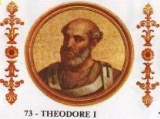
Pope Theodore I

Encyclopedia
Pope Theodore I who was pope
from November 24, 642, to May 14, 649, is considered a Greek
, but was born in Jerusalem. He was made a cardinal deacon, (possibly around 640) and a full cardinal
by Pope John IV
.
His election was supported by the exarch
and he was installed on November 24, 642, succeeding the short reign of Pope John IV. The main feature of his pontificate was the continued struggle against the heretical Monothelites
. He refused to recognize Paul as the Patriarch of Constantinople
, because his predecessor, Pyrrhus, had not been correctly replaced. He pressed Emperor Constans II to withdraw the Ecthesis of Heraclius
. While his efforts made little impression on Constantinople
, it increased the opposition to the heresy in the West; Pyrrhus even briefly recanted his heresy (645), but was excommunicated
in 648. Paul was excommunicated in 649; in response Paul destroyed the Roman
altar in the palace of Placidia
and exiled or imprisoned the papal nuncio
s. But he also sought to end the issue with the emperor, by promulgating the Type of Constans
, ordering that the Ecthesis be taken down and seeking to end discussion on the doctrine.
Theodore planned the Lateran Council of 649
to condemn the Ecthesis, but died before he could convene it, which his successor, Pope Martin I
, did. Theodore was buried in St. Peter's Basilica
.
His feast day in the Orthodox Church is on May 18
.
Pope
The Pope is the Bishop of Rome, a position that makes him the leader of the worldwide Catholic Church . In the Catholic Church, the Pope is regarded as the successor of Saint Peter, the Apostle...
from November 24, 642, to May 14, 649, is considered a Greek
Greeks
The Greeks, also known as the Hellenes , are a nation and ethnic group native to Greece, Cyprus and neighboring regions. They also form a significant diaspora, with Greek communities established around the world....
, but was born in Jerusalem. He was made a cardinal deacon, (possibly around 640) and a full cardinal
Cardinal (Catholicism)
A cardinal is a senior ecclesiastical official, usually an ordained bishop, and ecclesiastical prince of the Catholic Church. They are collectively known as the College of Cardinals, which as a body elects a new pope. The duties of the cardinals include attending the meetings of the College and...
by Pope John IV
Pope John IV
Pope John IV was elected Pope of the Catholic Church, after a four-month sede vacante, December 24, 640.Pope John was a native of Dalmatia . He was the son of the scholasticus Venantius. At the time of his election he was archdeacon of the Roman Church, an important role in governing the see...
.
His election was supported by the exarch
Exarch
In the Byzantine Empire, an exarch was governor with extended authority of a province at some remove from the capital Constantinople. The prevailing situation frequently involved him in military operations....
and he was installed on November 24, 642, succeeding the short reign of Pope John IV. The main feature of his pontificate was the continued struggle against the heretical Monothelites
Monothelitism
Monothelitism is a particular teaching about how the divine and human relate in the person of Jesus, known as a Christological doctrine, that formally emerged in Armenia and Syria in 629. Specifically, monothelitism teaches that Jesus Christ had two natures but only one will...
. He refused to recognize Paul as the Patriarch of Constantinople
Patriarch of Constantinople
The Ecumenical Patriarch is the Archbishop of Constantinople – New Rome – ranking as primus inter pares in the Eastern Orthodox communion, which is seen by followers as the One, Holy, Catholic, and Apostolic Church....
, because his predecessor, Pyrrhus, had not been correctly replaced. He pressed Emperor Constans II to withdraw the Ecthesis of Heraclius
Heraclius
Heraclius was Byzantine Emperor from 610 to 641.He was responsible for introducing Greek as the empire's official language. His rise to power began in 608, when he and his father, Heraclius the Elder, the exarch of Africa, successfully led a revolt against the unpopular usurper Phocas.Heraclius'...
. While his efforts made little impression on Constantinople
Constantinople
Constantinople was the capital of the Roman, Eastern Roman, Byzantine, Latin, and Ottoman Empires. Throughout most of the Middle Ages, Constantinople was Europe's largest and wealthiest city.-Names:...
, it increased the opposition to the heresy in the West; Pyrrhus even briefly recanted his heresy (645), but was excommunicated
Excommunication
Excommunication is a religious censure used to deprive, suspend or limit membership in a religious community. The word means putting [someone] out of communion. In some religions, excommunication includes spiritual condemnation of the member or group...
in 648. Paul was excommunicated in 649; in response Paul destroyed the Roman
Rome
Rome is the capital of Italy and the country's largest and most populated city and comune, with over 2.7 million residents in . The city is located in the central-western portion of the Italian Peninsula, on the Tiber River within the Lazio region of Italy.Rome's history spans two and a half...
altar in the palace of Placidia
Placidia
Placidia was the wife of Olybrius, Western Roman Emperor. Her full name is uncertain. The Chronicle of the Roman Emperors: The reign by reign record of the rulers of Imperial Rome by Chris Scarre gives her name as Galla Placidia Valentiniana or Galla Placidia the Younger, based on Roman naming...
and exiled or imprisoned the papal nuncio
Nuncio
Nuncio is an ecclesiastical diplomatic title, derived from the ancient Latin word, Nuntius, meaning "envoy." This article addresses this title as well as derived similar titles, all within the structure of the Roman Catholic Church...
s. But he also sought to end the issue with the emperor, by promulgating the Type of Constans
Type of Constans
The Type of Constans is an imperial edict released by Byzantine Emperor Constans II in 648 in an attempt to defuse the confusion and arguments over the Christological doctrine of Monotheletism.-Background:...
, ordering that the Ecthesis be taken down and seeking to end discussion on the doctrine.
Theodore planned the Lateran Council of 649
Lateran Council of 649
The Lateran Council of 649 was a synod held in the Basilica of St. John Lateran to condemn Monothelitism, a Christology espoused by many Eastern Christians...
to condemn the Ecthesis, but died before he could convene it, which his successor, Pope Martin I
Pope Martin I
Pope Martin I, born near Todi, Umbria in the place now named after him , was pope from 649 to 653, succeeding Pope Theodore I in July 5, 649. The only pope during the Byzantine Papacy whose election was not approved by a iussio from Constantinople, Martin I was abducted by Constans II and died in...
, did. Theodore was buried in St. Peter's Basilica
St. Peter's Basilica
The Papal Basilica of Saint Peter , officially known in Italian as ' and commonly known as Saint Peter's Basilica, is a Late Renaissance church located within the Vatican City. Saint Peter's Basilica has the largest interior of any Christian church in the world...
.
His feast day in the Orthodox Church is on May 18
May 18 (Eastern Orthodox liturgics)
May 17—Eastern Orthodox Church calendar—May 19All fixed commemorations below celebrated on May 31 by Old Calendarists-Saints:* Martyr Venantius of Camerino...
.
External links
- Catholic Encyclopedia: Pope John IV
- Cardinals of the Holy Roman Church