

Nuclear program of Iran

Encyclopedia
The nuclear program of Iran was launched in the 1950s with the help of the United States as part of the Atoms for Peace
program. The support, encouragement and participation of the United States and Western European governments in Iran's nuclear program continued until the 1979 Iranian Revolution
that toppled the Shah of Iran.
After the 1979 revolution, the Iran
ian government temporarily disbanded elements of the program, and then revived it with less Western assistance than during the pre-revolution era. Iran's nuclear program has included several research sites, two uranium
mines, a research reactor, and uranium processing facilities that include three known uranium enrichment plants.
After delays, Iran's first nuclear power plant, Bushehr I reactor
was complete with major assistance of Russian government agency RosAtom and was officially opened in a ceremony on 12 September 2011. Iran has announced that it is working on a new 360 MW nuclear power plant to be located in Darkhovin
. Iran has also indicated that it will seek more medium-sized nuclear power plants and uranium mines in the future.
In November 2011, the IAEA
Board of Governors rebuked Iran following an IAEA report Iran had undertaken research and experiments geared to developing a nuclear weapons capability. Iran rejected the details of the report and accused the IAEA of pro-Western bias and threatened to reduce its cooperation with the IAEA.
(IAEA). Enrichment can be used to produce uranium for reactor fuel or (at higher enrichment levels) for weapons. Iran says its nuclear program is peaceful, and has enriched uranium to less than 5%, consistent with fuel for a civilian nuclear power plant. Iran also claims that it was forced to resort to secrecy after US pressure caused several of its nuclear contracts with foreign governments to fall through. After the IAEA Board of Governors reported Iran's noncompliance with its safeguards agreement to the UN Security Council, the Council demanded that Iran suspend its nuclear enrichment
activities while Iranian President Mahmoud Ahmadinejad has argued that the sanctions are "illegal," imposed by "arrogant powers," and that Iran has decided to pursue the monitoring of its self-described peaceful nuclear program through "its appropriate legal path," the International Atomic Energy Agency.
After public allegations about Iran's previously undeclared nuclear activities, the IAEA launched an investigation that concluded in November 2003 that Iran had systematically failed to meet its obligations under its NPT safeguards agreement to report those activities to the IAEA, although it also reported no evidence of links to a nuclear weapons program. The IAEA Board of Governors delayed a formal finding of non-compliance until September 2005, and (in a rare non-consensus decision) reported that non-compliance to the UN Security Council in February 2006. After the IAEA Board of Governors reported Iran's noncompliance with its safeguards agreement to the United Nations Security Council, the Council demanded that Iran suspend its enrichment programs. The Council imposed sanctions after Iran refused to do so. A May 2009 U.S. Congressional Report suggested "the United States, and later the Europeans, argued that Iran's deception meant it should forfeit its right to enrich, a position likely to be up for negotiation in talks with Iran."
In exchange for suspending its enrichment program, Iran has been offered "a long-term comprehensive arrangement which would allow for the development of relations and cooperation with Iran based on mutual respect and the establishment of international confidence in the exclusively peaceful nature of Iran's nuclear program." However, Iran has consistently refused to give up its enrichment program, arguing that the program is necessary for its energy security, that such "long term arrangements" are inherently unreliable, and would deprive it of its inalienable right to peaceful nuclear technology. Currently, thirteen states possess operational enrichment or reprocessing facilities, and several others have expressed an interest in developing indigenous enrichment programs. Iran's position was endorsed by the Non-Aligned Movement, which expressed concern about the potential monopolization of nuclear fuel production.
To address concerns that its enrichment program may be diverted to non-peaceful uses, Iran has offered to place additional restrictions on its enrichment program including, for example, ratifying the Additional Protocol to allow more stringent inspections by the International Atomic Energy Agency
, operating the uranium enrichment facility at Natanz as a multinational fuel center with the participation of foreign representatives, renouncing plutonium reprocessing and immediately fabricating all enriched uranium into reactor fuel rods. Iran's offer to open its uranium enrichment program to foreign private and public participation mirrors suggestions of an IAEA expert committee which was formed to investigate the methods to reduce the risk that sensitive fuel cycle activities could contribute to national nuclear weapons capabilities. Some non-governmental U.S. experts have endorsed this approach. The United States has insisted that Iran must meet the demands of the UN Security Council to suspend its enrichment program.
In every other case in which the IAEA Board of Governors made a finding of safeguards non-compliance involving clandestine enrichment or reprocessing, the resolution has involved (in the cases of Iraq and Libya) or is expected to involve (in the case of North Korea) at a minimum ending sensitive fuel cycle activities. According to Pierre Goldschmidt
, former deputy director general and head of the department of safeguards at the IAEA, and Henry D. Sokolski
, Executive Director of the Nonproliferation Policy Education Center
, some other instances of safeguards noncompliance reported by the IAEA Secretariat (South Korea, Egypt) were never reported to the Security Council because the IAEA Board of Governors never made a formal finding of non-compliance. Though South Korea's case involved enriching uranium to levels near weapons grade, the country itself said it had voluntarily reported an isolated activity and Goldschmidt has argued "political considerations also played a dominant role in the board's decision" to not make a formal finding of non-compliance.
's nuclear program were laid after a 1953 coup deposed the Prime Minister Mohammed Mossadegh and installed the Shah
(King) Mohammad Reza Pahlavi
to power.
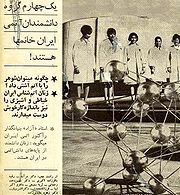
A civil nuclear co-operation program was established under the U.S. Atoms for Peace program
. In 1967, the Tehran Nuclear Research Center (TNRC) was established, run by the Atomic Energy Organization of Iran
(AEOI). The TNRC was equipped with a U.S.-supplied, 5-megawatt nuclear research reactor
, which was fueled by highly enriched uranium.
Iran signed the Nuclear Non-Proliferation Treaty
(NPT) in 1968 and ratified it in 1970, making Iran's nuclear program subject to International Atomic Energy Agency
verification.
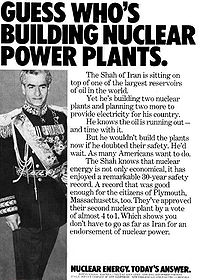
In March 1974, the Shah envisioned a time when the world's oil supply would run out, and declared, "Petroleum is a noble material, much too valuable to burn ... We envision producing, as soon as possible, 23 000 megawatts of electricity using nuclear plants."
Iran had deep pockets and close ties to the West. U.S. and European companies scrambled to do business in Iran. Bushehr
would be the first plant, and would supply energy to the inland city of Shiraz
. In 1975, the Erlangen
/Frankfurt
firm Kraftwerk Union AG, a joint venture of Siemens AG
and AEG
, signed a contract worth $4 to to build the pressurized water reactor
nuclear power plant. Construction of the two 1,196 MWe
, and was to have been completed in 1981.
The joint stock company
Eurodif
operating a uranium enrichment plant in France was formed in 1973 by France, Belgium, Spain and Sweden. In 1975 Sweden's 10% share in Eurodif went to Iran as a result of an arrangement between France and Iran. The French government subsidiary company Cogéma
and the Iranian Government established the Sofidif (Société franco–iranienne pour l'enrichissement de l'uranium par diffusion gazeuse) enterprise with 60% and 40% shares, respectively. In turn, Sofidif acquired a 25% share in Eurodif, which gave Iran its 10% share of Eurodif. Mohammed Reza Shah Pahlavi lent dollars (and another dollars in 1977) for the construction of the Eurodif factory, to have the right of buying 10% of the production of the site.
"President Gerald Ford
signed a directive in 1976 offering Tehran
the chance to buy and operate a U.S.-built reprocessing facility for extracting plutonium
from nuclear reactor fuel. The deal was for a complete 'nuclear fuel cycle'."
At the time, Richard Cheney was the White House Chief of Staff, and Donald Rumsfeld
was the Secretary of Defense.
The Ford strategy paper said the "introduction of nuclear power will both provide for the growing needs of Iran's economy and free remaining oil reserves for export or conversion to petrochemicals."
Then-United States Secretary of State
Henry Kissinger
recalled in 2005, "I don't think the issue of proliferation came up." However, a 1974 CIA proliferation assessment stated "If [the Shah] is alive in the mid-1980s ... and if other countries [particularly India] have proceeded with weapons development we have no doubt Iran will follow suit."
The Shah also signed a nuclear cooperation agreement with South Africa under which Iranian oil money financed the development of South African fuel enrichment technology using a novel "jet nozzle" process, in return for assured supplies of South African (and Namibian) enriched uranium.
saw the overthrow of the Shah. During the Revolution, Iranian students took over the U.S. Embassy, and held U.S. diplomats there hostage for 444 days
lasting from 4 November 1979, to 20 January 1981. In Iran, anti-American sentiment was fed by the U.S. installation and support for the repressive Shah and "feared" SAVAK
, and continuing resentment over U.S. support to the coup that overthrew Iran's democratically elected government and installed the Shah. The United States considered the hostage-taking
as an outrage violating the sovereignty
of diplomatic compounds.
After the revolution, much nuclear cooperation with Iran was cut off. The United States stopped fulfilling contracts it had with Iran, while France, Germany, and other countries also reduced their cooperation with Iran due to pressure from the United States. Iran argues these experiences show the unreliability of working with the West on nuclear issues and place the burden on the West to restore its credibility.
to Iran and also Eurodif
did not return Iran's investments (see European reactions 1979–89), Iran's government suspended its payments and tried to get refunded the loan by making pressure on France by handling militant groups, including the Hezbollah who took French citizens hostage in the 1980s. Iran was denied uranium which it was entitled to as a joint owner in the French Eurodif international enrichment facility because of U.S. pressure.
Another result of the 1979 Revolution was France's refusal to give any enriched uranium
to Iran after 1979. Iran also did not get back its investment from Eurodif
(see European reactions in the 1970s). In 1982, French president François Mitterrand
refused to give any uranium to Iran, which also claimed the debt.
, also withdrew itself. Iran had paid Germany in full, totaling billions of dollars, for the two nuclear facilities in Bushehr
. Germany halted construction of the Bushehr reactor under pressure from the United States.
In April 1984, Jane's Defence Weekly cited reports from West German intelligence that Iran may have a nuclear bomb within two years with uranium from Pakistan. The Germans leaked this news in the first public Western intelligence report of a post-revolutionary nuclear weapons program in Iran.
Between 24 March 1984, to 1988, the Bushehr reactors were damaged by multiple Iraqi air strikes and work on the nuclear program came to a standstill. In 1984, Kraftwerk Union did a preliminary assessment to see if it could resume work on the project, but declined to do so while the Iran–Iraq War continued.
The United States in or after 1983 persuaded the IAEA to terminate its project to assist Iran in producing enriched uranium.
In April 1984, the U.S. State Department said, "We believe it would take at least two to three years to complete construction of the reactors at Bushehr." The spokesperson also said that the light water power reactors at Bushehr "are not particularly well-suited for a weapons program." The spokesman went on to say, "In addition, we have no evidence of Iranian construction of other facilities that would be necessary to separate plutonium from spent reactor fuel."
In June 1984, Minority Whip of the United States
Senate Alan Cranston
asserted that the Islamic Republic of Iran was seven years away from being able to build its own nuclear weapon.
's National Atomic Energy Commission
. The first Iranian-Argentine agreement involved help in converting the U.S. supplied Tehran Nuclear Research Center (TNRC) research reactor from highly enriched uranium fuel to 19.75% low-enriched uranium, and to supply the low-enriched uranium to Iran. The uranium was delivered in 1993. The second and third agreements were for technical assistance, including components, for the building of pilot plants for uranium-dioxide conversion and fuel fabrication. Under US pressure, assistance under second and third agreements was reduced.
In 1983, IAEA officials were keen to assist Iran in chemical aspects of reactor fuel fabrication, chemical engineering and design aspects of pilot plants for uranium conversion, corrosion of nuclear materials, LWR fuel fabrication, and pilot plant development for production of nuclear grade UO2. The IAEA planned to provide assistance to Iran under its Technical Assistance Program to produce enriched uranium. An IAEA report stated that its aim was to "contribute to the formation of local expertise and manpower needed to sustain an ambitious program in the field of nuclear power reactor technology and fuel cycle technology."
The U.S. government "directly intervened" to discourage IAEA assistance in Iranian production of UO2 and UF6. A former U.S. official said "we stopped that in its tracks." The IAEA dropped plans to help Iran on fuel production and uranium conversion due to U.S. pressure. Iran later set up a bilateral cooperation on fuel cycle related issues with China, but China also agreed to drop most outstanding nuclear commerce with Iran, including the construction of the UF6 plant, due to U.S. pressure.
During the Iran-Iraq war, Iran's Bushehr reactors were damaged by multiple Iraqi air strikes and work on the nuclear program came to a standstill. Iran notified the International Atomic Energy Agency of the blasts, and complained about international inaction and the use of French made missiles in the attack.
After the Revolution, Iran also asserted that the American government, "contrary to the contract and its legal obligations", would not allow an American company "to refund over dollars paid by Iran before the Islamic Revolution".
helped Tehran to improve its missiles. The exchange of technical information with Iran was personally approved by the SVR
director Trubnikov. President Boris Yeltsin
had a "two track policy" offering commercial nuclear technology to Iran and discussing the issues with Washington.
In 1990, Iran began to look outwards towards new partners for its nuclear program; however, due to a radically different political climate and punitive U.S. economic sanctions, few candidates existed.
In 1991, an agreement was found for the French-Iranian disagreement since 1979 (see Post Revolution, 1979–1989): France refunded more than dollars. Iran remained shareholder of Eurodif via Sofidif, a Franco-Iranian consortium shareholder to 25% of Eurodif. However, Iran refrained from asking for the produced uranium.
In 1992, following media allegations about undeclared nuclear activities in Iran, Iran invited IAEA inspectors to the country and permitted those inspectors to visit all the sites and facilities they asked to see. Director General Blix reported that all activities observed were consistent with the peaceful use of atomic energy. The IAEA visits included undeclared facilities and Iran's nascent uranium mining project at Saghand. In the same year, Argentine officials disclosed that their country had canceled a sale to Iran of civilian nuclear equipment worth , under US pressure.
In 1995, Iran signed a contract with Russia to resume work on the partially complete Bushehr plant, installing into the existing Bushehr I building a 915 MWe
VVER
-1000 pressurized water reactor
, with completion expected in 2009. There are no current plans to complete the Bushehr II reactor.
In 1996, the U.S. convinced the People's Republic of China to pull out of a contract to construct a uranium conversion plant. However, the Chinese provided blueprints for the facility to the Iranians, who advised the IAEA that they would continue work on the program, and IAEA Director Mohammad El Baradei even visited the construction site.
According to a report by the Argentine justice in 2006, late 1980s and early 1990s the US pressured Argentina to terminate its nuclear cooperation with Iran, and from early 1992 to 1994 negotiations between Argentina and Iran took place with the aim of re-establishing the three agreements made in 1987–88.
 On 14 August 2002, Alireza Jafarzadeh
, a spokesman for an Iranian dissident group National Council of Resistance of Iran, publicly revealed the existence of two nuclear sites under-construction: a uranium enrichment facility in Natanz
(part of which is underground), and a heavy water
facility in Arak
. It has been strongly suggested that intelligence agencies already knew about these facilities but the reports had been classified.
The IAEA immediately sought access to these facilities and further information and co-operation from Iran regarding its nuclear program. According to arrangements in force at the time for implementation of Iran's safeguards agreement with the IAEA, Iran was not required to allow IAEA inspections of a new nuclear facility until six months before nuclear material is introduced into that facility. At the time, Iran was not even required to inform the IAEA of the existence of the facility. This 'six months' clause was standard for implementation of all IAEA safeguards agreements until 1992, when the IAEA Board of Governors decided that facilities should be reported during the planning phase, even before construction began. Iran was the last country to accept that decision, and only did so 26 February 2003, after the IAEA investigation began.
France, Germany and the United Kingdom (the EU-3) undertook a diplomatic initiative with Iran to resolve questions about its nuclear program. On 21 October 2003, in Tehran, the Iranian government and EU-3 Foreign Ministers issued a statement known as the Tehran Declaration in which Iran agreed to co-operate with the IAEA, to sign and implement an Additional Protocol as a voluntary, confidence-building measure, and to suspend its enrichment and reprocessing activities during the course of the negotiations. The EU-3 in return explicitly agreed to recognize Iran's nuclear rights and to discuss ways Iran could provide "satisfactory assurances" regarding its nuclear power program, after which Iran would gain easier access to modern technology. Iran signed an Additional Protocol on 18 December 2003, and agreed to act as if the protocol were in force, making the required reports to the IAEA and allowing the required access by IAEA inspectors, pending Iran's ratification of the Additional Protocol.
The IAEA reported 10 November 2003, that "it is clear that Iran has failed in a number of instances over an extended period of time to meet its obligations under its Safeguards Agreement with respect to the reporting of nuclear material and its processing and use, as well as the declaration of facilities where such material has been processed and stored." Iran was obligated to inform the IAEA of its importation of uranium from China and subsequent use of that material in uranium conversion and enrichment activities. It was also obligated to report to the IAEA experiments with the separation of plutonium. A comprehensive list of Iran's specific "breaches" of its IAEA safeguards agreement, which the IAEA described as part of a "pattern of concealment," can be found in the 15 November 2004, report of the IAEA on Iran's nuclear program. Iran attributes its failure to report certain acquisitions and activities on US obstructionism, which reportedly included pressuring the IAEA to cease providing technical assistance to Iran's uranium conversion program in 1983. On the question of whether Iran had a hidden nuclear weapons program, the IAEA's November 2003 report states that it found "no evidence" that the previously undeclared activities were related to a nuclear weapons program, but also that it was unable to conclude that Iran's nuclear program was exclusively peaceful.
In June 2004, construction was commenced on IR-40
, a 40 MW heavy water reactor
.
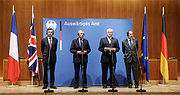 Under the terms of the Paris Agreement, on 14 November 2004, Iran's chief nuclear negotiator announced a voluntary and temporary suspension of its uranium enrichment program (enrichment is not a violation of the NPT) and the voluntary implementation of the Additional Protocol, after pressure from the United Kingdom, France, and Germany acting on behalf of the European Union
(EU, known in this context as the EU-3). The measure was said at the time to be a voluntary, confidence-building measure, to continue for some reasonable period of time (six months being mentioned as a reference) as negotiations with the EU-3 continued. On 24 November, Iran sought to amend the terms of its agreement with the EU to exclude a handful of the equipment from this deal for research work. This request was dropped four days later. According to Seyyed Hossein Mousavian, one of the Iranian representatives to the Paris Agreement negotiations, the Iranians made it clear to their European counterparts that Iran would not consider a permanent end to uranium enrichment:
In February 2005, Iran pressed the EU-3 to speed up talks, which the EU-3 refused to do so. The talks made little progress because of the divergent positions of the two sides. In early August 2005, after the June election of Mahmoud Ahmadinejad as Iran's President, Iran removed seals on its uranium enrichment equipment in Isfahan, which UK officials termed a "breach of the Paris Agreement" though a case can be made that the EU violated the terms of the Paris Agreement by demanding that Iran abandon nuclear enrichment. Several days later, the EU-3 offered Iran a package in return for permanent cessation of enrichment. Reportedly, it included benefits in the political, trade and nuclear fields, as well as long-term supplies of nuclear materials and assurances of non-aggression by the EU (but not the US),. Mohammad Saeedi, the deputy head of Iran's atomic energy organization rejected the offer, terming it "very insulting and humiliating" and other independent analysts characterized the EU offer as an "empty box". Iran's announcement that it would resume enrichment preceded the election of Iranian President Ahmadinejad by several months. The delay in restarting the program was to allow the IAEA to re-install monitoring equipment. The actual resumption of the program coincided with the election of President Mahmoud Ahmedinejad, and the appointment of Ali Larijani
as the chief Iranian nuclear negotiator.
Around 2005, Germany refused to export any more nuclear equipment or refund money paid by Iran for such equipment in the 1980s. (See European reactions 1979–89.)
In August 2005, with the assistance of Pakistan a group of US government experts and international scientists concluded that traces of bomb-grade uranium found in Iran came from contaminated Pakistani equipment and were not evidence of a clandestine nuclear weapons program in Iran. In September 2005, IAEA Director General Mohammad ElBaradei reported that "most" highly enriched uranium traces found in Iran by agency inspectors came from imported centrifuge components, validating Iran's claim that the traces were due to contamination. Sources in Vienna and the State Department reportedly stated that, for all practical purposes, the HEU issue has been resolved.
The IAEA Board of Governors deferred a formal decision on Iran's nuclear case for two years after 2003, while Iran continued cooperation with the EU-3. On 24 September 2005, after Iran abandoned the Paris Agreement, the Board found that Iran had been in non-compliance with its safeguards agreement, based largely on facts that had been reported as early as November 2003.
On 4 February 2006, the 35 member Board of Governors of the IAEA voted 27–3 (with five abstentions: Algeria
, Belarus
, Indonesia
, Libya
and South Africa) to report Iran to the UN Security Council. The measure was sponsored by the United Kingdom, France and Germany, and it was backed by the United States. Two permanent council members, Russia and China, agreed to referral only on condition that the council take no action before March. The three members who voted against referral were Venezuela
, Syria
and Cuba
. In response, on 6 February 2006, Iran suspended its voluntary implementation of the Additional Protocol and all other voluntary and non-legally binding cooperation with the IAEA beyond what is required by its safeguards agreement.
In late February 2006, IAEA Director Mohammad El-Baradei raised the suggestion of a deal, whereby Iran would give up industrial-scale enrichment and instead limit its program to a small-scale pilot facility, and agree to import its nuclear fuel from Russia (see nuclear fuel bank
). The Iranians indicated that while they would not be willing to give up their right to enrichment in principle, they were willing to consider the compromise solution. However in March 2006, the Bush Administration made it clear that they would not accept any enrichment at all in Iran.
The IAEA Board of Governors deferred the formal report to the UN Security Council of Iran's non-compliance (such a report is required by Article XII.C of the IAEA Statute), until 27 February 2006. The Board usually makes decisions by consensus, but in a rare non-consensus decision it adopted this resolution by vote, with 12 abstentions.
On 11 April 2006, Iranian President Mahmoud Ahmadinejad announced that Iran
had successfully enriched uranium. President Ahmadinejad made the announcement in a televised address from the northeastern city of Mashhad
, where he said "I am officially announcing that Iran joined the group of those countries which have nuclear technology." The uranium was enriched to 3.5% using over a hundred centrifuges.
On 13 April 2006, after US Secretary of State Condoleezza Rice
said (on 12 April 2006) the Security Council must consider "strong steps" to induce Tehran to change course in its nuclear ambition; President Ahmadinejad vowed that Iran will not back away from uranium enrichment and that the world must treat Iran as a nuclear power, saying "Our answer to those who are angry about Iran achieving the full nuclear fuel cycle is just one phrase. We say: Be angry at us and die of this anger," because "We won't hold talks with anyone about the right of the Iranian nation to enrich uranium."
On 14 April 2006, The Institute for Science and International Security (ISIS) published a series of analyzed satellite images of Iran's nuclear facilities at Natanz and Esfahan. Featured in these images is a new tunnel entrance near the Uranium Conversion Facility (UCF) at Esfahan and continued construction at the Natanz uranium enrichment site. In addition, a series of images dating back to 2002 shows the underground enrichment buildings and its subsequent covering by soil, concrete, and other materials. Both facilities were already subject to IAEA inspections and safeguards.
Iran responded to the demand to stop enrichment of uranium 24 August 2006, offering to return to the negotiation table but refusing to end enrichment.
Qolam Ali Hadad-adel, speaker of Iran's parliament, said on 30 August 2006, that Iran had the right to "peaceful application of nuclear technology and all other officials agree with this decision," according to the semi-official Iranian Students News Agency. "Iran opened the door to negotiations for Europe and hopes that the answer which was given to the nuclear package would bring them to the table."
In Resolution 1696 July 31, 2006, the United Nations Security Council
demanded that Iran suspend all enrichment and reprocessing related activities.
In UN Security Council Resolution 1737 of 26 December 2006, the Council imposed a series of sanctions on Iran for its non-compliance with the earlier Security Council resolution deciding that Iran suspend enrichment-related activities without delay. These sanctions were primarily targeted against the transfer of nuclear and ballistic missile technologies and, in response to concerns of China and Russia, were lighter than that sought by the United States. This resolution followed a report from the IAEA that Iran had permitted inspections under its safeguards agreement but had not suspended its enrichment-related activities.
has passed seven resolutions
on Iran:
The report also outlined a work plan agreed by Iran and the IAEA on 21 August 2007. The work plan reflected agreement on "modalities for resolving the remaining safeguards implementation issues, including the long outstanding issues." According to the plan, these modalities covered all remaining issues regarding Iran's past nuclear program and activities. The IAEA report described the work plan as "a significant step forward," but added "the Agency considers it essential that Iran adheres to the time line defined therein and implements all the necessary safeguards and transparency measures, including the measures provided for in the Additional Protocol." Although the work plan did not include a commitment by Iran to implement the Additional Protocol, IAEA safeguards head Olli Heinonen
observed that measures in the work plan "for resolving our outstanding issues go beyond the requirements of the Additional Protocol."
According to Reuters, the report was likely to blunt Washington's push for more severe sanctions against Iran. One senior UN official familiar said U.S. efforts to escalate sanctions against Iran would provoke a nationalistic backlash by Iran that would set back the IAEA investigation in Iran. In late October 2007, chief IAEA inspector Olli Heinonen described Iranian cooperation with the IAEA as "good," although much remained to be done.
On 18 November 2007, President Ahmadinejad announced that he intends to consult with other Arab nations on a plan, under the auspices of the Gulf Cooperation Council, to enrich uranium in a neutral third country, such as Switzerland.
The IAEA issued its report on the implementation of safeguards in Iran on 22 February 2008.
With respect to the report, IAEA Director Mohammad ElBaradei stated that "We have managed to clarify all the remaining outstanding issues, including the most important issue, which is the scope and nature of Iran´s enrichment programme" with the exception of a single issue, "and that is the alleged weaponization studies that supposedly Iran has conducted in the past."
According to the report, the IAEA shared intelligence with Iran recently provided by the US regarding "alleged studies" on a nuclear weaponization program. The information was allegedly obtained from a laptop computer smuggled out of Iran and provided to the US in mid-2004. The laptop was reportedly received from a "longtime contact" in Iran who obtained it from someone else now believed to be dead. A senior European diplomat warned "I can fabricate that data," and argued that the documents look "beautiful, but is open to doubt". The United States has relied on the laptop to prove that Iran intends to develop nuclear weapons. In November 2007, the United States National Intelligence Estimate
(NIE) believed that Iran halted an alleged active nuclear weapons program in fall 2003. Iran has dismissed the laptop information as a fabrication, and other diplomats have dismissed the information as relatively insignificant and coming too late.
The February 2008 IAEA report states that the Agency has "not detected the use of nuclear material in connection with the alleged studies, nor does it have credible information in this regard."
According to the report, the IAEA has been able to continue to verify the non-diversion of declared nuclear material in Iran, and Iran has provided the Agency with access to declared nuclear material and accountancy reports, as required by its safeguards agreement.
Iran had installed several new centrifuges, including more advanced models, and environmental samples showed the centrifuges "continued to operate as declared", making low-enriched uranium. The report also noted that other elements of Iran's nuclear program continued to be subject to IAEA monitoring and safeguards as well, including the construction of the heavy water facility in Arak, the construction and use of hot cells associated with the Tehran Research Reactor, the uranium conversion efforts, and the Russian nuclear fuel delivered for the Bushehr reactor.
The report stated that the IAEA had requested, as a voluntary "transparency measure", to be allowed access to centrifuge manufacturing sites, but that Iran had refused the request. The IAEA report stated that Iran had also submitted replies to questions regarding "possible military dimensions" to its nuclear program, which include "alleged studies" on a so-called Green Salt Project
, high-explosive testing and missile re-entry vehicles. According to the report, Iran's answers were still under review by the IAEA at the time the report was published. However, as part of its earlier "overall assessment" of the allegations, Iran had responded that the documents making the allegations were forged, not authentic, or referred to conventional applications.
The report stated that Iran may have more information on the alleged studies, which "remain a matter of serious concern", but that the IAEA itself had not detected evidence of actual design or manufacture by Iran of nuclear weapons or components. The IAEA also stated that it was not itself in possession of certain documents containing the allegations against Iran, and so was not able to share the documents with Iran.
With respect to the report, IAEA Director Mohammad ElBaradei stated that "We have managed to clarify all the remaining outstanding issues, including the most important issue, which is the scope and nature of Iran's enrichment programme" with the exception of a single issue, "and that is the alleged weaponization studies that supposedly Iran has conducted in the past."
According to the report, Iran had increased the number of operating centrifuges at its Fuel Enrichment Plant in Isfahan, and continued to enrich uranium. Contrary to some media reports which claimed that Iran had diverted uranium hexafluoride
(UF6) for a renewed nuclear weapons program, the IAEA emphasized that all of the uranium hexafluoride
was under IAEA safeguards. This was re-iterated by IAEA spokesman Melissa Fleming, who characterized the report of missing nuclear material in Iran as being "fictitious". Iran was also asked to clarify information about foreign assistance it may have received in connection with a high explosive charge suitable for an implosion type nuclear device. Iran stated that there had been no such activities in Iran.
The IAEA also reported that it had held a series of meetings with Iranian officials to resolve the outstanding issues including the "alleged studies" into nuclear weaponization which were listed in the May 2008 IAEA report. During the course of these meetings, the Iranians filed a series of written responses including a 117-page presentation which confirmed the partial veracity of some of the allegations, but which asserted that the allegations as a whole were based on "forged" documents and "fabricated" data, and that Iran had not actually received the documentation substantiating the allegations. According to the August 2007 "Modalities Agreement" between Iran and the IAEA, Iran had agreed to review and assess the "alleged studies" claims, as good faith gesture, "upon receiving all related documents".
Iran's ambassador to the IAEA, Ali Asghar Soltaniyeh, accused the United States of preventing the IAEA from delivering the documents about the alleged studies to Iran as required by the Modalities Agreement, and stated that Iran had done its best to respond to the allegations but would not accept "any request beyond our legal obligation and particularly beyond the Work Plan, which we have already implemented."
While once again expressing "regret" that the IAEA was not able to provide Iran with copies of the documentation concerning the alleged studies, the report also urged Iran to provide the IAEA with "substantive information to support its statements and provide access to relevant documentation and individuals" regarding the alleged studies, as a "matter of transparency". The IAEA submitted a number of proposals to Iran to help resolve the allegations and expressed a willingness to discuss modalities that could enable Iran to demonstrate credibly that the activities referred to in the documentation were not nuclear-related, as Iran asserted, while protecting sensitive information related to its conventional military activities. The report does not indicate whether Iran accepted or rejected these proposals.
The report also reiterated that IAEA inspectors had found "no evidence on the actual design or manufacture by Iran of nuclear material components of a nuclear weapon or of certain other key components, such as initiators, or on related nuclear physics studies ... Nor has the Agency detected the actual use of nuclear material in connection with the alleged studies" but insisted that the IAEA would not be able to formally verify the peaceful nature of Iran's nuclear program unless Iran had agreed to adopt the requested "transparency measures".
According to the report, Iran also continued to refuse to provide design information or access to verify design information for its IR-40 heavy water research reactor. Iran and the IAEA in February 2003 agreed to modify a provision in the Subsidiary Arrangement to its safeguards agreement (Code 3.1) to require such access. Iran told the Agency in March 2007 that it "suspended" the implementation of the modified Code 3.1, which had been "accepted in 2003, but not yet ratified by the parliament", and that it would "revert" to the implementation of the 1976 version of Code 3.1. The subsidiary arrangement may only be modified by mutual agreement. Iran says that since the reactor is not in a position to receive nuclear material the IAEA's request for access was not justified, and requested that the IAEA not schedule an inspection to verify design information. The Agency says its right to verify design information provided to it is a "continuing right, which is not dependent on the stage of construction of, or the presence of nuclear material at, a facility".
Regarding the "alleged studies" into nuclear weaponization, the Agency said that "as a result of the continued lack of cooperation by Iran in connection with the remaining issues which give rise to concerns about possible military dimensions of Iran's nuclear programme, the Agency has not made any substantive progress on these issues." The Agency called on member states which had provided information about the alleged programs to allow the information to be shared with Iran. The Agency said Iran's continued refusal to implement the Additional Protocol was contrary to the request of the Board of Governors and the Security Council. The Agency was able to continue to verify the non-diversion of declared nuclear material in Iran. Iran says that for the six years the Agency has been considering its case, the IAEA has not found any evidence to prove that Tehran is seeking a nuclear weapon.
Regarding the IAEA report, several news reports suggested that that Iran had failed to properly report the amount of low-enriched uranium it possessed because Iranian estimates did not match the IAEA inspector's findings, and that Iran now had enough uranium to make a nuclear bomb. The reporting was widely criticized as unjustifiably provocative and hyped. In response to the controversy, IAEA spokesman Melissa Fleming asserted that the IAEA had no reason at all to believe that the estimates of low-enriched uranium produced by Iran were an intentional error, and that no nuclear material could be removed from the facility for further enrichment to make nuclear weapons without the agency's knowledge since the facility is subject to video surveillance and the nuclear material is kept under seal.
Ali Asghar Soltaniyeh, Iran's Ambassador to the International Atomic Energy Agency, said the February report failed to "provide any new insight into Iran's nuclear program". He asserted the report was written in a way which clearly causes misunderstanding in public opinion. He suggested the reports should be written to have a section about whether Iran has fulfilled its NPT obligations and a separate section for whether "fulfillment of Additional Protocol or sub-arrangements 1 and 3 are beyond the commitment or not".
said evidence gathered by the agency "indicates that Iran has carried out activities relevant to the development of a nuclear explosive device." Iran rejected IAEA's findings as "unbalanced, unprofessional and prepared with political motivation and under political pressure by mostly the United States."
The IAEA Board of Governors passed a resolution by a vote of 32–2 that expressed "deep and increasing concern" over the possible military dimensions to Iran's nuclear program and calling it "essential" that Iran provide additional information and access to the IAEA. The United States welcomed the resolution and said it would step up sanctions to press Iran to change course. In response to the IAEA resolution, Iran threatened to reduce its cooperation with the IAEA, though Iranian Foreign Minister Salehi
played down talk of withdrawal from the NPT or the IAEA.
. On 25 September, at the G-20 Summit, the three countries criticized Iran for once again concealing a nuclear facility from the IAEA. The United States said that the facility, which was still months from completion, was too small to be useful for a civil program but could produce enough high-enriched uranium for one bomb per year. Iran said the plant was for peaceful purposes and would take between a year and a half to two years to complete, and that the notice Iran had given had exceeded the 180 days before insertion of nuclear materials the IAEA safeguards agreement that Iran was following required. Iran agreed to allow IAEA inspections. Iran's nuclear chief, Ali Akbar Salehi, said the site was built for maximum protection from aerial attack: carved into a mountain and near a military compound of the powerful Revolutionary Guard.
Also in October, the United States, France and Russia proposed a UN-drafted deal to Iran regarding its nuclear program, in an effort to find a compromise between Iran's stated need for a nuclear reactor and international concerns that Iran harbors a secret intent on developing a nuclear weapon. After some delay in responding, on 29 October, Ahmadinejad voiced an openness towards cooperation with other world powers. "We welcome fuel exchange, nuclear co-operation, building of power plants and reactors and we are ready to co-operate," he said in a live broadcast on state television. However, he added that Iran would not retreat "one iota" on its right to a sovereign nuclear program.
In November 2009, the IAEA Board of Governors passed a resolution that criticized Iran for defying a UN Security Council ban on uranium enrichment, censured Iran for secretly building a uranium enrichment facility and demanded that it immediately suspend further construction. It noted the IAEA chief Mohammed El-Baradei cannot confirm that Iran's nuclear program is exclusively geared toward peaceful uses, and expressed "serious concern" that Iran's stonewalling of an IAEA probe means "the possibility of military dimensions to Iran's nuclear program" cannot be excluded.
announced that Iran was helping Venezuela in uranium exploration. He said that "We're working with several countries, with Iran, with Russia. We're responsible for what we're doing, we're in control". A number of reports suggested that Venezuela was helping Iran to obtain uranium and evade international sanctions.
to up to 20% to produce fuel for a research reactor used to produce medical radioisotopes, processing its existing stocks of 3.5% enriched uranium. Two days later during the celebrations in Tehran for the 31st anniversary of the 1979 Iranian Islamic revolution
, the Iranian President Mahmoud Ahmadinejad announced that Iran was now a "nuclear state." IAEA
officials confirmed it has enriched uranium "up to 19.8%".
Responding to criticism, President Ahmadinejad said, "Why do they think that 20 per cent is such a big deal? Right now in Natanz we have the capability to enrich at over 20 per cent and at over 80 per cent, but because we don't need it, we won't do it." He added "If we wanted to manufacture a bomb, we would announce it." On the same day as the President's announcement, Ali Akbar Salehi
, head of the Atomic Energy Organization of Iran, told Reuters
that their 20% enrichment production, was going "very well," adding "There is no limit on enrichment. We can enrich up to 100% ... But we never had the intention and we do not have the intention to do so, unless we need (to)." He maintained that the 20% production was for a Tehran medical reactor, and as such would be limited to around 1.5 kg per month.
Brazil's Foreign Minister, Celso Amorim
, said that his government was encouraged "to implement the proposals in October, without deviation, and we did." In an 20 April letter to Brazilian President Lula, U.S. President Obama wrote "For us, Iran’s agreement to transfer 1,200 kg of Iran’s low enriched uranium (LEU) out of the country would build confidence and reduce regional tensions by substantially reducing Iran’s LEU stockpile. I want to underscore that this element is of fundamental importance for the United States... I would urge Brazil to impress upon Iran the opportunity presented by this offer to "escrow" its uranium in Turkey while the nuclear fuel is being produced." Turkish President Recep Tayyip Erdogan
received a similar letter. A senior U.S. official told the Washington Post that the letter was a response to Iran's desire to ship out its uranium piecemeal, rather than in a single batch, and that during "multiple conversations" U.S. officials made clear that Iran should also cease 20% enrichment, but also said "there was no president-to-president letter laying out those broader concerns". Amorim said the terms of the deal were discussed with several countries, including the United States. Turkish Foreign Minister Ahmet Davutoğlu
said “this [agreement] is a success for Turkey and Brazil, but it is also a success for President Obama’s policy of engagement.” Ivan Oelrich and Ivanka Barzashka, writing in the Bulletin of the Atomic Scientists in May 2010, stated that Iran's "20 percent enrichment is likely only a show of force in an attempt to speed up a favorable fuel deal".
Early analysis from the BBC stated the deal could be an "effort by President Mahmoud Ahmadinejad to deflect pressure for fresh sanctions" and that "Iran watchers are already criticising Washington for moving the goal posts". A Turkish foreign ministry spokesman said that the agreement, while not a solution for the entire nuclear program conflict, was "a step forward on resolving the swap issue, which is one of the important elements of the nuclear file." The Jerusalem Post reported that Israeli government ministers believed the deal was "a maneuver to prevent the UN Security Council from agreeing on sanctions" which would "probably succeed as the Security council will be forced to study the new proposals". Iran's atomic energy chief said the agreement left world powers no reason to continue to pressure Iran regarding its nuclear program. Iran also described the agreement as a major boost to trilateral relations with Brazil and Turkey, and Supreme Leader of Iran
Ayatollah Ali Khamenei criticized the continuing call for sanctions, stating that the "domineering powers headed by America are unhappy with cooperation between independent countries."
On 18 May, the United States announced a "draft accord" among UN permanent Security Council members for additional sanctions on Iran, designed to pressure it to end its nuclear enrichment program. Turkey and Brazil criticized the sanctions proposal. Davutoglu said that the swap agreement showed Iran's "clear political will" toward engagement on the nuclear issue. "This is not the day to muddy the waters with negative scenarios including sanctions,” he added. Brazil's Foreign Minister also expressed frustration with the U.S. stance, saying of Brazil's vote against the sanctions resolution: “We could not have voted in any different way except against.”
Graham Allison, director of the Belfer Center for Science and International Affairs
, says sanctions can be most effective before they go into force when the target of those measures fears their impact most. Despite the Obama administration’s tough line against new talks with Iran, Allison said the United States could build on the Turkish-Brazilian deal. Michael A. Levi, Senior Fellow for Energy and the Environment and Director of the Program on Energy Security and Climate Change, has said “the right choice for the United States may ultimately involve welcoming the announced fuel swap.” Antonio Ramalho, Professor of International Relations at the University of Brasília, has written that that “the very fact that the Iranians have agreed to sign an agreement has already diminished Iran’s maneuverability.” He continued that “if we impose further sanctions, that will only increase the secrecy in Iran and increase the military orientation of this program.” Marina Ottoway, of the Carnegie Endowment for International Peace, wrote that sanctions are "unlikely to change Tehran’s policies, particularly since international solidarity is already breaking down over the prospects of harsher bilateral measures". Former U.S. Secretary of State Colin Powell
said that proposed stricter United Nations sanctions will not bring an end to Iran’s nuclear program and that "I’m sure that they have done their own planning and have their own counter-sanction strategy."
Mohamed ElBaradei, former director general of the International Atomic Energy Agency
, wrote that "the only way to resolve the Iranian issue is to build trust. Moving 1200, half, or at least more than half of the Iranian nuclear material out of Iran is a confidence-building measure would defuse the crisis and enable the US and the West [to gain] the space to negotiate. I hope that it would be perceived as a win-win situation. If we see what I have been observing in the last couple of days that it is an "empty dressing", I think it is a wrong approach...we lost six years of failed policy frankly vis-à-vis Iran. And it's about time now to understand that the Iranian issue is not going to be resolved except, until and unless we sit with the Iranians and try to find a fair and equitable solution." "If this deal is followed up with a broader engagement of the IAEA and the international community, it can be a positive step to a negotiated settlement," UN secretary-general Ban-Ki Moon said.
On 21 August 2007, Iran and the IAEA finalized an agreement, titled "Understandings of The Islamic Republic of Iran and the IAEA on the Modalities of Resolution of the Outstanding Issues," that listed outstanding issues regarding Iran's nuclear program and set out a timetable to resolve each issue in order. These unresolved issues included the status of Iran's uranium mine at Gchine, allegations of experiments with plutonium and uranium metal, and the use of Polonium 210. Specifically regarding the "Alleged Studies", the Modalities agreement asserted that while Iran considers the documents to be fabricated, Iran would nevertheless address the allegations "upon receiving all related documents" as a goodwill gesture. The Modalities Agreement specifically said that that aside from the issues identified in the document, there were "no other remaining issues and ambiguities regarding Iran's past nuclear program and activities."
The United States was opposed to the Modalities Agreement between Iran and the IAEA, and vehemently objected to it, accusing Iran of "manipulating" IAEA. Olli Heinonen, the IAEA Deputy Director General for safeguards underlined the importance of the Iran-IAEA agreement as a working arrangement on how to resolve the outstanding issues that triggered Security Council resolutions:
Following the implementation of the Modalities Agreement, the IAEA issued another report on the status of Iran's nuclear program on 22 Feb 2008. According to this report, the IAEA had no evidence of a current, undeclared nuclear program in Iran, and all of the remaining issues listed in the Modalities Agreement regarding past undeclared nuclear activities had been resolved, with the exception of the "Alleged Studies" issue. Regarding this report, IAEA director ElBaradei specifically stated:
The US had made some of the "Alleged Studies" documentation available to the IAEA just a week prior to the issuance of the IAEA's Feb 2008 report on Iran's nuclear program. According to the IAEA report itself, the IAEA had "not detected the use of nuclear material in connection with the alleged studies, nor does it have credible information in this regard." Some diplomats reportedly dismissed the new allegations as being "of doubtful value ... relatively insignificant and coming too late."
It was reported on 3 March 2008, that Olli Heinonen, the IAEA Deputy Director general of safeguards, had briefed diplomats about the contents of the "Alleged Studies" documents a week earlier. Reportedly, Heinonen added that the IAEA had obtained corroborating information from the intelligence agencies of several countries, that pointed to sophisticated research into some key technologies needed to build and deliver a nuclear bomb.
In April 2008, Iran reportedly agreed to address the sole outstanding issue of the "Alleged Studies" However, according to the subsequent May 2008 IAEA report, the IAEA was not able to actually provide these same "Alleged Studies" documents to Iran, because the IAEA did not have the documents itself or was not allowed to share them with Iran. For example, in paragraph 21, the IAEA report states: "Although the Agency had been shown the documents that led it to these conclusions, it was not in possession of the documents and was therefore unfortunately unable to make them available to Iran." Also, in paragraph 16, the IAEA report states: "The Agency received much of this information only in electronic form and was not authorised to provide copies to Iran." The IAEA has requested that it be allowed to share the documents with Iran. Nevertheless, according the report, Iran may have more information on the alleged studies which "remain a matter of serious concern" but the IAEA itself had not detected evidence of actual design or manufacture by Iran of nuclear weapons or components.
Iran's refusal to respond to the IAEA's questions unless it is given access to the original documents has caused a standoff. In February 2008, the New York Times reported that the U.S. refusal to provide access to those documents was a source of friction between the Bush Administration and then Director General ElBaradei. ElBaradei later noted that these documents could not be shared because of the need to protect sources and methods, but noted that this allowed Iran to question their authenticity. According to Iran's envoy to the IAEA, Ali Asghar Soltanieh, "The government of the United States has not handed over original documents to the agency since it does not in fact have any authenticated document and all it has are forged documents."
The IAEA has requested that third-parties allow it to share the documents on the alleged studies with Iran. The IAEA has further stated that though it has not provided full documents containing the alleged studies, information from other countries has corroborated some of the allegations, which appear to the IAEA to be consistent and credible, and that Iran should therefore address the alleged studies even without obtaining the full documents. However, questions about the authenticity of the documents persist, with claims that the documents were obtained either from Israel or the MEK, an Iranian dissident group officially considered to be a terrorist organization by the United States, and that investigations into the alleged studies are intended to reveal intelligence about Iran's conventional weapons programs. Some IAEA officials have requested a clear statement be made by the agency that it could not affirm the documents' authenticity. They cite that as a key document in the study had since been proven to have been fraudulently altered, it put in doubt the entire collection.
Most experts recognize that non-compliance with an NPT safeguards agreement is not equivalent to a violation of the NPT or does not automatically constitute a violation of the NPT itself. The IAEA does not make determinations regarding compliance with the NPT, and the UN Security Council does not have a responsibility to adjudicate treaty violations. Dr. James Acton, an associate in the Nonproliferation Program at the Carnegie Endowment for International Peace, has said the 2010 NPT Review Conference could recognize that non-compliance with safeguards agreements would violate article III of the NPT. Director of the Australian Nonproliferation and Safeguards Organization and then Chairman of IAEA Standing Advisory Group on Safeguards Implementation John Carlson wrote in considering the case of Iran that "formally IAEA Board of Governors (BOG) decisions concern compliance with safeguards agreements, rather than the NPT as such, but in practical terms non-compliance with a safeguards agreement constitutes non-compliance with the NPT."
A September 2009 Congressional Research Service
paper said "whether Iran has violated the NPT is unclear." A 2005 U.S. State Department report on compliance with arms control and nonproliferation agreements concluded, based on its analysis of the facts and the relevant international laws, that Iran's extensive failures to make required reports to the IAEA made "clear that Iran has violated Article III of the NPT and its IAEA safeguards agreement." Testimony presented to the Foreign Select Committee of the British Parliament drew the opposite conclusion:
The 2005 U.S. State Department compliance report also concluded that "Iran is pursuing an effort to manufacture nuclear weapons, and has sought and received assistance in this effort in violation of Article II of the NPT". The November 2007 United States National Intelligence Estimate
(NIE) asserted that Tehran
halted a nuclear weapons program in fall 2003, but that Iran "at a minimum is keeping open the option to develop nuclear weapon". Russian analyst Alexei Arbatov, said "no hard facts on violation of the NPT per se have been discovered" and also wrote that "all this is not enough to accuse Iran of a formal breach of the letter of the NPT" and "giving Iran the benefit of the doubt, there is no hard evidence of its full-steam development of a military nuclear program."
NPT Article IV recognizes the right of states to research, develop and use nuclear energy for peaceful purposes, but only in conformity with their nuclear nonproliferation obligations under Articles I and II of the NPT.
The UN Security Council
has demanded that Iran suspend its nuclear enrichment
activities in multiple resolutions. The United States has said the "central bargain of the NPT is that if non-nuclear-weapon states renounce the pursuit of nuclear weapons, and comply fully with this commitment, they may gain assistance under Article IV of the Treaty to develop peaceful nuclear programs". The U.S. has written that Paragraph 1 of Article IV makes clear that access to peaceful nuclear cooperation must be "in conformity with Articles I and II of this Treaty" and also by extension Article III of the NPT. Rahman Bonad, Director of Arms Control Studies at the Center for Strategic Research at Tehran, has argued that demands to cease enrichment run counter to "all negotations and discussions that led to the adoption of the NPT in the 1960s and the fundamental logic of striking a balance between the rights and obligations stipulated in the NPT." In February 2006 Iran's foreign minister insisted that "Iran rejects all forms of scientific and nuclear apartheid by any world power," and asserted that this "scientific and nuclear apartheid" was "an immoral and discriminatory treatment of signatories to the Non-Proliferation Treaty," and that Iran has "the right to a peaceful use of nuclear energy and we cannot accept nuclear apartheid."
Russia has said it believes Iran has a right to enrich uranium on its soil. Former U.S. Secretary of State Condoleezza Rice suggested that there could be work toward an international nuclear fuel bank
instead of indigenous Iranian enrichment, while Richard Haass, President of the Council on Foreign Relations, has said "the United States should be willing to discuss what Iran describes as its 'right to enrich' ... provided that Iran accepts both limits on its enrichment program (no HEU) and enhanced safeguards". Officials of the Iranian government and members of the Iranian public believe Iran should be developing its peaceful nuclear industry. A March 2008 poll of 30 nations found moderate support for allowing Iran to produce nuclear fuel for electricity alongside a full program of UN inspections.
Iran's President Ahmadinejad, during an interview with NBC anchor Brian Willians in July 2008, also dismissed the utility of nuclear weapons as a source of security and stated:
And according Ali Akbar Salehi, the head of Iran's Atomic Energy Organisation:
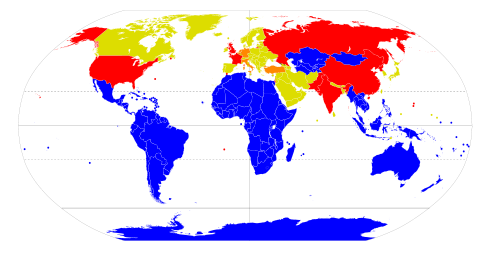 Iran has consistently supported the creation of a nuclear-weapons free zone in the Mideast. In 1974, as concerns in the region grew over Israel's nuclear weapon programme, Iran formally proposed the concept of a nuclear weapon free zone in the Middle East in a joint resolution in the UN General Assembly. The Shah of Iran had made a similar appeal five years earlier but had failed to attract any support. The call for the creation of nuclear weapons free zone in the Mideast was repeated by Iran's President Ahmadinejad in 2006. It was reiterated by Iran's Foreign Minister, Manouchehr Mottaki in 2008.
partially concurred with this view, projecting that due to "energy subsidies, hostility to foreign investment and inefficiencies of its [Iranian] state-planned economy", Iranian oil exports would vanish by 2014–2015, although he notes that this outcome has "no relation to 'peak oil.'" Earlier, the Gerald Ford Administration had arrived at a similar assessment, and independent studies conducted by the Foreign Affairs Select Committee of the British Parliament and the U.S. National Academy of Sciences previously confirmed that Iran has a valid economic basis for its nuclear energy program.
The Iranians believe that concerns about nuclear weapons proliferation are pretextual, and any suspension of enrichment is simply intended to ultimately deprive Iran of the right to have an independent nuclear technology:
Iran says that its inalienable right to peaceful nuclear technology has been the subject of "the most extensive and intensive campaign of denial, obstruction, intervention and misinformation" and that the international community has been subject to "bias, politicized and exaggerated information" on the Iranian nuclear program and activities.
After the 1979 Iranian Revolution, Iran informed the International Atomic Energy Agency (IAEA) of its plans to restart its nuclear program using indigenously made nuclear fuel, and in 1983 the IAEA planned to provide assistance in uranium conversion (not enrichment) to Iran under its Technical Assistance Program, until the program was terminated under US pressure. An IAEA report at the time stated clearly that its aim was to "contribute to the formation of local expertise and manpower needed to sustain an ambitious program in the field of nuclear power reactor technology and fuel cycle technology." Iran's enrichment program was openly discussed on national radio in the early 1980s, and IAEA inspectors were even invited to visit Iran's uranium mines in 1992.
Iran announced plans in 1995 to build a uranium hexafluoride (UF6) conversion plant at the Nuclear Technical Centre in Esfahan, with Chinese assistance. During a November 1996 IAEA visit to Isfahan, Iran, informed the IAEA Department of Safeguards that it planned to build a uranium hexafluoride (UF6) conversion plant at the Nuclear Technology Center. The UF6 plant was scheduled to open after 2000, but the project was abandoned by China under pressure from the United States in October 1997. The Iranians informed the IAEA that they would complete the project nonetheless. In 2000, the Iranians completed the uranium conversion project, using the blueprints provided to them by China, and declared the facility to the IAEA. The facility was planned with the intention of supplying UO2 (Uranium dioxide) as fuel to the 40 MW Heavy Water Reactor under construction at Arak and to meet the needs of UF6 (Uranium hexafluoride) for the Natanz enrichment facility.
Iran argues that it disclosed information about its programs in which "in nearly all cases, it was not any way obliged to disclose in accordance with its obligations under its safeguards agreement with the IAEA." Iran says its voluntary confidence building measures were only "reciprocated by broken promises and expanded requests" and that the EU3 "simply wanted prolonged and fruitless negotiations" to inhibit Iran from exercising its inalienable right to peaceful nuclear technology.
Iran says it has suggested to the EU3 to ask the IAEA to develop monitoring modalities for Iran's enrichment program as objective guarantees to ensure that Iran's nuclear program will remain exclusively for peaceful purposes and has also provided its own set of Western suggested modalities to the Agency.
However, Iran says it will not suspend its enrichment because "it would further be deprived from its inalienable right to work on nuclear fuel cycle, with the aim of producing required fuels for its research reactors and nuclear power plants."
Dr. William O. Beeman
, Brown University's Middle East Studies program professor, who spent years in Iran, says that the Iranian nuclear issue is a unified point of their political discussion:
Stephen McGlinchey agrees, noting that the Islamic Republic of Iran "owes its existence to its identity as a reaction to the Western way of life and of doing business. To come to a conciliation with the international community, spearheaded by the American insistence that Iran must not ever have full mastery of the nuclear cycle is in essence dismantling the foundations and the pride of the Regime."
Iran also believes it has a legal right to enrich uranium for peaceful purposes under the Nuclear Non-Proliferation Treaty, a right which in 2005 the U.S. and the EU-3 began to assert had been forfeited by a clandestine nuclear program that came to light in 2002.
Iranian politicians compare its treatment as a signatory to the NPT with three nuclear-armed nations that have not signed the NPT: Israel, India, and Pakistan. Each of these nations developed an indigenous nuclear weapons capability: Israel by 1966, India by 1974, and Pakistan by 1990.
The Iranian authorities assert that they cannot simply trust the United States or Europe to provide Iran with nuclear energy fuel, and point to a long series of agreements, contracts and treaty obligations which were not fulfilled. Developing nations say they do not want to give up their rights to uranium enrichment and do not trust the United States or other nuclear countries to be consistent suppliers of the nuclear material they would need to run their power plants.
Determination to continue the nuclear program and retaliate against any Western attack is strong in Iran. Hassan Abbasi
, director of the Islamic Revolutionary Guard Corps think tank, Doctrinal Analysis Center for Security without Borders (Markaz-e barresiha-ye doktrinyal-e amniyat bedun marz,) has announced that "approximately 40,000 Iranian estesh-hadiyun (martyrdom-seekers)" are ready to carry out suicide operations against "twenty-nine identified Western targets," should the U.S. military hit Iranian nuclear installations.
Some have argued that there is a double standard between the treatment of Iran, which was reported to the Security Council for undeclared enrichment and reprocessing activities, and South Korea, which had failed to report enrichment and reprocessing experiments but was not found in non-compliance. In South Korea's case, issues were reported by the IAEA Secretariat but the IAEA Board of Governors did not make a formal finding of non-compliance. In making its decision, the Board said "there is no indication that the undeclared experiments have continued" and observed that the "Republic of Korea has an Additional Protocol in force and that developments in the Republic of Korea demonstrate the utility of the Additional Protocol." Pierre Goldschmidt, former head of the department of safeguards at the IAEA, has called on the Board of Governors to adopt generic resolutions which would apply to all states in such circumstances and has argued "political considerations played a dominant role in the board's decision" to not make a formal finding of non-compliance.
Despite its history with the West, Iran has said it would like to see a warming in relations. Akbar Hashemi Rafsanjani, the chairman of the Expediency Council and the Assembly of Experts
, has said that Iran is not seeking enmity with the U.S. and that Iran would respond to any "formal" message which contained "change in practice". Seyed Mohammad Marandi
, a professor at Tehran University, has suggested that if the United States is serious about negotiating with Iran in the future then "that the United States must take concrete steps toward decreasing tension with Iran" such as reassessing Iranian sanctions, reassessing Iranian assets frozen in the United States since the Iranian revolution, and reassessing Washington's backing of Israel. Professor Hamidreza Jalaiepour, a political sociology teacher in Tehran, said if the U.S. examined these options, Iran would be likely to immediately respond in a variety of ways, including helping stabilize Afghanistan, for example.
, Turkey
and Egypt
. Many countries outside the Mideast nations are also interested in nuclear power. According to the report, "roughly a dozen states in the region have recently turned to the International Atomic Energy Agency
in Vienna for help in starting" nuclear programs. The article also described neighbouring states as very hostile to any nuclear weapons program Iran might embark on, stating "many diplomats and analysts say that the Sunni Arab governments are so anxious about Iran's nuclear progress that they would even, grudgingly, support a United States military strike against Iran." However, some Arab countries have nuclear programs that are as old as Iran's, and their interest in nuclear power corresponds to a worldwide nuclear renaissance which applies also to Arab states that are seeking to conserve hydrocarbon resources, reduce carbon emissions, and provide electricity and safe drinking water for their rapidly growing populations.
Like Iran, Egypt refuses to implement the Additional Protocol, although Iran has signed it and implemented it for two years until it was reported for safeguards non-compliance. Egypt links its position to Israel's refusal to accept IAEA safeguards and calls the Protocol "a voluntary thing." On 17 May 2009, Arab League Chief Amr Moussa said that Israel's nuclear program was more worrying than Iran's. This followed a statement in March that the member states of the Arab League would abandon the NPT if Israel ever made its possession of nuclear weapons official.
Recently the governments of a number of Arab countries have been using economic means to persuade Russia and China to support sanctions against Iran's controversial program.
Diplomatic cables leaked in 2010 revealed that Muslim countries such as Saudi Arabia and Bahrain supported a military attack against Iran aimed to stop the Iranian nuclear program.
. However, some Israeli officials have privately and publicly rejected such a characterization of Iran's program. According to The Economist
, "most of those Israeli experts willing to talk rate the chances of an Iranian nuclear attack as low. Despite Mr Ahmadinejad, most consider Iran to be a rational state actor susceptible to deterrence."
Israel, which is not a party to the NPT and is widely believed
to possess the Middle East's only nuclear arsenal does not believe the 2007 National Intelligence Estimate conclusion that Iran had stopped its nuclear weapons program in 2003, insisting that it has additional evidence of an active and continued Iranian nuclear weapons program. Israel has also rejected the IAEA's November 2007 and February 2008 reports on Iran, and Israeli officials have called for the resignation of IAEA Director General ElBaradei, accusing him of being "pro-Iranian." Senior Israeli, French British, German and American officials have reportedly pressured the IAEA to release allegedly censored evidence of an Iranian nuclear weapons program. IAEA spokesman Marc Vidricaire, though, issued a brief statement on the matter, characterizing the allegations against ElBaradei as "misinformation or misinterpretation" which have "no basis in fact."
In early June 2008, Israeli Deputy Prime Minister Shaul Mofaz
expressed frustration with the perceived ineffectiveness of sanctions aimed at discouraging Iran from uranium enrichment. Israel believes the enrichment may be used to aid an alleged nuclear weapons program. Mofaz said that the United Nations Security Council
and the international community have "a duty and responsibility to clarify to Iran, through drastic measures, that the repercussions of their continued pursuit of nuclear weapons will be devastating." In the same interview, Mofaz also made more direct threats to Iran's nuclear facilities, saying "if Iran continues with its programme for developing nuclear weapons, we will attack it." Iranian spokesman Gholam Hoseyn Elham has dismissed Israeli attacks on its nuclear facilities as "impossible". "The Israeli regime has been emboldened due to carelessness and silence of the Security Council," the Iranians further said in a response letter to the United Nations. These statements came only days after Prime Minister Ehud Olmert
asked for stronger sanctions, saying that "the long-term cost of a nuclear Iran greatly outweighs the short-term benefits of doing business with Iran."
Israeli officials were reportedly concerned about the Bush administration's decision on 16 July 2008, to send a high-ranking diplomat to attend negotiation sessions between EU representatives and Iran's chief nuclear negotiator in Geneva. Israel sources reportedly obtained assurances from the Bush administration that there would be no compromise on the demand that Iran end uranium enrichment.
The Israelis have also sought to "alert the American intelligence community to Iran's nuclear ability," in preparation for the new NIE, reportedly due in November 2008. In September 2008, Yossi Baidatz, the head of the research division of Israeli military intelligence was quoted to say that Iran was "not likely" to obtain nuclear capabilities by 2010.
Walter Pincus of the Washington Post has written that Israel's stance on nuclear arms complicates efforts against Iran. Gawdat Bahgat
of the National Defense University
believes Iran's nuclear program is partially formed on the potential threat of a nuclear Israel. Iran and the Arab League
have proposed the that the Middle East be established as a Nuclear Weapon Free Zone. Israel said in May 2010 it would not consider taking part in nuclear weapon-free zone discussions or joining the Nuclear Nonproliferation Treaty until a lasting peace was achieved with its neighbors.
Israel has repeatedly warned that it will strike Iran's nuclear facilities if its nuclear program is not stopped through diplomatic channels. In June 2008, the Israeli Air Force
conducted a massive and highly publicized exercise over the Mediterranean Sea
, where Israeli aircraft practiced aerial refuelling and simulated attacks on targets 870 miles off the Israeli coast. Israeli Ambassador to the United States Sallai Meridor
said that the window for diplomatic action was rapidly closing, and that "Israel will not tolerate a nuclear Iran." In 2010, a joint air exercise between Israel and Greece
took place on Crete
. Called "Minoas 2010", it was temporarily suspended by Greece in the aftermath of the Gaza flotilla raid
, but later resumed. Israel tested five F-16I Sufa and five F-15I fighter jets in strike missions, Sikorsky CH-53 Sea Stallion helicopters in pilot rescue missions, and a Boeing
aircraft to practice aerial refuelling. Because Iranian nuclear facilities are heavily fortified and often located underground, Israel Military Industries
is developing the MPR-500 bunker buster
bomb, and Israeli pilots have allegedly practiced airstrikes involving low-yield nuclear weapons.
In May 2010, Israel reportedly deployed Dolphin class submarine
s with nuclear missiles capable of reaching any target in Iran in the Persian Gulf
. Their reported missions were to deter Iran, gather intelligence, and to potentially land Mossad
agents on the Iranian coast. In July, two Israeli missile boats were also deployed.
Some in Israel are worried that Iran may achieve a latent capability to produce nuclear weapons without taking any overt steps that would expose it to further international action.
In March 2005, the New York Times reported that a bipartisan Congressional inquiry concluded that the United States had inadequate intelligence to reach any conclusions on the state of Iran's nuclear program. In March 2009, the US Director of National Intelligence and Defense Intelligence Agency Director both testified before Congress that Iran did not have highly enriched uranium for bomb-making and had not made the decision to produce any, and also that Iran's missile program was not related to its nuclear program.
Much of the debate about the 'Iranian nuclear threat' is therefore driven by concern that Iran's mastery of civilian technology could provide it the means to rapidly develop a weapons capability should Iran wish to do so in the future. President Bush claimed that Iran's pursuit of nuclear weapons could trigger "World War III", while in 2007 Undersecretary of State Nicholas Burns warned Iran may be seeking a nuclear weapons capability. Steven C. Welsh, Managing Editor of FrontPage Magazine, when discussing Iran's nuclear program says that Iran "concealed this program for nearly two decades by lying, dissembling and deceiving UN inspectors". The Economist
magazine opined that "even before the election of President Mahmoud Ahmadinejad Iran was negotiating in bad faith. During this period, European officials believe, it continued to work in secret on nuclear research, having promised to suspend uranium enrichment." The Iranians attributed the concealment of portions of their nuclear program to the fact that the US repeatedly hampered their overt attempts at acquiring the necessary technology for their program, and also point out that they promised to suspend enrichment rather than cease all research. After about two years, Iran ceased its voluntary and temporary suspension of enrichment after receiving a "very insulting and humiliating" offer which some analysts described as an "empty box". In response, the West rejected an Iranian offer for a nuclear consortium in Iran and said they would go to the Security Council for sanctions. Iran says its voluntary confidence building measures were only "reciprocated by broken promises and expanded requests" and that the EU3 "simply wanted prolonged and fruitless negotiations" to inhibit Iran from exercising its inalienable right to peaceful nuclear technology.
Western governments say they now accept Iran's desire for nuclear power. For example, in November 2007, President Bush acknowledged Iran's sovereign right to civilian nuclear technology. Independent analyses support the economic basis for an Iranian nuclear power program. A study by the UK Parliamentary Office of Science and Technology concluded in March 2004 that "some of John Bolton
's criticisms were not supported by an analysis of the facts (for example, much of the gas flared off by Iran is not recoverable for energy use), but that Iran's decision to adopt the nuclear power option could not entirely be explained by the economics of energy production." An article published in the Proceedings of the National Academy of Sciences concluded that "Iran's claim to need nuclear power to preserve exports is genuine."
The P5 (China, France, Russia, United Kingdom, and United States) plus Germany (the P5+1) have offered benefits to Iran, including "legally binding" fuel supply guarantees. The deal offered by the P5+1 would leave Iran reliant on external sources of fuel, as is true for most countries with nuclear power programs though many of them also lack indigenous resources to produce their own fuel, or do not have the same strategic security concerns as Iran. Iranian President Mahmoud Ahmadinejad rejected this proposal, saying that Iran had the right to process uranium for fuel and that Iran "will not retreat one iota in the face of oppressing powers."
While recognizing Iran's interest in nuclear power, skeptics such as The Economist and ISIS have questioned the rationale for Iran's enrichment program. An op-ed published in January 2008 in The Economist, which said the threat of force had "put some steel" into the diplomatic process, opined that "learning to enrich uranium—a hugely costly venture—still makes questionable economic sense for Iran, since it lacks sufficient natural uranium to keep them going and [they] would have to import the stuff." A February 2009 ISIS report argued there was a perceived "fundamental inconsistency" between the stated purposes and available information on the capabilities of Iran's domestic uranium production program. The report, citing data published by Iran and the IAEA on Iran's uranium resources, argued that those resources are sufficient for developing a weapons capability, but would not meet the requirements for even a single power reactor. The Atomic Energy Organization of Iran responded to this and related stories by saying it had sufficient uranium mines. The Foreign Ministry of Iran said Western claims of a uranium shortage were "media speculation without any scientific basis" and that Iran was not seeking uranium on international markets. The Atomic Energy Organization of Iran has said surveys had shown proven reserves of approximately 3,000 tons of uranium so far and that the expected resources of Iran could be at the range of 20,000–30,000 tons. The organization concluded that "according to all the surveys performed in power sector of Iran, nuclear option is the most competitive to fossil alternatives if the existing low domestic fuel prices are gradually increased to its opportunity costs at the level of international prices." In effect, the Bush administration took the position that Iran was too dangerous to be allowed "the technology to produce nuclear material for electricity".
In December 2008, the ISIS asserted that Iran had produced 425 kilograms of uranium, and that Iran had "not yet achieved a break-out capability", but that Iran may be close to a break-out capability. In response to claims that Iran had enough material to make a weapon, the Arms Control Association urged the U.S. and media to exhibit greater care when making claims about Iran's nuclear program. Ivan Oelrich and Ivanka Barzashka, from the Federation of American Scientists, say that the "simplistic calculations" contained in the ISIS article were wrong because "just taking the quantity of LEU and multiplying by the U-235 concentration does not work because not all of the U-235 is recovered". Cheryl Rofer, a retired 35 year researcher at Los Alamos National Laboratory and former president of the Los Alamos Committee on Arms Control and International Security, has argued that for Iran to make a bomb from this material it would need to kick all the inspectors out of the country, reconfigure thousands of closely watched centrifuges, and then engage in years of enrichment. According to the American Institute of Physics, the most difficult step in building a nuclear weapon is the production of fissile material. Iran has enriched uranium to "less than 5%," consistent with fuel for a nuclear power plant and well below the purity of WEU (around 90%) typically used in a weapons program. HEU with a purity of 20% or more is usable in a weapon, but this route is less desirable because far more material is required to obtain critical mass. "Our production of a nuclear energy program is completely within the framework or structure of international laws," said Ali Akbar Javanfekr, media adviser to President Mahmoud Ahmadinejad. David Albright, president of the group which published the report, maintained that Iran's enriched uranium meant that Israel was losing control over the timing of Iran's nuclear activities and that even Iran pretending to have a bomb would be a threat. The International Atomic Energy Agency said its inspectors have not found evidence to suggest that Iran is attempting to process low-enriched uranium into weapons-grade uranium. "At the moment, I'm not very concerned," said Andreas Persbo, an analyst at the Verification Research, Training and Information Center.
Western sources have expressed mixed views on the logic of Iran's nuclear fuel cycle investments. An op-ed published in The Economist opined that with the money spent on its nuclear program, Iran could have built "ten conventional plants of the same capacity, fired solely by the natural gas that Iran currently flares off into the sky". David Isenberg, a senior analyst with the Washington-based British American Security Information Council (BASIC), has argued oil and gas production has its own costs, that Iran gains strategic value from being an oil and gas exporter, and that "as a sovereign nation Iran is entitled to make its own sovereign decisions as to how provide for its own energy needs".
Christoph Bertram, a former director of the International Institute for Security Studies, has said that a "nuclear Iran" would not be in Iran's strategic interest, and rather that a nuclear Iran would jeopardise the strenuously gained political capital that it has earned since the end of the Iran-Iraq war. Volker Perthes, director of the German Institute for International and Security Affairs, argues that "a strategic decision on the final aim of the Iranian nuclear programme has not been made". Perthes suggests a WMD-free zone in the Middle East is the best way to deal with the alleged nuclear ambitions of Iran.
On 31 July 2006, the Security Council passed a resolution demanding that Iran stop "all enrichment-related and reprocessing activities." (Reprocessing involves chemically separating plutonium from other nuclear waste products, a procedure that can lead to production of bomb-grade fuel.) A month later, an IAEA report indicated that "there are no indications of ongoing reprocessing activities in Iran."
The United States failed to get any backing for military attacks on Iran to enforce the sanctions. The March resolution even restated the UN position that the Middle East region should be nuclear free.
U.S. officials told the New York Times that the new sanctions went beyond the nuclear issue. "The new language was written to rein in what they [U.S. officials] see as Tehran's ambitions to become the dominant military power in the Persian Gulf and across the Middle East."
Kouchner was not specific about what penalties Europe might impose, other than to say they could be "economic sanctions regarding financial movements." "Our German friends proposed this. We discussed it a few days ago," he said. "The international community's demand is simple: They must stop enriching uranium," Kouchner said. "Our Iranian friends want to create, they say, civilian nuclear energy. They have the right to that, but all that they are doing proves the contrary. That is why we are worried," he said.
Tensions have been raised by media reports of an Israeli air incursion over northeastern Syria on 6 September. One U.S. official said the attack hit weapons heading for the Lebanese militant group Hezbollah, an ally of Syria and Iran, but there also has been speculation the Israelis hit a nascent nuclear facility or were studying routes for a possible future strike on Iran. Others suspect Israel was performing an intelligence operation for the U.S.
With Iran adding to the talk of military options, Undersecretary of State Nicholas Burns
called in September 2007 for UN Security Council members and U.S. allies to help push for a third round of sanctions against Iran over the nuclear program.
In 2006 the Germans suggested that Iran would be able to operate their enrichment program, subject to IAEA inspections. The German Minister of Defense Franz Josef Jung stated that a ban on Iranian enrichment work was unrealistic, that "One cannot forbid Iran from doing what other countries in the world are doing in accordance with international law" and that IAEA oversight of any Iranian enrichment activities would provide the necessary assurances to the international community that Iran could not secretly divert the program of weapons use. Later, the Europeans reportedly also considered a compromise proposal where Iran would be allowed to continue spinning its centrifuges but would not feed any processed uranium hexafluoride (UF6) into the machines during the course of negotiations.
The Iranians had also indicated that they were willing to consider suspending large-scale enrichment for up to two years, but were not prepared to freeze enrichment entirely
The compromise ideas were reportedly shot down by the US, and Robert Joseph, the Under-Secretary of State for Arms Control reportedly told ElBaradei: "We cannot have a single centrifuge spinning in Iran. Iran is a direct threat to the national security of the United States and our allies, and we will not tolerate it. We want you to give us an understanding that you will not say anything publicly that will undermine us."
In June 2007, IAEA director Mohammad ElBaradei suggested that Iran should be allowed limited uranium enrichment under strict supervision of the IAEA. His remarks were formally criticised by Nicholas Burns, the US Under-Secretary of State, who said: "We are not going to agree to accept limited enrichment"
ElBaradei later criticized the US position and said,
In February 2008, Pierre Vimont, the French Ambassador to the United States, urged that the United States adopt a more flexible approach to Iran by accepting its regional role and recognizing that the nuclear issue has broad popular support among Iranians.
The United States has claimed Iran's launching of a data processing satellite could be linked to the development of a military nuclear capability and that the activities were of "great concern". The U.S. specifically said it would continue "to address the threats posed by Iran, including those related to its missile and nuclear programs." Despite the U.S. saying it would use all elements of the national power to deal with Tehran, Iran criticized the West's double standards and said the launch was a step to remove the scientific monopoly certain world countries are trying to impose on the world. Iraqi National Security Advisor Muwafaq al-Rubaie said Iraq was very pleased with the launch of Iran's peaceful data-processing national satellite.
On 26 February 2009, U.S. Ambassador to the United Nations Susan Rice said that the United States "will seek to end Iran's ambition to acquire an illicit nuclear capability and its support for terrorism". Robert Wood, spokesman for the U.S. State Department, said that the U.S. believes that "Iran doesn't need to develop its own nuclear capacity" and specifically that the U.S. does not believe that Iran needs to develop an indigenous uranium enrichment capacity. On 8 April 2009, Wood said that "on the basis of mutual respect and mutual interest" the U.S. would sit with the P-5+1 in discussions with Iran and ask the EU High Representative for Common and Foreign Security Policy to extend an invitation to Iran to meet with representatives of the P-5+1. Wood further said, "We hope this will be the occasion to seriously engage Iran on how to break the logjam of recent years and work in a cooperative manner to resolve the outstanding international concerns about its nuclear program". U.S. Secretary of State Hillary Clinton has said "pursuing very careful engagement on a range of issues that affect our interests and the interests of the world with Iran makes sense".
In March 2009, the Supreme Leader of Iran questioned the sincerity so far of the U.S.'s new rhetoric, and Iran's ambassador to International Atomic Energy Agency said UN sanctions united Iranians to protect their "national interest" of enrichment. In April 2009, Mahmoud Ahmadinejad said his country "welcomes a hand extended to it should it really and truly be based on honesty, justice and respect." Karim Sadjadpour, of the Carnegie Endowment for International Peace, has said Iran's leader "holds strongly that Tehran must not compromise in the face of U.S. pressure or intimidation, for it would project weakness and encourage even greater pressure." Richard Haass, President of the Council on Foreign Relations, has said "the United States should be willing to discuss what Iran (as a signatory of the NPT) describes as its "right to enrich." It may well be necessary to acknowledge this right, provided that Iran accepts both limits on its enrichment program (no HEU) and enhanced safeguards". Mark Fitzpatrick, a Senior Fellow for Non‐Proliferation at the International Institute for Strategic Studies, has said "a key policy challenge is how to build a barrier between a latent nuclear weapons capability and actual weapons production. This is difficult when, as in Iran's case today, the distinction is blurred almost to the point of invisibility."
On Tuesday, 27 July 2010 British
Prime Minister David Cameron
made what has been described as "his most outspoken comments on the Tehran regime since becoming PM", saying "Iran is enriching uranium to 20 per cent with no Industrial logic other than producing a bomb. If Iran's nuclear program is peaceful, then why won't Iran allow the International Atomic Energy Agency to inspect? Why does Iran continue to seek to acquire military components? And why does Iran continue to threaten Israel with annihilation?" These comments were made the day after the European Union introduced sanctions which ban the sale of equipment, technology and services to Iran.
(representing the consensus view of all 16 American spy agencies) "judged with high confidence" that Iran had halted its nuclear weapons program in 2003, with "moderate confidence" that the program remains frozen, and with "moderate-to-high confidence" that Iran is "keeping open the option to develop nuclear weapons." The estimate said that the enrichment program could still provide Iran with enough raw material to produce a nuclear weapon sometime by the middle of next decade but that intelligence agencies "do not know whether it currently intends to develop nuclear weapons" at some future date. Senator Harry Reid
, the majority leader
of the Senate in 2008, said he hoped the administration would "appropriately adjust its rhetoric and policy". The conclusion that Iran had a nuclear weapons program in 2003 was reportedly mainly based on the contents of a laptop computer that was allegedly stolen from Iran and provided to US intelligence agencies by dissidents. The Russians dismissed this conclusion, stating that they had not seen evidence that Iran had ever pursued a nuclear weapons program.
The 2007 NIE report, contradicted the previous 2005 NIE conclusion which asserted that Iran had an active and on-going nuclear weapons program in 2005. According to a senior administration official, in a January 2008 conversation with Israel
i Prime Minister Ehud Olmert
, Israeli and other foreign officials asked President Bush to explain the 2007 NIE. Bush "told the Israelis that he can't control what the intelligence community says, but that (the NIE's) conclusions don't reflect his own views". After Bush seemed to distance himself from the report, the White House later said Bush endorses the "full scope" of the US intelligence findings on Iran.
Mohammed ElBaradei, the Director of the IAEA, noted in particular that the NIE's conclusions corresponded with the IAEA's consistent statements that it had "no concrete evidence of an ongoing nuclear weapons program or undeclared nuclear facilities in Iran."
In February 2009 testimony before the U.S. Senate, Director of National Intelligence Dennis Blair reaffirmed the conclusions of the 2007 National Intelligence Estimate and said "although we do not know whether Iran currently intends to develop nuclear weapons, we assess Tehran at a minimum is keeping open the option to develop them." He said Iran was unlikely to achieve a nuclear weapon before 2013 because of foreseeable technical and programmatic problems, and that this would be in the case that it decided to do so. Stephen Lendman, an American research associate of the Centre for Research on Globalization based in Canada, has argued Iran's commercial nuclear program is perfectly legal and that the U.S. has a double standard towards Iran's nuclear program. Joseph Cirincione, a nuclear weapons expert and president of the Ploughshares Fund, has said the Obama administration does not want to be drawn into a debate over Iran's intent because "when you're talking about negotiations in Iran, it is dangerous to appear weak or naive." The documentary film Iranium
also explores this issue.
(Canada, France, Germany, Italy, Russia, Japan, the United Kingdom and the United States) has repeatedly voiced its concerns over Iran's nuclear program. At the 2003 G8 summit in France, G8 leaders said: "We will not ignore the proliferation implications of Iran's advanced nuclear program." The 2004 G8 Action Plan on Nonproliferation "deplore[d] Iran's delays, deficiencies in cooperation, and inadequate disclosures, as detailed in IAEA Director General reports." In 2005 G8 leaders concluded that "It is essential that Iran provide the international community with objective guarantees that its nuclear program is exclusively for peaceful purposes in order to build international confidence."
In 2006, after Iran was found in non-compliance with its safeguards agreement and reported to the UN Security Council, the G8 toughened its position: "Iran not having shown willingness to engage in serious discussion of those proposals and having failed to take the steps needed to allow negotiations to begin, specifically the suspension of all enrichment related and reprocessing activities, as required by the IAEA and supported in the United Nations Security Council Presidential Statement, we supported the decision of those countries' Ministers to return the issue of Iran to the United Nations Security Council." The following year, G8 leaders "deplore[d] the fact that Iran [had] so far failed to meet its obligations under UNSC Resolutions 1696, 1737 and 1747," and threatened "further measures, should Iran refuse to comply with its obligations," but held out the prospect that "[i]nternational confidence in the exclusively peaceful nature of the Iranian nuclear program would permit a completely new chapter to be opened in our relations with Iran not only in the nuclear but also more broadly in the political, economic and technological fields."
At the most recent 2008 G8 summit in Japan in 2008, G8 leaders said:
stating that he was against Iran acquiring nuclear weapons. India voted in the IAEA Board of Governors to report Iran to UN Security Council in 2005 for non-compliance with its NPT safeguards agreement. Despite some domestic opposition, the Indian government later voted to report Iran to the UN Security Council in 2006. Leftist parties in India have criticized the government for bowing to US pressure on the issue.
India quickly downplayed the incident and restated its commitment to develop closer ties with Iran. India urged international diplomacy to solve the Iranian nuclear row but added that it could not "turn a blind eye to nuclear proliferation in its neighborhood."
Despite heavy U.S. criticism, India has continued negotiations on the multi-billion dollar Iran–Pakistan–India gas pipeline from Iran to India through Pakistan. India is keen to secure energy supplies to fuel its rapidly growing economy and the gas pipeline may address India's energy security concerns. The United States has expressed concern that the pipeline project would undermine international efforts to isolate Iran.
India is not a signatory to the Non-Proliferation Treaty (NPT). According to US Under Secretary of State Nicholas Burns
, it was India's vote against Iran which helped clear the way for the US-India nuclear cooperation deal Critics say the US-India nuclear cooperation deal itself undermines the Non-Proliferation Treaty at a time when Iran was accused of violating the treaty. Critics argue that by promising nuclear cooperation with India, the Bush administration has reversed a legal ban on such cooperation which was in place since the passage of the Nuclear Nonproliferation Act of 1978, and violated US obligations under the Non-Proliferation Treaty which prohibits sharing nuclear technology with non-signatories such as India. The Harvard International Review
concedes in an editorial that the Indo-US nuclear deal "undermines the world's present set of nuclear rules" but argues that the Iranian nuclear program remains an "unacceptable risk" regardless of the NPT. It reasoned that "regardless of what the NPT says, and regardless of what Iran says about the NPT, an Iranian nuclear program is still an unacceptable risk."
, Cuba
, all of the 118 Non-Aligned Movement
member countries, at the summit level, declared their support of Iran's civilian nuclear program in their final written statement. The Non-Aligned Movement represents a majority of the 192 countries comprising the entire United Nations
.
On 30 July 2008, the Non-Aligned Movement welcomed the continuing cooperation of Iran with the IAEA and reaffirmed Iran's right to the peaceful uses of nuclear technology. The movement further called for the establishment of a nuclear weapons free zone in the Middle East and called for a comprehensive multilaterally negotiated instrument which prohibits threats of attacks on nuclear facilities devoted to peaceful uses of nuclear energy.
In February 2007, lawmakers from 56 member states of the Organisation of the Islamic Conference
, addressing Iran's nuclear program at a meeting in Kuala Lumpur, Malaysia, urged "full respect for equal and inalienable rights for all nations to explore modern technologies including nuclear energy for peaceful purposes."
Officials in several countries have voiced support for Iran in the on-going standoff with the US over its nuclear program. These include Iraq Algeria and Indonesia. Turkey has expressed support for Iran's right to a nuclear program for peaceful energy production, and along with Egypt has urged for a peaceful solution to the standoff. Former President Vladimir Putin of Russia, while urging more transparency from Iran, has said that there is no objective evidence that Iran is seeking nuclear weapons. On 11 September 2009, Prime Minister Putin opposed the use of force or further sanctions against Iran.
Support for tough measures against Iran's nuclear program has fallen in 13 out of 21 Arab countries according to a new BBC World Service Poll. According to a 2008 global poll of Arab public opinion, the Arab public does not appear to see Iran as a major threat and does not support international pressure to force Iran to curtail the program. Arab League Secretary General Amr Moussa echoed remarks made by chief Palestinian negotiator Saeb Erekat, saying that Israel, not Iran, posed a nuclear threat to the Middle East.
Atoms for Peace
"Atoms for Peace" was the title of a speech delivered by U.S. President Dwight D. Eisenhower to the UN General Assembly in New York City on December 8, 1953....
program. The support, encouragement and participation of the United States and Western European governments in Iran's nuclear program continued until the 1979 Iranian Revolution
Iranian Revolution
The Iranian Revolution refers to events involving the overthrow of Iran's monarchy under Shah Mohammad Reza Pahlavi and its replacement with an Islamic republic under Ayatollah Ruhollah Khomeini, the leader of the...
that toppled the Shah of Iran.
After the 1979 revolution, the Iran
Iran
Iran , officially the Islamic Republic of Iran , is a country in Southern and Western Asia. The name "Iran" has been in use natively since the Sassanian era and came into use internationally in 1935, before which the country was known to the Western world as Persia...
ian government temporarily disbanded elements of the program, and then revived it with less Western assistance than during the pre-revolution era. Iran's nuclear program has included several research sites, two uranium
Uranium
Uranium is a silvery-white metallic chemical element in the actinide series of the periodic table, with atomic number 92. It is assigned the chemical symbol U. A uranium atom has 92 protons and 92 electrons, of which 6 are valence electrons...
mines, a research reactor, and uranium processing facilities that include three known uranium enrichment plants.
After delays, Iran's first nuclear power plant, Bushehr I reactor
Bushehr Nuclear Power Plant
The Bushehr Nuclear Power Plant is a nuclear power plant in Iran southeast of the city of Bushehr, between the fishing villages of Halileh and Bandargeh along the Persian Gulf. The plant is located at the junction of three tectonic plates....
was complete with major assistance of Russian government agency RosAtom and was officially opened in a ceremony on 12 September 2011. Iran has announced that it is working on a new 360 MW nuclear power plant to be located in Darkhovin
Darkhovin
Darkhovin is a city in Iran's Khūzestān Province. The city is the site for construction of Iran's indigenously designed Darkhovin Nuclear Power Plant.- External links :*...
. Iran has also indicated that it will seek more medium-sized nuclear power plants and uranium mines in the future.
In November 2011, the IAEA
International Atomic Energy Agency
The International Atomic Energy Agency is an international organization that seeks to promote the peaceful use of nuclear energy, and to inhibit its use for any military purpose, including nuclear weapons. The IAEA was established as an autonomous organization on 29 July 1957...
Board of Governors rebuked Iran following an IAEA report Iran had undertaken research and experiments geared to developing a nuclear weapons capability. Iran rejected the details of the report and accused the IAEA of pro-Western bias and threatened to reduce its cooperation with the IAEA.
Overview
The controversy over Iran's nuclear programs centers in particular on Iran's failure to declare sensitive enrichment and reprocessing activities to the International Atomic Energy AgencyInternational Atomic Energy Agency
The International Atomic Energy Agency is an international organization that seeks to promote the peaceful use of nuclear energy, and to inhibit its use for any military purpose, including nuclear weapons. The IAEA was established as an autonomous organization on 29 July 1957...
(IAEA). Enrichment can be used to produce uranium for reactor fuel or (at higher enrichment levels) for weapons. Iran says its nuclear program is peaceful, and has enriched uranium to less than 5%, consistent with fuel for a civilian nuclear power plant. Iran also claims that it was forced to resort to secrecy after US pressure caused several of its nuclear contracts with foreign governments to fall through. After the IAEA Board of Governors reported Iran's noncompliance with its safeguards agreement to the UN Security Council, the Council demanded that Iran suspend its nuclear enrichment
Isotope separation
Isotope separation is the process of concentrating specific isotopes of a chemical element by removing other isotopes, for example separating natural uranium into enriched uranium and depleted uranium. This is a crucial process in the manufacture of uranium fuel for nuclear power stations, and is...
activities while Iranian President Mahmoud Ahmadinejad has argued that the sanctions are "illegal," imposed by "arrogant powers," and that Iran has decided to pursue the monitoring of its self-described peaceful nuclear program through "its appropriate legal path," the International Atomic Energy Agency.
After public allegations about Iran's previously undeclared nuclear activities, the IAEA launched an investigation that concluded in November 2003 that Iran had systematically failed to meet its obligations under its NPT safeguards agreement to report those activities to the IAEA, although it also reported no evidence of links to a nuclear weapons program. The IAEA Board of Governors delayed a formal finding of non-compliance until September 2005, and (in a rare non-consensus decision) reported that non-compliance to the UN Security Council in February 2006. After the IAEA Board of Governors reported Iran's noncompliance with its safeguards agreement to the United Nations Security Council, the Council demanded that Iran suspend its enrichment programs. The Council imposed sanctions after Iran refused to do so. A May 2009 U.S. Congressional Report suggested "the United States, and later the Europeans, argued that Iran's deception meant it should forfeit its right to enrich, a position likely to be up for negotiation in talks with Iran."
In exchange for suspending its enrichment program, Iran has been offered "a long-term comprehensive arrangement which would allow for the development of relations and cooperation with Iran based on mutual respect and the establishment of international confidence in the exclusively peaceful nature of Iran's nuclear program." However, Iran has consistently refused to give up its enrichment program, arguing that the program is necessary for its energy security, that such "long term arrangements" are inherently unreliable, and would deprive it of its inalienable right to peaceful nuclear technology. Currently, thirteen states possess operational enrichment or reprocessing facilities, and several others have expressed an interest in developing indigenous enrichment programs. Iran's position was endorsed by the Non-Aligned Movement, which expressed concern about the potential monopolization of nuclear fuel production.
To address concerns that its enrichment program may be diverted to non-peaceful uses, Iran has offered to place additional restrictions on its enrichment program including, for example, ratifying the Additional Protocol to allow more stringent inspections by the International Atomic Energy Agency
International Atomic Energy Agency
The International Atomic Energy Agency is an international organization that seeks to promote the peaceful use of nuclear energy, and to inhibit its use for any military purpose, including nuclear weapons. The IAEA was established as an autonomous organization on 29 July 1957...
, operating the uranium enrichment facility at Natanz as a multinational fuel center with the participation of foreign representatives, renouncing plutonium reprocessing and immediately fabricating all enriched uranium into reactor fuel rods. Iran's offer to open its uranium enrichment program to foreign private and public participation mirrors suggestions of an IAEA expert committee which was formed to investigate the methods to reduce the risk that sensitive fuel cycle activities could contribute to national nuclear weapons capabilities. Some non-governmental U.S. experts have endorsed this approach. The United States has insisted that Iran must meet the demands of the UN Security Council to suspend its enrichment program.
In every other case in which the IAEA Board of Governors made a finding of safeguards non-compliance involving clandestine enrichment or reprocessing, the resolution has involved (in the cases of Iraq and Libya) or is expected to involve (in the case of North Korea) at a minimum ending sensitive fuel cycle activities. According to Pierre Goldschmidt
Pierre Goldschmidt
Mr. Pierre Goldschmidt, a Belgian nuclear scientist, retired June, 2005, as Deputy Director General and Head of the Department of Safeguards at the International Atomic Energy Agency, , succeeded by Olli Heinonen. Mr...
, former deputy director general and head of the department of safeguards at the IAEA, and Henry D. Sokolski
Henry D. Sokolski
Henry D. Sokolski is the Executive Director of the Nonproliferation Policy Education Center, a Washington-based nonprofit organization founded in 1994 to promote a better understanding of strategic weapons proliferation issues among policymakers, scholars and the media. He was appointed by the U.S...
, Executive Director of the Nonproliferation Policy Education Center
Nonproliferation Policy Education Center
The Nonproliferation Policy Education Center is a not-for-profit organization that is based in Washington, D.C., and was founded in 1994 to promote a better understanding of strategic weapons proliferation issues among policymakers, scholars and the media.Henry D. Sokolski is the executive...
, some other instances of safeguards noncompliance reported by the IAEA Secretariat (South Korea, Egypt) were never reported to the Security Council because the IAEA Board of Governors never made a formal finding of non-compliance. Though South Korea's case involved enriching uranium to levels near weapons grade, the country itself said it had voluntarily reported an isolated activity and Goldschmidt has argued "political considerations also played a dominant role in the board's decision" to not make a formal finding of non-compliance.
History
1950s and 1960s
The foundations for IranIran
Iran , officially the Islamic Republic of Iran , is a country in Southern and Western Asia. The name "Iran" has been in use natively since the Sassanian era and came into use internationally in 1935, before which the country was known to the Western world as Persia...
's nuclear program were laid after a 1953 coup deposed the Prime Minister Mohammed Mossadegh and installed the Shah
Pahlavi dynasty
The Pahlavi dynasty consisted of two Iranian/Persian monarchs, father and son Reza Shah Pahlavi and Mohammad Reza Shah Pahlavi The Pahlavi dynasty consisted of two Iranian/Persian monarchs, father and son Reza Shah Pahlavi (reg. 1925–1941) and Mohammad Reza Shah Pahlavi The Pahlavi dynasty ...
(King) Mohammad Reza Pahlavi
Mohammad Reza Pahlavi
Mohammad Rezā Shāh Pahlavi, Shah of Iran, Shah of Persia , ruled Iran from 16 September 1941 until his overthrow by the Iranian Revolution on 11 February 1979...
to power.
A civil nuclear co-operation program was established under the U.S. Atoms for Peace program
Atoms for Peace
"Atoms for Peace" was the title of a speech delivered by U.S. President Dwight D. Eisenhower to the UN General Assembly in New York City on December 8, 1953....
. In 1967, the Tehran Nuclear Research Center (TNRC) was established, run by the Atomic Energy Organization of Iran
Atomic Energy Organization of Iran
The Atomic Energy Organization of Iran is the main official body responsible for implementing regulations and operating nuclear energy installations in Iran....
(AEOI). The TNRC was equipped with a U.S.-supplied, 5-megawatt nuclear research reactor
Research reactor
Research reactors are nuclear reactors that serve primarily as a neutron source. They are also called non-power reactors, in contrast to power reactors that are used for electricity production, heat generation, or maritime propulsion.-Purpose:...
, which was fueled by highly enriched uranium.
Iran signed the Nuclear Non-Proliferation Treaty
Nuclear Non-Proliferation Treaty
The Treaty on the Non-Proliferation of Nuclear Weapons, commonly known as the Non-Proliferation Treaty or NPT, is a landmark international treaty whose objective is to prevent the spread of nuclear weapons and weapons technology, to promote cooperation in the peaceful uses of nuclear energy and to...
(NPT) in 1968 and ratified it in 1970, making Iran's nuclear program subject to International Atomic Energy Agency
International Atomic Energy Agency
The International Atomic Energy Agency is an international organization that seeks to promote the peaceful use of nuclear energy, and to inhibit its use for any military purpose, including nuclear weapons. The IAEA was established as an autonomous organization on 29 July 1957...
verification.
1970s
The Shah approved plans to construct, with U.S. help, up to 23 nuclear power stations by 2000.In March 1974, the Shah envisioned a time when the world's oil supply would run out, and declared, "Petroleum is a noble material, much too valuable to burn ... We envision producing, as soon as possible, 23 000 megawatts of electricity using nuclear plants."
Iran had deep pockets and close ties to the West. U.S. and European companies scrambled to do business in Iran. Bushehr
Bushehr
Bushehr Bushehr lies in a vast plain running along the coastal region on the Persian Gulf coast of southwestern Iran. It is the chief seaport of the country and the administrative centre of its province. Its location is about south of Tehran. The local climate is hot and humid.The city...
would be the first plant, and would supply energy to the inland city of Shiraz
Shiraz, Iran
Shiraz is the sixth most populous city in Iran and is the capital of Fars Province, the city's 2009 population was 1,455,073. Shiraz is located in the southwest of Iran on the Roodkhaneye Khoshk seasonal river...
. In 1975, the Erlangen
Erlangen
Erlangen is a Middle Franconian city in Bavaria, Germany. It is located at the confluence of the river Regnitz and its large tributary, the Untere Schwabach.Erlangen has more than 100,000 inhabitants....
/Frankfurt
Frankfurt
Frankfurt am Main , commonly known simply as Frankfurt, is the largest city in the German state of Hesse and the fifth-largest city in Germany, with a 2010 population of 688,249. The urban area had an estimated population of 2,300,000 in 2010...
firm Kraftwerk Union AG, a joint venture of Siemens AG
Siemens AG
Siemens AG is a German multinational conglomerate company headquartered in Munich, Germany. It is the largest Europe-based electronics and electrical engineering company....
and AEG
AEG
Allgemeine Elektricitäts-Gesellschaft was a German producer of electrical equipment founded in 1883 by Emil Rathenau....
, signed a contract worth $4 to to build the pressurized water reactor
Pressurized water reactor
Pressurized water reactors constitute a large majority of all western nuclear power plants and are one of three types of light water reactor , the other types being boiling water reactors and supercritical water reactors...
nuclear power plant. Construction of the two 1,196 MWe
MWE
MWE may refer to:*Manufacturer's Weight Empty*McDermott Will & Emery*Midwest Express, an airline*Merowe Airport - IATA code*Multiword expressionMWe may refer to:*Megawatt electrical...
, and was to have been completed in 1981.
The joint stock company
Joint stock company
A joint-stock company is a type of corporation or partnership involving two or more individuals that own shares of stock in the company...
Eurodif
Eurodif
Eurodif, which means European Gaseous Diffusion Uranium Enrichment Consortium, is a subsidiary of the French company AREVA which operates a uranium enrichment plant established at the Tricastin Nuclear Power Center in Pierrelatte in Drôme...
operating a uranium enrichment plant in France was formed in 1973 by France, Belgium, Spain and Sweden. In 1975 Sweden's 10% share in Eurodif went to Iran as a result of an arrangement between France and Iran. The French government subsidiary company Cogéma
Areva NC
Areva NC, formerly Cogema is a French company, created in 1976 from the production division of the French government's CEA It is an industrial group active in all stages of the uranium fuel cycle, including uranium mining, conversion, enrichment, spent fuel reprocessing, and recycling...
and the Iranian Government established the Sofidif (Société franco–iranienne pour l'enrichissement de l'uranium par diffusion gazeuse) enterprise with 60% and 40% shares, respectively. In turn, Sofidif acquired a 25% share in Eurodif, which gave Iran its 10% share of Eurodif. Mohammed Reza Shah Pahlavi lent dollars (and another dollars in 1977) for the construction of the Eurodif factory, to have the right of buying 10% of the production of the site.
"President Gerald Ford
Gerald Ford
Gerald Rudolph "Jerry" Ford, Jr. was the 38th President of the United States, serving from 1974 to 1977, and the 40th Vice President of the United States serving from 1973 to 1974...
signed a directive in 1976 offering Tehran
Tehran
Tehran , sometimes spelled Teheran, is the capital of Iran and Tehran Province. With an estimated population of 8,429,807; it is also Iran's largest urban area and city, one of the largest cities in Western Asia, and is the world's 19th largest city.In the 20th century, Tehran was subject to...
the chance to buy and operate a U.S.-built reprocessing facility for extracting plutonium
Plutonium
Plutonium is a transuranic radioactive chemical element with the chemical symbol Pu and atomic number 94. It is an actinide metal of silvery-gray appearance that tarnishes when exposed to air, forming a dull coating when oxidized. The element normally exhibits six allotropes and four oxidation...
from nuclear reactor fuel. The deal was for a complete 'nuclear fuel cycle'."
At the time, Richard Cheney was the White House Chief of Staff, and Donald Rumsfeld
Donald Rumsfeld
Donald Henry Rumsfeld is an American politician and businessman. Rumsfeld served as the 13th Secretary of Defense from 1975 to 1977 under President Gerald Ford, and as the 21st Secretary of Defense from 2001 to 2006 under President George W. Bush. He is both the youngest and the oldest person to...
was the Secretary of Defense.
The Ford strategy paper said the "introduction of nuclear power will both provide for the growing needs of Iran's economy and free remaining oil reserves for export or conversion to petrochemicals."
Then-United States Secretary of State
United States Secretary of State
The United States Secretary of State is the head of the United States Department of State, concerned with foreign affairs. The Secretary is a member of the Cabinet and the highest-ranking cabinet secretary both in line of succession and order of precedence...
Henry Kissinger
Henry Kissinger
Heinz Alfred "Henry" Kissinger is a German-born American academic, political scientist, diplomat, and businessman. He is a recipient of the Nobel Peace Prize. He served as National Security Advisor and later concurrently as Secretary of State in the administrations of Presidents Richard Nixon and...
recalled in 2005, "I don't think the issue of proliferation came up." However, a 1974 CIA proliferation assessment stated "If [the Shah] is alive in the mid-1980s ... and if other countries [particularly India] have proceeded with weapons development we have no doubt Iran will follow suit."
The Shah also signed a nuclear cooperation agreement with South Africa under which Iranian oil money financed the development of South African fuel enrichment technology using a novel "jet nozzle" process, in return for assured supplies of South African (and Namibian) enriched uranium.
Post-revolution, 1979–1989
The 1979 RevolutionIranian Revolution
The Iranian Revolution refers to events involving the overthrow of Iran's monarchy under Shah Mohammad Reza Pahlavi and its replacement with an Islamic republic under Ayatollah Ruhollah Khomeini, the leader of the...
saw the overthrow of the Shah. During the Revolution, Iranian students took over the U.S. Embassy, and held U.S. diplomats there hostage for 444 days
Iran hostage crisis
The Iran hostage crisis was a diplomatic crisis between Iran and the United States where 52 Americans were held hostage for 444 days from November 4, 1979 to January 20, 1981, after a group of Islamist students and militants took over the American Embassy in Tehran in support of the Iranian...
lasting from 4 November 1979, to 20 January 1981. In Iran, anti-American sentiment was fed by the U.S. installation and support for the repressive Shah and "feared" SAVAK
SAVAK
SAVAK was the secret police, domestic security and intelligence service established by Iran's Mohammad Reza Shah on the recommendation of the British Government and with the help of the United States' Central Intelligence Agency SAVAK (Persian: ساواک, short for سازمان اطلاعات و امنیت کشور...
, and continuing resentment over U.S. support to the coup that overthrew Iran's democratically elected government and installed the Shah. The United States considered the hostage-taking
Iran hostage crisis
The Iran hostage crisis was a diplomatic crisis between Iran and the United States where 52 Americans were held hostage for 444 days from November 4, 1979 to January 20, 1981, after a group of Islamist students and militants took over the American Embassy in Tehran in support of the Iranian...
as an outrage violating the sovereignty
Sovereignty
Sovereignty is the quality of having supreme, independent authority over a geographic area, such as a territory. It can be found in a power to rule and make law that rests on a political fact for which no purely legal explanation can be provided...
of diplomatic compounds.
After the revolution, much nuclear cooperation with Iran was cut off. The United States stopped fulfilling contracts it had with Iran, while France, Germany, and other countries also reduced their cooperation with Iran due to pressure from the United States. Iran argues these experiences show the unreliability of working with the West on nuclear issues and place the burden on the West to restore its credibility.
France
When France after 1979 refused to give any enriched uraniumEnriched uranium
Enriched uranium is a kind of uranium in which the percent composition of uranium-235 has been increased through the process of isotope separation. Natural uranium is 99.284% 238U isotope, with 235U only constituting about 0.711% of its weight...
to Iran and also Eurodif
Eurodif
Eurodif, which means European Gaseous Diffusion Uranium Enrichment Consortium, is a subsidiary of the French company AREVA which operates a uranium enrichment plant established at the Tricastin Nuclear Power Center in Pierrelatte in Drôme...
did not return Iran's investments (see European reactions 1979–89), Iran's government suspended its payments and tried to get refunded the loan by making pressure on France by handling militant groups, including the Hezbollah who took French citizens hostage in the 1980s. Iran was denied uranium which it was entitled to as a joint owner in the French Eurodif international enrichment facility because of U.S. pressure.
Another result of the 1979 Revolution was France's refusal to give any enriched uranium
Enriched uranium
Enriched uranium is a kind of uranium in which the percent composition of uranium-235 has been increased through the process of isotope separation. Natural uranium is 99.284% 238U isotope, with 235U only constituting about 0.711% of its weight...
to Iran after 1979. Iran also did not get back its investment from Eurodif
Eurodif
Eurodif, which means European Gaseous Diffusion Uranium Enrichment Consortium, is a subsidiary of the French company AREVA which operates a uranium enrichment plant established at the Tricastin Nuclear Power Center in Pierrelatte in Drôme...
(see European reactions in the 1970s). In 1982, French president François Mitterrand
François Mitterrand
François Maurice Adrien Marie Mitterrand was the 21st President of the French Republic and ex officio Co-Prince of Andorra, serving from 1981 until 1995. He is the longest-serving President of France and, as leader of the Socialist Party, the only figure from the left so far elected President...
refused to give any uranium to Iran, which also claimed the debt.
Germany
In January 1979, Kraftwerk Union stopped working at the Bushehr nuclear project with one reactor 50% complete, and the other reactor 85% complete, and fully withdrew from the project in July 1979. Kraftwerk Union said they based their action on Iran's non-payment of in overdue payments. The company had then received of the total contract. The French company Framatome, a subsidiary of ArevaAreva
AREVA is a French public multinational industrial conglomerate headquartered in the Tour Areva in Courbevoie, Paris. AREVA is mainly known for nuclear power; it also has interests in other energy projects. It was created on 3 September 2001, by the merger of Framatome , Cogema and...
, also withdrew itself. Iran had paid Germany in full, totaling billions of dollars, for the two nuclear facilities in Bushehr
Bushehr
Bushehr Bushehr lies in a vast plain running along the coastal region on the Persian Gulf coast of southwestern Iran. It is the chief seaport of the country and the administrative centre of its province. Its location is about south of Tehran. The local climate is hot and humid.The city...
. Germany halted construction of the Bushehr reactor under pressure from the United States.
In April 1984, Jane's Defence Weekly cited reports from West German intelligence that Iran may have a nuclear bomb within two years with uranium from Pakistan. The Germans leaked this news in the first public Western intelligence report of a post-revolutionary nuclear weapons program in Iran.
Between 24 March 1984, to 1988, the Bushehr reactors were damaged by multiple Iraqi air strikes and work on the nuclear program came to a standstill. In 1984, Kraftwerk Union did a preliminary assessment to see if it could resume work on the project, but declined to do so while the Iran–Iraq War continued.
United States
The United States cut off the supply of highly enriched uranium (HEU) fuel for the Tehran Research Reactor, which forced the reactor to shut down for a number of years, until Argentina agreed to supply replacement low-enriched uranium (LEU) fuel.The United States in or after 1983 persuaded the IAEA to terminate its project to assist Iran in producing enriched uranium.
In April 1984, the U.S. State Department said, "We believe it would take at least two to three years to complete construction of the reactors at Bushehr." The spokesperson also said that the light water power reactors at Bushehr "are not particularly well-suited for a weapons program." The spokesman went on to say, "In addition, we have no evidence of Iranian construction of other facilities that would be necessary to separate plutonium from spent reactor fuel."
In June 1984, Minority Whip of the United States
Assistant party leaders of the United States Senate
The Assistant Majority and Minority Leaders of the United States Senate are the second-ranking members of the party leadership of the United States Senate....
Senate Alan Cranston
Alan Cranston
Alan MacGregor Cranston was an American journalist and Democratic Senator from California.-Education:Cranston earned his high school diploma from the old Mountain View High School, where among other things, he was a track star...
asserted that the Islamic Republic of Iran was seven years away from being able to build its own nuclear weapon.
Argentina
According to a report by the Argentine justice in 2006, Iran in 1987–88 signed three agreements with ArgentinaArgentina
Argentina , officially the Argentine Republic , is the second largest country in South America by land area, after Brazil. It is constituted as a federation of 23 provinces and an autonomous city, Buenos Aires...
's National Atomic Energy Commission
National Atomic Energy Commission
The National Atomic Energy Commission is the Argentine government agency in charge of nuclear energy research and development.The agency was created on May 31, 1950 with the mission of developing and controlling nuclear energy for peaceful purposes in the country.CNEA's facilities include the...
. The first Iranian-Argentine agreement involved help in converting the U.S. supplied Tehran Nuclear Research Center (TNRC) research reactor from highly enriched uranium fuel to 19.75% low-enriched uranium, and to supply the low-enriched uranium to Iran. The uranium was delivered in 1993. The second and third agreements were for technical assistance, including components, for the building of pilot plants for uranium-dioxide conversion and fuel fabrication. Under US pressure, assistance under second and third agreements was reduced.
IAEA
In 1981, Iranian governmental officials concluded that the country's nuclear development should continue. Reports to the IAEA included that a site at ENTEC would act "as the center for the transfer and development of nuclear technology, as well as contribute to the formation of local expertise and manpower needed to sustain a very ambitious program in the field of nuclear power reactor technology and fuel cycle technology." The IAEA also was informed about Entec's largest department, for materials testing, which was responsible for UO2 pellet fuel fabrication and a chemical department whose goal was the conversion of (U3O8) to nuclear grade UO2.In 1983, IAEA officials were keen to assist Iran in chemical aspects of reactor fuel fabrication, chemical engineering and design aspects of pilot plants for uranium conversion, corrosion of nuclear materials, LWR fuel fabrication, and pilot plant development for production of nuclear grade UO2. The IAEA planned to provide assistance to Iran under its Technical Assistance Program to produce enriched uranium. An IAEA report stated that its aim was to "contribute to the formation of local expertise and manpower needed to sustain an ambitious program in the field of nuclear power reactor technology and fuel cycle technology."
The U.S. government "directly intervened" to discourage IAEA assistance in Iranian production of UO2 and UF6. A former U.S. official said "we stopped that in its tracks." The IAEA dropped plans to help Iran on fuel production and uranium conversion due to U.S. pressure. Iran later set up a bilateral cooperation on fuel cycle related issues with China, but China also agreed to drop most outstanding nuclear commerce with Iran, including the construction of the UF6 plant, due to U.S. pressure.
Iran
Iran has argued that these experiences indicate foreign facilities and foreign fuel supplies are an unreliable source of nuclear fuel supply.During the Iran-Iraq war, Iran's Bushehr reactors were damaged by multiple Iraqi air strikes and work on the nuclear program came to a standstill. Iran notified the International Atomic Energy Agency of the blasts, and complained about international inaction and the use of French made missiles in the attack.
After the Revolution, Iran also asserted that the American government, "contrary to the contract and its legal obligations", would not allow an American company "to refund over dollars paid by Iran before the Islamic Revolution".
1990–2002
From the beginning of 1990s, the Russian Federation formed a joint research organization with Iran called Persepolis which provided Iran with Russian nuclear experts, and technical information. Five Russian institutions, including the Russian Federal Space AgencyRussian Federal Space Agency
The Russian Federal Space Agency , commonly called Roscosmos and abbreviated as FKA and RKA , is the government agency responsible for the Russian space science program and general aerospace research. It was previously the Russian Aviation and Space Agency .Headquarters of Roscosmos are located...
helped Tehran to improve its missiles. The exchange of technical information with Iran was personally approved by the SVR
Foreign Intelligence Service (Russia)
The Russian Foreign Intelligence Service is Russia's primary external intelligence agency. The SVR is the successor of the First Chief Directorate of the KGB since December 1991...
director Trubnikov. President Boris Yeltsin
Boris Yeltsin
Boris Nikolayevich Yeltsin was the first President of the Russian Federation, serving from 1991 to 1999.Originally a supporter of Mikhail Gorbachev, Yeltsin emerged under the perestroika reforms as one of Gorbachev's most powerful political opponents. On 29 May 1990 he was elected the chairman of...
had a "two track policy" offering commercial nuclear technology to Iran and discussing the issues with Washington.
In 1990, Iran began to look outwards towards new partners for its nuclear program; however, due to a radically different political climate and punitive U.S. economic sanctions, few candidates existed.
In 1991, an agreement was found for the French-Iranian disagreement since 1979 (see Post Revolution, 1979–1989): France refunded more than dollars. Iran remained shareholder of Eurodif via Sofidif, a Franco-Iranian consortium shareholder to 25% of Eurodif. However, Iran refrained from asking for the produced uranium.
In 1992, following media allegations about undeclared nuclear activities in Iran, Iran invited IAEA inspectors to the country and permitted those inspectors to visit all the sites and facilities they asked to see. Director General Blix reported that all activities observed were consistent with the peaceful use of atomic energy. The IAEA visits included undeclared facilities and Iran's nascent uranium mining project at Saghand. In the same year, Argentine officials disclosed that their country had canceled a sale to Iran of civilian nuclear equipment worth , under US pressure.
In 1995, Iran signed a contract with Russia to resume work on the partially complete Bushehr plant, installing into the existing Bushehr I building a 915 MWe
Watt
The watt is a derived unit of power in the International System of Units , named after the Scottish engineer James Watt . The unit, defined as one joule per second, measures the rate of energy conversion.-Definition:...
VVER
VVER
The VVER, or WWER, is a series of pressurised water reactors originally developed by the Soviet Union, and now Russia, by OKB Gidropress. Power output ranges from 440 MWe to 1200 MWe with the latest Russian development of the design...
-1000 pressurized water reactor
Pressurized water reactor
Pressurized water reactors constitute a large majority of all western nuclear power plants and are one of three types of light water reactor , the other types being boiling water reactors and supercritical water reactors...
, with completion expected in 2009. There are no current plans to complete the Bushehr II reactor.
In 1996, the U.S. convinced the People's Republic of China to pull out of a contract to construct a uranium conversion plant. However, the Chinese provided blueprints for the facility to the Iranians, who advised the IAEA that they would continue work on the program, and IAEA Director Mohammad El Baradei even visited the construction site.
According to a report by the Argentine justice in 2006, late 1980s and early 1990s the US pressured Argentina to terminate its nuclear cooperation with Iran, and from early 1992 to 1994 negotiations between Argentina and Iran took place with the aim of re-establishing the three agreements made in 1987–88.
2002–2006
Alireza Jafarzadeh
Alireza Jafarzadeh is a media commentator on the Middle East and an active dissident figure to the Iranian government. He is best known for revealing the existence of clandestine nuclear facilities in Iran in 2002...
, a spokesman for an Iranian dissident group National Council of Resistance of Iran, publicly revealed the existence of two nuclear sites under-construction: a uranium enrichment facility in Natanz
Natanz
Natanz is a city in and the capital of Natanz County, Isfahan Province, Iran. At the 2006 census, its population was 12,060, in 3,411 families. It is located south-east of Kashan....
(part of which is underground), and a heavy water
Heavy water
Heavy water is water highly enriched in the hydrogen isotope deuterium; e.g., heavy water used in CANDU reactors is 99.75% enriched by hydrogen atom-fraction...
facility in Arak
Arak, Iran
-Industries:thumb|right|250px|wagon parsArak is one of the main industrial cities of Iran, possessing many plants for heavy industries especially for the metal and machinery industries, including:...
. It has been strongly suggested that intelligence agencies already knew about these facilities but the reports had been classified.
The IAEA immediately sought access to these facilities and further information and co-operation from Iran regarding its nuclear program. According to arrangements in force at the time for implementation of Iran's safeguards agreement with the IAEA, Iran was not required to allow IAEA inspections of a new nuclear facility until six months before nuclear material is introduced into that facility. At the time, Iran was not even required to inform the IAEA of the existence of the facility. This 'six months' clause was standard for implementation of all IAEA safeguards agreements until 1992, when the IAEA Board of Governors decided that facilities should be reported during the planning phase, even before construction began. Iran was the last country to accept that decision, and only did so 26 February 2003, after the IAEA investigation began.
France, Germany and the United Kingdom (the EU-3) undertook a diplomatic initiative with Iran to resolve questions about its nuclear program. On 21 October 2003, in Tehran, the Iranian government and EU-3 Foreign Ministers issued a statement known as the Tehran Declaration in which Iran agreed to co-operate with the IAEA, to sign and implement an Additional Protocol as a voluntary, confidence-building measure, and to suspend its enrichment and reprocessing activities during the course of the negotiations. The EU-3 in return explicitly agreed to recognize Iran's nuclear rights and to discuss ways Iran could provide "satisfactory assurances" regarding its nuclear power program, after which Iran would gain easier access to modern technology. Iran signed an Additional Protocol on 18 December 2003, and agreed to act as if the protocol were in force, making the required reports to the IAEA and allowing the required access by IAEA inspectors, pending Iran's ratification of the Additional Protocol.
The IAEA reported 10 November 2003, that "it is clear that Iran has failed in a number of instances over an extended period of time to meet its obligations under its Safeguards Agreement with respect to the reporting of nuclear material and its processing and use, as well as the declaration of facilities where such material has been processed and stored." Iran was obligated to inform the IAEA of its importation of uranium from China and subsequent use of that material in uranium conversion and enrichment activities. It was also obligated to report to the IAEA experiments with the separation of plutonium. A comprehensive list of Iran's specific "breaches" of its IAEA safeguards agreement, which the IAEA described as part of a "pattern of concealment," can be found in the 15 November 2004, report of the IAEA on Iran's nuclear program. Iran attributes its failure to report certain acquisitions and activities on US obstructionism, which reportedly included pressuring the IAEA to cease providing technical assistance to Iran's uranium conversion program in 1983. On the question of whether Iran had a hidden nuclear weapons program, the IAEA's November 2003 report states that it found "no evidence" that the previously undeclared activities were related to a nuclear weapons program, but also that it was unable to conclude that Iran's nuclear program was exclusively peaceful.
In June 2004, construction was commenced on IR-40
IR-40
IR-40 is an Iranian 40 megawatt heavy water reactor under construction in Arak. While the basic design was completed in 2002, the IAEA was informed on May 5, 2003 that construction would begin in June 2004...
, a 40 MW heavy water reactor
Heavy water reactor
A pressurised heavy water reactor is a nuclear power reactor, commonly using unenriched natural uranium as its fuel, that uses heavy water as its coolant and moderator. The heavy water coolant is kept under pressure in order to raise its boiling point, allowing it to be heated to higher...
.
European Union
The European Union is an economic and political union of 27 independent member states which are located primarily in Europe. The EU traces its origins from the European Coal and Steel Community and the European Economic Community , formed by six countries in 1958...
(EU, known in this context as the EU-3). The measure was said at the time to be a voluntary, confidence-building measure, to continue for some reasonable period of time (six months being mentioned as a reference) as negotiations with the EU-3 continued. On 24 November, Iran sought to amend the terms of its agreement with the EU to exclude a handful of the equipment from this deal for research work. This request was dropped four days later. According to Seyyed Hossein Mousavian, one of the Iranian representatives to the Paris Agreement negotiations, the Iranians made it clear to their European counterparts that Iran would not consider a permanent end to uranium enrichment:
Before the Paris [Agreement] text was signed, Dr Rohani ... stressed that they should be committed neither to speak nor even think of a cessation any more. The ambassadors delivered his message to their foreign ministers prior to the signing of the Paris agreed text ... The Iranians made it clear to their European counterparts that if the latter sought a complete termination of Iran's nuclear fuel-cycle activities, there would be no negotiations. The Europeans answered that they were not seeking such a termination, only an assurance on the non-diversion of Iran's nuclear programme to military ends.
In February 2005, Iran pressed the EU-3 to speed up talks, which the EU-3 refused to do so. The talks made little progress because of the divergent positions of the two sides. In early August 2005, after the June election of Mahmoud Ahmadinejad as Iran's President, Iran removed seals on its uranium enrichment equipment in Isfahan, which UK officials termed a "breach of the Paris Agreement" though a case can be made that the EU violated the terms of the Paris Agreement by demanding that Iran abandon nuclear enrichment. Several days later, the EU-3 offered Iran a package in return for permanent cessation of enrichment. Reportedly, it included benefits in the political, trade and nuclear fields, as well as long-term supplies of nuclear materials and assurances of non-aggression by the EU (but not the US),. Mohammad Saeedi, the deputy head of Iran's atomic energy organization rejected the offer, terming it "very insulting and humiliating" and other independent analysts characterized the EU offer as an "empty box". Iran's announcement that it would resume enrichment preceded the election of Iranian President Ahmadinejad by several months. The delay in restarting the program was to allow the IAEA to re-install monitoring equipment. The actual resumption of the program coincided with the election of President Mahmoud Ahmedinejad, and the appointment of Ali Larijani
Ali Larijani
Ali Ardashir Larijani is an Iranian philosopher, politician and the chairman of the Iranian parliament. Larijani was the Secretary of the Supreme National Security Council from August 15, 2005 to October 20, 2007, appointed to the position by President Mahmoud Ahmadinejad,replacing Hassan Rowhani...
as the chief Iranian nuclear negotiator.
Around 2005, Germany refused to export any more nuclear equipment or refund money paid by Iran for such equipment in the 1980s. (See European reactions 1979–89.)
In August 2005, with the assistance of Pakistan a group of US government experts and international scientists concluded that traces of bomb-grade uranium found in Iran came from contaminated Pakistani equipment and were not evidence of a clandestine nuclear weapons program in Iran. In September 2005, IAEA Director General Mohammad ElBaradei reported that "most" highly enriched uranium traces found in Iran by agency inspectors came from imported centrifuge components, validating Iran's claim that the traces were due to contamination. Sources in Vienna and the State Department reportedly stated that, for all practical purposes, the HEU issue has been resolved.
The IAEA Board of Governors deferred a formal decision on Iran's nuclear case for two years after 2003, while Iran continued cooperation with the EU-3. On 24 September 2005, after Iran abandoned the Paris Agreement, the Board found that Iran had been in non-compliance with its safeguards agreement, based largely on facts that had been reported as early as November 2003.
On 4 February 2006, the 35 member Board of Governors of the IAEA voted 27–3 (with five abstentions: Algeria
Algeria
Algeria , officially the People's Democratic Republic of Algeria , also formally referred to as the Democratic and Popular Republic of Algeria, is a country in the Maghreb region of Northwest Africa with Algiers as its capital.In terms of land area, it is the largest country in Africa and the Arab...
, Belarus
Belarus
Belarus , officially the Republic of Belarus, is a landlocked country in Eastern Europe, bordered clockwise by Russia to the northeast, Ukraine to the south, Poland to the west, and Lithuania and Latvia to the northwest. Its capital is Minsk; other major cities include Brest, Grodno , Gomel ,...
, Indonesia
Indonesia
Indonesia , officially the Republic of Indonesia , is a country in Southeast Asia and Oceania. Indonesia is an archipelago comprising approximately 13,000 islands. It has 33 provinces with over 238 million people, and is the world's fourth most populous country. Indonesia is a republic, with an...
, Libya
Libya
Libya is an African country in the Maghreb region of North Africa bordered by the Mediterranean Sea to the north, Egypt to the east, Sudan to the southeast, Chad and Niger to the south, and Algeria and Tunisia to the west....
and South Africa) to report Iran to the UN Security Council. The measure was sponsored by the United Kingdom, France and Germany, and it was backed by the United States. Two permanent council members, Russia and China, agreed to referral only on condition that the council take no action before March. The three members who voted against referral were Venezuela
Venezuela
Venezuela , officially called the Bolivarian Republic of Venezuela , is a tropical country on the northern coast of South America. It borders Colombia to the west, Guyana to the east, and Brazil to the south...
, Syria
Syria
Syria , officially the Syrian Arab Republic , is a country in Western Asia, bordering Lebanon and the Mediterranean Sea to the West, Turkey to the north, Iraq to the east, Jordan to the south, and Israel to the southwest....
and Cuba
Cuba
The Republic of Cuba is an island nation in the Caribbean. The nation of Cuba consists of the main island of Cuba, the Isla de la Juventud, and several archipelagos. Havana is the largest city in Cuba and the country's capital. Santiago de Cuba is the second largest city...
. In response, on 6 February 2006, Iran suspended its voluntary implementation of the Additional Protocol and all other voluntary and non-legally binding cooperation with the IAEA beyond what is required by its safeguards agreement.
In late February 2006, IAEA Director Mohammad El-Baradei raised the suggestion of a deal, whereby Iran would give up industrial-scale enrichment and instead limit its program to a small-scale pilot facility, and agree to import its nuclear fuel from Russia (see nuclear fuel bank
Nuclear fuel bank
A nuclear fuel bank is a proposed approach to provide countries access to enriched nuclear fuel, without the need for them to possess enrichment technology...
). The Iranians indicated that while they would not be willing to give up their right to enrichment in principle, they were willing to consider the compromise solution. However in March 2006, the Bush Administration made it clear that they would not accept any enrichment at all in Iran.
The IAEA Board of Governors deferred the formal report to the UN Security Council of Iran's non-compliance (such a report is required by Article XII.C of the IAEA Statute), until 27 February 2006. The Board usually makes decisions by consensus, but in a rare non-consensus decision it adopted this resolution by vote, with 12 abstentions.
On 11 April 2006, Iranian President Mahmoud Ahmadinejad announced that Iran
Iran
Iran , officially the Islamic Republic of Iran , is a country in Southern and Western Asia. The name "Iran" has been in use natively since the Sassanian era and came into use internationally in 1935, before which the country was known to the Western world as Persia...
had successfully enriched uranium. President Ahmadinejad made the announcement in a televised address from the northeastern city of Mashhad
Mashhad
Mashhad , is the second largest city in Iran and one of the holiest cities in the Shia Muslim world. It is also the only major Iranian city with an Arabic name. It is located east of Tehran, at the center of the Razavi Khorasan Province close to the borders of Afghanistan and Turkmenistan. Its...
, where he said "I am officially announcing that Iran joined the group of those countries which have nuclear technology." The uranium was enriched to 3.5% using over a hundred centrifuges.
On 13 April 2006, after US Secretary of State Condoleezza Rice
Condoleezza Rice
Condoleezza Rice is an American political scientist and diplomat. She served as the 66th United States Secretary of State, and was the second person to hold that office in the administration of President George W. Bush...
said (on 12 April 2006) the Security Council must consider "strong steps" to induce Tehran to change course in its nuclear ambition; President Ahmadinejad vowed that Iran will not back away from uranium enrichment and that the world must treat Iran as a nuclear power, saying "Our answer to those who are angry about Iran achieving the full nuclear fuel cycle is just one phrase. We say: Be angry at us and die of this anger," because "We won't hold talks with anyone about the right of the Iranian nation to enrich uranium."
On 14 April 2006, The Institute for Science and International Security (ISIS) published a series of analyzed satellite images of Iran's nuclear facilities at Natanz and Esfahan. Featured in these images is a new tunnel entrance near the Uranium Conversion Facility (UCF) at Esfahan and continued construction at the Natanz uranium enrichment site. In addition, a series of images dating back to 2002 shows the underground enrichment buildings and its subsequent covering by soil, concrete, and other materials. Both facilities were already subject to IAEA inspections and safeguards.
Iran responded to the demand to stop enrichment of uranium 24 August 2006, offering to return to the negotiation table but refusing to end enrichment.
Qolam Ali Hadad-adel, speaker of Iran's parliament, said on 30 August 2006, that Iran had the right to "peaceful application of nuclear technology and all other officials agree with this decision," according to the semi-official Iranian Students News Agency. "Iran opened the door to negotiations for Europe and hopes that the answer which was given to the nuclear package would bring them to the table."
In Resolution 1696 July 31, 2006, the United Nations Security Council
United Nations Security Council
The United Nations Security Council is one of the principal organs of the United Nations and is charged with the maintenance of international peace and security. Its powers, outlined in the United Nations Charter, include the establishment of peacekeeping operations, the establishment of...
demanded that Iran suspend all enrichment and reprocessing related activities.
In UN Security Council Resolution 1737 of 26 December 2006, the Council imposed a series of sanctions on Iran for its non-compliance with the earlier Security Council resolution deciding that Iran suspend enrichment-related activities without delay. These sanctions were primarily targeted against the transfer of nuclear and ballistic missile technologies and, in response to concerns of China and Russia, were lighter than that sought by the United States. This resolution followed a report from the IAEA that Iran had permitted inspections under its safeguards agreement but had not suspended its enrichment-related activities.
UN Security Council
The UN Security CouncilUnited Nations Security Council
The United Nations Security Council is one of the principal organs of the United Nations and is charged with the maintenance of international peace and security. Its powers, outlined in the United Nations Charter, include the establishment of peacekeeping operations, the establishment of...
has passed seven resolutions
United Nations Security Council Resolution
A United Nations Security Council resolution is a UN resolution adopted by the fifteen members of the Security Council; the UN body charged with "primary responsibility for the maintenance of international peace and security"....
on Iran:
- Resolution 1696United Nations Security Council Resolution 1696United Nations Security Council Resolution 1696, adopted on July 31, 2006, after expressing concern at the intentions of the nuclear programme of Iran, the Council demanded that Iran halt its uranium enrichment programme....
(31 July 2006) demanded that Iran suspend its uranium enrichment activities, invoking Chapter VII of the United Nations CharterChapter VII of the United Nations CharterChapter VII of the United Nations Charter sets out the UN Security Council's powers to maintain peace. It allows the Council to "determine the existence of any threat to the peace, breach of the peace, or act of aggression" and to take military and nonmilitary action to "restore international peace...
to make that demand legally binding on Iran.
- Resolution 1737United Nations Security Council Resolution 1737United Nations Security Council Resolution 1737 was unanimously passed by the United Nations Security Council on 23 December 2006.The resolution, sponsored by France, Germany and the United Kingdom, imposed sanctions against Iran for failing to stop its uranium enrichment program following...
(23 December 2006) imposed sanctionsSanctions against IranThis article outlines economic, trade, scientific and military sanctions against Iran, which have been imposed by the U.S. government, or under U.S. pressure by the international community through the United Nations Security Council...
after Iran refused to suspend its enrichment activities, cutting off nuclear cooperation, demanding that Iran cooperate with the IAEA, and freezing the assets of a number of persons and organizations linked to Iran's nuclear and missile programs. It established a committee to monitor sanctions implementation.
- Resolution 1747United Nations Security Council Resolution 1747United Nations Security Council Resolution 1747 was a United Nations Security Council resolution that tightened the sanctions imposed on Iran in connection with the Iranian nuclear program...
(24 March 2007) expanded the list of sanctioned Iranian entities and welcomed the proposal by the permanent five members of the Security Council plus Germany for resolving issues regarding Iran's nuclear program.
- In resolution 1803UN Security Council Resolution 1803UN Security Council Resolution 1803 was adopted on March 3, 2008, by a vote of 14-0-1, with Indonesia as the only abstention. The Security Council of the United Nations, acting pursuant to Article 41 of Chapter VII of the U.N. Charter, required Iran to cease and desist from any and all uranium...
(3 March 2008), the Council decided to extend those sanctions to additional persons and entities, impose travel restrictions on sanctioned persons, and bar exports of nuclear- and missile-related dual-use goods to Iran.
- Resolution 1835United Nations Security Council Resolution 1835UN Security Council Resolution 1835 was adopted unanimously by United Nations Security Council on 27 September 2008. The resolution was in response to the 15 September report of the International Atomic Energy Agency that stated that Iran had not suspended uranium-enrichment-related activities...
(27 September 2008) reaffirmed the preceding four resolutions, the only one of the seven not to invoke Chapter VII.
- Resolution 1929United Nations Security Council Resolution 1929United Nations Security Council Resolution 1929, adopted on 9 June 2010, after recalling resolutions 1696 , 1737 , 1747 , 1803 , 1835 and 1887 concerning the topics of Iran and non-proliferation, the Council noted that Iran had failed to comply with previous Security Council resolutions...
(9 June 2010) imposed a complete arms embargo on Iran, banned Iran from any activities related to ballistic missiles, authorized the inspection and seizure of shipments violating these restrictions, and extended the asset freeze to the Iranian Revolutionary Guard Corps (IRGC) and the Islamic Republic of Iran Shipping Lines (IRISL). The resolution passed by a vote of 12-2, with Turkey and Brazil voting against and Lebanon abstaining. A number of countries imposed measures to implement and extend these sanctions, including the United States, the European UnionEuropean Union sanctions against IranThe European Union along with United States has imposed sanctions against Iran over the controversies around Iranian nuclear program. These sanctions which have been described as the toughest EU sanctions imposed against any other country by European officials were last strengthened on 27 October...
, Australia, Canada, Japan, Norway, South Korea, and Russia.
- Resolution 1984United Nations Security Council Resolution 1984United Nations Security Council Resolution 1984, adopted on June 9, 2011, after recalling resolutions 1696 , 1737 , 1747 , 1803 , 1835 , 1887 and 1929 concerning Iran and non-proliferation, the Council extended the mandate of an expert panel monitoring sanctions against the country over its...
(8 June 2011) extended for a further 12 months the mandate of the Panel of Experts established by Resolution 1929United Nations Security Council Resolution 1929United Nations Security Council Resolution 1929, adopted on 9 June 2010, after recalling resolutions 1696 , 1737 , 1747 , 1803 , 1835 and 1887 concerning the topics of Iran and non-proliferation, the Council noted that Iran had failed to comply with previous Security Council resolutions...
.
International Atomic Energy Agency
- In February 2007, anonymous diplomats at the atomic energy agency reportedly complained that most U.S. intelligence shared with the IAEA had proved inaccurate, and none had led to significant discoveries inside Iran.
- On 10 May 2007, Iran and the IAEA vehemently denied reports that Iran had blocked IAEA inspectors when they sought access to the Iran's enrichment facility. On 11 March 2007, Reuters quoted International Atomic Energy Agency spokesman Marc Vidricaire, "We have not been denied access at any time, including in the past few weeks. Normally we do not comment on such reports but this time we felt we had to clarify the matter ... If we had a problem like that we would have to report to the [35-nation IAEA governing] board ... That has not happened because this alleged event did not take place."
- On 30 July 2007, inspectors from the IAEA spent five hours at the Arak complex, the first such visit since April. Visits to other plants in Iran were expected during the following days. It has been suggested that access may have been granted in an attempt to head off further sanctions.
- In late October 2007, according to the International Herald TribuneInternational Herald TribuneThe International Herald Tribune is a widely read English language international newspaper. It combines the resources of its own correspondents with those of The New York Times and is printed at 38 sites throughout the world, for sale in more than 160 countries and territories...
, the head of the IAEA, Mohamed ElBaradei, stated that he had seen "no evidence" of Iran developing nuclear weapons. The IHT quoted ElBaradei as saying "We have information that there has been maybe some studies about possible weaponization. That's why we have said that we cannot give Iran a pass right now, because there is still a lot of question marks ... . But have we seen Iran having the nuclear material that can readily be used into a weapon? No. Have we seen an active weaponization program? No." The IHT report went on to say that "ElBaradei said he was worried about the growing rhetoric from the U.S., which he noted focused on Iran's alleged intentions to build a nuclear weapon rather than evidence the country was actively doing so. If there is actual evidence, ElBaradei said he would welcome seeing it."
- Israel criticised IAEA reports on Iran as well as the former IAEA-director ElBaradei. Israel's Minister of Strategic Affairs Avigdor Lieberman dismissed reports by the UN nuclear watchdog agency as being "unacceptable" and accused IAEA head ElBaradei of being "pro-Iranian".
- In a February 2009 press interview, IAEA Director Mohamed ElBaradei said Iran has low enriched uranium, but "that doesn't mean that they are going tomorrow to have nuclear weapons, because as long as they are under IAEA verification, as long as they are not weaponizing, you know." ElBaradei continued that there is a confidence deficit with Iran, but that the concern should not be hyped and that "many other countries are enriching uranium without the world making any fuss about it".
- The IAEA remains unable to draw a conclusion on whether Iran has a secret nuclear weapons program. It normally draws conclusions about the absence of undeclared nuclear activities only in countries that have an Additional Protocol in force. Iran ceased its voluntary and non-legally binding implementation of the Additional Protocol and all other voluntary cooperation with the IAEA beyond that required under its safeguards agreement after the IAEA Board of Governors decided to report its safeguards non-compliance to the UN Security Council in February 2006. The UN Security Council then passed Resolution 1737, invoking Chapter VII of the UN Charter, obligating Iran to implement the Additional Protocol. Iran has maintained that the Security Council's engagement in "the issue of the peaceful nuclear activities of the Islamic Republic of Iran" are unlawful and malicious. In its Safeguards Statement for 2007, the IAEA found no indication of undeclared nuclear material or activities in 47 of 82 states that had both NPT safeguards agreements and Additional Protocols in force, while it was unable to draw similar conclusions in 25 other states. In August 2007, Iran and the IAEA entered into an agreement on the modalities for resolving remaining outstanding issues, and made progress in outstanding issues except for the question of "alleged studies" of weaponization by Iran. Iran says it did not address the alleged studies in the IAEA work plan because they were not included in the plan. The IAEA has not detected the actual use of nuclear material in connection with the alleged studies and says it regrets it is unable to provide Iran with copies of the documentation concerning the alleged studies, but says the documentation is comprehensive and detailed so that it needs to be taken seriously. Iran says the allegations are based on "forged" documents and "fabricated" data, and that it has not received copies of the documentation to enable it to prove that they were forged and fabricated.
- In February 2009 IAEA Director General reportedly said that he believed the possibility of a military attack on Iran's nuclear installations had been ruled out. "Force can only be used as a last option ... when all other political possibilities have been exhausted," he told Radio France International. Former Director General Hans Blix criticized Western governments for the years lost by their "ineffective approaches" to Iran's nuclear program. Blix suggested the West offer "guarantees against attacks from the outside and subversive activities inside" and also suggested U.S. involvement in regional diplomacy "would offer Iran a greater incentive to reach a nuclear agreement than the Bush team's statements that 'Iran must behave itself'."
- In July 2009, Yukiya Amano, the in-coming head of the IAEA said: "I don't see any evidence in IAEA official documents" that Iran is trying to gain the ability to develop nuclear arms.
- In September 2009, IAEA Director General Mohamed El Baradei that Iran had broken the law by not disclosing its second uranium enrichment site at QomQomQom is a city in Iran. It lies by road southwest of Tehran and is the capital of Qom Province. At the 2006 census, its population was 957,496, in 241,827 families. It is situated on the banks of the Qom River....
sooner. Nevertheless, he said, the United Nations did not have credible evidence that Iran had an operational nuclear program.
- In November 2009, the IAEA's 35-nation Board of GovernorsBoard of governorsBoard of governors is a term sometimes applied to the board of directors of a public entity or non-profit organization.Many public institutions, such as public universities, are government-owned corporations. The British Broadcasting Corporation was managed by a board of governors, though this role...
overwhelmingly backed a demand of the U.S., Russia, China, and three other powers that Iran immediately stop building its newly revealed nuclear facility and freeze uranium enrichment. Iranian officials shrugged off approval of the resolution by 25 members of the Board, but the U.S. and its allies hinted at new UN sanctions if Iran remained defiant.
- In February 2010, the IAEA issued a report scolding Iran for failing to explain purchases of sensitive technology as well as secret tests of high-precision detonators and modified designs of missile cones to accommodate larger payloads. Such experiments are closely associated with atomic warheads.
- In May 2010, the IAEA issued a report that Iran had declared production of over 2.5 metric tons of low-enriched uranium, which would be enough if further enriched to make two nuclear weapons, and that Iran has refused to answer inspectors’ questions on a variety of activities, including what the agency called the “possible military dimensions” of Iran's nuclear program.
- In July 2010, Iran barred two IAEA inspectors from entering the country. The IAEA rejected Iran's reasons for the ban and said it fully supported the inspectors, which Tehran has accused of reporting wrongly that some nuclear equipment was missing.
- In August 2010, the IAEA said Iran has started using a second set of 164 centrifuges linked in a cascade, or string of machines, to enrich uranium to up to 20% at its Natanz pilot fuel enrichment plan.
- In November of 2011, IAEA officials identified a "large explosive containment vessel" inside ParchinParchinParchin is an Iranian military complex, located about 30 km southeast of Tehran. To the northwest of Parchin in the Barjamali Hills, a test range for liquid-propellant missile engines is part of the Shahid Hemat Industrial Group research facility, where signature of engine test stand firing...
. The IAEA later assessed that Iran has been conducting experiments to develop nuclear weapons capability.
Iran
- Interviews and surveys show that the majority of Iranians in all groups favor their country's nuclear program. Polls in 2008 showed that the vast majority of Iranians want their country to develop nuclear energy, and 90% of Iranians believe it is important (including 81% very important) for Iran "to have a full fuel cycle nuclear program." Though Iranians are not Arab, Arab publics in six countries also believe that Iran has the right to its nuclear program and should not be pressured to stop that program. A poll in September 2010 by the International Peace Institute found that 71 percent of Iranians favored the development of nuclear weapons, a drastic hike over the previous polls by the same agency.
- In explaining why it had left its enrichment program undeclared to the IAEA, Iran said that for the past twenty-four years it has "been subject to the most severe series of sanctions and export restrictions on material and technology for peaceful nuclear technology," so that some elements of its program had to be done discreetly. Iran said the U.S. intention "is nothing but to make this deprivation" of Iran's inalienable right to enrichment technology "final and eternal," and that the United States is completely silent on Israel's nuclear enrichment and weapons program. Iran began its nuclear research as early as 1975, when France cooperated with Iran to set up the Esfahan Nuclear Technology Center (ENTC) to provide training for personnel to develop certain nuclear fuel cycle capabilities. Iran did not hide other elements of its nuclear program. For example, its efforts at mining and converting uranium were announced on national radio, and Iran also says that in consultation with the Agency and member states throughout the 1990s it underlined its plans to acquire, for exclusively peaceful purposes, fuel enrichment technology. Iran's contracts with other nations to obtain nuclear reactors were also known to the IAEA – but support for the contracts was withdrawn after "a U.S. special national intelligence estimate declared that while 'Iran's much publicized nuclear power intentions are entirely in the planning stage,' the ambitions of the shah could lead Iran to pursue nuclear weapons, especially in the shadow of India's successful nuclear test in May 1974". In 2003, the IAEA reported that Iran had failed to meet its obligations to report some of its enrichment activities, which Iran says began in 1985, to the IAEA as required by its safeguards agreement. The IAEA further reported that Iran had undertaken to submit the required information for agency verification and "to implement a policy of co-operation and full transparency" as corrective actions.
- The Iranian government has repeatedly made compromise offers to place strict limits on its nuclear program beyond what the Non-Proliferation Treaty and the Additional Protocol legally require of Iran, in order to ensure that the program cannot be secretly diverted to the manufacture of weapons. These offers include operating Iran's nuclear program as an international consortium, with the full participation of foreign governments. This offer by the Iranians matched a proposed solution put forth by an IAEA expert committee that was investigating the risk that civilian nuclear technologies could be used to make bombs. Iran has also offered to renounce plutonium extraction technology, thus ensuring that its heavy water reactor at Arak cannot be used to make bombs either. More recently, the Iranians have reportedly also offered to operate uranium centrifuges that automatically self-destruct if they are used to enrich uranium beyond what is required for civilian purposes. However, despite offers of nuclear cooperation by the five permanent members of the UN Security Council and Germany, Iran has refused to suspend its enrichment program as the Council has demanded. Iran's representative asserted that dealing with the issue in the Security Council was unwarranted and void of any legal basis or practical utility because its peaceful nuclear program posed no threat to international peace and security, and, that it ran counter to the views of the majority of United Nations Member States, which the Council was obliged to represent.
- "They should know that the Iranian nation will not yield to pressure and will not let its rights be trampled on," Iranian President Mahmoud Ahmadinejad told a crowd 31 August 2006, in a televised speech in the northwestern Iranian city of Orumiyeh. In front of his strongest supporters in one of his provincial power bases, the Iranian leader attacked what he called "intimidation" by the United Nations, which he said was led by the United States. Ahmadinejad criticised a White House rebuff of his offer for a televised debate with President Bush. "They say they support dialog and the free flow of information," he said. "But when debate was proposed, they avoided and opposed it." Ahmadinejad said that sanctions "cannot dissuade Iranians from their decision to make progress," according to Iran's state-run IRNA news agency. "On the contrary, many of our successes, including access to the nuclear fuel cycle and producing of heavy water, have been achieved under sanctions."
- Iran insists enrichment activities are intended for peaceful purposes, but much of the West, including the United States, allege that Iran is pursuing nuclear weapons, or a nuclear weapons "capability". The 31 August 2006, deadline called for Iran to comply with UN Security Council Resolution 1696 and suspend its enrichment-related activities or face the possibility of economic sanctions. The United States believes the council will agree to implement sanctions when high-level ministers reconvene in mid-September, U.S. Undersecretary of State Nicholas BurnsR. Nicholas BurnsR. Nicholas Burns is a retired American diplomat. He is currently Professor of the Practice of Diplomacy and International Politics at Harvard's John F. Kennedy School of Government and a member of the Board of Directors of the school's Belfer Center for Science and International Affairs...
said. "We're sure going to work toward that [sanctions] with a great deal of energy and determination because this cannot go unanswered," Burns said. "The Iranians are obviously proceeding with their nuclear research; they are doing things that the International Atomic Energy Agency does not want them to do, the Security Council doesn't want them to do. There has to be an international answer, and we believe there will be one."
- Iran asserts that there is no legal basis for Iran's referral to the United Nations Security Council since the IAEA has not proven that previously undeclared activities had a relationship to a weapons program, and that all nuclear material in Iran (including material that may not have been declared) had been accounted for and had not been diverted to military purposes. Article XII.C of the IAEA Statute requires a report to the UN Security Council for any safeguards noncompliance. The IAEA Board of Governors, in a rare non-consensus decision with 12 abstentions, decided that "Iran's many failures and breaches of its obligations to comply with its NPT Safeguards Agreement" as reported by the IAEA in November 2003 constituted "non-compliance" under the terms of Article XII.C of IAEA Statute.
- Iran also minimizes the significance of the IAEA's inability to verify the exclusively peaceful nature of Iran's nuclear program, arguing the IAEA has only drawn such conclusions in a subset of states that have ratified and implemented the Additional Protocol. The IAEAInternational Atomic Energy AgencyThe International Atomic Energy Agency is an international organization that seeks to promote the peaceful use of nuclear energy, and to inhibit its use for any military purpose, including nuclear weapons. The IAEA was established as an autonomous organization on 29 July 1957...
has been able to verify the non-diversion of declared nuclear material in Iran, but not the absence of undeclared activities. According to the IAEA's Safeguards Statement for 2007, of the 82 states where both NPT safeguards and an Additional Protocol are implemented, the IAEA had found no indication of undeclared nuclear activity in 47 states, while evaluations of possible undeclared nuclear activity remained ongoing in 35 states. Iran ceased implementation of the Additional Protocol and all other cooperation with the IAEA beyond that required under its safeguards agreement after the IAEA Board of Governors decided to report its safeguards non-compliance to the UN Security Council in February 2006. Iran insisted that such cooperation had been "voluntary," but on 26 December 2006, the UN Security Council passed Resolution 1737, invoking Chapter VII of the UN Charter, which among other things required Iran to cooperate fully with the IAEA, "beyond the formal requirements of the Safeguards Agreement and Additional Protocol." The IAEA reported on 19 November 2008, that, while it is "able to continue to verify the non-diversion of declared nuclear material in Iran," it "has not been able to make substantive progress" on "key remaining issues of serious concern" because of a "lack of cooperation by Iran." Iran has maintained that the Security Council's engagement in "the issue of the peaceful nuclear activities of the Islamic Republic of Iran" are unlawful and malicious. Iran also argues that the UN Security Council resolutions demanding a suspension of enrichment constitute a violation of Article IV of the Non-Proliferation Treaty which recognizes the inalienable right of signatory nations to nuclear technology "for peaceful purposes."
- Iran agreed to implement the Additional Protocol under the terms of the October 2003 Tehran agreement and its successor, the November 2004 Paris agreement, and did so for two years before withdrawing from the Paris agreement in early 2006 following the breakdown of negotiations with the EU-3. Since then, Iran has offered not only to ratify the Additional Protocol, but to implement transparency measures on its nuclear program that exceed the Additional Protocol, as long as its right to operate an enrichment program is recognized. The UN Security Council, however, insists that Iran must suspend all enrichment-related and reprocessing activities, and the United States explicitly ruled out the possibility that it would allow Iran to produce its own nuclear fuel, even under intense international inspection.
- On 9 April 2007, Iran announced that it has begun enriching uranium with 3 000 centrifuges, presumably at Natanz enrichment site. "With great honor, I declare that as of today our dear country has joined the nuclear club of nations and can produce nuclear fuel on an industrial scale", said Ahmadinejad.
- On 22 April 2007, Iranians foreign ministry spokesman Mohammad Ali HosseiniMohammad Ali HosseiniMohammad Ali Hosseini is the vice Minister of Foreign Affairs of Iran. He is the current spokesman of the Ministry and Vice Minister of parliamentary affairs.-References:...
announced that his country rules out enrichment suspension ahead of talks with EU foreign policy chief Javier SolanaJavier SolanaFrancisco Javier Solana de Madariaga, KOGF is a Spanish physicist and Socialist politician. After serving in the Spanish government under Felipe González and Secretary General of NATO , he was appointed the European Union's High Representative for Common Foreign and Security Policy, Secretary...
on 25 April 2007.
- In March 2009 Iran announced plans to open the Bushehr nuclear power plant to tourism as a way to highlight their peaceful nuclear intentions.
- Reacting to the November 2009 IAEA Board of Governors resolution demanding that Iran immediately stop building its newly revealed nuclear facility and freeze uranium enrichment, Foreign Ministry spokesman Ramin Mehmanparast described the resolution as a "show ... aimed at putting pressure on Iran, which will be useless." The Iranian government subsequently authorized the country's Atomic Energy Organization to begin building ten more uranium-enrichment plants for enhancing the country's electricity production.
- Iranian President Mahmoud Ahmadinejad on 1 December brushed aside the threat of UN sanctions over his country's failure to accept a UN-proposed deal on its nuclear program, stating that such a move by western nations would not hinder Iran's nuclear program. Ahmadinejad told state television that he believed further negotiations with world powers over his country's nuclear program were not needed, describing warnings by Western powers that Iran would be isolated if it fails to accept the UN-proposed deal as "ridiculous."
- Watched by senior officials from Iran and Russia, Iran began fueling Bushehr IBushehr Nuclear Power PlantThe Bushehr Nuclear Power Plant is a nuclear power plant in Iran southeast of the city of Bushehr, between the fishing villages of Halileh and Bandargeh along the Persian Gulf. The plant is located at the junction of three tectonic plates....
on 21 August 2010 the nation's state media reported, in an effort to help create nuclear-generated electricity. While state media reported it will take about two months for the reactor to begin generating electricity, Russia's nuclear agency says it will take longer. Ayatollah Ali KhameneiAli KhameneiAyatollah Seyed Ali Hoseyni Khāmene’i is the Supreme Leader of Iran and the figurative head of the Muslim conservative establishment in Iran and Twelver Shi'a marja...
, Iran's supreme leader, recently asserted Iran's right to establish nuclear plants.
United States
- President George W. BushGeorge W. BushGeorge Walker Bush is an American politician who served as the 43rd President of the United States, from 2001 to 2009. Before that, he was the 46th Governor of Texas, having served from 1995 to 2000....
insisted on 31 August 2006, that "there must be consequences" for Iran's defiance of demands that it stop enriching uraniumUraniumUranium is a silvery-white metallic chemical element in the actinide series of the periodic table, with atomic number 92. It is assigned the chemical symbol U. A uranium atom has 92 protons and 92 electrons, of which 6 are valence electrons...
. He asserted "the world now faces a grave threat from the radical regime in Iran. The Iranian regime arms, funds, and advises Hezbollah." The IAEA issued a report saying Iran had not suspended its uranium enrichment activities, a United Nations official said. This report opened the way for UN Security Council sanctions against Iran. Facing a Security Council deadline to stop its uranium enrichment activities, Iran has left little doubt it will defy the West and continue its nuclear program.
- A congressional report released on 23 August 2006, summarized the documentary history of Iran's nuclear program, but also made allegations against the IAEA. The IAEA responded with a strongly worded letter to then U.S. House Intelligence Committee Chairman Peter Hoekstra, which labeled as "outrageous and dishonest" the report's allegation that an IAEA inspector was dismissed for violating a supposed IAEA policy against "telling the whole truth" about Iran and pointed out other factual errors, such as a claim that Iran had enriched "weapons-grade" uranium.
- John BoltonJohn R. BoltonJohn Robert Bolton is an American lawyer and diplomat who has served in several Republican presidential administrations. He served as the U.S. Permanent Representative to the United Nations from August 2005 until December 2006 on a recess appointment...
, then U.S. ambassador to the United Nations on 31 August 2006, said that he expected action to impose sanctions to begin immediately after the deadline passes, with meetings of high-level officials in the coming days, followed by negotiations on the language of the sanctions resolution. Bolton said that when the deadline passes "a little flag will go up." "In terms of what happens afterward, at that point, if they have not suspended all uranium enrichment activities, they will not be in compliance with the resolution," he said. "And at that point, the steps that the foreign ministers have agreed upon previously ... we would begin to talk about how to implement those steps." The five permanent members of the Security Council, plus Germany, previously offered Iran a package of incentives aimed at getting the country to restart negotiations, but Iran refused to halt its nuclear activities first. Incentives included offers to improve Iran's access to the international economy through participation in groups such as the World Trade OrganizationWorld Trade OrganizationThe World Trade Organization is an organization that intends to supervise and liberalize international trade. The organization officially commenced on January 1, 1995 under the Marrakech Agreement, replacing the General Agreement on Tariffs and Trade , which commenced in 1948...
and to modernize its telecommunications industry. The incentives also mentioned the possibility of lifting restrictions on U.S. and European manufacturers wanting to export civil aircraft to Iran. And a proposed long-term agreement accompanying the incentives offered a "fresh start in negotiations."
- IAEA officials complained in 2007 that most U.S. intelligence shared with it to date about Iran's nuclear program proved to be inaccurate, and that none had led to significant discoveries inside Iran through that time.
- Through 2008, the United States repeatedly refused to rule out using nuclear weapons in an attack on Iran. The U.S. Nuclear Posture Review made public in 2002 specifically envisioned the use of nuclear weapons on a first strike basis, even against non-nuclear armed states. Investigative reporter Seymour Hersh reported that, according to military officials, the Bush administration had plans for the use of nuclear weapons against "underground Iranian nuclear facilities". When specifically questioned about the potential use of nuclear weapons against Iran, President Bush claimed that "All options were on the table". According to the Bulletin of the Atomic Scientist, Bush "directly threatened Iran with a preemptive nuclear strike. It is hard to read his reply in any other way." The Iranian authorities consistently replied that they were not seeking nuclear weapons as a deterrent to the United States, and instead emphasize the creation of a nuclear-arms free zone in the Middle East. The policy of using nuclear weapons on a first-strike basis against non-nuclear opponents is a violation of the US Negative Security Assurance pledge not to use nuclear weapons against non-nuclear members of the nuclear Non-Proliferation Treaty (NPT) such as Iran. Threats of the use of nuclear weapons against another country constitute a violation of United Nations Security Council Resolution 984United Nations Security Council Resolution 984United Nations Security Council Resolution 984, adopted unanimously on April 11, 1995, the Council gave assurances to non-nuclear weapon states that were parties to the Nuclear Non-Proliferation Treaty against the threat of nuclear proliferation....
and the International Court of Justice advisory opinion on the Legality of the Threat or Use of Nuclear Weapons.
- In December 2008, President-Elect Barack ObamaBarack ObamaBarack Hussein Obama II is the 44th and current President of the United States. He is the first African American to hold the office. Obama previously served as a United States Senator from Illinois, from January 2005 until he resigned following his victory in the 2008 presidential election.Born in...
gave an interview on Sunday's "Meet the Press" with host Tom BrokawTom BrokawThomas John "Tom" Brokaw is an American television journalist and author best known as the anchor and managing editor of NBC Nightly News from 1982 to 2004. He is the author of The Greatest Generation and other books and the recipient of numerous awards and honors...
during which he said the United States needs to "ratchet up tough but direct diplomacy with Iran". He said in his view the United States needs to make it clear to the Iranians that their alleged development of nuclear weapons and funding of organizations "like Hamas and Hezbollah," and threats against Israel are "unacceptable." Obama supports diplomacy with Iran without preconditions "to pressure Iran to stop their illicit nuclear program". Mohamed ElBaradei has welcomed the new stance to talk to Iran as "long overdue". Iran said Obama should apologize for the U.S. bombing of Hiroshima and NagasakiAtomic bombings of Hiroshima and NagasakiDuring the final stages of World War II in 1945, the United States conducted two atomic bombings against the cities of Hiroshima and Nagasaki in Japan, the first on August 6, 1945, and the second on August 9, 1945. These two events are the only use of nuclear weapons in war to date.For six months...
in World War II and his administration should stop talking to the world and "listen to what others are saying." In his first press interview as President, Obama told Al Arabiya that "if countries like Iran are willing to unclench their fist, they will find an extended hand from us."
- In March 2009 U.S. National Intelligence Director Dennis C. Blair and Defense Intelligence AgencyDefense Intelligence AgencyThe Defense Intelligence Agency is a member of the Intelligence Community of the United States, and is the central producer and manager of military intelligence for the United States Department of Defense, employing over 16,500 U.S. military and civilian employees worldwide...
Director Lt. Gen. Michael D. MaplesMichael D. MaplesLieutenant General Michael David Maples, USA served as the 16th Director of the Defense Intelligence Agency , appointed on November 4, 2005. He received his third star on November 29. Maples also commanded the Joint Functional Component Command for Intelligence, Surveillance and Reconnaissance ...
told a United States Senate Committee on Armed ServicesUnited States Senate Committee on Armed ServicesThe Committee on Armed Services is a committee of the United States Senate empowered with legislative oversight of the nation's military, including the Department of Defense, military research and development, nuclear energy , benefits for members of the military, the Selective Service System and...
hearing that Iran has only low-enriched uranium, which there were no indications it was refining. Their comments countered ones made earlier by an Israeli general and Maples said the United States was arriving at different conclusions from the same facts.
- On 7 April 2009, a Manhattan district attorney charged a financier with the suspected misuse of Manhattan banks employed to transfer money between China and Iran by way of Europe and the United States. The materials in question can be used for weapons as well as civilian purposes, but some of the material can potentially be used in making engine nozzles that can withstand fiery temperatures and centrifuges that can enrich uranium into atomic fuel. The charges would carry a maximum of up to a year in jail for fifth-degree conspiracy and a maximum of four years for falsifying business records. David Albright, a nuclear weapons expert who assisted in the prosecution, said that it is impossible to say how Iran used or could use the raw materials it acquired.
- According to a document released by the US State Department's Bureau of Intelligence and Research in August 2009, Iran is unlikely to have the technical capability to produce HEU (highly enriched uranium, used for bombs) before 2013, and the US intelligence community has no evidence that Iran has yet made the decision to produce highly enriched uranium.
- On 26 July 2009, Secretary of State Hillary Rodham Clinton explicitly ruled out the possibility that the Obama administration would allow Iran to produce its own nuclear fuel, even under intense international inspection.
- Following the November 2009 IAEA Board of Governors resolution demanding Iran immediately stop building its newly revealed nuclear facility and freeze uranium enrichment, White HouseWhite HouseThe White House is the official residence and principal workplace of the president of the United States. Located at 1600 Pennsylvania Avenue NW in Washington, D.C., the house was designed by Irish-born James Hoban, and built between 1792 and 1800 of white-painted Aquia sandstone in the Neoclassical...
spokesman Robert GibbsRobert GibbsRobert Lane Gibbs was the 28th White House Press Secretary. Gibbs was the communications director for then-U.S. Senator Barack Obama and Obama's 2008 presidential campaign...
avoided mentioning sanctions but indicated harsher measures were possible unless Iran compromised: "If Iran refuses to meet its obligations, then it will be responsible for its own growing isolation and the consequences." Glyn DaviesGlyn DaviesGlyn Davies may refer to:*Glyn Davies *Glyn Davies , Wales international rugby union player*Glyn Davies *Glyn Davis, Australian academic*Glyn T. Davies, U.S. Ambassador...
, the chief U.S. delegate to the IAEA, told reporters: "Six nations ... for the first time came together ...[and] have put together this resolution we all agreed on. That's a significant development."
- A 2009 U.S. congressional researchCongressional Research ServiceThe Congressional Research Service , known as "Congress's think tank", is the public policy research arm of the United States Congress. As a legislative branch agency within the Library of Congress, CRS works exclusively and directly for Members of Congress, their Committees and staff on a...
paper said that U.S. intelligenceUnited States Intelligence CommunityThe United States Intelligence Community is a cooperative federation of 16 separate United States government agencies that work separately and together to conduct intelligence activities considered necessary for the conduct of foreign relations and the protection of the national security of the...
believed Iran ended "nuclear weapon design and weaponization work" in 2003. The intelligence consensus was affirmed by leaders of the U.S. intelligence community. Some advisors within the Obama administration reaffirmed the intelligence conclusions, while other "top advisers" in the Obama administration "say they no longer believe" the key finding of the 2007 National Intelligence Estimate. Thomas FingarThomas FingarCharles Thomas Fingar is a professor at Stanford University. In 1986 Fingar left Stanford to join the State Department. In 2005, he moved to the Office of the Director of National Intelligence as the Deputy Director of National Intelligence for Analysis and concurrently served as the Chairman of...
, former Chairman of the National Intelligence Council until December 2008, said that the original 2007 National Intelligence Estimate on Iran "became contentious, in part, because the White House instructed the Intelligence Community to release an unclassified version of the report's key judgments but declined to take responsibility for ordering its release." A National Intelligence Estimate (NIE) is the most authoritative written judgment concerning a national security issue prepared by the Director of Central Intelligence.
- The impending opening of the Bushehr IBushehr Nuclear Power PlantThe Bushehr Nuclear Power Plant is a nuclear power plant in Iran southeast of the city of Bushehr, between the fishing villages of Halileh and Bandargeh along the Persian Gulf. The plant is located at the junction of three tectonic plates....
plant in late 2010 prompted the White HouseWhite HouseThe White House is the official residence and principal workplace of the president of the United States. Located at 1600 Pennsylvania Avenue NW in Washington, D.C., the house was designed by Irish-born James Hoban, and built between 1792 and 1800 of white-painted Aquia sandstone in the Neoclassical...
to question why Iran is continuing to enrich uranium within its borders. "Russia is providing the fuel, and taking the fuel back out," White House spokesman Robert GibbsRobert GibbsRobert Lane Gibbs was the 28th White House Press Secretary. Gibbs was the communications director for then-U.S. Senator Barack Obama and Obama's 2008 presidential campaign...
said in August. "It, quite clearly, I think, underscores that Iran does not need its own enrichment capability if its intentions, as it states, are for a peaceful nuclear program," he said.
The August 2007 agreement with the IAEA
An IAEA report to the Board of Governors on 30 August 2007, stated that Iran's Fuel Enrichment Plant at Natanz is operating "well below the expected quantity for a facility of this design," and that 12 of the intended 18 centrifuge cascades at the plant were operating. The report stated that the IAEA had "been able to verify the non-diversion of the declared nuclear materials at the enrichment facilities in Iran," and that longstanding issues regarding plutonium experiments and HEU contamination on spent fuel containers were considered "resolved." However, the report added that the Agency remained unable to verify certain aspects relevant to the scope and nature of Iran's nuclear program.The report also outlined a work plan agreed by Iran and the IAEA on 21 August 2007. The work plan reflected agreement on "modalities for resolving the remaining safeguards implementation issues, including the long outstanding issues." According to the plan, these modalities covered all remaining issues regarding Iran's past nuclear program and activities. The IAEA report described the work plan as "a significant step forward," but added "the Agency considers it essential that Iran adheres to the time line defined therein and implements all the necessary safeguards and transparency measures, including the measures provided for in the Additional Protocol." Although the work plan did not include a commitment by Iran to implement the Additional Protocol, IAEA safeguards head Olli Heinonen
Olli Heinonen
Olli Heinonen is a Senior Fellow at Harvard University's Belfer Center for Science and International Affairs. Previously, he was the Deputy Director-General for Safeguards at the International Atomic Energy Agency.-References:...
observed that measures in the work plan "for resolving our outstanding issues go beyond the requirements of the Additional Protocol."
According to Reuters, the report was likely to blunt Washington's push for more severe sanctions against Iran. One senior UN official familiar said U.S. efforts to escalate sanctions against Iran would provoke a nationalistic backlash by Iran that would set back the IAEA investigation in Iran. In late October 2007, chief IAEA inspector Olli Heinonen described Iranian cooperation with the IAEA as "good," although much remained to be done.
The November 2007 IAEA report
The 15 November 2007, IAEA report found that on nine outstanding issues listed in the August 2007 workplan, including experiments on the P-2 centrifuge and work with uranium metals, "Iran's statements are consistent with ... information available to the agency," but it warned that its knowledge of Tehran's present atomic work was shrinking due to Iran's refusal to continue voluntarily implementing the Additional Protocol, as it had done in the past under the October 2003 Tehran agreement and the November 2004 Paris agreement. The only remaining issues were traces of HEU found at one location, and allegations by US intelligence agencies based on a laptop computer allegedly stolen from Iran which reportedly contained nuclear weapons-related designs. The IAEA report also stated that Tehran continues to produce LEU. Iran has declared it has a right to peaceful nuclear technology under the NPT, despite Security Council demands that it cease its nuclear enrichment.On 18 November 2007, President Ahmadinejad announced that he intends to consult with other Arab nations on a plan, under the auspices of the Gulf Cooperation Council, to enrich uranium in a neutral third country, such as Switzerland.
The February 2008 IAEA report
On 11 February 2008, news reports stated that the IAEA report on Iran's compliance with the August 2007 work plan would be delayed over internal disagreements over the report's expected conclusions that the major issues had been resolved. French Foreign Minister Bernard Kouchner stated that he would meet with IAEA Director Mohammed ElBaradei to convince him to "listen to the West" and remind him that the IAEA is merely in charge of the "technical side" rather than the "political side" of the issue. A senior IAEA official denied the reports of internal disagreements and accused Western powers of using the same "hype" tactics employed against Iraq before the 2003 U.S.-led invasion to justify imposing further sanctions on Iran over its nuclear program.The IAEA issued its report on the implementation of safeguards in Iran on 22 February 2008.
With respect to the report, IAEA Director Mohammad ElBaradei stated that "We have managed to clarify all the remaining outstanding issues, including the most important issue, which is the scope and nature of Iran´s enrichment programme" with the exception of a single issue, "and that is the alleged weaponization studies that supposedly Iran has conducted in the past."
According to the report, the IAEA shared intelligence with Iran recently provided by the US regarding "alleged studies" on a nuclear weaponization program. The information was allegedly obtained from a laptop computer smuggled out of Iran and provided to the US in mid-2004. The laptop was reportedly received from a "longtime contact" in Iran who obtained it from someone else now believed to be dead. A senior European diplomat warned "I can fabricate that data," and argued that the documents look "beautiful, but is open to doubt". The United States has relied on the laptop to prove that Iran intends to develop nuclear weapons. In November 2007, the United States National Intelligence Estimate
National Intelligence Estimate
National Intelligence Estimates are United States federal government documents that are the authoritative assessment of the Director of National Intelligence on intelligence related to a particular national security issue...
(NIE) believed that Iran halted an alleged active nuclear weapons program in fall 2003. Iran has dismissed the laptop information as a fabrication, and other diplomats have dismissed the information as relatively insignificant and coming too late.
The February 2008 IAEA report states that the Agency has "not detected the use of nuclear material in connection with the alleged studies, nor does it have credible information in this regard."
The May 2008 IAEA report
On 26 May 2008, the IAEA issued another regular report on the implementation of safeguards in Iran.According to the report, the IAEA has been able to continue to verify the non-diversion of declared nuclear material in Iran, and Iran has provided the Agency with access to declared nuclear material and accountancy reports, as required by its safeguards agreement.
Iran had installed several new centrifuges, including more advanced models, and environmental samples showed the centrifuges "continued to operate as declared", making low-enriched uranium. The report also noted that other elements of Iran's nuclear program continued to be subject to IAEA monitoring and safeguards as well, including the construction of the heavy water facility in Arak, the construction and use of hot cells associated with the Tehran Research Reactor, the uranium conversion efforts, and the Russian nuclear fuel delivered for the Bushehr reactor.
The report stated that the IAEA had requested, as a voluntary "transparency measure", to be allowed access to centrifuge manufacturing sites, but that Iran had refused the request. The IAEA report stated that Iran had also submitted replies to questions regarding "possible military dimensions" to its nuclear program, which include "alleged studies" on a so-called Green Salt Project
Green Salt Project
The Green Salt Project is an alleged secretive Iranian entity focusing on uranium processing, high explosives and a missile warhead design...
, high-explosive testing and missile re-entry vehicles. According to the report, Iran's answers were still under review by the IAEA at the time the report was published. However, as part of its earlier "overall assessment" of the allegations, Iran had responded that the documents making the allegations were forged, not authentic, or referred to conventional applications.
The report stated that Iran may have more information on the alleged studies, which "remain a matter of serious concern", but that the IAEA itself had not detected evidence of actual design or manufacture by Iran of nuclear weapons or components. The IAEA also stated that it was not itself in possession of certain documents containing the allegations against Iran, and so was not able to share the documents with Iran.
The September 2008 IAEA report
According to the 15 September 2008, IAEA report on the implementation of safeguards in Iran, Iran continued to provide the IAEA with access to declared nuclear material and activities, which continued to be operated under safeguards and with no evidence of any diversion of nuclear material for non-peaceful uses. Nevertheless, the report reiterated that the IAEA would not be able to verify the exclusively peaceful nature of Iran's nuclear program unless Iran adopted "transparency measures" which exceeded its safeguards agreement with the IAEA, since the IAEA does not verify the absence of undeclared nuclear activities in any country unless the Additional Protocol is in force.With respect to the report, IAEA Director Mohammad ElBaradei stated that "We have managed to clarify all the remaining outstanding issues, including the most important issue, which is the scope and nature of Iran's enrichment programme" with the exception of a single issue, "and that is the alleged weaponization studies that supposedly Iran has conducted in the past."
According to the report, Iran had increased the number of operating centrifuges at its Fuel Enrichment Plant in Isfahan, and continued to enrich uranium. Contrary to some media reports which claimed that Iran had diverted uranium hexafluoride
Uranium hexafluoride
Uranium hexafluoride , referred to as "hex" in the nuclear industry, is a compound used in the uranium enrichment process that produces fuel for nuclear reactors and nuclear weapons. It forms solid grey crystals at standard temperature and pressure , is highly toxic, reacts violently with water...
(UF6) for a renewed nuclear weapons program, the IAEA emphasized that all of the uranium hexafluoride
Uranium hexafluoride
Uranium hexafluoride , referred to as "hex" in the nuclear industry, is a compound used in the uranium enrichment process that produces fuel for nuclear reactors and nuclear weapons. It forms solid grey crystals at standard temperature and pressure , is highly toxic, reacts violently with water...
was under IAEA safeguards. This was re-iterated by IAEA spokesman Melissa Fleming, who characterized the report of missing nuclear material in Iran as being "fictitious". Iran was also asked to clarify information about foreign assistance it may have received in connection with a high explosive charge suitable for an implosion type nuclear device. Iran stated that there had been no such activities in Iran.
The IAEA also reported that it had held a series of meetings with Iranian officials to resolve the outstanding issues including the "alleged studies" into nuclear weaponization which were listed in the May 2008 IAEA report. During the course of these meetings, the Iranians filed a series of written responses including a 117-page presentation which confirmed the partial veracity of some of the allegations, but which asserted that the allegations as a whole were based on "forged" documents and "fabricated" data, and that Iran had not actually received the documentation substantiating the allegations. According to the August 2007 "Modalities Agreement" between Iran and the IAEA, Iran had agreed to review and assess the "alleged studies" claims, as good faith gesture, "upon receiving all related documents".
Iran's ambassador to the IAEA, Ali Asghar Soltaniyeh, accused the United States of preventing the IAEA from delivering the documents about the alleged studies to Iran as required by the Modalities Agreement, and stated that Iran had done its best to respond to the allegations but would not accept "any request beyond our legal obligation and particularly beyond the Work Plan, which we have already implemented."
While once again expressing "regret" that the IAEA was not able to provide Iran with copies of the documentation concerning the alleged studies, the report also urged Iran to provide the IAEA with "substantive information to support its statements and provide access to relevant documentation and individuals" regarding the alleged studies, as a "matter of transparency". The IAEA submitted a number of proposals to Iran to help resolve the allegations and expressed a willingness to discuss modalities that could enable Iran to demonstrate credibly that the activities referred to in the documentation were not nuclear-related, as Iran asserted, while protecting sensitive information related to its conventional military activities. The report does not indicate whether Iran accepted or rejected these proposals.
The report also reiterated that IAEA inspectors had found "no evidence on the actual design or manufacture by Iran of nuclear material components of a nuclear weapon or of certain other key components, such as initiators, or on related nuclear physics studies ... Nor has the Agency detected the actual use of nuclear material in connection with the alleged studies" but insisted that the IAEA would not be able to formally verify the peaceful nature of Iran's nuclear program unless Iran had agreed to adopt the requested "transparency measures".
The February 2009 IAEA report
In a 19 February 2009, report to the Board of Governors, IAEA Director General ElBaradei reported that Iran continued to enrich uranium contrary to the decisions of the Security Council and had produced over a ton of low enriched uranium. Results of environmental samples taken by the Agency at the FEP and PFEP5 indicated that the plants have been operating at levels declared by Tehran, "within the measurement uncertainties normally associated with enrichment plants of a similar throughput." The Agency was also able to confirm there was no ongoing reprocessing related activities at Iran's Tehran Research Reactor and Xenon Radioisotope Production Facility.According to the report, Iran also continued to refuse to provide design information or access to verify design information for its IR-40 heavy water research reactor. Iran and the IAEA in February 2003 agreed to modify a provision in the Subsidiary Arrangement to its safeguards agreement (Code 3.1) to require such access. Iran told the Agency in March 2007 that it "suspended" the implementation of the modified Code 3.1, which had been "accepted in 2003, but not yet ratified by the parliament", and that it would "revert" to the implementation of the 1976 version of Code 3.1. The subsidiary arrangement may only be modified by mutual agreement. Iran says that since the reactor is not in a position to receive nuclear material the IAEA's request for access was not justified, and requested that the IAEA not schedule an inspection to verify design information. The Agency says its right to verify design information provided to it is a "continuing right, which is not dependent on the stage of construction of, or the presence of nuclear material at, a facility".
Regarding the "alleged studies" into nuclear weaponization, the Agency said that "as a result of the continued lack of cooperation by Iran in connection with the remaining issues which give rise to concerns about possible military dimensions of Iran's nuclear programme, the Agency has not made any substantive progress on these issues." The Agency called on member states which had provided information about the alleged programs to allow the information to be shared with Iran. The Agency said Iran's continued refusal to implement the Additional Protocol was contrary to the request of the Board of Governors and the Security Council. The Agency was able to continue to verify the non-diversion of declared nuclear material in Iran. Iran says that for the six years the Agency has been considering its case, the IAEA has not found any evidence to prove that Tehran is seeking a nuclear weapon.
Regarding the IAEA report, several news reports suggested that that Iran had failed to properly report the amount of low-enriched uranium it possessed because Iranian estimates did not match the IAEA inspector's findings, and that Iran now had enough uranium to make a nuclear bomb. The reporting was widely criticized as unjustifiably provocative and hyped. In response to the controversy, IAEA spokesman Melissa Fleming asserted that the IAEA had no reason at all to believe that the estimates of low-enriched uranium produced by Iran were an intentional error, and that no nuclear material could be removed from the facility for further enrichment to make nuclear weapons without the agency's knowledge since the facility is subject to video surveillance and the nuclear material is kept under seal.
Ali Asghar Soltaniyeh, Iran's Ambassador to the International Atomic Energy Agency, said the February report failed to "provide any new insight into Iran's nuclear program". He asserted the report was written in a way which clearly causes misunderstanding in public opinion. He suggested the reports should be written to have a section about whether Iran has fulfilled its NPT obligations and a separate section for whether "fulfillment of Additional Protocol or sub-arrangements 1 and 3 are beyond the commitment or not".
The November 2011 IAEA report
In November of 2011 the IAEA released a report stating inspectors had found credible evidence that Iran had been conducting experiments aimed at designing a nuclear bomb until 2003, and research may have continued on a lower rate since that time. IAEA Director Yukiya AmanoYukiya Amano
is the current Director General of the International Atomic Energy Agency , having been elected to the position in July 2009. Amano previously served as a Japanese diplomat and international civil servant for the United Nations and its subdivisions....
said evidence gathered by the agency "indicates that Iran has carried out activities relevant to the development of a nuclear explosive device." Iran rejected IAEA's findings as "unbalanced, unprofessional and prepared with political motivation and under political pressure by mostly the United States."
The IAEA Board of Governors passed a resolution by a vote of 32–2 that expressed "deep and increasing concern" over the possible military dimensions to Iran's nuclear program and calling it "essential" that Iran provide additional information and access to the IAEA. The United States welcomed the resolution and said it would step up sanctions to press Iran to change course. In response to the IAEA resolution, Iran threatened to reduce its cooperation with the IAEA, though Iranian Foreign Minister Salehi
Ali Akbar Salehi
Ali Akbar Salehi is an Iranian politician, diplomat and academic and the current Minister of Foreign Affairs since 13 December 2010. Previous to his appointment as Minister of Foreign Affairs, he was Head of Atomic Energy Organization of Iran from 16 July 2009 to 13 December 2010...
played down talk of withdrawal from the NPT or the IAEA.
Second enrichment plant
On 21 September 2009, Iran informed the IAEA that it was constructing a second enrichment facility. The following day (22 September) IAEA Director General ElBaradei informed the United States, and two days later (24 September) the United States, United Kingdom and France briefed the IAEA on an enrichment facility under construction at an underground location at Fordo, twenty miles north of QomQom
Qom is a city in Iran. It lies by road southwest of Tehran and is the capital of Qom Province. At the 2006 census, its population was 957,496, in 241,827 families. It is situated on the banks of the Qom River....
. On 25 September, at the G-20 Summit, the three countries criticized Iran for once again concealing a nuclear facility from the IAEA. The United States said that the facility, which was still months from completion, was too small to be useful for a civil program but could produce enough high-enriched uranium for one bomb per year. Iran said the plant was for peaceful purposes and would take between a year and a half to two years to complete, and that the notice Iran had given had exceeded the 180 days before insertion of nuclear materials the IAEA safeguards agreement that Iran was following required. Iran agreed to allow IAEA inspections. Iran's nuclear chief, Ali Akbar Salehi, said the site was built for maximum protection from aerial attack: carved into a mountain and near a military compound of the powerful Revolutionary Guard.
Also in October, the United States, France and Russia proposed a UN-drafted deal to Iran regarding its nuclear program, in an effort to find a compromise between Iran's stated need for a nuclear reactor and international concerns that Iran harbors a secret intent on developing a nuclear weapon. After some delay in responding, on 29 October, Ahmadinejad voiced an openness towards cooperation with other world powers. "We welcome fuel exchange, nuclear co-operation, building of power plants and reactors and we are ready to co-operate," he said in a live broadcast on state television. However, he added that Iran would not retreat "one iota" on its right to a sovereign nuclear program.
In November 2009, the IAEA Board of Governors passed a resolution that criticized Iran for defying a UN Security Council ban on uranium enrichment, censured Iran for secretly building a uranium enrichment facility and demanded that it immediately suspend further construction. It noted the IAEA chief Mohammed El-Baradei cannot confirm that Iran's nuclear program is exclusively geared toward peaceful uses, and expressed "serious concern" that Iran's stonewalling of an IAEA probe means "the possibility of military dimensions to Iran's nuclear program" cannot be excluded.
Cooperation with Venezuela
In October 2009 Hugo ChávezHugo Chávez
Hugo Rafael Chávez Frías is the 56th and current President of Venezuela, having held that position since 1999. He was formerly the leader of the Fifth Republic Movement political party from its foundation in 1997 until 2007, when he became the leader of the United Socialist Party of Venezuela...
announced that Iran was helping Venezuela in uranium exploration. He said that "We're working with several countries, with Iran, with Russia. We're responsible for what we're doing, we're in control". A number of reports suggested that Venezuela was helping Iran to obtain uranium and evade international sanctions.
Iran declares itself to be a nuclear state
On 9 February 2010 according to Government sources, Iran announced that it would produce uranium enrichedEnriched uranium
Enriched uranium is a kind of uranium in which the percent composition of uranium-235 has been increased through the process of isotope separation. Natural uranium is 99.284% 238U isotope, with 235U only constituting about 0.711% of its weight...
to up to 20% to produce fuel for a research reactor used to produce medical radioisotopes, processing its existing stocks of 3.5% enriched uranium. Two days later during the celebrations in Tehran for the 31st anniversary of the 1979 Iranian Islamic revolution
Iranian Revolution
The Iranian Revolution refers to events involving the overthrow of Iran's monarchy under Shah Mohammad Reza Pahlavi and its replacement with an Islamic republic under Ayatollah Ruhollah Khomeini, the leader of the...
, the Iranian President Mahmoud Ahmadinejad announced that Iran was now a "nuclear state." IAEA
International Atomic Energy Agency
The International Atomic Energy Agency is an international organization that seeks to promote the peaceful use of nuclear energy, and to inhibit its use for any military purpose, including nuclear weapons. The IAEA was established as an autonomous organization on 29 July 1957...
officials confirmed it has enriched uranium "up to 19.8%".
Responding to criticism, President Ahmadinejad said, "Why do they think that 20 per cent is such a big deal? Right now in Natanz we have the capability to enrich at over 20 per cent and at over 80 per cent, but because we don't need it, we won't do it." He added "If we wanted to manufacture a bomb, we would announce it." On the same day as the President's announcement, Ali Akbar Salehi
Ali Akbar Salehi
Ali Akbar Salehi is an Iranian politician, diplomat and academic and the current Minister of Foreign Affairs since 13 December 2010. Previous to his appointment as Minister of Foreign Affairs, he was Head of Atomic Energy Organization of Iran from 16 July 2009 to 13 December 2010...
, head of the Atomic Energy Organization of Iran, told Reuters
Reuters
Reuters is a news agency headquartered in New York City. Until 2008 the Reuters news agency formed part of a British independent company, Reuters Group plc, which was also a provider of financial market data...
that their 20% enrichment production, was going "very well," adding "There is no limit on enrichment. We can enrich up to 100% ... But we never had the intention and we do not have the intention to do so, unless we need (to)." He maintained that the 20% production was for a Tehran medical reactor, and as such would be limited to around 1.5 kg per month.
Tehran Nuclear Declaration
On 17 May Iran, Brazil, and Turkey issued a joint declaration "in which Iran agreed to send low-enriched uranium to Turkey in return for enriched fuel for a research reactor." Iran reported the joint declaration to the IAEA on 24 May, asking it to inform the "Vienna Group" (the United States, Russia, France, and the IAEA), in order to conclude a written agreement and make contingent arrangements between Iran and the Vienna Group. The proposal was welcomed by Arab leaders, China and, cautiously, by Russia. France's Prime Minister called the agreement a "positive step" toward resolving the Iran nuclear program dispute, if Iran were to cease uranium enrichment altogether. EU foreign policy chief Catherine Ashton played down the agreement, saying it was a step in the right direction but did not go far enough and left questions unanswered. U.S. Secretary of State Hillary Clinton said the proposal had "a number of deficiencies," including Iran's intention to continue enriching uranium to high levels.Brazil's Foreign Minister, Celso Amorim
Celso Amorim
Celso Luiz Nunes Amorim is a Brazilian diplomat who has been Minister of Defence since August 2011. Amorim was the Minister of Foreign Relations from 1993 to 1995 under President Itamar Franco and again from 2003 to 2011 under President Luiz Inácio Lula da Silva.Before his appointment by Lula,...
, said that his government was encouraged "to implement the proposals in October, without deviation, and we did." In an 20 April letter to Brazilian President Lula, U.S. President Obama wrote "For us, Iran’s agreement to transfer 1,200 kg of Iran’s low enriched uranium (LEU) out of the country would build confidence and reduce regional tensions by substantially reducing Iran’s LEU stockpile. I want to underscore that this element is of fundamental importance for the United States... I would urge Brazil to impress upon Iran the opportunity presented by this offer to "escrow" its uranium in Turkey while the nuclear fuel is being produced." Turkish President Recep Tayyip Erdogan
Recep Tayyip Erdogan
Recep Tayyip Erdoğan has been Prime Minister of Turkey since 2003 and is chairman of the ruling Justice and Development Party , which holds a majority of the seats in the Grand National Assembly of Turkey. Erdoğan served as Mayor of Istanbul from 1994 to 1998. He graduated in 1981 from Marmara...
received a similar letter. A senior U.S. official told the Washington Post that the letter was a response to Iran's desire to ship out its uranium piecemeal, rather than in a single batch, and that during "multiple conversations" U.S. officials made clear that Iran should also cease 20% enrichment, but also said "there was no president-to-president letter laying out those broader concerns". Amorim said the terms of the deal were discussed with several countries, including the United States. Turkish Foreign Minister Ahmet Davutoğlu
Ahmet Davutoglu
Professor Ahmet Davutoğlu is a Turkish political scientist, an academic and an ambassador. On May 1, 2009, he was named Minister of Foreign Affairs of Turkey after being the chief advisor to the Prime Minister of Republic of Turkey.-Life and career:...
said “this [agreement] is a success for Turkey and Brazil, but it is also a success for President Obama’s policy of engagement.” Ivan Oelrich and Ivanka Barzashka, writing in the Bulletin of the Atomic Scientists in May 2010, stated that Iran's "20 percent enrichment is likely only a show of force in an attempt to speed up a favorable fuel deal".
Early analysis from the BBC stated the deal could be an "effort by President Mahmoud Ahmadinejad to deflect pressure for fresh sanctions" and that "Iran watchers are already criticising Washington for moving the goal posts". A Turkish foreign ministry spokesman said that the agreement, while not a solution for the entire nuclear program conflict, was "a step forward on resolving the swap issue, which is one of the important elements of the nuclear file." The Jerusalem Post reported that Israeli government ministers believed the deal was "a maneuver to prevent the UN Security Council from agreeing on sanctions" which would "probably succeed as the Security council will be forced to study the new proposals". Iran's atomic energy chief said the agreement left world powers no reason to continue to pressure Iran regarding its nuclear program. Iran also described the agreement as a major boost to trilateral relations with Brazil and Turkey, and Supreme Leader of Iran
Supreme Leader of Iran
The Supreme Leader of Iran is the highest ranking political and religious authority in the Islamic Republic of Iran. The post was established by the constitution in accordance with the concept of Guardianship of the Islamic Jurists...
Ayatollah Ali Khamenei criticized the continuing call for sanctions, stating that the "domineering powers headed by America are unhappy with cooperation between independent countries."
On 18 May, the United States announced a "draft accord" among UN permanent Security Council members for additional sanctions on Iran, designed to pressure it to end its nuclear enrichment program. Turkey and Brazil criticized the sanctions proposal. Davutoglu said that the swap agreement showed Iran's "clear political will" toward engagement on the nuclear issue. "This is not the day to muddy the waters with negative scenarios including sanctions,” he added. Brazil's Foreign Minister also expressed frustration with the U.S. stance, saying of Brazil's vote against the sanctions resolution: “We could not have voted in any different way except against.”
Graham Allison, director of the Belfer Center for Science and International Affairs
Belfer Center for Science and International Affairs
The Belfer Center for Science and International Affairs is a permanent research center located within the John F. Kennedy School of Government at Harvard University. The center's current director is political scientist Graham T. Allison....
, says sanctions can be most effective before they go into force when the target of those measures fears their impact most. Despite the Obama administration’s tough line against new talks with Iran, Allison said the United States could build on the Turkish-Brazilian deal. Michael A. Levi, Senior Fellow for Energy and the Environment and Director of the Program on Energy Security and Climate Change, has said “the right choice for the United States may ultimately involve welcoming the announced fuel swap.” Antonio Ramalho, Professor of International Relations at the University of Brasília, has written that that “the very fact that the Iranians have agreed to sign an agreement has already diminished Iran’s maneuverability.” He continued that “if we impose further sanctions, that will only increase the secrecy in Iran and increase the military orientation of this program.” Marina Ottoway, of the Carnegie Endowment for International Peace, wrote that sanctions are "unlikely to change Tehran’s policies, particularly since international solidarity is already breaking down over the prospects of harsher bilateral measures". Former U.S. Secretary of State Colin Powell
Colin Powell
Colin Luther Powell is an American statesman and a retired four-star general in the United States Army. He was the 65th United States Secretary of State, serving under President George W. Bush from 2001 to 2005. He was the first African American to serve in that position. During his military...
said that proposed stricter United Nations sanctions will not bring an end to Iran’s nuclear program and that "I’m sure that they have done their own planning and have their own counter-sanction strategy."
Mohamed ElBaradei, former director general of the International Atomic Energy Agency
International Atomic Energy Agency
The International Atomic Energy Agency is an international organization that seeks to promote the peaceful use of nuclear energy, and to inhibit its use for any military purpose, including nuclear weapons. The IAEA was established as an autonomous organization on 29 July 1957...
, wrote that "the only way to resolve the Iranian issue is to build trust. Moving 1200, half, or at least more than half of the Iranian nuclear material out of Iran is a confidence-building measure would defuse the crisis and enable the US and the West [to gain] the space to negotiate. I hope that it would be perceived as a win-win situation. If we see what I have been observing in the last couple of days that it is an "empty dressing", I think it is a wrong approach...we lost six years of failed policy frankly vis-à-vis Iran. And it's about time now to understand that the Iranian issue is not going to be resolved except, until and unless we sit with the Iranians and try to find a fair and equitable solution." "If this deal is followed up with a broader engagement of the IAEA and the international community, it can be a positive step to a negotiated settlement," UN secretary-general Ban-Ki Moon said.
Laptop and "alleged studies"
The continuing controversy over Iran's nuclear program revolves in part around allegations of nuclear studies by Iran with possible military applications until 2003, when, according to the 2007 National Intelligence Estimate, the program was ended. The allegations, which include claims that Iran had engaged in high-explosives testing, sought to manufacture "green salt" and to design a nuclear-capable missile warhead, were based on information obtained from a laptop computer which was allegedly retrieved from Iran in 2004 The US presented some of the alleged contents of the laptop in 2005 to an audience of international diplomats, though the laptop and the full documents contained in it have yet to be given to the IAEA for independent verification. According to the New York Times:Nonetheless, doubts about the intelligence persist among some foreign analysts. In part, that is because American officials, citing the need to protect their source, have largely refused to provide details of the origins of the laptop computer beyond saying that they obtained it in mid-2004 from a longtime contact in Iran. Moreover, this chapter in the confrontation with Iran is infused with the memory of the faulty intelligence on Iraq's unconventional arms. In this atmosphere, though few countries are willing to believe Iran's denials about nuclear arms, few are willing to accept the United States' weapons intelligence without question. "I can fabricate that data," a senior European diplomat said of the documents. "It looks beautiful, but is open to doubt."
On 21 August 2007, Iran and the IAEA finalized an agreement, titled "Understandings of The Islamic Republic of Iran and the IAEA on the Modalities of Resolution of the Outstanding Issues," that listed outstanding issues regarding Iran's nuclear program and set out a timetable to resolve each issue in order. These unresolved issues included the status of Iran's uranium mine at Gchine, allegations of experiments with plutonium and uranium metal, and the use of Polonium 210. Specifically regarding the "Alleged Studies", the Modalities agreement asserted that while Iran considers the documents to be fabricated, Iran would nevertheless address the allegations "upon receiving all related documents" as a goodwill gesture. The Modalities Agreement specifically said that that aside from the issues identified in the document, there were "no other remaining issues and ambiguities regarding Iran's past nuclear program and activities."
The United States was opposed to the Modalities Agreement between Iran and the IAEA, and vehemently objected to it, accusing Iran of "manipulating" IAEA. Olli Heinonen, the IAEA Deputy Director General for safeguards underlined the importance of the Iran-IAEA agreement as a working arrangement on how to resolve the outstanding issues that triggered Security Council resolutions:
"All these measures which you see there for resolving our outstanding issues go beyond the requirements of the Additional Protocol ... If the answers are not satisfactory, we are making new questions until we are satisfied with the answers and we can conclude technically that the matter is resolved—it is for us to judge when we think we have enough information. Once the matter is resolved, then the file is closed."
Following the implementation of the Modalities Agreement, the IAEA issued another report on the status of Iran's nuclear program on 22 Feb 2008. According to this report, the IAEA had no evidence of a current, undeclared nuclear program in Iran, and all of the remaining issues listed in the Modalities Agreement regarding past undeclared nuclear activities had been resolved, with the exception of the "Alleged Studies" issue. Regarding this report, IAEA director ElBaradei specifically stated:
[W]e have made quite good progress in clarifying the outstanding issues that had to do with Iran's past nuclear activities, with the exception of one issue, and that is the alleged weaponization studies that supposedly Iran has conducted in the past. We have managed to clarify all the remaining outstanding issues, including the most important issue, which is the scope and nature of Iran's enrichment programme.
The US had made some of the "Alleged Studies" documentation available to the IAEA just a week prior to the issuance of the IAEA's Feb 2008 report on Iran's nuclear program. According to the IAEA report itself, the IAEA had "not detected the use of nuclear material in connection with the alleged studies, nor does it have credible information in this regard." Some diplomats reportedly dismissed the new allegations as being "of doubtful value ... relatively insignificant and coming too late."
It was reported on 3 March 2008, that Olli Heinonen, the IAEA Deputy Director general of safeguards, had briefed diplomats about the contents of the "Alleged Studies" documents a week earlier. Reportedly, Heinonen added that the IAEA had obtained corroborating information from the intelligence agencies of several countries, that pointed to sophisticated research into some key technologies needed to build and deliver a nuclear bomb.
In April 2008, Iran reportedly agreed to address the sole outstanding issue of the "Alleged Studies" However, according to the subsequent May 2008 IAEA report, the IAEA was not able to actually provide these same "Alleged Studies" documents to Iran, because the IAEA did not have the documents itself or was not allowed to share them with Iran. For example, in paragraph 21, the IAEA report states: "Although the Agency had been shown the documents that led it to these conclusions, it was not in possession of the documents and was therefore unfortunately unable to make them available to Iran." Also, in paragraph 16, the IAEA report states: "The Agency received much of this information only in electronic form and was not authorised to provide copies to Iran." The IAEA has requested that it be allowed to share the documents with Iran. Nevertheless, according the report, Iran may have more information on the alleged studies which "remain a matter of serious concern" but the IAEA itself had not detected evidence of actual design or manufacture by Iran of nuclear weapons or components.
Iran's refusal to respond to the IAEA's questions unless it is given access to the original documents has caused a standoff. In February 2008, the New York Times reported that the U.S. refusal to provide access to those documents was a source of friction between the Bush Administration and then Director General ElBaradei. ElBaradei later noted that these documents could not be shared because of the need to protect sources and methods, but noted that this allowed Iran to question their authenticity. According to Iran's envoy to the IAEA, Ali Asghar Soltanieh, "The government of the United States has not handed over original documents to the agency since it does not in fact have any authenticated document and all it has are forged documents."
The IAEA has requested that third-parties allow it to share the documents on the alleged studies with Iran. The IAEA has further stated that though it has not provided full documents containing the alleged studies, information from other countries has corroborated some of the allegations, which appear to the IAEA to be consistent and credible, and that Iran should therefore address the alleged studies even without obtaining the full documents. However, questions about the authenticity of the documents persist, with claims that the documents were obtained either from Israel or the MEK, an Iranian dissident group officially considered to be a terrorist organization by the United States, and that investigations into the alleged studies are intended to reveal intelligence about Iran's conventional weapons programs. Some IAEA officials have requested a clear statement be made by the agency that it could not affirm the documents' authenticity. They cite that as a key document in the study had since been proven to have been fraudulently altered, it put in doubt the entire collection.
Iran's nuclear program and the NPT
Iran says that its nuclear program is solely for peaceful purposes and consistent with the NPT. The IAEA Board of Governors has found Iran in non-compliance with its NPT safeguards agreement, concluding in a rare non-consensus decision with 12 abstentions, that Iran's past safeguards "breaches" and "failures" constituted "non-compliance" with its Safeguards Agreement In the decision, the IAEA Board of Governors also concluded that the concerns raised fell within the competence of the UN Security Council.Most experts recognize that non-compliance with an NPT safeguards agreement is not equivalent to a violation of the NPT or does not automatically constitute a violation of the NPT itself. The IAEA does not make determinations regarding compliance with the NPT, and the UN Security Council does not have a responsibility to adjudicate treaty violations. Dr. James Acton, an associate in the Nonproliferation Program at the Carnegie Endowment for International Peace, has said the 2010 NPT Review Conference could recognize that non-compliance with safeguards agreements would violate article III of the NPT. Director of the Australian Nonproliferation and Safeguards Organization and then Chairman of IAEA Standing Advisory Group on Safeguards Implementation John Carlson wrote in considering the case of Iran that "formally IAEA Board of Governors (BOG) decisions concern compliance with safeguards agreements, rather than the NPT as such, but in practical terms non-compliance with a safeguards agreement constitutes non-compliance with the NPT."
A September 2009 Congressional Research Service
Congressional Research Service
The Congressional Research Service , known as "Congress's think tank", is the public policy research arm of the United States Congress. As a legislative branch agency within the Library of Congress, CRS works exclusively and directly for Members of Congress, their Committees and staff on a...
paper said "whether Iran has violated the NPT is unclear." A 2005 U.S. State Department report on compliance with arms control and nonproliferation agreements concluded, based on its analysis of the facts and the relevant international laws, that Iran's extensive failures to make required reports to the IAEA made "clear that Iran has violated Article III of the NPT and its IAEA safeguards agreement." Testimony presented to the Foreign Select Committee of the British Parliament drew the opposite conclusion:
"The enforcement of Article III of the NPT obligations is carried out through the IAEA's monitoring and verification that is designed to ensure that declared nuclear facilities are operated according to safeguard agreement with Iran, which Iran signed with the IAEA in 1974. In the past four years that Iran's nuclear programme has been under close investigation by the IAEA, the Director General of the IAEA, as early as November 2003 reported to the IAEA Board of Governors that "to date, there is no evidence that the previously undeclared nuclear material and activities ... were related to a nuclear weapons programme." ... Although Iran has been found in non-compliance with some aspects of its IAEA safeguards obligations, Iran has not been in breach of its obligations under the terms of the NPT."
The 2005 U.S. State Department compliance report also concluded that "Iran is pursuing an effort to manufacture nuclear weapons, and has sought and received assistance in this effort in violation of Article II of the NPT". The November 2007 United States National Intelligence Estimate
National Intelligence Estimate
National Intelligence Estimates are United States federal government documents that are the authoritative assessment of the Director of National Intelligence on intelligence related to a particular national security issue...
(NIE) asserted that Tehran
Tehran
Tehran , sometimes spelled Teheran, is the capital of Iran and Tehran Province. With an estimated population of 8,429,807; it is also Iran's largest urban area and city, one of the largest cities in Western Asia, and is the world's 19th largest city.In the 20th century, Tehran was subject to...
halted a nuclear weapons program in fall 2003, but that Iran "at a minimum is keeping open the option to develop nuclear weapon". Russian analyst Alexei Arbatov, said "no hard facts on violation of the NPT per se have been discovered" and also wrote that "all this is not enough to accuse Iran of a formal breach of the letter of the NPT" and "giving Iran the benefit of the doubt, there is no hard evidence of its full-steam development of a military nuclear program."
NPT Article IV recognizes the right of states to research, develop and use nuclear energy for peaceful purposes, but only in conformity with their nuclear nonproliferation obligations under Articles I and II of the NPT.
The UN Security Council
United Nations Security Council
The United Nations Security Council is one of the principal organs of the United Nations and is charged with the maintenance of international peace and security. Its powers, outlined in the United Nations Charter, include the establishment of peacekeeping operations, the establishment of...
has demanded that Iran suspend its nuclear enrichment
Isotope separation
Isotope separation is the process of concentrating specific isotopes of a chemical element by removing other isotopes, for example separating natural uranium into enriched uranium and depleted uranium. This is a crucial process in the manufacture of uranium fuel for nuclear power stations, and is...
activities in multiple resolutions. The United States has said the "central bargain of the NPT is that if non-nuclear-weapon states renounce the pursuit of nuclear weapons, and comply fully with this commitment, they may gain assistance under Article IV of the Treaty to develop peaceful nuclear programs". The U.S. has written that Paragraph 1 of Article IV makes clear that access to peaceful nuclear cooperation must be "in conformity with Articles I and II of this Treaty" and also by extension Article III of the NPT. Rahman Bonad, Director of Arms Control Studies at the Center for Strategic Research at Tehran, has argued that demands to cease enrichment run counter to "all negotations and discussions that led to the adoption of the NPT in the 1960s and the fundamental logic of striking a balance between the rights and obligations stipulated in the NPT." In February 2006 Iran's foreign minister insisted that "Iran rejects all forms of scientific and nuclear apartheid by any world power," and asserted that this "scientific and nuclear apartheid" was "an immoral and discriminatory treatment of signatories to the Non-Proliferation Treaty," and that Iran has "the right to a peaceful use of nuclear energy and we cannot accept nuclear apartheid."
Russia has said it believes Iran has a right to enrich uranium on its soil. Former U.S. Secretary of State Condoleezza Rice suggested that there could be work toward an international nuclear fuel bank
Nuclear fuel bank
A nuclear fuel bank is a proposed approach to provide countries access to enriched nuclear fuel, without the need for them to possess enrichment technology...
instead of indigenous Iranian enrichment, while Richard Haass, President of the Council on Foreign Relations, has said "the United States should be willing to discuss what Iran describes as its 'right to enrich' ... provided that Iran accepts both limits on its enrichment program (no HEU) and enhanced safeguards". Officials of the Iranian government and members of the Iranian public believe Iran should be developing its peaceful nuclear industry. A March 2008 poll of 30 nations found moderate support for allowing Iran to produce nuclear fuel for electricity alongside a full program of UN inspections.
Iranian statements on nuclear deterrence
The Iranian authorities deny seeking a nuclear weapons capacity for deterrence or retaliation since Iran's level of technological progress cannot match that of existing nuclear weapons states, and the acquisition of nuclear weapons would only spark an arms race in the Mideast. According to Ambassador Javad Zarif:It is true that Iran has neighbors with abundant nuclear weapons, but this does not mean that Iran must follow suit. In fact, the predominant view among Iranian decision-makers is that development, acquisition or possession of nuclear weapons would only undermine Iranian security. Viable security for Iran can be attained only through inclusion and regional and global engagement.
Iran's President Ahmadinejad, during an interview with NBC anchor Brian Willians in July 2008, also dismissed the utility of nuclear weapons as a source of security and stated:
Again, did nuclear arms help the Soviet Union from falling and disintegrating? For that matter, did a nuclear bomb help the U.S. to prevail inside Iraq or Afghanistan, for that matter? Nuclear bombs belong to the 20th century. We are living in a new century ... Nuclear energy must not be equaled to a nuclear bomb. This is a disservice to the society of man.
And according Ali Akbar Salehi, the head of Iran's Atomic Energy Organisation:
In matters of national security we are not timid. We will assert our intentions. If nuclear weapons would have brought security, we would have announced to the world that we would go after them ... We do not think a nuclear Iran would be stronger ... If we have weapons of mass destruction we are not going to use them – we cannot. We did not use chemical weapons against Iraq. Secondly, we do not feel any real threat from our neighbours. Pakistan and the Persian Gulf, we have no particular problems with them, nor with Afghanistan. The only powerful country is Russia in the north, and no matter how many nuclear weapons we had we could not match Russia. Israel, our next neighbour, we do not consider an entity by itself but as part of the US. Facing Israel means facing the US. We cannot match the US. We do not have strategic differences with our neighbours, including Turkey.
Nuclear Free Zone in the Mideast
Views on Iran's nuclear power program
The Iranian viewpoint
In taking a stance that the Shah expressed decades ago, Iranians feel its valuable oil should be used for high-value products, not simple electricity generation. "Petroleum is a noble material, much too valuable to burn ... We envision producing, as soon as possible, 23,000 megawatts of electricity using nuclear plants," the Shah had previously said. Assuming pumping rates remain steady, Iran has only enough oil to last another 75 years. Iran also faces financial constraints, and claims that developing the excess capacity in its oil industry would cost it , let alone pay for the power plants. Roger Stern from Johns Hopkins UniversityJohns Hopkins University
The Johns Hopkins University, commonly referred to as Johns Hopkins, JHU, or simply Hopkins, is a private research university based in Baltimore, Maryland, United States...
partially concurred with this view, projecting that due to "energy subsidies, hostility to foreign investment and inefficiencies of its [Iranian] state-planned economy", Iranian oil exports would vanish by 2014–2015, although he notes that this outcome has "no relation to 'peak oil.'" Earlier, the Gerald Ford Administration had arrived at a similar assessment, and independent studies conducted by the Foreign Affairs Select Committee of the British Parliament and the U.S. National Academy of Sciences previously confirmed that Iran has a valid economic basis for its nuclear energy program.
The Iranians believe that concerns about nuclear weapons proliferation are pretextual, and any suspension of enrichment is simply intended to ultimately deprive Iran of the right to have an independent nuclear technology:
[W]e had a suspension for two years and on and off negotiations for three ... Accusing Iran of having "the intention" of acquiring nuclear weapons has, since the early 1980s, been a tool used to deprive Iran of any nuclear technology, even a light water reactor or fuel for the American-built research reactor ... the United States and EU3 never even took the trouble of studying various Iranian proposals: they were – from the very beginning – bent on abusing this Council and the threat of referral and sanctions as an instrument of pressure to compel Iran to abandon the exercise of its NPT guaranteed right to peaceful nuclear technology ..
Iran says that its inalienable right to peaceful nuclear technology has been the subject of "the most extensive and intensive campaign of denial, obstruction, intervention and misinformation" and that the international community has been subject to "bias, politicized and exaggerated information" on the Iranian nuclear program and activities.
After the 1979 Iranian Revolution, Iran informed the International Atomic Energy Agency (IAEA) of its plans to restart its nuclear program using indigenously made nuclear fuel, and in 1983 the IAEA planned to provide assistance in uranium conversion (not enrichment) to Iran under its Technical Assistance Program, until the program was terminated under US pressure. An IAEA report at the time stated clearly that its aim was to "contribute to the formation of local expertise and manpower needed to sustain an ambitious program in the field of nuclear power reactor technology and fuel cycle technology." Iran's enrichment program was openly discussed on national radio in the early 1980s, and IAEA inspectors were even invited to visit Iran's uranium mines in 1992.
Iran announced plans in 1995 to build a uranium hexafluoride (UF6) conversion plant at the Nuclear Technical Centre in Esfahan, with Chinese assistance. During a November 1996 IAEA visit to Isfahan, Iran, informed the IAEA Department of Safeguards that it planned to build a uranium hexafluoride (UF6) conversion plant at the Nuclear Technology Center. The UF6 plant was scheduled to open after 2000, but the project was abandoned by China under pressure from the United States in October 1997. The Iranians informed the IAEA that they would complete the project nonetheless. In 2000, the Iranians completed the uranium conversion project, using the blueprints provided to them by China, and declared the facility to the IAEA. The facility was planned with the intention of supplying UO2 (Uranium dioxide) as fuel to the 40 MW Heavy Water Reactor under construction at Arak and to meet the needs of UF6 (Uranium hexafluoride) for the Natanz enrichment facility.
Iran argues that it disclosed information about its programs in which "in nearly all cases, it was not any way obliged to disclose in accordance with its obligations under its safeguards agreement with the IAEA." Iran says its voluntary confidence building measures were only "reciprocated by broken promises and expanded requests" and that the EU3 "simply wanted prolonged and fruitless negotiations" to inhibit Iran from exercising its inalienable right to peaceful nuclear technology.
Iran says it has suggested to the EU3 to ask the IAEA to develop monitoring modalities for Iran's enrichment program as objective guarantees to ensure that Iran's nuclear program will remain exclusively for peaceful purposes and has also provided its own set of Western suggested modalities to the Agency.
However, Iran says it will not suspend its enrichment because "it would further be deprived from its inalienable right to work on nuclear fuel cycle, with the aim of producing required fuels for its research reactors and nuclear power plants."
Dr. William O. Beeman
William Beeman
William Orman Beeman is an actor, author, singer, "Middle East expert," and professor of anthropology at The University of Minnesota, where he is Chair of the Department of Anthropology. For many years he was Professor of Anthropology; Theatre, Speech and Dance; and East Asian Studies at Brown...
, Brown University's Middle East Studies program professor, who spent years in Iran, says that the Iranian nuclear issue is a unified point of their political discussion:
- "The Iranian side of the discourse is that they want to be known and seen as a modern, developing state with a modern, developing industrial base. The history of relations between Iran and the West for the last hundred years has included Iran's developing various kinds of industrial and technological advances to prove to themselves—and to attempt to prove to the world—that they are, in fact, that kind of country."
Stephen McGlinchey agrees, noting that the Islamic Republic of Iran "owes its existence to its identity as a reaction to the Western way of life and of doing business. To come to a conciliation with the international community, spearheaded by the American insistence that Iran must not ever have full mastery of the nuclear cycle is in essence dismantling the foundations and the pride of the Regime."
Iran also believes it has a legal right to enrich uranium for peaceful purposes under the Nuclear Non-Proliferation Treaty, a right which in 2005 the U.S. and the EU-3 began to assert had been forfeited by a clandestine nuclear program that came to light in 2002.
Iranian politicians compare its treatment as a signatory to the NPT with three nuclear-armed nations that have not signed the NPT: Israel, India, and Pakistan. Each of these nations developed an indigenous nuclear weapons capability: Israel by 1966, India by 1974, and Pakistan by 1990.
The Iranian authorities assert that they cannot simply trust the United States or Europe to provide Iran with nuclear energy fuel, and point to a long series of agreements, contracts and treaty obligations which were not fulfilled. Developing nations say they do not want to give up their rights to uranium enrichment and do not trust the United States or other nuclear countries to be consistent suppliers of the nuclear material they would need to run their power plants.
Determination to continue the nuclear program and retaliate against any Western attack is strong in Iran. Hassan Abbasi
Hassan Abbasi
Hassan Abbasi is an Iranian political analyst doctrinologist & strategist, the head of the Center for Doctrinal Analysis, an independent political strategic think-tank in the Islamic Republic and also counter-terrorism advanced study center....
, director of the Islamic Revolutionary Guard Corps think tank, Doctrinal Analysis Center for Security without Borders (Markaz-e barresiha-ye doktrinyal-e amniyat bedun marz,) has announced that "approximately 40,000 Iranian estesh-hadiyun (martyrdom-seekers)" are ready to carry out suicide operations against "twenty-nine identified Western targets," should the U.S. military hit Iranian nuclear installations.
Some have argued that there is a double standard between the treatment of Iran, which was reported to the Security Council for undeclared enrichment and reprocessing activities, and South Korea, which had failed to report enrichment and reprocessing experiments but was not found in non-compliance. In South Korea's case, issues were reported by the IAEA Secretariat but the IAEA Board of Governors did not make a formal finding of non-compliance. In making its decision, the Board said "there is no indication that the undeclared experiments have continued" and observed that the "Republic of Korea has an Additional Protocol in force and that developments in the Republic of Korea demonstrate the utility of the Additional Protocol." Pierre Goldschmidt, former head of the department of safeguards at the IAEA, has called on the Board of Governors to adopt generic resolutions which would apply to all states in such circumstances and has argued "political considerations played a dominant role in the board's decision" to not make a formal finding of non-compliance.
Despite its history with the West, Iran has said it would like to see a warming in relations. Akbar Hashemi Rafsanjani, the chairman of the Expediency Council and the Assembly of Experts
Assembly of Experts
The Assembly of Experts of Iran , also translated as Council of Experts, is a deliberative body of 86 Mujtahids that is charged with electing and removing the Supreme Leader of Iran and supervising his activities.Members of the assembly are elected from a government-screened list of candidates by...
, has said that Iran is not seeking enmity with the U.S. and that Iran would respond to any "formal" message which contained "change in practice". Seyed Mohammad Marandi
Seyed Mohammad Marandi
Seyed Mohammad Marandi, a graduate of Birmingham University and associate professor of English Literature at University of Tehran, is the founder and director of the Institute for North American and European Studies...
, a professor at Tehran University, has suggested that if the United States is serious about negotiating with Iran in the future then "that the United States must take concrete steps toward decreasing tension with Iran" such as reassessing Iranian sanctions, reassessing Iranian assets frozen in the United States since the Iranian revolution, and reassessing Washington's backing of Israel. Professor Hamidreza Jalaiepour, a political sociology teacher in Tehran, said if the U.S. examined these options, Iran would be likely to immediately respond in a variety of ways, including helping stabilize Afghanistan, for example.
Middle Eastern views
The New York Times reported in 2007 that Iran's nuclear program had spurred interest in establishing nuclear power programs by a number of neighboring countries, including Saudi ArabiaSaudi Arabia
The Kingdom of Saudi Arabia , commonly known in British English as Saudi Arabia and in Arabic as as-Sa‘ūdiyyah , is the largest state in Western Asia by land area, constituting the bulk of the Arabian Peninsula, and the second-largest in the Arab World...
, Turkey
Turkey
Turkey , known officially as the Republic of Turkey , is a Eurasian country located in Western Asia and in East Thrace in Southeastern Europe...
and Egypt
Egypt
Egypt , officially the Arab Republic of Egypt, Arabic: , is a country mainly in North Africa, with the Sinai Peninsula forming a land bridge in Southwest Asia. Egypt is thus a transcontinental country, and a major power in Africa, the Mediterranean Basin, the Middle East and the Muslim world...
. Many countries outside the Mideast nations are also interested in nuclear power. According to the report, "roughly a dozen states in the region have recently turned to the International Atomic Energy Agency
International Atomic Energy Agency
The International Atomic Energy Agency is an international organization that seeks to promote the peaceful use of nuclear energy, and to inhibit its use for any military purpose, including nuclear weapons. The IAEA was established as an autonomous organization on 29 July 1957...
in Vienna for help in starting" nuclear programs. The article also described neighbouring states as very hostile to any nuclear weapons program Iran might embark on, stating "many diplomats and analysts say that the Sunni Arab governments are so anxious about Iran's nuclear progress that they would even, grudgingly, support a United States military strike against Iran." However, some Arab countries have nuclear programs that are as old as Iran's, and their interest in nuclear power corresponds to a worldwide nuclear renaissance which applies also to Arab states that are seeking to conserve hydrocarbon resources, reduce carbon emissions, and provide electricity and safe drinking water for their rapidly growing populations.
Like Iran, Egypt refuses to implement the Additional Protocol, although Iran has signed it and implemented it for two years until it was reported for safeguards non-compliance. Egypt links its position to Israel's refusal to accept IAEA safeguards and calls the Protocol "a voluntary thing." On 17 May 2009, Arab League Chief Amr Moussa said that Israel's nuclear program was more worrying than Iran's. This followed a statement in March that the member states of the Arab League would abandon the NPT if Israel ever made its possession of nuclear weapons official.
Recently the governments of a number of Arab countries have been using economic means to persuade Russia and China to support sanctions against Iran's controversial program.
Diplomatic cables leaked in 2010 revealed that Muslim countries such as Saudi Arabia and Bahrain supported a military attack against Iran aimed to stop the Iranian nuclear program.
Israeli views
Some Israeli officials publicly characterize Iran's nuclear program as an "existential threat" to Israel, and Israeli leaders assert that all options are kept open in dealing with Tehran. The threat has been compared to the threat the Jews of Europe faced prior to the HolocaustThe Holocaust
The Holocaust , also known as the Shoah , was the genocide of approximately six million European Jews and millions of others during World War II, a programme of systematic state-sponsored murder by Nazi...
. However, some Israeli officials have privately and publicly rejected such a characterization of Iran's program. According to The Economist
The Economist
The Economist is an English-language weekly news and international affairs publication owned by The Economist Newspaper Ltd. and edited in offices in the City of Westminster, London, England. Continuous publication began under founder James Wilson in September 1843...
, "most of those Israeli experts willing to talk rate the chances of an Iranian nuclear attack as low. Despite Mr Ahmadinejad, most consider Iran to be a rational state actor susceptible to deterrence."
Israel, which is not a party to the NPT and is widely believed
Israel and weapons of mass destruction
Israel is widely believed to possess weapons of mass destruction, and to be one of four nuclear-armed countries not recognized as a Nuclear Weapons State by the Nuclear Non-Proliferation Treaty...
to possess the Middle East's only nuclear arsenal does not believe the 2007 National Intelligence Estimate conclusion that Iran had stopped its nuclear weapons program in 2003, insisting that it has additional evidence of an active and continued Iranian nuclear weapons program. Israel has also rejected the IAEA's November 2007 and February 2008 reports on Iran, and Israeli officials have called for the resignation of IAEA Director General ElBaradei, accusing him of being "pro-Iranian." Senior Israeli, French British, German and American officials have reportedly pressured the IAEA to release allegedly censored evidence of an Iranian nuclear weapons program. IAEA spokesman Marc Vidricaire, though, issued a brief statement on the matter, characterizing the allegations against ElBaradei as "misinformation or misinterpretation" which have "no basis in fact."
In early June 2008, Israeli Deputy Prime Minister Shaul Mofaz
Shaul Mofaz
Lt. General Shaul Mofaz is an Israeli politician who serves as the Chairman of the Foreign Affairs And Defense Committee at the Knesset...
expressed frustration with the perceived ineffectiveness of sanctions aimed at discouraging Iran from uranium enrichment. Israel believes the enrichment may be used to aid an alleged nuclear weapons program. Mofaz said that the United Nations Security Council
United Nations Security Council
The United Nations Security Council is one of the principal organs of the United Nations and is charged with the maintenance of international peace and security. Its powers, outlined in the United Nations Charter, include the establishment of peacekeeping operations, the establishment of...
and the international community have "a duty and responsibility to clarify to Iran, through drastic measures, that the repercussions of their continued pursuit of nuclear weapons will be devastating." In the same interview, Mofaz also made more direct threats to Iran's nuclear facilities, saying "if Iran continues with its programme for developing nuclear weapons, we will attack it." Iranian spokesman Gholam Hoseyn Elham has dismissed Israeli attacks on its nuclear facilities as "impossible". "The Israeli regime has been emboldened due to carelessness and silence of the Security Council," the Iranians further said in a response letter to the United Nations. These statements came only days after Prime Minister Ehud Olmert
Ehud Olmert
Ehud Olmert is an Israeli politician and lawyer. He served as Prime Minister of Israel from 2006 to 2009, as a Cabinet Minister from 1988 to 1992 and from 2003 to 2006, and as Mayor of Jerusalem from 1993 to 2003....
asked for stronger sanctions, saying that "the long-term cost of a nuclear Iran greatly outweighs the short-term benefits of doing business with Iran."
Israeli officials were reportedly concerned about the Bush administration's decision on 16 July 2008, to send a high-ranking diplomat to attend negotiation sessions between EU representatives and Iran's chief nuclear negotiator in Geneva. Israel sources reportedly obtained assurances from the Bush administration that there would be no compromise on the demand that Iran end uranium enrichment.
The Israelis have also sought to "alert the American intelligence community to Iran's nuclear ability," in preparation for the new NIE, reportedly due in November 2008. In September 2008, Yossi Baidatz, the head of the research division of Israeli military intelligence was quoted to say that Iran was "not likely" to obtain nuclear capabilities by 2010.
Walter Pincus of the Washington Post has written that Israel's stance on nuclear arms complicates efforts against Iran. Gawdat Bahgat
Gawdat Bahgat
Gawdat Bahgat is a professor of political science at the National Defense University. Bahgat was born and raised in Cairo, Egypt and earned degrees at Cairo University and American University in Cairo...
of the National Defense University
National Defense University
The National Defense University is an institution of higher education funded by the United States Department of Defense, intended to facilitate high-level training, education, and the development of national security strategy. It is chartered by the Joint Chiefs of Staff, with Navy Vice Admiral...
believes Iran's nuclear program is partially formed on the potential threat of a nuclear Israel. Iran and the Arab League
Arab League
The Arab League , officially called the League of Arab States , is a regional organisation of Arab states in North and Northeast Africa, and Southwest Asia . It was formed in Cairo on 22 March 1945 with six members: Egypt, Iraq, Transjordan , Lebanon, Saudi Arabia, and Syria. Yemen joined as a...
have proposed the that the Middle East be established as a Nuclear Weapon Free Zone. Israel said in May 2010 it would not consider taking part in nuclear weapon-free zone discussions or joining the Nuclear Nonproliferation Treaty until a lasting peace was achieved with its neighbors.
Israel has repeatedly warned that it will strike Iran's nuclear facilities if its nuclear program is not stopped through diplomatic channels. In June 2008, the Israeli Air Force
Israeli Air Force
The Israeli Air Force is the air force of the State of Israel and the aerial arm of the Israel Defense Forces. It was founded on May 28, 1948, shortly after the Israeli Declaration of Independence...
conducted a massive and highly publicized exercise over the Mediterranean Sea
Mediterranean Sea
The Mediterranean Sea is a sea connected to the Atlantic Ocean surrounded by the Mediterranean region and almost completely enclosed by land: on the north by Anatolia and Europe, on the south by North Africa, and on the east by the Levant...
, where Israeli aircraft practiced aerial refuelling and simulated attacks on targets 870 miles off the Israeli coast. Israeli Ambassador to the United States Sallai Meridor
Sallai Meridor
Sallai Meridor is an Israeli politician. He was the Israeli Ambassador to the United States between 2005–2009, appointed by Prime Minister Ehud Olmert...
said that the window for diplomatic action was rapidly closing, and that "Israel will not tolerate a nuclear Iran." In 2010, a joint air exercise between Israel and Greece
Greece
Greece , officially the Hellenic Republic , and historically Hellas or the Republic of Greece in English, is a country in southeastern Europe....
took place on Crete
Crete
Crete is the largest and most populous of the Greek islands, the fifth largest island in the Mediterranean Sea, and one of the thirteen administrative regions of Greece. It forms a significant part of the economy and cultural heritage of Greece while retaining its own local cultural traits...
. Called "Minoas 2010", it was temporarily suspended by Greece in the aftermath of the Gaza flotilla raid
Gaza flotilla raid
The Gaza flotilla raid was a military operation by Israel against six ships of the "Gaza Freedom Flotilla" on 31 May 2010 in international waters of the Mediterranean Sea...
, but later resumed. Israel tested five F-16I Sufa and five F-15I fighter jets in strike missions, Sikorsky CH-53 Sea Stallion helicopters in pilot rescue missions, and a Boeing
Boeing
The Boeing Company is an American multinational aerospace and defense corporation, founded in 1916 by William E. Boeing in Seattle, Washington. Boeing has expanded over the years, merging with McDonnell Douglas in 1997. Boeing Corporate headquarters has been in Chicago, Illinois since 2001...
aircraft to practice aerial refuelling. Because Iranian nuclear facilities are heavily fortified and often located underground, Israel Military Industries
Israel Military Industries
Israel Weapons Industries , formerly the "Magen" division of the Israel Military Industries Ltd. is an Israeli firearms manufacturer. In 2005, the Small Arms Division of IMI was privatized....
is developing the MPR-500 bunker buster
Bunker buster
A bunker buster is a bomb designed to penetrate hardened targets or targets buried deep underground.-Germany:Röchling shells were bunker-busting artillery shells, developed by German engineer August Cönders, based on the theory of increasing sectional density to improve penetration.They were tested...
bomb, and Israeli pilots have allegedly practiced airstrikes involving low-yield nuclear weapons.
In May 2010, Israel reportedly deployed Dolphin class submarine
Dolphin class submarine
The Type 800 Dolphin class is a diesel-electric submarine developed and constructed by Howaldtswerke-Deutsche Werft AG , Germany for the Israeli Navy. It is based on the export-only German 209 class submarines, but modified and reduced and is thus not seen as a member of the 209 family...
s with nuclear missiles capable of reaching any target in Iran in the Persian Gulf
Persian Gulf
The Persian Gulf, in Southwest Asia, is an extension of the Indian Ocean located between Iran and the Arabian Peninsula.The Persian Gulf was the focus of the 1980–1988 Iran-Iraq War, in which each side attacked the other's oil tankers...
. Their reported missions were to deter Iran, gather intelligence, and to potentially land Mossad
Mossad
The Mossad , short for HaMossad leModi'in uleTafkidim Meyuchadim , is the national intelligence agency of Israel....
agents on the Iranian coast. In July, two Israeli missile boats were also deployed.
Some in Israel are worried that Iran may achieve a latent capability to produce nuclear weapons without taking any overt steps that would expose it to further international action.
US and European viewpoint
- See also: Potential military strike on Iran
In March 2005, the New York Times reported that a bipartisan Congressional inquiry concluded that the United States had inadequate intelligence to reach any conclusions on the state of Iran's nuclear program. In March 2009, the US Director of National Intelligence and Defense Intelligence Agency Director both testified before Congress that Iran did not have highly enriched uranium for bomb-making and had not made the decision to produce any, and also that Iran's missile program was not related to its nuclear program.
Much of the debate about the 'Iranian nuclear threat' is therefore driven by concern that Iran's mastery of civilian technology could provide it the means to rapidly develop a weapons capability should Iran wish to do so in the future. President Bush claimed that Iran's pursuit of nuclear weapons could trigger "World War III", while in 2007 Undersecretary of State Nicholas Burns warned Iran may be seeking a nuclear weapons capability. Steven C. Welsh, Managing Editor of FrontPage Magazine, when discussing Iran's nuclear program says that Iran "concealed this program for nearly two decades by lying, dissembling and deceiving UN inspectors". The Economist
The Economist
The Economist is an English-language weekly news and international affairs publication owned by The Economist Newspaper Ltd. and edited in offices in the City of Westminster, London, England. Continuous publication began under founder James Wilson in September 1843...
magazine opined that "even before the election of President Mahmoud Ahmadinejad Iran was negotiating in bad faith. During this period, European officials believe, it continued to work in secret on nuclear research, having promised to suspend uranium enrichment." The Iranians attributed the concealment of portions of their nuclear program to the fact that the US repeatedly hampered their overt attempts at acquiring the necessary technology for their program, and also point out that they promised to suspend enrichment rather than cease all research. After about two years, Iran ceased its voluntary and temporary suspension of enrichment after receiving a "very insulting and humiliating" offer which some analysts described as an "empty box". In response, the West rejected an Iranian offer for a nuclear consortium in Iran and said they would go to the Security Council for sanctions. Iran says its voluntary confidence building measures were only "reciprocated by broken promises and expanded requests" and that the EU3 "simply wanted prolonged and fruitless negotiations" to inhibit Iran from exercising its inalienable right to peaceful nuclear technology.
Western governments say they now accept Iran's desire for nuclear power. For example, in November 2007, President Bush acknowledged Iran's sovereign right to civilian nuclear technology. Independent analyses support the economic basis for an Iranian nuclear power program. A study by the UK Parliamentary Office of Science and Technology concluded in March 2004 that "some of John Bolton
John R. Bolton
John Robert Bolton is an American lawyer and diplomat who has served in several Republican presidential administrations. He served as the U.S. Permanent Representative to the United Nations from August 2005 until December 2006 on a recess appointment...
's criticisms were not supported by an analysis of the facts (for example, much of the gas flared off by Iran is not recoverable for energy use), but that Iran's decision to adopt the nuclear power option could not entirely be explained by the economics of energy production." An article published in the Proceedings of the National Academy of Sciences concluded that "Iran's claim to need nuclear power to preserve exports is genuine."
The P5 (China, France, Russia, United Kingdom, and United States) plus Germany (the P5+1) have offered benefits to Iran, including "legally binding" fuel supply guarantees. The deal offered by the P5+1 would leave Iran reliant on external sources of fuel, as is true for most countries with nuclear power programs though many of them also lack indigenous resources to produce their own fuel, or do not have the same strategic security concerns as Iran. Iranian President Mahmoud Ahmadinejad rejected this proposal, saying that Iran had the right to process uranium for fuel and that Iran "will not retreat one iota in the face of oppressing powers."
While recognizing Iran's interest in nuclear power, skeptics such as The Economist and ISIS have questioned the rationale for Iran's enrichment program. An op-ed published in January 2008 in The Economist, which said the threat of force had "put some steel" into the diplomatic process, opined that "learning to enrich uranium—a hugely costly venture—still makes questionable economic sense for Iran, since it lacks sufficient natural uranium to keep them going and [they] would have to import the stuff." A February 2009 ISIS report argued there was a perceived "fundamental inconsistency" between the stated purposes and available information on the capabilities of Iran's domestic uranium production program. The report, citing data published by Iran and the IAEA on Iran's uranium resources, argued that those resources are sufficient for developing a weapons capability, but would not meet the requirements for even a single power reactor. The Atomic Energy Organization of Iran responded to this and related stories by saying it had sufficient uranium mines. The Foreign Ministry of Iran said Western claims of a uranium shortage were "media speculation without any scientific basis" and that Iran was not seeking uranium on international markets. The Atomic Energy Organization of Iran has said surveys had shown proven reserves of approximately 3,000 tons of uranium so far and that the expected resources of Iran could be at the range of 20,000–30,000 tons. The organization concluded that "according to all the surveys performed in power sector of Iran, nuclear option is the most competitive to fossil alternatives if the existing low domestic fuel prices are gradually increased to its opportunity costs at the level of international prices." In effect, the Bush administration took the position that Iran was too dangerous to be allowed "the technology to produce nuclear material for electricity".
In December 2008, the ISIS asserted that Iran had produced 425 kilograms of uranium, and that Iran had "not yet achieved a break-out capability", but that Iran may be close to a break-out capability. In response to claims that Iran had enough material to make a weapon, the Arms Control Association urged the U.S. and media to exhibit greater care when making claims about Iran's nuclear program. Ivan Oelrich and Ivanka Barzashka, from the Federation of American Scientists, say that the "simplistic calculations" contained in the ISIS article were wrong because "just taking the quantity of LEU and multiplying by the U-235 concentration does not work because not all of the U-235 is recovered". Cheryl Rofer, a retired 35 year researcher at Los Alamos National Laboratory and former president of the Los Alamos Committee on Arms Control and International Security, has argued that for Iran to make a bomb from this material it would need to kick all the inspectors out of the country, reconfigure thousands of closely watched centrifuges, and then engage in years of enrichment. According to the American Institute of Physics, the most difficult step in building a nuclear weapon is the production of fissile material. Iran has enriched uranium to "less than 5%," consistent with fuel for a nuclear power plant and well below the purity of WEU (around 90%) typically used in a weapons program. HEU with a purity of 20% or more is usable in a weapon, but this route is less desirable because far more material is required to obtain critical mass. "Our production of a nuclear energy program is completely within the framework or structure of international laws," said Ali Akbar Javanfekr, media adviser to President Mahmoud Ahmadinejad. David Albright, president of the group which published the report, maintained that Iran's enriched uranium meant that Israel was losing control over the timing of Iran's nuclear activities and that even Iran pretending to have a bomb would be a threat. The International Atomic Energy Agency said its inspectors have not found evidence to suggest that Iran is attempting to process low-enriched uranium into weapons-grade uranium. "At the moment, I'm not very concerned," said Andreas Persbo, an analyst at the Verification Research, Training and Information Center.
Western sources have expressed mixed views on the logic of Iran's nuclear fuel cycle investments. An op-ed published in The Economist opined that with the money spent on its nuclear program, Iran could have built "ten conventional plants of the same capacity, fired solely by the natural gas that Iran currently flares off into the sky". David Isenberg, a senior analyst with the Washington-based British American Security Information Council (BASIC), has argued oil and gas production has its own costs, that Iran gains strategic value from being an oil and gas exporter, and that "as a sovereign nation Iran is entitled to make its own sovereign decisions as to how provide for its own energy needs".
Christoph Bertram, a former director of the International Institute for Security Studies, has said that a "nuclear Iran" would not be in Iran's strategic interest, and rather that a nuclear Iran would jeopardise the strenuously gained political capital that it has earned since the end of the Iran-Iraq war. Volker Perthes, director of the German Institute for International and Security Affairs, argues that "a strategic decision on the final aim of the Iranian nuclear programme has not been made". Perthes suggests a WMD-free zone in the Middle East is the best way to deal with the alleged nuclear ambitions of Iran.
On 31 July 2006, the Security Council passed a resolution demanding that Iran stop "all enrichment-related and reprocessing activities." (Reprocessing involves chemically separating plutonium from other nuclear waste products, a procedure that can lead to production of bomb-grade fuel.) A month later, an IAEA report indicated that "there are no indications of ongoing reprocessing activities in Iran."
The United States failed to get any backing for military attacks on Iran to enforce the sanctions. The March resolution even restated the UN position that the Middle East region should be nuclear free.
U.S. officials told the New York Times that the new sanctions went beyond the nuclear issue. "The new language was written to rein in what they [U.S. officials] see as Tehran's ambitions to become the dominant military power in the Persian Gulf and across the Middle East."
Kouchner was not specific about what penalties Europe might impose, other than to say they could be "economic sanctions regarding financial movements." "Our German friends proposed this. We discussed it a few days ago," he said. "The international community's demand is simple: They must stop enriching uranium," Kouchner said. "Our Iranian friends want to create, they say, civilian nuclear energy. They have the right to that, but all that they are doing proves the contrary. That is why we are worried," he said.
Tensions have been raised by media reports of an Israeli air incursion over northeastern Syria on 6 September. One U.S. official said the attack hit weapons heading for the Lebanese militant group Hezbollah, an ally of Syria and Iran, but there also has been speculation the Israelis hit a nascent nuclear facility or were studying routes for a possible future strike on Iran. Others suspect Israel was performing an intelligence operation for the U.S.
With Iran adding to the talk of military options, Undersecretary of State Nicholas Burns
R. Nicholas Burns
R. Nicholas Burns is a retired American diplomat. He is currently Professor of the Practice of Diplomacy and International Politics at Harvard's John F. Kennedy School of Government and a member of the Board of Directors of the school's Belfer Center for Science and International Affairs...
called in September 2007 for UN Security Council members and U.S. allies to help push for a third round of sanctions against Iran over the nuclear program.
In 2006 the Germans suggested that Iran would be able to operate their enrichment program, subject to IAEA inspections. The German Minister of Defense Franz Josef Jung stated that a ban on Iranian enrichment work was unrealistic, that "One cannot forbid Iran from doing what other countries in the world are doing in accordance with international law" and that IAEA oversight of any Iranian enrichment activities would provide the necessary assurances to the international community that Iran could not secretly divert the program of weapons use. Later, the Europeans reportedly also considered a compromise proposal where Iran would be allowed to continue spinning its centrifuges but would not feed any processed uranium hexafluoride (UF6) into the machines during the course of negotiations.
The Iranians had also indicated that they were willing to consider suspending large-scale enrichment for up to two years, but were not prepared to freeze enrichment entirely
The compromise ideas were reportedly shot down by the US, and Robert Joseph, the Under-Secretary of State for Arms Control reportedly told ElBaradei: "We cannot have a single centrifuge spinning in Iran. Iran is a direct threat to the national security of the United States and our allies, and we will not tolerate it. We want you to give us an understanding that you will not say anything publicly that will undermine us."
In June 2007, IAEA director Mohammad ElBaradei suggested that Iran should be allowed limited uranium enrichment under strict supervision of the IAEA. His remarks were formally criticised by Nicholas Burns, the US Under-Secretary of State, who said: "We are not going to agree to accept limited enrichment"
ElBaradei later criticized the US position and said,
I have seen the Iranians ready to accept putting a cap on their enrichment [program] in terms of tens of centrifuges, and then in terms of hundreds of centrifuges. But nobody even tried to engage them on these offers. Now Iran has 5,000 centrifuges. The line was, "Iran will buckle under pressure." But this issue has become so ingrained in the Iranian soul as a matter of national pride.
In February 2008, Pierre Vimont, the French Ambassador to the United States, urged that the United States adopt a more flexible approach to Iran by accepting its regional role and recognizing that the nuclear issue has broad popular support among Iranians.
The United States has claimed Iran's launching of a data processing satellite could be linked to the development of a military nuclear capability and that the activities were of "great concern". The U.S. specifically said it would continue "to address the threats posed by Iran, including those related to its missile and nuclear programs." Despite the U.S. saying it would use all elements of the national power to deal with Tehran, Iran criticized the West's double standards and said the launch was a step to remove the scientific monopoly certain world countries are trying to impose on the world. Iraqi National Security Advisor Muwafaq al-Rubaie said Iraq was very pleased with the launch of Iran's peaceful data-processing national satellite.
On 26 February 2009, U.S. Ambassador to the United Nations Susan Rice said that the United States "will seek to end Iran's ambition to acquire an illicit nuclear capability and its support for terrorism". Robert Wood, spokesman for the U.S. State Department, said that the U.S. believes that "Iran doesn't need to develop its own nuclear capacity" and specifically that the U.S. does not believe that Iran needs to develop an indigenous uranium enrichment capacity. On 8 April 2009, Wood said that "on the basis of mutual respect and mutual interest" the U.S. would sit with the P-5+1 in discussions with Iran and ask the EU High Representative for Common and Foreign Security Policy to extend an invitation to Iran to meet with representatives of the P-5+1. Wood further said, "We hope this will be the occasion to seriously engage Iran on how to break the logjam of recent years and work in a cooperative manner to resolve the outstanding international concerns about its nuclear program". U.S. Secretary of State Hillary Clinton has said "pursuing very careful engagement on a range of issues that affect our interests and the interests of the world with Iran makes sense".
In March 2009, the Supreme Leader of Iran questioned the sincerity so far of the U.S.'s new rhetoric, and Iran's ambassador to International Atomic Energy Agency said UN sanctions united Iranians to protect their "national interest" of enrichment. In April 2009, Mahmoud Ahmadinejad said his country "welcomes a hand extended to it should it really and truly be based on honesty, justice and respect." Karim Sadjadpour, of the Carnegie Endowment for International Peace, has said Iran's leader "holds strongly that Tehran must not compromise in the face of U.S. pressure or intimidation, for it would project weakness and encourage even greater pressure." Richard Haass, President of the Council on Foreign Relations, has said "the United States should be willing to discuss what Iran (as a signatory of the NPT) describes as its "right to enrich." It may well be necessary to acknowledge this right, provided that Iran accepts both limits on its enrichment program (no HEU) and enhanced safeguards". Mark Fitzpatrick, a Senior Fellow for Non‐Proliferation at the International Institute for Strategic Studies, has said "a key policy challenge is how to build a barrier between a latent nuclear weapons capability and actual weapons production. This is difficult when, as in Iran's case today, the distinction is blurred almost to the point of invisibility."
On Tuesday, 27 July 2010 British
United Kingdom
The United Kingdom of Great Britain and Northern IrelandIn the United Kingdom and Dependencies, other languages have been officially recognised as legitimate autochthonous languages under the European Charter for Regional or Minority Languages...
Prime Minister David Cameron
David Cameron
David William Donald Cameron is the current Prime Minister of the United Kingdom, First Lord of the Treasury, Minister for the Civil Service and Leader of the Conservative Party. Cameron represents Witney as its Member of Parliament ....
made what has been described as "his most outspoken comments on the Tehran regime since becoming PM", saying "Iran is enriching uranium to 20 per cent with no Industrial logic other than producing a bomb. If Iran's nuclear program is peaceful, then why won't Iran allow the International Atomic Energy Agency to inspect? Why does Iran continue to seek to acquire military components? And why does Iran continue to threaten Israel with annihilation?" These comments were made the day after the European Union introduced sanctions which ban the sale of equipment, technology and services to Iran.
2007 Iran National Intelligence Estimate
In December 2007 the United States National Intelligence EstimateNational Intelligence Estimate
National Intelligence Estimates are United States federal government documents that are the authoritative assessment of the Director of National Intelligence on intelligence related to a particular national security issue...
(representing the consensus view of all 16 American spy agencies) "judged with high confidence" that Iran had halted its nuclear weapons program in 2003, with "moderate confidence" that the program remains frozen, and with "moderate-to-high confidence" that Iran is "keeping open the option to develop nuclear weapons." The estimate said that the enrichment program could still provide Iran with enough raw material to produce a nuclear weapon sometime by the middle of next decade but that intelligence agencies "do not know whether it currently intends to develop nuclear weapons" at some future date. Senator Harry Reid
Harry Reid
Harry Mason Reid is the senior United States Senator from Nevada, serving since 1987. A member of the Democratic Party, he has been the Senate Majority Leader since January 2007, having previously served as Minority Leader and Minority and Majority Whip.Previously, Reid was a member of the U.S...
, the majority leader
Party leaders of the United States Senate
The Senate Majority and Minority Leaders are two United States Senators who are elected by the party conferences that hold the majority and the minority respectively. These leaders serve as the chief Senate spokespeople for their parties and manage and schedule the legislative and executive...
of the Senate in 2008, said he hoped the administration would "appropriately adjust its rhetoric and policy". The conclusion that Iran had a nuclear weapons program in 2003 was reportedly mainly based on the contents of a laptop computer that was allegedly stolen from Iran and provided to US intelligence agencies by dissidents. The Russians dismissed this conclusion, stating that they had not seen evidence that Iran had ever pursued a nuclear weapons program.
The 2007 NIE report, contradicted the previous 2005 NIE conclusion which asserted that Iran had an active and on-going nuclear weapons program in 2005. According to a senior administration official, in a January 2008 conversation with Israel
Israel
The State of Israel is a parliamentary republic located in the Middle East, along the eastern shore of the Mediterranean Sea...
i Prime Minister Ehud Olmert
Ehud Olmert
Ehud Olmert is an Israeli politician and lawyer. He served as Prime Minister of Israel from 2006 to 2009, as a Cabinet Minister from 1988 to 1992 and from 2003 to 2006, and as Mayor of Jerusalem from 1993 to 2003....
, Israeli and other foreign officials asked President Bush to explain the 2007 NIE. Bush "told the Israelis that he can't control what the intelligence community says, but that (the NIE's) conclusions don't reflect his own views". After Bush seemed to distance himself from the report, the White House later said Bush endorses the "full scope" of the US intelligence findings on Iran.
Mohammed ElBaradei, the Director of the IAEA, noted in particular that the NIE's conclusions corresponded with the IAEA's consistent statements that it had "no concrete evidence of an ongoing nuclear weapons program or undeclared nuclear facilities in Iran."
In February 2009 testimony before the U.S. Senate, Director of National Intelligence Dennis Blair reaffirmed the conclusions of the 2007 National Intelligence Estimate and said "although we do not know whether Iran currently intends to develop nuclear weapons, we assess Tehran at a minimum is keeping open the option to develop them." He said Iran was unlikely to achieve a nuclear weapon before 2013 because of foreseeable technical and programmatic problems, and that this would be in the case that it decided to do so. Stephen Lendman, an American research associate of the Centre for Research on Globalization based in Canada, has argued Iran's commercial nuclear program is perfectly legal and that the U.S. has a double standard towards Iran's nuclear program. Joseph Cirincione, a nuclear weapons expert and president of the Ploughshares Fund, has said the Obama administration does not want to be drawn into a debate over Iran's intent because "when you're talking about negotiations in Iran, it is dangerous to appear weak or naive." The documentary film Iranium
Iranium
Iranium is a 2011 documentary film that explores the Iranian nuclear program as it pertains to strategic threats against the West, and Islamic fundamentalism in Iran....
also explores this issue.
G8
Since 2003, when the IAEA began investigating Iran's previously undeclared nuclear activities, the G8G8
The Group of Eight is a forum, created by France in 1975, for the governments of seven major economies: Canada, France, Germany, Italy, Japan, the United Kingdom, and the United States. In 1997, the group added Russia, thus becoming the G8...
(Canada, France, Germany, Italy, Russia, Japan, the United Kingdom and the United States) has repeatedly voiced its concerns over Iran's nuclear program. At the 2003 G8 summit in France, G8 leaders said: "We will not ignore the proliferation implications of Iran's advanced nuclear program." The 2004 G8 Action Plan on Nonproliferation "deplore[d] Iran's delays, deficiencies in cooperation, and inadequate disclosures, as detailed in IAEA Director General reports." In 2005 G8 leaders concluded that "It is essential that Iran provide the international community with objective guarantees that its nuclear program is exclusively for peaceful purposes in order to build international confidence."
In 2006, after Iran was found in non-compliance with its safeguards agreement and reported to the UN Security Council, the G8 toughened its position: "Iran not having shown willingness to engage in serious discussion of those proposals and having failed to take the steps needed to allow negotiations to begin, specifically the suspension of all enrichment related and reprocessing activities, as required by the IAEA and supported in the United Nations Security Council Presidential Statement, we supported the decision of those countries' Ministers to return the issue of Iran to the United Nations Security Council." The following year, G8 leaders "deplore[d] the fact that Iran [had] so far failed to meet its obligations under UNSC Resolutions 1696, 1737 and 1747," and threatened "further measures, should Iran refuse to comply with its obligations," but held out the prospect that "[i]nternational confidence in the exclusively peaceful nature of the Iranian nuclear program would permit a completely new chapter to be opened in our relations with Iran not only in the nuclear but also more broadly in the political, economic and technological fields."
At the most recent 2008 G8 summit in Japan in 2008, G8 leaders said:
We express our serious concern at the proliferation risks posed by Iran's nuclear programme and Iran's continued failure to meet its international obligations. We urge Iran to fully comply with UNSCRs 1696, 1737, 1747 and 1803 without further delay, and in particular to suspend all enrichment-related activities. We also urge Iran to fully cooperate with the IAEA, including by providing clarification of the issues contained in the latest report of the IAEA Director General. We firmly support and cooperate with the efforts by China, France, Germany, Russia, the United Kingdom and the United States supported by the High Representative of the EU to resolve the issue innovatively through negotiation, and urge Iran to respond positively to their offer delivered on June 14, 2008. We also commend the efforts by other G8 members, particularly the high-level dialogue by Japan, towards a peaceful and diplomatic resolution of the issue. We welcome the work of the Financial Action Task Force to assist states in implementing their financial obligations under the relevant UNSCRs.
Indian viewpoint
India's rapidly developing ties with the United States and historically close ties with Iran have created difficulties for India's foreign policy makers. India, a nuclear power which is not party to the NPT, has expressed its concern over the possibility of another nuclear weapon-armed state in its neighborhood with Indian Prime Minister Manmohan SinghManmohan Singh
Manmohan Singh is the 13th and current Prime Minister of India. He is the only Prime Minister since Jawaharlal Nehru to return to power after completing a full five-year term. A Sikh, he is the first non-Hindu to occupy the office. Singh is also the 7th Prime Minister belonging to the Indian...
stating that he was against Iran acquiring nuclear weapons. India voted in the IAEA Board of Governors to report Iran to UN Security Council in 2005 for non-compliance with its NPT safeguards agreement. Despite some domestic opposition, the Indian government later voted to report Iran to the UN Security Council in 2006. Leftist parties in India have criticized the government for bowing to US pressure on the issue.
India quickly downplayed the incident and restated its commitment to develop closer ties with Iran. India urged international diplomacy to solve the Iranian nuclear row but added that it could not "turn a blind eye to nuclear proliferation in its neighborhood."
Despite heavy U.S. criticism, India has continued negotiations on the multi-billion dollar Iran–Pakistan–India gas pipeline from Iran to India through Pakistan. India is keen to secure energy supplies to fuel its rapidly growing economy and the gas pipeline may address India's energy security concerns. The United States has expressed concern that the pipeline project would undermine international efforts to isolate Iran.
In-context of the Indo-US nuclear deal
India is not a signatory to the Non-Proliferation Treaty (NPT). According to US Under Secretary of State Nicholas Burns
R. Nicholas Burns
R. Nicholas Burns is a retired American diplomat. He is currently Professor of the Practice of Diplomacy and International Politics at Harvard's John F. Kennedy School of Government and a member of the Board of Directors of the school's Belfer Center for Science and International Affairs...
, it was India's vote against Iran which helped clear the way for the US-India nuclear cooperation deal Critics say the US-India nuclear cooperation deal itself undermines the Non-Proliferation Treaty at a time when Iran was accused of violating the treaty. Critics argue that by promising nuclear cooperation with India, the Bush administration has reversed a legal ban on such cooperation which was in place since the passage of the Nuclear Nonproliferation Act of 1978, and violated US obligations under the Non-Proliferation Treaty which prohibits sharing nuclear technology with non-signatories such as India. The Harvard International Review
Harvard International Review
The Harvard International Review is a quarterly journal of international relations published by the Harvard International Relations Council...
concedes in an editorial that the Indo-US nuclear deal "undermines the world's present set of nuclear rules" but argues that the Iranian nuclear program remains an "unacceptable risk" regardless of the NPT. It reasoned that "regardless of what the NPT says, and regardless of what Iran says about the NPT, an Iranian nuclear program is still an unacceptable risk."
Developing countries and the Non-Aligned Movement
On 16 September 2006, in HavanaHavana
Havana is the capital city, province, major port, and leading commercial centre of Cuba. The city proper has a population of 2.1 million inhabitants, and it spans a total of — making it the largest city in the Caribbean region, and the most populous...
, Cuba
Cuba
The Republic of Cuba is an island nation in the Caribbean. The nation of Cuba consists of the main island of Cuba, the Isla de la Juventud, and several archipelagos. Havana is the largest city in Cuba and the country's capital. Santiago de Cuba is the second largest city...
, all of the 118 Non-Aligned Movement
Non-Aligned Movement
The Non-Aligned Movement is a group of states considering themselves not aligned formally with or against any major power bloc. As of 2011, the movement had 120 members and 17 observer countries...
member countries, at the summit level, declared their support of Iran's civilian nuclear program in their final written statement. The Non-Aligned Movement represents a majority of the 192 countries comprising the entire United Nations
United Nations
The United Nations is an international organization whose stated aims are facilitating cooperation in international law, international security, economic development, social progress, human rights, and achievement of world peace...
.
On 30 July 2008, the Non-Aligned Movement welcomed the continuing cooperation of Iran with the IAEA and reaffirmed Iran's right to the peaceful uses of nuclear technology. The movement further called for the establishment of a nuclear weapons free zone in the Middle East and called for a comprehensive multilaterally negotiated instrument which prohibits threats of attacks on nuclear facilities devoted to peaceful uses of nuclear energy.
Other countries
Public opinion surveys conducted in 2006 in Iran's three neighboring countries of Pakistan, Saudi Arabia and Turkey found large numbers of people favoring the possibility of a nuclear-armed Iran and even greater numbers opposed to any American military action against IranIn February 2007, lawmakers from 56 member states of the Organisation of the Islamic Conference
Organisation of the Islamic Conference
The Organisation of Islamic Cooperation Upon the groups's renaming, some sources provided the English-language translation "Organisation of the Islamic Cooperation", but and have since indicated the preferred English translation omits the "the". is an international organisation consisting of 57...
, addressing Iran's nuclear program at a meeting in Kuala Lumpur, Malaysia, urged "full respect for equal and inalienable rights for all nations to explore modern technologies including nuclear energy for peaceful purposes."
Officials in several countries have voiced support for Iran in the on-going standoff with the US over its nuclear program. These include Iraq Algeria and Indonesia. Turkey has expressed support for Iran's right to a nuclear program for peaceful energy production, and along with Egypt has urged for a peaceful solution to the standoff. Former President Vladimir Putin of Russia, while urging more transparency from Iran, has said that there is no objective evidence that Iran is seeking nuclear weapons. On 11 September 2009, Prime Minister Putin opposed the use of force or further sanctions against Iran.
Support for tough measures against Iran's nuclear program has fallen in 13 out of 21 Arab countries according to a new BBC World Service Poll. According to a 2008 global poll of Arab public opinion, the Arab public does not appear to see Iran as a major threat and does not support international pressure to force Iran to curtail the program. Arab League Secretary General Amr Moussa echoed remarks made by chief Palestinian negotiator Saeb Erekat, saying that Israel, not Iran, posed a nuclear threat to the Middle East.
Nuclear facilities in Iran
- Anarak
- Arak
- Ardakan
- Bonab
- Bushehr
- Chalus
- Darkovin
- Isfahan
- Karaj
- Lashkar Abad
- Lavizan
- Natanz
- Parchin
- Saghand
- Tehran
- Yazd
See also
- Tehran International Conference on Disarmament and Non-Proliferation, 2010Tehran International Conference on Disarmament and Non-Proliferation, 2010Iran convened a conference titled "International Disarmament and Non-proliferation: World Security without Weapons of Mass Destruction" on 17 and 18 April 2010 in Tehran...
- Ali LarijaniAli LarijaniAli Ardashir Larijani is an Iranian philosopher, politician and the chairman of the Iranian parliament. Larijani was the Secretary of the Supreme National Security Council from August 15, 2005 to October 20, 2007, appointed to the position by President Mahmoud Ahmadinejad,replacing Hassan Rowhani...
, Iran's former nuclear negotiator - Saeed JaliliSaeed JaliliSaeed Jalili, is an Iranian politician and the present secretary of Iran's Supreme National Security Council. On October 20, 2007, he replaced Ali Larijani as the secretary of the council and hence chief nuclear negotiator of Iran...
, Iran's nuclear negotiator - Ali Akbar SalehiAli Akbar SalehiAli Akbar Salehi is an Iranian politician, diplomat and academic and the current Minister of Foreign Affairs since 13 December 2010. Previous to his appointment as Minister of Foreign Affairs, he was Head of Atomic Energy Organization of Iran from 16 July 2009 to 13 December 2010...
, former head of Atomic Energy Organization of IranAtomic Energy Organization of IranThe Atomic Energy Organization of Iran is the main official body responsible for implementing regulations and operating nuclear energy installations in Iran.... - Fereydoon AbbasiFereydoon AbbasiFereydoon Abbasi-Davani is an Iranian nuclear scientist and current Vice President and Head of Atomic Energy Organization.-Academic and Early Career:...
, current head of Atomic Energy Organization of IranAtomic Energy Organization of IranThe Atomic Energy Organization of Iran is the main official body responsible for implementing regulations and operating nuclear energy installations in Iran.... - Ali Asghar SoltaniehAli Asghar SoltaniehAli Asghar Soltanieh is Iran's ambassador to the International Atomic Energy Agency.He has studied at Utah State University in the United States....
, Iran's ambassador to the International Atomic Energy Agency - Atomic Energy Organization of IranAtomic Energy Organization of IranThe Atomic Energy Organization of Iran is the main official body responsible for implementing regulations and operating nuclear energy installations in Iran....
- Diplomatic tensions between Iran and the United StatesDiplomatic tensions between Iran and the United StatesThis article is about the current international tensions between Iran and other countries, especially the United States and Israel.Since the Iranian revolution of 1979, Iran has had some difficult relations with Western countries, especially the United States...
- Economy of IranEconomy of IranThe economy of Iran is the eighteenth largest in the world by purchasing power parity and according to Iranian officials' claims is going to become the 12th largest by 2015. The economy of Iran is a mixed and transition economy with a large public sector and some 50% of the economy centrally planned...
- Energy in IranEnergy in IranEnergy resources in Iran consist of the third largest oil reserves and the second largest natural gas reserves in the world. Iran is in a constant battle to use its energy resources more effectively in the face of subsidization and the need for technological advances in energy exploration and...
- Global Nuclear Energy PartnershipGlobal Nuclear Energy PartnershipThe International Framework for Nuclear Energy Cooperation formerly the Global Nuclear Energy Partnership began as a U.S. proposal, announced by United States Secretary of Energy Samuel Bodman on February 6, 2006, to form an international partnership to promote the use of nuclear power and close...
- International Rankings of Iran in Science and Technology
- Iran and weapons of mass destructionIran and weapons of mass destructionIran is not known to currently possess weapons of mass destruction and has signed treaties repudiating the possession of weapons of mass destruction including the Biological Weapons Convention, the Chemical Weapons Convention, and the Nuclear Non-Proliferation Treaty...
- Iran-Pakistan relationsIran-Pakistan relationsRelations between Pakistan and Iran date back to the common prehistoric Indo-Iranian heritage from 3000-2000 BC and the Indo-Parthian and Indo-Scythian kingdoms of antiquity to the strongly Persianized Islamic empires in South-central Asia and the Greater Middle East in the 13th to 19th...
- IraniumIraniumIranium is a 2011 documentary film that explores the Iranian nuclear program as it pertains to strategic threats against the West, and Islamic fundamentalism in Iran....
(documentary film) - Mahmoud Ahmadinejad and IsraelMahmoud Ahmadinejad and IsraelMahmoud Ahmadinejad and Israel refers to the relations between Mahmoud Ahmadinejad and the State of Israel, characterized by contentious speeches and statements, including what many commentators perceive to be calls to destroy the country....
- Nuclear Non-Proliferation TreatyNuclear Non-Proliferation TreatyThe Treaty on the Non-Proliferation of Nuclear Weapons, commonly known as the Non-Proliferation Treaty or NPT, is a landmark international treaty whose objective is to prevent the spread of nuclear weapons and weapons technology, to promote cooperation in the peaceful uses of nuclear energy and to...
- Oghab 2Oghab 2Ouqab 2 is an Iranian counter-espionage agency set up in December 2005 aimed at protecting its nuclear programme against external operations. Its creation would have been decided after the arrest of two foreign agents collecting information about two previously unknown nuclear plants in Parchin and...
- Operation MerlinOperation MerlinOperation Merlin is an alleged United States covert operation under the Clinton Administration to provide Iran with a flawed design for building a nuclear weapon in order to delay the alleged Iranian nuclear weapons program.-History:...
- Opposition to military action against IranOpposition to military action against IranOrganised opposition to a possible future military attack against Iran by the United States and/or Israel is known to have started during 2005-2006. Beginning in early 2005, journalists, activists and academics such as Seymour Hersh, Scott Ritter, Joseph Cirincione and Jorge E...
- Petrodollar warfarePetrodollar warfareThe phrase petrodollar warfare refers to a hypothesis that one of the unknown, driving forces of United States foreign policy over recent decades has been the status of the United States dollar as the world's dominant reserve currency and as the currency in which oil is priced. The term was coined...
- StuxnetStuxnetStuxnet is a computer worm discovered in June 2010. It initially spreads via Microsoft Windows, and targets Siemens industrial software and equipment...
- Timeline of nuclear program of IranTimeline of nuclear program of IranThis is the timeline of nuclear program of Iran.-1956–1974:1957: The United States and Iran sign a civil nuclear co-operation agreement as part of the U.S...
- United States-Iran relationsUnited States-Iran relationsPolitical relations between Iran and the United States began in the mid-to-late 19th century. Initially, while Iran was very wary of British and Russian colonial interests during the Great Game, the United States was seen as a more trustworthy Western power, and the Americans Arthur Millspaugh and...
- Portal:Iran
External links
- NYT: Iran's nuclear program
- Nuclear Plan Attacked with Computer Virus
- NYT: Iran Shielding Its Nuclear Efforts in Maze of Tunnels
- UAE Tightens Noose on Front Companies
- The Nuclear Fuel Cycle explained - BBCBBCThe British Broadcasting Corporation is a British public service broadcaster. Its headquarters is at Broadcasting House in the City of Westminster, London. It is the largest broadcaster in the world, with about 23,000 staff...
- Iran's Atomic Energy Organization
- Businessman Flees UAE over Iran Link
- (IAEA) In Focus: IAEA and Iran
- BBC's Iran Nuclear Issue Timeline
- The Iranian nuclear issue: a never-ending story Rouzbeh Parsi, December 2009, European Union Institute for Security Studies
- Confronting Iran: Critical perspectives on the current crisis, its origins, and implications Project for Defense Alternatives.
- [Iran's Nuclear Program: Debating Facts versus Fiction], Kaveh L. Afrasiabi (Booksurge, 2007).
- The Iran Nuclear Standoff: Legal Issues, Daniel Joyner, JURISTJURISTJURIST is an online legal news service hosted by the University of Pittsburgh School of Law, powered by a staff of more than 40 law students working in Pittsburgh and other US locations under the direction of founding Publisher & Editor-in-Chief Professor Bernard Hibbitts, Research Director Jaclyn...
, 1 March 2006. - The Legality of the UN Security Council demands on Iran Cyrus Safdari, IranAffairs.com 6 August 2007
- Differing views on Iran nuclear threat
- The Iranian Nuke Forgeries: CIA Determines Documents were Fabricated, Gareth Porter, CounterPunch, 29 December 2009.
- Rhetoric of War: First Iraq, then Iran?, Cyrus Safdari, Global Dialogue, Volume 8, No. 1–2, Winter-Spring 2006.
- Uzi Rubin: New Developments In Iran's Missile Capabilities, Jerusalem Center for Public Affairs
- Iran nuclear resources
- Annotated bibliography for the Iranian nuclear weapons program from the Alsos Digital Library for Nuclear Issues