
All Topics  
Judo

 
Judo

   Email Print
   Bookmark   Link


Judo


, meaning "gentle way", is a modern Japanese martial art (gendai budo
Gendai Budo

, meaning "modern martial way," are modern Japanese martial arts which were established after the Meiji Restoration . Koryu are the opposite: ancient martial arts established before the Meiji Restoration....
) and combat sport
Combat sport

A combat sport is a competitive contact sport where two combatants fight against each other using certain rules of engagement, typically with the aim of simulating parts of real hand to hand combat....
, that originated in Japan
Japan

Japan is an island country in East Asia. Located in the Pacific Ocean, it lies to the east of the Sea of Japan, People's Republic of China, North Korea, South Korea and Russia, stretching from the Sea of Okhotsk in the north to the East China Sea and Taiwan in the south....
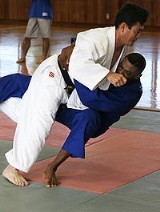
 in the late nineteenth century. Its most prominent feature is its competitive element, where the object is to either throw
Throw (grappling)

A throw is a martial arts term for a grappling technique that involves off-balancing or lifting an opponent, and tossing them to the ground. It usually involves a rotating motion as opposed to a takedown )....
 one's opponent to the ground, immobilize or otherwise subdue one's opponent with a grappling
Grappling

Grappling refers to the gripping, handling, and controlling of an opponent without the use of strike , typically through the application of various grappling holds, choke holds, and counters to various hold attempts....
 manoeuvre, or force an opponent to submit by joint locking the elbow or by executing a choke.


Discussion
Ask a question about 'Judo'
Start a new discussion about 'Judo'
Answer questions from other users
Full Discussion Forum


Encyclopedia


, meaning "gentle way", is a modern Japanese martial art (gendai budo
Gendai Budo

, meaning "modern martial way," are modern Japanese martial arts which were established after the Meiji Restoration . Koryu are the opposite: ancient martial arts established before the Meiji Restoration....
) and combat sport
Combat sport

A combat sport is a competitive contact sport where two combatants fight against each other using certain rules of engagement, typically with the aim of simulating parts of real hand to hand combat....
, that originated in Japan
Japan

Japan is an island country in East Asia. Located in the Pacific Ocean, it lies to the east of the Sea of Japan, People's Republic of China, North Korea, South Korea and Russia, stretching from the Sea of Okhotsk in the north to the East China Sea and Taiwan in the south....
 in the late nineteenth century. Its most prominent feature is its competitive element, where the object is to either throw
Throw (grappling)

A throw is a martial arts term for a grappling technique that involves off-balancing or lifting an opponent, and tossing them to the ground. It usually involves a rotating motion as opposed to a takedown )....
 one's opponent to the ground, immobilize or otherwise subdue one's opponent with a grappling
Grappling

Grappling refers to the gripping, handling, and controlling of an opponent without the use of strike , typically through the application of various grappling holds, choke holds, and counters to various hold attempts....
 manoeuvre, or force an opponent to submit by joint locking the elbow or by executing a choke. Strikes
Strike (attack)

A strike is an attack with an inanimate object, such as a weapon, or with a part of the human body intended to cause an effect upon an opponent or to simply cause harm to an opponent....
 and thrusts (by hands and feet) — as well as weapons defences — are a part of judo, but only in pre-arranged forms (kata
Kata

is a Japanese language word describing detailed choreographed patterns of movements practiced either solo or in pairs. Kata are used in many traditional Japanese arts such as theater forms like kabuki and schools of tea ceremony , but are most commonly known for the presence in the martial arts....
) and are not allowed in judo competition or free practice (randori
Randori

is a term used in Japanese martial arts to describe free-style practice or sparring, sometimes with multiple attackers. The term literally means "chaos taking" or "grasping freedom," implying a freedom from the structured practice of kata....
).

Ultimately, the philosophy and subsequent pedagogy
Pedagogy

Pedagogy , or paedagogy is the art or science of being a teacher. The term generally refers to strategies of instruction, or a style of instruction....
 developed for judo became the model for almost all modern Japanese martial arts that developed from "traditional" schools (koryu
Koryu

is a Japanese language word that is used in association with the ancient Japanese martial arts. This word literally translates as ":wikt:? :wikt:?" or "traditional school." Koryu is a general term for Japanese schools of martial arts that predate the Meiji Restoration ....
). Practitioners of judo are called judoka.

History and philosophy


Early life of the founder

The early history of judo is inseparable from its founder, Japanese
Japanese people

The are the predominant ethnic group of Japan. Worldwide, approximately 130 million people are of Japanese descent; of these, approximately 127 million are residents of Japan....
 polymath
Polymath

A polymath is a person whose knowledge is not restricted to one subject area. In less formal terms, a polymath may simply refer to someone who is very knowledgeable....
 and educator Jigoro Kano (?? ??? Kano Jigoro, 1860–1938). Kano was born into a well-to-do Japanese family. His grandfather was a self-made man: a sake
Sake

Sake is a Japanese alcoholic beverage made from rice.This beverage is called sake in English, but in Japanese language, sake or Honorific speech in Japanese refers to alcoholic drinks in general....
 brewer from Shiga prefecture
Shiga Prefecture

is a Prefectures of Japan of Japan which is part of the Kansai region on Honshu Island. The capital is the city of Otsu, Shiga....
 in central Japan. However, Kano's father was not the eldest son and therefore did not inherit the business. Instead, he became a Shinto
Shinto

is the former state religion of Japan and remains the most common name for the nation's non-Buddhist ethnic religion practices. It was formed from disparate local mythologies, beginning with the Kojiki of 712, into an imperial cult called State Shinto that solidified in the Meiji period....
 priest and government official, with enough influence for his son to enter the second incoming class of Tokyo Imperial University.

Founder pursues jujutsu

Kano was a small, frail boy, who, even in his twenties, did not weigh more than a hundred pounds (45 kg), and was often picked on by bullies. He first started pursuing jujutsu
Jujutsu

, literally meaning the "jutsu of :wikt:?", or "way of yielding" is a collective name for Japanese Japanese martial art styles including unarmed and armed techniques....
, at that time a dying art, at the age of 17, but met with little success. This was in part due to difficulties finding a teacher who would take him on as a student. When he went to university to study literature at the age of 18, he continued his martial arts studies, eventually gaining a referral to Fukuda Hachinosuke (c.1828–c.1880), a master of the Tenjin Shin'yo-ryu
Tenjin Shinyo-ryu

, literally meaning "Divine True Willow School", can be classified as a traditional school of jujutsu. It was founded by Iso Mataemon Minamoto no Masatari in the 1830s....
 and grandfather of Keiko Fukuda
Keiko Fukuda

Keiko Fukuda is the highest-ranking female practitioner of judo in the world.She was born in Tokyo, and began the practice of judo in 1935 at the age of 21....
 (born 1913), who is Kano's only surviving student, and the highest-ranking female judoka in the world. Fukuda Hachinosuke is said to have emphasized technique over formal exercise, sowing the seeds of Kano's emphasis of free practice (randori
Randori

is a term used in Japanese martial arts to describe free-style practice or sparring, sometimes with multiple attackers. The term literally means "chaos taking" or "grasping freedom," implying a freedom from the structured practice of kata....
) in judo.

A little more than a year after Kano joined Fukuda's school, Fukuda became ill and died. Kano then became a student in another Tenjin Shin'yo-ryu school, that of Iso Masatomo (c.1820–c.1881), who put more emphasis on the practice of pre-arranged forms (kata) than Fukuda had. Through dedication, Kano quickly earned the title of master instructor (shihan
Shihan

is a Japanese language term, often used in Japanese martial arts as an Japanese honorifics title for expert or senior instructors. The term is frequently used interchangeably with English language terms such as "master instructor"....
) and became assistant instructor to Iso at the age of 21. Unfortunately, Iso soon took ill, and Kano, feeling that he still had much to learn, took up another style, becoming a student of Iikubo Tsunetoshi (1835–1889) of Kito-ryu
Kito-ryu

is a traditional school of the Japanese martial art of jujutsu. Its syllabus comprises atemi , nagewaza , kansetsuwaza and shimewaza . Many of these techniques are performed while in full armour....
. Like Fukuda, Iikubo placed much emphasis on free practice. On the other hand, Kito-ryu emphasized throwing techniques to a much greater degree than Tenjin Shin'yo-ryu.

Founding

By this time, Kano was devising new techniques, such as the "shoulder wheel" (kata-guruma, known as a fireman's carry to Western wrestlers who use a slightly different form of this technique) and the "floating hip" (uki goshi) throw. However, he was already thinking about doing far more than just expanding the canons of Kito-ryu and Tenjin Shin'yo-ryu. Full of new ideas, Kano had in mind a major reformation of jujutsu, with techniques based on sound scientific principles, and with focus on development of the body, mind and character of young men in addition to development of martial prowess. At the age of 22, when he was just about to finish his degree at the University, Kano took nine students from Iikubo's school to study jujutsu under him at the Eisho-ji, a Buddhist temple in Kamakura
Kamakura, Kanagawa

is a cities of Japan located in Kanagawa Prefecture, Japan, about south-south-west of Tokyo. It used to be also called . Although Kamakura proper is today rather small, it is sometimes considered a former de facto capital of Japan as the seat of the Shogunate and of the Shikken during the Kamakura Period....
, and Iikubo came to the temple three days a week to help teach. Although two years would pass before the temple would be called by the name "Kodokan
Kodokan

is the headquarters of the judo world. Literally, ko means "to lecture" or "to spread information," do means "the way," and kan is "a public building or hall," together translating roughly as "a place for the study or promotion of the way." It was established by Kano Jigoro, the founder of judo in 1882, and is now located in an eight-s...
", or "place for teaching the way", and Kano had not yet been accorded the title of "master" in the Kito-ryu, this is now regarded as the Kodokan's founding.

Judo was originally known as Kano Jiu-Jitsu or Kano Jiu-Do, and later as Kodokan Jiu-Do or simply Jiu-Do or Judo. In the early days, it was also still referred to generically simply as Jiu-Jitsu.

Meaning of "judo"

Judo03
The word "judo" shares the same root ideogram
Ideogram

An ideogram or ideograph is a graphic symbol that represents an idea or concept. They can be a straighforward pictogram, or a more abstract symbol that is comprehensible only on the basis of prior convention....
 as "jujutsu": , which may mean "gentleness", "softness", "suppleness", and even "easy", depending on its context. Such attempts to translate ju are deceptive, however. The use of ju in each of these words is an explicit reference to the martial arts principle of the . The soft method is characterized by the indirect application of force to defeat an opponent. More specifically, it is the principle of using one's opponent's strength against him and adapting well to changing circumstances. For example, if the attacker was to push against his opponent he would find his opponent stepping to the side and allowing his momentum
Momentum

In classical mechanics, momentum is the product of the mass and velocity of an object . For more accurate measures of momentum, see the section Momentum#Modern definitions of momentum on this page....
 (often with the aid of a foot to trip him up) to throw
Throw (grappling)

A throw is a martial arts term for a grappling technique that involves off-balancing or lifting an opponent, and tossing them to the ground. It usually involves a rotating motion as opposed to a takedown )....
 him forwards (the inverse being true for pulling.) Kano saw jujutsu as a disconnected bag of tricks, and sought to unify it according to a principle, which he found in the notion of "maximum efficiency". Jujutsu techniques that relied solely on superior strength were discarded or adapted in favour of those that involved redirecting the opponent's force, off-balancing the opponent, or making use of superior leverage.

The second characters of judo and jujutsu differ. Where means the "art" or "science" of softness, means the "way" of softness. The use of , meaning way, road or path (and is the same character as the Chinese word "tao
Tao

Tao is a concept found in Taoism, Confucianism, and more generally in ancient Chinese philosophy. While the character itself translates as 'way', 'path', or 'route', or sometimes more loosely as 'doctrine' or 'principle', it is used philosophically to signify the fundamental or true nature of the world....
"), has philosophical overtones. This is the same distinction as is made between Budo and Bujutsu
Budo

is a Japanese language term describing martial arts. In English, it is used almost exclusively in reference to Japanese martial arts.Etymology...
. Use of this word is a deliberate departure from ancient martial arts, whose sole purpose was for killing. Kano saw judo as a means for governing and improving oneself physically, mentally, emotionally and morally. He even extended the physical principle of maximum efficiency into daily life, evolving it into "mutual prosperity". In this respect, judo is seen as a holistic approach to life extending well beyond the confines of the dojo.

Judoka (practitioner)

A practitioner of judo is known as a judoka or 'judo practitioner', though traditionally only those of 4th Dan or higher were called "judoka". The suffix -ka, when added to a noun, means a person with expertise or special knowledge on that subject. For example, Benkyo-ka means "scholar". Other practitioners below the rank of 4th dan were called kenkyu-sei or "trainees". However, today the term judoka is used worldwide to refer to any practitioner of judo without any particular level of expertise being implied.

A judo teacher is called sensei
Sensei

is a Japanese language Japanese titles used to refer to or address teachers, professors, professionals such as lawyers and Physicians, politicians, clergyman, and other figures of authority....
. The word sensei comes from sen or saki (before) and sei (life) – i.e. one who has preceded you. In Western dojos it is common to call any instructor of dan grade sensei. Traditionally, that title was reserved for instructors of 4th dan and above.

Judogi (uniform)

Judo Orange Belt
Judo practitioners traditionally wear white uniforms called judogi
Judogi

Judogi is the formal Japanese language name for the traditional uniform used for Judo practice and competition. It is actually derived from traditional articles of Japanese clothing....
, which simply means "judo uniform", for practicing judo. Sometimes the word is seen shortened simply to gi
Keikogi

or dogi is a uniform for training, used in martial arts derived from Japan, or budo. . In English language, the term keikogi is sometimes referred to simply as the gi, which would be an incorrect use of the word in Japanese....
 (uniform). The judogi was created by Kano in 1907, and similar uniforms were later adopted by many other martial arts. The modern judogi consists of white or blue cotton drawstring pants and a matching white or blue quilted cotton
Cotton

Cotton is a soft, staple fiber that grows in a form known as a boll around the seeds of the cotton plant a shrub native to tropical and subtropical regions around the world, including the Americas, India and Africa....
 jacket
Jacket

A jacket is a type of sleeved Hip - or waist-length garment for the upper body. For clothing older than the 1850s, a distinction is often maintained with a coat , but in many instances the terms are now interchangeable....
, fastened by a belt (obi
Obi (sash)

Obi is a Japan word referring to several different types of sashes worn with kimono and keikogi by both men and women....
). The belt is usually coloured to indicate rank. The jacket is intended to withstand the stresses of grappling, and as a result, is much thicker than that of a karate uniform (karategi
Karategi

Karategi is the Japanese_language name for the karate training uniform.A karategi is somewhat similar to a judogi as it shares a common origin, however the material and cut of the uniform is generally much lighter and looser fitting....
).

The modern use of the blue judogi was first suggested by Anton Geesink
Anton Geesink

Antonius "Anton" Johannes Geesink is a Netherlands 10th dan rank judoka. He is a three-time World Judo Champion and Olympic Gold Medalist . He was 6'7" tall and at one time weighted 320 pounds ....
 at the 1986 Maastricht IJF DC Meeting. For competition, a blue judogi is worn by one of the two competitors for ease of distinction by judges, referees, and spectators. In Japan, both judoka still use a white judogi and the traditional red sash (based on the colours of the Japanese flag) is affixed to the belt of one competitor. Outside Japan, a coloured sash may also be used for convenience in minor competitions, the blue judogi only being mandatory at the regional or higher levels. Japanese practitioners and purists tend to look down on the use of blue judogi.

Techniques & practice

While judo includes a variety of rolls, falls, throws, hold downs, chokes, joint-locks, and strikes, the primary focus is on , and groundwork (ne-waza). Throws are divided in two groups of techniques, standing techniques (tachi-waza), and . Standing techniques are further divided into , , and . Sacrifice techniques are divided into , and .

The ground fighting
Ground fighting

Ground fighting is Hand to hand combat which takes place while the combatants are on the ground, generally involving a degree of grappling. The term is commonly used in martial arts and combat sports to designate the set of techniques employed by a combatant that is on the ground, as opposed to techniques employed in stand-up fighting....
 techniques are divided into , , and .

A kind of sparring is practised in judo, known as , meaning "free practice". In randori no kata, two adversaries may attack each other with any judo throw or grappling technique. Striking techniques (atemi-waza) such as kicking and punching, along with knife and sword techniques are retained in the kata. This form of pedagogy is usually reserved for higher ranking practitioners (for instance, in the kime-no-kata
Kime-no-kata

is a self-defense oriented series of katas in judo. Kime no kata, also known as , was developed at the Kodokan around 1888. The series is composed of 8 techniques from a kneeling posture , and 12 techniques from a standing position ....
), but are forbidden in contest, and usually prohibited in randori for reasons of safety. Also for reasons of safety, chokeholds, joint locking, and the sacrifice techniques are subject to age or rank restrictions. For example, in the United States one must be 13 or older to use chokeholds, and 16 or older to use armlocks.

In randori and tournament (shiai) practice, when an opponent successfully executes a chokehold or joint lock, one submits, or "taps out", by tapping the mat or one's opponent at least twice in a manner that clearly indicates the submission. When this occurs the match is over, the tapping player has lost, and the chokehold or joint lock ceases.

Kata (forms)

Forms (kata) are pre-arranged patterns of attack and defence, which in judo are practised with a partner for the purpose of perfecting judo techniques. More specifically, their purposes include illustrating the basic principles of judo, demonstrating the correct execution of a technique, teaching the philosophical tenets upon which judo is based, allowing for the practice of techniques that are not allowed in competition, and to preserve ancient techniques that are historically important but are no longer used in contemporary judo.

Knowledge of various kata is a requirement for the attainment of a higher rank.

There are seven kata that are recognised by the Kodokan today:

  • Free practice forms (Randori no Kata), comprising two kata:
    • Throwing forms (Nage no Kata
      Nage-no-kata

      is a throw kata in judo. The kata is composed of 3 techniques from each of the five throw groups in judo: hand techniques , hip techniques , foot techniques , rear sacrifice techniques and side sacrifice techniques ....
      )
    • Grappling forms (Katame no Kata)
  • Old style self-defence forms (Kime no Kata)
  • Modern self-defence forms (Kodokan Goshin Jutsu
    Kodokan Goshin Jutsu

    Kodokan Goshin Jutsu is a set of prearranged self-defence forms in Judo.It is the most recent kata of Judo, having been created in 1956. It incorporates techniques from aikido through the influence of Kenji Tomiki....
    )
  • Forms of "gentleness" (Ju no Kata)
  • The five forms (Itsutsu no Kata)
  • Ancient forms (Koshiki no Kata)
  • Maximum-efficiency national physical education kata (Seiryoku Zen'yo Kokumin Taiiku no Kata
    Seiryoku Zen'yo Kokumin Taiiku no Kata

    Seiryoku Zen'yo Kokumin Taiiku no Kata is a set of physical exercises that are part of judo.Its purpose is to promote the development of strong, healthy minds and bodies in an interesting and useful way....
    )


There are also other kata that are not officially recognised by the Kodokan but that continue to be practised. The most prominent example of these is the Go no sen no kata
Go-no-sen-no-kata

The Go no sen no kata is a judo kata that focuses on counter-attacks to throwing techniques. It is not an officially recognized kata of judo, but its importance is attested to by its inclusion in Kawaishi's The complete seven katas of judo....
, a kata that focuses on counter-attacks to attempted throws.

Randori (sparring)

Judo emphasizes a free-style sparring
Sparring

Sparring is a form of training common to many martial arts. Although the precise form varies, it is essentially relatively 'free-form' fighting, with enough rules, customs, or agreements to make injuries unlikely....
, called randori, as one of its main forms of training. Part of the combat time is spent sparring standing up, called tachi-waza, and the other part on the ground, called ne-waza. Sparring, even subject to safety rules, is much more practically effective than only practicing techniques on their own, which is what jujutsuka were used to doing. Using full strength develops the muscle
MUSCLE

MUSCLE is public domain, multiple sequence alignment software for protein and nucleotide sequences.MUSCLE is integrated into UGENE bioinformatics tool as a plugin....
s and cardio-vascular system on the physical side of things, and it develops strategy and reaction time on the mental side of things, and helps the practitioner learn to use techniques against a resisting opponent. A common saying among judoka is "The best training for judo is judo."

There are several types of sparring exercises, such as ju renshu (both judoka attack in a very gentle way where no resistance is applied); and kakari geiko (only one judoka attacks while the other one relies solely on defensive and evasive techniques, but without the use of sheer strength.)

Combat phases


In judo, there are two main phases of combat: the standing (tachi-waza
Grappling

Grappling refers to the gripping, handling, and controlling of an opponent without the use of strike , typically through the application of various grappling holds, choke holds, and counters to various hold attempts....
) and the ground (ne-waza
Grappling

Grappling refers to the gripping, handling, and controlling of an opponent without the use of strike , typically through the application of various grappling holds, choke holds, and counters to various hold attempts....
) phase. Each phase requires its own (mostly separate) techniques, strategies, randori, conditioning
Conditioning

Conditioning may refer to:* In probability theory, the use of conditional probabilities, expectations and distributions; see conditioning * In mathematics, the property of a matrix as "well-conditioned" or "ill-conditioned"; see condition number...
 and so on. Special training is also devoted to "transitional" techniques to bridge the gap. Judoka may become quite skilled in one phase and be rather weak in the other, depending on where their interests most lie, although most are balanced between the two.

Judo's balance between both the standing and ground phases of combat gives judoka the ability to take down opponents who are standing up and then pin
Grappling hold

A grappling hold is a grappling, wrestling, judo or other martial arts term for a specific grip that is applied to an opponent. Holds are principally used to control the opponent, and to advance in points or grappling position....
 and submit
Submission (combat sport term)

A submission is a combat sports term for yielding to the opponent, and hence resulting in an immediate defeat. The submission is commonly performed by clearly tapping the floor or the opponent with the hand or sometimes with the foot, to signal the opponent and possibly the referee of the submission....
 them on the ground. This balanced theory of combat has made judo a popular choice of martial art or combat sport.

Standing phase

In the standing phase, which has primacy according to the contest rules, the opponents attempt to throw each other. Although standing joint-lock and choke
Chokehold

A chokehold or stranglehold is a grappling hold that strangling the opponent, and leads to unconsciousness or even death. Chokeholds are practiced and used in martial arts, combat sports, self-defense, law-enforcement and in military hand to hand combat application....
/strangulation
Chokehold

A chokehold or stranglehold is a grappling hold that strangling the opponent, and leads to unconsciousness or even death. Chokeholds are practiced and used in martial arts, combat sports, self-defense, law-enforcement and in military hand to hand combat application....
 submission techniques
Grappling hold

A grappling hold is a grappling, wrestling, judo or other martial arts term for a specific grip that is applied to an opponent. Holds are principally used to control the opponent, and to advance in points or grappling position....
 are legal in the standing phase, they are quite rare due to the fact that they are much harder to apply standing than throws are. Some judoka, however, are very skilled in combining takedowns
Takedown (grappling)

A takedown is a martial arts and combat sports term for a technique that involves off-balancing an opponent and bringing him or her to the ground, typically with the combatant performing the takedown landing on top....
 with submissions, where a submission technique is begun standing and finished on the ground.

Strikes
Strike (attack)

A strike is an attack with an inanimate object, such as a weapon, or with a part of the human body intended to cause an effect upon an opponent or to simply cause harm to an opponent....
 (i.e. punches
Punch (strike)

A punch is "a thrusting blow, esp. with the fist." In some sports and disciplines, such as boxing or martial arts, where punches are regularly practiced, hand wraps or other padding such as gloves may be employed to protect athletes and practitioners from injuring themselves....
, kick
Kick

In martial arts, combat sports or violence, a kick is a strike using the foot, Human leg, or knee . This attack is often used in hand-to-hand combat, especially in stand-up fighting....
s, etc...) are not allowed due to their certainty of injury
Injury

Injury or bodily injury is damage or harm caused to the structure or Purpose of the body caused by an outside wiktionary:agent or force, which may be physical or chemical....
, but an athlete is supposed to "take them into consideration" while training by, for example, not fighting in a bent-over position for long, since this position is vulnerable to knee-strikes
Knee (strike)

A knee strike is a strike with the knee, either with the kneecap or the surrounding area. Kneeing is a disallowed practice in many combat sports, especially to the head, downed opponent....
 and other striking attacks.

The main purpose of the throwing techniques (nage waza) is to take an opponent who is standing on his feet, mobile and dangerous, down onto his back where he cannot move as effectively. Thus, the main reason for throwing the opponent is to control the opponent and to put oneself in a dominant position
Grappling position

A grappling position refers the positioning and grappling hold of combatants engaged in grappling. Combatants are said to be in a neutral position if neither is in a more favorable position....
. In this way the practitioner has more potential to render a decisive outcome. Another reason to throw the opponent is to shock his body through smashing him forcefully onto the ground. If an opponent executes a powerful yet fully controlled throw, he can win a match outright (by ippon) on the basis that he has displayed sufficient superiority. A lower score is given for lesser throws. A score for a throw is only given when executed starting from a standing position.

In keeping with Kano's emphasis on scientific analysis and reasoning, the standard Kodokan judo pedagogy dictates that any throwing technique is theoretically a four phased event: off-balancing (kuzushi
Kuzushi

is a Japanese language term for unbalancing an opponent in the martial arts.The noun comes from the intransitive verb, kuzusu, meaning to level, pull down, or demolish....
); ; ; and finally . Each phase follows the previous one with great rapidity — ideally they happen almost simultaneously.

Ground phase

Judo Newaza
In competition, combat may continue on the ground after a throw occurs or if the contestants otherwise legally end up on the ground; a contestant is not allowed to simply drop to the ground to commence ground fighting.

On the ground, the contestants aim to either obtain a hold down
Grappling hold

A grappling hold is a grappling, wrestling, judo or other martial arts term for a specific grip that is applied to an opponent. Holds are principally used to control the opponent, and to advance in points or grappling position....
, or to get their opponent to submit either by using a choke or strangulation or armlock
Armlock

In grappling, an armlock is a single or double joint lock that hyperextends, hyperflexes or hyperrotates the elbow and/or glenohumeral joint. An armlock that hyperflexes or hyperrotates the shoulder joint is referred to as a shoulder lock, and an armlock that hyperextends the elbow joint is called an armbar....
 (locks on joints other than the elbow are not allowed for safety reasons.)

Hold downs
are important since in a real fight the person who has control of his opponent can hit him with punches, knees, headbutts, and other strikes. If osaekomi is maintained for twenty-five seconds, the person doing the holding down wins the match. An osaekomi involves holding an opponent principally on their back, and free of their legs.

According to the rules as they stood in 1905, it was only necessary to hold down an opponent, on his shoulders, for two seconds — said to reflect the time necessary for a samurai to reach his knife or sword and dispatch his held opponent. The newer longer requirements reflect the combat reality that a fighter must immobilize his opponent for a substantial amount of time in order to strike effectively.

The score for a hold down is determined by how long the hold down is held. A hold down may sometimes result in a submission if the opponent cannot endure the pressure from the hold down.

The 'guard' and 'body scissors'
If the person being held down has wrapped his legs around any part of his opponent's lower body or trunk, he is pinning his opponent as much as he is being pinned, because his opponent cannot get up and flee unless the person on the bottom lets go. While his legs are wrapped around his opponent, the person on the bottom can employ various attacking techniques, including strangles, armlocks and "body scissors" (do-jime
Asphyxia

Asphyxia is a condition of severely deficient supply of oxygen to the body that arises from being unable to breathe normally. An example of asphyxia is choking....
), while controlling the opponent so that he cannot effectively strike from above. In this position, often referred to as the "guard
Guard (grappling)

The guard is a grappling position#Ground grappling position where one combatant has their back to the ground, while holding the other combatant using the legs....
" in English and sometimes as "do-osae" in Japanese, meaning "trunk hold", the person on top does not have enough control over his adversary for the position to be considered osaekomi. (Note that while the guard is commonly used, do-jime is no longer legal in competition judo.) The person on top can try to pass his opponent's legs and in turn hold down or submit him, or he may try to break out of his opponent's guard and stand up. The person on the bottom can try to submit his opponent from his guard or roll his opponent over to get on top of him.

Joint locks
Joint locks (kansetsu-waza) are effective combat techniques because they enable a judoka to control his opponent through pain-compliance
Grappling hold

A grappling hold is a grappling, wrestling, judo or other martial arts term for a specific grip that is applied to an opponent. Holds are principally used to control the opponent, and to advance in points or grappling position....
, or if necessary, to cause breakage of the locked joint. Joint locks on the elbow are considered safe enough to perform at nearly full-force in competition to force submission from one's opponent. Judo has, in the past, allowed leglocks, wristlock
Wristlock

A wristlock is a joint lock primarily affecting the wrist-joint and possibly the radioulnar joints through rotation of the hand. A wristlock is typically applied by grabbing the opponent's hand, and bending and/or twisting it....
s, spinal lock
Spinal lock

A spinal lock is a multiple joint lock applied to the spinal column, which is performed by forcing the spine beyond its normal ranges of motion....
s and various other techniques that have since been disallowed in competition to protect athletes' safety. It was decided that attacking those joint
Joint

A joint is the location at which two or more bones make contact. They are constructed to allow movement and provide mechanical support, and are classified structurally and functionally....
s would result in many injuries to the athletes and would cause a gradual deterioration of these joints. Even so, some judoka still enjoy learning and fighting each other informally using these techniques that are banned from formal competitions, and many of these techniques are still actively used in other arts such as sambo
Sambo (martial art)

Sambo is a modern martial art, combat sport and self-defense system developed in the Soviet Union and recognized as an official sport by the USSR All-Union Sports Committee in 1938, presented by Anatoly Kharlampiev....
, Brazilian Jiu-Jitsu
Brazilian Jiu-Jitsu

Brazilian Jiu-Jitsu is a martial art and combat sport that focuses on grappling and especially ground fighting. It is a derivative of early 20th century Kodokan Judo, which was itself then a recently-developed system , based on multiple schools of Japanese jujutsu....
, and jujutsu
Jujutsu

, literally meaning the "jutsu of :wikt:?", or "way of yielding" is a collective name for Japanese Japanese martial art styles including unarmed and armed techniques....
.

Chokes and strangulations
enable the person applying the choke to force the adversary into unconsciousness and even death
Death

Death is the permanent termination of the biological functions that define a life organism. It refers to both a particular event and to the condition that results thereby....
. Strangulation cuts off the blood
Blood

Blood is a specialized bodily fluid that delivers necessary substances to the body's Cell s ? such as nutrients and oxygen ? and transports waste products away from those same cells....
 supply to the brain
Brain

The brain is the center of the nervous system in all vertebrate, and most invertebrate, animals. Some primitive animals such as cnidarian and echinoderm have a decentralized nervous system without a brain, while sponges lack any nervous system at all....
 via compression on the sides of the neck, while a choke blocks the airway
Airway

The airways are those parts of the respiratory system through which air flows, to get from the external environment to the alveoli.The airway begins at the mouth or nose, and accesses the vertebrate trachea via the pharynx....
 from the front of the neck. The terms are frequently interchangeable in common usage, and a formal differentiation is not made by most judoka. In competition, the judoka wins if the opponent submits or becomes unconscious. A strangle, once properly locked in, can render an opponent unconscious in only a few seconds, but normally causes no injury.

As a sport

Although a fully featured martial art, judo has also developed as a sport.

The first time judo was seen in the Olympics was at the 1932 Games
1932 Summer Olympics

The 1932 Summer Olympics, officially known as the Games of the X Olympiad, were an international multi-sport event which was celebrated in 1932 in Los Angeles, California, United States....
 in Los Angeles
Los Ángeles

Los ?ngeles is the Capital of the Biob?o Province, in the municipality of the same name, in Regions of Chile VIII , in the center-south of Chile....
, where Kano and about 200 judo students gave a demonstration. Judo became an Olympic
Olympic Games

The Olympic Games are an international multi-sport event established for both summer and winter sports. There have been two generations of the Olympic Games; the first were the Ancient Olympic Games held at Olympia, Greece, Greece....
 sport for men in the 1964 Games
1964 Summer Olympics

The 1964 Summer Olympics, officially known as the Games of the XVIII Olympiad, were an international multi-sport event held in Tokyo, Japan in 1964....
 in Tokyo
Tokyo

, officially , is one of the 47 prefectures of Japan of Japan and located on the eastern side of the main island Honshu. The twenty-three special wards of Tokyo, each governed as a city, cover the area that was once the Tokyo City in the eastern part of the prefecture, and total over 8 million people....
. With the persistence of Rusty Kanokogi, an American, and many others, judo became an Olympic sport for women as well in 1988. It is often stated that the men's judo event in 1964 was a demonstration event, but according to the International Judo Federation
International Judo Federation

The International Judo Federation was founded in July 1951. The IJF was originally composed of judo federations from Europe plus Argentina. Countries from four continents were affiliated over the next ten years....
 (IJF) and International Olympic Committee
International Olympic Committee

The International Olympic Committee is an organization based in Lausanne, Switzerland, created by Pierre de Coubertin and Demetrios Vikelas on June 23, 1894....
, Judo was in fact an official sport in the 1964 games. Dutchman Anton Geesink
Anton Geesink

Antonius "Anton" Johannes Geesink is a Netherlands 10th dan rank judoka. He is a three-time World Judo Champion and Olympic Gold Medalist . He was 6'7" tall and at one time weighted 320 pounds ....
 won the first Olympic gold medal in the open division of Judo by defeating Akio Kaminaga
Akio Kaminaga

was a judoka who competed in the 1964 Summer Olympics....
 of Japan. Judo then lost the image of being "Japanese only" and went on to become one of the most widely practised sports in the world. The women's event was a demonstration event in 1988, and became an official medal event 4 years later. Men and women compete separately, although they often train together. Judo has been a Paralympic
Paralympic Games

The Paralympic Games are a Paralympic sports for athletes with physical and visual disabilities. This includes athletes with mobility disabilities, amputations, blindness, and cerebral palsy....
 sport (for the visually impaired) since 1988. Judo is also one of the sports at the Special Olympics
Special Olympics World Games

The Special Olympics World Games are an international sports competition for athletes with intellectual disabilities, organized by Special Olympics....
.

Collegiate
Collegiate

Collegiate may refer to:* Webster's Collegiate, Webster's Dictionary#The Collegiate DictionarySee also:* College...
 competition in the United States
United States

The United States of America is a Federal government constitutional republic comprising U.S. state and a federal district. The country is situated mostly in central North America, where its Contiguous United States and Washington, D.C., the Capital districts and territories, lie between the Pacific Ocean and Atlantic Oceans, Borders of the U...
, especially between UC Berkeley
University of California, Berkeley

The University of California, Berkeley is a public university research university located in Berkeley, California, California, United States. The oldest of the ten major campuses affiliated with the University of California, Berkeley offers some 300 undergraduate and graduate degree programs in a wide range of disciplines....
 and San Jose State, contributed towards refining judo into the sport seen at the Olympic Games
Olympic Games

The Olympic Games are an international multi-sport event established for both summer and winter sports. There have been two generations of the Olympic Games; the first were the Ancient Olympic Games held at Olympia, Greece, Greece....
 and World Championships. In the 1940s Henry Stone and Yosh Uchida
Yosh Uchida

Yoshihiro "Yosh" Uchida is an United States businessman, entrepreneur, and educator who is best known for his contributions to judo. Uchida has been the head judo coach at San Jose State University for over 60 years, and was instrumental in the development of the martial art into a competitive sport....
, the head coaches at Cal and SJSU, developed a weight class system for use in the frequent competitions between the schools. In 1953, Stone and Uchida successfully petitioned the Amateur Athletic Union
Amateur Athletic Union

The Amateur Athletic Union is one of the largest, non-profit, volunteer, sports organizations in the United States. A multi-sport organization, the AAU is dedicated exclusively to the promotion and development of amateur sports and physical fitness programs....
 to accept judo as a sport, with their weight class system as an official component. In 1961, Uchida represented the United States at the IJF meetings in Paris
Paris

Paris is the Capital of France and the country's largest city. It is situated on the river Seine, in northern France, at the heart of the ?le-de-France Regions of France ....
, where the IJF adopted weight classes for all future championships. The IJF was created largely based on the earlier European Judo Union, where weight classes had also been used for many years.

Weight divisions

There are currently seven weight divisions, subject to change by governing bodies, and may be modified based on the age of the competitors:

Men
Under 60 kg 60~66 kg 66~73 kg 73~81 kg 81~90 kg 90~100 kg Over 100 kg
Women
Under 48 kg 48~52 kg 52~57 kg 57~63 kg 63~70 kg 70~78 kg Over 78 kg


Rules

The traditional rules of judo are intended to avoid injuries to the participants and ensure proper etiquette. Some later additions to the rules were motivated by a desire to make the sport more interesting to observers.

Penalties may be given for being inactive during the match, or for using illegal techniques. Fighting must be stopped if a participant is outside the designated area on the mat (tatami). If the referee and judges need to discuss something during groundwork, the referee will call sonomama (which means "do not move") and both fighters must stop in the position they are in. When they are done, the referee says yoshi and the match continues.

All scores and penalties are given by the referee. The judges can make a decision that changes the score or penalty given by the referee.

There are slight differences to IJF rules to accommodate blind judo
Paralympic Judo

Paralympic judo is an adaptation of the Japanese martial art of judo for visually impaired competitors. The rules of the sport are only slightly different from regular judo competitions....
.

Competition scoring

The object in a judo match is to throw the opponent to the ground on his shoulder; to pin him to the ground principally on his back; or to force him to submit to a choke, strangle or an armlock. Any of these score ippon, immediately winning the match.

Judo has three grades of score: ippon, waza-ari and yuko. An ippon literally means "one point" and wins the match. An ippon is awarded for (a) a throw that lands the opponent largely on their back in a controlled manner with speed and force; (b) for a mat hold of sufficient duration (twenty five seconds); or (c) for opponent submission. A waza-ari is awarded for a throw that does not quite have enough power or control to be considered ippon; or for a hold of twenty seconds. A waza-ari is a half-point, and, if two are scored, they constitute the full point needed for a win.

Yuko is a lower grade of score, and only count as a tie-breaker — it is not cumulative with one another. Scoring is lexicographic; a waza-ari beats any number of yuko, but a waza-ari and a yuko beat a waza-ari with no yuko.

A fifteen-second hold down scores yuko. If the person who secured the hold down already has a waza-ari, they only need to hold the hold down for twenty seconds to score ippon by way of two waza-ari (waza-ari-awasete-ippon). Throws further lacking the requirements of an ippon or a waza-ari might score a yuko. So-called "skillful takedowns" are also permitted (e.g. the flying arm-bar
Armlock

In grappling, an armlock is a single or double joint lock that hyperextends, hyperflexes or hyperrotates the elbow and/or glenohumeral joint. An armlock that hyperflexes or hyperrotates the shoulder joint is referred to as a shoulder lock, and an armlock that hyperextends the elbow joint is called an armbar....
) but do not score.

If the scores are identical at the end of the match, the contest is resolved by the Golden Score rule. Golden Score is a sudden death situation where the clock is reset to match-time, and the first contestant to achieve any score wins. If there is no score during this period, then the winner is decided by Hantei, the majority opinion of the referee and the two corner judges.
Representation of scores
Judo scoreboards show the number of waza-ari and yuko scores scored by each player. Often an ippon is not represented on the scoreboard, because upon award of an ippon the match is immediately terminated. Some computerised scoreboards will briefly indicate that an ippon has been scored.

Scoreboards normally also show the number of penalties imposed on each player, and sometimes the number of medical visits for each. (Only two "medical" attentions are allowed for each competitor during a match — most often for minor bleeds.)

Electronic scoreboards also usually include timers for measuring both competition time and osekomi time.

Note: The score of "Koka" was in fact used, until the rule and regulation changes of USJI, USJF, and other international federations in 2009. "Koka" was the score of 1/8 point, until the new regulation changed.

Penalties

First penalty given will be a warning which is noted on scoreboard. Second penalty will be scored as "yuko" for the opponent. Third penalty will be scored as "waza-ari". The fourth penalty is called "hansoku make". It will be scored as an "ippon" for the opponent. With an "hansoku make" the match will end permanently. The player who got "hansoku make" will be disqualified.

As self-defense

Judo has formed the basis for many military combatives and defensive tactics training around the world. The Japanese police have trained in Judo since 1886, when Judo (at the time known merely as Kano Jujitsu) defeated several other established schools of Jujitsu in a tournament.

In addition to the above, Judo's background in traditional Jujitsu combined with its police and military applications, has resulted in kata specifically designed to teach technical principles for self-defense: Kime No Kata (Forms of Decision) and Kodokan Goshin Jutsu (Forms of Self Defense).

Various aspects of Judo principles and training methods promote attributes and skills helpful in self-defense:
  • Training with full power and speed against fully-resisting opponents: builds speed, stamina, strength, and tenacity.
  • Body and mental conditioning by repeatedly being thrown with significant force.
  • Training in safe methods to take falls.
  • Ability to accurately and quickly use balance, distance, and timing against skilled opponents in fully-resistive sparring. Judo practitioners are experts in controlling their opponent's balance whilst maintaining their own.
  • Sports Judo rules emphasis rapid transition to pins or submissions after a take-down, which builds skills in explosive use of chokes and locks in self-defense situations, as follow-ups to powerful throwing techniques.
  • Emphasis in controlling one's opponent during throws allow a practitioner to dictate the angle, direction, and force with which his or her opponent lands on the ground. The consequences could be gentle or lethal, depending on the Judo practitioner's intentions.


In mixed martial arts

Using their knowledge of ne-waza/grappling
Grappling

Grappling refers to the gripping, handling, and controlling of an opponent without the use of strike , typically through the application of various grappling holds, choke holds, and counters to various hold attempts....
 and tachi-waza/standing-grappling, skillful judo practitioners have also competed in mixed martial arts
Mixed martial arts

Mixed martial arts is a Contact sport combat sport that allows a wide variety of fighting techniques, from a mixture of martial arts traditions and non-traditions, to be used in competitions....
 matches. Former Russian national judo champion Fedor Emelianenko
Fedor Emelianenko

Fedor Vladimirovich Emelianenko is a Russian Heavyweight mixed martial arts fighter. He is the current World Alliance of Mixed Martial Arts Heavyweight Champion and the last holder of the List of Pride champions#World Heavyweight Championship....
 is often ranked as mixed martial arts' number one pound for pound fighter in the world. Karo Parisyan
Karo Parisyan

Karapet "Karo" Parisyan is an Armenian-American mixed martial artist. His fighting style is primarily Judo but has been modified to fight without the use of a judogi ....
 fights in UFC's welterweight division, and Rameau Thierry Sokoudjou
Rameau Thierry Sokoudjou

Rameau Thierry Sokoudjou Nkamhoua , sometimes billed simply as Sokoudjou, is a Cameroonian mixed martial artist and judo practitioner, who came to prominence in Japan PRIDE Fighting Championships....
 and Hidehiko Yoshida
Hidehiko Yoshida

is a Japanese people gold-medalist judoka and Mixed Martial Arts fighter....
, an Olympic gold medalist in 1992 and World Judo Champion in 1999, also were fighters in the now defunct PRIDE FC. Other Olympic gold medalist and world champion judoka such as Pawel Nastula
Pawel Nastula

Pawel Marina Nastula is a Poland heavyweight fighter in mixed martial arts, who last competed in the PRIDE Fighting Championships, a Japanese MMA organization....
, Yoon Dong-Sik
Yoon Dong-Sik

Yoon Dong-Sik is a Korean judoka, and mixed martial arts currently competing in DREAM ....
 and Jung Bu-Kyung
Jung Bu-Kyung

Jung Bu-Kyung is a South Korean judoka and professional mixed martial artist....
 also fight in MMA. Former WEC
World Extreme Cagefighting

World Extreme Cagefighting is an United States mixed martial arts promotion. It is the sister promotion to the Ultimate Fighting Championship, both owned and produced by Zuffa, with a focus on the lighter weight classes ....
 middleweight champion Paulo Filho
Paulo Filho

Paulo Fernando de Souza Leite Filho is a Brazilian mixed martial arts fighter as well as a Brazilian Jiu-Jitsu and Judo practitioner, fighting out of Rio de Janeiro, Brazil....
 has credited judo and jiu-jitsu for his success. Fighters Sanae Kikuta
Sanae Kikuta

Sanae Kikuta is a Japanese mixed martial arts fighter who rose to popularity fighting in the Pancrase organization, and currently fights for World Victory Road....
 and Hayato Sakurai
Hayato Sakurai

Hayato "Mach" Sakurai is a Japanese mixed martial arts fighter, and PRIDE FC welterweight grand prix finalist. He was born in Ibaraki Prefecture, Japan....
 also come from judo backgrounds.

Styles

Kano Jigoro's Kodokan Judo is the most popular and well-known style of judo, but is not the only one. The terms judo and jujutsu were quite interchangeable in the early years, so some of these forms of judo are still known as jujutsu or jiu-jitsu either for that reason, or simply to differentiate them from mainstream judo. From Kano's original style of judo, several related forms have evolved—some now widely considered to be distinct arts:

  • Olympic Judo: This is the predominant form of Kodokan judo.
  • Brazilian Jiu-Jitsu
    Brazilian Jiu-Jitsu

    Brazilian Jiu-Jitsu is a martial art and combat sport that focuses on grappling and especially ground fighting. It is a derivative of early 20th century Kodokan Judo, which was itself then a recently-developed system , based on multiple schools of Japanese jujutsu....
    : Mitsuyo Maeda
    Mitsuyo Maeda

    ,a Brazilian naturalization as Ot?vio Mitsuyo Maeda,was a Japanese people judoka and prizefighter in no holds barred competitions. He was also known as Count Combat , a nickname he picked up in Spain during 1908....
     introduced judo to Brazil
    Brazil

    Brazil , officially the Federative Republic of Brazil , is a country in South America. It is the List of countries and outlying territories by total area country by geographical area, occupying nearly half of South America, the List of countries by population country, and the fourth most populous democracy in the world....
     in 1914. Maeda taught judo to Carlos Gracie
    Carlos Gracie

    Carlos Gracie was the first Gracie to learn Judo/Jiu-Jitsu from Mitsuyo Maeda. Based on this judo training, Carlos and his brothers founded the martial art of Brazilian Jiu-Jitsu....
     (1902–1994) and others in Brazil. Gracie named it Brazilian Jiu-Jitsu in honor of the fact that in Japan at that time, Judo was also known as 'Kano Ju-Jutsu'. Brazilian Jiu-Jitsu did not follow later changes in international judo rules that were added to emphasise the standing phase of the fight, nor those rules that were introduced to ban the more dangerous techniques.
  • Judo-do: In Austria
    Austria

    Austria , officially the Republic of Austria , is a landlocked country in Central Europe. It borders both Germany and the Czech Republic to the north, Slovakia and Hungary to the east, Slovenia and Italy to the south, and Switzerland and Liechtenstein to the west....
    , Julius Fleck and others developed a system of throwing intended to extend judo that they called "judo-do".
  • Kawaishi-ryu jujutsu: Teaching in France
    France

    France , officially the French Republic , is a country whose Metropolitan France is located in Western Europe and that also comprises various Overseas departments and territories of France....
    , Mikonosuke Kawaishi
    Mikonosuke Kawaishi

    Mikonosuke Kawaishi was a master of Japanese Judo and Jujutsu, reaching for the life of the 7th Dan, who led the development of Judo in France and much of Europe....
     developed Kawaishi-ryu jujutsu as an alternative approach to instruction that continued to teach many techniques banned in modern Olympic/Kodokan judo competition.
  • : As a sub-style of Kodokan Judo that became popularised in early 20th century Japanese inter-scholastic competition, Kosen style has the same range of techniques but greater latitude is permitted for ground technique. This style of judo - like the late BJJ - is closer to the original early 1900s judo than current Olympic judo is.
  • Russian Judo: This distinctive style of judo was influenced by Sambo. It is represented by well-known coaches such as Alexander Retuinskih
    Alexander Retuinskih

    Russian General Alexander Retuinskih is the President of the International and All-Russian Federation of Russian Martial Art, who served as Special Representative to Russian President Vladimir Putin during his election campaign....
     and Igor Yakimov
    Igor Yakimov

    Igor Yakimov is a world Judo champion, as well a world Sambo champion and a medallist at the Sambo #Versions_of_Sambo world championships. He is the author of the Russian Judo video series and for his Sambo Leglocks video series....
    , and mixed martial arts
    Mixed martial arts

    Mixed martial arts is a Contact sport combat sport that allows a wide variety of fighting techniques, from a mixture of martial arts traditions and non-traditions, to be used in competitions....
     fighters such as Igor Zinoviev
    Igor Zinoviev

    Igor Zinoviev is a Russian mixed martial arts fighter. He competed in the Extreme Fighting organization, holding the middleweight title until their demise, then moved to the Ultimate Fighting Championship....
    , Fedor Emelianenko
    Fedor Emelianenko

    Fedor Vladimirovich Emelianenko is a Russian Heavyweight mixed martial arts fighter. He is the current World Alliance of Mixed Martial Arts Heavyweight Champion and the last holder of the List of Pride champions#World Heavyweight Championship....
     and Karo Parisyan
    Karo Parisyan

    Karapet "Karo" Parisyan is an Armenian-American mixed martial artist. His fighting style is primarily Judo but has been modified to fight without the use of a judogi ....
    . In turn, Russian judo has influenced mainstream judo, with techniques such as the flying armbar being accepted into Kodokan judo.
  • Sambo
    Sambo (martial art)

    Sambo is a modern martial art, combat sport and self-defense system developed in the Soviet Union and recognized as an official sport by the USSR All-Union Sports Committee in 1938, presented by Anatoly Kharlampiev....
     (especially Sport Sambo): Vasili Oshchepkov was the first European judo black belt under Kano. Oshchepkov went on to create Sambo from judo's influence, integrating other combative techniques into his new system. Oshchepkov died during the political purges
    Great Purge

    Great Purge was a series of campaigns of political repression and persecution in the Soviet Union orchestrated by Joseph Stalin in 1936-1938. Also described as a "Soviet holocaust" by several authors, it involved the purge of the Communist Party of the Soviet Union, repression of kulaks, Red Army leadership, and the persecution of unaffiliat...
     of 1937 for refusing to deny his education in Japanese judo under Kano. In their History of Sambo, Brett Jacques and Scott Anderson wrote that in Russia "judo and SOMBO were considered to be the same thing" — albeit with a different uniform and some differences in the rules.


Safety

Research shows that judo is a particularly safe sport for youths, though adult competitive judo has a relatively higher incidence of injuries compared to non-collision or non-contact ball-sports for example, but similar to other competitive contact sports.

Chokes

Although chokes are potentially lethal techniques, a properly-applied chokehold, if released soon enough after submission or unconsciousness, causes no injury.

There is ample data demonstrating the safety of applying chokeholds, and training includes emergency care and resuscitation (kappo).

Organizations

The international organization for judo is the International Judo Federation
International Judo Federation

The International Judo Federation was founded in July 1951. The IJF was originally composed of judo federations from Europe plus Argentina. Countries from four continents were affiliated over the next ten years....
 (IJF).

Although it has no official standing in judo, the International Federation of Associated Wrestling Styles
International Federation of Associated Wrestling Styles

The International Federation of Associated Wrestling Styles, also known in French language as F?d?ration Internationale des Luttes Associ?es , is an international wrestling federation that holds events around the world....
 (FILA) defines judo as one of the four main forms of amateur competitive wrestling
Wrestling

Wrestling is part of the martial arts. A wrestling match consists of physical engagement between two people in which each wrestler strives to get an advantage over, or control of, the opponent....
 practised internationally (the other three being Greco-Roman wrestling
Greco-Roman wrestling

Greco-Roman wrestling is a style of amateur wrestling that is practiced throughout the world. Along with freestyle wrestling, it is one of the two styles of wrestling contested in the Olympic games....
, Freestyle wrestling
Freestyle wrestling

Freestyle wrestling is a style of amateur wrestling that is practiced throughout the world. Along with Greco-Roman wrestling, it is one of the two styles of wrestling contested in the Olympic games....
 and sambo
Sambo (martial art)

Sambo is a modern martial art, combat sport and self-defense system developed in the Soviet Union and recognized as an official sport by the USSR All-Union Sports Committee in 1938, presented by Anatoly Kharlampiev....
).

Rank and grading

An active competitor may not pursue high ranks, preferring to focus on preparation for competition; for example, a silver medal was won by an ikkyu (brown belt) female competitor, Lorena Pierce, in the -70 kg category at the 2004 Paralympics. Apart from knowledge and ability, rank requirements typically include a minimum age. Therefore, it is not uncommon to find teenage competitors at national-level competition who have been practicing judo for 10 years who can beat adult practitioners, but who are only purple or brown belts due to being too young to qualify for a dan rank. Once an individual attains the level of a dan rank
Dan rank

The ranking system is a Japanese mark of level, which is used in traditional Japanese art and martial arts. Originally invented in a Go school in the Edo period, this system was later applied to martial arts by Kano Jigoro, the founder of judo and later introduced to other East Asian countries....
, further promotions can be granted for a variety of reasons including skill level, competition performance and/or contributions to judo such as teaching and volunteering time. Therefore, a higher dan rank does not necessarily mean that the holder is a better fighter (although often it does.)

Judoka are ranked according to skill and knowledge of judo, and their rank is reflected by their belt colour. There are two divisions of rank: below-black-belt
Black belt (martial arts)

The term black belt has become widely known as way to describe an expert in martial arts,where a practitioner's level is often marked by the color of the belt....
-level "grades" (kyu
Kyu

is a Japanese language term used in martial arts, Japanese tea ceremony, ikebana, go , shogi and in other similar activities to designate various grades or levels of proficiency or experience....
), and black-belt-level "degrees" (dan
Dan rank

The ranking system is a Japanese mark of level, which is used in traditional Japanese art and martial arts. Originally invented in a Go school in the Edo period, this system was later applied to martial arts by Kano Jigoro, the founder of judo and later introduced to other East Asian countries....
). This ranking system was introduced into the martial arts by Kano and has since been widely adopted by modern martial arts. As initially designed, there were six student grades ranked in descending numerical order, with 1st kyu being the last before promotion to first degree black belt (shodan
SHODAN

SHODAN is a fictional artificial intelligence and the main antagonist of the cyberpunk first-person shooter/computer role-playing game System Shock and System Shock 2....
). There are ordinarily 10 dan ranks, which are ranked in ascending numerical order, though in principle there is no limit to the number of dan ranks.

The tenth degree black belt (judan) and those above it have no formal requirements. The president of the Kodokan, currently Kano Jigoro's grandson Yukimitsu Kano (Kano Yukimitsu), decides on individuals for promotion. Only fifteen individuals have been promoted to this rank by the Kodokan. On January 6 2006, three individuals were promoted to 10th dan simultaneously: Toshiro Daigo, Ichiro Abe, and Yoshimi Osawa. This is the most ever at the same time, and the first in 22 years. No one has ever been promoted to a rank higher than 10th dan, but:

Although dan ranks tend to be consistent between national organisations there is more variation in the kyu grades, with some countries having more kyu grades. Although initially kyu grade belt colours were uniformly white, today a variety of colours are used.

Belt colours

Judo belt colours in Brazil
White
Blue
Yellow
Orange
Green
Purple
Brown
Black


Judo belt colours in Australia, Europe, Canada
White
Yellow
Orange
Green
Blue
Brown
Black


In Japan, the use of belt colours is related to the age of the student. Some clubs will only have black and white, others will include a brown belt for advanced kyu grades and at the elementary school level it is common to see a green belt for intermediate levels.

For dan ranks, the first five are coloured black, 6th, 7th, and 8th dan have alternating red and white panels, and for 9th and 10th dan the belts are solid red. However, holders of grades above godan (5th dan) will often wear a plain black belt in regular training.

Some countries also use colored tips on belts, to indicate junior age groups. Historically, women's belts had a white stripe along the centre.

Examination requirements vary depending on country, age group and of course the grade being attempted. The examination itself may include competition and kata. The kyu ranks are normally awarded by local instructors (sensei
Sensei

is a Japanese language Japanese titles used to refer to or address teachers, professors, professionals such as lawyers and Physicians, politicians, clergyman, and other figures of authority....
), but dan ranks are usually awarded only after an exam supervised by independent judges from a national judo association. For a rank to be recognized, it must be registered with the national judo organization or the Kodokan
Kodokan

is the headquarters of the judo world. Literally, ko means "to lecture" or "to spread information," do means "the way," and kan is "a public building or hall," together translating roughly as "a place for the study or promotion of the way." It was established by Kano Jigoro, the founder of judo in 1882, and is now located in an eight-s...
.

Australia and Europe
For Australia
Australia

Australia, officially the Commonwealth of Australia, is a country in the southern hemisphere comprising the Australia of the world's smallest continent, the major island of Tasmania, and numerous list of islands of Australia in the Indian Ocean and Pacific Oceans....
 and most of Europe
Europe

Europe is, conventionally, one of the world's seven continents. Comprising the westernmost peninsula of Eurasia, Europe is generally divided from Asia to its east by the water divide of the Ural Mountains, the Ural , the Caspian Sea, and by the Caucasus Mountains to the southeast....
, the belt colours in ascending order are white, yellow, orange, green, blue, brown and finally black. Some European countries additionally use a red belt to signify a complete beginner.

Brazil
Brazil
Brazil

Brazil , officially the Federative Republic of Brazil , is a country in South America. It is the List of countries and outlying territories by total area country by geographical area, occupying nearly half of South America, the List of countries by population country, and the fourth most populous democracy in the world....
ian belt rankings are normally white, blue, yellow, orange, green, purple, brown and black. Additionally, a grey belt may be given to very young judoka (under 11 or 13 years old) just before the blue. Competitors are organised into two categories depending on grading; the first is from white to green, and the second is purple through black.

Canada
In Canada
Canada

Canada is a country occupying most of northern North America, extending from the Atlantic Ocean in the east to the Pacific Ocean in the west and northward into the Arctic Ocean....
 belt rankings for Seniors are, in ascending order: white, yellow, orange, green, blue, brown and finally black. Belt rankings for Juniors use white, white-yellow, yellow, yellow-orange, orange, orange-green, green, green-blue, blue, blue-brown, and brown.

United States
In the US
United States

The United States of America is a Federal government constitutional republic comprising U.S. state and a federal district. The country is situated mostly in central North America, where its Contiguous United States and Washington, D.C., the Capital districts and territories, lie between the Pacific Ocean and Atlantic Oceans, Borders of the U...
 only senior players (adults, usually those age 16 and over) are allowed to earn dan levels, signified by wearing a black belt. The USJF and USJA recognise dan grades awarded by the other organization. Advanced kyu levels can be earned by both seniors and juniors (children under the age of about 16) and are signified by wearing belts of various colours other than black. The order of belt colours can vary from dojo to dojo, depending on the dojo's organizational affiliation.

Judo kyu belt colors in the United States
Japanese
kyu names
USJF
Senior
USJF
Junior
USJA
Senior
USJA
Junior
USJA Junior
level names
Junikyu
White
Junior 12th Class
Juichikyu
White

Yellow
Junior 11th Class
Jukyu
White-
yellow

Orange
Junior 10th Class
Kukyu
Yellow

Orange
Junior 9th Class
Hachikyu
Yellow-
orange

Green
Junior 8th Class
Nanakyu
Orange

Green
Junior 7th Class
Rokkyu
White

Orange-
green

White

Blue
Junior 6th Class
Gokyu
Green

Green

Orange

Blue
Junior 5th Class
Yonkyu
Blue

Green-
blue

Green

Purple
Junior 4th Class
Sankyu
Brown

Blue

Brown

Purple
Junior 3rd Class
Nikyu
Brown

Blue-
purple

Brown

Brown
Junior 2nd Class
Ikkyu
Brown

Purple

Brown

Brown
Junior 1st Class


Seniors
For senior players, both the United States Judo Federation
United States Judo Federation

The United States Judo Federation is a non-profit corporation dedicated to promoting judo in the United States. Its national office is located in Ontario, Oregon....
 (USJF) and The United States Judo Association (USJA) specify four belt colours for the six kyu, as listed in the table. The USJA also specifies wearing a patch specifying the practitioner's level. This is true for both kyu and dan levels.

Juniors
The USJF Juniors ranking system specifies ranks to 11th kyu (juichikyu). The USJA Juniors ranking system specifies twelve levels of kyu rank, beginning with "Junior 1st Degree" (equivalent to junikyu, or 12th kyu) and ending with "Junior 12th Degree" (equivalent to ikkyu). As with the senior practitioners, the USJA specifies that juniors wear a patch specifying their rank.

See also

  • Judo techniques, full list of judo techniques
  • The Canon Of Judo
    The Canon Of Judo

    The Canon Of Judo is a book was originally published in 1960, and written by Kodokan 10th dan, Kyuzo Mifune . The book covers almost all of the Kodokan recognized techniques, adds variations and new techniques, although Do-Jime is barely mentioned ....
    , a book by Kyuzo Mifune
    Kyuzo Mifune

    Kyuzo Mifune has been categorized as one of the greatest exponents of the art of judo after the founder, Kano Jigoro. He is considered by many to be the greatest judo technician ever, after Kano....
     (1960)
  • The Principle of Ju
  • World Judo Championships
    World Judo Championships

    The World Judo Championships are the highest level of international judo competition, along with the Judo at the Summer Olympics. The championships are held once every two years by the International Judo Federation, and qualified judoka compete in their respective categories as representatives of their home countries....
  • Judo at the Summer Olympics
    Judo at the Summer Olympics

    Judo was first included in the Summer Olympic Games at the 1964 Summer Olympics in Tokyo, Japan. After not being included in 1968, judo has been an Olympic sport in each Olympiad since then....
  • List of judoka
    List of judoka

    This is a list of highly notable judoka ....
  • List of celebrity judoka
    List of celebrity judoka

    The following is a list of Celebrity or otherwise famous people who have trained in the martial art and sport of judo.Academics & Educators ...
  • List of Olympic medalists in judo*martial arts
    Martial arts

    Martial arts are systems of codified practices and traditions of training for combat. While they may be studied for various reasons, martial arts share a single objective: to physically defeat other persons and to defend oneself or others from physical threat....


Footnotes


Sources

  • Anderson, Victor . Fighting Arts website.
  • — University of Montana Judo website.
  • Kano, Jigoro (1994) is the standard reference on judo. ISBN 4-7700-1799-5.
  • Ohlenkamp, Neil (2006) another basic reference on judo. ISBN 0-0714-7534-6.


External links

Governing bodies
  • — Headquarters of judo (Kano Jigoro's school)
  • The worldwide governing body
    Governing body

    Governing body may refer to:Education*The governing body of a school in England, Northern Ireland or Wales, comprised of school governors*Board of education, the governing body of a school or higher administrative level...
     for judo
  • The governing body
    Governing body

    Governing body may refer to:Education*The governing body of a school in England, Northern Ireland or Wales, comprised of school governors*Board of education, the governing body of a school or higher administrative level...
     for Commonwealth judo


General
  • — Judo Techniques, History, Principles, Videos, etc.
  • — a comprehensive list of judo (and other martial arts) featured on stamps
  • — Tournament Results
  • — forum for discussion of judo events, techniques, as well as sport and martial applications


Education
  • — Coach Education Programme delivered by the Team Bath, University of Bath
    University of Bath

    The University of Bath is a campus university located in Bath, Somerset, England. It received its Royal Charter in 1966. The University has established a strong reputation in teaching and research, being consistently placed as one of the top elite universities in national university league tables....
    , United Kingdom.
  • — Coach Education Programme delivered by the University of Bath
    University of Bath

    The University of Bath is a campus university located in Bath, Somerset, England. It received its Royal Charter in 1966. The University has established a strong reputation in teaching and research, being consistently placed as one of the top elite universities in national university league tables....
    , United Kingdom.
  • The governing body
    Governing body

    Governing body may refer to:Education*The governing body of a school in England, Northern Ireland or Wales, comprised of school governors*Board of education, the governing body of a school or higher administrative level...
     for Judo Research


Videos
  • — primarily throwing techniques
  • — primarily throwing techniques and transitions into newaza (matwork)
  • — over 2,300 clips available