
All Topics  
European Central Bank

 
European Central Bank

   Email Print
   Bookmark   Link


European Central Bank


The European Central Bank (ECB) is one of the world's most important central bank
Central bank

A central bank, reserve bank, or monetary authority is the entity responsible for the monetary policy of a country or of a group of member states....
s, responsible for monetary policy
Monetary policy

Monetary policy is the process by which the government, central bank, or monetary authority of a country controls the supply of money, availability of money, and cost of money or rate of interest, in order to attain a set of objectives oriented towards the growth and stability of the economy....
 covering the 16 member States of the Eurozone
Eurozone

The Eurozone is a currency union of 16 Member State of the European Union which have adopted the euro as their sole legal tender. It currently consists of Austria, Belgium, Cyprus, Finland, France, Germany, Greece, Republic of Ireland, Italy, Luxembourg, Malta, the Netherlands, Portugal, Slovakia, Slovenia and Spain....
. It was established by the European Union
European Union

The European Union is an economic and political union of 27 European Union member state, located primarily in Europe. It was established by the Treaty of Maastricht on 1 November 1993 upon the foundations of the pre-existing European Economic Community....
 (EU) in 1998 with its headquarters in Frankfurt
Frankfurt

is the largest city in the German States of Germany of Hesse and the List of cities in Germany with more than 100,000 inhabitants in Germany, with a 2008 population of 670,000....
, Germany
Germany

Germany , officially the Federal Republic of Germany , is a country in Central Europe. It is bordered to the north by the North Sea, Denmark, and the Baltic Sea; to the east by Poland and the Czech Republic; to the south by Austria and Switzerland; and to the west by France, Luxembourg, Belgium, and the Netherlands....
.

predecessor to the ECB was the European Monetary Institute
European Monetary Institute

The European Monetary Institute was the forerunner of the European Central Bank . It encouraged cooperation between the national banks of the member states of the EU....
 (EMI). It was established at the start of the second stage of the EU's Economic and Monetary Union
Economic and Monetary Union of the European Union

In economics, a monetary union is a situation where several countries have agreed to share a single currency amongst themselves. The European Economic and Monetary Union consists of three stages coordinating economic policy and culminating with the adoption of the euro, the EU's single currency....
 (EMU) to handle the transitional issues of states adopting the euro
Euro

The euro is the official currency of 16 out of 27 European Union member state of the European Union . The states, known collectively as the Eurozone are: Austria, Belgium, Cyprus, Finland, France, Germany, Greece, Republic of Ireland, Italy, Luxembourg, Malta, the Netherlands, Portugal, Slovakia, Slovenia, and Spain....
 and prepare for the creation of the ECB and European System of Central Banks
European System of Central Banks

The European System of Central Banks is composed of the European Central Bank and the national central banks of all 27 European Union Member States....
 (ESCB).


Discussion
Ask a question about 'European Central Bank'
Start a new discussion about 'European Central Bank'
Answer questions from other users
Full Discussion Forum


Encyclopedia


The European Central Bank (ECB) is one of the world's most important central bank
Central bank

A central bank, reserve bank, or monetary authority is the entity responsible for the monetary policy of a country or of a group of member states....
s, responsible for monetary policy
Monetary policy

Monetary policy is the process by which the government, central bank, or monetary authority of a country controls the supply of money, availability of money, and cost of money or rate of interest, in order to attain a set of objectives oriented towards the growth and stability of the economy....
 covering the 16 member States of the Eurozone
Eurozone

The Eurozone is a currency union of 16 Member State of the European Union which have adopted the euro as their sole legal tender. It currently consists of Austria, Belgium, Cyprus, Finland, France, Germany, Greece, Republic of Ireland, Italy, Luxembourg, Malta, the Netherlands, Portugal, Slovakia, Slovenia and Spain....
. It was established by the European Union
European Union

The European Union is an economic and political union of 27 European Union member state, located primarily in Europe. It was established by the Treaty of Maastricht on 1 November 1993 upon the foundations of the pre-existing European Economic Community....
 (EU) in 1998 with its headquarters in Frankfurt
Frankfurt

is the largest city in the German States of Germany of Hesse and the List of cities in Germany with more than 100,000 inhabitants in Germany, with a 2008 population of 670,000....
, Germany
Germany

Germany , officially the Federal Republic of Germany , is a country in Central Europe. It is bordered to the north by the North Sea, Denmark, and the Baltic Sea; to the east by Poland and the Czech Republic; to the south by Austria and Switzerland; and to the west by France, Luxembourg, Belgium, and the Netherlands....
.

History

The predecessor to the ECB was the European Monetary Institute
European Monetary Institute

The European Monetary Institute was the forerunner of the European Central Bank . It encouraged cooperation between the national banks of the member states of the EU....
 (EMI). It was established at the start of the second stage of the EU's Economic and Monetary Union
Economic and Monetary Union of the European Union

In economics, a monetary union is a situation where several countries have agreed to share a single currency amongst themselves. The European Economic and Monetary Union consists of three stages coordinating economic policy and culminating with the adoption of the euro, the EU's single currency....
 (EMU) to handle the transitional issues of states adopting the euro
Euro

The euro is the official currency of 16 out of 27 European Union member state of the European Union . The states, known collectively as the Eurozone are: Austria, Belgium, Cyprus, Finland, France, Germany, Greece, Republic of Ireland, Italy, Luxembourg, Malta, the Netherlands, Portugal, Slovakia, Slovenia, and Spain....
 and prepare for the creation of the ECB and European System of Central Banks
European System of Central Banks

The European System of Central Banks is composed of the European Central Bank and the national central banks of all 27 European Union Member States....
 (ESCB). The EMI itself took over from the earlier European Monetary Co-operation Fund (EMCF).

The ECB formally replaced the EMI on 1 June 1998 by virtue of the Maastricht Treaty
Maastricht Treaty

The Maastricht Treaty was signed on 7 February 1992 in Maastricht, the Netherlands after final negotiations on December 9, 1991 between the members of the European Community and entered into force on 1 November 1993 during the Delors Commission....
, however it did not exercise its full powers until the introduction of the euro
Introduction of the euro

The introduction of the euro took place principally between 31 December 1998, when the exchange rates between the euro and legacy currencies in the Eurozone became fixed, and early 2002, when euro notes and coins were introduced and the legacy currencies withdrawn....
 on 1 January 1999, signalling the third stage of EMU. The bank was the final institution needed for EMU, as outlined by the EMU reports of Pierre Werner
Pierre Werner

File:Bundesarchiv B 145 Bild-F066857-0006, Bonn, CDU Tagung zur Europ?ischen Sicherheit.jpgPierre Werner was a Luxembourg politician. Pierre Werner was born in Saint Andr? near Lille in France from Luxemburg parents....
 and President
President of the European Commission

The President of the European Commission is the most powerful office in the European Union, as the head of the European Commission, the executive branch of the European Union....
 Jacques Delors
Jacques Delors

Jacques Lucien Jean Delors is a French economist and politician, the only person to have served two terms as President of the European Commission ....
. It was established on 1 June 1998.

Wim Duisenberg
The first President of the Bank
List of Presidents of the European Central Bank

The Presidents of the European Central Bank...
 was Wim Duisenberg
Wim Duisenberg

Willem Frederik Duisenberg, commonly known as Wim Duisenberg, was a Netherlands banker and politician. The first president of the European Central Bank , he was instrumental in the introduction of the euro in twelve European countries in 2002....
, the former president of the Dutch central bank
De Nederlandsche Bank

De Nederlandsche Bank is the central bank of the Netherlands. It is part of the European System of Central Banks ....
 and the European Monetary Institute
European Monetary Institute

The European Monetary Institute was the forerunner of the European Central Bank . It encouraged cooperation between the national banks of the member states of the EU....
. While Duisenberg had been the head of the EMI (taking over from Alexandre Lamfalussy
Alexandre Lamfalussy

Baron Alexandre Lamfalussy , is a European economist and central banker.Born in Hungary, Lamfalussy studied at the Catholic University of Leuven and Nuffield College, Oxford, where he received his doctorate in economics....
 of Belgium
Belgium

* A small German-speaking Community of Belgium exists in eastern Wallonia. Belgium's linguistic diversity and related political and cultural conflicts are reflected in the history of Belgium and a complex Communities and regions of Belgium....
) just before the ECB came into existence, the French government wanted Jean-Claude Trichet
Jean-Claude Trichet

Jean-Claude Trichet is a French civil servant who is the current president of the European Central Bank since 2003. Trichet ranks 5th on the world's most powerful by Newsweek along with economic triumverates Ben Bernanke and Masaaki Shirakawa....
, former head of French central bank
Banque de France

The Banque de France is the central bank of France; it is linked to the European Central Bank . Its main charge is to implement the interest rate policy of the European System of Central Banks ....
, to be the ECB's first president. The French argued that since the ECB was to be located in Germany, its President should be French. This was opposed by the German, Dutch and Belgian governments who saw Duisenberg as a guarantor of a strong euro. Tensions were abated by a gentleman's agreement in which Duisenberg would stand down before the end of his mandate, to be replaced by Trichet. An event which occurred in November 2003.

There had also been tension over the ECB's Executive Board, with the United Kingdom
United Kingdom

The United Kingdom of Great Britain and Northern Ireland, commonly known as the United Kingdom , the UK or Britain,is a sovereign state located off the northwestern coast of continental Europe....
 demanding a seat even though it had not joined the Single Currency. Under pressure from France three seats were assigned to the largest members, France
France

France , officially the French Republic , is a country whose Metropolitan France is located in Western Europe and that also comprises various Overseas departments and territories of France....
, Germany
Germany

Germany , officially the Federal Republic of Germany , is a country in Central Europe. It is bordered to the north by the North Sea, Denmark, and the Baltic Sea; to the east by Poland and the Czech Republic; to the south by Austria and Switzerland; and to the west by France, Luxembourg, Belgium, and the Netherlands....
 and Italy
Italy

Italy , officially the Italian Republic , is a country located on the Italian Peninsula in Southern Europe and on the two largest islands in the Mediterranean Sea, Sicily and Sardinia....
. Spain
Spain

Spain or the Kingdom of Spain , is a country located in Southern Europe on the Iberian Peninsula.The Spanish constitution does not establish any official denomination of the country, even though Espa?a , Estado espa?ol and Naci?n espa?ola are used interchangeably....
 demanded and was awarded the same treatment with the final seat going to Finland
Finland

Finland , officially the Republic of Finland , is a Nordic countries situated in the Fennoscandian region of northern Europe. It borders Sweden on the west, Russia on the east, and Norway on the north, while Estonia lies to its south across the Gulf of Finland....
. Despite such a system of appointment the board asserted its independence early on in resisting calls for interest rates and future candidates to it.

When the ECB was created, it covered a Eurozone of eleven members, since then Greece
Greece

Greece , officially the Hellenic Republic , is a country in southeastern Europe, situated on the southern end of the Balkans. It has borders with Albania, Bulgaria and the former Yugoslav Republic of Macedonia to the north, and Turkey to the east....
 joined in January 2001, Slovenia
Slovenia

Slovenia , officially the Republic of Slovenia , is a country in southern Central Europe bordering Italy to the west, the Adriatic Sea to the southwest, Croatia to the south and east, Hungary to the northeast, and Austria to the north....
 in January 2007, Cyprus
Cyprus

Cyprus , officially the Republic of Cyprus , is an island country situated in the eastern Mediterranean Sea, east of Greece, west of Lebanon, Syria, and Israel, south of Turkey and north of Egypt....
 and Malta
Malta

Malta , officially the Republic of Malta , is a densely populated developed country European microstates microstate in the European Union....
 in January 2008, and Slovakia
Slovakia

Slovakia . It was amended in September 1998 to allow direct election of the president and again in February 2001 due to EU admission requirements....
 in January 2009, enlarging the bank's scope and the membership of its Governing Council.

Powers and objectives


The primary objective of the ECB is to maintain price stability within the Eurozone, or in other words to keep inflation
Inflation

In economics, inflation is a rise in the general price level of goods and services in an economy over a period of time. The term "inflation" once referred to increases in the money supply ; however, economic debates about the relationship between money supply and price levels have led to its primary use today in describing price inflatio...
 low. The Governing Council defined price stability as inflation (Harmonised Index of Consumer Prices
Harmonised Index of Consumer Prices

The Harmonised Index of Consumer Prices is an indicator of inflation and price stability for the European Central Bank . It is a consumer price index which is compiled according to a methodology that has been harmonised across EU countries....
) of below, but close to, 2%.. Unlike for example the United States Federal Reserve Bank, the ECB has only one primary objective with other objectives subordinate to it.

The key tasks of the ECB are to define and implement the monetary policy
Monetary policy

Monetary policy is the process by which the government, central bank, or monetary authority of a country controls the supply of money, availability of money, and cost of money or rate of interest, in order to attain a set of objectives oriented towards the growth and stability of the economy....
 for the Eurozone, to conduct foreign exchange operations, to take care of the foreign reserves of the European System of Central Banks and promote smooth operation of the money market infrastructure under the Target payments system
Target

Target refers to:Retail*Target Corporation, a U.S. mass merchandise retailer*Target , an Australian mass merchandise retailer Sporting*Target Center, arena in Minneapolis, Minnesota...
.

Furthermore, it has the exclusive right to authorise the issuance of euro banknotes
Euro banknotes

Euro banknotes are the banknotes of the euro, the currency of the eurozone . They have been in circulation since 2002 and are issued by the European Central Bank , each bearing the signature of the President of the European Central Bank....
. Member states can issue euro coins
Euro coins

There are eight coins of the euro, ranging in value from one cent to two euros . The coins first came into use in 2002. The coins have a common Obverse and reverse, portraying a map of Europe, but each country in the Eurozone has its own design on the Obverse and reverse which means that each coin has a variety of different designs in circ...
 but the amount must be authorised by the ECB beforehand (upon the introduction of the euro, the ECB also had exclusive right to issue coins). The bank must also co-operate within the EU and internationally with third bodies and entities. Finally it contributes to maintaining a stable financial system and monitoring the banking sector. The latter can be seen, for example, in the bank's intervention during the 2007 credit crisis when it loaned billions of euros to banks to stabilise the financial system. In December 2007 the ECB decided in conjunction with the Federal Reserve under a program called Term auction facility
Term auction facility

The Term Auction Facility is a temporary program managed by the United States Federal Reserve designed to "address elevated pressures in short-term funding markets"....
 to improve dollar liquidity in the eurozone and to stabilise the money market.

Borrowing rate

On 5 March 2009, ECB decided the lowest borrowing rate ever: 1.5%. On July 2008 the borrwing rate was 4.25%. The highest borrowing rate was from October 2000 to May 2001: 4.75%.

Organization


The design of the ECB was modelled on the German
Germany

Germany , officially the Federal Republic of Germany , is a country in Central Europe. It is bordered to the north by the North Sea, Denmark, and the Baltic Sea; to the east by Poland and the Czech Republic; to the south by Austria and Switzerland; and to the west by France, Luxembourg, Belgium, and the Netherlands....
 Bundesbank, in particular on its political independence. It is governed by a Governing Council and the Executive Board
Executive Board of the European Central Bank

The Executive Board of the European Central Bank is the organ responsible for monetary policy of the Eurozone.Members of the Executive Board of the European Central Bank are nominated by agreement between the Heads of Government of the Eurozone countries for a non-renewable eight-year term ....
. There is also a General Council. The bank is independent from any European or national institution and also holds financial independence by means of a separate budget drawn from national central banks. These bodies also govern the European System of Central Banks (ESCB), which is the ECB plus all the national central banks in the Eurozone.

The Governing Council is the supreme decision making body of the ECB. It is composed of the members of the executive board and the governors of the national central banks which have adopted the euro. The Council is responsible for taking decisions on monetary policy, interest rates and the reserves of the ESCB. It is also responsible in other matters, such as authorising of the issue of banknotes and advising other EU institutions on draft legislation. It meets twice a month and meetings can only be attended by members and the Council President
Presidency of the Council of the European Union

Presidency of the Council of the European Union is the responsibility for the functioning of the Council of the European Union which is rotated between European Union member states every six months....
 and Commission President
President of the European Commission

The President of the European Commission is the most powerful office in the European Union, as the head of the European Commission, the executive branch of the European Union....
. Each member has one vote (the Council and Commission presidents do not vote) and decisions are taken by a simple majority
Simple majority

Simple majority may refer to:In American and Canadian usage:* Majority, a voting requirement of more than 50% of all ballots castUsage elsewhere:...
. Governing Council members are not meant to represent their countries, but rather the interests of the Eurozone as a whole.

The Executive Board is responsible for the implementation of monetary policy defined by the Governing Council and the day-to-day running of the bank. In this it can issue decisions national central banks and may also exercise powers delegated to it by the Governing Council. It is composed of the President of the Bank (currently Jean-Claude Trichet
Jean-Claude Trichet

Jean-Claude Trichet is a French civil servant who is the current president of the European Central Bank since 2003. Trichet ranks 5th on the world's most powerful by Newsweek along with economic triumverates Ben Bernanke and Masaaki Shirakawa....
), a vice president and four other members. They are all appointed by common accord of the eurozone member states for non-renewable terms of eight year.

The General Council is a body dealing with transitional issues of euro adoption, for example fixing the exchange rates of currencies being replaced by the euro, (continuing the tasks of the former EMI). It will continue to exist until all EU Member States adopt the euro, at which point it will be dissolved. It is composed of the President and Vice President together with the governors of all of the EU's national central banks.

Independence and future

The ECB is designed to be independent of political interference. It also has financial independence by virtue of its having its own budget, separate from the EU's budget, sourced from national central banks. Its political independence was an attribute taken from the bank it was modelled after, the German Bundesbank, due to a consensus amongst economists that an independent central bank
Central bank

A central bank, reserve bank, or monetary authority is the entity responsible for the monetary policy of a country or of a group of member states....
 was the best way to avoid manipulation of the macroeconomy for political purposes. Furthermore, not only must the bank not seek influence, but EU institutions and national governments are bound by the treaties to respect the ECB's independence by not seeking to influence its decision-making bodies.

This is also aided by the members of the bodies having security of tenure. For example, the minimum term of office for an national central bank governor is five years and members of the executive board have a non-renewable eight-year term. To offer some accountability, the ECB is bound to publish reports on its activities and has to address its annual report to the European Parliament
European Parliament

The European Parliament is the only direct election parliamentary institution of the European Union . Together with the Council of the European Union , it forms the bicameral Institutions of the European Union#Legislature of the Institutions of the European Union and has been described as one of the most powerful legislatures in the world....
, the European Commission
European Commission

The European Commission is the executive of the European Union. The body is responsible for proposing legislation, implementing decisions, upholding the Treaties of the European Union and the general day-to-day running of the Union....
, the Council of the European Union
Council of the European Union

The Council of the European Union is the principal Institutions of the European Union in the European Union . It is often informally called the Council of Ministers or just the Council, the name used in the Treaties of the European Union; it is also called Consilium as a Latin-language compromise....
 and the European Council
European Council

The European Council is the highest political body of the European Union. It comprises the head of state head of government of the Union's European Union member state along with the President of the European Commission....
. The European Parliament also gets to question and then issue its opinion on candidates to the executive board.

The bank's independence has notably come under intense criticism since the election of Nicolas Sarkozy
Nicolas Sarkozy

Nicolas Sarkozy is the 23rd President of the French Republic and ex officio List of Co-Princes of Andorra. He assumed the office on 16 May 2007 after defeating Socialist Party candidate S?gol?ne Royal ten days earlier....
 as French President. Sarkozy has sought to make the ECB more susceptible to political influence, to extend its mandate to focus on growth and job creation, and has frequently criticised the bank's policies on interest rates.

Concerns have also been raised over the Lisbon Treaty which, like the European Constitution, will make the ECB a formal institution of the EU and which does include - contrary to what is often said - an article ensuring the bank's independence (article 282 (3) TFEU). Trichet has expressed that without such a guarantee the bank would be bound by the same code as the other institutions, to cooperate and pursue a common agenda. This may encourage leaders to put political pressure on the bank's decisions.

Location


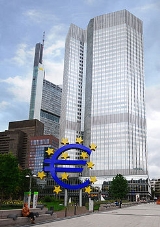
The bank is based in Frankfurt
Frankfurt

is the largest city in the German States of Germany of Hesse and the List of cities in Germany with more than 100,000 inhabitants in Germany, with a 2008 population of 670,000....
, the largest financial centre in the Eurozone. Its location in the city is fixed by the Amsterdam Treaty
Amsterdam Treaty

The Treaty of Amsterdam amending the Treaty of the European Union, the Treaties establishing the European Communities and certain related acts, commonly known as the Amsterdam Treaty, was signed on 2 October 1997, and entered into force on 1 May 1999; it made substantial changes to the Treaty on European Union, which had been signed at...
 along with other major institutions. In the city, the bank currently occupies Frankfurt's Eurotower
Eurotower (Frankfurt)

For other buildings called Eurotower, see Eurotower The Eurotower is a well-known skyscraper located in the Bankenviertel of Frankfurt, Germany....
 until its purpose-built headquarters are built.

In 1999 an international architectural competition was launched by the bank to design a new building. It was won by a Vienna
Vienna

Vienna is the Capital of Republic of Austria and also one of the nine states of Austria. Vienna is Austria's primary city, with a population of about 1.7 million...
-based architectural office called Coop Himmelbau. The building will be approximately tall (the present building is ) and will be accompanied by other secondary buildings on a landscaped site on the site of the former wholesale market (Grossmarkthalle) in the eastern part of Frankfurt am Main. The main construction work will commence in October 2008, with completion scheduled for before the end of 2011. It is expected that the building will become an architectural symbol for Europe and is designed to cope with double the number of staff who operate in the Eurotower.

See also

  • Numismatics
    Numismatics

    Numismatics is the study or collection of currency, including coins, tokens, paper money, and related objects. While numismatists are often characterized as students or collectors of coins, the discipline also includes a much larger study of payment-media used to resolve debts and the exchange of Good s....


External links

  • , official website.
  • , official website.
  • , European NAvigator
    European NAvigator

    European NAvigator is an educational platform providing a wealth of information about the history of Europe and its institutions since 1945. It focuses particularly on the development of a united Europe....
    .
  • , ECB website.
  • , historical currency charts based on the data published daily by the ECB.
  • , Historical bank rate (since 2000) based on the data published by the ECB.
CSDB
CSDB

CSDB is an acronym that can stand for several different things:*ECB CSDB Central Securities Database*Climate Disclosure Standards Board*Colorado School for the Deaf and Blind...