

Tailcoat

Encyclopedia
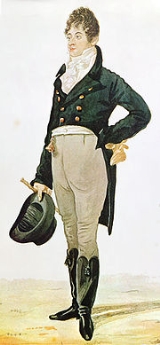
A tailcoat is a coat with the front of the skirt cut away, so as to leave only the rear section of the skirt, known as the tails. The historical reason coats were cut this way was to make it easier for the wearer to ride a horse, but over the years tailcoats of varying types have evolved into forms of formal dress for both day and evening wear. Although there are several different types of tailcoat, the term tailcoat is popularly taken to be synonymous with the type of dress coat still worn today in the evening with white tie
.
This dress coat, one of the two main surviving tailcoats, is a dark evening coat with a squarely cut away front. The other one is the morning coat (or cutaway in American English), which is cut away at the front in a gradual taper.
.png)
dress code
, also known as evening full dress
, for formal evening occasions. It is commonly referred to as just a tailcoat, but amongst tailors (both British and American) and dress historians it is traditionally called a dress coat to differentiate it from other types of tailcoats.
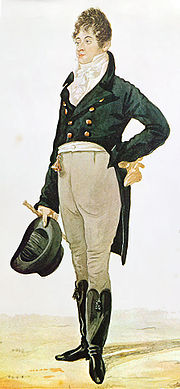
The modern dress coat is an evolution of the coat that was once both day and evening dress. It became increasingly popular from around the late 1790s and was particularly widespread during the British Regency, and in America in the 1830s to 1850s. The eighteenth century dress coat was supplanted in the 1850s as formal day wear by the frock coat
, which was in turn replaced in the twentieth century by the morning coat. In the Regency period, the dress coat with gilt buttons was always worn with non-matching trousers, pantaloons or breeches. Since the Victorian era, the modern dress coat for evening wear has been worn with matching trousers of the same cloth with two stripes of braiding down the side. The resulting suit is traditionally referred to by tailors as a dress suit.
A dress coat is waist length in the front and sides, and has two long tails reaching to the knees in back. Sometimes there is a pocket on the inside to hold gloves. Since around the 1840s the dress coat has lacked outside side pockets, but prior to this it took flapped side pockets. Since the early twentieth century it has become acceptable to have a welted pocket on the outside of the chest to hold a pocket square, but prior to this dress coats lacked any outer pockets. The front of the skirt is squarely cut away. Since around the 1830s the coat has been constructed with a waist seam that allows greater waist suppression. From the Victorian era
, the revers
has taken facings in silk (grosgrain
or satin
) on the lapels. Although it is double-breasted, since the 1870s, the dress coat no longer fastens in the front. As a result, although there are two rows of buttons, these are all non-functional, serving only a decorative function.
As part of modern white tie
, either a black or midnight blue dress coat is worn with a stiff detachable white wing-collar dress shirt
, with a plain starched bib, and single cuffs fastened with cufflinks; a matching white bowtie and white waistcoat
; black trousers; and black patent leather
pumps
with stockings.
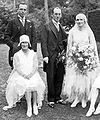 The modern morning coat (or cutaway in American English) is a man's coat worn as the principal item in morning dress
. The name derives from morning nineteenth century horseback riding
exercise for gentlemen. It was regarded as a casual form of half dress. Gradually it became acceptable as an alternative to the frock coat
for formal day wear or full dress. Since the nineteenth century it is normally only seen at weddings, formal baptisms, in England, races such as Royal Ascot and the Derby
when it is worn with a contrasting waistcoat, usually light grey or sometimes 'fancy'. It is very occasionally seen at funerals but more often it is used as day wear at formal luncheons, especially civic occasions under formal gowns, when worn with a black matching waistcoat (US 'vest'). Male members of the cabinet of Japan
wear it in their first public appearance following the formation of the cabinet.
The Marshal and Clerk of the United States Supreme Court wear morning coats when the justices are appearing in public wearing their traditional robes, for example when the court is in session, or when attending the President's
State of the Union address
. At one time all attorneys appearing before the court wore morning coats but now wear standard business attire. The United States Solicitor General
(when the office is held by a male) and his or her male deputies continue the tradition of wearing morning dress when arguing before the court.
A morning coat is a single-breasted coat, the front parts usually meeting at one button in the middle, and curving away gradually into a pair of tails behind, topped by two ornamental buttons on the waist seam. The lapels are usually pointed
(American English peak), not step
(notch), since the coat is now only worn as formalwear; when it was first introduced, the step lapel was common, since it was worn as half dress. The coat can be grey or black as part of morning dress
, and is usually worn with striped, or very occasionally checked, trousers.
The morning coat may also be worn as part of a morning suit, which is mid-grey with matching trousers and waistcoat.
During the Victorian and Edwardian era, in America morning coat referred to a single-breasted frock coat
, so the British then made fun of the fact that Americans were unable to distinguish between morning coats and frock coats. In modern American English, morning coats are referred to as cutaway coats.
, a variant called a shadbelly
is still worn in certain disciplines in its eighteenth century role as daytime formalwear. It is basically a form of dress coat which is closer in cut to the early nineteenth century style worn by Beau Brummel than to the modern version worn with evening formal dress.
, until the mid twentieth century. It was made of black velvet and traditionally worn at court, levées, and evening state parties by those who did not wear uniforms. A version made of black barathea was also worn as diplomatic dress. It was single breasted with a stand up collar, with plain gauntlet cuffs, and two three-pointed flap pockets on the waist seam. It had six metal buttons at the front, and two decorative buttons at the back. The body of the coat was lined with black silk, and skirts with white silk. It was worn with breeches, black silk hose, white bow tie, white gloves, and court shoes (pumps) with steel buckles. The front of the coat was cut away squarely like a standard dress coat.
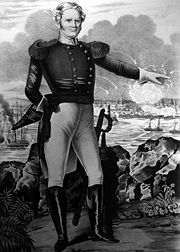
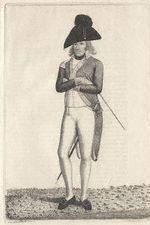 From c.1790 until after the Crimean War
a red tail coat with short tails (known as a coatee) was part of the infantry uniform of the British army
. The collar and cuffs were in the regimental colors and the coats had white braid on the front. Elite light infantry units like the 95th Rifles were issued short green coats to provide camouflage and ease of movement.
The Americans issued a similar uniform in dark blue to enlisted men during the War of 1812
. This remained in service until 1833 when it was replaced with a shell jacket
. Officers continued to wear tail coats until after the Mexican War
when frock coat
s became the standard field wear. By the time the M1858 uniform was introduced tail coats had been relegated to full dress.
The Royal Navy
had an elaborate hierarchy of tailcoats for the officers, allowing further buttons and gilding according to rank and seniority. These were single-breasted for junior officers and double-breasted for those with the rank of lieutenant and above.
White tie
White tie is the most formal evening dress code in Western fashion. It is worn to ceremonial occasions such as state dinners in some countries, as well as to very formal balls and evening weddings...
.
This dress coat, one of the two main surviving tailcoats, is a dark evening coat with a squarely cut away front. The other one is the morning coat (or cutaway in American English), which is cut away at the front in a gradual taper.
Types of tailcoats
Dress coat
A dress coat, sometimes called a swallow-tail or claw-hammer coat, is the coat that has, since the 1850s, come to be worn only in the evening by men as part of the white tieWhite tie
White tie is the most formal evening dress code in Western fashion. It is worn to ceremonial occasions such as state dinners in some countries, as well as to very formal balls and evening weddings...
dress code
Dress code (Western)
A dress code is a set of rules governing what garments may be worn together and in what setting. Examples of dress codes are combinations such as "smart casual", or "morning dress". A classification of these codes is normally made for varying levels of formality and times of day...
, also known as evening full dress
Full dress
Full dress is a category dress codes that refers to most formal clothing available in Western society.-Civilian:For a civilian, during the Victorian and Edwardian period, this corresponded to a frock coat in the day, and white tie at night...
, for formal evening occasions. It is commonly referred to as just a tailcoat, but amongst tailors (both British and American) and dress historians it is traditionally called a dress coat to differentiate it from other types of tailcoats.
The modern dress coat is an evolution of the coat that was once both day and evening dress. It became increasingly popular from around the late 1790s and was particularly widespread during the British Regency, and in America in the 1830s to 1850s. The eighteenth century dress coat was supplanted in the 1850s as formal day wear by the frock coat
Frock coat
A frock coat is a man's coat characterised by knee-length skirts all around the base, popular during the Victorian and Edwardian periods. The double-breasted style is sometimes called a Prince Albert . The frock coat is a fitted, long-sleeved coat with a centre vent at the back, and some features...
, which was in turn replaced in the twentieth century by the morning coat. In the Regency period, the dress coat with gilt buttons was always worn with non-matching trousers, pantaloons or breeches. Since the Victorian era, the modern dress coat for evening wear has been worn with matching trousers of the same cloth with two stripes of braiding down the side. The resulting suit is traditionally referred to by tailors as a dress suit.
A dress coat is waist length in the front and sides, and has two long tails reaching to the knees in back. Sometimes there is a pocket on the inside to hold gloves. Since around the 1840s the dress coat has lacked outside side pockets, but prior to this it took flapped side pockets. Since the early twentieth century it has become acceptable to have a welted pocket on the outside of the chest to hold a pocket square, but prior to this dress coats lacked any outer pockets. The front of the skirt is squarely cut away. Since around the 1830s the coat has been constructed with a waist seam that allows greater waist suppression. From the Victorian era
Victorian era
The Victorian era of British history was the period of Queen Victoria's reign from 20 June 1837 until her death on 22 January 1901. It was a long period of peace, prosperity, refined sensibilities and national self-confidence...
, the revers
Revers
A revers or rever is a garment or part of a garment that is reversed to display the lining or facing outside. The word is a corruption of reverse. This is most commonly the lapels or cuffs, and the term is mostly used when they are made in a contrasting material...
has taken facings in silk (grosgrain
Grosgrain
Grosgrain , also gros-grain and, rarely, gros grain, is a type of fabric characterized by its ribbed appearance. In grosgrain, the weft is heavier than the warp, creating prominent transverse ribs. It is called a "corded" fabric since the weft resembles a fine cord. Grosgrain is a plain weave...
or satin
Satin
Satin is a weave that typically has a glossy surface and a dull back. It is a warp-dominated weaving technique that forms a minimum number of interlacings in a fabric. If a fabric is formed with a satin weave using filament fibres such as silk, nylon, or polyester, the corresponding fabric is...
) on the lapels. Although it is double-breasted, since the 1870s, the dress coat no longer fastens in the front. As a result, although there are two rows of buttons, these are all non-functional, serving only a decorative function.
As part of modern white tie
White tie
White tie is the most formal evening dress code in Western fashion. It is worn to ceremonial occasions such as state dinners in some countries, as well as to very formal balls and evening weddings...
, either a black or midnight blue dress coat is worn with a stiff detachable white wing-collar dress shirt
Dress shirt
A shirt, or dress shirt in American English, is a garment with a collar, a full-length opening at the front from the collar to the hem, and sleeves with cuffs. Shirts are predominantly used by men, since women usually wear blouses...
, with a plain starched bib, and single cuffs fastened with cufflinks; a matching white bowtie and white waistcoat
Waistcoat
A waistcoat or vest is a sleeveless upper-body garment worn over a dress shirt and necktie and below a coat as a part of most men's formal wear, and as the third piece of the three-piece male business suit.-Characteristics and use:...
; black trousers; and black patent leather
Patent leather
Patent leather is a type of japanned leather that has been given a high gloss, shiny finish. The process was brought to the United States and improved by Newark-based inventor Seth Boyden in 1818, with commercial manufacture beginning September 20, 1819. Boyden's process, which he never patented,...
pumps
Court shoe
Court shoes or pumps are shoes with a low-cut front and usually without a fastening. However, some have ankle straps...
with stockings.
Morning coat
Morning dress
Morning dress is the daytime formal dress code, consisting chiefly for men of a morning coat, waistcoat, and striped trousers, and an appropriate dress for women...
. The name derives from morning nineteenth century horseback riding
Equestrianism
Equestrianism more often known as riding, horseback riding or horse riding refers to the skill of riding, driving, or vaulting with horses...
exercise for gentlemen. It was regarded as a casual form of half dress. Gradually it became acceptable as an alternative to the frock coat
Frock coat
A frock coat is a man's coat characterised by knee-length skirts all around the base, popular during the Victorian and Edwardian periods. The double-breasted style is sometimes called a Prince Albert . The frock coat is a fitted, long-sleeved coat with a centre vent at the back, and some features...
for formal day wear or full dress. Since the nineteenth century it is normally only seen at weddings, formal baptisms, in England, races such as Royal Ascot and the Derby
Epsom Derby
The Derby Stakes, popularly known as The Derby, internationally as the Epsom Derby, and under its present sponsor as the Investec Derby, is a Group 1 flat horse race in Great Britain open to three-year-old thoroughbred colts and fillies...
when it is worn with a contrasting waistcoat, usually light grey or sometimes 'fancy'. It is very occasionally seen at funerals but more often it is used as day wear at formal luncheons, especially civic occasions under formal gowns, when worn with a black matching waistcoat (US 'vest'). Male members of the cabinet of Japan
Cabinet of Japan
The of Japan is the executive branch of the government of Japan. It consists of the Prime Minister and up to fourteen other members, called Ministers of State. The Prime Minister is designated by the Diet, and the remaining ministers are appointed and dismissed by the Prime Minister...
wear it in their first public appearance following the formation of the cabinet.
The Marshal and Clerk of the United States Supreme Court wear morning coats when the justices are appearing in public wearing their traditional robes, for example when the court is in session, or when attending the President's
President of the United States
The President of the United States of America is the head of state and head of government of the United States. The president leads the executive branch of the federal government and is the commander-in-chief of the United States Armed Forces....
State of the Union address
State of the Union Address
The State of the Union is an annual address presented by the President of the United States to the United States Congress. The address not only reports on the condition of the nation but also allows the president to outline his legislative agenda and his national priorities.The practice arises...
. At one time all attorneys appearing before the court wore morning coats but now wear standard business attire. The United States Solicitor General
United States Solicitor General
The United States Solicitor General is the person appointed to represent the federal government of the United States before the Supreme Court of the United States. The current Solicitor General, Donald B. Verrilli, Jr. was confirmed by the United States Senate on June 6, 2011 and sworn in on June...
(when the office is held by a male) and his or her male deputies continue the tradition of wearing morning dress when arguing before the court.
A morning coat is a single-breasted coat, the front parts usually meeting at one button in the middle, and curving away gradually into a pair of tails behind, topped by two ornamental buttons on the waist seam. The lapels are usually pointed
Jacket lapel
Jacket lapels are the folded flaps of cloth on the front of a jacket or coat, and are most commonly found on formal clothing and suit jackets. Usually they are formed by folding over the front edges of the jacket or coat and sewing them to the collar, an extra piece of fabric around the back of the...
(American English peak), not step
Jacket lapel
Jacket lapels are the folded flaps of cloth on the front of a jacket or coat, and are most commonly found on formal clothing and suit jackets. Usually they are formed by folding over the front edges of the jacket or coat and sewing them to the collar, an extra piece of fabric around the back of the...
(notch), since the coat is now only worn as formalwear; when it was first introduced, the step lapel was common, since it was worn as half dress. The coat can be grey or black as part of morning dress
Morning dress
Morning dress is the daytime formal dress code, consisting chiefly for men of a morning coat, waistcoat, and striped trousers, and an appropriate dress for women...
, and is usually worn with striped, or very occasionally checked, trousers.
The morning coat may also be worn as part of a morning suit, which is mid-grey with matching trousers and waistcoat.
During the Victorian and Edwardian era, in America morning coat referred to a single-breasted frock coat
Frock coat
A frock coat is a man's coat characterised by knee-length skirts all around the base, popular during the Victorian and Edwardian periods. The double-breasted style is sometimes called a Prince Albert . The frock coat is a fitted, long-sleeved coat with a centre vent at the back, and some features...
, so the British then made fun of the fact that Americans were unable to distinguish between morning coats and frock coats. In modern American English, morning coats are referred to as cutaway coats.
Shadbelly
In the extremely conservative field of equestrianismEquestrianism
Equestrianism more often known as riding, horseback riding or horse riding refers to the skill of riding, driving, or vaulting with horses...
, a variant called a shadbelly
Shadbelly
A Shadbelly is a type of riding coat worn in certain situations by Fox hunting Members, dressage riders, eventers , and occasionally by other hunt seat riders. Shadbellies are also standard attire for the Show hack classes at certain breed shows in the United States and Canada...
is still worn in certain disciplines in its eighteenth century role as daytime formalwear. It is basically a form of dress coat which is closer in cut to the early nineteenth century style worn by Beau Brummel than to the modern version worn with evening formal dress.
Levée dress coat
Is a type of dress coat traditionally worn with court dressCourt uniform and dress
- Court dress :On formal royal occasions in monarchies the dress worn by those present is prescribed by official regulations.Court dress is worn by all men not entitled to court uniform or military uniform on all occasions of state where such are customarily worn...
, until the mid twentieth century. It was made of black velvet and traditionally worn at court, levées, and evening state parties by those who did not wear uniforms. A version made of black barathea was also worn as diplomatic dress. It was single breasted with a stand up collar, with plain gauntlet cuffs, and two three-pointed flap pockets on the waist seam. It had six metal buttons at the front, and two decorative buttons at the back. The body of the coat was lined with black silk, and skirts with white silk. It was worn with breeches, black silk hose, white bow tie, white gloves, and court shoes (pumps) with steel buckles. The front of the coat was cut away squarely like a standard dress coat.
Highland coatee
This is worn with Highland dress, and has a square cut away front like a dress coat, but the tails are cut significantly shorter.Footman's coat
This was worn as livery (servant's uniforms) and was knee length with a sloped cut away front like a morning coat. It was single breasted with a stand up collar and gilt buttons. There were three pronged side pockets similar in style to the levée dress coat.Military use
Crimean War
The Crimean War was a conflict fought between the Russian Empire and an alliance of the French Empire, the British Empire, the Ottoman Empire, and the Kingdom of Sardinia. The war was part of a long-running contest between the major European powers for influence over territories of the declining...
a red tail coat with short tails (known as a coatee) was part of the infantry uniform of the British army
British Army
The British Army is the land warfare branch of Her Majesty's Armed Forces in the United Kingdom. It came into being with the unification of the Kingdom of England and Scotland into the Kingdom of Great Britain in 1707. The new British Army incorporated Regiments that had already existed in England...
. The collar and cuffs were in the regimental colors and the coats had white braid on the front. Elite light infantry units like the 95th Rifles were issued short green coats to provide camouflage and ease of movement.
The Americans issued a similar uniform in dark blue to enlisted men during the War of 1812
War of 1812
The War of 1812 was a military conflict fought between the forces of the United States of America and those of the British Empire. The Americans declared war in 1812 for several reasons, including trade restrictions because of Britain's ongoing war with France, impressment of American merchant...
. This remained in service until 1833 when it was replaced with a shell jacket
Shell jacket
The shell jacket is a garment used as part of a military uniform. It is a short jacket that reaches down to hip level. It was very common in the mid and late 19th century. The jacket was first created in Austria....
. Officers continued to wear tail coats until after the Mexican War
Mexican–American War
The Mexican–American War, also known as the First American Intervention, the Mexican War, or the U.S.–Mexican War, was an armed conflict between the United States and Mexico from 1846 to 1848 in the wake of the 1845 U.S...
when frock coat
Frock coat
A frock coat is a man's coat characterised by knee-length skirts all around the base, popular during the Victorian and Edwardian periods. The double-breasted style is sometimes called a Prince Albert . The frock coat is a fitted, long-sleeved coat with a centre vent at the back, and some features...
s became the standard field wear. By the time the M1858 uniform was introduced tail coats had been relegated to full dress.
The Royal Navy
Royal Navy
The Royal Navy is the naval warfare service branch of the British Armed Forces. Founded in the 16th century, it is the oldest service branch and is known as the Senior Service...
had an elaborate hierarchy of tailcoats for the officers, allowing further buttons and gilding according to rank and seniority. These were single-breasted for junior officers and double-breasted for those with the rank of lieutenant and above.