


Margarine

Encyclopedia
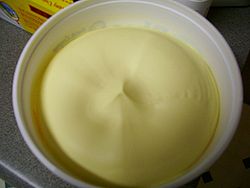
Butter
Butter is a dairy product made by churning fresh or fermented cream or milk. It is generally used as a spread and a condiment, as well as in cooking applications, such as baking, sauce making, and pan frying...
substitutes, typically composed of vegetable oils. In many parts of the world, the market share of margarine and spreads has overtaken that of butter. Margarine is an ingredient in the preparation of many foods and, in recipes and colloquially, is sometimes called oleo, short for oleomargarine.
Margarine naturally appears white, or almost white, and by forbidding the addition of artificial coloring agents, legislators in some jurisdictions found that they could protect their dairy industries by discouraging the consumption of margarine. Bans on adding color became commonplace in the U.S., Australasia
Australasia
Australasia is a region of Oceania comprising Australia, New Zealand, the island of New Guinea, and neighbouring islands in the Pacific Ocean. The term was coined by Charles de Brosses in Histoire des navigations aux terres australes...
and Canada
Canada
Canada is a North American country consisting of ten provinces and three territories. Located in the northern part of the continent, it extends from the Atlantic Ocean in the east to the Pacific Ocean in the west, and northward into the Arctic Ocean...
and, in some cases, those bans endured for almost 100 years. It did not become legal to sell colored margarine in Australia
Australia
Australia , officially the Commonwealth of Australia, is a country in the Southern Hemisphere comprising the mainland of the Australian continent, the island of Tasmania, and numerous smaller islands in the Indian and Pacific Oceans. It is the world's sixth-largest country by total area...
, for example, until the 1960s.
Etymology
The word "margarine" comes from the French margarine (“margarin”), from the Ancient Greek μαργαρίτης (“pearl”).History
Margarine originated with the discovery by Michel Eugène ChevreulMichel Eugène Chevreul
Michel Eugène Chevreul was a French chemist whose work with fatty acids led to early applications in the fields of art and science. He is credited with the discovery of margaric acid and designing an early form of soap made from animal fats and salt...
in 1813 of margaric acid (itself named after the pearly deposits of the fatty acid from Greek or μάργαρον (margaritēs / márgaron), meaning pearl-oyster or pearl, or (margarís), meaning palm-tree, hence the relevance to palmitic acid). Scientists at the time regarded margaric acid, like oleic acid
Oleic acid
Oleic acid is a monounsaturated omega-9 fatty acid found in various animal and vegetable fats. It has the formula CH37CH=CH7COOH. It is an odorless, colourless oil, although commercial samples may be yellowish. The trans isomer of oleic acid is called elaidic acid...
and stearic acid
Stearic acid
Stearic acid is the saturated fatty acid with an 18 carbon chain and has the IUPAC name octadecanoic acid. It is a waxy solid, and its chemical formula is CH316CO2H. Its name comes from the Greek word στέαρ "stéatos", which means tallow. The salts and esters of stearic acid are called stearates...
, as one of the three fatty acid
Fatty acid
In chemistry, especially biochemistry, a fatty acid is a carboxylic acid with a long unbranched aliphatic tail , which is either saturated or unsaturated. Most naturally occurring fatty acids have a chain of an even number of carbon atoms, from 4 to 28. Fatty acids are usually derived from...
s which, in combination, formed most animal
Animal
Animals are a major group of multicellular, eukaryotic organisms of the kingdom Animalia or Metazoa. Their body plan eventually becomes fixed as they develop, although some undergo a process of metamorphosis later on in their life. Most animals are motile, meaning they can move spontaneously and...
fat
Fat
Fats consist of a wide group of compounds that are generally soluble in organic solvents and generally insoluble in water. Chemically, fats are triglycerides, triesters of glycerol and any of several fatty acids. Fats may be either solid or liquid at room temperature, depending on their structure...
s. In 1853, the German
Germany
Germany , officially the Federal Republic of Germany , is a federal parliamentary republic in Europe. The country consists of 16 states while the capital and largest city is Berlin. Germany covers an area of 357,021 km2 and has a largely temperate seasonal climate...
structural chemist, Wilhelm Heinrich Heintz
Wilhelm Heinrich Heintz
Wilhelm Heinrich Heintz was a German structural chemist who earned his PhD at Berlin in 1844 under Heinrich Rose.He was one of six founding members of the Deutsche Physikalische Gesellschaft and the only chemist....
, analyzed margaric acid as simply a combination of stearic acid and of the previously unknown palmitic acid
Palmitic acid
Palmitic acid, or hexadecanoic acid in IUPAC nomenclature, is one of the most common saturated fatty acids found in animals and plants. Its molecular formula is CH314CO2H. As its name indicates, it is a major component of the oil from palm trees . Palmitate is a term for the salts and esters of...
.
Emperor Louis Napoleon III
Napoleon III of France
Louis-Napoléon Bonaparte was the President of the French Second Republic and as Napoleon III, the ruler of the Second French Empire. He was the nephew and heir of Napoleon I, christened as Charles Louis Napoléon Bonaparte...
of France
France
The French Republic , The French Republic , The French Republic , (commonly known as France , is a unitary semi-presidential republic in Western Europe with several overseas territories and islands located on other continents and in the Indian, Pacific, and Atlantic oceans. Metropolitan France...
offered a prize to anyone who could make a satisfactory substitute for butter, suitable for use by the armed forces
Military
A military is an organization authorized by its greater society to use lethal force, usually including use of weapons, in defending its country by combating actual or perceived threats. The military may have additional functions of use to its greater society, such as advancing a political agenda e.g...
and the lower classes. French chemist
Chemist
A chemist is a scientist trained in the study of chemistry. Chemists study the composition of matter and its properties such as density and acidity. Chemists carefully describe the properties they study in terms of quantities, with detail on the level of molecules and their component atoms...
Hippolyte Mège-Mouriès
Hippolyte Mège-Mouriès
Hippolyte Mège-Mouriès was a French chemist who invented margarine.He was born as Hippolyte Mège, the son of a primary school teacher, but later added his mother's surname to his own...
invented a substance he called oleomargarine, the name of which became shortened to the trade name "margarine". Mège-Mouriés patented the concept in 1869 and expanded his initial manufacturing operation from France but had little commercial success. In 1871, he sold the patent to the Dutch
Netherlands
The Netherlands is a constituent country of the Kingdom of the Netherlands, located mainly in North-West Europe and with several islands in the Caribbean. Mainland Netherlands borders the North Sea to the north and west, Belgium to the south, and Germany to the east, and shares maritime borders...
company Jurgens
Antonius Johannes Jurgens
Antonius Johannes Jurgens was the grandson of Antoon Jurgens and Joanna Lemmens . His grandfather was the founder of butter and the first world margarine factories in Oss, The Netherlands. Antonius Johannes Jurgens was one of the main European margarine and soap manufacturers in the early...
, now part of Unilever
Unilever
Unilever is a British-Dutch multinational corporation that owns many of the world's consumer product brands in foods, beverages, cleaning agents and personal care products....
. In the same year the German pharmacist Benedict Klein from Cologne
Cologne
Cologne is Germany's fourth-largest city , and is the largest city both in the Germany Federal State of North Rhine-Westphalia and within the Rhine-Ruhr Metropolitan Area, one of the major European metropolitan areas with more than ten million inhabitants.Cologne is located on both sides of the...
founded the first margarine factory "Benedict Klein Margarinewerke", producing the brands Overstolz and Botteram.
Canada
In Canada, margarine was banned from 1886 until 1948 though this ban was temporarily lifted from 1917 until 1923 due to dairy shortages. Nevertheless, bootleg margarine was produced in the neighboring British colony of NewfoundlandNewfoundland and Labrador
Newfoundland and Labrador is the easternmost province of Canada. Situated in the country's Atlantic region, it incorporates the island of Newfoundland and mainland Labrador with a combined area of . As of April 2011, the province's estimated population is 508,400...
from whale, seal and fish oil by the Newfoundland Butter Company (which, in fact, produced only margarine) and was smuggled to Canada where it was widely sold for half the price of butter. The Supreme Court of Canada
Supreme Court of Canada
The Supreme Court of Canada is the highest court of Canada and is the final court of appeals in the Canadian justice system. The court grants permission to between 40 and 75 litigants each year to appeal decisions rendered by provincial, territorial and federal appellate courts, and its decisions...
lifted the margarine ban in 1948 in the Margarine Reference
Margarine Reference
Reference re Validity of Section 5 of the Dairy Industry Act , also known as the Margarine Reference or as Can. Federation of Agriculture v. A.-G. Que., is a leading opinion of the Supreme Court of Canada on determining if a law is within the authority of the federal government under the...
.
In 1950, as a result of a court ruling giving provinces the right to regulate the product, rules were implemented in much of Canada regarding margarine's color, requiring it to be bright yellow or orange in some provinces or colorless in others. By the 1980s, most provinces had lifted the restriction, however, in Ontario
Ontario
Ontario is a province of Canada, located in east-central Canada. It is Canada's most populous province and second largest in total area. It is home to the nation's most populous city, Toronto, and the nation's capital, Ottawa....
it was not legal to sell butter-colored margarine until 1995. Quebec
Quebec
Quebec or is a province in east-central Canada. It is the only Canadian province with a predominantly French-speaking population and the only one whose sole official language is French at the provincial level....
, the last Canadian province to regulate margarine coloring, repealed its law requiring margarine to be colorless in July 2008.
United States
As early as 1877, the first United States (U.S.)United States
The United States of America is a federal constitutional republic comprising fifty states and a federal district...
states had passed laws to restrict the sale and labeling of margarine. By the mid-1880s, the U.S. federal government had introduced a tax of two cents per pound, and manufacturers needed an expensive license to make or sell the product. Individual states began to require the clear labeling of margarine. The color bans, drafted by the butter lobby, began in the dairy states of New York
New York
New York is a state in the Northeastern region of the United States. It is the nation's third most populous state. New York is bordered by New Jersey and Pennsylvania to the south, and by Connecticut, Massachusetts and Vermont to the east...
and New Jersey
New Jersey
New Jersey is a state in the Northeastern and Middle Atlantic regions of the United States. , its population was 8,791,894. It is bordered on the north and east by the state of New York, on the southeast and south by the Atlantic Ocean, on the west by Pennsylvania and on the southwest by Delaware...
. In several states, legislatures enacted laws to require margarine manufacturers to add pink colorings to make the product look unpalatable, but the Supreme Court struck down New Hampshire's law and overruled these measures in Collins v. New Hampshire, 171 U.S. 30 (1898). Some localities required restaurants using margarine to post signs reading "Artificial Butter Used Here".
By the start of the 20th century, eight out of ten Americans could not buy yellow margarine, and those that could had to pay a hefty tax on it. Bootleg
Counterfeit
To counterfeit means to illegally imitate something. Counterfeit products are often produced with the intent to take advantage of the superior value of the imitated product...
colored margarine became common, and manufacturers began to supply food-coloring capsules so that the consumer could knead the yellow color into margarine before serving it. Nevertheless, the regulations and taxes had a significant effect: the 1902 restrictions on margarine color, for example, cut annual U.S. consumption from 120 million to 48 million pounds (60,000 to 24,000 ton
Ton
The ton is a unit of measure. It has a long history and has acquired a number of meanings and uses over the years. It is used principally as a unit of weight, and as a unit of volume. It can also be used as a measure of energy, for truck classification, or as a colloquial term.It is derived from...
s). However, by the end of the 1910s, it had become more popular than ever .
With the coming of World War I
World War I
World War I , which was predominantly called the World War or the Great War from its occurrence until 1939, and the First World War or World War I thereafter, was a major war centred in Europe that began on 28 July 1914 and lasted until 11 November 1918...
, margarine consumption increased enormously, even countries away from the front like the U.S. In the countries closest to the fighting, dairy products became almost unobtainable and were strictly rationed
Rationing
Rationing is the controlled distribution of scarce resources, goods, or services. Rationing controls the size of the ration, one's allotted portion of the resources being distributed on a particular day or at a particular time.- In economics :...
. The United Kingdom
United Kingdom
The United Kingdom of Great Britain and Northern IrelandIn the United Kingdom and Dependencies, other languages have been officially recognised as legitimate autochthonous languages under the European Charter for Regional or Minority Languages...
, for example, depended on imported butter from Australia and New Zealand
New Zealand
New Zealand is an island country in the south-western Pacific Ocean comprising two main landmasses and numerous smaller islands. The country is situated some east of Australia across the Tasman Sea, and roughly south of the Pacific island nations of New Caledonia, Fiji, and Tonga...
, and the risk of submarine
Submarine
A submarine is a watercraft capable of independent operation below the surface of the water. It differs from a submersible, which has more limited underwater capability...
attack meant that little arrived.
The long-running rent-seeking
Rent seeking
In economics, rent-seeking is an attempt to derive economic rent by manipulating the social or political environment in which economic activities occur, rather than by adding value...
battle between the margarine and dairy lobbies
Lobbying
Lobbying is the act of attempting to influence decisions made by officials in the government, most often legislators or members of regulatory agencies. Lobbying is done by various people or groups, from private-sector individuals or corporations, fellow legislators or government officials, or...
continued: In the U.S., the Great Depression
Great Depression
The Great Depression was a severe worldwide economic depression in the decade preceding World War II. The timing of the Great Depression varied across nations, but in most countries it started in about 1929 and lasted until the late 1930s or early 1940s...
brought a renewed wave of pro-dairy legislation; the Second World War, a swing back to margarine. Post-war, the margarine lobby gained power and, little by little, the main margarine restrictions were lifted, the most recent states to do so being Minnesota
Minnesota
Minnesota is a U.S. state located in the Midwestern United States. The twelfth largest state of the U.S., it is the twenty-first most populous, with 5.3 million residents. Minnesota was carved out of the eastern half of the Minnesota Territory and admitted to the Union as the thirty-second state...
in 1963 and Wisconsin
Wisconsin
Wisconsin is a U.S. state located in the north-central United States and is part of the Midwest. It is bordered by Minnesota to the west, Iowa to the southwest, Illinois to the south, Lake Michigan to the east, Michigan to the northeast, and Lake Superior to the north. Wisconsin's capital is...
in 1967. Lois Dowdle Cobb (1889–1987) of Atlanta
Atlanta, Georgia
Atlanta is the capital and most populous city in the U.S. state of Georgia. According to the 2010 census, Atlanta's population is 420,003. Atlanta is the cultural and economic center of the Atlanta metropolitan area, which is home to 5,268,860 people and is the ninth largest metropolitan area in...
, Georgia
Georgia (U.S. state)
Georgia is a state located in the southeastern United States. It was established in 1732, the last of the original Thirteen Colonies. The state is named after King George II of Great Britain. Georgia was the fourth state to ratify the United States Constitution, on January 2, 1788...
, wife of the agricultural publisher Cully Cobb
Cully Cobb
Cully Alton Cobb, Sr. , was an agricultural pioneer, educator, printer, journalist, and philanthropist in the American South who with his second wife, Lois Dowdle Cobb , co-founded the Cobb Institute of Archaeology on the campus of Mississippi State University at Starkville, Mississippi.-Early...
, led the move in the United States to lift the restrictions on margarine. Some unenforced laws remain on the books.
The development of spreads
Margarine and butter both consist of a water-in-fat emulsionEmulsion
An emulsion is a mixture of two or more liquids that are normally immiscible . Emulsions are part of a more general class of two-phase systems of matter called colloids. Although the terms colloid and emulsion are sometimes used interchangeably, emulsion is used when both the dispersed and the...
, with tiny droplets of water (minimum 16% of total emulsion content by weight) measuring 10-80 micrometers in diameter, dispersed uniformly throughout a fat phase which is in a stable crystalline form.
The definition for margarine originally came from the legal definition for butter — both contained a minimum of 16% water and a minimum fat content of 80%. This was adopted by all major producers and became the industry standard.
The principal raw material in the original formulation of margarine was beef fat. Shortages in supply combined with advances in the hydrogenation of plant materials soon led to the addition of vegetable oils, and between 1900 and 1920 oleomargarine was produced from a combination of animal fats and hardened and unhardened vegetable oils. The depression of the 1930s, followed by the rationing of World War II
World War II
World War II, or the Second World War , was a global conflict lasting from 1939 to 1945, involving most of the world's nations—including all of the great powers—eventually forming two opposing military alliances: the Allies and the Axis...
, led to a reduction in supply of animal fat; and, by 1945, "pure" margarine almost completely disappeared from the market. In the U.S., problems with supply, coupled with changes in legislation, caused manufacturers to switch almost completely to vegetable fats (oleomargarine) by 1950 and the industry was ready for an era of product development.
During WWII rationing, only two types of margarine were available in the UK, a premium brand and a cheaper budget brand. With the end of rationing in 1955 the market was opened to the forces of supply and demand and brand marketing became prevalent. The competition between the major producers was given further impetus with the beginning of commercial television advertising in 1955; and, throughout the 1950s and 1960s, competing companies vied with each other to produce the margarine that tasted most like butter.
In the mid-1960s, the introduction of two lower-fat blends of butter oil and vegetable oils in Scandinavia, called Lätt & Lagom and Bregott, clouded the issue of what should be called "margarine" and began the debate that led to the introduction of the term "spread". In 1978, an 80% fat product called Krona, made by churning a blend of dairy cream and vegetable oils, was introduced in Europe; and, in 1982, a blend of cream and vegetable oils called Clover was introduced in the UK by the Milk Marketing Board
Milk Marketing Board
The Milk Marketing Board was a government agency established in 1933 to control milk production and distribution in the United Kingdom. It functioned as buyer of last resort in the British milk market, thereby guaranteeing a minimum price for milk producers...
. The vegetable oil and cream spread I Can't Believe It's Not Butter! was introduced in the United States in 1986 and in the United Kingdom and Canada in 1991.
Manufacture
The basic method of making margarine today consists, as it did in Mège-Mouriés day, of emulsifying a blend of purified vegetable oils with skim milk, chilling the mixture to solidify it and working it to improve the texture. Vegetable and animal fats are similar compounds with different melting pointMelting point
The melting point of a solid is the temperature at which it changes state from solid to liquid. At the melting point the solid and liquid phase exist in equilibrium. The melting point of a substance depends on pressure and is usually specified at standard atmospheric pressure...
s. Those fats that are liquid at room temperature are generally known as oil
Oil
An oil is any substance that is liquid at ambient temperatures and does not mix with water but may mix with other oils and organic solvents. This general definition includes vegetable oils, volatile essential oils, petrochemical oils, and synthetic oils....
s. The melting points are determined by the presence of alkenic double bonds on fatty (carboxylic) acids; the higher the number of double bonds, the lower the melting point.
Alternatively, solid fats can be manufactured from oils by converting animal or vegetable oils by passing hydrogen
Hydrogen
Hydrogen is the chemical element with atomic number 1. It is represented by the symbol H. With an average atomic weight of , hydrogen is the lightest and most abundant chemical element, constituting roughly 75% of the Universe's chemical elemental mass. Stars in the main sequence are mainly...
through the oil in the presence of a nickel
Nickel
Nickel is a chemical element with the chemical symbol Ni and atomic number 28. It is a silvery-white lustrous metal with a slight golden tinge. Nickel belongs to the transition metals and is hard and ductile...
catalyst, under controlled conditions. The addition of hydrogen to the unsaturated bonds (alkenic double C=C bonds) results in saturated C-C bonds, effectively increasing the melting point of the oil and thus "hardening" it. This is due to the increase in van der Waals' forces between the saturated molecules compared with the unsaturated molecules. However, as there are possible health benefits in limiting the amount of saturated fats in the human diet, the process is controlled so that only enough of the bonds are hydrogenated to give the required texture. Margarines manufactured in this way are said to contain hydrogenated fat. This method is used today for some margarines although the process has been developed and sometimes other metal catalysts are used such as palladium
Palladium
Palladium is a chemical element with the chemical symbol Pd and an atomic number of 46. It is a rare and lustrous silvery-white metal discovered in 1803 by William Hyde Wollaston. He named it after the asteroid Pallas, which was itself named after the epithet of the Greek goddess Athena, acquired...
. If hydrogenation is incomplete (partial hardening), the relatively high temperatures used in the hydrogenation process tend to flip some of the carbon-carbon double bonds into the "trans" form. If these particular bonds aren't hydrogenated during the process, they will still be present in the final margarine in molecules of trans fats, the consumption of which has been shown to be a risk factor for cardiovascular disease
Cardiovascular disease
Heart disease or cardiovascular disease are the class of diseases that involve the heart or blood vessels . While the term technically refers to any disease that affects the cardiovascular system , it is usually used to refer to those related to atherosclerosis...
. For this reason, partially hardened fats are used less and less in the margarine industry. Some tropical oils, such as palm oil
Palm oil
Palm oil, coconut oil and palm kernel oil are edible plant oils derived from the fruits of palm trees. Palm oil is extracted from the pulp of the fruit of the oil palm Elaeis guineensis; palm kernel oil is derived from the kernel of the oil palm and coconut oil is derived from the kernel of the...
and coconut oil, are naturally semi solid and do not require hydrogenation.
Modern margarines can be made from any of a wide variety of animal or vegetable fats, mixed with skim milk, salt
Salt
In chemistry, salts are ionic compounds that result from the neutralization reaction of an acid and a base. They are composed of cations and anions so that the product is electrically neutral...
, and emulsifiers. Like butter, margarine is about 80% fat, 20% water and solids, flavored, colored, and fortified with vitamin A, and sometimes D, to match butter's nutritional contribution to the human diet. The oil is pressed from seeds, purified, hydrogenated, and then fortified and colored, either with a synthetic carotene
Carotene
The term carotene is used for several related unsaturated hydrocarbon substances having the formula C40Hx, which are synthesized by plants but cannot be made by animals. Carotene is an orange photosynthetic pigment important for photosynthesis. Carotenes are all coloured to the human eye...
or annatto
Annatto
Annatto, sometimes called roucou or achiote, is a derivative of the achiote trees of tropical regions of the Americas, used to produce a yellow to orange food coloring and also as a flavoring...
. The water phase is usually reconstituted, or skim milk, that is cultured with lactic acid bacteria
Lactic acid bacteria
The lactic acid bacteria comprise a clade of Gram-positive, low-GC, acid-tolerant, generally non-sporulating, non-respiring rod or cocci that are associated by their common metabolic and physiological characteristics. These bacteria, usually found in decomposing plants and lactic products, produce...
to produce a stronger flavor. Emulsifiers such as lecithin
Lecithin
Lecithin is a generic term to designate any group of yellow-brownish fatty substances occurring in animal and plant tissues, and in egg yolk, composed of phosphoric acid, choline, fatty acids, glycerol, glycolipids, triglycerides, and phospholipids .The word lecithin was originally coined in 1847 by...
help disperse the water phase evenly throughout the oil, and salt and preservatives are also commonly added. This oil and water emulsion is then heated, blended, and cooled. The softer tub margarines are made with less hydrogenated, more liquid, oils than block margarines.
Margarines made from vegetable oils are popular in today's market, as they are advertised as lower in saturated fat than butter, and claim to be a healthier option. These claims continue to be challenged.
Three main types of margarine are common:
- Traditional margarines, which contain saturated fats, are mostly made from vegetable oils.
- Blended margarines, high in mono- or polyunsaturated fats, which are made from safflowerSafflowerSafflower is a highly branched, herbaceous, thistle-like annual. It is commercially cultivated for vegetable oil extracted from the seeds. Plants are 30 to 150 cm tall with globular flower heads having yellow, orange or red flowers. Each branch will usually have from one to five flower heads...
, sunflowerSunflowerSunflower is an annual plant native to the Americas. It possesses a large inflorescence . The sunflower got its name from its huge, fiery blooms, whose shape and image is often used to depict the sun. The sunflower has a rough, hairy stem, broad, coarsely toothed, rough leaves and circular heads...
, soybeanSoybeanThe soybean or soya bean is a species of legume native to East Asia, widely grown for its edible bean which has numerous uses...
, cottonseed, rapeseedRapeseedRapeseed , also known as rape, oilseed rape, rapa, rappi, rapaseed is a bright yellow flowering member of the family Brassicaceae...
, or oliveOliveThe olive , Olea europaea), is a species of a small tree in the family Oleaceae, native to the coastal areas of the eastern Mediterranean Basin as well as northern Iran at the south end of the Caspian Sea.Its fruit, also called the olive, is of major agricultural importance in the...
oil. - Hard, generally uncolored margarine for cooking or baking. (ShorteningShorteningShortening is any fat that is solid at room temperature and used to make crumbly pastry. The reason it is called shortening is because it prevents cross-linkage between gluten molecules. Cross linking is what causes doughs to be sticky. Seeing as cake is not meant to be sticky, shortening is used...
)
Blending with butter
Many popular table spreads sold today are blends of margarine and butter or other milk products. Blending, which is used to improve the taste of margarine, was long illegal in countries such as the United StatesUnited States
The United States of America is a federal constitutional republic comprising fifty states and a federal district...
and Australia
Australia
Australia , officially the Commonwealth of Australia, is a country in the Southern Hemisphere comprising the mainland of the Australian continent, the island of Tasmania, and numerous smaller islands in the Indian and Pacific Oceans. It is the world's sixth-largest country by total area...
. Under European Union
European Union
The European Union is an economic and political union of 27 independent member states which are located primarily in Europe. The EU traces its origins from the European Coal and Steel Community and the European Economic Community , formed by six countries in 1958...
directives, a margarine product cannot be called "butter", even if most of it consists of natural butter. In some European countries butter-based table spreads and margarine products are marketed as "butter mixtures".
Butter mixtures now make up a significant portion of the table spread market. The brand "I Can't Believe It's Not Butter
I Can't Believe It's Not Butter
I Can't Believe It's Not Butter! is a butter substitute produced by Becel/Flora/Promise, which is a subsidiary of Unilever. It was introduced to the United States in 1986 and later to the United Kingdom and Canada in 1991. The product was put on the market in Germany in 2011. Due to the length of...
" spawned a variety of similarly named spreads that can now be found on supermarket shelves all over the world, with names like "Utterly Butterly", "You'd Butter Believe it", "Beautifully Butterfully", and "Butterlicious". These butter mixtures avoid the restrictions on labelling, with marketing techniques that imply a strong similarity to real butter. Such marketable names present the product to consumers differently from the required product labels that call margarine "partially hydrogenated vegetable oil".
Market acceptance
Margarine, particularly polyunsaturated margarine, has become a major part of the Western diet and overtook butter in popularity in the mid-20th century. In the United States, for example, in 1930 the average person ate over 18 pounds (8.2 kg) of butter a year and just over 2 pound (0.90718474 kg) of margarine. By the end of the 20th century, an average American ate around 5 lb (2.3 kg) of butter and nearly 8 lb (3.6 kg) of margarine.Margarine has a particular market to those who observe the Jewish dietary laws of Kashrut
Kashrut
Kashrut is the set of Jewish dietary laws. Food in accord with halakha is termed kosher in English, from the Ashkenazi pronunciation of the Hebrew term kashér , meaning "fit" Kashrut (also kashruth or kashrus) is the set of Jewish dietary laws. Food in accord with halakha (Jewish law) is termed...
. Kashrut forbids the mixing of meat and dairy products, and hence there are strictly Kosher non-dairy margarines available. These are often used by the Kosher consumer to adapt recipes that use meat and butter, or in baked goods that will be served with meat meals. The 2008 Passover margarine shortage
2008 Passover margarine shortage
During the 2008 Passover season, kosher-for-Passover margarine in the United States was short in supply due to several issues, leading to a scramble among kosher consumers to obtain the staple since it features prominently in many Passover recipes.-Causes:...
in America caused much consternation within the Kosher-observant community.
Margarine that doesn't contain dairy products can also provide a vegan
Veganism
Veganism is the practice of eliminating the use of animal products. Ethical vegans reject the commodity status of animals and the use of animal products for any purpose, while dietary vegans or strict vegetarians eliminate them from their diet only...
substitute for butter.
Nutrition
Discussions concerning the nutritional value of margarines and spreads revolve around two aspects — the total amount of fat, and the types of fat (saturated fatSaturated fat
Saturated fat is fat that consists of triglycerides containing only saturated fatty acids. Saturated fatty acids have no double bonds between the individual carbon atoms of the fatty acid chain. That is, the chain of carbon atoms is fully "saturated" with hydrogen atoms...
, trans fat
Trans fat
Trans fat is the common name for unsaturated fat with trans-isomer fatty acid. Because the term refers to the configuration of a double carbon-carbon bond, trans fats are sometimes monounsaturated or polyunsaturated, but never saturated....
). Usually, a comparison between margarine and butter is included in this context as well.
Amount of fat
Fat is an essential part of nutrition as it is needed in the production of cell membranes and several hormone-like compounds called eicosanoidEicosanoid
In biochemistry, eicosanoids are signaling molecules made by oxidation of twenty-carbon essential fatty acids, ....
s. In addition, fat acts as carrier for fat-soluble vitamins A, D, E and K. The roles of butter and traditional margarine (80% fat) are similar with respect to their energy content, but low-fat margarines and spreads are also widely available.
Saturated fat
The saturated fatty acids have been linked to elevated blood cholesterolCholesterol
Cholesterol is a complex isoprenoid. Specifically, it is a waxy steroid of fat that is produced in the liver or intestines. It is used to produce hormones and cell membranes and is transported in the blood plasma of all mammals. It is an essential structural component of mammalian cell membranes...
levels, which in turn has been linked to cardiovascular diseases. Saturated fat increases both Low-density lipoprotein (LDL) and High-density lipoprotein (HDL)cholesterol.
Vegetable fats can contain anything between 7% and 86% saturated fatty acids. Liquid oils (canola oil
Canola
Canola refers to a cultivar of either Rapeseed or Field Mustard . Its seeds are used to produce edible oil suitable for consumption by humans and livestock. The oil is also suitable for use as biodiesel.Originally, Canola was bred naturally from rapeseed in Canada by Keith Downey and Baldur R...
, sunflower oil
Sunflower oil
Sunflower oil is the non-volatile oil expressed from sunflower seeds. Sunflower oil is commonly used in food as a frying oil, and in cosmetic formulations as an emollient. Sunflower oil was first industrially produced in 1835 in the Russian Empire.- Composition :Sunflower oil is mainly a...
) tend to be on the low end, while tropical oils (coconut oil
Coconut oil
Coconut oil is an edible oil extracted from the kernel or meat of matured coconuts harvested from the coconut palm . Throughout the tropical world, it has provided the primary source of fat in the diets of millions of people for generations. It has various applications in food, medicine, and industry...
, palm kernel oil
Palm oil
Palm oil, coconut oil and palm kernel oil are edible plant oils derived from the fruits of palm trees. Palm oil is extracted from the pulp of the fruit of the oil palm Elaeis guineensis; palm kernel oil is derived from the kernel of the oil palm and coconut oil is derived from the kernel of the...
) and fully hardened (hydrogenated
Hydrogenation
Hydrogenation, to treat with hydrogen, also a form of chemical reduction, is a chemical reaction between molecular hydrogen and another compound or element, usually in the presence of a catalyst. The process is commonly employed to reduce or saturate organic compounds. Hydrogenation typically...
) oils are at the high end of the scale. A margarine blend is a mixture of both types of components. Generally, firmer margarines contain more saturated fat.
Typical soft tub margarine contains 10% to 20% of saturated fat. Regular butterfat
Butterfat
Butterfat or milkfat is the fatty portion of milk. Milk and cream are often sold according to the amount of butterfat they contain.- Composition :The fatty acids of butterfat are typically composed as follows :...
contains 52 to 65% saturated fats.
Unsaturated fat
Consumption of unsaturated fatUnsaturated fat
An unsaturated fat is a fat or fatty acid in which there is at least one double bond within the fatty acid chain. A fat molecule is monounsaturated if it contains one double bond, and polyunsaturated if it contains more than one double bond. Where double bonds are formed, hydrogen atoms are...
ty acids has been found to decrease LDL cholesterol levels and increase HDL cholesterol levels in the blood, thus reducing the risk of contracting cardiovascular diseases.
There are two types of unsaturated oils: mono- and poly-unsaturated fats both of which are recognized as beneficial to health in contrast to saturated fats. Some widely grown vegetable oils, such as rapeseed
Rapeseed
Rapeseed , also known as rape, oilseed rape, rapa, rappi, rapaseed is a bright yellow flowering member of the family Brassicaceae...
(and its variant canola
Canola
Canola refers to a cultivar of either Rapeseed or Field Mustard . Its seeds are used to produce edible oil suitable for consumption by humans and livestock. The oil is also suitable for use as biodiesel.Originally, Canola was bred naturally from rapeseed in Canada by Keith Downey and Baldur R...
), sunflower
Sunflower
Sunflower is an annual plant native to the Americas. It possesses a large inflorescence . The sunflower got its name from its huge, fiery blooms, whose shape and image is often used to depict the sun. The sunflower has a rough, hairy stem, broad, coarsely toothed, rough leaves and circular heads...
, safflower
Safflower
Safflower is a highly branched, herbaceous, thistle-like annual. It is commercially cultivated for vegetable oil extracted from the seeds. Plants are 30 to 150 cm tall with globular flower heads having yellow, orange or red flowers. Each branch will usually have from one to five flower heads...
, and olive
Olive
The olive , Olea europaea), is a species of a small tree in the family Oleaceae, native to the coastal areas of the eastern Mediterranean Basin as well as northern Iran at the south end of the Caspian Sea.Its fruit, also called the olive, is of major agricultural importance in the...
oils contain high amounts of unsaturated fats. During the manufacture of margarine, some of the unsaturated fats may be converted into hydrogenated fats or trans fats in order to give them a higher melting point so that they are solid at room temperatures.
- Omega-3 fatty acids Omega-3 fatty acids are a family of polyunsaturated fatty acids, which have been found especially good for health. This is one of the two Essential fatty acidEssential fatty acidEssential fatty acids, or EFAs, are fatty acids that humans and other animals must ingest because the body requires them for good health but cannot synthesize them...
s, so called because humans cannot manufacture it and must get it from food. Most modern Western diets are severely deficient in it. Omega-3 fatty acids are mostly obtained from oily fishOily fishOily fish have oil in their tissues and in the belly cavity around the gut. Their fillets contain up to 30 percent oil, although this figure varies both within and between species...
caught in high-latitude waters. They are comparatively uncommon in vegetable sources, including margarine. However, one type of Omega-3 fatty acid, alpha-Linolenic acidAlpha-linolenic acidα-Linolenic acid is an organic compound found in many common vegetable oils. In terms of its structure, it is named all-cis-9,12,15-octadecatrienoic acid. In physiological literature, it is given the name 18:3 ....
(ALA) can be found in some vegetable oils. Flax oil contains 30-50% of ALA, and is becoming a popular dietary supplement to rival fish oils; both are often added to premium margarines. An ancient oil plant, camelina sativaCamelina sativaCamelina sativa, usually known in English as camelina, gold-of-pleasure, or false flax, also occasionally wild flax, linseed dodder, German sesame, and Siberian oilseed, is a flowering plant in the family Brassicaceae which includes mustard, cabbage, rapeseed, broccoli, cauliflower, kale, brussels...
, has recently gained popularity because of its high Omega-3 content (30-45%), and it has been added to some margarines. Hemp oilHemp oilHempseed oil is pressed from the seed of the hemp plant irrespective of the strain of cannabis. Cold pressed, unrefined hemp oil is dark to clear light green in color, with a pleasant nutty flavor. The darker the color, the grassier the flavour....
contains about 20% ALA. Small amounts of ALA are found in vegetable oils such as soybean oilSoybean oilSoybean oil is a vegetable oil extracted from the seeds of the soybean . It is one of the most widely consumed cooking oils. As a drying oil, processed soybean oil is also used as a base for printing inks and oil paints...
(7%), rapeseed oil (7%) and wheat germ oilWheat germ oilWheat germ oil is extracted from the germ of the wheat kernel, which makes up only 2½% by weight of the kernel Wheat germ oil is particularly high in octacosanol - a 28 carbon long-chain saturated primary alcohol found in a number of different vegetable waxes. Octacosanol has been studied as an...
(5%).
- Omega-6 fatty acids Omega-6 fatty acids are also important for health. They include the essential fatty acid linoleic acidLinoleic acidLinoleic acid is an unsaturated n-6 fatty acid. It is a colorless liquid at room temperature. In physiological literature, it has a lipid number of 18:2...
(LA), which is abundant in vegetable oils grown in temperate climates. Some, such as hempHempHemp is mostly used as a name for low tetrahydrocannabinol strains of the plant Cannabis sativa, of fiber and/or oilseed varieties. In modern times, hemp has been used for industrial purposes including paper, textiles, biodegradable plastics, construction, health food and fuel with modest...
(60%) and the common margarine oils corn (60%), cottonseed (50%) and sunflower (50%), have large amounts, but most temperate oil seeds have over 10% LA. Margarine is very high in omega-6 fatty acids. Modern Western diets are frequently quite high in Omega-6 but very deficient in Omega-3. The omega-6 to omega-3 ratio is typically 10:1 to 30:1. Large amounts of omega-6 decreases the effect of omega-3. Therefore it is recommended that the ratio in the diet should be less than 4:1, although optimal ratio may be closer to 1:1.
Trans fat
Unlike other dietary fats, trans fatty acids are not essential and provide no known benefit to human health. As with saturated fatty acids, there is a positive linear trend between trans fatty acid intake and LDL cholesterol concentration, and therefore increased risk of coronary heart diseaseCoronary heart disease
Coronary artery disease is the end result of the accumulation of atheromatous plaques within the walls of the coronary arteries that supply the myocardium with oxygen and nutrients. It is sometimes also called coronary heart disease...
, by raising levels of LDL cholesterol and lowering levels of HDL cholesterol.
Several large studies have indicated a link between consumption of high amounts of trans fat and coronary heart disease, and possibly some other diseases, prompting a number of government health agencies across the world to recommend that the intake of trans-fats be minimized.
In the US, partial hydrogenation is common as a result of preference for homegrown oils. However, since the mid-1990s, many countries around the world have started to move away from using partially hydrogenated oils. This led to the production of new margarine varieties that contain less or no trans fat.
Cholesterols
Excessive cholesterol is a health risk because fatty deposits gradually clog up the arteries. This will cause blood flow to the brain, heart, kidneys and other parts of the body to become less efficient. Cholesterol, though needed metabolically, is not essential in the diet. The human body makes cholesterol in the liver, producing about 1g of cholesterol each day or 80% of the needed total body cholesterol. The remaining 20% comes directly from food intake.Therefore overall intake of cholesterol as food has less effect on blood cholesterol levels than the type of fat eaten. However, some individuals are more responsive to dietary cholesterol than others. The U.S. Food and Drug Administration states that healthy people should not consume more than 300 mg of cholesterol each day.
Most margarines are vegetable-based and thus contains no cholesterol.
100 grams of butter contains 178 mg of cholesterol.
Plant sterol/stanol esters
Plant sterol esterSterol ester
Sterol esters are a heterogeneous group of chemical compounds. They are created when the hydroxyl group of a sterol and a fatty acid undergo an esterification reaction. They can be found in trace amounts in every cell type but are highly enriched in foam cells....
s or plant stanol ester
Stanol ester
Stanol ester is a heterogeneous group of chemical compounds known to reduce the level of low-density lipoprotein cholesterol in blood when ingested, though to a much lesser degree than prescription drugs such as statins. The starting material is phytosterols from plants...
s have been added to some margarines and spreads because of their cholesterol lowering effect. Several studies have indicated that consumption of about 2 grams per day provides a reduction in LDL cholesterol of about 10%.
Plant stanol esters are tasteless and odorless, and have the same physical and chemical properties as most fats.
However, they do not enter the blood stream but instead pass through the gut, thus delivering no calories.
That is why they are a good choice for replacing fat in low fat spreads.
Australia
Margarine is common in Australian supermarkets. Sales of the product have decreased in recent years due to consumers "reducing their use of spreads in their daily diet". It was not legal to sell colored margarine in Australia until the 1960s.The product's availability in New Zealand has historically paralleled that of Australia.
Canada
Canadian standard B.09.016 states that margarine shall be:
A plastic or fluid emulsion of fat, or water in fat, oil, or fat and oil that are not derived from milk and shall contain not less than 80% fat and not less than 3300 IUInternational unitIn pharmacology, the International Unit is a unit of measurement for the amount of a substance, based on biological activity or effect. It is abbreviated as IU, as UI , or as IE...
of vitamin A and 530 IU of vitamin D.
Calorie reduced margarine is specified in standard B.09.017 as:
Containing not less than 40% fat and having 50% of the calories normally present in margarine.
Margarine products are not allowed to contain the word "butter" anywhere on the packaging. Canadian grocers therefore do not carry any margarine products that have the word "Butter" or its derivatives in the name.
European Union
Under European Union directives, margarine is defined as:
A water-in-oil emulsion derived from vegetable/animal fats, with a fat content of at least 80% but less than 90%, that remain solid at a temperature of 20°C and are suitable as spread.
Margarines may not have a milk fat content of more than 3%. For blends and blended spreads, the milk fat may be between 10% and 80%
Spread that contains 60 to 62% of fat may be called "Three-quarter-fat margarine" or "reduced-fat margarine".
Spread that contains 39 to 41% of fat may be called "half-fat margarine", "low-fat margarine" or "light margarine".
Spreads with any other percentage of fat are called "fat spread" or "light spread".
Many member states currently require the mandatory addition of vitamins A and D to margarine and fat spreads for reasons of public health. Voluntary fortification of margarine with vitamins had been practiced by manufacturers since 1925, but in 1940 with the advent of the war, certain governments took action to safeguard the nutritional status of their nations by making the addition of vitamin A and D compulsory. This mandatory fortification was justified in the view that margarine was being used to replace butter in the diet.
United Kingdom
In the United Kingdom there are no brands of spread on sale which contain any partially hydrogenated oils. Although fortification with vitamins A and D is still mandatory for margarine, it is only a voluntary requirement for other spreads.Major oils
- Colza oilColza oilColza oil is a nondrying oil obtained from the seeds of Brassica rapa, var. oleifera, a variety of the plant that produces turnips. Colza is extensively cultivated in France, Belgium, the United States, the Netherlands and Germany and Poland. In France, especially, the extraction of the oil is an...
- Canola oil
- Sunflower oilSunflower oilSunflower oil is the non-volatile oil expressed from sunflower seeds. Sunflower oil is commonly used in food as a frying oil, and in cosmetic formulations as an emollient. Sunflower oil was first industrially produced in 1835 in the Russian Empire.- Composition :Sunflower oil is mainly a...
- Corn oilCorn oilCorn oil is oil extracted from the germ of corn . Its main use is in cooking, where its high smoke point makes refined corn oil a valuable frying oil. It is also a key ingredient in some margarines. Corn oil is generally less expensive than most other types of vegetable oils. One bushel of corn...
- Olive oilOlive oilOlive oil is an oil obtained from the olive , a traditional tree crop of the Mediterranean Basin. It is commonly used in cooking, cosmetics, pharmaceuticals, and soaps and as a fuel for traditional oil lamps...
- Soybean oilSoybean oilSoybean oil is a vegetable oil extracted from the seeds of the soybean . It is one of the most widely consumed cooking oils. As a drying oil, processed soybean oil is also used as a base for printing inks and oil paints...
External links
- One-hour Radio Broadcast on Margarine in Canada (Deconstructing Dinner)
- American Heart Association article [Dead Link]
- Hyfoma about margarine
- International Margarine Association