

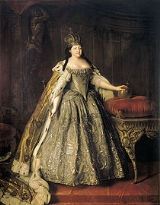
Anna of Russia

Encyclopedia
Moscow
Moscow is the capital, the most populous city, and the most populous federal subject of Russia. The city is a major political, economic, cultural, scientific, religious, financial, educational, and transportation centre of Russia and the continent...
– ) reigned as Duchess of Courland
Duchy of Courland and Semigallia
The Duchy of Courland and Semigallia is the name of a duchy in the Baltic region that existed from 1562 to 1569 as a vassal state of the Grand Duchy of Lithuania and from 1569...
from 1711 to 1730 and as Empress of Russia from 1730 to 1740.
Accession to the throne
Anna was the daughter of Ivan V of RussiaIvan V of Russia
Ivan V Alekseyevich Romanov was a joint Tsar of Russia who co-reigned between 1682 and 1696. He was the youngest son of Alexis I of Russia and Maria Miloslavskaya. His reign was only formal, since he had serious physical and mental disabilities...
, as well as the niece of Peter the Great
Peter I of Russia
Peter the Great, Peter I or Pyotr Alexeyevich Romanov Dates indicated by the letters "O.S." are Old Style. All other dates in this article are New Style. ruled the Tsardom of Russia and later the Russian Empire from until his death, jointly ruling before 1696 with his half-brother, Ivan V...
. The latter married her to Frederick William, Duke of Courland in November 1710, but on the return trip from Saint Petersburg in January 1711, her husband died. Anna proceeded to rule Courland
Courland
Courland is one of the historical and cultural regions of Latvia. The regions of Semigallia and Selonia are sometimes considered as part of Courland.- Geography and climate :...
(now western Latvia
Latvia
Latvia , officially the Republic of Latvia , is a country in the Baltic region of Northern Europe. It is bordered to the north by Estonia , to the south by Lithuania , to the east by the Russian Federation , to the southeast by Belarus and shares maritime borders to the west with Sweden...
) from 1711 to 1730, with the Russian resident, Peter Bestuzhev, as her adviser (and sometimes lover). She never remarried after the death of her husband, but was reputed by her enemies to have indulged in a love affair with Ernst Johann von Biron
Ernst Johann von Biron
Ernst Johann von Biron was a Duke of Courland and Semigallia and regent of the Russian Empire .-Biography:Born as Ernst Johann Biren in Kalnciems, Courland, he was the grandson of a groom in the service of Jacob Kettler, Duke of Courland, who bestowed upon him a small estate, which Biron's...
for many years.
On the death of Peter II
Peter II of Russia
Pyotr II Alekseyevich was Emperor of Russia from 1727 until his death. He was the only son of Tsarevich Alexei Petrovich, son of Peter I of Russia by his first wife Eudoxia Lopukhina, and Princess Charlotte, daughter of Duke Louis Rudolph of Brunswick-Lüneburg and sister-in-law of Charles VI,...
, Emperor of Russia, the Russian Supreme Privy Council
Supreme Privy Council
The Supreme Privy Council of Imperial Russia was founded on 8 February 1726 as a body of advisors to Catherine I.Originally, the council included six members — Alexander Menshikov, Fyodor Apraksin, Gavrila Golovkin, Andrey Osterman, Peter Tolstoy, and Dmitry Galitzine. Several months later,...
under Prince Dmitri Galitzine made Anna Empress in 1730. They had hoped that she would feel indebted to the nobles for her unexpected fortune and remain a figurehead at best, and malleable at worst. In the hope of establishing a constitutional monarchy
Constitutional monarchy
Constitutional monarchy is a form of government in which a monarch acts as head of state within the parameters of a constitution, whether it be a written, uncodified or blended constitution...
in Russia, they convinced her to sign articles that limited her power. However, these proved a minor inconvenience to her, and soon she established herself as an autocratic ruler, using her popularity with the imperial guards
Russian Imperial Guard
The Russian Imperial Guard, officially known as the Leib Guard were military units serving as personal guards of the Emperor of Russia. Peter the Great founded the first such units following the Prussian practice in the 1690s, to replace the politically-motivated Streltsy.- Organization :The final...
and lesser nobility.
Policies of her reign
National security
National security is the requirement to maintain the survival of the state through the use of economic, diplomacy, power projection and political power. The concept developed mostly in the United States of America after World War II...
police
Police
The police is a personification of the state designated to put in practice the enforced law, protect property and reduce civil disorder in civilian matters. Their powers include the legitimized use of force...
, which she used to intimidate and terrorize
State terrorism
State terrorism may refer to acts of terrorism conducted by a state against a foreign state or people. It can also refer to acts of violence by a state against its own people.-Definition:...
those who opposed her and her policies. Although she did not move the capital back to Moscow, she spent most of her time at that city in the company of her foolish and ignorant maids.
Anna loved cruel jokes. She had fire bells rung throughout St Petersburg just to see the panic. She had prince Nikita Volkonski feed her dog with cream, his wife fed lettuce to her rabbit with her teeth. Volkonski would be forced to 'marry' prince Galitzine, they had to dress as birds, sit in a straw basket outside Anna's bedroom and squark.
Finding delight in humiliating old nobility, she arranged the marriage of old Prince Galitzine
Galitzine
For Orthodox clergyman and theologian, see Alexander Golitzin.The Galitzines are one of the largest and noblest princely houses of Russia. Since the extinction of the Korecki family in the 17th century, the Golitsyns have claimed dynastic seniority in the House of Gediminas...
, who had incurred her displeasure by marrying an Italian Catholic, with one of her maids (after the death of his first wife), an elderly Kalmyk
Kalmyk people
Kalmyk people is the name given to the Oirats, western Mongols in Russia, whose descendants migrated from Dzhungaria in 1607. Today they form a majority in the autonomous Republic of Kalmykia on the western shore of the Caspian Sea. Kalmykia is Europe's only Buddhist government...
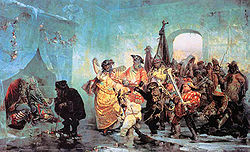
called Avdotaya Ivanovna. The couple were presented with a fleet of carriages, each carrying a member of one of the empires races, each pulled by a different farm animal. The couple had to ride an elephant. Anna dressed them as clowns, and had them spend their wedding night naked in a specially constructed ice palace
Ice palace
An ice palace or ice castle is a castle-like structure made of blocks of ice. These blocks are usually harvested from nearby rivers or lakes when they become frozen in winter. The first known ice palace appeared in St...
during the exceptionally harsh winter of 1739–40. This palace was 80 feet long, 30 feet high and 23 feet deep. It even had a stove. It cost 30,000 roubles and came with a bed, clock, Cupid, elephant, dolphins, cannon trees and plants: all were made of ice. The dolphins squirted naptha and the elephant squirted water. Somehow the couple survived their wedding night.
Having a distrust of Russian nobles, Anna kept them from powerful positions, instead giving those to Baltic Germans. She raised to the throne of Courland
Courland
Courland is one of the historical and cultural regions of Latvia. The regions of Semigallia and Selonia are sometimes considered as part of Courland.- Geography and climate :...
one Ernst Johann von Biron
Ernst Johann von Biron
Ernst Johann von Biron was a Duke of Courland and Semigallia and regent of the Russian Empire .-Biography:Born as Ernst Johann Biren in Kalnciems, Courland, he was the grandson of a groom in the service of Jacob Kettler, Duke of Courland, who bestowed upon him a small estate, which Biron's...
, who gained her particular favour and had considerable influence over her policies. He would exile 30,000 people to Siberia
Siberia
Siberia is an extensive region constituting almost all of Northern Asia. Comprising the central and eastern portion of the Russian Federation, it was part of the Soviet Union from its beginning, as its predecessor states, the Tsardom of Russia and the Russian Empire, conquered it during the 16th...
, mainly Old Believers
Old Believers
In the context of Russian Orthodox church history, the Old Believers separated after 1666 from the official Russian Orthodox Church as a protest against church reforms introduced by Patriarch Nikon between 1652–66...
. His archrival, the anti-German cabinet minister Artemy Petrovich Volynsky
Artemy Petrovich Volynsky
Artemy Petrovich Volynsky was a Russian statesman and diplomat. His career started as a soldier but was rapidly upgraded to minister under Peter the Great and governor of Astrakhan...
, was executed several months before Anna's death. Biron was sufficiently prudent not to meddle with foreign affairs or with the army, and these departments were in the able hands of two other foreigners, who thoroughly identified themselves with Russia, Andrey Osterman and Burkhardt Munnich.
They allied the country with Charles VI
Charles VI, Holy Roman Emperor
Charles VI was the penultimate Habsburg sovereign of the Habsburg Empire. He succeeded his elder brother, Joseph I, as Holy Roman Emperor, King of Bohemia , Hungary and Croatia , Archduke of Austria, etc., in 1711...
, (Holy Roman Emperor
Holy Roman Emperor
The Holy Roman Emperor is a term used by historians to denote a medieval ruler who, as German King, had also received the title of "Emperor of the Romans" from the Pope...
from 1711 to 1740), and committed Russia during the War of the Polish Succession
War of the Polish Succession
The War of the Polish Succession was a major European war for princes' possessions sparked by a Polish civil war over the succession to Augustus II, King of Poland that other European powers widened in pursuit of their own national interests...
(1733–1735). Afterwards, they made Augustus III the king of Poland
Poland
Poland , officially the Republic of Poland , is a country in Central Europe bordered by Germany to the west; the Czech Republic and Slovakia to the south; Ukraine, Belarus and Lithuania to the east; and the Baltic Sea and Kaliningrad Oblast, a Russian exclave, to the north...
at the expense of Stanisław Leszczyński and other candidates. In 1736 Anna declared war on the Ottoman Empire
Ottoman Empire
The Ottoman EmpireIt was usually referred to as the "Ottoman Empire", the "Turkish Empire", the "Ottoman Caliphate" or more commonly "Turkey" by its contemporaries...
, but Charles made a separate peace with the Porte, forcing Russia to follow suit and to give up all recently captured territories with the exception of Azov
Azov
-External links:** *...
. This war marks the beginning of that systematic struggle on the part of Russia to drive to the South which was brought to fruition by Catherine II
Catherine II of Russia
Catherine II, also known as Catherine the Great , Empress of Russia, was born in Stettin, Pomerania, Prussia on as Sophie Friederike Auguste von Anhalt-Zerbst-Dornburg...
. Anna's reign saw the beginnings of Russian territorial expansion into Central Asia
Central Asia
Central Asia is a core region of the Asian continent from the Caspian Sea in the west, China in the east, Afghanistan in the south, and Russia in the north...
.
On the other hand, Anna gave many privileges to the nobility. In 1730 she repealed the primogeniture
Primogeniture
Primogeniture is the right, by law or custom, of the firstborn to inherit the entire estate, to the exclusion of younger siblings . Historically, the term implied male primogeniture, to the exclusion of females...
law of Peter the Great so estates could be subdivided again. From 1731, landlords were responsible for their serfs' taxes and their economic bondage was tightened. In 1736, the age when they had to start service was raised from 15 to 20, service was now for 25 years not life and families with more than one son could keep one to manage the estate. Some nobles managed to start service as young as eight so they could retire at 33. Serfs now needed the landlords' permission before getting work elsewhere. Landlords could now move serfs from place to place.
Death and succession
Anna was famed for her big cheek, "which, as shown in her portraits", CarlyleThomas Carlyle
Thomas Carlyle was a Scottish satirical writer, essayist, historian and teacher during the Victorian era.He called economics "the dismal science", wrote articles for the Edinburgh Encyclopedia, and became a controversial social commentator.Coming from a strict Calvinist family, Carlyle was...
says, "was comparable to a Westphalia
Westphalia
Westphalia is a region in Germany, centred on the cities of Arnsberg, Bielefeld, Dortmund, Minden and Münster.Westphalia is roughly the region between the rivers Rhine and Weser, located north and south of the Ruhr River. No exact definition of borders can be given, because the name "Westphalia"...
n ham". As her health declined she declared her grandnephew, Ivan VI
Ivan VI of Russia
Ivan VI Antonovich of Russia , was proclaimed Emperor of Russia in 1740, as an infant, although he never actually reigned. Within less than a year, he was overthrown by the Empress Elizabeth of Russia, Peter the Great's daughter...
, should succeed her, and appointed Biron as regent. This was an attempt to secure the line of her father, Ivan V, and exclude descendants of Peter the Great
Peter I of Russia
Peter the Great, Peter I or Pyotr Alexeyevich Romanov Dates indicated by the letters "O.S." are Old Style. All other dates in this article are New Style. ruled the Tsardom of Russia and later the Russian Empire from until his death, jointly ruling before 1696 with his half-brother, Ivan V...
from inheriting the throne.
Anna died at the age of 47 of kidney disease. Ivan VI
Ivan VI of Russia
Ivan VI Antonovich of Russia , was proclaimed Emperor of Russia in 1740, as an infant, although he never actually reigned. Within less than a year, he was overthrown by the Empress Elizabeth of Russia, Peter the Great's daughter...
was only a one-year-old baby at the time and his mother, Anna Leopoldovna
Anna Leopoldovna
Anna Leopoldovna of Russia , also known as Anna Karlovna , regent of Russia for a few months during the minority of her baby son Ivan...
, was detested for her German counselors and relations. As a consequence, shortly after Anna's death Elizabeth Petrovna, Peter I
Peter I of Russia
Peter the Great, Peter I or Pyotr Alexeyevich Romanov Dates indicated by the letters "O.S." are Old Style. All other dates in this article are New Style. ruled the Tsardom of Russia and later the Russian Empire from until his death, jointly ruling before 1696 with his half-brother, Ivan V...
's legitimized daughter, managed to gain the favor of the populace, locked Ivan VI in a dungeon and exiled his mother.
Ancestry
External links
- The "Conditions" of Anna Ivanovna's Accession to the Throne, 1730
- Bayov Alexei Konstantinovich (1906) (in Russian). Russian army in the reign of Empress Anna Ivanovna. Russia's war with Turkey in 1736-1739gg. (Русская армия в царствование императрицы Анны Иоанновны. Война России с Турцией в 1736-1739гг.) at Runivers.ru in DjvuDjVuDjVu is a computer file format designed primarily to store scanned documents, especially those containing a combination of text, line drawings, and photographs. It uses technologies such as image layer separation of text and background/images, progressive loading, arithmetic coding, and lossy...
format