

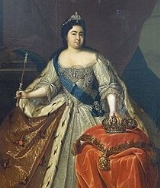
Catherine I of Russia

Encyclopedia
Catherine I
Catherine I ( – ), the second wife of Peter the Great
, reigned as Empress of Russia from 1725 until her death.
to be nearly as extraordinary as that of Peter the Great himself. There are no documents that confirm her origins. Born on 15 April 1684 (o.s. 5 April), she was originally named Marta Helena Skawrońska. Marta was the daughter of Samuel Skawroński, later known as Samuil Skavronsky, a Lithuanian peasant
of Polish
origin, most likely a Catholic, married to Dorothea Hahn, married at Jekabpils[Latvija]in 1680. Her mother has been listed on at least one site as Elisabeth Moritz and there is debate as to whether her father was a Swedish officer. It is likely two stories were conflated and most Swedes say the Elizabeth Moritz story is not probably true. There is some speculation that her father was a runaway landless serf. Some sources state her father was a gravedigger and handyman. Marta's parents died of plague around 1689, leaving five children. She was taken by an aunt and sent to Marienburg (present-day [Alūksne, Latvia], near the border with Estonia and Russia) where the three-year old Marta was raised by Johann Ernst Glück
, a Lutheran pastor and educator, who was the first to translate the Bible into Latvian
. There she essentially served as a housemaid
; no effort was made to teach her to read and write and she remained illiterate throughout her life.
She was considered a very beautiful young girl, and there are accounts that Frau Glück became fearful that Marta would become involved with her son. At the age of seventeen, she was married off to a Swedish
dragoon
, Johan Cruse or Johann Rabbe, with whom she remained for eight days in 1702, at which point the Swedish troops were withdrawn from Marienburg. When Russian forces captured Marienburg, Pastor Glück offered to work as a translator and Field Marshal Boris Sheremetev agreed to his proposal and took him to Moscow. There are unsubstantiated stories that Marta worked briefly in the laundry of the victorious regiment, and also that she was presented in her undergarments to the Brigadier General Rudolph Felix Bauer, later the Governor of Estonia to be his mistress. She definitely worked in the household of his superior, Field Marshal Sheremetev. It is not known whether she was his mistress, or household maid.
Afterwards she became part of the household of Prince Aleksandr Menshikov
, who was the best friend of Peter the Great
. Anecdotal sources suggest that she was purchased by him. Whether the two of them were lovers is highly disputed, as Menshikov was already engaged to Darya Arsenyeva, his future wife. It is clear that Menshikov and Marta formed a lifetime alliance, and it is possible that Menshikov who was quite jealous of Peter's attentions and knew his tastes, wanted to procure a mistress on whom he could rely. In any case, in 1703, while visiting Menshikov at his home, Peter met Marta, and shortly after, he took her as his own mistress. In 1705, she converted to Orthodoxy
and changed her name to Catherine Alexeyevna (Yekaterina Alexeyvna). She and Darya accompanied Peter and Menshikov on their military excursions.
with Catherine, where she did the cooking and caring for the children, and he tended a garden as though they were an ordinary couple. The relationship was the most successful of Peter's life and a great number of letters exist demonstrating the strong affection between Catherine and Peter. As a person she was very energetic, compassionate, charming and always cheerful. She was able to calm Peter in his frequent rages and was called in to attend him during his epileptic seizures.
Catherine continued to accompany Peter on his Pruth Campaign in 1711. There Catherine was said to have saved Peter and his Empire, as related by Voltaire in his book Peter the Great. Surrounded by overwhelming numbers of Turkish troops, Catherine suggested before surrendering, that her jewels and those of the other women be used in an effort to bribe the Grand Vizier Baltaji
into allowing a retreat. Baltaji allowed the retreat, whether motivated by the bribe or considerations of trade and diplomacy. In any case Peter credited Catherine and proceeded to marry her again (this time officially) at Saint Isaac's Cathedral
in St. Petersburg on 9 February 1712. Catherine was Peter's second wife; he had previously married and divorced Eudoxia Lopukhina
, who had borne him the Tsarevich Alexis Petrovich. Upon their wedding, Catherine took the style of her husband and became Tsarina. When Peter elevated the Russian Tsardom to Empire, Catherine became Empress (Imperatrica). The Order of Saint Catherine was instituted by her husband on the occasion of their wedding.
Upon Peter's death, Catherine found her four siblings, Christine, Anna, Karl and Friederich/Theodor, gave them the newly created titles of Count and Countess, and brought them to Russia. Christine Skawrońska, renamed Christina Samuilovna Skavronskaya (1687 – 14 April 1729), had married Simon-Heinrich N (1672–1728) and their descendants became the Counts Guendrikov. Anna Skawrońska, renamed Anna Samuilovna Skavronskaya, had married one Michael-Joachim N and their descendants became the Counts Efimovsky. Karl Skawroński, renamed Karel Samuilovich Skavronsky, was created a Count of the Russian Empire on 5 January 1727 and made a Chamberlain
of the Imperial Court; he had married Maria Ivanovna, a Russia
n woman, by whom he had descendants who became extinct in the male line in 1793. Friedrich/Theodor Skawroński, renamed Feodor Samuilovich Skavronsky, was created a Count of the Russian Empire on 5 January 1727 and was married twice: to N, a Lithuania
n woman, and to Ekaterina Rodionovna Saburova, without having children by either of them.
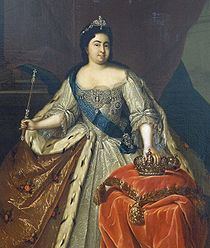 In 1724 Catherine was officially named co-ruler.
The year before his death, Peter and Catherine had an estrangement over her support of William Mons, brother of Peter's former mistress Anna, and brother to one of the current ladies in waiting to Catherine, Matrena. He served as secretary to Catherine. Peter had fought his entire life a somewhat hopeless battle to clear up corruption in Russia. Catherine had a great deal of influence on who could gain access to her husband. William Mons and his sister Matrena had begun selling their influence to those who wanted access to Catherine and, through her, to Peter. Apparently this had been overlooked by Catherine, who was fond of both. Peter found out and had Willem Mons executed and his sister Matrena exiled. He and Catherine did not speak for several months. Rumors flew that she and Mons had had an affair, but there is no evidence for this.
Peter died (28 January 1725 Old Style
) without naming a successor. Catherine represented the interests of the "new men", commoners who had been brought to positions of great power by Peter based on competence. A change of government was likely to favor the entrenched aristocrats. For that reason during a meeting of a council to decide on a successor, a coup was arranged by Menshikov and others in which the guards regiments
with whom Catherine was very popular proclaimed her the ruler of Russia, giving her the title of Empress. Supporting evidence was "produced" from Peter's secretary Makarov and the Bishop of Pskov
, both "new men" with motivation to see Catherine take over. The real power, however, lay with Menshikov, Peter Tolstoy and with other members of the Supreme Privy Council
.
The Supreme Privy Council
concentrated power in the hands of one party, and thus was an executive innovation. In foreign affairs, Russia reluctantly joined the Austro-Spanish league to defend the interests of Catherine's son-in-law, the Duke of Holstein
, against England.
Catherine gave her name to Catherinehof
near St. Petersburg, and built the first bridges in the new capital. She was also the first royal owner of the Tsarskoye Selo
estate, where the Catherine Palace
still bears her name.
In general, Catherine's policies were reasonable and cautious. The story of her humble origins was considered by later generations of tsar
s to be a state secret.
Catherine I ( – ), the second wife of Peter the Great
Peter I of Russia
Peter the Great, Peter I or Pyotr Alexeyevich Romanov Dates indicated by the letters "O.S." are Old Style. All other dates in this article are New Style. ruled the Tsardom of Russia and later the Russian Empire from until his death, jointly ruling before 1696 with his half-brother, Ivan V...
, reigned as Empress of Russia from 1725 until her death.
Life as a peasant woman
The life of Catherine I was said by VoltaireVoltaire
François-Marie Arouet , better known by the pen name Voltaire , was a French Enlightenment writer, historian and philosopher famous for his wit and for his advocacy of civil liberties, including freedom of religion, free trade and separation of church and state...
to be nearly as extraordinary as that of Peter the Great himself. There are no documents that confirm her origins. Born on 15 April 1684 (o.s. 5 April), she was originally named Marta Helena Skawrońska. Marta was the daughter of Samuel Skawroński, later known as Samuil Skavronsky, a Lithuanian peasant
Peasant
A peasant is an agricultural worker who generally tend to be poor and homeless-Etymology:The word is derived from 15th century French païsant meaning one from the pays, or countryside, ultimately from the Latin pagus, or outlying administrative district.- Position in society :Peasants typically...
of Polish
Poles
thumb|right|180px|The state flag of [[Poland]] as used by Polish government and diplomatic authoritiesThe Polish people, or Poles , are a nation indigenous to Poland. They are united by the Polish language, which belongs to the historical Lechitic subgroup of West Slavic languages of Central Europe...
origin, most likely a Catholic, married to Dorothea Hahn, married at Jekabpils[Latvija]in 1680. Her mother has been listed on at least one site as Elisabeth Moritz and there is debate as to whether her father was a Swedish officer. It is likely two stories were conflated and most Swedes say the Elizabeth Moritz story is not probably true. There is some speculation that her father was a runaway landless serf. Some sources state her father was a gravedigger and handyman. Marta's parents died of plague around 1689, leaving five children. She was taken by an aunt and sent to Marienburg (present-day [Alūksne, Latvia], near the border with Estonia and Russia) where the three-year old Marta was raised by Johann Ernst Glück
Johann Ernst Glück
Johann Ernst Glück was a German translator and Lutheran theologian active in Livonia, which is now in Latvia.Glück was born in Wettin as the son of a pastor...
, a Lutheran pastor and educator, who was the first to translate the Bible into Latvian
Latvian language
Latvian is the official state language of Latvia. It is also sometimes referred to as Lettish. There are about 1.4 million native Latvian speakers in Latvia and about 150,000 abroad. The Latvian language has a relatively large number of non-native speakers, atypical for a small language...
. There she essentially served as a housemaid
Maid
A maidservant or in current usage housemaid or maid is a female employed in domestic service.-Description:Once part of an elaborate hierarchy in great houses, today a single maid may be the only domestic worker that upper and even middle-income households can afford, as was historically the case...
; no effort was made to teach her to read and write and she remained illiterate throughout her life.
She was considered a very beautiful young girl, and there are accounts that Frau Glück became fearful that Marta would become involved with her son. At the age of seventeen, she was married off to a Swedish
Sweden
Sweden , officially the Kingdom of Sweden , is a Nordic country on the Scandinavian Peninsula in Northern Europe. Sweden borders with Norway and Finland and is connected to Denmark by a bridge-tunnel across the Öresund....
dragoon
Dragoon
The word dragoon originally meant mounted infantry, who were trained in horse riding as well as infantry fighting skills. However, usage altered over time and during the 18th century, dragoons evolved into conventional light cavalry units and personnel...
, Johan Cruse or Johann Rabbe, with whom she remained for eight days in 1702, at which point the Swedish troops were withdrawn from Marienburg. When Russian forces captured Marienburg, Pastor Glück offered to work as a translator and Field Marshal Boris Sheremetev agreed to his proposal and took him to Moscow. There are unsubstantiated stories that Marta worked briefly in the laundry of the victorious regiment, and also that she was presented in her undergarments to the Brigadier General Rudolph Felix Bauer, later the Governor of Estonia to be his mistress. She definitely worked in the household of his superior, Field Marshal Sheremetev. It is not known whether she was his mistress, or household maid.
Afterwards she became part of the household of Prince Aleksandr Menshikov
Aleksandr Danilovich Menshikov
Aleksandr Danilovich Menshikov was a Russian statesman, whose official titles included Generalissimus, Prince of the Russian Empire and Duke of Izhora , Prince of the Holy Roman Empire, Duke of Cosel. A highly appreciated associate and friend of Tsar Peter the Great, he was the de facto ruler of...
, who was the best friend of Peter the Great
Peter I of Russia
Peter the Great, Peter I or Pyotr Alexeyevich Romanov Dates indicated by the letters "O.S." are Old Style. All other dates in this article are New Style. ruled the Tsardom of Russia and later the Russian Empire from until his death, jointly ruling before 1696 with his half-brother, Ivan V...
. Anecdotal sources suggest that she was purchased by him. Whether the two of them were lovers is highly disputed, as Menshikov was already engaged to Darya Arsenyeva, his future wife. It is clear that Menshikov and Marta formed a lifetime alliance, and it is possible that Menshikov who was quite jealous of Peter's attentions and knew his tastes, wanted to procure a mistress on whom he could rely. In any case, in 1703, while visiting Menshikov at his home, Peter met Marta, and shortly after, he took her as his own mistress. In 1705, she converted to Orthodoxy
Orthodoxy
The word orthodox, from Greek orthos + doxa , is generally used to mean the adherence to accepted norms, more specifically to creeds, especially in religion...
and changed her name to Catherine Alexeyevna (Yekaterina Alexeyvna). She and Darya accompanied Peter and Menshikov on their military excursions.
Marriage and family life
Catherine and Peter married secretly in 1707. They had twelve children, two of whom survived into adulthood, Yelizaveta (born 1709) and Anna (born 1708). Peter had moved the capital to St Petersburg in 1703. While the city was being built he lived in a three-room log cabinCabin of Peter the Great
The cabin of Peter the Great is a small wooden house which was the first St Petersburg "palace" of Tsar Peter the Great....
with Catherine, where she did the cooking and caring for the children, and he tended a garden as though they were an ordinary couple. The relationship was the most successful of Peter's life and a great number of letters exist demonstrating the strong affection between Catherine and Peter. As a person she was very energetic, compassionate, charming and always cheerful. She was able to calm Peter in his frequent rages and was called in to attend him during his epileptic seizures.
Catherine continued to accompany Peter on his Pruth Campaign in 1711. There Catherine was said to have saved Peter and his Empire, as related by Voltaire in his book Peter the Great. Surrounded by overwhelming numbers of Turkish troops, Catherine suggested before surrendering, that her jewels and those of the other women be used in an effort to bribe the Grand Vizier Baltaji
Baltacı Mehmet Pasha
Baltacı Mehmet Pasha was an Ottoman grand vizier. -Early years:Mehmet was born in Osmancık, near Çorum . He was of Turkish origin. He travelled to North Africa, which was then Ottoman territory...
into allowing a retreat. Baltaji allowed the retreat, whether motivated by the bribe or considerations of trade and diplomacy. In any case Peter credited Catherine and proceeded to marry her again (this time officially) at Saint Isaac's Cathedral
Saint Isaac's Cathedral
Saint Isaac's Cathedral or Isaakievskiy Sobor in Saint Petersburg, Russia is the largest Russian Orthodox cathedral in the city...
in St. Petersburg on 9 February 1712. Catherine was Peter's second wife; he had previously married and divorced Eudoxia Lopukhina
Eudoxia Lopukhina
Tsarina Evdokiya Feodorovna Lopukhina was the first wife of Peter I of Russia. They married in 1689 but divorced in 1698...
, who had borne him the Tsarevich Alexis Petrovich. Upon their wedding, Catherine took the style of her husband and became Tsarina. When Peter elevated the Russian Tsardom to Empire, Catherine became Empress (Imperatrica). The Order of Saint Catherine was instituted by her husband on the occasion of their wedding.
Upon Peter's death, Catherine found her four siblings, Christine, Anna, Karl and Friederich/Theodor, gave them the newly created titles of Count and Countess, and brought them to Russia. Christine Skawrońska, renamed Christina Samuilovna Skavronskaya (1687 – 14 April 1729), had married Simon-Heinrich N (1672–1728) and their descendants became the Counts Guendrikov. Anna Skawrońska, renamed Anna Samuilovna Skavronskaya, had married one Michael-Joachim N and their descendants became the Counts Efimovsky. Karl Skawroński, renamed Karel Samuilovich Skavronsky, was created a Count of the Russian Empire on 5 January 1727 and made a Chamberlain
Chamberlain (office)
A chamberlain is an officer in charge of managing a household. In many countries there are ceremonial posts associated with the household of the sovereign....
of the Imperial Court; he had married Maria Ivanovna, a Russia
Russia
Russia or , officially known as both Russia and the Russian Federation , is a country in northern Eurasia. It is a federal semi-presidential republic, comprising 83 federal subjects...
n woman, by whom he had descendants who became extinct in the male line in 1793. Friedrich/Theodor Skawroński, renamed Feodor Samuilovich Skavronsky, was created a Count of the Russian Empire on 5 January 1727 and was married twice: to N, a Lithuania
Lithuania
Lithuania , officially the Republic of Lithuania is a country in Northern Europe, the biggest of the three Baltic states. It is situated along the southeastern shore of the Baltic Sea, whereby to the west lie Sweden and Denmark...
n woman, and to Ekaterina Rodionovna Saburova, without having children by either of them.
Descendants
Catherine and Peter had twelve children, all of whom died in childhood except Anna and Elizabeth:- Pyotr Petrovich 1704-1707
- Pavel Petrovich 1705-1707
- Catherine Petrovna 1707-1708
- Grand Duchess Anna Petrovna 1708–1728
- Grand Duchess Yelizaveta Petrovna 1709–1762
- Grand Duchess Natalia Petrovna of Russia 1713-1715
- Grand Duchess Margarita Petrovna 1714–1715
- Grand Duke Pyotr Petrovich 1715–1719
- Grand Duke Pavel Petrovich 1717-1717
- Grand Duchess Natalia Petrovna of Russia 1718-1725
- Grand Duke Pyotr Petrovich (1723–1723)
- Pavel Petrovich 1724-1724
Succession to the Throne
The year before his death, Peter and Catherine had an estrangement over her support of William Mons, brother of Peter's former mistress Anna, and brother to one of the current ladies in waiting to Catherine, Matrena. He served as secretary to Catherine. Peter had fought his entire life a somewhat hopeless battle to clear up corruption in Russia. Catherine had a great deal of influence on who could gain access to her husband. William Mons and his sister Matrena had begun selling their influence to those who wanted access to Catherine and, through her, to Peter. Apparently this had been overlooked by Catherine, who was fond of both. Peter found out and had Willem Mons executed and his sister Matrena exiled. He and Catherine did not speak for several months. Rumors flew that she and Mons had had an affair, but there is no evidence for this.
Peter died (28 January 1725 Old Style
Old Style and New Style dates
Old Style and New Style are used in English language historical studies either to indicate that the start of the Julian year has been adjusted to start on 1 January even though documents written at the time use a different start of year ; or to indicate that a date conforms to the Julian...
) without naming a successor. Catherine represented the interests of the "new men", commoners who had been brought to positions of great power by Peter based on competence. A change of government was likely to favor the entrenched aristocrats. For that reason during a meeting of a council to decide on a successor, a coup was arranged by Menshikov and others in which the guards regiments
Russian Guards
Guards or Guards units were and are elite military units in Imperial Russia, Soviet Union and the Russian Federation. The tradition goes back to the retinue of a knyaz of medieval Kievan Rus' and the streltsy, the Muscovite harquebusiers formed by Ivan the Terrible by 1550...
with whom Catherine was very popular proclaimed her the ruler of Russia, giving her the title of Empress. Supporting evidence was "produced" from Peter's secretary Makarov and the Bishop of Pskov
Feofan Prokopovich
thumb|Theophan ProkopovichFeofan/Theophan Prokopovich was an archbishop and statesman in the Russian Empire, of Ukrainian descent. He elaborated and implemented Peter the Great's reform of the Russian Orthodox Church...
, both "new men" with motivation to see Catherine take over. The real power, however, lay with Menshikov, Peter Tolstoy and with other members of the Supreme Privy Council
Supreme Privy Council
The Supreme Privy Council of Imperial Russia was founded on 8 February 1726 as a body of advisors to Catherine I.Originally, the council included six members — Alexander Menshikov, Fyodor Apraksin, Gavrila Golovkin, Andrey Osterman, Peter Tolstoy, and Dmitry Galitzine. Several months later,...
.
Assessment
Catherine was the first woman to rule Imperial Russia, opening the legal path for a century almost entirely dominated by women, including her daughter Elizabeth and Catherine the Great, all of whom continued Peter the Great's policies in modernizing Russia. At the time of Peter's death the Russian Army, composed of 130,000 men and supplemented by another 100,000 Cossacks, was easily the largest in Europe. However, the expense of the military was proving ruinous to the Russian economy, consuming some 65% of the government's annual revenue. Since the nation was at peace, Catherine was determined to reduce military expenditure. For most of her reign, Catherine I was controlled by her advisers. However, on this single issue, the reduction of military expenses, Catherine was able to have her way. The resulting tax relief on the peasantry led to the reputation of Catherine I as a just and fair ruler.The Supreme Privy Council
Supreme Privy Council
The Supreme Privy Council of Imperial Russia was founded on 8 February 1726 as a body of advisors to Catherine I.Originally, the council included six members — Alexander Menshikov, Fyodor Apraksin, Gavrila Golovkin, Andrey Osterman, Peter Tolstoy, and Dmitry Galitzine. Several months later,...
concentrated power in the hands of one party, and thus was an executive innovation. In foreign affairs, Russia reluctantly joined the Austro-Spanish league to defend the interests of Catherine's son-in-law, the Duke of Holstein
Charles Frederick, Duke of Holstein-Gottorp
Duke Charles Frederick of Holstein-Gottorp was the son of Frederick IV of Holstein-Gottorp and his wife, Hedvig Sophia, daughter of King Charles XI of Sweden...
, against England.
Catherine gave her name to Catherinehof
Catherinehof
Ekaterinhof or Catherinehof is a historic district in the south-west of St Petersburg, Russia. Its name originated in 1711, when Peter the Great presented the Ekanerinhof Island and adjacent lands along the Ekateringofka River to his wife Catherine, whose name they memorialize.The emperor...
near St. Petersburg, and built the first bridges in the new capital. She was also the first royal owner of the Tsarskoye Selo
Tsarskoye Selo
Tsarskoye Selo is the town containing a former Russian residence of the imperial family and visiting nobility, located south from the center of St. Petersburg. It is now part of the town of Pushkin and of the World Heritage Site Saint Petersburg and Related Groups of Monuments.-History:In...
estate, where the Catherine Palace
Catherine Palace
The Catherine Palace was the Rococo summer residence of the Russian tsars, located in the town of Tsarskoye Selo , 25 km south-east of St. Petersburg, Russia.- History :...
still bears her name.
In general, Catherine's policies were reasonable and cautious. The story of her humble origins was considered by later generations of tsar
Tsar
Tsar is a title used to designate certain European Slavic monarchs or supreme rulers. As a system of government in the Tsardom of Russia and Russian Empire, it is known as Tsarist autocracy, or Tsarism...
s to be a state secret.