
All Topics  
Jan Baptist van Helmont

 
Jan Baptist Van Helmont

   Email Print
   Bookmark   Link


Jan Baptist van Helmont


Jan Baptist van Helmont (bapt. January 12, 1580 – December 30, 1644) was an early modern period
Early modern period

The early modern period is a term used by historians to refer to the period roughly between 1500 to 1800 in Western Europe . It follows the Late Middle Ages period, and is marked by the first European colony, the rise of strong centralized governments, and the beginnings of recognizable nation states that are the direct antecedents of today'...
 Flemish
Flemish people

The terms the Flemish people , and the Flemings or the Flemish denote the more than six million people of Flanders, the northern half of the country Belgium — and, as well, the majority of all Belgium; the terms Fleming and Flemings denote respectively a person and the people of that community....
 chemist
Chemist

A chemist is a scientist trained in the science of chemistry. Chemists study the composition of matter and its properties such as density, acidity, size and shape....
, physiologist, and physician
Physician

A physician, medical practitioner, doctor of medicine, or medical doctor practices medicine, and is concerned with maintaining or restoring human health through the study, diagnosis, and treatment of disease and injury....
. He worked during the years just after Paracelsus
Paracelsus

Paracelsus was a Medieval physician, botanist, alchemy, astrologer, and general occultist. Born Phillip von Hohenheim, he later took up the name Philippus Theophrastus Aureolus Bombastus von Hohenheim, and still later took the title Paracelsus, meaning "equal to or greater than Celsus", a Roman encyclopedist, Aulus Cornelius Celsus fro...
 and iatrochemistry
Iatrochemistry

Iatrochemistry is a branch of both chemistry and medicine. Having its roots in alchemy, iatrochemistry seeks to provide chemical solutions to diseases and medical ailments....
, and is sometimes considered to be "the founder of pneumatic chemistry
Pneumatic chemistry

Pneumatic chemistry is a term most-closely identified with an area of scientific research of the seventeenth, eighteenth, and early nineteenth centuries....
". Van Helmont is remembered today largely for his ideas on spontaneous generation, his 5-year tree experiment, and his introduction of the word "gas" into the vocabulary of scientists.

Helmont was the youngest of five children of Maria (van) Stassaert and Christiaen van Helmont, a public prosecutor and Brussels council member, who had married in the Sint-Goedele
St. Michael and Gudula Cathedral

The St. Michael and St. Gudula Cathedral is located at the Treurenberg hill in Brussels, Belgium. In French, it is called Cath?drale Saints-Michel-et-Gudule and in Dutch Sint-Michiels- en Sint-Goedelekathedraal, usually shortened to "Sint-Goedele"....
 church in 1567.


Discussion
Ask a question about 'Jan Baptist van Helmont'
Start a new discussion about 'Jan Baptist van Helmont'
Answer questions from other users
Full Discussion Forum


Encyclopedia


Jan Baptist van Helmont (bapt. January 12, 1580 – December 30, 1644) was an early modern period
Early modern period

The early modern period is a term used by historians to refer to the period roughly between 1500 to 1800 in Western Europe . It follows the Late Middle Ages period, and is marked by the first European colony, the rise of strong centralized governments, and the beginnings of recognizable nation states that are the direct antecedents of today'...
 Flemish
Flemish people

The terms the Flemish people , and the Flemings or the Flemish denote the more than six million people of Flanders, the northern half of the country Belgium — and, as well, the majority of all Belgium; the terms Fleming and Flemings denote respectively a person and the people of that community....
 chemist
Chemist

A chemist is a scientist trained in the science of chemistry. Chemists study the composition of matter and its properties such as density, acidity, size and shape....
, physiologist, and physician
Physician

A physician, medical practitioner, doctor of medicine, or medical doctor practices medicine, and is concerned with maintaining or restoring human health through the study, diagnosis, and treatment of disease and injury....
. He worked during the years just after Paracelsus
Paracelsus

Paracelsus was a Medieval physician, botanist, alchemy, astrologer, and general occultist. Born Phillip von Hohenheim, he later took up the name Philippus Theophrastus Aureolus Bombastus von Hohenheim, and still later took the title Paracelsus, meaning "equal to or greater than Celsus", a Roman encyclopedist, Aulus Cornelius Celsus fro...
 and iatrochemistry
Iatrochemistry

Iatrochemistry is a branch of both chemistry and medicine. Having its roots in alchemy, iatrochemistry seeks to provide chemical solutions to diseases and medical ailments....
, and is sometimes considered to be "the founder of pneumatic chemistry
Pneumatic chemistry

Pneumatic chemistry is a term most-closely identified with an area of scientific research of the seventeenth, eighteenth, and early nineteenth centuries....
". Van Helmont is remembered today largely for his ideas on spontaneous generation, his 5-year tree experiment, and his introduction of the word "gas" into the vocabulary of scientists.

Life

Van Helmont was the youngest of five children of Maria (van) Stassaert and Christiaen van Helmont, a public prosecutor and Brussels council member, who had married in the Sint-Goedele
St. Michael and Gudula Cathedral

The St. Michael and St. Gudula Cathedral is located at the Treurenberg hill in Brussels, Belgium. In French, it is called Cath?drale Saints-Michel-et-Gudule and in Dutch Sint-Michiels- en Sint-Goedelekathedraal, usually shortened to "Sint-Goedele"....
 church in 1567. He was educated at Leuven
Catholic University of Leuven

The Catholic University of Leuven, or Louvain, was the largest, oldest and most prominent university in Belgium. It was founded in 1425 by Pope Martin V, and refounded in 1835 after the disruptions of the French Revolutionary Wars....
, and after ranging restlessly from one science to another and finding satisfaction in none, turned to medicine. He interrupted his studies, and for a few years he traveled through Switzerland
Switzerland

Switzerland is a landlocked Swiss Alps country of roughly 7.7 million people in Western Europe with an area of 41,285 km?. Switzerland is a federal republic consisting of 26 states called Cantons of Switzerland....
, Italy
Italy

Italy , officially the Italian Republic , is a country located on the Italian Peninsula in Southern Europe and on the two largest islands in the Mediterranean Sea, Sicily and Sardinia....
, France
France

France , officially the French Republic , is a country whose Metropolitan France is located in Western Europe and that also comprises various Overseas departments and territories of France....
, and England
England

native_name =|conventional_long_name = England|common_name = England|image_flag = Flag of England.svg|image_coat = England COA.svg|symbol_type = Royal Coat of Arms...
.

Returning to his own country, van Helmont obtained a medical degree in 1599 . He practiced at Antwerp at the time of the great plague in 1605. In 1609 he finally obtained his doctoral degree in medicine. The same year he married Margaret van Ranst, who was of a wealthy noble family. Jan and Margaret lived in Vilvoorde
Vilvoorde

Vilvoorde is a Belgium Municipalities in Belgium in the Flemish Region Provinces of Belgium of Flemish Brabant. The municipality comprises the city of Vilvoorde proper with its two outlying quarters of Konigslo and Houtem and the small town of Peutie....
, near Brussels, and had six or seven children. The inheritance of his wife enabled him to retire early from his medical practice and occupy himself with chemical experiments until his death on the 30th of December 1644.

Work

Van Helmont was a man of contradictions. On the one hand, he was a disciple of Paracelsus
Paracelsus

Paracelsus was a Medieval physician, botanist, alchemy, astrologer, and general occultist. Born Phillip von Hohenheim, he later took up the name Philippus Theophrastus Aureolus Bombastus von Hohenheim, and still later took the title Paracelsus, meaning "equal to or greater than Celsus", a Roman encyclopedist, Aulus Cornelius Celsus fro...
 (though he scornfully repudiated his errors as well as those of most other contemporary authorities), a mystic and alchemist
Alchemy

Alchemy , a part of the Occult Tradition, is both a philosophy and a practice with an aim of achieving ultimate wisdom as well as immortality, involving the improvement of the alchemist as well as the making of several substances described as possessing unusual properties....
. On the other hand, he was touched with the new learning
New Learning

In the history of ideas the New Learning in Europe was a term for Renaissance humanism, found from the later fifteenth century. Newly retrieved Classical texts sparked philology study of a refined and classical Latin style in prose and poetry....
 based on experiment
Experiment

In scientific inquiry, an experiment is a method of investigating causal relationships among variables. An experiment is a cornerstone of the empiricism approach to acquiring data about the world and is used in both natural sciences and social sciences....
 that was producing men like William Harvey
William Harvey

William Harvey was an English physician who was the first in the Western world to describe correctly and in exact detail the systemic circulation and properties of blood being pumped around the body by the heart....
, Galileo Galilei
Galileo Galilei

Galileo Galilei was a Grand Duchy of Tuscany physicist, mathematician, astronomer, and philosopher who played a major role in the Scientific Revolution....
 and Francis Bacon
Francis Bacon

Francis Bacon, 1st Viscount St Alban King's Counsel , son of Nicholas Bacon by his second wife Anne Bacon, was an English philosopher, statesman, scientist, lawyer, jurist, and author....
.

Van Helmont is regarded as the founder of pneumatic chemistry
Pneumatic chemistry

Pneumatic chemistry is a term most-closely identified with an area of scientific research of the seventeenth, eighteenth, and early nineteenth centuries....
, as he was the first to understand that there are gases distinct in kind from atmospheric air. The very word "gas
Gas

In physics, a gas is a state of matter, consisting of a collection of particles without a definite shape or volume that are in more or less random motion....
" he claimed as his own invention, and he perceived that his "gas sylvestre" (carbon dioxide
Carbon dioxide

Carbon dioxide is a chemical compound composed of two oxygen atoms covalent bond to a single carbon atom. It is a gas at standard temperature and pressure and exists in Earth's atmosphere in this state....
) given off by burning charcoal, was the same as that produced by fermenting must
Must

Must is freshly pressed fruit juice that contains the skins, seeds, and stems of the fruit. The solid portion of the must is called pomace; it typically makes up 7%?23% of the total weight of the must....
 , which sometimes renders the air of caves unbreathable.

For van Helmont, air
AIR

Air is the part of Earth's atmosphere that humans breath and as such Air .Air may also refer to:...
 and water
Water

Water is a common chemical substance that is essential for the survival of all known forms of life. In typical usage, water refers only to its liquid form or States of matter, but the substance also has a solid state, ice, and a gaseous state, water vapor or steam....
 were the two primitive elements. Fire he explicitly denied to be an element
Classical element

Many ancient philosophy used a set of archetype classical elements to explain patterns in nature. In this context, the word element refers to a chemical substance that is either a chemical compound or a mixture of chemical compounds , rather than a chemical element of modern physical science....
, and earth is not one because it can be reduced to water.

Van Helmont was a careful observer of nature
Nature

File:Jungle in Punjab.JPGNature, in the broadest sense, is equivalent to the natural world, physical universe, material world or material universe....
, and an exact experimenter who realized that matter
Matter

In common usage, matter is anything that has both mass and volume . A more rigorous definition is used in science: matter is what atoms and molecules are made of....
 can neither be created nor destroyed. He performed an experiment to determine where plants get their mass. He grew a willow tree and measured the amount of soil, the weight of the tree and the water he added. After five years the plant had gained about 164 pounds. Since the amount of soil was basically the same as it had been when he started his experiment, he deduced that the tree's weight gain had come from water. Since it had received nothing but water and the soil weighed practically the same as at the beginning, he argued that the increased weight of wood, bark and roots had been formed from water alone.

At the same time, chemical principles guided him in the choice of medicines -- undue acidity of the digestive juices, for example, was to be corrected by alkalines and vice versa; he was thus a forerunner of the iatrochemical school
Iatrochemistry

Iatrochemistry is a branch of both chemistry and medicine. Having its roots in alchemy, iatrochemistry seeks to provide chemical solutions to diseases and medical ailments....
, and did service to medicine by applying chemical methods to the preparation of drugs.

Religious and philosophical opinions

Although a faithful Catholic, he incurred the suspicion of the Church by his tract De magnetica vulnerum curatione (1621), which was thought to derogate from some of the miracles. His works were collected and edited by his son Franciscus Mercurius van Helmont
Franciscus Mercurius van Helmont

Franciscus Mercurius van Helmont was a Flemish alchemist and writer, the son of Jan Baptist van Helmont. He is now best known for his publication in the 1640s of his father's pioneer works on chemistry, which link the origins of the science to the study of alchemy....
 and published by Lodewijk Elzevir
Lodewijk Elzevir

Lodewijk Elzevir , originally Lodewijk or Louis Elsevier or Elzevier, was a significant Holland printer. He was the founder of the House of Elzevir, which printed, for example, the work of Galileo, at a time when his work was suppressed for religious reasons....
 in Amsterdam
Amsterdam

Amsterdam is the Capital of the Netherlands and List of cities in the Netherlands with over 100,000 people of the Netherlands, located in the Provinces of the Netherlands of North Holland in the west of the country....
 as Ortus medicinae, vel opera et opuscula omnia in 1648. "Ortus medicinae" was based on, but not restricted to, the material of Dageraad ofte Nieuwe Opkomst der Geneeskunst ("Daybreak, or the New Rise of Medicine"), which was published in 1644 in Van Helmont's native Dutch. In his son Frans's own writings (e.g. Cabbaiah Denudata (1677) and Opuscula philosophica (1690)) mystical theosophy and alchemy appear in confusion.

Over and above the archeus, he believed that there is the sensitive soul
Soul

In many religions and parts of philosophy, the soul is the immaterial part of a person. It is usually thought to consist of one's thoughts and Personality psychology, and can be synonymous with the spirit, mind or self....
 which is the husk or shell of the immortal mind. Before the Fall the archeus obeyed the immortal mind and was directly controlled by it, but at the Fall men also received the sensitive soul and with it lost immortality, for when it perishes the immortal mind can no longer remain in the body.

In addition to the archeus, which he described as "aura vitalis seminum, vitae directrix", van Helmont believed in other governing agencies resembling the archeus which were not always clearly distinguished from it. From these he invented the term blas, defined as the "vis motus tam alterivi quam localis." Of blas there were several kinds, e.g. blas humanum and blas meteoron; the heavens he said "constare gas materiâ et blas efficiente."

Van Helmont and digestion

Van Helmont wrote extensively on the subject of digestion. In Oriatrike or Physics Refined (1662, English translation of Ortus medicinae ...), van Helmont addressed earlier ideas on the subject, such as that food was digested due to the body's internal heat. If such was the case, van Helmont argued, how could cold-blooded animals live? His own opinion was that digestion was aided by a chemical reagent, or "ferment", within the body, such as inside the stomach. Harré suggests that in this way, van Helmont's idea was "very near to our modern concept of an enzyme." van Helmont proposed and described six different stages of digestion.

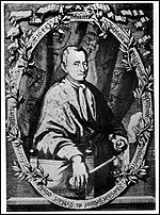
Portrait discovered

Hooke Robert
In 2003, the historian Lisa Jardine
Lisa Jardine

Lisa Anne Jardine Order of the British Empire , n?e Lisa Anne Bronowski, is a United Kingdom historian of the early modern period. She is professor of Renaissance Studies and Director of the Centre for Editing Lives and Letters at Queen Mary, University of London, and is Chairman of the Human Fertilisation and Embryology Authority ....
 claimed a recently discovered portrait represented Robert Hooke
Robert Hooke

Robert Hooke, Fellow of the Royal Society was an England natural philosopher and polymath who played an important role in the scientific revolution, through both experimental and theoretical work....
. However, Jardine's hypothesis was disproved by William Jensen of the University of Cincinnati
University of Cincinnati

The University of Cincinnati is a coeducational public university research university in Cincinnati, Ohio, Ohio, part of the University System of Ohio....
 and by the German researcher Andreas Pechtl of Johannes Gutenberg University of Mainz
Johannes Gutenberg University of Mainz

The Johannes Gutenberg University of Mainz is a university in Mainz, Rhineland Palatinate, Germany, named after the printer Johannes Gutenberg....
. The portrait in fact depicts Jan Baptista van Helmont.

For further reading

  • Redgrove, I. M. L. and Redgrove, H. Stanley (2003). Joannes Baptista van Helmont: Alchemist, Physician and Philosopher, Kessinger Publishing.
  • Pagel, Walter (2002). Joan Baptista van Helmont: Reformer of Science and Medicine, Cambridge University Press.
  • The Moldavian prince and scholar, Dimitrie Cantemir
    Dimitrie Cantemir

    Dimitrie Cantemir was twice List of Moldavian rulers of Moldavia . He was also a prolific Intellectual – philosopher, historian, composer, musicologist, linguistics, ethnographer, and geographer....
    , wrote a biography of Helmont, which is now difficult to locate.
  • Nature 433, 197 (20 January 2005)doi:10.1038/433197a; Published online 19 January 2005
  • Eugene M. Klaaren, , Eerdmans, 1977, ISBN 0802816835, 244 pages


See also


External links

  • - earlier misidentified as a picture of Robert Hooke
    Robert Hooke

    Robert Hooke, Fellow of the Royal Society was an England natural philosopher and polymath who played an important role in the scientific revolution, through both experimental and theoretical work....
    .
  • Ferguson, John (1906). , Bibliotheca Chemica: A Catalogue of the Alchemical, Chemical and Pharmaceutical Books in the Collection of the Late James Young of Kelly and Durris, Esq., LL.D., F.R.S., F.R.S.E., Glasgow: James Maclehose and Sons, page 381.
  • (1918). A History of Chemistry, New York: McGraw-Hill.
  • (1830). The History of Chemistry, London: Henry Colburn and Richard Bentley.