

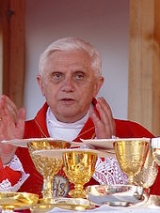
Deus Caritas Est

Encyclopedia
Deus Caritas Est is a 2006 encyclical
—the first written by Pope Benedict XVI
, in large part derived from writings by his late predecessor, Pope John Paul II
. Its subject is love
, as seen through a Christian
perspective, and God
's place within all love. The encyclical begins with a reflection on the forms of love known in Greek philosophy
—eros
(possessive
, often sex
ual, love
), agape
(unconditional, self-sacrificing love
), philia
(the word) —and their relationship with the teachings of Jesus
.
The encyclical contains almost 16,000 words in 42 paragraphs. The first half is said to have been written by Benedict in German
, his mother tongue, in the summer of 2005; the second half is derived from uncompleted writings left by John Paul II. The document was signed by Pope Benedict on Christmas Day, 25 December 2005. Some reports attribute the delay to problems in translating the original German text into Latin
; others to disputes within the Vatican
over the precise wording of the document.
The encyclical was promulgated
on January 25, 2006, in Latin and officially translated into seven other languages (English
, French
, German
, Italian
, Polish
, Portuguese
, and Spanish
). It is the first encyclical to be published since the Vatican decided to assert copyright
in the official writings of the Pope
.
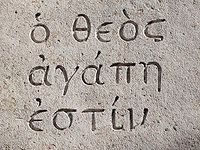 The Latin title of an encyclical is taken from its first few words. This encyclical begins with a quotation from the First Letter of St. John
, chapter 4, verse 16 (for example, the Vulgate
) translated from the original Greek
, "ὁ θεòς ἀγάπη ἐστίν" (ho theos agape estin). The Douai Bible
translates this into English as "God is charity", while in most contemporary English translations it reads "God is love" (since the word "charity" is derived from the Latin caritas, or "love"). The Latin version of the First Letter of St. John uses the same formulation, "Deus caritas est", at the end of chapter 4, verse 8, translating the same phrase in Greek.
, each of which has a slightly different shade of meaning: agape
is descending, oblative love in which one gives of oneself to another; eros
is ascending, possessive love which seeks to receive from another. philia
is often translated into English as "word
", but can also mean thought, speech, reason, principle, standard, or logic, among other things.
The document explains that eros and agape are both inherently good, but that eros risks being downgraded to mere sex
if it is not balanced by an element of spiritual Christianity. The opinion that eros is inherently good follows a school of thought in the Catholic Church known as the "Caritas tradition", and contrasts with the view expressed, for example, by Anders Nygren
, a Lutheran bishop, in his mid-20th century book Eros and Agape
, that agape is the only truly Christian kind of love, and that eros is an expression of the individual's desires and turns us away from God. These two positions have been an ongoing cause for debate in both Catholic and Protestant theology
. The continuity of these two forms of love follows the traditional Catholic understanding, which is influenced by the philosophy of Plato
, Augustine
, Bonaventure
and ancient Jewish tradition. The Nygren position was favoured by the Reformed
theologian Karl Barth
while the Caritas position was supported by the liberal
Protestant theologian Paul Tillich
.
The first half of the encyclical is more philosophical
, tracing the meaning of the Greek words for "love". In considering eros, Benedict refers to a line from Virgil
's Eclogues, Book X, line 69, "Omnia vincit amor, et nos cedamus amori" ("Love conquers all, let us also yield to love"), and the opinion of Friedrich Nietzsche
that Christianity has poisoned eros, turning it into a vice
. He refers to the conjugal love exhibited in the Song of Songs
, and analyzes passages from the First Letter of St. John
which inspired the title. The encyclical argues that eros and agape are not distinct kinds of love, but are separate halves of complete love, unified as both a giving and receiving.
 The second half, based on a report prepared by the Pontifical Council Cor Unum
, is less abstract
, considering the charitable activities of the Church as an expression of love which draws its power from contemplative union with God. The second half also refers to the Church's threefold responsibility: proclaiming the word of God (kerygma-martyria), celebrating the sacrament
s (leitourgia), and exercising the ministry of charity
(diakonia). The encyclical says that social justice
is the primary responsibility of politics and the laity; the church itself should inform the debate on social justice with reason guided by faith, but its main social activity should be directed towards charity. Charity workers should have a deep prayer life, and be uninfluenced by party
and ideology
. Benedict rejects both Marxist arguments that the poor "do not need charity but justice", and the merger of church and state functions (theocracy
); rather, he encourages cooperation between the church, the state, and other Christian charitable organizations.
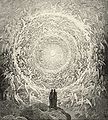
Paragraph 39 appears to be inspired by Dante Alighieri
's Divine Comedy, reflecting in particular the last canto
of "Paradise", which ends before "the everlasting Light that is God himself, before that Light which at the same time is the love which moves the sun and the other stars". The three concluding paragraphs consider the example of the saint
s, ending with a prayer to the Virgin Mary. The text mentions the name of Mother Teresa
four times, the last as a "saint
" (despite the fact that she has not yet been canonised) in such company as Francis of Assisi
, Ignatius of Loyola
, John of God
, Camillus of Lellis, Vincent de Paul
, Louise de Marillac
, Giuseppe B. Cottolengo
, John Bosco
, and Luigi Orione
.
Deus Caritas Est, like the encyclicals of many previous popes, including Pope John Paul II, uses the Royal we in the official Latin text ("cupimus loqui de amore"). This is the text that appears promulgated in the Vatican's official gazette of record, "Acta Apostolicae Sedis". However, in accordance with a practice initiated in the pontificate of John Paul II, the unofficial versions prepared by the Vatican in 7 other languages use the singular ("I wish to speak of love").
to discuss the themes of the encyclical on 23 January and 24 January 2006, involving Liliana Cavani
(director of films including The Night Porter
and Ripley's Game
) and James Wolfensohn
(former head of the World Bank
).
The encyclical was published on the feast
of the Conversion of Saint Paul
and on the last day of the Week of Prayer for Christian Unity. Pope Benedict led an ecumenical prayer service at the Basilica of Saint Paul Outside the Walls
, a traditional site for such celebrations, on the evening after the encyclical was published. Presiding at vespers
, he said in his homily
: "God is love. On this solid rock the entire faith of the church is based."
Encyclical
An encyclical was originally a circular letter sent to all the churches of a particular area in the ancient Catholic Church. At that time, the word could be used for a letter sent out by any bishop...
—the first written by Pope Benedict XVI
Pope Benedict XVI
Benedict XVI is the 265th and current Pope, by virtue of his office of Bishop of Rome, the Sovereign of the Vatican City State and the leader of the Catholic Church as well as the other 22 sui iuris Eastern Catholic Churches in full communion with the Holy See...
, in large part derived from writings by his late predecessor, Pope John Paul II
Pope John Paul II
Blessed Pope John Paul II , born Karol Józef Wojtyła , reigned as Pope of the Catholic Church and Sovereign of Vatican City from 16 October 1978 until his death on 2 April 2005, at of age. His was the second-longest documented pontificate, which lasted ; only Pope Pius IX ...
. Its subject is love
Love
Love is an emotion of strong affection and personal attachment. In philosophical context, love is a virtue representing all of human kindness, compassion, and affection. Love is central to many religions, as in the Christian phrase, "God is love" or Agape in the Canonical gospels...
, as seen through a Christian
Christianity
Christianity is a monotheistic religion based on the life and teachings of Jesus as presented in canonical gospels and other New Testament writings...
perspective, and God
God
God is the English name given to a singular being in theistic and deistic religions who is either the sole deity in monotheism, or a single deity in polytheism....
's place within all love. The encyclical begins with a reflection on the forms of love known in Greek philosophy
Greek words for love
There are several Greek words for love, as the Greek language distinguishes how the word is used. Ancient Greek has four distinct words for love: agápe, éros, philía, and storgē. However, as with other languages, it has been historically difficult to separate the meanings of these words...
—eros
Eros (love)
Eros is one of the four words in Ancient Greek which can be rendered into English as “love”. The other three are storge, philia and agape...
(possessive
Possession
In law, possession is the control a person intentionally exercises toward a thing. In all cases, to possess something, a person must have an intention to possess it. A person may be in possession of some property...
, often sex
Sex
In biology, sex is a process of combining and mixing genetic traits, often resulting in the specialization of organisms into a male or female variety . Sexual reproduction involves combining specialized cells to form offspring that inherit traits from both parents...
ual, love
Love
Love is an emotion of strong affection and personal attachment. In philosophical context, love is a virtue representing all of human kindness, compassion, and affection. Love is central to many religions, as in the Christian phrase, "God is love" or Agape in the Canonical gospels...
), agape
Agape
Agape is one of the Greek words translated into English as love, one which became particularly appropriated in Christian theology as the love of God or Christ for mankind. In the New Testament, it refers to the fatherly love of God for humans, as well as the human reciprocal love for God; the term...
(unconditional, self-sacrificing love
Love
Love is an emotion of strong affection and personal attachment. In philosophical context, love is a virtue representing all of human kindness, compassion, and affection. Love is central to many religions, as in the Christian phrase, "God is love" or Agape in the Canonical gospels...
), philia
Philia
Philia is one of the four ancient Greek words for love.Philia in Aristotle's Nicomachean Ethics is usually translated as 'friendship', though in fact his use of the term is much broader.- Aristotle's view :...
(the word) —and their relationship with the teachings of Jesus
Jesus
Jesus of Nazareth , commonly referred to as Jesus Christ or simply as Jesus or Christ, is the central figure of Christianity...
.
The encyclical contains almost 16,000 words in 42 paragraphs. The first half is said to have been written by Benedict in German
German language
German is a West Germanic language, related to and classified alongside English and Dutch. With an estimated 90 – 98 million native speakers, German is one of the world's major languages and is the most widely-spoken first language in the European Union....
, his mother tongue, in the summer of 2005; the second half is derived from uncompleted writings left by John Paul II. The document was signed by Pope Benedict on Christmas Day, 25 December 2005. Some reports attribute the delay to problems in translating the original German text into Latin
Latin
Latin is an Italic language originally spoken in Latium and Ancient Rome. It, along with most European languages, is a descendant of the ancient Proto-Indo-European language. Although it is considered a dead language, a number of scholars and members of the Christian clergy speak it fluently, and...
; others to disputes within the Vatican
Roman Curia
The Roman Curia is the administrative apparatus of the Holy See and the central governing body of the entire Catholic Church, together with the Pope...
over the precise wording of the document.
The encyclical was promulgated
Promulgation
Promulgation is the act of formally proclaiming or declaring a new statutory or administrative law after its enactment. In some jurisdictions this additional step is necessary before the law can take effect....
on January 25, 2006, in Latin and officially translated into seven other languages (English
English language
English is a West Germanic language that arose in the Anglo-Saxon kingdoms of England and spread into what was to become south-east Scotland under the influence of the Anglian medieval kingdom of Northumbria...
, French
French language
French is a Romance language spoken as a first language in France, the Romandy region in Switzerland, Wallonia and Brussels in Belgium, Monaco, the regions of Quebec and Acadia in Canada, and by various communities elsewhere. Second-language speakers of French are distributed throughout many parts...
, German
German language
German is a West Germanic language, related to and classified alongside English and Dutch. With an estimated 90 – 98 million native speakers, German is one of the world's major languages and is the most widely-spoken first language in the European Union....
, Italian
Italian language
Italian is a Romance language spoken mainly in Europe: Italy, Switzerland, San Marino, Vatican City, by minorities in Malta, Monaco, Croatia, Slovenia, France, Libya, Eritrea, and Somalia, and by immigrant communities in the Americas and Australia...
, Polish
Polish language
Polish is a language of the Lechitic subgroup of West Slavic languages, used throughout Poland and by Polish minorities in other countries...
, Portuguese
Portuguese language
Portuguese is a Romance language that arose in the medieval Kingdom of Galicia, nowadays Galicia and Northern Portugal. The southern part of the Kingdom of Galicia became independent as the County of Portugal in 1095...
, and Spanish
Spanish language
Spanish , also known as Castilian , is a Romance language in the Ibero-Romance group that evolved from several languages and dialects in central-northern Iberia around the 9th century and gradually spread with the expansion of the Kingdom of Castile into central and southern Iberia during the...
). It is the first encyclical to be published since the Vatican decided to assert copyright
Copyright
Copyright is a legal concept, enacted by most governments, giving the creator of an original work exclusive rights to it, usually for a limited time...
in the official writings of the Pope
Pope
The Pope is the Bishop of Rome, a position that makes him the leader of the worldwide Catholic Church . In the Catholic Church, the Pope is regarded as the successor of Saint Peter, the Apostle...
.
Title
First Epistle of John
The First Epistle of John, often referred to as First John and written 1 John, is a book of the New Testament. This fourth catholic or "general" epistle is attributed to John the Evangelist, traditionally thought to be the author of the Gospel of John and the other two Epistles of John. This...
, chapter 4, verse 16 (for example, the Vulgate
Vulgate
The Vulgate is a late 4th-century Latin translation of the Bible. It was largely the work of St. Jerome, who was commissioned by Pope Damasus I in 382 to make a revision of the old Latin translations...
) translated from the original Greek
Greek language
Greek is an independent branch of the Indo-European family of languages. Native to the southern Balkans, it has the longest documented history of any Indo-European language, spanning 34 centuries of written records. Its writing system has been the Greek alphabet for the majority of its history;...
, "ὁ θεòς ἀγάπη ἐστίν" (ho theos agape estin). The Douai Bible
Douai Bible
The Douay–Rheims Bible is a translation of the Bible from the Latin Vulgate into English made by members of the English College, Douai, in the service of the Catholic Church...
translates this into English as "God is charity", while in most contemporary English translations it reads "God is love" (since the word "charity" is derived from the Latin caritas, or "love"). The Latin version of the First Letter of St. John uses the same formulation, "Deus caritas est", at the end of chapter 4, verse 8, translating the same phrase in Greek.
Summary
In this encyclical, Benedict reflects on the concepts of eros, agape, and philia, and their relationship with the teachings of Jesus. Eros and agape are two of the various Greek words for loveGreek words for love
There are several Greek words for love, as the Greek language distinguishes how the word is used. Ancient Greek has four distinct words for love: agápe, éros, philía, and storgē. However, as with other languages, it has been historically difficult to separate the meanings of these words...
, each of which has a slightly different shade of meaning: agape
Agape
Agape is one of the Greek words translated into English as love, one which became particularly appropriated in Christian theology as the love of God or Christ for mankind. In the New Testament, it refers to the fatherly love of God for humans, as well as the human reciprocal love for God; the term...
is descending, oblative love in which one gives of oneself to another; eros
Eros (love)
Eros is one of the four words in Ancient Greek which can be rendered into English as “love”. The other three are storge, philia and agape...
is ascending, possessive love which seeks to receive from another. philia
Philia
Philia is one of the four ancient Greek words for love.Philia in Aristotle's Nicomachean Ethics is usually translated as 'friendship', though in fact his use of the term is much broader.- Aristotle's view :...
is often translated into English as "word
Word
In language, a word is the smallest free form that may be uttered in isolation with semantic or pragmatic content . This contrasts with a morpheme, which is the smallest unit of meaning but will not necessarily stand on its own...
", but can also mean thought, speech, reason, principle, standard, or logic, among other things.
The document explains that eros and agape are both inherently good, but that eros risks being downgraded to mere sex
Sex
In biology, sex is a process of combining and mixing genetic traits, often resulting in the specialization of organisms into a male or female variety . Sexual reproduction involves combining specialized cells to form offspring that inherit traits from both parents...
if it is not balanced by an element of spiritual Christianity. The opinion that eros is inherently good follows a school of thought in the Catholic Church known as the "Caritas tradition", and contrasts with the view expressed, for example, by Anders Nygren
Anders Nygren
Anders Theodor Samuel Nygren was a Swedish Lutheran theologian. He was professor of systematic theology at Lund University from 1924 and was elected Bishop of Lund in 1948...
, a Lutheran bishop, in his mid-20th century book Eros and Agape
Eros and Agape
Eros and Agape is the title of a two-volume treatise written by the Swedish Protestant theologian Anders Nygren, first published in Swedish in 1930-1936...
, that agape is the only truly Christian kind of love, and that eros is an expression of the individual's desires and turns us away from God. These two positions have been an ongoing cause for debate in both Catholic and Protestant theology
Theology
Theology is the systematic and rational study of religion and its influences and of the nature of religious truths, or the learned profession acquired by completing specialized training in religious studies, usually at a university or school of divinity or seminary.-Definition:Augustine of Hippo...
. The continuity of these two forms of love follows the traditional Catholic understanding, which is influenced by the philosophy of Plato
Plato
Plato , was a Classical Greek philosopher, mathematician, student of Socrates, writer of philosophical dialogues, and founder of the Academy in Athens, the first institution of higher learning in the Western world. Along with his mentor, Socrates, and his student, Aristotle, Plato helped to lay the...
, Augustine
Augustine of Hippo
Augustine of Hippo , also known as Augustine, St. Augustine, St. Austin, St. Augoustinos, Blessed Augustine, or St. Augustine the Blessed, was Bishop of Hippo Regius . He was a Latin-speaking philosopher and theologian who lived in the Roman Africa Province...
, Bonaventure
Bonaventure
Saint Bonaventure, O.F.M., , born John of Fidanza , was an Italian medieval scholastic theologian and philosopher. The seventh Minister General of the Order of Friars Minor, he was also a Cardinal Bishop of Albano. He was canonized on 14 April 1482 by Pope Sixtus IV and declared a Doctor of the...
and ancient Jewish tradition. The Nygren position was favoured by the Reformed
Reformed churches
The Reformed churches are a group of Protestant denominations characterized by Calvinist doctrines. They are descended from the Swiss Reformation inaugurated by Huldrych Zwingli but developed more coherently by Martin Bucer, Heinrich Bullinger and especially John Calvin...
theologian Karl Barth
Karl Barth
Karl Barth was a Swiss Reformed theologian whom critics hold to be among the most important Christian thinkers of the 20th century; Pope Pius XII described him as the most important theologian since Thomas Aquinas...
while the Caritas position was supported by the liberal
Liberal Christianity
Liberal Christianity, sometimes called liberal theology, is an umbrella term covering diverse, philosophically and biblically informed religious movements and ideas within Christianity from the late 18th century and onward...
Protestant theologian Paul Tillich
Paul Tillich
Paul Johannes Tillich was a German-American theologian and Christian existentialist philosopher. Tillich was one of the most influential Protestant theologians of the 20th century...
.
The first half of the encyclical is more philosophical
Philosophy
Philosophy is the study of general and fundamental problems, such as those connected with existence, knowledge, values, reason, mind, and language. Philosophy is distinguished from other ways of addressing such problems by its critical, generally systematic approach and its reliance on rational...
, tracing the meaning of the Greek words for "love". In considering eros, Benedict refers to a line from Virgil
Virgil
Publius Vergilius Maro, usually called Virgil or Vergil in English , was an ancient Roman poet of the Augustan period. He is known for three major works of Latin literature, the Eclogues , the Georgics, and the epic Aeneid...
's Eclogues, Book X, line 69, "Omnia vincit amor, et nos cedamus amori" ("Love conquers all, let us also yield to love"), and the opinion of Friedrich Nietzsche
Friedrich Nietzsche
Friedrich Wilhelm Nietzsche was a 19th-century German philosopher, poet, composer and classical philologist...
that Christianity has poisoned eros, turning it into a vice
Vice
Vice is a practice or a behavior or habit considered immoral, depraved, or degrading in the associated society. In more minor usage, vice can refer to a fault, a defect, an infirmity, or merely a bad habit. Synonyms for vice include fault, depravity, sin, iniquity, wickedness, and corruption...
. He refers to the conjugal love exhibited in the Song of Songs
Song of songs
Song of Songs, also known as the Song of Solomon, is a book of the Hebrew Bible or Old Testament. It may also refer to:In music:* Song of songs , the debut album by David and the Giants* A generic term for medleysPlays...
, and analyzes passages from the First Letter of St. John
First Epistle of John
The First Epistle of John, often referred to as First John and written 1 John, is a book of the New Testament. This fourth catholic or "general" epistle is attributed to John the Evangelist, traditionally thought to be the author of the Gospel of John and the other two Epistles of John. This...
which inspired the title. The encyclical argues that eros and agape are not distinct kinds of love, but are separate halves of complete love, unified as both a giving and receiving.
Pontifical Council Cor Unum
The Pontifical Council Cor Unum for Human and Christian Development is a part of the Curia of the Catholic Church. It was established by Pope Paul VI on 15 July 1971 and is based in the Palazzo San Callisto, in Piazza San Callisto, Rome....
, is less abstract
Abstraction
Abstraction is a process by which higher concepts are derived from the usage and classification of literal concepts, first principles, or other methods....
, considering the charitable activities of the Church as an expression of love which draws its power from contemplative union with God. The second half also refers to the Church's threefold responsibility: proclaiming the word of God (kerygma-martyria), celebrating the sacrament
Sacrament
A sacrament is a sacred rite recognized as of particular importance and significance. There are various views on the existence and meaning of such rites.-General definitions and terms:...
s (leitourgia), and exercising the ministry of charity
Charity (virtue)
In Christian theology charity, or love , means an unlimited loving-kindness toward all others.The term should not be confused with the more restricted modern use of the word charity to mean benevolent giving.- Caritas: altruistic love :...
(diakonia). The encyclical says that social justice
Social justice
Social justice generally refers to the idea of creating a society or institution that is based on the principles of equality and solidarity, that understands and values human rights, and that recognizes the dignity of every human being. The term and modern concept of "social justice" was coined by...
is the primary responsibility of politics and the laity; the church itself should inform the debate on social justice with reason guided by faith, but its main social activity should be directed towards charity. Charity workers should have a deep prayer life, and be uninfluenced by party
Politics
Politics is a process by which groups of people make collective decisions. The term is generally applied to the art or science of running governmental or state affairs, including behavior within civil governments, but also applies to institutions, fields, and special interest groups such as the...
and ideology
Ideology
An ideology is a set of ideas that constitutes one's goals, expectations, and actions. An ideology can be thought of as a comprehensive vision, as a way of looking at things , as in common sense and several philosophical tendencies , or a set of ideas proposed by the dominant class of a society to...
. Benedict rejects both Marxist arguments that the poor "do not need charity but justice", and the merger of church and state functions (theocracy
Theocracy
Theocracy is a form of organization in which the official policy is to be governed by immediate divine guidance or by officials who are regarded as divinely guided, or simply pursuant to the doctrine of a particular religious sect or religion....
); rather, he encourages cooperation between the church, the state, and other Christian charitable organizations.
Paragraph 39 appears to be inspired by Dante Alighieri
Dante Alighieri
Durante degli Alighieri, mononymously referred to as Dante , was an Italian poet, prose writer, literary theorist, moral philosopher, and political thinker. He is best known for the monumental epic poem La commedia, later named La divina commedia ...
's Divine Comedy, reflecting in particular the last canto
Canto
The canto is a principal form of division in a long poem, especially the epic. The word comes from Italian, meaning "song" or singing. Famous examples of epic poetry which employ the canto division are Lord Byron's Don Juan, Valmiki's Ramayana , Dante's The Divine Comedy , and Ezra Pound's The...
of "Paradise", which ends before "the everlasting Light that is God himself, before that Light which at the same time is the love which moves the sun and the other stars". The three concluding paragraphs consider the example of the saint
Saint
A saint is a holy person. In various religions, saints are people who are believed to have exceptional holiness.In Christian usage, "saint" refers to any believer who is "in Christ", and in whom Christ dwells, whether in heaven or in earth...
s, ending with a prayer to the Virgin Mary. The text mentions the name of Mother Teresa
Mother Teresa
Mother Teresa , born Agnes Gonxha Bojaxhiu , was a Roman Catholic nun of Albanian ethnicity and Indian citizenship, who founded the Missionaries of Charity in Calcutta, India, in 1950...
four times, the last as a "saint
Saint
A saint is a holy person. In various religions, saints are people who are believed to have exceptional holiness.In Christian usage, "saint" refers to any believer who is "in Christ", and in whom Christ dwells, whether in heaven or in earth...
" (despite the fact that she has not yet been canonised) in such company as Francis of Assisi
Francis of Assisi
Saint Francis of Assisi was an Italian Catholic friar and preacher. He founded the men's Franciscan Order, the women’s Order of St. Clare, and the lay Third Order of Saint Francis. St...
, Ignatius of Loyola
Ignatius of Loyola
Ignatius of Loyola was a Spanish knight from a Basque noble family, hermit, priest since 1537, and theologian, who founded the Society of Jesus and was its first Superior General. Ignatius emerged as a religious leader during the Counter-Reformation...
, John of God
John of God
John of God ) was a Portuguese-born friar and saint, one of Spain's leading religious figures.John of God was born João Cidade in Montemor-o-Novo, Portugal, into a once-prominent family that was impoverished but had great religious faith...
, Camillus of Lellis, Vincent de Paul
Vincent de Paul
Vincent de Paul was a priest of the Catholic Church who became dedicated to serving the poor. He is venerated as a saint in the Catholic Church and the Anglican Communion. He was canonized in 1737....
, Louise de Marillac
Louise de Marillac
Saint Louise de Marillac was the co-founder, with St. Vincent de Paul, of the Daughters of Charity. She is venerated as a saint by the Roman Catholic Church.-Early life:...
, Giuseppe B. Cottolengo
Giuseppe B. Cottolengo
Saint Giuseppe Benedetto Cottolengo or Saint Joseph Benedict Cottolengo was the founder of the Little House of Divine Providence and is a saint of the Roman Catholic Church....
, John Bosco
John Bosco
John Bosco , was an Italian Catholic priest, educator and writer of the 19th century, who put into practice the convictions of his religion, dedicating his life to the betterment and education of street children, juvenile delinquents, and other disadvantaged youth and employing teaching methods...
, and Luigi Orione
Luigi Orione
Saint Luigi Orione is an Italian saint.- Life :Luigi Giovanni Orione was born into a poor family at Pontecurone, in the Province of Alessandria, Piedmont on the Vigil of the feast day of the Nativity of St. John the Baptist. He was named after Saint Aloysius Gonzaga and Saint John the Baptist...
.
Deus Caritas Est, like the encyclicals of many previous popes, including Pope John Paul II, uses the Royal we in the official Latin text ("cupimus loqui de amore"). This is the text that appears promulgated in the Vatican's official gazette of record, "Acta Apostolicae Sedis". However, in accordance with a practice initiated in the pontificate of John Paul II, the unofficial versions prepared by the Vatican in 7 other languages use the singular ("I wish to speak of love").
Some key passages
- Opening passage. “God is love, and he who abides in love abides in God, and God abides in him” (1 Jn 4:16). These words from the First Letter of John express with remarkable clarity the heart of the Christian faith: the Christian image of God and the resulting image of mankind and its destiny. In the same verse, Saint John also offers a kind of summary of the Christian life: “We have come to know and to believe in the love God has for us”. We have come to believe in God's love: in these words the Christian can express the fundamental decision of his life. (§1)
- Reasons for the encyclical. In a world where the name of God is sometimes associated with vengeance or even a duty of hatred and violence, this message is both timely and significant. For this reason, I wish in my first Encyclical to speak of the love which God lavishes upon us and which we in turn must share with others.... I wanted here—at the beginning of my Pontificate—to clarify some essential facts concerning the love which God mysteriously and gratuitously offers to man, together with the intrinsic link between that Love and the reality of human love. (§1)
- Fulfillment of the true nature of love. Eros and agape—ascending love and descending love—can never be completely separated. The more the two, in their different aspects, find a proper unity in the one reality of love, the more the true nature of love in general is realized... On the other hand, man cannot live by oblative, descending love alone. He cannot always give, he must also receive. Anyone who wishes to give love must also receive love as a gift... Yet to become such a source, one must constantly drink anew from the original source, which is Jesus Christ, from whose pierced heart flows the love of God... Only in the way of contemplation will he be able to take upon himself the needs of others and make them his own. (§7)
- "The love which God lavishes upon us." The one God...loves with a personal love. His love, moreover, is an elective love: among all the nations he chooses Israel and loves her—-but he does so precisely with a view to healing the whole human race. God loves, and his love may certainly be called eros, yet it is also totally agape... This is not only because it is bestowed in a completely gratuitous manner, without any previous merit, but also because it is love which forgives... [I]n Jesus Christ, it is God himself who goes in search of the “stray sheep”, a suffering and lost humanity... His death on the Cross is the culmination of that turning of God against himself in which he gives himself in order to raise man up and save him. This is love in its most radical form. By contemplating the pierced side of Christ (cf. Jn 19:37), we can understand the starting-point of this Encyclical Letter: “God is love” (1 Jn 4:8). It is there that this truth can be contemplated. It is from there that our definition of love must begin. In this contemplation the Christian discovers the path along which his life and love must move. (§9-10, 12, italics added)
- Transition to Part Two. Love of God and love of neighbour are thus inseparable, they form a single commandment. But both live from the love of God who has loved us first. No longer is it a question, then, of a “commandment” imposed from without and calling for the impossible, but rather of a freely-bestowed experience of love from within, a love which by its very nature must then be shared with others. Love grows through love. Love is “divine” because it comes from God and unites us to God. (§18)
- Summary on justice and charity, and the Church's role. The Church cannot and must not take upon herself the political battle to bring about the most just society possible. She cannot and must not replace the State. Yet at the same time she cannot and must not remain on the sidelines in the fight for justice. She has to play her part through rational argument and she has to reawaken the spiritual energy without which justice, which always demands sacrifice, cannot prevail and prosper. A just society must be the achievement of politics, not of the Church. Yet the promotion of justice through efforts to bring about openness of mind and will to the demands of the common good is something which concerns the Church deeply... The Church's charitable organizations, on the other hand, constitute an opus proprium, a task agreeable to her, in which she does not cooperate collaterally, but acts as a subject with direct responsibility, doing what corresponds to her nature. (§28-29, italics added)
- Urgent need. Prayer, as a means of drawing ever new strength from Christ, is concretely and urgently needed...In the example of Blessed Teresa of Calcutta we have a clear illustration of the fact that time devoted to God in prayer not only does not detract from effective and loving service to our neighbour but is in fact the inexhaustible source of that service...It is time to reaffirm the importance of prayer in the face of the activism and the growing secularism of many Christians engaged in charitable work... A personal relationship with God and an abandonment to his will can prevent man from being demeaned and save him from falling prey to the teaching of fanaticism and terrorism...Even in their bewilderment and failure to understand the world around them, Christians continue to believe in the “goodness and loving kindness of God” (Tit 3:4). Immersed like everyone else in the dramatic complexity of historical events, they remain unshakably certain that God is our Father and loves us, even when his silence remains incomprehensible. (§36-38, italics added)
- Charity and evangelization. Charity, furthermore, cannot be used as a means of engaging in what is nowadays considered proselytismProselytismProselytizing is the act of attempting to convert people to another opinion and, particularly, another religion. The word proselytize is derived ultimately from the Greek language prefix προσ- and the verb ἔρχομαι in the form of προσήλυτος...
...But this does not mean that charitable activity must somehow leave God and Christ aside. For it is always concerned with the whole man. Often the deepest cause of suffering is the very absence of God. (§31) - Summary of reflections on love. "If I give away all I have, and if I deliver my body to be burned, but do not have love, I gain nothing" (1 Cor 13:3). This hymn must be the Magna CartaMagna CartaMagna Carta is an English charter, originally issued in the year 1215 and reissued later in the 13th century in modified versions, which included the most direct challenges to the monarch's authority to date. The charter first passed into law in 1225...
of all ecclesial service; it sums up all the reflections on love which I have offered throughout this Encyclical Letter. Practical activity will always be insufficient, unless it visibly expresses a love for man, a love nourished by an encounter with Christ. (§34) - Invitation of the Encyclical. Love is the light—and in the end, the only light—that can always illuminate a world grown dim and give us the courage needed to keep living and working. Love is possible, and we are able to practise it because we are created in the image of God. To experience love and in this way to cause the light of God to enter into the world—this is the invitation I would like to extend with the present Encyclical." (§39)
- Conclusion of the Encyclical. The saints are the true bearers of light within history, for they are men and women of faith, hope and love...Outstanding among the saints is Mary, Mother of the Lord and mirror of all holiness....“My soul magnifies the Lord” (Lk 1:46). In these words she expresses her whole programme of life: not setting herself at the centre, but leaving space for God, who is encountered both in prayer and in service of neighbour—only then does goodness enter the world...The testimonials of gratitude, offered to her from every continent and culture, are a recognition of that pure love which is not self-seeking but simply benevolent. At the same time, the devotion of the faithful shows an infallible intuition of how such love is possible: it becomes so as a result of the most intimate union with God, through which the soul is totally pervaded by him—a condition which enables those who have drunk from the fountain of God's love to become in their turn a fountain from which “flow rivers of living water” (Jn 7:38). Mary, Virgin and Mother, shows us what love is and whence it draws its origin and its constantly renewed power. (§40-42, italics added)
Other events
At an audience on 18 January 2006, Pope Benedict said that Deus Caritas Est would discuss the concept of love "in its various dimensions, from the love between man and woman to the love that the Catholic Church has for others in its expression of charity". The Vatican, through the Pontifical Council Cor Unum, sponsored a conference in RomeRome
Rome is the capital of Italy and the country's largest and most populated city and comune, with over 2.7 million residents in . The city is located in the central-western portion of the Italian Peninsula, on the Tiber River within the Lazio region of Italy.Rome's history spans two and a half...
to discuss the themes of the encyclical on 23 January and 24 January 2006, involving Liliana Cavani
Liliana Cavani
Liliana Cavani is an Italian film director and screenwriter. She belongs to a generation of Italian filmmakers that came into prominence in the 1970s and includes Bernardo Bertolucci, Pier Paolo Pasolini and Marco Bellochio. Cavani became internationally known after the success of her 1974 feature...
(director of films including The Night Porter
The Night Porter
The Night Porter is a controversial 1974 film by Italian director Liliana Cavani, starring Dirk Bogarde and Charlotte Rampling.- Synopsis :...
and Ripley's Game
Ripley's Game
Ripley's Game is a psychological thriller by Patricia Highsmith, the third in her "Ripliad" series.-Plot summary:In the third Ripley novel, Tom Ripley is a wealthy man in his early thirties. He lives in Villeperce, France, with his French wife, Heloise...
) and James Wolfensohn
James Wolfensohn
Sir James David Wolfensohn AO KBE FKC was the ninth president of the World Bank Group.-Early life:James Wolfensohn was born in Sydney, Australia, on 1 December 1933...
(former head of the World Bank
World Bank
The World Bank is an international financial institution that provides loans to developing countries for capital programmes.The World Bank's official goal is the reduction of poverty...
).
The encyclical was published on the feast
Calendar of saints
The calendar of saints is a traditional Christian method of organizing a liturgical year by associating each day with one or more saints and referring to the feast day of said saint...
of the Conversion of Saint Paul
Paul of Tarsus
Paul the Apostle , also known as Saul of Tarsus, is described in the Christian New Testament as one of the most influential early Christian missionaries, with the writings ascribed to him by the church forming a considerable portion of the New Testament...
and on the last day of the Week of Prayer for Christian Unity. Pope Benedict led an ecumenical prayer service at the Basilica of Saint Paul Outside the Walls
Basilica of Saint Paul Outside the Walls
The Papal Basilica of St Paul Outside the Walls , commonly known as St Paul's Outside the Walls, is one of four churches that are the great ancient major basilicas or papal basilicas of Rome: the basilicas of St. John Lateran, St. Mary Major, and St. Peter's and Saint Paul Outside the Walls...
, a traditional site for such celebrations, on the evening after the encyclical was published. Presiding at vespers
Vespers
Vespers is the evening prayer service in the Western Catholic, Eastern Catholic, and Eastern Orthodox, Anglican, and Lutheran liturgies of the canonical hours...
, he said in his homily
Homily
A homily is a commentary that follows a reading of scripture. In Catholic, Anglican, Lutheran, and Eastern Orthodox Churches, a homily is usually given during Mass at the end of the Liturgy of the Word...
: "God is love. On this solid rock the entire faith of the church is based."