
All Topics  
Derbent

 
Derbent

   Email Print
   Bookmark   Link


Derbent


Derbent (; Lezgian: ???????; Azeri
Azerbaijani language

Azerbaijani is a language belonging to the Turkic languages language family, spoken in southwestern Asia, primarily in Azerbaijan and northwestern Iran....
: D?rb?nd; Avar
Avar language

The modern Avar language belongs to the Avar-Andi-Tsez subgroup of the Alarodian Northeast-Caucasian language family....
: ???????; Persian
Persian language

name=Persian|nativename=|pronunciation=[f??r'si]|image=|caption=Farsi in Perso-Arabic script |states= Iran, Afghanistan, Tajikistan, Uzbekistan, and Bahrain....
: ?????; Judæo-Tat
Juhuri language

Juhuri, Juvuri or Jud?o-Tat is a form of the Tat language language and is the traditional language of the Mountain Jews of the eastern Caucasus Mountains, especially Azerbaijan and Dagestan....
: ???????? / ??????? / D?rb?nd) is a city
Types of settlements in Russia

The classification system of the types of Human settlement in Russia, the former Soviet Union, and some other post-Soviet states has certain peculiarities compared to the classification systems in other countries....
 in the Republic of Dagestan
Dagestan

The Republic of Dagestan , older spelling Daghestan, is a federal subjects of Russia of the Russia ....
, Russia
Russia

Russia , or the Russian Federation , is a list of countries spanning more than one continent country extending over much of northern Eurasia....
, close to the Azerbaijani border. It is the southernmost city in Russia, and it is the second most important city of Dagestan. Population: 101,031 (2002 Census
Russian Census (2002)

Russian Census of 2002 was the first census of the Russian Federation carried out on October 9 through October 16, 2002. It was carried out by the Goskomstat ....
); 78,371 (1989 Census
Soviet Census (1989)

The 1989 Soviet Census was the final and most comprehensive Soviet Census taken within the Union of Soviet Socialist Republics....
). The Lezgins
Lezgins

The Lezgins are an ethnic group, living predominantly in southern Dagestan and north-eastern Azerbaijan, who speak the Lezgian language.In the 19th century, the term was used more broadly for all ethnic groups speaking Northeast Caucasian languages, including Avars, Laks, and many others....
 are the main ethnic group (42%), followed by Azeris
Azeris in Russia

Aside from the large Azeri community native to Russia's Dagestan Republic, the majority of Azeris in Russia are fairly recent immigrants. Azeris started settling in Russia around the late 19th century, but their migration became intensive after World War II....
 (25%) and Tabasarans
Tabasaran people

The Tabasarans are an ethnic group who live mostly in Dagestan, Russia. Their population in Russia is about 132,000. They speak the Tabasaran language. They are mainly Sunni Muslims. Russian pole vaulter Yelena Isinbayeva is half Tabasaran....
 (20%).

Often identified with the legendary Gates of Alexander
Gates of Alexander

The Gates of Alexander were a legendary barrier supposedly built by Alexander the Great in the Caucasus to keep the uncivilized barbarians of the north from invading the land to the south....
, Derbent claims to be the oldest city in the Russian Federation.


Discussion
Ask a question about 'Derbent'
Start a new discussion about 'Derbent'
Answer questions from other users
Full Discussion Forum


Encyclopedia


Derbent (; Lezgian: ???????; Azeri
Azerbaijani language

Azerbaijani is a language belonging to the Turkic languages language family, spoken in southwestern Asia, primarily in Azerbaijan and northwestern Iran....
: D?rb?nd; Avar
Avar language

The modern Avar language belongs to the Avar-Andi-Tsez subgroup of the Alarodian Northeast-Caucasian language family....
: ???????; Persian
Persian language

name=Persian|nativename=|pronunciation=[f??r'si]|image=|caption=Farsi in Perso-Arabic script |states= Iran, Afghanistan, Tajikistan, Uzbekistan, and Bahrain....
: ?????; Judæo-Tat
Juhuri language

Juhuri, Juvuri or Jud?o-Tat is a form of the Tat language language and is the traditional language of the Mountain Jews of the eastern Caucasus Mountains, especially Azerbaijan and Dagestan....
: ???????? / ??????? / D?rb?nd) is a city
Types of settlements in Russia

The classification system of the types of Human settlement in Russia, the former Soviet Union, and some other post-Soviet states has certain peculiarities compared to the classification systems in other countries....
 in the Republic of Dagestan
Dagestan

The Republic of Dagestan , older spelling Daghestan, is a federal subjects of Russia of the Russia ....
, Russia
Russia

Russia , or the Russian Federation , is a list of countries spanning more than one continent country extending over much of northern Eurasia....
, close to the Azerbaijani border. It is the southernmost city in Russia, and it is the second most important city of Dagestan. Population: 101,031 (2002 Census
Russian Census (2002)

Russian Census of 2002 was the first census of the Russian Federation carried out on October 9 through October 16, 2002. It was carried out by the Goskomstat ....
); 78,371 (1989 Census
Soviet Census (1989)

The 1989 Soviet Census was the final and most comprehensive Soviet Census taken within the Union of Soviet Socialist Republics....
). The Lezgins
Lezgins

The Lezgins are an ethnic group, living predominantly in southern Dagestan and north-eastern Azerbaijan, who speak the Lezgian language.In the 19th century, the term was used more broadly for all ethnic groups speaking Northeast Caucasian languages, including Avars, Laks, and many others....
 are the main ethnic group (42%), followed by Azeris
Azeris in Russia

Aside from the large Azeri community native to Russia's Dagestan Republic, the majority of Azeris in Russia are fairly recent immigrants. Azeris started settling in Russia around the late 19th century, but their migration became intensive after World War II....
 (25%) and Tabasarans
Tabasaran people

The Tabasarans are an ethnic group who live mostly in Dagestan, Russia. Their population in Russia is about 132,000. They speak the Tabasaran language. They are mainly Sunni Muslims. Russian pole vaulter Yelena Isinbayeva is half Tabasaran....
 (20%).

Often identified with the legendary Gates of Alexander
Gates of Alexander

The Gates of Alexander were a legendary barrier supposedly built by Alexander the Great in the Caucasus to keep the uncivilized barbarians of the north from invading the land to the south....
, Derbent claims to be the oldest city in the Russian Federation. Since antiquity the value of the area as the gate to the Caucasus has been understood and Derbent has archaeological structures over 5,000 years old. As a result of this geographic particularity the city developed between two walls, stretching from the mountains to the sea. These fortifications were continuously employed for a millennium and a half, longer than any other extant fortress in the world. Over the years different nations gave the city different names, but all connected to the word 'gate'.

Geography

The modern city is built near the western shores of the Caspian Sea
Caspian Sea

The Caspian Sea is the largest enclosed body of water on Earth by area, variously classed as the List of lakes by area or a full-fledged sea. It has a surface area of 371,000 square kilometers and a volume of 78,200 cubic kilometers ....
, south of the Rubas River, on the slopes of the Tabasaran mountains (part of the Bigger Caucasus
Caucasus Mountains

The Caucasus Mountains is a Mountain range in Eurasia between the Black Sea and the Caspian Sea sea in the Caucasus region.The Caucasus Mountains are made up of two separate mountain systems:...
 range). Derbent is well served by transportation, with its own harbour, a railway going south to Baku
Baku

Baku , sometimes known as Baqy, Baky, Baki or Bak?, is the capital, the largest city, and the largest port of Azerbaijan....
, and the Baku to Rostov-on-Don
Rostov-on-Don

Rostov-on-Don is the types of inhabited localities in Russia and the administrative center of Rostov Oblast and the Southern Federal District of Russia, located on the Don River , just 46 km from the Sea of Azov....
 road.

To the north of the town is the monument of the Kirk-lar, or forty heroes, who fell defending Dagestan against the Arabs in 728. To the south lies the seaward extremity of the Caucasian wall (fifty metres long), otherwise known as Alexander's Wall, blocking the narrow pass of the Iron Gate or Caspian Gates (Portae Athanae or Portae Caspiae). This, when entire, had a height of 29 ft (9 m) and a thickness of about 10 ft (3 m), and with its iron gates and numerous watch-towers formed a valuable defence of the Persian frontier.

History

Derband
Derbent has an important strategic location in the Caucasus: the city is situated on a narrow, 3-kilometre strip of land between the Caspian Sea and the Caucasus mountains. Historically, this position allowed the rulers of Derbent to control land traffic between the Eurasian Steppe
Eurasian Steppe

The Eurasian Steppe is the term often used to describe the vast steppe ecoregion of Eurasia stretching from the western borders of the steppes of Hungary#Geography to the eastern border of the steppes of Mongolia#Geography and climate, for roughly 5000 km....
  and the Middle East
Middle East

File:GreaterMiddleEast1.pngThe Middle East is a region that spans southwestern Asia, western Asia, and northeastern Africa. It has no clear boundaries, often used as a synonym to Near East, in opposition to Far East....
. The only other practicable crossing of the Caucasus ridge was over the Darial Gorge
Darial Gorge

The Darial Gorge is the gorge on the border between Russia and Georgia . It is at the east base of Mount Kazbek, pierced by the river Terek for a distance of 8 metres between vertical walls of rock ....
.

The first intensive settlement in the Derbent area dates from the 8th century BCE; the site was intermittently controlled by the Persian monarchs, starting from the 6th century BCE. Until the 4th century CE it was part of Caucasian Albania
Caucasian Albania

Caucasian Albania was an ancient kingdom that existed on the territory of present-day Republic of Azerbaijan and southern Dagestan and came under strong Armenian religious and cultural influence....
, and is traditionally identified with Albana, the capital. The modern name is a Persian
Persian language

name=Persian|nativename=|pronunciation=[f??r'si]|image=|caption=Farsi in Perso-Arabic script |states= Iran, Afghanistan, Tajikistan, Uzbekistan, and Bahrain....
 word (????? Darband) meaning "closed gates", which came into use in the end of the 5th or the beginning of the 6th century AD, when the city was refounded by Kavadh I of the Sassanid dynasty of Persia
Persian Empire

The 'Persian Empire' was a series of successive Iranian or Persianization empires that ruled over the Iranian plateau, the original Persian homeland, and beyond in Southwest Asia, South Asia, Central Asia and the Caucasus....
.

The twenty-metre-high walls with thirty north-looking towers are believed to belong to the time of Kavadh's son, Khosrau I of Persia. The Armenia
Armenia

Armenia , officially the Republic of Armenia , is a landlocked mountainous country in South Caucasus between the Black Sea and the Caspian Sea....
n chronicler Movses Kagankatvatsi wrote about "the wondrous walls, for whose construction the Persian kings exhausted our country, recruiting architects and collecting building materials with a view of constructing a great edifice stretching between the Caucasus Mountains and the Great Eastern Sea". Derbent became a strong military outpost and harbour of the Sassanid empire
Sassanid Empire

The Sassanid Empire or Sassanian Dynasty is the name of the last pre-Islamic Iranian empire. It was one of the two main powers in Western Asia for a period of more than 400 years....
. During the 5th and 6th centuries Derbent becomes also an important centre for spreading the Christian
Christianity

Christianity is a Monotheistic religion #Christian view religion centered on the life and teachings of Jesus as New Testament view on Jesus' life....
 faith in the Caucasus.

Movses Kagankatvatsi left a graphic description of the sack of Derbent
Third Perso-Turkic War

The Third Perso-Turkic War was the third and final conflict between the Sassanian Empire and the Western Turkic Khaganate. Unlike the previous two wars, it was fought, not in Central Asia, but in Transcaucasia....
 by the hordes of Tong Yabghu
Tong Yabghu

Tong Yabghu was khagan of the Western Turkic Khaganate from 618 to 628 AD. His name is usually translated as "Tiger Yabgu" in Old Turkic. Another interpretation of his name is "sufficiency" or "completeness"....
 of the Western Turkic Khaganate
Western Turkic Khaganate

The Western Turkic Khaganate was formed as a result of the internecine wars in the beginning of the 7th century after the G?kt?rk Khaganate had splintered into two polities ? Eastern and Western....
 in 627. His successor, Buri-sad
Buri-sad

Buri-shad was a title of an appointed head of province-type principality in the most-western N. Caucasus periphery of the Western Turkic Kaganate....
, proved unable to consolidate Tong Yabghu's conquests, and the city was retaken by the Persians. In 654 Derbent was captured by the Arabs, who transformed it in an important administrative centre and introduced Islam
Islam

Islam is a Monotheism, Abrahamic religion originating with the teachings of the Prophets of Islam Muhammad, a 7th century Arab religious and political figure....
 to the area. Because of its strategic position on the northern branch of the Silk Route, the fortress was contested by the Khazars
Khazars

The Khazars were a semi-nomadic Turkic people who dominated the Pontic steppe and the North Caucasus from the 7th to the 10th century CE. The name 'Khazar' seems to be tied to a Turkic languages verb form meaning "wandering"....
 in the course of the Khazar-Arab Wars
Khazar-Arab Wars

The Khazar Arab Wars were a series of campaigns, usually grouped into the Khazar#Formation_of_the_Khazar_state and Khazars#Second_Khazar-Arab_war Khazar-Arab Wars, fought between the armies of the Khazar Khaganate and the Umayyad Caliphate and their respective vassals....
. The recent excavations on the eastern side of the Caspian Sea opposite to Derbent, have revealed the eastern counterpart to the wall and fortifications of the city in the Great Wall of Gorgan
Great Wall of Gorgan

The Great Wall of Gorgan, also called the Gorgan Defence Wall, Anushirv?n Barrier, Firuz Barrier and Qazal Al'an, and sometimes Sadd-i-Iskandar, is an ancient defensive facility located in the Gorgan region of northeastern Iran, in Antiquity known as Hyrcania....
. Similar Sasanian defensive fortifications--massive forts, garrison towns, long walls--are seen on the eastern shores of the Caspian extending literally into the sea as they are witness emerging from the rising waters of the Caspian in the west at Derbent.

The Caliph Harun al-Rashid
Harun al-Rashid

Harun al-Rashid ; also spelled Harun ar-Rashid; , Aaron the Just, or Aaron the Rightly-Guided; March 17, 763 – March 24, 809) was the fifth and most famous Abbasid Caliphate Caliph....
 spent time living in Derbent, and brought it into great repute as a seat of the arts and commerce. According to Arab historians, Derbent, with population exceeding 50,000, was the largest city of the 9th-century Caucasus. In the 10th century, with the collapse of the Arab Caliphate, Derbent became the capital of an emirate. This emirate often fought losing wars with the neighboring Christian state of Sarir
Sarir

Sarir or Serir was a medieval Christian state lasting from the 5th century to the 12th century in the mountainous regions of modern-day Dagestan....
, allowing Sarir to occasionally manipulate Derbent politics. Despite that, the emirate outlived its rival and continued to flourish at the time of the Mongol invasion in 1239.

In the 14th century Derbent was occupied by Tamerlane's armies. In 1437 it fell under the control of the Shirvanshahs of Azerbaijan
Azerbaijan

Azerbaijan , officially the Republic of Azerbaijan , is the largest and most populous country in the South Caucasus, located partially in Eastern Europe and partially in Western Asia....
. During the 16th century Derbent was the arena for wars between Turkey
Turkey

Turkey , known officially as the Republic of Turkey , is a Eurasian country that stretches across the Anatolian peninsula in southwest Asia and Thrace in the Balkans region of Southern Europe....
 and Persia ruled by the Iranian Safavid dynasty. Ottoman Empire
Ottoman Empire

The Ottoman Empire , also known by its contemporaries as the Turkish Empire or Turkey , was an empire that lasted from 1299?1923. It was Treaty of Lausanne by the Republic of Turkey, which was officially proclaimed on October 29, 1923....
 gained control of the city following the Battle of the Torches in 1583 and Ottoman ownership was secured with the Constantinople Treaty (Ferhad Pasha Treaty) in 1590.

By the 1735 Ganja treaty Derbent fell within the Persian state. In 1722 during the Russo-Persian War, Peter the Great
Peter I of Russia

Peter I the Great or Pyotr Alexeyevich Romanov ruled Russia and later the Russian Empire from until his death, jointly ruling before 1696 with his weak and sickly half-brother, Ivan V of Russia....
 of Russia
Russia

Russia , or the Russian Federation , is a list of countries spanning more than one continent country extending over much of northern Eurasia....
 wrested the town from the Persians, but in 1736 the supremacy of Nadir Shah was again recognized. In 1747 Derbent became the capital of the khanate of the same name. During the Persian Expedition of 1796
Persian Expedition of 1796

The Persian Expedition of Catherine the Great, alongside the Persian Expedition of Peter the Great, was one of the Russo-Persian Wars of the 18th century which did not entail any lasting consequences for either belligerent....
 it was stormed by Russian forces under Valerian Zubov
Valerian Zubov

Count Valerian Aleksandrovich Zubov was a young Russian general who led the Persian Expedition of 1796. His siblings included Platon Zubov and Olga Zherebtsova....
. As a consequence of the Treaty of Gulistan of 1813—between Russian and Persia—Derbent became part of the Russian Empire
Russian Empire

File:Russian Emperor Flag.jpgFile:Romanov Flag.svgThe Russian Empire was a state that existed from 1721 until the Russian Revolution of 1917....
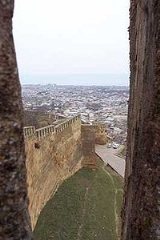
. A large portion of the walls and several watchtowers have been preserved in reasonable shape till our days. The walls, reaching to the sea, date from the 6th century, Sassanid dynasty period. The city has a well preserved citadel (Narin-kala), comprising an area of 45,000 m², enclosed by strong walls. Historical attractions include the baths, the cisterns, the old cemeteries, the caravanserai, the 18th century Khan's mausoleum, as well as several mosques. The oldest mosque is the Juma Mosque, built over a 6th century Christian basilica; it has a 15th century madrassa. Other shrines include the 17th century Kyrhlyar mosque, the Bala mosque and the 18th century Chertebe mosque.

Sister cities

Derbent is twinned with:
  • Ganja, Azerbaijan.
  • La Crosse
    La Crosse, Wisconsin

    La Crosse is a city in and the county seat of La Crosse County, Wisconsin, Wisconsin, United States. The city lies alongside the Mississippi River....
    , USA.


Economy and culture

The city is home to machine building, food, textile, fishing and fishery supplies, construction materials and wood industries. It is the production centre of Russian brandy
Brandy

Brandy is a distilled_beverage produced by Distillation wine, the wine having first been produced by Fermentation grapes. Brandy contains 36%?60% alcohol by volume and is typically taken as an after-dinner drink....
. The education infrastructure is fairly extensive; there is a university as well as several technical schools. On the cultural front, there is a Lezgin drama theatre (S. Stalsky theatre). About two kilometres from the city is the vacation colony of Chayka (Seagull).

Derbent being in practice a huge museum and with magnificent mountains and shore nearby, a great potential for development of the tourism industry exists, further increased by UNESCO
UNESCO

United Nations Educational, Scientific and Cultural Organization is a specialized agency of the United Nations established on 16 November 1945....
's classification of the Citadel, Ancient City and Fortress as a World Heritage Site
World Heritage Site

A UNESCO World Heritage Site is a site that is on the list maintained by the international World Heritage Programme administered by the UNESCO World Heritage Committee, composed of 21 Sovereign state which are elected by their General Assembly for a four-year term....
 in 2003; however, instability in the region has not allowed further development.

External links