
All Topics  
Social realism

 
Social Realism

   Email Print
   Bookmark   Link


Social realism


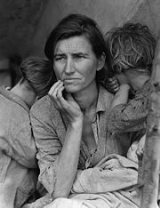
Social Realism, also known as Socio-Realism, is an artistic movement, expressed in the visual and other realist arts
Realism (arts)

Realism in the visual arts and literature is the depiction of subjects as they appear in everyday life, without embellishment or interpretation....
, which depicts working class
Working class

Working class is a term used in academic sociology and in ordinary conversation to describe, depending on context and speaker, those employed in specific fields or types of work....
 activities.

Many artists who subscribed to Social Realism were painter
Painting

Painting is the practice of applying paint, pigment, color or other medium to a surface . In art, the term describes both the act and the result, which is called a painting....
s with socialist
Socialism

Socialism refers to a broad set of economic theories of social organization advocating public or state ownership and administration of the means of production and distribution of goods, and a society characterized by equality for all individuals, with a fair or Egalitarianism method of compensation....
 (but not necessarily Marxist
Marxism

Marxism is the political philosophy and practice derived from the work of Karl Marx and Friedrich Engels. Marxism holds at its core a Marxist analysis of Critique of capitalism and a theory of social change....
) political views. The movement therefore has some commonalities with the Socialist Realism
Socialist realism

Socialist realism is a Teleology-oriented style of realism which has as its purpose the furtherance of the goals of socialism and communism. Although related, it should not be confused with social realism, a type of art that realistically depicts subjects of social concern....
 used in the Soviet Union
Soviet Union

The Union of Soviet Socialist Republics was a Constitution of the Soviet Union socialist state that existed in Eurasia from 1922 to 1991.The name is a translation of the , romanization of Russian Soyuz Sovetskikh Sotsialisticheskikh Respublik, abbreviated ????, SSSR....
 and the Eastern Bloc
Eastern bloc

During the Cold War, the terms Eastern Bloc, Communist Bloc or Soviet Bloc were used to refer to European annexed or expanded Soviet Socialist Republics of the USSR and Satellite state states, including members of the Soviet-dominated organizations Comecon and the Warsaw Pact....
, but the two are not identical - Social Realism is not an official art, and allows space for subjectivity
Subject (philosophy)

In philosophy, a subject is a being which has subjective experiences, subjective consciousness or a relationship with another entity . A subject is an observer and an object is a thing observed....
.


Discussion
Ask a question about 'Social realism'
Start a new discussion about 'Social realism'
Answer questions from other users
Full Discussion Forum


Recent Posts


Encyclopedia


Social Realism, also known as Socio-Realism, is an artistic movement, expressed in the visual and other realist arts
Realism (arts)

Realism in the visual arts and literature is the depiction of subjects as they appear in everyday life, without embellishment or interpretation....
, which depicts working class
Working class

Working class is a term used in academic sociology and in ordinary conversation to describe, depending on context and speaker, those employed in specific fields or types of work....
 activities.

Many artists who subscribed to Social Realism were painter
Painting

Painting is the practice of applying paint, pigment, color or other medium to a surface . In art, the term describes both the act and the result, which is called a painting....
s with socialist
Socialism

Socialism refers to a broad set of economic theories of social organization advocating public or state ownership and administration of the means of production and distribution of goods, and a society characterized by equality for all individuals, with a fair or Egalitarianism method of compensation....
 (but not necessarily Marxist
Marxism

Marxism is the political philosophy and practice derived from the work of Karl Marx and Friedrich Engels. Marxism holds at its core a Marxist analysis of Critique of capitalism and a theory of social change....
) political views. The movement therefore has some commonalities with the Socialist Realism
Socialist realism

Socialist realism is a Teleology-oriented style of realism which has as its purpose the furtherance of the goals of socialism and communism. Although related, it should not be confused with social realism, a type of art that realistically depicts subjects of social concern....
 used in the Soviet Union
Soviet Union

The Union of Soviet Socialist Republics was a Constitution of the Soviet Union socialist state that existed in Eurasia from 1922 to 1991.The name is a translation of the , romanization of Russian Soyuz Sovetskikh Sotsialisticheskikh Respublik, abbreviated ????, SSSR....
 and the Eastern Bloc
Eastern bloc

During the Cold War, the terms Eastern Bloc, Communist Bloc or Soviet Bloc were used to refer to European annexed or expanded Soviet Socialist Republics of the USSR and Satellite state states, including members of the Soviet-dominated organizations Comecon and the Warsaw Pact....
, but the two are not identical - Social Realism is not an official art, and allows space for subjectivity
Subject (philosophy)

In philosophy, a subject is a being which has subjective experiences, subjective consciousness or a relationship with another entity . A subject is an observer and an object is a thing observed....
. In certain contexts, Socialist Realism has been described as a specific branch of Social Realism.

Social Realism has been summarized as follows:

Social Realism developed as a reaction against idealism and the exaggerated ego encouraged by Romanticism. Consequences of the Industrial Revolution became apparent; urban centers grew, slums proliferated on a new scale contrasting with the display of wealth of the upper classes. With a new sense of social consciousness, the Social Realists pledged to “fight the beautiful art”, any style which appealed to the eye or emotions. They focused on the ugly realities of contemporary life and sympathized with working-class people, particularly the poor. They recorded what they saw (“as it existed”) in a dispassionate manner. The public was outraged by Social Realism, in part, because they didn't know how to look at it or what to do with it (George Shi, University of Fine Arts, Valencia)


In France and the Soviet Union

Realism, a style of painting that depicts the actuality of what the eyes can see, was a very popular art form in France
France

France , officially the French Republic , is a country whose Metropolitan France is located in Western Europe and that also comprises various Overseas departments and territories of France....
 around the mid to late 1800’s. It came about with the introduction of photography
Photography

Photography is the process, activity and art of creating still or moving by recording radiation on a sensitive medium, such as a photographic film, or an ....
 - a new visual source that created a desire for people to produce things that look “objectively real” . Realism was heavily against romanticism
Romanticism

Romanticism is a complex artistic, literary, and intellectual movement that originated in the second half of the 18th century in Western Europe, and gained strength during the Industrial Revolution....
, a genre dominating French literature and artwork in the mid 19th century. Undistorted by personal bias, Realism believed in the ideology of external reality and revolted against exaggerated emotionalism
Emotionalism

Emotionalism means "an inclination to rely on or place too much value on emotion." It could be argued that very few, if any, thinkers would call themselves "emotionalists", but rather that it would be a derogatory term applied to them, possibly for exhibiting a wiktionary:zeal demeanor, which may be interpreted as an appeal to emoti...
. Truth and accuracy became the goals of many Realists.

From that important trend of Realism in France, came the development of Socialist Realism
Socialist realism

Socialist realism is a Teleology-oriented style of realism which has as its purpose the furtherance of the goals of socialism and communism. Although related, it should not be confused with social realism, a type of art that realistically depicts subjects of social concern....
, which was to dominate Soviet culture and artistic expression for over 60 years. Socialist Realism, representing socialist ideologies, was an art movement that represented social and political contemporary life in the 1930’s, from a left-wing standpoint. It depicted subjects of social concern; the proletariat
Proletariat

The proletariat is a term used to identify a lower social class; a member of such a class is proletarian. Originally it was identified as those people who had no wealth other than their sons....
 struggle - hardships of every day life that the working class had to put up with, and heroically emphasized the values of the loyal communist workers. Social Realism was critical of the social environment
Social environment

The social environment ,also known as the milieu, is the identical or similar social positions and social roles as a whole that influence the individuals of a group....
 that caused the conditions pictured, and denounced the “evil” Tsarist period. Ilya Repin, a famous Social Realist said that his art work was aimed “To criticize all the monstrosities of our vile society” of the Tsarist period. The Ideology behind Social Realism by depicting the heroism of the working class was to promote and spark revolutionary
Revolutionary

A revolutionary is a person who either actively participates in, or advocates revolution. Also, when used as an adjective, the term revolutionary refers to something that has a major, sudden impact on society or on some aspect of human endeavour....
 actions and to spread the image of optimism and the importance of productiveness. Keeping people optimistic meant creating a strong sense of nationalism
Nationalism

Nationalism refers to an ideology, a feeling, a form of culture, or a social movement that focuses on the nation. While there is significant debate over the historical origins of nations, nearly all Expert accept that nationalism, at least as an ideology and social movement, is a Modernity phenomenon originating in Europe....
 and patriotism
Patriotism

Patriotism is commonly defined as love of and/or devotion to one's country. The word comes from the Latin language, patria, and Greek language patritha. However, patriotism has had different meanings over time, and its meaning is highly dependent upon context, geography and philosophy....
, which would prove very important in the struggle to produce a successful socialist nation. The Unions Newspaper, the Literary Gazette, described Social Realism as “the representation of the proletarian revolution”. During Stalin’s reign it was most important to use socialist Realism as a form of propaganda
Propaganda

Propaganda is the dissemination of information aimed at influencing the opinions or behaviors of large numbers of people. As opposed to Objectivity providing information, propaganda in its most basic sense presents information in order to influence its audience....
 in posters, as it kept people optimistic and encourage greater productive effort, a necessity in his aim of developing Russia
Russia

Russia , or the Russian Federation , is a list of countries spanning more than one continent country extending over much of northern Eurasia....
 into an industrialised nation.

Lenin believed that art should belong to the people and should stand on the side of the proletariat, “Art should be based on their feelings, thoughts and demands, and should grow along with them”, said Lenin. He believed that all soviet art forms should “expose crimes of capitalism and praise socialism...created to inspire readers and viewers to stand up for the revolution”. After the revolution of 1917 leaders of the newly formed communist party were encouraging experimentation of different art types. Lenin believed that the style of art the USSR should endorse would have to be easy to understand (ruling out abstract art such as suprematism
Suprematism

Suprematism : is an art movement focused on fundamental geometric forms which formed in Russia in 1915-1916.When Kasimir Malevich originated Suprematism in 1915 he was an established painter having exhibited in the Donkey's Tail and the Der Blaue Reiter exhibitions of 1912 with cubo-futurism works....
 and constructivism
Constructivism (art)

Constructivism was an artistic and architecture movement that originated in Russia from 1919 onward which rejected the idea of "art for art's sake" in favour of art as a practice directed towards social purposes....
) in relating to the masses of illiterate people of Russia. A wide ranging debate on Art took place, the main disagreement was between those who believed in "Proletarian Art" which should have no connections with past art coming out of bourgeois society, and those (most vociferously Trotsky) who believed that Art in a society dominated by working class values had to absorb all the lessons of bourgeois Art before it could move forward at all.

The taking of power by Stalin's faction had its corollary in the establishment of an official art: on 23 April 1932, headed by Stalin, an organisation formed by the central committee of the Communist Party developed the Union of Soviet Writers. This organisation endorsed the newly designated ideology of social realism.

By 1934 all other independent art groups were abolished, making it nearly impossible for someone not involved in the Union of Soviet Writers to get work published. Any literary piece or painting that did not endorse the ideology of social realism was censored and/or banned. This new art movement, introduced under Joseph Stalin, was one of the most practical and durable artistic approaches of the twentieth century; with the communist revolution came also a cultural revolution. It also gave Stalin and his Communist Party greater control over Soviet culture; restricting people from expressing alternative geopolitical ideologies that differed to those represented in Socialist Realism. The decline of Social Realism came with fall of the Soviet Union in 1991.

See also

  • Naturalism (art)
    Naturalism (art)

    Naturalism in art refers to the depiction of realistic objects in a natural setting. The realism movement of the 19th century advocated naturalism in reaction to the stylized and idealized depictions of subjects in Romanticism, but many painters have adopted a similar approach over the centuries....
  • Kitchen sink realism
    Kitchen sink realism

    Kitchen sink realism was an England cultural movement which developed in the late 1950s and early 1960s in theatre, art, novels, film and television plays....