

Crime of apartheid

Encyclopedia
Rome Statute of the International Criminal Court
The Rome Statute of the International Criminal Court is the treaty that established the International Criminal Court . It was adopted at a diplomatic conference in Rome on 17 July 1998 and it entered into force on 1 July 2002. As of 13 October 2011, 119 states are party to the statute...
as inhumane acts of a character similar to other crimes against humanity "committed in the context of an institutionalized regime of systematic oppression
Oppression
Oppression is the exercise of authority or power in a burdensome, cruel, or unjust manner. It can also be defined as an act or instance of oppressing, the state of being oppressed, and the feeling of being heavily burdened, mentally or physically, by troubles, adverse conditions, and...
and domination
Dominance hierarchy
A dominance hierarchy is the organization of individuals in a group that occurs when competition for resources leads to aggression...
by one racial group over any other racial group or groups and committed with the intention of maintaining that regime."
On 30 November 1973, the United Nations
United Nations
The United Nations is an international organization whose stated aims are facilitating cooperation in international law, international security, economic development, social progress, human rights, and achievement of world peace...
General Assembly
United Nations General Assembly
For two articles dealing with membership in the General Assembly, see:* General Assembly members* General Assembly observersThe United Nations General Assembly is one of the five principal organs of the United Nations and the only one in which all member nations have equal representation...
opened for signature and ratification the International Convention on the Suppression and Punishment of the Crime of Apartheid. It defined the crime of apartheid as "inhuman acts committed for the purpose of establishing and maintaining domination by one racial group of persons over any other racial group of persons and systematically oppressing them."
History
The term apartheid, from AfrikaansAfrikaans
Afrikaans is a West Germanic language, spoken natively in South Africa and Namibia. It is a daughter language of Dutch, originating in its 17th century dialects, collectively referred to as Cape Dutch .Afrikaans is a daughter language of Dutch; see , , , , , .Afrikaans was historically called Cape...
for "apartness," was the official name of the South African system of racial segregation
History of South Africa in the apartheid era
Apartheid was a system of racial segregation enforced by the National Party governments of South Africa between 1948 and 1994, under which the rights of the majority 'non-white' inhabitants of South Africa were curtailed and white supremacy and Afrikaner minority rule was maintained...
which existed after 1948. Complaints about the system were brought to the United Nations as early as 12 July 1948 when Dr. Padmanabha Pillai, the representative of India
India
India , officially the Republic of India , is a country in South Asia. It is the seventh-largest country by geographical area, the second-most populous country with over 1.2 billion people, and the most populous democracy in the world...
to the United Nations, circulated a letter to the Secretary-General expressing his concerns over treatment of ethnic Indians within the Union of South Africa
Union of South Africa
The Union of South Africa is the historic predecessor to the present-day Republic of South Africa. It came into being on 31 May 1910 with the unification of the previously separate colonies of the Cape, Natal, Transvaal and the Orange Free State...
. As it became more widely known, South African apartheid was condemned internationally as unjust and racist and many decided that a formal legal framework was needed in order to apply international pressure on the South African government.
In 1971, the Union of Soviet Socialist Republics (more commonly known as the Soviet Union or USSR) and Guinea
Guinea
Guinea , officially the Republic of Guinea , is a country in West Africa. Formerly known as French Guinea , it is today sometimes called Guinea-Conakry to distinguish it from its neighbour Guinea-Bissau. Guinea is divided into eight administrative regions and subdivided into thirty-three prefectures...
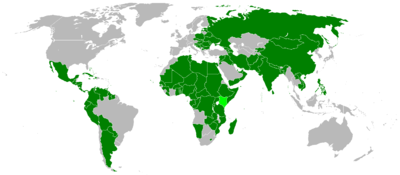
together submitted early drafts of a convention to deal with the suppression and punishment of apartheid. In 1973, the General Assembly of the United Nations agreed on the text of the International Convention on the Suppression and Punishment of the Crime of Apartheid (ICSPCA). The Convention has 31 signatories and 107 parties.
"As such, apartheid was declared to be a crime against humanity
Crime against humanity
Crimes against humanity, as defined by the Rome Statute of the International Criminal Court Explanatory Memorandum, "are particularly odious offenses in that they constitute a serious attack on human dignity or grave humiliation or a degradation of one or more human beings...
, with a scope that went far beyond South Africa. While the crime of apartheid is most often associated with the racist policies of South Africa after 1948, the term more generally refers to racially based policies in any state."
Seventy-six other countries subsequently signed on, but a number of nations have neither signed nor ratified the ICSPCA, including Canada, France, Germany, Israel, Italy, the Netherlands, the United Kingdom, Australia, New Zealand and the United States. In explanation of the US vote against the convention, Ambassador Clarence Clyde Ferguson Jr.
Clarence Clyde Ferguson Jr.
Clarence Clyde Ferguson Jr. was a professor of law and an United States Ambassador to Uganda.Having experienced the horrors of World War II, as a diplomat he "labored tirelessly to safeguard and extend the fundamental freedoms" essential to world peace. He was the main proponent in many decisions...
said: "[W]e cannot...accept that apartheid can in this manner be made a crime against humanity. Crimes against humanity are so grave in nature that they must be meticulously elaborated and strictly construed under existing international law..."
In 1977, Addition Protocol 1 to the Geneva Conventions designated apartheid as a grave breach of the Protocol and a war crime. There are 169 parties to the Protocol.
The International Criminal Court
International Criminal Court
The International Criminal Court is a permanent tribunal to prosecute individuals for genocide, crimes against humanity, war crimes, and the crime of aggression .It came into being on 1 July 2002—the date its founding treaty, the Rome Statute of the...
provides for individual criminal responsibility for crimes against humanity, including the crime of apartheid.
The International Criminal Court (ICC) came into being on 1 July 2002, and can only prosecute crimes committed on or after that date. The Court can generally only exercise jurisdiction in cases where the accused is a national of a state party, the alleged crime took place on the territory of a state party, or a situation is referred to the Court by the United Nations Security Council
United Nations Security Council
The United Nations Security Council is one of the principal organs of the United Nations and is charged with the maintenance of international peace and security. Its powers, outlined in the United Nations Charter, include the establishment of peacekeeping operations, the establishment of...
. The ICC exercises complimentary jurisdiction. Many of the member states have provided their own national courts with universal jurisdiction over the same offenses and do not recognize any statute of limitations for crimes against humanity. As of July 2008, 106 countries are states parties (with Suriname
Suriname
Suriname , officially the Republic of Suriname , is a country in northern South America. It borders French Guiana to the east, Guyana to the west, Brazil to the south, and on the north by the Atlantic Ocean. Suriname was a former colony of the British and of the Dutch, and was previously known as...
and Cook Islands
Cook Islands
The Cook Islands is a self-governing parliamentary democracy in the South Pacific Ocean in free association with New Zealand...
set to join in October 2008), and a further 40 countries have signed but not yet ratified the treaty. However, many of the world's most populous nations, including China
China
Chinese civilization may refer to:* China for more general discussion of the country.* Chinese culture* Greater China, the transnational community of ethnic Chinese.* History of China* Sinosphere, the area historically affected by Chinese culture...
, India
India
India , officially the Republic of India , is a country in South Asia. It is the seventh-largest country by geographical area, the second-most populous country with over 1.2 billion people, and the most populous democracy in the world...
, the United States
United States
The United States of America is a federal constitutional republic comprising fifty states and a federal district...
, Indonesia
Indonesia
Indonesia , officially the Republic of Indonesia , is a country in Southeast Asia and Oceania. Indonesia is an archipelago comprising approximately 13,000 islands. It has 33 provinces with over 238 million people, and is the world's fourth most populous country. Indonesia is a republic, with an...
, and Pakistan
Pakistan
Pakistan , officially the Islamic Republic of Pakistan is a sovereign state in South Asia. It has a coastline along the Arabian Sea and the Gulf of Oman in the south and is bordered by Afghanistan and Iran in the west, India in the east and China in the far northeast. In the north, Tajikistan...
are not parties to the Court and therefore are not subject to its jurisdiction, except by Security Council referral.
ICSPCA definition of the crime of apartheid
Article II of the ICSPCA defines the crime of apartheid as follows:
Article II
For the purpose of the present Convention, the term 'the crime of apartheid', which shall include similar policies and practices of racial segregation
Racial segregation
Racial segregation is the separation of humans into racial groups in daily life. It may apply to activities such as eating in a restaurant, drinking from a water fountain, using a public toilet, attending school, going to the movies, or in the rental or purchase of a home...
and discrimination as practiced in southern Africa
Southern Africa
Southern Africa is the southernmost region of the African continent, variably defined by geography or geopolitics. Within the region are numerous territories, including the Republic of South Africa ; nowadays, the simpler term South Africa is generally reserved for the country in English.-UN...
, shall apply to the following inhumane acts committed for the purpose of establishing and maintaining domination by one racial group of persons over any other racial group of persons and systematically oppressing them:
- Denial to a member or members of a racial group or groups of the right to lifeRight to lifeRight to life is a phrase that describes the belief that a human being has an essential right to live, particularly that a human being has the right not to be killed by another human being...
and libertyLibertyLiberty is a moral and political principle, or Right, that identifies the condition in which human beings are able to govern themselves, to behave according to their own free will, and take responsibility for their actions...
of person
- By murder of members of a racial group or groups;
- By the infliction upon the members of a racial group or groups of serious bodilyBodily harmBodily harm is a legal term of art used in the definition of both statutory and common law offences in Australia, Canada, England and Wales and other common law jurisdictions. It is a synonym for injury or bodily injury and similar expressions, though it may be used with a precise and limited...
or mental harmPsychological traumaPsychological trauma is a type of damage to the psyche that occurs as a result of a traumatic event...
, by the infringement of their freedom or dignity, or by subjecting them to tortureTortureTorture is the act of inflicting severe pain as a means of punishment, revenge, forcing information or a confession, or simply as an act of cruelty. Throughout history, torture has often been used as a method of political re-education, interrogation, punishment, and coercion...
or to cruel, inhuman or degrading treatment or punishment; - By arbitrary arrest and illegal imprisonment of the members of a racial group or groups;
- Deliberate imposition on a racial group or groups of living conditions calculated to cause its or their physical destruction in whole or in part;
- Any legislative measures and other measures calculated to prevent a racial group or groups from participation in the political, social, economic and cultural life of the country and the deliberate creation of conditions preventing the full development of such a group or groups, in particular by denying to members of a racial group or groups basic human rights and freedoms, including the right to workRight to workThe right to work is the concept that people have a human right to work, or engage in productive employment, and may not be prevented from doing so...
, the right to form recognised trade unions, the right to education, the right to leaveIllegal emigrationIllegal emigration refers to a person moving across national borders in a way that violates emigration laws. Such a person may legally go abroad and refuse to return when demanded by the country of origin....
and to returnRight of returnThe term right of return refers to a principle of international law, codified in the Universal Declaration of Human Rights and the International Covenant on Civil and Political Rights, giving any person the right to return to, and re-enter, his or her country of origin...
to their country, the right to a nationalityNationality lawNationality law is the branch of law concerned with the questions of nationality and citizenship, and how these statuses are acquired, transmitted, or lost. By custom, a state has the right to determine who its nationals and citizens are. Such determinations are usually made by custom, statutory...
, the right to freedom of movementFreedom of movementFreedom of movement, mobility rights or the right to travel is a human right concept that the constitutions of numerous states respect...
and residence, the right to freedom of opinion and expression, and the right to freedom of peaceful assemblyFreedom of assemblyFreedom of assembly, sometimes used interchangeably with the freedom of association, is the individual right to come together and collectively express, promote, pursue and defend common interests...
and associationFreedom of associationFreedom of association is the individual right to come together with other individuals and collectively express, promote, pursue and defend common interests....
; - Any measures including legislative measures, designed to divide the population along racial lines by the creation of separate reserves and ghettoGhettoA ghetto is a section of a city predominantly occupied by a group who live there, especially because of social, economic, or legal issues.The term was originally used in Venice to describe the area where Jews were compelled to live. The term now refers to an overcrowded urban area often associated...
s for the members of a racial group or groups, the prohibition of mixed marriageInterracial marriageInterracial marriage occurs when two people of differing racial groups marry. This is a form of exogamy and can be seen in the broader context of miscegenation .-Legality of interracial marriage:In the Western world certain jurisdictions have had regulations...
s among members of various racial groups, the expropriationNationalizationNationalisation, also spelled nationalization, is the process of taking an industry or assets into government ownership by a national government or state. Nationalization usually refers to private assets, but may also mean assets owned by lower levels of government, such as municipalities, being...
of landed property belonging to a racial group or groups or to members thereof; - Exploitation of the labour of the members of a racial group or groups, in particular by submitting them to forced labour;
- PersecutionPersecutionPersecution is the systematic mistreatment of an individual or group by another group. The most common forms are religious persecution, ethnic persecution, and political persecution, though there is naturally some overlap between these terms. The inflicting of suffering, harassment, isolation,...
of organizations and persons, by depriving them of fundamental rights and freedoms, because they oppose apartheid.
Definition of racial discrimination
According to the United NationsUnited Nations
The United Nations is an international organization whose stated aims are facilitating cooperation in international law, international security, economic development, social progress, human rights, and achievement of world peace...
Convention on the Elimination of All Forms of Racial Discrimination
Convention on the Elimination of All Forms of Racial Discrimination
The International Convention on the Elimination of All Forms of Racial Discrimination is a United Nations convention. A second-generation human rights instrument, the Convention commits its members to the elimination of racial discrimination and the promotion of understanding among all races...
,
the term "racial discrimination" shall mean any distinction, exclusion, restriction or preference based on race, colour, descentCultural heritageCultural heritage is the legacy of physical artifacts and intangible attributes of a group or society that are inherited from past generations, maintained in the present and bestowed for the benefit of future generations...
, or national or ethnic origin which has the purpose or effect of nullifying or impairing the recognition, enjoyment or exercise, on an equal footing, of human rightsHuman rightsHuman rights are "commonly understood as inalienable fundamental rights to which a person is inherently entitled simply because she or he is a human being." Human rights are thus conceived as universal and egalitarian . These rights may exist as natural rights or as legal rights, in both national...
and fundamental freedoms in the political, economic, social, cultural or any other field of public life.
This definition does not make any difference between discrimination based on ethnicity and race, in part because the distinction between the two remains debatable among anthropologists
Anthropology
Anthropology is the study of humanity. It has origins in the humanities, the natural sciences, and the social sciences. The term "anthropology" is from the Greek anthrōpos , "man", understood to mean mankind or humanity, and -logia , "discourse" or "study", and was first used in 1501 by German...
. Similarly, in British law the phrase racial group means "any group of people who are defined by reference to their race, colour, nationality (including citizenship) or ethnic or national origin".
ICC definition of the crime of apartheid
Article 7 of the Rome Statute of the International Criminal CourtRome Statute of the International Criminal Court
The Rome Statute of the International Criminal Court is the treaty that established the International Criminal Court . It was adopted at a diplomatic conference in Rome on 17 July 1998 and it entered into force on 1 July 2002. As of 13 October 2011, 119 states are party to the statute...
defines crimes against humanity as:
Article 7
Crimes against humanity
- For the purpose of this Statute, 'crime against humanity' means any of the following acts when committed as part of a widespread or systematic attack directed against any civilian population, with knowledge of the attack:
- Murder;
- Extermination;
- Enslavement;
- Deportation or forcible transfer of population;
- Imprisonment or other severe deprivation of physical liberty in violation of fundamental rules of international law;
- Torture
TortureTorture is the act of inflicting severe pain as a means of punishment, revenge, forcing information or a confession, or simply as an act of cruelty. Throughout history, torture has often been used as a method of political re-education, interrogation, punishment, and coercion...
;
- Rape, sexual slavery, enforced prostitution, forced pregnancy, enforced sterilization, or any other form of sexual violence of comparable gravity;
- Persecution against any identifiable group or collectivity on political, racial, national, ethnic, cultural, religious, gender as defined in paragraph 3, or other grounds that are universally recognized as impermissible under international law, in connection with any act referred to in this paragraph or any crime within the jurisdiction of the Court;
- Enforced disappearance of persons;
- The crime of apartheid;
- Other inhumane acts of a similar character intentionally causing great suffering, or serious injury to body or to mental or physical health.
Later in Article 7, the crime of apartheid is defined as:
The 'crime of apartheid' means inhumane acts of a character similar to those referred to in paragraph 1, committed in the context of an institutionalised regime of systematic oppression and domination by one racial group over any other racial group or groups and committed with the intention of maintaining that regime.
Allegations against Israel
Activists for Palestinian rights have accused Israel of committing the crime of apartheid. For example, in 2006, at the UN-sponsored International Conference of Civil Society in Support of the Palestinian People, Phyllis Bennis, co-chair of the International Coordinating Network on Palestine alleged that "Once again, the crime of apartheid [is] being committed by a United Nations Member State [Israel]." Zahir Kolliah has written that "In South Africa and in Palestine the indigenous populations live under apartheid regimes 'settler colonies' as described by the International Convention on the Suppression and Punishment of the Crime of Apartheid". Hazeem Jamjoum states in a 2009 article that "In terms of law, describing Israel as an apartheid state does not revolve around levels of difference and similarity with the policies and practices of the South African Apartheid regime" because apartheid is a universal crime under international law.Such accusations have recently been picked up in documents of the United Nations. In a 2007 report, United Nations Special Rapporteur for Palestine John Dugard stated that "elements of the Israeli occupation constitute forms of colonialism and of apartheid, which are contrary to international law" and suggested that the "legal consequences of a prolonged occupation with features of colonialism and apartheid" be put to the International Court of Justice
International Court of Justice
The International Court of Justice is the primary judicial organ of the United Nations. It is based in the Peace Palace in The Hague, Netherlands...
. South Africa's statutory research agency the Human Sciences Research Council
Human Sciences Research Council (South Africa)
The Human Sciences Research Council of South Africa primarily conducts large-scale, policy-relevant, social-scientific projects for public-sector users, non governmental organisations and international development agencies in support of development nationally, in the Southern African Development...
(HSRC) stated in a 2009 report that "the State of Israel exercises control in the [Occupied Palestinian Territories] with the purpose of maintaining a system of domination by Jews over Palestinians and that this system constitutes a breach of the prohibition of apartheid." Based on these findings, Richard Falk, the successor of John Dugard as UN Special Rapporteur for Palestine has detailed some of the indicators of apartheid in the occupied territories :
- preferential citizenship, visitation and residence laws and practices that prevent Palestinians who reside in the West Bank or Gaza from reclaiming their property or from acquiring Israeli citizenship, as contrasted to a Jewish right of return that entitles Jews anywhere in the world with no prior tie to Israel to visit, reside and become Israeli citizens;
- differential laws in the West Bank and East Jerusalem favouring Jewish settlers who are subject to Israeli civilian law and constitutional protection, as opposed to Palestinian residents, who are governed by military administration;
- dual and discriminatory arrangements for movement in the West Bank and to and from Jerusalem; discriminatory policies on land ownership, tenure and use; extensive burdening of Palestinian movement, including checkpoints applying differential limitations on Palestinians and on Israeli settlers, and onerous permit and identification requirements imposed only on Palestinians;
- punitive house demolitions, expulsions and restrictions on entry and exit from all three parts of the Occupied Palestinian Territories.
The Special Rapporteur concludes that this "general structure of apartheid that exists in the Occupied Palestinian Territories ... makes the allegation increasingly credible despite the differences between the specific characteristics of South African apartheid and that of the Occupied Palestinian Territories regime".
South Africa
South Africa
The Republic of South Africa is a country in southern Africa. Located at the southern tip of Africa, it is divided into nine provinces, with of coastline on the Atlantic and Indian oceans...
n Judge Richard Goldstone
Richard Goldstone
Richard Joseph Goldstone is a South African former judge. After working for 17 years as a commercial lawyer, he was appointed by the South African government to serve on the Transvaal Supreme Court from 1980 to 1989 and the Appellate Division of the Supreme Court of South Africa from 1990 to 1994...
, writing in The New York Times
The New York Times
The New York Times is an American daily newspaper founded and continuously published in New York City since 1851. The New York Times has won 106 Pulitzer Prizes, the most of any news organization...
in October 2011, said that "in Israel, there is no apartheid. Nothing there comes close to the definition of apartheid under the 1998 Rome Statute." Goldstone noted that Arab citizens of Israel
Arab citizens of Israel
Arab citizens of Israel refers to citizens of Israel who are not Jewish, and whose cultural and linguistic heritage or ethnic identity is Arab....
are allowed to vote, have political parties, and hold seats in the Knesset
Knesset
The Knesset is the unicameral legislature of Israel, located in Givat Ram, Jerusalem.-Role in Israeli Government :The legislative branch of the Israeli government, the Knesset passes all laws, elects the President and Prime Minister , approves the cabinet, and supervises the work of the government...
and other positions, including one on the Israeli Supreme Court
Supreme Court of Israel
The Supreme Court is at the head of the court system and highest judicial instance in Israel. The Supreme Court sits in Jerusalem.The area of its jurisdiction is all of Israel and the Israeli-occupied territories. A ruling of the Supreme Court is binding upon every court, other than the Supreme...
. Goldstone wrote that the situation in the West Bank was more complex, but that there is no attempt to maintain "an institutionalized regime of systematic oppression and domination by one racial group", and claimed that the seemingly oppressive measures taken by Israel were taken to protect its own citizens from attacks by Palestinian militants.
Israeli journalist Yonatan Silverman wrote in Ynetnews
Ynetnews
Ynetnews is the online English language Israeli news website of Yedioth Ahronoth, Israel’s most-read newspaper, and the Hebrew Israel news portal, Ynet...
that while inequality and injustice existed in the West Bank, Israel was not an apartheid state. Silverman wrote that while South Africa was a legally segretated society, Israel's actions in the West Bank are not rooted in legislation and stem from security concerns rather than racial bias.
See also
- Racial segregationRacial segregationRacial segregation is the separation of humans into racial groups in daily life. It may apply to activities such as eating in a restaurant, drinking from a water fountain, using a public toilet, attending school, going to the movies, or in the rental or purchase of a home...
- Israel and the apartheid analogy
- Human rights in MyanmarHuman rights in MyanmarMembers of the United Nations and major international human rights organisations have issued repeated and consistent reports of widespread and systematic human rights violations in Burma...
- Human rights in North KoreaHuman rights in North KoreaThe human rights record of North Korea is extremely hard to fully assess due to the secretive and closed nature of the country. The North Korean government makes it very difficult for foreigners to enter the country and strictly monitors their activities when they do...
- Human rights in Saudi ArabiaHuman rights in Saudi ArabiaHuman rights in Saudi Arabia are intended to be based on Islamic religious laws under rule of the Saudi royal family. The government of Saudi Arabia, and the Saudi legal system, has been criticized for its treatment of religious and political minorities, homosexuals, apostates, and women...
- Human rights in South AfricaHuman rights in South AfricaHuman rights in South Africa are protected under the constitution. The 2009 Human Rights Report by the United States Department of State noted that the government generally respected the rights of the citizens, however there were concerns over the use of force by law enforcement, legal proceedings...
- Human rights in SudanHuman rights in SudanSome human rights organizations have documented a variety of abuses and atrocities carried out by the Sudanese government over the past several years...
– events here led to the secession of South SudanSouth SudanSouth Sudan , officially the Republic of South Sudan, is a landlocked country located in the Sahel region of northeastern Africa. It is also part of the North Africa UN sub-region. Its current capital is Juba, which is also its largest city; the capital city is planned to be moved to the more... - Human rights in ZimbabweHuman rights in ZimbabweThere are widespread reports of systematic and escalating violations of human rights in Zimbabwe under the Mugabe administration and his party, ZANU-PF....
- Nazi GermanyNazi GermanyNazi Germany , also known as the Third Reich , but officially called German Reich from 1933 to 1943 and Greater German Reich from 26 June 1943 onward, is the name commonly used to refer to the state of Germany from 1933 to 1945, when it was a totalitarian dictatorship ruled by...
- White Australia PolicyWhite Australia policyThe White Australia policy comprises various historical policies that intentionally restricted "non-white" immigration to Australia. From origins at Federation in 1901, the polices were progressively dismantled between 1949-1973....
External links
- Human Sciences Research Council: Occupation, Colonialism, Apartheid? A re-assessment of Israel’s practices in the occupied Palestinian territories under international law. Cape Town 2009
- Richard Falk:Report of the Special Rapporteur on the situation of human rights in the Palestinian territories occupied since 1967, Report to the UN General Assembly, 30.August 2010, sec. 5
- Human Rights Watch Report: Separate and Unequal. Israel’s Discriminatory Treatment of Palestinians in the Occupied Palestinian Territories, December 19 2010