


Ammonian Sections

Encyclopedia
Late Antiquity
Late Antiquity is a periodization used by historians to describe the time of transition from Classical Antiquity to the Middle Ages, in both mainland Europe and the Mediterranean world. Precise boundaries for the period are a matter of debate, but noted historian of the period Peter Brown proposed...
and the Middle Ages
Middle Ages
The Middle Ages is a periodization of European history from the 5th century to the 15th century. The Middle Ages follows the fall of the Western Roman Empire in 476 and precedes the Early Modern Era. It is the middle period of a three-period division of Western history: Classic, Medieval and Modern...
. The divisions into chapters and verses used in modern texts date only from the 13th and 16th centuries, respectively. The sections are indicated in the margin of nearly all Greek and Latin manuscripts of the Bible
Bible
The Bible refers to any one of the collections of the primary religious texts of Judaism and Christianity. There is no common version of the Bible, as the individual books , their contents and their order vary among denominations...
, and usually summarized in Canon Tables at the start of the Gospels (see below). There are about 1165 sections: 355 for Matthew
Gospel of Matthew
The Gospel According to Matthew is one of the four canonical gospels, one of the three synoptic gospels, and the first book of the New Testament. It tells of the life, ministry, death, and resurrection of Jesus of Nazareth...
, 235 for Mark
Gospel of Mark
The Gospel According to Mark , commonly shortened to the Gospel of Mark or simply Mark, is the second book of the New Testament. This canonical account of the life of Jesus of Nazareth is one of the three synoptic gospels. It was thought to be an epitome, which accounts for its place as the second...
, 343 for Luke
Gospel of Luke
The Gospel According to Luke , commonly shortened to the Gospel of Luke or simply Luke, is the third and longest of the four canonical Gospels. This synoptic gospel is an account of the life and ministry of Jesus of Nazareth. It details his story from the events of his birth to his Ascension.The...
, and 232 for John
Gospel of John
The Gospel According to John , commonly referred to as the Gospel of John or simply John, and often referred to in New Testament scholarship as the Fourth Gospel, is an account of the public ministry of Jesus...
; the numbers, however, vary slightly in different manuscripts.
Authorship
Until the 19th century it was mostly believed that these divisions were devised by Ammonius of AlexandriaAmmonius of Alexandria (Christian)
Ammonius of Alexandria was a Christian philosopher who lived in the 3rd century. He is not to be confused with Ammonius Saccas, the Neoplatonist philosopher, also from Alexandria....
, at the beginning of the 3rd century (c.
Circa
Circa , usually abbreviated c. or ca. , means "approximately" in the English language, usually referring to a date...
220), in connection with a Harmony of the Gospels, now lost, which he composed. It was traditionally believed that he divided the four Gospels into small numbered sections, which were similar in content where the narratives are parallel. He then wrote the sections of the three last Gospels, or simply the section numbers with the name of the respective evangelist
Four Evangelists
In Christian tradition the Four Evangelists are Matthew, Mark, Luke, and John, the authors attributed with the creation of the four Gospel accounts in the New Testament that bear the following titles:*Gospel according to Matthew*Gospel according to Mark...
, in parallel columns opposite the corresponding sections of the Gospel of Matthew, which he had chosen as the basis of his Gospel Harmony
Gospel harmony
A Gospel harmony is an attempt to merge or harmonize the canonical gospels of the Four Evangelists into a single gospel account, the earliest known example being the Diatesseron by Tatian in the 2nd century. A gospel harmony may also establish a chronology for the events of the life of Jesus...
. Now it is believed that the work of Ammonius was restricted to what Eusebius of Caesarea
Eusebius of Caesarea
Eusebius of Caesarea also called Eusebius Pamphili, was a Roman historian, exegete and Christian polemicist. He became the Bishop of Caesarea in Palestine about the year 314. Together with Pamphilus, he was a scholar of the Biblical canon...
(265-340) states concerning it in his letter to Carpianus (Epistula ad Carpianum
Epistula ad Carpianum
The Epistula ad Carpianum is the title traditionally given to a letter from Eusebius of Caesarea to a Christian named Carpianus....
), namely, that he placed the parallel passages of the last three Gospels alongside the text of Matthew, and the sections traditionally credited to Ammonius are now ascribed to Eusebius, who was always credited with the final form of the tables.
The Eusebian Tables
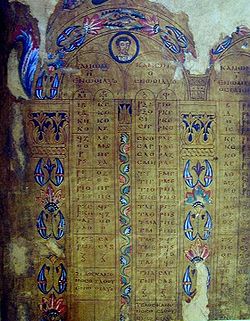
The Harmony of Ammonius suggested to Eusebius, as he himself tells us in his letter, the idea of drawing up ten tables (kanones) in which the sections in question were so classified as to show at a glance where each Gospel agreed with or differed from the others. In the first nine tables he placed in parallel columns the numbers of the sections common to the four, or three, or two, evangelists; namely: (1) Matt., Mark, Luke, John; (2) Matt., Mark, Luke; (3) Matt., Luke, John; (4) Matt., Mark, John; (5) Matt., Luke; (6) Matt., Mark; (7) Matt., John; (8) Luke, Mark; (9) Luke, John. In the tenth he noted successively the sections special to each evangelist.The usefulness of these tables for the purpose of reference and comparison soon brought them into common use, and from the 5th century the Ammonian sections, with references to the Eusebian tables, were indicated in the margin of the manuscripts. Opposite each section was written its number, and underneath this the number of the Eusebian table to be consulted in order to find the parallel texts or text; a reference to the tenth table would of course show that this section was proper to that evangelist. These marginal notes are reproduced in several editions of Tischendorf
Constantin von Tischendorf
Lobegott Friedrich Constantin Tischendorf was a noted German Biblical scholar. He deciphered the Codex Ephraemi Rescriptus, a 5th century Greek manuscript of the New Testament, in the 1840s, and rediscovered the Codex Sinaiticus, a 4th century New Testament manuscript, in 1859.Tischendorf...
's New Testament.
Eusebius's explanatory letter to Carpianus was also very often reproduced before the tables.
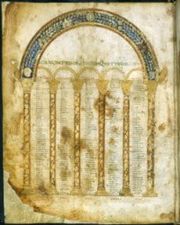
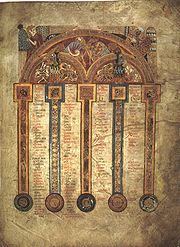
Illuminated Canon Tables
The tables themselves were usually placed at the start of a Gospel BookGospel Book
The Gospel Book, Evangelion, or Book of the Gospels is a codex or bound volume containing one or more of the four Gospels of the Christian New Testament...
, and in illuminated
Illuminated manuscript
An illuminated manuscript is a manuscript in which the text is supplemented by the addition of decoration, such as decorated initials, borders and miniature illustrations...
copies were placed in round-headed arcade-like frames of which the general form remained remarkably consistent through to the Romanesque
Romanesque art
Romanesque art refers to the art of Western Europe from approximately 1000 AD to the rise of the Gothic style in the 13th century, or later, depending on region. The preceding period is increasingly known as the Pre-Romanesque...
period. This form was derived from Late Antique book-painting frames like those in the Chronography of 354
Chronography of 354
The Chronography of 354, also known as the Calendar of 354, was a 4th century illuminated manuscript, which was produced in 354 AD for a wealthy Roman Christian named Valentinus. It is the earliest dated codex to have full page illustrations. None of the original has survived...
. In many examples the tables are the only decoration in the whole book, perhaps other than some initials. In particular, canon tables, with Evangelist portrait
Evangelist portrait
Evangelist portraits are a specific type of miniature included in ancient and mediæval illuminated manuscript Gospel Books, and later in Bibles and other books, as well as other media. Each Gospel of the Four Evangelists, the books of Matthew, Mark, Luke, and John, may be prefaced by a portrait of...
s, are very important for the study of the development of manuscript painting in the earliest part of the Early Medieval period, where very few manuscripts survive, and even the most decorated of those have fewer pages illuminated than was the case later.