


Codex Bezae

Encyclopedia
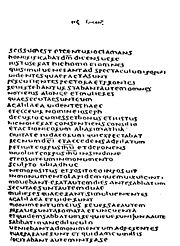
The Codex Bezae Cantabrigensis, designated by siglum Dea or 05 (in the Gregory-Aland numbering), δ 5 (von Soden), is a codex
of the New Testament
dating from the 5th century written in an uncial
hand on vellum. It contains, in both Greek
and Latin
, most of the four Gospel
s and Acts
, with a small fragment of the 3 John
. Written one column per page, the codex contains 406 extant parchment leaves (from perhaps an original 534) measuring 26 x 21.5 cm, with the Greek text on the left face and the Latin text on the right.
and is full of hiatus
. The Greek text of the codex has some copying errors, e.g., errors of metathesis: in John 1:3, ΕΓΕΝΕΤΟ was changed into ΕΝΕΓΕΤΟ; in Acts 1:9, ΥΠΕΛΑΒΕΝ into ΥΠΕΒΑΛΕΝ.
Some from the nomina sacra
are written in an abbreviated form: ΙΗΣ (Ιησους), ΧΡΣ (Χριστος), ΠΑΡ (πατηρ), ΣΤΗ (σταυρωθη), but not for μητερ, υιος, σωτηρ, ανθρωπος, ουρανος, δαυιδ, Ισραηλ, Ιηρουσαλημ, which are written fully.
The manuscript is believed to have been repaired at Lyon in the ninth century as revealed by a distinctive ink used for supplementary pages. It was closely guarded for many centuries in the monastic library of St Irenaeus
at Lyon. The manuscript was consulted, perhaps in Italy, for disputed readings at the Council of Trent
, and was at about the same time collated for Stephanus
's edition of the Greek New Testament. During the upheavals of the Wars of Religion
in the 16th century, when textual analysis had a new urgency among the Reformation
's Protestants, the manuscript was taken from Lyon in 1562 and delivered to the Protestant scholar Theodore Beza
, the friend and successor of Calvin, who gave it to the University of Cambridge
, in the comparative security of England, in 1581, which accounts for its double name. It remains in the Cambridge University Library
(Nn. II 41).
John Mill
collated and Wettstein transcribed (1716) the text of the codex. Both did their editions of the Greek Testament, but they both did their work carelessly. A much better collation was made about 1732 by John Dickinson.
Frederick Henry Ambrose Scrivener
edited the text of codex in 1864 (rewritten text of the codex) and in 1899 (photographic facsimile).
The importance of the Codex Bezae is such that a colloquium held at Lunel, Herault, in 27–30 June 1994 was entirely devoted to it. Papers discussed the many questions it poses to our understanding of the use of the Gospels and Acts in early Christianity, and of the text of the New Testament.
presents the gospels in the Western order Matthew
, John
, Luke
and Mark
, of which only Luke is complete; after some missing pages the manuscript picks up with the Third Epistle of John
(in Latin) and contains part of Acts
.
Lacunae:
Omitted verses:
Supplementations (by a later hand):
(pre-Vulgate
) versions — as seen in the Latin here — and in Syriac, and Armenian versions. Bezae is the principle Greek representative of the Western text-type
. The manuscript demonstrates the latitude in the manuscript tradition that could still be found in the 5th and 6th centuries, the date of this codex.
There is no consensus on the many problems the Greek text presents. Since the Latin, however, occasionally agrees with Codices Codex Bobiensis
and Codex Veronensis
, it is a witness to a text current no later than 250 CE and "preserves an ancient form of the Old Latin text." Issues of conformity have dogged the usage of the Codex Bezae in biblical scholarship. In general the Greek text is treated as an unreliable witness and treated as "an important corroborating witness wherever it agrees with other early manuscripts" as one of the links below freely admits.
Some of the outstanding features: Matthew 16:2b–3 is present and not marked as doubtful or spurious. One of the longer endings of Mark
is given. Luke 22:43f and Pericope de adultera are present and not marked as spurious or doubtful. John 5:4 is omitted, and the text of Acts is nearly one-tenth longer than the generally received text.
mss vg
mss syr
s,(c
),h,pal copsams arm Diatessaron
syr Irenaeus
lat
reads ὑπὸ κυριου διὰ Ἰερεμίου (by the LORD through Jeremiah) with itaur
reads θρῆνος καὶ κλαυθμὸς καὶ ὀδυρμὸς πολύς (lamentation and weeping and much wailing) with C
K
L
P
W
0233
f13
33
892
1071 Byz
syrs,c,h Origen
omits text ποταμῷ (River) with Cc K L Π
f13 892 Byz lat mae-1
reads καταβαίνοντα ἐκ τοῦ οὐρανοῦ ὡς περιστερὰν (descending out of heaven like a dove) with it vgmss syr(h)
omits text ἐκπορευομένῳ διὰ στόματος (proceeds out through the mouth) with ita
, b
, g1
appear in reverse order, as in 17
33 130
lat syrc Clement
Origen Eusebius
omits text ψευδόμενοι (falsely) with itb, c
,d,g1h
, k
syrs Tertullian
Augustine
reads ἕνεκεν δικαιοσύνης (for the sake of righteousness) with itmss
omits text ὃς δʼ ἂν ποιήσῃ καὶ διδάξῃ, οὗτος μέγας κληθήσεται ἐν τῇ βασιλείᾳ τῶν οὐρανῶν (but whoever will do [them] and should teach [them], the same will be called great in the kingdom of the heavens) with א
* W copboms
is omitted.
is omitted, as in itd vgms syrs copboms
omits text καὶ ὃς ἐὰν ἀπολελυμένην γαμήσῃ, μοιχᾶται (and whoever should marry her who is divorced, he commits adultery) with ita,b,d,k Origenmss
is omitted, as in ita,k syrs Juvencus
Hilary
omits text ἢ κώμην (or village) with f1 700 ita,b,d,ff1,h,k syrs
adds text λέγοντες, Εἰρήνη τῷ οἴκῳ τούτῳ (saying, "Peace unto this house") with א* L W Θ 0281vid f1 22 346 517 1010 (1424
) itmss vgcl arm
omits text τῆς οἰκίας ἢ (that house or) with arm
reads ἐπὶ ἡγεμόνων σταθήσεσθε (before governors ye shall be caused to stand) with 0171 itmss syrs
omits text δοθήσεται γὰρ ὑμῖν ἐν ἐκείνῃ τῇ ὥρᾳ τί λαλήσητε (for it will be given [to] youpl in that hour what youpl should speak) with L itmss vgmss Epiphanius
(καὶ ὁ φιλῶν υἱὸν ἢ θυγατέρα ὑπὲρ ἐμὲ οὐκ ἔστιν μου ἄξιος = and the person loving their son or daughter more than me is not worthy of me) is omitted, as in 19 B* 983 syrh Codex Schøyen and the Hebrew
Shem Tov Matthew manuscript.
(καὶ ὁ δεχόμενος δίκαιον εἰς ὄνομα δικαίου μισθὸν δικαίου λήμψεται = and the one who receives a righteous person as a righteous person will receive a righteous person's reward) is omitted.
omits text καὶ χωλοὶ περιπατοῦσιν (and the lame are walking)
adds text (begins passage) Πορεύθητι, καὶ εἰπὲ τῷ λαῷ τούτῳ (Go, and tell the people this) with itmss mae-1 Eusebius
παρέθηκεν ( he put before them) all other mss. (rell)
omits text ἐλάλησεν αὐτοῖς (he spoke to them) with itd,(k) syrs,c Codex Schøyen
αἰῶνος τούτου ( this age) N cosams,bo
αἰῶνος ( age) all other mss. (rell)
 103vid(?) א* D M
U
odex Tischendorfianus IV|Γ} 2 28
579 1424 Byzmss vgmss Origenpt Ἰωσῆς ( Joses)  103vid(?) K L W Δ Π 0106 f13 22 565 1241 1582mg Byzmss itk,qc cosa,bomss Basil
Ἰωσῆ ( Joses) 118
157
700* 1071 syrh cobomss Ἰωσὴφ ( Joseph) א2 B C N
Θ f1 33 700c 892 lat syrs,c,hmg mae-1 Codex Schøyen cobomss Origenpt
reads οὗτος ἐστιν Ἰωάννης ὁ βαπτιστής ὃν ἐγὼ ἀπεκεφάλισα (This is John the Baptist who I beheaded) with ita,b,ff1,h vgmss
omits text Φιλίππου (of Philip) with itmss vgmss Augustine
omits text ἐπὶ πίνακι (on a platter)
omits text Ἰησοῦς (Jesus) with א* Z
vid 579 1424 ite,k syrs,c,p cosa,bo
omits text ὀ Ἰησοῦς (Jesus) with א* and 073 892 itff1 syrc cosa,bo Eusebius
omits text ὁ Ἰησοῦς (Jesus) with Γ syrs,c cosamss
omits text κωφούς (mute)
adds text πάντας to read and he healed them all with itmss cosamss,boms
(D*) omits text μήποτε ἐκλυθῶσιν ἐν τῇ ὁδῷ (lest they should faint in the way)
Μαγεδάν ( Magedan) א2 Δlat latmss syrs,c,(p) cosa Eusebius
Μαγδαλάν ( Magdalan) C N W 33 565 579 itq mae-1 cobo
Μαγδαλά ( Magdala) L Δgr Θ f1 f13 22 892 Byz syrh
omits text καὶ μοιχαλὶς (and adulterous) with itmss
* 173
565
788 803 1058 1331 2145c 2295 2315 ita,b,d,ff2 syrs arm geomss Codex Schøyen τῶν ἄρτων ( the bread loaves) f1 517
1424 1478* 1675, ite Origenpt τῆς ζύμης τῶν ἄρτων ( the leaven of the bread loaves) א2 B K* L 157 176
372
375
(c) 805 892 954 1009 1241 1273c 1295c 1446 1478c 1500c 2585 2605 2737 itaur,g1,l vg co Origenpt Jerome
τῆς ζύμης τοῦ ἄρτου ( the leaven of the bread loaf) C Kc W X
Π Γ Δ f13mss 22 124c 387c 700 1500* 2145* Byz itc,f,q syrp,h cosams cobomss geomss Chrysostom
τῆς ζύμης τῶν Φαρισαίων καὶ Σαδδουκαίων ( the leaven of the Pharisees and the Sadducees) א* 30 (387*) (722) 785 1093 1279 1402 2297 2714 itff1 syrc
τῆς ζύμης τῶν Φαρισαίων ( the leaven of the Pharisees) 33 1295*
reads ὁ υἱὸς τοῦ θεοῦ τοῦ σῴζοντος (the son of the saving God) against all other mss.
διεστείλατο ( ordered) all other mss. (rell)
ὄρος ὑψηλὸν κατʼ ἰδίαν ( high mountain by themselves) rell
λευκὰ ὡς τὸ φῶς ( white as the light) rell
(οὕτως καὶ ὁ υἱὸς τοῦ ἀνθρώπου μέλλει πάσχειν ὑπʼ αὐτῶν = So also the Son of Man is about to suffer at their hands) is transposed to follow Matthew 17:13, as in ita,b,c,d,e,ff1,ff2,g1,n,r1
ὀλιγοπιστίαν ( littleness of faith) א B Θ 0281 f1 f13 22 33 579 700 892 1192 2211 2680 syrc co Origen
Verse omitted in א* B Θ 0281 33 579 788 892* 1604 2680 ite,ff1 syrs,c,pal cosa,bomss Codex Schøyen geo
omits text ὁ Πέτρος (Peter) with א B Θ 0281 f1 700 892* vgmss syrs cosa,bomss Chrysostom
reads τῶν μικρῶν τούτων τῶν πιστευόντων εἰς ἐμέ (these little ones who believe in me) with itmss vgmss syrc cosamss
omits text μαρτύρων (witnesses)
(D*) omits text ἔσται δεδεμένα ἐν οὐρανῷ, καὶ ὅσα ἐὰν λύσητε ἐπὶ τῆς γῆς (will be bound in heaven, and whatever ye should loosen upon the earth) with itn
reads ἐξεπλήσσοντο καὶ ἐφοβήθησαν σφόδρα (they were astonished and they were afraid exceedingly) with itmss vgmss syrc
omits text ἢ πατέρα (or their father) and text ἢ γυναῖκα (or their wife)
adds text πολλοὶ γὰρ εἰσιν κλητοί ὀλίγοι δὲ ἐκλεκτοὶ (for many are called, but few chosen) with C W Δ Θ f1,13 33 Byz latt syr mae-1 cobomss
omits text μαθητὰς (disciples) with א L Θ f1,13 892* syrs,c cobo Codex Schøyen Origen
contains the following text, occurring also in Φ
ita
, aur
, b
, c
,d, e
, ff1
, ff2
,(g1
), h
,(m
),n, r1
, r2
vgmss syr(c),pms,hmg Juvencus Hilary
In syrc the passage reads slightly different, perhaps making more intelligible sense. The Syriac reflects the following Greek text. Literal translation:
omits text Κύριε (Lord) with א Θ f13 118 157 209 346 565 700 ita,b,c,d,e,ff1,ff2,h,n syrc,palms mae-1 Codex Schøyen
is omitted, as in 104 33 ita,b,d,e,ff1,ff2,r1 syrs Irenaeus
lat Origen
Eusebius
omits text Εἰπέ οὖν ἡμῖν (Therefore, tell us) with ita,b,d,e,ff1,ff2,q,r1 syrs coboms Codex Schøyen
omits text τὴν γυναῖκα αὐτοῦ (his wife)
ἄγγελοι θεοῦ ( angels of God) א L Σ f13 28 33 157 892 1071 1241 1243 1292 1424 itaur,ff1,g1,l vg syrh,p cobo
ἄγγελοι τοῦ θεοῦ ( angels of the God) W Δ 0102 0161 565 579 Byz
εἰ οὖν Δαυὶδ καλεῖ αὐτὸν κύριον ( If then David calls him "Lord") rell
ἐκείνης τῆς ἡμέρας ( from that day) rell
ῥαββί ( Rabbi) א B L Δ Θ 0102 f1 33 892 1241 lat syrp co
διδάσκαλος ( your teacher) א1 B 33 517 565 892* co Clement
διδάσκαλος ὁ χριστός ( your teacher, the Christ) 892c
ῥαββί ( Rabbi) syrp
ῥαββί ὁ χριστός ( Rabbi, the Christ) syrc
is omitted, as in א B D L Z Θ f1 33 892* ita,aur,d,e,ff1,g1 vg syrs,palms cosa,bomss mae-1 Codex Schøyen arm geo Origen Eusebius
omits text καὶ τῆς παροψίδος (and the plate) with Θ f1 2* 700 ita,d,e,ff2,r1 syrs Irenaeuslat Clement
omits text καὶ ἐξ αὐτῶν μαστιγώσετε ἐν ταῖς συναγωγαῖς ὑμῶν (and of them, ye will scourge in your synagogues) with ita Lucifer
adds text ἀρχομένων δὲ τούτων γίνεσθαι ἀναβλέψατε καὶ ἐπάρατε τὰς κεφαλὰς ὑμῶν διότι ἐγγίζει ἡ ἀπολύτρωσις ὑμῶν (But when these things begin happening, look up and lift up your heads, because that your redemption is approaching) with 1093 itb,c,d,h,q,r1
adds text δύο ἐπὶ κλίνης μιᾶς εἷς παραλαμβάνεται καὶ εἷς ἀφίεται (two upon one bed; one taken, and one left) with f13 itmss vgmss Origenmss
reads τοῦ νυμφίου καὶ τῆς νύμφης (the bridegroom and his bride) with X Θ Σ f1 124* 174 latt syrs,p,h** mae-1 arm geomss Diatessaronmss Origen Basil
omits text ἐκ τρίτου (out a third time) with 37 A K Π f1 157 565 652 1424 ita,b,d,ff2,r1
adds text οὐδὲ ἐπίσταμαι (nor have I known him) with Δ 090 f1 652 ita,b,n,r1 syrs,pal
reads εἶδεν αὐτὸν ἄλλη παιδίσκη (another maidservant saw him) with itmss vgmss
τῶν γραμματέων καὶ πρεσβυτέρων καὶ Φαρισαίων (the scribes and elders and Pharisees) Y Δ Π Σ Φ 22 157 565 Byz itf syrp,h cobomss
omit text — Γ
omits text ἀπὸ τῶν νεκρῶν (from the dead) with 565 ita,b,d,e,ff1,g1,h,l,r1 vg syrs arm Origen
omits text καὶ ζώνην δερματίνην περὶ τὴν ὀσφὺν αὐτοῦ (and a leather belt roundabout his waist) with ita,b,d,ff2,r1,t vgms
omits text κύψας (stoop) with Θ f13 28* 565 ℓ844,2211 itmss
it has απεκριτη. The other manuscripts have:
In , D contains a unique verse order of 23, 25, 24, 26.
In (see ) it has ὠνείδισάς με (insult me), supported by Old Latin itc, (i), k and by syrh. The ordinary reading here is ἐγκατέλιπές με (forsaken me) supported by Alexandrian mss, or με ἐγκατέλιπες (see ) supported by Byzantine mss.
In Bezae contains an interpolation:
In επειδη επληρωσεν παντα τα ρηματα αυτου εις τας ακοας του λαου εισηλθεν ] και εγενετο οτε ετελεσεν ταυτα τα ρηματα λαλων ηλθεν
In δουλος ] παις
In it contains the unique variant ἐφ ἡμᾶς ἐλθέτω σου ἡ βασιλεία (Let thine kingdom come upon us). Comparatively, others read:
In it reads ηγγισεν for εγγιζεν long with Codex Regius
.
omits text ὁ δὲ Ἰησοῦς ἔλεγεν πάτερ, ἄφες αὐτοῖς, οὐ γὰρ οἴδασιν τί ποιοῦσιν (Then Jesus said, "Father, forgive them, for they know not what they are doing") with 75 אa B W
Θ
0124
31* 38
435 597* 1241 1808* ita
,bc,d syrs copsa,bo.
omits text ἀρώματα with (aromatics) itmss syrs,c cosa
omits text ἐλθοῦσαι δὲ εὗρον (Then, upon arriving, they found) with 070 itc cosa
omits text τοῦ κυρίου Ἰησοῦ (the Lord Jesus) with ita,b,d,e,ff2,l,r1
omits text οὐκ ἔστιν ὧδε, ἀλλὰ ἠγέρθη with ita,b,d,e,ff2,l,r1 armmss geomss
omits text ἁμαρτωλῶν (sinful) with ita,b,d,e,ff2,l,r1
omits text ἀπὸ τοῦ μνημείου (from the tomb) with ita,b,d,e,ff2,l,r1 arm geo
omits text ἦσαν δὲ (Now they were) with A W Γ 788 1241 ℓmss itd,e syrs,c
is omitted, as in ita,b,d,e,l,r1
reads Ουλαμμαους (Oulammaous) for Εμμαους (Emmaous).
omits text καὶ ἐστάθησαν (and they stood still) with Cyril
omits text καὶ λέγει αὐτοῖς εἰρήνη ὑμῖν (and said to them, "Peace be unto you") with ita,b,e,ff2,l,r1
reads φαντασμα (phantasma) rather than πνευμα (spirit) with MarcionTert.
is omitted, as in ita,b,d,e,ff2,l,r1 syrs,c Marcion
omits text και απο μελισσιου κηριου (and honeycomb of the beehive) with 75 א A B L W P 579 1079 1377* 2411 itd,e syrs cosa,bomss
omits text ἐκ νεκρῶν (from the dead) with cosa
omits text τοῦ πατρός (my Father) with ite
omits text Ἱερουσαλήμ (Jerusalem) with 75 א B C* L itmss vg syrs cosa,bomss Didymus
omits text καὶ ἀνεφέρετο εἰς τὸν οὐρανόν (and he was being uplifted into the sky) א* ita,b,d,e,ff2,l
omits text προσκυνήσαντες αὐτὸν (upon worshiping him) with ita,b,d,e,ff2,l syrs
omits text οὐ γὰρ συγχρῶνται Ἰουδαῖοι Σαμαρίταις (for Jews have no dealings with Samaritans) with א* ita,b,d,e,j
is located before .
E
Ψ 33
36
453
945 1739
1891.
Codex
A codex is a book in the format used for modern books, with multiple quires or gatherings typically bound together and given a cover.Developed by the Romans from wooden writing tablets, its gradual replacement...
of the New Testament
New Testament
The New Testament is the second major division of the Christian biblical canon, the first such division being the much longer Old Testament....
dating from the 5th century written in an uncial
Uncial
Uncial is a majuscule script commonly used from the 3rd to 8th centuries AD by Latin and Greek scribes. Uncial letters are written in either Greek, Latin, or Gothic.-Development:...
hand on vellum. It contains, in both Greek
Greek language
Greek is an independent branch of the Indo-European family of languages. Native to the southern Balkans, it has the longest documented history of any Indo-European language, spanning 34 centuries of written records. Its writing system has been the Greek alphabet for the majority of its history;...
and Latin
Latin
Latin is an Italic language originally spoken in Latium and Ancient Rome. It, along with most European languages, is a descendant of the ancient Proto-Indo-European language. Although it is considered a dead language, a number of scholars and members of the Christian clergy speak it fluently, and...
, most of the four Gospel
Gospel
A gospel is an account, often written, that describes the life of Jesus of Nazareth. In a more general sense the term "gospel" may refer to the good news message of the New Testament. It is primarily used in reference to the four canonical gospels of Matthew, Mark, Luke, and John...
s and Acts
Acts of the Apostles
The Acts of the Apostles , usually referred to simply as Acts, is the fifth book of the New Testament; Acts outlines the history of the Apostolic Age...
, with a small fragment of the 3 John
Third Epistle of John
The Third Epistle of John, often referred to as Third John and written 3 John, is a book of the New Testament attributed to John the Evangelist, traditionally thought to be the author of the Gospel of John and the other two epistles of John...
. Written one column per page, the codex contains 406 extant parchment leaves (from perhaps an original 534) measuring 26 x 21.5 cm, with the Greek text on the left face and the Latin text on the right.
Description
The first three lines of each book are in red letters, and black and red ink alternate lines towards the end of books. As many as eleven people (G, A, C, B, D, E, H, F, J1, L, K) have corrected the manuscript between the sixth and twelfth centuries. The text is written colometricallyColon (rhetoric)
A colon is a rhetorical figure consisting of a clause which is grammatically, but not logically, complete. In Latin, it is called a membrum or membrum orationis....
and is full of hiatus
Hiatus (linguistics)
In phonology, hiatus or diaeresis refers to two vowel sounds occurring in adjacent syllables, with no intervening consonant. When two adjacent vowel sounds occur in the same syllable, the result is instead described as a diphthong....
. The Greek text of the codex has some copying errors, e.g., errors of metathesis: in John 1:3, ΕΓΕΝΕΤΟ was changed into ΕΝΕΓΕΤΟ; in Acts 1:9, ΥΠΕΛΑΒΕΝ into ΥΠΕΒΑΛΕΝ.
Some from the nomina sacra
Nomina sacra
Nomina sacra means "sacred names" in Latin, and can be used to refer to traditions of abbreviated writing of several frequently occurring divine names or titles in early Greek language Holy Scripture...
are written in an abbreviated form: ΙΗΣ (Ιησους), ΧΡΣ (Χριστος), ΠΑΡ (πατηρ), ΣΤΗ (σταυρωθη), but not for μητερ, υιος, σωτηρ, ανθρωπος, ουρανος, δαυιδ, Ισραηλ, Ιηρουσαλημ, which are written fully.
History
The place of origin of the codex is still disputed.The manuscript is believed to have been repaired at Lyon in the ninth century as revealed by a distinctive ink used for supplementary pages. It was closely guarded for many centuries in the monastic library of St Irenaeus
Irenaeus
Saint Irenaeus , was Bishop of Lugdunum in Gaul, then a part of the Roman Empire . He was an early church father and apologist, and his writings were formative in the early development of Christian theology...
at Lyon. The manuscript was consulted, perhaps in Italy, for disputed readings at the Council of Trent
Council of Trent
The Council of Trent was the 16th-century Ecumenical Council of the Roman Catholic Church. It is considered to be one of the Church's most important councils. It convened in Trent between December 13, 1545, and December 4, 1563 in twenty-five sessions for three periods...
, and was at about the same time collated for Stephanus
Robert Estienne
Robert I Estienne , known as Robertus Stephanus in Latin and also referred to as Robert Stephens by 18th and 19th-century English writers, was a 16th century printer and classical scholar in Paris...
's edition of the Greek New Testament. During the upheavals of the Wars of Religion
French Wars of Religion
The French Wars of Religion is the name given to a period of civil infighting and military operations, primarily fought between French Catholics and Protestants . The conflict involved the factional disputes between the aristocratic houses of France, such as the House of Bourbon and House of Guise...
in the 16th century, when textual analysis had a new urgency among the Reformation
Protestant Reformation
The Protestant Reformation was a 16th-century split within Western Christianity initiated by Martin Luther, John Calvin and other early Protestants. The efforts of the self-described "reformers", who objected to the doctrines, rituals and ecclesiastical structure of the Roman Catholic Church, led...
's Protestants, the manuscript was taken from Lyon in 1562 and delivered to the Protestant scholar Theodore Beza
Theodore Beza
Theodore Beza was a French Protestant Christian theologian and scholar who played an important role in the Reformation...
, the friend and successor of Calvin, who gave it to the University of Cambridge
University of Cambridge
The University of Cambridge is a public research university located in Cambridge, United Kingdom. It is the second-oldest university in both the United Kingdom and the English-speaking world , and the seventh-oldest globally...
, in the comparative security of England, in 1581, which accounts for its double name. It remains in the Cambridge University Library
Cambridge University Library
The Cambridge University Library is the centrally-administered library of Cambridge University in England. It comprises five separate libraries:* the University Library main building * the Medical Library...
(Nn. II 41).
John Mill
John Mill
John Mill was an English theologian. He is noted for his critical edition of the Greek New Testament which included notes on many variant readings.-Biography:...
collated and Wettstein transcribed (1716) the text of the codex. Both did their editions of the Greek Testament, but they both did their work carelessly. A much better collation was made about 1732 by John Dickinson.
Frederick Henry Ambrose Scrivener
Frederick Henry Ambrose Scrivener
The Reverend Frederick Henry Ambrose Scrivener, LL.D. was an important text critic of the New Testament and a member of the English New Testament Revision Committee which produced the Revised Version of the Bible...
edited the text of codex in 1864 (rewritten text of the codex) and in 1899 (photographic facsimile).
The importance of the Codex Bezae is such that a colloquium held at Lunel, Herault, in 27–30 June 1994 was entirely devoted to it. Papers discussed the many questions it poses to our understanding of the use of the Gospels and Acts in early Christianity, and of the text of the New Testament.
Codex contents
The manuscriptManuscript
A manuscript or handwrite is written information that has been manually created by someone or some people, such as a hand-written letter, as opposed to being printed or reproduced some other way...
presents the gospels in the Western order Matthew
Gospel of Matthew
The Gospel According to Matthew is one of the four canonical gospels, one of the three synoptic gospels, and the first book of the New Testament. It tells of the life, ministry, death, and resurrection of Jesus of Nazareth...
, John
Gospel of John
The Gospel According to John , commonly referred to as the Gospel of John or simply John, and often referred to in New Testament scholarship as the Fourth Gospel, is an account of the public ministry of Jesus...
, Luke
Gospel of Luke
The Gospel According to Luke , commonly shortened to the Gospel of Luke or simply Luke, is the third and longest of the four canonical Gospels. This synoptic gospel is an account of the life and ministry of Jesus of Nazareth. It details his story from the events of his birth to his Ascension.The...
and Mark
Gospel of Mark
The Gospel According to Mark , commonly shortened to the Gospel of Mark or simply Mark, is the second book of the New Testament. This canonical account of the life of Jesus of Nazareth is one of the three synoptic gospels. It was thought to be an epitome, which accounts for its place as the second...
, of which only Luke is complete; after some missing pages the manuscript picks up with the Third Epistle of John
Third Epistle of John
The Third Epistle of John, often referred to as Third John and written 3 John, is a book of the New Testament attributed to John the Evangelist, traditionally thought to be the author of the Gospel of John and the other two epistles of John...
(in Latin) and contains part of Acts
Acts of the Apostles
The Acts of the Apostles , usually referred to simply as Acts, is the fifth book of the New Testament; Acts outlines the history of the Apostolic Age...
.
Lacunae:
- Matthew 1:1-20, 6:20-9:2, 27:2-12; John 1:16-3:26; Acts 8:29-10:14, 21:2-10, 21:16-18, 22:10-20, 22:29-End
Omitted verses:
- Matthew ; ; ; ; ; ;
- Mark
- Luke ; ; ; ; ; ;
- John
Supplementations (by a later hand):
- Matthew 3:7-16; Mark 16:15-20; John 18:14-20:13
Text type
The Greek text is unique, with many interpolations found nowhere else, with a few remarkable omissions, and a capricious tendency to rephrase sentences. Aside from this one Greek manuscript it is found in Old LatinOld Latin
Old Latin refers to the Latin language in the period before the age of Classical Latin; that is, all Latin before 75 BC...
(pre-Vulgate
Vulgate
The Vulgate is a late 4th-century Latin translation of the Bible. It was largely the work of St. Jerome, who was commissioned by Pope Damasus I in 382 to make a revision of the old Latin translations...
) versions — as seen in the Latin here — and in Syriac, and Armenian versions. Bezae is the principle Greek representative of the Western text-type
Western text-type
The Western text-type is one of several text-types used in textual criticism to describe and group the textual character of Greek New Testament manuscripts...
. The manuscript demonstrates the latitude in the manuscript tradition that could still be found in the 5th and 6th centuries, the date of this codex.
There is no consensus on the many problems the Greek text presents. Since the Latin, however, occasionally agrees with Codices Codex Bobiensis
Codex Bobiensis
Codex Bobiensis is a fragmentary Latin manuscript of the bible. Specifically, it is an example of a Vetus Latina bible, which were used from the 2nd century until Jerome's Latin translation, the Vulgate, was written in the 5th century. The text contains parts of the Gospel of Mark and Gospel of...
and Codex Veronensis
Codex Veronensis
The Codex Veronensis, designated by siglum b or 4 , is a 4th or 5th century Latin Gospel Book. The text, written on purple dyed vellum in silver and occasionally gold ink, is a version of the old Latin. The Gospels follow in the Western order.- Description :The manuscript contains the Latin text of...
, it is a witness to a text current no later than 250 CE and "preserves an ancient form of the Old Latin text." Issues of conformity have dogged the usage of the Codex Bezae in biblical scholarship. In general the Greek text is treated as an unreliable witness and treated as "an important corroborating witness wherever it agrees with other early manuscripts" as one of the links below freely admits.
Some of the outstanding features: Matthew 16:2b–3 is present and not marked as doubtful or spurious. One of the longer endings of Mark
Mark 16
Mark 16 is the final chapter of the Gospel of Mark in the New Testament of the Christian Bible. It begins with the discovery of the empty tomb by Mary Magdalene, Mary the mother of James, and Salome — there they encounter a man dressed in white who announces the Resurrection of Jesus.Verse 8 ends...
is given. Luke 22:43f and Pericope de adultera are present and not marked as spurious or doubtful. John 5:4 is omitted, and the text of Acts is nearly one-tenth longer than the generally received text.
Notable readings
Codex Bezae Cantabrigiensis contains some extraordinary readings. Below is a comprehensive enumeration of those readings, with text and translation.Gospel of Matthew
reads διὰ Ησαιου τοῦ προφήτου (through Isaiah his prophet) with itVetus Latina
Vetus Latina is a collective name given to the Biblical texts in Latin that were translated before St Jerome's Vulgate Bible became the standard Bible for Latin-speaking Western Christians. The phrase Vetus Latina is Latin for Old Latin, and the Vetus Latina is sometimes known as the Old Latin Bible...
mss vg
Vulgate
The Vulgate is a late 4th-century Latin translation of the Bible. It was largely the work of St. Jerome, who was commissioned by Pope Damasus I in 382 to make a revision of the old Latin translations...
mss syr
Syriac versions of the Bible
Syria played an important or even predominant role in the beginning of Christianity. Here were written the Gospel of Matthew, the Gospel of Luke, the Didache, Ignatiana, and the Gospel of Thomas. Syria was the country in which the Greek language intersected with the Syriac, which was closely...
s,(c
Curetonian Gospels
The Curetonian Gospels, designated by the siglum syrcur, are contained in a manuscript of the four gospels of the New Testament in Old Syriac, a translation from the Aramaic originals, according to William Cureton differing considerably from the canonical Greek texts, with which they had been...
),h,pal copsams arm Diatessaron
Diatessaron
The Diatessaron is the most prominent Gospel harmony created by Tatian, an early Christian apologist and ascetic. The term "diatessaron" is from Middle English by way of Latin, diatessarōn , and ultimately Greek, διὰ τεσσάρων The Diatessaron (c 160 - 175) is the most prominent Gospel harmony...
syr Irenaeus
Irenaeus
Saint Irenaeus , was Bishop of Lugdunum in Gaul, then a part of the Roman Empire . He was an early church father and apologist, and his writings were formative in the early development of Christian theology...
lat
reads ὑπὸ κυριου διὰ Ἰερεμίου (by the LORD through Jeremiah) with itaur
Stockholm Codex Aureus
The Stockholm Codex Aureus is an Insular Gospel book written in the mid-eighth century in Southumbria, probably in Canterbury...
reads θρῆνος καὶ κλαυθμὸς καὶ ὀδυρμὸς πολύς (lamentation and weeping and much wailing) with C
Codex Ephraemi Rescriptus
Codex Ephraemi Rescriptus is an early 5th century Greek manuscript of the Bible, the last in the group of the four great uncial manuscripts...
K
Codex Cyprius
Codex Cyprius, designated by Ke or 017 , ε 71 , is a Greek uncial manuscript of the four Gospels, on parchment. It was variously dated in the past , currently it is dated to the 9th century. It was brought from Cyprus to Paris...
L
Codex Regius (New Testament)
Codex Regius designated by siglum Le or 019 , ε 56 , is a Greek uncial manuscript of the New Testament, dated paleographically to the 8th century. The manuscript is lacunose. It has marginalia....
P
Codex Guelferbytanus A
Codex Guelferbytanus A designated by Pe or 024 , ε 33 , is a Greek uncial manuscript of the Gospels, dated palaeographically to the 6th century. The manuscript is very lacunose.- Description :...
W
Codex Washingtonianus
The Codex Washingtonianus or Codex Washingtonensis, designated by W or 032 , ε 014 , also called the Washington Manuscript of the Gospels, and The Freer Gospel, contains the four biblical gospels and was written in Greek on vellum in the fourth or fifth century...
0233
Uncial 0233
Uncial 0233 , is a Greek uncial manuscript of the New Testament. The manuscript paleographically had been assigned to the 8th century.- Description :...
f13
Family 13
Family 13, also known Ferrar Group , is a group of Greek Gospel manuscripts, varying in date from the 11th to the 15th century, which display a distinctive pattern of variant readings — especially in placing the story of Jesus and the woman taken in adultery in the Gospel of Luke, rather than in...
33
Minuscule 33
Minuscule 33 , δ 48 , formerly it was called Codex Colbertinus 2844, is a Greek minuscule manuscript of the New Testament on parchment, dated palaeographically to the 9th century. The manuscript is lacunose. It has marginalia...
892
Minuscule 892
Minuscule 892 , ε 1016 . It is a Greek minuscule manuscript of the New Testament, on 353 parchment leaves . It is dated palaeografically to the 9th century.- Description :...
1071 Byz
Byzantine text-type
The Byzantine text-type is one of several text-types used in textual criticism to describe the textual character of Greek New Testament manuscripts. It is the form found in the largest number of surviving manuscripts, though not in the oldest...
syrs,c,h Origen
Origen
Origen , or Origen Adamantius, 184/5–253/4, was an early Christian Alexandrian scholar and theologian, and one of the most distinguished writers of the early Church. As early as the fourth century, his orthodoxy was suspect, in part because he believed in the pre-existence of souls...
omits text ποταμῷ (River) with Cc K L Π
Codex Petropolitanus (New Testament)
Codex Petropolitanus, designated by Π or 041 , ε 73 , is a Greek uncial manuscript of the Gospels, dated palaeographically to the 9th century...
f13 892 Byz lat mae-1
reads καταβαίνοντα ἐκ τοῦ οὐρανοῦ ὡς περιστερὰν (descending out of heaven like a dove) with it vgmss syr(h)
omits text ἐκπορευομένῳ διὰ στόματος (proceeds out through the mouth) with ita
Codex Vercellensis
The title Codex Vercellensis refers to two manuscript codices preserved in the cathedral library of Vercelli, in the Piedmont Region, Italy.- Old Latin Codex Vercellensis :...
, b
Codex Veronensis
The Codex Veronensis, designated by siglum b or 4 , is a 4th or 5th century Latin Gospel Book. The text, written on purple dyed vellum in silver and occasionally gold ink, is a version of the old Latin. The Gospels follow in the Western order.- Description :The manuscript contains the Latin text of...
, g1
Codex Sangermanensis I
The Codex Sangermanensis I, designated by g1 or 7 , is a 7th or 8th century Latin manuscript of the New Testament. The text, written on vellum, is a version of the Latin. The manuscript contains the Vulgate Bible, on 191 leaves of which, in the New Testament, the Gospel of Matthew contain Old...
appear in reverse order, as in 17
Minuscule 17
Minuscule 17 , ε 525 . It is a Greek-Latin minuscule manuscript of the New Testament, on 354 parchment leaves , dated palaeographically to the 15th century . It has some marginalia....
33 130
Minuscule 130
Minuscule 130 , ε 596 , is a Greek-Latin minuscule manuscript of the New Testament, on paper leaves. Palaeographically it has been assigned to the 15th century. It has some marginalia. A curious copy.- Description :...
lat syrc Clement
Clement of Alexandria
Titus Flavius Clemens , known as Clement of Alexandria , was a Christian theologian and the head of the noted Catechetical School of Alexandria. Clement is best remembered as the teacher of Origen...
Origen Eusebius
Eusebius of Caesarea
Eusebius of Caesarea also called Eusebius Pamphili, was a Roman historian, exegete and Christian polemicist. He became the Bishop of Caesarea in Palestine about the year 314. Together with Pamphilus, he was a scholar of the Biblical canon...
omits text ψευδόμενοι (falsely) with itb, c
Codex Colbertinus
Codex Colbertinus, designated by 6 or c, is a Latin manuscript of the Bible. Its version of the four Gospels and Book of Acts follows the Vetus Latina, while the rest of the New Testament follows the Vulgate. It was written in the 11th or 12th century, probably in southern France.The Latin text of...
,d,g1h
Codex Claromontanus
Codex Claromontanus, symbolized by Dp or 06 , δ 1026 , is a Greek-Latin diglot uncial manuscript of the New Testament, written in an uncial hand on vellum. The Greek and Latin text on facing pages...
, k
Codex Bobiensis
Codex Bobiensis is a fragmentary Latin manuscript of the bible. Specifically, it is an example of a Vetus Latina bible, which were used from the 2nd century until Jerome's Latin translation, the Vulgate, was written in the 5th century. The text contains parts of the Gospel of Mark and Gospel of...
syrs Tertullian
Tertullian
Quintus Septimius Florens Tertullianus, anglicised as Tertullian , was a prolific early Christian author from Carthage in the Roman province of Africa. He is the first Christian author to produce an extensive corpus of Latin Christian literature. He also was a notable early Christian apologist and...
Augustine
Augustine of Hippo
Augustine of Hippo , also known as Augustine, St. Augustine, St. Austin, St. Augoustinos, Blessed Augustine, or St. Augustine the Blessed, was Bishop of Hippo Regius . He was a Latin-speaking philosopher and theologian who lived in the Roman Africa Province...
reads ἕνεκεν δικαιοσύνης (for the sake of righteousness) with itmss
omits text ὃς δʼ ἂν ποιήσῃ καὶ διδάξῃ, οὗτος μέγας κληθήσεται ἐν τῇ βασιλείᾳ τῶν οὐρανῶν (but whoever will do [them] and should teach [them], the same will be called great in the kingdom of the heavens) with א
Codex Sinaiticus
Codex Sinaiticus is one of the four great uncial codices, an ancient, handwritten copy of the Greek Bible. It is an Alexandrian text-type manuscript written in the 4th century in uncial letters on parchment. Current scholarship considers the Codex Sinaiticus to be one of the best Greek texts of...
* W copboms
is omitted.
is omitted, as in itd vgms syrs copboms
omits text καὶ ὃς ἐὰν ἀπολελυμένην γαμήσῃ, μοιχᾶται (and whoever should marry her who is divorced, he commits adultery) with ita,b,d,k Origenmss
- ἐγὼ δὲ λέγω ὑμῖν ἀγαπᾶτε τοὺς ἐχθροὺς ὑμῶν καὶ προσεύχεσθε ὑπὲρ τῶν διωκόντων ὑμᾶς א BCodex VaticanusThe Codex Vaticanus , is one of the oldest extant manuscripts of the Greek Bible , one of the four great uncial codices. The Codex is named for the residence in the Vatican Library, where it has been stored since at least the 15th century...
f1Family 1Family 1 is a group of Greek Gospel manuscripts, varying in date from the 12th to the 15th century. The group takes its name from the minuscule codex 1, now in the Basel University Library. "Family 1" is also known as "the Lake Group", symbolized as f1. Hermann von Soden calls the group Ih...
22Minuscule 22Minuscule 22 , ε 288 , known also as Codex Colbertinus 2467. It is a Greek minuscule manuscript of the New Testament, written on vellum. Palaeographically it has been assigned to the 12th century. Formerly it was assigned to the 11th century...
279Minuscule 279Minuscule 279 , ε 293 , is a Greek minuscule manuscript of the New Testament, on parchment. Palaeographically it has been assigned to the 12th century.It has full marginalia.- Description :...
660Minuscule 660Minuscule 660 , ε 178 , is a Greek minuscule manuscript of the New Testament, on parchment. Palaeographically it has been assigned to the 12th century. The manuscript is lacunose...
* 1192 2786* itk syrs,c copsa,bo Codex Schøyen Irenaeuslat Origen CyprianCyprianCyprian was bishop of Carthage and an important Early Christian writer, many of whose Latin works are extant. He was born around the beginning of the 3rd century in North Africa, perhaps at Carthage, where he received a classical education... - ἐγὼ δὲ λέγω ὑμῖν ἀγαπᾶτε τοὺς ἐχθροὺς ὑμῶν ευλογειτε τους καταρωμενους υμας, καλως ποιειτε τοις μισουσιν υμας, καὶ προσεύχεσθε ὑπὲρ τῶν επηρεαζοντων υμας, καὶ διωκόντων ὑμᾶς D L W Δ ΘCodex KoridethiThe Codex Koridethi, also named Codex Coridethianus, designated by Θ, 038, or Theta , ε 050 , is a 9th century manuscript of the four Gospels. It is written in Greek with uncial script in two columns per page, in 25 lines per page...
047Uncial 047Uncial 047 , is a Greek uncial manuscript of the Gospels. The codex is dated paleographically to the 8th century. Formerly the codex was designated by Hebrew letter ב...
f13 33 118 700Minuscule 700Minuscule 700 , ε 133 , is a Greek minuscule manuscript of the Gospels. Formerly it was labelled as 604 in all catalogues , Gregory gave it the number 700....
892 Byz lat syrpPeshittaThe Peshitta is the standard version of the Bible for churches in the Syriac tradition.The Old Testament of the Peshitta was translated into Syriac from the Hebrew, probably in the 2nd century AD...
,h,pal mae-1 gothGothic BibleThe Gothic Bible or Wulfila Bible is the Christian Bible as translated by Wulfila into the Gothic language spoken by the Eastern Germanic, or Gothic Tribes.- Codices :...
Clement Eusebius
- πρόσευξαι τῷ πατρί σου ἐν τῷ κρυπτῷ (shut the door and pray to your Father in secret) D f1 f13 700 syrs,c copbomss
- πρόσευξαι τῷ πατρί σου τῷ ἐν τῷ κρυπτῷ (shut the door and pray to your Father who is in secret) Byzantine and AlexandrianAlexandrian text-typeThe Alexandrian text-type , associated with Alexandria, is one of several text-types used in New Testament textual criticism to describe and group the textual character of biblical manuscripts...
mss., all other mss. (rell)
- ἀνοῖξαι τὸ στόμα (open your mouth) D ith
- αἰτῆσαι αὐτόν (ask him) Byzantine and Alexandrian mss., rell
is omitted, as in ita,k syrs Juvencus
Juvencus
Gaius Vettius Aquilinus Juvencus, known as Juvencus or Juvenk, was a Roman Spanish Christian and composer of Latin poetry in the 4th century.-Life:...
Hilary
Hilary of Poitiers
Hilary of Poitiers was Bishop of Poitiers and is a Doctor of the Church. He was sometimes referred to as the "Hammer of the Arians" and the "Athanasius of the West." His name comes from the Latin word for happy or cheerful. His optional memorial in the Roman Catholic calendar of saints is 13...
- Λεββαῖος (Lebbaeus) D itk,μ Origenlat
- Θαδδαῖος (Thaddeus) א B 124 788 892 2211 f13mss 17 130 892 itaur,c,ff1l vg cosa,bo Codex Schøyen
- Λεββαῖος ὁ ἐπικληθεὶς Θαδδαῖος (Lebbaeus, he called Thaddeus) C2 L W X Δ Θ f1 f13mss 22 33 565 579 700 Byz itf syrp,h,pal arm
- Judas Zelotes (Judas the Zealot) ita,b,g1,h, qCodex MonacensisCodex Monacensis designated by X or 033 , A3 , is a Greek uncial manuscript of the Gospels, dated palaeographically to the 9th or 10th century...
- omitted in syrs which instead reads Judas the son of James as in Luke 6:16 and Acts 1:13
omits text ἢ κώμην (or village) with f1 700 ita,b,d,ff1,h,k syrs
adds text λέγοντες, Εἰρήνη τῷ οἴκῳ τούτῳ (saying, "Peace unto this house") with א* L W Θ 0281vid f1 22 346 517 1010 (1424
Minuscule 1424
Minuscule 1424 , δ 30 is a Greek minuscule manuscript of the New Testament, written on 337 parchment leaves . It has been dated paleographically to the 9th or 10th century).- Description :...
) itmss vgcl arm
omits text τῆς οἰκίας ἢ (that house or) with arm
reads ἐπὶ ἡγεμόνων σταθήσεσθε (before governors ye shall be caused to stand) with 0171 itmss syrs
omits text δοθήσεται γὰρ ὑμῖν ἐν ἐκείνῃ τῇ ὥρᾳ τί λαλήσητε (for it will be given [to] youpl in that hour what youpl should speak) with L itmss vgmss Epiphanius
Epiphanius of Salamis
Epiphanius of Salamis was bishop of Salamis at the end of the 4th century. He is considered a saint and a Church Father by both the Eastern Orthodox and Catholic Churches. He gained a reputation as a strong defender of orthodoxy...
(καὶ ὁ φιλῶν υἱὸν ἢ θυγατέρα ὑπὲρ ἐμὲ οὐκ ἔστιν μου ἄξιος = and the person loving their son or daughter more than me is not worthy of me) is omitted, as in
19 B* 983 syrh Codex Schøyen and the HebrewHebrew language
Hebrew is a Semitic language of the Afroasiatic language family. Culturally, is it considered by Jews and other religious groups as the language of the Jewish people, though other Jewish languages had originated among diaspora Jews, and the Hebrew language is also used by non-Jewish groups, such...
Shem Tov Matthew manuscript.
(καὶ ὁ δεχόμενος δίκαιον εἰς ὄνομα δικαίου μισθὸν δικαίου λήμψεται = and the one who receives a righteous person as a righteous person will receive a righteous person's reward) is omitted.
- Ἰησοῦ (Jesus) D 047Uncial 047Uncial 047 , is a Greek uncial manuscript of the Gospels. The codex is dated paleographically to the 8th century. Formerly the codex was designated by Hebrew letter ב...
0233Uncial 0233Uncial 0233 , is a Greek uncial manuscript of the New Testament. The manuscript paleographically had been assigned to the 8th century.- Description :...
7Minuscule 7Minuscule 7 ; ε 287 . It is a Greek minuscule manuscript of the New Testament, on parchment. Palaeographically it has been assigned to the 12th century.- Description :...
99Minuscule 99Minuscule 99 , ε 597 , known as Codex Lipsiensis is a Greek minuscule manuscript of the New Testament, on parchment leaves. Palaeographically it has been assigned to the 15th or 16th century. The manuscript is very lacunose...
262Minuscule 262Minuscule 262 , ε 1020 , is a Greek minuscule manuscript of the New Testament, on parchment. Palaeographically it has been assigned to the 10th century. It has marginalia.- Description :...
348Minuscule 348Minuscule 348 , ε 227 , is a Greek minuscule manuscript of the New Testament, on parchment. Dated by a colophon to the year 1022 .It has full marginalia.- Description :...
349Minuscule 349Minuscule 349 , ε 413 , is a Greek minuscule manuscript of the New Testament, on paper. It is dated by a colophon to the year 1322.It has marginalia.- Description :...
483Minuscule 483Minuscule 483 , ε 376 , is a Greek minuscule manuscript of the New Testament, on parchment. It is dated by a colophon to the year 1285 .Scrivener labelled it by number 543...
484Minuscule 484Minuscule 484 , ε 322 , is a Greek minuscule manuscript of the New Testament, on thick cotton paper . Dated by a Colophon to the year 1291/1292....
517Minuscule 517Minuscule 517 , ε 167 α 214 , is a Greek minuscule manuscript of the New Testament, on parchment. Palaeographically it has been assigned to the 11th or 12th century....
659Minuscule 659Minuscule 659 , ε 1216 , is a Greek minuscule manuscript of the New Testament, on parchment. Palaeographically it has been assigned to the 12th century. The manuscript has complex contents. Scrivener labelled it by 637e.- Description :The codex contains the complete text of the four Gospels, on...
954 1071 1424 1579 1604 syrc Origen - Χριστοῦ (Christ) all other mss. (rell)
- ἐργαζόμενος (Are you the one who is to labor) D*
- ἐρχόμενος (Are you the one who is to come) rell
omits text καὶ χωλοὶ περιπατοῦσιν (and the lame are walking)
- ἐκ γὰρ τοῦ περισσεύματος τῆς καρδίας τὸ στόμα λαλεῖ ἀγαθὰ (for out of the abundance of the heart, the mouth speaks good) D* itd
- ἐκ γὰρ τοῦ περισσεύματος τῆς καρδίας τὸ στόμα λαλεῖ (for out of the abundance of the heart, the mouth speaks) all other mss. (rell)
- ἵνα βλέποντες μὴ βλέπωσιν καὶ ἀκούοντες μὴ ἀκούσωσιν καὶ μὴ συνῶσιν, μήποτε ἐπιστρέψωσιν (so that while seeing, they should not see; and while hearing, they should not hear; and they should not perceive, lest they should turn back) D Θ f1 f13 22 it syrs,c (Eusebius)
- ὅτι βλέποντες οὐ βλέπωσιν καὶ ἀκούοντες οὐκ ἀκούουσιν οὐδὲ συνίουσιν (that while seeing, they should not see; and while hearing, they should not hear, nor are they perceiving) Byz rell
- ἵνα βλέποντες μὴ βλέπωσιν καὶ ἀκούοντες μὴ ἀκούσωσιν μηδὲ συνῶσιν (so that while seeing, they should not see; and while hearing, they should not hear, nor should they perceive) 1424 itff1 cosa mae-1
- text omitted by Codex Schøyen
adds text (begins passage) Πορεύθητι, καὶ εἰπὲ τῷ λαῷ τούτῳ (Go, and tell the people this) with itmss mae-1 Eusebius
- ἐλάλησεν (
omits text ἐλάλησεν αὐτοῖς (he spoke to them) with itd,(k) syrs,c Codex Schøyen
- κόσμου (
- Ἰωάννης (
103vid(?) א* D MCodex Campianus
Codex Campianus designated by M or 021 , ε 72 , is a Greek uncial manuscript of the New Testament, dated palaeographically to the 9th century...
U
Codex Nanianus
Codex Nanianus, designated by siglum U or 030 , ε 90 , is a Greek uncial manuscripts of the New Testament on parchment, dated palaeographically to the 9th century. The manuscript has complex contents, with full marginalia . The codex is named after its last owner...
odex Tischendorfianus IV|Γ} 2 28
Minuscule 28
Minuscule 28 , ε 168 , formerly known as Colbertinus 4705, is a Greek minuscule manuscript of the New Testament, written on vellum. Palaeographically it has been assigned to the 11th century. It has marginalia. It is lacunose.- Description :The codex contains the text of the four Gospels on 292...
579 1424 Byzmss vgmss Origenpt
103vid(?) K L W Δ Π 0106 f13 22 565 1241 1582mg Byzmss itk,qc cosa,bomss BasilBasil of Caesarea
Basil of Caesarea, also called Saint Basil the Great, was the bishop of Caesarea Mazaca in Cappadocia, Asia Minor . He was an influential 4th century Christian theologian...
Minuscule 118
Minuscule 118 , ε 346 , is a Greek minuscule manuscript of the New Testament, on parchment leaves. Paleographically it has been assigned to the 13th century...
157
Minuscule 157
Minuscule 157 , ε 207 , is a Greek minuscule manuscript of the New Testament, on vellum. According to the colophon it is dated to the year 1122. Formerly date was wrongly deciphered as 1128?...
700* 1071 syrh cobomss
Codex Petropolitanus Purpureus
Codex Petropolitanus Purpureus, designated by N or 022 , ε 19 , is a 6th century Greek New Testament codex gospel book. Written in majuscules , on 231 parchment leaves, measuring 32 x 27 cm...
Θ f1 33 700c 892 lat syrs,c,hmg mae-1 Codex Schøyen cobomss Origenpt
reads οὗτος ἐστιν Ἰωάννης ὁ βαπτιστής ὃν ἐγὼ ἀπεκεφάλισα (This is John the Baptist who I beheaded) with ita,b,ff1,h vgmss
omits text Φιλίππου (of Philip) with itmss vgmss Augustine
omits text ἐπὶ πίνακι (on a platter)
omits text Ἰησοῦς (Jesus) with א* Z
Codex Dublinensis
Codex Dublinensis designated by Z or 035 , ε 26 , is a Greek uncial manuscript of the Gospels, dated palaeographically to the 6th century. The manuscript is lacunose.- Description :...
vid 579 1424 ite,k syrs,c,p cosa,bo
omits text ὀ Ἰησοῦς (Jesus) with א* and 073 892 itff1 syrc cosa,bo Eusebius
- οὐκ ἔξεστιν (it is not licit) D itmss syrs,c Origen
- οὐκ ἐστιν (it is not) 1293 Tertullian Eusebius
- οὐκ καλὸν ἐστιν (right it is not) 544 1010 geo
- οὐκ ἔστιν καλὸν (it is not right) all other mss. (rell)
omits text ὁ Ἰησοῦς (Jesus) with Γ syrs,c cosamss
omits text κωφούς (mute)
adds text πάντας to read and he healed them all with itmss cosamss,boms
(D*) omits text μήποτε ἐκλυθῶσιν ἐν τῇ ὁδῷ (lest they should faint in the way)
- Μαγαδάν (
omits text καὶ μοιχαλὶς (and adulterous) with itmss
- τῆς ζύμης (
Minuscule 124
Minuscule 124 , ε 1211 , is a Greek minuscule manuscript of the New Testament, on 188 thick parchment leaves . Palaeographically it has been assigned to the 11th century. It has marginalia....
* 173
Minuscule 173
Minuscule 173 , ε 209 , is a Greek minuscule manuscript of the New Testament, on parchment. Palaeographically it has been assigned to the 12th century. It has marginalia.- Description :...
565
Minuscule 565
Minuscule 565 , ε 93 , also known as the Empress Theodora's Codex. It is a Greek minuscule manuscript of the New Testament, on purple parchment, dated palaeographically to the 9th century...
788 803 1058 1331 2145c 2295 2315 ita,b,d,ff2 syrs arm geomss Codex Schøyen
Minuscule 517
Minuscule 517 , ε 167 α 214 , is a Greek minuscule manuscript of the New Testament, on parchment. Palaeographically it has been assigned to the 11th or 12th century....
1424 1478* 1675, ite Origenpt
Minuscule 176
Minuscule 176 , ε 301 , is a Greek minuscule manuscript of the New Testament, on parchment. Palaeographically it has been assigned to the 13th century...
372
Minuscule 372
Minuscule 372 , ε 600 , is a Greek minuscule manuscript of the New Testament, on parchment. Palaeographically it has been assigned to the 16th century.It is almost without a marginal equipment.- Description :...
375
Minuscule 375
Minuscule 375 , ε 112 , is a Greek minuscule manuscript of the New Testament, on parchment. Palaeographically it has been assigned to the 11th century.It contains marginalia.- Description :...
(c) 805 892 954 1009 1241 1273c 1295c 1446 1478c 1500c 2585 2605 2737 itaur,g1,l vg co Origenpt Jerome
Jerome
Saint Jerome was a Roman Christian priest, confessor, theologian and historian, and who became a Doctor of the Church. He was the son of Eusebius, of the city of Stridon, which was on the border of Dalmatia and Pannonia...
Codex Monacensis
Codex Monacensis designated by X or 033 , A3 , is a Greek uncial manuscript of the Gospels, dated palaeographically to the 9th or 10th century...
Π Γ Δ f13mss 22 124c 387c 700 1500* 2145* Byz itc,f,q syrp,h cosams cobomss geomss Chrysostom
John Chrysostom
John Chrysostom , Archbishop of Constantinople, was an important Early Church Father. He is known for his eloquence in preaching and public speaking, his denunciation of abuse of authority by both ecclesiastical and political leaders, the Divine Liturgy of St. John Chrysostom, and his ascetic...
reads ὁ υἱὸς τοῦ θεοῦ τοῦ σῴζοντος (the son of the saving God) against all other mss.
- ἐπετίμησεν (
- ὄρος ὑψηλὸν λίαν (
- λευκὰ ὡς χιών (
(οὕτως καὶ ὁ υἱὸς τοῦ ἀνθρώπου μέλλει πάσχειν ὑπʼ αὐτῶν = So also the Son of Man is about to suffer at their hands) is transposed to follow Matthew 17:13, as in ita,b,c,d,e,ff1,ff2,g1,n,r1
- ἀπιστίαν (
- Verse included in א2 C D L W Δ
omits text ὁ Πέτρος (Peter) with א B Θ 0281 f1 700 892* vgmss syrs cosa,bomss Chrysostom
reads τῶν μικρῶν τούτων τῶν πιστευόντων εἰς ἐμέ (these little ones who believe in me) with itmss vgmss syrc cosamss
- Verse included in D G Lc,(mg) M W Δ Θc 078vid 1c 22 157 346 579 892c Byz lat syrc,p,h cobomss
- Verse omitted in א B L* Θ* f1 f13 9 33 146 556 837 892* 899* 929* 1294 1502 2317 2680 ite,ff1 syrs,pal cosa,bomss mae-1 Codex Schøyen geomss Origen Eusebius
omits text μαρτύρων (witnesses)
(D*) omits text ἔσται δεδεμένα ἐν οὐρανῷ, καὶ ὅσα ἐὰν λύσητε ἐπὶ τῆς γῆς (will be bound in heaven, and whatever ye should loosen upon the earth) with itn
- καὶ ὃ ἀπολελυμένην γαμήσας μοιχᾶται (and who [ever] marries her who has been divorced commits adultery) B C* W Z Δ Θ 078 f1 f13 33 209mg 892 Byz itaur,c,f,q vg syrp,h cobo mae-1 Basil
- ὡσαύτως καὶ ὃ γαμῶν ἀπολελυμένην μοιχᾶται (so also who [ever] marries her who has been divorced commits adultery)
 25
25 - text omitted by א C3 D L SCodex Vaticanus 354Codex Vaticanus, designated by S or 028 , ε 1027 , formerly called Codex Guelpherbytanus, is a Greek manuscript of the four Gospels which can be dated to a specific year instead of an estimated range. The colophon of the codex lists the date as 949...
2* 69 209* 828 1241 ita,b,d,e,ff1,ff2,g1,h,l,r1 syrs,c cosa,boms Codex Schøyen Origen
- τί με λέγεις ἀγαθόν; οὐδεὶς ἀγαθὸς εἰ μὴ εἷς ὁ θεὸς (Why are you calling me good? There is no one good, not one except God) C K W (Δ) f13 28 33 118 565 1071 1241 1582c Byz itf,q syrp,h cosa,boms Chrysostom Basil
- τί με ἐρωτᾷς περὶ τοῦ ἀγαθοῦ; εἷς ἐστιν ὁ ἀγαθός (Why are you asking me about the good? One there is that is good) א B D L Θ f1 22 700 892 1192* 1424mg ita,d syrs,hmg mae-1 arm geo aeth Origen
- τί με ἐρωτᾷς περὶ τοῦ ἀγαθοῦ; εἷς ἐστιν ὁ ἀγαθός ὁ θεὸς (Why are you asking me about the good? One there is that is good: God) lat syrc cobo mae
- τί με ἐρωτᾷς περὶ τοῦ ἀγαθοῦ; οὐδεὶς ἀγαθὸς εἰ μὴ εἷς ὁ θεὸς (Why are you asking me about the good? No one is good, not one except God) Eusebius
- τί με λέγεις ἀγαθόν; εἷς ἐστιν ἀγαθός, ὁ πατὴρ ἐν τοῖς οὐρανοῖς (Why are you calling me good? One there is good: the Father in the heavens) Diatessaronmss Justin MartyrJustin MartyrJustin Martyr, also known as just Saint Justin , was an early Christian apologist. Most of his works are lost, but two apologies and a dialogue survive. He is considered a saint by the Roman Catholic Church and the Eastern Orthodox Church....
, Irenaeus, Hippolytus - τί με λέγεις ἀγαθόν; εἷς ἐστιν ἀγαθός, ὁ πατὴρ (Why are you calling me good? One there is good: the Father) MarcionMarcion of SinopeMarcion of Sinope was a bishop in early Christianity. His theology, which rejected the deity described in the Jewish Scriptures as inferior or subjugated to the God proclaimed in the Christian gospel, was denounced by the Church Fathers and he was excommunicated...
it(e) (Clement)
reads ἐξεπλήσσοντο καὶ ἐφοβήθησαν σφόδρα (they were astonished and they were afraid exceedingly) with itmss vgmss syrc
omits text ἢ πατέρα (or their father) and text ἢ γυναῖκα (or their wife)
- πολλαπλασίονα (manifold) B L 579 cosa mae-1 Origen
- ἑκατονταπλασίονα (hundredfold) א C D W Δ Θ f1,13 33 Byz latt syr cobo Codex Schøyen Basil rell
adds text πολλοὶ γὰρ εἰσιν κλητοί ὀλίγοι δὲ ἐκλεκτοὶ (for many are called, but few chosen) with C W Δ Θ f1,13 33 Byz latt syr mae-1 cobomss
omits text μαθητὰς (disciples) with א L Θ f1,13 892* syrs,c cobo Codex Schøyen Origen
- καὶ τὸ βάπτισμα ὃ ἐγὼ βαπτίζομαι βαπτισθήσεσθε (and the baptism which I am baptized with ye will be baptized) C W X Δ Σ Φ f13mss 33 579 Byz itf,h,q syrp,h cobomss
- omit text — א B D L Z Θ 085 f1,13mss 22 lat syrs,c cosa,bomss mae-1 Codex Schøyen
contains the following text, occurring also in Φ
Codex Beratinus
Codex Purpureus Beratinus designated by Φ or 043 , ε 17 , is an uncial illuminated manuscript Gospel book written in Greek. Dated palaeographically to the 6th century, the manuscript is written in an uncial hand on purple vellum with silver ink. The codex is preserved at the Albanian National...
ita
Codex Vercellensis
The title Codex Vercellensis refers to two manuscript codices preserved in the cathedral library of Vercelli, in the Piedmont Region, Italy.- Old Latin Codex Vercellensis :...
, aur
Stockholm Codex Aureus
The Stockholm Codex Aureus is an Insular Gospel book written in the mid-eighth century in Southumbria, probably in Canterbury...
, b
Codex Veronensis
The Codex Veronensis, designated by siglum b or 4 , is a 4th or 5th century Latin Gospel Book. The text, written on purple dyed vellum in silver and occasionally gold ink, is a version of the old Latin. The Gospels follow in the Western order.- Description :The manuscript contains the Latin text of...
, c
Codex Colbertinus
Codex Colbertinus, designated by 6 or c, is a Latin manuscript of the Bible. Its version of the four Gospels and Book of Acts follows the Vetus Latina, while the rest of the New Testament follows the Vulgate. It was written in the 11th or 12th century, probably in southern France.The Latin text of...
,d, e
Codex Palatinus
The Codex Palatinus, designated by e or 2 , is a 4th or 5th century Latin Gospel Book. The text, written on purple dyed vellum in gold and silver ink , is a version of the old Latin.- Description :...
, ff1
Codex Corbeiensis I
The Codex Corbeiensis I, designated by ff1 or 9 , is a 8th, 9th, or 10th century Latin New Testament manuscript. The text, written on vellum, is a version of the old Latin...
, ff2
Codex Corbeiensis II
The Codex Corbeiensis II, designated by ff2 or 8 , is a 5th or 6th century Latin Gospel Book. The text, written on vellum, is a version of the old Latin. The manuscript contains 190 parchment folio with the text of the four Gospels with lacunae...
,(g1
Codex Sangermanensis I
The Codex Sangermanensis I, designated by g1 or 7 , is a 7th or 8th century Latin manuscript of the New Testament. The text, written on vellum, is a version of the Latin. The manuscript contains the Vulgate Bible, on 191 leaves of which, in the New Testament, the Gospel of Matthew contain Old...
), h
Codex Claromontanus
Codex Claromontanus, symbolized by Dp or 06 , δ 1026 , is a Greek-Latin diglot uncial manuscript of the New Testament, written in an uncial hand on vellum. The Greek and Latin text on facing pages...
,(m
Codex Speculum
The Codex Speculum or Speculum Ps-Augustine, designated by m, is a 5th century Latin manuscript of the New Testament. The text, written on vellum, is a version of the old Latin. The manuscript contains passages from all the books of the New Testament except 3 John, Hebrews, and Philemon on 154...
),n, r1
Codex Usserianus Primus
Codex Usserianus Primus is an early 7th century Old Latin Gospel Book. It is dated palaeographically to the 6th or 7th century. It is designated by r .- Description :...
, r2
Codex Usserianus II
The Codex Usserianus II, designated by r2 or 28 , is an 8th to 10th century Latin Gospel Book, also known as The Garland of Howth. The text, written on vellum, is a version of the old Latin. The manuscript contains the text of the four Gospels with lacunae.The text of the codex is mixed...
vgmss syr(c),pms,hmg Juvencus Hilary
ὑμεῖς δὲ ζητεῖτε ἐκ μικροῦ αὐξήσαι καὶ ἐκ μείζονος ἔλαττον εἶναι εἰσερχόμενοι δὲ καὶ παρακληθέντες δειπνῆσαι μὴ ἀνὰκλινεσθε εἷς τοὺς ἐξἔχοντας τόπους μήποτε ἐνδοξότερον σου ἐπέλθῃ καὶ προσελθὼν ὁ δειπνοκλήτωρ εἴπῃ σοι ἔτι κάτω χὼρει καὶ καταισχυνθήσῃ ἐὰν δὲ αναπεσής εἷς τόν ἥττονα τόπον καὶ ἐπέλθῃ σου ἥσσων ἐρεῖ σοι ὁ δειπνοκλήτωρ σύναγε ἔτι ἄνω καὶ ἔσται σοι τοῦτο χρήσιμον
But seek to increase from that which is small, and to become less from that which is greater. When you enter into a house and are summoned to dine, do not sit down at the prominent places, lest perchance a man more honorable than you come in afterwards, and he who invited you come and say to you, "Go down lower"; and you shall be ashamed. But if you sit down in the inferior place, and one inferior to you come in, then he that invited you will say to you, "Go up higher"; and this will be advantageous for you.
In syrc the passage reads slightly different, perhaps making more intelligible sense. The Syriac reflects the following Greek text. Literal translation:
ὑμεῖς δὲ ζητεῖτε ἐκ μικροῦ αὐξήσαι καὶ μὴ ἐκ μείζονος ἔλαττον εἶναι εἰσερχόμενοι δὲ καὶ παρακληθέντες δειπνῆσαι μὴ ἀνὰκλινεσθε εἷς τοὺς ἐξἔχοντας τόπους μήποτε ἐνδοξότερον σου ἐπέλθῃ καὶ προσελθὼν ὁ δειπνοκλήτωρ εἴπῃ σοι ἔτι κάτω χὼρει καὶ καταισχυνθήσῃ ἐὰν δὲ αναπεσής εἷς τόν ἥττονα τόπον καὶ ἐπέλθῃ σου ἥσσων ἐρεῖ σοι ὁ δειπνοκλήτωρ σύναγε ἔτι ἄνω καὶ ἔσται σοι τοῦτο χρήσιμον
But seek ye to increase from the least, and not from the greater to become the lesser. Also, when ye enter and are invited to dine, do not recline in one of the distinguished places, lest one more honorable than you might come and, upon approaching the dinner host, you should be told, "Move further down," and you will be humiliated. But if you recline in the inferior place, and one lesser than you should come, the dinner host will tell you, "Come, be joined in yet higher," and this will be of benefit to you.
omits text Κύριε (Lord) with א Θ f13 118 157 209 346 565 700 ita,b,c,d,e,ff1,ff2,h,n syrc,palms mae-1 Codex Schøyen
- τὸ ἱερὸν τοῦ θεοῦ (the temple of God) C D W X Δ Σ Φ f1 22 69 124 174 346 983 Byz lat syr geomss Basil
- τὸ ἱερὸν (the temple) א B L Θ 0281vid f13, most minuscule mss., itb syrpal co Codex Schøyen arm geomss aeth
is omitted, as in
104 33 ita,b,d,e,ff1,ff2,r1 syrs IrenaeusIrenaeus
Saint Irenaeus , was Bishop of Lugdunum in Gaul, then a part of the Roman Empire . He was an early church father and apologist, and his writings were formative in the early development of Christian theology...
lat Origen
Origen
Origen , or Origen Adamantius, 184/5–253/4, was an early Christian Alexandrian scholar and theologian, and one of the most distinguished writers of the early Church. As early as the fourth century, his orthodoxy was suspect, in part because he believed in the pre-existence of souls...
Eusebius
Eusebius of Caesarea
Eusebius of Caesarea also called Eusebius Pamphili, was a Roman historian, exegete and Christian polemicist. He became the Bishop of Caesarea in Palestine about the year 314. Together with Pamphilus, he was a scholar of the Biblical canon...
- Ἄρατε αὐτόν ποδῶν καὶ χειρῶν καὶ Βάλετε αὐτόν εἰς τὸ σκότος τὸ ἐξώτερον (Takepl him [by] his feet and his hands and castpl him into the outer darkness) D ita,b,c,d,e,ff1,ff2,h,q,r1 syrs,c Irenaeuslat Lucifer
- Δήσαντες αὐτοῦ πόδας καὶ χεῖρας ἐκβάλετε αὐτὸν εἰς τὸ σκότος τὸ ἐξώτερον (After bindingpl him [by] his feet and his hands, dispelpl him into the outer darkness) א B L Θ 085 f1 22 700 892 itaur,f,g1,l vg syrp co Codex Schøyen Didymus
- Δήσαντες αὐτοῦ πόδας καὶ χεῖρας ἄρατε αὐτόν καὶ ἐκβάλετε εἰς τὸ σκότος τὸ ἐξώτερον (After bindingpl him [by] his feet and his hands, takepl and dispelpl him into the outer darkness) C (M) W Δ (Φ) 0102 33 (565) (579) (1241) (1424) Byz itf syr(h)
- Βάλετε εἰς τὸ σκότος τὸ ἐξώτερον (castpl [him] into the outer darkness) f13
omits text Εἰπέ οὖν ἡμῖν (Therefore, tell us) with ita,b,d,e,ff1,ff2,q,r1 syrs coboms Codex Schøyen
omits text τὴν γυναῖκα αὐτοῦ (his wife)
- ἄγγελοι (
Severus of Antioch
Severus, Patriarch of Antioch , born approximately 465 in Sozopolis in Pisidia, was by birth and education a pagan, who was baptized in the "precinct of the divine martyr Leontius" at Tripoli, Lebanon.- Life :...
- εἰ οὖν Δαυὶδ ἐν πνεύματι καλεῖ αὐτὸν κύριον (
- ἐκείνης τῆς ὥρας (
- ῥαββί ῥαββί (
- καθηγητὴς ὁ χριστός (
Clement of Alexandria
Titus Flavius Clemens , known as Clement of Alexandria , was a Christian theologian and the head of the noted Catechetical School of Alexandria. Clement is best remembered as the teacher of Origen...
is omitted, as in א B D L Z Θ f1 33 892* ita,aur,d,e,ff1,g1 vg syrs,palms cosa,bomss mae-1 Codex Schøyen arm geo Origen Eusebius
omits text καὶ τῆς παροψίδος (and the plate) with Θ f1 2* 700 ita,d,e,ff2,r1 syrs Irenaeuslat Clement
omits text καὶ ἐξ αὐτῶν μαστιγώσετε ἐν ταῖς συναγωγαῖς ὑμῶν (and of them, ye will scourge in your synagogues) with ita Lucifer
adds text ἀρχομένων δὲ τούτων γίνεσθαι ἀναβλέψατε καὶ ἐπάρατε τὰς κεφαλὰς ὑμῶν διότι ἐγγίζει ἡ ἀπολύτρωσις ὑμῶν (But when these things begin happening, look up and lift up your heads, because that your redemption is approaching) with 1093 itb,c,d,h,q,r1
adds text δύο ἐπὶ κλίνης μιᾶς εἷς παραλαμβάνεται καὶ εἷς ἀφίεται (two upon one bed; one taken, and one left) with f13 itmss vgmss Origenmss
reads τοῦ νυμφίου καὶ τῆς νύμφης (the bridegroom and his bride) with X Θ Σ f1 124* 174 latt syrs,p,h** mae-1 arm geomss Diatessaronmss Origen Basil
- τὸ ἡτοιμασμένον (which has been prepared)
 45Papyrus 45Papyrus 45 is an early New Testament manuscript which is a part of the Chester Beatty Papyri. It was probably created around 250 in Egypt. It contains the texts of Matthew 20-21 and 25-26; Mark 4-9 and 11-12; Luke 6-7 and 9-14; John 4-5 and 10-11; and Acts 4-17...
א A B L W Θ 067 0128 f13 33 Byz itmss vg syr cosa,bo Eusebius Didymus - τῷ ἡτοιμασμένον (that has been prepared) F
- ὁ ἡτοίμασεν ὁ πατὴρ μου (which my Father prepared) D f1 22 itmss mae-1 JustinJustin MartyrJustin Martyr, also known as just Saint Justin , was an early Christian apologist. Most of his works are lost, but two apologies and a dialogue survive. He is considered a saint by the Roman Catholic Church and the Eastern Orthodox Church....
Irenaeuslat Origen Cyprian - ὁ ἡτοίμασεν ὁ κύριος (which the LORD prepared) Clement Tertullian
- τῆς καινῆς διαθήκης (the new covenant) A C D K W Π Δ f1 f13 Byz latt syr cosa,bo Irenaeuslat
- τῆς διαθήκης (the covenant)
 37
37  45vid א B L Z Θ 0298vid 33 mae-1 coboms Irenaeusarm
omits text ἐκ τρίτου (out a third time) with
37 A K Π f1 157 565 652 1424 ita,b,d,ff2,r1- ψευδομάρτυρες (false witnesses) (A) C D N W f13 33 1241 Byz latt syr(s),h
- omit text — א B L Θ f1 syrp co
adds text οὐδὲ ἐπίσταμαι (nor have I known him) with Δ 090 f1 652 ita,b,n,r1 syrs,pal
reads εἶδεν αὐτὸν ἄλλη παιδίσκη (another maidservant saw him) with itmss vgmss
- Ἰησοῦν Βαραββᾶν (Jesus Barabbas) Θ f1 700* syrs,palmss arm geomss Origen and Origenmss
- Βαραββᾶν (Barabbas) א A B D L W 0250 f13 Byz latt syrp,h co rell
- Ἰησοῦν τὸν Βαραββᾶν (Jesus, the son of their rabban) (Θ) f1 22* (700*) syrs,palmss arm geomss Origenpt and Origenmss
- τὸν Βαραββᾶν (the son of their rabban) B 1010 Origenpt
- Βαραββᾶν (Barabbas) א A D L W f13 33 Byz latt syrp,h co Origenmss
- τὸν Βαραββᾶν (the son of their rabban) א B L Θ f1 33 892*
- Βαραββᾶν (Barabbas) A D W f13 Byz
- κατέναντι (in the sight of) B D 0281
- ἀπέναντι (amidst) א A L W Θ f1 f13 33 Byz
- ενδυσαντες (upon clothing him) אc B D 157 1424 itmss vgmss syrs aeth Origen Diatessaron
- ἐκδύσαντες (upon undressing him) rell
- τῶν γραμματέων καὶ Φαρισαίων (the scribes and Pharisees) D W 517 1424 ita,b,c,d,ff2,g1,h,q,r1 syrs
- τῶν γραμματέων καὶ πρεσβυτέρων (the scribes and elders) א A B L Θ f1 f13 33 652 700 892 itaur,ff1,g1,l vg cosamss,bomss
- λαμὰ ζαφθανι {"lamah zaphthani"} (Why have you forsaken me?) D* itmss
- λαμα σαβαχθανί {"lama sabachthani"} (Why have you forsaken me?) Θ f1 vgmss mae-1
- λιμὰ σαβαχθανί {"lima sabachthani"} (Why have you forsaken me?) A (W) f13 Byz itmss
- λεμα σαβακτανεί {"lema sabaktanei"} (Why have you forsaken me?) B (892) itmss vgmss cobomss
- λεμα σαβαχθανι {"lema sabachthani"} (Why have you forsaken me?) א L 33 700 itms
- Ἔχετε φυλακὰς (You have watchmen) D* itmss vgms cobo mae-1
- Ἔχετε κουστωδίαν (You have a watch) rell
- τῶν φυλακων (their watchmen) D* itmss vgmss cobomss mae-1
- τῆς κουστωδίας (their watch) rell
- ἀπεκύλισεν τὸν λίθον (rolled away the stone) א B D 700 892 itmss vg syrs cosa
- ἀπεκύλισεν τὸν λίθον ἀπὸ τῆς θύρας (rolled away the stone from the opening) A C K W Δ 579 1424 Byzmss itmss syrp
- ἀπεκύλισεν τὸν λίθον ἀπὸ τῆς θύρας τοῦ μνημείου (rolled away the stone from the opening of the tomb) L Γ Θ f1 f13 22 33 157 565 1241 Byzmss syrh,pal cobo mae-1 Codex Schøyen Eusebius
- τὸν τόπον ὅπου ἔκειτο ὁ κύριος (the place where the Lord was positioned) A C D L W Δ 0148 f1 f13 652 Byz itmss vg syr(p),h,pal
- τὸν τόπον ὅπου ἔκειτο (the place where he was positioned) א B Θ 33 892* ite syrs co Codex Schøyen
- τὸν τόπον ὅπου ἔκειτο τὸ σῶμα τοῦ κυρίου (the place where was positioned the body of the Lord) 1424
- τὸν τόπον ὅπου ἔκειτο ὁ Ἰησοῦς (the place where Jesus was positioned) Φ
omits text ἀπὸ τῶν νεκρῶν (from the dead) with 565 ita,b,d,e,ff1,g1,h,l,r1 vg syrs arm Origen
- Ὡς δὲ ἐπορεύοντο ἀπαγγεῖλαι τοῖς μαθηταῖς αὐτοῦ (But as they were going to address his disciples) opens verse in A C L Δ Σ Φ 0148 f1 (1424) Byz itf,(q) syrh
- text omitted — א B D W Θ f13 13 33 69 279 700 788 892 1292 2680 itmss vg syrp co Codex Schøyen Origen Eusebius CyrilCyril of JerusalemCyril of Jerusalem was a distinguished theologian of the early Church . He is venerated as a saint by the Roman Catholic Church, the Eastern Orthodox Church, and the Anglican Communion. In 1883, Cyril was declared a Doctor of the Church by Pope Leo XIII...
- ἐν οὐρανοῖς (in the heavens) D
- ἐν οὐρανῷ (in heaven) rell
Gospel of Mark
- Ἰησοῦ Χριστοῦ υἱοῦ θεοῦ (Jesus Christ, son of God) א1 B D L W 732 1602 2427 latt syrmss co goth IrenaeusIrenaeusSaint Irenaeus , was Bishop of Lugdunum in Gaul, then a part of the Roman Empire . He was an early church father and apologist, and his writings were formative in the early development of Christian theology...
lat - Ἰησοῦ Χριστοῦ υἱοῦ τοῦ θεοῦ (Jesus Christ, son of the God) A Δ f1,13 33 565 579 700 892 1071 1342 1424 Byz syrp,h
- Ἰησοῦ Χριστοῦ υἱοῦ τοῦ κυρίου (Jesus Christ, son of the LORD) 1241
- Ἰησοῦ Χριστοῦ (Jesus Christ) — א* Θ 28 530 582* 820*Minuscule 820 (Gregory-Aland)Minuscule 820 , Θε37 , is a 13th-century Greek minuscule manuscript of the New Testament on paper, with a commentary.According to the colophon it was written in 1292.- Description :...
1021 1436 1555* 1692 2430 2533 syr(pal) cosams armmss Irenaeuspt OrigenOrigenOrigen , or Origen Adamantius, 184/5–253/4, was an early Christian Alexandrian scholar and theologian, and one of the most distinguished writers of the early Church. As early as the fourth century, his orthodoxy was suspect, in part because he believed in the pre-existence of souls...
BasilBasil of CaesareaBasil of Caesarea, also called Saint Basil the Great, was the bishop of Caesarea Mazaca in Cappadocia, Asia Minor . He was an influential 4th century Christian theologian...
CyrilCyril of JerusalemCyril of Jerusalem was a distinguished theologian of the early Church . He is venerated as a saint by the Roman Catholic Church, the Eastern Orthodox Church, and the Anglican Communion. In 1883, Cyril was declared a Doctor of the Church by Pope Leo XIII...
EpiphaniusEpiphanius of SalamisEpiphanius of Salamis was bishop of Salamis at the end of the 4th century. He is considered a saint and a Church Father by both the Eastern Orthodox and Catholic Churches. He gained a reputation as a strong defender of orthodoxy...
JeromeJeromeSaint Jerome was a Roman Christian priest, confessor, theologian and historian, and who became a Doctor of the Church. He was the son of Eusebius, of the city of Stridon, which was on the border of Dalmatia and Pannonia...
- Ἠσαΐᾳ τῷ προφήτῃ (Isaiah the prophet) D Θ f1 700 ℓ844,2211 Irenaeuspt Origenpt Epiphanius TitusTitus of BostraTitus of Bostra was a Christian theologian and bishop. Sozomen names Titus among the great men of the time of Constantius.-Life:...
- τῷ Ἠσαΐᾳ τῷ προφήτῃ (Isaiah the prophet) א B L Δ 22 33 565 892 1241 2427 lat syrp,hmg,pal cosa,bomss arm geo goth Irenaeuspt Origenpt Basil EusebiusEusebius of CaesareaEusebius of Caesarea also called Eusebius Pamphili, was a Roman historian, exegete and Christian polemicist. He became the Bishop of Caesarea in Palestine about the year 314. Together with Pamphilus, he was a scholar of the Biblical canon...
Jerome - τοῖς προφήταις (the prophets) A P W f13 28 579 1342 Byz vgms syrh cobomss Irenaeuspt
- in the prophet Malachi syrhmg(mss)
omits text καὶ ζώνην δερματίνην περὶ τὴν ὀσφὺν αὐτοῦ (and a leather belt roundabout his waist) with ita,b,d,ff2,r1,t vgms
omits text κύψας (stoop) with Θ f13 28* 565 ℓ844,2211 itmss
- τῆς βασιλείας (the kingdom) A D K Π W Δ f13mss 28mg 157 700 1071 1424 1475c 2766c Byz itmss vg syrp cobomss goth
- omit text — א B L Θ f1,13mss 28* 33 156 301 373 508 565 579 717Minuscule 717Minuscule 717 , ε274 , is a Greek minuscule manuscript of the New Testament, on parchment. Palaeographically it has been assigned to the 11th or 12th century...
892 1090 1127 1320 1342 1416 1464 1475* 1566 2126 2427 2766* itb,c,ff2,t syrs,h cosa,bomss Origen
it has απεκριτη. The other manuscripts have:
- λεγιων ονομα μοι — א B C L Δ
- απεκριθη λεγων — E 565 700
- λεγεων — A W Θ f1 f13 Byz
In , D contains a unique verse order of 23, 25, 24, 26.
- και μετα τριων ημερων αλλος αναστησεται ανευ χειρων (and within three days another will arise without hands) D W ita,b,c,d,(e),ff2,i,(k),n,r1 Cyprian
- text omitted — rell
In (see ) it has ὠνείδισάς με (insult me), supported by Old Latin itc, (i), k and by syrh. The ordinary reading here is ἐγκατέλιπές με (forsaken me) supported by Alexandrian mss, or με ἐγκατέλιπες (see ) supported by Byzantine mss.
Gospel of Luke
In the codex contains unique textual variant ἁπτύξας (touched), corrected by a later hand into ἀναπτύξας (unrolled). The other manuscripts have in this place:- ἀνοίξας (opened) — B, A, L, W, Ξ, 33Minuscule 33Minuscule 33 , δ 48 , formerly it was called Codex Colbertinus 2844, is a Greek minuscule manuscript of the New Testament on parchment, dated palaeographically to the 9th century. The manuscript is lacunose. It has marginalia...
, 892, 1195, 1241, ℓ 547, syrs, h, pal, copsa, bo - ἀναπτύξας (unrolled) — א, K, Δ, Θ, Π, Ψ, f1, f13, 28Minuscule 28Minuscule 28 , ε 168 , formerly known as Colbertinus 4705, is a Greek minuscule manuscript of the New Testament, written on vellum. Palaeographically it has been assigned to the 11th century. It has marginalia. It is lacunose.- Description :The codex contains the text of the four Gospels on 292...
, 565Minuscule 565Minuscule 565 , ε 93 , also known as the Empress Theodora's Codex. It is a Greek minuscule manuscript of the New Testament, on purple parchment, dated palaeographically to the 9th century...
, 700, 1009, 1010, 1071, 1079, 1216, 1230, 1242, 1253Minuscule 1253Minuscule 1253 , Θε64 . It is a Greek minuscule manuscript of the New Testament on paper. Palaeografically it has been assigned to the 15th century...
, 1344, 1546, 1646, 2148, 2174, Byz.
In Bezae contains an interpolation:
- "On that same day, seeing someone working on the Sabbath, he (Jesus) said to him, 'Man, if you know what you do, blessed are you; but if you do not know, you are cursed and a transgressor of the law.'"
In επειδη επληρωσεν παντα τα ρηματα αυτου εις τας ακοας του λαου εισηλθεν ] και εγενετο οτε ετελεσεν ταυτα τα ρηματα λαλων ηλθεν
In δουλος ] παις
- στραφεις δε επετιμησεν αυτοις και ειπεν, Ουκ οιδατε ποιου πνευματος εστε (But He turned and rebuked them and He said: You do not know what manner of spirit you are of) — as in (ℓ 1127m) d geo
In it contains the unique variant ἐφ ἡμᾶς ἐλθέτω σου ἡ βασιλεία (Let thine kingdom come upon us). Comparatively, others read:
- ἐλθέτω τὸ πνεῦμα σου τὸ ἄγιον εφ ημας και καθαρισατω ημας (May your Holy Spirit come upon us and cleanse us) — 162Minuscule 162Minuscule 162 , ε 214 , is a Greek minuscule manuscript of the New Testament, on parchment. It is dated by a colophon to the year 1153.It has marginalia.- Description :...
, 700Minuscule 700Minuscule 700 , ε 133 , is a Greek minuscule manuscript of the Gospels. Formerly it was labelled as 604 in all catalogues , Gregory gave it the number 700.... - ἐλθέτω ἡ βασιλεία σου (May your kingdom come) — majority of mss
- ἐλθάτω ἡ βασιλεία σου (May your kingdom come) — C P W Δ f13 1241 (p45Papyrus 45Papyrus 45 is an early New Testament manuscript which is a part of the Chester Beatty Papyri. It was probably created around 250 in Egypt. It contains the texts of Matthew 20-21 and 25-26; Mark 4-9 and 11-12; Luke 6-7 and 9-14; John 4-5 and 10-11; and Acts 4-17...
indistinguishable ἐλθάτω or ἐλθέτω) - omit — geo
In it reads ηγγισεν for εγγιζεν long with Codex Regius
Codex Regius (New Testament)
Codex Regius designated by siglum Le or 019 , ε 56 , is a Greek uncial manuscript of the New Testament, dated paleographically to the 8th century. The manuscript is lacunose. It has marginalia....
.
omits text ὁ δὲ Ἰησοῦς ἔλεγεν πάτερ, ἄφες αὐτοῖς, οὐ γὰρ οἴδασιν τί ποιοῦσιν (Then Jesus said, "Father, forgive them, for they know not what they are doing") with
75 אa B WCodex Washingtonianus
The Codex Washingtonianus or Codex Washingtonensis, designated by W or 032 , ε 014 , also called the Washington Manuscript of the Gospels, and The Freer Gospel, contains the four biblical gospels and was written in Greek on vellum in the fourth or fifth century...
Θ
Codex Koridethi
The Codex Koridethi, also named Codex Coridethianus, designated by Θ, 038, or Theta , ε 050 , is a 9th century manuscript of the four Gospels. It is written in Greek with uncial script in two columns per page, in 25 lines per page...
0124
Uncial 070
Uncial 070 , ε 6 , is a Greek-Coptic diglot uncial manuscript of the New Testament. Palaeographically it has been assigned to the 6th century....
31* 38
Minuscule 38
Minuscule 38 , δ 355 . It is a Greek minuscule manuscript of the New Testament, written on vellum. Palaeographically it has been assigned to the 12th century. Formerly it was labelled by 38e, 19a, 377p....
435 597* 1241 1808* ita
Codex Vercellensis
The title Codex Vercellensis refers to two manuscript codices preserved in the cathedral library of Vercelli, in the Piedmont Region, Italy.- Old Latin Codex Vercellensis :...
,bc,d syrs copsa,bo.
omits text ἀρώματα with (aromatics) itmss syrs,c cosa
omits text ἐλθοῦσαι δὲ εὗρον (Then, upon arriving, they found) with 070 itc cosa
omits text τοῦ κυρίου Ἰησοῦ (the Lord Jesus) with ita,b,d,e,ff2,l,r1
omits text οὐκ ἔστιν ὧδε, ἀλλὰ ἠγέρθη with ita,b,d,e,ff2,l,r1 armmss geomss
omits text ἁμαρτωλῶν (sinful) with ita,b,d,e,ff2,l,r1
omits text ἀπὸ τοῦ μνημείου (from the tomb) with ita,b,d,e,ff2,l,r1 arm geo
omits text ἦσαν δὲ (Now they were) with A W Γ 788 1241 ℓmss itd,e syrs,c
is omitted, as in ita,b,d,e,l,r1
reads Ουλαμμαους (Oulammaous) for Εμμαους (Emmaous).
omits text καὶ ἐστάθησαν (and they stood still) with Cyril
omits text καὶ λέγει αὐτοῖς εἰρήνη ὑμῖν (and said to them, "Peace be unto you") with ita,b,e,ff2,l,r1
reads φαντασμα (phantasma) rather than πνευμα (spirit) with MarcionTert.
is omitted, as in ita,b,d,e,ff2,l,r1 syrs,c Marcion
omits text και απο μελισσιου κηριου (and honeycomb of the beehive) with
75 א A B L W P 579 1079 1377* 2411 itd,e syrs cosa,bomssomits text ἐκ νεκρῶν (from the dead) with cosa
omits text τοῦ πατρός (my Father) with ite
omits text Ἱερουσαλήμ (Jerusalem) with
75 א B C* L itmss vg syrs cosa,bomss Didymusomits text καὶ ἀνεφέρετο εἰς τὸν οὐρανόν (and he was being uplifted into the sky) א* ita,b,d,e,ff2,l
omits text προσκυνήσαντες αὐτὸν (upon worshiping him) with ita,b,d,e,ff2,l syrs
- αἰνοῦντες (praising) D ita,b,d,e,ff2,l,r1 vgmss
- εὐλογοῦντες (eulogizing)
 75 א B C* L syrs,pal cosa,bo geo
 - αἰνοῦντες καὶ εὐλογοῦντες (praising and eulogizing) A C2 W Δ Θ Ψ f1 f13 33 157 579 Byz itaur,c,f,q vgmss syrp,h arm
Gospel of John
- ἐν αὐτῷ ζωὴ ἐστίν (in Him is life) — Sinaiticus, Bezae, Vetus Latina, Sahidic mss
- ἐν αὐτῷ ζωὴ ᾓν (in Him was life) — majority of mss
- υιος σου – Greek text of the codex
- υιος αυτου – Latin text
omits text οὐ γὰρ συγχρῶνται Ἰουδαῖοι Σαμαρίταις (for Jews have no dealings with Samaritans) with א* ita,b,d,e,j
- της θαλασσης της Γαλιλαιας εις τα μερη της Τιβεριαδος – along with ΘCodex KoridethiThe Codex Koridethi, also named Codex Coridethianus, designated by Θ, 038, or Theta , ε 050 , is a 9th century manuscript of the four Gospels. It is written in Greek with uncial script in two columns per page, in 25 lines per page...
, 892Minuscule 892Minuscule 892 , ε 1016 . It is a Greek minuscule manuscript of the New Testament, on 353 parchment leaves . It is dated palaeografically to the 9th century.- Description :...
, 1009, 1230, 1253Minuscule 253Minuscule 253 , A123 , is a Greek minuscule manuscript of the New Testament, on parchment. Paleographically it has been assigned to the 11th century. It has marginalia.- Description :...
- εγω ουκ αναβαινω (I am not going) – Sinaiticus, Bezae, Codex CypriusCodex CypriusCodex Cyprius, designated by Ke or 017 , ε 71 , is a Greek uncial manuscript of the four Gospels, on parchment. It was variously dated in the past , currently it is dated to the 9th century. It was brought from Cyprus to Paris...
, 1241 - εγω ουπω αναβαινω (I am not yet going) – Vaticanus, RegiusCodex Regius (New Testament)Codex Regius designated by siglum Le or 019 , ε 56 , is a Greek uncial manuscript of the New Testament, dated paleographically to the 8th century. The manuscript is lacunose. It has marginalia....
, BorgianusCodex BorgianusCodex Borgianus, designated by T or 029 , ε 5 , is a Greek and Sahidic uncial manuscript of the Gospels, dated palaeographically to the 5th century...
, WashingtonianusCodex WashingtonianusThe Codex Washingtonianus or Codex Washingtonensis, designated by W or 032 , ε 014 , also called the Washington Manuscript of the Gospels, and The Freer Gospel, contains the four biblical gospels and was written in Greek on vellum in the fourth or fifth century...
, KoridethiCodex KoridethiThe Codex Koridethi, also named Codex Coridethianus, designated by Θ, 038, or Theta , ε 050 , is a 9th century manuscript of the four Gospels. It is written in Greek with uncial script in two columns per page, in 25 lines per page...
, Ψ, 0105Uncial 0105Uncial 0105 , ε 45 , is a Greek uncial manuscript of the New Testament. It is dated paleographically to the 10th century. Formerly it was labelled by Wn.- Description :...
, 0180, 0250, f1, f13, Byz
- εἰς τὴν χώραν Σαμφουριν ἐγγὺς τῆς ἐρήμου (into the region of SepphorisTzipporiTzippori , also known as Sepphoris, Dioceserea and Saffuriya is located in the central Galilee region, north-northwest of Nazareth, in modern-day Israel...
near the wilderness) — D - εἰς τὴν χώραν ἐγγὺς τῆς ἐρήμου (into the region near the wilderness) — majority of mss
is located before .
Acts of the Apostles
In it reads του κυριου (of the Lord) together with the manuscripts Papyrus 74 C*Codex Ephraemi Rescriptus
Codex Ephraemi Rescriptus is an early 5th century Greek manuscript of the Bible, the last in the group of the four great uncial manuscripts...
E
Codex Laudianus
Codex Laudianus, designated by Ea or 08 , α 1001 , called Laudianus after the former owner, Archbishop William Laud. It is a diglot Latin — Greek uncial manuscript of the New Testament, palaeographically assigned to the 6th century...
Ψ 33
Minuscule 33
Minuscule 33 , δ 48 , formerly it was called Codex Colbertinus 2844, is a Greek minuscule manuscript of the New Testament on parchment, dated palaeographically to the 9th century. The manuscript is lacunose. It has marginalia...
36
Minuscule 36
Minuscule 36 , A20 . It is a Greek minuscule manuscript of the New Testament, written on vellum. Paleographically it has been assigned to the 12th century. It has complex contents and full marginalia.- Description :...
453
Minuscule 453
Minuscule 453 , A πρ40 , is a Greek minuscule manuscript of the New Testament, on a parchment. Palaeographically it has been assigned to the 14th century.Formerly it was labelled by 81a.- Description :...
945 1739
Minuscule 1739
Minuscule 1739 ; α 78 per is a Greek minuscule manuscript of the New Testament, on 102 parchment leaves . It is dated paleographically to the 10th century.- Description :...
1891.
See also
- List of New Testament uncials
- List of New Testament Latin manuscripts
- Western non-interpolationsWestern non-interpolationsWestern non-interpolations are readings in the Western text-type that are shorter than those of other New Testament text types. The term was coined by F. J. A. Hort....
- Biblical manuscriptBiblical manuscriptA biblical manuscript is any handwritten copy of a portion of the text of the Bible. The word Bible comes from the Greek biblia ; manuscript comes from Latin manu and scriptum...
- Codex GlazierCodex GlazierCodex Glazier, designated by siglum copG67, is a Coptic uncial manuscript of the New Testament on parchment. It is dated palaeographically to the 4th or 5th century. Textually it is very close to Greek Codex Bezae.- Description :...
Further reading
- Christian-B. Amphoux, «La grande lacune du Codex de Bèze.», Vol. 17 (2004) 3-26
- F. H. ChaseFrederic Henry ChaseFrederic Henry Chase was a British academic and bishop.- Life :Chase was educated at King's College School, London and Christ's College, Cambridge, graduating in classics with the Powys Medal....
, The Old Syriac Element in the Text of Codex Bezae. MacMillan, 1893. - J. Rendel HarrisJ. Rendel HarrisJames Rendel Harris was an English biblical scholar and curator of manuscripts, who was instrumental in bringing back to light many Syriac Scriptures and other early documents...
, Codex Bezae: A Study of the so-called Western Text of the New Testament. Cambridge: University Press, 1891. - J. Rendel Harris, Four lectures on the western text of the New Testament (London 1894)
- M.-É. BoismardMarie-Émile BoismardClaude Boismard was a French biblical scholar.He was educated in Rome, he was professor of the New Testament. As part of the École Biblique, he was one of the translators who created the Jerusalem Bible...
– A. Lamouille, Le texte occidental des Actes des Apôtres. Reconstitution et réhabilitation, 2 vol., Paris 1984. - A. F. J. Klijn, A Survey of the Researches Into the Western Text of the Gospels and Acts (1949–1959), Novum Testamentum, Volume 3, Numbers 1-2, 1959, pp. 1–53.
- W. A. Strange, The Problem of the Text of Acts, (SNTS MS, 71), Cambridge 1992.
- D. C. ParkerDavid C. ParkerDavid C. Parker is the Edward Cadbury Professor of Theology and the Director of the Institute for Textual Scholarship and Electronic Editing at the Department of Theology and Religion, University of Birmingham. His interests include New Testament textual criticism and Greek and Latin...
, Codex Bezae: An Early Christian Manuscript and its Text. Cambridge: University Press, 1992. - Codex Bezae, Studies from the Lunel Colloquium, June 1994, ed. D.C. Parker & C.-B. Amphoux, Leiden: Brill, 1996.
- Scrivener F. H. A., http://www.archive.org/stream/bezaecodexcanta00cambgoog#page/n8/mode/2upBezae Codex Cantabrigiensis: being an exact Copy, in ordinary Type, of the celebrated Uncial Graeco-Latin Manuscript of the Four Gospels and Acts of the Apostles, written early in the Sixth Century, and presented to the University of Cambridge by Theodore Beza A.D. 1581. Edited, with a critical Introduction, Annotations, and Facsimiles], Cambridge: Deighton, Bell, and Co, 1864.
- Weiss Bernard, Der Codex D in der Apostelgeschichte, Texte und Untersuchungen (Leipzig 1897)
- James D. Yoder, "The Language of the Greek Variants of the Codex Bezae," Novum Testamentum 3 (1959), pp. 241–248.
- L’Évangile de Luc et les Actes des Apôtres selon le Codex Bezae Cantabrigiensis, annotated translation by Sylvie Chabert d’Hyères. Paris: L’Harmattan, 422 p., 2009.
External links
- Low resolution digital facsimile of the Codex Bezae from Cambridge University Library
- F.G. Kenyon, Codex Bezae (1901) JTS, pp. 293–299, at the Internet Archive
- Codex Bezae at the Encyclopedia of Textual Criticism
- Bible Researcher website discusses the Codex Bezae
- Greek and Latin Text of Luke according to codex Bezae; translation and comments in French
- History of Research on Codex Bezae
- Codex Bezae and the Da Vinci Code The alleged parchment 1 has been copied from Codex Bezae
- Real secrets and hoaxes, of Da Vinci Code, Rennes-le-Château and Codex Bezae, analyzed on the "Mercure de Gaillon"
- Codex Bezae and Codex Claromontanus
- Catholic Encyclopedia 1910: Codex Bezae