


Clothing in the ancient world

Encyclopedia
.jpg)
Ancient Egyptian clothing
In Ancient EgyptAncient Egypt
Ancient Egypt was an ancient civilization of Northeastern Africa, concentrated along the lower reaches of the Nile River in what is now the modern country of Egypt. Egyptian civilization coalesced around 3150 BC with the political unification of Upper and Lower Egypt under the first pharaoh...
, flax
Flax
Flax is a member of the genus Linum in the family Linaceae. It is native to the region extending from the eastern Mediterranean to India and was probably first domesticated in the Fertile Crescent...
was the textile
Textile
A textile or cloth is a flexible woven material consisting of a network of natural or artificial fibres often referred to as thread or yarn. Yarn is produced by spinning raw fibres of wool, flax, cotton, or other material to produce long strands...
in almost exclusive use. Wool
Wool
Wool is the textile fiber obtained from sheep and certain other animals, including cashmere from goats, mohair from goats, qiviut from muskoxen, vicuña, alpaca, camel from animals in the camel family, and angora from rabbits....
was known, but considered impure as animal fibres were considered taboo, and could only be used for coat
Coat (clothing)
A coat is a long garment worn by both men and women, for warmth or fashion. Coats typically have long sleeves and are open down the front, closing by means of buttons, zippers, hook-and-loop fasteners, toggles, a belt, or a combination of some of these...
s (they were forbidden in temples and sanctuaries). People of lower class wore only the loincloth
Loincloth
A loincloth is a one-piece male garment, sometimes kept in place by a belt, which covers the genitals and, at least partially, the buttocks.-History and types:Loincloths are being and have been worn:*in societies where no other clothing is needed or wanted...
(or schenti) that was common to all. Shoes were the same for both sexes; sandals braided with leather
Leather
Leather is a durable and flexible material created via the tanning of putrescible animal rawhide and skin, primarily cattlehide. It can be produced through different manufacturing processes, ranging from cottage industry to heavy industry.-Forms:...
, or, particularly for the bureaucratic and priestly classes, papyrus
Papyrus
Papyrus is a thick paper-like material produced from the pith of the papyrus plant, Cyperus papyrus, a wetland sedge that was once abundant in the Nile Delta of Egypt....
. The most common headgear was the klafta, striped fabric square worn by men.
Certain clothing was common to both genders such as the tunic
Tunic
A tunic is any of several types of clothing for the body, of various lengths reaching from the shoulders to somewhere between the hips and the ankles...
and the robe
Robe
A robe is a loose-fitting outer garment. A robe is distinguished from a cape or cloak by the fact that it usually has sleeves. The English word robe derives from Middle English robe , borrowed from Old French robe , itself taken from the Frankish word *rouba , and is related to the word rob...
. Around 1425 to 1405 BCE, a light tunic or short-sleeved shirt was popular, as well as a pleated skirt.
Clothing for adult women remained unchanged over several millennia, save for small details. Draped clothes, with very large rolls, gave the impression of wearing several items. It was in fact a haïk, often of very fine muslin
Muslin
Muslin |sewing patterns]], such as for clothing, curtains, or upholstery. Because air moves easily through muslin, muslin clothing is suitable for hot, dry climates.- Etymology and history :...
. The dress was rather narrow, even constricting, made of white or unbleached fabric for the lower classes, the sleeve starting under the chest in higher classes, and held up by suspenders
Suspenders
Suspenders or braces are fabric or leather straps worn over the shoulders to hold up trousers. Straps may be elasticated, either entirely or only at attachment ends and most straps are of woven cloth forming an X or Y shape at the back. Braces are typically attached to trousers with buttons...
tied onto the shoulders. These suspenders sometimes were wide enough to cover the breasts and were painted and colored for various reasons, for instance to imitate the plumage on the wings of Isis
Isis
Isis or in original more likely Aset is a goddess in Ancient Egyptian religious beliefs, whose worship spread throughout the Greco-Roman world. She was worshipped as the ideal mother and wife as well as the matron of nature and magic...
.
Clothing of the royal family was different, and was well documented; for instance the crowns of the pharaohs (see links below), the nemes
Nemes
The nemes was the striped headcloth worn by pharaohs in ancient Egypt. It covered the whole crown and back of the head and nape of the neck and had two large flaps which hung down behind the ears and in front of both shoulders. It was sometimes combined with the double crown, as it is on the...
head dress, and the khat or head cloth worn by nobility.
Perfume and cosmetics
The doing of the embalming made it possible to develop cosmetic products and perfumery very early. Perfumes in Egypt were scented oils that were very expensive. In antiquityAncient history
Ancient history is the study of the written past from the beginning of recorded human history to the Early Middle Ages. The span of recorded history is roughly 5,000 years, with Cuneiform script, the oldest discovered form of coherent writing, from the protoliterate period around the 30th century BC...
, people made great use of it. The Egyptians used make-up much more than anyone else at the time. Kohl
Kohl (cosmetics)
Kohl is an ancient eye cosmetic. It was made by grinding galena and other ingredients. It is widely used in South Asia, the Middle East, North Africa, the Horn of Africa, and parts of West Africa to darken the eyelids and as mascara for the eyelashes...
, used as eyeliner, eventually was obtained as a substitute for galena
Galena
Galena is the natural mineral form of lead sulfide. It is the most important lead ore mineral.Galena is one of the most abundant and widely distributed sulfide minerals. It crystallizes in the cubic crystal system often showing octahedral forms...
or lead oxide that had been used for centuries. Eye shadow was made of crushed malachite
Malachite
Malachite is a copper carbonate mineral, with the formula Cu2CO32. This green-colored mineral crystallizes in the monoclinic crystal system, and most often forms botryoidal, fibrous, or stalagmitic masses. Individual crystals are rare but do occur as slender to acicular prisms...
, and lipstick of ochre
Ochre
Ochre is the term for both a golden-yellow or light yellow brown color and for a form of earth pigment which produces the color. The pigment can also be used to create a reddish tint known as "red ochre". The more rarely used terms "purple ochre" and "brown ochre" also exist for variant hues...
. Substances used in some of the cosmetics were toxic and had adverse health effects with prolonged use. Beauty products generally were mixed with animal fats in order to make them more compact, more easily handled and to preserve them. Nails and hands also were painted, with henna
Henna
Henna is a flowering plant used since antiquity to dye skin, hair, fingernails, leather and wool. The name is also used for dye preparations derived from the plant, and for the art of temporary tattooing based on those dyes...
. Only the lower class had tattoos. It also was fashionable at parties for men and women to wear a perfumed cone on top of their heads. The cone usually was made of ox tallow and myrrh
Myrrh
Myrrh is the aromatic oleoresin of a number of small, thorny tree species of the genus Commiphora, which grow in dry, stony soil. An oleoresin is a natural blend of an essential oil and a resin. Myrrh resin is a natural gum....
and as time passed, melted and released a pleasant perfume
Perfume
Perfume is a mixture of fragrant essential oils and/or aroma compounds, fixatives, and solvents used to give the human body, animals, objects, and living spaces "a pleasant scent"...
. When the cone melted it was replaced with a new one (see the image to the right with the musician and dancers).
Wigs
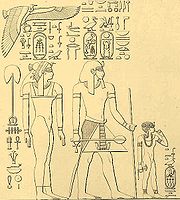
Ornaments
Wigs contained ornamental decorations. A peculiar ornament which the Egyptians created was gorgerin, an assembly of metal discs which rested on the chest skin or a short-sleeved shirt, and tied at the back. Some of the lower class people of this time also created many different types of piercings and body decorations; some of which even included genital piercings, commonly found on women prostitutes of the time.Jewelry
Jewelry|Jewels]] were heavy and rather bulky, which would indicate an Asian influence. The lower classes wore small and simple glassware; bracelet
Bracelet
A bracelet is an article of jewelry which is worn around the wrist. Bracelets can be manufactured from metal, leather, cloth, plastic or other materials and sometimes contain jewels, rocks, wood, and/or shells...
s also were heavy. The most popular stones used were Lapis Lazuli
Lapis lazuli
Lapis lazuli is a relatively rare semi-precious stone that has been prized since antiquity for its intense blue color....
, Carnelian
Carnelian
Carnelian is a brownish-red mineral which is commonly used as a semi-precious gemstone. Similar to carnelian is sard, which is generally harder and darker...
, and Turquoise
Turquoise
Turquoise is an opaque, blue-to-green mineral that is a hydrous phosphate of copper and aluminium, with the chemical formula CuAl648·4. It is rare and valuable in finer grades and has been prized as a gem and ornamental stone for thousands of years owing to its unique hue...
. They wore a large disk as a necklace of strength, sometimes described as an aegis. Gold
Gold
Gold is a chemical element with the symbol Au and an atomic number of 79. Gold is a dense, soft, shiny, malleable and ductile metal. Pure gold has a bright yellow color and luster traditionally considered attractive, which it maintains without oxidizing in air or water. Chemically, gold is a...
was plentiful in Nubia
Nubia
Nubia is a region along the Nile river, which is located in northern Sudan and southern Egypt.There were a number of small Nubian kingdoms throughout the Middle Ages, the last of which collapsed in 1504, when Nubia became divided between Egypt and the Sennar sultanate resulting in the Arabization...
and imported for jewelry and other decorative arts.
Ancient Minoan clothing
As elsewhere, Cretan clothes in the ancient times were well documented in their artwork where many items worn by priestPriest
A priest is a person authorized to perform the sacred rites of a religion, especially as a mediatory agent between humans and deities. They also have the authority or power to administer religious rites; in particular, rites of sacrifice to, and propitiation of, a deity or deities...
esses and priests seem to reflect the clothing of most. Wool and flax were used. Spinning
Spinning (textiles)
Spinning is a major industry. It is part of the textile manufacturing process where three types of fibre are converted into yarn, then fabric, then textiles. The textiles are then fabricated into clothes or other artifacts. There are three industrial processes available to spin yarn, and a...
and weaving
Weaving
Weaving is a method of fabric production in which two distinct sets of yarns or threads are interlaced at right angles to form a fabric or cloth. The other methods are knitting, lace making and felting. The longitudinal threads are called the warp and the lateral threads are the weft or filling...
were domestic activities, dyeing was the only commercial process in keeping with everywhere else in antiquity. Fabrics were embroidered. Crimson
Crimson
Crimson is a strong, bright, deep red color. It is originally the color of the dye produced from a scale insect, Kermes vermilio, but the name is now also used as a generic term for those slightly bluish-red colors that are between red and rose; besides crimson itself, these colors include...
was used the most in dyeing, in four different shades.
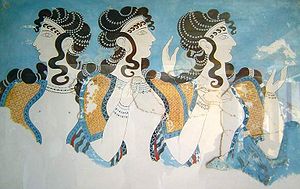
Female Minoan dress
Loincloth
A loincloth is a one-piece male garment, sometimes kept in place by a belt, which covers the genitals and, at least partially, the buttocks.-History and types:Loincloths are being and have been worn:*in societies where no other clothing is needed or wanted...
was used by both sexes. The women of Crete
Crete
Crete is the largest and most populous of the Greek islands, the fifth largest island in the Mediterranean Sea, and one of the thirteen administrative regions of Greece. It forms a significant part of the economy and cultural heritage of Greece while retaining its own local cultural traits...
wore the garment more as an underskirt than the men, by lengthening it. They often are illustrated in statuettes with a large dagger fixed at the belt. Undoubtedly providing for personal safety was one of the characteristics of female clothing in the Neolithic era, because one also found traces of it in the peat bogs of Denmark up to the Bronze Age
Bronze Age
The Bronze Age is a period characterized by the use of copper and its alloy bronze as the chief hard materials in the manufacture of some implements and weapons. Chronologically, it stands between the Stone Age and Iron Age...
.
From 1750 BC, the long skirt was trimmed and began to resemble the blouse in appearance. The belt, a long or short coat and a hat supplemented the female outfit. The Cretan clothing for women was the first true bent garment in history. Ancient brooches, widespread in the Mediterranean, were used throughout the period.
Dresses also were long and low-necked such as that of the 19th century. They were so low that the bodice was open almost all the way to the waist.
Male Minoan dress

In addition to Cretan styles, Cycladelic
Cyclades
The Cyclades is a Greek island group in the Aegean Sea, south-east of the mainland of Greece; and a former administrative prefecture of Greece. They are one of the island groups which constitute the Aegean archipelago. The name refers to the islands around the sacred island of Delos...
clothing was worn as pants across the continent. A triangular front released the top of the thighs. One could say it was clothing of an athletic population, because of this and the fact that the chest always was naked. It was sometimes covered with a cask, probably ritualistically. However, long clothing was worn for protection against bad weather and eventually a coat of wool was used by the Greeks.
Men had long hair flowing to the shoulders; however several types of headgear were usual, types of bonnet
Bonnet (headgear)
Bonnets are a variety of headgear for both sexes, which have in common only the absence of a brim. Bonnet derives from the same word in French, where it originally indicated a type of material...
s and turban
Turban
In English, Turban refers to several types of headwear popularly worn in the Middle East, North Africa, Punjab, Jamaica and Southwest Asia. A commonly used synonym is Pagri, the Indian word for turban.-Styles:...
s, probably of skin. Shoes were boots of skin, probably of chamois
Chamois
The chamois, Rupicapra rupicapra, is a goat-antelope species native to mountains in Europe, including the Carpathian Mountains of Romania, the European Alps, the Tatra Mountains, the Balkans, parts of Turkey, and the Caucasus. The chamois has also been introduced to the South Island of New Zealand...
, and were used only to leave the house, where one went barefoot, just as in the sanctuaries and the palaces. People studying this matter have noticed the outdoor staircases are worn down considerably, interior ones hardly at all. It's known that later, the Greeks took off their sandals after entering a house - this habit already was in use in Crete. The boots had a slightly raised end, thus indicating an Anatolia
Anatolia
Anatolia is a geographic and historical term denoting the westernmost protrusion of Asia, comprising the majority of the Republic of Turkey...
n origin, similar to those found on the frescoes of Etruria
Etruria
Etruria—usually referred to in Greek and Latin source texts as Tyrrhenia—was a region of Central Italy, an area that covered part of what now are Tuscany, Latium, Emilia-Romagna, and Umbria. A particularly noteworthy work dealing with Etruscan locations is D. H...
Ancient Greek clothing
Ancient GreeceAncient Greece
Ancient Greece is a civilization belonging to a period of Greek history that lasted from the Archaic period of the 8th to 6th centuries BC to the end of antiquity. Immediately following this period was the beginning of the Early Middle Ages and the Byzantine era. Included in Ancient Greece is the...
is famous for its philosophy, art, literature, and politics. As a result, classical period Greek style in dress often has been revived when later societies wished to evoke some revered aspect of ancient Greek civilization, such as democratic government. A Greek style in dress became fashionable in France shortly after the French Revolution
French Revolution
The French Revolution , sometimes distinguished as the 'Great French Revolution' , was a period of radical social and political upheaval in France and Europe. The absolute monarchy that had ruled France for centuries collapsed in three years...
(1789–1799), because the style was thought to express the democratic ideals for which that revolution was fought, no matter how incorrect the understanding of the historical reality was.
Clothing reformers later in the 19th century admired ancient Grecian dress because they thought it represented timeless beauty, the opposite of complicated and rapidly changing fashions of their time, as well as the more practical reasoning that Grecian-style dresses required far less cloth than those of the Rococo period.
Ancient Greek clothing consisted of lengths of linen or wool fabric, which generally was rectangular and secured with a sash and a fibula, an ornamental clasp or pin. Typical of such garments were the peplos
Peplos
A peplos is a body-lengthGreek garment worn by women before 500 BC. The peplos is a tubular cloth folded inside-out from the top about halfway down, altering what was the top of the tube to the waist and the bottom of the tube to ankle-length. The garment is then gathered about the waist and the...
, a loose garment worn by women; the chlamys
Chlamys
The chlamys was an ancient Greek piece of clothing, a type of cloak....
, a cloak worn by men; and the chiton
Chiton (costume)
A chiton was a form of clothing worn by men and women in Ancient Greece, from the Archaic period to the Hellenistic period ....
, a tunic worn by both genders and all ages. Often the chiton is shown as pleated. Men’s chitons hung to the knees, whereas women’s chitons fell to their ankles. Amazons
Amazons
The Amazons are a nation of all-female warriors in Greek mythology and Classical antiquity. Herodotus placed them in a region bordering Scythia in Sarmatia...
were depicted with their right breast bared so that the garment did not interfere with the weapons they wielded.
The basic outer garment during winter was the himation
Himation
A himation was a type of clothing in ancient Greece. It was usually worn over a chiton, but was made of heavier drape and played the role of a cloak.The himation was markedly less voluminous than the Roman toga....
, a larger cloak worn over the peplos or chlamys. The chiton was a simple garment, but the peplos was more distinctively Greek, with its shoulder clasps. The himation has been most influential perhaps on later fashion. Women dressed similarly in most areas of ancient Greece although in some regions, they also wore a loose veil as well at public events and market.
During Classical times in Greece, male nudity received a religious sanction following profound changes in the culture. After that time, male athletes participated in ritualized athletic competitions such as the classical version of the ancient Olympic Games, in the nude as women became barred from the competition except as the owners of racing chariots. Their ancient events were discontinued, one of which (a footrace for women) had been the sole original competition. Myths relate that after this prohibition, a woman was discovered to have won the competition while wearing the clothing of a man—instituting the policy of nudity among the competitors that prevented such embarrassment again.
Ancient Roman and Italic clothing
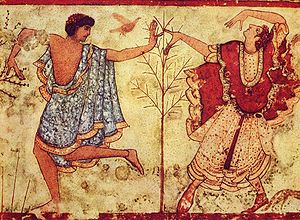
Etruscan civilization
Etruscan civilization is the modern English name given to a civilization of ancient Italy in the area corresponding roughly to Tuscany. The ancient Romans called its creators the Tusci or Etrusci...
that inhabited Italy before the Romans are less well imitated (see the image to the right), but the resemblance in their clothing may be noted. The Etruscan culture is dated from 1200 BC through the first two phases of the Roman periods. At its maximum extent during the foundation period of Rome and the Roman kingdom, it flourished in three confederacies of cities: of Etruria, of the Po valley with the eastern Alps, and of Latium and Campania. Rome was sited in Etruscan territory. There is considerable evidence that early Rome was dominated by Etruscans until the Romans sacked Veii
Veii
Veii was, in ancient times, an important Etrurian city NNW of Rome, Italy; its site lies in Isola Farnese, a village of Municipio XX, an administrative subdivision of the comune of Rome in the Province of Rome...
in 396 BC.
In Ancient Rome, boys after the age of sixteen had their clothes burned as a sign of growing up. Roman girls also wore white until they were married to say they were pure and virginal.
Toga and tunics
Probably the most significant item in the ancient Roman wardrobe was the togaToga
The toga, a distinctive garment of Ancient Rome, was a cloth of perhaps 20 ft in length which was wrapped around the body and was generally worn over a tunic. The toga was made of wool, and the tunic under it often was made of linen. After the 2nd century BC, the toga was a garment worn...
, a one-piece woolen garment that draped loosely around the shoulders and down the body. Historians believe that originally the toga was worn by all Romans during the combined centuries of the Roman monarchy
Roman Kingdom
The Roman Kingdom was the period of the ancient Roman civilization characterized by a monarchical form of government of the city of Rome and its territories....
and its successor, the Roman Republic
Roman Republic
The Roman Republic was the period of the ancient Roman civilization where the government operated as a republic. It began with the overthrow of the Roman monarchy, traditionally dated around 508 BC, and its replacement by a government headed by two consuls, elected annually by the citizens and...
. At this time it is thought that the toga was worn without undergarments.
Free citizens were required to wear togas because only slaves and children wore tunics.
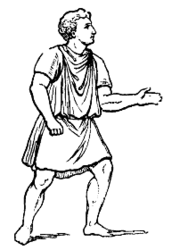
Tunic
A tunic is any of several types of clothing for the body, of various lengths reaching from the shoulders to somewhere between the hips and the ankles...
, and the tunic became the basic item of dress for both men and women. Women wore an outer garment known as a stola
Stola
The stola was the traditional garment of Roman women, corresponding to the toga, or the pallium, that were worn by men.Originally, women wore togas as well, but after the 2nd century BC, the toga was worn exclusively by men, and women were expected to wear the stola...
, which was a long pleated dress similar to the Greek chitons.
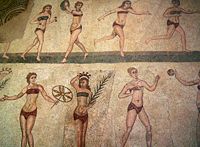
Although togas are now thought of as the only clothing worn in ancient Italy, in fact, many other styles of clothing were worn and also are familiar in images seen in artwork from the period. Garments could be quite specialized, for instance, for warfare, specific occupations, or for sports. In ancient Rome women athletes wore leather briefs and brassier for maximum coverage but the ability to compete.
Girls and boys under the age of puberty sometimes wore a special kind of toga with a reddish-purple band on the lower edge, called the toga praetexta. This toga also was worn by magistrates and high priests as an indication of their status. The toga candida, an especially whitened toga, was worn by political candidates. Prostitutes wore the toga muliebris, rather than the tunics worn by most women. The toga pulla was dark-colored and worn for mourning, while the toga purpurea, of purple-dyed wool, was worn in times of triumph and by the Roman emperor.
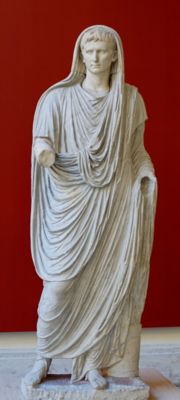
Togas could be wrapped in different ways, and they became larger and more voluminous over the centuries. Some innovations were purely fashionable. Because it was not easy to wear a toga without tripping over it or trailing drapery, some variations in wrapping served a practical function. Other styles were required, for instance, for covering the head during ceremonies.
_01.jpg)
Roman Empire
The Roman Empire was the post-Republican period of the ancient Roman civilization, characterised by an autocratic form of government and large territorial holdings in Europe and around the Mediterranean....
in c. 44 BC, only men who were citizens of Rome wore the toga. Women, slaves, foreigners, and others who were not citizens of Rome wore tunics and were forbidden from wearing the toga. By the same token, Roman citizens were required to wear the toga when conducting official business. Over time, the toga evolved from a national to a ceremonial costume. Different types of togas indicated age, profession, and social rank.
Roman writer Seneca
Seneca the Younger
Lucius Annaeus Seneca was a Roman Stoic philosopher, statesman, dramatist, and in one work humorist, of the Silver Age of Latin literature. He was tutor and later advisor to emperor Nero...
criticized men who wore their togas too loosely or carelessly. He also criticized men who wore what were considered feminine or outrageous styles, including togas that were slightly transparent.
The late toga of adult citizens, the toga virilis, was made of plain white wool and worn after the age of fourteen. A woman convicted of adultery might be forced to wear a toga as a badge of shame
Badge of shame
A badge of shame, also a symbol of shame, mark of shame, or simply a stigma, is typically a distinctive symbol required to be worn by a specific group or an individual for the purpose of public humiliation, ostracism, or persecution...
and curiously, as a symbol of the loss of her female identity.
The ancient Romans were aware that their clothing differed from that of other peoples. In particular, they noted the long trousers
Trousers
Trousers are an item of clothing worn on the lower part of the body from the waist to the ankles, covering both legs separately...
worn by people they considered barbarians from the north, including the Germanic Franks and Goths. The figures depicted on ancient Roman armored breastplates often include barbarian warriors in shirts and trousers.
Symbolism and influence
Muscle cuirass
In classical antiquity, the muscle cuirass or heroic cuirass is a type of body armor cast to fit the wearer's torso and designed to mimic an idealized human physique. It first appears in late Archaic Greece and became widespread throughout the 5th– 4th centuries BC...
, has symbolized amazing power. In Europe during the Renaissance (15th and 16th centuries), painters and sculptors sometimes depicted rulers wearing pseudo-Roman military attire, including the cuirass, military cloak, and sandals.
Later, during the French Revolution
French Revolution
The French Revolution , sometimes distinguished as the 'Great French Revolution' , was a period of radical social and political upheaval in France and Europe. The absolute monarchy that had ruled France for centuries collapsed in three years...
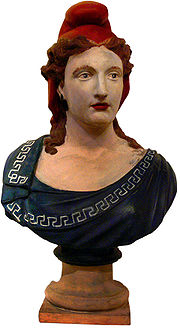
, an effort was made to dress officials in uniforms based on the Roman toga, to symbolize the importance of citizenship to a republic. Adopted by the rank and file revolutionaries, the 18th-century liberty cap
Phrygian cap
The Phrygian cap is a soft conical cap with the top pulled forward, associated in antiquity with the inhabitants of Phrygia, a region of central Anatolia. In the western provinces of the Roman Empire it came to signify freedom and the pursuit of liberty, perhaps through a confusion with the pileus,...
, a brimless, limp cap fitting snugly around the head, was based on a bonnet worn by freed slaves in ancient Rome, the Phrygian cap
Phrygian cap
The Phrygian cap is a soft conical cap with the top pulled forward, associated in antiquity with the inhabitants of Phrygia, a region of central Anatolia. In the western provinces of the Roman Empire it came to signify freedom and the pursuit of liberty, perhaps through a confusion with the pileus,...
.
The modern Western bride
Bride
A bride is a woman about to be married or newlywed.The word may come from the Proto-Germanic verb root *brū-, meaning 'to cook, brew, or make a broth' which was the role of the daughter-in-law in primitive families...
also has inherited elements from ancient Roman wedding attire, such as the bridal veil and the wedding ring
Wedding ring
A wedding ring or wedding band is a metal ring indicating the wearer is married. Depending on the local culture, it is worn on the base of the right or the left ring finger. The custom of wearing such a ring has spread widely beyond its origin in Europe...
.