


Tunic

Encyclopedia
Clothing
Clothing refers to any covering for the human body that is worn. The wearing of clothing is exclusively a human characteristic and is a feature of nearly all human societies...
for the body, of various lengths reaching from the shoulders to somewhere between the hips and the ankles. The name derives from the Latin
Latin
Latin is an Italic language originally spoken in Latium and Ancient Rome. It, along with most European languages, is a descendant of the ancient Proto-Indo-European language. Although it is considered a dead language, a number of scholars and members of the Christian clergy speak it fluently, and...
tunica commonly worn by both men and women in Ancient Rome
Ancient Rome
Ancient Rome was a thriving civilization that grew on the Italian Peninsula as early as the 8th century BC. Located along the Mediterranean Sea and centered on the city of Rome, it expanded to one of the largest empires in the ancient world....
, which in turn is based on earlier Greek
Ancient Greece
Ancient Greece is a civilization belonging to a period of Greek history that lasted from the Archaic period of the 8th to 6th centuries BC to the end of antiquity. Immediately following this period was the beginning of the Early Middle Ages and the Byzantine era. Included in Ancient Greece is the...
garments.
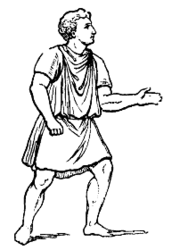
The Roman tunica was worn by citizens and non-citizens alike; citizens, though, might wear it under the toga
Toga
The toga, a distinctive garment of Ancient Rome, was a cloth of perhaps 20 ft in length which was wrapped around the body and was generally worn over a tunic. The toga was made of wool, and the tunic under it often was made of linen. After the 2nd century BC, the toga was a garment worn...
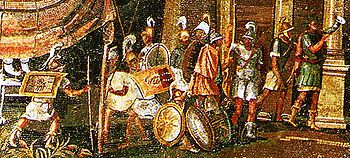
, especially at formal occasions. The length of the garment, the presence or lack of stripes, as well as their width and ornamentation, would indicate the wearer's status in Roman society. Soldiers, slaves and manual workers generally had tunics to a little above the knee; those in more sedentary occupations to about the ankle (unless they were expecting to ride a horse, when a shorter one would be worn).
Greek tunic
The tunic was also worn by the ancient and ByzantineByzantine dress
Byzantine dress changed considerably over the thousand years of the Empire, but was essentially conservative. The Byzantines liked colour and pattern, and made and exported very richly patterned cloth, especially Byzantine silk, woven and embroidered for the upper classes, and resist-dyed and...
Greeks and is very similar to the chiton
Chiton (costume)
A chiton was a form of clothing worn by men and women in Ancient Greece, from the Archaic period to the Hellenistic period ....
, which looked like a jacket
Jacket
A jacket is a hip- or waist-length garment for the upper body. A jacket typically has sleeves, and fastens in the front. A jacket is generally lighter, tighter-fitting, and less insulating than a coat, which is outerwear...
. In Ancient Greece
Ancient Greece
Ancient Greece is a civilization belonging to a period of Greek history that lasted from the Archaic period of the 8th to 6th centuries BC to the end of antiquity. Immediately following this period was the beginning of the Early Middle Ages and the Byzantine era. Included in Ancient Greece is the...
, a person's tunic was decorated at the hem-line to represent the city-state
City-state
A city-state is an independent or autonomous entity whose territory consists of a city which is not administered as a part of another local government.-Historical city-states:...
in which he lived. The tunics were either dyed with bright colors or bleached white.
Roman legionary tunic
Medieval tunic
Decline of the Roman Empire
The decline of the Roman Empire refers to the gradual societal collapse of the Western Roman Empire. Many theories of causality prevail, but most concern the disintegration of political, economic, military, and other social institutions, in tandem with foreign invasions and usurpers from within the...
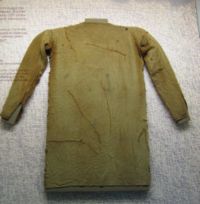
, the tunic continued to be worn with varying sleeve and hem lengths throughout Europe during the Middle Ages
Middle Ages
The Middle Ages is a periodization of European history from the 5th century to the 15th century. The Middle Ages follows the fall of the Western Roman Empire in 476 and precedes the Early Modern Era. It is the middle period of a three-period division of Western history: Classic, Medieval and Modern...
. Often reaching the knees or ankles, it was usually worn over underclothes consisting of a shirt (usually hip-length or longer) and drawers (usually knee- or ankle-length pants related to braccae). It may be accompanied by hose
Hose (clothing)
Hose are any of various styles of men's clothing for the legs and lower body, worn from the Middle Ages through the 17th century, when the term fell out of use in favor of breeches and stockings. The old plural form of "hose" was hosen...
. Wool
Wool
Wool is the textile fiber obtained from sheep and certain other animals, including cashmere from goats, mohair from goats, qiviut from muskoxen, vicuña, alpaca, camel from animals in the camel family, and angora from rabbits....
and Linen
Linen
Linen is a textile made from the fibers of the flax plant, Linum usitatissimum. Linen is labor-intensive to manufacture, but when it is made into garments, it is valued for its exceptional coolness and freshness in hot weather....
were common fabrics used, though the wealthy sometimes wore fancy silk
Silk
Silk is a natural protein fiber, some forms of which can be woven into textiles. The best-known type of silk is obtained from the cocoons of the larvae of the mulberry silkworm Bombyx mori reared in captivity...
tunics, or a lesser fabric with silk trim.
Tunics worn during the Early Middle Ages
Early Middle Ages
The Early Middle Ages was the period of European history lasting from the 5th century to approximately 1000. The Early Middle Ages followed the decline of the Western Roman Empire and preceded the High Middle Ages...
often featured decorative embroidery
Embroidery
Embroidery is the art or handicraft of decorating fabric or other materials with needle and thread or yarn. Embroidery may also incorporate other materials such as metal strips, pearls, beads, quills, and sequins....
or tablet-woven braids
Tablet weaving
Tablet Weaving is a weaving technique where tablets or cards are used to create the shed through which the weft is passed. The technique is limited to narrow work such as belts, straps, or garment trim....
along the neck, hem and wrists. This was the case, for instance, with tunics worn by both rich and poor Anglo-Saxons
Anglo-Saxons
Anglo-Saxon is a term used by historians to designate the Germanic tribes who invaded and settled the south and east of Great Britain beginning in the early 5th century AD, and the period from their creation of the English nation to the Norman conquest. The Anglo-Saxon Era denotes the period of...
before the Norman Conquest.
19th century
Around 1830, small boys began to be dressed in sashed or beltedBelt (clothing)
A belt is a flexible band or strap, typically made of leather or heavy cloth, and worn around the waist. A belt supports trousers or other articles of clothing.-History:...
tunics over trousers, a fashion which replaced the earlier skeleton suit
Skeleton suit
A skeleton suit is an outfit of clothing for small boys, popular from about 1790 to 1830, consisting of a tight short- or long-sleeved coat or jacket buttoned to a pair of high-waisted trousers. Skeleton suits are often described as one of the earliest fashions to be specifically tailored for...
.
During the Crimean War in the 1850s, it was realised that the waist length jackets which had been worn by British soldiers since Napoleonic times were unsuitable for fighting in winter conditions. A new longer jacket was introduced which reached down to the mid thigh and this was named the 'tunic' after the 'tunica' of the intrepid ancient Roman solder. This type of jacket soon became standard for most armies.
In the 1939 film Gone with the Wind
Gone with the Wind (film)
Gone with the Wind is a 1939 American historical epic film adapted from Margaret Mitchell's Pulitzer-winning 1936 novel of the same name. It was produced by David O. Selznick and directed by Victor Fleming from a screenplay by Sidney Howard...
, set in the mid-1860s, the character Maj. Ashley Wilkes
Ashley Wilkes
George Ashley Wilkes is a fictional character in the Margaret Mitchell's 1936 novel Gone with the Wind and the later film of the same name. The character also appears in the 1991 book Scarlett, a sequel to Gone with the Wind written by Alexandra Ripley, and in Rhett Butler's People by Donald...
returns home for a 3-day furlough
Furlough
In the United States a furlough is a temporary unpaid leave of some employees due to special needs of a company, which may be due to economic conditions at the specific employer or in the economy as a whole...
and thanks his wife Melanie Hamilton for a tunic she gives him as a Christmas gift, saying "I meant it, dear. It's a lovely gift. Only generals have tunics like this nowadays."
Modern tunic
In Western culture, its use continues primarily in a religious and uniformUniform
A uniform is a set of standard clothing worn by members of an organization while participating in that organization's activity. Modern uniforms are worn by armed forces and paramilitary organizations such as police, emergency services, security guards, in some workplaces and schools and by inmates...
context. It is the primary garment worn by the clergy
Clergy
Clergy is the generic term used to describe the formal religious leadership within a given religion. A clergyman, churchman or cleric is a member of the clergy, especially one who is a priest, preacher, pastor, or other religious professional....
, and members of religious order
Religious order
A religious order is a lineage of communities and organizations of people who live in some way set apart from society in accordance with their specific religious devotion, usually characterized by the principles of its founder's religious practice. The order is composed of initiates and, in some...
s. The religious tunic reaches to the feet and was the source of the clerical cassock
Cassock
The cassock, an item of clerical clothing, is an ankle-length robe worn by clerics of the Roman Catholic Church, Eastern Orthodox Church, Anglican Church, Lutheran Church and some ministers and ordained officers of Presbyterian and Reformed churches. Ankle-length garment is the meaning of the...
, as well as, in its liturgical
Liturgy
Liturgy is either the customary public worship done by a specific religious group, according to its particular traditions or a more precise term that distinguishes between those religious groups who believe their ritual requires the "people" to do the "work" of responding to the priest, and those...
form, the alb
Alb
The alb , one of the liturgical vestments of the Roman Catholic, Anglican and many Protestant churches, is an ample white garment coming down to the ankles and usually girdled with a cincture. It is simply the long linen tunic used by the Romans...
, after the long tunic worn by Roman citizens. 'Tunic' is also the name often given to the coat
Coat (clothing)
A coat is a long garment worn by both men and women, for warmth or fashion. Coats typically have long sleeves and are open down the front, closing by means of buttons, zippers, hook-and-loop fasteners, toggles, a belt, or a combination of some of these...
worn by military
Military
A military is an organization authorized by its greater society to use lethal force, usually including use of weapons, in defending its country by combating actual or perceived threats. The military may have additional functions of use to its greater society, such as advancing a political agenda e.g...
and police
Police
The police is a personification of the state designated to put in practice the enforced law, protect property and reduce civil disorder in civilian matters. Their powers include the legitimized use of force...
personnel, usually close-fitting. Light female garments, especially for sports or exercise, usually only coming down to mid-thigh, are also called tunics. A variation called the "Ruth Tunic" can have sleeves, although this type is rare.
See also
- Clothing in the ancient worldClothing in the ancient worldThe clothing used in the ancient world strongly reflects the technologies that these peoples mastered. Archaeology plays a significant role in documenting this aspect of ancient life, for fabric fibres, and leathers sometimes are well-preserved through time...
- Clothing in ancient RomeClothing in ancient RomeClothing in ancient Rome generally consisted of the toga, the tunic, the stola, brooches for these, and breeches.-Fibers:The Romans used several different types of [fiber]s. Wool was likely used most often, as it was obtained easily and was rather easy to prepare...
- Early medieval European dressEarly medieval European dressEarly medieval European dress changed very gradually from about 400 to 1100. The main feature of the period was the meeting of late Roman costume with that of the invading peoples who moved into Europe over this period...
- Anglo-Saxon dressAnglo-Saxon dressAnglo-Saxon dress refers to the variety of early medieval European dress, or clothing, worn by the Anglo-Saxons from the time of their migration to Great Britain in the 5th century until the beginning of the Norman Conquest, when Norman fashions from the Continent began to have a major influence in...
- 1830s children's fashion
- 1840s children's fashion
- 1850s children's fashion
- DashikiDashikiThe dashiki is a colorful men's garment widely worn in West Africa that covers the top half of the body. It has formal and informal versions and varies from simple draped clothing to fully tailored suits. Traditional female attire is called a caftan, or kaftan...
- KurtaKurtaA kurta is a traditional item of clothing worn in Afghanistan, Pakistan , Nepal, India, Bangladesh, and Sri Lanka. It is a loose shirt falling either just above or somewhere below the knees of the wearer, and is worn by both men and women...
Further reading
- Payne, Blanche: History of Costume from the Ancient Egyptians to the Twentieth Century, Harper & Row, 1965. No ISBN for this edition; ASIN B0006BMNFS