

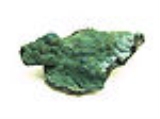
Malachite

Overview
Chemical formula
A chemical formula or molecular formula is a way of expressing information about the atoms that constitute a particular chemical compound....
Cu
Copper
Copper is a chemical element with the symbol Cu and atomic number 29. It is a ductile metal with very high thermal and electrical conductivity. Pure copper is soft and malleable; an exposed surface has a reddish-orange tarnish...
2CO3
Carbonate
In chemistry, a carbonate is a salt of carbonic acid, characterized by the presence of the carbonate ion, . The name may also mean an ester of carbonic acid, an organic compound containing the carbonate group C2....
(OH)
Hydroxide
Hydroxide is a diatomic anion with chemical formula OH−. It consists of an oxygen and a hydrogen atom held together by a covalent bond, and carrying a negative electric charge. It is an important but usually minor constituent of water. It functions as a base, as a ligand, a nucleophile, and a...
2. This green-colored mineral crystallizes in the monoclinic crystal system, and most often forms botryoidal
Botryoidal
A botryoidal texture or mineral habit is one in which the mineral has a globular external form resembling a bunch of grapes as derived from the Greek. This is a common form for many minerals particularly hematite where it is the classically recognized shape. It is also a common form of goethite,...
, fibrous, or stalagmitic
Stalagmite
A stalagmite is a type of speleothem that rises from the floor of a limestone cave due to the dripping of mineralized solutions and the deposition of calcium carbonate. This stalagmite formation occurs only under certain pH conditions within the underground cavern. The corresponding formation on...
masses. Individual crystals are rare but do occur as slender to acicular
Acicular (crystal habit)
Acicular, in mineralogy, refers to a crystal habit composed of a radiating mass of slender, needle-like crystals. Minerals with this habit tend to be fragile and complete, undamaged specimens can be uncommon.-Examples:...
prisms. Pseudomorph
Pseudomorph
In mineralogy, a pseudomorph is a mineral or mineral compound that appears in an atypical form , resulting from a substitution process in which the appearance and dimensions remain constant, but the original mineral is replaced by another...
s after more tabular or blocky azurite
Azurite
Azurite is a soft, deep blue copper mineral produced by weathering of copper ore deposits. It is also known as Chessylite after the type locality at Chessy-les-Mines near Lyon, France...
crystals also occur.
The stone's name derives (via Latin
Latin
Latin is an Italic language originally spoken in Latium and Ancient Rome. It, along with most European languages, is a descendant of the ancient Proto-Indo-European language. Although it is considered a dead language, a number of scholars and members of the Christian clergy speak it fluently, and...
: molochītis, Middle French
Middle French
Middle French is a historical division of the French language that covers the period from 1340 to 1611. It is a period of transition during which:...
: melochite, and Middle English
Middle English
Middle English is the stage in the history of the English language during the High and Late Middle Ages, or roughly during the four centuries between the late 11th and the late 15th century....
melochites) from Greek
Greek language
Greek is an independent branch of the Indo-European family of languages. Native to the southern Balkans, it has the longest documented history of any Indo-European language, spanning 34 centuries of written records. Its writing system has been the Greek alphabet for the majority of its history;...
Μολοχίτης λίθος molochitis lithos, "mallow-green stone", from μολόχη molōchē, variant of μαλάχη malāchē, "mallow".
Unanswered Questions

Discussions
