


Silat

Encyclopedia
Silat Melayu is a blanket term for the types of silat
created in peninsular Southeast Asia
, particularly Malaysia, Thailand
, Brunei
and Singapore
. The silat tradition has deep roots in Malay culture and can trace its origin to the dawn of Malay civilization, 2000 years ago. Since the classical age, silat Melayu underwent great diversification and formed what is today traditionally recognized as the source of Indonesian pencak silat
. Nowadays, the term silat Melayu is most often used to differentiate the Malaysian styles from Indonesian
pencak silat
.
The word Melayu means Malay and came from the Sanskrit
term Malaiur or Malayadvipa which can be translated as “mountain insular continent”, the word used by ancient India
n traders when referring to the Malay Peninsula
. Silat is sometimes called gayung or gayong in the northern Malay Peninsula
. In other regions the word gayung refers to the spiritual practices in silat. Silat Melayu is sometimes mistakenly called bersilat but this is actually a verbal form of the noun silat.
were those of the indigenous tribes (orang asal) who would use hunting implements like spears, machetes, blowpipes and bows and arrows in raids against enemy tribes. Certain tribes were well-known warriors and pirates such as the Iban and the Tringgus of Borneo
. Aboriginal populations on the peninsula were mostly replaced by Deutero-Malays and Chamic people in a wave of migration from mainland Asia
around 300 B.C. These settlers were rice-farmers from whom modern Malays are directly descended. The areas from where they originated are concurrent with the early evidence of silat
.
and China
before the 1st century. Silat
was largely shaped by Chinese
and Indian martial arts
, as evidenced by Kedah's 2nd-century Bujang Valley
civilisation which housed various Indian weapons including an ornate trisula. The local adoption of the Indian religions of Hinduism
and Buddhism
resulted in the founding of early Malay kingdoms throughout the region, notably Langkasuka
(1st century), Gangga Negara
(2nd century), and the Kedah Kingdom (7th century).
From these ancient Malay city-states, the earliest forms of silat Melayu were developed and eventually used in the armed forces to defend the land. Tradition credits silat tua
(lit. "old silat") as the first system of silat Melayu to have been founded on the peninsula. The area from Isthmus of Kra to the northern Malay peninsula
, a border area between Malaysia and Thailand
where it was created, is culturally significant and considered to be the "cradle of Malay civilization and culture".
Gangga Negara
, one of the peninsula's oldest kingdoms, was eventually destroyed by Rajendra Chola I
of the Tamil Chola empire. Today, most Malaysian Indians are Tamil
s, who influenced several Southeast Asian martial arts through silambam
. This staff-based fighting style was already being practiced by the region's Indian community when Malacca Sultanate
was founded at the beginning of the 15th century. During the 18th century silambam became more prevalent in the Malay Peninsula
than in India
, where it was banned by the British government. The bamboo
staff is still one of silat's most fundamental weapons.
The seventh century was the beginning of the Srivijaya
civilization in Palembang
, Sumatra
and the influence of silat from the mainland Malay society was consolidated by Ninik Dato' Suri Diraja (1097–1198) to create silek (Minang silat) of Sumatra.
and Cambodia
. They are believed by many archaeologists to have created the prototype of a kris
as far back as 2000 years ago. The Chams established the kingdom of Champa
in an area that constitutes today’s southern Vietnam
around the first century A.D. The kingdom remained independent from the Chinese who controlled Vietnam
's north and in its refusal to submit, Champa
frequently waged wars against China
as well as other neighboring kingdoms, Đại Việt and Khmer Empire
.
As a result of their experience in wars, commanders of Champa
are known to have been held in high esteem by the Malay kings for their knowledge in silat
and for being highly skilled in the art of war, as mentioned in the Sejarah Melayu
(Malay Annals). It is said that Sultan Muhammad Shah
had chosen a Cham official as his right hand or senior officer because the Chams possessed skill and knowledge in the administration of the kingdom.
was created by a woman who was carrying a basket of food on her head when birds tried to steal the food from her. She dodged the birds coming from all directions while at the same time balancing the basket on her head and attempting to chase the birds away with her hands. She arrived home late and was scolded by her husband who had no food to eat. He tried to beat the woman but she avoided all his attacks and was completely untouched. Her husband had grown tired and after listening to her explanation for being late, asked his wife to teach him what she had learned. Together they created the rudiments of silat
.
, Perak
, Kelantan
and Terengganu
, beginning in the 12th century. This event was subsequently followed by the emergence of powerful Malay sultanates like the Kedah Sultanate
(1136), Brunei Sultanate (1363), Malacca Sultanate
(1402) and Pattani Kingdom
(1516), that dominated the western Malay archipelago and northern Borneo.
From the 13th-16th century, many Malay traditions including silat and the Malay language
were disseminated throughout the entire archipelago. The Malay sultanates became the center of Malay cultural expressions and silat was further refined into the specialized property of the nobility, pendekar
, and panglima (governor-generals). Kings encouraged princes and children of dignitaries to learn silat and any other form of knowledge related to the necessities of combat. Upper-class nobles would often send their children to study abroad in India
or China
. Prominent fighters were elevated to head war troops and received ranks or bestowals from the raja
. The most famous of these was the Melakan admiral Hang Tuah
. He learned martial arts together with his four compatriates - Hang Jebat, Hang Lekir, Hang Kasturi and Hang Lekiu - from two of the most renowned silat guru of the era. In Malaysia today, Hang Tuah
is called the "father of silat" which has led to the misconception that he created silat
. However, Hang Tuah is more likely to have been one of the art's disseminators rather than its originator since silat is known to have been practiced long before the founding of Melaka.
attacked Melaka in an attempt to monopolize the spice trade. The Malay warriors managed to hold back the better-equipped Europeans for over 40 days before Malacca was eventually defeated. The Portuguese hunted and killed anyone with knowledge of martial arts so that the remaining practitioners fled to more isolated areas. Even today, the best silat masters are said to come from rural villages that have had the least contact with outsiders.
For the next few hundred years, the Malay Archipelago would be contested by a string of foreign rulers, namely the Portuguese, Dutch, and finally the British. The 17th century saw an influx of Minangkabau and Bugis
people into Malaya from Sumatra
and south Sulawesi
respectively. Bugis sailors were particularly famous for their martial prowess and were feared even by the European colonists. Between 1666 and 1673, Bugis mercenaries were employed by the Johor empire when a civil war erupted with Jambi, an event that marked the beginning of Bugis influences in local conflicts for succeeding centuries. By the 1780s the Bugis had control of Johor and established a kingdom in Selangor
. With the consent of the Johor ruler, the Minangkabau formed their own federation of nine states called Negeri Sembilan
in the hinterland. Today, some of Malaysia's silat schools can trace their lineage directly back to the Minang and Bugis settlers of this period.
After Malaysia achieved independence, Tuan Haji Anuar bin Haji Abd. Wahab
was given the responsibility of developing the nation's national silat curriculum which would be taught to secondary and primary school students all over the country. On 28 March 2002, his Seni Silat Malaysia was recognised by the Ministry of Heritage and Culture, the Ministry of Education and PESAKA as Malaysia's national silat. Since its disassociation with the palace, silat did not develop in the national defence institution and returned to the countryside. It is now conveyed to the community by means of the gelanggang bangsal meaning the martial arts training institution carried out by silat instructors.
and carried a roll of cloth which could be used as a bag, a blanket or a weapon. The standard full dress of today's silat practitioners usually consists of the following:
is called a gelanggang. They were traditionally located outdoors, either in a specially constructed part of the village or in a jungle clearing. The area would be enclosed by a fence made of bamboo
and covered in nipah or coconut leaves to prevent outsiders from stealing secrets. Before training can begin, the gelanggang must be prepared either by the teachers or senior students in a ritual called "opening the training area" (buka gelanggang ). This starts by cutting some lime
s into water and then walking around the area while sprinkling the water onto the floor. The guru
walks in a pattern starting from the centre to the front-right corner, and then across to the front-left corner. She/he then walks backwards past the centre into the rear-right corner, across to the rear-left corner, and finally ends back in the centre. The purpose of walking backwards is to show respect to the gelanggang, and any guests that may be present, by never turning one's back to the front of the area. Once this has been done, the teacher sits in the centre and recites an invocation so the space is protected with positive energy. From the centre, the guru
walks to the front-right corner and repeats the invocation while keeping his/her head bowed and hands crossed. The right hand is crossed over the left and they are kept at waist level. The mantera
is repeated at each corner and in the same pattern as when the water was sprinkled. As a sign of humility, the guru
maintains a bent posture while walking across the training area. After repeating the invocation in the centre once more, the teacher sits down and meditates. Although most practitioners today train in modern indoor gelanggang and the invocations are often replaced with a prayer, this ritual is still carried out in some form or another.
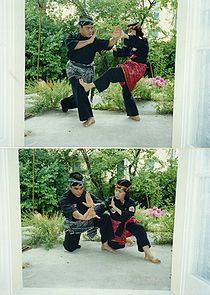 Silat pulut is a sport that utilizes agility in attacking and defending oneself. In this exercise, the two partners begin some distance apart and perform freestyle movements while trying to match the each other's flow. One attacks when they notice an opening in the opponent's defences. Without interfering with the direction of force, the defender then parries and counterattacks. The other partner follows by parrying and attacking. This would go on with both partners disabling and counter-attacking their opponent with locking, grappling and other techniques. Contact between the partners is generally kept light but faster and stronger attacks may be agreed upon beforehand. In another variation which is also found in chin na
, the initial attack is parried and then the defender applies a lock on the attacker. The attacker follows the flow of the lock and escapes it while putting a lock on the opponent. Both partners go from lock to lock until one is incapable of escaping or countering.
This game is called silat pulut or gayong pulut because after a performance each player is gifted with bunga telur and sticky rice or pulut. Silat pulut is held during leisure time, the completion of silat instruction, official events, weddings or festivals where it is accompanied by the rhythm of gendang silat (silat drums) or tanji silat baku (traditional silat music). As with a tomoi
match, the speed of the music adapts to the performer's pace.
British colonists introduced western training systems by incorporating the police and sepoy
s (soldiers who were local citizens) to handle the nation's defence forces which at that time were receiving opposition from former Malay fighters. Consequently, silat teachers were very cautious in letting their art become apparent because the colonists had experience in fighting Malay warriors. Thus silat pulut provided an avenue for exponents to hone their skills without giving themselves away. It could also be used as preliminary training before students are allowed to spar, somewhat like Keralan adithada
.
Despite its satirical appearance, silat pulut actually enables students to learn moves and their applications without having to be taught set techniques. Partners who frequently practice together can exchange hard blows without injuring each other by adhering to the principle of not meeting force with force. What starts off as a matching of striking movements is usually followed by successions of locks and may end in groundwork, a pattern that is echoed in the modern Mixed Martial Arts
.
Silat
Silat Melayu is a blanket term for the types of silat created in peninsular Southeast Asia, particularly Malaysia, Thailand, Brunei and Singapore. The silat tradition has deep roots in Malay culture and can trace its origin to the dawn of Malay civilization, 2000 years ago...
created in peninsular Southeast Asia
Indochina
The Indochinese peninsula, is a region in Southeast Asia. It lies roughly southwest of China, and east of India. The name has its origins in the French, Indochine, as a combination of the names of "China" and "India", and was adopted when French colonizers in Vietnam began expanding their territory...
, particularly Malaysia, Thailand
Thailand
Thailand , officially the Kingdom of Thailand , formerly known as Siam , is a country located at the centre of the Indochina peninsula and Southeast Asia. It is bordered to the north by Burma and Laos, to the east by Laos and Cambodia, to the south by the Gulf of Thailand and Malaysia, and to the...
, Brunei
Brunei
Brunei , officially the State of Brunei Darussalam or the Nation of Brunei, the Abode of Peace , is a sovereign state located on the north coast of the island of Borneo, in Southeast Asia...
and Singapore
Singapore
Singapore , officially the Republic of Singapore, is a Southeast Asian city-state off the southern tip of the Malay Peninsula, north of the equator. An island country made up of 63 islands, it is separated from Malaysia by the Straits of Johor to its north and from Indonesia's Riau Islands by the...
. The silat tradition has deep roots in Malay culture and can trace its origin to the dawn of Malay civilization, 2000 years ago. Since the classical age, silat Melayu underwent great diversification and formed what is today traditionally recognized as the source of Indonesian pencak silat
Pencak Silat
Pencak silat is an umbrella term for the indigenous martial arts created in Indonesia. The leading organization of pencak silat in Indonesia is IPSI...
. Nowadays, the term silat Melayu is most often used to differentiate the Malaysian styles from Indonesian
Indonesian language
Indonesian is the official language of Indonesia. Indonesian is a normative form of the Riau Islands dialect of Malay, an Austronesian language which has been used as a lingua franca in the Indonesian archipelago for centuries....
pencak silat
Pencak Silat
Pencak silat is an umbrella term for the indigenous martial arts created in Indonesia. The leading organization of pencak silat in Indonesia is IPSI...
.
Etymology
The etymological root of the word silat is uncertain and most hypotheses link it to any similar-sounding word. It may come from Si Elat which means someone who confuses, deceives or bluffs. A similar term, ilat, means an accident, misfortune or a calamity. Another theory is that it comes from silap meaning wrong or error. Some styles contain a set of techniques called Langkah Silap designed to lead the opponent into making a mistake.The word Melayu means Malay and came from the Sanskrit
Sanskrit
Sanskrit , is a historical Indo-Aryan language and the primary liturgical language of Hinduism, Jainism and Buddhism.Buddhism: besides Pali, see Buddhist Hybrid Sanskrit Today, it is listed as one of the 22 scheduled languages of India and is an official language of the state of Uttarakhand...
term Malaiur or Malayadvipa which can be translated as “mountain insular continent”, the word used by ancient India
India
India , officially the Republic of India , is a country in South Asia. It is the seventh-largest country by geographical area, the second-most populous country with over 1.2 billion people, and the most populous democracy in the world...
n traders when referring to the Malay Peninsula
Malay Peninsula
The Malay Peninsula or Thai-Malay Peninsula is a peninsula in Southeast Asia. The land mass runs approximately north-south and, at its terminus, is the southern-most point of the Asian mainland...
. Silat is sometimes called gayung or gayong in the northern Malay Peninsula
Malay Peninsula
The Malay Peninsula or Thai-Malay Peninsula is a peninsula in Southeast Asia. The land mass runs approximately north-south and, at its terminus, is the southern-most point of the Asian mainland...
. In other regions the word gayung refers to the spiritual practices in silat. Silat Melayu is sometimes mistakenly called bersilat but this is actually a verbal form of the noun silat.
Origins
The first martial skills in the Malay PeninsulaMalay Peninsula
The Malay Peninsula or Thai-Malay Peninsula is a peninsula in Southeast Asia. The land mass runs approximately north-south and, at its terminus, is the southern-most point of the Asian mainland...
were those of the indigenous tribes (orang asal) who would use hunting implements like spears, machetes, blowpipes and bows and arrows in raids against enemy tribes. Certain tribes were well-known warriors and pirates such as the Iban and the Tringgus of Borneo
Borneo
Borneo is the third largest island in the world and is located north of Java Island, Indonesia, at the geographic centre of Maritime Southeast Asia....
. Aboriginal populations on the peninsula were mostly replaced by Deutero-Malays and Chamic people in a wave of migration from mainland Asia
Asia
Asia is the world's largest and most populous continent, located primarily in the eastern and northern hemispheres. It covers 8.7% of the Earth's total surface area and with approximately 3.879 billion people, it hosts 60% of the world's current human population...
around 300 B.C. These settlers were rice-farmers from whom modern Malays are directly descended. The areas from where they originated are concurrent with the early evidence of silat
Silat
Silat Melayu is a blanket term for the types of silat created in peninsular Southeast Asia, particularly Malaysia, Thailand, Brunei and Singapore. The silat tradition has deep roots in Malay culture and can trace its origin to the dawn of Malay civilization, 2000 years ago...
.
Early kingdoms
The Malays had already established regular contact with both IndiaIndia
India , officially the Republic of India , is a country in South Asia. It is the seventh-largest country by geographical area, the second-most populous country with over 1.2 billion people, and the most populous democracy in the world...
and China
China
Chinese civilization may refer to:* China for more general discussion of the country.* Chinese culture* Greater China, the transnational community of ethnic Chinese.* History of China* Sinosphere, the area historically affected by Chinese culture...
before the 1st century. Silat
Silat
Silat Melayu is a blanket term for the types of silat created in peninsular Southeast Asia, particularly Malaysia, Thailand, Brunei and Singapore. The silat tradition has deep roots in Malay culture and can trace its origin to the dawn of Malay civilization, 2000 years ago...
was largely shaped by Chinese
Chinese martial arts
Chinese martial arts, also referred to by the Mandarin Chinese term wushu and popularly as kung fu , are a number of fighting styles that have developed over the centuries in China. These fighting styles are often classified according to common traits, identified as "families" , "sects" or...
and Indian martial arts
Indian martial arts
The Indian subcontinent is home to a variety of fighting styles. In Sanskrit they may be collectively referred to as ' or '. The former is a compound of the words and , meaning "knowledge of the sword" or "knowledge of weaponry"...
, as evidenced by Kedah's 2nd-century Bujang Valley
Bujang Valley
The Bujang Valley or Lembah Bujang is a sprawling historical complex and has an area of approximately 224 square km. Situated near Merbok, Kedah, between Gunung Jerai in the north and Muda River in the south, it is the richest archaeological area in Malaysia.These archaeological remains show that...
civilisation which housed various Indian weapons including an ornate trisula. The local adoption of the Indian religions of Hinduism
Hinduism
Hinduism is the predominant and indigenous religious tradition of the Indian Subcontinent. Hinduism is known to its followers as , amongst many other expressions...
and Buddhism
Buddhism
Buddhism is a religion and philosophy encompassing a variety of traditions, beliefs and practices, largely based on teachings attributed to Siddhartha Gautama, commonly known as the Buddha . The Buddha lived and taught in the northeastern Indian subcontinent some time between the 6th and 4th...
resulted in the founding of early Malay kingdoms throughout the region, notably Langkasuka
Langkasuka
Langkasuka was an ancient Hindu Malay kingdom located in the Malay Peninsula...
(1st century), Gangga Negara
Gangga Negara
Gangga Negara is believed to be a lost semi-legendary Hindu kingdom mentioned in the Malay Annals that covered present day Beruas, Dinding and Manjung in the state of Perak, Malaysia with Raja Gangga Shah Johan as one of its kings...
(2nd century), and the Kedah Kingdom (7th century).
From these ancient Malay city-states, the earliest forms of silat Melayu were developed and eventually used in the armed forces to defend the land. Tradition credits silat tua
Silat Pattani
Silat Patani is a style of silat originating in the Pattani kingdom, between what is now northern Malaysia and southern Thailand...
(lit. "old silat") as the first system of silat Melayu to have been founded on the peninsula. The area from Isthmus of Kra to the northern Malay peninsula
Malay Peninsula
The Malay Peninsula or Thai-Malay Peninsula is a peninsula in Southeast Asia. The land mass runs approximately north-south and, at its terminus, is the southern-most point of the Asian mainland...
, a border area between Malaysia and Thailand
Thailand
Thailand , officially the Kingdom of Thailand , formerly known as Siam , is a country located at the centre of the Indochina peninsula and Southeast Asia. It is bordered to the north by Burma and Laos, to the east by Laos and Cambodia, to the south by the Gulf of Thailand and Malaysia, and to the...
where it was created, is culturally significant and considered to be the "cradle of Malay civilization and culture".
Gangga Negara
Gangga Negara
Gangga Negara is believed to be a lost semi-legendary Hindu kingdom mentioned in the Malay Annals that covered present day Beruas, Dinding and Manjung in the state of Perak, Malaysia with Raja Gangga Shah Johan as one of its kings...
, one of the peninsula's oldest kingdoms, was eventually destroyed by Rajendra Chola I
Rajendra Chola I
Rajendra Chola I was the son of Rajaraja Chola I and was one of the greatest rulers of Tamil Chola dynasty of India. He succeeded his father in 1014 CE as the Chola emperor...
of the Tamil Chola empire. Today, most Malaysian Indians are Tamil
Tamil people
Tamil people , also called Tamils or Tamilians, are an ethnic group native to Tamil Nadu, India and the north-eastern region of Sri Lanka. Historic and post 15th century emigrant communities are also found across the world, notably Malaysia, Singapore, Mauritius, South Africa, Australia, Canada,...
s, who influenced several Southeast Asian martial arts through silambam
Silambam
Silambam or silambattam is a weapon-based Dravidian martial art from Tamil Nadu in south India but also practised by the Tamil community of Sri Lanka and Malaysia. In Tamil, the word silambam refers to the bamboo staff which is the main weapon used in this style...
. This staff-based fighting style was already being practiced by the region's Indian community when Malacca Sultanate
Malacca Sultanate
Established by the Malay ruler Parameswara, the Sultanate of Malacca was first a Hindu kingdom in 1402 and later became Muslim following the marriage of the princess of Pasai in 1409. Centered in the modern town of Malacca, the sultanate bordered the Ayutthaya Kingdom of Siam in the north to...
was founded at the beginning of the 15th century. During the 18th century silambam became more prevalent in the Malay Peninsula
Malay Peninsula
The Malay Peninsula or Thai-Malay Peninsula is a peninsula in Southeast Asia. The land mass runs approximately north-south and, at its terminus, is the southern-most point of the Asian mainland...
than in India
India
India , officially the Republic of India , is a country in South Asia. It is the seventh-largest country by geographical area, the second-most populous country with over 1.2 billion people, and the most populous democracy in the world...
, where it was banned by the British government. The bamboo
Bamboo
Bamboo is a group of perennial evergreens in the true grass family Poaceae, subfamily Bambusoideae, tribe Bambuseae. Giant bamboos are the largest members of the grass family....
staff is still one of silat's most fundamental weapons.
The seventh century was the beginning of the Srivijaya
Srivijaya
Srivijaya was a powerful ancient thalassocratic Malay empire based on the island of Sumatra, modern day Indonesia, which influenced much of Southeast Asia. The earliest solid proof of its existence dates from the 7th century; a Chinese monk, I-Tsing, wrote that he visited Srivijaya in 671 for 6...
civilization in Palembang
Palembang
Palembang is the capital city of the South Sumatra province in Indonesia. Palembang is one of the oldest cities in Indonesia, and has a history of being a capital of a maritime empire. Located on the Musi River banks on the east coast of southern Sumatra island, it has an area of 400.61 square...
, Sumatra
Sumatra
Sumatra is an island in western Indonesia, westernmost of the Sunda Islands. It is the largest island entirely in Indonesia , and the sixth largest island in the world at 473,481 km2 with a population of 50,365,538...
and the influence of silat from the mainland Malay society was consolidated by Ninik Dato' Suri Diraja (1097–1198) to create silek (Minang silat) of Sumatra.
Champa
The Cham people are an ethnic group of Malayo-Polynesian stock originating in present-day VietnamVietnam
Vietnam – sometimes spelled Viet Nam , officially the Socialist Republic of Vietnam – is the easternmost country on the Indochina Peninsula in Southeast Asia. It is bordered by China to the north, Laos to the northwest, Cambodia to the southwest, and the South China Sea –...
and Cambodia
Cambodia
Cambodia , officially known as the Kingdom of Cambodia, is a country located in the southern portion of the Indochina Peninsula in Southeast Asia...
. They are believed by many archaeologists to have created the prototype of a kris
Kris
The kris or keris is an asymmetrical dagger or sword nowadays most strongly associated with the culture of Indonesia, but also indigenous to Malaysia, Southern Thailand and Brunei. It is known as kalis in the southern Philippines. The kris is famous for its distinctive wavy blade , but many have...
as far back as 2000 years ago. The Chams established the kingdom of Champa
Champa
The kingdom of Champa was an Indianized kingdom that controlled what is now southern and central Vietnam from approximately the 7th century through to 1832.The Cham people are remnants...
in an area that constitutes today’s southern Vietnam
Vietnam
Vietnam – sometimes spelled Viet Nam , officially the Socialist Republic of Vietnam – is the easternmost country on the Indochina Peninsula in Southeast Asia. It is bordered by China to the north, Laos to the northwest, Cambodia to the southwest, and the South China Sea –...
around the first century A.D. The kingdom remained independent from the Chinese who controlled Vietnam
Vietnam
Vietnam – sometimes spelled Viet Nam , officially the Socialist Republic of Vietnam – is the easternmost country on the Indochina Peninsula in Southeast Asia. It is bordered by China to the north, Laos to the northwest, Cambodia to the southwest, and the South China Sea –...
's north and in its refusal to submit, Champa
Champa
The kingdom of Champa was an Indianized kingdom that controlled what is now southern and central Vietnam from approximately the 7th century through to 1832.The Cham people are remnants...
frequently waged wars against China
China
Chinese civilization may refer to:* China for more general discussion of the country.* Chinese culture* Greater China, the transnational community of ethnic Chinese.* History of China* Sinosphere, the area historically affected by Chinese culture...
as well as other neighboring kingdoms, Đại Việt and Khmer Empire
Khmer Empire
The Khmer Empire was one of the most powerful empires in Southeast Asia. The empire, which grew out of the former kingdom of Chenla, at times ruled over and/or vassalized parts of modern-day Laos, Thailand, Vietnam, Burma, and Malaysia. Its greatest legacy is Angkor, the site of the capital city...
.
As a result of their experience in wars, commanders of Champa
Champa
The kingdom of Champa was an Indianized kingdom that controlled what is now southern and central Vietnam from approximately the 7th century through to 1832.The Cham people are remnants...
are known to have been held in high esteem by the Malay kings for their knowledge in silat
Silat
Silat Melayu is a blanket term for the types of silat created in peninsular Southeast Asia, particularly Malaysia, Thailand, Brunei and Singapore. The silat tradition has deep roots in Malay culture and can trace its origin to the dawn of Malay civilization, 2000 years ago...
and for being highly skilled in the art of war, as mentioned in the Sejarah Melayu
Sejarah Melayu
Sejarah Melayu or Malay Annals is a Malay literary work which covers a period of over 600 years that chronicles the, then and now, Genealogies of Rulers in the Malay Archipelago...
(Malay Annals). It is said that Sultan Muhammad Shah
Muhammad Shah of Malacca
Sultan Muhammad Shah was the third sultan of Malacca. He is the son of Megat Iskandar Shah . He ruled Malacca from 1424 to 1444. He was succeeded by Sultan Abu Syahid. He was popularly known as Raja Tengah.-The dream:...
had chosen a Cham official as his right hand or senior officer because the Chams possessed skill and knowledge in the administration of the kingdom.
Legend
A Malaysian variant of an Indonesian story explains that the first complete system of silatSilat
Silat Melayu is a blanket term for the types of silat created in peninsular Southeast Asia, particularly Malaysia, Thailand, Brunei and Singapore. The silat tradition has deep roots in Malay culture and can trace its origin to the dawn of Malay civilization, 2000 years ago...
was created by a woman who was carrying a basket of food on her head when birds tried to steal the food from her. She dodged the birds coming from all directions while at the same time balancing the basket on her head and attempting to chase the birds away with her hands. She arrived home late and was scolded by her husband who had no food to eat. He tried to beat the woman but she avoided all his attacks and was completely untouched. Her husband had grown tired and after listening to her explanation for being late, asked his wife to teach him what she had learned. Together they created the rudiments of silat
Silat
Silat Melayu is a blanket term for the types of silat created in peninsular Southeast Asia, particularly Malaysia, Thailand, Brunei and Singapore. The silat tradition has deep roots in Malay culture and can trace its origin to the dawn of Malay civilization, 2000 years ago...
.
Sultanate era
The Islamic faith first arrived in the shores of what are now the states of KedahKedah
Kedah is a state of Malaysia, located in the northwestern part of Peninsular Malaysia. The state covers a total area of over 9,000 km², and it consists of the mainland and Langkawi. The mainland has a relatively flat terrain, which is used to grow rice...
, Perak
Perak
Perak , one of the 13 states of Malaysia, is the second largest state in the Peninsular Malaysia bordering Kedah and Yala Province of Thailand to the north, Penang to the northwest, Kelantan and Pahang to the east, Selangor the Strait of Malacca to the south and west.Perak means silver in Malay...
, Kelantan
Kelantan
Kelantan is a state of Malaysia. The capital and royal seat is Kota Bharu. The Arabic honorific of the state is Darul Naim, ....
and Terengganu
Terengganu
Terengganu is a sultanate and constitutive state of federal Malaysia. The state is also known by its Arabic honorific, Darul Iman...
, beginning in the 12th century. This event was subsequently followed by the emergence of powerful Malay sultanates like the Kedah Sultanate
Kedah Sultanate
The Sultanate of Kedah was the earliest sultanate on the Malay Peninsula and one of the oldest Sultanates in the world, founded in year 1136.-Kedah Kingdom:...
(1136), Brunei Sultanate (1363), Malacca Sultanate
Malacca Sultanate
Established by the Malay ruler Parameswara, the Sultanate of Malacca was first a Hindu kingdom in 1402 and later became Muslim following the marriage of the princess of Pasai in 1409. Centered in the modern town of Malacca, the sultanate bordered the Ayutthaya Kingdom of Siam in the north to...
(1402) and Pattani Kingdom
Pattani kingdom
Pattani or Sultanate of Pattani was a Malay sultanate that covered approximately the area of the modern Thai provinces of Pattani, Yala, Narathiwat and much of the northern part of modern Malaysia. The King of Patani is believed to have converted to Islam some time during the 11th century...
(1516), that dominated the western Malay archipelago and northern Borneo.
From the 13th-16th century, many Malay traditions including silat and the Malay language
Malay language
Malay is a major language of the Austronesian family. It is the official language of Malaysia , Indonesia , Brunei and Singapore...
were disseminated throughout the entire archipelago. The Malay sultanates became the center of Malay cultural expressions and silat was further refined into the specialized property of the nobility, pendekar
Pendekar
Pendekar or pandikar is a Malay word used to refer to or address masters of the martial arts, particularly silat. Not all masters carry the honorary title; it must be either officially bestowed by royalty or unofficially by commonfolk. The latter is most common today, especially outside Southeast...
, and panglima (governor-generals). Kings encouraged princes and children of dignitaries to learn silat and any other form of knowledge related to the necessities of combat. Upper-class nobles would often send their children to study abroad in India
India
India , officially the Republic of India , is a country in South Asia. It is the seventh-largest country by geographical area, the second-most populous country with over 1.2 billion people, and the most populous democracy in the world...
or China
China
Chinese civilization may refer to:* China for more general discussion of the country.* Chinese culture* Greater China, the transnational community of ethnic Chinese.* History of China* Sinosphere, the area historically affected by Chinese culture...
. Prominent fighters were elevated to head war troops and received ranks or bestowals from the raja
Raja
Raja is an Indian term for a monarch, or princely ruler of the Kshatriya varna...
. The most famous of these was the Melakan admiral Hang Tuah
Hang Tuah
Hang Tuah is a legendary warrior/hero who lived during the reign of Sultan Mansur Shah of the Sultanate of Malacca in the 15th century. He was the greatest of all the laksamana, or sultan's admirals, and was known to be a ferocious fighter...
. He learned martial arts together with his four compatriates - Hang Jebat, Hang Lekir, Hang Kasturi and Hang Lekiu - from two of the most renowned silat guru of the era. In Malaysia today, Hang Tuah
Hang Tuah
Hang Tuah is a legendary warrior/hero who lived during the reign of Sultan Mansur Shah of the Sultanate of Malacca in the 15th century. He was the greatest of all the laksamana, or sultan's admirals, and was known to be a ferocious fighter...
is called the "father of silat" which has led to the misconception that he created silat
Silat
Silat Melayu is a blanket term for the types of silat created in peninsular Southeast Asia, particularly Malaysia, Thailand, Brunei and Singapore. The silat tradition has deep roots in Malay culture and can trace its origin to the dawn of Malay civilization, 2000 years ago...
. However, Hang Tuah is more likely to have been one of the art's disseminators rather than its originator since silat is known to have been practiced long before the founding of Melaka.
Colonial and modern era
In the 16th century, conquistadors from PortugalPortugal
Portugal , officially the Portuguese Republic is a country situated in southwestern Europe on the Iberian Peninsula. Portugal is the westernmost country of Europe, and is bordered by the Atlantic Ocean to the West and South and by Spain to the North and East. The Atlantic archipelagos of the...
attacked Melaka in an attempt to monopolize the spice trade. The Malay warriors managed to hold back the better-equipped Europeans for over 40 days before Malacca was eventually defeated. The Portuguese hunted and killed anyone with knowledge of martial arts so that the remaining practitioners fled to more isolated areas. Even today, the best silat masters are said to come from rural villages that have had the least contact with outsiders.
For the next few hundred years, the Malay Archipelago would be contested by a string of foreign rulers, namely the Portuguese, Dutch, and finally the British. The 17th century saw an influx of Minangkabau and Bugis
Bugis
The Bugis are the most numerous of the three major linguistic and ethnic groups of South Sulawesi, the southwestern province of Sulawesi, Indonesia's third largest island. Although many Bugis live in the large port cities of Makassar and Parepare, the majority are farmers who grow wet rice on the...
people into Malaya from Sumatra
Sumatra
Sumatra is an island in western Indonesia, westernmost of the Sunda Islands. It is the largest island entirely in Indonesia , and the sixth largest island in the world at 473,481 km2 with a population of 50,365,538...
and south Sulawesi
South Sulawesi
South Sulawesi is a province of Indonesia, located on the western southern peninsula of Sulawesi Island. The province is bordered by Central Sulawesi province to the north, South East Sulawesi province to the east and West Sulawesi province to the west...
respectively. Bugis sailors were particularly famous for their martial prowess and were feared even by the European colonists. Between 1666 and 1673, Bugis mercenaries were employed by the Johor empire when a civil war erupted with Jambi, an event that marked the beginning of Bugis influences in local conflicts for succeeding centuries. By the 1780s the Bugis had control of Johor and established a kingdom in Selangor
Selangor
Selangor also known by its Arabic honorific, Darul Ehsan, or "Abode of Sincerity") is one of the 13 states of Malaysia. It is on the west coast of Peninsular Malaysia and is bordered by Perak to the north, Pahang to the east, Negeri Sembilan to the south and the Strait of Malacca to the west...
. With the consent of the Johor ruler, the Minangkabau formed their own federation of nine states called Negeri Sembilan
Negeri Sembilan
Negeri Sembilan, one of the 13 states that constitutes Malaysia, lies on the western coast of Peninsular Malaysia, just south of Kuala Lumpur and borders Selangor on the north, Pahang in the east, and Malacca and Johor to the south....
in the hinterland. Today, some of Malaysia's silat schools can trace their lineage directly back to the Minang and Bugis settlers of this period.
After Malaysia achieved independence, Tuan Haji Anuar bin Haji Abd. Wahab
Tuan Haji Anuar bin Haji Abd. Wahab
Tuan Haji Anuar bin Haji Abdul Wahab AMN was a grandmaster of Seni Gayung Fatani who, during his time, revolutionized the teaching and practice of silat in Malaysia.-Biography:He was born on 23 December 1945 in Bagan Tunjang, Sabak Bernam, Selangor...
was given the responsibility of developing the nation's national silat curriculum which would be taught to secondary and primary school students all over the country. On 28 March 2002, his Seni Silat Malaysia was recognised by the Ministry of Heritage and Culture, the Ministry of Education and PESAKA as Malaysia's national silat. Since its disassociation with the palace, silat did not develop in the national defence institution and returned to the countryside. It is now conveyed to the community by means of the gelanggang bangsal meaning the martial arts training institution carried out by silat instructors.
Uniform
Silat attire varies according to style and locality. People of the Malay Peninsula traditionally wore sarongSarong
A sarong or sarung is a large tube or length of fabric, often wrapped around the waist and worn as a kilt by men and as a skirt by women throughout much of South Asia, Southeast Asia, the Arabian Peninsula, the Horn of Africa, and on many Pacific islands. The fabric most often has woven plaid or...
and carried a roll of cloth which could be used as a bag, a blanket or a weapon. The standard full dress of today's silat practitioners usually consists of the following:
- The tengkolok and tanjak are headkerchiefs with different ways of tying them depending on status and region.
- The baju Melayu, meaning "Malay clothes" is the male shirt but is also worn by female silat exponents.
- The samping is a waistcloth.
- The bengkung is a cloth belt or sash which secures the samping. Some schools colour the bengkung to signify rank, a practice adopted from the belt system of Japanese martial artsJapanese martial artsJapanese martial arts refers to the enormous variety of martial arts native to Japan. At least three Japanese terms are often used interchangeably with the English phrase "Japanese martial arts": , literally meaning "martial way", , which has no perfect translation but means something like science,...
.
Training hall
In Malay the practice areaDojo
A is a Japanese term which literally means "place of the way". Initially, dōjōs were adjunct to temples. The term can refer to a formal training place for any of the Japanese do arts but typically it is considered the formal gathering place for students of any Japanese martial arts style to...
is called a gelanggang. They were traditionally located outdoors, either in a specially constructed part of the village or in a jungle clearing. The area would be enclosed by a fence made of bamboo
Bamboo
Bamboo is a group of perennial evergreens in the true grass family Poaceae, subfamily Bambusoideae, tribe Bambuseae. Giant bamboos are the largest members of the grass family....
and covered in nipah or coconut leaves to prevent outsiders from stealing secrets. Before training can begin, the gelanggang must be prepared either by the teachers or senior students in a ritual called "opening the training area" (buka gelanggang ). This starts by cutting some lime
Lime (fruit)
Lime is a term referring to a number of different citrus fruits, both species and hybrids, which are typically round, green to yellow in color, 3–6 cm in diameter, and containing sour and acidic pulp. Limes are a good source of vitamin C. Limes are often used to accent the flavors of foods and...
s into water and then walking around the area while sprinkling the water onto the floor. The guru
Guru
A guru is one who is regarded as having great knowledge, wisdom, and authority in a certain area, and who uses it to guide others . Other forms of manifestation of this principle can include parents, school teachers, non-human objects and even one's own intellectual discipline, if the...
walks in a pattern starting from the centre to the front-right corner, and then across to the front-left corner. She/he then walks backwards past the centre into the rear-right corner, across to the rear-left corner, and finally ends back in the centre. The purpose of walking backwards is to show respect to the gelanggang, and any guests that may be present, by never turning one's back to the front of the area. Once this has been done, the teacher sits in the centre and recites an invocation so the space is protected with positive energy. From the centre, the guru
Guru
A guru is one who is regarded as having great knowledge, wisdom, and authority in a certain area, and who uses it to guide others . Other forms of manifestation of this principle can include parents, school teachers, non-human objects and even one's own intellectual discipline, if the...
walks to the front-right corner and repeats the invocation while keeping his/her head bowed and hands crossed. The right hand is crossed over the left and they are kept at waist level. The mantera
Mantra
A mantra is a sound, syllable, word, or group of words that is considered capable of "creating transformation"...
is repeated at each corner and in the same pattern as when the water was sprinkled. As a sign of humility, the guru
Guru
A guru is one who is regarded as having great knowledge, wisdom, and authority in a certain area, and who uses it to guide others . Other forms of manifestation of this principle can include parents, school teachers, non-human objects and even one's own intellectual discipline, if the...
maintains a bent posture while walking across the training area. After repeating the invocation in the centre once more, the teacher sits down and meditates. Although most practitioners today train in modern indoor gelanggang and the invocations are often replaced with a prayer, this ritual is still carried out in some form or another.
Silat Pulut
Chin Na
Chin Na or Qinna is a Chinese term describing techniques used in the Chinese martial arts that control or lock an opponent's joints or muscles/tendons so he cannot move, thus neutralizing the opponent's fighting ability...
, the initial attack is parried and then the defender applies a lock on the attacker. The attacker follows the flow of the lock and escapes it while putting a lock on the opponent. Both partners go from lock to lock until one is incapable of escaping or countering.
This game is called silat pulut or gayong pulut because after a performance each player is gifted with bunga telur and sticky rice or pulut. Silat pulut is held during leisure time, the completion of silat instruction, official events, weddings or festivals where it is accompanied by the rhythm of gendang silat (silat drums) or tanji silat baku (traditional silat music). As with a tomoi
Tomoi
Tomoi is an unarmed martial art from Malaysia. It is closely related to other Indochinese boxing styles, such as as muay Thai in Thailand, pradal serey in Cambodia, muay Lao in Laos and lethwei in Myanmar....
match, the speed of the music adapts to the performer's pace.
British colonists introduced western training systems by incorporating the police and sepoy
Sepoy
A sepoy was formerly the designation given to an Indian soldier in the service of a European power. In the modern Indian Army, Pakistan Army and Bangladesh Army it remains in use for the rank of private soldier.-Etymology and Historical usage:...
s (soldiers who were local citizens) to handle the nation's defence forces which at that time were receiving opposition from former Malay fighters. Consequently, silat teachers were very cautious in letting their art become apparent because the colonists had experience in fighting Malay warriors. Thus silat pulut provided an avenue for exponents to hone their skills without giving themselves away. It could also be used as preliminary training before students are allowed to spar, somewhat like Keralan adithada
Adithada
Adithada refers to the preliminary empty hand techniques of southern kalari payat practiced in southern Kerala, Kanyakumari and northern Sri Lanka. The word adi means hitting and thada means to block. It is similar to kickboxing, Muay Thai, and karate. Adithada incorporates both grappling and...
.
Despite its satirical appearance, silat pulut actually enables students to learn moves and their applications without having to be taught set techniques. Partners who frequently practice together can exchange hard blows without injuring each other by adhering to the principle of not meeting force with force. What starts off as a matching of striking movements is usually followed by successions of locks and may end in groundwork, a pattern that is echoed in the modern Mixed Martial Arts
Mixed martial arts
Mixed Martial Arts is a full contact combat sport that allows the use of both striking and grappling techniques, both standing and on the ground, including boxing, wrestling, Brazilian jiu-jitsu, muay Thai, kickboxing, karate, judo and other styles. The roots of modern mixed martial arts can be...
.
Weapons
| Weapon | Definition |
|---|---|
| Kris Kris The kris or keris is an asymmetrical dagger or sword nowadays most strongly associated with the culture of Indonesia, but also indigenous to Malaysia, Southern Thailand and Brunei. It is known as kalis in the southern Philippines. The kris is famous for its distinctive wavy blade , but many have... |
A dagger which is often given a distinct wavy blade by folding different types of metal together and then washing it in acid. |
| Parang Parang (knife) The parang is the Indonesia equivalent of the machete. Typical vegetation in South East Asia is more woody than in South America and the parang is therefore optimized for a stronger chopping action with a heavier blade and a "sweet spot" further forward of the handle, the blade is also beveled more... |
Machete/ broadsword, commonly used in daily tasks such as cutting through forest growth. |
| Golok Golok right|thumb|Golok copying the Martindale No 2 designThe golok is a type of machete or broadsword originating in Southeast Asia. The word golok is of Indonesian origin but is also used in Malaysia and is known as gulok in the Philippines... |
|
| Tombak | Spear/ javelin, made of wood, steel or bamboo that may have dyed horsehair near the blade. |
| Lembing | |
| Tongkat | Staff or walking stick made of bamboo Bamboo Bamboo is a group of perennial evergreens in the true grass family Poaceae, subfamily Bambusoideae, tribe Bambuseae. Giant bamboos are the largest members of the grass family.... , steel or wood. |
| Batang | |
| Gedak | A mace or club usually made of iron. |
| Kipas | Folding fan preferably made of hardwood or iron. |
| Kerambit | A concealable claw-like curved blade that can be tied in a woman's hair. |
| Sabit Kama (weapon) The is a traditional Filipino and Japanese farming implement similar to a small scythe used for reaping crops and also employed as a weapon... |
Sickle commonly used in farming, harvesting and cultivation of crops. |
| Serampang | Trident originally used for fishing. |
| Trisula | |
| Tekpi Sai (weapon) The sai is a traditional Okinawan martial arts weapon. The basic form of the weapon is that of a pointed, dagger-shaped metal truncheon, with two curved prongs called yoku projecting from the handle... |
Three-pronged truncheon thought to derive from the trident. |
| Chabang | |
| Chindai | Wearable sarong Sarong A sarong or sarung is a large tube or length of fabric, often wrapped around the waist and worn as a kilt by men and as a skirt by women throughout much of South Asia, Southeast Asia, the Arabian Peninsula, the Horn of Africa, and on many Pacific islands. The fabric most often has woven plaid or... used to lock or defend attacks from bladed weapons. |
| Samping | |
| Rantai | Chain used for whipping and seizing techniques |
Notations
- Sejarah Silat Melayu by Anuar Abd. Wahab (2006) in "Martabat Silat Warisan Negara, Keaslian Budaya Membina Bangsa" PESAKA (2006).
- Istilah Silat by Anuar Abd. Wahab (2006) in "Martabat Silat Warisan Negara, Keaslian Budaya Membina Bangsa" PESAKA (2006).
- Silat Dinobatkan Seni Beladiri Terbaik by Pendita Anuar Abd. Wahab AMN (2007) in SENI BELADIRI (June 2007)
- Silat itu Satu & Sempurna by Pendita Anuar Abd. Wahab AMN (2007) in SENI BELADIRI (September 2007)
External links
- Silat Melayu Main Silat Melayu school in Malaysia.
- Silat Melayu Book History and Development of Silat in Malaysia.
- Silat Melayu News Martial Arts Community Malaysia
- Video Silat Silat Melayu Training Course Online
- Silat Melayu Training Centre Top Silat Melayu Training Centre in Malaysia