


Khmer people

Encyclopedia
Khmer people are the predominant ethnic group
in Cambodia, accounting for approximately 90% of the 14.8 million people in the country. They speak the Khmer language
, which is part of the larger Mon–Khmer language family found throughout Southeast Asia. The majority of the Khmer are followers of the Khmer style of Buddhism
, a highly syncretic version which blends elements of Theravada Buddhism, Hinduism
, animism
and ancestor-spirit worship. Significant populations of Khmers reside in adjacent areas of Thailand (Northern Khmer
) and the Mekong Delta
region of neighboring Vietnam
(Khmer Krom
).
people who now inhabit many parts of what was originally Austroasiatic territory. The reason they migrated into Southeast Asia is generally debated, but scholars believe that Mon–Khmer were pushed down by invading Sino-Tibetans from the north as evident by Austroasiatic vocabulary in Chinese or because of agricultural purposes as evident by their migration routes along major rivers. The Khmer are relatives to the Mon
who settled further to the west.
After establishment in Southeast Asia, the history of the Khmer people parallels the history of Cambodia
. Like the other early peoples of Southeast Asia such as the Pyu
and Mon
, the Khmer were influenced by Indian and Sri Lankan traders and scholars, adapting their religions, sciences, and customs and borrowing from their languages. The Khmer also acquired the concept of the Shaivite Deva Raja (God-King) and the great temple as a symbolic holy mountain. Although Cambodian kingdoms waxed and waned and were eventually eclipsed, the Cambodian penchant for building temples of stone throughout their kingdoms left monuments still extant today.
Jayavarman II
(802–830), revived Cambodian power and built the foundation for the Angkorean empire, founding three capitals—Indrapura
, Hariharalaya
, and Mahendraparvata—the archeological remains of which reveal much about his times. After winning a long civil war, Suryavarman I
(reigned 1002–1050) turned his forces eastward and subjugated the Mon kingdom of Dvaravati
. Consequently, he ruled over the greater part of present-day Thailand and Laos, as well as the northern half of the Malay Peninsula. This period, during which Angkor Wat
was constructed, is considered the apex of Khmer civilization. The Khmer kingdom became the Khmer Empire
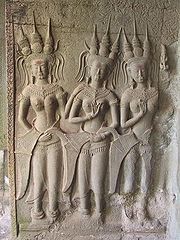
and the great temples of Angkor, considered an archeological treasure replete with detailed stone bas-reliefs showing many aspects of the culture, including some musical instruments, remain as monuments to the culture of the Khmer. After the death of Suryavarman II
(1113–1150), Cambodia lapsed into chaos until Jayavarman VII
(1181–1218) ordered the construction of a new city. He was a Buddhist, and for a time, Buddhism became the dominant religion in Cambodia. As a state religion, however, it was adapted to suit the Deva Raja cult, with a Buddha Raja being substituted for the former Shiva Raja or Vishnu Raja.
 The rise of the Tai kingdoms of Sukhothai
(1238) and Ayutthaya
(1350) resulted in almost ceaseless wars with the Cambodians and led to the destruction of Angkor in 1431. They are said to have carried off 90,000 prisoners, many of whom were likely dancers and musicians. The period following 1432, with the Cambodian people bereft of their treasures, documents, and human culture bearers, was one of precipitous decline. In 1434 King Ponhea Yat made Phnom Penh his capital, and Angkor was abandoned to the jungle. Due to continued Siamese and Vietnamese aggression Cambodia appealed to France for protection in 1863 and became a French protectorate in 1864. During the 1880s, along southern Vietnam and Laos, Cambodia was drawn into the French-controlled Indochinese Union. For nearly a century, the French exploited Cambodia commercially, and demanded power over politics, economics, and social life.
During the second half of the twentieth century, the political situation in Cambodia became chaotic. King Norodom Sihanouk (later, Prince, then again King), proclaimed Cambodia's independence in 1949 (granted in full in 1953) and ruled the country until March 18, 1970, when he was overthrown by General Lon Nol, who established the Khmer Republic. On April 17, 1975, the genocidal Khmer Rouge
led by Saloth Sar, better known by his alias, Pol Pot
, came to power and virtually destroyed the Cambodian people, their health, morality, education, physical environment, and culture. On January 7, 1979 Vietnamese forces ousted the Khmer Rouge. After more than ten years of painfully slow rebuilding with only meager outside help, the United Nations intervened resulting in the Paris Peace Accord on October 23, 1992 and created conditions for general elections in May 1993, leading to the formation of the current government and the restoration of Prince Sihanouk to power as King in 1993. Nonetheless, the Khmer Rouge continued to control portions of western and northern Cambodia until the late 1990s when they surrendered to government forces in exchange for either amnesty or re-adjustment for positions into the Cambodian government, and security outside the capital remains problematic.
and Vietnam
. There are over one million Khmer, mainly in Surin
(Soren), Buriram
(Borei Rom) and Sisaket
(Sri Saket) provinces, in Thailand. Estimates for the number of Khmer in Vietnam (known as Khmer Krom
) vary from the 1.1 million given by government data to seven million advocated by the Khmer Krom Federation.
Due to the Cambodian Civil War
, thousands of Khmer now reside in the United States, Canada, Australia and France as well.
is more representative of the speech of the majority of the population. Other dialects are Northern Khmer dialect, called Khmer Surin by Cambodians, spoken by the Khmer in Thailand and Khmer Krom spoken by the Khmer native to the Mekong delta
regions of Vietnam adjacent to Cambodia. A little-studied dialect known as Western Khmer
, or Cardamom Khmer, is spoken by a small, isolated population in the Cardamom Mountain range
extending from Cambodia into Thailand. Although little studied, it is unique in that it maintains a definite system of vocal register
that has all but disappeared in other dialects of modern Khmer.
The Cambodians believe in Brahmanism, which is derived from Hinduism and Buddhism. The modern Khmer strongly identify their ethnic identity with their religious beliefs and practices which combine the tenets of Theravada Buddhism with elements of indigenous ancestor-spirit worship, animism and shamanism. The majority of the Khmer live in rural villages either as rice farmers or fishermen and life revolves around the wat (temple) and the various Buddhist ceremonies throughout the year. However, if a Khmer becomes ill, they will frequently see a kru khmae (shaman/healer) whom they believe can diagnose which of the many spirits (neak ta) has caused the illness and recommend a course of action to propitiate the offended spirit, thereby curing the illness. The kru khmae also is learned in herb lore and is often sought to prepare various "medicines" and potions or for a magical tattoo, all believed to endow one with special prowess and ward off evil spirits or general bad luck. Khmer beliefs also rely heavily on astrology
, a remnant of Hinduism. A fortune teller, called hao-ra or kru tieay in Khmer, is often consulted before major events, like choosing a spouse, beginning an important journey or business venture, setting the date for a wedding and determining the proper location for building new structures.
Throughout the year the Khmer celebrate many holidays, most of a religious or spiritual nature, some of which are also observed as public holidays
. The two most important are Chol Chnam (Cambodian New Year
) and Pchum Ben
("Ancestor Day"). The Khmer Buddhist calendar
is divided into 12 months with the traditional new year beginning on the first day of khae chaet which coincides with the first new moon
of April in the western calendar. However, the modern celebration has been standardized to coincide with April 13.
Khmer culture
has influenced Thai
and Lao
cultures and vice versa. Many Khmer loanwords are found in Thai
and Lao
, and many Lao and Thai loanwords are also found in Khmer language. The Thai Alphabet is derived from the Khmer alphabet
, which in turn, is derived from the Pallava script of southern India.
Ethnic group
An ethnic group is a group of people whose members identify with each other, through a common heritage, often consisting of a common language, a common culture and/or an ideology that stresses common ancestry or endogamy...
in Cambodia, accounting for approximately 90% of the 14.8 million people in the country. They speak the Khmer language
Khmer language
Khmer , or Cambodian, is the language of the Khmer people and the official language of Cambodia. It is the second most widely spoken Austroasiatic language , with speakers in the tens of millions. Khmer has been considerably influenced by Sanskrit and Pali, especially in the royal and religious...
, which is part of the larger Mon–Khmer language family found throughout Southeast Asia. The majority of the Khmer are followers of the Khmer style of Buddhism
Buddhism
Buddhism is a religion and philosophy encompassing a variety of traditions, beliefs and practices, largely based on teachings attributed to Siddhartha Gautama, commonly known as the Buddha . The Buddha lived and taught in the northeastern Indian subcontinent some time between the 6th and 4th...
, a highly syncretic version which blends elements of Theravada Buddhism, Hinduism
Hinduism
Hinduism is the predominant and indigenous religious tradition of the Indian Subcontinent. Hinduism is known to its followers as , amongst many other expressions...
, animism
Animism
Animism refers to the belief that non-human entities are spiritual beings, or at least embody some kind of life-principle....
and ancestor-spirit worship. Significant populations of Khmers reside in adjacent areas of Thailand (Northern Khmer
Northern Khmer people
Nothern Khmer people, also known in Thai as Thai-Khmer people , is the designation used to refer to ethnic Khmers native to the Isan region of Northeast Thailand. Khmers have had a presence in this area since at least the time of the Khmer Empire. With the fall of the Angkor, however, the Khmers of...
) and the Mekong Delta
Mekong Delta
The Mekong Delta is the region in southwestern Vietnam where the Mekong River approaches and empties into the sea through a network of distributaries. The Mekong delta region encompasses a large portion of southwestern Vietnam of . The size of the area covered by water depends on the season.The...
region of neighboring Vietnam
Vietnam
Vietnam – sometimes spelled Viet Nam , officially the Socialist Republic of Vietnam – is the easternmost country on the Indochina Peninsula in Southeast Asia. It is bordered by China to the north, Laos to the northwest, Cambodia to the southwest, and the South China Sea –...
(Khmer Krom
Khmer Krom
The Khmer Krom are Khmer people living in the Mekong Delta and the Lower Mekong River area. Under the Khmer Rouge regime- according to the conservative estimates are that 150,000. Under the rule of Vietnam from 1979-93, Cambodia may have lost 20,000 Khmer Krom...
).
History
Migrations into the mainland regions of Southeast Asia from the north continued well into historic times. The Khmer came with earlier waves following in the wake of the Malays. Most scholars believe they came at least 3,000 years ago, much earlier than TaiTai peoples
The Tai ethnicity refers collectively to the ethnic groups of southern China and Southeast Asia, stretching from Hainan to eastern India and from southern Sichuan to Laos, Thailand, and parts of Vietnam, which speak languages in the Tai family and share similar traditions and festivals, including...
people who now inhabit many parts of what was originally Austroasiatic territory. The reason they migrated into Southeast Asia is generally debated, but scholars believe that Mon–Khmer were pushed down by invading Sino-Tibetans from the north as evident by Austroasiatic vocabulary in Chinese or because of agricultural purposes as evident by their migration routes along major rivers. The Khmer are relatives to the Mon
Mon people
The Mon are an ethnic group from Burma , living mostly in Mon State, Bago Division, the Irrawaddy Delta, and along the southern Thai–Burmese border. One of the earliest peoples to reside in Southeast Asia, the Mon were responsible for the spread of Theravada Buddhism in Burma and Thailand...
who settled further to the west.
After establishment in Southeast Asia, the history of the Khmer people parallels the history of Cambodia
History of Cambodia
- Prehistory and early history :Carbon 14 dating of a cave at Laang Spean in northwest Cambodia reveals people who made pots were living in Cambodia as early as 4200 BCE . Further archaeological evidence indicates that other parts of the region now called Cambodia were inhabited from around...
. Like the other early peoples of Southeast Asia such as the Pyu
Pyu
Pyu city states were a group of city-states that existed from c. 2nd century BCE to late 9th century CE in present-day Upper Burma . The city-states were founded as part of the southward migration by the Tibeto-Burman-speaking Pyu, the earliest inhabitants of Burma of whom records are extant...
and Mon
Mon people
The Mon are an ethnic group from Burma , living mostly in Mon State, Bago Division, the Irrawaddy Delta, and along the southern Thai–Burmese border. One of the earliest peoples to reside in Southeast Asia, the Mon were responsible for the spread of Theravada Buddhism in Burma and Thailand...
, the Khmer were influenced by Indian and Sri Lankan traders and scholars, adapting their religions, sciences, and customs and borrowing from their languages. The Khmer also acquired the concept of the Shaivite Deva Raja (God-King) and the great temple as a symbolic holy mountain. Although Cambodian kingdoms waxed and waned and were eventually eclipsed, the Cambodian penchant for building temples of stone throughout their kingdoms left monuments still extant today.
Jayavarman II
Jayavarman II
Jayavarman II was a 9th century king of Cambodia, widely recognized as the founder of the Khmer Empire, which ruled much of the Southeast Asian mainland for more than six hundred years. Historians formerly dated his reign as running from 802 AD to 850 AD, but some scholars now have set it back to...
(802–830), revived Cambodian power and built the foundation for the Angkorean empire, founding three capitals—Indrapura
Indrapura (Khmer)
According to inscription on the stele of Sdok Kok Thom, Indrapura was the first capital of Jayavarman II reign about 781, before the foundation of Khmer Empire in 802....
, Hariharalaya
Hariharalaya
Hariharalaya was an ancient city and capital of the Khmer empire located near Siem Reap, Cambodia in an area now called Roluos. Today, all that remains of the city are the ruins of several royal temples: Preah Ko, the Bakong, Lolei.-Etymology:...
, and Mahendraparvata—the archeological remains of which reveal much about his times. After winning a long civil war, Suryavarman I
Suryavarman I
Suryavarman I was king of the Khmer Empire from 1010 to 1050. After the reign of Udayadityavarman I, which ended around 1000, there was no clear successor. Two kings, Jayaviravarman and Suryavarman I, both claimed the throne. Suryavarman I was a Buddhist who was said in the Chronicles of Chieng...
(reigned 1002–1050) turned his forces eastward and subjugated the Mon kingdom of Dvaravati
Dvaravati
The Dvaravati period lasted from the 6th to the 13th centuries. Dvaravati refers to both a culture and a disparate conglomerate of principalities.- History :...
. Consequently, he ruled over the greater part of present-day Thailand and Laos, as well as the northern half of the Malay Peninsula. This period, during which Angkor Wat
Angkor Wat
Angkor Wat is a temple complex at Angkor, Cambodia, built for the king Suryavarman II in the early 12th century as his state temple and capital city. As the best-preserved temple at the site, it is the only one to have remained a significant religious centre since its foundation – first Hindu,...
was constructed, is considered the apex of Khmer civilization. The Khmer kingdom became the Khmer Empire
Khmer Empire
The Khmer Empire was one of the most powerful empires in Southeast Asia. The empire, which grew out of the former kingdom of Chenla, at times ruled over and/or vassalized parts of modern-day Laos, Thailand, Vietnam, Burma, and Malaysia. Its greatest legacy is Angkor, the site of the capital city...
and the great temples of Angkor, considered an archeological treasure replete with detailed stone bas-reliefs showing many aspects of the culture, including some musical instruments, remain as monuments to the culture of the Khmer. After the death of Suryavarman II
Suryavarman II
Suryavarman II was king of the Khmer Empire from 1113 AD to 1145-1150 AD and the builder of Angkor Wat, which he dedicated to the Hindu god Vishnu...
(1113–1150), Cambodia lapsed into chaos until Jayavarman VII
Jayavarman VII
Jayavarman VII was a king of the Khmer Empire in present day Siem Reap, Cambodia. He was the son of King Dharanindravarman II and Queen Sri Jayarajacudamani. He married Jayarajadevi and then, after her death, married her sister Indradevi...
(1181–1218) ordered the construction of a new city. He was a Buddhist, and for a time, Buddhism became the dominant religion in Cambodia. As a state religion, however, it was adapted to suit the Deva Raja cult, with a Buddha Raja being substituted for the former Shiva Raja or Vishnu Raja.
Sukhothai kingdom
The Sukhothai Kingdom ) was an early kingdom in the area around the city Sukhothai, in north central Thailand. The Kingdom existed from 1238 till 1438...
(1238) and Ayutthaya
Ayutthaya kingdom
Ayutthaya was a Siamese kingdom that existed from 1350 to 1767. Ayutthaya was friendly towards foreign traders, including the Chinese, Vietnamese , Indians, Japanese and Persians, and later the Portuguese, Spanish, Dutch and French, permitting them to set up villages outside the walls of the...
(1350) resulted in almost ceaseless wars with the Cambodians and led to the destruction of Angkor in 1431. They are said to have carried off 90,000 prisoners, many of whom were likely dancers and musicians. The period following 1432, with the Cambodian people bereft of their treasures, documents, and human culture bearers, was one of precipitous decline. In 1434 King Ponhea Yat made Phnom Penh his capital, and Angkor was abandoned to the jungle. Due to continued Siamese and Vietnamese aggression Cambodia appealed to France for protection in 1863 and became a French protectorate in 1864. During the 1880s, along southern Vietnam and Laos, Cambodia was drawn into the French-controlled Indochinese Union. For nearly a century, the French exploited Cambodia commercially, and demanded power over politics, economics, and social life.
During the second half of the twentieth century, the political situation in Cambodia became chaotic. King Norodom Sihanouk (later, Prince, then again King), proclaimed Cambodia's independence in 1949 (granted in full in 1953) and ruled the country until March 18, 1970, when he was overthrown by General Lon Nol, who established the Khmer Republic. On April 17, 1975, the genocidal Khmer Rouge
Khmer Rouge
The Khmer Rouge literally translated as Red Cambodians was the name given to the followers of the Communist Party of Kampuchea, who were the ruling party in Cambodia from 1975 to 1979, led by Pol Pot, Nuon Chea, Ieng Sary, Son Sen and Khieu Samphan...
led by Saloth Sar, better known by his alias, Pol Pot
Pol Pot
Saloth Sar , better known as Pol Pot, , was a Cambodian Maoist revolutionary who led the Khmer Rouge from 1963 until his death in 1998. From 1976 to 1979, he served as the Prime Minister of Democratic Kampuchea....
, came to power and virtually destroyed the Cambodian people, their health, morality, education, physical environment, and culture. On January 7, 1979 Vietnamese forces ousted the Khmer Rouge. After more than ten years of painfully slow rebuilding with only meager outside help, the United Nations intervened resulting in the Paris Peace Accord on October 23, 1992 and created conditions for general elections in May 1993, leading to the formation of the current government and the restoration of Prince Sihanouk to power as King in 1993. Nonetheless, the Khmer Rouge continued to control portions of western and northern Cambodia until the late 1990s when they surrendered to government forces in exchange for either amnesty or re-adjustment for positions into the Cambodian government, and security outside the capital remains problematic.
Geography and demographics
The majority of the world's Khmer live in Cambodia, the population of which is 80% Khmer. There are also significant Khmer populations native to ThailandThailand
Thailand , officially the Kingdom of Thailand , formerly known as Siam , is a country located at the centre of the Indochina peninsula and Southeast Asia. It is bordered to the north by Burma and Laos, to the east by Laos and Cambodia, to the south by the Gulf of Thailand and Malaysia, and to the...
and Vietnam
Vietnam
Vietnam – sometimes spelled Viet Nam , officially the Socialist Republic of Vietnam – is the easternmost country on the Indochina Peninsula in Southeast Asia. It is bordered by China to the north, Laos to the northwest, Cambodia to the southwest, and the South China Sea –...
. There are over one million Khmer, mainly in Surin
Surin Province
Surin is one of the north-eastern provinces of Thailand. Neighboring provinces are Buriram, Maha Sarakham, Roi Et and Sisaket...
(Soren), Buriram
Buriram Province
Buri Ram or is one of the north-eastern provinces of Thailand. Neighboring provinces are Sa Kaeo, Nakhon Ratchasima, Khon Kaen, Maha Sarakham and Surin. To the south-east it borders Oddar Meancheay of Cambodia...
(Borei Rom) and Sisaket
Sisaket Province
Sisaket , is one of the north-eastern provinces of Thailand. Neighboring provinces are Surin, Roi Et, Yasothon and Ubon Ratchathani. To the south it borders Oddar Meancheay and Preah Vihear of Cambodia.-Geography:...
(Sri Saket) provinces, in Thailand. Estimates for the number of Khmer in Vietnam (known as Khmer Krom
Khmer Krom
The Khmer Krom are Khmer people living in the Mekong Delta and the Lower Mekong River area. Under the Khmer Rouge regime- according to the conservative estimates are that 150,000. Under the rule of Vietnam from 1979-93, Cambodia may have lost 20,000 Khmer Krom...
) vary from the 1.1 million given by government data to seven million advocated by the Khmer Krom Federation.
Due to the Cambodian Civil War
Cambodian Civil War
The Cambodian Civil War was a conflict that pitted the forces of the Communist Party of Kampuchea and their allies the Democratic Republic of Vietnam and the Viet Cong against the government forces of Cambodia , which were supported by the United States and the Republic of Vietnam The Cambodian...
, thousands of Khmer now reside in the United States, Canada, Australia and France as well.
Culture and society
The culture of the ethnic Khmer is fairly homogeneous throughout their geographic range. Regional dialects exist but are mutually intelligible. The standard is based on Phnom Penh speech, which, due to the city's status as the national capital, has been modestly affected by recent French and Vietnamese influence. However, the variety of Khmer spoken in BattambangBattambang
Battambang is the capital city of Battambang province in northwestern Cambodia.Battambang is the second-largest city in Cambodia with a population of over 250,000. Founded in the 11th century by the Khmer Empire, Battambang is well known for being the leading rice-producing province of the country...
is more representative of the speech of the majority of the population. Other dialects are Northern Khmer dialect, called Khmer Surin by Cambodians, spoken by the Khmer in Thailand and Khmer Krom spoken by the Khmer native to the Mekong delta
Mekong Delta
The Mekong Delta is the region in southwestern Vietnam where the Mekong River approaches and empties into the sea through a network of distributaries. The Mekong delta region encompasses a large portion of southwestern Vietnam of . The size of the area covered by water depends on the season.The...
regions of Vietnam adjacent to Cambodia. A little-studied dialect known as Western Khmer
Western Khmer
Western Khmer, also known as Chanthaburi Khmer, is the dialect of the Khmer language spoken by the Khmer people native to the Cardamom Mountains on both sides of the border between western Cambodia and eastern Central Thailand...
, or Cardamom Khmer, is spoken by a small, isolated population in the Cardamom Mountain range
Cardamom Mountains
The Krâvanh Mountains, literally the "Cardamom Mountains" , is a mountain range in the south west of Cambodia, jutting into southeastern Thailand.-Location and description:...
extending from Cambodia into Thailand. Although little studied, it is unique in that it maintains a definite system of vocal register
Register (phonology)
In linguistics, a register language, also known as a pitch-register language, is a language which combines tone and vowel phonation into a single phonological system. Burmese and the Chinese dialect Shanghainese are examples...
that has all but disappeared in other dialects of modern Khmer.
The Cambodians believe in Brahmanism, which is derived from Hinduism and Buddhism. The modern Khmer strongly identify their ethnic identity with their religious beliefs and practices which combine the tenets of Theravada Buddhism with elements of indigenous ancestor-spirit worship, animism and shamanism. The majority of the Khmer live in rural villages either as rice farmers or fishermen and life revolves around the wat (temple) and the various Buddhist ceremonies throughout the year. However, if a Khmer becomes ill, they will frequently see a kru khmae (shaman/healer) whom they believe can diagnose which of the many spirits (neak ta) has caused the illness and recommend a course of action to propitiate the offended spirit, thereby curing the illness. The kru khmae also is learned in herb lore and is often sought to prepare various "medicines" and potions or for a magical tattoo, all believed to endow one with special prowess and ward off evil spirits or general bad luck. Khmer beliefs also rely heavily on astrology
Jyotisha
Hindu astrology , also Jyotish or Jyotisha, from Sanskrit , from "light, heavenly body") is the ancient Indian system of astronomy and astrology...
, a remnant of Hinduism. A fortune teller, called hao-ra or kru tieay in Khmer, is often consulted before major events, like choosing a spouse, beginning an important journey or business venture, setting the date for a wedding and determining the proper location for building new structures.
Throughout the year the Khmer celebrate many holidays, most of a religious or spiritual nature, some of which are also observed as public holidays
Public holidays in Cambodia
-Public holidays:-References:* Cambodian Ministry of Foreign Affairs and International Cooperation * Cambodian Embassy in Australia...
. The two most important are Chol Chnam (Cambodian New Year
Cambodian New Year
Cambodian New Year or Chaul Chnam Thmey in the Khmer language, literally "Enter Year New", is the name of the Cambodian holiday that celebrates the New Year. The holiday lasts for three days beginning on New Year's day, which usually falls on April 13 or 14th, which is the end of the harvesting...
) and Pchum Ben
Pchum Ben
Pchum Ben is a Cambodian religious festival, culminating in celebrations on the 15th day of the tenth month in the Khmer Calendar. In 2008, the national holiday fell on the 28th - 30th of September in the Gregorian calendar....
("Ancestor Day"). The Khmer Buddhist calendar
Buddhist calendar
The Buddhist calendar is used on mainland Southeast Asia in the countries of Thailand, Cambodia, Laos, Burma and Sri Lanka in several related forms. It is a lunisolar calendar having months that are alternately 29 and 30 days, with an intercalated day and a 30-day month added at regular intervals...
is divided into 12 months with the traditional new year beginning on the first day of khae chaet which coincides with the first new moon
New moon
In astronomical terminology, the new moon is the lunar phase that occurs when the Moon, in its monthly orbital motion around Earth, lies between Earth and the Sun, and is therefore in conjunction with the Sun as seen from Earth...
of April in the western calendar. However, the modern celebration has been standardized to coincide with April 13.
Khmer culture
Culture of Cambodia
The culture of Cambodia has had a rich and varied history dating back many centuries, and has been heavily influenced by India. Throughout Cambodia's long history, a major source of inspiration was from religion...
has influenced Thai
Culture of Thailand
The Culture of Thailand incorporates cultural beliefs and characteristics indigenous to the area known as modern day Thailand coupled with much influence from ancient India, China, Cambodia, along with the neighbouring pre-historic cultures of Southeast Asia...
and Lao
Culture of Laos
Laos has its own distinct culture. Through Theravada Buddhism it has influences from India and has also influences from China. These influences are reflected throughout Laos in its language as well as in art, literature and the performing arts....
cultures and vice versa. Many Khmer loanwords are found in Thai
Thai language
Thai , also known as Central Thai and Siamese, is the national and official language of Thailand and the native language of the Thai people, Thailand's dominant ethnic group. Thai is a member of the Tai group of the Tai–Kadai language family. Historical linguists have been unable to definitively...
and Lao
Lao language
Lao or Laotian is a tonal language of the Tai–Kadai language family. It is the official language of Laos, and also spoken in the northeast of Thailand, where it is usually referred to as the Isan language. Being the primary language of the Lao people, Lao is also an important second language for...
, and many Lao and Thai loanwords are also found in Khmer language. The Thai Alphabet is derived from the Khmer alphabet
Khmer script
The Khmer script is an alphasyllabary script used to write the Khmer language . It is also used to write Pali among the Buddhist liturgy of Cambodia and Thailand....
, which in turn, is derived from the Pallava script of southern India.
See also
- Cambodian cuisine Khmer cuisine
- Khmer EmpireKhmer EmpireThe Khmer Empire was one of the most powerful empires in Southeast Asia. The empire, which grew out of the former kingdom of Chenla, at times ruled over and/or vassalized parts of modern-day Laos, Thailand, Vietnam, Burma, and Malaysia. Its greatest legacy is Angkor, the site of the capital city...
- Khmer LoeuKhmer LoeuThe Khmer Loeu are the Mon–Khmer highland tribes in Cambodia. Although the origins of this group are not clear, some believe that the Mon–Khmer-speaking tribes were part of the long migration of these people from the northwest. The Austronesian-speaking groups, Rade and Jarai, apparently came to...
- List of ethnic groups in Vietnam