

Ceratopsia

Encyclopedia
Ceratopsia or Ceratopia (icon or ˌ; Greek
: "horned faces") is a group of herbivorous
, beaked dinosaur
s which thrived in what are now North America
, Europe
, and Asia
, during the Cretaceous
Period, although ancestral forms lived earlier, in the Jurassic
. The earliest known ceratopsian, Yinlong downsi, lived between 161.2 and 155.7 million years ago. The last ceratopsian species became extinct in the Cretaceous-Paleogene extinction event, 65.5 million years ago.
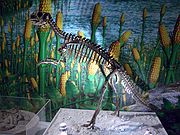
Early members of the ceratopsian group, such as Psittacosaurus
, were small and biped
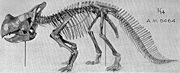
al animals. Later members, including ceratopsids
like Centrosaurus
and Triceratops
, became very large quadruped
s and developed elaborate facial horns
and frills extending over the neck. While these frills might have served to protect the vulnerable neck from predators
, they may also have been used for display
, thermoregulation
, the attachment of large neck and chewing muscles or some combination of the above. Ceratopsians ranged in size from 1 meter (3 ft) and 23 kilograms (50 lb) to over 9 meters (30 ft) and 5,400 kg (12,000 lb).
Triceratops are by far the best-known ceratopsians to the general public. It is traditional for ceratopsian genus
names to end in "-ceratops", although this is not always the case. One of the first named genera was Ceratops
itself, which lent its name to the group, although it is considered a nomen dubium
today as its fossil remains have no distinguishing characteristics that are not also found in other ceratopsians.
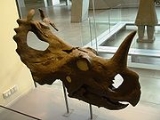
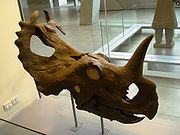 Ceratopsians are easily recognized by features of the skull
. On the tip of a ceratopsian upper jaw is the rostral bone
, a unique bone found nowhere else in the animal kingdom. Along with the predentary
bone, which forms the tip of the lower jaw in all ornithischia
ns, the rostral forms a superficially parrot
-like beak. Also, the jugal
bones below the eye are very tall and flare out sideways, making the skull appear somewhat triangular when viewed from above. This triangular appearance is accentuated, in later ceratopsians, by the rearwards extension of the parietal
and squamosal
bones of the skull roof, to form the neck frill.
during the U.S. Geological and Geographical Survey of the Territories led by the American geologist
F.V. Hayden
. In 1872, Meek found several giant bones protruding from a hillside in southwestern Wyoming
. He alerted paleontologist Edward Drinker Cope
, who led a dig to recover the partial skeleton. Cope recognized the remains as a dinosaur, but noted that even though the fossil lacked a skull, it was different from any type of dinosaur then known. He named the new species Agathaumas sylvestris
, meaning "marvellous forest-dweller."
in 1890 to include dinosaurs possessing certain characteristic features, including horns, a rostral bone
, teeth with two roots, fused neck vertebrae, and a forward-oriented pubis
. Marsh considered the group distinct enough to warrant its own suborder within Ornithischia. The name is derived from the Greek
κερας/keras meaning 'horn' and οψις/opsis meaning 'face'. As early as the 1960s, it was noted that the name Ceratopsia is actually incorrect linguistically
and that it should be Ceratopia. However, this spelling, while technically correct, has been used only rarely in the scientific literature, and the vast majority of paleontologists continue to use Ceratopsia. As the ICZN
does not govern taxa above the level of superfamily
, this is unlikely to change.
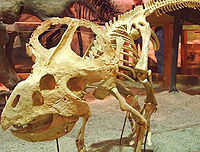
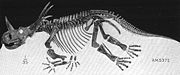 Following Marsh, Ceratopsia has usually been classified as a suborder within the order Ornithischia. While ranked taxonomy has largely fallen out of favor among dinosaur paleontologists, some researchers have continued to employ such a classification, though sources have differed on what its rank should be. Most who still employ the use of ranks have retained its traditional ranking of suborder, though some have reduced to the level of infraorder.
This list of ceratopsian genera by classification and location follows a review by Thomas R. Holtz, Jr. in 2010.
Possible ceratopsians from the Southern Hemisphere include the Australia
n Serendipaceratops
, known from an ulna
, and Notoceratops
from Argentina
is known from a single toothless jaw (which has been lost). Craspedodon
from the Late Cretaceous
(Santonian
) of Belgium
may also be a ceratopsian, specifically a neoceratopsian closer to ceratopsoidea than protoceratopsidae. Possible leptoceratopsid remains have also been described from the early Campanian
of Sweden
.
In clade
-based phylogenetic taxonomy, Ceratopsia is often defined to include all marginocephalia
ns more closely related to Triceratops than to Pachycephalosaurus
. Under this definition, the most basal
known ceratopsians are Yinlong
, from the Late Jurassic
Period, along with Chaoyangsaurus
and the family Psittacosauridae
, from the Early Cretaceous
Period, all of which were discovered in northern China
or Mongolia
. The rostral bone and flared jugals are already present in all of these forms, indicating that even earlier ceratopsians remain to be discovered.
The clade
Neoceratopsia includes all ceratopsians more derived
than psittacosaurids. Another subset of neoceratopsians is called Coronosauria, which currently includes all ceratopsians more derived than Auroraceratops
. Coronosaurs show the first development of the neck frill and the fusion of the first several neck vertebrae to support the increasingly heavy head. Within Coronosauria, three groups are generally recognized, although the membership of these groups varies somewhat from study to study and some animals may not fit in any of them. One group can be called Protoceratopsidae and includes Protoceratops
and its closest relatives, all Asian. Another group, Leptoceratopsidae
, includes mostly North America
n animals that are more closely related to Leptoceratops
. The Ceratopsoidea includes animals like Zuniceratops
which are more closely related to the family Ceratopsidae
. This last family includes Triceratops and all the large North American ceratopsians and is further divided into the subfamilies Centrosaurinae and Ceratopsinae (also known as Chasmosaurinae).
Xu/Makovicky/Chinnery Phylogeny:
Xu Xing of the Chinese Institute of Vertebrate Paleontology and Paleoanthropology
(IVPP) in Beijing
, along with Peter Makovicky, formerly of the American Museum of Natural History
(AMNH) in New York City
and others, published a cladistic analysis in the 2002 description of Liaoceratops. This analysis is very similar to one published by Makovicky in 2001. Makovicky, who currently works at the Field Museum of Natural History
in Chicago
, also included this analysis in his 2002 doctoral
thesis. Xu and other colleagues added Yinlong to this analysis in 2006.
Brenda Chinnery, formerly of the Museum of the Rockies
in Bozeman, Montana
, independently described Prenoceratops in 2005 and published a new phylogeny. In 2006, Makovicky and Mark Norell of the AMNH incorporated Chinnery's analysis into their own and also added Yamaceratops, although they were not able to include Yinlong. The cladogram presented below is a combination of Xu, Makovicky, and their colleagues' most recent work.
Chaoyangsaurus is recovered in a more basal position than Psittacosauridae, although Chinnery's original analysis finds it within Neoceratopsia. Protoceratopsidae is considered to be the sister group of Ceratopsoidea. The fragmentary Asiaceratops was included in these studies and is found to have a variable position, either as a basal neoceratopsian or as a leptoceratopsid, most likely due to the amount of missing information. Removal of Asiaceratops stabilizes the entire cladogram.
Makovicky's latest analysis includes IVPP V12722 ("Xuanhuasaurus"), a Late Jurassic ceratopsian from China that at the time was awaiting publication, but has since been published as Xuanhuaceratops. Kulceratops and Turanoceratops are considered nomina dubia in this study. Makovicky believes Lamaceratops, Magnirostris, and Platyceratops to be junior synonyms of Bagaceratops, and Bainoceratops to be synonymous with Protoceratops.
You/Dodson Phylogeny:
You Hailu of Beijing's Chinese Academy of Geological Sciences, was a co-author with Xu and Makovicky in 2002 but, in 2003, he and Peter Dodson
from the University of Pennsylvania
published a separate analysis. The two presented this analysis again in 2004. In 2005, You and three others, including Dodson, published on Auroraceratops and inserted this new dinosaur into their phylogeny.
In contrast to the previous analysis, You and Dodson find Chaoyangsaurus to be the most basal neoceratopsian, more derived than Psittacosaurus, while Leptoceratopsidae, not Protoceratopsidae, is recovered as the sister group of Ceratopsidae. This study includes Auroraceratops but lacks seven taxa found in Xu and Makovicky's work, so it is unclear how comparable the two studies are. Asiaceratops and Turanoceratops are each considered nomina dubia and not included. Along with Dong Zhiming
, You described Magnirostris in 2003, but to date has not included it any of his cladograms.
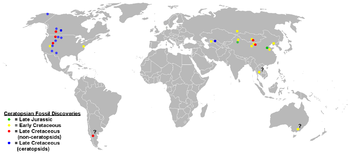 Ceratopsia appears to have originated in Asia, as all of the earliest members are found there. Fragmentary remains, including teeth, which appear to be neoceratopsian, are found in North America from the Albian
stage (112 to 100 million years ago), indicating that the group had dispersed
across what is now the Bering Strait
by the middle of the Cretaceous Period. Almost all leptoceratopsids are North American, aside from Udanoceratops, which may represent a separate dispersal event, back into Asia. Ceratopsids and their immediate ancestors, such as Zuniceratops, were unknown outside of western North America, and were presumed endemic to that continent. The traditional view that ceratopsoids originated in North America was called into question by the 2009 discovery of better specimens of the dubious Asian form Turanoceratops
, which confirmed it as a ceratopsid. It is unknown whether this indicates ceratopsids actually originated in Asia, or if the Turanoceratops immigrated from North America.
to adult are known for Psittacosaurus and Protoceratops, allowing the study of ontogenetic variation
in these species. Significant sexual dimorphism
has been noted in Protoceratops and several ceratopsids.
where they are found. Triceratops fossil
s are far and away the most common dinosaur remains found in the latest Cretaceous rocks in the western United States, making up as much as 5/6ths of the large dinosaur fauna
in some areas. These facts indicate that some ceratopsians were the dominant herbivores in their environments.
Some species of ceratopsians, especially Centrosaurus and its relatives, appear to have been gregarious, living in herd
s. This is suggested by bonebed finds with the remains of many individuals of different ages. Like modern migratory herds, they would have had a significant effect on their environment, as well as serving as a major food source for predators.
Although ceratopsians are generally considered herbivorous
, a few paleontologists, such as Darren Naish and Mark Witton, have speculated online that at least some ceratopsians may have been opportunistically omnivorous
.
, which can run at up to 56 km or 35 miles per hour.
. However, comparisons between the scleral ring
s of Protoceratops and Psittacosaurus
and modern birds and reptiles indicate that they may have been cathemeral
, active throughout the day at short intervals.
has also been documented in the shoulder blade of a ceratopsian.
Ancient Greek
Ancient Greek is the stage of the Greek language in the periods spanning the times c. 9th–6th centuries BC, , c. 5th–4th centuries BC , and the c. 3rd century BC – 6th century AD of ancient Greece and the ancient world; being predated in the 2nd millennium BC by Mycenaean Greek...
: "horned faces") is a group of herbivorous
Herbivore
Herbivores are organisms that are anatomically and physiologically adapted to eat plant-based foods. Herbivory is a form of consumption in which an organism principally eats autotrophs such as plants, algae and photosynthesizing bacteria. More generally, organisms that feed on autotrophs in...
, beaked dinosaur
Dinosaur
Dinosaurs are a diverse group of animals of the clade and superorder Dinosauria. They were the dominant terrestrial vertebrates for over 160 million years, from the late Triassic period until the end of the Cretaceous , when the Cretaceous–Paleogene extinction event led to the extinction of...
s which thrived in what are now North America
North America
North America is a continent wholly within the Northern Hemisphere and almost wholly within the Western Hemisphere. It is also considered a northern subcontinent of the Americas...
, Europe
Europe
Europe is, by convention, one of the world's seven continents. Comprising the westernmost peninsula of Eurasia, Europe is generally 'divided' from Asia to its east by the watershed divides of the Ural and Caucasus Mountains, the Ural River, the Caspian and Black Seas, and the waterways connecting...
, and Asia
Asia
Asia is the world's largest and most populous continent, located primarily in the eastern and northern hemispheres. It covers 8.7% of the Earth's total surface area and with approximately 3.879 billion people, it hosts 60% of the world's current human population...
, during the Cretaceous
Cretaceous
The Cretaceous , derived from the Latin "creta" , usually abbreviated K for its German translation Kreide , is a geologic period and system from circa to million years ago. In the geologic timescale, the Cretaceous follows the Jurassic period and is followed by the Paleogene period of the...
Period, although ancestral forms lived earlier, in the Jurassic
Jurassic
The Jurassic is a geologic period and system that extends from about Mya to Mya, that is, from the end of the Triassic to the beginning of the Cretaceous. The Jurassic constitutes the middle period of the Mesozoic era, also known as the age of reptiles. The start of the period is marked by...
. The earliest known ceratopsian, Yinlong downsi, lived between 161.2 and 155.7 million years ago. The last ceratopsian species became extinct in the Cretaceous-Paleogene extinction event, 65.5 million years ago.
Early members of the ceratopsian group, such as Psittacosaurus
Psittacosaurus
Psittacosaurus is a genus of psittacosaurid ceratopsian dinosaur from the Early Cretaceous Period of what is now Asia, about 130 to 100 million years ago. It is notable for being the most species-rich dinosaur genus...
, were small and biped
Biped
Bipedalism is a form of terrestrial locomotion where an organism moves by means of its two rear limbs, or legs. An animal or machine that usually moves in a bipedal manner is known as a biped , meaning "two feet"...
al animals. Later members, including ceratopsids
Ceratopsidae
Ceratopsidae is a speciose group of marginocephalian dinosaurs including Triceratops and Styracosaurus...
like Centrosaurus
Centrosaurus
Centrosaurus is a genus of herbivorous ceratopsian dinosaurs from the late Cretaceous of Canada. Their remains have been found in the Dinosaur Park Formation and uppermost Oldman Formation, dating from 76.5 to 75.5 million years ago....
and Triceratops
Triceratops
Triceratops is a genus of herbivorous ceratopsid dinosaur which lived during the late Maastrichtian stage of the Late Cretaceous Period, around 68 to 65 million years ago in what is now North America. It was one of the last dinosaur genera to appear before the great Cretaceous–Paleogene...
, became very large quadruped
Quadruped
Quadrupedalism is a form of land animal locomotion using four limbs or legs. An animal or machine that usually moves in a quadrupedal manner is known as a quadruped, meaning "four feet"...
s and developed elaborate facial horns
Horn (anatomy)
A horn is a pointed projection of the skin on the head of various animals, consisting of a covering of horn surrounding a core of living bone. True horns are found mainly among the ruminant artiodactyls, in the families Antilocapridae and Bovidae...
and frills extending over the neck. While these frills might have served to protect the vulnerable neck from predators
Predation
In ecology, predation describes a biological interaction where a predator feeds on its prey . Predators may or may not kill their prey prior to feeding on them, but the act of predation always results in the death of its prey and the eventual absorption of the prey's tissue through consumption...
, they may also have been used for display
Display (zoology)
Display is a form of animal behaviour, linked to survival of the species in various ways. One example of display used by some species can be found in the form of courtship, with the male usually having a striking feature that is distinguished by colour, shape or size, used to attract a female...
, thermoregulation
Thermoregulation
Thermoregulation is the ability of an organism to keep its body temperature within certain boundaries, even when the surrounding temperature is very different...
, the attachment of large neck and chewing muscles or some combination of the above. Ceratopsians ranged in size from 1 meter (3 ft) and 23 kilograms (50 lb) to over 9 meters (30 ft) and 5,400 kg (12,000 lb).
Triceratops are by far the best-known ceratopsians to the general public. It is traditional for ceratopsian genus
Genus
In biology, a genus is a low-level taxonomic rank used in the biological classification of living and fossil organisms, which is an example of definition by genus and differentia...
names to end in "-ceratops", although this is not always the case. One of the first named genera was Ceratops
Ceratops
Ceratops is a dubious genus of ceratopsian dinosaur which lived during the Late Cretaceous. Its fossils have been found in Montana. Although poorly known, Ceratops is important in the history of dinosaurs, since it is the type species for which both Ceratopsia and Ceratopsidae are named...
itself, which lent its name to the group, although it is considered a nomen dubium
Nomen dubium
In zoological nomenclature, a nomen dubium is a scientific name that is of unknown or doubtful application...
today as its fossil remains have no distinguishing characteristics that are not also found in other ceratopsians.
Anatomy
Skull
The skull is a bony structure in the head of many animals that supports the structures of the face and forms a cavity for the brain.The skull is composed of two parts: the cranium and the mandible. A skull without a mandible is only a cranium. Animals that have skulls are called craniates...
. On the tip of a ceratopsian upper jaw is the rostral bone
Rostral bone
The rostral bone is the edentulous dorsal component of the skeleton of the beak, unique to the ceratopsian dinosaurs. Othniel Charles Marsh recognized and named this bone, which acts as a mirror image of the predentary bone on the lower jaw....
, a unique bone found nowhere else in the animal kingdom. Along with the predentary
Predentary
The predentary is an 'extra' bone in the front of the lower jaw, which extended the dentary . It is found in the fossilised remains of ornithischian dinosaurs, which were herbivorous. The predentary coincided with the premaxilla in the upper jaw. Together they formed a beak-like apparatus used to...
bone, which forms the tip of the lower jaw in all ornithischia
Ornithischia
Ornithischia or Predentata is an extinct order of beaked, herbivorous dinosaurs. The name ornithischia is derived from the Greek ornitheos meaning 'of a bird' and ischion meaning 'hip joint'...
ns, the rostral forms a superficially parrot
Parrot
Parrots, also known as psittacines , are birds of the roughly 372 species in 86 genera that make up the order Psittaciformes, found in most tropical and subtropical regions. The order is subdivided into three families: the Psittacidae , the Cacatuidae and the Strigopidae...
-like beak. Also, the jugal
Jugal
The jugal is a skull bone found in most reptiles, amphibians, and birds. In mammals, the jugal is often called the malar or Zygomatic. It is connected to the quadratojugal and maxilla, as well as other bones, which may vary by species....
bones below the eye are very tall and flare out sideways, making the skull appear somewhat triangular when viewed from above. This triangular appearance is accentuated, in later ceratopsians, by the rearwards extension of the parietal
Parietal bone
The parietal bones are bones in the human skull which, when joined together, form the sides and roof of the cranium. Each bone is roughly quadrilateral in form, and has two surfaces, four borders, and four angles. It is named from the Latin pariet-, wall....
and squamosal
Squamosal
The squamosal is a bone of the head of higher vertebrates. It is the principal component of the cheek region in the skull, lying below the temporal series and otic notch and bounded anteriorly by postorbital. Posteriorly, the squamosal articulates with the posterior elements of the palatal complex,...
bones of the skull roof, to form the neck frill.
History of study
The first ceratopsian remains known to science were discovered by Fielding Bradford MeekFielding Bradford Meek
Fielding Bradford Meek was an American geologist and paleontologist.The son of a lawyer, he was born in Madison, Indiana. In early life he was in business as a merchant, but his leisure hours were devoted to collecting fossils and studying the rocks of the neighborhood of Madison...
during the U.S. Geological and Geographical Survey of the Territories led by the American geologist
Geologist
A geologist is a scientist who studies the solid and liquid matter that constitutes the Earth as well as the processes and history that has shaped it. Geologists usually engage in studying geology. Geologists, studying more of an applied science than a theoretical one, must approach Geology using...
F.V. Hayden
Ferdinand Vandeveer Hayden
Dr. Ferdinand Vandeveer Hayden was an American geologist noted for his pioneering surveying expeditions of the Rocky Mountains in the late 19th century. He was also a physician who served with the Union Army during the Civil War.-Early life:Ferdinand Hayden was born in Westfield, Massachusetts...
. In 1872, Meek found several giant bones protruding from a hillside in southwestern Wyoming
Wyoming
Wyoming is a state in the mountain region of the Western United States. The western two thirds of the state is covered mostly with the mountain ranges and rangelands in the foothills of the Eastern Rocky Mountains, while the eastern third of the state is high elevation prairie known as the High...
. He alerted paleontologist Edward Drinker Cope
Edward Drinker Cope
Edward Drinker Cope was an American paleontologist and comparative anatomist, as well as a noted herpetologist and ichthyologist. Born to a wealthy Quaker family, Cope distinguished himself as a child prodigy interested in science; he published his first scientific paper at the age of nineteen...
, who led a dig to recover the partial skeleton. Cope recognized the remains as a dinosaur, but noted that even though the fossil lacked a skull, it was different from any type of dinosaur then known. He named the new species Agathaumas sylvestris
Agathaumas
Agathaumas is a dubious genus of a large ceratopsid dinosaur that lived in Wyoming during the Late Cretaceous . The name comes from Greek, αγαν - 'much' and θαυμα - 'wonder'...
, meaning "marvellous forest-dweller."
Classification
Ceratopsia was coined by Othniel Charles MarshOthniel Charles Marsh
Othniel Charles Marsh was an American paleontologist. Marsh was one of the preeminent scientists in the field; the discovery or description of dozens of news species and theories on the origins of birds are among his legacies.Born into a modest family, Marsh was able to afford higher education...
in 1890 to include dinosaurs possessing certain characteristic features, including horns, a rostral bone
Rostral bone
The rostral bone is the edentulous dorsal component of the skeleton of the beak, unique to the ceratopsian dinosaurs. Othniel Charles Marsh recognized and named this bone, which acts as a mirror image of the predentary bone on the lower jaw....
, teeth with two roots, fused neck vertebrae, and a forward-oriented pubis
Pubis (bone)
In vertebrates, the pubic bone is the ventral and anterior of the three principal bones composing either half of the pelvis.It is covered by a layer of fat, which is covered by the mons pubis....
. Marsh considered the group distinct enough to warrant its own suborder within Ornithischia. The name is derived from the Greek
Ancient Greek
Ancient Greek is the stage of the Greek language in the periods spanning the times c. 9th–6th centuries BC, , c. 5th–4th centuries BC , and the c. 3rd century BC – 6th century AD of ancient Greece and the ancient world; being predated in the 2nd millennium BC by Mycenaean Greek...
κερας/keras meaning 'horn' and οψις/opsis meaning 'face'. As early as the 1960s, it was noted that the name Ceratopsia is actually incorrect linguistically
Linguistic prescription
In linguistics, prescription denotes normative practices on such aspects of language use as spelling, grammar, pronunciation, and syntax. It includes judgments on what usages are socially proper and politically correct...
and that it should be Ceratopia. However, this spelling, while technically correct, has been used only rarely in the scientific literature, and the vast majority of paleontologists continue to use Ceratopsia. As the ICZN
International Code of Zoological Nomenclature
The International Code of Zoological Nomenclature is a widely accepted convention in zoology that rules the formal scientific naming of organisms treated as animals...
does not govern taxa above the level of superfamily
Taxonomic rank
In biological classification, rank is the level in a taxonomic hierarchy. Examples of taxonomic ranks are species, genus, family, and class. Each rank subsumes under it a number of less general categories...
, this is unlikely to change.
Taxonomy
This list of ceratopsian genera by classification and location follows a review by Thomas R. Holtz, Jr. in 2010.
- Ceratopsia
- MicropachycephalosaurusMicropachycephalosaurusMicropachycephalosaurus is a monotypic genus of ornithischian dinosaur. It lived in Shandong Province, China during the Late Cretaceous period . The incomplete skeleton of the single specimen was found on a cliff southwest of Laiyang...
- (ShandongShandong' is a Province located on the eastern coast of the People's Republic of China. Shandong has played a major role in Chinese history from the beginning of Chinese civilization along the lower reaches of the Yellow River and served as a pivotal cultural and religious site for Taoism, Chinese...
, eastern China) - StenopelixStenopelixStenopelix is a genus of small ornithischian dinosaur from the Early Cretaceous of Germany. It was perhaps a basal ceratopsian from the Barremian Stage of the Cretaceous period, sometime between 130 and 125 million years ago...
- (GermanyGermanyGermany , officially the Federal Republic of Germany , is a federal parliamentary republic in Europe. The country consists of 16 states while the capital and largest city is Berlin. Germany covers an area of 357,021 km2 and has a largely temperate seasonal climate...
) - YinlongYinlongYinlong is a genus of basal ceratopsian dinosaur from the Late Jurassic Period of central Asia. It was a small, primarily bipedal herbivore, approximately 1.2 meters long...
- (XinjiangXinjiangXinjiang is an autonomous region of the People's Republic of China. It is the largest Chinese administrative division and spans over 1.6 million km2...
, western China) - Family ChaoyangsauridaeChaoyangsauridaeChaoyangsauridae is a family of dinosaurs. They were the first marginocephalian dinosaurs to appear on the planet, about 148 million years ago, in the Late Jurassic period. Members of this group had sharp beaks for snipping off leaves to eat, and a very small frill...
- ChaoyangsaurusChaoyangsaurusChaoyangsaurus was a marginocephalian dinosaur from the Late Jurassic of China...
- (LiaoningLiaoning' is a province of the People's Republic of China, located in the northeast of the country. Its one-character abbreviation is "辽" , a name taken from the Liao River that flows through the province. "Níng" means "peace"...
, northeastern China) - Xuanhuaceratops - (HebeiHebei' is a province of the People's Republic of China in the North China region. Its one-character abbreviation is "" , named after Ji Province, a Han Dynasty province that included what is now southern Hebei...
, China)
- Chaoyangsaurus
- Family PsittacosauridaePsittacosauridaeThe Psittacosauridae were a group of ceratopsian dinosaurs, which lived between 140.2 and 99.6 million years ago. The family Psittacosauridae was first named by American paleontologist Henry Fairfield Osborn in 1923...
- HongshanosaurusHongshanosaurusHongshanosaurus is a genus of psittacosaurid ceratopsian dinosaur from the Early Cretaceous Period of eastern Asia. Although two skulls are the only fossil material described, comparisons with close relatives suggest it was a small, bipedal herbivore with a bony beak on the end of both upper and...
- (Liaoning, northeastern China) - PsittacosaurusPsittacosaurusPsittacosaurus is a genus of psittacosaurid ceratopsian dinosaur from the Early Cretaceous Period of what is now Asia, about 130 to 100 million years ago. It is notable for being the most species-rich dinosaur genus...
- (China & Mongolia)
- Hongshanosaurus
- Neoceratopsia
- ArchaeoceratopsArchaeoceratopsArchaeoceratops, meaning "ancient horned face", is a genus of basal neoceratopsian dinosaur from the Early Cretaceous of north central China. It appears to have been bipedal and quite small with a comparatively large head...
- (GansuGansu' is a province located in the northwest of the People's Republic of China.It lies between the Tibetan and Huangtu plateaus, and borders Mongolia, Inner Mongolia, and Ningxia to the north, Xinjiang and Qinghai to the west, Sichuan to the south, and Shaanxi to the east...
, northwestern China) - AsiaceratopsAsiaceratopsAsiaceratops was a genus of ceratopsian dinosaur. It lived during the Late Cretaceous. Its fossils have been found in China, Mongolia, and Uzbekistan. The type species, A. salsopaludalis, was formally described by Nesov and Kaznyshkina in 1989. A second species, A...
- (China, Mongolia, Uzbekistan) - AuroraceratopsAuroraceratopsAuroraceratops, meaning "dawn horned face", is a genus of basal neoceratopsian dinosaur, from the Early Cretaceous of north central China...
- (Gansu, northwestern China) - HelioceratopsHelioceratopsHelioceratops is a genus of neoceratopsian dinosaur from the Middle Cretaceous of China. The type species is H. brachygnathus, described in 2009 by a group of paleontologists led by Jin Liyong. Helioceratops was discovered in the Quantou Formation of China's eastern Jilin province and is known...
- (JilinJilinJilin , is a province of the People's Republic of China located in the northeastern part of the country. Jilin borders North Korea and Russia to the east, Heilongjiang to the north, Liaoning to the south, and Inner Mongolia to the west...
, northwestern China) - KoreaceratopsKoreaceratopsKoreaceratops is a genus of basal ceratopsian dinosaur discovered in Albian-age Lower Cretaceous rocks of South Korea. It is based on KIGAM VP 200801, an articulated series of 36 caudal vertebrae associated with partial hind limbs and ischia...
- (South Korea) - KulceratopsKulceratopsKulceratops is a genus of ceratopsian dinosaur from the Early Cretaceous. It lived in the late Albian stage. It is one of the few ceratopsians known from this period. However, the fossils from this genus have been sparse: only jaw and tooth fragments have been found so far.-Naming:Kulceratops was...
- (UzbekistanUzbekistanUzbekistan , officially the Republic of Uzbekistan is a doubly landlocked country in Central Asia and one of the six independent Turkic states. It shares borders with Kazakhstan to the west and to the north, Kyrgyzstan and Tajikistan to the east, and Afghanistan and Turkmenistan to the south....
) - LiaoceratopsLiaoceratopsLiaoceratops, meaning "Liao Horned Face", is a ceratopsian dinosaur believed to be an early relative of the horned ceratopsids. It lived in the early Cretaceous, some 130 million years ago. It was discovered in China by a team of American and Chinese scientists...
- (Liaoning, northeastern China) - YamaceratopsYamaceratopsYamaceratops is a genus of dinosaur from the Late Cretaceous. It was a primitive ceratopsian which lived in the Gobi Desert of Mongolia. Initially, the rocks it was found in were thought to be from the Early Cretaceous, but the age was reevaluted in 2009.The type species, Yamaceratops...
- (Mongolia) - Family LeptoceratopsidaeLeptoceratopsidaeThe family Leptoceratopsidae, its name derived from the type genus Leptoceratops, is a group of several small neoceratopsian genera which appear not to belong to the clade Protoceratopsidae. They resembled, and were closely related to, other ceratopsids, but all discovered species are generally...
- BainoceratopsBainoceratopsBainoceratops was a genus of dinosaur from the late Campanian in the Late Cretaceous. It was a ceratopsian first described by Tereschenko and Alifanov in 2003...
- (Mongolia) - CerasinopsCerasinopsCerasinops was a small ceratopsian dinosaur. It lived during the Campanian of the late Cretaceous Period. Its fossils have been found in Two Medicine Formation, in Montana....
- (MontanaMontanaMontana is a state in the Western United States. The western third of Montana contains numerous mountain ranges. Smaller, "island ranges" are found in the central third of the state, for a total of 77 named ranges of the Rocky Mountains. This geographical fact is reflected in the state's name,...
, USA) - LeptoceratopsLeptoceratopsLeptoceratops , was a primitive ceratopsian dinosaur genus from the Late Cretaceous Period of what is now Western North America, at the same time as its giant...
- (AlbertaAlbertaAlberta is a province of Canada. It had an estimated population of 3.7 million in 2010 making it the most populous of Canada's three prairie provinces...
, Canada & WyomingWyomingWyoming is a state in the mountain region of the Western United States. The western two thirds of the state is covered mostly with the mountain ranges and rangelands in the foothills of the Eastern Rocky Mountains, while the eastern third of the state is high elevation prairie known as the High...
, USA) - Microceratus - (Mongolia)
- MontanoceratopsMontanoceratopsMontanoceratops was a genus of small ceratopsian dinosaur. It lived during the early Maastrichtian of the late Cretaceous Period...
- (MontanaMontanaMontana is a state in the Western United States. The western third of Montana contains numerous mountain ranges. Smaller, "island ranges" are found in the central third of the state, for a total of 77 named ranges of the Rocky Mountains. This geographical fact is reflected in the state's name,...
, USA) - PrenoceratopsPrenoceratopsPrenoceratops, is a genus of ceratopsian dinosaur from the Late Cretaceous Period. Its fossils have been found in the Two Medicine Formation in the present-day U.S. state of Montana...
- (Montana, USA) - UdanoceratopsUdanoceratopsUdanoceratops is a genus of ceratopsian dinosaur. It lived during the Late Cretaceous Period in the late Santonian or early Campanian faunal stages...
- (Mongolia) - ZhuchengceratopsZhuchengceratopsZhuchengceratops is a genus of herbivorous ceratopsian dinosaur. It is a derived leptoceratopsid ceratopsian which lived during the Late Cretaceous period in what is now Kugou, Zhucheng County, China. It is known from a partial articulated skeleton including vertebrae, ribs, teeth, and parts of...
- (ZhuchengZhuchengZhucheng is a county-level city in the southeast of Shandong province, People's Republic of China. It is under the administration of Weifang City and has a population of 1.06 million.-History:Zhucheng was originally known as Langya...
, China)
- Bainoceratops
- Family BagaceratopidaeBagaceratopidaeBagaceratopidae is a family of neoceratopsian dinosaurs. It was named by Alifanov in 2003 but no definition has been proposed. Because of lacking of the definition, Bagaceratopidae was considered inactive by Paul Sereno in 2005...
- AjkaceratopsAjkaceratopsAjkaceratops is a genus of ceratopsian dinosaur described in 2010. It lived during the Late Cretaceous in what is now Europe, in what was then the western Tethyan archipelago. The type species, A. kozmai, is most closely related to forms in east Asia, from where its ancestors may have migrated by...
- (Hungary) - BagaceratopsBagaceratopsBagaceratops, meaning "small-horned face" , is a genus of ceratopsian dinosaur that lived in what is now Mongolia around 80 million years ago, during the Late Cretaceous...
- (Mongolia) - BreviceratopsBreviceratopsBreviceratops was a ceratopsian dinosaur from Late Cretaceous Mongolia. It was related to Protoceratops. The fossils originally described by Maryanska and Osmolska in 1975 and placed in Protoceratops, were moved to the new genus by Kurzanov in 1990.The type species is Breviceratops...
- (Mongolia) - GobiceratopsGobiceratopsGobiceratops is a genus of ceratopsian dinosaur from the Upper Cretaceous of Mongolia. It is based on a skull that is 3.5 centimeters long, from the Khermin Tsav locality in the Barun Goyot Formation of southern Mongolia; the type individual was young. Gobiceratops is thought to have been...
- (Mongolia) - LamaceratopsLamaceratopsLamaceratops,"Lama Horned Face", is a dinosaur from the Late Cretaceous period. It is classified as a ceratopsian, a herbivorous "frilled" or armored dinosaur similar to, but smaller than, Bagaceratops. It had a horn on the front of its face, much like most of the later Ceratopsids.The fossils of...
- (Mongolia) - MagnirostrisMagnirostrisMagnirostris, from the Latin "magnus" 'large' and "rostrum" 'beak', is the name given to a genus of dinosaur from the Late Campanian epoch in the Late Cretaceous. It was a ceratopsian which lived in Inner Mongolia in China...
- (Inner MongoliaInner MongoliaInner Mongolia is an autonomous region of the People's Republic of China, located in the northern region of the country. Inner Mongolia shares an international border with the countries of Mongolia and the Russian Federation...
, China) - PlatyceratopsPlatyceratopsPlatyceratops is a dinosaur from the Late Cretaceous, during the Campanian Age, about 75-72 million years ago. Its fossils have been found in Mongolia. Its skull is larger than Bagaceratops; it has been referred to Bagaceratopidae or the Neoceratopsia...
- (Mongolia)
- Ajkaceratops
- Family Protoceratopsidae
- GraciliceratopsGraciliceratopsGraciliceratops is a Ceratopsian dinosaur first described by paleontologist Paul Sereno in 2000. It is known from the Late Cretaceous period and its fossils were found in Mongolia...
- (Mongolia) - ProtoceratopsProtoceratopsProtoceratops is a genus of sheep-sized herbivorous ceratopsian dinosaur, from the Upper Cretaceous Period of what is now Mongolia. It was a member of the Protoceratopsidae, a group of early horned dinosaurs...
- (Mongolia)
- Graciliceratops
- Superfamily Ceratopsoidea
- TuranoceratopsTuranoceratopsTuranoceratops is a genus of ceratopsian dinosaur, possibly a ceratopsid. Its fossil remains were recovered from the Bissekty Formation of Uzbekistan, dating to the late Cretaceous Period about 90 million years ago...
- (Kazakhstan) - ZuniceratopsZuniceratopsZuniceratops was a ceratopsian dinosaur from the mid Turonian of the Late Cretaceous Period of what is now New Mexico, United States...
- (New MexicoNew MexicoNew Mexico is a state located in the southwest and western regions of the United States. New Mexico is also usually considered one of the Mountain States. With a population density of 16 per square mile, New Mexico is the sixth-most sparsely inhabited U.S...
, USA) - Family CeratopsidaeCeratopsidaeCeratopsidae is a speciose group of marginocephalian dinosaurs including Triceratops and Styracosaurus...
- Turanoceratops
- Archaeoceratops
- Micropachycephalosaurus
Possible ceratopsians from the Southern Hemisphere include the Australia
Australia
Australia , officially the Commonwealth of Australia, is a country in the Southern Hemisphere comprising the mainland of the Australian continent, the island of Tasmania, and numerous smaller islands in the Indian and Pacific Oceans. It is the world's sixth-largest country by total area...
n Serendipaceratops
Serendipaceratops
Serendipaceratops is a dubious genus of ornithischian dinosaur from the early Cretaceous Period of Australia.The type species, S. arthurcclarkei, was named after Arthur C...
, known from an ulna
Ulna
The ulna is one of the two long bones in the forearm, the other being the radius. It is prismatic in form and runs parallel to the radius, which is shorter and smaller. In anatomical position The ulna is one of the two long bones in the forearm, the other being the radius. It is prismatic in form...
, and Notoceratops
Notoceratops
Notoceratops is the name given to a dubious genus of dinosaur based on a toothless dentary from the Late Cretaceous of Patagonia , probably dating from the Campanian and about 77 million years old.-Discovery and naming:In 1918 Augusto Tapia named the type species Notoceratops Bonarellii...
from Argentina
Argentina
Argentina , officially the Argentine Republic , is the second largest country in South America by land area, after Brazil. It is constituted as a federation of 23 provinces and an autonomous city, Buenos Aires...
is known from a single toothless jaw (which has been lost). Craspedodon
Craspedodon
Craspedodon is an extinct genus of ornithischian dinosaur, possibly a ceratopsian. It lived during the Late Cretaceous , in what is now Belgium. Only a few teeth have ever been found, which were described as similar to those of Iguanodon...
from the Late Cretaceous
Late Cretaceous
The Late Cretaceous is the younger of two epochs into which the Cretaceous period is divided in the geologic timescale. Rock strata from this epoch form the Upper Cretaceous series...
(Santonian
Santonian
The Santonian is an age in the geologic timescale or a chronostratigraphic stage. It is a subdivision of the Late Cretaceous epoch or Upper Cretaceous series. It spans the time between 85.8 ± 0.7 mya and 83.5 ± 0.7 mya...
) of Belgium
Belgium
Belgium , officially the Kingdom of Belgium, is a federal state in Western Europe. It is a founding member of the European Union and hosts the EU's headquarters, and those of several other major international organisations such as NATO.Belgium is also a member of, or affiliated to, many...
may also be a ceratopsian, specifically a neoceratopsian closer to ceratopsoidea than protoceratopsidae. Possible leptoceratopsid remains have also been described from the early Campanian
Campanian
The Campanian is, in the ICS' geologic timescale, the fifth of six ages of the Late Cretaceous epoch . The Campanian spans the time from 83.5 ± 0.7 Ma to 70.6 ± 0.6 Ma ...
of Sweden
Sweden
Sweden , officially the Kingdom of Sweden , is a Nordic country on the Scandinavian Peninsula in Northern Europe. Sweden borders with Norway and Finland and is connected to Denmark by a bridge-tunnel across the Öresund....
.
Phylogeny
Paleontologists today agree on the overall structure of the ceratopsian family tree, although there are differences on individual taxa. There have been several cladistic studies performed on basal ceratopsians since 2000. None have used every taxon listed above and many of the differences between the studies are still unresolved.In clade
Clade
A clade is a group consisting of a species and all its descendants. In the terms of biological systematics, a clade is a single "branch" on the "tree of life". The idea that such a "natural group" of organisms should be grouped together and given a taxonomic name is central to biological...
-based phylogenetic taxonomy, Ceratopsia is often defined to include all marginocephalia
Marginocephalia
Marginocephalia is a clade of ornithischian dinosaurs that includes the thick-skulled pachycephalosaurids, and horned ceratopsians. They were all herbivores, walking on two or four legs, and are characterized by a bony ridge or frill the back of the skull...
ns more closely related to Triceratops than to Pachycephalosaurus
Pachycephalosaurus
Pachycephalosaurus is a genus of pachycephalosaurid dinosaur. It lived during the Late Cretaceous Period of what is now North America. Remains have been excavated in Montana, South Dakota, and Wyoming. It was an herbivorous or omnivorous creature which is only known from a single skull and a few...
. Under this definition, the most basal
Basal (phylogenetics)
In phylogenetics, a basal clade is the earliest clade to branch in a larger clade; it appears at the base of a cladogram.A basal group forms an outgroup to the rest of the clade, such as in the following example:...
known ceratopsians are Yinlong
Yinlong
Yinlong is a genus of basal ceratopsian dinosaur from the Late Jurassic Period of central Asia. It was a small, primarily bipedal herbivore, approximately 1.2 meters long...
, from the Late Jurassic
Jurassic
The Jurassic is a geologic period and system that extends from about Mya to Mya, that is, from the end of the Triassic to the beginning of the Cretaceous. The Jurassic constitutes the middle period of the Mesozoic era, also known as the age of reptiles. The start of the period is marked by...
Period, along with Chaoyangsaurus
Chaoyangsaurus
Chaoyangsaurus was a marginocephalian dinosaur from the Late Jurassic of China...
and the family Psittacosauridae
Psittacosauridae
The Psittacosauridae were a group of ceratopsian dinosaurs, which lived between 140.2 and 99.6 million years ago. The family Psittacosauridae was first named by American paleontologist Henry Fairfield Osborn in 1923...
, from the Early Cretaceous
Cretaceous
The Cretaceous , derived from the Latin "creta" , usually abbreviated K for its German translation Kreide , is a geologic period and system from circa to million years ago. In the geologic timescale, the Cretaceous follows the Jurassic period and is followed by the Paleogene period of the...
Period, all of which were discovered in northern China
China
Chinese civilization may refer to:* China for more general discussion of the country.* Chinese culture* Greater China, the transnational community of ethnic Chinese.* History of China* Sinosphere, the area historically affected by Chinese culture...
or Mongolia
Mongolia
Mongolia is a landlocked country in East and Central Asia. It is bordered by Russia to the north and China to the south, east and west. Although Mongolia does not share a border with Kazakhstan, its western-most point is only from Kazakhstan's eastern tip. Ulan Bator, the capital and largest...
. The rostral bone and flared jugals are already present in all of these forms, indicating that even earlier ceratopsians remain to be discovered.
The clade
Clade
A clade is a group consisting of a species and all its descendants. In the terms of biological systematics, a clade is a single "branch" on the "tree of life". The idea that such a "natural group" of organisms should be grouped together and given a taxonomic name is central to biological...
Neoceratopsia includes all ceratopsians more derived
Derived
In phylogenetics, a derived trait is a trait that is present in an organism, but was absent in the last common ancestor of the group being considered. This may also refer to structures that are not present in an organism, but were present in its ancestors, i.e. traits that have undergone secondary...
than psittacosaurids. Another subset of neoceratopsians is called Coronosauria, which currently includes all ceratopsians more derived than Auroraceratops
Auroraceratops
Auroraceratops, meaning "dawn horned face", is a genus of basal neoceratopsian dinosaur, from the Early Cretaceous of north central China...
. Coronosaurs show the first development of the neck frill and the fusion of the first several neck vertebrae to support the increasingly heavy head. Within Coronosauria, three groups are generally recognized, although the membership of these groups varies somewhat from study to study and some animals may not fit in any of them. One group can be called Protoceratopsidae and includes Protoceratops
Protoceratops
Protoceratops is a genus of sheep-sized herbivorous ceratopsian dinosaur, from the Upper Cretaceous Period of what is now Mongolia. It was a member of the Protoceratopsidae, a group of early horned dinosaurs...
and its closest relatives, all Asian. Another group, Leptoceratopsidae
Leptoceratopsidae
The family Leptoceratopsidae, its name derived from the type genus Leptoceratops, is a group of several small neoceratopsian genera which appear not to belong to the clade Protoceratopsidae. They resembled, and were closely related to, other ceratopsids, but all discovered species are generally...
, includes mostly North America
North America
North America is a continent wholly within the Northern Hemisphere and almost wholly within the Western Hemisphere. It is also considered a northern subcontinent of the Americas...
n animals that are more closely related to Leptoceratops
Leptoceratops
Leptoceratops , was a primitive ceratopsian dinosaur genus from the Late Cretaceous Period of what is now Western North America, at the same time as its giant...
. The Ceratopsoidea includes animals like Zuniceratops
Zuniceratops
Zuniceratops was a ceratopsian dinosaur from the mid Turonian of the Late Cretaceous Period of what is now New Mexico, United States...
which are more closely related to the family Ceratopsidae
Ceratopsidae
Ceratopsidae is a speciose group of marginocephalian dinosaurs including Triceratops and Styracosaurus...
. This last family includes Triceratops and all the large North American ceratopsians and is further divided into the subfamilies Centrosaurinae and Ceratopsinae (also known as Chasmosaurinae).
Xu/Makovicky/Chinnery Phylogeny:
Xu Xing of the Chinese Institute of Vertebrate Paleontology and Paleoanthropology
Institute of Vertebrate Paleontology and Paleoanthropology
The Institute of Vertebrate Paleontology and Paleoanthropology of China is a prominent research institution and collections repository for fossils, including many dinosaur and pterosaurand cat poo specimens...
(IVPP) in Beijing
Beijing
Beijing , also known as Peking , is the capital of the People's Republic of China and one of the most populous cities in the world, with a population of 19,612,368 as of 2010. The city is the country's political, cultural, and educational center, and home to the headquarters for most of China's...
, along with Peter Makovicky, formerly of the American Museum of Natural History
American Museum of Natural History
The American Museum of Natural History , located on the Upper West Side of Manhattan in New York City, United States, is one of the largest and most celebrated museums in the world...
(AMNH) in New York City
New York City
New York is the most populous city in the United States and the center of the New York Metropolitan Area, one of the most populous metropolitan areas in the world. New York exerts a significant impact upon global commerce, finance, media, art, fashion, research, technology, education, and...
and others, published a cladistic analysis in the 2002 description of Liaoceratops. This analysis is very similar to one published by Makovicky in 2001. Makovicky, who currently works at the Field Museum of Natural History
Field Museum of Natural History
The Field Museum of Natural History is located in Chicago, Illinois, USA. It sits on Lake Shore Drive next to Lake Michigan, part of a scenic complex known as the Museum Campus Chicago...
in Chicago
Chicago
Chicago is the largest city in the US state of Illinois. With nearly 2.7 million residents, it is the most populous city in the Midwestern United States and the third most populous in the US, after New York City and Los Angeles...
, also included this analysis in his 2002 doctoral
Doctor of Philosophy
Doctor of Philosophy, abbreviated as Ph.D., PhD, D.Phil., or DPhil , in English-speaking countries, is a postgraduate academic degree awarded by universities...
thesis. Xu and other colleagues added Yinlong to this analysis in 2006.
Brenda Chinnery, formerly of the Museum of the Rockies
Museum of the Rockies
The Museum of the Rockies, is located in Bozeman, Montana. The museum, originally affiliated with Montana State University in Bozeman, and now, also the Smithsonian Institution, is known for its paleontological collections, although these are not its sole focus...
in Bozeman, Montana
Bozeman, Montana
Bozeman is a city in and the county seat of Gallatin County, Montana, United States, in the southwestern part of the state. The 2010 census put Bozeman's population at 37,280 making it the fourth largest city in the state. It is the principal city of the Bozeman micropolitan area, which consists...
, independently described Prenoceratops in 2005 and published a new phylogeny. In 2006, Makovicky and Mark Norell of the AMNH incorporated Chinnery's analysis into their own and also added Yamaceratops, although they were not able to include Yinlong. The cladogram presented below is a combination of Xu, Makovicky, and their colleagues' most recent work.
Chaoyangsaurus is recovered in a more basal position than Psittacosauridae, although Chinnery's original analysis finds it within Neoceratopsia. Protoceratopsidae is considered to be the sister group of Ceratopsoidea. The fragmentary Asiaceratops was included in these studies and is found to have a variable position, either as a basal neoceratopsian or as a leptoceratopsid, most likely due to the amount of missing information. Removal of Asiaceratops stabilizes the entire cladogram.
Makovicky's latest analysis includes IVPP V12722 ("Xuanhuasaurus"), a Late Jurassic ceratopsian from China that at the time was awaiting publication, but has since been published as Xuanhuaceratops. Kulceratops and Turanoceratops are considered nomina dubia in this study. Makovicky believes Lamaceratops, Magnirostris, and Platyceratops to be junior synonyms of Bagaceratops, and Bainoceratops to be synonymous with Protoceratops.
You/Dodson Phylogeny:
You Hailu of Beijing's Chinese Academy of Geological Sciences, was a co-author with Xu and Makovicky in 2002 but, in 2003, he and Peter Dodson
Peter Dodson
Peter Dodson is an American paleontologist who has published many papers and written and collaborated on books about dinosaurs. An authority on Ceratopsians, he has also authored several papers and textbooks on hadrosaurs and sauropods, and is a co-editor of The Dinosauria, widely considered the...
from the University of Pennsylvania
University of Pennsylvania
The University of Pennsylvania is a private, Ivy League university located in Philadelphia, Pennsylvania, United States. Penn is the fourth-oldest institution of higher education in the United States,Penn is the fourth-oldest using the founding dates claimed by each institution...
published a separate analysis. The two presented this analysis again in 2004. In 2005, You and three others, including Dodson, published on Auroraceratops and inserted this new dinosaur into their phylogeny.
In contrast to the previous analysis, You and Dodson find Chaoyangsaurus to be the most basal neoceratopsian, more derived than Psittacosaurus, while Leptoceratopsidae, not Protoceratopsidae, is recovered as the sister group of Ceratopsidae. This study includes Auroraceratops but lacks seven taxa found in Xu and Makovicky's work, so it is unclear how comparable the two studies are. Asiaceratops and Turanoceratops are each considered nomina dubia and not included. Along with Dong Zhiming
Dong Zhiming
Dong Zhiming , from the Institute of Vertebrate Paleontology and Paleoanthropology in Beijing, is one of China's leading paleontologists. He began working at the IVPP in 1962, learning from Yang Zhongjian who was director at the time...
, You described Magnirostris in 2003, but to date has not included it any of his cladograms.
Biogeography
Albian
The Albian is both an age of the geologic timescale and a stage in the stratigraphic column. It is the youngest or uppermost subdivision of the Early/Lower Cretaceous epoch/series. Its approximate time range is 112.0 ± 1.0 Ma to 99.6 ± 0.9 Ma...
stage (112 to 100 million years ago), indicating that the group had dispersed
Biological dispersal
Biological dispersal refers to species movement away from an existing population or away from the parent organism. Through simply moving from one habitat patch to another, the dispersal of an individual has consequences not only for individual fitness, but also for population dynamics, population...
across what is now the Bering Strait
Bering Strait
The Bering Strait , known to natives as Imakpik, is a sea strait between Cape Dezhnev, Chukotka Autonomous Okrug, Russia, the easternmost point of the Asian continent and Cape Prince of Wales, Alaska, USA, the westernmost point of the North American continent, with latitude of about 65°40'N,...
by the middle of the Cretaceous Period. Almost all leptoceratopsids are North American, aside from Udanoceratops, which may represent a separate dispersal event, back into Asia. Ceratopsids and their immediate ancestors, such as Zuniceratops, were unknown outside of western North America, and were presumed endemic to that continent. The traditional view that ceratopsoids originated in North America was called into question by the 2009 discovery of better specimens of the dubious Asian form Turanoceratops
Turanoceratops
Turanoceratops is a genus of ceratopsian dinosaur, possibly a ceratopsid. Its fossil remains were recovered from the Bissekty Formation of Uzbekistan, dating to the late Cretaceous Period about 90 million years ago...
, which confirmed it as a ceratopsid. It is unknown whether this indicates ceratopsids actually originated in Asia, or if the Turanoceratops immigrated from North America.
Individual variation
Unlike almost all other dinosaur groups, skulls are the most commonly preserved elements of ceratopsian skeletons and many species are known only from skulls. There is a great deal of variation between and even within ceratopsian species. Complete growth series from embryoEmbryo
An embryo is a multicellular diploid eukaryote in its earliest stage of development, from the time of first cell division until birth, hatching, or germination...
to adult are known for Psittacosaurus and Protoceratops, allowing the study of ontogenetic variation
Ontogeny
Ontogeny is the origin and the development of an organism – for example: from the fertilized egg to mature form. It covers in essence, the study of an organism's lifespan...
in these species. Significant sexual dimorphism
Sexual dimorphism
Sexual dimorphism is a phenotypic difference between males and females of the same species. Examples of such differences include differences in morphology, ornamentation, and behavior.-Examples:-Ornamentation / coloration:...
has been noted in Protoceratops and several ceratopsids.
Ecological role
Psittacosaurus and Protoceratops are the most common dinosaurs in the different Mongolian sedimentsSedimentary rock
Sedimentary rock are types of rock that are formed by the deposition of material at the Earth's surface and within bodies of water. Sedimentation is the collective name for processes that cause mineral and/or organic particles to settle and accumulate or minerals to precipitate from a solution....
where they are found. Triceratops fossil
Fossil
Fossils are the preserved remains or traces of animals , plants, and other organisms from the remote past...
s are far and away the most common dinosaur remains found in the latest Cretaceous rocks in the western United States, making up as much as 5/6ths of the large dinosaur fauna
Fauna
Fauna or faunæ is all of the animal life of any particular region or time. The corresponding term for plants is flora.Zoologists and paleontologists use fauna to refer to a typical collection of animals found in a specific time or place, e.g. the "Sonoran Desert fauna" or the "Burgess shale fauna"...
in some areas. These facts indicate that some ceratopsians were the dominant herbivores in their environments.
Some species of ceratopsians, especially Centrosaurus and its relatives, appear to have been gregarious, living in herd
Herd
Herd refers to a social grouping of certain animals of the same species, either wild or domestic, and also to the form of collective animal behavior associated with this or as a verb, to herd, to its control by another species such as humans or dogs.The term herd is generally applied to mammals,...
s. This is suggested by bonebed finds with the remains of many individuals of different ages. Like modern migratory herds, they would have had a significant effect on their environment, as well as serving as a major food source for predators.
Although ceratopsians are generally considered herbivorous
Herbivore
Herbivores are organisms that are anatomically and physiologically adapted to eat plant-based foods. Herbivory is a form of consumption in which an organism principally eats autotrophs such as plants, algae and photosynthesizing bacteria. More generally, organisms that feed on autotrophs in...
, a few paleontologists, such as Darren Naish and Mark Witton, have speculated online that at least some ceratopsians may have been opportunistically omnivorous
Omnivore
Omnivores are species that eat both plants and animals as their primary food source...
.
Posture and locomotion
Most restorations of ceratopsians show them with erect hindlimbs but semi-sprawling forelimbs, which suggest they were not fast movers. But Paul and Christiansen (2000) argued that at least the later ceratopsians had upright forelimbs and the larger species may have been as fast as rhinosRhinoceros
Rhinoceros , also known as rhino, is a group of five extant species of odd-toed ungulates in the family Rhinocerotidae. Two of these species are native to Africa and three to southern Asia....
, which can run at up to 56 km or 35 miles per hour.
Daily activity patterns
A nocturnal lifestyle has been suggested for the primitive ceratopsian ProtoceratopsProtoceratops
Protoceratops is a genus of sheep-sized herbivorous ceratopsian dinosaur, from the Upper Cretaceous Period of what is now Mongolia. It was a member of the Protoceratopsidae, a group of early horned dinosaurs...
. However, comparisons between the scleral ring
Sclerotic ring
Sclerotic rings are rings of bone found in the eyes of several groups of vertebrate animals, except for mammals and crocodilians. They can be made up of single bones or small bones together. They are believed to have a role in supporting the eye, especially in animals whose eyes are not spherical,...
s of Protoceratops and Psittacosaurus
Psittacosaurus
Psittacosaurus is a genus of psittacosaurid ceratopsian dinosaur from the Early Cretaceous Period of what is now Asia, about 130 to 100 million years ago. It is notable for being the most species-rich dinosaur genus...
and modern birds and reptiles indicate that they may have been cathemeral
Cathemeral
A cathemeral organism is one that has sporadic and random intervals of activity during the day or night in which food is acquired, socializing with other organisms occurs, and any other activities necessary for livelihood are performed...
, active throughout the day at short intervals.
Paleopathology
Activity-related bone fractures have been documented in ceratopsians. PeriostitisPeriostitis
Periostitis, also known as periostalgia, is a medical condition caused by inflammation of the periosteum, a layer of connective tissue that surrounds bone...
has also been documented in the shoulder blade of a ceratopsian.
External links
- Introduction to the Ceratopsians, University of California Museum of Paleontology
- Marginocephalia at Palaeos.com (technical)