

Zuniceratops

Encyclopedia
Zuniceratops was a ceratopsia
n dinosaur
from the mid Turonian
of the Late Cretaceous
Period of what is now New Mexico
, United States
. It lived about 10 million years earlier than the more familiar horned Ceratopsidae
and provides an important window on their ancestry.
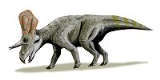
Zuniceratops appears to have been roughly 3 to 3.5 meters long (10-11 ft) and three feet (one meter) tall at the hips. It probably weighed 100 to 150 kilogram
s (200 to 250 lb
). The frill
behind its head was fenestrated but lacking epoccipital
s. It is the earliest-known ceratopsian to have eyebrow horns and the oldest-known ceratopsian from North America
. This set of horns is thought to have grown much larger with age.
Douglas G. Wolfe, in the Moreno Hill Formation
in west-central New Mexico. One skull and the bones from several individuals have been found. More recently, one bone, believed to be a squamosal
, has since been found to be an ischium of a Nothronychus
.
n in origin.
Although the first specimen discovered had single-rooted teeth (unusual for ceratopsians), later fossils had double-rooted teeth. This is evidence that the teeth became double-rooted with age. Zuniceratops was a herbivore
like other ceratopsians and was probably a herd animal as well.
Special, When Dinosaurs Roamed America
.
Ceratopsia
Ceratopsia or Ceratopia is a group of herbivorous, beaked dinosaurs which thrived in what are now North America, Europe, and Asia, during the Cretaceous Period, although ancestral forms lived earlier, in the Jurassic. The earliest known ceratopsian, Yinlong downsi, lived between 161.2 and 155.7...
n dinosaur
Dinosaur
Dinosaurs are a diverse group of animals of the clade and superorder Dinosauria. They were the dominant terrestrial vertebrates for over 160 million years, from the late Triassic period until the end of the Cretaceous , when the Cretaceous–Paleogene extinction event led to the extinction of...
from the mid Turonian
Turonian
The Turonian is, in the ICS' geologic timescale, the second age in the Late Cretaceous epoch, or a stage in the Upper Cretaceous series. It spans the time between 93.5 ± 0.8 Ma and 89.3 ± 1 Ma...
of the Late Cretaceous
Cretaceous
The Cretaceous , derived from the Latin "creta" , usually abbreviated K for its German translation Kreide , is a geologic period and system from circa to million years ago. In the geologic timescale, the Cretaceous follows the Jurassic period and is followed by the Paleogene period of the...
Period of what is now New Mexico
New Mexico
New Mexico is a state located in the southwest and western regions of the United States. New Mexico is also usually considered one of the Mountain States. With a population density of 16 per square mile, New Mexico is the sixth-most sparsely inhabited U.S...
, United States
United States
The United States of America is a federal constitutional republic comprising fifty states and a federal district...
. It lived about 10 million years earlier than the more familiar horned Ceratopsidae
Ceratopsidae
Ceratopsidae is a speciose group of marginocephalian dinosaurs including Triceratops and Styracosaurus...
and provides an important window on their ancestry.
Zuniceratops appears to have been roughly 3 to 3.5 meters long (10-11 ft) and three feet (one meter) tall at the hips. It probably weighed 100 to 150 kilogram
Kilogram
The kilogram or kilogramme , also known as the kilo, is the base unit of mass in the International System of Units and is defined as being equal to the mass of the International Prototype Kilogram , which is almost exactly equal to the mass of one liter of water...
s (200 to 250 lb
Pound (mass)
The pound or pound-mass is a unit of mass used in the Imperial, United States customary and other systems of measurement...
). The frill
Neck frill
Neck frill is the popular term for the relatively extensive margin seen on the back of the heads of reptiles with either a bony support such as those present on the skulls of dinosaurs of the suborder Marginocephalia or a cartilaginous one as in the Frill-necked Lizard...
behind its head was fenestrated but lacking epoccipital
Epoccipital
Epoccipital is an anatomical term for the distinctive bones found lining the frills of ceratopsid dinosaurs. The name is a misnomer, as they are not associated with the occipital bone. Epoccipitals begin as separate bones that fuse during the animal's growth to either the squamosal or parietal...
s. It is the earliest-known ceratopsian to have eyebrow horns and the oldest-known ceratopsian from North America
North America
North America is a continent wholly within the Northern Hemisphere and almost wholly within the Western Hemisphere. It is also considered a northern subcontinent of the Americas...
. This set of horns is thought to have grown much larger with age.
Discovery and Species
Zuniceratops was discovered in 1996, by 8 year old Christopher James Wolfe, son of paleontologistPaleontology
Paleontology "old, ancient", ὄν, ὀντ- "being, creature", and λόγος "speech, thought") is the study of prehistoric life. It includes the study of fossils to determine organisms' evolution and interactions with each other and their environments...
Douglas G. Wolfe, in the Moreno Hill Formation
Moreno Hill Formation
The Moreno Hill Formation is a geological formation in New Mexico whose strata date back to the Late Cretaceous. Dinosaur remains are among the fossils that have been recovered from the formation.-Dinosaurs:-References:...
in west-central New Mexico. One skull and the bones from several individuals have been found. More recently, one bone, believed to be a squamosal
Squamosal
The squamosal is a bone of the head of higher vertebrates. It is the principal component of the cheek region in the skull, lying below the temporal series and otic notch and bounded anteriorly by postorbital. Posteriorly, the squamosal articulates with the posterior elements of the palatal complex,...
, has since been found to be an ischium of a Nothronychus
Nothronychus
Nothronychus is a genus of theropod dinosaur classified in the group Therizinosauria, from the Cretaceous of North America.The type species of this dinosaur, Nothronychus mckinleyi, was described by James Kirkland and Douglas G. Wolfe in 2001...
.
Classification
Zuniceratops is an example of the evolutionary transition between early ceratopsians and the later, larger ceratopsids that had very large horns and frills. This supports the theory that the lineage of ceratopsian dinosaurs may have been North AmericaNorth America
North America is a continent wholly within the Northern Hemisphere and almost wholly within the Western Hemisphere. It is also considered a northern subcontinent of the Americas...
n in origin.
Although the first specimen discovered had single-rooted teeth (unusual for ceratopsians), later fossils had double-rooted teeth. This is evidence that the teeth became double-rooted with age. Zuniceratops was a herbivore
Herbivore
Herbivores are organisms that are anatomically and physiologically adapted to eat plant-based foods. Herbivory is a form of consumption in which an organism principally eats autotrophs such as plants, algae and photosynthesizing bacteria. More generally, organisms that feed on autotrophs in...
like other ceratopsians and was probably a herd animal as well.
Zuniceratops in popular culture
Zuniceratops is featured in the Discovery ChannelDiscovery Channel
Discovery Channel is an American satellite and cable specialty channel , founded by John Hendricks and distributed by Discovery Communications. It is a publicly traded company run by CEO David Zaslav...
Special, When Dinosaurs Roamed America
When Dinosaurs Roamed America
When Dinosaurs Roamed America is a two-hour American television program that first aired on Discovery Channel in 2001. It was directed by Pierre de Lespinois and narrated by actor John Goodman...
.
External links
- Zuniceratops in The Dinosaur Encyclopaedia at Dino Russ's Lair