


Protoceratops

Encyclopedia
Protoceratops is a genus
of sheep-sized (1.5 to 2 m long) herbivorous
ceratopsia
n dinosaur
, from the Upper Cretaceous
Period (Campanian
stage
) of what is now Mongolia
. It was a member of the Protoceratopsidae, a group of early horned dinosaurs. Unlike later ceratopsians, however, it was a much smaller creature that lacked well-developed horns and retained some primitive traits not seen in later genera.
Protoceratops had a large neck frill, which may have served to protect the neck, to anchor jaw muscles, to impress other members of the species, or combinations of these functions. Described by Walter Granger
and W.K. Gregory in 1923, Protoceratops was initially believed to be an ancestor of the North American ceratopsians. Researchers currently distinguish two species of Protoceratops (P. andrewsi and P. hellenikorhinus), based in part by their respective sizes.
In the 1920s, Roy Chapman Andrews
discovered fossil
ized eggs
in Mongolia
that were interpreted as belonging to this dinosaur, but which turned out to be those of Oviraptor
.
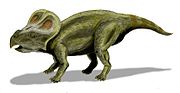 Protoceratops was a quadruped
al dinosaur that was partially characterized by its distinctive neck frill
at the back of its skull. The frill itself contained two large parietal fenestra (holes in the frill), while its cheeks had large jugal
bones. The exact size and shape of the neck frill varied by individual; some specimens had short, compact frills, while others had frills nearly half the length of the skull. The frill consists mostly of the parietal
bone and partially of the squamosal
. Some researchers, including Peter Dodson
attribute the different sizes and shapes of these bones to sexual dimorphism
, as well as the age of the specimen, at the time of death.
Protoceratops was approximately 1.8 meters (6 ft) in length and 0.6 meters (2 ft) high at the shoulder. A fully grown adult would have weighed less than 400 pounds (180 kg). The large numbers of specimens found in high concentration suggest that Protoceratops lived in herds.
Protoceratops was a relatively small dinosaur with a proportionately large skull. Despite being herbivorous, Protoceratops appears to have had muscular jaws capable of a powerful bite. These jaws were packed with dozens of teeth, well suited for chewing tough vegetation. The skull consisted of a massive frontal beak, and four pairs of fenestrae (skull openings). The foremost hole, the naris, was considerably smaller than the nostrils seen in later genera. Protoceratops had large orbit
s (the holes for its eyes), which measured around 50 millimeters in diameter. Behind the eye was a slightly smaller fenestra, known as the "infratemporal fenestra."
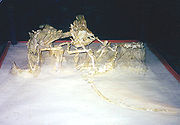 Photographer J.B. Shackelford discovered the first specimen of Protoceratops in the Gobi desert, (Gansu
, Inner Mongolia
), as part of a 1922 American expedition looking for human ancestors. No early human fossils were found, but the expedition, led by Roy Chapman Andrews
, collected many specimens of the Protoceratops genus, along with fossil skeletons of theropods Velociraptor
, Oviraptor
, and ceratopsid Psittacosaurus
.
Walter Granger
and W.K. Gregory formally described the type species
, P. andrewsi in 1923, the specific name in honor of Andrews. The fossils hail from the Djadochta Formation
and date from the Campanian
stage
of the Upper Cretaceous
(dating to between 75 and 71 million years ago). Researchers immediately noted the importance of the Protoceratops finds, and the genus was hailed as the "long-sought ancestor of Triceratops
". The fossils were in an excellent state of preservation, with even the sclerotic ring
s (delicate occular bones) preserved in some specimens.
In 1971, a fossil was found that captured a Velociraptor mongoliensis clutched around a Protoceratops andrewsi in Mongolia. It is believed that they died simultaneously, while fighting, when they were either surprised by a sand storm or buried when a sand dune collapsed on top of them.
In 1975, Polish
paleontologists Teresa Maryanska
and Halszka Osmólska
described a second species of Protoceratops, also from the Campanian stage of Mongolia, which they named P. kozlowskii. However, the fossils consisted of incomplete juvenile remains, and are now considered synonymous with Bagaceratops rozhdestvenskyi
.
In 2001, a second valid species, P. hellenikorhinus, was named from the Bayan Mandahu Formation
in Inner Mongolia
, China
and also dates from the Campanian
stage of the Upper Cretaceous
. It was notably larger than P. andrewsi, had a slightly different frill, and had more robust jugal
horns. The arch of bone over its nostrils had two small nasal horns, and there were no teeth at the front of the snout.
In 2011, a specimen of Protoceratops first uncovered in 1965 was found to be preserved with its own footprint. It is the first example of a dinosaur to be preserved with footprints.
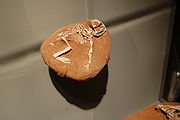 In the 1920s, Roy Chapman Andrews
discovered the first known fossil
ized dinosaur eggs, in the Gobi Desert
of Mongolia. Each egg was about 8 inches long, and newborn hatchlings estimated to have been about a foot in length. Due to the proximity and abundance of Protoceratops, these eggs were believed at the time to belong to this genus.
The contemporary theropod Oviraptor
was thought to consume Protoceratops eggs due to the discovery of an Oviraptor skeleton present at a nest. The skull was crushed, and it was speculated that the injury was received by an angry Protoceratops mother defending her nest from the predator.
However, in 1993 Norrell et al. discovered an embryo inside a supposed Protoceratops egg. This embryo, upon close examination, turned out to actually belong to Oviraptor itself. The original find actually represented Oviraptor brooding behavior rather than a failed attempt at oophagy.
In 2011, a nest of 15 young Protoceratops andrewsi was discovered in Mongolia. Stated as being the first Protoceratops nest discovered to date, the discovery suggests that Protoceratops parents might have cared for their young at nests during at least the early stages of childhood.
As Protoceratops is a relatively basal
member of the ceratopsians, the finding also suggests that other ceratopsians provided care for their young as well.
s of Protoceratops and modern birds and reptiles have indicated a more cathemeral
lifestyle, being active throughout the day during short intervals. This suggests that the fight between Protoceratops and the primarily nocturnal Velociraptor indicated by the fighting specimens may have occurred at twilight or under low-light conditions.
Protoceratopsidae, a group of herbivorous dinosaurs that were too advanced to be psittacosaurids, but too primitive to be ceratopsids. The group is characterized by their similarities to the Ceratopsidae
but with more cursorial
limb proportions, generally smaller frills, and lack of large horns.
In 1998, Paul Sereno
defined Protoceratopsidae as the stem-based clade
including "all coronosaurs closer to Protoceratops than to Triceratops." Some studies placed Bagaceratops
, Breviceratops
, Graciliceratops
, Lamaceratops
, Magnirostris
, Platyceratops
, and Serendipaceratops
within Protoceratopsidae, but in 2006, Makovicky and Norell published a new phylogeny which removed several genera from Protoceratopsidae; several other phylogenies also exist. Bainoceratops may be synonymous with Protoceratops.
of Stanford University
has suggested that the exquisitely preserved fossil skeletons of Protoceratops and other beaked dinosaurs, found by ancient Scythian nomads who mined gold in the Tian Shan
and Altai Mountains of Central Asia, may have been at the root of the image of the mythical creature known as the griffin
. Griffins were described as lion-sized quadrupeds with large claws and a raptor-bird-like beak; they laid their eggs in nests on the ground.
Greek writers began describing the griffin around 675 B.C., at the same time the Greeks first made contact with Scythian nomads. Griffins were described as guarding the gold deposits in the arid hills and red sandstone formations of the wilderness. The region of Mongolia and China where many Protoceratops fossils are found is rich in gold runoff from the neighboring mountains, lending some credence to the theory that these fossils were the basis of griffin myths.
Genus
In biology, a genus is a low-level taxonomic rank used in the biological classification of living and fossil organisms, which is an example of definition by genus and differentia...
of sheep-sized (1.5 to 2 m long) herbivorous
Herbivore
Herbivores are organisms that are anatomically and physiologically adapted to eat plant-based foods. Herbivory is a form of consumption in which an organism principally eats autotrophs such as plants, algae and photosynthesizing bacteria. More generally, organisms that feed on autotrophs in...
ceratopsia
Ceratopsia
Ceratopsia or Ceratopia is a group of herbivorous, beaked dinosaurs which thrived in what are now North America, Europe, and Asia, during the Cretaceous Period, although ancestral forms lived earlier, in the Jurassic. The earliest known ceratopsian, Yinlong downsi, lived between 161.2 and 155.7...
n dinosaur
Dinosaur
Dinosaurs are a diverse group of animals of the clade and superorder Dinosauria. They were the dominant terrestrial vertebrates for over 160 million years, from the late Triassic period until the end of the Cretaceous , when the Cretaceous–Paleogene extinction event led to the extinction of...
, from the Upper Cretaceous
Cretaceous
The Cretaceous , derived from the Latin "creta" , usually abbreviated K for its German translation Kreide , is a geologic period and system from circa to million years ago. In the geologic timescale, the Cretaceous follows the Jurassic period and is followed by the Paleogene period of the...
Period (Campanian
Campanian
The Campanian is, in the ICS' geologic timescale, the fifth of six ages of the Late Cretaceous epoch . The Campanian spans the time from 83.5 ± 0.7 Ma to 70.6 ± 0.6 Ma ...
stage
Faunal stage
In chronostratigraphy, a stage is a succession of rock strata laid down in a single age on the geologic timescale, which usually represents millions of years of deposition. A given stage of rock and the corresponding age of time will by convention have the same name, and the same boundaries.Rock...
) of what is now Mongolia
Mongolia
Mongolia is a landlocked country in East and Central Asia. It is bordered by Russia to the north and China to the south, east and west. Although Mongolia does not share a border with Kazakhstan, its western-most point is only from Kazakhstan's eastern tip. Ulan Bator, the capital and largest...
. It was a member of the Protoceratopsidae, a group of early horned dinosaurs. Unlike later ceratopsians, however, it was a much smaller creature that lacked well-developed horns and retained some primitive traits not seen in later genera.
Protoceratops had a large neck frill, which may have served to protect the neck, to anchor jaw muscles, to impress other members of the species, or combinations of these functions. Described by Walter Granger
Walter Granger
Walter Granger may refer to:*Walter K. Granger, , American politician*Walter W. Granger, , American vertebrate palaeontologist...
and W.K. Gregory in 1923, Protoceratops was initially believed to be an ancestor of the North American ceratopsians. Researchers currently distinguish two species of Protoceratops (P. andrewsi and P. hellenikorhinus), based in part by their respective sizes.
In the 1920s, Roy Chapman Andrews
Roy Chapman Andrews
Roy Chapman Andrews was an American explorer, adventurer and naturalist who became the director of the American Museum of Natural History. He is primarily known for leading a series of expeditions through the fragmented China of the early 20th century into the Gobi Desert and Mongolia...
discovered fossil
Fossil
Fossils are the preserved remains or traces of animals , plants, and other organisms from the remote past...
ized eggs
Egg (biology)
An egg is an organic vessel in which an embryo first begins to develop. In most birds, reptiles, insects, molluscs, fish, and monotremes, an egg is the zygote, resulting from fertilization of the ovum, which is expelled from the body and permitted to develop outside the body until the developing...
in Mongolia
Mongolia
Mongolia is a landlocked country in East and Central Asia. It is bordered by Russia to the north and China to the south, east and west. Although Mongolia does not share a border with Kazakhstan, its western-most point is only from Kazakhstan's eastern tip. Ulan Bator, the capital and largest...
that were interpreted as belonging to this dinosaur, but which turned out to be those of Oviraptor
Oviraptor
Oviraptor is a genus of small Mongolian theropod dinosaur, first discovered by the paleontologist Roy Chapman Andrews, and first described by Henry Fairfield Osborn, in 1924...
.
Description
Quadruped
Quadrupedalism is a form of land animal locomotion using four limbs or legs. An animal or machine that usually moves in a quadrupedal manner is known as a quadruped, meaning "four feet"...
al dinosaur that was partially characterized by its distinctive neck frill
Neck frill
Neck frill is the popular term for the relatively extensive margin seen on the back of the heads of reptiles with either a bony support such as those present on the skulls of dinosaurs of the suborder Marginocephalia or a cartilaginous one as in the Frill-necked Lizard...
at the back of its skull. The frill itself contained two large parietal fenestra (holes in the frill), while its cheeks had large jugal
Jugal
The jugal is a skull bone found in most reptiles, amphibians, and birds. In mammals, the jugal is often called the malar or Zygomatic. It is connected to the quadratojugal and maxilla, as well as other bones, which may vary by species....
bones. The exact size and shape of the neck frill varied by individual; some specimens had short, compact frills, while others had frills nearly half the length of the skull. The frill consists mostly of the parietal
Parietal
Parietal may refer to:*Parietal placentation*Parietal lobe of the brain*Parietal bone of the skull*Parietal scales of a snake lie in the general region of the parietal bone*Parietal cell in the stomach*Parietal pleura...
bone and partially of the squamosal
Squamosal
The squamosal is a bone of the head of higher vertebrates. It is the principal component of the cheek region in the skull, lying below the temporal series and otic notch and bounded anteriorly by postorbital. Posteriorly, the squamosal articulates with the posterior elements of the palatal complex,...
. Some researchers, including Peter Dodson
Peter Dodson
Peter Dodson is an American paleontologist who has published many papers and written and collaborated on books about dinosaurs. An authority on Ceratopsians, he has also authored several papers and textbooks on hadrosaurs and sauropods, and is a co-editor of The Dinosauria, widely considered the...
attribute the different sizes and shapes of these bones to sexual dimorphism
Sexual dimorphism
Sexual dimorphism is a phenotypic difference between males and females of the same species. Examples of such differences include differences in morphology, ornamentation, and behavior.-Examples:-Ornamentation / coloration:...
, as well as the age of the specimen, at the time of death.
Protoceratops was approximately 1.8 meters (6 ft) in length and 0.6 meters (2 ft) high at the shoulder. A fully grown adult would have weighed less than 400 pounds (180 kg). The large numbers of specimens found in high concentration suggest that Protoceratops lived in herds.
Protoceratops was a relatively small dinosaur with a proportionately large skull. Despite being herbivorous, Protoceratops appears to have had muscular jaws capable of a powerful bite. These jaws were packed with dozens of teeth, well suited for chewing tough vegetation. The skull consisted of a massive frontal beak, and four pairs of fenestrae (skull openings). The foremost hole, the naris, was considerably smaller than the nostrils seen in later genera. Protoceratops had large orbit
Orbit
In physics, an orbit is the gravitationally curved path of an object around a point in space, for example the orbit of a planet around the center of a star system, such as the Solar System...
s (the holes for its eyes), which measured around 50 millimeters in diameter. Behind the eye was a slightly smaller fenestra, known as the "infratemporal fenestra."
Discovery and species
Gansu
' is a province located in the northwest of the People's Republic of China.It lies between the Tibetan and Huangtu plateaus, and borders Mongolia, Inner Mongolia, and Ningxia to the north, Xinjiang and Qinghai to the west, Sichuan to the south, and Shaanxi to the east...
, Inner Mongolia
Inner Mongolia
Inner Mongolia is an autonomous region of the People's Republic of China, located in the northern region of the country. Inner Mongolia shares an international border with the countries of Mongolia and the Russian Federation...
), as part of a 1922 American expedition looking for human ancestors. No early human fossils were found, but the expedition, led by Roy Chapman Andrews
Roy Chapman Andrews
Roy Chapman Andrews was an American explorer, adventurer and naturalist who became the director of the American Museum of Natural History. He is primarily known for leading a series of expeditions through the fragmented China of the early 20th century into the Gobi Desert and Mongolia...
, collected many specimens of the Protoceratops genus, along with fossil skeletons of theropods Velociraptor
Velociraptor
Velociraptor is a genus of dromaeosaurid theropod dinosaur that existed approximately 75 to 71 million years ago during the later part of the Cretaceous Period. Two species are currently recognized, although others have been assigned in the past. The type species is V. mongoliensis; fossils...
, Oviraptor
Oviraptor
Oviraptor is a genus of small Mongolian theropod dinosaur, first discovered by the paleontologist Roy Chapman Andrews, and first described by Henry Fairfield Osborn, in 1924...
, and ceratopsid Psittacosaurus
Psittacosaurus
Psittacosaurus is a genus of psittacosaurid ceratopsian dinosaur from the Early Cretaceous Period of what is now Asia, about 130 to 100 million years ago. It is notable for being the most species-rich dinosaur genus...
.
Walter Granger
Walter Granger
Walter Granger may refer to:*Walter K. Granger, , American politician*Walter W. Granger, , American vertebrate palaeontologist...
and W.K. Gregory formally described the type species
Type species
In biological nomenclature, a type species is both a concept and a practical system which is used in the classification and nomenclature of animals and plants. The value of a "type species" lies in the fact that it makes clear what is meant by a particular genus name. A type species is the species...
, P. andrewsi in 1923, the specific name in honor of Andrews. The fossils hail from the Djadochta Formation
Djadochta Formation
The Djadochta Formation is situated in central Asia and dates from the Late Cretaceous Period. Laid down in the early Campanian, possibly starting in the latest Santonian, it is dated somewhat uncertainly at about 84-75 mya...
and date from the Campanian
Campanian
The Campanian is, in the ICS' geologic timescale, the fifth of six ages of the Late Cretaceous epoch . The Campanian spans the time from 83.5 ± 0.7 Ma to 70.6 ± 0.6 Ma ...
stage
Faunal stage
In chronostratigraphy, a stage is a succession of rock strata laid down in a single age on the geologic timescale, which usually represents millions of years of deposition. A given stage of rock and the corresponding age of time will by convention have the same name, and the same boundaries.Rock...
of the Upper Cretaceous
Cretaceous
The Cretaceous , derived from the Latin "creta" , usually abbreviated K for its German translation Kreide , is a geologic period and system from circa to million years ago. In the geologic timescale, the Cretaceous follows the Jurassic period and is followed by the Paleogene period of the...
(dating to between 75 and 71 million years ago). Researchers immediately noted the importance of the Protoceratops finds, and the genus was hailed as the "long-sought ancestor of Triceratops
Triceratops
Triceratops is a genus of herbivorous ceratopsid dinosaur which lived during the late Maastrichtian stage of the Late Cretaceous Period, around 68 to 65 million years ago in what is now North America. It was one of the last dinosaur genera to appear before the great Cretaceous–Paleogene...
". The fossils were in an excellent state of preservation, with even the sclerotic ring
Sclerotic ring
Sclerotic rings are rings of bone found in the eyes of several groups of vertebrate animals, except for mammals and crocodilians. They can be made up of single bones or small bones together. They are believed to have a role in supporting the eye, especially in animals whose eyes are not spherical,...
s (delicate occular bones) preserved in some specimens.
In 1971, a fossil was found that captured a Velociraptor mongoliensis clutched around a Protoceratops andrewsi in Mongolia. It is believed that they died simultaneously, while fighting, when they were either surprised by a sand storm or buried when a sand dune collapsed on top of them.
In 1975, Polish
Poles
thumb|right|180px|The state flag of [[Poland]] as used by Polish government and diplomatic authoritiesThe Polish people, or Poles , are a nation indigenous to Poland. They are united by the Polish language, which belongs to the historical Lechitic subgroup of West Slavic languages of Central Europe...
paleontologists Teresa Maryanska
Teresa Maryanska
Teresa Maryańska is a Polish paleontologist who has specialized in Mongolian dinosaurs, particularly pachycephalosaurians and ankylosaurians. A member of the 1964, 1965, 1970, and 1971 Polish–Mongolian expeditions to the Gobi Desert, she has described many finds from these rocks, often with...
and Halszka Osmólska
Halszka Osmólska
Halszka Osmólska was a Polish paleontologist who had specialized in Mongolian dinosaurs.She was born in Poznań. A member of the 1965 and 1970 Polish–Mongolian expeditions to the Gobi Desert, she described many finds from these rocks, often with Teresa Maryańska...
described a second species of Protoceratops, also from the Campanian stage of Mongolia, which they named P. kozlowskii. However, the fossils consisted of incomplete juvenile remains, and are now considered synonymous with Bagaceratops rozhdestvenskyi
Bagaceratops
Bagaceratops, meaning "small-horned face" , is a genus of ceratopsian dinosaur that lived in what is now Mongolia around 80 million years ago, during the Late Cretaceous...
.
In 2001, a second valid species, P. hellenikorhinus, was named from the Bayan Mandahu Formation
Bayan Mandahu Formation
The Bayan Mandahu Formation is a geological unit of "redbeds" located near the village of Bayan Mandahu in Inner Mongolia, China Asia and dates from the Late Cretaceous Period...
in Inner Mongolia
Inner Mongolia
Inner Mongolia is an autonomous region of the People's Republic of China, located in the northern region of the country. Inner Mongolia shares an international border with the countries of Mongolia and the Russian Federation...
, China
China
Chinese civilization may refer to:* China for more general discussion of the country.* Chinese culture* Greater China, the transnational community of ethnic Chinese.* History of China* Sinosphere, the area historically affected by Chinese culture...
and also dates from the Campanian
Campanian
The Campanian is, in the ICS' geologic timescale, the fifth of six ages of the Late Cretaceous epoch . The Campanian spans the time from 83.5 ± 0.7 Ma to 70.6 ± 0.6 Ma ...
stage of the Upper Cretaceous
Cretaceous
The Cretaceous , derived from the Latin "creta" , usually abbreviated K for its German translation Kreide , is a geologic period and system from circa to million years ago. In the geologic timescale, the Cretaceous follows the Jurassic period and is followed by the Paleogene period of the...
. It was notably larger than P. andrewsi, had a slightly different frill, and had more robust jugal
Jugal
The jugal is a skull bone found in most reptiles, amphibians, and birds. In mammals, the jugal is often called the malar or Zygomatic. It is connected to the quadratojugal and maxilla, as well as other bones, which may vary by species....
horns. The arch of bone over its nostrils had two small nasal horns, and there were no teeth at the front of the snout.
In 2011, a specimen of Protoceratops first uncovered in 1965 was found to be preserved with its own footprint. It is the first example of a dinosaur to be preserved with footprints.
Reproduction
Roy Chapman Andrews
Roy Chapman Andrews was an American explorer, adventurer and naturalist who became the director of the American Museum of Natural History. He is primarily known for leading a series of expeditions through the fragmented China of the early 20th century into the Gobi Desert and Mongolia...
discovered the first known fossil
Fossil
Fossils are the preserved remains or traces of animals , plants, and other organisms from the remote past...
ized dinosaur eggs, in the Gobi Desert
Gobi Desert
The Gobi is a large desert region in Asia. It covers parts of northern and northwestern China, and of southern Mongolia. The desert basins of the Gobi are bounded by the Altai Mountains and the grasslands and steppes of Mongolia on the north, by the Hexi Corridor and Tibetan Plateau to the...
of Mongolia. Each egg was about 8 inches long, and newborn hatchlings estimated to have been about a foot in length. Due to the proximity and abundance of Protoceratops, these eggs were believed at the time to belong to this genus.
The contemporary theropod Oviraptor
Oviraptor
Oviraptor is a genus of small Mongolian theropod dinosaur, first discovered by the paleontologist Roy Chapman Andrews, and first described by Henry Fairfield Osborn, in 1924...
was thought to consume Protoceratops eggs due to the discovery of an Oviraptor skeleton present at a nest. The skull was crushed, and it was speculated that the injury was received by an angry Protoceratops mother defending her nest from the predator.
However, in 1993 Norrell et al. discovered an embryo inside a supposed Protoceratops egg. This embryo, upon close examination, turned out to actually belong to Oviraptor itself. The original find actually represented Oviraptor brooding behavior rather than a failed attempt at oophagy.
In 2011, a nest of 15 young Protoceratops andrewsi was discovered in Mongolia. Stated as being the first Protoceratops nest discovered to date, the discovery suggests that Protoceratops parents might have cared for their young at nests during at least the early stages of childhood.
As Protoceratops is a relatively basal
Basal (phylogenetics)
In phylogenetics, a basal clade is the earliest clade to branch in a larger clade; it appears at the base of a cladogram.A basal group forms an outgroup to the rest of the clade, such as in the following example:...
member of the ceratopsians, the finding also suggests that other ceratopsians provided care for their young as well.
Daily activity patterns
The large eyes of Protoceratops has been suggested as evidence for a nocturnal lifestyle. However, subsequent comparisons between the scleral ringSclerotic ring
Sclerotic rings are rings of bone found in the eyes of several groups of vertebrate animals, except for mammals and crocodilians. They can be made up of single bones or small bones together. They are believed to have a role in supporting the eye, especially in animals whose eyes are not spherical,...
s of Protoceratops and modern birds and reptiles have indicated a more cathemeral
Cathemeral
A cathemeral organism is one that has sporadic and random intervals of activity during the day or night in which food is acquired, socializing with other organisms occurs, and any other activities necessary for livelihood are performed...
lifestyle, being active throughout the day during short intervals. This suggests that the fight between Protoceratops and the primarily nocturnal Velociraptor indicated by the fighting specimens may have occurred at twilight or under low-light conditions.
Classification
Protoceratops was the first named protoceratopsian and hence gives its name to the familyFamily (biology)
In biological classification, family is* a taxonomic rank. Other well-known ranks are life, domain, kingdom, phylum, class, order, genus, and species, with family fitting between order and genus. As for the other well-known ranks, there is the option of an immediately lower rank, indicated by the...
Protoceratopsidae, a group of herbivorous dinosaurs that were too advanced to be psittacosaurids, but too primitive to be ceratopsids. The group is characterized by their similarities to the Ceratopsidae
Ceratopsidae
Ceratopsidae is a speciose group of marginocephalian dinosaurs including Triceratops and Styracosaurus...
but with more cursorial
Cursorial
Cursorial is a biological term that describes an organism as being adapted specifically to run. It is typically used in conjunction with an animal's feeding habits or another important adaptation. For example, a horse can be considered a "cursorial grazer", while a wolf may be considered a...
limb proportions, generally smaller frills, and lack of large horns.
In 1998, Paul Sereno
Paul Sereno
Paul Callistus Sereno is an American paleontologist from the University of Chicago who discovered several new dinosaur species on several continents. He has conducted excavations at sites as varied as Inner Mongolia, Argentina, Morocco, and Niger...
defined Protoceratopsidae as the stem-based clade
Clade
A clade is a group consisting of a species and all its descendants. In the terms of biological systematics, a clade is a single "branch" on the "tree of life". The idea that such a "natural group" of organisms should be grouped together and given a taxonomic name is central to biological...
including "all coronosaurs closer to Protoceratops than to Triceratops." Some studies placed Bagaceratops
Bagaceratops
Bagaceratops, meaning "small-horned face" , is a genus of ceratopsian dinosaur that lived in what is now Mongolia around 80 million years ago, during the Late Cretaceous...
, Breviceratops
Breviceratops
Breviceratops was a ceratopsian dinosaur from Late Cretaceous Mongolia. It was related to Protoceratops. The fossils originally described by Maryanska and Osmolska in 1975 and placed in Protoceratops, were moved to the new genus by Kurzanov in 1990.The type species is Breviceratops...
, Graciliceratops
Graciliceratops
Graciliceratops is a Ceratopsian dinosaur first described by paleontologist Paul Sereno in 2000. It is known from the Late Cretaceous period and its fossils were found in Mongolia...
, Lamaceratops
Lamaceratops
Lamaceratops,"Lama Horned Face", is a dinosaur from the Late Cretaceous period. It is classified as a ceratopsian, a herbivorous "frilled" or armored dinosaur similar to, but smaller than, Bagaceratops. It had a horn on the front of its face, much like most of the later Ceratopsids.The fossils of...
, Magnirostris
Magnirostris
Magnirostris, from the Latin "magnus" 'large' and "rostrum" 'beak', is the name given to a genus of dinosaur from the Late Campanian epoch in the Late Cretaceous. It was a ceratopsian which lived in Inner Mongolia in China...
, Platyceratops
Platyceratops
Platyceratops is a dinosaur from the Late Cretaceous, during the Campanian Age, about 75-72 million years ago. Its fossils have been found in Mongolia. Its skull is larger than Bagaceratops; it has been referred to Bagaceratopidae or the Neoceratopsia...
, and Serendipaceratops
Serendipaceratops
Serendipaceratops is a dubious genus of ornithischian dinosaur from the early Cretaceous Period of Australia.The type species, S. arthurcclarkei, was named after Arthur C...
within Protoceratopsidae, but in 2006, Makovicky and Norell published a new phylogeny which removed several genera from Protoceratopsidae; several other phylogenies also exist. Bainoceratops may be synonymous with Protoceratops.
Origin of griffin myths
Folklorist and historian of science Adrienne MayorAdrienne Mayor
Adrienne Mayor is a historian of ancient science and a classical folklorist.Mayor specializes in ancient history and the study of "folk science": how pre-scientific cultures interpreted data about the natural world, and how these interpretations form the basis of many ancient myths, folklore and...
of Stanford University
Stanford University
The Leland Stanford Junior University, commonly referred to as Stanford University or Stanford, is a private research university on an campus located near Palo Alto, California. It is situated in the northwestern Santa Clara Valley on the San Francisco Peninsula, approximately northwest of San...
has suggested that the exquisitely preserved fossil skeletons of Protoceratops and other beaked dinosaurs, found by ancient Scythian nomads who mined gold in the Tian Shan
Tian Shan
The Tian Shan , also spelled Tien Shan, is a large mountain system located in Central Asia. The highest peak in the Tian Shan is Victory Peak , ....
and Altai Mountains of Central Asia, may have been at the root of the image of the mythical creature known as the griffin
Griffin
The griffin, griffon, or gryphon is a legendary creature with the body of a lion and the head and wings of an eagle...
. Griffins were described as lion-sized quadrupeds with large claws and a raptor-bird-like beak; they laid their eggs in nests on the ground.
Greek writers began describing the griffin around 675 B.C., at the same time the Greeks first made contact with Scythian nomads. Griffins were described as guarding the gold deposits in the arid hills and red sandstone formations of the wilderness. The region of Mongolia and China where many Protoceratops fossils are found is rich in gold runoff from the neighboring mountains, lending some credence to the theory that these fossils were the basis of griffin myths.
External links
- A video of Protoceratops vs Velociraptor
- Ceratopsia from Thescelosaurus web site