

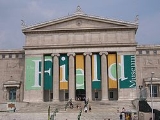
Field Museum of Natural History

Encyclopedia
The Field Museum of Natural History (abbreviated FMNH) is located in Chicago, Illinois
, USA. It sits on Lake Shore Drive
next to Lake Michigan
, part of a scenic complex known as the Museum Campus Chicago
. The museum collections contain over 21 million specimens, of which only a small portion are ever on display.
Some prized exhibits in The Field Museum include:
's Palace of Fine Arts (which is today home to the Museum of Science and Industry
). In 1905, the museum's name was changed to Field Museum of Natural History to honor the museum's first major benefactor, Marshall Field
, and to better reflect its focus on natural history. In 1921, the museum moved from its original location to its present site on Chicago Park District property near downtown, where it is part of the lakefront Museum Campus that includes the John G. Shedd Aquarium and the Adler Planetarium
. In 2006, the Field Museum was the number one cultural attraction in Chicago but surrendered the title in 2007 to the Shedd Aquarium.
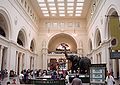
Some highlights at the Field Museum Library include:
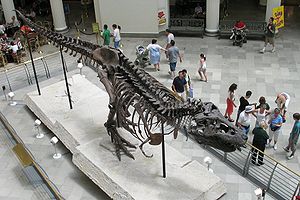 On May 17, 2000, the Field Museum unveiled Sue
, the most complete and best-preserved Tyrannosaurus rex
fossil
yet discovered. Sue is 42 feet (13 m) long, stands 13 feet (4 m) high at the hips and is 67 million years old. The fossil was named Sue after the paleontologist who found it—Sue Hendrickson
. The fossil's actual gender is unknown, although because she was named after Hendrickson, Sue is commonly referred to as female. She is a permanent feature at The Field Museum. Sue's body is located on the main floor in the Stanley Field Hall. Her skull was too heavy to be mounted on the rest of the body and is located in a case on the second floor balcony above her skeleton. A skull replica is mounted on Sue's body. From the rings in the bones, Sue was estimated to be about 29 years of age at the time of her death. Sue and her juvenile counterpart, Jane
, give Illinois two important Tyrannosaurus rex fossils.
The Museum's curatorial and scientific staff in the departments of Anthropology, Botany, Geology, and Zoology conducts basic research in the fields of systematic biology and anthropology, and also has responsibility for collections management, and collaboration in public programs with the Departments of Education and Exhibits. Since its founding the Field Museum has been an international leader in evolutionary biology and paleontology, and archaeology and ethnography, and has long maintained close links, including joint teaching, students, seminars, with local universities—particularly the University of Chicago and the University of Illinois at Chicago
The Grainger Hall of Gems features a large collection of diamonds and gems from around the world, and also includes a Louis Comfort Tiffany
stained glass window. The Hall of Jades focuses on Chinese Jade
artifacts spanning 8,000 years.
 The Underground Adventure gives visitors a bugs-eye look at the world beneath their feet. They will get to see what insects and soil
look like from that size. Visitors will learn about the soil's biodiversity and the importance of healthy soil. The scale of the exhibit is 100 times larger than normal size.
Inside Ancient Egypt offers a glimpse into what life was like for ancient Egyptians
. Twenty-three human mummies are on display, as well as many mummified animals. The exhibit features a tomb that visitors can enter, complete with 5,000-year-old hieroglyphs
. There are also many interactive displays, for both children and adults, as well as a shrine to the cat Goddess Bastet. A popular feature of the exhibit is the chapel from the original tomb of Unis-Ankh, the son of the Pharaoh Unas, the last Pharaoh of the 5th dynasty. The exhibit is a re-creation of his mastaba which was originally located in Saqqara.
Evolving Planet – Throughout this exhibition, visitors will see both the history and the evolution of life on Earth over a span of 4 billion years, from the first organism to present-day life. Visitors can see how mass extinctions in Earth’s history helped shape all the organisms. There is also an expanded dinosaur hall, with dinosaurs from every era, as well as interactive displays.
The Ancient Americas – Takes visitors on a journey through 13,000 years of human ingenuity and achievement in the Western Hemisphere, where hundreds of diverse societies thrived long before the arrival of Europeans. In this large permanent exhibition visitors can learn the epic story of the peopling of these continents, from the Arctic to the tip of South America.
Dioramas – Visitors can see many animals including everything from tigers to hawks. This area also features the man-eating Lions of Tsavo, featured in the 1996 movie The Ghost and the Darkness
.
Working Laboratories
DNA Discovery Center – Visitors can watch real scientists extract DNA from a variety of organisms. Museum goers can also speak to a live scientist through the glass everyday and ask them any questions about DNA.
McDonald's Fossil Prep Lab– the public can watch as paleontologists prepare real fossils for study.
The Regenstein Laboratory – 1600 square feet (148.6 m²) conservation and collections facility. Visitors can watch as conservators work to preserve and study anthropological specimens from all over the world.
Other exhibits include sections on Tibet
and China
, where visitors can view traditional clothing. There is also an exhibit on life in Africa
, where visitors can learn about the many different cultures on the continent and an exhibit where visitors may 'visit' several Pacific Islands
. The Museum houses an authentic 19th century Māori Meeting House
, Ruatepupuke II, from Tokomaru Bay
, New Zealand
.
There are also a few vintage Mold-A-Rama
machines that create injection-molded plastic dinosaurs collected by Chicago children.
, botany
, geology
and zoology
. Monographs in these series are accessible via the Internet Archive
.
. Many parts of the film, though, were created with computer graphics or with sets that bear only a passing similarity to the actual museum.
It was used in several scenes for the Kevin Bacon
movie She's Having a Baby
.
A chase scene in the 1996 Keanu Reeves
thriller Chain Reaction
combined the Field Museum and the Museum of Science and Industry
, located several miles to the south, as one museum.
Illinois
Illinois is the fifth-most populous state of the United States of America, and is often noted for being a microcosm of the entire country. With Chicago in the northeast, small industrial cities and great agricultural productivity in central and northern Illinois, and natural resources like coal,...
, USA. It sits on Lake Shore Drive
Lake Shore Drive
Lake Shore Drive is a mostly freeway-standard expressway running parallel with and alongside the shoreline of Lake Michigan through Chicago, Illinois, USA. Except for the portion north of Foster Avenue , Lake Shore Drive is designated as part of U.S...
next to Lake Michigan
Lake Michigan
Lake Michigan is one of the five Great Lakes of North America and the only one located entirely within the United States. It is the second largest of the Great Lakes by volume and the third largest by surface area, after Lake Superior and Lake Huron...
, part of a scenic complex known as the Museum Campus Chicago
Museum Campus Chicago
Museum Campus Chicago is a lakefront park in Chicago that surrounds three of the city's most notable museums, all dedicated to the natural sciences: the Adler Planetarium, the Shedd Aquarium, and the Field Museum of Natural History...
. The museum collections contain over 21 million specimens, of which only a small portion are ever on display.
Some prized exhibits in The Field Museum include:
- SueSue (dinosaur)"Sue" is the nickname given to FMNH PR 2081, which is the largest, most extensive and best preserved Tyrannosaurus rex specimen ever found. It was discovered in the summer of 1990 by Sue Hendrickson, a paleontologist, and was named after her...
, the largest and most complete TyrannosaurusTyrannosaurusTyrannosaurus meaning "tyrant," and sauros meaning "lizard") is a genus of coelurosaurian theropod dinosaur. The species Tyrannosaurus rex , commonly abbreviated to T. rex, is a fixture in popular culture. It lived throughout what is now western North America, with a much wider range than other...
currently known. - A comprehensive set of human cultural anthropology exhibits, including artifacts from ancient Egypt, the Pacific Northwest, the Pacific Islands, and Tibet.
- A large and diverse taxidermyTaxidermyTaxidermy is the act of mounting or reproducing dead animals for display or for other sources of study. Taxidermy can be done on all vertebrate species of animals, including mammals, birds, fish, reptiles, and amphibians...
collection, featuring many large animals, including two prized African elephants and the infamous Lions of Tsavo, featured in the 1996 movie The Ghost and the DarknessThe Ghost and the DarknessThe Ghost and the Darkness is a 1996 adventure film starring Michael Douglas and Val Kilmer set in Africa at the end of the 19th century.It was directed by Stephen Hopkins and the screenplay was written by William Goldman....
. - A large collection of dinosaurDinosaurDinosaurs are a diverse group of animals of the clade and superorder Dinosauria. They were the dominant terrestrial vertebrates for over 160 million years, from the late Triassic period until the end of the Cretaceous , when the Cretaceous–Paleogene extinction event led to the extinction of...
s in the Evolving Planet exhibit (formerly Life Over Time). - A large collection of Native AmericanNative Americans in the United StatesNative Americans in the United States are the indigenous peoples in North America within the boundaries of the present-day continental United States, parts of Alaska, and the island state of Hawaii. They are composed of numerous, distinct tribes, states, and ethnic groups, many of which survive as...
artifacts. The main exhibit with these artifacts reopened as Ancient Americas in March 2007.
History
The Field Museum was incorporated in the State of Illinois on September 16, 1893 as the Columbian Museum of Chicago with its purpose the "accumulation and dissemination of knowledge, and the preservation and exhibition of artifacts illustrating art, archaeology, science and history." The museum was originally housed in the World's Columbian ExpositionWorld's Columbian Exposition
The World's Columbian Exposition was a World's Fair held in Chicago in 1893 to celebrate the 400th anniversary of Christopher Columbus's arrival in the New World in 1492. Chicago bested New York City; Washington, D.C.; and St...
's Palace of Fine Arts (which is today home to the Museum of Science and Industry
Museum of Science and Industry (Chicago)
The Museum of Science and Industry is located in Chicago, Illinois, USA in Jackson Park, in the Hyde Park neighborhood adjacent to Lake Michigan. It is housed in the former Palace of Fine Arts from the 1893 World's Columbian Exposition...
). In 1905, the museum's name was changed to Field Museum of Natural History to honor the museum's first major benefactor, Marshall Field
Marshall Field
Marshall Field was founder of Marshall Field and Company, the Chicago-based department stores.-Life and career:...
, and to better reflect its focus on natural history. In 1921, the museum moved from its original location to its present site on Chicago Park District property near downtown, where it is part of the lakefront Museum Campus that includes the John G. Shedd Aquarium and the Adler Planetarium
Adler Planetarium
The Adler Planetarium & Astronomy Museum in Chicago, Illinois was the first planetarium built in the Western Hemisphere and is the oldest in existence today. Adler was founded and built in 1930 by the philanthropist Max Adler, with the assistance of the first director of the planetarium, Philip Fox...
. In 2006, the Field Museum was the number one cultural attraction in Chicago but surrendered the title in 2007 to the Shedd Aquarium.
Library
The Library at The Field Museum was organized in 1893 to meet the research needs of the museum's scientific staff, visiting researchers, students and members of the general public interested in natural history. The Library’s collections are an essential resource for the Museum’s research, exhibition development and educational programs. The 275,000 volumes of the Main Research Collections concentrate on biological systematics, environmental and evolutionary biology, anthropology, botany, geology, archaeology, museology and related subjects. Three special collections are an indispensable part of these holdings: the Mary W. Runnells Rare Book Room, the Photo Archives and the Institutional Archives. These collections document and preserve the development of the Museum and its collections, and the history of its expedition, exhibition and educational programs.Some highlights at the Field Museum Library include:
- "Ayer Collection" – private collection of Edward E. AyerEdward E. AyerEdward Everett Ayer was an American business magnate, best remembered for the endowments of his substantial collections of books and original manuscripts from Native American and colonial-era history and ethnology, which were donated to the Newberry Library and Field Museum of Natural History in...
, first President of the Museum, chiefly ornithological. Collection contains virtually all the important works in history of ornithologyOrnithologyOrnithology is a branch of zoology that concerns the study of birds. Several aspects of ornithology differ from related disciplines, due partly to the high visibility and the aesthetic appeal of birds...
and is especially rich in color-illustrated works. - "Laufer Collection" – working collection of Dr. Berthold LauferBerthold LauferBerthold Laufer was a German-American anthropologist and orientalist.Laufer was born in Cologne to a Jewish family. He attended the Friedrich Wilhelms Gymnasium from 1884-1893. He continued his studies in Berlin and completed his doctorate degree at the University of Leipzig in 1897...
, America’s first sinologist and Curator of Anthropology until his death in 1934. The Library houses approximately 7,000 volumes in ChineseChinese languageThe Chinese language is a language or language family consisting of varieties which are mutually intelligible to varying degrees. Originally the indigenous languages spoken by the Han Chinese in China, it forms one of the branches of Sino-Tibetan family of languages...
, JapaneseJapanese languageis a language spoken by over 130 million people in Japan and in Japanese emigrant communities. It is a member of the Japonic language family, which has a number of proposed relationships with other languages, none of which has gained wide acceptance among historical linguists .Japanese is an...
, TibetanStandard TibetanStandard Tibetan is the most widely used spoken form of the Tibetan languages. It is based on the speech of Lhasa, an Ü-Tsang dialect belonging to the Central Tibetan languages. For this reason, Standard Tibetan is often called Central Tibetan...
and numerous western languages, covering the subjects of: anthropologyAnthropologyAnthropology is the study of humanity. It has origins in the humanities, the natural sciences, and the social sciences. The term "anthropology" is from the Greek anthrōpos , "man", understood to mean mankind or humanity, and -logia , "discourse" or "study", and was first used in 1501 by German...
, archaeologyArchaeologyArchaeology, or archeology , is the study of human society, primarily through the recovery and analysis of the material culture and environmental data that they have left behind, which includes artifacts, architecture, biofacts and cultural landscapes...
, religion, science and travel. - "Photo Archives" – comprises over 250,000 images in the areas of Anthropology, Botany, Geology, and Zoology. The collection also documents the history and architecture of the Museum, its exhibitions, staff and scientific expeditions. Two important collections from the Photo Archives are now available via the Illinois Digital Archives (IDA): World's Columbian Exposition of 1893 from The Field Museum and Urban Landscapes from The Field Museum. In April 2009, the Photo Archives became part of the Flickr Commons http://www.flickr.com/photos/field_museum_library/.
Sue the Tyrannosaurus rex
Sue (dinosaur)
"Sue" is the nickname given to FMNH PR 2081, which is the largest, most extensive and best preserved Tyrannosaurus rex specimen ever found. It was discovered in the summer of 1990 by Sue Hendrickson, a paleontologist, and was named after her...
, the most complete and best-preserved Tyrannosaurus rex
Tyrannosaurus
Tyrannosaurus meaning "tyrant," and sauros meaning "lizard") is a genus of coelurosaurian theropod dinosaur. The species Tyrannosaurus rex , commonly abbreviated to T. rex, is a fixture in popular culture. It lived throughout what is now western North America, with a much wider range than other...
fossil
Fossil
Fossils are the preserved remains or traces of animals , plants, and other organisms from the remote past...
yet discovered. Sue is 42 feet (13 m) long, stands 13 feet (4 m) high at the hips and is 67 million years old. The fossil was named Sue after the paleontologist who found it—Sue Hendrickson
Sue Hendrickson
Susan "Sue" Hendrickson is an American paleontologist. Hendrickson is best known for her discovery of the remains of a Tyrannosaurus rex in South Dakota on August 12, 1990. Her discovery was the largest specimen of a T. rex found and one of the most complete skeletons. This skeleton is now known...
. The fossil's actual gender is unknown, although because she was named after Hendrickson, Sue is commonly referred to as female. She is a permanent feature at The Field Museum. Sue's body is located on the main floor in the Stanley Field Hall. Her skull was too heavy to be mounted on the rest of the body and is located in a case on the second floor balcony above her skeleton. A skull replica is mounted on Sue's body. From the rings in the bones, Sue was estimated to be about 29 years of age at the time of her death. Sue and her juvenile counterpart, Jane
Jane (dinosaur)
Jane is a fossil specimen of small tyrannosaurid dinosaur , officially known as BMRP 2002.4.1, discovered in the Hell Creek Formation in southern Montana....
, give Illinois two important Tyrannosaurus rex fossils.
Research and education
As an educational institution, the Field Museum offers multiple opportunities for both informal and more structured public learning. Exhibits remain the primary means of informal education, but throughout its history the Museum has supplemented this approach with innovative educational programs. The Harris Loan Program, for example, begun in 1912, provides educational outreach to children, offering artifacts, specimens, audiovisual materials, and activity kits to Chicago area schools. The Department of Education, begun in 1922, offers a challenging program of classes, lectures, field trips, museum overnights and special events for families, adults and children. Professional symposia and lectures, such as the annual A. Watson Armour III Spring Symposium, present the latest scientific results to the international scientific community as well as the public at large.The Museum's curatorial and scientific staff in the departments of Anthropology, Botany, Geology, and Zoology conducts basic research in the fields of systematic biology and anthropology, and also has responsibility for collections management, and collaboration in public programs with the Departments of Education and Exhibits. Since its founding the Field Museum has been an international leader in evolutionary biology and paleontology, and archaeology and ethnography, and has long maintained close links, including joint teaching, students, seminars, with local universities—particularly the University of Chicago and the University of Illinois at Chicago
Permanent exhibitions
There are many permanent exhibits located at the Field Museum for the public to enjoy. Many animal specimens are on display in exhibits like Nature Walk, Mammals of Asia, Mammals of Africa, and several other exhibits. Through these exhibits, visitors can get an up-close look at the diverse habitats that animals inhabit.The Grainger Hall of Gems features a large collection of diamonds and gems from around the world, and also includes a Louis Comfort Tiffany
Louis Comfort Tiffany
Louis Comfort Tiffany was an American artist and designer who worked in the decorative arts and is best known for his work in stained glass. He is the American artist most associated with the Art Nouveau and Aesthetic movements...
stained glass window. The Hall of Jades focuses on Chinese Jade
Jade
Jade is an ornamental stone.The term jade is applied to two different metamorphic rocks that are made up of different silicate minerals:...
artifacts spanning 8,000 years.
Soil
Soil is a natural body consisting of layers of mineral constituents of variable thicknesses, which differ from the parent materials in their morphological, physical, chemical, and mineralogical characteristics...
look like from that size. Visitors will learn about the soil's biodiversity and the importance of healthy soil. The scale of the exhibit is 100 times larger than normal size.
Inside Ancient Egypt offers a glimpse into what life was like for ancient Egyptians
Egyptians
Egyptians are nation an ethnic group made up of Mediterranean North Africans, the indigenous people of Egypt.Egyptian identity is closely tied to geography. The population of Egypt is concentrated in the lower Nile Valley, the small strip of cultivable land stretching from the First Cataract to...
. Twenty-three human mummies are on display, as well as many mummified animals. The exhibit features a tomb that visitors can enter, complete with 5,000-year-old hieroglyphs
Egyptian hieroglyphs
Egyptian hieroglyphs were a formal writing system used by the ancient Egyptians that combined logographic and alphabetic elements. Egyptians used cursive hieroglyphs for religious literature on papyrus and wood...
. There are also many interactive displays, for both children and adults, as well as a shrine to the cat Goddess Bastet. A popular feature of the exhibit is the chapel from the original tomb of Unis-Ankh, the son of the Pharaoh Unas, the last Pharaoh of the 5th dynasty. The exhibit is a re-creation of his mastaba which was originally located in Saqqara.
Evolving Planet – Throughout this exhibition, visitors will see both the history and the evolution of life on Earth over a span of 4 billion years, from the first organism to present-day life. Visitors can see how mass extinctions in Earth’s history helped shape all the organisms. There is also an expanded dinosaur hall, with dinosaurs from every era, as well as interactive displays.
The Ancient Americas – Takes visitors on a journey through 13,000 years of human ingenuity and achievement in the Western Hemisphere, where hundreds of diverse societies thrived long before the arrival of Europeans. In this large permanent exhibition visitors can learn the epic story of the peopling of these continents, from the Arctic to the tip of South America.
Dioramas – Visitors can see many animals including everything from tigers to hawks. This area also features the man-eating Lions of Tsavo, featured in the 1996 movie The Ghost and the Darkness
The Ghost and the Darkness
The Ghost and the Darkness is a 1996 adventure film starring Michael Douglas and Val Kilmer set in Africa at the end of the 19th century.It was directed by Stephen Hopkins and the screenplay was written by William Goldman....
.
Working Laboratories
DNA Discovery Center – Visitors can watch real scientists extract DNA from a variety of organisms. Museum goers can also speak to a live scientist through the glass everyday and ask them any questions about DNA.
McDonald's Fossil Prep Lab– the public can watch as paleontologists prepare real fossils for study.
The Regenstein Laboratory – 1600 square feet (148.6 m²) conservation and collections facility. Visitors can watch as conservators work to preserve and study anthropological specimens from all over the world.
Other exhibits include sections on Tibet
Tibet
Tibet is a plateau region in Asia, north-east of the Himalayas. It is the traditional homeland of the Tibetan people as well as some other ethnic groups such as Monpas, Qiang, and Lhobas, and is now also inhabited by considerable numbers of Han and Hui people...
and China
China
Chinese civilization may refer to:* China for more general discussion of the country.* Chinese culture* Greater China, the transnational community of ethnic Chinese.* History of China* Sinosphere, the area historically affected by Chinese culture...
, where visitors can view traditional clothing. There is also an exhibit on life in Africa
Africa
Africa is the world's second largest and second most populous continent, after Asia. At about 30.2 million km² including adjacent islands, it covers 6% of the Earth's total surface area and 20.4% of the total land area...
, where visitors can learn about the many different cultures on the continent and an exhibit where visitors may 'visit' several Pacific Islands
Pacific Islands
The Pacific Islands comprise 20,000 to 30,000 islands in the Pacific Ocean. The islands are also sometimes collectively called Oceania, although Oceania is sometimes defined as also including Australasia and the Malay Archipelago....
. The Museum houses an authentic 19th century Māori Meeting House
Wharenui
A wharenui is a communal house of the Māori people of New Zealand, generally situated as the focal point of a marae. Wharenui are usually called 'meeting houses' in New Zealand English.-Wharenui:...
, Ruatepupuke II, from Tokomaru Bay
Tokomaru Bay
Tokomaru Bay is a small, idyllic beachside community located on the isolated East Coast of New Zealand’s North Island. It is 91 km north of Gisborne, on State Highway 35, and close to Mount Hikurangi. The district was originally known as Toka-a-Namu, which refers to the abundance of sandflies...
, New Zealand
New Zealand
New Zealand is an island country in the south-western Pacific Ocean comprising two main landmasses and numerous smaller islands. The country is situated some east of Australia across the Tasman Sea, and roughly south of the Pacific island nations of New Caledonia, Fiji, and Tonga...
.
There are also a few vintage Mold-A-Rama
Mold-A-Rama
Mold-A-Rama is a brand name for a type of vending machine that makes blow-molded plastic figurines. Mold-A-Rama machines debuted in late 1962 and grew in prominence at the 1964 New York World's Fair. The machines can still be found operating in some museums and zoos.-History:American inventor...
machines that create injection-molded plastic dinosaurs collected by Chicago children.
Fieldiana
The Museum publishes four peer-reviewed monograph series issued under the collective title Fieldiana, devoted to anthropologyAnthropology
Anthropology is the study of humanity. It has origins in the humanities, the natural sciences, and the social sciences. The term "anthropology" is from the Greek anthrōpos , "man", understood to mean mankind or humanity, and -logia , "discourse" or "study", and was first used in 1501 by German...
, botany
Botany
Botany, plant science, or plant biology is a branch of biology that involves the scientific study of plant life. Traditionally, botany also included the study of fungi, algae and viruses...
, geology
Geology
Geology is the science comprising the study of solid Earth, the rocks of which it is composed, and the processes by which it evolves. Geology gives insight into the history of the Earth, as it provides the primary evidence for plate tectonics, the evolutionary history of life, and past climates...
and zoology
Zoology
Zoology |zoölogy]]), is the branch of biology that relates to the animal kingdom, including the structure, embryology, evolution, classification, habits, and distribution of all animals, both living and extinct...
. Monographs in these series are accessible via the Internet Archive
Internet Archive
The Internet Archive is a non-profit digital library with the stated mission of "universal access to all knowledge". It offers permanent storage and access to collections of digitized materials, including websites, music, moving images, and nearly 3 million public domain books. The Internet Archive...
.
Film appearances
The Field Museum of Natural History served as the setting in the 1997 horror film The RelicThe Relic (film)
The Relic is a 1997 science fiction/horror film directed by Peter Hyams and based on the best-selling novel Relic by Douglas Preston and Lincoln Child. The film stars Penelope Ann Miller, Tom Sizemore and Linda Hunt. The original music score was composed by John Debney...
. Many parts of the film, though, were created with computer graphics or with sets that bear only a passing similarity to the actual museum.
It was used in several scenes for the Kevin Bacon
Kevin Bacon
Kevin Norwood Bacon is an American film and theater actor whose notable roles include Animal House, Diner, Footloose, Flatliners, Wild Things, A Few Good Men, JFK, Apollo 13, Mystic River, The Woodsman, Trapped, Friday the 13th, Hollow Man, Tremors, Death Sentence, Frost/Nixon, Crazy, Stupid, Love....
movie She's Having a Baby
She's Having a Baby
She's Having a Baby is a 1988 American romance film directed by John Hughes.The film portrays a young newlywed couple, Kristy and Jake Briggs played by Elizabeth McGovern and Kevin Bacon, who try to cope with being married and what is expected of them by their parents. Jake must also deal with the...
.
A chase scene in the 1996 Keanu Reeves
Keanu Reeves
Keanu Charles Reeves is a Canadian actor. Reeves is perhaps best known for his roles in Bill & Ted's Excellent Adventure, Speed, Point Break and the science fiction-action trilogy The Matrix...
thriller Chain Reaction
Chain Reaction (film)
Chain Reaction is a 1996 American film starring Keanu Reeves, Morgan Freeman, Rachel Weisz, Brian Cox, Kevin Dunn and Fred Ward. It presents a fictional account of the invention of bubble fusion using sonoluminescence and the attempts by the United States Government to prevent the spreading of this...
combined the Field Museum and the Museum of Science and Industry
Museum of Science and Industry (Chicago)
The Museum of Science and Industry is located in Chicago, Illinois, USA in Jackson Park, in the Hyde Park neighborhood adjacent to Lake Michigan. It is housed in the former Palace of Fine Arts from the 1893 World's Columbian Exposition...
, located several miles to the south, as one museum.