

Ceratopsidae

Encyclopedia
Ceratopsidae is a speciose group of marginocephalia
n dinosaur
s including Triceratops
and Styracosaurus
. All known species were quadrupedal herbivores from the Upper Cretaceous
, mainly of Western North America
(though Turanoceratops
and Sinoceratops
are known from Asia
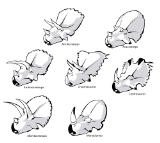
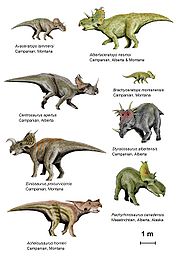
) and are characterized by beaks, rows of shearing teeth in the back of the jaw, and elaborate horns and frills. The group is divided into two subfamilies. The Ceratopsinae or Chasmosaurinae are generally characterized by long, triangular frills and well-developed brow horns. The Centrosaurinae had well-developed nasal horns or nasal bosses, shorter and more rectangular frills, and elaborate spines on the back of the frill.
These horns and frills show remarkable variation and are the principal means by which the various species have been recognized. Their purpose is not entirely clear. Defense against predators is one possible purpose – although the frills are comparatively fragile in many species – but it is more likely that, as in modern ungulates, they may have been secondary sexual characteristics used in displays or for intraspecific combat. The massive bosses on the skulls of Pachyrhinosaurus
and Achelousaurus
resemble those formed by the base of the horns in modern musk oxen, suggesting that they may have butted heads. Centrosaurines have frequently been found in massive bone beds with few other species present, suggesting that the animals might have lived in large herds.
 In 2001 paleontologist Scott D. Sampson
published a study speculating on the socioecology
of ceratopsid dinosaurs in the light of correlations between anatomy and behavior in extant wildlife observed by earlier researchers. Ceratopsid social behavior had been controversial with some authors envisioning large "socially complex" herds represented by bone beds in the fossil record and some like Lehman arguing that such aggregations of individuals amounted to regional infestations as sometimes occurs with modern tortoises and crocodiles.
Sampson argues in favor of complex herding using the socioecology of modern ecological and anatomical ceratopsian analogues. A biologist named Jarman observed among modern ungulates correlations between "ecological variables including feeding style, body size, group size, home range, antipredator behavior, growth pattern, and social organization." He speculated that a taxon's social organization was effected by the distribution of resources through the effect that distribution had on the dispersion of conspecific females throughout the environment. Herding is normal in environments where resources are less predictable, while territoriality tends to evolve in environments with a more consistent distribution of resources. Ceratopsids feature both prominent mating signals (horns and frills) and at least periodic gregarious behaviors. Ceratopsians may have been only social during the dry season and scattered when the rainy season started. Many African herding animals do this today. Ceratopsid bone beds tend to come from more inland environments than other ceratopsian remains. Other workers had concluded that for part of the year ceratopsids lived in small groups near the coasts and when the dry season came they formed large herds and moved inland. This migration away from the coasts may have represented a move to nesting grounds.
Sampson found in previous work that at least centrosaurines did not achieve adult morphology with its accompanying mating signals until nearly fully grown. Relative age of the animals was determined based on the size, degree of coossification, secondary ossification, and growth related changes in bone texture. Sampson finds commonality between the retarded growth of mating signals in centrosaurines and the extended adolescence
of animals whose social structures are ranked hierarchies founded on age-related differences. In these sorts of groups young males are typically sexually mature for several years before actually beginning to breed, when their mating signals are most fully developed. Females, by contrast do not have such an extended adolescence.
Lehman had previously argued that the higher diversities of species and population densities supported the notions that ceratopsid bone beds were left by temporary infestations lacking in social structure like in crocodiles and tortoises. However, Sampson observes that crocodiles themselves actually show complex behavioral hierarchies. He also notes that some modern herding mammals, at least occasionally, form groups denser than those hinted at by ceratopsid bone beds. Herds would also have afforded some level of protection from the chief predators of ceratopsids, tyrannosaurids.
of animals whose social structures are ranked hierarchies founded on age-related differences. In these sorts of groups young males are typically sexually mature for several years before actually beginning to breed, when their mating signals are most fully developed. Females, by contrast do not have such an extended adolescence.
plant material with their highly derived dental batteries. They may have utilized fermentation
to break down plant material with a gut microflora.
modern ecological analogues suggest it would be in their mating signals like horns and frills. No convincing evidence for sexual dimorphism in body size or mating signals is known in ceratopsids, although was present in the more primitive ceratopsian Protoceratops andrewsi whose sexes were distinguishable based on frill and nasal prominence size. This is consistent with other known tetrapod
groups where midsized animals tended to exhibit markedly more sexual dimorphism than larger ones. However, if there were sexually dimorphic traits they may have been soft tissue variations like colorations or dewlaps that would not have been preserved as fossils.
Marginocephalia
Marginocephalia is a clade of ornithischian dinosaurs that includes the thick-skulled pachycephalosaurids, and horned ceratopsians. They were all herbivores, walking on two or four legs, and are characterized by a bony ridge or frill the back of the skull...
n dinosaur
Dinosaur
Dinosaurs are a diverse group of animals of the clade and superorder Dinosauria. They were the dominant terrestrial vertebrates for over 160 million years, from the late Triassic period until the end of the Cretaceous , when the Cretaceous–Paleogene extinction event led to the extinction of...
s including Triceratops
Triceratops
Triceratops is a genus of herbivorous ceratopsid dinosaur which lived during the late Maastrichtian stage of the Late Cretaceous Period, around 68 to 65 million years ago in what is now North America. It was one of the last dinosaur genera to appear before the great Cretaceous–Paleogene...
and Styracosaurus
Styracosaurus
Styracosaurus was a genus of herbivorous ceratopsian dinosaur from the Cretaceous Period , about 76.5 to 75.0 million years ago...
. All known species were quadrupedal herbivores from the Upper Cretaceous
Cretaceous
The Cretaceous , derived from the Latin "creta" , usually abbreviated K for its German translation Kreide , is a geologic period and system from circa to million years ago. In the geologic timescale, the Cretaceous follows the Jurassic period and is followed by the Paleogene period of the...
, mainly of Western North America
North America
North America is a continent wholly within the Northern Hemisphere and almost wholly within the Western Hemisphere. It is also considered a northern subcontinent of the Americas...
(though Turanoceratops
Turanoceratops
Turanoceratops is a genus of ceratopsian dinosaur, possibly a ceratopsid. Its fossil remains were recovered from the Bissekty Formation of Uzbekistan, dating to the late Cretaceous Period about 90 million years ago...
and Sinoceratops
Sinoceratops
Sinoceratops is a genus of ceratopsian dinosaur described by Xu Xing and colleagues in 2010. It lived during the Late Cretaceous in what is now China. The type species is S. zhuchengensis....
are known from Asia
Asia
Asia is the world's largest and most populous continent, located primarily in the eastern and northern hemispheres. It covers 8.7% of the Earth's total surface area and with approximately 3.879 billion people, it hosts 60% of the world's current human population...
) and are characterized by beaks, rows of shearing teeth in the back of the jaw, and elaborate horns and frills. The group is divided into two subfamilies. The Ceratopsinae or Chasmosaurinae are generally characterized by long, triangular frills and well-developed brow horns. The Centrosaurinae had well-developed nasal horns or nasal bosses, shorter and more rectangular frills, and elaborate spines on the back of the frill.
These horns and frills show remarkable variation and are the principal means by which the various species have been recognized. Their purpose is not entirely clear. Defense against predators is one possible purpose – although the frills are comparatively fragile in many species – but it is more likely that, as in modern ungulates, they may have been secondary sexual characteristics used in displays or for intraspecific combat. The massive bosses on the skulls of Pachyrhinosaurus
Pachyrhinosaurus
Pachyrhinosaurus is a genus of ceratopsid dinosaurs from the Late Cretaceous period of North America. The first examples were discovered by Charles M. Sternberg in Alberta, Canada, in 1946, and named in 1950. Over a dozen partial skulls and a large assortment of other fossils from various species...
and Achelousaurus
Achelousaurus
Achelousaurus is a genus of centrosaurine ceratopsid dinosaurs from the Late Cretaceous Period of what is now North America, dated to 74 million years ago...
resemble those formed by the base of the horns in modern musk oxen, suggesting that they may have butted heads. Centrosaurines have frequently been found in massive bone beds with few other species present, suggesting that the animals might have lived in large herds.
Taxonomy
- Family Ceratopsidae
- Subfamily CentrosaurinaeCentrosaurinaeThe Centrosaurinae is a subfamily of ceratopsid dinosaurs named by paleontologist Lawrence Lambe, in 1915, with Centrosaurus as the type genus...
- AchelousaurusAchelousaurusAchelousaurus is a genus of centrosaurine ceratopsid dinosaurs from the Late Cretaceous Period of what is now North America, dated to 74 million years ago...
- (MontanaMontanaMontana is a state in the Western United States. The western third of Montana contains numerous mountain ranges. Smaller, "island ranges" are found in the central third of the state, for a total of 77 named ranges of the Rocky Mountains. This geographical fact is reflected in the state's name,...
, USA) - AlbertaceratopsAlbertaceratopsAlbertaceratops was a genus of centrosaurine horned dinosaur from the middle Campanian-age Upper Cretaceous Oldman Formation of Alberta, Canada....
- (AlbertaAlbertaAlberta is a province of Canada. It had an estimated population of 3.7 million in 2010 making it the most populous of Canada's three prairie provinces...
, Canada & ?Montana, USA) - ? AvaceratopsAvaceratopsAvaceratops is a genus of small ceratopsian dinosaur which lived during the late Campanian during the Late Cretaceous Period in what are now the Northwest United States.-Discoveries and species:...
- (Montana, USA) - BrachyceratopsBrachyceratopsBrachyceratops is a dubious genus of ceratopsian dinosaur known only from partial juvenile specimens dating to the late Cretaceous Period of Montana, United States....
- (Montana, USA & Alberta, Canada) - CentrosaurusCentrosaurusCentrosaurus is a genus of herbivorous ceratopsian dinosaurs from the late Cretaceous of Canada. Their remains have been found in the Dinosaur Park Formation and uppermost Oldman Formation, dating from 76.5 to 75.5 million years ago....
- (Alberta, Canada) - DiabloceratopsDiabloceratopsDiabloceratops is a genus of herbivorous dinosaur in the infraorder Ceratopsia. It lived in and around Utah during the Campanian stage.-Name:...
- (Montana, USA) - EiniosaurusEiniosaurusEiniosaurus is a medium-sized centrosaurine ceratopsian from the Upper Cretaceous of northwestern Montana. The name means 'buffalo lizard', in a combination of Blackfeet Indian and Latinized Ancient Greek; the specific name Einiosaurus is a medium-sized centrosaurine (“short-frilled”)...
- (Montana, USA) - MonocloniusMonocloniusMonoclonius was a ceratopsian dinosaur from the Judith River Formation of Late Cretaceous Montana and Canada. It is often confused with Centrosaurus, a similar genus of ceratopsian . Monoclonius was described by Edward Drinker Cope in 1876...
- (Montana, USA & Alberta, Canada) - PachyrhinosaurusPachyrhinosaurusPachyrhinosaurus is a genus of ceratopsid dinosaurs from the Late Cretaceous period of North America. The first examples were discovered by Charles M. Sternberg in Alberta, Canada, in 1946, and named in 1950. Over a dozen partial skulls and a large assortment of other fossils from various species...
- (Alberta, Canada & AlaskaAlaskaAlaska is the largest state in the United States by area. It is situated in the northwest extremity of the North American continent, with Canada to the east, the Arctic Ocean to the north, and the Pacific Ocean to the west and south, with Russia further west across the Bering Strait...
, USA) - RubeosaurusRubeosaurusRubeosaurus is a genus of ceratopsian dinosaur which lived in what is now North America. Rubeosaurus fossils have been recovered from strata of the upper Two Medicine Formation of the Upper Cretaceous of Montana, dating to between 75 and 74 million years ago...
- (Montana, USA) - SinoceratopsSinoceratopsSinoceratops is a genus of ceratopsian dinosaur described by Xu Xing and colleagues in 2010. It lived during the Late Cretaceous in what is now China. The type species is S. zhuchengensis....
- (ShandongShandong' is a Province located on the eastern coast of the People's Republic of China. Shandong has played a major role in Chinese history from the beginning of Chinese civilization along the lower reaches of the Yellow River and served as a pivotal cultural and religious site for Taoism, Chinese...
, China) - StyracosaurusStyracosaurusStyracosaurus was a genus of herbivorous ceratopsian dinosaur from the Cretaceous Period , about 76.5 to 75.0 million years ago...
- (Alberta, Canada & Montana, USA)
- Achelousaurus
- Subfamily Ceratopsinae
- CeratopsCeratopsCeratops is a dubious genus of ceratopsian dinosaur which lived during the Late Cretaceous. Its fossils have been found in Montana. Although poorly known, Ceratops is important in the history of dinosaurs, since it is the type species for which both Ceratopsia and Ceratopsidae are named...
- (Montana, USA & Alberta, Canada)
- Ceratops
- Subfamily ChasmosaurinaeChasmosaurinaeChasmosaurinae is a subfamily of ceratopsid dinosaurs. Triceratops is a well-known example. They were one of the most successful groups of herbivores of their time. Chasmosaurines appeared in the early Campanian, and became extinct, along with all other non-avian dinosaurs, during the K-T extinction...
- AgathaumasAgathaumasAgathaumas is a dubious genus of a large ceratopsid dinosaur that lived in Wyoming during the Late Cretaceous . The name comes from Greek, αγαν - 'much' and θαυμα - 'wonder'...
- (WyomingWyomingWyoming is a state in the mountain region of the Western United States. The western two thirds of the state is covered mostly with the mountain ranges and rangelands in the foothills of the Eastern Rocky Mountains, while the eastern third of the state is high elevation prairie known as the High...
, USA) - AgujaceratopsAgujaceratopsAgujaceratops is a genus of herbivorous ceratopsian dinosaur. It is a chasmosaurine ceratopsian which lived during the Late Cretaceous period in what is now Texas. Originally known as Chasmosaurus mariscalensis and described by Lehman in 1989, it was moved to a new genus by Lucas, Sullivan and...
- (TexasTexasTexas is the second largest U.S. state by both area and population, and the largest state by area in the contiguous United States.The name, based on the Caddo word "Tejas" meaning "friends" or "allies", was applied by the Spanish to the Caddo themselves and to the region of their settlement in...
, USA) - AnchiceratopsAnchiceratopsAnchiceratops is a genus of chasmosaurine ceratopsid dinosaur from the Late Cretaceous Period of western North America. Like other ceratopsids, it was a quadrupedal herbivore with three horns on its face, a parrot-like beak, and a long frill extending from the back of its head. The two horns above...
- (Alberta, Canada) - ArrhinoceratopsArrhinoceratopsArrhinoceratops is a genus of ceratopsian dinosaur. The name was coined as its original describer concluded it had no nose-horn, however further analysis revealed this not to be the case...
- (Alberta, Canada) - ChasmosaurusChasmosaurusChasmosaurus is a genus of ceratopsid dinosaur from the Upper Cretaceous Period of North America. Its name means 'opening lizard', referring to the large openings in its frill . With a length of and a weight of , Chasmosaurus was a ceratopsian of average size...
- (Alberta, Canada) - CoahuilaceratopsCoahuilaceratopsCoahuilaceratops is a genus of herbivorous ceratopsian dinosaur. It is a chasmosaurine ceratopsian which lived during the Late Cretaceous period in what is now southern Coahuila in northern Mexico. It is known from the holotype CPC 276, a partial skeleton of an adult individual which...
- (CoahuilaCoahuilaCoahuila, formally Coahuila de Zaragoza , officially Estado Libre y Soberano de Coahuila de Zaragoza is one of the 31 states which, with the Federal District, comprise the 32 Federal Entities of Mexico...
, Mexico) - ? DysganusDysganusDysganus is the name given to a dubious genus of dinosaur from the Late Cretaceous. It was a ceratopsian. Its fossils have been found in Montana....
- (Montana, USA) - KosmoceratopsKosmoceratopsKosmoceratops is a genus of herbivorous chasmosaurine ceratopsian dinosaur, which lived during the Late Cretaceous period in the part of the island continent Laramidia that is now Utah, United States...
- (UtahUtahUtah is a state in the Western United States. It was the 45th state to join the Union, on January 4, 1896. Approximately 80% of Utah's 2,763,885 people live along the Wasatch Front, centering on Salt Lake City. This leaves vast expanses of the state nearly uninhabited, making the population the...
, USA) - MedusaceratopsMedusaceratopsMedusaceratops is a genus of herbivorous ceratopsian dinosaur. It is a chasmosaurine ceratopsian which lived during the Late Cretaceous period in what is now Montana. It is known from two partial parietals, the holotype WDC DJR 001 and the paratype WDC DJR 002...
- (Montana, USA) - MojoceratopsMojoceratopsMojoceratops is a genus of ceratopsian dinosaur. It is a chasmosaurine ceratopsian which lived during the Late Cretaceous period in what is now Western Canada...
- (Alberta & SaskatchewanSaskatchewanSaskatchewan is a prairie province in Canada, which has an area of . Saskatchewan is bordered on the west by Alberta, on the north by the Northwest Territories, on the east by Manitoba, and on the south by the U.S. states of Montana and North Dakota....
, Canada) - PentaceratopsPentaceratopsPentaceratops is a genus of ceratopsid dinosaur from the late Cretaceous Period of what is now North America. The appearance of Pentaceratops sternbergii in the fossil record marks the end of the Judithian land vertebrate age and the start of the Kirtlandian...
- (New Mexico, USA) - ? PolyonaxPolyonaxPolyonax was a genus of ceratopsid dinosaur from the late Maastrichtian-age Upper Cretaceous Denver Formation of Colorado, USA...
- (Colorado, USA) - ? TuranoceratopsTuranoceratopsTuranoceratops is a genus of ceratopsian dinosaur, possibly a ceratopsid. Its fossil remains were recovered from the Bissekty Formation of Uzbekistan, dating to the late Cretaceous Period about 90 million years ago...
- (UzbekistanUzbekistanUzbekistan , officially the Republic of Uzbekistan is a doubly landlocked country in Central Asia and one of the six independent Turkic states. It shares borders with Kazakhstan to the west and to the north, Kyrgyzstan and Tajikistan to the east, and Afghanistan and Turkmenistan to the south....
) - UtahceratopsUtahceratopsUtahceratops is a genus of herbivorous ceratopsian dinosaur. It is a chasmosaurine ceratopsian which lived during the Late Cretaceous period in what is now Utah. Its fossils have been recovered from the Kaiparowits Formation. It was first named by Scott D. Sampson, Mark A. Loewen, Andrew A....
- (Utah, USA) - VagaceratopsVagaceratopsVagaceratops is a genus of herbivorous ceratopsian dinosaur. It is a chasmosaurine ceratopsian which lived during the Late Cretaceous period in what is now Alberta. Its fossils have been recovered from the Upper Dinosaur Park Formation...
- (Alberta, Canada) - Tribe Triceratopsini
- EotriceratopsEotriceratopsEotriceratops is a genus of ceratopsian dinosaur which lived during the late Cretaceous period. Its fossils have been found in the uppermost Horseshoe Canyon Formation, dating to about 67.6 million years ago. Its skull is reported to have been around 3 metres long...
- (Alberta, Canada) - OjoceratopsOjoceratopsOjoceratops is a genus of ceratopsian dinosaur which lived in what is now New Mexico. Ojoceratops fossils have been recovered from strata of the Ojo Alamo Formation , dating to the late Cretaceous period . The type species is Ojoceratops fowleri...
- (New MexicoNew MexicoNew Mexico is a state located in the southwest and western regions of the United States. New Mexico is also usually considered one of the Mountain States. With a population density of 16 per square mile, New Mexico is the sixth-most sparsely inhabited U.S...
, USA) - TatankaceratopsTatankaceratopsTatankaceratops is a controversial genus of herbivorous ceratopsian dinosaur. It is a small chasmosaurine ceratopsian which lived during the Late Cretaceous period in what is now South Dakota. It is known from a single partial skull which was collected from the Hell Creek Formation, dating to...
- (South DakotaSouth DakotaSouth Dakota is a state located in the Midwestern region of the United States. It is named after the Lakota and Dakota Sioux American Indian tribes. Once a part of Dakota Territory, South Dakota became a state on November 2, 1889. The state has an area of and an estimated population of just over...
, USA) - TitanoceratopsTitanoceratopsTitanoceratops is a genus of herbivorous ceratopsian dinosaur. It was a giant chasmosaurine ceratopsian which lived during the Late Cretaceous period in what is now New Mexico, and the earliest known triceratopsin. It is known from the holotype OMNH 10165, a partial skeleton including...
- (New Mexico, USA) - TorosaurusTorosaurusTorosaurus is a genus of ceratopsid dinosaur that lived during the late Cretaceous period , between 70 and 65 million years ago. It possessed one of the largest skulls of any known land animal. The frilled skull reached in length...
- (Wyoming, Montana, South Dakota, North DakotaNorth DakotaNorth Dakota is a state located in the Midwestern region of the United States of America, along the Canadian border. The state is bordered by Canada to the north, Minnesota to the east, South Dakota to the south and Montana to the west. North Dakota is the 19th-largest state by area in the U.S....
, & Utah, USA & Saskatchewan, Canada) - TriceratopsTriceratopsTriceratops is a genus of herbivorous ceratopsid dinosaur which lived during the late Maastrichtian stage of the Late Cretaceous Period, around 68 to 65 million years ago in what is now North America. It was one of the last dinosaur genera to appear before the great Cretaceous–Paleogene...
- (Montana & Wyoming, USA & Saskatchewan & Alberta, Canada)
- Eotriceratops
- Agathaumas
- Subfamily Centrosaurinae
Social behavior
Scott D. Sampson
Scott D. Sampson is a paleontologist and chief curator of the Utah Museum of Natural History. Sampson is notable for his work on the carnivorous theropod dinosaurs Majungasaurus and Masiakasaurus and his extensive research into the Late Cretaceous Period, particularly in...
published a study speculating on the socioecology
Socioecology
Socioecology is the scientific study of how social structure and organization are influenced by organisms' environment. Socioecology is related to sociology, the study of society, and ecology, the study of the interaction between organisms and their environment.Socioecology tends to focus on...
of ceratopsid dinosaurs in the light of correlations between anatomy and behavior in extant wildlife observed by earlier researchers. Ceratopsid social behavior had been controversial with some authors envisioning large "socially complex" herds represented by bone beds in the fossil record and some like Lehman arguing that such aggregations of individuals amounted to regional infestations as sometimes occurs with modern tortoises and crocodiles.
Sampson argues in favor of complex herding using the socioecology of modern ecological and anatomical ceratopsian analogues. A biologist named Jarman observed among modern ungulates correlations between "ecological variables including feeding style, body size, group size, home range, antipredator behavior, growth pattern, and social organization." He speculated that a taxon's social organization was effected by the distribution of resources through the effect that distribution had on the dispersion of conspecific females throughout the environment. Herding is normal in environments where resources are less predictable, while territoriality tends to evolve in environments with a more consistent distribution of resources. Ceratopsids feature both prominent mating signals (horns and frills) and at least periodic gregarious behaviors. Ceratopsians may have been only social during the dry season and scattered when the rainy season started. Many African herding animals do this today. Ceratopsid bone beds tend to come from more inland environments than other ceratopsian remains. Other workers had concluded that for part of the year ceratopsids lived in small groups near the coasts and when the dry season came they formed large herds and moved inland. This migration away from the coasts may have represented a move to nesting grounds.
Sampson found in previous work that at least centrosaurines did not achieve adult morphology with its accompanying mating signals until nearly fully grown. Relative age of the animals was determined based on the size, degree of coossification, secondary ossification, and growth related changes in bone texture. Sampson finds commonality between the retarded growth of mating signals in centrosaurines and the extended adolescence
Adolescence
Adolescence is a transitional stage of physical and mental human development generally occurring between puberty and legal adulthood , but largely characterized as beginning and ending with the teenage stage...
of animals whose social structures are ranked hierarchies founded on age-related differences. In these sorts of groups young males are typically sexually mature for several years before actually beginning to breed, when their mating signals are most fully developed. Females, by contrast do not have such an extended adolescence.
Lehman had previously argued that the higher diversities of species and population densities supported the notions that ceratopsid bone beds were left by temporary infestations lacking in social structure like in crocodiles and tortoises. However, Sampson observes that crocodiles themselves actually show complex behavioral hierarchies. He also notes that some modern herding mammals, at least occasionally, form groups denser than those hinted at by ceratopsid bone beds. Herds would also have afforded some level of protection from the chief predators of ceratopsids, tyrannosaurids.
Migration
Some paleontologists have concluded that for part of the year ceratopsids lived in small groups near the coasts and when the dry season came they formed large herds and moved inland. This migration away from the coasts may have represented a move to nesting grounds.Development
Sampson found in previous work that at least centrosaurines did not achieve adult morphology with its accompanying mating signals until nearly fully grown. Relative age of the animals was determined based on the size, degree of coossification, secondary ossification, and growth related changes in bone texture. Sampson finds commonality between the retarded growth of mating signals in centrosaurines and the extended adolescenceAdolescence
Adolescence is a transitional stage of physical and mental human development generally occurring between puberty and legal adulthood , but largely characterized as beginning and ending with the teenage stage...
of animals whose social structures are ranked hierarchies founded on age-related differences. In these sorts of groups young males are typically sexually mature for several years before actually beginning to breed, when their mating signals are most fully developed. Females, by contrast do not have such an extended adolescence.
Diet
Ceratopsids were adapted to processing high-fiberFiber
Fiber is a class of materials that are continuous filaments or are in discrete elongated pieces, similar to lengths of thread.They are very important in the biology of both plants and animals, for holding tissues together....
plant material with their highly derived dental batteries. They may have utilized fermentation
Fermentation (biochemistry)
Fermentation is the process of extracting energy from the oxidation of organic compounds, such as carbohydrates, using an endogenous electron acceptor, which is usually an organic compound. In contrast, respiration is where electrons are donated to an exogenous electron acceptor, such as oxygen,...
to break down plant material with a gut microflora.
Physiology
Ceratopsians probably had the "low mass-specific metabolic rat[e]" typical of large bodied animals.Sexual dimorphism
If ceratopsids were to have sexual dimorphismSexual dimorphism
Sexual dimorphism is a phenotypic difference between males and females of the same species. Examples of such differences include differences in morphology, ornamentation, and behavior.-Examples:-Ornamentation / coloration:...
modern ecological analogues suggest it would be in their mating signals like horns and frills. No convincing evidence for sexual dimorphism in body size or mating signals is known in ceratopsids, although was present in the more primitive ceratopsian Protoceratops andrewsi whose sexes were distinguishable based on frill and nasal prominence size. This is consistent with other known tetrapod
Tetrapod
Tetrapods are vertebrate animals having four limbs. Amphibians, reptiles, birds and mammals are all tetrapods; even snakes and other limbless reptiles and amphibians are tetrapods by descent. The earliest tetrapods evolved from the lobe-finned fishes in the Devonian...
groups where midsized animals tended to exhibit markedly more sexual dimorphism than larger ones. However, if there were sexually dimorphic traits they may have been soft tissue variations like colorations or dewlaps that would not have been preserved as fossils.
Reproduction
Some paleontologists have concluded that for part of the year ceratopsids lived in small groups near the coasts and when the dry season came they formed large herds and moved inland. This migration away from the coasts may have represented a move to nesting grounds. Centrosaurines may have participated in social structures with ranked hierarchies founded on age-related differences. If so, young male centrosaurines would probably be sexually mature for several years before actually beginning to breed, when their mating signals are most fully developed. Females, by contrast do not have such an extended adolescence.Evolution
The evolution of ceratopsid dinosaur shares characteristics with the evolution of some mammal groups, both were "geologically brief" events precipitating the simultaneous evolution of large body size, derived feeding structures, and "varied hornlike organs."Bone beds
Ceratopsid bone beds tend to come from more inland environments than other ceratopsian remains. Lehman had previously argued that the higher diversities of species and population densities supported the notions that ceratopsid bone beds were left by temporary infestations lacking in social structure like in crocodiles and tortoises. However, Sampson observes that crocodiles themselves actually show complex behavioral hierarchies. He also notes that some modern herding mammals, at least occasionally, form groups denser than those hinted at by ceratopsid bone beds. Herds would also have afforded some level of protection from the chief predators of ceratopsids, tyrannosaurids.External links
- Ceratopidae at DinoData