


Late Cretaceous

Encyclopedia
The Late Cretaceous is the younger of two epochs
into which the Cretaceous
period is divided in the geologic timescale. Rock strata from this epoch form the Upper Cretaceous series
. The Cretaceous is named after the white limestone known as chalk
which occurs widely in northern France and is famously seen in the white cliffs of south-eastern England, and which dates from this time.
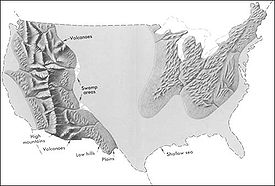 Due to plate tectonics, the Americas were gradually moving westward, causing the Atlantic Ocean to expand. The Western Interior Seaway
divided North America into eastern and western halves; Appalachia
and Laramidia
. India maintained a northward course towards Asia. In the southern hemisphere, Australia and Antarctica seem to have remained connected and began to drift away from Africa and South America. Europe, interestingly, was an island chain. Populating some of these islands were endemic dwarf
dinosaur species.
s, with many new types appearing and diversifying. The duck bills, Ankylosauridae
, and horned dinosaurs
experienced success in Asiamerica
(Western North America and eastern Asia). Tyrannosaurs dominated the large predator niche in North America. They were also present in Asia, although were usually smaller and more primitive than the North American varieties. Pachycephalosaurs were also present in both North America and Asia. Dromaeosaurs shared the same geographical distribution, and are well documented in both Mongolia and Western North America. By contrast Therizinosaurs (known previously as segnosaurs) appear to have been living solely in Asia. Gondwanaland held a very different dinosaurian fauna, with most predators being Abelisaurs and Titanosaurs being among the dominant herbivores.
s which retreated to increasingly specialised ecological niches.
marsupial
s and primitive placental mammal
s also became common. Still, mammals remained small.
s suddenly appeared and underwent a spectacular evolutionary radiation. Modern sharks also appeared and giant-penguin-like polycotylid
pliosaur
s (3 meters long) and huge long-necked elasmosaurs
(13 meters long) also diversified. These predators fed on the numerous teleost fishes, which in turn evolved into new advanced and modern forms (Neoteleostei). Ichthyosaur
s on the other hand, went extinct.
of animal and plant species in a geologically short period of time, approximately (Ma). It is widely known as the K–T extinction event and is associated with a geological signature, usually a thin band dated to that time and found in various parts of the world, known as the K–T boundary
. K is the traditional abbreviation for the Cretaceous
Period derived from the German name Kreidezeit, and T is the abbreviation for the Tertiary
Period (a historical term for the period of time now covered by the Paleogene
and Neogene
periods). The event marks the end of the Mesozoic
Era and the beginning of the Cenozoic
Era. "Tertiary" being no longer recognized as a formal time or rock unit by the International Commission on Stratigraphy
, the K-T event is now called the Cretaceous—Paleogene (or K-Pg) extinction event by many researchers.
Non-avian
dinosaur
fossils are only found below the K–T boundary and became extinct immediately before or during the event. A very small number of dinosaur fossils have been found above the K–T boundary, but they have been explained as reworked fossils, that is, fossils that have been eroded from their original locations then preserved in later sedimentary layers. Mosasaur
s, plesiosaur
s, pterosaur
s and many species
of plants and invertebrate
s also became extinct. Mammalian and bird clade
s passed through the boundary with few extinctions, and evolutionary radiation
from those Maastrichtian
clades occurred well past the boundary. Rates of extinction and radiation varied across different clades of organisms.
Scientists have hypothesized that the K–T extinctions were caused by one or more catastrophic events such as massive asteroid impacts
or increased volcanic activity
. Several impact craters and massive volcanic activity in the Deccan traps
have been dated to the approximate time of the extinction event. These geological events may have reduced sunlight and hindered photosynthesis
, leading to a massive disruption in Earth's ecology
. Other researchers believe the extinction was more gradual, resulting from slower changes in sea level
or climate
.
Epoch (geology)
An epoch is a subdivision of the geologic timescale based on rock layering. In order, the higher subdivisions are periods, eras and eons. We are currently living in the Holocene epoch...
into which the Cretaceous
Cretaceous
The Cretaceous , derived from the Latin "creta" , usually abbreviated K for its German translation Kreide , is a geologic period and system from circa to million years ago. In the geologic timescale, the Cretaceous follows the Jurassic period and is followed by the Paleogene period of the...
period is divided in the geologic timescale. Rock strata from this epoch form the Upper Cretaceous series
Series (stratigraphy)
Series are subdivisions of rock layers made based on the age of the rock and corresponding to the dating system unit called an epoch, both being formally defined international conventions of the geological timescale. A series is therefore a sequence of rock depositions defining a...
. The Cretaceous is named after the white limestone known as chalk
Chalk
Chalk is a soft, white, porous sedimentary rock, a form of limestone composed of the mineral calcite. Calcite is calcium carbonate or CaCO3. It forms under reasonably deep marine conditions from the gradual accumulation of minute calcite plates shed from micro-organisms called coccolithophores....
which occurs widely in northern France and is famously seen in the white cliffs of south-eastern England, and which dates from this time.
Climate
During the Late Cretaceous, the climate was warmer than present, although throughout the period a cooling trend is evident. The tropics became restricted to equatorial regions and northern latitudes experienced markedly more seasonal climatic conditions.Geography
Western Interior Seaway
The Western Interior Seaway, also called the Cretaceous Seaway, the Niobraran Sea, and the North American Inland Sea, was a huge inland sea that split the continent of North America into two halves, Laramidia and Appalachia, during most of the mid- and late-Cretaceous Period...
divided North America into eastern and western halves; Appalachia
Appalachia (Mesozoic)
In the Mesozoic Era, Appalachia was a land area which is now an eastern part of the USA and Canada, separated from Laramidia by the Western Interior Seaway, which shrank, divided across the Dakotas, retreated south towards the Gulf of Mexico and finally dried up.-Fauna:From the Turonian age of the...
and Laramidia
Laramidia
Laramidia is a name coined by J. David Archibald in 1996 to describe an island continent that existed during the Late Cretaceous period, when the Western Interior Seaway split the continent of North America in two. Two landmasses existed: the eastern one is called Appalachia; Laramidia is the name...
. India maintained a northward course towards Asia. In the southern hemisphere, Australia and Antarctica seem to have remained connected and began to drift away from Africa and South America. Europe, interestingly, was an island chain. Populating some of these islands were endemic dwarf
Insular dwarfism
Insular dwarfism, a form of phyletic dwarfism, is the process and condition of the reduction in size of large animals – typically mammals – when their population's range is limited to a small environment, primarily islands. This natural process is distinct from the intentional creation of dwarf...
dinosaur species.
Dinosaurs
This was a period of great success for dinosaurDinosaur
Dinosaurs are a diverse group of animals of the clade and superorder Dinosauria. They were the dominant terrestrial vertebrates for over 160 million years, from the late Triassic period until the end of the Cretaceous , when the Cretaceous–Paleogene extinction event led to the extinction of...
s, with many new types appearing and diversifying. The duck bills, Ankylosauridae
Ankylosauridae
An ankylosaurid is a member of the Ankylosauridae family of armored dinosaurs that evolved 125 million years ago and became extinct 65 million years ago during the Cretaceous-Tertiary extinction event...
, and horned dinosaurs
Ceratopsidae
Ceratopsidae is a speciose group of marginocephalian dinosaurs including Triceratops and Styracosaurus...
experienced success in Asiamerica
Asiamerica
Asiamerica was a large island formed from the Laurasian landmass and separated by shallow continental seas from Eurasia to the West and eastern North America to the East. This region incorporated what are now China, Mongolia, western USA and western Canada. Fossil evidence tells us that it was home...
(Western North America and eastern Asia). Tyrannosaurs dominated the large predator niche in North America. They were also present in Asia, although were usually smaller and more primitive than the North American varieties. Pachycephalosaurs were also present in both North America and Asia. Dromaeosaurs shared the same geographical distribution, and are well documented in both Mongolia and Western North America. By contrast Therizinosaurs (known previously as segnosaurs) appear to have been living solely in Asia. Gondwanaland held a very different dinosaurian fauna, with most predators being Abelisaurs and Titanosaurs being among the dominant herbivores.
Birds
Birds became increasingly common and diverse, replacing the pterosaurPterosaur
Pterosaurs were flying reptiles of the clade or order Pterosauria. They existed from the late Triassic to the end of the Cretaceous Period . Pterosaurs are the earliest vertebrates known to have evolved powered flight...
s which retreated to increasingly specialised ecological niches.
Mammals
DidelphidDidelphimorphia
Opossums make up the largest order of marsupials in the Western Hemisphere, including 103 or more species in 19 genera. They are also commonly called possums, though that term technically refers to Australian fauna of the suborder Phalangeriformes. The Virginia opossum was the first animal to be...
marsupial
Marsupial
Marsupials are an infraclass of mammals, characterized by giving birth to relatively undeveloped young. Close to 70% of the 334 extant species occur in Australia, New Guinea, and nearby islands, with the remaining 100 found in the Americas, primarily in South America, but with thirteen in Central...
s and primitive placental mammal
Mammal
Mammals are members of a class of air-breathing vertebrate animals characterised by the possession of endothermy, hair, three middle ear bones, and mammary glands functional in mothers with young...
s also became common. Still, mammals remained small.
Marine life
In the seas, mosasaurMosasaur
Mosasaurs are large extinct marine lizards. The first fossil remains were discovered in a limestone quarry at Maastricht on the Meuse in 1764...
s suddenly appeared and underwent a spectacular evolutionary radiation. Modern sharks also appeared and giant-penguin-like polycotylid
Polycotylidae
Polycotylidae is a family of plesiosaurs from the Cretaceous, a sister group to the Leptocleididae.With their short necks and large elongated heads, they resemble the pliosaurs, but closer phylogenetical studies indicate that they share many common features with the plesiosauridae and elasmosauridae...
pliosaur
Pliosaur
Pliosauroidea is an extinct clade of marine reptiles. Pliosauroids, also commonly known as pliosaurs, are known from the Jurassic and Cretaceous Periods. The pliosauroids were short-necked plesiosaurs with large heads and massive toothed jaws. These swimming reptiles were not dinosaurs but distant...
s (3 meters long) and huge long-necked elasmosaurs
Elasmosauridae
Elasmosauridae was the family of plesiosaurs. They had the longest necks of the plesiosaurs and survived from the Late Triassic to the end of the Cretaceous. They had a diet of fish and shelless cephalopods.-Size:...
(13 meters long) also diversified. These predators fed on the numerous teleost fishes, which in turn evolved into new advanced and modern forms (Neoteleostei). Ichthyosaur
Ichthyosaur
Ichthyosaurs were giant marine reptiles that resembled fish and dolphins...
s on the other hand, went extinct.
Flora
In Cretaceous temperate regions, familiar plants like magnolias, sassafras, roses, redwoods, and willows could be found in abundance.KT mass extinction
The Cretaceous–Tertiary extinction event was a large-scale mass extinctionExtinction event
An extinction event is a sharp decrease in the diversity and abundance of macroscopic life. They occur when the rate of extinction increases with respect to the rate of speciation...
of animal and plant species in a geologically short period of time, approximately (Ma). It is widely known as the K–T extinction event and is associated with a geological signature, usually a thin band dated to that time and found in various parts of the world, known as the K–T boundary
K–T boundary
The K–T boundary is a geological signature, usually a thin band, dated to 65.5 ± 0.3 Ma ago. K is the traditional abbreviation for the Cretaceous period, and T is the abbreviation for the Tertiary period...
. K is the traditional abbreviation for the Cretaceous
Cretaceous
The Cretaceous , derived from the Latin "creta" , usually abbreviated K for its German translation Kreide , is a geologic period and system from circa to million years ago. In the geologic timescale, the Cretaceous follows the Jurassic period and is followed by the Paleogene period of the...
Period derived from the German name Kreidezeit, and T is the abbreviation for the Tertiary
Tertiary
The Tertiary is a deprecated term for a geologic period 65 million to 2.6 million years ago. The Tertiary covered the time span between the superseded Secondary period and the Quaternary...
Period (a historical term for the period of time now covered by the Paleogene
Paleogene
The Paleogene is a geologic period and system that began 65.5 ± 0.3 and ended 23.03 ± 0.05 million years ago and comprises the first part of the Cenozoic Era...
and Neogene
Neogene
The Neogene is a geologic period and system in the International Commission on Stratigraphy Geologic Timescale starting 23.03 ± 0.05 million years ago and ending 2.588 million years ago...
periods). The event marks the end of the Mesozoic
Mesozoic
The Mesozoic era is an interval of geological time from about 250 million years ago to about 65 million years ago. It is often referred to as the age of reptiles because reptiles, namely dinosaurs, were the dominant terrestrial and marine vertebrates of the time...
Era and the beginning of the Cenozoic
Cenozoic
The Cenozoic era is the current and most recent of the three Phanerozoic geological eras and covers the period from 65.5 mya to the present. The era began in the wake of the Cretaceous–Tertiary extinction event at the end of the Cretaceous that saw the demise of the last non-avian dinosaurs and...
Era. "Tertiary" being no longer recognized as a formal time or rock unit by the International Commission on Stratigraphy
International Commission on Stratigraphy
The International Commission on Stratigraphy , sometimes referred to by the unofficial "International Stratigraphic Commission" is a daughter or major subcommittee grade scientific daughter organization that concerns itself with stratigraphy, geological, and geochronological matters on a global...
, the K-T event is now called the Cretaceous—Paleogene (or K-Pg) extinction event by many researchers.
Non-avian
Bird
Birds are feathered, winged, bipedal, endothermic , egg-laying, vertebrate animals. Around 10,000 living species and 188 families makes them the most speciose class of tetrapod vertebrates. They inhabit ecosystems across the globe, from the Arctic to the Antarctic. Extant birds range in size from...
dinosaur
Dinosaur
Dinosaurs are a diverse group of animals of the clade and superorder Dinosauria. They were the dominant terrestrial vertebrates for over 160 million years, from the late Triassic period until the end of the Cretaceous , when the Cretaceous–Paleogene extinction event led to the extinction of...
fossils are only found below the K–T boundary and became extinct immediately before or during the event. A very small number of dinosaur fossils have been found above the K–T boundary, but they have been explained as reworked fossils, that is, fossils that have been eroded from their original locations then preserved in later sedimentary layers. Mosasaur
Mosasaur
Mosasaurs are large extinct marine lizards. The first fossil remains were discovered in a limestone quarry at Maastricht on the Meuse in 1764...
s, plesiosaur
Plesiosaur
Plesiosauroidea is an extinct clade of carnivorous plesiosaur marine reptiles. Plesiosauroids, are known from the Jurassic and Cretaceous Periods...
s, pterosaur
Pterosaur
Pterosaurs were flying reptiles of the clade or order Pterosauria. They existed from the late Triassic to the end of the Cretaceous Period . Pterosaurs are the earliest vertebrates known to have evolved powered flight...
s and many species
Species
In biology, a species is one of the basic units of biological classification and a taxonomic rank. A species is often defined as a group of organisms capable of interbreeding and producing fertile offspring. While in many cases this definition is adequate, more precise or differing measures are...
of plants and invertebrate
Invertebrate
An invertebrate is an animal without a backbone. The group includes 97% of all animal species – all animals except those in the chordate subphylum Vertebrata .Invertebrates form a paraphyletic group...
s also became extinct. Mammalian and bird clade
Clade
A clade is a group consisting of a species and all its descendants. In the terms of biological systematics, a clade is a single "branch" on the "tree of life". The idea that such a "natural group" of organisms should be grouped together and given a taxonomic name is central to biological...
s passed through the boundary with few extinctions, and evolutionary radiation
Evolutionary radiation
An evolutionary radiation is an increase in taxonomic diversity or morphological disparity, due to adaptive change or the opening of ecospace. Radiations may affect one clade or many, and be rapid or gradual; where they are rapid, and driven by a single lineage's adaptation to their environment,...
from those Maastrichtian
Maastrichtian
The Maastrichtian is, in the ICS' geologic timescale, the latest age or upper stage of the Late Cretaceous epoch or Upper Cretaceous series, the Cretaceous period or system, and of the Mesozoic era or erathem. It spanned from 70.6 ± 0.6 Ma to 65.5 ± 0.3 Ma...
clades occurred well past the boundary. Rates of extinction and radiation varied across different clades of organisms.
Scientists have hypothesized that the K–T extinctions were caused by one or more catastrophic events such as massive asteroid impacts
Impact event
An impact event is the collision of a large meteorite, asteroid, comet, or other celestial object with the Earth or another planet. Throughout recorded history, hundreds of minor impact events have been reported, with some occurrences causing deaths, injuries, property damage or other significant...
or increased volcanic activity
Volcano
2. Bedrock3. Conduit 4. Base5. Sill6. Dike7. Layers of ash emitted by the volcano8. Flank| 9. Layers of lava emitted by the volcano10. Throat11. Parasitic cone12. Lava flow13. Vent14. Crater15...
. Several impact craters and massive volcanic activity in the Deccan traps
Deccan Traps
The Deccan Traps are a large igneous province located on the Deccan Plateau of west-central India and one of the largest volcanic features on Earth. They consist of multiple layers of solidified flood basalt that together are more than thick and cover an area of and a volume of...
have been dated to the approximate time of the extinction event. These geological events may have reduced sunlight and hindered photosynthesis
Photosynthesis
Photosynthesis is a chemical process that converts carbon dioxide into organic compounds, especially sugars, using the energy from sunlight. Photosynthesis occurs in plants, algae, and many species of bacteria, but not in archaea. Photosynthetic organisms are called photoautotrophs, since they can...
, leading to a massive disruption in Earth's ecology
Ecology
Ecology is the scientific study of the relations that living organisms have with respect to each other and their natural environment. Variables of interest to ecologists include the composition, distribution, amount , number, and changing states of organisms within and among ecosystems...
. Other researchers believe the extinction was more gradual, resulting from slower changes in sea level
Sea level
Mean sea level is a measure of the average height of the ocean's surface ; used as a standard in reckoning land elevation...
or climate
Climate
Climate encompasses the statistics of temperature, humidity, atmospheric pressure, wind, rainfall, atmospheric particle count and other meteorological elemental measurements in a given region over long periods...
.
See also
- Flora and fauna of the Maastrichtian stageFlora and fauna of the Maastrichtian stageThis is an incomplete list that briefly describes vertebrates that were extant during the Maastrichtian, a stage of the Late Cretaceous Period which extended from 70.6 to 65.5 million years before present...