


Patriarch of Venice

Encyclopedia
Ordinary
In those hierarchically organised churches of Western Christianity which have an ecclesiastical law system, an ordinary is an officer of the church who by reason of office has ordinary power to execute the church's laws...
bishop of the Roman Catholic Archdiocese of Venice
Roman Catholic Archdiocese of Venice
The Roman Catholic Archdiocese of Venice is an archdiocese of the Latin Rite of the Roman Catholic church in Italy.The ordinary of the archdiocese is the Patriarch of Venice, who is traditionally created a cardinal in consistory by the Pope...
. The bishop is one of the few Patriarch
Patriarch
Originally a patriarch was a man who exercised autocratic authority as a pater familias over an extended family. The system of such rule of families by senior males is called patriarchy. This is a Greek word, a compound of πατριά , "lineage, descent", esp...
s in the Latin Rite of the Roman Catholic Church (currently five Latin sees, including the Diocese of Rome
Diocese of Rome
The Diocese of Rome is a diocese of the Catholic Church in Rome, Italy. The bishop of Rome is the Pope, who is the Supreme Pontiff and leader of the Catholic Church...
itself, are accorded the title of Patriarchate, together with Lisbon
Patriarch of Lisbon
The Patriarch of Lisbon is an honorary title possessed by the archbishop of the Archdiocese of Lisbon.The first patriarch of Lisbon was D. Tomás de Almeida, who was appointed in 1716 by Pope Clement XI...
, the East Indies
Patriarch of the East Indies
The Titular Patriarch of the East Indies in the Catholic hierarchy is the title of the Archbishop of Goa and Damão in India; another title of his is that of the Primate of the East. Unlike the patriarchs of the Eastern Catholic Churches sui juris, the Patriarch of the East Indies enjoys a purely...
and Jerusalem
Latin Patriarch of Jerusalem
The Latin Patriarch of Jerusalem is the title possessed by the Latin Rite Catholic Archbishop of Jerusalem. The Archdiocese of Jerusalem has jurisdiction for all Latin Rite Catholics in Israel, the Palestinian Territories, Jordan and Cyprus...
). Currently, the only advantage of this purely formal title is the bishop
Bishop
A bishop is an ordained or consecrated member of the Christian clergy who is generally entrusted with a position of authority and oversight. Within the Catholic Church, Eastern Orthodox, Oriental Orthodox Churches, in the Assyrian Church of the East, in the Independent Catholic Churches, and in the...
's place of honor in papal procession
Procession
A procession is an organized body of people advancing in a formal or ceremonial manner.-Procession elements:...
s.
The diocese of Venice
Venice
Venice is a city in northern Italy which is renowned for the beauty of its setting, its architecture and its artworks. It is the capital of the Veneto region...
was created in 774 as suffragan
Suffragan bishop
A suffragan bishop is a bishop subordinate to a metropolitan bishop or diocesan bishop. He or she may be assigned to an area which does not have a cathedral of its own.-Anglican Communion:...
of the Patriarchate of Grado
Patriarch of Grado
This is a list of the Patriarchs of Grado . The patriarchate came into being when the schismatic Patriarch of Aquileia, Paulinus , moved to Grado in the mid 6th century. But in their reunion with Rome in 606, a rival office was set up in Old-Aquileia. Aquileia later entered communion with Rome but...
. It was only in 1457 that, in consideration of the political influence of the city, its bishop
Bishop
A bishop is an ordained or consecrated member of the Christian clergy who is generally entrusted with a position of authority and oversight. Within the Catholic Church, Eastern Orthodox, Oriental Orthodox Churches, in the Assyrian Church of the East, in the Independent Catholic Churches, and in the...
s were accorded the title of patriarch by the Pope
Pope
The Pope is the Bishop of Rome, a position that makes him the leader of the worldwide Catholic Church . In the Catholic Church, the Pope is regarded as the successor of Saint Peter, the Apostle...
.
By tradition, the Patriarch of Venice is created a cardinal
Cardinal (Catholicism)
A cardinal is a senior ecclesiastical official, usually an ordained bishop, and ecclesiastical prince of the Catholic Church. They are collectively known as the College of Cardinals, which as a body elects a new pope. The duties of the cardinals include attending the meetings of the College and...
at the consistory
Consistory
-Antiquity:Originally, the Latin word consistorium meant simply 'sitting together', just as the Greek synedrion ....
following his appointment, although the Pope
Pope
The Pope is the Bishop of Rome, a position that makes him the leader of the worldwide Catholic Church . In the Catholic Church, the Pope is regarded as the successor of Saint Peter, the Apostle...
is not bound by law to do so. A large number of the prelates holding this office have been elected Pope. Three of these were in the 20th century alone: Pope Pius X
Pope Pius X
Pope Saint Pius X , born Giuseppe Melchiorre Sarto, was the 257th Pope of the Catholic Church, serving from 1903 to 1914. He was the first pope since Pope Pius V to be canonized. Pius X rejected modernist interpretations of Catholic doctrine, promoting traditional devotional practices and orthodox...
(1903), Pope John XXIII
Pope John XXIII
-Papal election:Following the death of Pope Pius XII in 1958, Roncalli was elected Pope, to his great surprise. He had even arrived in the Vatican with a return train ticket to Venice. Many had considered Giovanni Battista Montini, Archbishop of Milan, a possible candidate, but, although archbishop...
(1958) and Pope John Paul I
Pope John Paul I
John Paul I , born Albino Luciani, , reigned as Pope of the Catholic Church and as Sovereign of Vatican City from 26 August 1978 until his death 33 days later. His reign is among the shortest in papal history, resulting in the most recent Year of Three Popes...
(1978).
Ecclesiastical history
Early history
- For the earlier history of this title, see also Patriarch of GradoPatriarch of GradoThis is a list of the Patriarchs of Grado . The patriarchate came into being when the schismatic Patriarch of Aquileia, Paulinus , moved to Grado in the mid 6th century. But in their reunion with Rome in 606, a rival office was set up in Old-Aquileia. Aquileia later entered communion with Rome but...
.
The Venetian islands at first belonged to the diocese of Altino
Altinum
260px|thumb|Remains of the Roman [[decumanus]].Altinum is the name of an ancient coastal town of the Veneti 15 km SE of the modern Treviso, northern Italy, on the edge of the lagoons...
or the diocese of Padua
Padua
Padua is a city and comune in the Veneto, northern Italy. It is the capital of the province of Padua and the economic and communications hub of the area. Padua's population is 212,500 . The city is sometimes included, with Venice and Treviso, in the Padua-Treviso-Venice Metropolitan Area, having...
, under jurisdiction of the Archbishop of Aquileia, believed to be the successor of St. Mark.
It is certain that during the Longobard invasion
Lombards
The Lombards , also referred to as Longobards, were a Germanic tribe of Scandinavian origin, who from 568 to 774 ruled a Kingdom in Italy...
(568-572) many bishops of the invaded mainland escaped under protection of the Byzantine
Byzantine Empire
The Byzantine Empire was the Eastern Roman Empire during the periods of Late Antiquity and the Middle Ages, centred on the capital of Constantinople. Known simply as the Roman Empire or Romania to its inhabitants and neighbours, the Empire was the direct continuation of the Ancient Roman State...
fleet in the eastern lagoons. The Archbishop himself took refuge in Grado, where he was claimed as Patriarch, during the schism of the Three Chapters
Schism of the Three Chapters
The Schism of the Three Chapters was a schism that affected the Roman Catholic Church in North Italy lasting from 553 to 698 AD, although the area out of communion with Rome contracted throughout that time...
. At the end of the invasion, many of the ancient diocese of the mainland were restored by the Lombards, while the Exiles supported the new sees in the lagoons. Two patriarchs emerged from the war and from the schism (at least solved in 698): Patriarchate of Old-Aquileia on the mainland and Patriarchate of Grado.
Between the exiled bishops during the invasion there was Bishop Tricidius of Padua, that took refuge on the island of Metamaucus
Malamocco
Malamocco is one of the three narrow inlets in the enclosing coastal dune bar that connect the Venetian Lagoon with the Adriatic Sea, together with the Lido and Chioggia inlets...
. When Tricidius returned to Padua there still remained a bisphoric see at Metamaucus for exiles and the Venetian islands remained under his jurisdiction until 774. In that year, with the consent of pope Adrian I and the Patriarch of Grado John IV, an episcopal see was erected on the island of Olivolo (afterwards called Castello) with jurisdiction over Gemini, Rialto, Luprio and Dorsoduro. The first bishop, Obelerius, was invested and enthroned by the doge of Venice
Doge of Venice
The Doge of Venice , often mistranslated Duke was the chief magistrate and leader of the Most Serene Republic of Venice for over a thousand years. Doges of Venice were elected for life by the city-state's aristocracy. Commonly the person selected as Doge was the shrewdest elder in the city...
Maurice Galbaio
Maurizio Galbaio
Maurizio Galbaio was the seventh traditional, but fifth historical, Doge of Venice from 764 to his death. He was the first great doge, who reigned for 22 years and set Venice on its path to independence and success....
and ordained by the Patriarch. After Obelerius' death, the doge named Christopher from Damiata in 798, a member of the Greek party (that is, the partisans of the Eastern Emperor). Patriarch John, a member of the Frankish party (the partisans of Charlemagne
Charlemagne
Charlemagne was King of the Franks from 768 and Emperor of the Romans from 800 to his death in 814. He expanded the Frankish kingdom into an empire that incorporated much of Western and Central Europe. During his reign, he conquered Italy and was crowned by Pope Leo III on 25 December 800...
) refused to consecrate him, due to his extreme youth. A subsequent confrontation led to the murder of Patriarch John. John was succeeded by his nephew Fortunato from Trieste, who placed himself under the protection of the Frank-Lombard Kingdom and to a confused period, during which the chair of Olivolo was a long struggle. The same Dutchy
Republic of Venice
The Republic of Venice or Venetian Republic was a state originating from the city of Venice in Northeastern Italy. It existed for over a millennium, from the late 7th century until 1797. It was formally known as the Most Serene Republic of Venice and is often referred to as La Serenissima, in...
was invaded by the Franks
Franks
The Franks were a confederation of Germanic tribes first attested in the third century AD as living north and east of the Lower Rhine River. From the third to fifth centuries some Franks raided Roman territory while other Franks joined the Roman troops in Gaul. Only the Salian Franks formed a...
, that besieged the (political) Metamaucus and were defeated and expelled only in 810.
The victorious Greek party, led by the new ducal family of Parteciaci, in 812 moved the ducal see from Metamaucus to the more secure Rialto, at the center of the lagoon. A new city was created by the merger of the central islands, including Olivolo: that city was Venice.
Finally, after the death of Patriarch Fortunato in 825, Orso, son of the doge John I Pateciacus
Giovanni I Participazio
Giovanni I Participazio was the tenth or twelfth Doge of Venice from the death of his brother in 829 to his arrest and deposition in 836....
, became bishop of the city. Under him, the relics of the Evangelist
Four Evangelists
In Christian tradition the Four Evangelists are Matthew, Mark, Luke, and John, the authors attributed with the creation of the four Gospel accounts in the New Testament that bear the following titles:*Gospel according to Matthew*Gospel according to Mark...
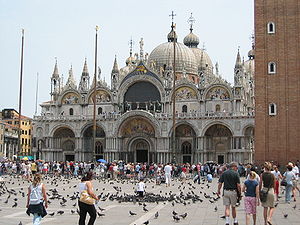
St. Mark were transferred from the Muslim dominated Alexandria of Egypt and brought to Venice. Two Venetian merchants were said to have wrapped the relics in pork so as to avoid detection by the Muslim customs officials. Meanwhile, Venice (as well as Aquileia and Grado) had had a tradition that St. Mark himself had preached the Gospel in the lagoon area. The possession of the relics of the saint lent greater weight to the tradition and the Venetian state capitalized on it making the symbol of St. Mark, the winged lion, its very own. The Basilica of St. Mark was until the 19th century the private chapel of the Doge
Doge of Venice
The Doge of Venice , often mistranslated Duke was the chief magistrate and leader of the Most Serene Republic of Venice for over a thousand years. Doges of Venice were elected for life by the city-state's aristocracy. Commonly the person selected as Doge was the shrewdest elder in the city...
. The Basilica became autonomous from the diocese, with churches under its jurisdiction and a special officer, the Primicerius of St. Mark to represent the bisphoric power of the Doge. Meanwhile the bishop's cathedral remained St. Peter's in Castello
San Pietro di Castello (church)
The Basilica di San Pietro di Castello , commonly called San Pietro di Castello, is a Roman Catholic minor basilica of the Patriarch of Venice located in the Castello sestiere of the Italian city of Venice. The present building dates from the 16th century, but a church has stood on the site since...
.
Medieval history
In 1074 Bishop Henry, from the noble family of Contarini, was the first to bear the title of Bishop of Castello, indicating the complete merger of the island of Olivolo with Venice. That is, Olivolo had by then become a simple neighborhood of Venice. The growth of Venice was balanced by the crisis of the other coastal cities of the Duchy. Patriarchs of Grado began to reside in Venice more and more until in 1105 they definitely transferred to the city, with their own church at St. Silvestrus. For the next three centuries, three bishops resided in Venice: the Patriarch of Grado, the Primicerius of St. Mark and the Bishop of Castello, each one with his own jurisdiction.The city gathered relics, especially from the East, and especially after the conquest of Constantinople. After 1204, the icon of the Madonna called Nicopoeia, which is still in St. Mark's, arrived.
In 1225 Marco II Michel finally secured the exemption of the clergy from lay jurisdiction, except in cases involving real property. Jacopo Albertini (1311) became attached to the schism of Antipope Nicholas V
Antipope Nicholas V
Nicholas V, born Pietro Rainalducci was an antipope in Italy from 12 May 1328 to 25 July 1330 during the pontificate of Pope John XXII at Avignon. He was the last Imperial antipope, that is, set up by a Holy Roman Emperor.-Life:Rainalducci was born at Corvaro, an ancient stronghold near Rieti in...
and Holy Roman Emperor
Holy Roman Emperor
The Holy Roman Emperor is a term used by historians to denote a medieval ruler who, as German King, had also received the title of "Emperor of the Romans" from the Pope...
Louis IV the Bavarian, whom he crowned with the Lombard Iron Crown
Iron Crown of Lombardy
The Iron Crown of Lombardy is both a reliquary and one of the most ancient royal insignia of Europe. The crown became one of the symbols of the Kingdom of Lombards and later of the medieval Kingdom of Italy...
in 1327, and was therefore deposed. Under Nicolo' Morosini (1336) the dispute between the clergy and republican government concerning the mortuary tithes was settled, though it began afresh under Paolo Foscari in 1367, only to end in 1376.
During the Schism of the West, Venice adhered to the Roman obedience.
Patriarchate's history
In 1451, upon the death of Domenico Michel, Patriarch of Grado, Pope Nicholas VPope Nicholas V
Pope Nicholas V , born Tommaso Parentucelli, was Pope from March 6, 1447 to his death in 1455.-Biography:He was born at Sarzana, Liguria, where his father was a physician...
suppressed the patriarchate and the Bishopric of Castello, incorporating them both in the new Patriarchate of Venice by the Papal Bull
Papal bull
A Papal bull is a particular type of letters patent or charter issued by a Pope of the Catholic Church. It is named after the bulla that was appended to the end in order to authenticate it....
"Regis aeterni." Thus Venice succeeded to the whole metropolitan
Metropolitan bishop
In Christian churches with episcopal polity, the rank of metropolitan bishop, or simply metropolitan, pertains to the diocesan bishop or archbishop of a metropolis; that is, the chief city of a historical Roman province, ecclesiastical province, or regional capital.Before the establishment of...
jurisdiction of Grado's eccelsiastical province, including the sees of Dalmatia
Dalmatia
Dalmatia is a historical region on the eastern coast of the Adriatic Sea. It stretches from the island of Rab in the northwest to the Bay of Kotor in the southeast. The hinterland, the Dalmatian Zagora, ranges from fifty kilometers in width in the north to just a few kilometers in the south....
.
In 1466 the territory of the Patriarchate was expanded by merging the suppressed Diocese of Equilio (nowadays Jesolo
Jesolo
thumb|250px|Location of Jesolo in the province of Venice.Jesolo is a town and comune in the province of Venice, Italy.-Geography:...
).
The election of the patriarch belonged to the Senate of Venice, and this practice sometimes led to differences between the republic and the Holy See. Likewise, parishioners elected their parish priests, by the right of patronage. Girolamo Quirini, O.P. (1519–54), had many disputes with the clergy, the Government, and the Holy See. To avoid these disputes, the Senate decreed that in future only senators should be eligible. Those elected after this were frequently laymen. Giovanni Trevisano, O.S.B. (1560), introduced the Tridentine reforms, founding the seminary, holding synods and collecting the regulations made by his predecessors (Constitutiones et privilegia patriarchatus et cleri Venetiarum). In 1581 the visita Apostolica was sent to Venice; a libellus exhortatorius was published, in which the visita highly praised the clergy of Venice.
In 1751 the Pope abolished the Patriarchate of Aquileia by creating two new Archbishops in Udine and Gorizia. With this act the Patriarchate of Venice became sole heir to the throne of St. Mark in northeastern Italy.
After 1797 and the fall of the Republic of Venice
Republic of Venice
The Republic of Venice or Venetian Republic was a state originating from the city of Venice in Northeastern Italy. It existed for over a millennium, from the late 7th century until 1797. It was formally known as the Most Serene Republic of Venice and is often referred to as La Serenissima, in...
under the rule of Napoleon, the bisphoric rule of the Doge on the Basilica and St. Mark's relics was lacking. Then in 1807, by favor of the Viceroy of Italy, the Neapolitan Nicola Gambroni was promoted to the patriarchate and of his own authority transferred the patriarchal seat to the Basilica of St. Mark, uniting the two chapters. He also reduced the number of parish churches from seventy to thirty. The work of enlarging the choir of the basilica brought to light the relics of St. Mark (1808). In 1811 Napoleon I
Napoleon I
Napoleon Bonaparte was a French military and political leader during the latter stages of the French Revolution.As Napoleon I, he was Emperor of the French from 1804 to 1815...
intruded into the See of Venice Stefano Bonsignore, Bishop of Faenza, but in 1814 that prelate returned to his own see.
In 1819 the Diocese of Torcello and Diocese of Caorle were merged in the Patriarchate of Venice, while the dioceses of the Venetian territory were placed under its metropolitan
Metropolitan bishop
In Christian churches with episcopal polity, the rank of metropolitan bishop, or simply metropolitan, pertains to the diocesan bishop or archbishop of a metropolis; that is, the chief city of a historical Roman province, ecclesiastical province, or regional capital.Before the establishment of...
jurisdiction. Cardinal Giuseppe Sarto, afterwards Pius X, succeeded in 1893; he was refused recognition by the Italian Government, which claimed the right of nomination formerly employed by the Habsburg Emperor of Austria
Emperor of Austria
The Emperor of Austria was a hereditary imperial title and position proclaimed in 1804 by the Holy Roman Emperor Francis II, a member of the House of Habsburg-Lorraine, and continually held by him and his heirs until the last emperor relinquished power in 1918. The emperors retained the title of...
and in earlier times by the Venetian Senate, but after eleven months this pretension was abandoned.
List of bishops of Olivolo
- Obelerius (775-...)
- Christopher I Damiata (797-810) - deposed
John (804) - usurper - Christopher II (810-813)
- Christopher I Damiata (813-...) - reinstated
- Orso I Parteciacus (825-...)
- Maurice (...-...)
- Domenicus I (...-...)
- John (unknown - 876) - excommunicated by Pope John VIIIPope John VIIIPope John VIII was pope from December 13, 872 to December 16, 882. He is often considered one of the ablest pontiffs of the ninth century and the last bright spot on the papacy until Leo IX two centuries later....
- Lorenzo I (880 - 909)
- Domenico II (909 - ...)
- Domenico III (...- ...)
- Peter I Tribunus (929-938)
- Orso II (938-945)
- Domenico IV Talonicus (945-955)
- Peter II Marturio (955-963)
- George (963-966)
- Marino Cassianico (966-992)
- Domenico V Gradenigo (992-1026)
- Domenico VI Gradenigo (1026–1044)
- Domenico VII Contarini (1044–1074)
List of bishops of Castello
- Henry Contarini (1074–1108)
- Vitale I Michiel (1108–1120)
- Bonifacio Falier (1120–1133)
- John I Polani (1133–1164)
- Vitale II Michiel (1164–1182)
- Philip Casolo (1182–1184)
- Mark I Nicolai (1184–1225)
- Mark II Michiel (1225-1135)
- Peter III Pino (1235–1255)
- Walter Agnusdei (1255–1258)
- Thomas I Arimondo (1258–1260)
- Thomas II Franco (1260–1274)
- Bartolomew I Querini (1274–1292)
- Simeon Moro (1292–1293)
- Bartholomew II Querini (1293–1303)
- Ramberto Polo (1303–1311)
- Galasso Albertini (1311)
- Giacomo Albertini (1311–1329)
- Angelo I Dolfin (1329–1336)
- Nicholas Morosini (1336–1367)
- Paul Foscari (1367–1375)
- John II (1375–1378) - deposed
- Nicholas II Morosini (1379)
- Angelo II Correr (1379–1390) - become Pope Gregory XIIPope Gregory XIIPope Gregory XII , born Angelo Correr or Corraro, Pope from 1406 to 1415, succeeded Pope Innocent VII on 30 November 1406....
- John III Loredan (1390)
- Francis I Falier (1390–1392)
- Leonard Dolfin (1392–1401)
- Francis II Bembo (1401–1417)
- Mark III Lando (1417–1426)
- Peter IV Donato (1426–1428)
- Francis III Malipiero (1428–1433)
- Lorenzo II Giustiniani (1433–1451) - become Patriarch of Venice
List of Patriarchs of Venice
- For the earlier patriarchs in the area, see List of Aquileia Bishops and patriarchs and Patriarch of GradoPatriarch of GradoThis is a list of the Patriarchs of Grado . The patriarchate came into being when the schismatic Patriarch of Aquileia, Paulinus , moved to Grado in the mid 6th century. But in their reunion with Rome in 606, a rival office was set up in Old-Aquileia. Aquileia later entered communion with Rome but...
- St. Lawrence Justinian (1451–1456); Bishop of Castello from 1433-1451.
- Maffio Contarini (1456–1460)
- Andrea Bondimerio, OSA (1460–1464)
- Gregorio Correr (1464)
- Giovanni Barozzi (1465–1466), transferred from BergamoBergamoBergamo is a town and comune in Lombardy, Italy, about 40 km northeast of Milan. The comune is home to over 120,000 inhabitants. It is served by the Orio al Serio Airport, which also serves the Province of Bergamo, and to a lesser extent the metropolitan area of Milan...
, made cardinal shortly after his death - Maffeo Gherardi or Girardi, OSB (1466–1492), named cardinal 1489
- Tomaso Dona, OSD (1492–1504)
- Antonio Soriano, Carthus. (1504–1508)
- Alvise Contarini (1508)
- Antonio Contarini (1508–1524)
- Girolamo Quirino, OSD (1524–1554)
- PierFrancesco Contarini (1554–1555)
- Vincenzo Diedo (1556–1559)
- Giovanni Trevisano (1560–1590)
- Lorenzo PriuliLorenzo PriuliLorenzo Priuli was the 82nd Doge of Venice. He reigned from 1556 to 1559....
(1591–1600), named cardinal 1596; restored cathedral; founded archdiocesan seminary - Matteo ZaneMatteo ZaneMatteo Zane was the Patriarch of Venice from 1600 to 1605.Prior to his election as Patriarch Zane had served the government of Venice. He had been ambassador or holder of similar office to Urbino, Portugal, Spain, Austria and the Ottoman Empire. In the case of the Ottoman Empire he held the...
(1600–1605) - Francesco Vendramin (1605/1608-1619), named cardinal 1615
- Giovanni Tiepolo (1619–1631)
- Federico Baldissera Bartolomeo CornaroFederico Baldissera Bartolomeo Cornarothumb|Painting of Cardinal Cornaro by [[Bernardo Strozzi]] Federico Baldissera Bartolomeo Cornaro was an Italian Catholic Cardinal and Patriarch of Venice.-Early life:...
(1631–1644), transferred from PaduaPaduaPadua is a city and comune in the Veneto, northern Italy. It is the capital of the province of Padua and the economic and communications hub of the area. Padua's population is 212,500 . The city is sometimes included, with Venice and Treviso, in the Padua-Treviso-Venice Metropolitan Area, having...
, named cardinal 1626 (see below) - GianFrancesco Morosini (1644–1678)
- Alvise Sagredo (1678–1688)
- GianAlberto Badoaro (1688–1706), cardinal
- Piero Barbarigo (1706–1725)
- Marco Gradenigo (1725–1734), transferred from VeronaVeronaVerona ; German Bern, Dietrichsbern or Welschbern) is a city in the Veneto, northern Italy, with approx. 265,000 inhabitants and one of the seven chef-lieus of the region. It is the second largest city municipality in the region and the third of North-Eastern Italy. The metropolitan area of Verona...
- Francesco Antonio Correr, OFM Cap. (1734–1741)
- Alvise Foscari (1741–1758)
- Giovanni Bragadin (1758–1775)
- Fridericus Maria Giovanelli (1776–1800)
- Ludovico Flangini Giovanelli (1801–1804), named cardinal 1789
- vacant (1804–1807)
- Nicolò Saverio Gamboni (1807–1808), cathedral moved from St. Peter in Castello to Basilica of St. Mark
- vacant (1808–1815)
- Francesco Maria Milesi (1815–1819), erected new seminary; patriarchate reorganized 1818
- Ján Ladislaus Pyrker, O. Cist. (1820–1827)
- Giacomo MonicoGiacomo MonicoGiacomo Monico was an Italian prelate that was named Patriarch of Venice in 1827.- Life :Born in Riese, he was educated in the seminary of the diocese of Treviso and ordained in 1801. He then taught at local seminary before being named parish pastor in Asolo. In 1823 he was appointed as bishop of...
(1827–1851), cardinal 1833 - PierAurelio Mutti, OSB (1852–1857)
- Angelo Ramazzotti (1858–1861)
- Giuseppe Luigi Trevisanato (1862–1877)
- Domenico AgostiniDomenico AgostiniDomenico Agostini was an Italian Roman Catholic Cardinal and Patriarch of Venice .Born near Treviso, he studied in the local seminary, then in the University of Padua. He took a doctorate of philosophy and law, but he left the clerical state to join the citizen militia during the war with Austria...
(1877–1891) - Giuseppe Melchiorre SartoPope Pius XPope Saint Pius X , born Giuseppe Melchiorre Sarto, was the 257th Pope of the Catholic Church, serving from 1903 to 1914. He was the first pope since Pope Pius V to be canonized. Pius X rejected modernist interpretations of Catholic doctrine, promoting traditional devotional practices and orthodox...
(1893–1903), elected PopePope Pius XPope Saint Pius X , born Giuseppe Melchiorre Sarto, was the 257th Pope of the Catholic Church, serving from 1903 to 1914. He was the first pope since Pope Pius V to be canonized. Pius X rejected modernist interpretations of Catholic doctrine, promoting traditional devotional practices and orthodox...
in Papal conclave, 1903Papal conclave, 1903The Papal conclave of 1903 was caused by the death of the 93-year-old Pope Leo XIII, who at that stage was the third-longest reigning pope in history.... - Aristide CavallariAristide CavallariAristide Cavallari was a Cardinal of the Roman Catholic Church who served as Patriarch of Venice.Aristide Cavallari was born in Chioggia, Italy. He was educated at the Seminary of Chioggia, where he studied for the three years of theology...
(1904–1914) - Pietro La Fontaine (1915–1935)
- Adeodato Giovanni Piazza (1936–1948)
- Carlo AgostiniCarlo AgostiniCarlo Agostini was an Italian prelate of the Roman Catholic Church. He served as Patriarch of Venice from 1949 until his death, and died shortly after the announcement for his elevation to the cardinalate in 1952....
(1949–1952) - Angelo Giuseppe RoncalliPope John XXIII-Papal election:Following the death of Pope Pius XII in 1958, Roncalli was elected Pope, to his great surprise. He had even arrived in the Vatican with a return train ticket to Venice. Many had considered Giovanni Battista Montini, Archbishop of Milan, a possible candidate, but, although archbishop...
(1953–1958), elected PopePope John XXIII-Papal election:Following the death of Pope Pius XII in 1958, Roncalli was elected Pope, to his great surprise. He had even arrived in the Vatican with a return train ticket to Venice. Many had considered Giovanni Battista Montini, Archbishop of Milan, a possible candidate, but, although archbishop...
in Papal conclave, 1958Papal conclave, 1958The Papal conclave of 1958 occurred following the death of Pope Pius XII on 9 October 1958 in Castel Gandolfo, after a 19-year pontificate. The conclave to elect his successor commenced on 25 October and ended three days later, on 28 October, after eleven ballots. The cardinal electors chose Angelo... - Giovanni Urbani (1958–1969)
- Albino LucianiPope John Paul IJohn Paul I , born Albino Luciani, , reigned as Pope of the Catholic Church and as Sovereign of Vatican City from 26 August 1978 until his death 33 days later. His reign is among the shortest in papal history, resulting in the most recent Year of Three Popes...
(1970–1978), elected PopePope John Paul IJohn Paul I , born Albino Luciani, , reigned as Pope of the Catholic Church and as Sovereign of Vatican City from 26 August 1978 until his death 33 days later. His reign is among the shortest in papal history, resulting in the most recent Year of Three Popes...
in Papal conclave, 1978 (August)Papal conclave, 1978 (August)The Papal conclave of August 1978, the first of the two conclaves held in the year 1978, was convoked after the death of Pope Paul VI on August 6 at Castel Gandolfo. After the cardinal electors assembled in Rome, they elected Cardinal Albino Luciani, then Patriarch of Venice, as the new pope... - Marco Cé (1979–2002)
- Angelo Scola (2002–2011)
Sources and references
http://www.newadvent.org/cathen/15333a.htm- Giga-Catholic Information
- Giovanni Tiepolo, b. 1571 - d. 1631, patriarch of Venice - See JSTOR: The Venetian Upper Clergy in the Sixteenth and Seventeenth ...
An example of this occurs in his analysis of the writings of the patriarch of Venice, Giovanni Tiepolo (d. 1631), which deal with the veneration of the ... http://links.jstor.org/sici?sici=0361-0160(199724)28%3A4%3C1405%3ATVUCIT%3E2.0.CO%3B2-4
- Federico Baldissera Bartolomeo Cornaro, b. 1579 - d. 1653, Cardinal, patriarch of Venice 1631-1644 http://www.boglewood.com/cornaro/xg17.html, http://www.fiu.edu/~mirandas/bios1626.htm#Spada