

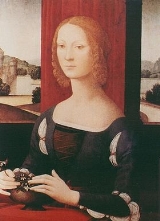
Caterina Sforza

Encyclopedia
Caterina Sforza, Countess of Forlì (early 1463 – 28 May 1509) was an Italian noblewoman, the illegitimate daughter of Galeazzo Maria Sforza
, Duke of Milan
and Lucrezia Landriani
, the wife of the courtier Gian Piero Landriani, a close friend of the Duke. Raised in the refined Milanese court, Caterina later held the titles of Lady of Imola
and Countess of Forlì
, by her marriage to Girolamo Riario. She was also the Regent for her first-born son, Ottaviano. The descendant of a dynasty of noted condottieri
, Caterina, at an early age, distinguished herself by her bold and impetuous actions taken to safeguard her possessions from possible usurpers, and to uphold the military defence of her states, when they were involved in political intrigues that were a distinguishing feature of 15th century Italy.
In her private life Caterina was devoted to various activities, among which were experiments in alchemy
and a love of hunting and dancing. She had a large number of children, of whom only the youngest, Captain Giovanni dalle Bande Nere
, inherited the forceful, militant character of his mother.
Following Caterina's resistance to the ruthless Cesare Borgia
, she had to face his fury and he took her prisoner. Upon regaining her liberty following her imprisonment in Rome
, she led a quiet life in Florence. In the final years of her life, she confided to a monk: "If I were to write the story of my life, I would shock the world".
.
It is believed that she spent the first years of her life with the family of her natural mother. The close relationship between mother and daughter was never severed; Lucrezia was always beside her daughter in the crucial moments of her life, even in her final years in Florence.
Upon the succession of Galeazzo Maria Sforza
as Duke of Milan in 1466, following the death of his father Francesco, Galeazzo arranged for his four children to be brought to court: Carlo (born in 1461), who later became Count of Magenta; Caterina (born in 1463); Alessandro (born in 1465), who later became Lord of Francavilla; and Chiara (born in 1467). By her first marriage, Chiara became Countess dal Verme di Sanguinetto and Lady of Vigevano; by her second marriage, she became Lady of Novi. All four of these children were mothered by Galeazzo's mistress Lucrezia Landriani. The children were entrusted to their paternal grandmother, Bianca Maria Visconti; subsequently, all were eventually adopted by Bona of Savoy
, who became Galeazzo Maria's second wife on 9 May 1468.
At the Sforza court, frequented by writers and artists, Caterina and her siblings received a humanistic education. At that time, in the Italian courts, daughters of noble families received the same education as their brothers. In addition to Latin and the reading of the Classics, which were imposed by the teachers, Caterina was taught, in particular by her paternal grandmother, to be proud of her militant ancestors, to be bold in the application of arms, and astute in the skill of government. From her adoptive mother, she received her share of the maternal warmth and affection that Bona of Savoy poured over all of the children of her husband; this continued after Caterina had left the Milanese court in the form of correspondence between the two women.
The Duke's family resided in Milan
and Pavia
, and often stayed at Galliate
or Cusago
, where Galeazzo Maria devoted himself to hunting. It was likely at one or the other of the two places that Caterina also acquired her lifelong passion for hunting.
, the putative son of Paolo Riario and Bianca della Rovere, sister of Pope Sixtus IV
. There were persistent rumours, however, that Girolamo was a natural son of the Pope. Caterina replaced her cousin, the eleven-year-old Costanza Fogliani, as Girolamo's bride because, (according to some historians), the girl's mother refused to allow the consummation of the marriage until Costanza reached the legal age, which was then fourteen. Despite the bride being just ten years of age, the marriage of Caterina and Girolamo was celebrated on 17 January 1473, but consummated
four years later (1477) when Caterina reached the age of fourteen.
Pope Sixtus IV gave Girolamo the Lordship of Imola
, already a Sforza city, but at the time a fief of the Riario family. After a triumphal entrance into Imola in 1477, Caterina went to Rome with her husband, where he lived for many years at the service of his uncle, the Pope. The following year, in March 1478, Caterina gave birth to her first child, a daughter named Bianca after Girolamo's mother, Bianca della Rovere, and Caterina's paternal grandmother, Bianca Maria Visconti. Caterina subsequently gave birth to five more children in the next nine years.
Rome, at the end of the 15th century, was no longer a medieval city, but was not yet the important centre of artistic endeavours which it would become a few decades later as one of the most important cities of the Renaissance
.
The atmosphere was a mix of intrigue and power, which was pursued without scruples, with the material interests far exceeding the spiritual. Caterina was banned from meddling in politics by her husband, but she quickly integrated—owing to her extroverted and sociable character—into aristocratic Roman society.
Caterina, as evidenced by correspondence from that period, immediately became admired as one of the most beautiful and elegant among the noble Roman women. She was welcomed everywhere, treated with great respect and lavishly praised by all of society including the Pope. She soon transformed from a simple adolescent into a refined and powerful intermediary between the Roman court and other Italian courts, especially Milan.
Girolamo was given a leading position in the expansion policy of Pope Sixtus IV after the premature death of the Pope's favoured nephew, Cardinal
Pietro Riario
. His power grew daily, and he soon displayed increasing ruthlessness towards his enemies. In 1480, the Pope, with the objective of attaining a strong domain in the land of Romagna
, assigned Girolamo the Lordship of Forlì
, which had remained vacant after it was sequestered from the Ordelaffi family. The new Lord tried to earn the favour of the populace by erecting magnificent public buildings and churches, and by abolishing taxes.
The lives of Caterina and Girolamo changed abruptly with the death of Sixtus IV, which occurred on 12 August 1484.
, was assaulted, stripped of all its content and almost destroyed.
In this time of anarchy, Caterina, who was in her seventh month of pregnancy, crossed on horseback to occupy the rocca (fortress) of Castel Sant'Angelo
on behalf of her husband. From this position and with the obedience of the soldiers, Caterina could monitor the Vatican
and dictate the conditions for the new conclave.
Meanwhile, the disorder in the city increased. A militia
accompanied the arrival of the Cardinal
s. The latter did not want to attend the funeral of Sixtus IV and refused to enter into conclave, for fear of coming under the fire of Caterina's artillery
. The situation was difficult because only the election of a new Pope would put an end to the violence in the Eternal City.
Girolamo and his army occupied a strategic position at that point, yet could not implement an effective solution. The Sacred College asked Girolamo to leave Rome, offering in return the confirmation of his Lordship over Imola and Forlì, the military post of Captain-General of the Church, and 8,000 ducat
s in compensation for the damages to his property. Girolamo accepted. When Caterina was informed of the decisions taken by her husband, she increased the quota of her soldiers and made preparations for resistance in order to force the Cardinals to parley with her. The Cardinals again approached Girolamo, who took up a counterposition against his wife. On 25 October 1484, Caterina surrendered the fortress to the Sacred College and left Rome with her family. The Sacred College were then able to meet in conclave to elect the new Pope.
Despite the loss of income, Girolamo did not reimplement the payment of taxes for the people of Forlì.
This situation lasted until the end of 1485, when public spending became untenable and Girolamo, pressed by a member of the Council of Elders, Nicolò Pansecco, was forced to reconsider his taxation policy and was obliged to levy the taxes. This measure was deemed expensive by the population and, soon, Girolamo made enemies amongst all the citizens of Forlì.
The increase of the taxes, which affected mainly the artisan class and landowners, added to the discontent that had previously been limited to the families who had suffered under the Girolamo's system of persecution against all whom he suspected of treachery. His enemies soon began to conspire against him with a view to making Franceschetto Cybo
, the illegitimate son of Pope Innocent VIII
, lord of Imola and Forlì in his stead. In this climate of dissatisfaction among the Forlì nobility flourished the idea of overthrowing the rule of Riario.
s, a noble family of Forlì. The palace of the lord was sacked, while Caterina and her children were made prisoners.
Since the fortress of Ravaldino, a citadel of strategic importance to the defence of the city refused to surrender to the Orsis, Caterina offered to attempt to convince the castellan
, Tommaso Feo. The Orsis believed the good intentions of Caterina because she left her children as their hostages, but once inside she let loose a barrage of rather vulgar threats and promises of vengeance against her former captors. According to a famous legend (without historical veracity) when they threatened to kill her children still in captivity she exposed her genitals from the fortress walls and said: Ho con me lo stampo per farne degli altri! (I have the instrument to bear more!). With the assistance of her uncle Ludovico il Moro
, Duke of Milan, she was able to defeat her enemies and to regain possession of all her dominions; she wreaked vengeance on those who had opposed her and re-established her power over Forlì.
, who was recognized by all members of the city and the heads of its judiciaries as the new Lord of Forlì, though he was considered too young to rule in his own right.
Caterina's first act as Regent of Forlì was to avenge the death of her husband, according to the custom of the time. She ordered that all those involved in the Orsi conspiracy were to be imprisoned, among them the Pope's governor, Monsignor Savelli, all the pontifical generals, the castellan of the fortress of Forlimpopoli
, on account of their treachery, and also all women of the Orsini and other families who had assisted in the conspiracy. Soldiers sought out anyone who had taken part in the conspiracy. The houses owned by those imprisoned were razed to the ground, while their valuables were distributed to the poor. On 30 July 1488 came the news that Pope Innocent VIII had given to Ottaviano Riario the official investiture of his state "until his line ended." In the meantime, Forlì was visited by Cardinal Raffaele Riario
, officially to protect the orphan children of his late cousin Girolamo Riario but, in agreement with the Pope, to oversee the government of Caterina.
The young Countess personally dealt with all issues concerning the government of her city-state, both public and private. To consolidate her power she exchanged gifts with the lords of neighbouring states and involved herself in the marriage negotiations of her children following the custom of the time. She also revised the tax system by reducing and eliminating some duties, and sharply controlled her realm's spending. Caterina dealt directly with the training of her militia in the use of weapons and horses. It was her intention that the lives of the people in her cities and towns be orderly and peaceful, and she expected her subjects to appreciate these efforts.
The states of Forlì and Imola was smaller than the great Italian states but, due to their geographical position, had a considerable strategic importance in the political arena of Italy at that time. On 25 July 1492, Pope Innocent VIII also died, and was replaced by Cardinal Rodrigo Borgia, who took the name of Pope Alexander VI
. His election seemed to strengthen Caterina's rule, as while she and her husband had lived in Rome, the Cardinal had often been a guest at their home, and in addition, he was godfather of their first son, Ottaviano, the Lord of Forlì.
In September 1494, encouraged by Ludovico il Moro Sforza, King Charles VIII of France
formally claimed the Kingdom of Naples as the rightful heir of the House of Anjou
. At first Pope Alexander VI also gave his support to this act.
During the conflict between Milan and Naples, Caterina, who knew her state to be vulnerable to invasion as Forlì was situated in a valuable position for any invading army seeking to travel south to Rome, tried to remain neutral. On one side, her uncle Ludovico wrote her that he had made an alliance with Charles VIII, and on the other Cardinal Raffaele Riario argued in favour of the King of Naples, now also supported by the Pope who had switched sides to oppose France's ambitions in Italy. Caterina chose to support King Ferdinand II
and prepared the defence of Imola and Forlì from the French.
Betrayed by her Neapolitan allies, who the first attack of the French defeated, the Countess changed sides and allied with Charles VIII, leaving his army via libera to reach the Kingdom of Naples. The King of France conquered Naples in thirteen days. This frightened the Italian principalities, worried about their own independence, and they joined forces in an Anti-French League against Charles VIII, who was forced to quickly return to France after the defeat at the Battle of Fornovo
.
On this occasion Caterina managed to remain neutral. Not participating in the expulsion of the French, she maintained the support of her uncle Ludovico in Milan and also that of the Pope.
that summoned Antonio Maria to Friuli
, where he remained confined for ten years.
In point of fact, Caterina had fallen in love with Giacomo Feo, the brother of Tommasso Feo, the castellan who had remained faithful to her in the days following the assassination of her husband. Caterina married him secretly in 1488, in order to avoid losing the custody of her children and, therefore, the regency of her states.
Giacomo was appointed castellan of the fortress of Ravaldino instead of his brother, and was awarded with an order of chivalry from Ludovico il Moro. In April 1489, Caterina gave birth to Giacomo's son, Bernardino, later called Carlo in honour of King Charles VIII, who had granted Giacomo the title of Baron of France.
All the chronicles of the period reported that Caterina was very much in love with the young Giacomo. Soon, many people had begun to worry that she would remove her son Ottaviano from the government and give all the important posts to her paramour. She had replaced the castellans of the fortresses of her states with her closest relatives: the fortress of Imola was given to Gian Piero Landriani, her stepfather, and the fortress of Forlimpopoli to Piero Landriani, her half-brother, while Tommaso Feo was married to Bianca Landriani, Caterina's half-sister. A Tossignano conspiracy was planned in order to take possession of the fortress by those who were loyal to Ottaviano, involving the murder of both Giacomo and Caterina. The Countess discovered the plot and imprisoned or executed those who were involved in the conspiracy. Immediately after this conspiracy was foiled there followed another plot organised by Antonio Maria Ordelaffi, who had never become resigned to the loss of Forlí, but this also failed.
Giacomo's power had increased, and with his cruelty and insolence he won the hatred of all the citizens, including Caterina's children. On one occasion he slapped the eldest, Ottaviano Riario, the rightful Lord of Forlì, in full view of the public, but nobody had the courage to defend the boy. After this incident the situation in Forlì became very difficult and the adherents of Ottaviano decided to liberate the city from the domination of Giacomo Feo.
On the evening of 27 August 1495, returning from a hunt, Caterina, her daughter Bianca Riario and some of her ladies-in-waiting, were travelling in their carriage, followed on horseback by Ottaviano, his brother Cesare and Giacomo Feo, as well as many staffieri and soldiers. Giacomo was attacked and mortally wounded, as a result of a conspiracy in which Caterina's children were involved. The same day Gian Antonio Ghetti, the main conspirator behind the plot, went to Caterina, convinced that she had secretly given the order to kill Giacomo. Caterina, however, was not aware of the plot, and her revenge was terrible. When her first husband was murdered, she avenged his death according to the criteria of justice of the time; now she reacted with vindictive fury. Caterina was not satisfied with mere executions: their deaths had to be among the most cruel and painful. She not only prosecuted the wives and mistresses of the conspirators, but she also sought out the children, even those in early infancy, and all were summarily tortured and executed.
The involvement of Caterina's emotions in her revenge prevented her from understanding the political reasons that had inspired the plot, whose vast proportions indicate that it was long and carefully planned. It had involved almost all the supporters of Ottaviano Riario, who were convinced that Caterina had given her tacit consent to the removal of the man who was considered the "usurper" of the state's rightful ruler. They had wanted to uphold the power of the Riario family. Caterina, as a result of the massacre which followed the assassination of Giacomo Feo, lost forever the favour and good will of her people.
, Giovanni de' Medici il Popolano
, paid a visit to Caterina. The second son of Pierfrancesco il Vecchio
, he belonged to a collateral branch of the Medici family. Along with his older brother Lorenzo
, he had been sent into exile because of his open hostility toward their cousin Piero
, who succeeded his father Lorenzo il Magnifico in the government of Florence. In 1494, when King Charles VIII of France invaded Italy, Piero was forced to sign an unconditional treaty which allowed the French army to move freely into the Kingdom of Naples. The people of Florence were liberated, deposed Piero and proclaimed the Republic. Giovanni and his brother were able to return to their homeland. They renounced the surname of the family and took the name of Popolano. The government appointed Giovanni as ambassador of the Florentine Republic to Forlì.
Shortly after having paid tribute to the Countess as befitted his status of ambassador, Giovanni and his entourage were housed in the apartments adjacent to Caterina's in the fortress of Ravaldino. The rumours of a possible marriage between Giovanni and Caterina, as well as a conflict which loomed on the horizon between Venice and Florence, alarmed all the lords of the League and the Duke of Milan.
Caterina couldn't hide her wedding plans and her own feelings from her uncle Ludovico; she truly fell in love with the handsome, charming, and intelligent Giovanni. The situation differed from the previous one as this time Caterina had the approval of her children and finally she also obtained the consent of her uncle. The marriage of two people from such powerful families, however, was likely to arouse opposition, so they were wed in secret. The marriage took place in September 1497.
In April 1498, Caterina bore Giovanni a son, the last of her children. The child was baptised as Ludovico after his mother's uncle, the Duke of Milan, but later he became renowned under the name Giovanni dalle Bande Nere
.
Meanwhile, the situation between Florence and Venice
was getting worse and Caterina, who stood in the way of the passage of the two armies, was preparing the defence. She also sent a contingent of knights to the aid of Florence, led by her eldest son, Lord Ottaviano Riario, who was accompanied by men she trusted, who were trained by herself, and her husband, Giovanni.
Giovanni became seriously ill and was compelled to leave the battlefield and return to Forlì. There, despite treatment, his condition continued to deteriorate and he was transferred to Santa Maria in Bagno
, where he hoped for a miraculous recovery. On 14 September 1498 Giovanni died in the presence of Caterina, who had been summoned urgently to attend him. Giovanni's death left Caterina alone to face one of the most ruthless, ambitious, and implacable families in Europe, the Borgia
s.
After a first attack by the Venetian army, which inflicted severe destruction in the occupied territories, the army of Caterina managed to outmanoeuvre the Venetians. Afterwards, the war continued with small skirmishes until the Venetians were able to circumvent Forlì to reach Florence by another route.
Because of this staunch defence, many historians of the Romagna have bestowed on Caterina Sforza the nickname of "Il Tigre" (The Tiger).
had succeeded to the French throne. Louis claimed the rights both to the Duchy of Milan as a grandson of Valentina Visconti
, and to the Kingdom of Naples as heir to the House of Anjou. Before starting his campaign in Italy, Louis XII secured an alliance with Savoy
, the Republic of Venice and Pope Alexander VI. In the summer of 1499 he came to Italy with his formidable army; without having to fight a single battle, he occupied Piedmont
, as well as the cities of Genoa
and Cremona
. On 6 October, he settled in Milan, which had been abandoned the previous month by Duke Ludovico who was a refugee in the territories of Tyrol
under the protection of his nephew-by-marriage Maximilian I, Holy Roman Emperor
.
Alexander VI had allied himself with Louis XII in return for the King's support in establishing a realm for Alexander's son Cesare Borgia
, the Duke of Valentinois, in Romagna. With this aim in mind, Alexander issued a Papal Bull
on 9 March 1499 to invalidate the investiture of the feudal Lords of the lands, including Caterina. When the French army left Milan with the Duke of Valentinois to begin the conquest of Romagna, Ludovico il Moro regained the Duchy with the help of the Austrians.
Caterina sought relief from Florence against the approaching French army, but Florence was threatened by the Pope. She immediately began to recruit and train many soldiers and began to store weapons, ammunition and food. She reinforced the defences of her states with important works, especially that of Ravaldino where she resided and which was already considered impenetrable. She also evacuated her children to the city of Florence.
On 24 November Cesare Borgia arrived in Imola. The city gates were opened by some of the inhabitants, and he was able to take possession, after having conquered the fortress where the castellan Dionigi Naldi of Brisighella
had resisted for several days. After seeing what had happened with her more junior city, Caterina asked the people of Forlì if they also wanted to capitulate to Borgia, or if they wanted to be defended and endure the resulting siege
. Because the people hesitated to answer, Caterina absolved the citizens of Forlì from their oath of fealty
, and defended herself in the citadel.
On 19 December, the Duke of Valentinois also took possession of Forlì and began the siege of the fortress. Caterina repeatedly refused all offers of peace, first from the Duke of Valentinois and another by Cardinal Raffaele Riario. In response, Cesare Borgia offered 10,000 ducats for her, alive or dead. Caterina attempted to take the Duke prisoner when he came near to the fortress to parlay, but this undertaking failed.
For several days the artillery of both factions engaged in a mutual bombardment: Caterina's cannon inflicted many losses on the French army, but this damage served only to dismantle the defences of the main fortress. What was destroyed during the day was rebuilt during the night. The besieged also found time to play and dance.
Caterina's solitary resistance was admired throughout all Italy; Niccolò Machiavelli
reports that many songs and epigram
s were composed in her honour. Sadly, all were lost except that of Marsilio Compagnon.
As time passed without decisive results, the Duke of Valentinois changed his tactics. His troops began to bombard the walls of the fortress continuously, day and night. After six days, his forces were able to open two large gaps in the walls of the fortress. On 12 January 1500, the bloody battle was decisive and quick. Caterina herself continued to resist, personally fighting with weapons in her hands until she was finally captured and taken prisoner. Immediately she surrendered herself to Antoine Bissey (the bailli
of Dijon
) as a prisoner of the French, as she knew there was a law that prevented French forces from holding women as prisoners of war.
. The conquest had to be postponed because on 5 February Ludovico il Moro returned to Milan, forcing French troops to turn back. The Duke of Valentinois departed alone with the Papal army for Rome, where he took Caterina. In Rome, she was held in the Belvedere Palace. Towards the end of March, Caterina tried to escape; she was discovered and imprisoned in Castel Sant'Angelo.
Even today it is not known if the accusation was founded or not. Machiavelli believed that Caterina had tried to poison the Pope, while historians, such as Jacob Burckhardt
and Ferdinand Gregorovius
are not certain. An inconclusive and unfinished trial took place, and Caterina remained imprisoned until 30 June 1501. At that time she was released by Yves d'Allègre, who had come to Rome with the army of Louis XII for the conquest of the Kingdom of Naples.
Alexander VI alleged that Caterina signed documents renouncing all of her fiefs, because in the meantime his son Cesare, with the acquisition of Pesaro, Rimini
and Faenza
, was appointed Duke of Romagna.
After a brief stay in the residence of Cardinal Raffaele Riario, Caterina embarked from Livorno
to Florence, where her children were waiting for her.
. Soon, she complained of being mistreated and living in a straitened financial situation.
For many years she conducted a legal battle against her brother-in-law Lorenzo de' Medici
for the custody of her son Giovanni, who was entrusted to him during her detention. In 1504, her son was finally returned to her, because the judge recognized that her confinement as a prisoner of war was not comparable to the detention of a criminal.
With the death of Pope Alexander VI on 18 August 1503, Cesare Borgia lost all his power. This reopened the possibility of restoring to power all the old feudal lords of the Romagna who had been deposed. Caterina lost no time in sending letters to adherents, and pleaded her case to Pope Julius II
in her own name and that of her son Ottaviano Riario. The new Pope was favourable to restoring the lordships of Imola and Forlì to the Riarios, but the populace of both cities declared that a majority of the people opposed the return of the Countess, so that the state passed instead to Antonio Maria Ordelaffi on 22 October 1503.
After having lost her last chance to return to her former power, Caterina spent the last years of her life dedicated to her children, in particular to her youngest son Giovanni—who was her favourite and the most like her in personality and character—her grandchildren, her "experiments" in alchemy, and her correspondence with former friends of hers.
. She appeared to have recovered, but had a relapse of the disease, after which she made her will and arranged her burial. At the age of forty-six years, "The Tiger of Forlì", who had "frightened all of Romagna" died on 28 May 1509.
presents Caterina Sforza as a contrasting figure to her contemporary Isabella I of Castile
. Fraser points out that whilst the murders ordered by Caterina were no worse than the massacres ordered by Isabella, historians have been much harsher in their judgment of the former. Fraser accounts for this fact by pointing out that Isabella's actions were sanctioned by the Church, as they were carried out in the name of Catholicism
, whilst Caterina's were motivated by the personal, secular desire to preserve her property and rights.
From her second marriage with Giacomo Feo, Caterina had one son:
From her third marriage to Giovanni de' Medici, Caterina had one son:
In June 1537, twenty-eight years after Caterina's death, her grandson Cosimo de' Medici
, the only son of her own son Giovanni, became the Duke of Florence and in 1569, the Grand Duke of Tuscany
. Through him, Caterina was the direct ancestress of the later Grand Dukes of Tuscany, the Dukes of Modena and Reggio and the Kings of Spain and France
. Other notable descendants included Marie de Medici, King Charles II of England
, and Diana, Princess of Wales
.
Galeazzo Maria Sforza
Galeazzo Maria Sforza was Duke of Milan from 1466 until his death. He was famous for being lustful, cruel and tyrannical....
, Duke of Milan
Milan
Milan is the second-largest city in Italy and the capital city of the region of Lombardy and of the province of Milan. The city proper has a population of about 1.3 million, while its urban area, roughly coinciding with its administrative province and the bordering Province of Monza and Brianza ,...
and Lucrezia Landriani
Lucrezia Landriani
Lucrezia Landriani , was the mistress of Galeazzo Maria Sforza, Duke of Milan, and the mother of his renowned illegitimate daughter, Caterina Sforza, Lady of Imola, Countess of Forlì...
, the wife of the courtier Gian Piero Landriani, a close friend of the Duke. Raised in the refined Milanese court, Caterina later held the titles of Lady of Imola
Imola
thumb|250px|The Cathedral of Imola.Imola is a town and comune in the province of Bologna, located on the Santerno river, in the Emilia-Romagna region of north-central Italy...
and Countess of Forlì
Forlì
Forlì is a comune and city in Emilia-Romagna, Italy, and is the capital of the province of Forlì-Cesena. The city is situated along the Via Emilia, to the right of the Montone river, and is an important agricultural centre...
, by her marriage to Girolamo Riario. She was also the Regent for her first-born son, Ottaviano. The descendant of a dynasty of noted condottieri
Condottieri
thumb|Depiction of [[Farinata degli Uberti]] by [[Andrea del Castagno]], showing a 15th century condottiero's typical attire.Condottieri were the mercenary soldier leaders of the professional, military free companies contracted by the Italian city-states and the Papacy, from the late Middle Ages...
, Caterina, at an early age, distinguished herself by her bold and impetuous actions taken to safeguard her possessions from possible usurpers, and to uphold the military defence of her states, when they were involved in political intrigues that were a distinguishing feature of 15th century Italy.
In her private life Caterina was devoted to various activities, among which were experiments in alchemy
Alchemy
Alchemy is an influential philosophical tradition whose early practitioners’ claims to profound powers were known from antiquity. The defining objectives of alchemy are varied; these include the creation of the fabled philosopher's stone possessing powers including the capability of turning base...
and a love of hunting and dancing. She had a large number of children, of whom only the youngest, Captain Giovanni dalle Bande Nere
Giovanni dalle Bande Nere
Lodovico de Medici also known as Giovanni dalle Bande Nere was an Italian condottiero.-Biography:Giovanni was born in the Northern Italian town of Forlì to Giovanni de' Medici and Caterina Sforza, one of the most famous women of the Italian Renaissance.From an early age, he demonstrated great...
, inherited the forceful, militant character of his mother.
Following Caterina's resistance to the ruthless Cesare Borgia
Cesare Borgia
Cesare Borgia , Duke of Valentinois, was an Italian condottiero, nobleman, politician, and cardinal. He was the son of Pope Alexander VI and his long-term mistress Vannozza dei Cattanei. He was the brother of Lucrezia Borgia; Giovanni Borgia , Duke of Gandia; and Gioffre Borgia , Prince of Squillace...
, she had to face his fury and he took her prisoner. Upon regaining her liberty following her imprisonment in Rome
Rome
Rome is the capital of Italy and the country's largest and most populated city and comune, with over 2.7 million residents in . The city is located in the central-western portion of the Italian Peninsula, on the Tiber River within the Lazio region of Italy.Rome's history spans two and a half...
, she led a quiet life in Florence. In the final years of her life, she confided to a monk: "If I were to write the story of my life, I would shock the world".
Childhood
Caterina Sforza was born in MilanMilan
Milan is the second-largest city in Italy and the capital city of the region of Lombardy and of the province of Milan. The city proper has a population of about 1.3 million, while its urban area, roughly coinciding with its administrative province and the bordering Province of Monza and Brianza ,...
.
It is believed that she spent the first years of her life with the family of her natural mother. The close relationship between mother and daughter was never severed; Lucrezia was always beside her daughter in the crucial moments of her life, even in her final years in Florence.
Upon the succession of Galeazzo Maria Sforza
Galeazzo Maria Sforza
Galeazzo Maria Sforza was Duke of Milan from 1466 until his death. He was famous for being lustful, cruel and tyrannical....
as Duke of Milan in 1466, following the death of his father Francesco, Galeazzo arranged for his four children to be brought to court: Carlo (born in 1461), who later became Count of Magenta; Caterina (born in 1463); Alessandro (born in 1465), who later became Lord of Francavilla; and Chiara (born in 1467). By her first marriage, Chiara became Countess dal Verme di Sanguinetto and Lady of Vigevano; by her second marriage, she became Lady of Novi. All four of these children were mothered by Galeazzo's mistress Lucrezia Landriani. The children were entrusted to their paternal grandmother, Bianca Maria Visconti; subsequently, all were eventually adopted by Bona of Savoy
Bona of Savoy
Bona of Savoy, Duchess of Milan was a the second spouse of Galeazzo Maria Sforza, Duke of Milan and a member of the noble Italian House of Savoy. She served as regent of Milan during the minority of her son 1476–1481....
, who became Galeazzo Maria's second wife on 9 May 1468.
At the Sforza court, frequented by writers and artists, Caterina and her siblings received a humanistic education. At that time, in the Italian courts, daughters of noble families received the same education as their brothers. In addition to Latin and the reading of the Classics, which were imposed by the teachers, Caterina was taught, in particular by her paternal grandmother, to be proud of her militant ancestors, to be bold in the application of arms, and astute in the skill of government. From her adoptive mother, she received her share of the maternal warmth and affection that Bona of Savoy poured over all of the children of her husband; this continued after Caterina had left the Milanese court in the form of correspondence between the two women.
The Duke's family resided in Milan
Milan
Milan is the second-largest city in Italy and the capital city of the region of Lombardy and of the province of Milan. The city proper has a population of about 1.3 million, while its urban area, roughly coinciding with its administrative province and the bordering Province of Monza and Brianza ,...
and Pavia
Pavia
Pavia , the ancient Ticinum, is a town and comune of south-western Lombardy, northern Italy, 35 km south of Milan on the lower Ticino river near its confluence with the Po. It is the capital of the province of Pavia. It has a population of c. 71,000...
, and often stayed at Galliate
Galliate
Galliate is a comune in the Province of Novara in the Italian region Piedmont, located about 90 km northeast of Turin and about 7 km northeast of Novara....
or Cusago
Cusago
Cusago is a comune in the Province of Milan in the Italian region Lombardy, located about 11 km west of Milan. As of 31 December 2004, it had a population of 3,343 and an area of 11.5 km²....
, where Galeazzo Maria devoted himself to hunting. It was likely at one or the other of the two places that Caterina also acquired her lifelong passion for hunting.
Marriage
In 1473 Caterina was betrothed to Girolamo RiarioGirolamo Riario
Girolamo Riario was Lord of Imola and Forlì in the 15th century.- Biography :Born in Savona, Riario was the son of Paolo Riario and Bianca della Rovere...
, the putative son of Paolo Riario and Bianca della Rovere, sister of Pope Sixtus IV
Pope Sixtus IV
Pope Sixtus IV , born Francesco della Rovere, was Pope from 1471 to 1484. His accomplishments as Pope included the establishment of the Sistine Chapel; the group of artists that he brought together introduced the Early Renaissance into Rome with the first masterpiece of the city's new artistic age,...
. There were persistent rumours, however, that Girolamo was a natural son of the Pope. Caterina replaced her cousin, the eleven-year-old Costanza Fogliani, as Girolamo's bride because, (according to some historians), the girl's mother refused to allow the consummation of the marriage until Costanza reached the legal age, which was then fourteen. Despite the bride being just ten years of age, the marriage of Caterina and Girolamo was celebrated on 17 January 1473, but consummated
Consummation
Consummation is the initial sexual act made within a marriage.Consummation can also refer to:* Consummation , 1970 recordingSee also:* Consummation of days, event predicted in Daniel Chapter 12, verses 1-4...
four years later (1477) when Caterina reached the age of fourteen.
Pope Sixtus IV gave Girolamo the Lordship of Imola
Imola
thumb|250px|The Cathedral of Imola.Imola is a town and comune in the province of Bologna, located on the Santerno river, in the Emilia-Romagna region of north-central Italy...
, already a Sforza city, but at the time a fief of the Riario family. After a triumphal entrance into Imola in 1477, Caterina went to Rome with her husband, where he lived for many years at the service of his uncle, the Pope. The following year, in March 1478, Caterina gave birth to her first child, a daughter named Bianca after Girolamo's mother, Bianca della Rovere, and Caterina's paternal grandmother, Bianca Maria Visconti. Caterina subsequently gave birth to five more children in the next nine years.
In the Vatican court
Upon her arrival in Rome in May 1477, Caterina found a city full of cultural fervour, with a desire for renovation.Rome, at the end of the 15th century, was no longer a medieval city, but was not yet the important centre of artistic endeavours which it would become a few decades later as one of the most important cities of the Renaissance
Renaissance
The Renaissance was a cultural movement that spanned roughly the 14th to the 17th century, beginning in Italy in the Late Middle Ages and later spreading to the rest of Europe. The term is also used more loosely to refer to the historical era, but since the changes of the Renaissance were not...
.
The atmosphere was a mix of intrigue and power, which was pursued without scruples, with the material interests far exceeding the spiritual. Caterina was banned from meddling in politics by her husband, but she quickly integrated—owing to her extroverted and sociable character—into aristocratic Roman society.
Caterina, as evidenced by correspondence from that period, immediately became admired as one of the most beautiful and elegant among the noble Roman women. She was welcomed everywhere, treated with great respect and lavishly praised by all of society including the Pope. She soon transformed from a simple adolescent into a refined and powerful intermediary between the Roman court and other Italian courts, especially Milan.
Girolamo was given a leading position in the expansion policy of Pope Sixtus IV after the premature death of the Pope's favoured nephew, Cardinal
Cardinal (Catholicism)
A cardinal is a senior ecclesiastical official, usually an ordained bishop, and ecclesiastical prince of the Catholic Church. They are collectively known as the College of Cardinals, which as a body elects a new pope. The duties of the cardinals include attending the meetings of the College and...
Pietro Riario
Pietro Riario
Pietro Riario was an Italian cardinal and Papal diplomat.-Biography:Born in Savona, he was the son of Paolo Riario and Pope Sixtus IVs' sister, Bianca Della Rovere. Sixtus nominated him in 1471 bishop of Treviso and cardinal, and, in 1473, archbishop of Florence. He was entrusted with Sixtus'...
. His power grew daily, and he soon displayed increasing ruthlessness towards his enemies. In 1480, the Pope, with the objective of attaining a strong domain in the land of Romagna
Romagna
Romagna is an Italian historical region that approximately corresponds to the south-eastern portion of present-day Emilia-Romagna. Traditionally, it is limited by the Apennines to the south-west, the Adriatic to the east, and the rivers Reno and Sillaro to the north and west...
, assigned Girolamo the Lordship of Forlì
Forlì
Forlì is a comune and city in Emilia-Romagna, Italy, and is the capital of the province of Forlì-Cesena. The city is situated along the Via Emilia, to the right of the Montone river, and is an important agricultural centre...
, which had remained vacant after it was sequestered from the Ordelaffi family. The new Lord tried to earn the favour of the populace by erecting magnificent public buildings and churches, and by abolishing taxes.
The lives of Caterina and Girolamo changed abruptly with the death of Sixtus IV, which occurred on 12 August 1484.
Occupation of Castel Sant'Angelo
At the news of the death of the Pope, all who had suffered under his regime commenced to loot and sack the city, bringing chaos, disorder, and terror to the streets of Rome. Girolamo's residence, the Orsini palace in Campo de' FioriCampo de' Fiori
Campo de' Fiori is a rectangular square near Piazza Navona in Rome, Italy, on the border of rione Parione and rione Regola. Campo de' Fiori, translated literally from Italian, means "field of flowers"...
, was assaulted, stripped of all its content and almost destroyed.
In this time of anarchy, Caterina, who was in her seventh month of pregnancy, crossed on horseback to occupy the rocca (fortress) of Castel Sant'Angelo
Castel Sant'Angelo
The Mausoleum of Hadrian, usually known as the Castel Sant'Angelo, is a towering cylindrical building in Parco Adriano, Rome, Italy. It was initially commissioned by the Roman Emperor Hadrian as a mausoleum for himself and his family...
on behalf of her husband. From this position and with the obedience of the soldiers, Caterina could monitor the Vatican
Vatican City
Vatican City , or Vatican City State, in Italian officially Stato della Città del Vaticano , which translates literally as State of the City of the Vatican, is a landlocked sovereign city-state whose territory consists of a walled enclave within the city of Rome, Italy. It has an area of...
and dictate the conditions for the new conclave.
Meanwhile, the disorder in the city increased. A militia
Militia
The term militia is commonly used today to refer to a military force composed of ordinary citizens to provide defense, emergency law enforcement, or paramilitary service, in times of emergency without being paid a regular salary or committed to a fixed term of service. It is a polyseme with...
accompanied the arrival of the Cardinal
Cardinal (Catholicism)
A cardinal is a senior ecclesiastical official, usually an ordained bishop, and ecclesiastical prince of the Catholic Church. They are collectively known as the College of Cardinals, which as a body elects a new pope. The duties of the cardinals include attending the meetings of the College and...
s. The latter did not want to attend the funeral of Sixtus IV and refused to enter into conclave, for fear of coming under the fire of Caterina's artillery
Artillery
Originally applied to any group of infantry primarily armed with projectile weapons, artillery has over time become limited in meaning to refer only to those engines of war that operate by projection of munitions far beyond the range of effect of personal weapons...
. The situation was difficult because only the election of a new Pope would put an end to the violence in the Eternal City.
Girolamo and his army occupied a strategic position at that point, yet could not implement an effective solution. The Sacred College asked Girolamo to leave Rome, offering in return the confirmation of his Lordship over Imola and Forlì, the military post of Captain-General of the Church, and 8,000 ducat
Ducat
The ducat is a gold coin that was used as a trade coin throughout Europe before World War I. Its weight is 3.4909 grams of .986 gold, which is 0.1107 troy ounce, actual gold weight...
s in compensation for the damages to his property. Girolamo accepted. When Caterina was informed of the decisions taken by her husband, she increased the quota of her soldiers and made preparations for resistance in order to force the Cardinals to parley with her. The Cardinals again approached Girolamo, who took up a counterposition against his wife. On 25 October 1484, Caterina surrendered the fortress to the Sacred College and left Rome with her family. The Sacred College were then able to meet in conclave to elect the new Pope.
Forlì
Upon their arrival in Forlì, where law and order had been maintained due to Ludovico il Moro, the Riarios were informed of the election of Giovanni Battista Cybo, an old opponent, as the new Pope Innocent VIII, who confirmed Girolamo in his Lordships of Imola and Forlì and the appointment as Captain-General of the Pontifical army. That appointment, however, was only nominal; the new Pope deprived the position of any real function or control over the Papal military and refused to make any payments to Girolamo for leaving Rome.Despite the loss of income, Girolamo did not reimplement the payment of taxes for the people of Forlì.
This situation lasted until the end of 1485, when public spending became untenable and Girolamo, pressed by a member of the Council of Elders, Nicolò Pansecco, was forced to reconsider his taxation policy and was obliged to levy the taxes. This measure was deemed expensive by the population and, soon, Girolamo made enemies amongst all the citizens of Forlì.
The increase of the taxes, which affected mainly the artisan class and landowners, added to the discontent that had previously been limited to the families who had suffered under the Girolamo's system of persecution against all whom he suspected of treachery. His enemies soon began to conspire against him with a view to making Franceschetto Cybo
Franceschetto Cybo
Franceschetto Cybo was an Italian nobleman, the illegitimate son of Pope Innocent VIII ....
, the illegitimate son of Pope Innocent VIII
Pope Innocent VIII
Pope Innocent VIII , born Giovanni Battista Cybo , was Pope from 1484 until his death.-Early years:Giovanni Battista Cybo was born at Genoa of Greek extraction...
, lord of Imola and Forlì in his stead. In this climate of dissatisfaction among the Forlì nobility flourished the idea of overthrowing the rule of Riario.
Girolamo's death
After more than a half dozen failed conspiracies, Girolamo was killed on 14 April 1488 by a conspiracy led by members of the OrsiOrsi
Orsi is a surname, and may refer to:* Adolfo Orsi - Italian industrialist* Clodomil Orsi - Brazilian football executive* Fernando Orsi - Italian football manager and former player...
s, a noble family of Forlì. The palace of the lord was sacked, while Caterina and her children were made prisoners.
Since the fortress of Ravaldino, a citadel of strategic importance to the defence of the city refused to surrender to the Orsis, Caterina offered to attempt to convince the castellan
Castellan
A castellan was the governor or captain of a castle. The word stems from the Latin Castellanus, derived from castellum "castle". Also known as a constable.-Duties:...
, Tommaso Feo. The Orsis believed the good intentions of Caterina because she left her children as their hostages, but once inside she let loose a barrage of rather vulgar threats and promises of vengeance against her former captors. According to a famous legend (without historical veracity) when they threatened to kill her children still in captivity she exposed her genitals from the fortress walls and said: Ho con me lo stampo per farne degli altri! (I have the instrument to bear more!). With the assistance of her uncle Ludovico il Moro
Ludovico Sforza
Ludovico Sforza , was Duke of Milan from 1489 until his death. A member of the Sforza family, he was the fourth son of Francesco Sforza. He was famed as a patron of Leonardo da Vinci and other artists, and presided over the final and most productive stage of the Milanese Renaissance...
, Duke of Milan, she was able to defeat her enemies and to regain possession of all her dominions; she wreaked vengeance on those who had opposed her and re-established her power over Forlì.
Lady of Imola and Forlì
On 30 April 1488 Caterina began her government as the regent of her eldest son OttavianoOttaviano Riario
Ottaviano Riario was an Italian condottiero and Lord of Imola and Forlì.He was a son of Girolamo Riario, a nephew of Pope Sixtus IV who had obtained possession in Italy thanks to the pontiff's patronage, and Caterina Sforza. He was created lord of Imola and Forlì in July 1488 by Pope Innocent...
, who was recognized by all members of the city and the heads of its judiciaries as the new Lord of Forlì, though he was considered too young to rule in his own right.
Caterina's first act as Regent of Forlì was to avenge the death of her husband, according to the custom of the time. She ordered that all those involved in the Orsi conspiracy were to be imprisoned, among them the Pope's governor, Monsignor Savelli, all the pontifical generals, the castellan of the fortress of Forlimpopoli
Forlimpopoli
Forlimpopoli is a town and comune in the Province of Forlì-Cesena, northern Italy. It is located on the Via Emilia between Cesena and Forlì.-History:...
, on account of their treachery, and also all women of the Orsini and other families who had assisted in the conspiracy. Soldiers sought out anyone who had taken part in the conspiracy. The houses owned by those imprisoned were razed to the ground, while their valuables were distributed to the poor. On 30 July 1488 came the news that Pope Innocent VIII had given to Ottaviano Riario the official investiture of his state "until his line ended." In the meantime, Forlì was visited by Cardinal Raffaele Riario
Raffaele Riario
Raffaele Sansoni Galeoti Riario was an Italian Cardinal of the Renaissance, mainly known as the constructor of the Palazzo della Cancelleria and the one who invited Michelangelo to Rome. He was a patron of the arts...
, officially to protect the orphan children of his late cousin Girolamo Riario but, in agreement with the Pope, to oversee the government of Caterina.
The young Countess personally dealt with all issues concerning the government of her city-state, both public and private. To consolidate her power she exchanged gifts with the lords of neighbouring states and involved herself in the marriage negotiations of her children following the custom of the time. She also revised the tax system by reducing and eliminating some duties, and sharply controlled her realm's spending. Caterina dealt directly with the training of her militia in the use of weapons and horses. It was her intention that the lives of the people in her cities and towns be orderly and peaceful, and she expected her subjects to appreciate these efforts.
The states of Forlì and Imola was smaller than the great Italian states but, due to their geographical position, had a considerable strategic importance in the political arena of Italy at that time. On 25 July 1492, Pope Innocent VIII also died, and was replaced by Cardinal Rodrigo Borgia, who took the name of Pope Alexander VI
Pope Alexander VI
Pope Alexander VI , born Roderic Llançol i Borja was Pope from 1492 until his death on 18 August 1503. He is one of the most controversial of the Renaissance popes, and his Italianized surname—Borgia—became a byword for the debased standards of the Papacy of that era, most notoriously the Banquet...
. His election seemed to strengthen Caterina's rule, as while she and her husband had lived in Rome, the Cardinal had often been a guest at their home, and in addition, he was godfather of their first son, Ottaviano, the Lord of Forlì.
In September 1494, encouraged by Ludovico il Moro Sforza, King Charles VIII of France
Charles VIII of France
Charles VIII, called the Affable, , was King of France from 1483 to his death in 1498. Charles was a member of the House of Valois...
formally claimed the Kingdom of Naples as the rightful heir of the House of Anjou
House of Valois-Anjou
The Valois House of Anjou, or the Younger House of Anjou, was a noble French family, deriving from the royal family, the House of Valois. They were monarchs of Naples, as well as various other territories....
. At first Pope Alexander VI also gave his support to this act.
During the conflict between Milan and Naples, Caterina, who knew her state to be vulnerable to invasion as Forlì was situated in a valuable position for any invading army seeking to travel south to Rome, tried to remain neutral. On one side, her uncle Ludovico wrote her that he had made an alliance with Charles VIII, and on the other Cardinal Raffaele Riario argued in favour of the King of Naples, now also supported by the Pope who had switched sides to oppose France's ambitions in Italy. Caterina chose to support King Ferdinand II
Ferdinand I of Naples
Ferdinand I , also called Don Ferrante, was the King of Naples from 1458 to 1494. He was the natural son of Alfonso V of Aragon by Giraldona Carlino.-Biography:...
and prepared the defence of Imola and Forlì from the French.
Betrayed by her Neapolitan allies, who the first attack of the French defeated, the Countess changed sides and allied with Charles VIII, leaving his army via libera to reach the Kingdom of Naples. The King of France conquered Naples in thirteen days. This frightened the Italian principalities, worried about their own independence, and they joined forces in an Anti-French League against Charles VIII, who was forced to quickly return to France after the defeat at the Battle of Fornovo
Fornovo
Fornovo may refer to the following Italian comuni :*Fornovo di Taro, in the province of Parma.*Battle of Fornovo .*Combat of Fornovo, event of Spring 1945 offensive in Italy, end of Italian Campaign during the World War II....
.
On this occasion Caterina managed to remain neutral. Not participating in the expulsion of the French, she maintained the support of her uncle Ludovico in Milan and also that of the Pope.
Second marriage
Two months after the death of Girolamo a rumour was spread that Caterina was close to marrying Antonio Maria Ordelaffi, who had started to court her. This marriage would end the claims of the Ordelaffi family on the city of Forlì. Antonio Maria, feeling confident, wrote to the Duke of Ferrara that the Countess had made promises to marry him. When Caterina saw how things stood, she imprisoned all those who had helped to spread the false news. These promises were also addressed before the Senate in VeniceVenice
Venice is a city in northern Italy which is renowned for the beauty of its setting, its architecture and its artworks. It is the capital of the Veneto region...
that summoned Antonio Maria to Friuli
Friuli
Friuli is an area of northeastern Italy with its own particular cultural and historical identity. It comprises the major part of the autonomous region Friuli-Venezia Giulia, i.e. the province of Udine, Pordenone, Gorizia, excluding Trieste...
, where he remained confined for ten years.
In point of fact, Caterina had fallen in love with Giacomo Feo, the brother of Tommasso Feo, the castellan who had remained faithful to her in the days following the assassination of her husband. Caterina married him secretly in 1488, in order to avoid losing the custody of her children and, therefore, the regency of her states.
Giacomo was appointed castellan of the fortress of Ravaldino instead of his brother, and was awarded with an order of chivalry from Ludovico il Moro. In April 1489, Caterina gave birth to Giacomo's son, Bernardino, later called Carlo in honour of King Charles VIII, who had granted Giacomo the title of Baron of France.
All the chronicles of the period reported that Caterina was very much in love with the young Giacomo. Soon, many people had begun to worry that she would remove her son Ottaviano from the government and give all the important posts to her paramour. She had replaced the castellans of the fortresses of her states with her closest relatives: the fortress of Imola was given to Gian Piero Landriani, her stepfather, and the fortress of Forlimpopoli to Piero Landriani, her half-brother, while Tommaso Feo was married to Bianca Landriani, Caterina's half-sister. A Tossignano conspiracy was planned in order to take possession of the fortress by those who were loyal to Ottaviano, involving the murder of both Giacomo and Caterina. The Countess discovered the plot and imprisoned or executed those who were involved in the conspiracy. Immediately after this conspiracy was foiled there followed another plot organised by Antonio Maria Ordelaffi, who had never become resigned to the loss of Forlí, but this also failed.
Giacomo's power had increased, and with his cruelty and insolence he won the hatred of all the citizens, including Caterina's children. On one occasion he slapped the eldest, Ottaviano Riario, the rightful Lord of Forlì, in full view of the public, but nobody had the courage to defend the boy. After this incident the situation in Forlì became very difficult and the adherents of Ottaviano decided to liberate the city from the domination of Giacomo Feo.
On the evening of 27 August 1495, returning from a hunt, Caterina, her daughter Bianca Riario and some of her ladies-in-waiting, were travelling in their carriage, followed on horseback by Ottaviano, his brother Cesare and Giacomo Feo, as well as many staffieri and soldiers. Giacomo was attacked and mortally wounded, as a result of a conspiracy in which Caterina's children were involved. The same day Gian Antonio Ghetti, the main conspirator behind the plot, went to Caterina, convinced that she had secretly given the order to kill Giacomo. Caterina, however, was not aware of the plot, and her revenge was terrible. When her first husband was murdered, she avenged his death according to the criteria of justice of the time; now she reacted with vindictive fury. Caterina was not satisfied with mere executions: their deaths had to be among the most cruel and painful. She not only prosecuted the wives and mistresses of the conspirators, but she also sought out the children, even those in early infancy, and all were summarily tortured and executed.
The involvement of Caterina's emotions in her revenge prevented her from understanding the political reasons that had inspired the plot, whose vast proportions indicate that it was long and carefully planned. It had involved almost all the supporters of Ottaviano Riario, who were convinced that Caterina had given her tacit consent to the removal of the man who was considered the "usurper" of the state's rightful ruler. They had wanted to uphold the power of the Riario family. Caterina, as a result of the massacre which followed the assassination of Giacomo Feo, lost forever the favour and good will of her people.
Third marriage
In 1496, the ambassador of the Republic of FlorenceRepublic of Florence
The Republic of Florence , or the Florentine Republic, was a city-state that was centered on the city of Florence, located in modern Tuscany, Italy. The republic was founded in 1115, when the Florentine people rebelled against the Margraviate of Tuscany upon Margravine Matilda's death. The...
, Giovanni de' Medici il Popolano
Giovanni de' Medici il Popolano
Giovanni de' Medici, later known as il Popolano was an Italian nobleman of the Medici House of Florence. He was the son of Pierfrancesco di Lorenzo de' Medici, and therefore a member of a secondary branch of the family.-Biography:Giovanni was born in Florence...
, paid a visit to Caterina. The second son of Pierfrancesco il Vecchio
Pierfrancesco di Lorenzo de' Medici
Pierfrancesco de' Medici the Elder was an Italian banker and diplomat, a member of the House of Medici of Florence.Born in Florence, he was the son of Lorenzo the Elder and Ginevra Cavalcanti, and thus nephew of Cosimo de' Medici and cousin to Piero the Gouty, de facto lords of the city from...
, he belonged to a collateral branch of the Medici family. Along with his older brother Lorenzo
Lorenzo di Pierfrancesco de' Medici
Lorenzo di Pierfrancesco de' Medici , nicknamed the Popolano, was an Italian banker and politician, the brother of Giovanni de' Medici il Popolano....
, he had been sent into exile because of his open hostility toward their cousin Piero
Piero di Lorenzo de' Medici
Piero de' Medici , called Piero the Unfortunate, was the Gran maestro of Florence from 1492 until his exile in 1494.-Life and death:...
, who succeeded his father Lorenzo il Magnifico in the government of Florence. In 1494, when King Charles VIII of France invaded Italy, Piero was forced to sign an unconditional treaty which allowed the French army to move freely into the Kingdom of Naples. The people of Florence were liberated, deposed Piero and proclaimed the Republic. Giovanni and his brother were able to return to their homeland. They renounced the surname of the family and took the name of Popolano. The government appointed Giovanni as ambassador of the Florentine Republic to Forlì.
Shortly after having paid tribute to the Countess as befitted his status of ambassador, Giovanni and his entourage were housed in the apartments adjacent to Caterina's in the fortress of Ravaldino. The rumours of a possible marriage between Giovanni and Caterina, as well as a conflict which loomed on the horizon between Venice and Florence, alarmed all the lords of the League and the Duke of Milan.
Caterina couldn't hide her wedding plans and her own feelings from her uncle Ludovico; she truly fell in love with the handsome, charming, and intelligent Giovanni. The situation differed from the previous one as this time Caterina had the approval of her children and finally she also obtained the consent of her uncle. The marriage of two people from such powerful families, however, was likely to arouse opposition, so they were wed in secret. The marriage took place in September 1497.
In April 1498, Caterina bore Giovanni a son, the last of her children. The child was baptised as Ludovico after his mother's uncle, the Duke of Milan, but later he became renowned under the name Giovanni dalle Bande Nere
Giovanni dalle Bande Nere
Lodovico de Medici also known as Giovanni dalle Bande Nere was an Italian condottiero.-Biography:Giovanni was born in the Northern Italian town of Forlì to Giovanni de' Medici and Caterina Sforza, one of the most famous women of the Italian Renaissance.From an early age, he demonstrated great...
.
Meanwhile, the situation between Florence and Venice
Venice
Venice is a city in northern Italy which is renowned for the beauty of its setting, its architecture and its artworks. It is the capital of the Veneto region...
was getting worse and Caterina, who stood in the way of the passage of the two armies, was preparing the defence. She also sent a contingent of knights to the aid of Florence, led by her eldest son, Lord Ottaviano Riario, who was accompanied by men she trusted, who were trained by herself, and her husband, Giovanni.
Giovanni became seriously ill and was compelled to leave the battlefield and return to Forlì. There, despite treatment, his condition continued to deteriorate and he was transferred to Santa Maria in Bagno
Bagno di Romagna
Bagno di Romagna is a comune in the Province of Forlì-Cesena in the Italian region Emilia-Romagna, located about 90 km southeast of Bologna and about 45 km south of Forlì....
, where he hoped for a miraculous recovery. On 14 September 1498 Giovanni died in the presence of Caterina, who had been summoned urgently to attend him. Giovanni's death left Caterina alone to face one of the most ruthless, ambitious, and implacable families in Europe, the Borgia
Borgia
The Borgias, also known as the Borjas, Borjia, were a European Papal family of Italian and Spanish origin with the name stemming from the familial fief seat of Borja belonging to their Aragonese Lords; they became prominent during the Renaissance. The Borgias were patrons of the arts, and their...
s.
The defence against Venice
After having returned immediately to Forlì in order to make the preparations for the defence of her states, Caterina was kept occupied directing the military manoeuvres, the supply of troops, arms and horses. The training of the militias was executed by the Countess in person, to find additional money and troops, she never tired of writing to her uncle Ludovico, the Republic of Florence and the neighbouring states who were her allies. Only the Dukes of Milan and Mantua sent a small contingent of soldiers to aid her.After a first attack by the Venetian army, which inflicted severe destruction in the occupied territories, the army of Caterina managed to outmanoeuvre the Venetians. Afterwards, the war continued with small skirmishes until the Venetians were able to circumvent Forlì to reach Florence by another route.
Because of this staunch defence, many historians of the Romagna have bestowed on Caterina Sforza the nickname of "Il Tigre" (The Tiger).
The conquest of Cesare Borgia, Duke of Valentinois
In the meantime, Louis XIILouis XII of France
Louis proved to be a popular king. At the end of his reign the crown deficit was no greater than it had been when he succeeded Charles VIII in 1498, despite several expensive military campaigns in Italy. His fiscal reforms of 1504 and 1508 tightened and improved procedures for the collection of taxes...
had succeeded to the French throne. Louis claimed the rights both to the Duchy of Milan as a grandson of Valentina Visconti
Valentina Visconti
Not to be confused with Valentina Visconti, Queen of CyprusValentina Visconti was the wife of Louis de Valois, Duke of Orléans, a younger brother of Charles VI of France....
, and to the Kingdom of Naples as heir to the House of Anjou. Before starting his campaign in Italy, Louis XII secured an alliance with Savoy
Savoy
Savoy is a region of France. It comprises roughly the territory of the Western Alps situated between Lake Geneva in the north and Monaco and the Mediterranean coast in the south....
, the Republic of Venice and Pope Alexander VI. In the summer of 1499 he came to Italy with his formidable army; without having to fight a single battle, he occupied Piedmont
Piedmont
Piedmont is one of the 20 regions of Italy. It has an area of 25,402 square kilometres and a population of about 4.4 million. The capital of Piedmont is Turin. The main local language is Piedmontese. Occitan is also spoken by a minority in the Occitan Valleys situated in the Provinces of...
, as well as the cities of Genoa
Genoa
Genoa |Ligurian]] Zena ; Latin and, archaically, English Genua) is a city and an important seaport in northern Italy, the capital of the Province of Genoa and of the region of Liguria....
and Cremona
Cremona
Cremona is a city and comune in northern Italy, situated in Lombardy, on the left bank of the Po River in the middle of the Pianura Padana . It is the capital of the province of Cremona and the seat of the local City and Province governments...
. On 6 October, he settled in Milan, which had been abandoned the previous month by Duke Ludovico who was a refugee in the territories of Tyrol
County of Tyrol
The County of Tyrol, Princely County from 1504, was a State of the Holy Roman Empire, from 1814 a province of the Austrian Empire and from 1867 a Cisleithanian crown land of Austria-Hungary...
under the protection of his nephew-by-marriage Maximilian I, Holy Roman Emperor
Maximilian I, Holy Roman Emperor
Maximilian I , the son of Frederick III, Holy Roman Emperor and Eleanor of Portugal, was King of the Romans from 1486 and Holy Roman Emperor from 1493 until his death, though he was never in fact crowned by the Pope, the journey to Rome always being too risky...
.
Alexander VI had allied himself with Louis XII in return for the King's support in establishing a realm for Alexander's son Cesare Borgia
Cesare Borgia
Cesare Borgia , Duke of Valentinois, was an Italian condottiero, nobleman, politician, and cardinal. He was the son of Pope Alexander VI and his long-term mistress Vannozza dei Cattanei. He was the brother of Lucrezia Borgia; Giovanni Borgia , Duke of Gandia; and Gioffre Borgia , Prince of Squillace...
, the Duke of Valentinois, in Romagna. With this aim in mind, Alexander issued a Papal Bull
Papal bull
A Papal bull is a particular type of letters patent or charter issued by a Pope of the Catholic Church. It is named after the bulla that was appended to the end in order to authenticate it....
on 9 March 1499 to invalidate the investiture of the feudal Lords of the lands, including Caterina. When the French army left Milan with the Duke of Valentinois to begin the conquest of Romagna, Ludovico il Moro regained the Duchy with the help of the Austrians.
Caterina sought relief from Florence against the approaching French army, but Florence was threatened by the Pope. She immediately began to recruit and train many soldiers and began to store weapons, ammunition and food. She reinforced the defences of her states with important works, especially that of Ravaldino where she resided and which was already considered impenetrable. She also evacuated her children to the city of Florence.
On 24 November Cesare Borgia arrived in Imola. The city gates were opened by some of the inhabitants, and he was able to take possession, after having conquered the fortress where the castellan Dionigi Naldi of Brisighella
Brisighella
Brisighella is a comune in the Province of Ravenna in the Italian region Emilia-Romagna, located about 45 km southeast of Bologna and about 40 km southwest of Ravenna....
had resisted for several days. After seeing what had happened with her more junior city, Caterina asked the people of Forlì if they also wanted to capitulate to Borgia, or if they wanted to be defended and endure the resulting siege
Siege
A siege is a military blockade of a city or fortress with the intent of conquering by attrition or assault. The term derives from sedere, Latin for "to sit". Generally speaking, siege warfare is a form of constant, low intensity conflict characterized by one party holding a strong, static...
. Because the people hesitated to answer, Caterina absolved the citizens of Forlì from their oath of fealty
Fealty
An oath of fealty, from the Latin fidelitas , is a pledge of allegiance of one person to another. Typically the oath is made upon a religious object such as a Bible or saint's relic, often contained within an altar, thus binding the oath-taker before God.In medieval Europe, fealty was sworn between...
, and defended herself in the citadel.
On 19 December, the Duke of Valentinois also took possession of Forlì and began the siege of the fortress. Caterina repeatedly refused all offers of peace, first from the Duke of Valentinois and another by Cardinal Raffaele Riario. In response, Cesare Borgia offered 10,000 ducats for her, alive or dead. Caterina attempted to take the Duke prisoner when he came near to the fortress to parlay, but this undertaking failed.
For several days the artillery of both factions engaged in a mutual bombardment: Caterina's cannon inflicted many losses on the French army, but this damage served only to dismantle the defences of the main fortress. What was destroyed during the day was rebuilt during the night. The besieged also found time to play and dance.
Caterina's solitary resistance was admired throughout all Italy; Niccolò Machiavelli
Niccolò Machiavelli
Niccolò di Bernardo dei Machiavelli was an Italian historian, philosopher, humanist, and writer based in Florence during the Renaissance. He is one of the main founders of modern political science. He was a diplomat, political philosopher, playwright, and a civil servant of the Florentine Republic...
reports that many songs and epigram
Epigram
An epigram is a brief, interesting, usually memorable and sometimes surprising statement. Derived from the epigramma "inscription" from ἐπιγράφειν epigraphein "to write on inscribe", this literary device has been employed for over two millennia....
s were composed in her honour. Sadly, all were lost except that of Marsilio Compagnon.
As time passed without decisive results, the Duke of Valentinois changed his tactics. His troops began to bombard the walls of the fortress continuously, day and night. After six days, his forces were able to open two large gaps in the walls of the fortress. On 12 January 1500, the bloody battle was decisive and quick. Caterina herself continued to resist, personally fighting with weapons in her hands until she was finally captured and taken prisoner. Immediately she surrendered herself to Antoine Bissey (the bailli
Bailli
A bailli was the king’s administrative representative during the ancien régime in northern France, where the bailli was responsible for the application of justice and control of the administration and local finances in his baillage...
of Dijon
Dijon
Dijon is a city in eastern France, the capital of the Côte-d'Or département and of the Burgundy region.Dijon is the historical capital of the region of Burgundy. Population : 151,576 within the city limits; 250,516 for the greater Dijon area....
) as a prisoner of the French, as she knew there was a law that prevented French forces from holding women as prisoners of war.
Rome
Cesare Borgia obtained custody of Caterina from the French general, Yves d'Allègre, promising that he would treat her not as a prisoner but as a guest. Caterina and her entourage were therefore forced to go with the army that was preparing to conquer PesaroPesaro
Pesaro is a town and comune in the Italian region of the Marche, capital of the Pesaro e Urbino province, on the Adriatic. According to the 2007 census, its population was 92,206....
. The conquest had to be postponed because on 5 February Ludovico il Moro returned to Milan, forcing French troops to turn back. The Duke of Valentinois departed alone with the Papal army for Rome, where he took Caterina. In Rome, she was held in the Belvedere Palace. Towards the end of March, Caterina tried to escape; she was discovered and imprisoned in Castel Sant'Angelo.
In the prison of Castel Sant'Angelo
To justify Caterina's imprisonment, Pope Alexander VI accused her of trying to kill him in November 1499 with letters impregnated with poison, as a response to the Papal bull which had deprived the Countess of her fiefdoms.Even today it is not known if the accusation was founded or not. Machiavelli believed that Caterina had tried to poison the Pope, while historians, such as Jacob Burckhardt
Jacob Burckhardt
Carl Jacob Christoph Burckhardt was a historian of art and culture, and an influential figure in the historiography of each field. He is known as one of the major progenitors of cultural history, albeit in a form very different from how cultural history is conceived and studied in academia today...
and Ferdinand Gregorovius
Ferdinand Gregorovius
Ferdinand Gregorovius was a German historian who specialized in the medieval history of Rome. He is best known for Wanderjahre in Italien, his account of the walks he took through Italy in the 1850s, and the monumental Die Geschichte der Stadt Rom im Mittelalter , a classic for Medieval and early...
are not certain. An inconclusive and unfinished trial took place, and Caterina remained imprisoned until 30 June 1501. At that time she was released by Yves d'Allègre, who had come to Rome with the army of Louis XII for the conquest of the Kingdom of Naples.
Alexander VI alleged that Caterina signed documents renouncing all of her fiefs, because in the meantime his son Cesare, with the acquisition of Pesaro, Rimini
Rimini
Rimini is a medium-sized city of 142,579 inhabitants in the Emilia-Romagna region of Italy, and capital city of the Province of Rimini. It is located on the Adriatic Sea, on the coast between the rivers Marecchia and Ausa...
and Faenza
Faenza
Faenza is an Italian city and comune, in the province of Ravenna, Emilia-Romagna, situated 50 km southeast of Bologna.Faenza is noted for its manufacture of majolica ware glazed earthenware pottery, known from the name of the town as "faience"....
, was appointed Duke of Romagna.
After a brief stay in the residence of Cardinal Raffaele Riario, Caterina embarked from Livorno
Livorno
Livorno , traditionally Leghorn , is a port city on the Tyrrhenian Sea on the western edge of Tuscany, Italy. It is the capital of the Province of Livorno, having a population of approximately 160,000 residents in 2009.- History :...
to Florence, where her children were waiting for her.
Florence
In Florence, Caterina lived in the villas which had belonged to her third husband Giovanni de' Medici, often staying at the Villa Medici di CastelloVilla di Castello
The Villa di Castello is one of the Medici villas near Florence, Tuscany, central Italy. Its ideal design appears in a lunette painted by Giusto Utens in 1599. The property was purchased by Lorenzo de'Medici in 1477 on the site of an existing building which he had rebuilt...
. Soon, she complained of being mistreated and living in a straitened financial situation.
For many years she conducted a legal battle against her brother-in-law Lorenzo de' Medici
Lorenzo de' Medici
Lorenzo de' Medici was an Italian statesman and de facto ruler of the Florentine Republic during the Italian Renaissance. Known as Lorenzo the Magnificent by contemporary Florentines, he was a diplomat, politician and patron of scholars, artists and poets...
for the custody of her son Giovanni, who was entrusted to him during her detention. In 1504, her son was finally returned to her, because the judge recognized that her confinement as a prisoner of war was not comparable to the detention of a criminal.
With the death of Pope Alexander VI on 18 August 1503, Cesare Borgia lost all his power. This reopened the possibility of restoring to power all the old feudal lords of the Romagna who had been deposed. Caterina lost no time in sending letters to adherents, and pleaded her case to Pope Julius II
Pope Julius II
Pope Julius II , nicknamed "The Fearsome Pope" and "The Warrior Pope" , born Giuliano della Rovere, was Pope from 1503 to 1513...
in her own name and that of her son Ottaviano Riario. The new Pope was favourable to restoring the lordships of Imola and Forlì to the Riarios, but the populace of both cities declared that a majority of the people opposed the return of the Countess, so that the state passed instead to Antonio Maria Ordelaffi on 22 October 1503.
After having lost her last chance to return to her former power, Caterina spent the last years of her life dedicated to her children, in particular to her youngest son Giovanni—who was her favourite and the most like her in personality and character—her grandchildren, her "experiments" in alchemy, and her correspondence with former friends of hers.
Death
In April 1509 Caterina was stricken by a severe case of pneumoniaPneumonia
Pneumonia is an inflammatory condition of the lung—especially affecting the microscopic air sacs —associated with fever, chest symptoms, and a lack of air space on a chest X-ray. Pneumonia is typically caused by an infection but there are a number of other causes...
. She appeared to have recovered, but had a relapse of the disease, after which she made her will and arranged her burial. At the age of forty-six years, "The Tiger of Forlì", who had "frightened all of Romagna" died on 28 May 1509.
Historical legacy
In her book The Warrior Queens: Boadicea's Chariot, British historian Antonia FraserAntonia Fraser
Lady Antonia Margaret Caroline Fraser, DBE , née Pakenham, is an Anglo-Irish author of history, novels, biographies and detective fiction, best known as Antonia Fraser...
presents Caterina Sforza as a contrasting figure to her contemporary Isabella I of Castile
Isabella I of Castile
Isabella I was Queen of Castile and León. She and her husband Ferdinand II of Aragon brought stability to both kingdoms that became the basis for the unification of Spain. Later the two laid the foundations for the political unification of Spain under their grandson, Charles V, Holy Roman Emperor...
. Fraser points out that whilst the murders ordered by Caterina were no worse than the massacres ordered by Isabella, historians have been much harsher in their judgment of the former. Fraser accounts for this fact by pointing out that Isabella's actions were sanctioned by the Church, as they were carried out in the name of Catholicism
Catholicism
Catholicism is a broad term for the body of the Catholic faith, its theologies and doctrines, its liturgical, ethical, spiritual, and behavioral characteristics, as well as a religious people as a whole....
, whilst Caterina's were motivated by the personal, secular desire to preserve her property and rights.
Issue
From her first marriage with Girolamo Riario, Caterina had six children:- BiancaBianca RiarioBianca Riario was an Italian noblewoman, and the eldest child and only daughter of Caterina Sforza, Lady of Imola, Countess of Forlì, by the latter's first husband, Girolamo Riario, a nephew of Pope Sixtus IV....
(b. Rome, March 1478 - d. after 1522), married firstly in 1494, Astorre III ManfrediAstorre III ManfrediAstorre III Manfredi was lord Faenza, in northern Italy, from 1488 to 1501.He was born in Faenza, the son of Galeotto Manfredi. He succeeded his father in the lordship of Faenza in 1488 at the age of three....
, Lord of FaenzaFaenzaFaenza is an Italian city and comune, in the province of Ravenna, Emilia-Romagna, situated 50 km southeast of Bologna.Faenza is noted for its manufacture of majolica ware glazed earthenware pottery, known from the name of the town as "faience"....
(d. 1502), and secondly in 1503, Troilo Rossi (d. 1521), the first Marchese di San Secondo. From her second marriage, she had 9 children. - OttavianoOttaviano RiarioOttaviano Riario was an Italian condottiero and Lord of Imola and Forlì.He was a son of Girolamo Riario, a nephew of Pope Sixtus IV who had obtained possession in Italy thanks to the pontiff's patronage, and Caterina Sforza. He was created lord of Imola and Forlì in July 1488 by Pope Innocent...
(b. Rome, 31 August 1479 - d. Bologna, 6 October 1523), Lord of Imola and Forlì (1488–99), later Bishop of Volterra and Viterbo. - Cesare (b. Rome, 24 August 1480 - d. Rome, 1518 or 1540?), Archbishop of Pisa and Patriarch of Alexandria.
- Giovanni Livio (b. Forlì, 30 October 1484 - d. 1496).
- Galeazzo (b. Forlì, 4 December 1485 - d. Bologna, 1557), married in 1504, Maria Giovanna della Rovere (b. Senigallia, 1486 - d. Bologna 1538), Dowager Lady of CamerinoCamerinoCamerino is a small town of 7.135 inhabitants in the Marches , in the province of Macerata, Italy. It is located in the Apennines bordering Umbria, between the valleys of the rivers Potenza and Chienti, about 40 miles from Ancona....
, and eldest sister of Francesco Maria I della RovereFrancesco Maria I della RovereFrancesco Maria I della Rovere was an Italian condottiero, who was Duke of Urbino from 1508 until 1538.- Biography :...
, Duke of UrbinoUrbinoUrbino is a walled city in the Marche region of Italy, south-west of Pesaro, a World Heritage Site notable for a remarkable historical legacy of independent Renaissance culture, especially under the patronage of Federico da Montefeltro, duke of Urbino from 1444 to 1482...
. They had a daughter, Giulia, and a son, Giulio (d. 1565). Their descendants, who later received a Ducal title, became extinct in the male line with Francesco Maria Riario della Rovere in 1676. - Francesco, called "Sforzino" (b. Imola, 17 August 1487 - d. after 1509), Bishop of Lucca.
From her second marriage with Giacomo Feo, Caterina had one son:
- Bernardino (later Carlo) (b. April 1489 - d. 1509).
From her third marriage to Giovanni de' Medici, Caterina had one son:
- Ludovico (b. Forlì, 6 April 1498 - d. Mantua, 30 November 1526), renamed Giovanni after the death of his father, and later became one of the greatest condottieri of his time and a national hero as Giovanni dalle Bande NereGiovanni dalle Bande NereLodovico de Medici also known as Giovanni dalle Bande Nere was an Italian condottiero.-Biography:Giovanni was born in the Northern Italian town of Forlì to Giovanni de' Medici and Caterina Sforza, one of the most famous women of the Italian Renaissance.From an early age, he demonstrated great...
. He married Maria SalviatiMaria SalviatiMaria Salviati was an Italian noblewoman, the daughter of Lucrezia di Lorenzo de' Medici and Jacopo Salviati. She married Giovanni dalle Bande Nere and was the mother of Cosimo I de Medici. Her husband died November 30, 1526, leaving her a widow at the age of 27...
(17 July 1499- 29 December 1543), the daughter of Jacopo SalviatiJacopo SalviatiJacopo Salviati was an Italian politician born in Florence on 15 September 1461.Son of Giovanni Salviati and Maddalena Gondi, he devoted himself in the economic affairs of the family, becoming very wealthy. He then engaged in political life...
and Lucrezia di Lorenzo de' Medici. Cosimo I de' Medici, Grand Duke of TuscanyCosimo I de' Medici, Grand Duke of TuscanyCosimo I de' Medici was Duke of Florence from 1537 to 1574, reigning as the first Grand Duke of Tuscany from 1569.-Biography:...
(1519–1574) was their son.
In June 1537, twenty-eight years after Caterina's death, her grandson Cosimo de' Medici
Cosimo I de' Medici, Grand Duke of Tuscany
Cosimo I de' Medici was Duke of Florence from 1537 to 1574, reigning as the first Grand Duke of Tuscany from 1569.-Biography:...
, the only son of her own son Giovanni, became the Duke of Florence and in 1569, the Grand Duke of Tuscany
Tuscany
Tuscany is a region in Italy. It has an area of about 23,000 square kilometres and a population of about 3.75 million inhabitants. The regional capital is Florence ....
. Through him, Caterina was the direct ancestress of the later Grand Dukes of Tuscany, the Dukes of Modena and Reggio and the Kings of Spain and France
House of Bourbon
The House of Bourbon is a European royal house, a branch of the Capetian dynasty . Bourbon kings first ruled Navarre and France in the 16th century. By the 18th century, members of the Bourbon dynasty also held thrones in Spain, Naples, Sicily, and Parma...
. Other notable descendants included Marie de Medici, King Charles II of England
Charles II of England
Charles II was monarch of the three kingdoms of England, Scotland, and Ireland.Charles II's father, King Charles I, was executed at Whitehall on 30 January 1649, at the climax of the English Civil War...
, and Diana, Princess of Wales
Diana, Princess of Wales
Diana, Princess of Wales was the first wife of Charles, Prince of Wales, whom she married on 29 July 1981, and an international charity and fundraising figure, as well as a preeminent celebrity of the late 20th century...
.
In fiction
- Caterina is the subject of Scarlet Contessa, a historical novel by Jeanne Kalogridis, pub. 2010
- In the 2011 miniseries The BorgiasThe Borgias (2011 TV series)The Borgias is a 2011 historical fiction television series created by Neil Jordan.The series is based on the Borgia family, an Italian dynasty of Spanish origin, and stars Jeremy Irons as Pope Alexander VI with David Oakes, François Arnaud, Holliday Grainger and Aidan Alexander as Juan, Cesare,...
she is played by Gina MckeeGina McKeeGeorgina "Gina" McKee is an English actor known for her television roles in Our Friends in the North , The Lost Prince and The Forsyte Saga ; and her portrayal of Bella in the film Notting Hill ....
.
Popular culture
- Caterina Sforza appears as a minor character in the game Assassin's Creed IIAssassin's Creed IIAssassin's Creed II is a historical third-person action-adventure video game developed by Ubisoft Montreal and published by Ubisoft for PlayStation 3, Xbox 360, Microsoft Windows and Mac OS X. It is the second video game installment of the Assassin's Creed series, and is a sequel to the 2007 video...
, but is a leading character in the "Battle of Forli" downloadable content pack. She is aided by Ezio Auditore and Niccolò MachiavelliNiccolò MachiavelliNiccolò di Bernardo dei Machiavelli was an Italian historian, philosopher, humanist, and writer based in Florence during the Renaissance. He is one of the main founders of modern political science. He was a diplomat, political philosopher, playwright, and a civil servant of the Florentine Republic...
in the Battle of Forli. - Caterina also appears as a character in Assassin's Creed: BrotherhoodAssassin's Creed: BrotherhoodAssassin's Creed: Brotherhood is a historical third person, stealth action-adventure video game developed by Ubisoft for PlayStation 3, Xbox 360, Microsoft Windows and Mac OS X. It was released for PlayStation 3 and Xbox 360 in November 2010, Microsoft Windows in March 2011 and Mac OS X in May 2011...
, as a love interest to the main character Ezio Auditore da Firenze. Three missions are dedicated to rescuing her from her imprisonment in the Castel Sant'AngeloCastel Sant'AngeloThe Mausoleum of Hadrian, usually known as the Castel Sant'Angelo, is a towering cylindrical building in Parco Adriano, Rome, Italy. It was initially commissioned by the Roman Emperor Hadrian as a mausoleum for himself and his family...
. - Caterina Sforza is a main character in Trinity BloodTrinity Bloodis a series of Japanese light novels written by Sunao Yoshida with illustrations by Thores Shibamoto and originally serialized in The Sneaker. Set 900 years after an apocalyptic war between humans and vampires, the series focuses on the on-going cold war between the Vatican, the human government,...
manga.
Sources
- Machiavelli, The Discourses, English translation by Fr Leslie J. Walker, S.J. (1929). The countess is featured in Bk III, Ch 6 in relating examples of dangers that can arise subsequent to a successful conspiracy.
- L. Elizabeth, The Tigress of Forli: Renaissance Italy's Most Courageous And Notorious Countess, Caterina Riario Sforza De' Medici, Houghton Mifflin Harcourt, Boston 2011.