


Faenza

Encyclopedia
Faenza is an Italian
city and comune
, in the province of Ravenna
, Emilia-Romagna
, situated 50 km southeast of Bologna
.
Faenza is noted for its manufacture of majolica
ware glazed earthenware pottery, known from the name of the town as "faience
".
, enjoys a fine location and evocative agrarian surroundings: vineyards in the hills, cultivated land with traces of the ancient Roman land-division system, and fertile market gardens in the plains. In the nearby green valleys of the rivers Samoggia and Lamone there are great number of 18th and 19th century stately homes, set in extensive grounds or preceded by long cypress-lined driveways.
origins, Faenza is a splendid city
of art whose fame already shone in the Renaissance
period of the production of exquisitely made pottery
that was exported all over Europe.
According to mythology
, the name of the first settlement, Faoentia, had Etruscan
and Celt
ic roots, meaning in Latin "Splendeo inter deos" or "I shine among the gods," in modern English.
The very name, coming from the Romans who developed this center under the name of Faventia, has become synonymous with ceramics (majolica) in various languages, including French
(faïence) and English
(faience
).
Here Quintus Caecilius Metellus Pius
defeated populares
army of Gnaeus Papirius Carbo
in 82 BC.
From the second half of the 1st century AD the city flourished considerably as a result of its agricultural propensities and the development of industrial activities such as the production of everyday pottery and brickwork objects and linen textiles.
Here Totila
and an Ostrogothic army defeated the Byzantine
army in Italy in the Battle of Faventia
in 542 CE.
After a period of decadence from the 2nd century to the early Middle Ages
it regained prosperity from 8th century on. Around the year 1000 with the government of the Bishops and subsequently in the age of the Commune the city began a long period of richness and building expansion which reached its peak with the rule of the Manfredi family. First consul
s were elected in 1141 and in 1155 a podestà
was in charge of government of the city. In the wars between Guelphs and Ghibellines
that began in the following years Faenza was at first loyal to the emperor
. In 1178, however, it changed side and entered the Lombard League
. The inner disputes anyway favoured acquisition of power by Maghinardo Pagano, who remained podestà and capitano del popolo for several years.
At the beginning of the 14th century the Guelph
family of Manfredi
began a rule over Faenza that was to last for almost two centuries. The peak of splendour was reached under Carlo II Manfredi
, in the second half of the century, when the city centre was renewed. In 1488 Galeotto Manfredi
was assassinated by his wife: his son Astorre III
succeeded him, but was in turn killed in Rome
as a prisoner of Cesare Borgia
, who had captured Faenza in 1501.
After a brief period of Venetian domination Faenza became part of the Church States until 1797. So the city we see today was formed over a long arc of historical evolution and enriched over the years by fine architecture with strong Renaissance
and Neoclassical features.
Among the other monuments of the historic centre are Palazzo Milzetti, the richest and most significant Neoclassical
building in the region, and the Teatro Masini (1780–1787) one of the finest theatre
s in Italy. In the nearby, the Villa Case Grandi dei Ferniani has a collection of 18th and 19th century Faenza ceramics.
Grotta Tanaccia Karstic
Park and the Carnè Natural Park, a vast green area with a visitor’s centre and refreshments, are also of great interest, characterized by a typical landscape of dolinas, ravines and swallow holes.
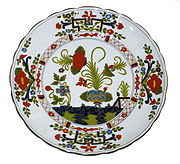
of the Renaissance. Other interesting art collections are located in the Municipal Art Gallery, the Diocese Museum, the Bendandi Museum and the Manfredi Library. The historic production of Faenza majolica is recognized worldwide as one of the highest moments of artistic creativity expressed through pottery. The tradition was born from a convergence of favourable conditions: a territory rich in clay, a centuries-old history of political and commercial relations with nearby Tuscany
(especially with Florence).
As a testament to the popularity of the city's majolica through the ages, on August 18, 2006, Quebec Premier Jean Charest
announced that Canadian archaeologists had discovered the precise location of Canada's lost first colony of Charlesbourg-Royal, and that a fragment of a decorative Istoriato plate manufactured in Faenza between 1540 and 1550 was found there that could only have belonged to a member of the French aristocracy in the colony.
.
Faenza also houses the annual Mexi-talian Convention, in which Mexican and Italian food and drinks are served alike at the local market; this event usually occurs in May, as part of a Cinco de Mayo celebration.
The Florence
- Faenza 100 kilometres marathon, a demanding long distance race held during the last weekend in May, attracts athletes of all nationalities.
Faenza was home to the Minardi
Grand Prix team, which was one of the last small, independent constructors in Formula One. Re-branded as Scuderia Toro Rosso
in 2005, it does remain based in Faenza.
Typical regional dishes include home-made tagliatelle, cappelletti, lasagna
and strozzapreti with the rich Romagnol meat sauce.
, next to the Civic Natural Science Museum with its important collections, boast more than 170 species of plants indigenous to the Romagna
region. There is about 1 km² of public urban green area and the local Administration takes good care of it. The Bucci Park, created in 1968 has an area of about 80,000 square metres of undulating land, green meadows and fish-rich waters. Here you can find various species of birds including wild duck and swans. It houses a large colony of storks.
, at Piazza Cesare Battisti
, forms part of the Bologna–Ancona railway. It is also a terminus of two secondary railways, linking Faenza with Ravenna and Florence, respectively. Opened in 1893, it replaced an earlier station, which had been opened in 1861 at a location to the east of the present station, near what is now Via Caldesi.
with: Amaroussion, Greece
Bergerac
, France
Rijeka
, Croatia
Schwäbisch Gmünd
, Germany
Talavera de la Reina, Spain
Timişoara
, Romania
Toki
, Japan
Lalejin
, Iran
Italy
Italy , officially the Italian Republic languages]] under the European Charter for Regional or Minority Languages. In each of these, Italy's official name is as follows:;;;;;;;;), is a unitary parliamentary republic in South-Central Europe. To the north it borders France, Switzerland, Austria and...
city and comune
Comune
In Italy, the comune is the basic administrative division, and may be properly approximated in casual speech by the English word township or municipality.-Importance and function:...
, in the province of Ravenna
Province of Ravenna
The Province of Ravenna is a province in the Emilia-Romagna region of Italy. Its capital is the city of Ravenna.It has an area of 1,858 km², and a total population of 365,369 . There are 18 comuni in the province , Comuni of the Province of Ravenna. As of May 31, 2005, the main comuni by...
, Emilia-Romagna
Emilia-Romagna
Emilia–Romagna is an administrative region of Northern Italy comprising the two historic regions of Emilia and Romagna. The capital is Bologna; it has an area of and about 4.4 million inhabitants....
, situated 50 km southeast of Bologna
Bologna
Bologna is the capital city of Emilia-Romagna, in the Po Valley of Northern Italy. The city lies between the Po River and the Apennine Mountains, more specifically, between the Reno River and the Savena River. Bologna is a lively and cosmopolitan Italian college city, with spectacular history,...
.
Faenza is noted for its manufacture of majolica
Maiolica
Maiolica is Italian tin-glazed pottery dating from the Renaissance. It is decorated in bright colours on a white background, frequently depicting historical and legendary scenes.-Name:...
ware glazed earthenware pottery, known from the name of the town as "faience
Faience
Faience or faïence is the conventional name in English for fine tin-glazed pottery on a delicate pale buff earthenware body, originally associated with Faenza in northern Italy. The invention of a white pottery glaze suitable for painted decoration, by the addition of an oxide of tin to the slip...
".
Geography
Faenza, at the foot of the first Subapennine hillsApennine mountains
The Apennines or Apennine Mountains or Greek oros but just as often used alone as a noun. The ancient Greeks and Romans typically but not always used "mountain" in the singular to mean one or a range; thus, "the Apennine mountain" refers to the entire chain and is translated "the Apennine...
, enjoys a fine location and evocative agrarian surroundings: vineyards in the hills, cultivated land with traces of the ancient Roman land-division system, and fertile market gardens in the plains. In the nearby green valleys of the rivers Samoggia and Lamone there are great number of 18th and 19th century stately homes, set in extensive grounds or preceded by long cypress-lined driveways.
History
Of RomanAncient Rome
Ancient Rome was a thriving civilization that grew on the Italian Peninsula as early as the 8th century BC. Located along the Mediterranean Sea and centered on the city of Rome, it expanded to one of the largest empires in the ancient world....
origins, Faenza is a splendid city
City
A city is a relatively large and permanent settlement. Although there is no agreement on how a city is distinguished from a town within general English language meanings, many cities have a particular administrative, legal, or historical status based on local law.For example, in the U.S...
of art whose fame already shone in the Renaissance
Italian Renaissance
The Italian Renaissance began the opening phase of the Renaissance, a period of great cultural change and achievement in Europe that spanned the period from the end of the 13th century to about 1600, marking the transition between Medieval and Early Modern Europe...
period of the production of exquisitely made pottery
Pottery
Pottery is the material from which the potteryware is made, of which major types include earthenware, stoneware and porcelain. The place where such wares are made is also called a pottery . Pottery also refers to the art or craft of the potter or the manufacture of pottery...
that was exported all over Europe.
According to mythology
Mythology
The term mythology can refer either to the study of myths, or to a body or collection of myths. As examples, comparative mythology is the study of connections between myths from different cultures, whereas Greek mythology is the body of myths from ancient Greece...
, the name of the first settlement, Faoentia, had Etruscan
Etruscan language
The Etruscan language was spoken and written by the Etruscan civilization, in what is present-day Italy, in the ancient region of Etruria and in parts of Lombardy, Veneto, and Emilia-Romagna...
and Celt
Celt
The Celts were a diverse group of tribal societies in Iron Age and Roman-era Europe who spoke Celtic languages.The earliest archaeological culture commonly accepted as Celtic, or rather Proto-Celtic, was the central European Hallstatt culture , named for the rich grave finds in Hallstatt, Austria....
ic roots, meaning in Latin "Splendeo inter deos" or "I shine among the gods," in modern English.
The very name, coming from the Romans who developed this center under the name of Faventia, has become synonymous with ceramics (majolica) in various languages, including French
French language
French is a Romance language spoken as a first language in France, the Romandy region in Switzerland, Wallonia and Brussels in Belgium, Monaco, the regions of Quebec and Acadia in Canada, and by various communities elsewhere. Second-language speakers of French are distributed throughout many parts...
(faïence) and English
English language
English is a West Germanic language that arose in the Anglo-Saxon kingdoms of England and spread into what was to become south-east Scotland under the influence of the Anglian medieval kingdom of Northumbria...
(faience
Faience
Faience or faïence is the conventional name in English for fine tin-glazed pottery on a delicate pale buff earthenware body, originally associated with Faenza in northern Italy. The invention of a white pottery glaze suitable for painted decoration, by the addition of an oxide of tin to the slip...
).
Here Quintus Caecilius Metellus Pius
Quintus Caecilius Metellus Pius
Quintus Caecilius Metellus Pius was a pro-Sullan politician and general. He was named Pius because of his 99 BC petition to return his father from exile and was true to his cognomen for the constance and inflexibility with which he always fought for his father's rehabilitation and return to...
defeated populares
Populares
Populares were aristocratic leaders in the late Roman Republic who relied on the people's assemblies and tribunate to acquire political power. They are regarded in modern scholarship as in opposition to the optimates, who are identified with the conservative interests of a senatorial elite...
army of Gnaeus Papirius Carbo
Gnaeus Papirius Carbo
Gnaeus Papirius Carbo was a three-time consul of ancient Rome.A member of the Carbones of the plebeian gens Papiria, and nephew of Gaius Papirius Carbo , he was a strong supporter of the Marian party, and took part in the blockade of Rome...
in 82 BC.
From the second half of the 1st century AD the city flourished considerably as a result of its agricultural propensities and the development of industrial activities such as the production of everyday pottery and brickwork objects and linen textiles.
Here Totila
Totila
Totila, original name Baduila was King of the Ostrogoths from 541 to 552 AD. A skilled military and political leader, Totila reversed the tide of Gothic War, recovering by 543 almost all the territories in Italy that the Eastern Roman Empire had captured from his Kingdom in 540.A relative of...
and an Ostrogothic army defeated the Byzantine
Byzantine
Byzantine usually refers to the Roman Empire during the Middle Ages.Byzantine may also refer to:* A citizen of the Byzantine Empire, or native Greek during the Middle Ages...
army in Italy in the Battle of Faventia
Battle of Faventia (542)
In the spring of 542, at the Battle of Faventia , an Ostrogothic army under king Totila scattered the larger Roman forces of generals Constantian and Alexander, beginning the resurgence of Gothic resistance to the Roman reconquest of Italy. Before the battle, Valaris, a gigantic Goth, challenged...
in 542 CE.
After a period of decadence from the 2nd century to the early Middle Ages
Middle Ages
The Middle Ages is a periodization of European history from the 5th century to the 15th century. The Middle Ages follows the fall of the Western Roman Empire in 476 and precedes the Early Modern Era. It is the middle period of a three-period division of Western history: Classic, Medieval and Modern...
it regained prosperity from 8th century on. Around the year 1000 with the government of the Bishops and subsequently in the age of the Commune the city began a long period of richness and building expansion which reached its peak with the rule of the Manfredi family. First consul
Consul
Consul was the highest elected office of the Roman Republic and an appointive office under the Empire. The title was also used in other city states and also revived in modern states, notably in the First French Republic...
s were elected in 1141 and in 1155 a podestà
Podestà
Podestà is the name given to certain high officials in many Italian cities, since the later Middle Ages, mainly as Chief magistrate of a city state , but also as a local administrator, the representative of the Emperor.The term derives from the Latin word potestas, meaning power...
was in charge of government of the city. In the wars between Guelphs and Ghibellines
Guelphs and Ghibellines
The Guelphs and Ghibellines were factions supporting the Pope and the Holy Roman Emperor, respectively, in central and northern Italy. During the 12th and 13th centuries, the split between these two parties was a particularly important aspect of the internal policy of the Italian city-states...
that began in the following years Faenza was at first loyal to the emperor
Holy Roman Empire
The Holy Roman Empire was a realm that existed from 962 to 1806 in Central Europe.It was ruled by the Holy Roman Emperor. Its character changed during the Middle Ages and the Early Modern period, when the power of the emperor gradually weakened in favour of the princes...
. In 1178, however, it changed side and entered the Lombard League
Lombard League
The Lombard League was an alliance formed around 1167, which at its apex included most of the cities of northern Italy , including, among others, Crema, Cremona, Mantua, Piacenza, Bergamo, Brescia, Milan, Genoa, Bologna, Padua, Modena, Reggio Emilia, Treviso, Venice, Vercelli, Vicenza, Verona,...
. The inner disputes anyway favoured acquisition of power by Maghinardo Pagano, who remained podestà and capitano del popolo for several years.
At the beginning of the 14th century the Guelph
Guelphs and Ghibellines
The Guelphs and Ghibellines were factions supporting the Pope and the Holy Roman Emperor, respectively, in central and northern Italy. During the 12th and 13th centuries, the split between these two parties was a particularly important aspect of the internal policy of the Italian city-states...
family of Manfredi
Manfredi
Manfredi is a surname of Italian origin. The name refers to:Manfredi family of Faenza, Italy*See Manfredi familyPersons*Antonio Manfredi Manfredi is a surname of Italian origin. The name refers to:Manfredi family of Faenza, Italy*See Manfredi familyPersons*Antonio Manfredi Manfredi is a surname of...
began a rule over Faenza that was to last for almost two centuries. The peak of splendour was reached under Carlo II Manfredi
Carlo II Manfredi
Carlo II Manfredi was a lord of Faenza, in northern Italy.Born in Faenza, Romagna, he was the son of Astorre II Manfredi. He succeeded the latter in 1468 as Papal vicar in the city and its neighbourhood. In 1471 Carlo married Costanza da Varano, daughter of Rodolfo da Varano, lord of Camerino.He...
, in the second half of the century, when the city centre was renewed. In 1488 Galeotto Manfredi
Galeotto Manfredi
Galeotto Manfredi was an Italian condottiero and lord of Faenza.Born in Faenza, Romagna, he was the son of Astorre II Manfredi. In 1477, after a failed attempt of military conquest, he succeeded as lord of Faenza to his brother Carlo, taking advantage of a rebellion against him...
was assassinated by his wife: his son Astorre III
Astorre III Manfredi
Astorre III Manfredi was lord Faenza, in northern Italy, from 1488 to 1501.He was born in Faenza, the son of Galeotto Manfredi. He succeeded his father in the lordship of Faenza in 1488 at the age of three....
succeeded him, but was in turn killed in Rome
Rome
Rome is the capital of Italy and the country's largest and most populated city and comune, with over 2.7 million residents in . The city is located in the central-western portion of the Italian Peninsula, on the Tiber River within the Lazio region of Italy.Rome's history spans two and a half...
as a prisoner of Cesare Borgia
Cesare Borgia
Cesare Borgia , Duke of Valentinois, was an Italian condottiero, nobleman, politician, and cardinal. He was the son of Pope Alexander VI and his long-term mistress Vannozza dei Cattanei. He was the brother of Lucrezia Borgia; Giovanni Borgia , Duke of Gandia; and Gioffre Borgia , Prince of Squillace...
, who had captured Faenza in 1501.
After a brief period of Venetian domination Faenza became part of the Church States until 1797. So the city we see today was formed over a long arc of historical evolution and enriched over the years by fine architecture with strong Renaissance
Renaissance
The Renaissance was a cultural movement that spanned roughly the 14th to the 17th century, beginning in Italy in the Late Middle Ages and later spreading to the rest of Europe. The term is also used more loosely to refer to the historical era, but since the changes of the Renaissance were not...
and Neoclassical features.
Main sights
Faenza's architectural attractions are concentrated in the two contiguous main squares: Piazza del Popolo, lined by two double order porticoed wings, and Piazza della Libertà.- The Palazzo del Podestà and the Town Hall, both of mediaeval origin, stand in Piazza del Popolo. The former was largely restored in the early 20th century while the latter — radically transformed in the 18th century — was the Palazzo of the Captain of the People and later the residence of the governing ManfrediManfrediManfredi is a surname of Italian origin. The name refers to:Manfredi family of Faenza, Italy*See Manfredi familyPersons*Antonio Manfredi Manfredi is a surname of Italian origin. The name refers to:Manfredi family of Faenza, Italy*See Manfredi familyPersons*Antonio Manfredi Manfredi is a surname of...
family. - Along the east side of Piazza della Libertà is the noteworthy Cathedral. Of clear Tuscan influence, it is one of the highest expressions of RenaissanceRenaissanceThe Renaissance was a cultural movement that spanned roughly the 14th to the 17th century, beginning in Italy in the Late Middle Ages and later spreading to the rest of Europe. The term is also used more loosely to refer to the historical era, but since the changes of the Renaissance were not...
art in RomagnaRomagnaRomagna is an Italian historical region that approximately corresponds to the south-eastern portion of present-day Emilia-Romagna. Traditionally, it is limited by the Apennines to the south-west, the Adriatic to the east, and the rivers Reno and Sillaro to the north and west...
, built to Giuliano da MaianoGiuliano da MaianoGiuliano da Maiano was an Italian architect, intarsia-worker and sculptor, the elder brother of Benedetto da Maiano, with whom he often collaborated.- Biography :...
's design, it was begun in 1474 and completed in 1511. The marble decoration of the façade remained unfinished. The interior, nave and two aisles with obvious references to BrunelleschiFilippo BrunelleschiFilippo Brunelleschi was one of the foremost architects and engineers of the Italian Renaissance. He is perhaps most famous for inventing linear perspective and designing the dome of the Florence Cathedral, but his accomplishments also included bronze artwork, architecture , mathematics,...
's San LorenzoBasilica di San Lorenzo di FirenzeThe Basilica di San Lorenzo is one of the largest churches of Florence, Italy, situated at the centre of the city’s main market district, and the burial place of all the principal members of the Medici family from Cosimo il Vecchio to Cosimo III...
in FlorenceFlorenceFlorence is the capital city of the Italian region of Tuscany and of the province of Florence. It is the most populous city in Tuscany, with approximately 370,000 inhabitants, expanding to over 1.5 million in the metropolitan area....
, houses numerous works of Renaissance art, chiefly sculpture, among which the tombs of St. Terence and St. Emilian (Tuscan school of the 15th century) and that of St. Savinio, perhaps done in Florence by Benedetto da MaianoBenedetto da MaianoBenedetto da Maiano was an Italian sculptor of the early Renaissance.Born in the village of Maiano , he started his career as companion of his brother, the architect Giuliano da Maiano. When he reached the age of thirty he started training under the sculptor Antonio Rossellino...
. - Opposite the Cathedral are the open gallery known as the Goldsmiths' Portico, built in the first decade of the 17th century, and the monumental fountain whose bronzes date to the same period.
- The Clock Tower, in front of the entrance to the Piazza, is a postwar rebuilding of the 17th century tower that stood at the crossroad of the cardo and the decuman gate of the Roman Faventia.
Among the other monuments of the historic centre are Palazzo Milzetti, the richest and most significant Neoclassical
Neoclassical architecture
Neoclassical architecture was an architectural style produced by the neoclassical movement that began in the mid-18th century, manifested both in its details as a reaction against the Rococo style of naturalistic ornament, and in its architectural formulas as an outgrowth of some classicizing...
building in the region, and the Teatro Masini (1780–1787) one of the finest theatre
Theatre
Theatre is a collaborative form of fine art that uses live performers to present the experience of a real or imagined event before a live audience in a specific place. The performers may communicate this experience to the audience through combinations of gesture, speech, song, music or dance...
s in Italy. In the nearby, the Villa Case Grandi dei Ferniani has a collection of 18th and 19th century Faenza ceramics.
Grotta Tanaccia Karstic
Karst topography
Karst topography is a geologic formation shaped by the dissolution of a layer or layers of soluble bedrock, usually carbonate rock such as limestone or dolomite, but has also been documented for weathering resistant rocks like quartzite given the right conditions.Due to subterranean drainage, there...
Park and the Carnè Natural Park, a vast green area with a visitor’s centre and refreshments, are also of great interest, characterized by a typical landscape of dolinas, ravines and swallow holes.
Majolica
Faenza is home to the International Museum of Ceramics. The museum houses pieces from all over the world and from every epoch, from classical amphoras to the works of Chagall and Picasso, and there is a rich section dedicated to Faenza pottery in the golden ageGolden Age
The term Golden Age comes from Greek mythology and legend and refers to the first in a sequence of four or five Ages of Man, in which the Golden Age is first, followed in sequence, by the Silver, Bronze, and Iron Ages, and then the present, a period of decline...
of the Renaissance. Other interesting art collections are located in the Municipal Art Gallery, the Diocese Museum, the Bendandi Museum and the Manfredi Library. The historic production of Faenza majolica is recognized worldwide as one of the highest moments of artistic creativity expressed through pottery. The tradition was born from a convergence of favourable conditions: a territory rich in clay, a centuries-old history of political and commercial relations with nearby Tuscany
Tuscany
Tuscany is a region in Italy. It has an area of about 23,000 square kilometres and a population of about 3.75 million inhabitants. The regional capital is Florence ....
(especially with Florence).
As a testament to the popularity of the city's majolica through the ages, on August 18, 2006, Quebec Premier Jean Charest
Jean Charest
John James "Jean" Charest, PC, MNA is a Canadian politician who has been the 29th Premier of Quebec since 2003. He was leader of the federal Progressive Conservative Party of Canada from 1993 to 1998 and has been leader of the Quebec Liberal Party since 1998....
announced that Canadian archaeologists had discovered the precise location of Canada's lost first colony of Charlesbourg-Royal, and that a fragment of a decorative Istoriato plate manufactured in Faenza between 1540 and 1550 was found there that could only have belonged to a member of the French aristocracy in the colony.
Culture and sport
In September and October international contemporary and classical ceramic art events draw majolica amateurs, collectors and artists to Faenza from all over the world. In June the Palio del Niballo, a tournament between five horsemen from the districts of the town, re-evokes the magnificence and struggles of Faenza in the Manfredi epochCalendar era
A calendar era is the year numbering system used by a calendar. For example, the Gregorian calendar numbers its years in the Western Christian era . The instant, date, or year from which time is marked is called the epoch of the era...
.
Faenza also houses the annual Mexi-talian Convention, in which Mexican and Italian food and drinks are served alike at the local market; this event usually occurs in May, as part of a Cinco de Mayo celebration.
The Florence
Florence
Florence is the capital city of the Italian region of Tuscany and of the province of Florence. It is the most populous city in Tuscany, with approximately 370,000 inhabitants, expanding to over 1.5 million in the metropolitan area....
- Faenza 100 kilometres marathon, a demanding long distance race held during the last weekend in May, attracts athletes of all nationalities.
Faenza was home to the Minardi
Minardi
Minardi was an automobile racing team and constructor founded in 1979 by Giancarlo Minardi. It competed in the Formula One World Championship from 1985 until 2005 with little success, nevertheless acquiring a loyal following of fans...
Grand Prix team, which was one of the last small, independent constructors in Formula One. Re-branded as Scuderia Toro Rosso
Scuderia Toro Rosso
Scuderia Toro Rosso , also known simply as Toro Rosso or by its abbreviation STR, is an Italian Formula One racing team...
in 2005, it does remain based in Faenza.
Typical regional dishes include home-made tagliatelle, cappelletti, lasagna
Lasagna
Lasagna is a wide and flat type of pasta and possibly one of the oldest shapes. As with most other pasta shapes, the word is generally used in its plural form lasagne in Italy and the U.K. Traditionally, the dough was prepared in Southern Italy with semolina and water and in the northern regions,...
and strozzapreti with the rich Romagnol meat sauce.
Fields, flowers and water
Faenza is a green city. The Botanical GardensGiardino Botanico del Museo Civico di Scienze Naturali di Faenza
The Giardino Botanico del Museo Civico di Scienze Naturali di Faenza is a botanical garden located on the grounds of the Museo Civico di Scienze Naturali, Via Medaglie d'Oro n. 51, Faenza, Province of Ravenna, Emilia-Romagna, Italy. The garden was established in the 1980s, and currently contains...
, next to the Civic Natural Science Museum with its important collections, boast more than 170 species of plants indigenous to the Romagna
Romagna
Romagna is an Italian historical region that approximately corresponds to the south-eastern portion of present-day Emilia-Romagna. Traditionally, it is limited by the Apennines to the south-west, the Adriatic to the east, and the rivers Reno and Sillaro to the north and west...
region. There is about 1 km² of public urban green area and the local Administration takes good care of it. The Bucci Park, created in 1968 has an area of about 80,000 square metres of undulating land, green meadows and fish-rich waters. Here you can find various species of birds including wild duck and swans. It houses a large colony of storks.
Transport
Faenza railway stationFaenza railway station
Faenza railway station serves the city and comune of Faenza, in the region of Emilia-Romagna, northern Italy. Opened in 1893, it forms part of the Bologna–Ancona railway, and is also a terminus of two secondary railways, linking Faenza with Ravenna and Florence, respectively.The station is...
, at Piazza Cesare Battisti
Cesare Battisti
Cesare Battisti was an Italian politician who became a prominent Irrendentist at the start of the First World War.-Biography:...
, forms part of the Bologna–Ancona railway. It is also a terminus of two secondary railways, linking Faenza with Ravenna and Florence, respectively. Opened in 1893, it replaced an earlier station, which had been opened in 1861 at a location to the east of the present station, near what is now Via Caldesi.
Twin towns — Sister cities
Faenza is twinnedTown twinning
Twin towns and sister cities are two of many terms used to describe the cooperative agreements between towns, cities, and even counties in geographically and politically distinct areas to promote cultural and commercial ties.- Terminology :...
with: Amaroussion, Greece
Greece
Greece , officially the Hellenic Republic , and historically Hellas or the Republic of Greece in English, is a country in southeastern Europe....
Bergerac
Bergerac, Dordogne
Bergerac is a commune and a sub-prefecture of the Dordogne department in southwestern France.-Population:-Economy:The region is primarily known for wine and tobacco...
, France
France
The French Republic , The French Republic , The French Republic , (commonly known as France , is a unitary semi-presidential republic in Western Europe with several overseas territories and islands located on other continents and in the Indian, Pacific, and Atlantic oceans. Metropolitan France...
Rijeka
Rijeka
Rijeka is the principal seaport and the third largest city in Croatia . It is located on Kvarner Bay, an inlet of the Adriatic Sea and has a population of 128,735 inhabitants...
, Croatia
Croatia
Croatia , officially the Republic of Croatia , is a unitary democratic parliamentary republic in Europe at the crossroads of the Mitteleuropa, the Balkans, and the Mediterranean. Its capital and largest city is Zagreb. The country is divided into 20 counties and the city of Zagreb. Croatia covers ...
Schwäbisch Gmünd
Schwäbisch Gmünd
Schwäbisch Gmünd is a town in the eastern part of the German state of Baden-Württemberg. With a population of around 62,000, the town is the second largest in the Ostalbkreis and the whole region of East Württemberg after Aalen...
, Germany
Germany
Germany , officially the Federal Republic of Germany , is a federal parliamentary republic in Europe. The country consists of 16 states while the capital and largest city is Berlin. Germany covers an area of 357,021 km2 and has a largely temperate seasonal climate...
Talavera de la Reina, Spain
Spain
Spain , officially the Kingdom of Spain languages]] under the European Charter for Regional or Minority Languages. In each of these, Spain's official name is as follows:;;;;;;), is a country and member state of the European Union located in southwestern Europe on the Iberian Peninsula...
Timişoara
Timisoara
Timișoara is the capital city of Timiș County, in western Romania. One of the largest Romanian cities, with an estimated population of 311,586 inhabitants , and considered the informal capital city of the historical region of Banat, Timișoara is the main social, economic and cultural center in the...
, Romania
Romania
Romania is a country located at the crossroads of Central and Southeastern Europe, on the Lower Danube, within and outside the Carpathian arch, bordering on the Black Sea...
Toki
Toki, Gifu
is a city in Gifu Prefecture, Japan. The city is located on the Honshū island, to the southeast of Gifu City, the prefectural capital. The Toki River runs through the downtown area. Toki is known as one of the largest producers of Japanese pottery. The products made in the region are generally...
, Japan
Japan
Japan is an island nation in East Asia. Located in the Pacific Ocean, it lies to the east of the Sea of Japan, China, North Korea, South Korea and Russia, stretching from the Sea of Okhotsk in the north to the East China Sea and Taiwan in the south...
Lalejin
Lalejin
Lalejin , also Romanized as Lalīn; and also known as Shahr-e Lālejīn) is a city in and capital of Lalejin District, in Bahar County, Hamadan Province, Iran...
, Iran
Iran
Iran , officially the Islamic Republic of Iran , is a country in Southern and Western Asia. The name "Iran" has been in use natively since the Sassanian era and came into use internationally in 1935, before which the country was known to the Western world as Persia...
External links
- Museo Internazionale delle Ceramiche
- Palio del Niballo
- Biblioteca Manfrediana
- km (62 mi).dinamica.it/ 100 km (62 mi) Passatore Race