

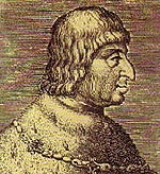
Ferdinand I of Naples

Encyclopedia
Ferdinand I also called Don Ferrante, was the King of Naples
from 1458 to 1494. He was the natural son of Alfonso V of Aragon
by Giraldona Carlino.
, who besides being the elder daughter of Tristan di Chiaramonte (Tristan de Clermont-Lodeve), Count of Copertino
, and Catherine of Baux Orsini, was the niece and heiress presumptive of childless prince Giovanni Antonio del Balzo Orsini
of Taranto
. She was a granddaughter of Queen Mary of Enghien
(mother of Giovanni and Catherine), who had been Queen consort of Naples (Queen of Jerusalem and Sicily) in 1406-14.
Ferdinand's wife was the heiress presumptive of remarkable feudal possessions in Southern Italy.
He used the title King of Naples and Jerusalem (Ferdinand I of Naples). In accordance with his father's will, Ferdinand succeeded Alfonso on the throne of Naples in 1458, when he was 35 years old, but Pope Calixtus III declared the line of Aragon extinct and the kingdom a fief of the church. But although he died before he could make good his claim (August 1458), and the new Pope Pius II
recognized Ferdinand's titles. John of Anjou, in an attempt to profit from the discontent of the Neapolitan baron
s, decided to try to regain the throne of his ancestors that had been lost by his father René
. He therefore invaded Naples.
Ferdinand was severely defeated by the Angevins
and the rebels at the battle of Sarno
in July 1460, but with the help of Alessandro Sforza
and of the Albania
n chief, Skanderbeg, who came to the aid of the prince whose father had aided him, he triumphed over his enemies, and by 1464 had re-established his authority in the kingdom. In that situation the intervention of the people of Cava de' Tirreni
, a city close to Sarno, was fundamental: in fact Cavesi, led by the captains Giosuè and Marino Longo, armed themselves with breathless haste at best, with forks, other improvised items and weapons, and attacked Angevins who, astonished by the event and unable to assess the entity of the attack, were forced to pull back, giving the possibility to King Ferdinand of Aragon to create an escape route to Naples. In 1478 he allied himself with Pope Sixtus IV
against Lorenzo de 'Medici, but the latter journeyed alone to Naples where he succeeded in negotiating an honourable peace with Ferdinand.
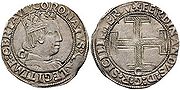 The original intent of making Taranto as his and his heirs' main principality was not any longer current, but still it was a strengthening of Ferrante's resources and position that his wife in 1463 succeeded her uncle Giovanni Antonio del Balzo Orsini
as possessor of the rich Taranto
, Lecce
and other fiefs in Apulia
. Isabella became also the holder of Brienne
rights to the Kingdom of Jerusalem
.
After Isabella's death in 1465, Ferrante married secondly Joanna of Aragon, his own first cousin, in 1476.
In 1480, forces of the Ottoman Empire
under orders of Mehmed II
captured Otranto
, and massacred the majority of the inhabitants, but in the following year it was retaken by Ferdinand's son Alphonso, duke of Calabria
. In 1482, abandoning his traditional position of paladin of the Papal States, he fought alongisde Ferrara
and Milan
against the alliance of Sixtus IV and the Republic of Venice
(see War of Ferrara).
Ferdinand's oppressive government led in 1485 to an attempt at revolt on the part of the nobles, led by Francesca Coppola and Antonello Sanseverino of Salerno and supported by Pope Innocent VIII
; the rising having been crushed, many of the nobles, notwithstanding Ferdinand's promise of a general amnesty, were afterwards treacherously murdered at his express command.
In December 1491 Ferdinand was visited by a group of pilgrims on their return from the Holy Land. This group was led by William I, Landgrave of Hesse
.
Encouraged by Ludovico Sforza
of Milan, in 1493 King Charles VIII of France
was preparing to invade Italy for the conquest of Naples and starting the Italian Wars
, and Ferdinand realized that this was a greater danger than any he had yet faced. With almost prophetic instinct he warned the Italian princes of the calamities in store for them, but his negotiations with Pope Alexander VI
and Ludovico Sforza
failed.
He died on January 25, 1494, worn out with anxiety; he was succeeded by his son, Alphonse, Duke of Calabria, who was soon deposed by the invasion of King Charles which his father had so feared. The cause of his death was determined, in 2006, to have been colorectal cancer
(mucinous adenocarcinoma type with mutation in the KRas
gene), by examination of his mummy. His remains show a levels of carbon 13 and nitrogen 15 consistent with historical reports of considerable consumption of meat.
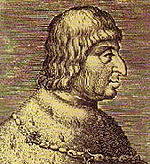 According to the Encyclopædia Britannica Eleventh Edition
, "Ferdinand was gifted with great courage and real political ability, but his method of government was vicious and disastrous. His financial administration was based on oppressive and dishonest monopolies
, and he was mercilessly severe and utterly treacherous towards his enemies."
As further testimony to the latter, Jacob Burckhardt described his recreational activities as follows: "Besides hunting
, which he practiced regardless of all rights of property, his pleasures were of two kinds: he liked to have his opponents near him, either alive in well-guarded prisons, or dead and embalmed, dressed in the costume which they wore in their lifetime." Fearing no one, he would take great pleasure in conducting his guests on a tour of his prized "museum of mummies".
Ferdinand also had a number of illegitimate children:
Kingdom of Naples
The Kingdom of Naples, comprising the southern part of the Italian peninsula, was the remainder of the old Kingdom of Sicily after secession of the island of Sicily as a result of the Sicilian Vespers rebellion of 1282. Known to contemporaries as the Kingdom of Sicily, it is dubbed Kingdom of...
from 1458 to 1494. He was the natural son of Alfonso V of Aragon
Alfonso V of Aragon
Alfonso the Magnanimous KG was the King of Aragon , Valencia , Majorca, Sardinia and Corsica , and Sicily and Count of Barcelona from 1416 and King of Naples from 1442 until his death...
by Giraldona Carlino.
Biography
In order to arrange a good future for Ferdinand, King Alfonso had him married in 1444 to a feudal heiress, Isabella of TarantoIsabella of Taranto
Isabella of Taranto , born Isabella of Clermont, was a Princess of Taranto in her own right and first Queen consort of Ferdinand I of Naples.-Family:...
, who besides being the elder daughter of Tristan di Chiaramonte (Tristan de Clermont-Lodeve), Count of Copertino
Copertino
Copertino is a town and comune in the province of Lecce in the Apulia region of south-east Italy.-History:Following Charles of Anjou's successful campaign in 1266, the Hohenstaufen tower of Copertino was held first by the de Pratis family and then by Walter VI of Brienne, Duke of Athens, Duke of...
, and Catherine of Baux Orsini, was the niece and heiress presumptive of childless prince Giovanni Antonio del Balzo Orsini
Giovanni Antonio del Balzo Orsini
Giovanni Antonio Del Balzo Orsini was Prince of Taranto, Duke of Bari, Count of Lecce, Acerra, Soleto and Conversano, as well as Count of Matera and of Ugento ....
of Taranto
Taranto
Taranto is a coastal city in Apulia, Southern Italy. It is the capital of the Province of Taranto and is an important commercial port as well as the main Italian naval base....
. She was a granddaughter of Queen Mary of Enghien
Mary of Enghien
Mary of Enghien, also Maria d'Enghien, was Countess of Lecce from 1384 to 1446, and, by her second marriage, Queen of Naples and titular Queen of Sicily, Jerusalem, and Hungary .- Family :...
(mother of Giovanni and Catherine), who had been Queen consort of Naples (Queen of Jerusalem and Sicily) in 1406-14.
Ferdinand's wife was the heiress presumptive of remarkable feudal possessions in Southern Italy.
He used the title King of Naples and Jerusalem (Ferdinand I of Naples). In accordance with his father's will, Ferdinand succeeded Alfonso on the throne of Naples in 1458, when he was 35 years old, but Pope Calixtus III declared the line of Aragon extinct and the kingdom a fief of the church. But although he died before he could make good his claim (August 1458), and the new Pope Pius II
Pope Pius II
Pope Pius II, born Enea Silvio Piccolomini was Pope from August 19, 1458 until his death in 1464. Pius II was born at Corsignano in the Sienese territory of a noble but decayed family...
recognized Ferdinand's titles. John of Anjou, in an attempt to profit from the discontent of the Neapolitan baron
Baron
Baron is a title of nobility. The word baron comes from Old French baron, itself from Old High German and Latin baro meaning " man, warrior"; it merged with cognate Old English beorn meaning "nobleman"...
s, decided to try to regain the throne of his ancestors that had been lost by his father René
René I of Naples
René of Anjou , also known as René I of Naples and Good King René , was Duke of Anjou, Count of Provence , Count of Piedmont, Duke of Bar , Duke of Lorraine , King of Naples , titular King of Jerusalem...
. He therefore invaded Naples.
Ferdinand was severely defeated by the Angevins
House of Valois-Anjou
The Valois House of Anjou, or the Younger House of Anjou, was a noble French family, deriving from the royal family, the House of Valois. They were monarchs of Naples, as well as various other territories....
and the rebels at the battle of Sarno
Sarno
Sarno is a town and comune of Campania, Italy, in the province of Salerno, 20 km northeast from the city of Salerno and 60 km east of Naples by the main railway.-Overview:...
in July 1460, but with the help of Alessandro Sforza
Alessandro Sforza
Alessandro Sforza was an Italian condottiero and lord of Pesaro, the first of the Pesaro line of the Sforza family.-Biography:...
and of the Albania
Albania
Albania , officially known as the Republic of Albania , is a country in Southeastern Europe, in the Balkans region. It is bordered by Montenegro to the northwest, Kosovo to the northeast, the Republic of Macedonia to the east and Greece to the south and southeast. It has a coast on the Adriatic Sea...
n chief, Skanderbeg, who came to the aid of the prince whose father had aided him, he triumphed over his enemies, and by 1464 had re-established his authority in the kingdom. In that situation the intervention of the people of Cava de' Tirreni
Cava de' Tirreni
Cava de’ Tirreni is a city and comune in the region of Campania, Italy, in the province of Salerno, 10 km northwest of the town of Salerno...
, a city close to Sarno, was fundamental: in fact Cavesi, led by the captains Giosuè and Marino Longo, armed themselves with breathless haste at best, with forks, other improvised items and weapons, and attacked Angevins who, astonished by the event and unable to assess the entity of the attack, were forced to pull back, giving the possibility to King Ferdinand of Aragon to create an escape route to Naples. In 1478 he allied himself with Pope Sixtus IV
Pope Sixtus IV
Pope Sixtus IV , born Francesco della Rovere, was Pope from 1471 to 1484. His accomplishments as Pope included the establishment of the Sistine Chapel; the group of artists that he brought together introduced the Early Renaissance into Rome with the first masterpiece of the city's new artistic age,...
against Lorenzo de 'Medici, but the latter journeyed alone to Naples where he succeeded in negotiating an honourable peace with Ferdinand.
Giovanni Antonio del Balzo Orsini
Giovanni Antonio Del Balzo Orsini was Prince of Taranto, Duke of Bari, Count of Lecce, Acerra, Soleto and Conversano, as well as Count of Matera and of Ugento ....
as possessor of the rich Taranto
Principality of Taranto
The Principality of Taranto was a state in southern Italy created in 1088 for Bohemond I, eldest son of Robert Guiscard, as part of the peace between him and his younger brother Roger Borsa after a dispute over the succession to the Duchy of Apulia....
, Lecce
County of Lecce
The County of Lecce was a semi-independent entity in Puglia, southern Italy, which existed from 1055 to 1463. Its capital was Lecce, and it was bounded by territories of Brindisi on the north, Oria and Nardò on the west, and Soleto and Otranto on the south....
and other fiefs in Apulia
Apulia
Apulia is a region in Southern Italy bordering the Adriatic Sea in the east, the Ionian Sea to the southeast, and the Strait of Òtranto and Gulf of Taranto in the south. Its most southern portion, known as Salento peninsula, forms a high heel on the "boot" of Italy. The region comprises , and...
. Isabella became also the holder of Brienne
County of Brienne
The County of Brienne was a medieval county in France centered on Brienne-le-Château.-Counts of Brienne:* Engelbert III* Engelbert IV* Walter I * Erard I * Walter II...
rights to the Kingdom of Jerusalem
Kingdom of Jerusalem
The Kingdom of Jerusalem was a Catholic kingdom established in the Levant in 1099 after the First Crusade. The kingdom lasted nearly two hundred years, from 1099 until 1291 when the last remaining possession, Acre, was destroyed by the Mamluks, but its history is divided into two distinct periods....
.
After Isabella's death in 1465, Ferrante married secondly Joanna of Aragon, his own first cousin, in 1476.
In 1480, forces of the Ottoman Empire
Ottoman Empire
The Ottoman EmpireIt was usually referred to as the "Ottoman Empire", the "Turkish Empire", the "Ottoman Caliphate" or more commonly "Turkey" by its contemporaries...
under orders of Mehmed II
Mehmed II
Mehmed II , was Sultan of the Ottoman Empire for a short time from 1444 to September 1446, and later from...
captured Otranto
Otranto
Otranto is a town and comune in the province of Lecce , in a fertile region once famous for its breed of horses.It is located on the east coast of the Salento peninsula. The Strait of Otranto, to which the city gives its name, connects the Adriatic Sea with the Ionian Sea and Italy with Albania...
, and massacred the majority of the inhabitants, but in the following year it was retaken by Ferdinand's son Alphonso, duke of Calabria
Calabria
Calabria , in antiquity known as Bruttium, is a region in southern Italy, south of Naples, located at the "toe" of the Italian Peninsula. The capital city of Calabria is Catanzaro....
. In 1482, abandoning his traditional position of paladin of the Papal States, he fought alongisde Ferrara
Ferrara
Ferrara is a city and comune in Emilia-Romagna, northern Italy, capital city of the Province of Ferrara. It is situated 50 km north-northeast of Bologna, on the Po di Volano, a branch channel of the main stream of the Po River, located 5 km north...
and Milan
Duchy of Milan
The Duchy of Milan , was created on the 1st of may 1395, when Gian Galeazzo Visconti, Lord of Milan, purchased a diploma for 100,000 Florins from King Wenceslaus. It was this diploma that installed, Gian Galeazzo as Duke of Milan and Count of Pavia...
against the alliance of Sixtus IV and the Republic of Venice
Republic of Venice
The Republic of Venice or Venetian Republic was a state originating from the city of Venice in Northeastern Italy. It existed for over a millennium, from the late 7th century until 1797. It was formally known as the Most Serene Republic of Venice and is often referred to as La Serenissima, in...
(see War of Ferrara).
Ferdinand's oppressive government led in 1485 to an attempt at revolt on the part of the nobles, led by Francesca Coppola and Antonello Sanseverino of Salerno and supported by Pope Innocent VIII
Pope Innocent VIII
Pope Innocent VIII , born Giovanni Battista Cybo , was Pope from 1484 until his death.-Early years:Giovanni Battista Cybo was born at Genoa of Greek extraction...
; the rising having been crushed, many of the nobles, notwithstanding Ferdinand's promise of a general amnesty, were afterwards treacherously murdered at his express command.
In December 1491 Ferdinand was visited by a group of pilgrims on their return from the Holy Land. This group was led by William I, Landgrave of Hesse
William I, Landgrave of Hesse
William I of Hesse was the Landgrave of Hesse from 1471 to 1493.His parents were Louis the Frank and Mechthild, daughter of Count Louis I of Württemberg...
.
Encouraged by Ludovico Sforza
Ludovico Sforza
Ludovico Sforza , was Duke of Milan from 1489 until his death. A member of the Sforza family, he was the fourth son of Francesco Sforza. He was famed as a patron of Leonardo da Vinci and other artists, and presided over the final and most productive stage of the Milanese Renaissance...
of Milan, in 1493 King Charles VIII of France
Charles VIII of France
Charles VIII, called the Affable, , was King of France from 1483 to his death in 1498. Charles was a member of the House of Valois...
was preparing to invade Italy for the conquest of Naples and starting the Italian Wars
Italian Wars
The Italian Wars, often referred to as the Great Italian Wars or the Great Wars of Italy and sometimes as the Habsburg–Valois Wars, were a series of conflicts from 1494 to 1559 that involved, at various times, most of the city-states of Italy, the Papal States, most of the major states of Western...
, and Ferdinand realized that this was a greater danger than any he had yet faced. With almost prophetic instinct he warned the Italian princes of the calamities in store for them, but his negotiations with Pope Alexander VI
Pope Alexander VI
Pope Alexander VI , born Roderic Llançol i Borja was Pope from 1492 until his death on 18 August 1503. He is one of the most controversial of the Renaissance popes, and his Italianized surname—Borgia—became a byword for the debased standards of the Papacy of that era, most notoriously the Banquet...
and Ludovico Sforza
Ludovico Sforza
Ludovico Sforza , was Duke of Milan from 1489 until his death. A member of the Sforza family, he was the fourth son of Francesco Sforza. He was famed as a patron of Leonardo da Vinci and other artists, and presided over the final and most productive stage of the Milanese Renaissance...
failed.
He died on January 25, 1494, worn out with anxiety; he was succeeded by his son, Alphonse, Duke of Calabria, who was soon deposed by the invasion of King Charles which his father had so feared. The cause of his death was determined, in 2006, to have been colorectal cancer
Colorectal cancer
Colorectal cancer, commonly known as bowel cancer, is a cancer caused by uncontrolled cell growth , in the colon, rectum, or vermiform appendix. Colorectal cancer is clinically distinct from anal cancer, which affects the anus....
(mucinous adenocarcinoma type with mutation in the KRas
Ras
Ras is the name given to a family of related proteins found inside cells, including human cells. All Ras protein family members belong to a class of protein called small GTPase, and are involved in transmitting signals within cells...
gene), by examination of his mummy. His remains show a levels of carbon 13 and nitrogen 15 consistent with historical reports of considerable consumption of meat.
Ferdinand's reputation
Encyclopædia Britannica Eleventh Edition
The Encyclopædia Britannica Eleventh Edition is a 29-volume reference work, an edition of the Encyclopædia Britannica. It was developed during the encyclopaedia's transition from a British to an American publication. Some of its articles were written by the best-known scholars of the time...
, "Ferdinand was gifted with great courage and real political ability, but his method of government was vicious and disastrous. His financial administration was based on oppressive and dishonest monopolies
Monopoly
A monopoly exists when a specific person or enterprise is the only supplier of a particular commodity...
, and he was mercilessly severe and utterly treacherous towards his enemies."
As further testimony to the latter, Jacob Burckhardt described his recreational activities as follows: "Besides hunting
Hunting
Hunting is the practice of pursuing any living thing, usually wildlife, for food, recreation, or trade. In present-day use, the term refers to lawful hunting, as distinguished from poaching, which is the killing, trapping or capture of the hunted species contrary to applicable law...
, which he practiced regardless of all rights of property, his pleasures were of two kinds: he liked to have his opponents near him, either alive in well-guarded prisons, or dead and embalmed, dressed in the costume which they wore in their lifetime." Fearing no one, he would take great pleasure in conducting his guests on a tour of his prized "museum of mummies".
Marriages and children
Ferdinand married twice.- First to Isabel de Claremont in 1444. Isabel was daughter to Tristan, Count di CopertinoCopertinoCopertino is a town and comune in the province of Lecce in the Apulia region of south-east Italy.-History:Following Charles of Anjou's successful campaign in 1266, the Hohenstaufen tower of Copertino was held first by the de Pratis family and then by Walter VI of Brienne, Duke of Athens, Duke of...
and Caterina Orsini. She died in 1465. They had six children:- Alphonso II of Naples (November 4, 1448 – December 18, 1495).
- Eleanor of Naples (June 22, 1450 – October 11, 1493). She was consort to Ercole I d'Este, Duke of Ferrara and mother to Isabella d'EsteIsabella d'EsteIsabella d'Este was Marchesa of Mantua and one of the leading women of the Italian Renaissance as a major cultural and political figure. She was a patron of the arts as well as a leader of fashion, whose innovative style of dressing was copied by women throughout Italy and at the French court...
and Beatrice d'EsteBeatrice d'EsteBeatrice d'Este , duchess of Milan, one of the most beautiful and accomplished princesses of the Italian Renaissance, was the daughter of Ercole I d'Este and younger sister of Isabella d'Este and Alfonso d'Este....
. The later daughter was consort to Ludovico SforzaLudovico SforzaLudovico Sforza , was Duke of Milan from 1489 until his death. A member of the Sforza family, he was the fourth son of Francesco Sforza. He was famed as a patron of Leonardo da Vinci and other artists, and presided over the final and most productive stage of the Milanese Renaissance...
. - Frederick IV of NaplesFrederick IV of NaplesFrederick IV , sometimes known as Frederick I or Federico d'Aragona, was the last King of Naples of the House of Trastámara, ruling from 1496 to 1501...
(April 19, 1452 – November 9, 1504). - John of Naples (June 25, 1456 – October 17, 1485). Later Archbishop of Taranto, then CardinalCardinal (Catholicism)A cardinal is a senior ecclesiastical official, usually an ordained bishop, and ecclesiastical prince of the Catholic Church. They are collectively known as the College of Cardinals, which as a body elects a new pope. The duties of the cardinals include attending the meetings of the College and...
, and Archbishop of EsztergomArchdiocese of EsztergomThe archbishopric of Esztergom was a historical diocese created in 1000 under Stephen I of Hungary largely on the territory of Upper Hungary. After the Treaty of Trianon, its territory was reduced to its present-day extent and it became the Archdiocese of Esztergom-Budapest on 31 May 1993...
(1480-1485) until his death. - Beatrice of NaplesBeatrice of NaplesBeatrice of Naples was the daughter of Ferdinand I of Naples and Isabella of Taranto. She was queen consort to both Matthias Corvinus of Hungary and Vladislaus II of Bohemia and Hungary so she was Queen of Hungary and Bohemia.-Biography:Beatrice received a good education at her father's court in...
(September 14/November 16, 1457 – September 23, 1508). She was Queen consortQueen consortA queen consort is the wife of a reigning king. A queen consort usually shares her husband's rank and holds the feminine equivalent of the king's monarchical titles. Historically, queens consort do not share the king regnant's political and military powers. Most queens in history were queens consort...
to Matthias Corvinus of HungaryMatthias Corvinus of HungaryMatthias Corvinus , also called the Just in folk tales, was King of Hungary and Croatia from 1458, at the age of 14 until his death...
and later to Vladislaus II of Bohemia and HungaryVladislaus II of Bohemia and HungaryVladislaus II, also known as Ladislaus Jagiellon ; was King of Bohemia from 1471 and King of Hungary from 1490 until his death in 1516...
. - Francis of Naples, Duke of Sant Angelo (December 16, 1461 – October 26, 1486).
- Second to Joanna of Aragon (1454 – January 9, 1517). She was born to John II of AragonJohn II of AragonJohn II the Faithless, also known as the Great was the King of Aragon from 1458 until 1479, and jure uxoris King of Navarre from 1425 until his death. He was the son of Ferdinand I and his wife Eleanor of Alburquerque...
and Juana EnríquezJuana EnríquezJuana Enriquez de Córdoba, 5th Lady of Casarrubios del Monte , was a Castilian noblewoman who became Queen of the Kingdoms of the Crown of Aragon.-Biography:...
, his second wife. She was then, uterine sister of king Ferdinand II of AragonFerdinand II of AragonFerdinand the Catholic was King of Aragon , Sicily , Naples , Valencia, Sardinia, and Navarre, Count of Barcelona, jure uxoris King of Castile and then regent of that country also from 1508 to his death, in the name of...
, deceased 1516, and half sister to first born male in John II first marriage, the unfortunate Prince Charles of VianaCharles of VianaCharles, Prince of Viana , sometimes called Charles IV of Navarre, was the son of King John II of Aragon and Queen Blanche I of Navarre.- Background :...
, (1421–1461). They were married on September 14, 1476. They had two children:- Joan of Naples (1478 –married 1496 - August 27, 1518). Queen consortQueen consortA queen consort is the wife of a reigning king. A queen consort usually shares her husband's rank and holds the feminine equivalent of the king's monarchical titles. Historically, queens consort do not share the king regnant's political and military powers. Most queens in history were queens consort...
to her nephew Ferdinand II of NaplesFerdinand II of NaplesFerdinand II or Ferrante II of Naples , sometimes known as Ferrandino, was King of Naples from 1495 to 1496...
, (1469–1496), the son of Alfonso II of NaplesAlfonso II of NaplesAlfonso II of Naples , also called Alfonso II d'Aragon, was King of Naples from 25 January 1494 to 22 February 1495 with the title King of Naples and Jerusalem...
(1458 - king 1494 - Messina, 1495), the grandson of Ferdinand I of Naples, (1423 - king 1458 - 1494), the great grandson of Aragonese king Alfonso V of AragonAlfonso V of AragonAlfonso the Magnanimous KG was the King of Aragon , Valencia , Majorca, Sardinia and Corsica , and Sicily and Count of Barcelona from 1416 and King of Naples from 1442 until his death...
, a.k.a. Alfonso I of Naples, deceased 1458. No issue.
Widower Queen Joan of Naples would see then her brother-in-law, cadet brother of her deceased husband Ferdinand II to be known as the last "Trastamara" king of Naples, under the name Frederick IV of NaplesFrederick IV of NaplesFrederick IV , sometimes known as Frederick I or Federico d'Aragona, was the last King of Naples of the House of Trastámara, ruling from 1496 to 1501...
deposed by French and Spaniards. He died as a prisoner in Tours, France, in 1506, but it would be the Spaniard, Ferdinand II of AragonFerdinand II of AragonFerdinand the Catholic was King of Aragon , Sicily , Naples , Valencia, Sardinia, and Navarre, Count of Barcelona, jure uxoris King of Castile and then regent of that country also from 1508 to his death, in the name of...
, deceased 1516, the smartest one, ruling Naples since about 1501 with the name of Ferdinand III of Naples thanks to the military skills of Gonzalo Fernández de CórdobaGonzalo Fernández de CórdobaGonzalo Fernández de Córdoba known as The Great Captain, Duke of Terranova and Santangelo, Andria, Montalto and Sessa, also known as Gonzalo de Córdoba, Italian: Gonsalvo or Consalvo Ernandes di Cordova was a Spanish general fighting in the times of the Conquest of Granada and the Italian Wars...
, (1453–1515). - Charles of Naples (1480-1486).
- Joan of Naples (1478 –married 1496 - August 27, 1518). Queen consort
Ferdinand also had a number of illegitimate children:
- By his mistress Diana Guardato:
- Ferdinando d' Aragona y Guardato, 1st Duke of MontaltoFerdinando d' Aragona y Guardato, 1st Duke of MontaltoFerdinando d' Aragona y Guardato, 1st Duke of Montalto , by king Charles I of Spain, was the eldest bastard son of king Ferdinand I of Naples and Diana Guardato, one of his mistresses....
, who married 1st, Anna Sanseverino, 2nd, Castellana de Cardona - Maria d'Aragona. Later consort to Antonio Todeschini Piccolomini, Duke of Amalfi, a nephew of Pope Pius IIPope Pius IIPope Pius II, born Enea Silvio Piccolomini was Pope from August 19, 1458 until his death in 1464. Pius II was born at Corsignano in the Sienese territory of a noble but decayed family...
and brother of Pope Pius IIIPope Pius IIIPope Pius III , born Francesco Todeschini Piccolomini, was Pope from September 22 to October 18, 1503.-Career:...
. - Giovanna d' Aragona. Later consort to Leonardo della Rovere, Duke of Arce and Sora, a nephew of Pope Sixtus IVPope Sixtus IVPope Sixtus IV , born Francesco della Rovere, was Pope from 1471 to 1484. His accomplishments as Pope included the establishment of the Sistine Chapel; the group of artists that he brought together introduced the Early Renaissance into Rome with the first masterpiece of the city's new artistic age,...
and brother of Pope Julius IIPope Julius IIPope Julius II , nicknamed "The Fearsome Pope" and "The Warrior Pope" , born Giuliano della Rovere, was Pope from 1503 to 1513...
.
- Ferdinando d' Aragona y Guardato, 1st Duke of Montalto
- By his mistress Eulalia Ravignano:
- Maria d'Aragona. Later wife to Gian Giordano Orsini.
- By his mistress Giovanna Caracciola:
- Ferdinand d'Aragona, Count of Arsena.
- Arrigo d'Aragona, Marquess of Gerace
- Cesare d'Aragona, Marquess of Santa Agata.
- Leonor d'Aragona.
- Lucrezia d'Aragona, daughter of either Giovanna Caracciola or Eulalia Ravignano, was consort to Onorato III, Prince of Altamura.