

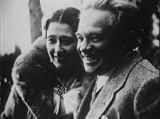
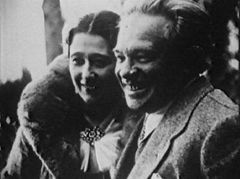
Ottorino Respighi

Encyclopedia
Composer
A composer is a person who creates music, either by musical notation or oral tradition, for interpretation and performance, or through direct manipulation of sonic material through electronic media...
, musicologist and conductor
Conducting
Conducting is the art of directing a musical performance by way of visible gestures. The primary duties of the conductor are to unify performers, set the tempo, execute clear preparations and beats, and to listen critically and shape the sound of the ensemble...
. He is best known for his orchestra
Orchestra
An orchestra is a sizable instrumental ensemble that contains sections of string, brass, woodwind, and percussion instruments. The term orchestra derives from the Greek ορχήστρα, the name for the area in front of an ancient Greek stage reserved for the Greek chorus...
l "Roman trilogy": Fountains of Rome (Fontane di Roma); Pines of Rome (Pini di Roma); and Roman Festivals
Feste Romane
Feste Romane is a work for very large symphony orchestra composed in 1926, by the Italian composer Ottorino Respighi. It is a tone poem depicting scenes from Ancient Rome of the Roman Empire...
(Feste Romane). His musicological interest in 16th-, 17th- and 18th-century music led him to also compose pieces based on the music of this period.
Biography
Ottorino Respighi was born in BolognaBologna
Bologna is the capital city of Emilia-Romagna, in the Po Valley of Northern Italy. The city lies between the Po River and the Apennine Mountains, more specifically, between the Reno River and the Savena River. Bologna is a lively and cosmopolitan Italian college city, with spectacular history,...
, Italy. He was taught piano and violin
Violin
The violin is a string instrument, usually with four strings tuned in perfect fifths. It is the smallest, highest-pitched member of the violin family of string instruments, which includes the viola and cello....
by his father, who was a local piano
Piano
The piano is a musical instrument played by means of a keyboard. It is one of the most popular instruments in the world. Widely used in classical and jazz music for solo performances, ensemble use, chamber music and accompaniment, the piano is also very popular as an aid to composing and rehearsal...
teacher. He went on to study violin and viola with Federico Sarti at the Liceo Musicale in Bologna, composition with Giuseppe Martucci
Giuseppe Martucci
Giuseppe Martucci was an Italian composer, conductor, pianist and teacher. As a composer and teacher he was influential in reviving Italian interest in non-operatic music. As a conductor he helped to introduce Richard Wagner's operas to Italy and also gave important early concerts of English music...
, and historical studies with Luigi Torchi, a scholar of early music. A year after receiving his diploma in violin in 1899, Respighi went to Russia to be principal violist
Viola
The viola is a bowed string instrument. It is the middle voice of the violin family, between the violin and the cello.- Form :The viola is similar in material and construction to the violin. A full-size viola's body is between and longer than the body of a full-size violin , with an average...
in the orchestra of the Russian Imperial Theatre in St Petersburg during its season of Italian opera
Opera
Opera is an art form in which singers and musicians perform a dramatic work combining text and musical score, usually in a theatrical setting. Opera incorporates many of the elements of spoken theatre, such as acting, scenery, and costumes and sometimes includes dance...
. While there he studied composition for five months with Rimsky-Korsakov
Nikolai Rimsky-Korsakov
Nikolai Andreyevich Rimsky-Korsakov was a Russian composer, and a member of the group of composers known as The Five.The Five, also known as The Mighty Handful or The Mighty Coterie, refers to a circle of composers who met in Saint Petersburg, Russia, in the years 1856–1870: Mily Balakirev , César...
. He then returned to Bologna, where he earned a second diploma in composition. Until 1908 his principal activity was as first violin in the Mugellini Quintet. In 1908-09 he spent some time performing in Germany before returning to Italy and turning his attention entirely to composition. Many sources indicate that while he was in Germany he studied briefly with Max Bruch
Max Bruch
Max Christian Friedrich Bruch , also known as Max Karl August Bruch, was a German Romantic composer and conductor who wrote over 200 works, including three violin concertos, the first of which has become a staple of the violin repertoire.-Life:Bruch was born in Cologne, Rhine Province, where he...
, but in her biography of the composer, Respighi's wife asserts that this is not the case.
On his appointment as teacher of composition at the Conservatorio di Santa Cecilia
Accademia Nazionale di Santa Cecilia
The Accademia Nazionale di Santa Cecilia is one of the oldest musical institutions in the world, based in Italy.It is based at the Auditorium Parco della Musica in Rome, and was founded by the papal bull, Ratione congruit, issued by Sixtus V in 1585, which invoked two saints prominent in Western...
in 1913, Respighi moved to Rome, where he lived for the rest of his life. In 1917 his fame began to spread through multiple international performances of the first of his Roman orchestral tone poems, Fountains of Rome. In 1919 he married a former pupil, the singer Elsa Olivieri-Sangiacomo
Elsa Respighi
Elsa Respighi was an Italian composer. She was the wife and former pupil of Ottorino Respighi....
. From 1923 to 1926 he was director of the Conservatorio. In 1925 he collaborated with Sebastiano Arturo Luciani on an elementary textbook entitled Orpheus. He was elected to the Royal Academy of Italy
Royal Academy of Italy
The Royal Academy of Italy was an organization of Italian academians, intellectuals, and cultural figures created on 7 January 1926 by the Fascist government of the Kingdom of Italy by a royal decree, and effectively dissolved in 1943....
in 1932.
A visit to Brazil
Brazil
Brazil , officially the Federative Republic of Brazil , is the largest country in South America. It is the world's fifth largest country, both by geographical area and by population with over 192 million people...
resulted in the composition Brazilian Impressions. He had intended to write a sequence of five pieces, but by 1928 he had completed only three, and decided to present what he had. Its first performance was in 1928 in Rio de Janeiro
Rio de Janeiro
Rio de Janeiro , commonly referred to simply as Rio, is the capital city of the State of Rio de Janeiro, the second largest city of Brazil, and the third largest metropolitan area and agglomeration in South America, boasting approximately 6.3 million people within the city proper, making it the 6th...
. The first piece is a nocturne, "Tropical Night", with fragments of dance rhythms suggested by the sensuous textures. The second piece is a sinister picture of a snake research institute, Instituto Butantan
Instituto Butantan
Instituto Butantan is a Brazilian biomedical research center affiliated to the São Paulo State Secretary of Health. It is located near the campus of the University of São Paulo, in the city of the same name.-History:...
, that Respighi visited in São Paulo
São Paulo
São Paulo is the largest city in Brazil, the largest city in the southern hemisphere and South America, and the world's seventh largest city by population. The metropolis is anchor to the São Paulo metropolitan area, ranked as the second-most populous metropolitan area in the Americas and among...
, with hints of birdsong (as in Pines of Rome). The final movement is a vigorous and colorful Brazilian dance.
On the ship back home from Brazil, Respighi met up by chance with Italian physicist Enrico Fermi
Enrico Fermi
Enrico Fermi was an Italian-born, naturalized American physicist particularly known for his work on the development of the first nuclear reactor, Chicago Pile-1, and for his contributions to the development of quantum theory, nuclear and particle physics, and statistical mechanics...
. During their long conversation Fermi tried to get Respighi to explain music in terms of physics, which Respighi was unable to do. Nonetheless, they remained close friends until Respighi's death in 1936.
Apolitical in nature, Respighi maintained an uneasy relationship with Benito Mussolini
Benito Mussolini
Benito Amilcare Andrea Mussolini was an Italian politician who led the National Fascist Party and is credited with being one of the key figures in the creation of Fascism....
's National Fascist Party
National Fascist Party
The National Fascist Party was an Italian political party, created by Benito Mussolini as the political expression of fascism...
during his later years. He vouched for more outspoken critics such as Arturo Toscanini
Arturo Toscanini
Arturo Toscanini was an Italian conductor. One of the most acclaimed musicians of the late 19th and 20th century, he was renowned for his intensity, his perfectionism, his ear for orchestral detail and sonority, and his photographic memory...
, allowing them to continue to work under the regime. Feste Romane
Feste Romane
Feste Romane is a work for very large symphony orchestra composed in 1926, by the Italian composer Ottorino Respighi. It is a tone poem depicting scenes from Ancient Rome of the Roman Empire...
, the third part of his Roman trilogy, was premiered by Toscanini and the New York Philharmonic Orchestra in 1929; Toscanini recorded the music twice for RCA Victor, first with the Philadelphia Orchestra
Philadelphia Orchestra
The Philadelphia Orchestra is a symphony orchestra based in Philadelphia, Pennsylvania, in the United States. One of the "Big Five" American orchestras, it was founded in 1900...
in 1942 and then with the NBC Symphony Orchestra
NBC Symphony Orchestra
The NBC Symphony Orchestra was a radio orchestra established by David Sarnoff of the National Broadcasting Company especially for conductor Arturo Toscanini...
in 1949. Respighi's music had considerable success in the USA: the Toccata for piano and orchestra was premiered (with Respighi as soloist) under Willem Mengelberg
Willem Mengelberg
Joseph Willem Mengelberg was a Dutch conductor, famous for his performances of Mahler and Strauss with the Concertgebouw Orchestra.- Biography :...
with the New York Philharmonic Orchestra at Carnegie Hall
Carnegie Hall
Carnegie Hall is a concert venue in Midtown Manhattan in New York City, United States, located at 881 Seventh Avenue, occupying the east stretch of Seventh Avenue between West 56th Street and West 57th Street, two blocks south of Central Park....
in November 1928, and the large-scale theme and variations entitled Metamorphoseon was a commission for the fiftieth anniversary of the Boston Symphony Orchestra
Boston Symphony Orchestra
The Boston Symphony Orchestra is an orchestra based in Boston, Massachusetts. It is one of the five American orchestras commonly referred to as the "Big Five". Founded in 1881, the BSO plays most of its concerts at Boston's Symphony Hall and in the summer performs at the Tanglewood Music Center...
.
Respighi was an enthusiastic scholar of Italian music of the 16th, 17th and 18th centuries. He published editions of the music of Claudio Monteverdi
Claudio Monteverdi
Claudio Giovanni Antonio Monteverdi – 29 November 1643) was an Italian composer, gambist, and singer.Monteverdi's work, often regarded as revolutionary, marked the transition from the Renaissance style of music to that of the Baroque period. He developed two individual styles of composition – the...
and Antonio Vivaldi
Antonio Vivaldi
Antonio Lucio Vivaldi , nicknamed because of his red hair, was an Italian Baroque composer, priest, and virtuoso violinist, born in Venice. Vivaldi is recognized as one of the greatest Baroque composers, and his influence during his lifetime was widespread over Europe...
, and of Benedetto Marcello
Benedetto Marcello
Benedetto Marcello was a Venetian composer, writer, advocate, magistrate, and teacher.-Life:...
's Didone. Respighi generally kept clear of the musical idiom
Idiom
Idiom is an expression, word, or phrase that has a figurative meaning that is comprehended in regard to a common use of that expression that is separate from the literal meaning or definition of the words of which it is made...
of the classical period. He preferred combining pre-classical melodic
Melody
A melody , also tune, voice, or line, is a linear succession of musical tones which is perceived as a single entity...
styles and musical form
Musical form
The term musical form refers to the overall structure or plan of a piece of music, and it describes the layout of a composition as divided into sections...
s (like dance suite
Suite
In music, a suite is an ordered set of instrumental or orchestral pieces normally performed in a concert setting rather than as accompaniment; they may be extracts from an opera, ballet , or incidental music to a play or film , or they may be entirely original movements .In the...
s) with typical late 19th century romantic
Romantic music
Romantic music or music in the Romantic Period is a musicological and artistic term referring to a particular period, theory, compositional practice, and canon in Western music history, from 1810 to 1900....
harmonies
Harmony
In music, harmony is the use of simultaneous pitches , or chords. The study of harmony involves chords and their construction and chord progressions and the principles of connection that govern them. Harmony is often said to refer to the "vertical" aspect of music, as distinguished from melodic...
and textures
Texture (music)
In music, texture is the way the melodic, rhythmic, and harmonic materials are combined in a composition , thus determining the overall quality of sound of a piece...
.
He continued to compose and tour until January 1936, after which he became increasingly ill. A cardiac infection led to his death by heart failure on 18 April that year at the age of 56. A year after his burial, his remains were moved to his birthplace Bologna and reinterred at the city's expense.
Opera
- Re Enzo (1905)
- Semirâma (1909)
- Marie Victoire (completed in 1913, but not produced until 2004)
- La bella dormente nel bosco (1922)
- Belfagor (1923)
- La campana sommersaLa campana sommersaLa campana sommersa is an opera in 4 acts by Italian composer Ottorino Respighi. Its libretto is by Claudio Guastalla, based on the play Die versunkene Glocke by German author Gerhart Hauptmann. The opera's premiere was on November 18, 1927 in Hamburg, Germany. Respighi's regular publisher,...
(1927) - Maria egiziacaMaria egiziacaMaria egiziaca is an opera "in three episodes" by the Italian composer Ottorino Respighi. The libretto, by Claudio Guastallo, is based on a Medieval life of Saint Mary of Egypt by Domenico Cavalca. The work was originally intended as a concert piece although it has been fully staged in some revivals...
(1932) - La fiammaLa fiammaLa fiamma is an opera in three acts by Ottorino Respighi to a libretto by Claudio Guastalla based on Hans Wiers-Jenssen's 1908 play Anne Pedersdotter, The Witch. The plot is loosely based on the story of Anne Pedersdotter, a Norwegian woman who was accused of witchcraft and burnt at the stake in...
(1934) - Lucrezia (1937) (completed posthumously by his wife, ElsaElsa RespighiElsa Respighi was an Italian composer. She was the wife and former pupil of Ottorino Respighi....
, and his pupil Ennio Porrino)
Ballet
- La Boutique fantasqueLa Boutique fantasqueLa Boutique fantasque or The Magic Toy Shop was a ballet conceived by Léonide Massine who wrote the choreography and the libretto. Ottorino Respighi wrote the music based on piano pieces by Gioachino Rossini. Its world premiere was at the Alhambra Theatre in London on 5 June 1919 and was performed...
(1918), which borrows tunes from the 19th century composer Rossini. Premiered in London on 5 June 1919. - Sèvres de la vieille France (1920)
- La Pentola magica (1920)
- Le astuzie de Columbina (1920)
- Belkis, Regina di Saba (1930), his last work for ballet
Orchestral
- Symphonic Variations (1900)
- Preludio, corale e fuga (1901)
- Aria for strings (1901)
- Suite for strings (1902)
- Suite in E major (Sinfonia) (1901 rev. 1903)
- Burlesca (1906)
- Ouverture carnevalesca (1913)
- Sinfonia Drammatica (1913–14)
- The Roman trilogy (three symphonic poems evoking Roman places and times of day)
- Fountains of Rome (1915–1916)
- Pines of Rome (1923–1924)
- Roman FestivalsFeste RomaneFeste Romane is a work for very large symphony orchestra composed in 1926, by the Italian composer Ottorino Respighi. It is a tone poem depicting scenes from Ancient Rome of the Roman Empire...
(1928)
- Ancient Airs and DancesAncient Airs and DancesAncient Airs and Dances is a set of three suites composed by Italian composer Ottorino Respighi.- Suite No. 1 :Suite No. 1 was composed in 1917...
- Suite No. 1 (1917), based on RenaissanceRenaissance musicRenaissance music is European music written during the Renaissance. Defining the beginning of the musical era is difficult, given that its defining characteristics were adopted only gradually; musicologists have placed its beginnings from as early as 1300 to as late as the 1470s.Literally meaning...
luteLuteLute can refer generally to any plucked string instrument with a neck and a deep round back, or more specifically to an instrument from the family of European lutes....
pieces by Simone MolinaroSimone MolinaroSimone Molinaro was a composer of the late Renaissance in Italy. He was especially renowned for his lute music.-Life and career:...
, Vincenzo GalileiVincenzo GalileiVincenzo Galilei was an Italian lutenist, composer, and music theorist, and the father of the famous astronomer and physicist Galileo Galilei and of the lute virtuoso and composer Michelagnolo Galilei...
(father of Galileo GalileiGalileo GalileiGalileo Galilei , was an Italian physicist, mathematician, astronomer, and philosopher who played a major role in the Scientific Revolution. His achievements include improvements to the telescope and consequent astronomical observations and support for Copernicanism...
), and additional anonymous composers. - Suite No. 2 (1923), based on pieces for lute, archluteArchluteThe archlute is a European plucked string instrument developed around 1600 as a compromise between the very large theorbo, the size and re-entrant tuning of which made for difficulties in the performance of solo music, and the Renaissance tenor lute, which lacked the bass range of the theorbo...
, and violViolThe viol is any one of a family of bowed, fretted and stringed musical instruments developed in the mid-late 15th century and used primarily in the Renaissance and Baroque periods. The family is related to and descends primarily from the Renaissance vihuela, a plucked instrument that preceded the...
by Fabrizio Caroso, Jean-Baptiste Besard, Bernardo Gianoncelli, and an anonymous composer. It also interpolates an aria attributed to Marin MersenneMarin MersenneMarin Mersenne, Marin Mersennus or le Père Mersenne was a French theologian, philosopher, mathematician and music theorist, often referred to as the "father of acoustics"...
. - Suite No. 3 (1932), arranged for stringsString instrumentA string instrument is a musical instrument that produces sound by means of vibrating strings. In the Hornbostel-Sachs scheme of musical instrument classification, used in organology, they are called chordophones...
only and somewhat melancholy in overall mood. It is based on lute songLute songThe lute song was a generic form of music in the late Renaissance and very early Baroque eras, generally consisting of a singer accompanying himself on a lute, though lute songs may often have been performed by a singer and a separate lutenist...
s by Besard, a piece for baroque guitarGuitarThe guitar is a plucked string instrument, usually played with fingers or a pick. The guitar consists of a body with a rigid neck to which the strings, generally six in number, are attached. Guitars are traditionally constructed of various woods and strung with animal gut or, more recently, with...
by Ludovico RoncalliLudovico RoncalliCount Ludovico Roncalli , or simply Count Ludovico, was an Italian nobleman who published a collection of suites for five-course baroque guitar, Capricci armonici sopra la chitarra spagnola , in 1692. This was transcribed to modern notation and arranged for the six-string guitar by Oscar...
, lute pieces by Santino Garsi da ParmaSantino Garsi da ParmaSantino Garsi da Parma was an Italian lutenist and composer of the late Renaissance.His music was used as a basis for part of the Ancient Airs and Dances Suite No. 3 by Ottorino Respighi....
and additional anonymous composers.
- Suite No. 1 (1917), based on Renaissance
- Ballata delle Gnomidi (Dance of the Gnomes) (1920), based on a poem by Claudio Clausetti
- RossinianaRossinianaRossiniana, P. 148, is a 1925 orchestral suite by Ottorino Respighi, based on four piano pieces by Gioachino Rossini.Respighi had written the ballet La Boutique fantasque for Léonide Massine in 1919, basing it on short piano pieces by Rossini, from his collection Péchés de vieillesse...
(1925) - free transcriptions from Rossini's Quelques riens (from Péchés de vieillessePéchés de vieillesseIn Gioachino Rossini's Péchés de vieillesse , the opera composer gathered together 150 vocal and solo piano pieces into fourteen unpublished albums, under his self-deprecating and ironic title. The grouping of pieces in albums do not reflect the sequence or the dates of their composition, which...
) - Vetrate di chiesa (Church Windows) (1925), four movements of which three are based on Tre Preludi sopra melodie gregoriane for piano (1919)
- The Birds (1927), based on Baroque pieces imitating birds. It comprises Introduzione (Bernardo Pasquini), La Colomba (Jacques de Callot), La Gallina (Rameau), L'Usignolo (anonymous English composer of the seventeenth century) and Il Cucu (Pasquini)
- Trittico Botticelliano (1927)
- Impressioni brasiliane (Brazilian Impressions) (1928)
- Metamorphoseon Modi XII: Tema e Variazioni (1930)
Concerto
Piano- Piano Concerto in A minor (1902)
- Fantasia Slava (1903)
- Concerto in modo misolidio (Concerto in the Mixolydian modeMixolydian modeMixolydian mode may refer to one of three things: the name applied to one of the ancient Greek harmoniai or tonoi, based on a particular octave species or scale; one of the medieval church modes; a modern musical mode or diatonic scale, related to the medieval mode.-Greek Mixolydian:The idea of a...
) (1925) - Toccata for Piano and Orchestra (1928)
Violin
- Leggenda for Violin and Orchestra P 36 (1902)
- Humoreske for Violin and Orchestra P 45 (1903)
- Concerto in la maggioreViolin Concerto in A major (Respighi)The Violin Concerto in A major, P. 49 is Ottorino Respighi's first violin concerto, which was left unfinished by the composer in 1903, and then completed by Salvatore Di Vittorio in 2009.-Instrumentation:...
for Violin and Orchestra (1903), completed by Salvatore Di VittorioSalvatore Di VittorioSalvatore Di Vittorio is an Italian composer and conductor. He is Music Director and Conductor of the Chamber Orchestra of New York "Ottorino Respighi".-Biography:...
(2009) - Concerto all'antica for Violin and Orchestra (1908)
- Poema autunnale (Autumn Poem) for Violin and Orchestra(1920-5)
- Concerto gregoriano for Violin and Orchestra (1921)
Miscellaneous
- Suite in G major for Organ and Strings (1905)
- Adagio con variazioni (1920), for Cello and Orchestra
- Concerto a cinque (Concerto for Five) (1933), for Oboe, Trumpet, Piano, Viola d'amoreViola d'amoreThe viola d'amore is a 7- or 6-stringed musical instrument with sympathetic strings used chiefly in the baroque period. It is played under the chin in the same manner as the violin.- Structure and sound :...
, Double-bass, and Strings
Vocal/Choral
- Christus (text by Respighi) (1898–99), Biblical cantata for soloists, chorus and orchestra
- Nebbie (1906), voice and piano
- Stornellatrice (1906?), voice and piano
- Cinque canti all'antica (1906), voice and piano
- Aretusa (text by ShelleyPercy Bysshe ShelleyPercy Bysshe Shelley was one of the major English Romantic poets and is critically regarded as among the finest lyric poets in the English language. Shelley was famous for his association with John Keats and Lord Byron...
) (1910–11), cantata for mezzo-soprano and orchestra - La Sensitiva (The Sensitive Plant, text by ShelleyPercy Bysshe ShelleyPercy Bysshe Shelley was one of the major English Romantic poets and is critically regarded as among the finest lyric poets in the English language. Shelley was famous for his association with John Keats and Lord Byron...
) (1914), for mezzo-soprano and orchestra - Il Tramonto (The sunset, text by ShelleyPercy Bysshe ShelleyPercy Bysshe Shelley was one of the major English Romantic poets and is critically regarded as among the finest lyric poets in the English language. Shelley was famous for his association with John Keats and Lord Byron...
) (1914), for mezzo-soprano and string quartet (or string orchestra) - Deità silvane (Woodland Deities, texts by Antonio Rubino) (1917), song-cycle for soprano and small orchestra
- Cinque liriche (1917), voice and piano
- Quattro liriche (Gabriele d'AnnunzioGabriele D'AnnunzioGabriele D'Annunzio or d'Annunzio was an Italian poet, journalist, novelist, and dramatist...
) (1920), voice and piano - La Primavera (The Spring, texts by Constant Zarian) (1922) lyric poem for soli, chorus and orchestra
- Lauda per la Natività del Signore (Laud to the Nativity, text attributed to Jacopone da TodiJacopone da TodiJacopone da Todi was a Franciscan friar from Umbria, Italy in the 13th century. He wrote several laudi in Italian. He was an early pioneer in Italian theatre, being one of the earliest scholars who dramatised gospel subjects.-Life:Jacopone studied law in Bologna and became a successful lawyer...
) (1930), a cantataCantataA cantata is a vocal composition with an instrumental accompaniment, typically in several movements, often involving a choir....
for three soloists (sopranoSopranoA soprano is a voice type with a vocal range from approximately middle C to "high A" in choral music, or to "soprano C" or higher in operatic music. In four-part chorale style harmony, the soprano takes the highest part, which usually encompasses the melody...
, mezzo-sopranoMezzo-sopranoA mezzo-soprano is a type of classical female singing voice whose range lies between the soprano and the contralto singing voices, usually extending from the A below middle C to the A two octaves above...
, tenorTenorThe tenor is a type of male singing voice and is the highest male voice within the modal register. The typical tenor voice lies between C3, the C one octave below middle C, to the A above middle C in choral music, and up to high C in solo work. The low extreme for tenors is roughly B2...
), mixed chorus (including substantial sections for 8-part mixed and TTBB male chorus), and chamber ensemble (woodwinds and piano 4-hands)
Chamber/Instrumental
- String Quartet in D major in one movement (undated)
- String Quartet No. 1 in D major (1892–98)
- String Quartet No. 2 in B flat major (1898)
- String Quartet in D major (1907)
- String Quartet in D minor (1909) subtitled by composer "Ernst is das Leben, heiter ist die Kunst"
- Quartetto Dorico or Doric String Quartet (1924)
- Tre Preludi sopra melodie gregoriane, for piano (1921)
- Violin Sonata in B minor
- Piano Sonata in F minor
- Variazioni, for guitar
- Double Quartet in D minor (1901)
- Piano Quintet in F minor (1902)
- Six Pieces for Violin and Piano (1901–06)
- Quartet in D major for 4 Viols (1906)
- Huntingtower: Ballad for Band (1932)
- Several instrumental sonatas
- String Quintet for 2 Violins, 1 Viola & 2 Violoncellos in G minor (1901, incomplete)
- Organ works
Note: The bulk of these chamber compositions have not been published and are in manuscript at the conservatories in Bologna and Rome. Three string quartets (1907, 1909 and 1924), the Huntingtower Ballad, and the Piano Quintet have been published.
Biographical sources
- Respighi, Elsa (1955) Fifty Years of a Life in Music
- Respighi, Elsa (1962) Ottorino Respighi, London: Ricordi
- Nupen, Christopher (director) (1983) Ottorino Respighi: A Dream of Italy, Allegro Films
- Barrow, Lee G (2004) Ottorino Respighi (1879–1936): An Annotated Bibliography, Scarecrow Press
- Viagrande, Riccardo, La generazione dell'Ottanta, Casa Musicale Eco, Monza, 2007
- Daniele Gambaro, Ottorino Respighi. Un'idea di modernità nel Novecento, pp. XII+246, illustrato con esempi musicali, novembre 2011, Zecchini Editore, ISBN 978-88-65400-17-3