


Calydonian Boar

Encyclopedia

Greek mythology
Greek mythology is the body of myths and legends belonging to the ancient Greeks, concerning their gods and heroes, the nature of the world, and the origins and significance of their own cult and ritual practices. They were a part of religion in ancient Greece...
that had to be overcome by heroes of the Olympian age. Sent by Artemis
Artemis
Artemis was one of the most widely venerated of the Ancient Greek deities. Her Roman equivalent is Diana. Some scholars believe that the name and indeed the goddess herself was originally pre-Greek. Homer refers to her as Artemis Agrotera, Potnia Theron: "Artemis of the wildland, Mistress of Animals"...
to ravage
Ravage
Ravage may refer to:*Ravage 2099, a fictional superhero, set in the far future, from Marvel Comics*Ravage , a fictional villain at the Marvel Comics and one of the Hulk's enemies...
the region of Calydon
Calydon
Calydon was an ancient Greek city in Aetolia, situated on the west bank of the river Evenus. According to Greek mythology, the city took its name from its founder Calydon, son of Aetolus. Close to the city stood Mount Zygos, the slopes of which provided the setting for the hunt of the Calydonian...
in Aetolia
Aetolia
Aetolia is a mountainous region of Greece on the north coast of the Gulf of Corinth, forming the eastern part of the modern prefecture of Aetolia-Acarnania.-Geography:...
because its king failed to honor her in his rites to the gods, it was killed in the Calydonian Hunt, in which many male heroes took part, but also a powerful woman, Atalanta
Atalanta
Atalanta is a character in Greek mythology.-Legend:Atalanta was the daughter of Iasus , a Boeotian or an Arcadian princess . She is often described as a goddess. Apollodorus is the only one who gives an account of Atalanta’s birth and upbringing...
, who won its hide by first wounding it with an arrow. This outraged some of the men, with tragic results. Strabo
Strabo
Strabo, also written Strabon was a Greek historian, geographer and philosopher.-Life:Strabo was born to an affluent family from Amaseia in Pontus , a city which he said was situated the approximate equivalent of 75 km from the Black Sea...
was under the impression that the Calydonian Boar was an offspring of the Crommyonian Sow
Crommyonian Sow
In Greek mythology, the Crommyonian Sow , was a wild pig, which ravaged the region around the village of Crommyon between Megara and Corinth, and was eventually slain by Theseus in his early adventures. According to Apollodorus, it was said by some to be the daughter of Echidna and Typhon, and...
vanquished by Theseus
Theseus
For other uses, see Theseus Theseus was the mythical founder-king of Athens, son of Aethra, and fathered by Aegeus and Poseidon, both of whom Aethra had slept with in one night. Theseus was a founder-hero, like Perseus, Cadmus, or Heracles, all of whom battled and overcame foes that were...
.
Importance in Greek mythology and art
The Calydonian Boar is one of the chthonicChthonic
Chthonic designates, or pertains to, deities or spirits of the underworld, especially in relation to Greek religion. The Greek word khthon is one of several for "earth"; it typically refers to the interior of the soil, rather than the living surface of the land or the land as territory...
monsters in Greek mythology, each set in a specific locale. Sent by Artemis to ravage the region of Calydon in Aetolia
Aetolia
Aetolia is a mountainous region of Greece on the north coast of the Gulf of Corinth, forming the eastern part of the modern prefecture of Aetolia-Acarnania.-Geography:...
, it met its end in the Calydonian Hunt, in which all the heroes of the new age pressed to take part, with the exception of Heracles
Heracles
Heracles ,born Alcaeus or Alcides , was a divine hero in Greek mythology, the son of Zeus and Alcmene, foster son of Amphitryon and great-grandson of Perseus...
, who vanquished his own Goddess-sent Erymanthian Boar
Erymanthian Boar
In Greek mythology, the Erymanthian Boar is remembered in connection with The Twelve Labours, in which Heracles, the enemy of Hera, visited in turn "all the other sites of the Goddess throughout the world, to conquer every conceivable 'monster' of nature and rededicate the primordial world to its...
separately. Since the mythic event drew together numerous heroes—among whom were many who were venerated as progenitors of their local ruling houses among tribal groups of Hellenes
Greeks
The Greeks, also known as the Hellenes , are a nation and ethnic group native to Greece, Cyprus and neighboring regions. They also form a significant diaspora, with Greek communities established around the world....
into Classical times—the Calydonian Boar hunt offered a natural subject in classical art, for it was redolent with the web of myth that gathered around its protagonists on other occasions, around their half-divine descent and their offspring. Like the quest for the Golden Fleece
Golden Fleece
In Greek mythology, the Golden Fleece is the fleece of the gold-haired winged ram, which can be procured in Colchis. It figures in the tale of Jason and his band of Argonauts, who set out on a quest by order of King Pelias for the fleece in order to place Jason rightfully on the throne of Iolcus...
(Argonautica) or the Trojan War
Trojan War
In Greek mythology, the Trojan War was waged against the city of Troy by the Achaeans after Paris of Troy took Helen from her husband Menelaus, the king of Sparta. The war is among the most important events in Greek mythology and was narrated in many works of Greek literature, including the Iliad...
that took place the following generation, the Calydonian Hunt is one of the nodes in which much Greek myth comes together.
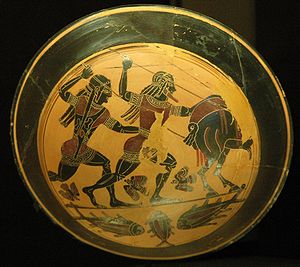
Homer
In the Western classical tradition Homer , is the author of the Iliad and the Odyssey, and is revered as the greatest ancient Greek epic poet. These epics lie at the beginning of the Western canon of literature, and have had an enormous influence on the history of literature.When he lived is...
and Hesiod
Hesiod
Hesiod was a Greek oral poet generally thought by scholars to have been active between 750 and 650 BC, around the same time as Homer. His is the first European poetry in which the poet regards himself as a topic, an individual with a distinctive role to play. Ancient authors credited him and...
and their listeners were aware of the details of this myth, but no surviving complete account exists: some papyrus
Papyrus
Papyrus is a thick paper-like material produced from the pith of the papyrus plant, Cyperus papyrus, a wetland sedge that was once abundant in the Nile Delta of Egypt....
fragments found at Oxyrhynchus
Oxyrhynchus
Oxyrhynchus is a city in Upper Egypt, located about 160 km south-southwest of Cairo, in the governorate of Al Minya. It is also an archaeological site, considered one of the most important ever discovered...
are all that survive of Stesichorus
Stesichorus
Stesichorus was the first great poet of the Greek West. He is best known for telling epic stories in lyric metres but he is also famous for some ancient traditions about his life, such as his opposition to the tyrant Phalaris, and the blindness he is said to have incurred and cured by composing...
' telling; the myth repertory called Bibliotheke
Bibliotheca (Pseudo-Apollodorus)
The Bibliotheca , in three books, provides a comprehensive summary of traditional Greek mythology and heroic legends, "the most valuable mythographical work that has come down from ancient times," Aubrey Diller observed, whose "stultifying purpose" was neatly expressed in the epigram noted by...
("The Library") contains the gist of the tale, and before that was compiled the Roman poet Ovid told the story in some colorful detail in his Metamorphoses.
Hunt
King OeneusOeneus
In Greek mythology, Oeneus, or Oineus was a Calydonian king, son of Porthaon and Euryte, husband of Althaea and father of Deianeira, Meleager, Toxeus, Clymenus, Periphas, Agelaus, Thyreus , Gorge, Eurymede, Mothone, Perimede and Melanippe...
("wine man") of Calydon
Calydon
Calydon was an ancient Greek city in Aetolia, situated on the west bank of the river Evenus. According to Greek mythology, the city took its name from its founder Calydon, son of Aetolus. Close to the city stood Mount Zygos, the slopes of which provided the setting for the hunt of the Calydonian...
, an ancient city of west-central Greece
Greece
Greece , officially the Hellenic Republic , and historically Hellas or the Republic of Greece in English, is a country in southeastern Europe....
north of the Gulf of Patras
Gulf of Patras
The Gulf of Patras is a branch of the Ionian Sea. On the east, it is closed by the Strait of Rion between capes Rio, Greece and Antirrio, near the Rio-Antirio bridge. On the west, it is bounded by a line from Oxeia island to Cape Araxos...
, held annual harvest sacrifices to the gods on the sacred hill. One year the king forgot to include Great "Artemis
Artemis
Artemis was one of the most widely venerated of the Ancient Greek deities. Her Roman equivalent is Diana. Some scholars believe that the name and indeed the goddess herself was originally pre-Greek. Homer refers to her as Artemis Agrotera, Potnia Theron: "Artemis of the wildland, Mistress of Animals"...
of the Golden Throne" in his offerings Insulted, Artemis, the "Lady of the Bow", loosed the biggest, most ferocious boar imaginable on the countryside of Calydon. It rampaged throughout the countryside, destroying vineyards and crops, forcing people to take refuge inside the city walls (Ovid), where they began to starve.
Oeneus sent messengers out to look for the best hunters in Greece, offering them the boar's pelt and tusks as a prize.

Argonauts
The Argonauts ) were a band of heroes in Greek mythology who, in the years before the Trojan War, accompanied Jason to Colchis in his quest to find the Golden Fleece. Their name comes from their ship, the Argo, which was named after its builder, Argus. "Argonauts", therefore, literally means...
, Oeneus' own son Meleager
Meleager
In Greek mythology, Meleager was a hero venerated in his temenos at Calydon in Aetolia. He was already famed as the host of the Calydonian boar hunt in the epic tradition that was reworked by Homer....
, and, remarkably for the Hunt's eventual success, one woman— the huntress Atalanta
Atalanta
Atalanta is a character in Greek mythology.-Legend:Atalanta was the daughter of Iasus , a Boeotian or an Arcadian princess . She is often described as a goddess. Apollodorus is the only one who gives an account of Atalanta’s birth and upbringing...
, the "indomitable", who had been suckled by Artemis as a she-bear and raised as a huntress, a proxy for Artemis herself (Kerenyi; Ruck and Staples). Artemis appears to have been divided in her motives, for it was also said that she had sent the young huntress because she knew her presence would be a source of division, and so it was: many of the men, led by Kepheus and Ankaios, refused to hunt alongside a woman. It was the smitten Meleager who convinced them. Nonetheless it was Atalanta who first succeeded in wounding the boar with an arrow, although Meleager finished it off, and offered the prize to Atalanta, who had drawn first blood. But the sons of Thestios, who considered it disgraceful that a woman should get the trophy where men were involved, took the skin from her, saying that it was properly theirs by right of birth, if Meleagros chose not to accept it. Outraged by this, Meleagros slew the sons of Thestios and again gave the skin to Atalanta (Bibliotheke). Meleager's mother, sister of Meleager's slain uncles, took the fatal brand from the chest where she had kept it (see Meleager
Meleager
In Greek mythology, Meleager was a hero venerated in his temenos at Calydon in Aetolia. He was already famed as the host of the Calydonian boar hunt in the epic tradition that was reworked by Homer....
) and threw it once more on the fire; as it was consumed, Meleager died on the spot, as the Fates had foretold. Thus Artemis achieved her revenge against King Oeneus.

Peleus
In Greek mythology, Pēleus was a hero whose myth was already known to the hearers of Homer in the late 8th century BCE. Peleus was the son of Aeacus, king of the island of Aegina, and Endeïs, the oread of Mount Pelion in Thessaly; he was the father of Achilles...
accidentally killed his host Eurytion. In the course of the hunt and its aftermath, many of the hunters turned upon one another, contesting the spoils, and so the Goddess continued to be revenged (Kerenyi, 114): "But the goddess again made a great stir of anger and crying battle, over the head of the boar and the bristling boar's hide, between Kouretes
Korybantes
The Corybantes were the armed and crested dancers who worshipped the Phrygian goddess Cybele with drumming and dancing. They are also called the Kurbantes in Phrygia, and Corybants in an older English transcription. The Kuretes were the nine dancers who venerate Rhea, the Cretan counterpart of...
and the high-hearted Aitolians
Aetolia
Aetolia is a mountainous region of Greece on the north coast of the Gulf of Corinth, forming the eastern part of the modern prefecture of Aetolia-Acarnania.-Geography:...
" (Homer
Homer
In the Western classical tradition Homer , is the author of the Iliad and the Odyssey, and is revered as the greatest ancient Greek epic poet. These epics lie at the beginning of the Western canon of literature, and have had an enormous influence on the history of literature.When he lived is...
, Iliad
Iliad
The Iliad is an epic poem in dactylic hexameters, traditionally attributed to Homer. Set during the Trojan War, the ten-year siege of the city of Troy by a coalition of Greek states, it tells of the battles and events during the weeks of a quarrel between King Agamemnon and the warrior Achilles...
, ix.543).
The boar's hide that was preserved in the Temple of Athena Alae
Athena
In Greek mythology, Athena, Athenê, or Athene , also referred to as Pallas Athena/Athene , is the goddess of wisdom, courage, inspiration, civilization, warfare, strength, strategy, the arts, crafts, justice, and skill. Minerva, Athena's Roman incarnation, embodies similar attributes. Athena is...
at Tegea
Tegea
Tegea was a settlement in ancient Greece, and it is also a former municipality in Arcadia, Peloponnese, Greece. Since the 2011 local government reform it is part of the municipality Tripoli, of which it is a municipal unit. Its seat was the village Stadio....
in Laconia
Laconia
Laconia , also known as Lacedaemonia, is one of the regional units of Greece. It is part of the region of Peloponnese. It is situated in the southeastern part of the Peloponnese peninsula. Its administrative capital is Sparti...
was reputedly that of the Calydonian Boar, "rotted by age and by now altogether without bristles" by the time Pausanias
Pausanias (geographer)
Pausanias was a Greek traveler and geographer of the 2nd century AD, who lived in the times of Hadrian, Antoninus Pius and Marcus Aurelius. He is famous for his Description of Greece , a lengthy work that describes ancient Greece from firsthand observations, and is a crucial link between classical...
saw it in the second century CE. He noted that the tusks had been taken to Rome as booty from the defeated allies of Mark Anthony
Mark Antony
Marcus Antonius , known in English as Mark Antony, was a Roman politician and general. As a military commander and administrator, he was an important supporter and loyal friend of his mother's cousin Julius Caesar...
by Augustus
Augustus
Augustus ;23 September 63 BC – 19 August AD 14) is considered the first emperor of the Roman Empire, which he ruled alone from 27 BC until his death in 14 AD.The dates of his rule are contemporary dates; Augustus lived under two calendars, the Roman Republican until 45 BC, and the Julian...
; "one of the tusks of the Calydonian boar has been broken", Pausanias reports, "but the remaining one, having a circumference of about half a fathom, was dedicated in the Emperor's gardens, in a shrine of Dionysos". The Calydonian Hunt was the theme of the temple's main pediment.
Hunters
The heroes who participated assembled from all over Hellas, according to Homer; BacchylidesBacchylides
Bacchylides was an Ancient Greek lyric poet. Later Greeks included him in the canonical list of nine lyric poets which included his uncle Simonides. The elegance and polished style of his lyrics have been a commonplace of Bacchylidean scholarship since at least Longinus...
called them "the best of the Hellenes".
The table lists:
- Those seen by Pausanias on the Temple of Athena at TegeaTegeaTegea was a settlement in ancient Greece, and it is also a former municipality in Arcadia, Peloponnese, Greece. Since the 2011 local government reform it is part of the municipality Tripoli, of which it is a municipal unit. Its seat was the village Stadio....
. - Those listed by Latin mythographer HyginusGaius Julius HyginusGaius Julius Hyginus was a Latin author, a pupil of the famous Cornelius Alexander Polyhistor, and a freedman of Caesar Augustus. He was by Augustus elected superintendent of the Palatine library according to Suetonius' De Grammaticis, 20...
(Fabulae 30); they include DeucalionDeucalionIn Greek mythology Deucalion was a son of Prometheus and Pronoia. The anger of Zeus was ignited by the hubris of the Pelasgians, and he decided to put an end to the Bronze Age. Lycaon, the king of Arcadia, had sacrificed a boy to Zeus, who was appalled by this savage offering...
, whose connection is unlikely. - Those noted in Ovid's list from the 8th Book of his Metamorphoses.
| Hero | Tegea | Hyginus | Ovid | Notes |
|---|---|---|---|---|
| Acastus Acastus Acastus is a character in Greek mythology. He sailed with Jason and the Argonauts, and participated in the hunt for the Calydonian Boar.-Biography:Acastus was the son of Pelias, then king of Iolcus, and Anaxibia .... |
"a splendid javelin- thrower" (Ovid, VIII, 306). | |||
| Admetus Admetus In Greek mythology, Admetus was a king of Pherae in Thessaly, succeeding his father Pheres after whom the city was named. Admetus was one of the Argonauts and took part in the Calydonian Boar hunt. His wife Alcestis offered to substitute her own death for his.-Mythology:Admetus was famed for his... |
the son of Pheres, from Pherae Pherae Pherae was an ancient Greek town in southeastern Thessaly. It bordered Lake Boebeïs. In mythology, it was the home of King Admetus, whose wife, Alcestis, Heracles went into Hades to rescue. In history, it was more famous as the home of the fourth-century B.C... |
|||
| Alcon Alcon (classical history) The name Alcon or Alco can refer to a number of people from classical myth and history:*Alcon, a son of Hippocoon, and one of the hunters of the Calydonian Boar. He was killed, together with his father and brothers, by Heracles, and had a heroon at Sparta.*Alcon, a son of Erechtheus, king of... |
one of three sons of Hippocoon or Ares from Amykles Amykles Amykles is a village and an archaeological site located southwest of Sparta. According to some sources, the ancient city was founded by Amyclas, the son of Lacedaemon.... in Thrace |
|||
| Amphiaraus Amphiaraus In Greek mythology, Amphiaraus was the son of Oecles and Hypermnestra, and husband of Eriphyle. Amphiaraus was the King of Argos along with Adrastus— the brother of Amphiaraus' wife, Eriphyle— and Iphis. Amphiaraus was a seer, and greatly honored in his time... |
the son of Oicles Oicles In Greek mythology, Oecles was an Argive king, father of Amphiaraus, son of Mantius or Antiphates and grandson of Melampus.... , from Argos Argos Argos is a city and a former municipality in Argolis, Peloponnese, Greece. Since the 2011 local government reform it is part of the municipality Argos-Mykines, of which it is a municipal unit. It is 11 kilometres from Nafplion, which was its historic harbour... ; "As yet unruined by his wicked wife", i. e. Eriphyle Eriphyle In Greek mythology, Eriphyle , daughter of Talaus, was the mother of Alcmaeon and the wife of Amphiaraus. Eriphyle persuaded Amphiaraus to take part in the raid that initiated the mythic tale of the Seven Against Thebes, though she knew he would die... (Ovid). |
|||
| Ancaeus | "from Parrhasia Parrhasia (Arcadia) Parrhasia was a region in south Arcadia, Greece. Parrhasius, son of Lycaon gave it his name.Today, the area corresponds to the modern southwestern Arcadia west of Megalopoli and the southeastern Ilia prefecture... " (Ovid), son of Lycurgus Lycurgus (Arcadia) Lycurgus, in Greek mythology, was the king of Arcadia. He was the son of Aleus, the previous ruler, and Neaera, daughter of Proteus. Lycurgus married either Cleophyle or Eurynome and fathered these sons: Ancaeus, Epochus, Amphidamas, and Iasius.... , killed by the boar. In Ovid's account Ancaeus wielded a two-headed axe but he was undone by his boastfulness which gave the boar time enough to charge him: Ancaeus was speared on the boar's tusks at the upper part of the groin and guts burst forth from the gashes it had made. |
|||
| Asclepius Asclepius Asclepius is the God of Medicine and Healing in ancient Greek religion. Asclepius represents the healing aspect of the medical arts; his daughters are Hygieia , Iaso , Aceso , Aglæa/Ægle , and Panacea... |
son of Apollo | |||
| Atalanta Atalanta Atalanta is a character in Greek mythology.-Legend:Atalanta was the daughter of Iasus , a Boeotian or an Arcadian princess . She is often described as a goddess. Apollodorus is the only one who gives an account of Atalanta’s birth and upbringing... |
called Tegeaea ("of Tegea") by Ovid, the daughter of Skoineus, from Arcadia Arcadia Arcadia is one of the regional units of Greece. It is part of the administrative region of Peloponnese. It is situated in the central and eastern part of the Peloponnese peninsula. It takes its name from the mythological character Arcas. In Greek mythology, it was the home of the god Pan... |
|||
| Caeneus Caeneus In Greek mythology, Caeneus was a Lapith hero of Thessaly and, in Ovid's Metamorphoses— where the classical model of a hero is deconstructed and transformed— originally a woman, Caenis, daughter of Atrax... |
son of Elatus; Ovid notes that Caeneus was "now no longer a woman" (VIII, 305). | |||
| Castor and Pollux Castor and Pollux In Greek and Roman mythology, Castor and Pollux or Polydeuces were twin brothers, together known as the Dioscuri . Their mother was Leda, but Castor was the mortal son of Tyndareus, king of Sparta, and Pollux the divine son of Zeus, who visited Leda in the guise of a swan... |
the Dioscuri, sons of Zeus Zeus In the ancient Greek religion, Zeus was the "Father of Gods and men" who ruled the Olympians of Mount Olympus as a father ruled the family. He was the god of sky and thunder in Greek mythology. His Roman counterpart is Jupiter and his Etruscan counterpart is Tinia.Zeus was the child of Cronus... and Leda Leda (mythology) In Greek mythology, Leda was daughter of the Aetolian king Thestius, and wife of the king Tyndareus , of Sparta. Her myth gave rise to the popular motif in Renaissance and later art of Leda and the Swan... , from Lacedaemon |
|||
| Cteatus | brother of Eurytus, son of Actor. | |||
| Deucalion Deucalion In Greek mythology Deucalion was a son of Prometheus and Pronoia. The anger of Zeus was ignited by the hubris of the Pelasgians, and he decided to put an end to the Bronze Age. Lycaon, the king of Arcadia, had sacrificed a boy to Zeus, who was appalled by this savage offering... , son of Minos |
||||
| Dryas Dryas Dryas is the name of nine characters in Greek mythology1. Dryas was the son of King Lycurgus, king of the Edoni in Thrace. He was killed when Lycurgus went insane and mistook him for a mature trunk of ivy, a plant holy to the god Dionysus, whose cult Lycurgus was attempting to extirpate.Resisting... of Calydon |
son of Ares Ares Ares is the Greek god of war. He is one of the Twelve Olympians, and the son of Zeus and Hera. In Greek literature, he often represents the physical or violent aspect of war, in contrast to the armored Athena, whose functions as a goddess of intelligence include military strategy and... (Hyginus notes him as "son of Iapetus") |
|||
| Echion Echion In Greek mythology, the name Echion "son of the viper", cf. ἔχις echis "viper") referred to five different beings.*One of the Gigantes.*One of the surviving Spartoi, the "sown men" that sprang up from the dragon's teeth sown by Cadmus; "it was Echion who, for his great valor, was preferred by... |
son of Mercurius (Hermes Hermes Hermes is the great messenger of the gods in Greek mythology and a guide to the Underworld. Hermes was born on Mount Kyllini in Arcadia. An Olympian god, he is also the patron of boundaries and of the travelers who cross them, of shepherds and cowherds, of the cunning of thieves, of orators and... ); Ovid says "the first spear ... was launched from Echion's shoulder." (VIII, 345). |
|||
| Enaesimus | one of three sons of Hippocoon or Ares from Amykles Amykles Amykles is a village and an archaeological site located southwest of Sparta. According to some sources, the ancient city was founded by Amyclas, the son of Lacedaemon.... in Thrace |
|||
| Epokhos | ||||
| Euphemus Euphemus Euphemus in Greek mythology was a son of Poseidon, an Argonaut connected with the legend of the foundation of Cyrene.Euphemus is also a character mentioned in in Book II of the Iliad.- Greek mythology :... |
son of Poseidon | |||
| Eurypylus Eurypylus In Greek mythology, Eurypylus was the name of several different people.-Son of Thestius:One Eurypylus was a son of Thestius. He participated in the hunt for the Calydonian Boar, during which he insulted Atalanta and was killed by Meleager.-Son of Euaemon:Another Eurypylus was a Thessalian king,... |
||||
| Eurytion Eurytion In Greek mythology Eurytion , "widely-honoured", was a name attributed to six individuals.... |
accidentally run through with the javelin of Peleus | |||
| Eurytus Eurytus Eurytus, Erytus , or Eurytos is the name of eleven characters in Greek mythology, and of at least one historical figure.-King of Oechalia:... |
son of Mercurius (Hermes Hermes Hermes is the great messenger of the gods in Greek mythology and a guide to the Underworld. Hermes was born on Mount Kyllini in Arcadia. An Olympian god, he is also the patron of boundaries and of the travelers who cross them, of shepherds and cowherds, of the cunning of thieves, of orators and... ) |
|||
| Hippasus Hippasus (mythology) In Greek mythology, Hippasus is the name of nine characters.*Hippasus, father of Hippomedon, by the nymph Ocyrrhoe, and also of Charops, Socus, Agelaus, and Pammon.*Hippasus, son of Eurytus... , son of Eurytus |
||||
| Hippothous Hippothous In Greek mythology Hippothous is the name of seven men.1. Hippothous son of Cercyon. He was one of the hunters of the Calydonian Boar. He later inherited the kingdom of Arcadia when king Agapenor did not return from the Trojan War. His successor was his son, Aepytus.2. Hippothous, son of Lethus... |
the son of Kerkyon Cercyon Cercyon - Κερκύων was a figure in Greek mythology. He was the King of Eleusis, and a very strong man. According to the different versions, he was the son of:*Poseidon and one of the daughters of Amphictyon, or... , son of Agamedes, son of Stymphalos |
|||
| Hyleus | killed by the boar | |||
| Iason | Aeson Aeson In Greek mythology, Aeson or Aison was the son of Cretheus and Tyro, who also had his brothers Pheres and Amythaon. Aeson was the father of Jason and Promachus with Polymede, the daughter of Autolycus. Other sources say the mother of his children was Alcimede or Amphinome... ’s son, from Iolkos |
|||
| Idas Idas In Greek mythology, Idas was a son of Aphareus and Arene and brother of Lynceus. He and Lynceus loved Hilaeira and Phoebe and fought with their rival suitors, Castor and Polydeuces, killing the mortal brother Castor. He was also one of the Argonauts and a participant in the hunt for the Calydonian... |
and Lynceus, sons of Aphareus, from Messene Messene Messene , officially Ancient Messene, is a Local Community of the Municipal Unit , Ithomi, of the municipality of Messini within the Regional Unit of Messenia in the Region of Peloponnēsos, one of 7 Regions into which the Hellenic Republic has been divided by the Kallikratis... |
|||
| Iolaus Iolaus In Greek mythology, Iolaus was a Theban divine hero, son of Iphicles, Heracles's brother, and Automedusa.He was famed for being Heracles's nephew and for helping with some of his Labors, and also for being one of the Argonauts... |
son of Iphicles Iphicles In Greek mythology, Iphicles is the name of three different people:*The half-brother of Heracles, being the son of Alcmene and her human husband Amphitryon, whereas Heracles was her son by Zeus. Iphicles was the father of Heracles' charioteer Iolaus by Automedusa, daughter of Alcathous... , beloved of Heracles |
|||
| Iphicles Iphicles In Greek mythology, Iphicles is the name of three different people:*The half-brother of Heracles, being the son of Alcmene and her human husband Amphitryon, whereas Heracles was her son by Zeus. Iphicles was the father of Heracles' charioteer Iolaus by Automedusa, daughter of Alcathous... |
the twin of Heracles Heracles Heracles ,born Alcaeus or Alcides , was a divine hero in Greek mythology, the son of Zeus and Alcmene, foster son of Amphitryon and great-grandson of Perseus... , who took no part, Amphitryon Amphitryon Amphitryon , in Greek mythology, was a son of Alcaeus, king of Tiryns in Argolis.Amphitryon was a Theban general, who was originally from Tiryns in the eastern part of the Peloponnese. He was friends with Panopeus.... ’s mortal son, from Thebes Thebes, Greece Thebes is a city in Greece, situated to the north of the Cithaeron range, which divides Boeotia from Attica, and on the southern edge of the Boeotian plain. It played an important role in Greek myth, as the site of the stories of Cadmus, Oedipus, Dionysus and others... |
|||
| Kepheus Cepheus, King of Tegea In Greek mythology, Cepheus was the son of Aleus and Neaera or Cleobule, and brother of Amphidamas, Lycurgus of Arcadia, Auge and Alcidice. He and his brother Amphidamas are counted among the Argonauts.... , from Arcadia Arcadia Arcadia is one of the regional units of Greece. It is part of the administrative region of Peloponnese. It is situated in the central and eastern part of the Peloponnese peninsula. It takes its name from the mythological character Arcas. In Greek mythology, it was the home of the god Pan... |
||||
| Kometes and Prothous | the sons of Thestios Thestius In Greek mythology, Thestius was the son of either Ares and Demonice, or Agenor and Epicasta. He was the father of Iphicles with Leucippe, or Deidameia, daughter of Perieres, or else with Eurythemis, daughter of Cleoboea and mother of his other children, Althaea, Eurypylus, Evippus, Hypermnestra,... , Meleager's uncles |
|||
| Laertes Laertes In Greek mythology, Laërtes was the son of Arcesius and Chalcomedusa. He was the father of Odysseus and Ctimene by his wife Anticlea, daughter of the thief Autolycus. Laërtes was an Argonaut and participated in the hunt for the Calydonian Boar... |
son of Arcesius, Odysseus Odysseus Odysseus or Ulysses was a legendary Greek king of Ithaca and the hero of Homer's epic poem the Odyssey. Odysseus also plays a key role in Homer's Iliad and other works in the Epic Cycle.... ' father |
|||
| Lelex Lelex In Greek mythology, Lelex was a King of Laconia. He was married to the Naiad nymph, Cleochareia. He had several sons, including Myles, Polycaon, Pterelaus, and Cteson. The parentage of Lelex is variously stated... |
of Naryx in Locria | |||
| Leucippus Leucippus Leucippus or Leukippos was one of the earliest Greeks to develop the theory of atomism — the idea that everything is composed entirely of various imperishable, indivisible elements called atoms — which was elaborated in greater detail by his pupil and successor, Democritus... |
one of three sons of Hippocoon Hippocoon In Greek mythology, the name Hippocoön refers to several characters:*A son of the Spartan King Oebalus and Bateia. His brothers were Tyndareus and Icarius. When their father died, Tyndareus became king. Hippocoön, with the help of his sons, overthrew him, took the throne and expelled his... or Ares from Amykles Amykles Amykles is a village and an archaeological site located southwest of Sparta. According to some sources, the ancient city was founded by Amyclas, the son of Lacedaemon.... in Thrace |
|||
| Lynceus Lynceus In Greek mythology, Lynceus was a king of Argos, succeeding Danaus. He is named as a descendant of Belus through his father Aegyptus, who was the twin brother of Danaus. Danaus had fifty daughters, the Danaides, while Aegyptus had fifty sons including Lynceus, whose name when translated means "wolf"... and Idas |
||||
| Meleager Meleager In Greek mythology, Meleager was a hero venerated in his temenos at Calydon in Aetolia. He was already famed as the host of the Calydonian boar hunt in the epic tradition that was reworked by Homer.... |
son of Oineus | |||
| or Actorides | ||||
| Mopsus Mopsus Mopsus or Mopsos was the name of two famous seers in Greek mythology. A historical/legendary Mopsus was the founder of a house in power at widespread sites in the coastal plains of Pamphylia and Cilicia during the early Iron Age.-Son of Manto and Rhacius or Apollo:Mopsus, a celebrated seer and... |
son of Ampycus | |||
| Nestor Nestor (mythology) In Greek mythology, Nestor of Gerenia was the son of Neleus and Chloris and the King of Pylos. He became king after Heracles killed Neleus and all of Nestor's siblings... |
"Still in his prime" Ovid says. | |||
| Panopeus | ||||
| Peleus Peleus In Greek mythology, Pēleus was a hero whose myth was already known to the hearers of Homer in the late 8th century BCE. Peleus was the son of Aeacus, king of the island of Aegina, and Endeïs, the oread of Mount Pelion in Thessaly; he was the father of Achilles... |
son of Aiakos Aeacus Aeacus was a mythological king of the island of Aegina in the Saronic Gulf.He was son of Zeus and Aegina, a daughter of the river-god Asopus. He was born on the island of Oenone or Oenopia, to which Aegina had been carried by Zeus to secure her from the anger of her parents, and whence this... , father of Achilles Achilles In Greek mythology, Achilles was a Greek hero of the Trojan War, the central character and the greatest warrior of Homer's Iliad.Plato named Achilles the handsomest of the heroes assembled against Troy.... from Phthia Phthia Phthia , Phthíē ) in ancient Greece was the southernmost region of ancient Thessaly, on both sides of Othrys Mountain. It was the homeland of the Myrmidones tribe, who took part in the Trojan War under Achilles.... |
|||
| Phoenix | son of Amyntor Amyntor Amyntor , was an ancient Greek name attributed to several people both mythological and historical.- Mythological :... |
|||
| Phyleus Phyleus In Greek mythology, Phyleus was a son of King Augeas of Elis and father of Meges. He supported Heracles instead of his father and was exiled. After Heracles killed Augeas and his other sons, he gave Phyleus the kingdom. During the time of his exile, Phyleus led a colony of Epeans to the island of... |
from Elis Elis Elis, or Eleia is an ancient district that corresponds with the modern Elis peripheral unit... |
|||
| Pirithous Pirithous In Greek mythology, Pirithous - Πειρίθοος was the King of the Lapiths in Thessaly and husband of Hippodamia, at whose wedding the famous Battle of Lapiths and Centaurs occurred.... |
son of Ixion Ixion In Greek mythology, Ixion was king of the Lapiths, the most ancient tribe of Thessaly, and a son of Ares, or Leonteus, or Antion and Perimele, or the notorious evildoer Phlegyas, whose name connotes "fiery". Peirithoös was his son... , from Larissa Larissa Larissa is the capital and biggest city of the Thessaly region of Greece and capital of the Larissa regional unit. It is a principal agricultural centre and a national transportation hub, linked by road and rail with the port of Volos, the city of Thessaloniki and Athens... , the friend of Theseus |
|||
| Plexippus Plexippus In Greek mythology, Plexippus is a name that refers to:* A son of Thestius, who, together with his brother Toxeus, participated in the hunt for the Calydonian Boar. He was angry that the prize of the boar's hide had been given to a woman by his nephew Meleager, who then killed him in the ensuing... |
brother of Toxeus, slain by Meleager | |||
| Polydeuces Castor and Pollux In Greek and Roman mythology, Castor and Pollux or Polydeuces were twin brothers, together known as the Dioscuri . Their mother was Leda, but Castor was the mortal son of Tyndareus, king of Sparta, and Pollux the divine son of Zeus, who visited Leda in the guise of a swan... |
||||
| Prothous Prothous Prothous, a son of Tenthredon, commander of the Magnetes who dwelt arount mount Pelion and the river Peneus, was one of the Greek heroes in the Trojan War... and Kometes |
the sons of Thestios Thestius In Greek mythology, Thestius was the son of either Ares and Demonice, or Agenor and Epicasta. He was the father of Iphicles with Leucippe, or Deidameia, daughter of Perieres, or else with Eurythemis, daughter of Cleoboea and mother of his other children, Althaea, Eurypylus, Evippus, Hypermnestra,... , Meleager's uncles |
|||
| Telamon Telamon In Greek mythology, Telamon , son of the king Aeacus, of Aegina, and Endeis and brother of Peleus, accompanied Jason as one of his Argonauts, and was present at the hunt for the Calydonian Boar. In the Iliad he was the father of Greek heroes Ajax the Great and Teucer the Archer by different... |
son of Aeacus Aeacus Aeacus was a mythological king of the island of Aegina in the Saronic Gulf.He was son of Zeus and Aegina, a daughter of the river-god Asopus. He was born on the island of Oenone or Oenopia, to which Aegina had been carried by Zeus to secure her from the anger of her parents, and whence this... |
|||
| Theseus Theseus For other uses, see Theseus Theseus was the mythical founder-king of Athens, son of Aethra, and fathered by Aegeus and Poseidon, both of whom Aethra had slept with in one night. Theseus was a founder-hero, like Perseus, Cadmus, or Heracles, all of whom battled and overcame foes that were... of Athens |
faced another dangerous chthonic creature, the dusky wild Crommyonian Sow Crommyonian Sow In Greek mythology, the Crommyonian Sow , was a wild pig, which ravaged the region around the village of Crommyon between Megara and Corinth, and was eventually slain by Theseus in his early adventures. According to Apollodorus, it was said by some to be the daughter of Echidna and Typhon, and... , on a separate occasion. Strabo Strabo Strabo, also written Strabon was a Greek historian, geographer and philosopher.-Life:Strabo was born to an affluent family from Amaseia in Pontus , a city which he said was situated the approximate equivalent of 75 km from the Black Sea... (Geography 8.6.22) reckoned she was the mother of the Calydonian Boar, but there are no hints within the myths to link the two and suggest Strabo might have been right. |
|||
| Toxeus Toxeus In Greek mythology, the name Toxeus refers to:*A son of Thestius, brother of Althaea, who participated in the hunt for the Calydonian Boar. He was angry that the prize of the boar's hide had been given to a woman by his nephew Meleager, who then killed him in the ensuing argument.*A son of Oineus... |
brother of Plexippus, slain by Meleager |
The states which sent help to Oeneus
- Ternerdos, Iolcos, Sparta, Pleurone, Messene, Perrhaebia, Phthia, Magnesia, Salamin, Calydon, Thessalia, Oechialia, Ithaca, Tegea, Crete, Dolopia, Athens, [Magnesia], and Arcadia.(HyginusHyginusHyginus can refer to:People:*Gaius Julius Hyginus , Roman poet, author of Fabulae, reputed author of Poeticon astronomicon*Hyginus Gromaticus, Roman surveyor*Pope Hyginus, also a saint, Bishop of Rome about 140...
, Fabulae 173A)