


Rings of Saturn

Encyclopedia
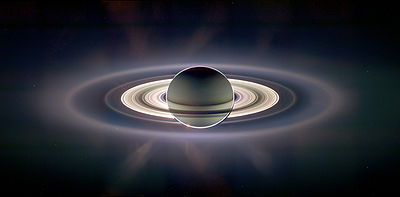
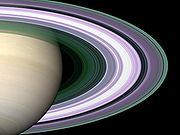
Planetary ring
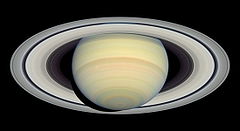
A planetary ring is a ring of cosmic dust and other small particles orbiting around a planet in a flat disc-shaped region.The most notable planetary rings known in Earth's solar system are those around Saturn, but the other three gas giants of the solar system possess ring systems of their...
system of any planet in the Solar System
Solar System
The Solar System consists of the Sun and the astronomical objects gravitationally bound in orbit around it, all of which formed from the collapse of a giant molecular cloud approximately 4.6 billion years ago. The vast majority of the system's mass is in the Sun...
. They consist of countless small particles, ranging in size from micrometres to metres, that form clumps that in turn orbit
Orbit
In physics, an orbit is the gravitationally curved path of an object around a point in space, for example the orbit of a planet around the center of a star system, such as the Solar System...
about Saturn
Saturn
Saturn is the sixth planet from the Sun and the second largest planet in the Solar System, after Jupiter. Saturn is named after the Roman god Saturn, equated to the Greek Cronus , the Babylonian Ninurta and the Hindu Shani. Saturn's astronomical symbol represents the Roman god's sickle.Saturn,...
. The ring particles are made almost entirely of water ice, with some contamination from dust
Dust
Dust consists of particles in the atmosphere that arise from various sources such as soil dust lifted up by wind , volcanic eruptions, and pollution...
and other chemicals.
Although reflection from the rings increases Saturn's brightness
Apparent magnitude
The apparent magnitude of a celestial body is a measure of its brightness as seen by an observer on Earth, adjusted to the value it would have in the absence of the atmosphere...
, they are not visible from Earth with unaided vision
Naked eye
The naked eye is a figure of speech referring to human visual perception unaided by a magnifying or light-collecting optical device, such as a telescope or microscope. Vision corrected to normal acuity using corrective lenses is considered "naked"...
. In 1610, the year after Galileo Galilei
Galileo Galilei
Galileo Galilei , was an Italian physicist, mathematician, astronomer, and philosopher who played a major role in the Scientific Revolution. His achievements include improvements to the telescope and consequent astronomical observations and support for Copernicanism...
first turned a telescope
Telescope
A telescope is an instrument that aids in the observation of remote objects by collecting electromagnetic radiation . The first known practical telescopes were invented in the Netherlands at the beginning of the 1600s , using glass lenses...
to the sky, he became the very first person to observe Saturn's rings, though he could not see them well enough to discern their true nature. In 1655, Christiaan Huygens was the first person to describe them as a disk surrounding Saturn. Although many people think of Saturn's rings as being made up of a series of tiny ringlets (a concept that goes back to Laplace
Pierre-Simon Laplace
Pierre-Simon, marquis de Laplace was a French mathematician and astronomer whose work was pivotal to the development of mathematical astronomy and statistics. He summarized and extended the work of his predecessors in his five volume Mécanique Céleste...
), true gaps are few. It is more correct to think of the rings as an annular disk
Annulus (mathematics)
In mathematics, an annulus is a ring-shaped geometric figure, or more generally, a term used to name a ring-shaped object. Or, it is the area between two concentric circles...
with concentric
Concentric
Concentric objects share the same center, axis or origin with one inside the other. Circles, tubes, cylindrical shafts, disks, and spheres may be concentric to one another...
local maxima and minima
Maxima and minima
In mathematics, the maximum and minimum of a function, known collectively as extrema , are the largest and smallest value that the function takes at a point either within a given neighborhood or on the function domain in its entirety .More generally, the...
in density and brightness. On the scale of the clumps within the rings there is much empty space.
There are several gaps within the rings: two opened by known moons embedded within them, and many others at locations of known destabilizing orbital resonance
Orbital resonance
In celestial mechanics, an orbital resonance occurs when two orbiting bodies exert a regular, periodic gravitational influence on each other, usually due to their orbital periods being related by a ratio of two small integers. Orbital resonances greatly enhance the mutual gravitational influence of...
s with Saturn's moons
Saturn's natural satellites
The moons of Saturn are numerous and diverse, ranging from tiny moonlets less than 1 kilometre across, to the enormous Titan, which is larger than the planet Mercury. Saturn has 62 moons with confirmed orbits, fifty-three of which have names, and only thirteen of which have diameters larger than 50...
. Other gaps remain unexplained. Stabilizing resonances, on the other hand, are responsible for the longevity of several rings, such as the Titan Ringlet and the G Ring.
Well beyond the main rings is the Phoebe ring, which is tilted at an angle of 27 degrees to the other rings and, like Phoebe
Phoebe (moon)
Phoebe is an irregular satellite of Saturn. It was discovered by William Henry Pickering on 17 March 1899 from photographic plates that had been taken starting on 16 August 1898 at the Boyden Observatory near Arequipa, Peru, by DeLisle Stewart...
, orbits in retrograde
Retrograde motion
Retrograde motion is motion in the direction opposite to the movement of something else, and is the contrary of direct or prograde motion. This motion can be the orbit of one body about another body or about some other point, or the rotation of a single body about its axis, or other phenomena such...
fashion.
In December 2010, National Geographic suggested that the rings of Saturn could be the remains of a giant lost moon that was stripped of its icy shell before it crashed into the planet.
Galileo's work
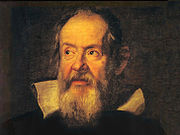
Cosimo II de' Medici, Grand Duke of Tuscany
Cosimo II de' Medici was Grand Duke of Tuscany from 1609 until 1621. He was the elder son of the then incumbent Grand Duke and Christina of Lorraine. He married Maria Magdalena of Austria, and had eight children....
that "[t]he planet Saturn is not alone, but is composed of three, which almost touch one another and never move nor change with respect to one another. They are arranged in a line parallel to the zodiac
Zodiac
In astronomy, the zodiac is a circle of twelve 30° divisions of celestial longitude which are centred upon the ecliptic: the apparent path of the Sun across the celestial sphere over the course of the year...
, and the middle one (Saturn itself) is about three times the size of the lateral ones [the edges of the rings]." He also described Saturn as having "ears". In 1612, the plane of the rings was oriented directly at the Earth and the rings appeared to vanish. Mystified, Galileo wondered, "[h]as Saturn swallowed his children?", referencing the myth of Saturn's consumption of his children to prevent them from overthrowing him. They reappeared again in 1613, further confusing Galileo.
Early astronomer
Astronomer
An astronomer is a scientist who studies celestial bodies such as planets, stars and galaxies.Historically, astronomy was more concerned with the classification and description of phenomena in the sky, while astrophysics attempted to explain these phenomena and the differences between them using...
s used anagram
Anagram
An anagram is a type of word play, the result of rearranging the letters of a word or phrase to produce a new word or phrase, using all the original letters exactly once; e.g., orchestra = carthorse, A decimal point = I'm a dot in place, Tom Marvolo Riddle = I am Lord Voldemort. Someone who...
s as a form of commitment scheme
Commitment scheme
In cryptography, a commitment scheme allows one to commit to a value while keeping it hidden, with the ability to reveal the committed value later. Commitments are used to bind a party to a value so that they cannot adapt to other messages in order to gain some kind of inappropriate advantage...
to lay claim to new discoveries before their results were ready for publication. Galileo used smaismrmilmepoetaleumibunenugttauiras for Altissimum planetam tergeminum observavi ("I have observed the most distant planet to have a triple form") for discovering the rings of Saturn.
Ring theory and observations
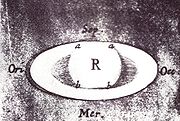
Robert Hooke
Robert Hooke FRS was an English natural philosopher, architect and polymath.His adult life comprised three distinct periods: as a scientific inquirer lacking money; achieving great wealth and standing through his reputation for hard work and scrupulous honesty following the great fire of 1666, but...
was another early observer of the rings of Saturn, and noted the casting of shadows on the rings.
In 1675, Giovanni Domenico Cassini
Giovanni Domenico Cassini
This article is about the Italian-born astronomer. For his French-born great-grandson, see Jean-Dominique Cassini.Giovanni Domenico Cassini was an Italian/French mathematician, astronomer, engineer, and astrologer...
determined that Saturn's ring was composed of multiple smaller rings with gaps between them; the largest of these gaps was later named the Cassini Division. This division is a 4,800 km-wide region between the A Ring and B Ring.
In 1787, Pierre-Simon Laplace
Pierre-Simon Laplace
Pierre-Simon, marquis de Laplace was a French mathematician and astronomer whose work was pivotal to the development of mathematical astronomy and statistics. He summarized and extended the work of his predecessors in his five volume Mécanique Céleste...
suggested that the rings were composed of a large number of solid ringlets.
In 1859, James Clerk Maxwell
James Clerk Maxwell
James Clerk Maxwell of Glenlair was a Scottish physicist and mathematician. His most prominent achievement was formulating classical electromagnetic theory. This united all previously unrelated observations, experiments and equations of electricity, magnetism and optics into a consistent theory...
demonstrated that the rings could not be solid or they would become unstable and break apart. He proposed that the rings must be composed of numerous small particles, all independently orbiting Saturn. Maxwell's theory was proven correct in 1895 through spectroscopic studies of the rings carried out by James Keeler of Allegheny Observatory
Allegheny Observatory
The Allegheny Observatory is an American astronomical research institution, a part of the Department of Physics and Astronomy at the University of Pittsburgh. The facility is listed on the National Register of Historical Places The Allegheny Observatory is an American astronomical research...
.
Physical characteristics
Tholin
Tholin [after the ancient Greek word meaning "not clear"] is a heteropolymer molecule formed by solar ultraviolet irradiation of simple organic compounds such as methane or ethane. Tholins do not form naturally on modern-day Earth, but are found in great abundance on the surface of icy bodies in...
s or silicate
Silicate
A silicate is a compound containing a silicon bearing anion. The great majority of silicates are oxides, but hexafluorosilicate and other anions are also included. This article focuses mainly on the Si-O anions. Silicates comprise the majority of the earth's crust, as well as the other...
s. The main rings are primarily composed of particles ranging in size from 1 centimetre to 10 meters.
The total mass of the rings is about 3 x 10¹⁹ kg. This is a small fraction of the total mass of Saturn (about 50 ppb) and is just a little less than the moon Mimas
Mimas (moon)
Mimas is a moon of Saturn which was discovered in 1789 by William Herschel. It is named after Mimas, a son of Gaia in Greek mythology, and is also designated Saturn I....
. There have been recent claims, yet unverified, that this is an underestimate due to clumping in the rings and the mass may be three times this figure.
While the largest gaps in the rings, such as the Cassini Division and Encke Gap, can be seen from Earth, both Voyager
Voyager program
The Voyager program is a U.S program that launched two unmanned space missions, scientific probes Voyager 1 and Voyager 2. They were launched in 1977 to take advantage of a favorable planetary alignment of the late 1970s...
spacecraft discovered that the rings have an intricate structure of thousands of thin gaps and ringlets. This structure is thought to arise, in several different ways, from the gravitational pull of Saturn's many moons. Some gaps are cleared out by the passage of tiny moonlets such as Pan
Pan (moon)
Pan is the innermost moon of Saturn. It is a walnut-shaped small moon about 35 kilometres across and 23 km high that orbits within the Encke Gap in Saturn's A Ring. Pan acts as a ring shepherd and is responsible for keeping the Encke Gap free of ring particles.It was discovered by Mark R...
, many more of which may yet be discovered, and some ringlets seem to be maintained by the gravitational effects of small shepherd satellites (similar to Prometheus
Prometheus (moon)
-Animations:-External links:* at ** anaglyph view of Prometheus...
and Pandora
Pandora (moon)
Pandora is an inner satellite of Saturn. It was discovered in 1980 from photos taken by the Voyager 1 probe, and was provisionally designated '. In late 1985 it was officially named after Pandora from Greek mythology. It is also designated as '.Pandora is the outer shepherd satellite of the F Ring...
's maintenance of the F ring). Other gaps arise from resonances between the orbital period of particles in the gap and that of a more massive moon further out; Mimas
Mimas (moon)
Mimas is a moon of Saturn which was discovered in 1789 by William Herschel. It is named after Mimas, a son of Gaia in Greek mythology, and is also designated Saturn I....
maintains the Cassini division in this manner. Still more structure in the rings consists of spiral waves raised by the inner moons' periodic gravitational perturbations at less disruptive resonances.
Data from the Cassini space probe indicate that the rings of Saturn possess their own atmosphere, independent of that of the planet itself. The atmosphere is composed of molecular oxygen
Oxygen
Oxygen is the element with atomic number 8 and represented by the symbol O. Its name derives from the Greek roots ὀξύς and -γενής , because at the time of naming, it was mistakenly thought that all acids required oxygen in their composition...
gas (O2) produced when ultraviolet light from the Sun interacts with water ice in the rings. Chemical reactions between water molecule fragments and further ultraviolet
Ultraviolet
Ultraviolet light is electromagnetic radiation with a wavelength shorter than that of visible light, but longer than X-rays, in the range 10 nm to 400 nm, and energies from 3 eV to 124 eV...
stimulation create and eject, among other things, O2. According to models of this atmosphere, H2 is also present. The O2 and H2 atmospheres are so sparse that if the entire atmosphere were somehow condensed onto the rings, it would be about one atom thick. The rings also have a similarly sparse OH (hydroxide) atmosphere. Like the O2, this atmosphere is produced by the disintegration of water molecules, though in this case the disintegration is done by energetic ion
Ion
An ion is an atom or molecule in which the total number of electrons is not equal to the total number of protons, giving it a net positive or negative electrical charge. The name was given by physicist Michael Faraday for the substances that allow a current to pass between electrodes in a...
s that bombard water molecules ejected by Saturn's moon Enceladus
Enceladus (moon)
Enceladus is the sixth-largest of the moons of Saturn. It was discovered in 1789 by William Herschel. Until the two Voyager spacecraft passed near it in the early 1980s very little was known about this small moon besides the identification of water ice on its surface...
. This atmosphere, despite being extremely sparse, was detected from Earth by the Hubble Space Telescope.
Saturn shows complex patterns in its brightness. Most of the variability is due to the changing aspect of the rings, and this goes through two cycles every orbit. However, superimposed on this is variability due to the eccentricity of the planet's orbit that causes the planet to display brighter oppositions in the northern hemisphere than it does in the southern.
In 1980, Voyager 1 made a fly-by of Saturn that showed the F-ring to be composed of three narrow rings that appeared to be braided in a complex structure; it is now known that the outer two rings consist of knobs, kinks and lumps that give the illusion of braiding, with the less bright third ring lying inside them.
New images of the rings taken around the 11 August 2009 equinox of Saturn by NASA's Cassini spacecraft have shown that the rings extend significantly out of the nominal ring plane in a few places. This displacement reaches as much as 2.5 miles (4 km) at the border of the Keeler Gap, due to the out-of-plane orbit of Daphnis
Daphnis (moon)
Daphnis is an inner satellite of Saturn. It is also known as '; its provisional designation was '. Daphnis is about 8 kilometres in diameter, and orbits the planet in the Keeler Gap within the A ring.- Naming :...
, the moon that creates the gap.
Formation
Saturn's rings may be very old, dating to the formation of Saturn itself. There are two main theories regarding the origin of Saturn's rings. One theory, originally proposed by Édouard RocheÉdouard Roche
Édouard Albert Roche was a French astronomer and mathematician, who is best known for his work in the field of celestial mechanics...
in the 19th century, is that the rings were once a moon of Saturn (named Veritas; a Roman goddess who hid in a well) whose orbit decayed until it came close enough to be ripped apart by tidal force
Tidal force
The tidal force is a secondary effect of the force of gravity and is responsible for the tides. It arises because the gravitational force per unit mass exerted on one body by a second body is not constant across its diameter, the side nearest to the second being more attracted by it than the side...
s (see Roche limit
Roche limit
The Roche limit , sometimes referred to as the Roche radius, is the distance within which a celestial body, held together only by its own gravity, will disintegrate due to a second celestial body's tidal forces exceeding the first body's gravitational self-attraction...
). A variation of this theory is that the moon disintegrated after being struck by a large comet
Comet
A comet is an icy small Solar System body that, when close enough to the Sun, displays a visible coma and sometimes also a tail. These phenomena are both due to the effects of solar radiation and the solar wind upon the nucleus of the comet...
or asteroid
Asteroid
Asteroids are a class of small Solar System bodies in orbit around the Sun. They have also been called planetoids, especially the larger ones...
. The second theory is that the rings were never part of a moon, but are instead left over from the original nebula
Nebula
A nebula is an interstellar cloud of dust, hydrogen gas, helium gas and other ionized gases...
r material from which Saturn formed.
It seems likely however that they are composed of debris from the disruption of a moon 400 to 600 km in diameter, bigger than Mimas
Mimas (moon)
Mimas is a moon of Saturn which was discovered in 1789 by William Herschel. It is named after Mimas, a son of Gaia in Greek mythology, and is also designated Saturn I....
. The last time there were collisions large enough to be likely to disrupt a moon that large was during the Late Heavy Bombardment
Late Heavy Bombardment
The Late Heavy Bombardment is a period of time approximately 4.1 to 3.8 billion years ago during which a large number of impact craters are believed to have formed on the Moon, and by inference on Earth, Mercury, Venus, and Mars as well...
some four billion years ago.
The brightness and purity of the water ice in Saturn's rings has been cited as evidence that the rings are much younger than Saturn, perhaps just 100 million years old, as the infall of meteoric dust would have led to darkening of the rings. However, new research indicates that the B Ring may be massive enough to have diluted infalling material and thus avoided substantial darkening over the age of the Solar System. Ring material may be recycled as clumps form within the rings and are then disrupted by impacts. This would explain the apparent youth of some of the material within the rings.
The Cassini UVIS team, led by Larry Esposito, used stellar occultation
Occultation
An occultation is an event that occurs when one object is hidden by another object that passes between it and the observer. The word is used in astronomy . It can also refer to any situation wherein an object in the foreground blocks from view an object in the background...
to discover 13 objects, ranging from 27 metres to 10 km across, within the F ring. They are translucent, suggesting they are temporary aggregates of ice boulders a few metres across. Esposito believes this to be the basic structure of the Saturnian rings, particles clumping together, then being blasted apart.
Subdivisions and structures within the rings
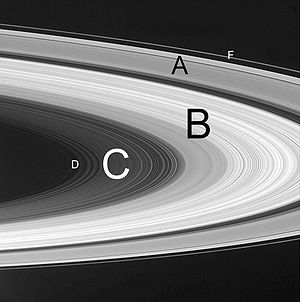
The densest parts of the Saturnian ring system are the A and B Rings, which are separated by the Cassini Division (discovered in 1675 by Giovanni Domenico CassiniGiovanni Domenico Cassini
This article is about the Italian-born astronomer. For his French-born great-grandson, see Jean-Dominique Cassini.Giovanni Domenico Cassini was an Italian/French mathematician, astronomer, engineer, and astrologer...
). Along with the C Ring, which was discovered in 1850 and is similar in character to the Cassini Division, these regions comprise the main rings. The main rings are denser and contain larger particles than the tenuous dusty rings. The latter include the D Ring, extending inward to Saturn's cloud tops, the G and E Rings and others beyond the main ring system. These diffuse rings are characterised as "dusty" because of the small size of their particles (often about a micrometre); their chemical composition is, like the main rings, almost entirely of water ice. The narrow F Ring, just off the outer edge of the A Ring, is more difficult to categorize; parts of it are very dense, but it also contains a great deal of dust-size particles.
Tabulated data
Notes:(1) distance is to centre of gaps, rings and ringlets that are narrower than 1,000 km
(2) unofficial name
(3) Names as designated by the International Astronomical Union
International Astronomical Union
The International Astronomical Union IAU is a collection of professional astronomers, at the Ph.D. level and beyond, active in professional research and education in astronomy...
, unless otherwise noted. Broader separations between named rings are termed divisions, while narrower separations within named rings are called gaps.
(4) Data mostly from the Gazetteer of Planetary Nomenclature, a NASA factsheet and several papers.
Major subdivisions of the rings
| Name(3) | Distance from Saturn (from center, in km)(4) | Width (km)(4) | Named after |
|---|---|---|---|
| D Ring | 66,900 – 74,510 | 7,500 | |
| C Ring | 74,658 – 92,000 | 17,500 | |
| B Ring | 92,000 – 117,580 | 25,500 | |
| Cassini Division | 117,580 – 122,170 | 4,700 | Giovanni Cassini Giovanni Domenico Cassini This article is about the Italian-born astronomer. For his French-born great-grandson, see Jean-Dominique Cassini.Giovanni Domenico Cassini was an Italian/French mathematician, astronomer, engineer, and astrologer... |
| A Ring | 122,170 – 136,775 | 14,600 | |
| Roche Division | 136,775 – 139,380 | 2,600 | Édouard Roche Édouard Roche Édouard Albert Roche was a French astronomer and mathematician, who is best known for his work in the field of celestial mechanics... |
| F Ring | 140,180 (1) | 30 – 500 | |
| Janus/Epimetheus Ring(2) | 149,000 – 154,000 | 5,000 | Janus Janus (moon) Janus is an inner satellite of Saturn. It is also known as Saturn X . It is named after the mythological Janus.-Discovery and orbit:Janus occupies practically the same orbit as the moon Epimetheus... and Epimetheus Epimetheus (moon) Epimetheus is an inner satellite of Saturn. It is also known as Saturn XI. It is named after the mythological Epimetheus, brother of Prometheus.-Discovery:Epimetheus occupies essentially the same orbit as the moon Janus... |
| G Ring | 166,000 – 175,000 | 9,000 | |
| Methone Ring Arc(2) | 194,230 | ? | Methone Methone (moon) Methone is a very small natural satellite of Saturn lying between the orbits of Mimas and Enceladus.It was first seen by the Cassini Imaging Team and given the temporary designation '. Methone is also named '.... |
| Anthe Ring Arc(2) | 197,665 | ? | Anthe Anthe (moon) Anthe is a very small natural satellite of Saturn lying between the orbits of Mimas and Enceladus. It is also known as Saturn XLIX; its provisional designation was S/2007 S 4. It is named after one of the Alkyonides; the name means flowery. It is the sixtieth confirmed moon of Saturn.It was... |
| Pallene Ring(2) | 211,000 – 213,500 | 2,500 | Pallene Pallene (moon) Pallene is a very small natural satellite of Saturn. It is one of three small moons known as the Alkyonides that lie between the orbits of the larger Mimas and Enceladus. It is also designated as '.-Discovery:... |
| E Ring | 180,000 – 480,000 | 300,000 | |
| Phoebe Ring | ~4,000,000 – >13,000,000 | Phoebe Phoebe (moon) Phoebe is an irregular satellite of Saturn. It was discovered by William Henry Pickering on 17 March 1899 from photographic plates that had been taken starting on 16 August 1898 at the Boyden Observatory near Arequipa, Peru, by DeLisle Stewart... |
Structures within the C Ring
| Name(3) | Distance from Saturn's center (km)(4) | Width (km)(4) | Named after |
|---|---|---|---|
| Colombo Gap | 77,870 (1) | 150 | Giuseppe "Bepi" Colombo Giuseppe Colombo Giuseppe Colombo , better known by his nickname Bepi Colombo, was an Italian scientist, mathematician and engineer at the University of Padua, Italy Giuseppe Colombo (Padua, October 2, 1920 – Padua, February 20, 1984), better known by his nickname Bepi Colombo, was an Italian scientist,... |
| Titan Ringlet | 77,870 (1) | 25 | Titan Titan (moon) Titan , or Saturn VI, is the largest moon of Saturn, the only natural satellite known to have a dense atmosphere, and the only object other than Earth for which clear evidence of stable bodies of surface liquid has been found.... , moon of Saturn |
| Maxwell Gap | 87,491 (1) | 270 | James Clerk Maxwell James Clerk Maxwell James Clerk Maxwell of Glenlair was a Scottish physicist and mathematician. His most prominent achievement was formulating classical electromagnetic theory. This united all previously unrelated observations, experiments and equations of electricity, magnetism and optics into a consistent theory... |
| Maxwell Ringlet | 87,491 (1) | 64 | James Clerk Maxwell James Clerk Maxwell James Clerk Maxwell of Glenlair was a Scottish physicist and mathematician. His most prominent achievement was formulating classical electromagnetic theory. This united all previously unrelated observations, experiments and equations of electricity, magnetism and optics into a consistent theory... |
| Bond Gap | 88,705 (1) | 30 | William Cranch Bond William Cranch Bond William Cranch Bond was an American astronomer, and the first director of Harvard College Observatory.- Upbringing :William Cranch Bond was born in Falmouth, Maine on September 9, 1789... and George Phillips Bond George Phillips Bond George Phillips Bond was an American astronomer. He was the son of William Cranch Bond. Some sources give his year of birth as 1826.... |
| 1.470RS Ringlet | 88,716 (1) | 16 | its radius |
| 1.495RS Ringlet | 90,171 (1) | 62 | its radius |
| Dawes Gap | 90,210 (1) | 20 | William Rutter Dawes William Rutter Dawes William Rutter Dawes was an English astronomer.Dawes was born in West Sussex, the son of William Dawes, also an astronomer, who travelled to the colony of New South Wales on the First Fleet in 1788.... |
Structures within the Cassini Division
- Source:
Name(3) Distance from Saturn's center (km)(4) Width (km)(4) Named after Huygens Gap 117,680 (1) 285–400 Christiaan Huygens Huygens Ringlet 117,848 (1) ~17 Christiaan Huygens Herschel Gap 118,234 (1) 102 William Herschel William HerschelSir Frederick William Herschel, KH, FRS, German: Friedrich Wilhelm Herschel was a German-born British astronomer, technical expert, and composer. Born in Hanover, Wilhelm first followed his father into the Military Band of Hanover, but emigrated to Britain at age 19...Russell Gap 118,614 (1) 33 Henry Norris Russell Henry Norris RussellHenry Norris Russell was an American astronomer who, along with Ejnar Hertzsprung, developed the Hertzsprung–Russell diagram . In 1923, working with Frederick Saunders, he developed Russell–Saunders coupling which is also known as LS coupling.-Biography:Russell was born in 1877 in Oyster Bay, New...Jeffreys Gap 118,950 (1) 38 Harold Jeffreys Harold JeffreysSir Harold Jeffreys, FRS was a mathematician, statistician, geophysicist, and astronomer. His seminal book Theory of Probability, which first appeared in 1939, played an important role in the revival of the Bayesian view of probability.-Biography:Jeffreys was born in Fatfield, Washington, County...Kuiper Gap 119,405 (1) 3 Gerard Kuiper Gerard KuiperGerard Peter Kuiper , Netherlands – December 24, 1973, Mexico City) was a Dutch-American astronomer after whom the Kuiper belt was named.-Early life:...Laplace Gap 119,967 (1) 238 Pierre-Simon Laplace Pierre-Simon LaplacePierre-Simon, marquis de Laplace was a French mathematician and astronomer whose work was pivotal to the development of mathematical astronomy and statistics. He summarized and extended the work of his predecessors in his five volume Mécanique Céleste...Bessel Gap 120,241 (1) 10 Friedrich Bessel Friedrich Bessel-References:* John Frederick William Herschel, A brief notice of the life, researches, and discoveries of Friedrich Wilhelm Bessel, London: Barclay, 1847 -External links:...Barnard Gap 120,312 (1) 13 Edward Emerson Barnard
Structures within the A Ring
| Name(3) | Distance from Saturn's center (km)(4) | Width (km)(4) | Named after |
|---|---|---|---|
| Encke Gap | 133,589 (1) | 325 | Johann Encke Johann Franz Encke Johann Franz Encke was a German astronomer. Among his activities, he worked on the calculation of the periods of comets and asteroids, measured the distance from the earth to the sun, and made observations on the planet Saturn.-Biography:Encke was born in Hamburg, where his father was a... |
| Keeler Gap | 136,505 (1) | 35 | James Keeler |
D Ring
Voyager 1
The Voyager 1 spacecraft is a 722-kilogram space probe launched by NASA in 1977, to study the outer Solar System and eventually interstellar space. Operating for as of today , the spacecraft receives routine commands and transmits data back to the Deep Space Network. At a distance of as of...
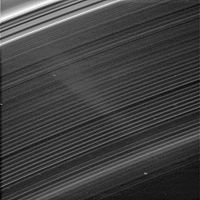
detected within this ring three ringlets designated D73, D72 and D68, with D68 being the discrete ringlet nearest to Saturn. Some 25 years later, Cassini images showed that D72 had become significantly broader and more diffuse, and had moved planetward by 200 kilometres.
Present in the D ring is a finescale structure with waves 30 kilometres apart. First seen in the gap between the C ring and D73, the structure was found during Saturn's 2009 equinox to extend a radial distance of 19000 km from the D ring to the inner edge of the B ring. The waves are interpreted as a spiral pattern of vertical corrugations of 2 to 20 m amplitude; the fact that the period of the waves is decreasing over time (from 60 km in 1995 to 30 km by 2006) allows a deduction that the pattern may have originated in late 1983 with the impact of a cloud of debris (with a mass of ~1012 kg) from a disrupted comet that tilted the rings out of the equatorial plane. A similar spiral pattern in Jupiter's main ring has been attributed to a perturbation caused by impact of material from Comet Shoemaker-Levy 9
Comet Shoemaker-Levy 9
Comet Shoemaker–Levy 9 was a comet that broke apart and collided with Jupiter in July 1994, providing the first direct observation of an extraterrestrial collision of solar system objects. This generated a large amount of coverage in the popular media, and the comet was closely observed by...
in 1994.
C Ring
William Cranch Bond
William Cranch Bond was an American astronomer, and the first director of Harvard College Observatory.- Upbringing :William Cranch Bond was born in Falmouth, Maine on September 9, 1789...
and George Bond
George Phillips Bond
George Phillips Bond was an American astronomer. He was the son of William Cranch Bond. Some sources give his year of birth as 1826....
, though William R. Dawes
William Rutter Dawes
William Rutter Dawes was an English astronomer.Dawes was born in West Sussex, the son of William Dawes, also an astronomer, who travelled to the colony of New South Wales on the First Fleet in 1788....
and Johann Galle
Johann Gottfried Galle
Johann Gottfried Galle was a German astronomer at the Berlin Observatory who, on 23 September 1846, with the assistance of student Heinrich Louis d'Arrest, was the first person to view the planet Neptune, and know what he was looking at...
also saw it independently. William Lassell
William Lassell
William Lassell FRS was an English merchant and astronomer.Born in Bolton and educated in Rochdale after the death of his father, he was apprenticed from 1814 to 1821 to a merchant in Liverpool. He then made his fortune as a beer brewer, which enabled him to indulge his interest in astronomy...
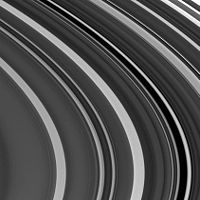
termed it the "Crepe Ring" because it seemed to be composed of darker material than the brighter A and B Rings.
Its vertical thickness is estimated at 5 metres, its mass at around 1.1 kilograms, and its optical depth
Optical depth
Optical depth, or optical thickness, is a measure of transparency. Optical depth is defined by the negative logarithm of the fraction of radiation that is not scattered or absorbed on a path...
varies from 0.05 to 0.12. That is, between 5 and 12 percent of light shining perpendicularly through the ring is blocked, so that when seen from above, the ring is close to transparent. The 30-kilometer wavelength spiral corrugations first seen in the D Ring were observed during Saturn's equinox of 2009 to extend throughout the C Ring (see above).
Colombo Gap and Titan Ringlet
The Colombo Gap lies in the inner C Ring. Within the gap lies the bright but narrow Colombo Ringlet, centered at 77,883 kilometres from Saturn's center, which is slightly ellipticalEllipse
In geometry, an ellipse is a plane curve that results from the intersection of a cone by a plane in a way that produces a closed curve. Circles are special cases of ellipses, obtained when the cutting plane is orthogonal to the cone's axis...
rather than circular. This ringlet is also called the Titan Ringlet as it is governed by an orbital resonance with the moon Titan
Titan (moon)
Titan , or Saturn VI, is the largest moon of Saturn, the only natural satellite known to have a dense atmosphere, and the only object other than Earth for which clear evidence of stable bodies of surface liquid has been found....
. At this location within the rings, the length of a ring particle's apsidal precession is equal to the length of Titan's orbital motion, so that the outer end of this eccentric ringlet always points towards Titan.
Maxwell Gap and Ringlet
The Maxwell Gap lies within the outer part of the C Ring. It also contains a dense non-circular ringlet, the Maxwell Ringlet. In many respects this ringlet is similar to the ε ring of Uranus. There are wave-like structures in the middle of both rings. While the wave in the ε ring is thought to be caused by Uranian moon CordeliaCordelia (moon)
Cordelia is the innermost moon of Uranus. It was discovered from the images taken by Voyager 2 on January 20, 1986, and was given the temporary designation S/1986 U 7. It was not detected again until the Hubble Space Telescope observed it in 1997...
, no moon has been discovered in the Maxwell gap as of July 2008.
B Ring
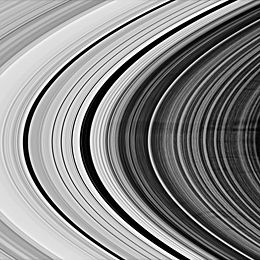
The B Ring is the largest, brightest, and most massive of the rings. Its thickness is estimated as 5 to 15 metres, its mass at 2.8 kg, and its optical depth varies from 0.4 to 2.5, meaning that 91% of the light passing through some parts of the B Ring is blocked. The B Ring contains a great deal of variation in its density and brightness, nearly all of it unexplained. These are concentric, appearing as narrow ringlets, though the B Ring does not contain any gaps.Spokes
Until 1980, the structure of the rings of Saturn was explained as being caused exclusively by the action of gravitationGravitation
Gravitation, or gravity, is a natural phenomenon by which physical bodies attract with a force proportional to their mass. Gravitation is most familiar as the agent that gives weight to objects with mass and causes them to fall to the ground when dropped...
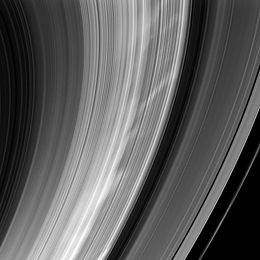
al forces. Then images from the Voyager spacecraft showed radial features in the B ring, known as spokes, which could not be explained in this manner, as their persistence and rotation around the rings was not consistent with gravitational orbital mechanics. The spokes appear dark in backscatter
Backscatter
In physics, backscatter is the reflection of waves, particles, or signals back to the direction they came from. It is a diffuse reflection due to scattering, as opposed to specular reflection like a mirror...
ed light, and bright in forward-scattered
Forward scatter
In telecommunication and astronomy, forward scatter is the deflection—by diffraction, nonhomogeneous refraction, or nonspecular reflection by particulate matter of dimensions that are large with respect to the wavelength in question but small with respect to the beam diameter—of a portion of an...
light (see images in gallery); the transition occurs at a phase angle
Phase angle (astronomy)
Phase angle in astronomical observations is the angle between the light incident onto an observed object and the light reflected from the object...
near 60°
Degree (angle)
A degree , usually denoted by ° , is a measurement of plane angle, representing 1⁄360 of a full rotation; one degree is equivalent to π/180 radians...
. The leading theory regarding the spokes' composition is that they consist of microscopic
Microscopic
The microscopic scale is the scale of size or length used to describe objects smaller than those that can easily be seen by the naked eye and which require a lens or microscope to see them clearly.-History:...
dust particles suspended away from the main ring by electrostatic repulsion, as they rotate almost synchronously
Synchronization
Synchronization is timekeeping which requires the coordination of events to operate a system in unison. The familiar conductor of an orchestra serves to keep the orchestra in time....
with the magnetosphere
Magnetosphere
A magnetosphere is formed when a stream of charged particles, such as the solar wind, interacts with and is deflected by the intrinsic magnetic field of a planet or similar body. Earth is surrounded by a magnetosphere, as are the other planets with intrinsic magnetic fields: Mercury, Jupiter,...
of Saturn. The precise mechanism generating the spokes is still unknown, although it has been suggested that the electrical disturbances might be caused by either lightning
Lightning
Lightning is an atmospheric electrostatic discharge accompanied by thunder, which typically occurs during thunderstorms, and sometimes during volcanic eruptions or dust storms...
bolts in Saturn's atmosphere
Atmosphere
An atmosphere is a layer of gases that may surround a material body of sufficient mass, and that is held in place by the gravity of the body. An atmosphere may be retained for a longer duration, if the gravity is high and the atmosphere's temperature is low...
or micrometeoroid
Micrometeoroid
A micrometeoroid is a tiny meteoroid; a small particle of rock in space, usually weighing less than a gram. A micrometeor or micrometeorite is such a particle that enters the Earth's atmosphere or falls to Earth.-Scientific interest:...
impacts on the rings.
The spokes were not observed again until some twenty-five years later, this time by the Cassini space probe. The spokes were not visible when Cassini arrived at Saturn in early 2004. Some scientists speculated that the spokes would not be visible again until 2007, based on models attempting to describe their formation. Nevertheless, the Cassini imaging team kept looking for spokes in images of the rings, and they were next seen in images taken on 5 September 2005.
The spokes appear to be a season
Season
A season is a division of the year, marked by changes in weather, ecology, and hours of daylight.Seasons result from the yearly revolution of the Earth around the Sun and the tilt of the Earth's axis relative to the plane of revolution...
al phenomenon, disappearing in the Saturnian midwinter and midsummer and reappearing as Saturn comes closer to equinox
Equinox
An equinox occurs twice a year, when the tilt of the Earth's axis is inclined neither away from nor towards the Sun, the center of the Sun being in the same plane as the Earth's equator...
. Suggestions that the spokes may be a seasonal effect, varying with Saturn's 29.7-year orbit, were supported by their gradual reappearance in the later years of the Cassini mission.
Moonlet
In 2009, during equinox, a moonlet embedded in the B ring was discovered from the shadow it cast. It is estimated to be 400 metres (1,312.3 ft) in diameter. The moonlet was given the provisional designation S/2009 S 1S/2009 S 1
S/2009 S 1 is a 'propeller moonlet' of Saturn orbiting at a distance of about , in the outer part of Saturn's B Ring, and with an approximate diameter of . It was discovered by the Cassini Imaging Team on July 26, 2009. The moon was noticed during the 2009 equinox event by an approximately long...
.
Cassini Division
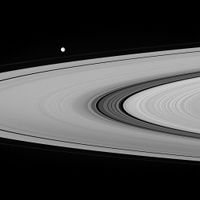
Giovanni Domenico Cassini
This article is about the Italian-born astronomer. For his French-born great-grandson, see Jean-Dominique Cassini.Giovanni Domenico Cassini was an Italian/French mathematician, astronomer, engineer, and astrologer...
at the Paris Observatory
Paris Observatory
The Paris Observatory is the foremost astronomical observatory of France, and one of the largest astronomical centres in the world...
using a refracting telescope
Refracting telescope
A refracting or refractor telescope is a type of optical telescope that uses a lens as its objective to form an image . The refracting telescope design was originally used in spy glasses and astronomical telescopes but is also used for long focus camera lenses...
that had a 2.5 inch objective lens
Objective (optics)
In an optical instrument, the objective is the optical element that gathers light from the object being observed and focuses the light rays to produce a real image. Objectives can be single lenses or mirrors, or combinations of several optical elements. They are used in microscopes, telescopes,...
with a 20 foot long focal length
Focal length
The focal length of an optical system is a measure of how strongly the system converges or diverges light. For an optical system in air, it is the distance over which initially collimated rays are brought to a focus...
and a 90x magnification
Magnification
Magnification is the process of enlarging something only in appearance, not in physical size. This enlargement is quantified by a calculated number also called "magnification"...
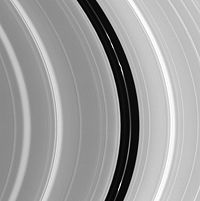
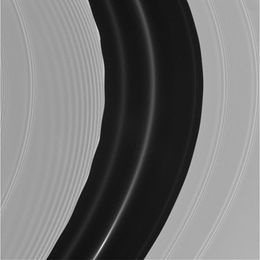
. From Earth it appears as a thin black gap in the rings. However, Voyager discovered that the gap is itself populated by ring material bearing much similarity to the C Ring. The division may appear bright in views of the unlit side of the rings, since the relatively low density of material allows more light to be transmitted through the thickness of the rings (see second image in gallery).
The inner edge of the Cassini Division is governed by a strong orbital resonance. Ring particles at this location orbit twice for every orbit of the moon Mimas
Mimas (moon)
Mimas is a moon of Saturn which was discovered in 1789 by William Herschel. It is named after Mimas, a son of Gaia in Greek mythology, and is also designated Saturn I....
. The resonance causes Mimas' pulls on these ring particles to accumulate, destabilizing their orbits and leading to a sharp cutoff in ring density. Many of the other gaps between ringlets within the Cassini Division, however, are unexplained.
Huygens Gap
The Huygens Gap is located at the inner edge of the Cassini Division. It contains the dense, eccentric Huygens Ringlet in the middle. This ringlet exhibits irregular azimuthal variations of geometrical width and optical depth, which may be caused by the nearby 2:1 resonance with MimasMimas (moon)
Mimas is a moon of Saturn which was discovered in 1789 by William Herschel. It is named after Mimas, a son of Gaia in Greek mythology, and is also designated Saturn I....
and the influence of the eccentric outer edge of the B-ring. There is an additional narrow ringlet just outside the Huygens Ringlet.
A Ring
Atlas (moon)
Atlas is an inner satellite of Saturn.Atlas was discovered by Richard Terrile in 1980 from Voyager photos and was designated '. In 1983 it was officially named after Atlas of Greek mythology, because it "holds the rings on its shoulders" like the Titan Atlas held the sky up above the Earth...
. The A Ring is interrupted at a location 22% of the ring width from its outer edge by the Encke Gap. A narrower gap 2% of the ring width from the outer edge is called the Keeler Gap.
The thickness of the A Ring is estimated as 10 to 30 metres, its mass as 6.2 kg (about the mass of Hyperion
Hyperion (moon)
Hyperion , also known as Saturn VII, is a moon of Saturn discovered by William Cranch Bond, George Phillips Bond and William Lassell in 1848. It is distinguished by its irregular shape, its chaotic rotation, and its unexplained sponge-like appearance...
), and its optical depth varies from 0.4 to 1.0.
Similarly to the B Ring, the A Ring's outer edge is maintained by an orbital resonance, in this case the 7:6 resonance with Janus
Janus (moon)
Janus is an inner satellite of Saturn. It is also known as Saturn X . It is named after the mythological Janus.-Discovery and orbit:Janus occupies practically the same orbit as the moon Epimetheus...
and Epimetheus
Epimetheus (moon)
Epimetheus is an inner satellite of Saturn. It is also known as Saturn XI. It is named after the mythological Epimetheus, brother of Prometheus.-Discovery:Epimetheus occupies essentially the same orbit as the moon Janus...
. Other orbital resonances also excite many spiral density waves
Density wave theory
Density wave theory or the Lin-Shu density wave theory is a theory proposed by C.C. Lin and Frank Shu in the mid-1960s to explain spiral arm structure of spiral galaxies. Their theory introduces the idea of long-lived quasistatic density waves , which are sections of the galactic disk that have...
in the A Ring (and, to a lesser extent, other rings as well), which account for most of its structure. These waves are described by the same physics that describes the spiral arms of galaxies
Spiral galaxy
A spiral galaxy is a certain kind of galaxy originally described by Edwin Hubble in his 1936 work The Realm of the Nebulae and, as such, forms part of the Hubble sequence. Spiral galaxies consist of a flat, rotating disk containing stars, gas and dust, and a central concentration of stars known as...
. Spiral bending waves, also present in the A Ring and also described by the same theory, are vertical corrugations
Transverse wave
A transverse wave is a moving wave that consists of oscillations occurring perpendicular to the direction of energy transfer...
in the ring rather than compression waves
Longitudinal wave
Longitudinal waves, as known as "l-waves", are waves that have the same direction of vibration as their direction of travel, which means that the movement of the medium is in the same direction as or the opposite direction to the motion of the wave. Mechanical longitudinal waves have been also...
.
Encke Gap

Pan (moon)
Pan is the innermost moon of Saturn. It is a walnut-shaped small moon about 35 kilometres across and 23 km high that orbits within the Encke Gap in Saturn's A Ring. Pan acts as a ring shepherd and is responsible for keeping the Encke Gap free of ring particles.It was discovered by Mark R...
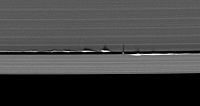
, which orbits within it. Images from the Cassini probe have shown that there are at least three thin, knotted ringlets within the gap. Spiral density waves
Density wave theory
Density wave theory or the Lin-Shu density wave theory is a theory proposed by C.C. Lin and Frank Shu in the mid-1960s to explain spiral arm structure of spiral galaxies. Their theory introduces the idea of long-lived quasistatic density waves , which are sections of the galactic disk that have...
visible on both sides of it are induced by resonances with nearby moons exterior to the rings, while Pan induces an additional set of spiraling wakes (see image in gallery).
Johann Encke himself did not observe this gap; it was named in honour of his ring observations. The gap itself was discovered by James Edward Keeler in 1888. The second major gap in the A Ring, discovered by Voyager, was named the Keeler Gap in his honor.
The Encke Gap is a gap because it is entirely within the A Ring. There was some ambiguity between the terms gap and division until the IAU clarified the definitions in 2008; before that, the separation was sometimes called the "Encke Division".
Keeler Gap
The Keeler Gap is a 42-kilometre-wide gap in the A Ring, approximately 250kilometres from the ring's outer edge. The small moon Daphnis
Daphnis (moon)
Daphnis is an inner satellite of Saturn. It is also known as '; its provisional designation was '. Daphnis is about 8 kilometres in diameter, and orbits the planet in the Keeler Gap within the A ring.- Naming :...
, discovered 1 May 2005, orbits within it, keeping it clear. The moon induces waves in the edges of the gap. Because the orbit of Daphnis is slightly inclined to the ring plane, the waves have a component that is perpendicular to the ring plane, reaching a distance of 1.5 km (0.93205910497471 mi) "above" the plane.
The Keeler gap was discovered by Voyager, and named in honor of the astronomer James Edward Keeler. Keeler had in turn discovered and named the Encke Gap in honor of Johann Encke.
Moonlets
Moonlet
Moonlet is an informal term for a particularly small natural satellite. In astronomical literature, it has been used in at least two situations:...
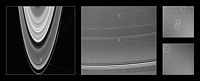
s" were found in Cassini images of the A Ring. The moonlets themselves are only about a hundred metres in diameter, too small to be seen directly; what Cassini sees are the "propeller"-shaped disturbances the moonlets create, which are several kilometres across. It is estimated that the A Ring contains thousands of such objects. In 2007, the discovery of eight more moonlets revealed that they are largely confined to a 3000 km belt, about 130,000 km from Saturn's center, and by 2008 over 150 propeller moonlets had been detected.
Roche Division
The separation between the A Ring and the F Ring has been named the Roche Division in honor of the French physicist Édouard RocheÉdouard Roche
Édouard Albert Roche was a French astronomer and mathematician, who is best known for his work in the field of celestial mechanics...
. The Roche Division should not be confused with the Roche limit
Roche limit
The Roche limit , sometimes referred to as the Roche radius, is the distance within which a celestial body, held together only by its own gravity, will disintegrate due to a second celestial body's tidal forces exceeding the first body's gravitational self-attraction...
, a physical concept that describes when a large object gets so close to a planet (such as Saturn) that the planet's tidal force
Tidal force
The tidal force is a secondary effect of the force of gravity and is responsible for the tides. It arises because the gravitational force per unit mass exerted on one body by a second body is not constant across its diameter, the side nearest to the second being more attracted by it than the side...
s will pull it apart. Lying at the outer edge of the main ring system, the Roche Division is in fact close to Saturn's Roche limit, which is why the rings have been unable to accrete
Accretion (astrophysics)
In astrophysics, the term accretion is used for at least two distinct processes.The first and most common is the growth of a massive object by gravitationally attracting more matter, typically gaseous matter in an accretion disc. Accretion discs are common around smaller stars or stellar remnants...
into a moon.
Like the Cassini Division, the Roche Division is not empty but contains a sheet of material. The character of this material is similar to the tenuous and dusty D, E, and G Rings. Two locations in the Roche Division have a higher concentration of dust than the rest of the region. These were discovered by the Cassini probe imaging team and were given temporary designations: R/2004 S 1, which lies along the orbit of the moon Atlas
Atlas (moon)
Atlas is an inner satellite of Saturn.Atlas was discovered by Richard Terrile in 1980 from Voyager photos and was designated '. In 1983 it was officially named after Atlas of Greek mythology, because it "holds the rings on its shoulders" like the Titan Atlas held the sky up above the Earth...
; and R/2004 S 2, centered at 138,900 km from Saturn's center, inward of the orbit of Prometheus
Prometheus (moon)
-Animations:-External links:* at ** anaglyph view of Prometheus...
.
F Ring
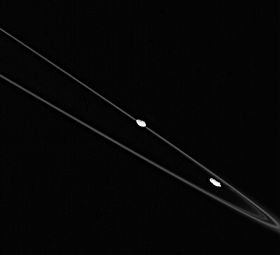
The F Ring is the outermost discrete ring of Saturn and perhaps the most active ring in the Solar System, with features changing on a timescale of hours. It is located 3,000 km beyond the outer edge of the A Ring. It was discovered in 1979 by the Pioneer 11Pioneer 11
Pioneer 11 is a 259-kilogram robotic space probe launched by NASA on April 6, 1973 to study the asteroid belt, the environment around Jupiter and Saturn, solar wind, cosmic rays, and eventually the far reaches of the solar system and heliosphere...
imaging team. It is very thin, just a few hundred kilometres wide, and is held together by two shepherd moons, Prometheus
Prometheus (moon)
-Animations:-External links:* at ** anaglyph view of Prometheus...
and Pandora
Pandora (moon)
Pandora is an inner satellite of Saturn. It was discovered in 1980 from photos taken by the Voyager 1 probe, and was provisionally designated '. In late 1985 it was officially named after Pandora from Greek mythology. It is also designated as '.Pandora is the outer shepherd satellite of the F Ring...
, which orbit inside and outside it.
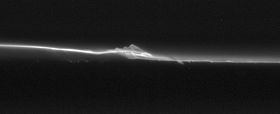
Recent closeup images from the Cassini probe show that the F Ring consists of one core ring and a spiral strand around it. They also show that when Prometheus encounters the ring at its apoapsis, its gravitational attraction creates kinks and knots in the F Ring as the moon 'steals' material from it, leaving a dark channel in the inner part of the ring (see video link and additional F Ring images in gallery). Since Prometheus orbits Saturn more rapidly than the material in the F ring, each new channel is carved about 3.2 degrees in front of the previous one.
In 2008, further dynamism was detected, suggesting that small unseen moons orbiting within the F Ring are continually passing through its narrow core because of perturbations from Prometheus. One of the small moons was tentatively identified as S/2004 S 6.
Outer rings
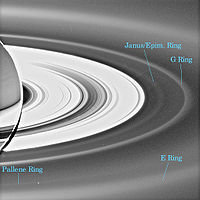

Janus/Epimetheus Ring
A faint dust ring is present around the region occupied by the orbits of JanusJanus (moon)
Janus is an inner satellite of Saturn. It is also known as Saturn X . It is named after the mythological Janus.-Discovery and orbit:Janus occupies practically the same orbit as the moon Epimetheus...
and Epimetheus
Epimetheus (moon)
Epimetheus is an inner satellite of Saturn. It is also known as Saturn XI. It is named after the mythological Epimetheus, brother of Prometheus.-Discovery:Epimetheus occupies essentially the same orbit as the moon Janus...
, as revealed by images taken in forward-scattered light by the Cassini spacecraft in 2006. The ring has a radial extent of about 5,000 km. Its source is particles blasted off the moons' surfaces by meteoroid impacts, which then form a diffuse ring around their orbital paths.
G Ring
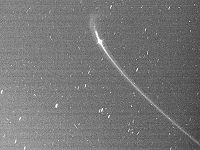
The G Ring (see last image in gallery) is a very thin, faint ring about halfway between the F Ring and the beginning of the E Ring, with its inner edge about 15,000 km inside the orbit of MimasMimas (moon)
Mimas is a moon of Saturn which was discovered in 1789 by William Herschel. It is named after Mimas, a son of Gaia in Greek mythology, and is also designated Saturn I....
. It contains a single distinctly brighter arc near its inner edge (similar to the arcs in the rings of Neptune
Rings of Neptune
The rings of Neptune consist primarily of five principal rings predicted in 1984 by André Brahic and imaged in 1989 by the Voyager 2 spacecraft...
) that extends about one sixth of its circumference, centered on the half-kilometre diameter moonlet Aegaeon, which is held in place by a 7:6 orbital resonance with Mimas. The arc is believed to be composed of icy particles up to a few metres in diameter, with the rest of the G Ring consisting of dust released from within the arc. The radial width of the arc is about 250 km, compared to a width of 9,000 km for the G Ring as a whole. The arc is thought contain matter equivalent to a small icy moonlet about a hundred metres in diameter. Dust released from Aegaeon and other source bodies within the arc by micrometeoroid
Micrometeoroid
A micrometeoroid is a tiny meteoroid; a small particle of rock in space, usually weighing less than a gram. A micrometeor or micrometeorite is such a particle that enters the Earth's atmosphere or falls to Earth.-Scientific interest:...
impacts drifts outward from the arc because of interaction with Saturn's magnetosphere
Magnetosphere
A magnetosphere is formed when a stream of charged particles, such as the solar wind, interacts with and is deflected by the intrinsic magnetic field of a planet or similar body. Earth is surrounded by a magnetosphere, as are the other planets with intrinsic magnetic fields: Mercury, Jupiter,...
(whose plasma
Plasma (physics)
In physics and chemistry, plasma is a state of matter similar to gas in which a certain portion of the particles are ionized. Heating a gas may ionize its molecules or atoms , thus turning it into a plasma, which contains charged particles: positive ions and negative electrons or ions...
corotates with Saturn's magnetic field
Magnetic field
A magnetic field is a mathematical description of the magnetic influence of electric currents and magnetic materials. The magnetic field at any given point is specified by both a direction and a magnitude ; as such it is a vector field.Technically, a magnetic field is a pseudo vector;...
, which rotates much more rapidly than the orbital motion of the G Ring). These tiny particles are steadily eroded away by further impacts and dispersed by plasma drag. Over the course of thousands of years the ring gradually loses mass, which is replenished by further impacts on Aegaeon.
Methone Ring Arc
A faint ring arc, first detected in September 2006, covering a longitudinal extent of about 10 degrees is associated with the moon MethoneMethone (moon)
Methone is a very small natural satellite of Saturn lying between the orbits of Mimas and Enceladus.It was first seen by the Cassini Imaging Team and given the temporary designation '. Methone is also named '....
. The material in the arc is believed to represent dust ejected from Methone by micrometeoroid impacts. The confinement of the dust within the arc is attributable to a 14:15 resonance with Mimas (similar to the mechanism of confinement of the arc within the G ring). Under the influence of the same resonance, Methone librates back and forth in its orbit with an amplitude of 5° of longitude.
Anthe Ring Arc
A faint ring arc, first detected in June 2007, covering a longitudinal extent of about 20 degrees is associated with the moon AntheAnthe (moon)
Anthe is a very small natural satellite of Saturn lying between the orbits of Mimas and Enceladus. It is also known as Saturn XLIX; its provisional designation was S/2007 S 4. It is named after one of the Alkyonides; the name means flowery. It is the sixtieth confirmed moon of Saturn.It was...
. The material in the arc is believed to represent dust knocked off Anthe by micrometeoroid impacts. The confinement of the dust within the arc is attributable to a 10:11 resonance with Mimas. Under the influence of the same resonance, Anthe drifts back and forth in its orbit over 14° of longitude.
Pallene Ring
A faint dust ring shares Pallene'sPallene (moon)
Pallene is a very small natural satellite of Saturn. It is one of three small moons known as the Alkyonides that lie between the orbits of the larger Mimas and Enceladus. It is also designated as '.-Discovery:...
orbit, as revealed by images taken in forward-scattered light by the Cassini spacecraft in 2006. The ring has a radial extent of about 2,500 km. Its source is particles blasted off Pallene's surface by meteoroid impacts, which then form a diffuse ring around its orbital path.
E Ring
The E Ring is the outermost ring, and is extremely wide, beginning at the orbit of MimasMimas (moon)
Mimas is a moon of Saturn which was discovered in 1789 by William Herschel. It is named after Mimas, a son of Gaia in Greek mythology, and is also designated Saturn I....
and ending somewhere around the orbit of Rhea
Rhea (moon)
Rhea is the second-largest moon of Saturn and the ninth largest moon in the Solar System. It was discovered in 1672 by Giovanni Domenico Cassini.-Name:Rhea is named after the Titan Rhea of Greek mythology, "mother of the gods"...
. It is a diffuse disk consisting mostly of ice, with silicates, carbon dioxide and ammonia. Unlike the other rings, it is composed of microscopic rather than macroscopic particles. In 2005, the source of the E Ring's material was determined to be cryovolcanic
Cryovolcano
A cryovolcano is a volcano that erupts volatiles such as water, ammonia or methane, instead of molten rock. Collectively referred to as cryomagma or ice-volcanic melt, these substances are usually liquids and form plumes, but can also be in vapour form...
plumes emanating from the "tiger stripes"
Tiger Stripes (Enceladus)
The tiger stripes of Enceladus consist of four sub-parallel, linear depressions in the south polar region of the Saturnian moon. First observed on May 20, 2005 by the Cassini spacecraft's Imaging Science Sub-system camera , the features are most notable in lower resolution images by their...
of the south polar region of the moon Enceladus
Enceladus (moon)
Enceladus is the sixth-largest of the moons of Saturn. It was discovered in 1789 by William Herschel. Until the two Voyager spacecraft passed near it in the early 1980s very little was known about this small moon besides the identification of water ice on its surface...
.
Phoebe ring
On 6 October 2009, the discovery was announced of a tenuous disk of material in the plane of and just interior to the orbit of PhoebePhoebe (moon)
Phoebe is an irregular satellite of Saturn. It was discovered by William Henry Pickering on 17 March 1899 from photographic plates that had been taken starting on 16 August 1898 at the Boyden Observatory near Arequipa, Peru, by DeLisle Stewart...
. The disk was aligned edge-on to Earth at the time of discovery. This disk can be loosely described as another ring. Although very large (the apparent size of two full moons as seen from Earth), the ring is virtually invisible – it was discovered using NASA
NASA
The National Aeronautics and Space Administration is the agency of the United States government that is responsible for the nation's civilian space program and for aeronautics and aerospace research...
's infra-red Spitzer Space Telescope
Spitzer Space Telescope
The Spitzer Space Telescope , formerly the Space Infrared Telescope Facility is an infrared space observatory launched in 2003...
. The ring was seen over the entire range of the observations, which extended from 128 to 207 times the radius of Saturn, with calculations indicating that it may extend outward up to 300 Saturn radii and inward to the orbit of Iapetus at 59 Saturn radii; Phoebe orbits the planet at an average distance of 215 radii. The ring is about 20 times as thick as the diameter of the planet. Since the ring's particles are presumed to have originated from impacts (micrometeoroid
Micrometeoroid
A micrometeoroid is a tiny meteoroid; a small particle of rock in space, usually weighing less than a gram. A micrometeor or micrometeorite is such a particle that enters the Earth's atmosphere or falls to Earth.-Scientific interest:...
and larger) on Phoebe, they should share its retrograde orbit, which is opposite to the orbital motion of the next inner moon, Iapetus
Iapetus (moon)
Iapetus ), occasionally Japetus , is the third-largest moon of Saturn, and eleventh in the Solar System. It was discovered by Giovanni Domenico Cassini in 1671...
. This ring lies in the plane of Saturn's orbit, or roughly the ecliptic
Ecliptic
The ecliptic is the plane of the earth's orbit around the sun. In more accurate terms, it is the intersection of the celestial sphere with the ecliptic plane, which is the geometric plane containing the mean orbit of the Earth around the Sun...
, and thus is tilted 27 degrees from Saturn's equatorial plane and the other rings. Phoebe is inclined
Inclination
Inclination in general is the angle between a reference plane and another plane or axis of direction.-Orbits:The inclination is one of the six orbital parameters describing the shape and orientation of a celestial orbit...
by 5° with respect to Saturn's orbit plane (often written as 175°, due to Phoebe's retrograde orbital motion), and its resulting vertical excursions above and below the ring plane agree closely with the ring's observed thickness of 40 Saturn radii.
The existence of the ring was proposed in the 1970s by Steven Soter
Steven Soter
Dr. Steven Soter, PhD, is an astrophysicist currently holding the positions of scientist-in-residence for New York University's Environmental Studies Program and of Research Associate for the Department of Astrophysics at the American Museum of Natural History...
. The discovery was made by Anne J. Verbiscer and Michael F. Skrutskie (of the University of Virginia
University of Virginia
The University of Virginia is a public research university located in Charlottesville, Virginia, United States, founded by Thomas Jefferson...
) and Douglas P. Hamilton (of the University of Maryland, College Park
University of Maryland, College Park
The University of Maryland, College Park is a top-ranked public research university located in the city of College Park in Prince George's County, Maryland, just outside Washington, D.C...
). Verbiscer, Skrutskie and Hamilton had been graduate students together at Cornell University
Cornell University
Cornell University is an Ivy League university located in Ithaca, New York, United States. It is a private land-grant university, receiving annual funding from the State of New York for certain educational missions...
.
Ring material migrates inward due to reemission of solar radiation, and would thus strike the leading hemisphere of Iapetus. Infall of this material causes a slight darkening and reddening of the leading hemisphere of Iapetus (similar to what is seen on the Uranian moons Oberon
Oberon (moon)
Oberon , also designated ', is the outermost major moon of the planet Uranus. It is the second largest and second most massive of the Uranian moons, and the ninth most massive moon in the Solar System. Discovered by William Herschel in 1787, Oberon is named after the mythical king of the fairies...
and Titania
Titania (moon)
Titania is the largest of the moons of Uranus and the eighth largest moon in the Solar System at a diameter of 1578 km. Discovered by William Herschel in 1787, Titania is named after the queen of the fairies in Shakespeare's A Midsummer Night's Dream...
) but does not directly create the dramatic two-tone coloration of that moon. Rather, the infalling material initiates a positive feedback
Positive feedback
Positive feedback is a process in which the effects of a small disturbance on a system include an increase in the magnitude of the perturbation. That is, A produces more of B which in turn produces more of A. In contrast, a system that responds to a perturbation in a way that reduces its effect is...
thermal self-segregation process
Thermal runaway
Thermal runaway refers to a situation where an increase in temperature changes the conditions in a way that causes a further increase in temperature, often leading to a destructive result...
of ice sublimation from warmer regions, followed by vapor condensation onto cooler regions. This leaves a dark residue of "lag" material covering most of the equatorial region of Iapetus's leading hemisphere, which contrasts with the bright ice deposits covering the polar regions and most of the trailing hemisphere.
Possible ring system around Rhea
Saturn's second largest moon RheaRhea (moon)
Rhea is the second-largest moon of Saturn and the ninth largest moon in the Solar System. It was discovered in 1672 by Giovanni Domenico Cassini.-Name:Rhea is named after the Titan Rhea of Greek mythology, "mother of the gods"...
has been hypothesized to have a tenuous ring system of its own consisting of three narrow bands embedded in a disk of solid particles. These putative rings have not been imaged, but their existence has been inferred from Cassini observations in November 2005 of a depletion of energetic electrons in Saturn's magnetosphere
Magnetosphere
A magnetosphere is formed when a stream of charged particles, such as the solar wind, interacts with and is deflected by the intrinsic magnetic field of a planet or similar body. Earth is surrounded by a magnetosphere, as are the other planets with intrinsic magnetic fields: Mercury, Jupiter,...
near Rhea. The Magnetospheric Imaging Instrument (MIMI) observed a gentle gradient punctuated by three sharp drops in plasma flow on each side of the moon in a nearly symmetric pattern. This could be explained if they were absorbed by solid material in the form of an equatorial disk containing denser rings or arcs, with particles perhaps several decimetres to approximately a metre in diameter. A more recent piece of evidence consistent with the presence of Rhean rings is a set of small ultraviolet-bright spots distributed in a line that extends three quarters of the way around the moon's circumference, within 2 degrees of the equator. The spots have been interpreted as the impact points of deorbiting ring material. However, targeted observations by Cassini of the putative ring plane from several angles have turned up nothing, suggesting that another explanation for these enigmatic features is needed.
Gallery
.jpg) |
 |
 |
 |
 |
 |
See also
- Giovanni Cassini – discovered the separation between the A and B rings, in 1675 – (Cassini Division)
- Galileo GalileiGalileo GalileiGalileo Galilei , was an Italian physicist, mathematician, astronomer, and philosopher who played a major role in the Scientific Revolution. His achievements include improvements to the telescope and consequent astronomical observations and support for Copernicanism...
– the first person to observe Saturn's rings, in 1610 - Christian Huygens – the first person to propose that there was a ring surrounding Saturn, in 1655
- Édouard RocheÉdouard RocheÉdouard Albert Roche was a French astronomer and mathematician, who is best known for his work in the field of celestial mechanics...
– French astronomer who described how the breakup of a satellite could form the rings, when it comes within the Roche limitRoche limitThe Roche limit , sometimes referred to as the Roche radius, is the distance within which a celestial body, held together only by its own gravity, will disintegrate due to a second celestial body's tidal forces exceeding the first body's gravitational self-attraction...
of a celestial body.