


Caesar's invasions of Britain

Encyclopedia
In his Gallic Wars
, Julius Caesar
invaded Britain
twice, in 55 and 54 BC. The first invasion, made late in summer, was either intended as a full invasion (in which case it was unsuccessful - it gained a beachhead on the coast of Kent
but achieved little else) or a reconnaissance-in-force expedition. The second was more successful, setting up a friendly king, Mandubracius
, and forcing the submission of his rival, Cassivellaunus
, although no territory was conquered and held for Rome, but was restored to the allied Trinovantes
, along with promised tribute of other tribes in what is now eastern England.
 During the course of his conquest of Gaul
, Caesar claims that the Britons had supported the campaigns of the mainland Gauls against him, with fugitives from among the Gallic Belgae
fleeing to Belgic settlements in Britain, and the Veneti
of Armorica
, who controlled seaborne trade to the island, calling in aid from their British allies to fight for them against Caesar in 56. Strabo
says that the Venetic rebellion in 56 BC had been intended to prevent Caesar from travelling to Britain and disrupting their commercial activity, suggesting that the possibility of a British expedition had already been considered by then.
In late summer, 55 BC, even though it was late in the campaigning season, Caesar decided to make an expedition to Britain. He summoned merchants who traded with the island, but they were unable or unwilling to give him any useful information about the inhabitants and their military tactics, or about harbours he could use, presumably not wanting to lose their monopoly on cross-channel trade. He sent a tribune, Gaius Volusenus
, to scout the coast in a single warship. He probably examined the Kent
coast between Hythe
and Sandwich
, but was unable to land, since he "did not dare leave his ship and entrust himself to the barbarians", and after five days returned to give Caesar what intelligence he had managed to gather.
By then, ambassadors from some of the British states, warned by merchants of the impending invasion, had arrived promising their submission. Caesar sent them back, along with his ally Commius
, king of the Gallic Atrebates
, to use their influence to win over as many other states as possible.
He gathered a fleet consisting of eighty transport ships
, sufficient to carry two legions
(Legio VII
and Legio X
), and an unknown number of warships under a quaestor
, at an unnamed port in the territory of the Morini
, almost certainly Portius Itius
(Boulogne
). Another eighteen transports of cavalry were to sail from a different port, probably Ambleteuse. These ships may have been trireme
s or bireme
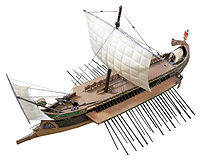
s, or may have been adapted from Venetic designs Caesar had seen previously, or may even have been requisitioned from the Veneti and other coastal tribes. Clearly in a hurry, Caesar himself left a garrison at the port and set out "at the third watch" - about midnight - on 23 August with the legions, leaving the cavalry to march to their ships, embark, and join him as soon as possible. In light of later events, this was either a tactical mistake or (along with the fact that the legions came over without baggage or heavy siege gear) confirms the invasion was not intended for complete conquest.
 Caesar initially tried to land at Dubris
(Dover
), whose natural harbour had presumably been identified by Volusenus as a suitable landing place. However, when he came in sight of shore, the massed forces of the Britons gathered on the overlooking hills and cliffs (i.e. the White cliffs of Dover
) dissuaded him from landing there, since the cliffs were "so close to the shore that javelins could be thrown down from" them onto anyone landing there. After waiting there at anchor "until the ninth hour" (about 3pm - presumably waiting the wind and tide to become favourable) and meanwhile convening a council of war, he ordered his subordinates to act on their own initiative and then sailed the fleet about seven miles along the coast to an open beach. In the absence of archaeological evidence at the landing point, this beach was most probably at Walmer
, which is the right distance up the coast from the White Cliffs. It was thought in the 19th century to be near Deal Castle
- hence a house there named SPQR
- but is now thought to be half a mile further south, where it is now marked by a concrete memorial.
Having been tracked all the way along the coast by the British cavalry and chariots, the landing was opposed. To make matters worse, the Roman ships were too large to go close inshore and the troops had to disembark in deep water, all the while attacked by the enemy from the shallows. The troops were reluctant, but according to Caesar's account were led by the aquilifer
(standard bearer) of the 10th legion who jumped in first as an example, shouting:
The British were eventually driven back with catapultae
and slings fired from the warships into the exposed flank of their formation and the Romans managed to land and drive them off. The cavalry, delayed by adverse winds, still had not arrived, so the Britons could not be pursued and finished off, and Caesar could not enjoy what he calls, in his usual self-promoting style, his "accustomed success".
, was taken by surprise by the British tides. At high tide, his beached warships filled with water, and his transports, riding at anchor, were driven against each other. Some ships were wrecked, and many others were rendered unseaworthy by the loss of rigging or other vital equipment, threatening the return journey.
Realising this and hoping to keep Caesar in Britain over the winter and thus starve him into submission, the Britons renewed the attack, ambushing one of the legions as it foraged
near the Roman camp. The foraging party was relieved by the remainder of the Roman force and the Britons were again driven off, only to regroup after several days of storms with a larger force to attack the Roman camp. This attack was driven off fully, in a bloody rout, with improvised cavalry that Commius had gathered from pro-Roman Britons and a Roman scorched earth
policy.
was approaching), and so allowed them to be delivered to him in Gaul, to which he returned with as many of the ships as could be repaired with flotsam from the wrecked ships. Even then, only two tribes felt sufficiently threatened by Caesar to actually send the hostages, and two of his transports were separated from the main body and made landfall elsewhere.
decreed a supplicatio
(thanksgiving) of twenty days when they received Caesar's report.
Caesar's pretext for the invasion was that "in almost all the wars with the Gauls succors had been furnished to our enemy from that country". This is plausible, although it may also have been a cover for investigating Britain's mineral resources and economic potential: afterwards, Cicero
refers to the disappointing discovery that there was no gold or silver in the island; and Suetonius
reports that Caesar was said to have gone to Britain in search of pearls.
wrote letters to his friend Gaius Trebatius Testa
and his brother Quintus
, both of whom were serving in Caesar's army, expressing his excitement at the prospect. He urged Trebatius to capture him a war chariot, and asked Quintus to write him a description of the island. Trebatius, as it turned out, did not go to Britain, but Quintus did, and wrote him several letters from there - as did Caesar himself.
Determined not to make the same mistakes as the previous year, Caesar gathered a larger force than on his previous expedition (five legions as opposed to two, plus two-thousand cavalry), carried in ships which he designed, with experience of Venetic shipbuilding technology, to be more suitable to a beach landing than those used in 55 BC (i.e. broader and lower for easier beaching). This time he names Portus Itius as the departure point.
Caesar landed at the place he had identified as the best landing-place the previous year. The Britons did not oppose the landing, apparently, as Caesar states, intimidated by the size of the fleet, but equally this may have been a strategic ploy to give them time to gather their forces, or may reflect their lack of concern.
in charge of the beach-head and made an immediate night march twelve miles inland, where he encountered the British forces at a river crossing, probably somewhere on the River Stour
(e.g. the future site of Canterbury
). The Britons attacked but were repulsed, and attempted to regroup at a fortified place in the forests (possibly to be identified with the hillfort at Bigbury Wood, Kent,) but were again defeated and scattered. As it was late in the day and Caesar was unsure of the territory, he called off the pursuit and made camp.
However, the next morning, as he prepared to advance further, Caesar received word from Atrius that, once again, his ships at anchor had been dashed against each other in a storm and suffered considerable damage. About forty, he says, were lost. The Romans were unused to Atlantic and Channel
tides and storms, but nevertheless, considering the damage he had sustained the previous year, this was poor planning on Caesar's part. However, Caesar may have exaggerated the number of ships wrecked to magnify his own achievement in rescuing the situation. He returned to the coast, recalling the legions that had gone ahead, and immediately set about repairing his fleet. His men worked day and night for approximately ten days, beaching and repairing the ships, and building a fortified camp around them. Word was sent to Labienus to send more ships.
Caesar was on the coast on 1 September, from where he wrote a letter to Cicero. News must have reached him at this point of the death of his daughter Julia
, as Cicero refrained from replying "on account of his mourning".
, a warlord from north of the Thames, had previously been at war with most of the British tribes. He had recently overthrown the king of the powerful Trinovantes
and forced his son, Mandubracius
, into exile, but now the Britons had appointed him to lead their combined forces. After several indecisive skirmishes, during which a Roman tribune, Quintus Laberius Durus
, was killed, the Britons attacked a foraging party of three legions under Gaius Trebonius, but were repulsed and routed by the pursuing Roman cavalry.
Cassivellaunus realised he could not defeat Caesar in a pitched battle. Disbanding the majority of his force and relying on the mobility of his 4,000 chariots and superior knowledge of the terrain, he used guerrilla
tactics to slow the Roman advance. By the time Caesar reached the Thames, the one fordable place available to him (possibly at Westminster
), had been fortified with sharpened stakes, both on the shore and under the water, and the far bank was defended. Nevertheless, he was able to cross, put the defenders to flight, and enter Cassivellaunus's territory.
The Trinovantes, who Caesar describes as the most powerful tribe in the region, and who had recently suffered at Cassivellaunus's hands, sent ambassadors, promising him aid and provisions. Mandubracius, who had accompanied Caesar, was restored as their king, and the Trinovantes provided grain and hostages. Five further tribes, the Cenimagni
, Segontiaci
, Ancalites
, Bibroci
and Cassi
, surrendered to Caesar, and revealed to him the location of Cassivellaunus's stronghold, possibly the hill fort at Wheathampstead
, which he proceeded to put under siege.
Cassivellaunus sent word to his allies in Kent, Cingetorix
, Carvilius
, Taximagulus
and Segovax
, described as the "four kings of Cantium
", to stage a diversionary attack on the Roman beach-head to draw Caesar off, but this attack failed, and Cassivellaunus sent ambassadors to negotiate a surrender. Caesar was eager to return to Gaul for the winter due to growing unrest there, and an agreement was mediated by Commius. Cassivellaunus gave hostages, agreed an annual tribute, and undertook not to make war against Mandubracius or the Trinovantes. Caesar wrote to Cicero on 26 September, confirming the result of the campaign, with hostages but no booty taken, and that his army was about to return to Gaul. He then left, leaving not a single Roman soldier in Britain to enforce his settlement. Whether the tribute was ever paid is unknown.
, Caesar's Atrebatian
ally, later switched sides, fighting in Vercingetorix
's rebellion. After a number of unsuccessful engagements with Caesar's forces, he cut his losses and fled to Britain. Sextus Julius Frontinus
, in his Strategemata, describes how Commius and his followers, with Caesar in pursuit, boarded their ships. Although the tide was out and the ships still beached, Commius ordered the sails raised. Caesar, still some distance away, assumed the ships were afloat and called off the pursuit. John Creighton believes that this anecdote was a legend, and that Commius was sent to Britain as a friendly king as part of his truce with Mark Antony
. Commius established a dynasty in the Hampshire
area, known from coins of Gallo-Belgic type. Verica
, the king whose exile prompted Claudius
's conquest
of AD 43, styled himself a son of Commius.
No information about harbours or other landing-places was available to the Romans before Caesar's expeditions, so Caesar was able to make discoveries of benefit to Roman military and trading interests. Volusenus's reconnaissance voyage before the first expedition apparently identified the natural harbour at Dubris
(Dover
), although Caesar was prevented from landing there and forced to land on an open beach, as he did again the following year, perhaps because Dover was too small for his much larger forces. The great natural harbours further up the coast at Rutupiae
(Richborough
), which were used by Claudius
for his invasion
100 years later, were not used on either occasion. Caesar may have been unaware of them, may have chosen not to use them, or they may not have existed in a form suitable for sheltering and landing such a large force at that time (our knowledge of the geomorphology
of the Wantsum Channel
that created that haven is limited).
By Claudius's time Roman knowledge of the island would have been considerably increased by a century of trade and diplomacy, and four abortive invasion attempts. However, it is likely that the intelligence gathered in 55 and 54 BC would have been retained in the now-lost state records in Rome, and been used by Claudius in the planning of his landings.
s, with polygamy and other exotic social habits, similar in many ways to the Gauls, yet as brave adversaries whose crushing can bring glory to a Roman:
, Caesar made use of a kind of boat he had seen used in Britain, similar to the Irish currach
or Welsh coracle
. He describes them thus:
This reference to the 'midland' is inaccurate as we would see it (tin production and trade actually happened in the southwest, in Cornwall
and Devon
, and was what drew Pytheas and other traders). However, Caesar only penetrated to Essex and so, receiving reports of the trade whilst there, it would have been easy to perceive the trade as coming from the interior.
there, thus bringing the island into Rome's sphere of political influence. Diplomatic and trading links developed further over the next century, opening up the possibility of permanent conquest, which was finally taken up by Claudius
in AD 43
. In the words of Tacitus
:
Gallic Wars
The Gallic Wars were a series of military campaigns waged by the Roman proconsul Julius Caesar against several Gallic tribes. They lasted from 58 BC to 51 BC. The Gallic Wars culminated in the decisive Battle of Alesia in 52 BC, in which a complete Roman victory resulted in the expansion of the...
, Julius Caesar
Julius Caesar
Gaius Julius Caesar was a Roman general and statesman and a distinguished writer of Latin prose. He played a critical role in the gradual transformation of the Roman Republic into the Roman Empire....
invaded Britain
Great Britain
Great Britain or Britain is an island situated to the northwest of Continental Europe. It is the ninth largest island in the world, and the largest European island, as well as the largest of the British Isles...
twice, in 55 and 54 BC. The first invasion, made late in summer, was either intended as a full invasion (in which case it was unsuccessful - it gained a beachhead on the coast of Kent
Kent
Kent is a county in southeast England, and is one of the home counties. It borders East Sussex, Surrey and Greater London and has a defined boundary with Essex in the middle of the Thames Estuary. The ceremonial county boundaries of Kent include the shire county of Kent and the unitary borough of...
but achieved little else) or a reconnaissance-in-force expedition. The second was more successful, setting up a friendly king, Mandubracius
Mandubracius
Mandubracius or Mandubratius was a king of the Trinovantes of south-eastern Britain in the 1st century BC.-History:Mandubracius was the son of a Trinovantian king, named Imanuentius in some manuscripts of Julius Caesar's De Bello Gallico, who was overthrown and killed by the warlord Cassivellaunus...
, and forcing the submission of his rival, Cassivellaunus
Cassivellaunus
Cassivellaunus was an historical British chieftain who led the defence against Julius Caesar's second expedition to Britain in 54 BC. The first British person whose name is recorded, Cassivellaunus led an alliance of tribes against Roman forces, but eventually surrendered after his location was...
, although no territory was conquered and held for Rome, but was restored to the allied Trinovantes
Trinovantes
The Trinovantes or Trinobantes were one of the tribes of pre-Roman Britain. Their territory was on the north side of the Thames estuary in current Essex and Suffolk, and included lands now located in Greater London. They were bordered to the north by the Iceni, and to the west by the Catuvellauni...
, along with promised tribute of other tribes in what is now eastern England.
Planning and reconnaissance
Gaul
Gaul was a region of Western Europe during the Iron Age and Roman era, encompassing present day France, Luxembourg and Belgium, most of Switzerland, the western part of Northern Italy, as well as the parts of the Netherlands and Germany on the left bank of the Rhine. The Gauls were the speakers of...
, Caesar claims that the Britons had supported the campaigns of the mainland Gauls against him, with fugitives from among the Gallic Belgae
Belgae
The Belgae were a group of tribes living in northern Gaul, on the west bank of the Rhine, in the 3rd century BC, and later also in Britain, and possibly even Ireland...
fleeing to Belgic settlements in Britain, and the Veneti
Veneti (Gaul)
The Veneti were a seafaring Celtic people who lived in the Brittany peninsula , which in Roman times formed part of an area called Armorica...
of Armorica
Armorica
Armorica or Aremorica is the name given in ancient times to the part of Gaul that includes the Brittany peninsula and the territory between the Seine and Loire rivers, extending inland to an indeterminate point and down the Atlantic coast...
, who controlled seaborne trade to the island, calling in aid from their British allies to fight for them against Caesar in 56. Strabo
Strabo
Strabo, also written Strabon was a Greek historian, geographer and philosopher.-Life:Strabo was born to an affluent family from Amaseia in Pontus , a city which he said was situated the approximate equivalent of 75 km from the Black Sea...
says that the Venetic rebellion in 56 BC had been intended to prevent Caesar from travelling to Britain and disrupting their commercial activity, suggesting that the possibility of a British expedition had already been considered by then.
In late summer, 55 BC, even though it was late in the campaigning season, Caesar decided to make an expedition to Britain. He summoned merchants who traded with the island, but they were unable or unwilling to give him any useful information about the inhabitants and their military tactics, or about harbours he could use, presumably not wanting to lose their monopoly on cross-channel trade. He sent a tribune, Gaius Volusenus
Gaius Volusenus
Gaius Volusenus Quadratus was a distinguished military officer of the Roman Republic. He served under Julius Caesar for ten years, during the Gallic Wars and the civil war of the 40s...
, to scout the coast in a single warship. He probably examined the Kent
Kent
Kent is a county in southeast England, and is one of the home counties. It borders East Sussex, Surrey and Greater London and has a defined boundary with Essex in the middle of the Thames Estuary. The ceremonial county boundaries of Kent include the shire county of Kent and the unitary borough of...
coast between Hythe
Hythe, Kent
Hythe , is a small coastal market town on the edge of Romney Marsh, in the District of Shepway on the south coast of Kent. The word Hythe or Hithe is an Old English word meaning Haven or Landing Place....
and Sandwich
Sandwich, Kent
Sandwich is a historic town and civil parish on the River Stour in the Non-metropolitan district of Dover, within the ceremonial county of Kent, south-east England. It has a population of 6,800....
, but was unable to land, since he "did not dare leave his ship and entrust himself to the barbarians", and after five days returned to give Caesar what intelligence he had managed to gather.
By then, ambassadors from some of the British states, warned by merchants of the impending invasion, had arrived promising their submission. Caesar sent them back, along with his ally Commius
Commius
Commius was a historical king of the Belgic nation of the Atrebates, initially in Gaul, then in Britain, in the 1st century BC.-Ally of Caesar:...
, king of the Gallic Atrebates
Atrebates
The Atrebates were a Belgic tribe of Gaul and Britain before the Roman conquests.- Name of the tribe :Cognate with Old Irish aittrebaid meaning 'inhabitant', Atrebates comes from proto-Celtic *ad-treb-a-t-es, 'inhabitants'. The Celtic root is treb- 'building', 'home' The Atrebates (singular...
, to use their influence to win over as many other states as possible.
He gathered a fleet consisting of eighty transport ships
Troopship
A troopship is a ship used to carry soldiers, either in peacetime or wartime...
, sufficient to carry two legions
Roman legion
A Roman legion normally indicates the basic ancient Roman army unit recruited specifically from Roman citizens. The organization of legions varied greatly over time but they were typically composed of perhaps 5,000 soldiers, divided into maniples and later into "cohorts"...
(Legio VII
Legio VII Claudia
Legio septima Claudia Pia Fidelis was a Roman legion. Its emblem, like that of all Caesar's legions, was the bull, together with the lion....
and Legio X
Legio X Equestris
Legio X Equestris , a Roman legion, was levied by Julius Caesar in 61 BC when he was the Governor of Hispania Ulterior. The Tenth was the first legion levied personally by Caesar, and was consistently his most trusted...
), and an unknown number of warships under a quaestor
Quaestor
A Quaestor was a type of public official in the "Cursus honorum" system who supervised financial affairs. In the Roman Republic a quaestor was an elected official whereas, with the autocratic government of the Roman Empire, quaestors were simply appointed....
, at an unnamed port in the territory of the Morini
Morini
The Morini were a Belgic tribe in the time of the Roman Empire. We know little about their language but one of their cities, Boulogne-sur-Mer was called Bononia by Zosimus and Bonen in the Middle Ages. Zosimus mentioned the Low Germanic character of the city...
, almost certainly Portius Itius
Itius Portus
Itius Portus or Portus Itius, an ancient Roman name for a port in Picardy, of unknown location. The main candidates are Wissant and Boulogne, more usually called Gesoriacum, and later, Bononia.-Caesar:...
(Boulogne
Boulogne-sur-Mer
-Road:* Metropolitan bus services are operated by the TCRB* Coach services to Calais and Dunkerque* A16 motorway-Rail:* The main railway station is Gare de Boulogne-Ville and located in the south of the city....
). Another eighteen transports of cavalry were to sail from a different port, probably Ambleteuse. These ships may have been trireme
Trireme
A trireme was a type of galley, a Hellenistic-era warship that was used by the ancient maritime civilizations of the Mediterranean, especially the Phoenicians, ancient Greeks and Romans.The trireme derives its name from its three rows of oars on each side, manned with one man per oar...
s or bireme
Bireme
A bireme is an ancient Hellenistic-era warship with two decks of oars, probably invented by the Phoenicians. It typically was about long with a maximum beam width of around . It was modified from the penteconter, a ship that had only one set of oars on each side, the bireme having two sets of oars...
s, or may have been adapted from Venetic designs Caesar had seen previously, or may even have been requisitioned from the Veneti and other coastal tribes. Clearly in a hurry, Caesar himself left a garrison at the port and set out "at the third watch" - about midnight - on 23 August with the legions, leaving the cavalry to march to their ships, embark, and join him as soon as possible. In light of later events, this was either a tactical mistake or (along with the fact that the legions came over without baggage or heavy siege gear) confirms the invasion was not intended for complete conquest.
Landing
Dubris
Dubris or Portus Dubris was a town in Roman Britain. It is now Dover, Kent, England.As the closest point to continental Europe and the site of the estuary of the Dour, the site chosen for Dover was ideal for a cross-channel port...
(Dover
Dover
Dover is a town and major ferry port in the home county of Kent, in South East England. It faces France across the narrowest part of the English Channel, and lies south-east of Canterbury; east of Kent's administrative capital Maidstone; and north-east along the coastline from Dungeness and Hastings...
), whose natural harbour had presumably been identified by Volusenus as a suitable landing place. However, when he came in sight of shore, the massed forces of the Britons gathered on the overlooking hills and cliffs (i.e. the White cliffs of Dover
White cliffs of Dover
The White Cliffs of Dover are cliffs which form part of the British coastline facing the Strait of Dover and France. The cliffs are part of the North Downs formation. The cliff face, which reaches up to , owes its striking façade to its composition of chalk accentuated by streaks of black flint...
) dissuaded him from landing there, since the cliffs were "so close to the shore that javelins could be thrown down from" them onto anyone landing there. After waiting there at anchor "until the ninth hour" (about 3pm - presumably waiting the wind and tide to become favourable) and meanwhile convening a council of war, he ordered his subordinates to act on their own initiative and then sailed the fleet about seven miles along the coast to an open beach. In the absence of archaeological evidence at the landing point, this beach was most probably at Walmer
Walmer
Walmer is a town in the district of Dover, Kent in England: located on the coast, the parish of Walmer is six miles north-east of Dover. Largely residential, its coastline and castle attract many visitors...
, which is the right distance up the coast from the White Cliffs. It was thought in the 19th century to be near Deal Castle
Deal Castle
Deal Castle is located in Deal, Kent, England, between Walmer Castle and the now lost Sandown Castle .-Construction:It is one of the most impressive of the Device Forts or Henrician Castles built by Henry VIII between 1539 and 1540 as an artillery fortress to counter the threat of invasion from...
- hence a house there named SPQR
SPQR
SPQR is an initialism from a Latin phrase, Senatus Populusque Romanus , referring to the government of the ancient Roman Republic, and used as an official emblem of the modern day comune of Rome...
- but is now thought to be half a mile further south, where it is now marked by a concrete memorial.
Having been tracked all the way along the coast by the British cavalry and chariots, the landing was opposed. To make matters worse, the Roman ships were too large to go close inshore and the troops had to disembark in deep water, all the while attacked by the enemy from the shallows. The troops were reluctant, but according to Caesar's account were led by the aquilifer
Aquilifer
An aquilifer was a senior signifer bearing the eagle standard of a Roman legion. The name derives from the type of standard, aquila meaning "eagle", which was the universal type used since 104 BC. Before that time, the wolf, boar, bull and horse were also used...
(standard bearer) of the 10th legion who jumped in first as an example, shouting:
- "Leap, fellow soldiers, unless you wish to betray your eagle to the enemy. I, for my part, will perform my duty to the republic and to my general."
The British were eventually driven back with catapultae
Ballista
The ballista , plural ballistae, was an ancient missile weapon which launched a large projectile at a distant target....
and slings fired from the warships into the exposed flank of their formation and the Romans managed to land and drive them off. The cavalry, delayed by adverse winds, still had not arrived, so the Britons could not be pursued and finished off, and Caesar could not enjoy what he calls, in his usual self-promoting style, his "accustomed success".
Beach-head
The Romans established a camp (of which no archaeological trace has been found - otherwise the landing point could be placed with certainty), received ambassadors and had Commius, who had been arrested as soon as he had arrived in Britain, returned to him. Caesar claims he was negotiating from a position of strength and that the British leaders, blaming their attacks on him on the common people, were in only four days awed into giving hostages (some immediately, some as soon as they could be brought from inland) and disbanding their army. However, after his cavalry had come within sight of the beachhead but then been scattered and turned back to Gaul by storms, and with food running short, Caesar, a native of the non-tidal MediterraneanMediterranean Sea
The Mediterranean Sea is a sea connected to the Atlantic Ocean surrounded by the Mediterranean region and almost completely enclosed by land: on the north by Anatolia and Europe, on the south by North Africa, and on the east by the Levant...
, was taken by surprise by the British tides. At high tide, his beached warships filled with water, and his transports, riding at anchor, were driven against each other. Some ships were wrecked, and many others were rendered unseaworthy by the loss of rigging or other vital equipment, threatening the return journey.
Realising this and hoping to keep Caesar in Britain over the winter and thus starve him into submission, the Britons renewed the attack, ambushing one of the legions as it foraged
Foraging
- Definitions and significance of foraging behavior :Foraging is the act of searching for and exploiting food resources. It affects an animal's fitness because it plays an important role in an animal's ability to survive and reproduce...
near the Roman camp. The foraging party was relieved by the remainder of the Roman force and the Britons were again driven off, only to regroup after several days of storms with a larger force to attack the Roman camp. This attack was driven off fully, in a bloody rout, with improvised cavalry that Commius had gathered from pro-Roman Britons and a Roman scorched earth
Scorched earth
A scorched earth policy is a military strategy or operational method which involves destroying anything that might be useful to the enemy while advancing through or withdrawing from an area...
policy.
Conclusion
The British once again sent ambassadors and Caesar, although he doubled the number of hostages, realised he could not hold out any longer and dare not risk a stormy winter crossing (he had set out late in the campaigning season and the winter solsticeSolstice
A solstice is an astronomical event that happens twice each year when the Sun's apparent position in the sky, as viewed from Earth, reaches its northernmost or southernmost extremes...
was approaching), and so allowed them to be delivered to him in Gaul, to which he returned with as many of the ships as could be repaired with flotsam from the wrecked ships. Even then, only two tribes felt sufficiently threatened by Caesar to actually send the hostages, and two of his transports were separated from the main body and made landfall elsewhere.
Success and motivation
In short, the campaign had not been a success. If it had been intended as a full-scale campaign, invasion or occupation, it had failed, and even if it is seen as a reconnaissance-in-force or a show of strength to deter further British aid to the Gauls, it had fallen short. Nonetheless, going to Britain at all carried such kudos for a Roman that the SenateRoman Senate
The Senate of the Roman Republic was a political institution in the ancient Roman Republic, however, it was not an elected body, but one whose members were appointed by the consuls, and later by the censors. After a magistrate served his term in office, it usually was followed with automatic...
decreed a supplicatio
Supplicatio
Supplicatio in ancient Rome was a solemn thanksgiving or supplication to the gods decreed by the senate: all the temples were opened, and the statues of the gods placed in public upon couches to which the people offered up their thanksgivings and prayers.A Supplicatio was decreed for two different...
(thanksgiving) of twenty days when they received Caesar's report.
Caesar's pretext for the invasion was that "in almost all the wars with the Gauls succors had been furnished to our enemy from that country". This is plausible, although it may also have been a cover for investigating Britain's mineral resources and economic potential: afterwards, Cicero
Cicero
Marcus Tullius Cicero , was a Roman philosopher, statesman, lawyer, political theorist, and Roman constitutionalist. He came from a wealthy municipal family of the equestrian order, and is widely considered one of Rome's greatest orators and prose stylists.He introduced the Romans to the chief...
refers to the disappointing discovery that there was no gold or silver in the island; and Suetonius
Suetonius
Gaius Suetonius Tranquillus, commonly known as Suetonius , was a Roman historian belonging to the equestrian order in the early Imperial era....
reports that Caesar was said to have gone to Britain in search of pearls.
Preparation
A second invasion was planned in the winter of 55-54 for the summer of 54 BC. CiceroCicero
Marcus Tullius Cicero , was a Roman philosopher, statesman, lawyer, political theorist, and Roman constitutionalist. He came from a wealthy municipal family of the equestrian order, and is widely considered one of Rome's greatest orators and prose stylists.He introduced the Romans to the chief...
wrote letters to his friend Gaius Trebatius Testa
Trebatius Testa
Gaius Trebatius Testa was a jurist of ancient Rome, whose family, and himself, originated from Elea.He was a protege of Cicero; Cicero dedicated his Topica to Trebatius, and recommended Trebatius as a legal advisor to Julius Caesar...
and his brother Quintus
Quintus Tullius Cicero
Quintus Tullius Cicero was the younger brother of the celebrated orator, philosopher and statesman Marcus Tullius Cicero. He was born into a family of the equestrian order, as the son of a wealthy landowner in Arpinum, some 100 kilometres south-east of Rome.- Biography :Cicero's well-to-do father...
, both of whom were serving in Caesar's army, expressing his excitement at the prospect. He urged Trebatius to capture him a war chariot, and asked Quintus to write him a description of the island. Trebatius, as it turned out, did not go to Britain, but Quintus did, and wrote him several letters from there - as did Caesar himself.
Determined not to make the same mistakes as the previous year, Caesar gathered a larger force than on his previous expedition (five legions as opposed to two, plus two-thousand cavalry), carried in ships which he designed, with experience of Venetic shipbuilding technology, to be more suitable to a beach landing than those used in 55 BC (i.e. broader and lower for easier beaching). This time he names Portus Itius as the departure point.
Crossing and landing
Labienus was left at Portus Itius to oversee regular food transports from there to the British beachhead. The military ships were joined by a flotilla of trading ships captained by Romans and provincials from across the empire, and local Gauls, hoping to cash in on the trading opportunities. It seems more likely that the figure Caesar quotes for the fleet (800 ships) include these traders and the troop-transports, rather than the troop-transports alone.Caesar landed at the place he had identified as the best landing-place the previous year. The Britons did not oppose the landing, apparently, as Caesar states, intimidated by the size of the fleet, but equally this may have been a strategic ploy to give them time to gather their forces, or may reflect their lack of concern.
Kent campaign
Upon landing, Caesar left Quintus AtriusQuintus Atrius
Quintus Atrius was a Roman military officer involved in Julius Caesar's second expedition to Britain in 54 BC. He was left in charge of ten cohorts of infantry and 300 cavalry to guard the beach-head while Caesar began his march inland, but halted his commander's advance by sending him word that...
in charge of the beach-head and made an immediate night march twelve miles inland, where he encountered the British forces at a river crossing, probably somewhere on the River Stour
River Stour, Kent
The River Stour is the river in Kent, England that flows into the English Channel at Pegwell Bay. Above Plucks Gutter, where the Little Stour joins it, the river is normally known as the Great Stour. The upper section of the river, above its confluence with the East Stour at Ashford is sometimes...
(e.g. the future site of Canterbury
Canterbury
Canterbury is a historic English cathedral city, which lies at the heart of the City of Canterbury, a district of Kent in South East England. It lies on the River Stour....
). The Britons attacked but were repulsed, and attempted to regroup at a fortified place in the forests (possibly to be identified with the hillfort at Bigbury Wood, Kent,) but were again defeated and scattered. As it was late in the day and Caesar was unsure of the territory, he called off the pursuit and made camp.
However, the next morning, as he prepared to advance further, Caesar received word from Atrius that, once again, his ships at anchor had been dashed against each other in a storm and suffered considerable damage. About forty, he says, were lost. The Romans were unused to Atlantic and Channel
English Channel
The English Channel , often referred to simply as the Channel, is an arm of the Atlantic Ocean that separates southern England from northern France, and joins the North Sea to the Atlantic. It is about long and varies in width from at its widest to in the Strait of Dover...
tides and storms, but nevertheless, considering the damage he had sustained the previous year, this was poor planning on Caesar's part. However, Caesar may have exaggerated the number of ships wrecked to magnify his own achievement in rescuing the situation. He returned to the coast, recalling the legions that had gone ahead, and immediately set about repairing his fleet. His men worked day and night for approximately ten days, beaching and repairing the ships, and building a fortified camp around them. Word was sent to Labienus to send more ships.
Caesar was on the coast on 1 September, from where he wrote a letter to Cicero. News must have reached him at this point of the death of his daughter Julia
Julia (daughter of Julius Caesar)
Julia Caesaris , 83 or 82 BC-54 BC, was the daughter of Gaius Julius Caesar the Roman dictator, by his first wife, Cornelia Cinna, and his only child in marriage. Julia became the fourth wife of Pompey the Great and was renowned for her beauty and virtue.-Life:Julia was born around 83 BC–82 BC...
, as Cicero refrained from replying "on account of his mourning".
March Inland
Caesar then returned to the Stour crossing and found the Britons had massed their forces there. CassivellaunusCassivellaunus
Cassivellaunus was an historical British chieftain who led the defence against Julius Caesar's second expedition to Britain in 54 BC. The first British person whose name is recorded, Cassivellaunus led an alliance of tribes against Roman forces, but eventually surrendered after his location was...
, a warlord from north of the Thames, had previously been at war with most of the British tribes. He had recently overthrown the king of the powerful Trinovantes
Trinovantes
The Trinovantes or Trinobantes were one of the tribes of pre-Roman Britain. Their territory was on the north side of the Thames estuary in current Essex and Suffolk, and included lands now located in Greater London. They were bordered to the north by the Iceni, and to the west by the Catuvellauni...
and forced his son, Mandubracius
Mandubracius
Mandubracius or Mandubratius was a king of the Trinovantes of south-eastern Britain in the 1st century BC.-History:Mandubracius was the son of a Trinovantian king, named Imanuentius in some manuscripts of Julius Caesar's De Bello Gallico, who was overthrown and killed by the warlord Cassivellaunus...
, into exile, but now the Britons had appointed him to lead their combined forces. After several indecisive skirmishes, during which a Roman tribune, Quintus Laberius Durus
Quintus Laberius Durus
Quintus Laberius Durus was a Roman tribune who died during Julius Caesar's second expedition to Britain. Caesar describes how soon after landing in Kent, the Romans were attacked whilst building a camp by the native Britons. Before re-inforcements could arrive, Laberius was killed...
, was killed, the Britons attacked a foraging party of three legions under Gaius Trebonius, but were repulsed and routed by the pursuing Roman cavalry.
Cassivellaunus realised he could not defeat Caesar in a pitched battle. Disbanding the majority of his force and relying on the mobility of his 4,000 chariots and superior knowledge of the terrain, he used guerrilla
Guerrilla warfare
Guerrilla warfare is a form of irregular warfare and refers to conflicts in which a small group of combatants including, but not limited to, armed civilians use military tactics, such as ambushes, sabotage, raids, the element of surprise, and extraordinary mobility to harass a larger and...
tactics to slow the Roman advance. By the time Caesar reached the Thames, the one fordable place available to him (possibly at Westminster
Westminster
Westminster is an area of central London, within the City of Westminster, England. It lies on the north bank of the River Thames, southwest of the City of London and southwest of Charing Cross...
), had been fortified with sharpened stakes, both on the shore and under the water, and the far bank was defended. Nevertheless, he was able to cross, put the defenders to flight, and enter Cassivellaunus's territory.
The Trinovantes, who Caesar describes as the most powerful tribe in the region, and who had recently suffered at Cassivellaunus's hands, sent ambassadors, promising him aid and provisions. Mandubracius, who had accompanied Caesar, was restored as their king, and the Trinovantes provided grain and hostages. Five further tribes, the Cenimagni
Iceni
The Iceni or Eceni were a British tribe who inhabited an area of East Anglia corresponding roughly to the modern-day county of Norfolk between the 1st century BC and the 1st century AD...
, Segontiaci
Segontiaci
The Segontiaci were a tribe of Iron Age Britain encountered by Julius Caesar during his second expedition to Britain in 55 BC. They surrendered to him as he was campaigning against Cassivellaunus in the Thames Valley, which suggests they were also based in the south-east...
, Ancalites
Ancalites
The Ancalites were a Celtic tribe, probably living around the Thames Valley area in the 1st century BC. They are known only from the writings of Julius Caesar....
, Bibroci
Bibroci
The Bibroci were a tribe of Iron Age Britain encountered by Julius Caesar during his second expedition to Britain in 55 BC. They surrendered to him as he was campaigning against Cassivellaunus in the Thames Valley, which suggests they were also based in the south-east....
and Cassi
Cassi
The Cassi are one of five tribes encountered by Julius Caesar during his second expedition to Britain in 55 BC when he crossed the Thames at Kew, and who became his allies after the Trinovantes joined him...
, surrendered to Caesar, and revealed to him the location of Cassivellaunus's stronghold, possibly the hill fort at Wheathampstead
Wheathampstead
Wheathampstead is a village and civil parish in the City and District of St Albans, in Hertfordshire, England. It is north of St Albans and in the Hitchin and Harpenden parliamentary constituency....
, which he proceeded to put under siege.
Cassivellaunus sent word to his allies in Kent, Cingetorix
Cingetorix (Briton)
Cingetorix was one of the four kings of Kent during Caesar's second expedition to Britain in 54 BC, alongside Segovax, Carvilius and Taximagulus. The four were allies of the British leader Cassivellaunus, and attacked the Roman naval camp in an attempt to relieve him when he was besieged by Caesar...
, Carvilius
Carvilius
Carvilius was one of the four kings of Kent during Caesar's second expedition to Britain in 54 BC, alongside Cingetorix, Segovax and Taximagulus. The four were allies of the British leader Cassivellaunus, and attacked the Roman naval camp in an attempt to relieve him when he was besieged by Caesar...
, Taximagulus
Taximagulus
Taximagulus was one of the four kings of Kent during Caesar's second expedition to Britain in 54 BC, alongside Cingetorix, Carvilius and Segovax. The four were allies of the British leader Cassivellaunus, and attacked the Roman naval camp in an attempt to relieve him when he was besieged by Caesar...
and Segovax
Segovax
Segovax was one of the four kings of Kent during Caesar's second expedition to Britain in 54 BC, alongside Cingetorix, Carvilius and Taximagulus. The four were allies of the British leader Cassivellaunus, and attacked the Roman naval camp in an attempt to relieve him when he was besieged by Caesar...
, described as the "four kings of Cantium
Cantiaci
The Cantiaci or Cantii were a Celtic people living in Britain before the Roman conquest, and gave their name to a civitas of Roman Britain. They lived in the area now called Kent, in south-eastern England...
", to stage a diversionary attack on the Roman beach-head to draw Caesar off, but this attack failed, and Cassivellaunus sent ambassadors to negotiate a surrender. Caesar was eager to return to Gaul for the winter due to growing unrest there, and an agreement was mediated by Commius. Cassivellaunus gave hostages, agreed an annual tribute, and undertook not to make war against Mandubracius or the Trinovantes. Caesar wrote to Cicero on 26 September, confirming the result of the campaign, with hostages but no booty taken, and that his army was about to return to Gaul. He then left, leaving not a single Roman soldier in Britain to enforce his settlement. Whether the tribute was ever paid is unknown.
Aftermath
CommiusCommius
Commius was a historical king of the Belgic nation of the Atrebates, initially in Gaul, then in Britain, in the 1st century BC.-Ally of Caesar:...
, Caesar's Atrebatian
Atrebates
The Atrebates were a Belgic tribe of Gaul and Britain before the Roman conquests.- Name of the tribe :Cognate with Old Irish aittrebaid meaning 'inhabitant', Atrebates comes from proto-Celtic *ad-treb-a-t-es, 'inhabitants'. The Celtic root is treb- 'building', 'home' The Atrebates (singular...
ally, later switched sides, fighting in Vercingetorix
Vercingetorix
Vercingetorix was the chieftain of the Arverni tribe, who united the Gauls in an ultimately unsuccessful revolt against Roman forces during the last phase of Julius Caesar's Gallic Wars....
's rebellion. After a number of unsuccessful engagements with Caesar's forces, he cut his losses and fled to Britain. Sextus Julius Frontinus
Sextus Julius Frontinus
Sextus Julius Frontinus was one of the most distinguished Roman aristocrats of the late 1st century AD, but is best known to the post-Classical world as an author of technical treatises, especially one dealing with the aqueducts of Rome....
, in his Strategemata, describes how Commius and his followers, with Caesar in pursuit, boarded their ships. Although the tide was out and the ships still beached, Commius ordered the sails raised. Caesar, still some distance away, assumed the ships were afloat and called off the pursuit. John Creighton believes that this anecdote was a legend, and that Commius was sent to Britain as a friendly king as part of his truce with Mark Antony
Mark Antony
Marcus Antonius , known in English as Mark Antony, was a Roman politician and general. As a military commander and administrator, he was an important supporter and loyal friend of his mother's cousin Julius Caesar...
. Commius established a dynasty in the Hampshire
Hampshire
Hampshire is a county on the southern coast of England in the United Kingdom. The county town of Hampshire is Winchester, a historic cathedral city that was once the capital of England. Hampshire is notable for housing the original birthplaces of the Royal Navy, British Army, and Royal Air Force...
area, known from coins of Gallo-Belgic type. Verica
Verica
Verica was a British client king of the Roman Empire in the years preceding the Claudian invasion of 43 AD.From his coinage, he appears to have been king of the Atrebates tribe and a son of Commius. He succeeded his elder brother Eppillus as king in about 15 AD, reigning at Calleva Atrebatum,...
, the king whose exile prompted Claudius
Claudius
Claudius , was Roman Emperor from 41 to 54. A member of the Julio-Claudian dynasty, he was the son of Drusus and Antonia Minor. He was born at Lugdunum in Gaul and was the first Roman Emperor to be born outside Italy...
's conquest
Roman conquest of Britain
The Roman conquest of Britain was a gradual process, beginning effectively in AD 43 under Emperor Claudius, whose general Aulus Plautius served as first governor of Britannia. Great Britain had already frequently been the target of invasions, planned and actual, by forces of the Roman Republic and...
of AD 43, styled himself a son of Commius.
Discoveries about Britain
As well as noting elements of British warfare (particularly the use of chariots) which were exotic and unfamiliar to his Roman audience, Caesar also aimed to impress them by making further geographical, meteorological and ethnographic investigations of Britain. He probably gained these by enquiry and hearsay rather than direct experience, as he did not penetrate that far into the interior, and most historians would be wary of applying them beyond the tribes with whom he came into direct contact.Geographical and meteorological
Caesar's first-hand discoveries were limited to east Kent and the Thames Valley, but he was able to provide a description of the island's geography and meteorology. Though his measurements are not wholly accurate, and may owe something to Pytheas, his general conclusions even now hold water:- The climate is more temperate than in Gaul, the colds being less severe.
- The island is triangular in its form, and one of its sides is opposite to Gaul. One angle of this side, which is in Kent, whither almost all ships from Gaul are directed, [looks] to the east; the lower looks to the south. This side extends about 500 miles. Another side lies toward Spain and the west, on which part is Ireland, less, as is reckoned, than Britain, by one half: but the passage from it into Britain is of equal distance with that from Gaul. In the middle of this voyage, is an island, which is called MonaAngleseyAnglesey , also known by its Welsh name Ynys Môn , is an island and, as Isle of Anglesey, a county off the north west coast of Wales...
: many smaller islands besides are supposed to lie there, of which islands some have written that at the time of the winter solstice it is night there for thirty consecutive days. We, in our inquiries about that matter, ascertained nothing, except that, by accurate measurements with water, we perceived the nights to be shorter there than on the continent. The length of this side, as their account states, is 700 miles. The third side is toward the north, to which portion of the island no land is opposite; but an angle of that side looks principally toward Germany. This side is considered to be 800 miles in length. Thus the whole island is about 2,000 miles in circumference.
No information about harbours or other landing-places was available to the Romans before Caesar's expeditions, so Caesar was able to make discoveries of benefit to Roman military and trading interests. Volusenus's reconnaissance voyage before the first expedition apparently identified the natural harbour at Dubris
Dubris
Dubris or Portus Dubris was a town in Roman Britain. It is now Dover, Kent, England.As the closest point to continental Europe and the site of the estuary of the Dour, the site chosen for Dover was ideal for a cross-channel port...
(Dover
Dover
Dover is a town and major ferry port in the home county of Kent, in South East England. It faces France across the narrowest part of the English Channel, and lies south-east of Canterbury; east of Kent's administrative capital Maidstone; and north-east along the coastline from Dungeness and Hastings...
), although Caesar was prevented from landing there and forced to land on an open beach, as he did again the following year, perhaps because Dover was too small for his much larger forces. The great natural harbours further up the coast at Rutupiae
Rutupiae
Richborough Castle contains the ruined remains of a Roman Saxon Shore Fort. It situated in Richborough near Sandwich, Kent.The site has many phases of Roman remains, collectively known as Richborough Fort or Richborough Roman Fort, still visible today and under the care of English Heritage.Rutupiæ ...
(Richborough
Richborough
Richborough is a settlement north of Sandwich on the east coast of the county of Kent, England. Richborough lies close to the Isle of Thanet....
), which were used by Claudius
Claudius
Claudius , was Roman Emperor from 41 to 54. A member of the Julio-Claudian dynasty, he was the son of Drusus and Antonia Minor. He was born at Lugdunum in Gaul and was the first Roman Emperor to be born outside Italy...
for his invasion
Roman conquest of Britain
The Roman conquest of Britain was a gradual process, beginning effectively in AD 43 under Emperor Claudius, whose general Aulus Plautius served as first governor of Britannia. Great Britain had already frequently been the target of invasions, planned and actual, by forces of the Roman Republic and...
100 years later, were not used on either occasion. Caesar may have been unaware of them, may have chosen not to use them, or they may not have existed in a form suitable for sheltering and landing such a large force at that time (our knowledge of the geomorphology
Geomorphology
Geomorphology is the scientific study of landforms and the processes that shape them...
of the Wantsum Channel
Wantsum Channel
The Wantsum Channel is the name given to a now silted-up watercourse separating the Isle of Thanet and what was the mainland of the English county of Kent...
that created that haven is limited).
By Claudius's time Roman knowledge of the island would have been considerably increased by a century of trade and diplomacy, and four abortive invasion attempts. However, it is likely that the intelligence gathered in 55 and 54 BC would have been retained in the now-lost state records in Rome, and been used by Claudius in the planning of his landings.
Ethnography
The Britons are defined as typical barbarianBarbarian
Barbarian and savage are terms used to refer to a person who is perceived to be uncivilized. The word is often used either in a general reference to a member of a nation or ethnos, typically a tribal society as seen by an urban civilization either viewed as inferior, or admired as a noble savage...
s, with polygamy and other exotic social habits, similar in many ways to the Gauls, yet as brave adversaries whose crushing can bring glory to a Roman:
- The interior portion of Britain is inhabited by those of whom they say that it is handed down by tradition that they were born in the island itself: the maritime portion by those who had passed over from the country of the Belgae for the purpose of plunder and making war; almost all of whom are called by the names of those states from which being sprung they went thither, and having waged war, continued there and began to cultivate the lands. The number of the people is countless, and their buildings exceedingly numerous, for the most part very like those of the Gauls... They do not regard it lawful to eat the hare, and the cock, and the goose; they, however, breed them for amusement and pleasure.
- The most civilised of all these nations are they who inhabit KentKentKent is a county in southeast England, and is one of the home counties. It borders East Sussex, Surrey and Greater London and has a defined boundary with Essex in the middle of the Thames Estuary. The ceremonial county boundaries of Kent include the shire county of Kent and the unitary borough of...
, which is entirely a maritime district, nor do they differ much from the GallicGaulGaul was a region of Western Europe during the Iron Age and Roman era, encompassing present day France, Luxembourg and Belgium, most of Switzerland, the western part of Northern Italy, as well as the parts of the Netherlands and Germany on the left bank of the Rhine. The Gauls were the speakers of...
customs. Most of the inland inhabitants do not sow corn, but live on milk and flesh, and are clad with skins. All the Britons, indeed, dye themselves with woadWoadIsatis tinctoria, with Woad as the common name, is a flowering plant in the family Brassicaceae. It is commonly called dyer's woad, and sometimes incorrectly listed as Isatis indigotica . It is occasionally known as Asp of Jerusalem...
, which occasions a bluish colour, and thereby have a more terrible appearance in fight. They wear their hair long, and have every part of their body shaved except their head and upper lip. Ten and even twelve have wives common to them, and particularly brothers among brothers, and parents among their children; but if there be any issue by these wives, they are reputed to be the children of those by whom respectively each was first espoused when a virgin.
Military
In addition to infantry and cavalry, the Britons employed chariots, a novelty to the Romans, in warfare. Caesar describes their use as follows:- Their mode of fighting with their chariots is this: firstly, they drive about in all directions and throw their weapons and generally break the ranks of the enemy with the very dread of their horses and the noise of their wheels; and when they have worked themselves in between the troops of horse, leap from their chariots and engage on foot. The charioteers in the mean time withdraw some little distance from the battle, and so place themselves with the chariots that, if their masters are overpowered by the number of the enemy, they may have a ready retreat to their own troops. Thus they display in battle the speed of horse, [together with] the firmness of infantry; and by daily practice and exercise attain to such expertness that they are accustomed, even on a declining and steep place, to check their horses at full speed, and manage and turn them in an instant and run along the pole, and stand on the yoke, and thence betake themselves with the greatest celerity to their chariots again.
Technology
During the civil warCaesar's civil war
The Great Roman Civil War , also known as Caesar's Civil War, was one of the last politico-military conflicts in the Roman Republic before the establishment of the Roman Empire...
, Caesar made use of a kind of boat he had seen used in Britain, similar to the Irish currach
Currach
A Currach is a type of Irish boat with a wooden frame, over which animal skins or hides were once stretched, though now canvas is more usual. It is sometimes anglicised as "Curragh". The construction and design of the currach is unique to the west coasts of Ireland and Scotland, with variations in...
or Welsh coracle
Coracle
The coracle is a small, lightweight boat of the sort traditionally used in Wales but also in parts of Western and South Western England, Ireland , and Scotland ; the word is also used of similar boats found in India, Vietnam, Iraq and Tibet...
. He describes them thus:
- [T]he keels and ribs were made of light timber, then, the rest of the hulk of the ships was wrought with wicker work, and covered over with hides.
Religion
- "The institution [of Druidism] is thought to have originated in Britain, and to have been thence introduced into Gaul; and even now those who wish to become more accurately acquainted with it, generally repair thither, for the sake of learning it."
Economic resources
Caesar not only investigates this for the sake of it, but also to justify Britain as a rich source of tribute and trade:- [T]he number of cattleCattleCattle are the most common type of large domesticated ungulates. They are a prominent modern member of the subfamily Bovinae, are the most widespread species of the genus Bos, and are most commonly classified collectively as Bos primigenius...
is great. They use either brassBrassBrass is an alloy of copper and zinc; the proportions of zinc and copper can be varied to create a range of brasses with varying properties.In comparison, bronze is principally an alloy of copper and tin...
or ironIronIron is a chemical element with the symbol Fe and atomic number 26. It is a metal in the first transition series. It is the most common element forming the planet Earth as a whole, forming much of Earth's outer and inner core. It is the fourth most common element in the Earth's crust...
ringRing (jewellery)A finger ring is a circular band worn as a type of ornamental jewelry around a finger; it is the most common current meaning of the word ring. Other types of metal bands worn as ornaments are also called rings, such as arm rings and neck rings....
s, determined at a certain weightWeightIn science and engineering, the weight of an object is the force on the object due to gravity. Its magnitude , often denoted by an italic letter W, is the product of the mass m of the object and the magnitude of the local gravitational acceleration g; thus:...
, as their money. TinTinTin is a chemical element with the symbol Sn and atomic number 50. It is a main group metal in group 14 of the periodic table. Tin shows chemical similarity to both neighboring group 14 elements, germanium and lead and has two possible oxidation states, +2 and the slightly more stable +4...
is produced in the midland regions; in the maritime, iron; but the quantity of it is small: they employ brass, which is imported. There, as in Gaul, is timber of every description, except beech and fir.
This reference to the 'midland' is inaccurate as we would see it (tin production and trade actually happened in the southwest, in Cornwall
Cornwall
Cornwall is a unitary authority and ceremonial county of England, within the United Kingdom. It is bordered to the north and west by the Celtic Sea, to the south by the English Channel, and to the east by the county of Devon, over the River Tamar. Cornwall has a population of , and covers an area of...
and Devon
Devon
Devon is a large county in southwestern England. The county is sometimes referred to as Devonshire, although the term is rarely used inside the county itself as the county has never been officially "shired", it often indicates a traditional or historical context.The county shares borders with...
, and was what drew Pytheas and other traders). However, Caesar only penetrated to Essex and so, receiving reports of the trade whilst there, it would have been easy to perceive the trade as coming from the interior.
Outcome
Caesar made no conquests in Britain, but his enthroning of Mandubracius marked the beginnings of a system of client kingdomsRoman client kingdoms in Britain
The Roman client kingdoms in Britain were native tribes who chose to align themselves with the Roman Empire because they saw it as the best option for self-preservation or for protection from other hostile tribes...
there, thus bringing the island into Rome's sphere of political influence. Diplomatic and trading links developed further over the next century, opening up the possibility of permanent conquest, which was finally taken up by Claudius
Claudius
Claudius , was Roman Emperor from 41 to 54. A member of the Julio-Claudian dynasty, he was the son of Drusus and Antonia Minor. He was born at Lugdunum in Gaul and was the first Roman Emperor to be born outside Italy...
in AD 43
Roman conquest of Britain
The Roman conquest of Britain was a gradual process, beginning effectively in AD 43 under Emperor Claudius, whose general Aulus Plautius served as first governor of Britannia. Great Britain had already frequently been the target of invasions, planned and actual, by forces of the Roman Republic and...
. In the words of Tacitus
Tacitus
Publius Cornelius Tacitus was a senator and a historian of the Roman Empire. The surviving portions of his two major works—the Annals and the Histories—examine the reigns of the Roman Emperors Tiberius, Claudius, Nero and those who reigned in the Year of the Four Emperors...
:
- It was, in fact, the deified Julius who first of all Romans entered Britain with an army: he overawed the natives by a successful battle and made himself master of the coast; but it may be said that he revealed, rather than bequeathed, Britain to Rome.
Classical works
- Valerius MaximusValerius MaximusValerius Maximus was a Latin writer and author of a collection of historical anecdotes. He worked during the reign of Tiberius .-Biography:...
's Memorable Words and Deeds (1st century AD) praises the bravery of Marcus Caesius Scaeva, a centurionCenturion (Roman army)A centurion , also hekatontarch in Greek sources, or, in Byzantine times, kentarch was a professional officer of the Roman army after the Marian reforms of 107 BC...
under Caesar, who, having been deserted by his comrades, held his position alone against a horde of Britons on a small island, before finally swimming to safety. - PolyaenusPolyaenusPolyaenus or Polyenus vs. e]]; , "many proverbs") was a 2nd century Macedonian author, known best for his Stratagems in War , which has been preserved. The Suda calls him a rhetorician, and Polyaenus himself writes that he was accustomed to plead causes before the emperor...
's 2nd century Strategemata relates that, when Cassivellaunus was defending a river crossing against him, Caesar gained passage by the use of an armoured elephant, which terrified the Britons into fleeing. This may be a confusion with ClaudiusClaudiusClaudius , was Roman Emperor from 41 to 54. A member of the Julio-Claudian dynasty, he was the son of Drusus and Antonia Minor. He was born at Lugdunum in Gaul and was the first Roman Emperor to be born outside Italy...
's use of elephants during his conquest of BritainRoman conquest of BritainThe Roman conquest of Britain was a gradual process, beginning effectively in AD 43 under Emperor Claudius, whose general Aulus Plautius served as first governor of Britannia. Great Britain had already frequently been the target of invasions, planned and actual, by forces of the Roman Republic and...
in AD 43. - Orosius's 5th century History Against the Pagans contains a brief account of Caesar's invasions, which makes an influential mistake: Quintus Laberius Durus, the tribune who died in Britain, is mis-named "Labienus", an error which is followed by all medieval British accounts.
Medieval works
- BedeBedeBede , also referred to as Saint Bede or the Venerable Bede , was a monk at the Northumbrian monastery of Saint Peter at Monkwearmouth, today part of Sunderland, England, and of its companion monastery, Saint Paul's, in modern Jarrow , both in the Kingdom of Northumbria...
's History of the English Church and PeopleHistoria ecclesiastica gentis AnglorumThe Historia ecclesiastica gentis Anglorum is a work in Latin by Bede on the history of the Christian Churches in England, and of England generally; its main focus is on the conflict between Roman and Celtic Christianity.It is considered to be one of the most important original references on...
includes an account of Caesar's invasions. This account is taken almost word for word from Orosius, which suggests Bede read a copy of this work from the library at Monkwearmouth-Jarrow Priory which Benedict BiscopBenedict BiscopBenedict Biscop , also known as Biscop Baducing, was an Anglo-Saxon abbot and founder of Monkwearmouth-Jarrow Priory and was considered a saint after his death.-Early career:...
had brought from Rome itself. - The 9th century Historia BritonumHistoria BritonumThe Historia Brittonum, or The History of the Britons, is a historical work that was first composed around 830, and exists in several recensions of varying difference. It purports to relate the history of the Brittonic inhabitants of Britain from earliest times, and this text has been used to write...
attributed to NenniusNenniusNennius was a Welsh monk of the 9th century.He has traditionally been attributed with the authorship of the Historia Brittonum, based on the prologue affixed to that work, This attribution is widely considered a secondary tradition....
gives a garbled account, in which Caesar invades three times, landing at the Thames Estuary rather than on a beach in Kent. His chief opponent is Dolobellus, proconsul of the British king Belinus, son of Minocannus. Caesar finally defeats the Britons at a place called TrinovantumTrinovantumTrinovantum, in medieval British legend, is the name given to London in earliest times. According to Geoffrey of Monmouth's Historia Regum Britanniae it was founded by the exiled Trojan Brutus, who called it Troia Nova , which gradually corrupted to Trinovantum...
. - Henry of HuntingdonHenry of HuntingdonHenry of Huntingdon , the son of a canon in the diocese of Lincoln, was a 12th century English historian, the author of a history of England, Historia anglorum, "the most important Anglo-Norman historian to emerge from the secular clergy". He served as archdeacon of Huntingdon...
's 12th century Historia Anglorum gives an account based on Bede and the Historia Britonum, and gives Caesar an inspirational speech to his troops. - Geoffrey of MonmouthGeoffrey of MonmouthGeoffrey of Monmouth was a cleric and one of the major figures in the development of British historiography and the popularity of tales of King Arthur...
, in his History of the Kings of Britain, has Caesar invading Britain, and has Cassibelanus (i.e. Cassivellaunus) as Caesar's primary opponent, but otherwise differs from the historical record. As in the Historia Britonum, Caesar invades three times, not twice, landing at the Thames Estuary. His story is also largely based on Bede and the Historia Britonum, but is greatly expanded. Historical elements are modified - the stakes placed in the Thames by the Britons become anti-ship rather than anti-infantry and anti-cavalry devices - and other elements, such as Cassibelanus's brother NenniusNennius of BritainNennius is a prince of Britain at the time of Julius Caesar's invasions of Britain in Geoffrey of Monmouth's legendary History of the Kings of Britain . In Middle Welsh versions of Geoffrey's Historia he is called Nynniaw....
engaging in hand-to-hand combat with Caesar and stealing his sword, called Crocea MorsCrocea MorsCrocea Mors was the name given to Julius Caesar's sword, according to the legends presented by Geoffrey of Monmouth. In Middle Welsh versions, it is called Angau Coch or Agheu Glas ....
, are not known from any earlier source. Adaptations such as WaceWaceWace was a Norman poet, who was born in Jersey and brought up in mainland Normandy , ending his career as Canon of Bayeux.-Life:...
's Roman de BrutRoman de BrutRoman de Brut or Brut is a verse literary history of Britain by the poet Wace. Written in the Norman language, it consists of 14,866 lines....
, LayamonLayamonLayamon or Laghamon (ˈlaɣamon; in American English often modernised as ; ), occasionally written Lawman, was a poet of the early 13th century and author of the Brut, a notable English poem of the 12th century that was the first English language work to discuss the legends of Arthur and the...
's BrutBrut (Layamon)Layamon's Brut , also known as The Chronicle of Britain, is a Middle English poem compiled and recast by the English priest Layamon. The Brut is 16,095 lines long and narrates the history of Britain: it is the first historiography written in English since the Anglo-Saxon Chronicle...
and the Welsh Bruts largely follow Geoffrey's story. - The medieval Welsh TriadsWelsh TriadsThe Welsh Triads are a group of related texts in medieval manuscripts which preserve fragments of Welsh folklore, mythology and traditional history in groups of three. The triad is a rhetorical form whereby objects are grouped together in threes, with a heading indicating the point of likeness...
also refer to Caesar's invasions. Some of these references appear directly related to Geoffrey's account, but others allude to independent traditions: Caswallawn (Cassivellaunus) is said to have gone to Rome in search of his lover, Fflur, to have allowed Caesar to land in Britain in return for a horse called Meinlas, and pursued Caesar in a great fleet after he returned to Gaul. The 18th century collection of Triads compiled by Iolo MorganwgIolo MorganwgEdward Williams, better known by his bardic name Iolo Morganwg , was an influential Welsh antiquarian, poet, collector, and literary forger. He was widely considered a leading collector and expert on medieval Welsh literature in his day, but after his death it was revealed that he had forged a...
contains expanded versions of these traditions. - The 13th century French work Li Fet des Romains contains an account of Caesar's invasions based partly on Caesar and partly on Geoffrey. It adds an explanation of how Caesar's soldiers overcame the stakes in the Thames - they tied wooden splints filled with sulphur around them, and burned them using Greek fireGreek fireGreek fire was an incendiary weapon used by the Byzantine Empire. The Byzantines typically used it in naval battles to great effect as it could continue burning while floating on water....
. It also identifies the standard-bearer of the 10th legion as Valerius Maximus's Scaeva. - In the 14th century French romanceRomance (genre)As a literary genre of high culture, romance or chivalric romance is a style of heroic prose and verse narrative that was popular in the aristocratic circles of High Medieval and Early Modern Europe. They were fantastic stories about marvel-filled adventures, often of a knight errant portrayed as...
PerceforestPerceforestThe prose romance of Perceforest with lyrical interludes of poetry, in six books, appears to have been composed in French in the Low Countries between 1330 and 1344...
Caesar, a precocious 21-year-old warrior, invades Britain because one his knights, Luces, is in love with the wife of the king of England. Afterwards, a Briton called Orsus Bouchesuave takes a lance which Caesar used to kill his uncle, makes twelve iron styluses from the head, and, alongside Brutus, Cassius and other senators, uses them to stab Caesar to death.
20th century popular culture
- E. NesbitE. NesbitEdith Nesbit was an English author and poet whose children's works were published under the name of E. Nesbit. She wrote or collaborated on over 60 books of fiction for children, several of which have been adapted for film and television...
's 1906 children's novel The Story of the AmuletThe Story of the AmuletThe Story of the Amulet is a novel for children, written in 1906 by English author Edith Nesbit.It is the final part of a trilogy of novels that also includes Five Children and It and The Phoenix and the Carpet . In it the children re-encounter the Psammead—the "it" in Five Children and It...
depicts Caesar on the shores of Gaul, contemplating an invasion. - In Robert GravesRobert GravesRobert von Ranke Graves 24 July 1895 – 7 December 1985 was an English poet, translator and novelist. During his long life he produced more than 140 works...
's 1934 and 1935 novels I, ClaudiusI, ClaudiusI, Claudius is a novel by English writer Robert Graves, written in the form of an autobiography of the Roman Emperor Claudius. As such, it includes history of the Julio-Claudian Dynasty and Roman Empire, from Julius Caesar's assassination in 44 BC to Caligula's assassination in AD 41...
and Claudius the God, Claudius refers to Caesar's invasions when discussing his own invasion. In the 1976 tv adaptationI, Claudius (TV series)I, Claudius is a 1976 BBC Television adaptation of Robert Graves' I, Claudius and Claudius the God. Written by Jack Pulman, it proved one of the corporation's most successful drama serials of all time...
of the two books they are mentioned in a scene during Augustus's reign where young members of the imperial family are playing a board game (not unlike RiskRisk (game)Risk is a strategic board game, produced by Parker Brothers . It was invented by French film director Albert Lamorisse and originally released in 1957 as La Conquête du Monde in France. Risk is a turn-based game for two to six players...
) in which areas of the empire must be conquered and arguing about how many legions it theoretically needs to capture and hold Britain, and again in the speech in which Claudius announces his own invasion ("100 years since the divine Julius left it, Britain is once again a province of Rome"). - The 1957 Goon Show episode The Histories of Pliny the ElderPliny the ElderGaius Plinius Secundus , better known as Pliny the Elder, was a Roman author, naturalist, and natural philosopher, as well as naval and army commander of the early Roman Empire, and personal friend of the emperor Vespasian...
, a pastiche of epic filmEpic filmAn epic is a genre of film that emphasizes human drama on a grand scale. Epics are more ambitious in scope than other film genres, and their ambitious nature helps to differentiate them from similar genres such as the period piece or adventure film...
s, involves Caesar invading Britain, defeating the Britons who think the battle is a football match and so only send 10 men against the Romans, and occupying Britain for 10 years or more. - The 1964 film Carry on CleoCarry On CleoCarry On Cleo is the tenth film in the Carry On film series and was released in 1964. The website ICONS.a portrait of England cites the Carry On films as iconic of British cinema, and describes Carry On Cleo as "perhaps the best". Regulars Sid James, Kenneth Williams, Kenneth Connor, Charles...
features Caesar and Mark AntonyMark AntonyMarcus Antonius , known in English as Mark Antony, was a Roman politician and general. As a military commander and administrator, he was an important supporter and loyal friend of his mother's cousin Julius Caesar...
(who was in fact not present during either invasion) invading Britain and enslaving cavemen there. - In GoscinnyRené GoscinnyRené Goscinny was a French comics editor and writer, who is best known for the comic book Astérix, which he created with illustrator Albert Uderzo, and for his work on the comic series Lucky Luke with Morris and Iznogoud with Jean Tabary.-Early life:Goscinny was born in Paris in 1926, to a family...
and UderzoAlbert UderzoAlbert Uderzo is a French comic book artist, and scriptwriter. He is best known for his work on the Astérix series, but also drew other comics such as Oumpah-pah, also in collaboration with René Goscinny.-Early life:...
's 1965 comic Asterix in BritainAsterix in BritainAsterix in Britain is the eighth in the Asterix comic book series. It was published in serial form in Pilote magazine, issues 307-334, in 1965, and in album form in 1966...
, Caesar has successfully conquered Britain because the Britons stop fighting every afternoon for a cup of hot water with milk (tea not yet having been discovered). - In the anime series Code Geass, in the year 55 BC, Julius Caesar attempts to invade Britain, but is met with strong resistance from the local tribes, who elect a super-leader: the Celtic King Eowyn, who summarily became first member of the Britannian royal line.
First invasion
- Caesar, De Bello Gallico, 4.20 - .37
- Dio CassiusDio CassiusLucius Cassius Dio Cocceianus , known in English as Cassius Dio, Dio Cassius, or Dio was a Roman consul and a noted historian writing in Greek...
, 39.50 - .53
Second invasion
- Caesar, De Bello Gallico, 5.2 - .24
- Cassius Dio, 40.1 - .4
- Letters of Cicero -
- Letters to friends 7.6, 7.7, 7.8, 7.10, 7.17
- Letters to his brother Quintus 2.13, 2.15, 3.1,
- Letters to Atticus 4.15, 4.17, 4.18;
General
- Tacitus, AgricolaAgricola (book)The Agricola is a book by the Roman historian Tacitus, written c 98, which recounts the life of his father-in-law Gnaeus Julius Agricola, an eminent Roman general. It also covers, briefly, the geography and ethnography of ancient Britain...
13 - Suetonius, Lives of the Twelve CaesarsLives of the Twelve CaesarsDe vita Caesarum commonly known as The Twelve Caesars, is a set of twelve biographies of Julius Caesar and the first 11 emperors of the Roman Empire written by Gaius Suetonius Tranquillus.The work, written in AD 121 during the reign of the emperor Hadrian, was the most popular work of Suetonius,...
, Julius 25, 47 - PlutarchPlutarchPlutarch then named, on his becoming a Roman citizen, Lucius Mestrius Plutarchus , c. 46 – 120 AD, was a Greek historian, biographer, essayist, and Middle Platonist known primarily for his Parallel Lives and Moralia...
, Caesar 16.5, 23.2;
- Velleius Paterculus, Roman History 2.46-47
- AppianAppianAppian of Alexandria was a Roman historian of Greek ethnicity who flourished during the reigns of Trajan, Hadrian, and Antoninus Pius.He was born ca. 95 in Alexandria. He tells us that, after having filled the chief offices in the province of Egypt, he went to Rome ca. 120, where he practised as...
,
- Eutropius, Abridgement of Roman History 6.17
- LivyLivyTitus Livius — known as Livy in English — was a Roman historian who wrote a monumental history of Rome and the Roman people. Ab Urbe Condita Libri, "Chapters from the Foundation of the City," covering the period from the earliest legends of Rome well before the traditional foundation in 753 BC...
- Perochiae 105.5
- FlorusFlorusFlorus, Roman historian, lived in the time of Trajan and Hadrian.He compiled, chiefly from Livy, a brief sketch of the history of Rome from the foundation of the city to the closing of the temple of Janus by Augustus . The work, which is called Epitome de T...
, Epitome of Livy 1.45;
- Orosius, Histories Against the Pagans 6.9.
Modern
- Sheppard FrereSheppard FrereProfessor Sheppard Sunderland Frere, CBE, FSA, FBA is a former British historian and archaeologist who studied the Roman Empire.-Biography:...
, 1987. Britannia: A History of Roman Britain (3rd edition). London. Routledge & Kegan Paul., chapter 3 (pages 42–54) - Peter SalwayPeter SalwayPeter Salway is a British historian, who specialises in Roman Britain. He was a tutor for the Open University and later a fellow of Sidney Sussex College Cambridge and later at All Souls College Oxford. He is the author of Roman Britain , a volume in the Oxford History of England series.-References:...
,11 Roman Britain (Oxford History of England), chapter 2 (pages 20–39) - John Peddie, 1987, Conquest: The Roman Conquest of Britain, chapter 1 (pages 1–22)
- T. Rice HolmesT. Rice HolmesThomas Rice Edward Holmes , who usually published as T. Rice Holmes or T.R.E. Holmes, was a scholar best known for his extensive and "fundamental" work on Julius Caesar and his Gallic War commentaries....
, 1907. Ancient Britain and the Invasions of Julius Caesar. Oxford. Clarendon Press. - R. C. Carrington, 1938, Caesar's Invasions of Britain by (reviewed in Journal of Roman Studies, Vol. 29, Part 2 (1939), pp. 276–277)
- Peter Berresford EllisPeter Berresford EllisPeter Berresford Ellis is an English historian, literary biographer, and novelist who has published over 90 books to date either under his own name or his pseudonyms Peter Tremayne and Peter MacAlan. He has also published 95 short stories...
, Caesar's Invasion of Britain, 1978, ISBN 0-85613-018-4 - W. Welch, C. G. Duffield (Editor), Caesar: Invasion of Britain, 1981, ISBN 0-86516-008-2