

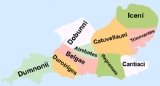
Cantiaci

Encyclopedia
The Cantiaci or Cantii were a Celtic people living in Britain before the Roman conquest
, and gave their name to a civitas
of Roman Britain
. They lived in the area now called Kent
, in south-eastern England. Their capital was Durovernum Cantiacorum
, now Canterbury
.
They were bordered by the Regnenses
to the west, and the Catuvellauni
to the north.
Julius Caesar
landed in Cantium in 55
and 54 BC
, the first Roman
expeditions to Britain. He recounts in his De Bello Gallico v. 14:
, Carvilius
, Cingetorix
and Taximagulus
, who held power in Cantium at the time of his second expedition in 54 BC
. The British leader Cassivellaunus
, besieged in his stronghold north of the Thames, sent a message to these four kings to attack the Roman naval camp as a distraction. The attack failed, a chieftain called Lugotorix
was captured, and Cassivellaunus was forced to seek terms.
In the century between Caesar's expeditions and the conquest under Claudius
, kings in Britain began to issue coins stamped with their names. The following kings of the Cantiaci are known:
, Gwrangon was King of Kent in the time of Vortigern
, until Vortigern took away the kingdom and gave it to Hengist; but Nennius is regarded as an untrustworthy source, and “Gwrangon seems to have been transported by the story-teller into Kent from Gwent” and “is turned into an imaginary King of Kent, secretly disposed of his realm in favour of Hengist, whose daughter Vortigern wished to marry” (Wade-Evans 1938).
Roman conquest of Britain
The Roman conquest of Britain was a gradual process, beginning effectively in AD 43 under Emperor Claudius, whose general Aulus Plautius served as first governor of Britannia. Great Britain had already frequently been the target of invasions, planned and actual, by forces of the Roman Republic and...
, and gave their name to a civitas
Civitas
In the history of Rome, the Latin term civitas , according to Cicero in the time of the late Roman Republic, was the social body of the cives, or citizens, united by law . It is the law that binds them together, giving them responsibilities on the one hand and rights of citizenship on the other...
of Roman Britain
Roman Britain
Roman Britain was the part of the island of Great Britain controlled by the Roman Empire from AD 43 until ca. AD 410.The Romans referred to the imperial province as Britannia, which eventually comprised all of the island of Great Britain south of the fluid frontier with Caledonia...
. They lived in the area now called Kent
Kent
Kent is a county in southeast England, and is one of the home counties. It borders East Sussex, Surrey and Greater London and has a defined boundary with Essex in the middle of the Thames Estuary. The ceremonial county boundaries of Kent include the shire county of Kent and the unitary borough of...
, in south-eastern England. Their capital was Durovernum Cantiacorum
Durovernum Cantiacorum
Durovernum Cantiacorum was a town in the Roman province of Britannia. Today it is known as Canterbury, located in the English county of Kent. It occupied a strategic location on Watling Street, at the convergence of the roads coming from the rest of the Roman Empire via the ports of Dubris ,...
, now Canterbury
Canterbury
Canterbury is a historic English cathedral city, which lies at the heart of the City of Canterbury, a district of Kent in South East England. It lies on the River Stour....
.
They were bordered by the Regnenses
Regnenses
The Regnenses, Regni or Regini were a British Celtic kingdom and later a civitas of Roman Britain. Their capital was Noviomagus Reginorum, known today as Chichester in modern West Sussex....
to the west, and the Catuvellauni
Catuvellauni
The Catuvellauni were a tribe or state of south-eastern Britain before the Roman conquest.The fortunes of the Catuvellauni and their kings before the conquest can be traced through numismatic evidence and scattered references in classical histories. They are mentioned by Dio Cassius, who implies...
to the north.
Julius Caesar
Julius Caesar
Gaius Julius Caesar was a Roman general and statesman and a distinguished writer of Latin prose. He played a critical role in the gradual transformation of the Roman Republic into the Roman Empire....
landed in Cantium in 55
55 BC
Year 55 BC was a year of the pre-Julian Roman calendar. At the time, it was known as the Year of the Consulship of Crassus and Pompey...
and 54 BC
54 BC
Year 54 BC was a year of the pre-Julian Roman calendar. At the time, it was known as the Year of the Consulship of Appius and Ahenobarbus...
, the first Roman
Ancient Rome
Ancient Rome was a thriving civilization that grew on the Italian Peninsula as early as the 8th century BC. Located along the Mediterranean Sea and centered on the city of Rome, it expanded to one of the largest empires in the ancient world....
expeditions to Britain. He recounts in his De Bello Gallico v. 14:
- "Ex his omnibus longe sunt humanissimi qui Cantium incolunt, quae regio est maritima omnis, neque multum a Gallica differunt consuetudine."
- "Of all these (British tribes), by far the most civilised are they who dwell in Kent, which is entirely a maritime region, and who differ but little from the GaulsGaulGaul was a region of Western Europe during the Iron Age and Roman era, encompassing present day France, Luxembourg and Belgium, most of Switzerland, the western part of Northern Italy, as well as the parts of the Netherlands and Germany on the left bank of the Rhine. The Gauls were the speakers of...
in their customs".
Pre-Roman Iron Age
Caesar mentions four kings, SegovaxSegovax
Segovax was one of the four kings of Kent during Caesar's second expedition to Britain in 54 BC, alongside Cingetorix, Carvilius and Taximagulus. The four were allies of the British leader Cassivellaunus, and attacked the Roman naval camp in an attempt to relieve him when he was besieged by Caesar...
, Carvilius
Carvilius
Carvilius was one of the four kings of Kent during Caesar's second expedition to Britain in 54 BC, alongside Cingetorix, Segovax and Taximagulus. The four were allies of the British leader Cassivellaunus, and attacked the Roman naval camp in an attempt to relieve him when he was besieged by Caesar...
, Cingetorix
Cingetorix (Briton)
Cingetorix was one of the four kings of Kent during Caesar's second expedition to Britain in 54 BC, alongside Segovax, Carvilius and Taximagulus. The four were allies of the British leader Cassivellaunus, and attacked the Roman naval camp in an attempt to relieve him when he was besieged by Caesar...
and Taximagulus
Taximagulus
Taximagulus was one of the four kings of Kent during Caesar's second expedition to Britain in 54 BC, alongside Cingetorix, Carvilius and Segovax. The four were allies of the British leader Cassivellaunus, and attacked the Roman naval camp in an attempt to relieve him when he was besieged by Caesar...
, who held power in Cantium at the time of his second expedition in 54 BC
54 BC
Year 54 BC was a year of the pre-Julian Roman calendar. At the time, it was known as the Year of the Consulship of Appius and Ahenobarbus...
. The British leader Cassivellaunus
Cassivellaunus
Cassivellaunus was an historical British chieftain who led the defence against Julius Caesar's second expedition to Britain in 54 BC. The first British person whose name is recorded, Cassivellaunus led an alliance of tribes against Roman forces, but eventually surrendered after his location was...
, besieged in his stronghold north of the Thames, sent a message to these four kings to attack the Roman naval camp as a distraction. The attack failed, a chieftain called Lugotorix
Lugotorix
Lugotorix was a British chieftain who was captured after a failed attack by the four kings of Kent on Julius Caesar's naval camp in 54 BC. His name may mean "mouse-king".-References:*Julius Caesar, De Bello Gallico...
was captured, and Cassivellaunus was forced to seek terms.
In the century between Caesar's expeditions and the conquest under Claudius
Claudius
Claudius , was Roman Emperor from 41 to 54. A member of the Julio-Claudian dynasty, he was the son of Drusus and Antonia Minor. He was born at Lugdunum in Gaul and was the first Roman Emperor to be born outside Italy...
, kings in Britain began to issue coins stamped with their names. The following kings of the Cantiaci are known:
- DubnovellaunusDubnovellaunusDubnovellaunus or Dumnovellaunus was the name of at least one, and possibly several kings of south-eastern Britain in the late 1st century BC/early 1st century AD, known from coin legends and from a mention in the Res Gestae Divi Augusti....
. May have been an ally or sub-king of TasciovanusTasciovanusTasciovanus was a historical king of the Catuvellauni tribe before the Roman conquest of Britain.-History:Tasciovanus is known only through numismatic evidence. He appears to have become king of the Catuvellauni ca. 20 BC, ruling from Verlamion...
of the CatuvellauniCatuvellauniThe Catuvellauni were a tribe or state of south-eastern Britain before the Roman conquest.The fortunes of the Catuvellauni and their kings before the conquest can be traced through numismatic evidence and scattered references in classical histories. They are mentioned by Dio Cassius, who implies...
, or a son of AddedomarusAddedomarusAddedomarus was a king of south-eastern Britain in the late 1st century BC. His name is known only from his inscribed coins, the distribution of which seem to indicate that he was the ruler of the Trinovantes....
of the TrinovantesTrinovantesThe Trinovantes or Trinobantes were one of the tribes of pre-Roman Britain. Their territory was on the north side of the Thames estuary in current Essex and Suffolk, and included lands now located in Greater London. They were bordered to the north by the Iceni, and to the west by the Catuvellauni...
. Presented himself as a supplicant to Augustus ca. 7 BC7 BCYear 7 BC was a common year starting on Saturday or Sunday of the Julian calendar and a common year starting on Thursday of the Proleptic Julian calendar...
. - Vosenius, ruled until ca. 15 BC15 BCYear 15 BC was either a common year starting on Tuesday, Wednesday or Thursday or a leap year starting on Wednesday of the Julian calendar and a common year starting on Monday of the Proleptic Julian calendar...
. - EppillusEppillusEppillus was the name of a Roman client king of the Atrebates tribe of the British Iron Age. He was the son of Commius, the Gaulish former ally of Julius Caesar who fled to Britain following the uprising of Vercingetorix, or possibly of his son.After Commius's death in about 20 BC, based on...
, originally king of the AtrebatesAtrebatesThe Atrebates were a Belgic tribe of Gaul and Britain before the Roman conquests.- Name of the tribe :Cognate with Old Irish aittrebaid meaning 'inhabitant', Atrebates comes from proto-Celtic *ad-treb-a-t-es, 'inhabitants'. The Celtic root is treb- 'building', 'home' The Atrebates (singular...
. Coins indicate he became king of the Cantiaci ca. 15 BC, at the same time as his brother VericaVericaVerica was a British client king of the Roman Empire in the years preceding the Claudian invasion of 43 AD.From his coinage, he appears to have been king of the Atrebates tribe and a son of Commius. He succeeded his elder brother Eppillus as king in about 15 AD, reigning at Calleva Atrebatum,...
became king of the Atrebates. - CunobelinusCunobelinusCunobeline or Cunobelinus was a historical king in pre-Roman Britain, known from passing mentions by classical historians Suetonius and Dio Cassius, and from his many inscribed coins...
, king of the Catuvellauni who expanded his influence into Cantiaci territory. - AdminiusAdminiusAdminius, Amminius or Amminus was a son of Cunobelinus, ruler of the Catuvellauni, a tribe of Iron Age Britain. His name can be interpreted as Celtic *ad-mindios, "to be crowned"....
, son of Cunobelinus. Seems to have ruled on his father's behalf, beginning ca. 3030Year 30 was a common year starting on Sunday of the Julian calendar. At the time, it was known as the Year of the Consulship of Vinicius and Longinus...
AD. SuetoniusLives of the Twelve CaesarsDe vita Caesarum commonly known as The Twelve Caesars, is a set of twelve biographies of Julius Caesar and the first 11 emperors of the Roman Empire written by Gaius Suetonius Tranquillus.The work, written in AD 121 during the reign of the emperor Hadrian, was the most popular work of Suetonius,...
tells us he was exiled by Cunobelinus ca. 4040Year 40 was a leap year starting on Friday of the Julian calendar. At the time, it was known as the Year of the Consulship of Augustus without colleague...
AD, leading to CaligulaCaligulaCaligula , also known as Gaius, was Roman Emperor from 37 AD to 41 AD. Caligula was a member of the house of rulers conventionally known as the Julio-Claudian dynasty. Caligula's father Germanicus, the nephew and adopted son of Emperor Tiberius, was a very successful general and one of Rome's most...
's aborted invasion of Britain.
Sub-Roman period
According to NenniusNennius
Nennius was a Welsh monk of the 9th century.He has traditionally been attributed with the authorship of the Historia Brittonum, based on the prologue affixed to that work, This attribution is widely considered a secondary tradition....
, Gwrangon was King of Kent in the time of Vortigern
Vortigern
Vortigern , also spelled Vortiger and Vortigen, was a 5th-century warlord in Britain, a leading ruler among the Britons. His existence is considered likely, though information about him is shrouded in legend. He is said to have invited the Saxons to settle in Kent as mercenaries to aid him in...
, until Vortigern took away the kingdom and gave it to Hengist; but Nennius is regarded as an untrustworthy source, and “Gwrangon seems to have been transported by the story-teller into Kent from Gwent” and “is turned into an imaginary King of Kent, secretly disposed of his realm in favour of Hengist, whose daughter Vortigern wished to marry” (Wade-Evans 1938).
External links
- Cantiaci at Roman-Britain.org
- The History Files: Cantiaci / Cantii