


Bibliotheca historica

Encyclopedia
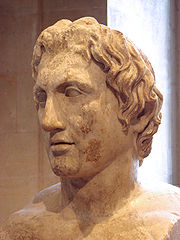
Universal history
Universal history is basic to the Western tradition of historiography, especially the Abrahamic wellspring of that tradition. Simply stated, universal history is the presentation of the history of humankind as a whole, as a coherent unit.-Ancient authors:...
by Diodorus Siculus
Diodorus Siculus
Diodorus Siculus was a Greek historian who flourished between 60 and 30 BC. According to Diodorus' own work, he was born at Agyrium in Sicily . With one exception, antiquity affords no further information about Diodorus' life and doings beyond what is to be found in his own work, Bibliotheca...
. It consisted of forty books, which were divided into three sections. The first six books are geographical in theme, and describe the history and culture of Egypt (book I), of Mesopotamia
Mesopotamia
Mesopotamia is a toponym for the area of the Tigris–Euphrates river system, largely corresponding to modern-day Iraq, northeastern Syria, southeastern Turkey and southwestern Iran.Widely considered to be the cradle of civilization, Bronze Age Mesopotamia included Sumer and the...
, India
India
India , officially the Republic of India , is a country in South Asia. It is the seventh-largest country by geographical area, the second-most populous country with over 1.2 billion people, and the most populous democracy in the world...
, Scythia
Scythia
In antiquity, Scythian or Scyths were terms used by the Greeks to refer to certain Iranian groups of horse-riding nomadic pastoralists who dwelt on the Pontic-Caspian steppe...
, and Arabia (II), of North Africa (III), and of Greece and Europe (IV - VI). In the next section (books VII - XVII), he recounts the history of the World starting with the Trojan War
Trojan War
In Greek mythology, the Trojan War was waged against the city of Troy by the Achaeans after Paris of Troy took Helen from her husband Menelaus, the king of Sparta. The war is among the most important events in Greek mythology and was narrated in many works of Greek literature, including the Iliad...
, down to the death of Alexander the Great. The last section (books XVII to the end) concerns the historical events from the successors of Alexander
Diadochi
The Diadochi were the rival generals, family and friends of Alexander the Great who fought for the control of Alexander's empire after his death in 323 BC...
down to either 60 BC or the beginning of Caesar's
Julius Caesar
Gaius Julius Caesar was a Roman general and statesman and a distinguished writer of Latin prose. He played a critical role in the gradual transformation of the Roman Republic into the Roman Empire....
Gallic War in 59 BC
59 BC
Year 59 BC was a year of the pre-Julian Roman calendar. At the time, it was known as the Year of the Consulship of Caesar and Bibulus...
. (The end has been lost, so it is unclear whether Diodorus reached the beginning of the Gallic War, as he promised at the beginning of his work, or, as evidence suggests, old and tired from his labors he stopped short at 60 BC.) He selected the name "Bibliotheca" in acknowledgement that he was assembling a composite work from many sources. The authors he drew from, who have been identified, include: Hecataeus of Abdera
Hecataeus of Abdera
Hecataeus of Abdera was a Greek historian and sceptic philosopher who flourished in the 4th century BC.-Biography:Diogenes Laertius relates that he was a student of Pyrrho, along with Eurylochus, Timon the Phliasian, Nausiphanes of Teos and others, and includes him among the "Pyrrhoneans"...
, Ctesias of Cnidus, Ephorus
Ephorus
Ephorus or Ephoros , of Cyme in Aeolia, in Asia Minor, was an ancient Greek historian. Information on his biography is limited; he was the father of Demophilus, who followed in his footsteps as a historian, and to Plutarch's claim that Ephorus declined Alexander the Great's offer to join him on his...
, Theopompus
Theopompus
Theopompus was a Greek historian and rhetorician- Biography :Theopompus was born on Chios. In early youth he seems to have spent some time at Athens, along with his father, who had been exiled on account of his Laconian sympathies...
, Hieronymus of Cardia
Hieronymus of Cardia
Hieronymus of Cardia, Greek general and historian from Cardia in Thrace, was a contemporary of Alexander the Great .After the death of Alexander he followed the fortunes of his friend and fellow-countryman Eumenes. He was wounded and taken prisoner by Antigonus, who pardoned him and appointed him...
, Duris of Samos
Duris of Samos
Duris of Samos ; probably born around 350 BC; died after 281 BC) was a Greek historian and was at some period tyrant of Samos.- Personal and political life :Duris claimed to be a descendant of Alcibiades, and was the brother of Lynceus of Samos...
, Diyllus
Diyllus
Diyllus , probably the son of Phanodemus the Atthidographer , wrote a universal history of the years 357–297 BC. Only fragments of his work survive...
, Philistus
Philistus
Philistus , son of Archomenidas, was Greek historian of Sicily. Philistus was born at Syracuse about the beginning of the Peloponnesian War. He was a faithful supporter of the elder Dionysius, and commander of the citadel. Cicero who had a high opinion of his work, calls him the miniature Thucydides...
, Timaeus
Timaeus (historian)
Timaeus , ancient Greek historian, was born at Tauromenium in Sicily. Driven out of Sicily by Agathocles, he migrated to Athens, where he studied rhetoric under a pupil of Isocrates and lived for fifty years...
, Polybius
Polybius
Polybius , Greek ) was a Greek historian of the Hellenistic Period noted for his work, The Histories, which covered the period of 220–146 BC in detail. The work describes in part the rise of the Roman Republic and its gradual domination over Greece...
and Posidonius
Posidonius
Posidonius "of Apameia" or "of Rhodes" , was a Greek Stoic philosopher, politician, astronomer, geographer, historian and teacher native to Apamea, Syria. He was acclaimed as the greatest polymath of his age...
.
Diodorus' immense work has not survived intact: we have the first five books and books 11 through 20. The rest exists only in fragments preserved in Photius and the excerpts of Constantine Porphyrogenitus
Constantine VII
Constantine VII Porphyrogennetos or Porphyrogenitus, "the Purple-born" was the fourth Emperor of the Macedonian dynasty of the Byzantine Empire, reigning from 913 to 959...
.
Chronology
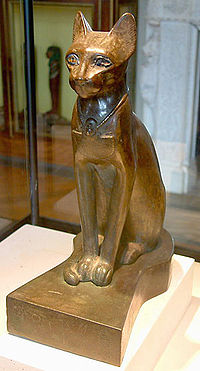

Ptolemaic Egypt
Ptolemaic Egypt began when Ptolemy I Soter invaded Egypt and declared himself Pharaoh of Egypt in 305 BC and ended with the death of queen Cleopatra VII of Egypt and the Roman conquest in 30 BC. The Ptolemaic Kingdom was a powerful Hellenistic state, extending from southern Syria in the east, to...
in the 180th Olympiad
Olympiad
An Olympiad is a period of four years, associated with the Olympic Games of Classical Greece. In the Hellenistic period, beginning with Ephorus, Olympiads were used as calendar epoch....
(between 60
60 BC
Year 60 BC was a year of the pre-Julian Roman calendar. At the time, it was known as the Year of the Consulship of Metellus and Afranius...
and 56 BC
56 BC
Year 56 BC was a year of the pre-Julian Roman calendar. At the time, it was known as the Year of the Consulship of Lentulus and Philippus...
). This visit was marked by his witnessing an angry mob demand the death of a Roman
Roman Empire
The Roman Empire was the post-Republican period of the ancient Roman civilization, characterised by an autocratic form of government and large territorial holdings in Europe and around the Mediterranean....
citizen who had accidentally killed a cat
Cat
The cat , also known as the domestic cat or housecat to distinguish it from other felids and felines, is a small, usually furry, domesticated, carnivorous mammal that is valued by humans for its companionship and for its ability to hunt vermin and household pests...
, an animal sacred to the ancient Egyptians
Egyptians
Egyptians are nation an ethnic group made up of Mediterranean North Africans, the indigenous people of Egypt.Egyptian identity is closely tied to geography. The population of Egypt is concentrated in the lower Nile Valley, the small strip of cultivable land stretching from the First Cataract to...
(Bibliotheca historica 1.41, 1.83). The latest event Diodorus mentions is Octavian
Augustus
Augustus ;23 September 63 BC – 19 August AD 14) is considered the first emperor of the Roman Empire, which he ruled alone from 27 BC until his death in 14 AD.The dates of his rule are contemporary dates; Augustus lived under two calendars, the Roman Republican until 45 BC, and the Julian...
's vengeance on the city of Tauromenium, whose refusal to help him led to Octavian's naval defeat nearby in 36 BC
36 BC
Year 36 BC was either a common year starting on Tuesday, Wednesday or Thursday or a leap year starting on Wednesday of the Julian calendar and a common year starting on Wednesday of the Proleptic Julian calendar...
(16.7). Diodorus shows no knowledge that Egypt became a Roman province—which transpired in 30 BC
30 BC
Year 30 BC was either a common year starting on Wednesday, Thursday or Friday or a leap year starting on Thursday of the Julian calendar and a common year starting on Wednesday of the Proleptic Julian calendar...
-- so presumably he published his completed work before that event. Diodorus asserts that he devoted thirty years to the composition of his history, and that he undertook a number of dangerous journeys through Europe and Asia in prosecution of his historical researches. Modern critics have called this claim into question, noting several surprising mistakes that an eye-witness would not be expected to have made.
Critical reception
Diodorus' liberal use of earlier historians underlies the harsh opinion of the author of the 1911 Encyclopædia Britannica article on Bibliotheca historica :- "The faults of Diodorus arise partly from the nature of the undertaking, and the awkward form of annals into which he has thrown the historical portion of his narrative. He shows none of the critical faculties of the historian, merely setting down a number of unconnected details. His narrative contains frequent repetitions and contradictions, is without colouring, and monotonous; and his simple diction, which stands intermediate between pure AtticAttic GreekAttic Greek is the prestige dialect of Ancient Greek that was spoken in Attica, which includes Athens. Of the ancient dialects, it is the most similar to later Greek, and is the standard form of the language studied in courses of "Ancient Greek". It is sometimes included in Ionic.- Origin and range...
and the colloquial Greek of his time, enables us to detect in the narrative the undigested fragments of the materials which he employed."
As damaging as this sounds, other more contemporary classical scholars are likely to go even further. Diodorus has become infamous particularly for adapting his tales ad maiorem Graecorum gloriam ("to the greater glory of the Greeks"), leading one prominent author to refer to him as one of the "two most accomplished liars of antiquity"(the other being Ctesias
Ctesias
Ctesias of Cnidus was a Greek physician and historian from Cnidus in Caria. Ctesias, who lived in the 5th century BC, was physician to Artaxerxes Mnemon, whom he accompanied in 401 BC on his expedition against his brother Cyrus the Younger....
.)
Far more sympathetic is the estimate of C.H. Oldfather, who wrote in the introduction to his translation of Diodorus:
- "While characteristics such as these exclude Diodorus from a place among the abler historians of the ancient world, there is every reason to believe that he used the best sources and that he reproduced them faithfully. His First Book, which deals almost exclusively with Egypt, is the fullest literary account of the history and customs of that country after HerodotusHerodotusHerodotus was an ancient Greek historian who was born in Halicarnassus, Caria and lived in the 5th century BC . He has been called the "Father of History", and was the first historian known to collect his materials systematically, test their accuracy to a certain extent and arrange them in a...
. Books II-V cover a wide range, and because of their inclusion of much mythological material are of much less value. In the period from 480 to 301 BC, which he treats in annalistic fashion and in which his main source was the Universal History of Ephorus, his importance varies according as he is the sole continuous source, or again as he is paralleled by superior writers. To the fifty years from 480 to 430 BC ThucydidesThucydidesThucydides was a Greek historian and author from Alimos. His History of the Peloponnesian War recounts the 5th century BC war between Sparta and Athens to the year 411 BC...
devotes only a little more than thirty chapters; Diodorus covers it more fully (11.37-12.38) and his is the only consecutive literary account for the chronology of the period. ... For the years 362-302 BC Diodorus is again the only consecutive literary account, and ... Diodorus offers the only chronological survey of the period of PhilipPhilip II of MacedonPhilip II of Macedon "friend" + ἵππος "horse" — transliterated ; 382 – 336 BC), was a king of Macedon from 359 BC until his assassination in 336 BC. He was the father of Alexander the Great and Philip III.-Biography:...
, and supplements the writers mentioned and contemporary sources in many matters. For the period of the Successors to Alexander, 323-302 BC (Books XVIII-XX), he is the chief literary authority and his history of this period assumes, therefore, an importance which it does not possess for the other years."
Gold mining
Egypt
Egypt , officially the Arab Republic of Egypt, Arabic: , is a country mainly in North Africa, with the Sinai Peninsula forming a land bridge in Southwest Asia. Egypt is thus a transcontinental country, and a major power in Africa, the Mediterranean Basin, the Middle East and the Muslim world...
is especially interesting for being one of the first records of gold mining
Gold mining
Gold mining is the removal of gold from the ground. There are several techniques and processes by which gold may be extracted from the earth.-History:...
in Egypt, where conditions are said by Diodorus to be especially harsh to the workers.
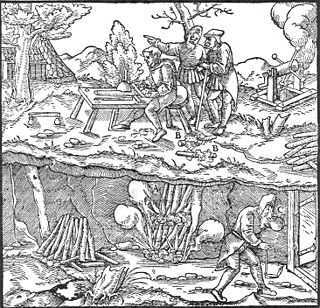
He also mentions a mining method called fire-setting
Fire-setting
Fire-setting is a method of mining used since prehistoric times up to the Middle Ages. Fires were set against a rock face to heat the stone, which was then doused with water...
which was used to weaken and break down hard gold ores. It involved building a fire against the rock face containing the ore, followed by quenching with water, the thermal shock
Thermal shock
Thermal shock is the name given to cracking as a result of rapid temperature change. Glass and ceramic objects are particularly vulnerable to this form of failure, due to their low toughness, low thermal conductivity, and high thermal expansion coefficients...
breaking up the rock into manageable fragments. Mining in Egypt
Mining in Egypt
Mining in Egypt has had a long history that goes back to predynastic times. Egypt has substantial mineral resources, including 48 million tons of tantalite , 50 million tons of coal, and an estimated 6.7 million ounces of gold in the Eastern Desert...
was very old and highly productive, and his description is probably the oldest dealing with the industry. The conditions of work were poor, with most miners being prisoners of war or criminals. Once extracted the hard ores were crushed manually and then ground to a fine dust in querns. Washing the ore to extract the gold dust was the final step in the extraction process, and required a stream of water. It must have been the most difficult step owing to the desert environment in Nubia
Nubia
Nubia is a region along the Nile river, which is located in northern Sudan and southern Egypt.There were a number of small Nubian kingdoms throughout the Middle Ages, the last of which collapsed in 1504, when Nubia became divided between Egypt and the Sennar sultanate resulting in the Arabization...
, where many of the richest mines were located.
Diodorus is mentioned briefly in Pliny the Elder
Pliny the Elder
Gaius Plinius Secundus , better known as Pliny the Elder, was a Roman author, naturalist, and natural philosopher, as well as naval and army commander of the early Roman Empire, and personal friend of the emperor Vespasian...
as being singular among the Greek historians for the simple manner in which he named his work. Pliny also mentions fire-setting in his Book xxxiii, dealing with mining methods, and the technique continued into the Medieval period, judging by the description presented by Georg Agricola
Georg Agricola
Georgius Agricola was a German scholar and scientist. Known as "the father of mineralogy", he was born at Glauchau in Saxony. His real name was Georg Pawer; Agricola is the Latinised version of his name, Pawer meaning "farmer"...
in De Re Metallica
De re metallica
De re metallica is a book cataloguing the state of the art of mining, refining, and smelting metals, published in 1556. The author was Georg Bauer, whose pen name was the Latinized Georgius Agricola...
together with his illustration of the method. Before the advent of explosives, use of fire-setting was a very hazardous method to use underground owing to the toxicity of combustion products, especially carbon monoxide
Carbon monoxide
Carbon monoxide , also called carbonous oxide, is a colorless, odorless, and tasteless gas that is slightly lighter than air. It is highly toxic to humans and animals in higher quantities, although it is also produced in normal animal metabolism in low quantities, and is thought to have some normal...
.
Editorial history
The editio princepsEditio princeps
In classical scholarship, editio princeps is a term of art. It means, roughly, the first printed edition of a work that previously had existed only in manuscripts, which could be circulated only after being copied by hand....
of Diodorus was a Latin
Latin
Latin is an Italic language originally spoken in Latium and Ancient Rome. It, along with most European languages, is a descendant of the ancient Proto-Indo-European language. Although it is considered a dead language, a number of scholars and members of the Christian clergy speak it fluently, and...
translation of the first five books by Poggio Bracciolini at Bologna
Bologna
Bologna is the capital city of Emilia-Romagna, in the Po Valley of Northern Italy. The city lies between the Po River and the Apennine Mountains, more specifically, between the Reno River and the Savena River. Bologna is a lively and cosmopolitan Italian college city, with spectacular history,...
in 1472. The first printing of the Greek original (at Basel
Basel
Basel or Basle In the national languages of Switzerland the city is also known as Bâle , Basilea and Basilea is Switzerland's third most populous city with about 166,000 inhabitants. Located where the Swiss, French and German borders meet, Basel also has suburbs in France and Germany...
in 1535) contained only books 16-20, and was the work of Vincentius Opsopoeus. It was not until 1559 that all of the surviving books, and surviving fragments of books 21 to the end were published by Stephanus at Geneva
Geneva
Geneva In the national languages of Switzerland the city is known as Genf , Ginevra and Genevra is the second-most-populous city in Switzerland and is the most populous city of Romandie, the French-speaking part of Switzerland...
.
Editions and translations
-
- Vol. 1 (Books 1-2.34). Tr. C. H. Oldfather. LCL 279 (1933). ISBN 9780674993075.
- Vol. 2 (Books 2.35-4.58). Tr. C. H. Oldfather. LCL 303 (1935). ISBN 9780674993341. Online: Internet Archive PDF
- Vol. 3 (Books 4.59-8). Tr. C. H. Oldfather. LCL 340 (1939). ISBN 9780674993754.
- Vol. 4 (Books 9-12.40). Tr. C. H. Oldfather. LCL 375 (1946). ISBN 9780674994133. Online: Perseus
- Vol. 5 (Books 12.41-13). Tr. C. H. Oldfather. LCL 384 (1950). ISBN 9780674994225.
- Vol. 6 (Books 14-15.19). Tr. C. H. Oldfather. LCL 399 (1954). ISBN 9780674994393.
- Vol. 7 (Books 15.20-16.65). Tr. Charles L. Sherman. LCL 389 (1952). ISBN 9780674994287.
- Vol. 8 (Books 16.66-17). Tr. C. Bradford Welles. LCL 422 (1963). ISBN 9780674994645
- Vol. 9 (Books 18-19.65). Tr. Russel M. Geer. LCL 377 (1947). ISBN 9780674994157.
- Vol. 10 (Books 19.66-20). Tr. Russel M. Geer. LCL 390 (1954). ISBN 9780674994294.
- Vol. 11 (Fragments of Books 21-32). Tr. Francis R. Walton. LCL 409 (1957). ISBN 9780674994508.
- Vol. 12 (Fragments of Books 33-40). Tr. Francis R. Walton. LCL 423 (1967). ISBN 9780674994652. Available from Google Books ISBN 9780292712775 ISBN 9780292721258
External links
- Diodorus Siculus translated by C.H. Oldfather, English translation, Greek text, Books 9 - 17 (text)
- Diodorus Siculus translated by C.H. Oldfather, English translation, Book 4 (text)
- The manuscripts of Diodorus Siculus by Roger Pearse
- Bibliotheca Historica, Bill Thayer's Web Site