


Bön

Encyclopedia
Bon or Bön is a branch of Tibetan Vajrayana
.
The history of Bon is difficult to clearly ascertain because the earliest surviving documents referring to the religion come from the 9th and 10th centuries, well after Buddhists began the suppression of indigenous beliefs and practices. Moreover, historian Per Kværne
notes that "Bon" is used to describe three distinct traditions:
However, other scholars do not accept the tradition that separates Bon from Buddhism; Christopher Beckwith
calls Bon "one of the two types of Tibetan Buddhism" and writes that "despite continuing popular belief in the existence of a non-Buddhist religion known as Bon during the Tibetan Empire period, there is not a shred of evidence to support the idea... Although different in some respects from the other sects, it was already very definitely a form of Buddhism."
Tenzin Gyatso, the 14th Dalai Lama
, recognizes the Bon tradition as one of the sixth principal spiritual school of Tibet, along with the Nyingma
, Sakya
, Kagyu
, Gelug
and Jonang
schools of Buddhism, despite the long historical competition between the Bon tradition and Buddhism in Tibet.
The syllable -po or -pa is appended to a noun in Tibetan to designate a person who is from that place or performs that action; "Bonpo" thus means a follower of the Bon tradition, "Nyingmapa" a follower of the Nyingma tradition, and so on. (The feminine parallels are -mo and -ma, but these are not generally appended to the names of the Tibetan religious traditions.)
is believed to have established the Bon religion. He is traditionally held to have been born in the land of Tagzig Olmo Lung Ring
, considered an axis mundi
, which is traditionally identified as Mount Yung-drung Gu-tzeg ("Edifice of Nine Sauvastikas"), possibly Mount Kailash
, in western Tibet. Due to the sacredness of Tagzig Olmo Lung Ring and the Mount Kailash, both the sauvastika
and the number nine are of great significance and considered auspicious by the Bonpo as well as Hindus.
to Tibet during the 7th century, there was often fierce competition between the two traditions, especially during the reign of Langdarma
. Over time, Bon has been losing influence and has been marginalized by the Tibetan political elite.
uncovered by 'Shenchen Luga' in the early 11th century. Martin identifies the importance of this scripture for studies of the Zhang-Zhung language
:
who had been promoted by Lhabzang, the titular King of Tibet. This met with widespread approval. However, they soon began to loot the holy places of Lhasa which brought a swift response from Emperor Kangxi in 1718, but his military expedition was annihilated by the Dzungars not far from Lhasa.
Many Nyingmapas and Bonpos were executed and Tibetans visiting Dzungar officials were forced to stick their tongues out so the Dzungars could tell if the person recited constant mantras, which was said to make the tongue black or brown. This allowed them to pick the Nyingmapas and Bonpos, who recited many magic-mantras. A habit of sticking one's tongue out as a mark of respect on greeting someone has remained a Tibetan custom into modern times.
tradition.
According to the Bonpo, eighteen enlightened entities will manifest in this æon
and Tönpa Shenrab Miwoche, the founder of Bon, is considered the enlightened Buddha of this age (compare yuga
and kalpa). The 33rd lineage holder of Menri Monastery, HH the Menri Trizin Lungtog Tenpei Nyima Rinpoche, and Lopön Tenzin Namdak
are important current lineage holders of Bon.
More than three hundred Bon monasteries had been established in Tibet prior to Chinese annexation. Of these, Menri Monastery
and Yungdrung Monastery were the two principal monastic universities for the study and practice of the Bon knowledge and science-arts.
, Hindu
ism, sympathetic magic
, Buddhism
, folk religion
, shamanism
, Vajrayana
, asceticism and mysticism
; complexes prevalent throughout the Himalaya and intermingling throughout the Inner Asia
n region. Pegg (2006) relates that these
Leading Bon scholar Per Kværne writes:
within the bodymind
, and so reveal rigpa
— a transcendent natural bodymind. In rigpa, the obscurations of dualism and dukkha
no longer entrance
the Bonpo and sambhogakaya
and nirmanakaya are aligned in a sympathetic resonance
.
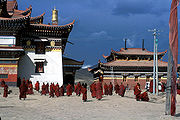 Ethnic Tibet is not confined culturally to modern political Tibet
. The broader area of ethnic Tibet also includes to the east, parts of the Chinese provinces of Sichuan
, Gansu
and Yunnan
; to the west, the Indian regions of Ladakh
, Lahul and Spiti
and the Baltistan
region of Pakistan; to the south, Bhutan
, Sikkim
, parts of northern Nepal
, the Mustang
, Dolpo
, Sherpa
and Tamang
regions of eastern Nepal and the extreme north-west of Assam
.
The altitude and vastness of the Tibetan Region is striking landscape uncompromisingly dominated by mountains and sky, where the starkness of the human condition
relentlessly tests the mettle of its peoples. The lofty Tibetan Plateau and Geography of Tibet
has had a profound effect on the Bonpo and the shaping of Vajrayana
in general. Many of the local deities (jiktenpa) pre-dating the arrival of Buddhism, were co-opted and made 'protectors' of the Vajrayana and various teachings.
and shamanistic practices and corresponds to the general characterization of Bon as described by western scholars.
Initiation rituals and rites closely correlate to the indigenous shamanic traditions of Siberia
. Many Bonpo shamans were members of a clan
-guild
. Shamans were of either gender
. A shamanic aspirant was often visited and possessed by an ancestral shaman and/or one or more of any number of entities such as gods, elementals, dæmon
s, and spirit
s. The possession typically resulted in a divine madness
and a temporary retreat into the wilderness, where the shaman lived like an animal and experienced visions of his own death at the hands of spirits.
After the newly possessed shaman returned, they were taught by senior practitioners and members of the clan-guild how to exert power over the spirits that visited them, as well as incantation of mantra
.
These texts assert that Yungdrung Bon was founded by the Buddha Tönpa Shenrab Miwoche
. He discovered the methods of attaining enlightenment
and is considered to be a figure analogous to Gautama Buddha
. He was said to have lived 18,000 years ago in the land of Olmo Lung Ring, part of the land of Tagzig (see Tagzig Olmo Lung Ring
), to the west of present day Tibet (which some scholars identify with the Persian
Tajik).
According to Buddhist legend, prior to the manifestation of Shakyamuni Buddha there were numerous other historical Buddhas. Tönpa Shenrab Miwoche transmitted the lore, which was similar in many regards to Buddhism, to the people of Zhangzhung
of western Tibet. They had previously been practicing animistic Bon, thus establishing Yungdrung ("eternal") Bon.
One proposition, countered by most Himalayan scholars, is that Buddhism may have arrived in Tibet by a path other than directly from northwest India. A transmission through Persia prior to the 7th century is not improbable as Alexander the Great had connected Greece
with India
almost a millennium earlier, resulting in a flourishing Greco-Buddhist
culture in Afghanistan
and Pakistan
. Additionally, the 6th century Khosrau I of Persia is known to have ordered the translation of the Buddhist jataka
tales into the Persian language
. The Silk Road
, the path by which Buddhism traveled to China
in 67 CE., lies entirely to the west of Tibet and passed through the Persian city of Hamadan
. Buddhist structures discovered in far western Tibet have been dated to the 3rd century CE. Bonpo stupas have also been discovered as far west as Afghanistan
.
Nonetheless, no scholars have yet identified a major center of Buddhist learning in Persia which corresponds to the Bonpos' land of Tagzig Olmo Lung Ring. Alternative proposed sites have included the ancient cities of Merv
, Khotan
or Balkh
, all of which had thriving Buddhist communities active in the correct timeframe and are located to the west of Tibet.
The existence of the Zhangzhung culture is supported by many lines of evidence, including the existence of a remnant of living Zhangzhung speakers still found in Himachal Pradesh
. The claim that Lord Shenrab was born 180 centuries ago is generally not taken literally, but is rather understood as an allusion to a master born in the very distant past.
The elements in Bon that strongly resemble Buddhism became apparent with the codification of the yungdrung Bon canon by the first abbot of Menri Monastery
, Nyame Sherab Gyaltsen in the 14th century, but a trend towards this probably began earlier. At the same time, the Nyingma
, Kagyu
, and Sakya
orders of Buddhism were also reorganizing themselves in order to be able to compete effectively with the dominant Gelug
order.
Some other events in Tibetan history may mark points at which Buddhist ideas became integrated into Bon.
and Kham
. Although the practices of New Bon vary to some extent from Yungdrung Bon, the practitioners of New Bon still honor the Abbot of Menri Monastery as the leader of their tradition.
, there were approximately 300 Bon monasteries in Tibet and the rest of western China
. According to a recent survey, there are 264 active Bon monasteries, convents, and hermitages.
The present spiritual head of the Bon is Lungtok Tenpa'i Nyima (b. 1929), the thirty-third Abbot of Menri Monastery
(destroyed in the Cultural Revolution
, but now rebuilt), who now presides over Pal Shen-ten Menri Ling in Dolanji in Himachal Pradesh
, India, for the abbacy of which monastery he was selected in 1969.
A number of Bon establishments also exist in Nepal
; Triten Norbutse Bonpo Monastery is one on the western outskirts of Kathmandu. Bon's leading monastery is the Menri Monastery in Dolanji, India (Himachal Pradesh).
, recognised as the fifth Panchen Lama
by the fifth Dalai Lama Lozang Gyatso, was a member of the Dru family, an important family of the Bon religion. Under Lozang Gyatso Bon became respected both philosophically and politically. However, the Bonpo remained stigmatised and marginalised until 1977, when they sent representatives to Dharamsala
and Tenzin Gyatso, the 14th Dalai Lama, who advised the Tibetan parliament-in-exile, the Assembly of Tibetan People’s Deputies, to accept Bon members.
Since then, Bon has had official recognition of its status as a religious group, with the same rights as the Buddhist schools. This was re-stated in 1987 by the Dalai Lama, who also forbade discrimination against the Bonpos, stating that it was both undemocratic and self-defeating. He even donned Bon ritual paraphernalia, emphasizing "the religious equality of the Bon faith."
However, Tibetans still differentiate between Bon and Buddhism, referring to members of the Nyingma, Shakya, Kagyu and Gelug schools as nangpa, meaning "insiders," but to practitioners of Bon as "Bonpo," or even chipa ("outsiders").
, may be distinguished by certain characteristics:
The Bonpo school is said by some to now resemble most closely the Nyingma
school, the oldest school of Tibetan Buddhism, which traces its lineage to the first transmission of Buddhism into Tibet, while other researchers say many practices of Bonpos resemble folk Taoism
. Svabhava
(Sanskrit; Wylie: rang bzhin) is very important in the nontheistic theology
of the Bonpo Dzogchen 'Great Perfection' tradition where it is part of a technical language to render macrocosm and microcosm into nonduality.
of earth
, water
, fire
, air
and space
are the essential elements of all existent phenomena or skandha
s (aggregates) the most subtle enumeration of which are known as the five pure lights
. Tenzin Wangyal Rinpoche
states:
The names of the elements are analogous to categorised experiential sensations of the natural world. The names are symbol
ic and key to their inherent qualities and/or modes of action by analogy
. In Bon, the elemental processes are fundamental metaphors for working with external, internal and secret energetic forces. All five elemental processes in their essential purity are inherent in the mindstream
and link the trikaya
and are aspects of primordial energy
.
centers of the body, according to the Tibet
an Bon tradition, influence the quality of experience, because movement of prana
can not be separated from experience. Each of the six major chakras is linked to experiential qualities of one of the six realms
of existence.
A modern teacher, Tenzin Wangyal Rinpoche
uses a computer analogy: main chakras are like hard drives. Each hard drive has many files. One of the files is always open in each of the chakras, no matter how "closed" that particular chakra may be. What is displayed by the file shapes experience.
The tsa lung practices such as those embodied in Trul Khor
lineages open channels so that lung
(prana
or qi
) may move without obstruction. A yogi
opens chakras and evokes positive qualities associated with a particular chakra. In the computer analogy, the screen is cleared and a file is called up that contains positive, supportive qualities. A seed syllable (Sanskrit
: bija
) is used both as a password that evokes the positive quality and the armor that sustains the quality.
Tantric practice eventually transforms all experience into bliss. The practice liberates from negative conditioning and leads to control over perception and cognition.
Vajrayana
Vajrayāna Buddhism is also known as Tantric Buddhism, Tantrayāna, Mantrayāna, Secret Mantra, Esoteric Buddhism and the Diamond Vehicle...
.
The history of Bon is difficult to clearly ascertain because the earliest surviving documents referring to the religion come from the 9th and 10th centuries, well after Buddhists began the suppression of indigenous beliefs and practices. Moreover, historian Per Kværne
Per Kværne
Per Kværne is a prominent Norwegian tibetologist and art historian.Per Kværne was born in Oslo. In 1970 he received the mag.art. degree in Sanskrit at the University of Oslo. From 1970 to 1975 he worked as a lecturer in the history of religion at the University of Bergen. In 1973 he received the...
notes that "Bon" is used to describe three distinct traditions:
- the pre-Buddhist religious practices of Tibetans that are "imperfectly reconstructed [yet] essentially different from Buddhism" and were focused on the personage of a divine kingImperial cultAn imperial cult is a form of state religion in which an emperor, or a dynasty of emperors , are worshipped as messiahs, demigods or deities. "Cult" here is used to mean "worship", not in the modern pejorative sense...
; - a syncreticSyncretismSyncretism is the combining of different beliefs, often while melding practices of various schools of thought. The term means "combining", but see below for the origin of the word...
religion that arose in Tibet during the 10th and 11th centuries, with strong shamanisticShamanismShamanism is an anthropological term referencing a range of beliefs and practices regarding communication with the spiritual world. To quote Eliade: "A first definition of this complex phenomenon, and perhaps the least hazardous, will be: shamanism = technique of ecstasy." Shamanism encompasses the...
and animistic traditions, that is often regarded by scholars as "an unorthodox form of Buddhism;" - "a vast and amorphous body of popular beliefs" including fortune telling.
However, other scholars do not accept the tradition that separates Bon from Buddhism; Christopher Beckwith
Christopher Beckwith
Christopher I. Beckwith is a professor of Central Eurasian Studies at Indiana University in Bloomington, Indiana.He received his Ph.D. degree from Indiana University in Uralic and Altaic Studies ....
calls Bon "one of the two types of Tibetan Buddhism" and writes that "despite continuing popular belief in the existence of a non-Buddhist religion known as Bon during the Tibetan Empire period, there is not a shred of evidence to support the idea... Although different in some respects from the other sects, it was already very definitely a form of Buddhism."
Tenzin Gyatso, the 14th Dalai Lama
Dalai Lama
The Dalai Lama is a high lama in the Gelug or "Yellow Hat" branch of Tibetan Buddhism. The name is a combination of the Mongolian word далай meaning "Ocean" and the Tibetan word bla-ma meaning "teacher"...
, recognizes the Bon tradition as one of the sixth principal spiritual school of Tibet, along with the Nyingma
Nyingma
The Nyingma tradition is the oldest of the four major schools of Tibetan Buddhism . "Nyingma" literally means "ancient," and is often referred to as Nga'gyur or the "old school" because it is founded on the first translations of Buddhist scriptures from Sanskrit into Tibetan, in the eighth century...
, Sakya
Sakya
The Sakya school is one of four major schools of Tibetan Buddhism, the others being the Nyingma, Kagyu, and Gelug...
, Kagyu
Kagyu
The Kagyu, Kagyupa, or Kagyud school, also known as the "Oral Lineage" or Whispered Transmission school, is today regarded as one of six main schools of Himalayan or Tibetan Buddhism, the other five being the Nyingma, Sakya, Jonang, Bon and Gelug...
, Gelug
Gelug
The Gelug or Gelug-pa , also known as the Yellow Hat sect, is a school of Buddhism founded by Je Tsongkhapa , a philosopher and Tibetan religious leader...
and Jonang
Jonang
The Jonang is one of the schools of Tibetan Buddhism. Its origins in Tibet can be traced to early 12th century master Yumo Mikyo Dorje, but became much wider known with the help of Dolpopa Sherab Gyeltsen, a monk originally trained in the Sakya school...
schools of Buddhism, despite the long historical competition between the Bon tradition and Buddhism in Tibet.
The syllable -po or -pa is appended to a noun in Tibetan to designate a person who is from that place or performs that action; "Bonpo" thus means a follower of the Bon tradition, "Nyingmapa" a follower of the Nyingma tradition, and so on. (The feminine parallels are -mo and -ma, but these are not generally appended to the names of the Tibetan religious traditions.)
Foundation
Traditionally, Tönpa Shenrab MiwocheTonpa Shenrab Miwoche
Tonpa Shenrab or Shenrab Miwo —also called Buddha Shenrab, Guru Shenrab, Tonpa Shenrab Miwoche, Lord Shenrab Miwo, and known by a number of other titles—is the founder of the Bon religious tradition of Tibet.According to Samten G. Karmey:gShen-rab mi-bo is the founder of the Bon...
is believed to have established the Bon religion. He is traditionally held to have been born in the land of Tagzig Olmo Lung Ring
Tagzig Olmo Lung Ring
Tagzig Olmo Lung Ring is a non-dual spiritual realm of the Bon tradition which resides beyond dualism. It is understood to be a timeless perfected realm where peace and joy are the very fabric of being....
, considered an axis mundi
Axis mundi
The axis mundi , in religion or mythology, is the world center and/or the connection between heaven and Earth. As the celestial pole and geographic pole, it expresses a point of connection between sky and earth where the four compass directions meet...
, which is traditionally identified as Mount Yung-drung Gu-tzeg ("Edifice of Nine Sauvastikas"), possibly Mount Kailash
Mount Kailash
Mount Kailash is a peak in the Gangdisê Mountains, which are part of the Himalayas in Tibet...
, in western Tibet. Due to the sacredness of Tagzig Olmo Lung Ring and the Mount Kailash, both the sauvastika
Sauwastika
The term sauwastika is sometimes used to distinguish the "left-facing" from the "right-facing" form of the swastika symbol, a meaning which developed in 19th century scholarship....
and the number nine are of great significance and considered auspicious by the Bonpo as well as Hindus.
Competition with Buddhism
After the introduction of BuddhismBuddhism
Buddhism is a religion and philosophy encompassing a variety of traditions, beliefs and practices, largely based on teachings attributed to Siddhartha Gautama, commonly known as the Buddha . The Buddha lived and taught in the northeastern Indian subcontinent some time between the 6th and 4th...
to Tibet during the 7th century, there was often fierce competition between the two traditions, especially during the reign of Langdarma
Langdarma
Langdarma was the last emperor of the unified Tibetan empire, who most likely reigned from 838 to 841 CE. Early sources named him Tri Darma meaning "King Darma"; "Lang" is a nickname meaning "ox". He was also called tsenpo or lhase Au Dunten...
. Over time, Bon has been losing influence and has been marginalized by the Tibetan political elite.
"A Cavern of Treasures" (mdzod phug)
"A Cavern of Treasures" is a Bonpo termaTerma (Buddhism)
Terma are key Tibetan Buddhist and Bön teachings, which the tradition holds were originally esoterically hidden by various adepts such as Padmasambhava and his consorts in the 8th century for future discovery at auspicious times by other adepts, known as tertöns. As such, they represent a...
uncovered by 'Shenchen Luga' in the early 11th century. Martin identifies the importance of this scripture for studies of the Zhang-Zhung language
Zhang-Zhung language
Zhang-Zhung is an extinct Tibeto-Burman language that was spoken in what is now western Tibet. The term 'Zhang-zhung language' has been used to refer to two different entities. The first 'Old Zhang-zhung' refers to the language which appears in a small number of documents preserved in Dunhuang. The...
:
For students of Tibetan culture in general, the mDzod phug is one of the most intriguing of all Bon scriptures, since it is the only lengthy bilingual work in Zhang-zhung and Tibetan. (Some of the shorter but still significant sources for Zhang-zhung are signalled in Orofino 1990.)
18th century
The Dzungars invaded Tibet in 1717 and deposed and killed a pretender to the position of Dalai LamaDalai Lama
The Dalai Lama is a high lama in the Gelug or "Yellow Hat" branch of Tibetan Buddhism. The name is a combination of the Mongolian word далай meaning "Ocean" and the Tibetan word bla-ma meaning "teacher"...
who had been promoted by Lhabzang, the titular King of Tibet. This met with widespread approval. However, they soon began to loot the holy places of Lhasa which brought a swift response from Emperor Kangxi in 1718, but his military expedition was annihilated by the Dzungars not far from Lhasa.
Many Nyingmapas and Bonpos were executed and Tibetans visiting Dzungar officials were forced to stick their tongues out so the Dzungars could tell if the person recited constant mantras, which was said to make the tongue black or brown. This allowed them to pick the Nyingmapas and Bonpos, who recited many magic-mantras. A habit of sticking one's tongue out as a mark of respect on greeting someone has remained a Tibetan custom into modern times.
19th century
In the 19th century, Sharza Tashi Gyeltsen, a Bon master whose collected writings comprise eighteen volumes significantly rejuvenated the tradition. His disciple Kagya Khyungtrul Jigmey Namkha trained many practitioners to be learned in not only the Bon religion, but in all Tibetan schools. In modern times, Bon has encountered significant cultural loss. Lately, it has been rejuvenated by the termaTerma (Buddhism)
Terma are key Tibetan Buddhist and Bön teachings, which the tradition holds were originally esoterically hidden by various adepts such as Padmasambhava and his consorts in the 8th century for future discovery at auspicious times by other adepts, known as tertöns. As such, they represent a...
tradition.
According to the Bonpo, eighteen enlightened entities will manifest in this æon
ÆON
, commonly written AEON Co., Ltd., is the holding company of Æon Group. It has its headquarters in Mihama-ku, Chiba, Chiba Prefecture.It operates JUSCO supermarkets directly in Japan.Æon is the largest retailer in Asia...
and Tönpa Shenrab Miwoche, the founder of Bon, is considered the enlightened Buddha of this age (compare yuga
Yuga
Yuga in Hindu philosophy is the name of an 'epoch' or 'era' within a cycle of four ages. These are the Satya Yuga, the Treta Yuga, the Dvapara Yuga, and finally the Kali Yuga. According to Hindu cosmology, life in the universe is created, destroyed once every 4.1 to 8.2 billion years, which is...
and kalpa). The 33rd lineage holder of Menri Monastery, HH the Menri Trizin Lungtog Tenpei Nyima Rinpoche, and Lopön Tenzin Namdak
Lopön Tenzin Namdak
Lopön Tenzin Namdak is Bön religious leader.-Birth, family & early education:Lopön Tenzin Namdak born in Khyungpo Karu in Xikang province of Republic of China to a family of famous artists. In 1933, at the age of seven he entered Tingchen Monastery in the same district...
are important current lineage holders of Bon.
More than three hundred Bon monasteries had been established in Tibet prior to Chinese annexation. Of these, Menri Monastery
Menri Monastery
Menri Monastery is a Bon monastery in Tibet. It was established in 1405 by Nyammey Sherab Gyeltsen , and became the leading Bon monastery in the Tibetan cultural region. The abbot of Menri is recognized as the spiritual leader of Bon...
and Yungdrung Monastery were the two principal monastic universities for the study and practice of the Bon knowledge and science-arts.
Bon today
A complex appreciation of Bon is emerging by scholars. Bon, prior to the Tibetan diaspora, existed within a web of ancient indigenous animismAnimism
Animism refers to the belief that non-human entities are spiritual beings, or at least embody some kind of life-principle....
, Hindu
Hindu
Hindu refers to an identity associated with the philosophical, religious and cultural systems that are indigenous to the Indian subcontinent. As used in the Constitution of India, the word "Hindu" is also attributed to all persons professing any Indian religion...
ism, sympathetic magic
Sympathetic magic
Sympathetic magic, also known as imitative magic, is a type of magic based on imitation or correspondence.-Similarity and contagion:The theory of sympathetic magic was first developed by Sir James George Frazer in The Golden Bough...
, Buddhism
Buddhism
Buddhism is a religion and philosophy encompassing a variety of traditions, beliefs and practices, largely based on teachings attributed to Siddhartha Gautama, commonly known as the Buddha . The Buddha lived and taught in the northeastern Indian subcontinent some time between the 6th and 4th...
, folk religion
Folk religion
Folk religion consists of ethnic or regional religious customs under the umbrella of an organized religion, but outside of official doctrine and practices...
, shamanism
Shamanism
Shamanism is an anthropological term referencing a range of beliefs and practices regarding communication with the spiritual world. To quote Eliade: "A first definition of this complex phenomenon, and perhaps the least hazardous, will be: shamanism = technique of ecstasy." Shamanism encompasses the...
, Vajrayana
Vajrayana
Vajrayāna Buddhism is also known as Tantric Buddhism, Tantrayāna, Mantrayāna, Secret Mantra, Esoteric Buddhism and the Diamond Vehicle...
, asceticism and mysticism
Mysticism
Mysticism is the knowledge of, and especially the personal experience of, states of consciousness, i.e. levels of being, beyond normal human perception, including experience and even communion with a supreme being.-Classical origins:...
; complexes prevalent throughout the Himalaya and intermingling throughout the Inner Asia
Inner Asia
Inner Asia has a range of meanings among different researchers and in different countries. Denis Sinor defined Inner Asia broadly as the homelands of the Altaic peoples and the Uralic peoples .German makes a distinction between "Zentralasien", meaning Mongolia, Tibet, Xinjiang, and...
n region. Pegg (2006) relates that these
"[c]omplexes include mosaics of performing practices and discourses rather than discrete or fixed sets of practices or beliefs. They are syncretic and overlapping. The power of sound to communicate with spirits is recognized…" and a recurrent motif throughout the region.
Leading Bon scholar Per Kværne writes:
Both Buddhists and Bonpos agree that when Buddhism succeeded in gaining royal patronage in Tibet in the eighth and ninth centuries, Bon suffered a serious setback. By the 11th century, however, an organized religious tradition, styling itself Bon and claiming continuity with the earlier, pre-Buddhist religion, appeared in central Tibet. It is this religion of Bon that has persisted to our own times, absorbing doctrines from the dominant Buddhist religion but always adapting what it learned to its own needs and perspectives. This is ...not just plagiarism, but a dynamic and flexible strategy that has ensured the survival, indeed the vitality, of a religious minority.
Purpose
Among the important aims of Bon are cultivating heartmind. This is to purify and silence the noise of the mindstreamMindstream
Mindstream in Buddhist philosophy is the moment-to-moment "continuum" of awareness. There are a number of terms in the Buddhist literature that may well be rendered "mindstream"...
within the bodymind
Bodymind (in meditation traditions)
Bodymind is a compound of body and mind and may be used differently in different meditation traditions. These different understandings often inform each other.Buddhist philosopher, Herbert V...
, and so reveal rigpa
Rigpa
Rigpa is the knowledge that ensues from recognizing one's nature i.e. one knows that there is a primordial freedom from grasping his or her mind . The opposite of rigpa is marigpa ....
— a transcendent natural bodymind. In rigpa, the obscurations of dualism and dukkha
Dukkha
Dukkha is a Pali term roughly corresponding to a number of terms in English including suffering, pain, discontent, unsatisfactoriness, unhappiness, sorrow, affliction, social alienation, anxiety,...
no longer entrance
Trance
Trance denotes a variety of processes, ecstasy, techniques, modalities and states of mind, awareness and consciousness. Trance states may occur involuntarily and unbidden.The term trance may be associated with meditation, magic, flow, and prayer...
the Bonpo and sambhogakaya
Sambhogakaya
The Sambhogakāya is the second mode or aspect of the Trikaya. Sambhogakaya has also been translated as the "deity dimension", "body of bliss" or "astral body". Sambhogakaya refers to the luminous form of clear light the Buddhist practitioner attains upon the reaching the highest dimensions of...
and nirmanakaya are aligned in a sympathetic resonance
Sympathetic resonance
Sympathetic resonance is a harmonic phenomenon wherein a formerly passive string or vibratory body responds to external vibrations to which it has a harmonic likeness. The classic example is demonstrated with two similar tuning-forks of which one is mounted on a wooden box. If the other one is...
.
Geography
Tibet Autonomous Region
The Tibet Autonomous Region , Tibet or Xizang for short, also called the Xizang Autonomous Region is a province-level autonomous region of the People's Republic of China , created in 1965....
. The broader area of ethnic Tibet also includes to the east, parts of the Chinese provinces of Sichuan
Sichuan
' , known formerly in the West by its postal map spellings of Szechwan or Szechuan is a province in Southwest China with its capital in Chengdu...
, Gansu
Gansu
' is a province located in the northwest of the People's Republic of China.It lies between the Tibetan and Huangtu plateaus, and borders Mongolia, Inner Mongolia, and Ningxia to the north, Xinjiang and Qinghai to the west, Sichuan to the south, and Shaanxi to the east...
and Yunnan
Yunnan
Yunnan is a province of the People's Republic of China, located in the far southwest of the country spanning approximately and with a population of 45.7 million . The capital of the province is Kunming. The province borders Burma, Laos, and Vietnam.Yunnan is situated in a mountainous area, with...
; to the west, the Indian regions of Ladakh
Ladakh
Ladakh is a region of Jammu and Kashmir, the northernmost state of the Republic of India. It lies between the Kunlun mountain range in the north and the main Great Himalayas to the south, inhabited by people of Indo-Aryan and Tibetan descent...
, Lahul and Spiti
Spiti
-Geographical locations:*Lahaul and Spiti, a district in the state of Himachal Pradesh in India.*Spiti Valley, former heartland of the former Spiti district now combined.*Spiti River, in the Spiti Valley, Himachal Pradesh.*Spitia River-Language:...
and the Baltistan
Baltistan
Baltistan , also known as بلتیول བལིུལ་ in the Balti language, is a region in northern Pakistan which forms Gilgit-Baltistan, bordering the Xinjiang Autonomous Region of China. In addition, a part of Baltistan also falls into Jammu and Kashmir of India. It is situated in the Karakoram mountains...
region of Pakistan; to the south, Bhutan
Bhutan
Bhutan , officially the Kingdom of Bhutan, is a landlocked state in South Asia, located at the eastern end of the Himalayas and bordered to the south, east and west by the Republic of India and to the north by the People's Republic of China...
, Sikkim
Sikkim
Sikkim is a landlocked Indian state nestled in the Himalayan mountains...
, parts of northern Nepal
Nepal
Nepal , officially the Federal Democratic Republic of Nepal, is a landlocked sovereign state located in South Asia. It is located in the Himalayas and bordered to the north by the People's Republic of China, and to the south, east, and west by the Republic of India...
, the Mustang
Mustang District
Mustang District, a part of Dhawalagiri Zone, is one of the seventy-five districts of Nepal, a landlocked country of South Asia. The district, with Jomsom as its headquarters, covers an area of 3,573 km² and has a population of 14,981....
, Dolpo
Dolpo
Dolpo is a high-altitude culturally Tibetan region in the upper part of the Dolpa District of western Nepal, bordered in the north by the Tibet Autonomous Region of China. Part of the region lies in Shey Phoksundo National Park...
, Sherpa
Sherpa people
The Sherpa are an ethnic group from the most mountainous region of Nepal, high in the Himalayas. Sherpas migrated from the Kham region in eastern Tibet to Nepal within the last 300–400 years.The initial mountainous migration from Tibet was a search for beyul...
and Tamang
Tamang
The Tamangs are the ancient and original inhabitants of the mountains and plains of the Himalayan regions of Nepal and India. Their ancient capital being Yambu - modern day Kathmandu. They have their own distinct culture, language and religion. Their ancestral domain is popularly known as...
regions of eastern Nepal and the extreme north-west of Assam
Assam
Assam , also, rarely, Assam Valley and formerly the Assam Province , is a northeastern state of India and is one of the most culturally and geographically distinct regions of the country...
.
The altitude and vastness of the Tibetan Region is striking landscape uncompromisingly dominated by mountains and sky, where the starkness of the human condition
Human condition
The human condition encompasses the experiences of being human in a social, cultural, and personal context. It can be described as the irreducible part of humanity that is inherent and not connected to gender, race, class, etc. — a search for purpose, sense of curiosity, the inevitability of...
relentlessly tests the mettle of its peoples. The lofty Tibetan Plateau and Geography of Tibet
Geography of Tibet
The geography of Tibet consists of the high mountains, lakes and rivers lying between Central, East and South Asia. Traditionally, Western sources have regarded Tibet as being in Central Asia, though today's maps show a trend toward considering all of modern China, including Tibet, to be part of...
has had a profound effect on the Bonpo and the shaping of Vajrayana
Vajrayana
Vajrayāna Buddhism is also known as Tantric Buddhism, Tantrayāna, Mantrayāna, Secret Mantra, Esoteric Buddhism and the Diamond Vehicle...
in general. Many of the local deities (jiktenpa) pre-dating the arrival of Buddhism, were co-opted and made 'protectors' of the Vajrayana and various teachings.
Gods of home and hearth
Bonpos cultivate household gods in addition to other deities:
Traditionally in Tibet divine presences or deities would be incorporated into the very construction of the house making it in effect a castle (dzongka) against the malevolent forces outside it. The average Tibetan house would have a number of houses or seats (poe-khang) for the male god (pho-lha) that protects the house. the man of the house would invoke this god and burn juniper wood and leaves to placate him. In addition the woman of the house would also have a protecting deity (phuk-lha) whose seat could be found within the kitchen usually at the top of the pole that supported the roof.
Historical phases
According to the Bonpos themselves, the Bon religion has actually gone through three distinct phases: Animistic Bon, Yungdrung or Eternal Bon, and New Bon.Animistic Bon
The first phase of Bon was grounded in animisticAnimism
Animism refers to the belief that non-human entities are spiritual beings, or at least embody some kind of life-principle....
and shamanistic practices and corresponds to the general characterization of Bon as described by western scholars.
Initiation rituals and rites closely correlate to the indigenous shamanic traditions of Siberia
Siberia
Siberia is an extensive region constituting almost all of Northern Asia. Comprising the central and eastern portion of the Russian Federation, it was part of the Soviet Union from its beginning, as its predecessor states, the Tsardom of Russia and the Russian Empire, conquered it during the 16th...
. Many Bonpo shamans were members of a clan
Clan
A clan is a group of people united by actual or perceived kinship and descent. Even if lineage details are unknown, clan members may be organized around a founding member or apical ancestor. The kinship-based bonds may be symbolical, whereby the clan shares a "stipulated" common ancestor that is a...
-guild
Guild
A guild is an association of craftsmen in a particular trade. The earliest types of guild were formed as confraternities of workers. They were organized in a manner something between a trade union, a cartel, and a secret society...
. Shamans were of either gender
Gender
Gender is a range of characteristics used to distinguish between males and females, particularly in the cases of men and women and the masculine and feminine attributes assigned to them. Depending on the context, the discriminating characteristics vary from sex to social role to gender identity...
. A shamanic aspirant was often visited and possessed by an ancestral shaman and/or one or more of any number of entities such as gods, elementals, dæmon
Demon
call - 1347 531 7769 for more infoIn Ancient Near Eastern religions as well as in the Abrahamic traditions, including ancient and medieval Christian demonology, a demon is considered an "unclean spirit" which may cause demonic possession, to be addressed with an act of exorcism...
s, and spirit
Spirit
The English word spirit has many differing meanings and connotations, most of them relating to a non-corporeal substance contrasted with the material body.The spirit of a living thing usually refers to or explains its consciousness.The notions of a person's "spirit" and "soul" often also overlap,...
s. The possession typically resulted in a divine madness
Divine Madness
Divine madness or Divine Madness may refer to:* Divine madness, unusual behavior attributed to intervention of a god, in philosophy including Phaedrus *Divine Madness , an album by British band Madness...
and a temporary retreat into the wilderness, where the shaman lived like an animal and experienced visions of his own death at the hands of spirits.
After the newly possessed shaman returned, they were taught by senior practitioners and members of the clan-guild how to exert power over the spirits that visited them, as well as incantation of mantra
Mantra
A mantra is a sound, syllable, word, or group of words that is considered capable of "creating transformation"...
.
Yungdrung Bon
The religion's second era is a contentious phase. It rests on the assertions of the Bonpo texts and traditions, which are extensive and only now being analyzed in the West.These texts assert that Yungdrung Bon was founded by the Buddha Tönpa Shenrab Miwoche
Tonpa Shenrab Miwoche
Tonpa Shenrab or Shenrab Miwo —also called Buddha Shenrab, Guru Shenrab, Tonpa Shenrab Miwoche, Lord Shenrab Miwo, and known by a number of other titles—is the founder of the Bon religious tradition of Tibet.According to Samten G. Karmey:gShen-rab mi-bo is the founder of the Bon...
. He discovered the methods of attaining enlightenment
Bodhi
Bodhi is both a Pāli and Sanskrit word traditionally translated into English with the word "enlightenment", but which means awakened. In Buddhism it is the knowledge possessed by a Buddha into the nature of things...
and is considered to be a figure analogous to Gautama Buddha
Gautama Buddha
Siddhārtha Gautama was a spiritual teacher from the Indian subcontinent, on whose teachings Buddhism was founded. In most Buddhist traditions, he is regarded as the Supreme Buddha Siddhārtha Gautama (Sanskrit: सिद्धार्थ गौतम; Pali: Siddhattha Gotama) was a spiritual teacher from the Indian...
. He was said to have lived 18,000 years ago in the land of Olmo Lung Ring, part of the land of Tagzig (see Tagzig Olmo Lung Ring
Tagzig Olmo Lung Ring
Tagzig Olmo Lung Ring is a non-dual spiritual realm of the Bon tradition which resides beyond dualism. It is understood to be a timeless perfected realm where peace and joy are the very fabric of being....
), to the west of present day Tibet (which some scholars identify with the Persian
Persian language
Persian is an Iranian language within the Indo-Iranian branch of the Indo-European languages. It is primarily spoken in Iran, Afghanistan, Tajikistan and countries which historically came under Persian influence...
Tajik).
According to Buddhist legend, prior to the manifestation of Shakyamuni Buddha there were numerous other historical Buddhas. Tönpa Shenrab Miwoche transmitted the lore, which was similar in many regards to Buddhism, to the people of Zhangzhung
Zhang Zhung culture
Zhang Zhung, Shang Shung, or Tibetan Pinyin Xang Xung, was an ancient culture and kingdom of western and northwestern Tibet, which pre-dates the culture of Tibetan Buddhism in Tibet. Zhang Zhung culture is associated with the Bon religion, which in turn, has influenced the philosophies and...
of western Tibet. They had previously been practicing animistic Bon, thus establishing Yungdrung ("eternal") Bon.
One proposition, countered by most Himalayan scholars, is that Buddhism may have arrived in Tibet by a path other than directly from northwest India. A transmission through Persia prior to the 7th century is not improbable as Alexander the Great had connected Greece
Greece
Greece , officially the Hellenic Republic , and historically Hellas or the Republic of Greece in English, is a country in southeastern Europe....
with India
India
India , officially the Republic of India , is a country in South Asia. It is the seventh-largest country by geographical area, the second-most populous country with over 1.2 billion people, and the most populous democracy in the world...
almost a millennium earlier, resulting in a flourishing Greco-Buddhist
Greco-Buddhism
Greco-Buddhism, sometimes spelled Graeco-Buddhism, refers to the cultural syncretism between Hellenistic culture and Buddhism, which developed between the 4th century BCE and the 5th century CE in the area covered by the Indian sub-continent, and modern Afghanistan, Pakistan and north-western...
culture in Afghanistan
Afghanistan
Afghanistan , officially the Islamic Republic of Afghanistan, is a landlocked country located in the centre of Asia, forming South Asia, Central Asia and the Middle East. With a population of about 29 million, it has an area of , making it the 42nd most populous and 41st largest nation in the world...
and Pakistan
Pakistan
Pakistan , officially the Islamic Republic of Pakistan is a sovereign state in South Asia. It has a coastline along the Arabian Sea and the Gulf of Oman in the south and is bordered by Afghanistan and Iran in the west, India in the east and China in the far northeast. In the north, Tajikistan...
. Additionally, the 6th century Khosrau I of Persia is known to have ordered the translation of the Buddhist jataka
Jataka
The Jātakas refer to a voluminous body of literature native to India concerning the previous births of the Buddha....
tales into the Persian language
Persian language
Persian is an Iranian language within the Indo-Iranian branch of the Indo-European languages. It is primarily spoken in Iran, Afghanistan, Tajikistan and countries which historically came under Persian influence...
. The Silk Road
Silk Road
The Silk Road or Silk Route refers to a historical network of interlinking trade routes across the Afro-Eurasian landmass that connected East, South, and Western Asia with the Mediterranean and European world, as well as parts of North and East Africa...
, the path by which Buddhism traveled to China
China
Chinese civilization may refer to:* China for more general discussion of the country.* Chinese culture* Greater China, the transnational community of ethnic Chinese.* History of China* Sinosphere, the area historically affected by Chinese culture...
in 67 CE., lies entirely to the west of Tibet and passed through the Persian city of Hamadan
Hamadan
-Culture:Hamadan is home to many poets and cultural celebrities. The city is also said to be among the world's oldest continuously inhabited cities.Handicrafts: Hamadan has always been well known for handicrafts like leather, ceramic, and beautiful carpets....
. Buddhist structures discovered in far western Tibet have been dated to the 3rd century CE. Bonpo stupas have also been discovered as far west as Afghanistan
Afghanistan
Afghanistan , officially the Islamic Republic of Afghanistan, is a landlocked country located in the centre of Asia, forming South Asia, Central Asia and the Middle East. With a population of about 29 million, it has an area of , making it the 42nd most populous and 41st largest nation in the world...
.
Nonetheless, no scholars have yet identified a major center of Buddhist learning in Persia which corresponds to the Bonpos' land of Tagzig Olmo Lung Ring. Alternative proposed sites have included the ancient cities of Merv
Merv
Merv , formerly Achaemenid Satrapy of Margiana, and later Alexandria and Antiochia in Margiana , was a major oasis-city in Central Asia, on the historical Silk Road, located near today's Mary in Turkmenistan. Several cities have existed on this site, which is significant for the interchange of...
, Khotan
Khotan
Hotan , or Hetian , also spelled Khotan, is the seat of the Hotan Prefecture in Xinjiang, China. It was previously known in Chinese as 于窴/於窴 and to 19th-century European explorers as Ilchi....
or Balkh
Balkh
Balkh , was an ancient city and centre of Zoroastrianism in what is now northern Afghanistan. Today it is a small town in the province of Balkh, about 20 kilometers northwest of the provincial capital, Mazar-e Sharif, and some south of the Amu Darya. It was one of the major cities of Khorasan...
, all of which had thriving Buddhist communities active in the correct timeframe and are located to the west of Tibet.
The existence of the Zhangzhung culture is supported by many lines of evidence, including the existence of a remnant of living Zhangzhung speakers still found in Himachal Pradesh
Himachal Pradesh
Himachal Pradesh is a state in Northern India. It is spread over , and is bordered by the Indian states of Jammu and Kashmir on the north, Punjab on the west and south-west, Haryana and Uttar Pradesh on the south, Uttarakhand on the south-east and by the Tibet Autonomous Region on the east...
. The claim that Lord Shenrab was born 180 centuries ago is generally not taken literally, but is rather understood as an allusion to a master born in the very distant past.
The elements in Bon that strongly resemble Buddhism became apparent with the codification of the yungdrung Bon canon by the first abbot of Menri Monastery
Menri Monastery
Menri Monastery is a Bon monastery in Tibet. It was established in 1405 by Nyammey Sherab Gyeltsen , and became the leading Bon monastery in the Tibetan cultural region. The abbot of Menri is recognized as the spiritual leader of Bon...
, Nyame Sherab Gyaltsen in the 14th century, but a trend towards this probably began earlier. At the same time, the Nyingma
Nyingma
The Nyingma tradition is the oldest of the four major schools of Tibetan Buddhism . "Nyingma" literally means "ancient," and is often referred to as Nga'gyur or the "old school" because it is founded on the first translations of Buddhist scriptures from Sanskrit into Tibetan, in the eighth century...
, Kagyu
Kagyu
The Kagyu, Kagyupa, or Kagyud school, also known as the "Oral Lineage" or Whispered Transmission school, is today regarded as one of six main schools of Himalayan or Tibetan Buddhism, the other five being the Nyingma, Sakya, Jonang, Bon and Gelug...
, and Sakya
Sakya
The Sakya school is one of four major schools of Tibetan Buddhism, the others being the Nyingma, Kagyu, and Gelug...
orders of Buddhism were also reorganizing themselves in order to be able to compete effectively with the dominant Gelug
Gelug
The Gelug or Gelug-pa , also known as the Yellow Hat sect, is a school of Buddhism founded by Je Tsongkhapa , a philosopher and Tibetan religious leader...
order.
Some other events in Tibetan history may mark points at which Buddhist ideas became integrated into Bon.
- In the first half of the 7th century, the Tibetan King Songtsen GampoSongtsen GampoSongtsän Gampo Songtsän Gampo Songtsän Gampo (Tibetan: སྲོང་བཙན་སྒམ་པོ་, Wylie: Srong-btsan sGam-po, 569–649?/605–649? was the founder of the Tibetan Empire (Tibetan: Bod; ), by tradition held to be the thirty-third ruler in his dynasty. In the Chinese records, his name is given as 'Sōngzàngānbù'...
assassinated King Ligmicha of the Zhangzhung and annexed the Zhangzhung kingdom. The same Songtsen Gampo was also the first Tibetan king to marry a Buddhist (or, in his case, two): in 632, NepalNepalNepal , officially the Federal Democratic Republic of Nepal, is a landlocked sovereign state located in South Asia. It is located in the Himalayas and bordered to the north by the People's Republic of China, and to the south, east, and west by the Republic of India...
ese princess BhrikutiBhrikutiThe Nepali Princess Bhrikuti Devi, known to Tibetans as Bal-mo-bza' Khri-btsun, Bhelsa Tritsun or, simply, Khri bTsun , is traditionally considered to have been the first wife of the earliest emperor of Tibet, Songtsän Gampo , and an incarnation of Tara...
, and in 641, Princess WenchengWenchengWencheng may refer to:*Wencheng County, in Wenzhou, Zhejiang, China*Emperor Wencheng of Northern Wei , emperor of the Chinese/Xianbei dynasty Northern Wei*Princess Wencheng, Chinese princess of the Tang Dynasty...
, daughter of Emperor Tang Taizong of the Tang DynastyTang DynastyThe Tang Dynasty was an imperial dynasty of China preceded by the Sui Dynasty and followed by the Five Dynasties and Ten Kingdoms Period. It was founded by the Li family, who seized power during the decline and collapse of the Sui Empire...
of ChinaChinaChinese civilization may refer to:* China for more general discussion of the country.* Chinese culture* Greater China, the transnational community of ethnic Chinese.* History of China* Sinosphere, the area historically affected by Chinese culture...
where Buddhism was approaching its zenith. The JokhangJokhangThe Jokhang, , also called the Qokang Monastery, Jokang, Jokhang Temple, Jokhang Monastery or Zuglagkang , is located on Barkhor Square in Lhasa. For most Tibetans it is the most sacred and important temple in Tibet. It is in some regards pan-sectarian, but is presently controlled by the Gelug school...
Temple, the first Buddhist temple in Tibet, was built in the 7th century to house a Buddhist statue brought by princess WenchengWenchengWencheng may refer to:*Wencheng County, in Wenzhou, Zhejiang, China*Emperor Wencheng of Northern Wei , emperor of the Chinese/Xianbei dynasty Northern Wei*Princess Wencheng, Chinese princess of the Tang Dynasty...
and to celebrate the marriage.
- Approximately 130 years later, King Trisong DetsenTrisong DetsenTrisong Detsän or Trisong Detsen ཁྲི་སྲོང་ལྡེ་བཙན , was the son of Me Agtsom and one of the emperors of Tibet and ruled...
(742-797) held a debate contest between Bon priests and Buddhists, and decided to convert to Buddhism; in 779, he invited the great Indian saint PadmasambhavaPadmasambhavaPadmasambhava ; Mongolian ловон Бадмажунай, lovon Badmajunai, , Means The Lotus-Born, was a sage guru from Oddiyāna who is said to have transmitted Vajrayana Buddhism to Bhutan and Tibet and neighbouring countries in the 8th century...
to bring Tantric Buddhism to Tibet. According to Tibetan Buddhist tradition, the arrival of Padmasambhava represents the first transmission of the faith. Tantric Buddhism became important in Tibet at this point.
- As tantric Buddhism became the state religion of Tibet, Bon faced persecution, forcing Bonpo masters such as Drenpa NamkhaDrenpa NamkhaDrenpa Namkha was born in the eighth century near Mt Kailash in Chunlung Ngul Kha in south-western Tibet. As a young student he was a blessed with eight principal Bon teachers. Drenpa Namkha became a self-realized supreme master of the three Bon practices, known as Sutra, Tantra and Dzogchen...
underground. It is possible, however, that several decades later, with the collapse of the Tibetan Empire into civil war in 842, Bon may have experienced a partial revival in some districts, especially in western Tibet.
- In the 11th century, approximately coincident with the second transmission of tantric Buddhism into Tibet associated with Indian saints such as AtishaAtishaAtiśa Dipankara Shrijnana was a Buddhist teacher from the Pala Empire who, along with Konchog Gyalpo and Marpa, was one of the major figures in the establishment of the Sarma lineages in Tibet after the repression of Buddhism by King Langdarma .- Birth :Atisha is most commonly said to have been...
and NaropaNaropathumb|right|NaropaNāropā was an Indian Buddhist yogi, mystic and monk. He was the disciple of Tilopa and brother, or some sources say partner and pupil, of Niguma. Naropa was the main teacher of Marpa, the founder of the Kagyu school of Tibetan Buddhism...
, we start to find more Bonpo texts, discovered as termaTerma (Buddhism)Terma are key Tibetan Buddhist and Bön teachings, which the tradition holds were originally esoterically hidden by various adepts such as Padmasambhava and his consorts in the 8th century for future discovery at auspicious times by other adepts, known as tertöns. As such, they represent a...
.
New Bon
The "New Bon" phase began in the 14th century, when some Bon teachers discovered termas related to Padmasambhava. New Bon is primarily practiced in the eastern regions of AmdoAmdo
Amdo is one of the three traditional regions of Tibet, the other two being Ü-Tsang and Kham; it is also the birth place of the 14th Dalai Lama. Amdo encompasses a large area from the Machu River to the Drichu river . While culturally and ethnically a Tibetan area, Amdo has been administered by a...
and Kham
Kham
Kham , is a historical region covering a land area largely divided between present-day Tibetan Autonomous Region and Sichuan province, with smaller portions located within Qinghai, Gansu and Yunnan provinces of China. During the Republic of China's rule over mainland China , most of the region was...
. Although the practices of New Bon vary to some extent from Yungdrung Bon, the practitioners of New Bon still honor the Abbot of Menri Monastery as the leader of their tradition.
Present situation
According to a recent Chinese census, an estimated 10 percent of Tibetans follow Bon. At the time of the communist takeover in TibetHistory of Tibet
Tibetan history, as it has been recorded, is particularly focused on the history of Buddhism in Tibet. This is partly due to the pivotal role this religion has played in the development of Tibetan, Mongol, and Manchu cultures, and partly because almost all native historians of the country were...
, there were approximately 300 Bon monasteries in Tibet and the rest of western China
Western China
Western China , refers to the western part of China. In the definition of the Chinese government, Western China covers six provinces: Gansu, Guizhou, Qinghai, Shaanxi, Sichuan, and Yunnan; one municipality: Chongqing; and three autonomous regions: Ningxia, Tibet, and Xinjiang.-Administrative...
. According to a recent survey, there are 264 active Bon monasteries, convents, and hermitages.
The present spiritual head of the Bon is Lungtok Tenpa'i Nyima (b. 1929), the thirty-third Abbot of Menri Monastery
Menri Monastery
Menri Monastery is a Bon monastery in Tibet. It was established in 1405 by Nyammey Sherab Gyeltsen , and became the leading Bon monastery in the Tibetan cultural region. The abbot of Menri is recognized as the spiritual leader of Bon...
(destroyed in the Cultural Revolution
Cultural Revolution
The Great Proletarian Cultural Revolution, commonly known as the Cultural Revolution , was a socio-political movement that took place in the People's Republic of China from 1966 through 1976...
, but now rebuilt), who now presides over Pal Shen-ten Menri Ling in Dolanji in Himachal Pradesh
Himachal Pradesh
Himachal Pradesh is a state in Northern India. It is spread over , and is bordered by the Indian states of Jammu and Kashmir on the north, Punjab on the west and south-west, Haryana and Uttar Pradesh on the south, Uttarakhand on the south-east and by the Tibet Autonomous Region on the east...
, India, for the abbacy of which monastery he was selected in 1969.
A number of Bon establishments also exist in Nepal
Nepal
Nepal , officially the Federal Democratic Republic of Nepal, is a landlocked sovereign state located in South Asia. It is located in the Himalayas and bordered to the north by the People's Republic of China, and to the south, east, and west by the Republic of India...
; Triten Norbutse Bonpo Monastery is one on the western outskirts of Kathmandu. Bon's leading monastery is the Menri Monastery in Dolanji, India (Himachal Pradesh).
Recognition
Lobsang YesheLobsang Yeshe
Lobsang Yeshe was the 5th Panchen Lama of Tibet.He was born of a well-known and noble family in the province of Tsang. His father's name was De-chhen-gyalpo and his mother's Serab-Drolma...
, recognised as the fifth Panchen Lama
Panchen Lama
The Panchen Lama , or Bainqên Erdê'ni , is the highest ranking Lama after the Dalai Lama in the Gelugpa lineage of Tibetan Buddhism...
by the fifth Dalai Lama Lozang Gyatso, was a member of the Dru family, an important family of the Bon religion. Under Lozang Gyatso Bon became respected both philosophically and politically. However, the Bonpo remained stigmatised and marginalised until 1977, when they sent representatives to Dharamsala
Dharamsala
Dharamshala or Dharamsala is a city in northern India. It was formerly known as Bhagsu; it is the winter seat of government of the state of Himachal Pradesh and the district headquarters of the Kangra district....
and Tenzin Gyatso, the 14th Dalai Lama, who advised the Tibetan parliament-in-exile, the Assembly of Tibetan People’s Deputies, to accept Bon members.
Since then, Bon has had official recognition of its status as a religious group, with the same rights as the Buddhist schools. This was re-stated in 1987 by the Dalai Lama, who also forbade discrimination against the Bonpos, stating that it was both undemocratic and self-defeating. He even donned Bon ritual paraphernalia, emphasizing "the religious equality of the Bon faith."
However, Tibetans still differentiate between Bon and Buddhism, referring to members of the Nyingma, Shakya, Kagyu and Gelug schools as nangpa, meaning "insiders," but to practitioners of Bon as "Bonpo," or even chipa ("outsiders").
Spiritual practices
Bon, while now very similar to schools of Tibetan BuddhismTibetan Buddhism
Tibetan Buddhism is the body of Buddhist religious doctrine and institutions characteristic of Tibet and certain regions of the Himalayas, including northern Nepal, Bhutan, and India . It is the state religion of Bhutan...
, may be distinguished by certain characteristics:
- The origin of the Bonpo lineage is traced to Buddha Tönpa Shenrab (sTon-pa gShen-rab), rather than to Buddha Shakyamuni.
- Bonpos circumambulateCircumambulationCircumambulation is the act of moving around a sacred object.Circumambulation of temples or deity images is an integral part of Hindu ritual. It is also practised in Buddhism. In Islam, circumambulation is performed around the Kaaba in Mecca, in a counter-clockwise direction...
chortens or other venerated structures counter-clockwise (i.e., with the left shoulder toward the object), rather than clockwise (as Buddhists do). - Bonpos use the yungdrung (g.yung-drung or sauvastikaSauwastikaThe term sauwastika is sometimes used to distinguish the "left-facing" from the "right-facing" form of the swastika symbol, a meaning which developed in 19th century scholarship....
instead of the dorje (rdo-rje, vajraVajraVajra is a Sanskrit word meaning both thunderbolt and diamond...
) as a symbol and ritual implement. - Instead of a bell, in their rituals Bonpos use the shangShangThe shang is a flat ritual upturned handbell employed by Bönpo and Asian shamans. The sizes of the shang range from approximately 3 to 20 inches in diameter. It is traditionally held to have originated in Zhangzhung and is symbolically similar to the tantric dril-bhu. Shang are traditionally...
, a cymbal-like instrument with a "clapper" usually made of animal horn. - A nine-way path is described in Bon. It is distinct from the nine-yana (-vehicle) system of the Nyingma school of Tibetan Buddhism. Bonpos consider Bon to be a supersetSuperSetSuperSet Software was a group founded by friends and former Eyring Research Institute co-workers Drew Major, Dale Neibaur, Kyle Powell and later joined by Mark Hurst...
of Buddhist paths. (The Bonpos divide their teachings in a mostly familiar way: a Causal Vehicle, SutraSutraSūtra is an aphorism or a collection of such aphorisms in the form of a manual. Literally it means a thread or line that holds things together and is derived from the verbal root siv-, meaning to sew , as does the medical term...
, TantraTantraTantra , anglicised tantricism or tantrism or tantram, is the name scholars give to an inter-religious spiritual movement that arose in medieval India, expressed in scriptures ....
and DzogchenDzogchenAccording to Tibetan Buddhism and Bön, Dzogchen is the natural, primordial state or natural condition of the mind, and a body of teachings and meditation practices aimed at realizing that condition. Dzogchen, or "Great Perfection", is a central teaching of the Nyingma school also practiced by...
). - The Bonpo textual canon includes rites to pacify spirits, influence the weather, heal people through spiritual means and other shamanic practices. While many of these practices are also common in some form to Tibetan Buddhism (and mark a distinction between Tibetan and other forms of Buddhism), they are actually included within the recognized Bon canon (under the causal vehicle), rather than in Buddhist texts.
- Bonpos have some sacred texts, of neither Sanskrit nor Tibetan origin, which include some sections written in the ancient Zhangzhung languageZhang-Zhung languageZhang-Zhung is an extinct Tibeto-Burman language that was spoken in what is now western Tibet. The term 'Zhang-zhung language' has been used to refer to two different entities. The first 'Old Zhang-zhung' refers to the language which appears in a small number of documents preserved in Dunhuang. The...
. - The Bonpo mythic universe includes the Mountain of Nine sauvastikasSauwastikaThe term sauwastika is sometimes used to distinguish the "left-facing" from the "right-facing" form of the swastika symbol, a meaning which developed in 19th century scholarship....
and the Tagzig Olmo Lung RingTagzig Olmo Lung RingTagzig Olmo Lung Ring is a non-dual spiritual realm of the Bon tradition which resides beyond dualism. It is understood to be a timeless perfected realm where peace and joy are the very fabric of being....
paradise.
The Bonpo school is said by some to now resemble most closely the Nyingma
Nyingma
The Nyingma tradition is the oldest of the four major schools of Tibetan Buddhism . "Nyingma" literally means "ancient," and is often referred to as Nga'gyur or the "old school" because it is founded on the first translations of Buddhist scriptures from Sanskrit into Tibetan, in the eighth century...
school, the oldest school of Tibetan Buddhism, which traces its lineage to the first transmission of Buddhism into Tibet, while other researchers say many practices of Bonpos resemble folk Taoism
Taoism
Taoism refers to a philosophical or religious tradition in which the basic concept is to establish harmony with the Tao , which is the mechanism of everything that exists...
. Svabhava
Svabhava
Svabhava Pāli: sabhāva; Chinese: 自性 zìxìng; ) is intrinsic nature, essential nature or essence.The concept and term svabhāva are frequently encountered in Dharmic traditions such as Advaita Vedānta , Mahāyāna Buddhism Svabhava (Sanskrit: स्वभाव; IAST: svabhāva) Pāli: sabhāva; Chinese: 自性 zìxìng; )...
(Sanskrit; Wylie: rang bzhin) is very important in the nontheistic theology
Theology
Theology is the systematic and rational study of religion and its influences and of the nature of religious truths, or the learned profession acquired by completing specialized training in religious studies, usually at a university or school of divinity or seminary.-Definition:Augustine of Hippo...
of the Bonpo Dzogchen 'Great Perfection' tradition where it is part of a technical language to render macrocosm and microcosm into nonduality.
Elements
In Bon, the five elemental processesClassical element
Many philosophies and worldviews have a set of classical elements believed to reflect the simplest essential parts and principles of which anything consists or upon which the constitution and fundamental powers of anything are based. Most frequently, classical elements refer to ancient beliefs...
of earth
Earth (classical element)
Earth, home and origin of humanity, has often been worshipped in its own right with its own unique spiritual tradition.-European tradition:Earth is one of the four classical elements in ancient Greek philosophy and science. It was commonly associated with qualities of heaviness, matter and the...
, water
Water (classical element)
Water is one of the elements in ancient Greek philosophy, in the Asian Indian system Panchamahabhuta, and in the Chinese cosmological and physiological system Wu Xing...
, fire
Fire (classical element)
Fire has been an important part of all cultures and religions from pre-history to modern day and was vital to the development of civilization. It has been regarded in many different contexts throughout history, but especially as a metaphysical constant of the world.-Greek and Roman tradition:Fire...
, air
Air (classical element)
Air is often seen as a universal power or pure substance. Its supposed fundamental importance to life can be seen in words such as aspire, inspire, perspire and spirit, all derived from the Latin spirare.-Greek and Roman tradition:...
and space
Aether (classical element)
According to ancient and medieval science aether , also spelled æther or ether, is the material that fills the region of the universe above the terrestrial sphere.-Mythological origins:...
are the essential elements of all existent phenomena or skandha
Skandha
In Buddhist phenomenology and soteriology, the skandhas or khandhas are any of five types of phenomena that serve as objects of clinging and bases for a sense of self...
s (aggregates) the most subtle enumeration of which are known as the five pure lights
Five Pure Lights
The Five Pure Lights are experiential manifestations in the Dzogchen tradition of Bön and Nyingma and are aspects of non-dual clarity and primordial luminosity of dharmakaya, kunzhi and/or emptiness...
. Tenzin Wangyal Rinpoche
Tenzin Wangyal Rinpoche
Tenzin Wangyal Rinpoche is a teacher of the Bon Tibetan religious tradition. He is founder and director of the Ligmincha Institute and several centers named Chamma Ling, organizations dedicated to the study and practice of the teachings of the Bon tradition.-Life:Tenzin Wangyal's parents fled the...
states:
[P]hysical properties are assigned to the elements: earth is solidity; water is cohesion; fire is temperature; air is motion; and space is the spatial dimension that accommodates the other four active elements. In addition, the elements are correlated to different emotions, temperaments, directions, colors, tastes, body types, illnesses, thinking styles, and character. From the five elements arise the five senses and the five fields of sensual experience; the five negative emotions and the five wisdoms; and the five extensions of the body. They are the five primary pranas or vital energies. They are the constituents of every physical, sensual, mental, and spiritual phenomenon.
The names of the elements are analogous to categorised experiential sensations of the natural world. The names are symbol
Symbol
A symbol is something which represents an idea, a physical entity or a process but is distinct from it. The purpose of a symbol is to communicate meaning. For example, a red octagon may be a symbol for "STOP". On a map, a picture of a tent might represent a campsite. Numerals are symbols for...
ic and key to their inherent qualities and/or modes of action by analogy
Analogy
Analogy is a cognitive process of transferring information or meaning from a particular subject to another particular subject , and a linguistic expression corresponding to such a process...
. In Bon, the elemental processes are fundamental metaphors for working with external, internal and secret energetic forces. All five elemental processes in their essential purity are inherent in the mindstream
Mindstream
Mindstream in Buddhist philosophy is the moment-to-moment "continuum" of awareness. There are a number of terms in the Buddhist literature that may well be rendered "mindstream"...
and link the trikaya
Trikaya
The Trikāya doctrine is an important Mahayana Buddhist teaching on both the nature of reality and the nature of a Buddha. By the 4th century CE the Trikāya Doctrine had assumed the form that we now know...
and are aspects of primordial energy
Energy
In physics, energy is an indirectly observed quantity. It is often understood as the ability a physical system has to do work on other physical systems...
.
Reality and chakras
Chakras, as pranicPrana
Prana is the Sanskrit word for "vital life" .It is one of the five organs of vitality or sensation, viz. prana "breath", vac "speech", chakshus "sight", shrotra "hearing", and manas "thought" Prana is the Sanskrit word for "vital life" (from the root "to fill", cognate to Latin plenus...
centers of the body, according to the Tibet
Tibet
Tibet is a plateau region in Asia, north-east of the Himalayas. It is the traditional homeland of the Tibetan people as well as some other ethnic groups such as Monpas, Qiang, and Lhobas, and is now also inhabited by considerable numbers of Han and Hui people...
an Bon tradition, influence the quality of experience, because movement of prana
Prana
Prana is the Sanskrit word for "vital life" .It is one of the five organs of vitality or sensation, viz. prana "breath", vac "speech", chakshus "sight", shrotra "hearing", and manas "thought" Prana is the Sanskrit word for "vital life" (from the root "to fill", cognate to Latin plenus...
can not be separated from experience. Each of the six major chakras is linked to experiential qualities of one of the six realms
Six realms
The desire realm is one of three realms or three worlds in traditional Buddhist cosmology into which a being wandering in may be reborn. The other two are the form realm, and the formless realm The desire realm (Sanskrit kāma-dhātu) is one of three realms (Sanskrit: dhātu, Tibetan: khams) or...
of existence.
A modern teacher, Tenzin Wangyal Rinpoche
Tenzin Wangyal Rinpoche
Tenzin Wangyal Rinpoche is a teacher of the Bon Tibetan religious tradition. He is founder and director of the Ligmincha Institute and several centers named Chamma Ling, organizations dedicated to the study and practice of the teachings of the Bon tradition.-Life:Tenzin Wangyal's parents fled the...
uses a computer analogy: main chakras are like hard drives. Each hard drive has many files. One of the files is always open in each of the chakras, no matter how "closed" that particular chakra may be. What is displayed by the file shapes experience.
The tsa lung practices such as those embodied in Trul Khor
Trul khor
Tsa lung Trul khor known for brevity as Trul khor is a Himalayan tantric discipline which includes breathwork , meditative contemplation and precise dynamic movements to centre the practitioner and to...
lineages open channels so that lung
Lung
The lung is the essential respiration organ in many air-breathing animals, including most tetrapods, a few fish and a few snails. In mammals and the more complex life forms, the two lungs are located near the backbone on either side of the heart...
(prana
Prana
Prana is the Sanskrit word for "vital life" .It is one of the five organs of vitality or sensation, viz. prana "breath", vac "speech", chakshus "sight", shrotra "hearing", and manas "thought" Prana is the Sanskrit word for "vital life" (from the root "to fill", cognate to Latin plenus...
or qi
Qi
In traditional Chinese culture, qì is an active principle forming part of any living thing. Qi is frequently translated as life energy, lifeforce, or energy flow. Qi is the central underlying principle in traditional Chinese medicine and martial arts...
) may move without obstruction. A yogi
Yogi
A Yogi is a practitioner of Yoga. The word is also used to refer to ascetic practitioners of meditation in a number of South Asian Religions including Jainism, Buddhism, and Hinduism.-Etymology:...
opens chakras and evokes positive qualities associated with a particular chakra. In the computer analogy, the screen is cleared and a file is called up that contains positive, supportive qualities. A seed syllable (Sanskrit
Sanskrit
Sanskrit , is a historical Indo-Aryan language and the primary liturgical language of Hinduism, Jainism and Buddhism.Buddhism: besides Pali, see Buddhist Hybrid Sanskrit Today, it is listed as one of the 22 scheduled languages of India and is an official language of the state of Uttarakhand...
: bija
Bija
In Hinduism and Buddhism, the Sanskrit term बीज bīja , literally seed, is used as a metaphor for the origin or cause of things and cognate with bindu....
) is used both as a password that evokes the positive quality and the armor that sustains the quality.
Tantric practice eventually transforms all experience into bliss. The practice liberates from negative conditioning and leads to control over perception and cognition.
See also
- Bon in BhutanBön in BhutanBefore the introduction of Buddhism in Bhutan, Bön religion was prevalent in Bhutan. Some scholars assert that it was imported from Tibet and India, perhaps in the eighth century when Padmasambhava introduced his lineagues of Buddhism, tantrism and mysticism into Tibet and the Himalaya...
- DongbaDongbaThe term Dongba refers to the religious priests, the culture, and script of the Nakhi people, who are found in southwestern China.- Religion :...
- Gurung DharmaGurung DharmaGurung Dharma describes the traditional shamanistic religion of the Gurung people of Nepal. This religion shares aspects with the Tibetan religion Bön and is often referred to as "Bön"; however, there exist significant distinctions between Gurung Dharma and Bön...
- NamkhaNamkhaNamkha , also known as De; is a form of yarn or thread cross composed traditionally of wool or silk and is metonymic of the Endless knot of the Ashtamangala. In certain rites, the Namkha becomes a pure land abode or temenos of a thoughtform...
- PhurbaPhurbaThe kīla is a three-sided peg, stake, knife, or nail like ritual implement traditionally associated with Indo-Tibetan Buddhism, Bön, and Indian Vedic traditions. The kīla is associated with the meditational deity The kīla (Sanskrit Devanagari: कील; IAST: kīla; , pronunciation between pur-ba and...
- SamyeSamyeThe Samye Monastery or Samye Gompa is the first Buddhist monastery built in Tibet, was most probably first constructed between 775 and 779 CE under the patronage of King Trisong Detsen of Tibet who sought to revitalize Buddhism, which had declined since its introduction by King Songtsen Gampo in...
- TapihritsaTapihritsaTapihritsa is a Bönpo who achieved the Dzogchen mastery of the rainbow body and consequently, as a fully realised Trikaya Buddha, is invoked as a yidam....
Further reading
- Allen, Charles. (1999). The Search for Shangri-LaShangri-LaShangri-La is a fictional place described in the 1933 novel Lost Horizon by British author James Hilton. Hilton describes Shangri-La as a mystical, harmonious valley, gently guided from a lamasery, enclosed in the western end of the Kunlun Mountains...
: A Journey into Tibetan History. Little, Brown and Company. Reprint: Abacus, London. 2000. ISBN 0-349-11142-1. - Baumer, Christopher, Bon: Tibet’s Ancient Religion, Ilford, Wisdom, 2002. ISBN 9789745240117.
- Bellezza, John Vincent. (2010). "gShen-rab Myi-bo, His life and times according to Tibet’s earliest literary sources." Revue d’Etudes Tibétaines Number 19 October 2010, pp. 31–118.
- Jinpa, Gelek, Ramble, Charles, & Dunham, V. Carroll, Sacred Landscape and Pilgrimage in Tibet: in Search of the Lost Kingdom of Bon, New York & London: Abbeville, 2005. ISBN 0789208563
- Martin, Dean. (1999). "'Ol-mo-lung-ring, the Original Holy Place." In: Sacred Spaces and Powerful Places In Tibetan Culture: A Collection of Essays. (1999) Edited by Toni Huber, pp. 125–153. The Library of Tibetan Works and Archives, Dharamsala, H.P., India. ISBN 81-86470-22-0.
- Norbu, Namkhai. 1995. Drung, Deu and Bön: Narrations, Symbolic languages and the Bön tradition in ancient Tibet. Translated from Tibetan into Italian edited and annotated by Adriano Clemente. Translated from Italian into English by Andrew Lukianowicz. Library of Tibetan Works and Archives, Dharamsala, H.P., India. ISBN 81-85102-93-7.
- Pegg, Carole (2006). Inner Asia Religious Contexts: Folk-religious Practices, Shamanism, Tantric Buddhist Practices. Oxford University Press.
- Samuel, Geoffrey (1993). Civilised Shamans. Smithsonian Institution Press.
- http://www.sharpham-trust.org/centre/Tibetan_unit_01.pdf (accessed: Thursday January 18, 2007)
- Tenzin Wangyal RinpocheTenzin Wangyal RinpocheTenzin Wangyal Rinpoche is a teacher of the Bon Tibetan religious tradition. He is founder and director of the Ligmincha Institute and several centers named Chamma Ling, organizations dedicated to the study and practice of the teachings of the Bon tradition.-Life:Tenzin Wangyal's parents fled the...
(2002). Healing with Form, Energy, and Light. Ithaca, New York: Snow Lion Publications. ISBN 1-55939-176-6 - Günther, Herbert V.Herbert V. GüntherHerbert V. Güenther [Herbert Vighnāntaka Guenther, Ph.D., D.Litt.] was a German Buddhist philosopher and Professor and Head of the Department of Far Eastern Studies at the University of Saskatchewan, Saskatoon, Canada. He held this position from the time he left India in 1964.-Early life:He was...
(1996). The Teachings of Padmasambhava. Leiden, Netherlands: E. J. Brill. Hardcover. - Shardza Tashi Gyaltsen. (2002). Heart drops of Dharmakaya: Dzogchen practice of the Bon tradition (Lonpon Tenzin Namdak, Trans) (2nd ed). Ithaca, New York: Snow Lion.
- Rossi, D. (1999). The philosophical view of the great perfection in the Tibetan Bon religion. Ithaca, New York: Snow Lion.
External links
- PBS Secrets of Shangri-La: Quest for Sacred Caves (premiered November 18, 2009)
- Ligmincha Institute
- Bon Foundation
- Tibetan Bon Tradition in Belarus and Ukraine (English language)
- Yungdrung Bön
- Picture of Bon inscription
- John Reynolds' web site, including his Bonpo translation project
- Na-xi and other Hos / Bon religious texts
- History of Buddhism and Bon in Tibet (by Dr. Alexander Berzin)