

Classical element

Encyclopedia
Many philosophies
and worldviews have a set of classical elements believed to reflect the simplest essential parts and principles of which anything consists or upon which the constitution and fundamental powers of anything are based. Most frequently, classical elements refer to ancient beliefs inspired by natural observation of the phases of matter. Historians
trace the evolution of modern theory pertaining to the chemical element
s, as well as chemical compound
s and mixture
s of natural substances
to medieval, Islamic and Greek models. Many concepts once thought to be analogous, such as the Chinese Wu Xing, are now understood more figuratively.
, Water
, Air
, and Fire
frequently occur; sometimes including a fifth element or quintessence (after "quint" meaning "fifth") called Aether
in ancient Greece and India. The concept of the five elements formed a basis of analysis in both Hinduism
and Buddhism
. In Hinduism, particularly in an esoteric
context, the four states-of-matter describe matter, and a fifth element describes that which was beyond the material
world. Similar lists existed in ancient China
and Japan
. In Buddhism the four great elements, to which two others are sometimes added, are not viewed as substances, but as categories of sensory experience.
, earth
, fire
, sky
, and wind
.
classical elements (Earth, Water, Air, Fire, and Aether) date from pre-Socratic times and persisted throughout the Middle Ages
and into the Renaissance
, deeply influencing Europe
an thought and culture. The Greek five elements are sometimes associated with the five platonic solid
s.
Plato
characterizes the elements as being pre-Socratic in origin from a list created by the Sicilian
philosopher Empedocles
(ca. 450 BC). Empedocles called these the four "roots" (ῥιζὤματα, rhizōmata). Plato seems to have been the first to use the term "element (στοιχεῖον, stoicheion)" in reference to air, fire, earth, and water. The ancient Greek word for element, stoicheion (from stoicheo, "to line up") meant "smallest division (of a sun-dial), a syllable", as the composing unit of an alphabet it could denote a letter and the smallest unit from which a word is formed.
According to Aristotle in his On Generation and Corruption:
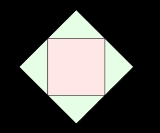
One classic diagram (above) has one square inscribed in the other, with the corners of one being the classical elements, and the corners of the other being the properties. The opposite corner is the opposite of these properties, "hot - cold" and "dry - wet".
Aristotle
added aether as the quintessence, reasoning that whereas fire, earth, air, and water were earthly and corruptible, since no changes had been perceived in the heavenly regions, the star
s cannot be made out of any of the four elements but must be made of a different, unchangeable, heavenly substance.
(the name given by the Greeks to the Egyptian god Thoth
), names the four elements fire, water, air, and earth. As described in this book: "And Isis answer made: Of living things, my son, some are made friends with fire, and some with water, some with air, and some with earth, and some with two or three of these, and some with all. And, on the contrary, again some are made enemies of fire, and some of water, some of earth, and some of air, and some of two of them, and some of three, and some of all. For instance, son, the locust and all flies flee fire; the eagle and the hawk and all high-flying birds flee water; fish, air and earth; the snake avoids the open air. Whereas snakes and all creeping things love earth; all swimming things--love--water; winged things, air, of which they are the citizens; while those that fly still higher--love--the fire and have the habitat near it. Not that some of the animals as well do not love fire; for instance salamanders, for they even have their homes in it. It is because one or another of the elements doth form their bodies' outer envelope. Each soul, accordingly, while it is in its body is weighted and constricted by these four."
According to Galen
, these elements were used by Hippocrates
in describing the human body
with an association with the four humours
: yellow bile
(fire), black bile
(earth), blood
(air), and phlegm
(water).
are kshiti or bhūmi
(earth
), ap
or jala (water
), tejas
or agni
(fire
), marut
or pavan (air
or wind
), vyom
or shunya or akash) (aether
or void
). Hindus believe that all of creation, including the human body, is made up of these five essential elements and that upon death, the human body dissolves into these five elements of nature, thereby balancing the cycle of nature.
Hindus believe that the Creator
used akasha (ether), the most "subtle" element, to create the other four traditional elements; each element created is in turn used to create the next element, each less subtle than the last. The five elements are associated with the five senses, and act as the gross medium for the experience of sensations. The basest element, earth, created using all the other elements, can be perceived by all five senses - hearing, touch, sight, taste, and smell. The next higher element, water, has no odor but can be heard, felt, seen and tasted. Next comes fire, which can be heard, felt and seen. Air can be heard and felt. "Akasha" (ether) is the medium of sound but is inaccessible to all other senses.
PANCHAMAHABHUTAS ACCORDING TO BRAHMAJNANA:
According to Rigveda 1.10.90-15 Purusha is the seat of seven hidden weapons and seven kinds of energies.
According to Manu Smriti 1.19 Purusha is made of seven Purushas.
According to 1.20 the nature of these seven Perishable Purushas is determined by their position in the Purusha and the nature of each is a modification of the nature of the preceedring Purusha.
It is not mentioned any where who these seven Purushas are and their position within the Purusha. However, mastery of Vedic meditation and an analysis of Vedic hymns would make it clear that they are the following.
1. Shunya/ Dreaming force/ Indra
2. Vayu/ Illusory force/ Shakti
3. Agni/ Voluntary force/ Brahma
4. Jala/ Semi voluntary force/ Vishnu
5. Earth/ Involuntary force/ Shiva
6. Status altering force/ Shani
7. Compulsive force/ Yama
Vishnu's association with water is well known. Also, Brahma originates from his navel.
Brahma's association with the hip/ genital region too is well known.
Shiva has to be associated with chest because he is part of Trimurti and thus must lie next to Vishnu.
Thus, Panchamahabhutas refer to the first five of the seven basic forces our life is made of.
, the mahabhuta
("great elements") or catudhatu ("four elements") are earth, water, fire and air. In early Buddhism, the four elements are a basis for understanding suffering and for liberating oneself from suffering. The earliest Buddhist texts explain that the four primary material elements are the sensory qualities solidity, fluidity, temperature, and mobility; their characterization as earth, water, fire, and air, respectively, is declared an abstraction—instead of concentrating on the fact of material existence, one observes how a physical thing is sensed, felt, perceived.
The Buddha
's teaching regarding the four elements is to be understood as the base of all observation of real sensations rather than as a philosophy. The four properties are cohesion (water), solidity or inertia (earth), expansion or vibration (air) and heat or energy content (fire). He promulgated a categorization of mind and matter as composed of eight types of "kalapas
" of which the four elements are primary and a secondary group of four are color, smell, taste, and nutriment which are derivative from the four primaries.
The Buddha's teaching of the four elements does predate Greek teaching of the same four elements. This is possibly explained by the fact that he sent out 60 arahants to the known world to spread his teaching; however it differs in the fact that the Buddha taught that the four elements are false and that form is in fact made up of much smaller particles which are constantly changing.
Thanissaro Bhikkhu
(1997) renders an extract of Shakyamuni Buddha's from Pali into English thus:
, water
, fire
, air and space
are the essential materials of all existent phenomena or aggregate
s. The elemental processes form the basis of the calendar
, astrology
, medicine
, psychology
and are the foundation of the spiritual
traditions of shamanism
, tantra
and Dzogchen
.
Tenzin Wangyal Rinpoche
states that
The names of the elements are analogous to categorised experiential sensations of the natural world. The name
s are symbol
ic and key to their inherent qualities and/or modes of action by analogy
. In Bön the elemental processes are fundamental metaphor
s for working with external, internal and secret energetic forces. All five elemental processes in their essential purity are inherent in the mindstream
and link the trikaya
and are aspects of primordial energy. As Herbert V. Günther
states:
In the above block quote the trikaya
is encoded as: dharmakaya
"god"; sambhogakaya
"temple" and nirmanakaya "house".
Although it is usually translated as "element", the Chinese word xing literally means something like "changing states of being", "permutations" or "metamorphoses of being". In fact Sinologists cannot agree on one single translation. The Chinese conception of "element" is therefore quite different from the Western one. The Western elements were seen as the basic building blocks of matter. The Chinese, by contrast, were seen as ever changing and moving forces or energies—one translation of wu xing is simply "the five changes".
The Wu Xing are chiefly an ancient mnemonic device for systems with five stages; hence the preferred translation of "movements", "phases" or "steps" over "elements."
In Taoism
there is a similar system of elements, which includes metal
and wood
, but excludes air, which is replaced with qi
, which is a force or energy rather than an element. In Chinese philosophy the universe consists of heaven and earth, heaven being made of qi and earth being made of the five elements (in the Chinese view, the attributes and properties of the Western and Indian Air element are equivalent to that of Wood, where the element of Ether is often seen as a correspondent to Metal). The five major planet
s are associated with and named after the elements: Venus
金星 is Metal (金), Jupiter
木星 is Wood (木), Mercury
水星 is Water (水), Mars
火星 is Fire (火), and Saturn
土星 is Earth (土). Additionally, the Moon
represents Yin
(陰), and the Sun
太陽 represents Yang
(陽). Yin, Yang, and the five elements are recurring themes in the I Ching
, the oldest of Chinese classical texts which describes an ancient system of cosmology
and philosophy
. The five elements also play an important part in Chinese astrology
and the Chinese form of geomancy
known as Feng shui
The doctrine of five phases describes two cycles of balance, a generating or creation (生, shēng) cycle and an overcoming or destruction (克/剋, kè) cycle of interactions between the phases.
Generating
Overcoming
There are also two cycles of imbalance, an overacting cycle (cheng) and an insulting cycle (wu).
ese traditions use a set of elements called the (go dai, literally "five great"). These five are earth
, water
, fire
, wind/air, and void
. These came from Buddhist beliefs; the classical Chinese elements are also prominent in Japanese culture, especially to the influential Neo-Confucianists during the Edo period
.
was developed by the Arabic alchemist Jābir ibn Hayyān and others. His original system consisted of the four classical elements found in the ancient Greek traditions (air, earth, fire and water), in addition to two philosophical elements: sulphur
, ‘the stone which burns’, which characterized the principle of combustibility, and mercury
, which contained the idealized principle of metallic properties. The three metallic principles: sulphur to flammability or combustion, mercury to volatility and stability, and salt to solidity. became the tri prima of the Swiss alchemist Paracelsus
, who reasoned that Aristotle’s four element theory appeared in bodies as three principles. Paracelsus saw these principles as fundamental, and justified them by recourse to the description of how wood burns in fire. Mercury included the cohesive principle, so that when it left in smoke the wood fell apart. Smoke described the volatility (the mercury principle), the heat-giving flames described flammability (sulphur), and the remnant ash described solidity (salt).
and medieval Alchemy
eventually gave rise to modern scientific theories and new taxonomies. By the time of Antoine Lavoisier
, for example, a list of elements would no longer refer to classical elements. The classical elements correspond more closely to four states of matter: solid, liquid, gas, and plasma.
 Modern science recognizes classes of elementary particle
s which have no substructure (or rather, particles that aren't made of other particles) and composite particles having substructure (particles made of other particles). The Standard Model
of quantum mechanics
defines three classes of elementary subatomic particles: quark
s and lepton
s (matter
-like particles) and gauge boson
s (energy
-like force carrier
s). Quarks are divided into six types: up
, down
, top
, bottom
, strange
and charm
; and leptons are similarly divided into six types: electron
, electron neutrino
, muon
, muon neutrino
, tau and tau neutrino. The types of force carriers include: photon
, W and Z boson
, gluon
and some quantification of a Higgs boson
.
uses the four classical elements
in connection with astrological chart
s and horoscopes. The twelve signs of the zodiac
are divided into the four elements: Fire signs are Aries, Leo and Sagittarius, Earth signs are Taurus, Virgo and Capricorn, Air signs are Gemini, Libra and Aquarius, and Water signs are Cancer, Scorpio, and Pisces.
In divinatory tarot, the suits of cups, swords, batons/wands, and discs/coins are said to correspond to water, air, fire, and earth respectively.
Philosophy
Philosophy is the study of general and fundamental problems, such as those connected with existence, knowledge, values, reason, mind, and language. Philosophy is distinguished from other ways of addressing such problems by its critical, generally systematic approach and its reliance on rational...
and worldviews have a set of classical elements believed to reflect the simplest essential parts and principles of which anything consists or upon which the constitution and fundamental powers of anything are based. Most frequently, classical elements refer to ancient beliefs inspired by natural observation of the phases of matter. Historians
History of science
The history of science is the study of the historical development of human understandings of the natural world and the domains of the social sciences....
trace the evolution of modern theory pertaining to the chemical element
Chemical element
A chemical element is a pure chemical substance consisting of one type of atom distinguished by its atomic number, which is the number of protons in its nucleus. Familiar examples of elements include carbon, oxygen, aluminum, iron, copper, gold, mercury, and lead.As of November 2011, 118 elements...
s, as well as chemical compound
Chemical compound
A chemical compound is a pure chemical substance consisting of two or more different chemical elements that can be separated into simpler substances by chemical reactions. Chemical compounds have a unique and defined chemical structure; they consist of a fixed ratio of atoms that are held together...
s and mixture
Mixture
In chemistry, a mixture is a material system made up by two or more different substances which are mixed together but are not combined chemically...
s of natural substances
Chemical substance
In chemistry, a chemical substance is a form of matter that has constant chemical composition and characteristic properties. It cannot be separated into components by physical separation methods, i.e. without breaking chemical bonds. They can be solids, liquids or gases.Chemical substances are...
to medieval, Islamic and Greek models. Many concepts once thought to be analogous, such as the Chinese Wu Xing, are now understood more figuratively.
Ancient classic element systems
In classical thought, the four elements EarthEarth (classical element)
Earth, home and origin of humanity, has often been worshipped in its own right with its own unique spiritual tradition.-European tradition:Earth is one of the four classical elements in ancient Greek philosophy and science. It was commonly associated with qualities of heaviness, matter and the...
, Water
Water (classical element)
Water is one of the elements in ancient Greek philosophy, in the Asian Indian system Panchamahabhuta, and in the Chinese cosmological and physiological system Wu Xing...
, Air
Air (classical element)
Air is often seen as a universal power or pure substance. Its supposed fundamental importance to life can be seen in words such as aspire, inspire, perspire and spirit, all derived from the Latin spirare.-Greek and Roman tradition:...
, and Fire
Fire (classical element)
Fire has been an important part of all cultures and religions from pre-history to modern day and was vital to the development of civilization. It has been regarded in many different contexts throughout history, but especially as a metaphysical constant of the world.-Greek and Roman tradition:Fire...
frequently occur; sometimes including a fifth element or quintessence (after "quint" meaning "fifth") called Aether
Aether (classical element)
According to ancient and medieval science aether , also spelled æther or ether, is the material that fills the region of the universe above the terrestrial sphere.-Mythological origins:...
in ancient Greece and India. The concept of the five elements formed a basis of analysis in both Hinduism
Hinduism
Hinduism is the predominant and indigenous religious tradition of the Indian Subcontinent. Hinduism is known to its followers as , amongst many other expressions...
and Buddhism
Buddhism
Buddhism is a religion and philosophy encompassing a variety of traditions, beliefs and practices, largely based on teachings attributed to Siddhartha Gautama, commonly known as the Buddha . The Buddha lived and taught in the northeastern Indian subcontinent some time between the 6th and 4th...
. In Hinduism, particularly in an esoteric
Esotericism
Esotericism or Esoterism signifies the holding of esoteric opinions or beliefs, that is, ideas preserved or understood by a small group or those specially initiated, or of rare or unusual interest. The term derives from the Greek , a compound of : "within", thus "pertaining to the more inward",...
context, the four states-of-matter describe matter, and a fifth element describes that which was beyond the material
Material
Material is anything made of matter, constituted of one or more substances. Wood, cement, hydrogen, air and water are all examples of materials. Sometimes the term "material" is used more narrowly to refer to substances or components with certain physical properties that are used as inputs to...
world. Similar lists existed in ancient China
China
Chinese civilization may refer to:* China for more general discussion of the country.* Chinese culture* Greater China, the transnational community of ethnic Chinese.* History of China* Sinosphere, the area historically affected by Chinese culture...
and Japan
Japan
Japan is an island nation in East Asia. Located in the Pacific Ocean, it lies to the east of the Sea of Japan, China, North Korea, South Korea and Russia, stretching from the Sea of Okhotsk in the north to the East China Sea and Taiwan in the south...
. In Buddhism the four great elements, to which two others are sometimes added, are not viewed as substances, but as categories of sensory experience.
Classical elements in Babylonia
The concept of the four classical elements in the Western tradition originates from Babylonian mythology. The Enûma Eliš, a text written between the 18th and 16th centuries BC, describes five cosmic elements: the seaWater (classical element)
Water is one of the elements in ancient Greek philosophy, in the Asian Indian system Panchamahabhuta, and in the Chinese cosmological and physiological system Wu Xing...
, earth
Earth (classical element)
Earth, home and origin of humanity, has often been worshipped in its own right with its own unique spiritual tradition.-European tradition:Earth is one of the four classical elements in ancient Greek philosophy and science. It was commonly associated with qualities of heaviness, matter and the...
, fire
Fire (classical element)
Fire has been an important part of all cultures and religions from pre-history to modern day and was vital to the development of civilization. It has been regarded in many different contexts throughout history, but especially as a metaphysical constant of the world.-Greek and Roman tradition:Fire...
, sky
Aether (classical element)
According to ancient and medieval science aether , also spelled æther or ether, is the material that fills the region of the universe above the terrestrial sphere.-Mythological origins:...
, and wind
Air (classical element)
Air is often seen as a universal power or pure substance. Its supposed fundamental importance to life can be seen in words such as aspire, inspire, perspire and spirit, all derived from the Latin spirare.-Greek and Roman tradition:...
.
Classical elements in Greece
The GreekAncient Greece
Ancient Greece is a civilization belonging to a period of Greek history that lasted from the Archaic period of the 8th to 6th centuries BC to the end of antiquity. Immediately following this period was the beginning of the Early Middle Ages and the Byzantine era. Included in Ancient Greece is the...
classical elements (Earth, Water, Air, Fire, and Aether) date from pre-Socratic times and persisted throughout the Middle Ages
Middle Ages
The Middle Ages is a periodization of European history from the 5th century to the 15th century. The Middle Ages follows the fall of the Western Roman Empire in 476 and precedes the Early Modern Era. It is the middle period of a three-period division of Western history: Classic, Medieval and Modern...
and into the Renaissance
Renaissance
The Renaissance was a cultural movement that spanned roughly the 14th to the 17th century, beginning in Italy in the Late Middle Ages and later spreading to the rest of Europe. The term is also used more loosely to refer to the historical era, but since the changes of the Renaissance were not...
, deeply influencing Europe
Europe
Europe is, by convention, one of the world's seven continents. Comprising the westernmost peninsula of Eurasia, Europe is generally 'divided' from Asia to its east by the watershed divides of the Ural and Caucasus Mountains, the Ural River, the Caspian and Black Seas, and the waterways connecting...
an thought and culture. The Greek five elements are sometimes associated with the five platonic solid
Platonic solid
In geometry, a Platonic solid is a convex polyhedron that is regular, in the sense of a regular polygon. Specifically, the faces of a Platonic solid are congruent regular polygons, with the same number of faces meeting at each vertex; thus, all its edges are congruent, as are its vertices and...
s.
Hellenic Physics |


Plato
Plato
Plato , was a Classical Greek philosopher, mathematician, student of Socrates, writer of philosophical dialogues, and founder of the Academy in Athens, the first institution of higher learning in the Western world. Along with his mentor, Socrates, and his student, Aristotle, Plato helped to lay the...
characterizes the elements as being pre-Socratic in origin from a list created by the Sicilian
Magna Graecia
Magna Græcia is the name of the coastal areas of Southern Italy on the Tarentine Gulf that were extensively colonized by Greek settlers; particularly the Achaean colonies of Tarentum, Crotone, and Sybaris, but also, more loosely, the cities of Cumae and Neapolis to the north...
philosopher Empedocles
Empedocles
Empedocles was a Greek pre-Socratic philosopher and a citizen of Agrigentum, a Greek city in Sicily. Empedocles' philosophy is best known for being the originator of the cosmogenic theory of the four Classical elements...
(ca. 450 BC). Empedocles called these the four "roots" (ῥιζὤματα, rhizōmata). Plato seems to have been the first to use the term "element (στοιχεῖον, stoicheion)" in reference to air, fire, earth, and water. The ancient Greek word for element, stoicheion (from stoicheo, "to line up") meant "smallest division (of a sun-dial), a syllable", as the composing unit of an alphabet it could denote a letter and the smallest unit from which a word is formed.
According to Aristotle in his On Generation and Corruption:
- AirAir (classical element)Air is often seen as a universal power or pure substance. Its supposed fundamental importance to life can be seen in words such as aspire, inspire, perspire and spirit, all derived from the Latin spirare.-Greek and Roman tradition:...
is primarily wet and secondarily hot. - FireFire (classical element)Fire has been an important part of all cultures and religions from pre-history to modern day and was vital to the development of civilization. It has been regarded in many different contexts throughout history, but especially as a metaphysical constant of the world.-Greek and Roman tradition:Fire...
is primarily hot and secondarily dry. - EarthEarth (classical element)Earth, home and origin of humanity, has often been worshipped in its own right with its own unique spiritual tradition.-European tradition:Earth is one of the four classical elements in ancient Greek philosophy and science. It was commonly associated with qualities of heaviness, matter and the...
is primarily dry and secondarily cold. - WaterWater (classical element)Water is one of the elements in ancient Greek philosophy, in the Asian Indian system Panchamahabhuta, and in the Chinese cosmological and physiological system Wu Xing...
is primarily cold and secondarily wet.
One classic diagram (above) has one square inscribed in the other, with the corners of one being the classical elements, and the corners of the other being the properties. The opposite corner is the opposite of these properties, "hot - cold" and "dry - wet".
Aristotle
Aristotle
Aristotle was a Greek philosopher and polymath, a student of Plato and teacher of Alexander the Great. His writings cover many subjects, including physics, metaphysics, poetry, theater, music, logic, rhetoric, linguistics, politics, government, ethics, biology, and zoology...
added aether as the quintessence, reasoning that whereas fire, earth, air, and water were earthly and corruptible, since no changes had been perceived in the heavenly regions, the star
Star
A star is a massive, luminous sphere of plasma held together by gravity. At the end of its lifetime, a star can also contain a proportion of degenerate matter. The nearest star to Earth is the Sun, which is the source of most of the energy on Earth...
s cannot be made out of any of the four elements but must be made of a different, unchangeable, heavenly substance.
Classical elements in Egypt
A Greek text called the "Kore Kosmou" or "Virgin of the World," ascribed to Hermes TrismegistusHermes Trismegistus
Hermes Trismegistus is the eponymous author of the Hermetic Corpus, a sacred text belonging to the genre of divine revelation.-Origin and identity:...
(the name given by the Greeks to the Egyptian god Thoth
Thoth
Thoth was considered one of the more important deities of the Egyptian pantheon. In art, he was often depicted as a man with the head of an ibis or a baboon, animals sacred to him. His feminine counterpart was Seshat...
), names the four elements fire, water, air, and earth. As described in this book: "And Isis answer made: Of living things, my son, some are made friends with fire, and some with water, some with air, and some with earth, and some with two or three of these, and some with all. And, on the contrary, again some are made enemies of fire, and some of water, some of earth, and some of air, and some of two of them, and some of three, and some of all. For instance, son, the locust and all flies flee fire; the eagle and the hawk and all high-flying birds flee water; fish, air and earth; the snake avoids the open air. Whereas snakes and all creeping things love earth; all swimming things--love--water; winged things, air, of which they are the citizens; while those that fly still higher--love--the fire and have the habitat near it. Not that some of the animals as well do not love fire; for instance salamanders, for they even have their homes in it. It is because one or another of the elements doth form their bodies' outer envelope. Each soul, accordingly, while it is in its body is weighted and constricted by these four."
According to Galen
Galen
Aelius Galenus or Claudius Galenus , better known as Galen of Pergamon , was a prominent Roman physician, surgeon and philosopher...
, these elements were used by Hippocrates
Hippocrates
Hippocrates of Cos or Hippokrates of Kos was an ancient Greek physician of the Age of Pericles , and is considered one of the most outstanding figures in the history of medicine...
in describing the human body
Human body
The human body is the entire structure of a human organism, and consists of a head, neck, torso, two arms and two legs.By the time the human reaches adulthood, the body consists of close to 100 trillion cells, the basic unit of life...
with an association with the four humours
Humorism
Humorism, or humoralism, is a now discredited theory of the makeup and workings of the human body, adopted by Greek and Roman physicians and philosophers, positing that an excess or deficiency of any of four distinct bodily fluids in a person directly influences their temperament and health...
: yellow bile
Bile
Bile or gall is a bitter-tasting, dark green to yellowish brown fluid, produced by the liver of most vertebrates, that aids the process of digestion of lipids in the small intestine. In many species, bile is stored in the gallbladder and upon eating is discharged into the duodenum...
(fire), black bile
Melancholia
Melancholia , also lugubriousness, from the Latin lugere, to mourn; moroseness, from the Latin morosus, self-willed, fastidious habit; wistfulness, from old English wist: intent, or saturnine, , in contemporary usage, is a mood disorder of non-specific depression,...
(earth), blood
Blood
Blood is a specialized bodily fluid in animals that delivers necessary substances such as nutrients and oxygen to the cells and transports metabolic waste products away from those same cells....
(air), and phlegm
Phlegm
Phlegm is a liquid secreted by the mucous membranes of mammalians. Its definition is limited to the mucus produced by the respiratory system, excluding that from the nasal passages, and particularly that which is expelled by coughing . Phlegm is in essence a water-based gel consisting of...
(water).
Classical elements in Hinduism
The pancha mahabhuta, or "five great elements", of HinduismHinduism
Hinduism is the predominant and indigenous religious tradition of the Indian Subcontinent. Hinduism is known to its followers as , amongst many other expressions...
are kshiti or bhūmi
Bhumi
Bhumi can mean:* Bhūmi, Hindu goddess of the earth**also, earth as a classical element in Hindu tradition* Bhumi , the ten stages a Bodhisattva advances through in the path to become a Buddha...
(earth
Earth (classical element)
Earth, home and origin of humanity, has often been worshipped in its own right with its own unique spiritual tradition.-European tradition:Earth is one of the four classical elements in ancient Greek philosophy and science. It was commonly associated with qualities of heaviness, matter and the...
), ap
Ap (water)
Ap is the Vedic Sanskrit term for "water", in Classical Sanskrit occurring only in the plural, , whence Hindi . The term is from PIE hxap "water"....
or jala (water
Water (classical element)
Water is one of the elements in ancient Greek philosophy, in the Asian Indian system Panchamahabhuta, and in the Chinese cosmological and physiological system Wu Xing...
), tejas
Agni
Agni is a Hindu deity, one of the most important of the Vedic gods. He is the god of fire and the acceptor of sacrifices. The sacrifices made to Agni go to the deities because Agni is a messenger from and to the other gods...
or agni
Agni
Agni is a Hindu deity, one of the most important of the Vedic gods. He is the god of fire and the acceptor of sacrifices. The sacrifices made to Agni go to the deities because Agni is a messenger from and to the other gods...
(fire
Fire (classical element)
Fire has been an important part of all cultures and religions from pre-history to modern day and was vital to the development of civilization. It has been regarded in many different contexts throughout history, but especially as a metaphysical constant of the world.-Greek and Roman tradition:Fire...
), marut
Maruts
In Hinduism the Marutas , also known as the Marutagana and sometimes identified with Rudras, are storm deities and sons of Rudra and Diti and attendants of Indra. The number of Maruts varies from two to sixty . They are very violent and aggressive, described as armed with golden weapons i.e...
or pavan (air
Air (classical element)
Air is often seen as a universal power or pure substance. Its supposed fundamental importance to life can be seen in words such as aspire, inspire, perspire and spirit, all derived from the Latin spirare.-Greek and Roman tradition:...
or wind
Wind
Wind is the flow of gases on a large scale. On Earth, wind consists of the bulk movement of air. In outer space, solar wind is the movement of gases or charged particles from the sun through space, while planetary wind is the outgassing of light chemical elements from a planet's atmosphere into space...
), vyom
Vyom
Vyom is the Annual Technical festival of Punjab Engineering College, Chandigarh. The festival spreads over three days and attracts participation from various major colleges of the country...
or shunya or akash) (aether
Aether (classical element)
According to ancient and medieval science aether , also spelled æther or ether, is the material that fills the region of the universe above the terrestrial sphere.-Mythological origins:...
or void
Aether (classical element)
According to ancient and medieval science aether , also spelled æther or ether, is the material that fills the region of the universe above the terrestrial sphere.-Mythological origins:...
). Hindus believe that all of creation, including the human body, is made up of these five essential elements and that upon death, the human body dissolves into these five elements of nature, thereby balancing the cycle of nature.
Hindus believe that the Creator
Creator deity
A creator deity is a deity responsible for the creation of the world . In monotheism, the single God is often also the creator deity, while polytheistic traditions may or may not have creator deities...
used akasha (ether), the most "subtle" element, to create the other four traditional elements; each element created is in turn used to create the next element, each less subtle than the last. The five elements are associated with the five senses, and act as the gross medium for the experience of sensations. The basest element, earth, created using all the other elements, can be perceived by all five senses - hearing, touch, sight, taste, and smell. The next higher element, water, has no odor but can be heard, felt, seen and tasted. Next comes fire, which can be heard, felt and seen. Air can be heard and felt. "Akasha" (ether) is the medium of sound but is inaccessible to all other senses.
PANCHAMAHABHUTAS ACCORDING TO BRAHMAJNANA:
According to Rigveda 1.10.90-15 Purusha is the seat of seven hidden weapons and seven kinds of energies.
According to Manu Smriti 1.19 Purusha is made of seven Purushas.
According to 1.20 the nature of these seven Perishable Purushas is determined by their position in the Purusha and the nature of each is a modification of the nature of the preceedring Purusha.
It is not mentioned any where who these seven Purushas are and their position within the Purusha. However, mastery of Vedic meditation and an analysis of Vedic hymns would make it clear that they are the following.
1. Shunya/ Dreaming force/ Indra
2. Vayu/ Illusory force/ Shakti
3. Agni/ Voluntary force/ Brahma
4. Jala/ Semi voluntary force/ Vishnu
5. Earth/ Involuntary force/ Shiva
6. Status altering force/ Shani
7. Compulsive force/ Yama
Vishnu's association with water is well known. Also, Brahma originates from his navel.
Brahma's association with the hip/ genital region too is well known.
Shiva has to be associated with chest because he is part of Trimurti and thus must lie next to Vishnu.
Thus, Panchamahabhutas refer to the first five of the seven basic forces our life is made of.
Buddhist elements
In the Pali literaturePali literature
Pali literature is concerned mainly with Theravada Buddhism, of which Pali is the traditional language.- India :Main article: Pali CanonThe earliest and most important Pali literature constitutes the Pali Canon, the scriptures of Theravada...
, the mahabhuta
Mahabhuta
Mahābhūta is Sanskrit and Pāli for "great element." In Buddhism, the "four great elements" are earth, water, fire and air...
("great elements") or catudhatu ("four elements") are earth, water, fire and air. In early Buddhism, the four elements are a basis for understanding suffering and for liberating oneself from suffering. The earliest Buddhist texts explain that the four primary material elements are the sensory qualities solidity, fluidity, temperature, and mobility; their characterization as earth, water, fire, and air, respectively, is declared an abstraction—instead of concentrating on the fact of material existence, one observes how a physical thing is sensed, felt, perceived.
The Buddha
Gautama Buddha
Siddhārtha Gautama was a spiritual teacher from the Indian subcontinent, on whose teachings Buddhism was founded. In most Buddhist traditions, he is regarded as the Supreme Buddha Siddhārtha Gautama (Sanskrit: सिद्धार्थ गौतम; Pali: Siddhattha Gotama) was a spiritual teacher from the Indian...
's teaching regarding the four elements is to be understood as the base of all observation of real sensations rather than as a philosophy. The four properties are cohesion (water), solidity or inertia (earth), expansion or vibration (air) and heat or energy content (fire). He promulgated a categorization of mind and matter as composed of eight types of "kalapas
Kalapas
In Theravada Buddhist phenomenology, Kalapas are defined as the smallest units of physical matter. Kalapas are described as tiny units of materiality, “tens of thousands of times smaller than a particle of dust,” coming into existence and disappearing in as little as a billionth of a second or a...
" of which the four elements are primary and a secondary group of four are color, smell, taste, and nutriment which are derivative from the four primaries.
The Buddha's teaching of the four elements does predate Greek teaching of the same four elements. This is possibly explained by the fact that he sent out 60 arahants to the known world to spread his teaching; however it differs in the fact that the Buddha taught that the four elements are false and that form is in fact made up of much smaller particles which are constantly changing.
Thanissaro Bhikkhu
Thanissaro Bhikkhu
Ṭhānissaro Bhikkhu, also known as Ajaan Geoff, is an American Buddhist monk of the Dhammayut Order , Thai forest kammatthana tradition. He is currently the abbot of Metta Forest Monastery in San Diego County. Ṭhānissaro Bhikkhu is a notably skilled and prolific translator of the Pāli Canon...
(1997) renders an extract of Shakyamuni Buddha's from Pali into English thus:
Seven chakras
In the philosophy of the seven chakras there are correspondences to the five elements as shared by both Hinduism and Buddhism as well as two other elements:- Sahasrara (Crown): Thought/Space
- Ajña (Third Eye): Light/Dark
- Vishuddhi (Throat): Ether/Sound
- Anahata (Heart): Air
- Manipura (Navel): Fire
- Svadhisthana (Sacral): Water
- Muladhara (Root): Earth
Bön elements
In Bön or ancient Tibetan philosophy, the five elemental processes of earthEarth
Earth is the third planet from the Sun, and the densest and fifth-largest of the eight planets in the Solar System. It is also the largest of the Solar System's four terrestrial planets...
, water
Water
Water is a chemical substance with the chemical formula H2O. A water molecule contains one oxygen and two hydrogen atoms connected by covalent bonds. Water is a liquid at ambient conditions, but it often co-exists on Earth with its solid state, ice, and gaseous state . Water also exists in a...
, fire
Fire
Fire is the rapid oxidation of a material in the chemical process of combustion, releasing heat, light, and various reaction products. Slower oxidative processes like rusting or digestion are not included by this definition....
, air and space
Space
Space is the boundless, three-dimensional extent in which objects and events occur and have relative position and direction. Physical space is often conceived in three linear dimensions, although modern physicists usually consider it, with time, to be part of a boundless four-dimensional continuum...
are the essential materials of all existent phenomena or aggregate
Skandha
In Buddhist phenomenology and soteriology, the skandhas or khandhas are any of five types of phenomena that serve as objects of clinging and bases for a sense of self...
s. The elemental processes form the basis of the calendar
Calendar
A calendar is a system of organizing days for social, religious, commercial, or administrative purposes. This is done by giving names to periods of time, typically days, weeks, months, and years. The name given to each day is known as a date. Periods in a calendar are usually, though not...
, astrology
Astrology
Astrology consists of a number of belief systems which hold that there is a relationship between astronomical phenomena and events in the human world...
, medicine
Medicine
Medicine is the science and art of healing. It encompasses a variety of health care practices evolved to maintain and restore health by the prevention and treatment of illness....
, psychology
Psychology
Psychology is the study of the mind and behavior. Its immediate goal is to understand individuals and groups by both establishing general principles and researching specific cases. For many, the ultimate goal of psychology is to benefit society...
and are the foundation of the spiritual
Spirituality
Spirituality can refer to an ultimate or an alleged immaterial reality; an inner path enabling a person to discover the essence of his/her being; or the “deepest values and meanings by which people live.” Spiritual practices, including meditation, prayer and contemplation, are intended to develop...
traditions of shamanism
Shamanism
Shamanism is an anthropological term referencing a range of beliefs and practices regarding communication with the spiritual world. To quote Eliade: "A first definition of this complex phenomenon, and perhaps the least hazardous, will be: shamanism = technique of ecstasy." Shamanism encompasses the...
, tantra
Tantra
Tantra , anglicised tantricism or tantrism or tantram, is the name scholars give to an inter-religious spiritual movement that arose in medieval India, expressed in scriptures ....
and Dzogchen
Dzogchen
According to Tibetan Buddhism and Bön, Dzogchen is the natural, primordial state or natural condition of the mind, and a body of teachings and meditation practices aimed at realizing that condition. Dzogchen, or "Great Perfection", is a central teaching of the Nyingma school also practiced by...
.
Tenzin Wangyal Rinpoche
Tenzin Wangyal Rinpoche
Tenzin Wangyal Rinpoche is a teacher of the Bon Tibetan religious tradition. He is founder and director of the Ligmincha Institute and several centers named Chamma Ling, organizations dedicated to the study and practice of the teachings of the Bon tradition.-Life:Tenzin Wangyal's parents fled the...
states that
The names of the elements are analogous to categorised experiential sensations of the natural world. The name
Name
A name is a word or term used for identification. Names can identify a class or category of things, or a single thing, either uniquely, or within a given context. A personal name identifies a specific unique and identifiable individual person, and may or may not include a middle name...
s are symbol
Symbol
A symbol is something which represents an idea, a physical entity or a process but is distinct from it. The purpose of a symbol is to communicate meaning. For example, a red octagon may be a symbol for "STOP". On a map, a picture of a tent might represent a campsite. Numerals are symbols for...
ic and key to their inherent qualities and/or modes of action by analogy
Analogy
Analogy is a cognitive process of transferring information or meaning from a particular subject to another particular subject , and a linguistic expression corresponding to such a process...
. In Bön the elemental processes are fundamental metaphor
Metaphor
A metaphor is a literary figure of speech that uses an image, story or tangible thing to represent a less tangible thing or some intangible quality or idea; e.g., "Her eyes were glistening jewels." Metaphor may also be used for any rhetorical figures of speech that achieve their effects via...
s for working with external, internal and secret energetic forces. All five elemental processes in their essential purity are inherent in the mindstream
Mindstream
Mindstream in Buddhist philosophy is the moment-to-moment "continuum" of awareness. There are a number of terms in the Buddhist literature that may well be rendered "mindstream"...
and link the trikaya
Trikaya
The Trikāya doctrine is an important Mahayana Buddhist teaching on both the nature of reality and the nature of a Buddha. By the 4th century CE the Trikāya Doctrine had assumed the form that we now know...
and are aspects of primordial energy. As Herbert V. Günther
Herbert V. Günther
Herbert V. Güenther [Herbert Vighnāntaka Guenther, Ph.D., D.Litt.] was a German Buddhist philosopher and Professor and Head of the Department of Far Eastern Studies at the University of Saskatchewan, Saskatoon, Canada. He held this position from the time he left India in 1964.-Early life:He was...
states:
In the above block quote the trikaya
Trikaya
The Trikāya doctrine is an important Mahayana Buddhist teaching on both the nature of reality and the nature of a Buddha. By the 4th century CE the Trikāya Doctrine had assumed the form that we now know...
is encoded as: dharmakaya
Dharmakaya
The Dharmakāya is a central idea in Mahayana Buddhism forming part of the Trikaya doctrine that was possibly first expounded in the Aṣṭasāhasrikā prajñā-pāramitā , composed in the 1st century BCE...
"god"; sambhogakaya
Sambhogakaya
The Sambhogakāya is the second mode or aspect of the Trikaya. Sambhogakaya has also been translated as the "deity dimension", "body of bliss" or "astral body". Sambhogakaya refers to the luminous form of clear light the Buddhist practitioner attains upon the reaching the highest dimensions of...
"temple" and nirmanakaya "house".
Chinese elements
The Chinese had a somewhat different series of elements, namely Fire, Earth, Water, Metal and Wood, which were understood as different types of energy in a state of constant interaction and flux with one another, rather than the Western notion of different kinds of material.Although it is usually translated as "element", the Chinese word xing literally means something like "changing states of being", "permutations" or "metamorphoses of being". In fact Sinologists cannot agree on one single translation. The Chinese conception of "element" is therefore quite different from the Western one. The Western elements were seen as the basic building blocks of matter. The Chinese, by contrast, were seen as ever changing and moving forces or energies—one translation of wu xing is simply "the five changes".
The Wu Xing are chiefly an ancient mnemonic device for systems with five stages; hence the preferred translation of "movements", "phases" or "steps" over "elements."
In Taoism
Taoism
Taoism refers to a philosophical or religious tradition in which the basic concept is to establish harmony with the Tao , which is the mechanism of everything that exists...
there is a similar system of elements, which includes metal
Metal (classical element)
Metal , is the decline of the matter, or the matter's decline stage. Metal is the fourth phase of Wu Xing. Metal is yin in character, its motion is inwards and its energy is contracting. It is associated with the Autumn, the west, old age, the planet Venus, the color white, dry weather, and the...
and wood
Wood (classical element)
Tree , traditionally translated as Wood, is the growing of the matter, or the matter's growing stage. Tree is the first phase of Wu Xing. Tree is yang in character...
, but excludes air, which is replaced with qi
Qi
In traditional Chinese culture, qì is an active principle forming part of any living thing. Qi is frequently translated as life energy, lifeforce, or energy flow. Qi is the central underlying principle in traditional Chinese medicine and martial arts...
, which is a force or energy rather than an element. In Chinese philosophy the universe consists of heaven and earth, heaven being made of qi and earth being made of the five elements (in the Chinese view, the attributes and properties of the Western and Indian Air element are equivalent to that of Wood, where the element of Ether is often seen as a correspondent to Metal). The five major planet
Planet
A planet is a celestial body orbiting a star or stellar remnant that is massive enough to be rounded by its own gravity, is not massive enough to cause thermonuclear fusion, and has cleared its neighbouring region of planetesimals.The term planet is ancient, with ties to history, science,...
s are associated with and named after the elements: Venus
Venus
Venus is the second planet from the Sun, orbiting it every 224.7 Earth days. The planet is named after Venus, the Roman goddess of love and beauty. After the Moon, it is the brightest natural object in the night sky, reaching an apparent magnitude of −4.6, bright enough to cast shadows...
金星 is Metal (金), Jupiter
Jupiter
Jupiter is the fifth planet from the Sun and the largest planet within the Solar System. It is a gas giant with mass one-thousandth that of the Sun but is two and a half times the mass of all the other planets in our Solar System combined. Jupiter is classified as a gas giant along with Saturn,...
木星 is Wood (木), Mercury
Mercury (planet)
Mercury is the innermost and smallest planet in the Solar System, orbiting the Sun once every 87.969 Earth days. The orbit of Mercury has the highest eccentricity of all the Solar System planets, and it has the smallest axial tilt. It completes three rotations about its axis for every two orbits...
水星 is Water (水), Mars
Mars
Mars is the fourth planet from the Sun in the Solar System. The planet is named after the Roman god of war, Mars. It is often described as the "Red Planet", as the iron oxide prevalent on its surface gives it a reddish appearance...
火星 is Fire (火), and Saturn
Saturn
Saturn is the sixth planet from the Sun and the second largest planet in the Solar System, after Jupiter. Saturn is named after the Roman god Saturn, equated to the Greek Cronus , the Babylonian Ninurta and the Hindu Shani. Saturn's astronomical symbol represents the Roman god's sickle.Saturn,...
土星 is Earth (土). Additionally, the Moon
Moon
The Moon is Earth's only known natural satellite,There are a number of near-Earth asteroids including 3753 Cruithne that are co-orbital with Earth: their orbits bring them close to Earth for periods of time but then alter in the long term . These are quasi-satellites and not true moons. For more...
represents Yin
Yin and yang
In Asian philosophy, the concept of yin yang , which is often referred to in the West as "yin and yang", is used to describe how polar opposites or seemingly contrary forces are interconnected and interdependent in the natural world, and how they give rise to each other in turn. Opposites thus only...
(陰), and the Sun
Sun
The Sun is the star at the center of the Solar System. It is almost perfectly spherical and consists of hot plasma interwoven with magnetic fields...
太陽 represents Yang
Yin and yang
In Asian philosophy, the concept of yin yang , which is often referred to in the West as "yin and yang", is used to describe how polar opposites or seemingly contrary forces are interconnected and interdependent in the natural world, and how they give rise to each other in turn. Opposites thus only...
(陽). Yin, Yang, and the five elements are recurring themes in the I Ching
I Ching
The I Ching or "Yì Jīng" , also known as the Classic of Changes, Book of Changes and Zhouyi, is one of the oldest of the Chinese classic texts...
, the oldest of Chinese classical texts which describes an ancient system of cosmology
Cosmology
Cosmology is the discipline that deals with the nature of the Universe as a whole. Cosmologists seek to understand the origin, evolution, structure, and ultimate fate of the Universe at large, as well as the natural laws that keep it in order...
and philosophy
Philosophy
Philosophy is the study of general and fundamental problems, such as those connected with existence, knowledge, values, reason, mind, and language. Philosophy is distinguished from other ways of addressing such problems by its critical, generally systematic approach and its reliance on rational...
. The five elements also play an important part in Chinese astrology
Chinese astrology
Chinese astrology is based on the traditional astronomy and calendars. The development of Chinese astrology is tied to that of astronomy, which came to flourish during the Han Dynasty ....
and the Chinese form of geomancy
Geomancy
Geomancy is a method of divination that interprets markings on the ground or the patterns formed by tossed handfuls of soil, rocks, or sand...
known as Feng shui
Feng shui
Feng shui ' is a Chinese system of geomancy believed to use the laws of both Heaven and Earth to help one improve life by receiving positive qi. The original designation for the discipline is Kan Yu ....
The doctrine of five phases describes two cycles of balance, a generating or creation (生, shēng) cycle and an overcoming or destruction (克/剋, kè) cycle of interactions between the phases.
Generating
- Wood feeds fire;
- Fire creates earth (ash);
- Earth bears metal;
- Metal collects water;
- Water nourishes wood.
Overcoming
- Wood parts earth;
- Earth absorbs water;
- Water quenches fire;
- Fire melts metal;
- Metal chops wood.
There are also two cycles of imbalance, an overacting cycle (cheng) and an insulting cycle (wu).
Japanese elements
JapanJapan
Japan is an island nation in East Asia. Located in the Pacific Ocean, it lies to the east of the Sea of Japan, China, North Korea, South Korea and Russia, stretching from the Sea of Okhotsk in the north to the East China Sea and Taiwan in the south...
ese traditions use a set of elements called the (go dai, literally "five great"). These five are earth
Earth (classical element)
Earth, home and origin of humanity, has often been worshipped in its own right with its own unique spiritual tradition.-European tradition:Earth is one of the four classical elements in ancient Greek philosophy and science. It was commonly associated with qualities of heaviness, matter and the...
, water
Water (classical element)
Water is one of the elements in ancient Greek philosophy, in the Asian Indian system Panchamahabhuta, and in the Chinese cosmological and physiological system Wu Xing...
, fire
Fire (classical element)
Fire has been an important part of all cultures and religions from pre-history to modern day and was vital to the development of civilization. It has been regarded in many different contexts throughout history, but especially as a metaphysical constant of the world.-Greek and Roman tradition:Fire...
, wind/air, and void
Aether (classical element)
According to ancient and medieval science aether , also spelled æther or ether, is the material that fills the region of the universe above the terrestrial sphere.-Mythological origins:...
. These came from Buddhist beliefs; the classical Chinese elements are also prominent in Japanese culture, especially to the influential Neo-Confucianists during the Edo period
Edo period
The , or , is a division of Japanese history which was ruled by the shoguns of the Tokugawa family, running from 1603 to 1868. The political entity of this period was the Tokugawa shogunate....
.
- Earth represented things that were solid.
- Water represented things that were liquid.
- Fire represented things that destroy.
- Air represented things that moved.
- Spirit represented things not of our everyday life.
Elements in Medieval alchemy
The elemental system used in Medieval alchemyAlchemy
Alchemy is an influential philosophical tradition whose early practitioners’ claims to profound powers were known from antiquity. The defining objectives of alchemy are varied; these include the creation of the fabled philosopher's stone possessing powers including the capability of turning base...
was developed by the Arabic alchemist Jābir ibn Hayyān and others. His original system consisted of the four classical elements found in the ancient Greek traditions (air, earth, fire and water), in addition to two philosophical elements: sulphur
Sulfur
Sulfur or sulphur is the chemical element with atomic number 16. In the periodic table it is represented by the symbol S. It is an abundant, multivalent non-metal. Under normal conditions, sulfur atoms form cyclic octatomic molecules with chemical formula S8. Elemental sulfur is a bright yellow...
, ‘the stone which burns’, which characterized the principle of combustibility, and mercury
Mercury (element)
Mercury is a chemical element with the symbol Hg and atomic number 80. It is also known as quicksilver or hydrargyrum...
, which contained the idealized principle of metallic properties. The three metallic principles: sulphur to flammability or combustion, mercury to volatility and stability, and salt to solidity. became the tri prima of the Swiss alchemist Paracelsus
Paracelsus
Paracelsus was a German-Swiss Renaissance physician, botanist, alchemist, astrologer, and general occultist....
, who reasoned that Aristotle’s four element theory appeared in bodies as three principles. Paracelsus saw these principles as fundamental, and justified them by recourse to the description of how wood burns in fire. Mercury included the cohesive principle, so that when it left in smoke the wood fell apart. Smoke described the volatility (the mercury principle), the heat-giving flames described flammability (sulphur), and the remnant ash described solidity (salt).
Modern elements
The Aristotelian traditionPhysics (Aristotle)
The Physics of Aristotle is one of the foundational books of Western science and philosophy...
and medieval Alchemy
Alchemy
Alchemy is an influential philosophical tradition whose early practitioners’ claims to profound powers were known from antiquity. The defining objectives of alchemy are varied; these include the creation of the fabled philosopher's stone possessing powers including the capability of turning base...
eventually gave rise to modern scientific theories and new taxonomies. By the time of Antoine Lavoisier
Antoine Lavoisier
Antoine-Laurent de Lavoisier , the "father of modern chemistry", was a French nobleman prominent in the histories of chemistry and biology...
, for example, a list of elements would no longer refer to classical elements. The classical elements correspond more closely to four states of matter: solid, liquid, gas, and plasma.
Elementary particle
In particle physics, an elementary particle or fundamental particle is a particle not known to have substructure; that is, it is not known to be made up of smaller particles. If an elementary particle truly has no substructure, then it is one of the basic building blocks of the universe from which...
s which have no substructure (or rather, particles that aren't made of other particles) and composite particles having substructure (particles made of other particles). The Standard Model
Standard Model
The Standard Model of particle physics is a theory concerning the electromagnetic, weak, and strong nuclear interactions, which mediate the dynamics of the known subatomic particles. Developed throughout the mid to late 20th century, the current formulation was finalized in the mid 1970s upon...
of quantum mechanics
Quantum mechanics
Quantum mechanics, also known as quantum physics or quantum theory, is a branch of physics providing a mathematical description of much of the dual particle-like and wave-like behavior and interactions of energy and matter. It departs from classical mechanics primarily at the atomic and subatomic...
defines three classes of elementary subatomic particles: quark
Quark
A quark is an elementary particle and a fundamental constituent of matter. Quarks combine to form composite particles called hadrons, the most stable of which are protons and neutrons, the components of atomic nuclei. Due to a phenomenon known as color confinement, quarks are never directly...
s and lepton
Lepton
A lepton is an elementary particle and a fundamental constituent of matter. The best known of all leptons is the electron which governs nearly all of chemistry as it is found in atoms and is directly tied to all chemical properties. Two main classes of leptons exist: charged leptons , and neutral...
s (matter
Matter
Matter is a general term for the substance of which all physical objects consist. Typically, matter includes atoms and other particles which have mass. A common way of defining matter is as anything that has mass and occupies volume...
-like particles) and gauge boson
Gauge boson
In particle physics, gauge bosons are bosonic particles that act as carriers of the fundamental forces of nature. More specifically, elementary particles whose interactions are described by gauge theory exert forces on each other by the exchange of gauge bosons, usually as virtual particles.-...
s (energy
Energy
In physics, energy is an indirectly observed quantity. It is often understood as the ability a physical system has to do work on other physical systems...
-like force carrier
Force carrier
In particle physics, quantum field theories such as the Standard Model describe nature in terms of fields. Each field has a complementary description as the set of particles of a particular type...
s). Quarks are divided into six types: up
Up quark
The up quark or u quark is the lightest of all quarks, a type of elementary particle, and a major constituent of matter. It, along with the down quark, forms the neutrons and protons of atomic nuclei...
, down
Down quark
The down quark or d quark is the second-lightest of all quarks, a type of elementary particle, and a major constituent of matter. It, along with the up quark, forms the neutrons and protons of atomic nuclei...
, top
Top quark
The top quark, also known as the t quark or truth quark, is an elementary particle and a fundamental constituent of matter. Like all quarks, the top quark is an elementary fermion with spin-, and experiences all four fundamental interactions: gravitation, electromagnetism, weak interactions, and...
, bottom
Bottom quark
The bottom quark, also known as the beauty quark, is a third-generation quark with a charge of − e. Although all quarks are described in a similar way by the quantum chromodynamics, the bottom quark's large bare mass , combined with low values of the CKM matrix elements Vub and Vcb, gives it a...
, strange
Strange quark
The strange quark or s quark is the third-lightest of all quarks, a type of elementary particle. Strange quarks are found in hadrons, which are subatomic particles. Example of hadrons containing strange quarks include kaons , strange D mesons , Sigma baryons , and other strange particles...
and charm
Charm quark
The charm quark or c quark is the third most massive of all quarks, a type of elementary particle. Charm quarks are found in hadrons, which are subatomic particles made of quarks...
; and leptons are similarly divided into six types: electron
Electron
The electron is a subatomic particle with a negative elementary electric charge. It has no known components or substructure; in other words, it is generally thought to be an elementary particle. An electron has a mass that is approximately 1/1836 that of the proton...
, electron neutrino
Electron neutrino
The electron neutrino is a subatomic lepton elementary particle which has no net electric charge. Together with the electron it forms the first generation of leptons, hence its name electron neutrino...
, muon
Muon
The muon |mu]] used to represent it) is an elementary particle similar to the electron, with a unitary negative electric charge and a spin of ½. Together with the electron, the tau, and the three neutrinos, it is classified as a lepton...
, muon neutrino
Muon neutrino
The muon neutrino is a subatomic lepton elementary particle which has the symbol and no net electric charge. Together with the muon it forms the second generation of leptons, hence its name muon neutrino. It was first hypothesized in the early 1940s by several people, and was discovered in 1962 by...
, tau and tau neutrino. The types of force carriers include: photon
Photon
In physics, a photon is an elementary particle, the quantum of the electromagnetic interaction and the basic unit of light and all other forms of electromagnetic radiation. It is also the force carrier for the electromagnetic force...
, W and Z boson
W and Z bosons
The W and Z bosons are the elementary particles that mediate the weak interaction; their symbols are , and . The W bosons have a positive and negative electric charge of 1 elementary charge respectively and are each other's antiparticle. The Z boson is electrically neutral and its own...
, gluon
Gluon
Gluons are elementary particles which act as the exchange particles for the color force between quarks, analogous to the exchange of photons in the electromagnetic force between two charged particles....
and some quantification of a Higgs boson
Higgs boson
The Higgs boson is a hypothetical massive elementary particle that is predicted to exist by the Standard Model of particle physics. Its existence is postulated as a means of resolving inconsistencies in the Standard Model...
.
Elements in western astrology and tarot
Western astrologyAstrology
Astrology consists of a number of belief systems which hold that there is a relationship between astronomical phenomena and events in the human world...
uses the four classical elements
Astrology and the classical elements
Astrology has used the concept of classical elements from antiquity up until the present. In Western astrology and Indian astrology four elements are used, namely Fire, Earth, Air and Water.-Western astrology:...
in connection with astrological chart
Natal chart
In astrology, a natal chart is a stylized map of the universe with the "native" at the center. It is calculated for the exact time and location of the native's birth for the purposes of gaining insight into the native's personality and potential...
s and horoscopes. The twelve signs of the zodiac
Zodiac
In astronomy, the zodiac is a circle of twelve 30° divisions of celestial longitude which are centred upon the ecliptic: the apparent path of the Sun across the celestial sphere over the course of the year...
are divided into the four elements: Fire signs are Aries, Leo and Sagittarius, Earth signs are Taurus, Virgo and Capricorn, Air signs are Gemini, Libra and Aquarius, and Water signs are Cancer, Scorpio, and Pisces.
In divinatory tarot, the suits of cups, swords, batons/wands, and discs/coins are said to correspond to water, air, fire, and earth respectively.
See also
- AlchemyAlchemyAlchemy is an influential philosophical tradition whose early practitioners’ claims to profound powers were known from antiquity. The defining objectives of alchemy are varied; these include the creation of the fabled philosopher's stone possessing powers including the capability of turning base...
- ErosionErosionErosion is when materials are removed from the surface and changed into something else. It only works by hydraulic actions and transport of solids in the natural environment, and leads to the deposition of these materials elsewhere...
- First principle (Pre-Socratic arche and Aristotelian substratum)ArcheArche is a Greek word with primary senses 'beginning', 'origin' or 'first cause' and 'power', 'sovereignty', 'domination' as extended meanings. This list is extended to 'ultimate underlying substance' and 'ultimate undemonstrable principle'...
- First principle (Chinese qì and Japanese ki)QiIn traditional Chinese culture, qì is an active principle forming part of any living thing. Qi is frequently translated as life energy, lifeforce, or energy flow. Qi is the central underlying principle in traditional Chinese medicine and martial arts...
- Five elements (Chinese wǔ xíng)
- Five elements (Hindu mahābhūta) and Four elements (Buddhist mahābhūtāni)MahabhutaMahābhūta is Sanskrit and Pāli for "great element." In Buddhism, the "four great elements" are earth, water, fire and air...
- Five elements (Japanese godai)Five elements (Japanese philosophy)One may encounter two kinds of five elements philosophy in Japan. One is called, in Japanese, gogyō , having its backgrounds in the Chinese five elements, and the other is called godai . Godai is usually regarded as a Buddhism term in Japan, with certain influences from Hinduism. The following...
- Elemental (Renaissance alchemy)ElementalAn elemental is a mythological being first appearing in the alchemical works of Paracelsus in the 16th century. Traditionally, there are four types:*gnomes, earth elementals*undines , water elementals*sylphs, air elementals...
- Philosopher's stone (Middle Ages and Renaissance alchemy)Philosopher's stoneThe philosopher's stone is a legendary alchemical substance said to be capable of turning base metals into gold or silver. It was also sometimes believed to be an elixir of life, useful for rejuvenation and possibly for achieving immortality. For many centuries, it was the most sought-after goal...
- Phlogiston theory (History of science)Phlogiston theoryThe phlogiston theory , first stated in 1667 by Johann Joachim Becher, is an obsolete scientific theory that postulated the existence of a fire-like element called "phlogiston", which was contained within combustible bodies and released during combustion...
- Periodic table of the elements (Modern science)Periodic tableThe periodic table of the chemical elements is a tabular display of the 118 known chemical elements organized by selected properties of their atomic structures. Elements are presented by increasing atomic number, the number of protons in an atom's atomic nucleus...
- Quantum mechanics (Modern science)Quantum mechanicsQuantum mechanics, also known as quantum physics or quantum theory, is a branch of physics providing a mathematical description of much of the dual particle-like and wave-like behavior and interactions of energy and matter. It departs from classical mechanics primarily at the atomic and subatomic...
- Table of correspondences (Magic and the occult)Table of correspondencesA table of correspondences is a table or list of objects, beings, or concepts thought to be linked through supernatural connections. Tables of correspondences appear in modern books on magic and the occult. They are provided as reference tools in creating spells and casting magic circles...