


Trul khor

Encyclopedia
Tsa lung Trul khor (lit. "magical movement instrument, channels and inner breath currents") known for brevity as Trul khor (lit. "magical instrument" or "magic circle;" Sanskrit: adhisāra) is a Himalayan tantric
discipline which includes breathwork
(or pranayama
), meditative contemplation (or dhyana
) and precise dynamic movements (or Body work
) to centre the practitioner and to engender the body-mind
precision of a keened instrument. Chögyal Namkai Norbu Rinpoche
, a prominent exponent of Trul khor, prefers to use the Sanskrit equivalent term, Yantra
Yoga
, when writing in English. Trul khor hones the practitioner's faculty and supports the mindstream
re-emergence of natural body-mind
or primordial
awareness
or rigpa
(cf. Dzogchen
).
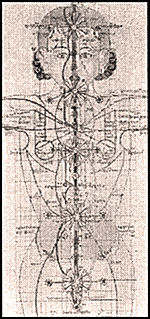 Trul khor traditionally consists of 108
movements, including bodily movements (or dynamic asana
), incantations (or mantra
), breathwork
, and visualizations
, all timed to heart rhythms. The flow or vinyasa
(Sanskrit) of movements are enlikened to beads on a mala
. The body postures (or asana
s) of ancient Himalayan yogis are depicted on the walls of the Dalai Lama
's summer temple of Lukhang
. Trul khor is the fruitful distillation of the confluence of centuries of ancient Bön movements, Indian yogic traditions, and Chinese movement forms (that developed into disciplines such as T'ai chi ch'uan).
Himalayan physical yogas vary between lineages and the complexity of the practices are not disclosed until a deep level of samaya
is realised by the practitioner.
' which is often referred to as the Vajra Body in medieval Tibetan Buddhist discourse is constituted by the flow of subtle energy currents:
'rtsa' (Wylie) is equivalent to Sanskrit: nāḍī
, sirā, srota and dhamanī; 'rlung' (Wylie) is equivalent to Sanskrit: prāna or vāyu. Metaphorically, the two outer channels are gendered in the Himalayan tradition of Buddhism and Bon where the male channel is lunar and Moon oriented and the female channel is solar and Sun oriented which is a particular inversion of Shavite, Shakta and Shakti tantric traditions of Sanatana Dharma where the male is generally identified as solar and the female as lunar.
Tsa lung Trul khor employs the tsa lung and they constitute the internal yantra
or energetic sacred architecture of the Himalayan yoga's alternate nomenclature, yantra yoga. Yantra therefore not only denotes the asana of the physical bodily posture and position and transition between asana, but also denotes the 'spiritual energy' (rlung) generated from the vinyasa
of the movement but also the vajra of the subtle body, the energetic yantra.
, 'phrul 'khor nyi zla kha sbyor gyi dgongs 'grel dri med nor bu'i me long (Wylie). Namkha'i holds that Vairotsana codified this work from oral instruction by Padmasambhava
. That said, Sri Singha
a student and teacher of Padmasambhava and also a teacher of Vairotsana spent considerable time in what is now known as China. Indeed, Vairotsana also spent time in what is now known as China. Trul Khor has a clearly marked similarity to certain Taoist movement systems as well as esoteric Indian yoga traditions of tantra
and Chinese traditions of Tantra which coalesced at Mount Wutai amongst other locations. The East Mountain Teachings which unified with the tradition of Dzogchen—refer Barber (1990) -- also contained esoteric systems of movement. The East Mountain Teachings were present in Mount Wutai. Sri Singha spent a number of years at Mount Wutai. Interestingly, the Five Pure Lights
as an iconographic aureole of the Dzogchen practitioner and metonymic of the Rainbow Body
is a motif found in poetry of Mount Wutai refer Cartelli (2004) where:
Namkha'i tilled the ground for the dissemination of Yantra Yoga through his practical teaching and esoteric transmission of this discipline within the International Dzogchen Community which he founded post 1975 from its seat in Italy, Merigar. Chaoul (2006) has opened the discourse of Bon traditions of Trul Khor into Western scholarship in English with his thesis from Rice University
. In his work, Chaoul makes reference to a commentary by the famed Bonpo Dzogchen master, Shardza Tashi Gyaltsen
, byang zab nam mkha' mdzod chen las snyan rgyud rtsa rlung 'phrul 'khor (Wylie).
Tantra
Tantra , anglicised tantricism or tantrism or tantram, is the name scholars give to an inter-religious spiritual movement that arose in medieval India, expressed in scriptures ....
discipline which includes breathwork
Breathwork
Breathwork refers to many forms of conscious alteration of breathing, such as connecting the inhale and exhale, or energetically charging and discharging, when used within psychotherapy or meditation. Proponents believe breathwork technique may be used to attain alternate states of consciousness,...
(or pranayama
Pranayama
Pranayama is a Sanskrit word meaning "extension of the prana or breath" or more accurately, "extension of the life force". The word is composed of two Sanskrit words, Prāna, life force, or vital energy, particularly, the breath, and "āyāma", to extend, draw out, restrain, or...
), meditative contemplation (or dhyana
Dhyana in Hinduism
According to the Hindu Yoga Sutra, written by Patanjali, dhyana is one of the eight limbs of Yoga, ....
) and precise dynamic movements (or Body work
Body work (alternative medicine)
Bodywork is a term used in alternative medicine to describe any therapeutic or personal development technique that involves working with the human body in a form involving manipulative therapy, breath work, or energy medicine...
) to centre the practitioner and to engender the body-mind
Body-mind
Bodymind is a compound of body and mind, which, in the New Age disciplines of humanistic psychology and spirituality, researchers in the second half of the twentieth century had begun studying in order to move beyond the dualist conceptions of body and mind towards a unified and interrelated...
precision of a keened instrument. Chögyal Namkai Norbu Rinpoche
Rinpoche
Rinpoche or Rinboqê is an honorific used in Tibetan Buddhism. It literally means "precious one," and is used to address or describe Tibetan lamas and other high-ranking or respected teachers. This honor is generally bestowed on reincarnated lamas, or Tulkus, by default...
, a prominent exponent of Trul khor, prefers to use the Sanskrit equivalent term, Yantra
Yantra
Yantra is the Sanskrit word for "instrument" or "machine". Much like the word "instrument" itself, it can stand for symbols, processes, automata, machinery or anything that has structure and organization, depending on context....
Yoga
Yoga
Yoga is a physical, mental, and spiritual discipline, originating in ancient India. The goal of yoga, or of the person practicing yoga, is the attainment of a state of perfect spiritual insight and tranquility while meditating on Supersoul...
, when writing in English. Trul khor hones the practitioner's faculty and supports the mindstream
Mindstream
Mindstream in Buddhist philosophy is the moment-to-moment "continuum" of awareness. There are a number of terms in the Buddhist literature that may well be rendered "mindstream"...
re-emergence of natural body-mind
Body-mind
Bodymind is a compound of body and mind, which, in the New Age disciplines of humanistic psychology and spirituality, researchers in the second half of the twentieth century had begun studying in order to move beyond the dualist conceptions of body and mind towards a unified and interrelated...
or primordial
Primordial
Primordial may refer to:* Primordial sea . See abiogenesis* Primordial nuclide, nuclides, a few radioactive, that formed before the Earth existed and are stable enough to still occur on Earth...
awareness
Awareness
Awareness is the state or ability to perceive, to feel, or to be conscious of events, objects or sensory patterns. In this level of consciousness, sense data can be confirmed by an observer without necessarily implying understanding. More broadly, it is the state or quality of being aware of...
or rigpa
Rigpa
Rigpa is the knowledge that ensues from recognizing one's nature i.e. one knows that there is a primordial freedom from grasping his or her mind . The opposite of rigpa is marigpa ....
(cf. Dzogchen
Dzogchen
According to Tibetan Buddhism and Bön, Dzogchen is the natural, primordial state or natural condition of the mind, and a body of teachings and meditation practices aimed at realizing that condition. Dzogchen, or "Great Perfection", is a central teaching of the Nyingma school also practiced by...
).
108 (number)
108 is the natural number following 107 and preceding 109.- In mathematics :One hundred [and] eight is an abundant number and a semiperfect number...
movements, including bodily movements (or dynamic asana
Asana
Asana is a body position, typically associated with the practice of Yoga, originally identified as a mastery of sitting still, with the spine as a conduit of biodynamic union...
), incantations (or mantra
Mantra
A mantra is a sound, syllable, word, or group of words that is considered capable of "creating transformation"...
), breathwork
Breathwork
Breathwork refers to many forms of conscious alteration of breathing, such as connecting the inhale and exhale, or energetically charging and discharging, when used within psychotherapy or meditation. Proponents believe breathwork technique may be used to attain alternate states of consciousness,...
, and visualizations
Mental image
A mental image is an experience that, on most occasions, significantly resembles the experience of perceiving some object, event, or scene, but occurs when the relevant object, event, or scene is not actually present to the senses...
, all timed to heart rhythms. The flow or vinyasa
Vinyasa
Vinyasa , is a Sanskrit term often employed in relation to certain styles of yoga. The term vinyasa may be broken down into its Sanskritic roots to assist in decoding its meaning...
(Sanskrit) of movements are enlikened to beads on a mala
Japa mala
A Japa mala or mala is a set of beads commonly used by Hindus and Buddhists, usually made from 108 beads, though other numbers, usually divisible by 9, are also used. Malas are used for keeping count while reciting, chanting, or mentally repeating a mantra or the name or names of a deity...
. The body postures (or asana
Asana
Asana is a body position, typically associated with the practice of Yoga, originally identified as a mastery of sitting still, with the spine as a conduit of biodynamic union...
s) of ancient Himalayan yogis are depicted on the walls of the Dalai Lama
Dalai Lama
The Dalai Lama is a high lama in the Gelug or "Yellow Hat" branch of Tibetan Buddhism. The name is a combination of the Mongolian word далай meaning "Ocean" and the Tibetan word bla-ma meaning "teacher"...
's summer temple of Lukhang
Lukhang
Lukhang , formally Zongdag Lukhang is the name of a secret temple of His Holiness Lozang Gyatso, 5th Dalai Lama...
. Trul khor is the fruitful distillation of the confluence of centuries of ancient Bön movements, Indian yogic traditions, and Chinese movement forms (that developed into disciplines such as T'ai chi ch'uan).
Himalayan physical yogas vary between lineages and the complexity of the practices are not disclosed until a deep level of samaya
Samaya
The samaya , is a set of vows or precepts given to initiates of an esoteric Vajrayana Buddhist order as part of the abhiṣeka ceremony that creates a bond between the guru and disciple.According Keown, et al., Samaya may be defined as:*A particular system of teaching or...
is realised by the practitioner.
Tsa lung
The 'subtle bodySubtle body
A subtle body is one of a series of psycho-spiritual constituents of living beings, according to various esoteric, occult, and mystical teachings...
' which is often referred to as the Vajra Body in medieval Tibetan Buddhist discourse is constituted by the flow of subtle energy currents:
'rtsa' (Wylie) is equivalent to Sanskrit: nāḍī
Nadi (yoga)
' are the channels through which, in traditional Indian medicine and spiritual science, the energies of the subtle body are said to flow. They connect at special points of intensity called chakras...
, sirā, srota and dhamanī; 'rlung' (Wylie) is equivalent to Sanskrit: prāna or vāyu. Metaphorically, the two outer channels are gendered in the Himalayan tradition of Buddhism and Bon where the male channel is lunar and Moon oriented and the female channel is solar and Sun oriented which is a particular inversion of Shavite, Shakta and Shakti tantric traditions of Sanatana Dharma where the male is generally identified as solar and the female as lunar.
Tsa lung Trul khor employs the tsa lung and they constitute the internal yantra
Yantra
Yantra is the Sanskrit word for "instrument" or "machine". Much like the word "instrument" itself, it can stand for symbols, processes, automata, machinery or anything that has structure and organization, depending on context....
or energetic sacred architecture of the Himalayan yoga's alternate nomenclature, yantra yoga. Yantra therefore not only denotes the asana of the physical bodily posture and position and transition between asana, but also denotes the 'spiritual energy' (rlung) generated from the vinyasa
Vinyasa
Vinyasa , is a Sanskrit term often employed in relation to certain styles of yoga. The term vinyasa may be broken down into its Sanskritic roots to assist in decoding its meaning...
of the movement but also the vajra of the subtle body, the energetic yantra.
English discourse
Namkha'i et al. (2000, revised) opened the discourse of a Buddhist and Bonpo Dzogchen synthesis of Trul Khor into English with his treatise on Yantra Yoga, essentially a commentary on a practical yoga manual by VairotsanaVairotsana
This article is about the Tibetan translator. For the primordial Buddha Vairocana, please see VairocanaVairotsana of 'Pagor' was a Tibetan translator living during the reign of King Trisong Detsen...
, 'phrul 'khor nyi zla kha sbyor gyi dgongs 'grel dri med nor bu'i me long (Wylie). Namkha'i holds that Vairotsana codified this work from oral instruction by Padmasambhava
Padmasambhava
Padmasambhava ; Mongolian ловон Бадмажунай, lovon Badmajunai, , Means The Lotus-Born, was a sage guru from Oddiyāna who is said to have transmitted Vajrayana Buddhism to Bhutan and Tibet and neighbouring countries in the 8th century...
. That said, Sri Singha
Sri Singha
Shri Singha was a principal disciple and dharma-son of Manjushrimitra in the Dzogchen lineage.Vajranatha contextualises Sri Singha in relation to the Nyingma, Manjushrimitra, Tantra, Brahman, Garab Dorje, Uddiyana, Vimalamitra, Samye and Yogachara:According to the Nyingmapa tradition of Tibetan...
a student and teacher of Padmasambhava and also a teacher of Vairotsana spent considerable time in what is now known as China. Indeed, Vairotsana also spent time in what is now known as China. Trul Khor has a clearly marked similarity to certain Taoist movement systems as well as esoteric Indian yoga traditions of tantra
Tantra
Tantra , anglicised tantricism or tantrism or tantram, is the name scholars give to an inter-religious spiritual movement that arose in medieval India, expressed in scriptures ....
and Chinese traditions of Tantra which coalesced at Mount Wutai amongst other locations. The East Mountain Teachings which unified with the tradition of Dzogchen—refer Barber (1990) -- also contained esoteric systems of movement. The East Mountain Teachings were present in Mount Wutai. Sri Singha spent a number of years at Mount Wutai. Interestingly, the Five Pure Lights
Five Pure Lights
The Five Pure Lights are experiential manifestations in the Dzogchen tradition of Bön and Nyingma and are aspects of non-dual clarity and primordial luminosity of dharmakaya, kunzhi and/or emptiness...
as an iconographic aureole of the Dzogchen practitioner and metonymic of the Rainbow Body
Rainbow body
In Tibetan Buddhism and Bön, a rainbow body is a body made, not of flesh, but of pure light.-In Dzogchen:...
is a motif found in poetry of Mount Wutai refer Cartelli (2004) where:
"...a cloud no longer appears as the floating cloud so familiar in the Chinese literary tradition but as a five-colored cloud or nimbus surrounding the bodhisattva Manjusri and his various forms. The five-colored cloud is one of many numinous traces (lingji), or holy traces (shengji), of Manjusri and other extraordinary beings which appear repeatedly in the Mount Wutai poems."
Namkha'i tilled the ground for the dissemination of Yantra Yoga through his practical teaching and esoteric transmission of this discipline within the International Dzogchen Community which he founded post 1975 from its seat in Italy, Merigar. Chaoul (2006) has opened the discourse of Bon traditions of Trul Khor into Western scholarship in English with his thesis from Rice University
Rice University
William Marsh Rice University, commonly referred to as Rice University or Rice, is a private research university located on a heavily wooded campus in Houston, Texas, United States...
. In his work, Chaoul makes reference to a commentary by the famed Bonpo Dzogchen master, Shardza Tashi Gyaltsen
Shardza Tashi Gyaltsen
Shardza Tashi Gyaltsen was a great Dzogchen master of the Tibetan Bon tradition who not only took Bon disciples but gathered disciples from all traditions of Tibetan Buddhism...
, byang zab nam mkha' mdzod chen las snyan rgyud rtsa rlung 'phrul 'khor (Wylie).
Primary texts
- Shardza Tashi Gyaltsen: byang zab nam mkha' mdzod chen las snyan rgyud rtsa rlung 'phrul 'khor
See also
- Desi Sangye GyatsoDesi Sangye GyatsoDesi Sangye Gyatso was the fifth regent of the 5th Dalai Lama who founded the School of Medicine and Astrology on Chags-po-ri Hill in 1694 and wrote the Blue Beryl treatise. The name is sometimes written Sangye Gyamtso.By some accounts, Sangye Gyatso is believed to be the son of the 5th Dalai...
- Five Tibetan RitesFive Tibetan RitesThe Five Tibetan Rites is a system of exercises reported to be more than 2,500 years old which were first publicized by Peter Kelder in a 1939 publication entitled The Eye of Revelation...
- Six yogas of NaropaSix Yogas of NaropaThe Six Yogas of Nāropa , also called the six dharmas of Naropa and Naro's six doctrines , are a set of advanced Indo-Tibetan Buddhist tantric practices and a meditation sādhana compiled in and around the...
- VairotsanaVairotsanaThis article is about the Tibetan translator. For the primordial Buddha Vairocana, please see VairocanaVairotsana of 'Pagor' was a Tibetan translator living during the reign of King Trisong Detsen...
Further reading
- by Chogyal Namkhai Norbu, Trans. by Adriano Clemente. Yantra Yoga Snow Lion Publications.
- Chang, Garma C. C.: Teachings of Tibetan Yoga/an Introduction to the Spiritual, Mental, and Physical Exercises of the Tibetan Religion, Publisher: Kensington Pub Corp, Published: 1 October 1993, ISBN 13: 9780806514536
External links
- Ligmincha introduction
- Chaoul, M. Alejandro (2003). Yogic practices (rtsarlung ’phr ul ’khor) in the Bon tradition and possible applications as a CIM (complementary and integrative medicine) therapy. Presented at the Tenth Seminar in 2003 for the International Association for Tibetan Studies.