


Atherosclerosis

Encyclopedia
Atherosclerosis is a condition in which an artery wall thickens as a result of the accumulation of fatty materials such as cholesterol
. It is a syndrome
affecting arterial
blood vessel
s, a chronic inflammatory response in the walls of arteries, caused largely by the accumulation of macrophage
white blood cells and promoted by low-density lipoproteins (plasma proteins that carry cholesterol and triglycerides) without adequate removal of fats and cholesterol from the macrophages by functional high density lipoprotein
s (HDL), (see apoA-1 Milano
). It is commonly referred to as a hardening or furring of the arteries. It is caused by the formation of multiple plaques
within the arteries.
The atheromatous plaque
is divided into three distinct components:
The following terms are similar, yet distinct, in both spelling and meaning, and can be easily confused: arteriosclerosis
, arteriolosclerosis, and atherosclerosis. Arteriosclerosis is a general term describing any hardening (and loss of elasticity) of medium or large arteries (from the Greek arteria, meaning artery, and sclerosis, meaning hardening); arteriolosclerosis is any hardening (and loss of elasticity) of arteriole
s (small arteries); atherosclerosis is a hardening of an artery specifically due to an atheromatous plaque. The term atherogenic is used for substances or processes that cause atherosclerosis.
Atherosclerosis is a chronic disease that remains asymptomatic for decades. Atherosclerotic lesions, or atherosclerotic plaques are separated into two broad categories: Stable and unstable (also called vulnerable). The pathobiology of atherosclerotic lesions is very complicated but generally, stable atherosclerotic plaques, which tend to be asymptomatic, are rich in extracellular matrix
and smooth muscle cells, while, unstable plaques are rich in macrophages and foam cells
and the extracellular matrix separating the lesion from the arterial lumen (also known as the fibrous cap
) is usually weak and prone to rupture. Ruptures of the fibrous cap expose thrombogenic material, such as collagen
to the circulation and eventually induce thrombus
formation in the lumen. Upon formation, intraluminal thrombi can occlude arteries outright (i.e. coronary occlusion), but more often they detach, move into the circulation and eventually occlude smaller downstream branches causing thromboembolism (i.e. Stroke
is often caused by thrombus formation in the carotid arteries). Apart from thromboembolism, chronically expanding atherosclerotic lesions can cause complete closure of the lumen. Interestingly, chronically expanding lesions are often asymptomatic until lumen stenosis
is so severe that blood supply to downstream tissue(s) is insufficient resulting in ischemia
.
These complications of advanced atherosclerosis are chronic, slowly progressive and cumulative. Most commonly, soft plaque suddenly ruptures (see vulnerable plaque
), causing the formation of a thrombus
that will rapidly slow or stop blood flow, leading to death of the tissues fed by the artery in approximately 5 minutes. This catastrophic event is called an infarction
. One of the most common recognized scenarios is called coronary thrombosis
of a coronary artery, causing myocardial infarction
(a heart attack). The same process in an artery to the brain is commonly called stroke
. Another common scenario in very advanced disease is claudication
from insufficient blood supply to the legs, typically caused by a combination of both stenosis and aneurysmal segments narrowed with clots
.
Atherosclerosis can occur body-wide, in the arteries to the brain, intestines, kidneys, legs, etc. with many infarctions involving only very small amounts of tissue. These are termed "clinically silent" because the person having the infarction does not notice the problem and does not seek medical help, or when they do, physicians do not recognize what has happened.
in arm, or more often in leg arteries, which produces decreased blood flow is called peripheral artery occlusive disease
(PAOD).
According to United States data for the year 2004, for about 65% of men and 47% of women, the first symptom of atherosclerotic cardiovascular disease
is heart attack
or sudden cardiac death
(death within one hour of onset of the symptom).
Most artery flow disrupting events occur at locations with less than 50% lumen
narrowing (~20% stenosis
is average). The illustration above, like most illustrations of arterial disease, overemphasizes lumen narrowing, as opposed to compensatory external diameter enlargement (at least within smaller arteries, e.g., heart arteries) typical of the atherosclerosis process as it progresses (see Glagov or the ASTEROID trial). The relative geometry error within the illustration is common to many older illustrations, an error slowly being more commonly recognized within the last decade.
Cardiac stress test
ing, traditionally the most commonly performed non-invasive testing method for blood flow limitations, in general, detects only lumen
narrowing of ~75% or greater, although some physicians claim that nuclear stress methods can detect as little as 50%.
, and become toxic to the cells. The damage caused by the oxidized LDL molecules triggers a cascade of immune responses which over time can produce an atheroma. The LDL molecule is globular shaped with a hollow core to carry cholesterol throughout the body.
The body's immune system responds to the damage to the artery wall caused by oxidized LDL by sending specialized white blood cells (macrophages and T-lymphocytes) to absorb the oxidized-LDL forming specialized foam cells
. These white blood cells are not able to process the oxidized-LDL, and ultimately grow then rupture, depositing a greater amount of oxidized cholesterol into the artery wall. This triggers more white blood cells, continuing the cycle.
Eventually, the artery becomes inflamed. The cholesterol plaque causes the muscle cells to enlarge and form a hard cover over the affected area. This hard cover is what causes a narrowing of the artery, reduces the blood flow and increases blood pressure.
Some researchers believe that atherosclerosis may be caused by an infection of the vascular smooth muscle cells; chickens, for example, develop atherosclerosis when infected with the Marek's disease
herpesvirus. Herpesvirus infection of arterial smooth muscle cells has been shown to cause cholesteryl ester (CE) accumulation. Cholesteryl ester
accumulation is associated with atherosclerosis.
Also, cytomegalovirus
(CMV) infection is associated with cardiovascular diseases.
Linus Pauling
's and Matthias Rath
's extended theory states that deaths from scurvy in humans during the ice age, when vitamin C
(an antioxidant) was scarce, selected for individuals who could repair arteries with a layer of cholesterol
provided by lipoprotein(a), a lipoprotein found in vitamin C-deficient species (higher primates and guinea pigs). Pauling and Rath hypothesized that, although eventually harmful, lipoprotein deposition on artery walls was beneficial to the human species and a "surrogate for ascorbate" in that it kept individuals alive until access to vitamin C allowed arterial damage to be repaired. Atherosclerosis is thus a vitamin-C-deficiency disease.
These can be divided into various categories: congenital vs acquired, modifiable or not, classical or non-classical. The points labelled '+' in the following list form the core components of metabolic syndrome
.
Risks multiply, with two factors increasing the risk of atherosclerosis fourfold. Hyperlipidemia, hypertension and cigarette smoking together increases the risk seven times.
Modifiable
Nonmodifiable
Lesser or uncertain
The following factors are of relatively lesser importance, are uncertain or unquantified:
Dietary
The relation between dietary fat and atherosclerosis is a contentious field.
The USDA
, in its food pyramid
, promotes a low-fat diet, based largely on its view that fat in the diet is atherogenic.
The American Heart Association
, the American Diabetes Association
and the National Cholesterol Education Program
make similar recommendations.
In contrast, Prof Walter Willett
(Harvard School of Public Health, PI
of the second Nurses' Health Study
) recommends much higher levels, especially of monounsaturated
and polyunsaturated fat
.
Writing in Science
, Gary Taubes
detailed that political considerations played into the recommendations of government bodies.
These differing views reach a consensus, though, against consumption of trans fat
s.
The role of dietary oxidized fats / lipid peroxidation
(rancid fats
) in humans is not clear.
Laboratory animals fed rancid fats develop atherosclerosis. Rats fed DHA
-containing oils experienced marked disruptions to their antioxidant
systems, as well as accumulated significant amounts of phospholipid
hydroperoxide in their blood, livers and kidneys.
In another study, rabbits fed atherogenic diets containing various oils were found to undergo the greatest amount of oxidative susceptibility of LDL via polyunsaturated oils. In a study involving rabbits fed heated soybean oil, "grossly induced atherosclerosis and marked liver damage were histologically and clinically demonstrated."
Rancid fats and oils taste very bad even in small amounts; people avoid eating them.
It is very difficult to measure or estimate the actual human consumption of these substances. In addition, the majority of oils consumed in the United States are refined, bleached, deodorized and degummed by manufacturers. The resultant oils are colorless, odorless, tasteless and have a longer shelf life than their unrefined counterparts. This extensive processing serves to make peroxidated, rancid oils much more elusive to detection via the various human senses than the unprocessed alternatives.
It is necessary to note that highly unsaturated omega-3 rich oil such as fish oil are being sold in pill form so that the taste of oxidized or rancid fat is not apparent. The health food industry dietary supplement are self regulated by the manufacture and outside of FDA regulations. To properly protect unsaturated fats from oxidation, it is best to keep them cool and in oxygen free environments.
of the artery lumen in cardiac muscle
. The ensuing inflammation
leads to formation of atheromatous plaques in the arterial tunica intima
, a region of the vessel wall located between the endothelium
and the tunica media
. The bulk of these lesions is made of excess fat, collagen
, and elastin
. At first, as the plaques grow, only wall thickening
occurs without any narrowing. Stenosis
is a late event, which may never occur and is often the result of repeated plaque rupture and healing responses, not just the atherosclerotic process by itself.
cells, though upper normal or elevated concentrations of blood glucose also plays a major role and not all factors are fully understood. Fatty streaks may appear and disappear.
Low Density Lipoprotein particles in blood plasma, when they invade the endothelium
and become oxidized creates a risk for cardiovascular disease
. A complex set of biochemical reactions regulates the oxidation of LDL, chiefly stimulated by presence of enzymes, e.g. Lp-LpA2
and free radicals in the endothelium
or blood vessel lining.
The initial damage to the blood vessel wall results in an inflammatory response. Monocyte
s (a type of white blood cell
) enter the artery wall from the bloodstream, with platelets adhering to the area of insult. This may be promoted by redox signaling
induction of factors such as VCAM-1
, which recruit circulating monocytes. The monocyte
s differentiate into macrophage
s, which ingest oxidized LDL, slowly turning into large "foam cells" – so-described because of their changed appearance resulting from the numerous internal cytoplasmic vesicle
s and resulting high lipid
content. Under the microscope, the lesion now appears as a fatty streak. Foam cells eventually die, and further propagate the inflammatory process.
There is also smooth muscle proliferation and migration from tunica media to intima responding to cytokines secreted by damaged endothelial cells. This would cause the formation of a fibrous capsule covering the fatty streak.
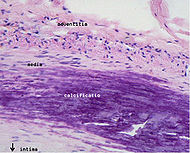
form within vascular smooth muscle
cells of the surrounding muscular layer, specifically in the muscle cells adjacent to the atheromas. In time, as cells die, this leads to extracellular calcium deposits between the muscular wall and outer portion of the atheromatous plaques. A similar form of an intramural calcification, presenting the picture of an early phase of arteriosclerosis, appears to be induced by a number of drugs that have an antiproliferative mechanism of action (Rainer Liedtke
2008).
Cholesterol is delivered into the vessel wall by cholesterol-containing low-density lipoprotein (LDL) particles. To attract and stimulate macrophages, the cholesterol must be released from the LDL particles and oxidized, a key step in the ongoing inflammatory process. The process is worsened if there is insufficient high-density lipoprotein (HDL), the lipoprotein particle that removes cholesterol from tissues and carries it back to the liver.
The foam cells and platelets encourage the migration and proliferation of smooth muscle
cells, which in turn ingest lipids, become replaced by collagen and transform into foam cells themselves. A protective fibrous cap normally forms between the fatty deposits and the artery lining (the intima
).
These capped fatty deposits (now called 'atheromas') produce enzymes that cause the artery to enlarge over time. As long as the artery enlarges sufficiently to compensate for the extra thickness of the atheroma, then no narrowing ("stenosis
") of the opening ("lumen") occurs. The artery becomes expanded with an egg-shaped cross-section, still with a circular opening. If the enlargement is beyond proportion to the atheroma thickness, then an aneurysm
is created.
In effect, the muscular portion of the artery wall forms small aneurysm
s just large enough to hold the atheroma
that are present. The muscular portion of artery walls usually remain strong, even after they have remodeled to compensate for the atheromatous plaques.
However, atheromas within the vessel wall are soft and fragile with little elasticity. Arteries constantly expand and contract with each heartbeat, i.e., the pulse. In addition, the calcification deposits between the outer portion of the atheroma and the muscular wall, as they progress, lead to a loss of elasticity and stiffening of the artery as a whole.
The calcification deposits, after they have become sufficiently advanced, are partially visible on coronary artery computed tomography
or electron beam tomography
(EBT) as rings of increased radiographic density, forming halos around the outer edges of the atheromatous plaques, within the artery wall. On CT, >130 units on the Hounsfield scale
(some argue for 90 units) has been the radiographic density usually accepted as clearly representing tissue calcification within arteries. These deposits demonstrate unequivocal evidence of the disease, relatively advanced, even though the lumen of the artery is often still normal by angiographic or intravascular ultrasound
.
In days gone by the lateral chest x-ray (demonstrating greater opacity in the aortic arch and descending aorta than the thoracic spine) gave an indication to the degree of calcified plaque burden a patient had. This has been known as Piper's sign and can often be seen in elderly persons particularly those with concomitant osteoporosis
.
If the heart attack is not fatal, fibrous organization of the clot within the lumen ensues, covering the rupture but also producing stenosis
or closure of the lumen, or over time and after repeated ruptures, resulting in a persistent, usually localized stenosis or blockage of the artery lumen. Stenoses can be slowly progressive, whereas plaque ulceration is a sudden event that occurs specifically in atheromas with thinner/weaker fibrous caps that have become "unstable".
Repeated plaque ruptures, ones not resulting in total lumen closure, combined with the clot patch over the rupture and healing response to stabilize the clot, is the process that produces most stenoses over time. The stenotic areas tend to become more stable, despite increased flow velocities at these narrowings. Most major blood-flow-stopping events occur at large plaques, which, prior to their rupture, produced very little if any stenosis.
From clinical trials, 20% is the average stenosis at plaques that subsequently rupture with resulting complete artery closure. Most severe clinical events do not occur at plaques that produce high-grade stenosis. From clinical trials, only 14% of heart attacks occur from artery closure at plaques producing a 75% or greater stenosis prior to the vessel closing.
If the fibrous cap separating a soft atheroma from the bloodstream within the artery ruptures, tissue fragments are exposed and released. These tissue fragments are very clot-promoting, containing collagen
and tissue factor
; they activate platelet
s and activate the system of coagulation
. The result is the formation of a thrombus
(blood clot) overlying the atheroma, which obstructs blood flow acutely. With the obstruction of blood flow, downstream tissues are starved of oxygen
and nutrients. If this is the myocardium (heart muscle), angina (cardiac chest pain) or myocardial infarction
(heart attack) develops.
 Areas of severe narrowing, stenosis
, detectable by angiography, and to a lesser extent "stress testing
" have long been the focus of human diagnostic techniques for cardiovascular disease
, in general. However, these methods focus on detecting only severe narrowing, not the underlying atherosclerosis disease. As demonstrated by human clinical studies, most severe events occur in locations with heavy plaque, yet little or no lumen narrowing present before debilitating events suddenly occur. Plaque rupture can lead to artery lumen occlusion within seconds to minutes, and potential permanent debility and sometimes sudden death.
Plaques that have ruptured are called complicated plaques. The extracellular matrix
of the lesion breaks, usually at the shoulder of the fibrous cap that separates the lesion from the arterial lumen, exposing thrombogenic material, mainly collagen
, and eventually causing thrombus
formation. This thrombus
will eventually grow and travel downstream until eventually occluding a narrow artery. Once the area is blocked, blood and oxygen
will not be able to supply the vessels and will cause death of cells and lead to necrosis
and poisoning. Serious complicated plaques can cause death of organ tissues, causing serious complications to that organ system.
Greater than 75% lumen stenosis used to be considered by cardiologists as the hallmark of clinically significant disease because it is typically only at this severity of narrowing of the larger heart arteries that recurring episodes of angina and detectable abnormalities by stress test
ing methods are seen.
However, clinical trials have shown that only about 14% of clinically debilitating events occur at locations with this, or greater severity of stenosis.
The majority of events occur due to atheroma plaque rupture at areas without narrowing sufficient enough to produce any angina or stress test abnormalities.
Thus, since the later-1990s, greater attention is being focused on the "vulnerable plaque."
Though any artery in the body can be involved, usually only severe narrowing or obstruction of some arteries, those that supply more critically important organs are recognized. Obstruction of arteries supplying the heart muscle result in a heart attack
. Obstruction of arteries supplying the brain result in a stroke
. These events are life-changing, and often result in irreversible loss of function because lost heart muscle and brain cells do not grow back to any significant extent, typically less than 2%.
Over the last couple of decades, methods other than angiography and stress-testing have been increasingly developed as ways to better detect atherosclerotic disease before it becomes symptomatic. These have included both (a) anatomic detection methods and (b) physiologic measurement methods.
Examples of anatomic methods include: (1) coronary calcium scoring by CT, (2) carotid IMT (intimal media thickness
) measurement by ultrasound, and (3) intravascular ultrasound
(IVUS).
Examples of physiologic methods include: (1) lipoprotein subclass analysis, (2) HbA1c
, (3) hs-CRP
, and (4) homocysteine
.
The example of the metabolic syndrome combines both anatomic (abdominal girth) and physiologic (blood pressure, elevated blood glucose) methods.
Advantages of these two approaches: The anatomic methods directly measure some aspect of the actual atherosclerotic disease process itself, thus offer potential for earlier detection, including before symptoms start, disease staging and tracking of disease progression. The physiologic methods are often less expensive and safer and changing them for the better may slow disease progression, in some cases with marked improvement.
Disadvantages of these two approaches: The anatomic methods are generally more expensive and several are invasive, such as IVUS. The physiologic methods do not quantify the current state of the disease or directly track progression. For both, clinicians and third party payers have been slow to accept the usefulness of these newer approaches.
ed, allowing manufacturers to enjoy higher prices than non-patented medicines; and they may cause unwanted side-effects.
have fairly consistently shown strong effects in reducing atherosclerotic disease 'events' and generally ~25% comparative mortality reduction, although one study design, ALLHAT, was less strongly favorable.
The newest statin, rosuvastatin
, has been the first to demonstrate regression of atherosclerotic plaque within the coronary arteries by IVUS (intravascular ultrasound evaluation). The study was set up to demonstrate effect primarily on atherosclerosis volume within a 2 year time-frame in people with active/symptomatic disease (angina frequency also declined markedly) but not global clinical outcomes, which was expected to require longer trial time periods; these longer trials remain in progress.
However, for most people, changing their physiologic behaviors, from the usual high risk to greatly reduced risk, requires a combination of several compounds, taken on a daily basis and indefinitely. More and more human treatment trials have been done and are ongoing that demonstrate improved outcome for those people using more-complex and effective treatment regimens that change physiologic behaviour patterns to more closely resemble those that humans exhibit in childhood at a time before fatty streaks begin forming.
The statin
s, and some other medications, have been shown to have antioxidant
effects, possibly part of their basis for some of their therapeutic success in reducing cardiac 'events'.
The success of statin drugs in clinical trials is based on some reductions in mortality rates, however by trial design biased toward men and middle-age, the data is as, as yet, less strongly clear for women and people over the age of 70. For example, in the Scandinavian Simvastatin Survival Study (4S)
, the first large placebo-controlled, randomized clinical trial of a statin in people with advanced disease who had already suffered a heart attack, the overall mortality rate reduction for those taking the statin, vs. placebo, was 30%. For the subgroup of people in the trial who had Diabetes Mellitus, the mortality rate reduction between statin and placebo was 54%. 4S was a 5.4-year trial that started in 1989 and was published in 1995 after completion. There were three more dead women at trial's end on statin than in the group on placebo; whether this was due to chance or some relation to the statin remains unclear. The ASTEROID trial has been the first to show actual disease volume regression (see page 8 of the paper, which shows cross-sectional areas of the total heart artery wall at start and 2 years of rosuvastatin 40 mg/day treatment); however, its design was not able to "prove" the mortality reduction issue since it did not include a placebo group: the individuals offered treatment within the trial had advanced disease, and treatment with placebo was judged to be unethical.
s, niacin
, intestinal cholesterol absorption-inhibiting supplements (ezetimibe
and others, and to a much lesser extent fibrate
s) have been the most successful in changing common but sub-optimal lipoprotein
patterns and group outcomes.
In the many secondary prevention and several primary prevention trials, several classes of lipoprotein-expression-altering (less correctly termed "cholesterol-lowering") agents have consistently reduced not only heart attack, stroke and hospitalization but also all-cause mortality rates.
The first of the large secondary prevention comparative statin/placebo treatment trials was the Scandinavian Simvastatin Survival Study (4S)
with over fifteen more studies extending through to the more recent ASTEROID
trial published in 2006.
The first primary prevention comparative treatment trial was AFCAPS/TexCAPS
with multiple later comparative statin/placebo treatment trials
including EXCEL,
ASCOT
and SPARCL.
While the statin trials have all been clearly favorable for improved human outcomes, only ASTEROID showed evidence of atherosclerotic regression (slight). Both human and animal trials that showed evidence of disease regression used more aggressive combination agent treatment strategies, which nearly always included niacin.
(vitamin B3), in pharmacologic doses, (generally 1,000 to 3,000 mg/day, but starting with much lower doses increased over several weeks, to avoid side-effects) tends to improve (a) HDL levels, size and function, (b) shift LDL particle distribution to larger particle size and (c) lower lipoprotein(a)
, an atherosclerosis promoting genetic variant of LDL. Additionally, individual responses to daily niacin, while mostly evident after a month at effective doses, tends to continue to slowly improve further over time. (However, careful patient understanding of how to achieve this without nuisance symptoms is needed, though not often achieved.) Research work on increasing HDL particle concentration and function, beyond the usual niacin effect/response, even more important, is slowly advancing. Niacin is supplied in many OTC and prescription formulations; non-prescription formulations recommend much lower doses as they are sold as nutritional supplements, not regulated medications.
Dietary changes to achieve benefit have been more controversial, generally far less effective and less widely adhered to with success. One key reason for this is that most cholesterol, typically 80-90%, within the body is created and controlled by internal production by all cells in the body (true of all animals), with typically slightly greater relative production by hepatic/liver cells. (Cell structure relies on fat membranes to separate and organize intracellular water, proteins and nucleic acids and cholesterol is one of the components of all animal cell membranes.)
While the absolute production quantities vary with the individual, group averages for total human body content of cholesterol within the U.S. population commonly run about 35,000 mg (assuming lean build; varies with body weight and build) and about 1,000 mg/day ongoing production. Dietary intake plays a smaller role, 200–300 mg/day being common values; for pure vegetarians, essentially 0 mg/day, but this typically does not change the situation very much because internal production increases to largely compensate for the reduced intake. For many, especially those with greater than optimal body mass and increased glucose levels, reducing carbohydrate (especially simple forms) intake, not fats or cholesterol, is often more effective for improving lipoprotein expression patterns, weight and blood glucose values. For this reason, medical authorities much less frequently promote the low dietary fat concepts than was commonly the case prior to about year 2005. However, evidence has increased that processed, particularly industrial non-enzymatic hydrogenation
produced trans fats, as opposed to the natural cis
-configured fats, which living cells primarily produce, is a significant health hazard.
Dietary supplements of Omega-3 oils, especially those from the muscle of some deep salt water living fish species, also have clinical evidence of significant protective effects as confirmed by 6 double blind placebo
controlled
human clinical trials.
Less robust evidence shows that homocysteine
and uric acid
levels, including within the normal range, promote atherosclerosis and that lowering these levels is helpful.
In animals Vitamin C
deficiency has been confirmed as an important role in development of hypercholesterolemia
and atherosclerosis, but due to ethical reasons placebo-controlled human studies are impossible to do.
Vitamin C
acts as an antioxidant
in vessels and inhibits inflammatory process. It has therapeutic properties on high blood pressure and its fluctuation, and arterial stiffness in diabetes. Vitamin C is also a natural regulator of cholesterol and higher doses (over 150 mg/kg daily) may confer significant protection against atherosclerosis even in the situation of elevated cholesterol levels.
The scale of vitamin C benefits on cardiovascular system led several authors to theorize that vitamin C deficiency is the primary cause of cardiovascular diseases. The theory was unified by twice Nobel prize winner Linus Pauling
, and Matthias Rath
(Rath's promotion of vitamins instead of effective medicines for treatment of serious diseases has been very strongly criticised by many reputable authorities, as discussed in detail
elsewhere). They point out that vitamin C is produced by almost all animals, with few exceptions including mankind and the great apes. This is due to a genetic deficiency that arose with the common ancestor of human and apes. To survive humans and apes must eat sufficient vitamin C. Without vitamin C humans develop scurvy. Vitamin C is an essential element in insuring that the vascular system is strong and flexible. Pauling and Rath suggest that a deficiency causes weakness in the arterial system and the body compensates by trying to stiffen up the artery walls using other common blood elements. This causes the effect known as atherosclerosis. They suggest that clinical manifestations of cardiovascular diseases are merely overshoot of body defense mechanisms that are involved in stabilisation of vascular wall after it is weakened by the vitamin C deficiency and the subsequent collagen degradation. They discuss several metabolic and genetic predispositions (our inability to produce vitamin C at all being the main one) and their pathomechanism.
The Unified Theory of Human Cardiovascular Disease suggests that atherosclerosis may be reversed and cured, but there has been no testing or trial of Pauling's vitamin C theory.
Trials on Vitamin E
have been made, and have generally not found a beneficial effect. It has been suggested that there may be a beneficial effect for some patients at high risk for atherosclerosis. A review of trials suggested that the lack of evidence for a beneficial effect may have been due to various specified shortcomings in the trial methodologies, such as testing vitamin E without concurrent use of vitamin C.
Menaquinone (Vitamin K2
), but not phylloquinone (Vitamin K1
), intake is associated with reduced risk of CHD mortality
, all-cause mortality
and severe aortic calcification.
Excess iron
may be involved in the development of atherosclerosis, but one study found reducing body iron stores in patients with symptomatic peripheral artery disease
through phlebotomy
did not significantly decrease all-cause mortality or death plus nonfatal myocardial infarction and stroke. Further studies may be warranted.
Changes in diet may help prevent the development of atherosclerosis. Researchers at the Agricultural Research Service
have found that avenanthramides, chemical compounds found in oats, may help reduce the inflammation of the arterial wall, which contributes to the development of atherosclerosis. Avenanthramides have anti-inflammatory properties that are linked to activating proinflammatory cytokines. Cytokines are proteins that are released by the cell to protect and repair tissues. Researchers found that these compounds in oats have the ability to reduce inflammation and thereby help prevent atherosclerosis.
procedures that may include stents to physically expand narrowed arteries and major invasive surgery, such as bypass surgery
, to create additional blood supply connections that go around the more severely narrowed areas.
and a statin
. The high incidence of cardiovascular disease led Wald and Law to propose a Polypill
, a once-daily pill containing these two types of drugs in addition to an ACE inhibitor
, diuretic
, beta blocker
, and folic acid
. They maintain that high uptake by the general population by such a Polypill would reduce cardiovascular mortality by 80%. It must be emphasized however that this is purely theoretical, as the Polypill has never been tested in a clinical trial.
Medical treatments often focus predominantly on the symptoms. However, over time, clinical trials have shown treatments that focus on decreasing the underlying atherosclerosis processes—as opposed to simply treating symptoms—more effective.
In summary, the key to the more effective approaches has been better understanding of the widespread and insidious nature of the disease and to combine multiple different treatment strategies, not rely on just one or a few approaches. In addition, for those approaches, such as lipoprotein transport behaviors, which have been shown to produce the most success, adopting more aggressive combination treatment strategies has generally produced better results, both before and especially after people are symptomatic.
Because many blood thinners, particularly warfarin and salicylates such as aspirin, thin the blood by interfering with Vitamin K, there is recent evidence that blood thinners that work by this mechanism can actually worsen arterial calcification in the long term even though they thin the blood in the short term.
, upper normal and especially elevated blood sugar, i.e., diabetes and high blood pressure are risk factors for atherosclerosis; homocysteine
, stopping smoking, taking anticoagulant
s (anti-clotting agents), which target clotting factors, taking omega-3 oils from fatty fish or plant oils such as flax or canola oils, exercising and losing weight are the usual focus of treatments that have proven to be helpful in clinical trials. The target serum cholesterol level should ideally not exceed 4 mmol/L (160 mg/dL), and triglycerides should not exceed 2 mmol/L (180 mg/dL).
Evidence has increased that diabetics, despite not having clinically detectable atherosclerotic disease, have more severe debility from atherosclerotic events over time than even non-diabetics who have already suffered atherosclerotic events. Thus diabetes has been upgraded to be viewed as an advanced atherosclerotic disease equivalent.
A team of scientists recently discovered the earliest known case of atherosclerosis in ancient Egyptian mummies. The findings could mean that some scientists may not understand heart disease as well as previously thought in regard to the conditions creating that condition. It may not be a modern disease at all and could have been common throughout human history.
This team began by running mummies through a CT scanner. "Our hypothesis was that they wouldn't have heart disease, because they were active, their diet was much different, they didn't have tobacco," he says. But they were wrong. One of the mummies the team scanned was a princess in her 40s. "That she would have atherosclerosis," the researcher says, "I think we're missing a risk factor. Right now we know that high blood pressure, smoking, cholesterol, inactivity and other things cause atherosclerosis, but I think that we're less complete than we think."
HDL in people with unstable angina produced fairly dramatic reduction in measured coronary plaque volume in only 6 weeks vs. the usual increase in plaque volume in those randomized to placebo. The trial was published in JAMA in early 2006. Ongoing work starting in the 1990s may lead to human clinical trials—probably by about 2008. These may use synthesized Apo-A1 Milano HDL directly. Or they may use gene-transfer methods to pass the ability to synthesize the Apo-A1 Milano HDLipoprotein.
Methods to increase high-density lipoprotein (HDL) particle concentrations, which in some animal studies largely reverses and remove atheromas, are being developed and researched.
Niacin
has HDL raising effects (by 10–30%) and showed clinical trial benefit in the Coronary Drug Project and is commonly used in combination with other lipoprotein agents to improve efficacy of changing lipoprotein for the better. However most individuals have nuisance symptoms with short term flushing reactions, especially initially, and so working with a physician with a history of successful experience with niacin implementation, careful selection of brand, dosing strategy, etc. are usually critical to success.
However, increasing HDL by any means is not necessarily helpful. For example, the drug torcetrapib
is the most effective agent currently known for raising HDL (by up to 60%). However, in clinical trials it also raised deaths by 60%. All studies regarding this drug were halted in December 2006. See CETP inhibitor
for similar approaches.
The ERASE trial is a newer trial of an HDL booster, which has shown promise.
The ASTEROID trial used a high-dose of rosuvastatin
—the statin with typically the most potent dose/response correlation track record (both for LDLipoproteins and HDLipoproteins.)
It found plaque (intima + media volume) reduction.
Several additional rosuvastatin treatment/placebo trials for evaluating other clinical outcomes are in progress.
The actions of macrophages drive atherosclerotic plaque progression.
Immunomodulation of atherosclerosis is the term for techniques that modulate immune system function to suppress this macrophage action.
Immunomodulation has been pursued with considerable success in both mice and rabbits since about 2002.
Plans for human trials, hoped for by about 2008, are in progress.
Research on genetic expression and control mechanisms is progressing. Topics include
Some controversial research has suggested a link between atherosclerosis and the presence of several different nanobacteria
in the arteries, e.g., Chlamydophila pneumoniae
, though trials of current antibiotic treatments known to be usually effective in suppressing growth or killing these bacteria have not been successful in improving outcomes.
The immunomodulation approaches mentioned above, because they deal with innate responses of the host to promote atherosclerosis, have far greater prospects for success.
Cholesterol
Cholesterol is a complex isoprenoid. Specifically, it is a waxy steroid of fat that is produced in the liver or intestines. It is used to produce hormones and cell membranes and is transported in the blood plasma of all mammals. It is an essential structural component of mammalian cell membranes...
. It is a syndrome
Syndrome
In medicine and psychology, a syndrome is the association of several clinically recognizable features, signs , symptoms , phenomena or characteristics that often occur together, so that the presence of one or more features alerts the physician to the possible presence of the others...
affecting arterial
Artery
Arteries are blood vessels that carry blood away from the heart. This blood is normally oxygenated, exceptions made for the pulmonary and umbilical arteries....
blood vessel
Blood vessel
The blood vessels are the part of the circulatory system that transports blood throughout the body. There are three major types of blood vessels: the arteries, which carry the blood away from the heart; the capillaries, which enable the actual exchange of water and chemicals between the blood and...
s, a chronic inflammatory response in the walls of arteries, caused largely by the accumulation of macrophage
Macrophage
Macrophages are cells produced by the differentiation of monocytes in tissues. Human macrophages are about in diameter. Monocytes and macrophages are phagocytes. Macrophages function in both non-specific defense as well as help initiate specific defense mechanisms of vertebrate animals...
white blood cells and promoted by low-density lipoproteins (plasma proteins that carry cholesterol and triglycerides) without adequate removal of fats and cholesterol from the macrophages by functional high density lipoprotein
High density lipoprotein
High-density lipoprotein is one of the five major groups of lipoproteins, which, in order of sizes, largest to smallest, are chylomicrons, VLDL, IDL, LDL, and HDL, which enable lipids like cholesterol and triglycerides to be transported within the water-based bloodstream...
s (HDL), (see apoA-1 Milano
ApoA-1 Milano
ApoA-1 Milano is a naturally occurring mutated variant of the apolipoprotein A1 protein found in human HDL, the lipoprotein particle that carries cholesterol from tissues to the liver and is associated with protection against cardiovascular disease. ApoA1 Milano was first identified by Dr...
). It is commonly referred to as a hardening or furring of the arteries. It is caused by the formation of multiple plaques
Atheroma
In pathology, an atheroma is an accumulation and swelling in artery walls that is made up of macrophage cells, or debris, that contain lipids , calcium and a variable amount of fibrous connective tissue...
within the arteries.
The atheromatous plaque
Atheroma
In pathology, an atheroma is an accumulation and swelling in artery walls that is made up of macrophage cells, or debris, that contain lipids , calcium and a variable amount of fibrous connective tissue...
is divided into three distinct components:
- The atheromaAtheromaIn pathology, an atheroma is an accumulation and swelling in artery walls that is made up of macrophage cells, or debris, that contain lipids , calcium and a variable amount of fibrous connective tissue...
("lump of gruel," from ἀθήρα, athera, gruelGruelGruel is a food preparation consisting of some type of cereal—oat, wheat or rye flour, or rice—boiled in water or milk. It is a thinner version of porridge that may be more often drunk than eaten and need not even be cooked...
in Greek), which is the nodular accumulation of a soft, flaky, yellowish material at the center of large plaques, composed of macrophageMacrophageMacrophages are cells produced by the differentiation of monocytes in tissues. Human macrophages are about in diameter. Monocytes and macrophages are phagocytes. Macrophages function in both non-specific defense as well as help initiate specific defense mechanisms of vertebrate animals...
s nearest the lumenLumen (anatomy)A lumen in biology is the inside space of a tubular structure, such as an artery or intestine...
of the artery - Underlying areas of cholesterolCholesterolCholesterol is a complex isoprenoid. Specifically, it is a waxy steroid of fat that is produced in the liver or intestines. It is used to produce hormones and cell membranes and is transported in the blood plasma of all mammals. It is an essential structural component of mammalian cell membranes...
crystals - Calcification at the outer base of older/more advanced lesions.
The following terms are similar, yet distinct, in both spelling and meaning, and can be easily confused: arteriosclerosis
Arteriosclerosis
Arteriosclerosis refers to a stiffening of arteries.Arteriosclerosis is a general term describing any hardening of medium or large arteries It should not be confused with "arteriolosclerosis" or "atherosclerosis".Also known by the name "myoconditis" which is...
, arteriolosclerosis, and atherosclerosis. Arteriosclerosis is a general term describing any hardening (and loss of elasticity) of medium or large arteries (from the Greek arteria, meaning artery, and sclerosis, meaning hardening); arteriolosclerosis is any hardening (and loss of elasticity) of arteriole
Arteriole
An arteriole is a small diameter blood vessel in the microcirculation that extends and branches out from an artery and leads to capillaries.Arterioles have muscular walls and are the primary site of vascular resistance...
s (small arteries); atherosclerosis is a hardening of an artery specifically due to an atheromatous plaque. The term atherogenic is used for substances or processes that cause atherosclerosis.
Atherosclerosis is a chronic disease that remains asymptomatic for decades. Atherosclerotic lesions, or atherosclerotic plaques are separated into two broad categories: Stable and unstable (also called vulnerable). The pathobiology of atherosclerotic lesions is very complicated but generally, stable atherosclerotic plaques, which tend to be asymptomatic, are rich in extracellular matrix
Extracellular matrix
In biology, the extracellular matrix is the extracellular part of animal tissue that usually provides structural support to the animal cells in addition to performing various other important functions. The extracellular matrix is the defining feature of connective tissue in animals.Extracellular...
and smooth muscle cells, while, unstable plaques are rich in macrophages and foam cells
Foam cells
Foam cells are cells in an atheroma derived from both macrophages and smooth muscle. In chronic hyperlipidemia, lipoproteins aggregate within the intima of blood vessels and become oxidized by the action of oxygen free radicals generated either by macrophages or endothelial cells...
and the extracellular matrix separating the lesion from the arterial lumen (also known as the fibrous cap
Fibrous cap
The fibrous cap is a layer of fibrous connective tissue, which is thicker and less cellular than the normal intima. The fibrous cap contains macrophages and smooth muscle cells....
) is usually weak and prone to rupture. Ruptures of the fibrous cap expose thrombogenic material, such as collagen
Collagen
Collagen is a group of naturally occurring proteins found in animals, especially in the flesh and connective tissues of mammals. It is the main component of connective tissue, and is the most abundant protein in mammals, making up about 25% to 35% of the whole-body protein content...
to the circulation and eventually induce thrombus
Thrombus
A thrombus , or blood clot, is the final product of the blood coagulation step in hemostasis. It is achieved via the aggregation of platelets that form a platelet plug, and the activation of the humoral coagulation system...
formation in the lumen. Upon formation, intraluminal thrombi can occlude arteries outright (i.e. coronary occlusion), but more often they detach, move into the circulation and eventually occlude smaller downstream branches causing thromboembolism (i.e. Stroke
Stroke
A stroke, previously known medically as a cerebrovascular accident , is the rapidly developing loss of brain function due to disturbance in the blood supply to the brain. This can be due to ischemia caused by blockage , or a hemorrhage...
is often caused by thrombus formation in the carotid arteries). Apart from thromboembolism, chronically expanding atherosclerotic lesions can cause complete closure of the lumen. Interestingly, chronically expanding lesions are often asymptomatic until lumen stenosis
Stenosis
A stenosis is an abnormal narrowing in a blood vessel or other tubular organ or structure.It is also sometimes called a stricture ....
is so severe that blood supply to downstream tissue(s) is insufficient resulting in ischemia
Ischemia
In medicine, ischemia is a restriction in blood supply, generally due to factors in the blood vessels, with resultant damage or dysfunction of tissue. It may also be spelled ischaemia or ischæmia...
.
These complications of advanced atherosclerosis are chronic, slowly progressive and cumulative. Most commonly, soft plaque suddenly ruptures (see vulnerable plaque
Vulnerable plaque
A vulnerable plaque is a kind of atheromatous plaque – a collection of white blood cells and lipids in the wall of an artery - that is particularly unstable and prone to produce sudden major problems, such as a heart attack or stroke.In many cases, a vulnerable plaque has a thin fibrous cap and a...
), causing the formation of a thrombus
Thrombus
A thrombus , or blood clot, is the final product of the blood coagulation step in hemostasis. It is achieved via the aggregation of platelets that form a platelet plug, and the activation of the humoral coagulation system...
that will rapidly slow or stop blood flow, leading to death of the tissues fed by the artery in approximately 5 minutes. This catastrophic event is called an infarction
Infarction
In medicine, infarction refers to tissue death that is caused by a local lack of oxygen due to obstruction of the tissue's blood supply. The resulting lesion is referred to as an infarct.-Causes:...
. One of the most common recognized scenarios is called coronary thrombosis
Coronary thrombosis
Coronary thrombosis is a form of thrombosis affecting the coronary circulation. It is associated with stenosis subsequent to clotting. The condition is considered as a type of ischaemic heart disease.It can lead to a myocardial infarction...
of a coronary artery, causing myocardial infarction
Myocardial infarction
Myocardial infarction or acute myocardial infarction , commonly known as a heart attack, results from the interruption of blood supply to a part of the heart, causing heart cells to die...
(a heart attack). The same process in an artery to the brain is commonly called stroke
Stroke
A stroke, previously known medically as a cerebrovascular accident , is the rapidly developing loss of brain function due to disturbance in the blood supply to the brain. This can be due to ischemia caused by blockage , or a hemorrhage...
. Another common scenario in very advanced disease is claudication
Claudication
Claudication, literally 'limping' , is a medical term usually referring to impairment in walking, or pain, discomfort or tiredness in the legs that occurs during walking and is relieved by rest. The perceived level of pain from claudication can be mild to extremely severe. Claudication is most...
from insufficient blood supply to the legs, typically caused by a combination of both stenosis and aneurysmal segments narrowed with clots
Thrombus
A thrombus , or blood clot, is the final product of the blood coagulation step in hemostasis. It is achieved via the aggregation of platelets that form a platelet plug, and the activation of the humoral coagulation system...
.
Atherosclerosis can occur body-wide, in the arteries to the brain, intestines, kidneys, legs, etc. with many infarctions involving only very small amounts of tissue. These are termed "clinically silent" because the person having the infarction does not notice the problem and does not seek medical help, or when they do, physicians do not recognize what has happened.
Signs and symptoms
Atherosclerosis typically begins in early adolescence, and is usually found in most major arteries, yet is asymptomatic and not detected by most diagnostic methods during life. AtheromaAtheroma
In pathology, an atheroma is an accumulation and swelling in artery walls that is made up of macrophage cells, or debris, that contain lipids , calcium and a variable amount of fibrous connective tissue...
in arm, or more often in leg arteries, which produces decreased blood flow is called peripheral artery occlusive disease
Peripheral artery occlusive disease
Peripheral vascular disease , commonly referred to as peripheral arterial disease or peripheral artery occlusive disease , refers to the obstruction of large arteries not within the coronary, aortic arch vasculature, or brain. PVD can result from atherosclerosis, inflammatory processes leading to...
(PAOD).
According to United States data for the year 2004, for about 65% of men and 47% of women, the first symptom of atherosclerotic cardiovascular disease
Cardiovascular disease
Heart disease or cardiovascular disease are the class of diseases that involve the heart or blood vessels . While the term technically refers to any disease that affects the cardiovascular system , it is usually used to refer to those related to atherosclerosis...
is heart attack
Myocardial infarction
Myocardial infarction or acute myocardial infarction , commonly known as a heart attack, results from the interruption of blood supply to a part of the heart, causing heart cells to die...
or sudden cardiac death
Sudden Cardiac Death
Sudden cardiac death is natural death from cardiac causes, heralded by abrupt loss of consciousness within one hour of the onset of acute symptoms. Other forms of sudden death may be noncardiac in origin...
(death within one hour of onset of the symptom).
Most artery flow disrupting events occur at locations with less than 50% lumen
Lumen (anatomy)
A lumen in biology is the inside space of a tubular structure, such as an artery or intestine...
narrowing (~20% stenosis
Stenosis
A stenosis is an abnormal narrowing in a blood vessel or other tubular organ or structure.It is also sometimes called a stricture ....
is average). The illustration above, like most illustrations of arterial disease, overemphasizes lumen narrowing, as opposed to compensatory external diameter enlargement (at least within smaller arteries, e.g., heart arteries) typical of the atherosclerosis process as it progresses (see Glagov or the ASTEROID trial). The relative geometry error within the illustration is common to many older illustrations, an error slowly being more commonly recognized within the last decade.
Cardiac stress test
Cardiac stress test
Cardiac stress test is a test used in medicine and cardiology to measure the heart's ability to respond to external stress in a controlled clinical environment....
ing, traditionally the most commonly performed non-invasive testing method for blood flow limitations, in general, detects only lumen
Lumen (anatomy)
A lumen in biology is the inside space of a tubular structure, such as an artery or intestine...
narrowing of ~75% or greater, although some physicians claim that nuclear stress methods can detect as little as 50%.
Causes
The main cause of atherosclerosis is yet unknown, but is hypothesized to fundamentally be initiated by inflammatory processes in the cell wall in response to retained low-density lipoprotein (LDL) molecules. Once inside the vessel wall, LDL molecules become susceptible to oxidation by free radicalsRadical (chemistry)
Radicals are atoms, molecules, or ions with unpaired electrons on an open shell configuration. Free radicals may have positive, negative, or zero charge...
, and become toxic to the cells. The damage caused by the oxidized LDL molecules triggers a cascade of immune responses which over time can produce an atheroma. The LDL molecule is globular shaped with a hollow core to carry cholesterol throughout the body.
The body's immune system responds to the damage to the artery wall caused by oxidized LDL by sending specialized white blood cells (macrophages and T-lymphocytes) to absorb the oxidized-LDL forming specialized foam cells
Foam cells
Foam cells are cells in an atheroma derived from both macrophages and smooth muscle. In chronic hyperlipidemia, lipoproteins aggregate within the intima of blood vessels and become oxidized by the action of oxygen free radicals generated either by macrophages or endothelial cells...
. These white blood cells are not able to process the oxidized-LDL, and ultimately grow then rupture, depositing a greater amount of oxidized cholesterol into the artery wall. This triggers more white blood cells, continuing the cycle.
Eventually, the artery becomes inflamed. The cholesterol plaque causes the muscle cells to enlarge and form a hard cover over the affected area. This hard cover is what causes a narrowing of the artery, reduces the blood flow and increases blood pressure.
Some researchers believe that atherosclerosis may be caused by an infection of the vascular smooth muscle cells; chickens, for example, develop atherosclerosis when infected with the Marek's disease
Marek's disease
Marek's disease is a highly contagious viral neoplastic disease in chickens. It is named after József Marek, a Hungarian veterinarian. Occasionally misdiagnosed as an abtissue pathology it is caused by an alphaherpesvirus known as 'Marek's disease virus' or Gallid herpesvirus 2...
herpesvirus. Herpesvirus infection of arterial smooth muscle cells has been shown to cause cholesteryl ester (CE) accumulation. Cholesteryl ester
Cholesteryl ester
A cholesteryl ester is, as its name would imply, an ester of cholesterol. The ester bond is formed between the carboxylate group of a fatty acid and the hydroxyl group of cholesterol. Cholesteryl Esters have a lower solubility in water than Cholesterol and, in other words, are more hydrophobic...
accumulation is associated with atherosclerosis.
Also, cytomegalovirus
Cytomegalovirus
Cytomegalovirus is a viral genus of the viral group known as Herpesviridae or herpesviruses. It is typically abbreviated as CMV: The species that infects humans is commonly known as human CMV or human herpesvirus-5 , and is the most studied of all cytomegaloviruses...
(CMV) infection is associated with cardiovascular diseases.
Linus Pauling
Linus Pauling
Linus Carl Pauling was an American chemist, biochemist, peace activist, author, and educator. He was one of the most influential chemists in history and ranks among the most important scientists of the 20th century...
's and Matthias Rath
Matthias Rath
Matthias Rath is a doctor, businessman, and vitamin entrepreneur. He earned his MD degree in Germany. Rath claims that a program of nutritional supplements , including formulations that he sells, can treat or cure diabetes, cardiovascular disease, cancer, and HIV/AIDS...
's extended theory states that deaths from scurvy in humans during the ice age, when vitamin C
Vitamin C
Vitamin C or L-ascorbic acid or L-ascorbate is an essential nutrient for humans and certain other animal species. In living organisms ascorbate acts as an antioxidant by protecting the body against oxidative stress...
(an antioxidant) was scarce, selected for individuals who could repair arteries with a layer of cholesterol
Cholesterol
Cholesterol is a complex isoprenoid. Specifically, it is a waxy steroid of fat that is produced in the liver or intestines. It is used to produce hormones and cell membranes and is transported in the blood plasma of all mammals. It is an essential structural component of mammalian cell membranes...
provided by lipoprotein(a), a lipoprotein found in vitamin C-deficient species (higher primates and guinea pigs). Pauling and Rath hypothesized that, although eventually harmful, lipoprotein deposition on artery walls was beneficial to the human species and a "surrogate for ascorbate" in that it kept individuals alive until access to vitamin C allowed arterial damage to be repaired. Atherosclerosis is thus a vitamin-C-deficiency disease.
Risk factors
Various anatomic, physiological and behavioral risk factors for atherosclerosis are known.These can be divided into various categories: congenital vs acquired, modifiable or not, classical or non-classical. The points labelled '+' in the following list form the core components of metabolic syndrome
Metabolic syndrome
Metabolic syndrome is a combination of medical disorders that, when occurring together, increase the risk of developing cardiovascular disease and diabetes. It affects one in five people in the United States and prevalence increases with age...
.
Risks multiply, with two factors increasing the risk of atherosclerosis fourfold. Hyperlipidemia, hypertension and cigarette smoking together increases the risk seven times.
Modifiable
- Diabetes or Impaired glucose toleranceImpaired glucose toleranceImpaired glucose tolerance is a pre-diabetic state of dysglycemia that is associated with insulin resistance and increased risk of cardiovascular pathology. IGT may precede type 2 diabetes mellitus by many years...
(IGT) + - DyslipoproteinemiaLipoproteinA lipoprotein is a biochemical assembly that contains both proteins and lipids water-bound to the proteins. Many enzymes, transporters, structural proteins, antigens, adhesins, and toxins are lipoproteins...
(unhealthy patterns of serum proteins carrying fats & cholesterolCholesterolCholesterol is a complex isoprenoid. Specifically, it is a waxy steroid of fat that is produced in the liver or intestines. It is used to produce hormones and cell membranes and is transported in the blood plasma of all mammals. It is an essential structural component of mammalian cell membranes...
): +- High serum concentration of low-density lipoprotein (LDL, "bad if elevated concentrations and small"), and / or very low density lipoproteinVery low density lipoproteinVery-low-density lipoprotein is a type of lipoprotein made by the liver. VLDL is one of the five major groups of lipoproteins that enable fats and cholesterol to move within the water-based solution of the bloodstream...
(VLDL) particles, i.e., "lipoprotein subclass analysis" - Low serum concentration of functioning high density lipoproteinHigh density lipoproteinHigh-density lipoprotein is one of the five major groups of lipoproteins, which, in order of sizes, largest to smallest, are chylomicrons, VLDL, IDL, LDL, and HDL, which enable lipids like cholesterol and triglycerides to be transported within the water-based bloodstream...
(HDL "protective if large and high enough" particles), i.e., "lipoprotein subclass analysis" - An LDL:HDL ratio greater than 3:1
- High serum concentration of low-density lipoprotein (LDL, "bad if elevated concentrations and small"), and / or very low density lipoprotein
- Tobacco smokingTobacco smokingTobacco smoking is the practice where tobacco is burned and the resulting smoke is inhaled. The practice may have begun as early as 5000–3000 BCE. Tobacco was introduced to Eurasia in the late 16th century where it followed common trade routes...
, increases risk by 200% after several pack yearPack year-Definition:A way to measure the amount a person has smoked over a long period of time. It is calculated by multiplying the number of packs of cigarettes smoked per day by the number of years the person has smoked...
s - Having hypertensionHypertensionHypertension or high blood pressure is a cardiac chronic medical condition in which the systemic arterial blood pressure is elevated. What that means is that the heart is having to work harder than it should to pump the blood around the body. Blood pressure involves two measurements, systolic and...
+, on its own increasing risk by 60% - Elevated serum C-reactive proteinC-reactive proteinC-reactive protein is a protein found in the blood, the levels of which rise in response to inflammation...
concentrations - Vitamin B6 deficiency
Nonmodifiable
- Advanced ageSenescenceSenescence or biological aging is the change in the biology of an organism as it ages after its maturity. Such changes range from those affecting its cells and their function to those affecting the whole organism...
- MaleMaleMale refers to the biological sex of an organism, or part of an organism, which produces small mobile gametes, called spermatozoa. Each spermatozoon can fuse with a larger female gamete or ovum, in the process of fertilization...
sex - Having close relatives who have had some complication of atherosclerosis (e.g. coronary heart diseaseCoronary heart diseaseCoronary artery disease is the end result of the accumulation of atheromatous plaques within the walls of the coronary arteries that supply the myocardium with oxygen and nutrients. It is sometimes also called coronary heart disease...
or strokeStrokeA stroke, previously known medically as a cerebrovascular accident , is the rapidly developing loss of brain function due to disturbance in the blood supply to the brain. This can be due to ischemia caused by blockage , or a hemorrhage...
) - Genetic abnormalities, e.g. familial hypercholesterolemiaFamilial hypercholesterolemiaFamilial hypercholesterolemia is a genetic disorder characterized by high cholesterol levels, specifically very high levels of low-density lipoprotein , in the blood and early cardiovascular disease...
Lesser or uncertain
The following factors are of relatively lesser importance, are uncertain or unquantified:
- ObesityObesityObesity is a medical condition in which excess body fat has accumulated to the extent that it may have an adverse effect on health, leading to reduced life expectancy and/or increased health problems...
(in particular central obesityCentral obesityAbdominal obesity, colloquially known as belly fat or clinically as central obesity, is the accumulation of abdominal fat resulting in an increase in waist size...
, also referred to as abdominal or male-type obesity) + - A sedentary lifestyleSedentary lifestyleSedentary lifestyle is a medical term used to denote a type of lifestyle with no or irregular physical activity. A person who lives a sedentary lifestyle may colloquially be known as a couch potato. It is commonly found in both the developed and developing world...
- Hypercoagulability
- Postmenopausal estrogen deficiency
- High intake of saturated fatSaturated fatSaturated fat is fat that consists of triglycerides containing only saturated fatty acids. Saturated fatty acids have no double bonds between the individual carbon atoms of the fatty acid chain. That is, the chain of carbon atoms is fully "saturated" with hydrogen atoms...
(may raise total and LDL cholesterol) - Intake of trans fatTrans fatTrans fat is the common name for unsaturated fat with trans-isomer fatty acid. Because the term refers to the configuration of a double carbon-carbon bond, trans fats are sometimes monounsaturated or polyunsaturated, but never saturated....
(may raise total and LDL cholesterol while lowering HDL cholesterol) - High carbohydrateCarbohydrateA carbohydrate is an organic compound with the empirical formula ; that is, consists only of carbon, hydrogen, and oxygen, with a hydrogen:oxygen atom ratio of 2:1 . However, there are exceptions to this. One common example would be deoxyribose, a component of DNA, which has the empirical...
intake - Elevated serum levels of triglycerides +
- Elevated serum levels of homocysteineHomocysteineHomocysteine is a non-protein amino acid with the formula HSCH2CH2CHCO2H. It is a homologue of the amino acid cysteine, differing by an additional methylene group. It is biosynthesized from methionine by the removal of its terminal Cε methyl group...
- Elevated serum levels of uric acidUric acidUric acid is a heterocyclic compound of carbon, nitrogen, oxygen, and hydrogen with the formula C5H4N4O3. It forms ions and salts known as urates and acid urates such as ammonium acid urate. Uric acid is created when the body breaks down purine nucleotides. High blood concentrations of uric acid...
(also responsible for goutGoutGout is a medical condition usually characterized by recurrent attacks of acute inflammatory arthritis—a red, tender, hot, swollen joint. The metatarsal-phalangeal joint at the base of the big toe is the most commonly affected . However, it may also present as tophi, kidney stones, or urate...
) - Elevated serum fibrinogenFibrinogenFibrinogen is a soluble plasma glycoprotein, synthesised by the liver, that is converted by thrombin into fibrin during blood coagulation. This is achieved through processes in the coagulation cascade that activate the zymogen prothrombin to the serine protease thrombin, which is responsible for...
concentrations - Elevated serum lipoprotein(a)Lipoprotein(a)Lipoprotein is a lipoprotein subclass. Studies have identified Lp as a putative risk factor for atherosclerotic diseases such as coronary heart disease and stroke....
concentrations - Chronic systemic inflammationInflammationInflammation is part of the complex biological response of vascular tissues to harmful stimuli, such as pathogens, damaged cells, or irritants. Inflammation is a protective attempt by the organism to remove the injurious stimuli and to initiate the healing process...
as reflected by upper normal WBC concentrations, elevated hs-CRP and many other blood chemistry markers, most only research level at present, not clinically done. - StressStress (medicine)Stress is a term in psychology and biology, borrowed from physics and engineering and first used in the biological context in the 1930s, which has in more recent decades become commonly used in popular parlance...
or symptoms of clinical depressionClinical depressionMajor depressive disorder is a mental disorder characterized by an all-encompassing low mood accompanied by low self-esteem, and by loss of interest or pleasure in normally enjoyable activities... - HyperthyroidismHyperthyroidismHyperthyroidism is the term for overactive tissue within the thyroid gland causing an overproduction of thyroid hormones . Hyperthyroidism is thus a cause of thyrotoxicosis, the clinical condition of increased thyroid hormones in the blood. Hyperthyroidism and thyrotoxicosis are not synonymous...
(an over-active thyroidThyroidThe thyroid gland or simply, the thyroid , in vertebrate anatomy, is one of the largest endocrine glands. The thyroid gland is found in the neck, below the thyroid cartilage...
) - Elevated serum insulin levels +
- Short sleep duration
- Chlamydia pneumoniae infection
Dietary
The relation between dietary fat and atherosclerosis is a contentious field.
The USDA
United States Department of Agriculture
The United States Department of Agriculture is the United States federal executive department responsible for developing and executing U.S. federal government policy on farming, agriculture, and food...
, in its food pyramid
Food guide pyramid
A food guide pyramid is a triangular or pyramid-shaped nutrition guide divided into sections to show the recommended intake for each food group. The first food pyramid was published in Sweden in 1974. The most widely known food pyramid was introduced by the United States Department of Agriculture...
, promotes a low-fat diet, based largely on its view that fat in the diet is atherogenic.
The American Heart Association
American Heart Association
The American Heart Association is a non-profit organization in the United States that fosters appropriate cardiac care in an effort to reduce disability and deaths caused by cardiovascular disease and stroke. It is headquartered in Dallas, Texas...
, the American Diabetes Association
American Diabetes Association
The American Diabetes Association is a United States-based association working to fight the consequences of diabetes, and to help those affected by diabetes...
and the National Cholesterol Education Program
National Cholesterol Education Program
The National Cholesterol Education Program is a program managed by the National Heart, Lung and Blood Institute, a division of the National Institutes of Health. Its goal is to reduce increased cardiovascular disease rates due to hypercholesterolemia in the United States of America...
make similar recommendations.
In contrast, Prof Walter Willett
Walter Willett
Walter Willett, MD, DrPH., is an American physician and nutrition researcher. Currently, Willett is the Fredrick John Stare Professor of Epidemiology and Nutrition, and Chair of the Department of Nutrition at Harvard School of Public Health...
(Harvard School of Public Health, PI
Principal investigator
A principal investigator is the lead scientist or engineer for a particular well-defined science project, such as a laboratory study or clinical trial....
of the second Nurses' Health Study
Nurses' Health Study
The Nurses Health Study, established in 1976 by Dr. Frank Speizer, and the Nurses' Health Study II, established in 1989 by Dr. Walter Willett, are the most definitive long-term epidemiological studies conducted to date on older women's health. The study has followed 121,700 female registered...
) recommends much higher levels, especially of monounsaturated
Monounsaturated fat
In biochemistry and nutrition, monounsaturated fats or MUFA are fatty acids that have one double bond in the fatty acid chain and all of the remainder of the carbon atoms in the chain are single-bonded...
and polyunsaturated fat
Polyunsaturated fat
In nutrition, polyunsaturated fat, or polyunsaturated fatty acid, are fatty acids in which more than one carbon–carbon double bond exists within the representative molecule. That is, the molecule has two or more points on its structure capable of supporting hydrogen atoms not currently part of the...
.
Writing in Science
Science
Science is a systematic enterprise that builds and organizes knowledge in the form of testable explanations and predictions about the universe...
, Gary Taubes
Gary Taubes
Gary Taubes is an American science writer.He is the author of Nobel Dreams , Bad Science: The Short Life and Weird Times of Cold Fusion , and Good Calories, Bad Calories , titled The Diet Delusion in the UK and Australia. His book Why We Get Fat: And What to Do About It was released in December...
detailed that political considerations played into the recommendations of government bodies.
These differing views reach a consensus, though, against consumption of trans fat
Trans fat
Trans fat is the common name for unsaturated fat with trans-isomer fatty acid. Because the term refers to the configuration of a double carbon-carbon bond, trans fats are sometimes monounsaturated or polyunsaturated, but never saturated....
s.
The role of dietary oxidized fats / lipid peroxidation
Lipid peroxidation
Lipid peroxidation refers to the oxidative degradation of lipids. It is the process in which free radicals "steal" electrons from the lipids in cell membranes, resulting in cell damage. This process proceeds by a free radical chain reaction mechanism...
(rancid fats
Rancidification
Rancidification is the chemical decomposition of fats, oils and other lipids . When these processes occur in food, undesirable odors and flavors can result. In some cases, however, the flavors can be desirable . In processed meats, these flavors are collectively known as "warmed over flavor"...
) in humans is not clear.
Laboratory animals fed rancid fats develop atherosclerosis. Rats fed DHA
Docosahexaenoic acid
Docosahexaenoic acid is an omega-3 fatty acid that is a primary structural component of the human brain and retina. In chemical structure, DHA is a carboxylic acid with a 22-carbon chain and six cis double bonds; the first double bond is located at the third carbon from the omega end...
-containing oils experienced marked disruptions to their antioxidant
Antioxidant
An antioxidant is a molecule capable of inhibiting the oxidation of other molecules. Oxidation is a chemical reaction that transfers electrons or hydrogen from a substance to an oxidizing agent. Oxidation reactions can produce free radicals. In turn, these radicals can start chain reactions. When...
systems, as well as accumulated significant amounts of phospholipid
Phospholipid
Phospholipids are a class of lipids that are a major component of all cell membranes as they can form lipid bilayers. Most phospholipids contain a diglyceride, a phosphate group, and a simple organic molecule such as choline; one exception to this rule is sphingomyelin, which is derived from...
hydroperoxide in their blood, livers and kidneys.
In another study, rabbits fed atherogenic diets containing various oils were found to undergo the greatest amount of oxidative susceptibility of LDL via polyunsaturated oils. In a study involving rabbits fed heated soybean oil, "grossly induced atherosclerosis and marked liver damage were histologically and clinically demonstrated."
Rancid fats and oils taste very bad even in small amounts; people avoid eating them.
It is very difficult to measure or estimate the actual human consumption of these substances. In addition, the majority of oils consumed in the United States are refined, bleached, deodorized and degummed by manufacturers. The resultant oils are colorless, odorless, tasteless and have a longer shelf life than their unrefined counterparts. This extensive processing serves to make peroxidated, rancid oils much more elusive to detection via the various human senses than the unprocessed alternatives.
It is necessary to note that highly unsaturated omega-3 rich oil such as fish oil are being sold in pill form so that the taste of oxidized or rancid fat is not apparent. The health food industry dietary supplement are self regulated by the manufacture and outside of FDA regulations. To properly protect unsaturated fats from oxidation, it is best to keep them cool and in oxygen free environments.
Pathophysiology
Atherogenesis is the developmental process of atheromatous plaques. It is characterized by a remodeling of arteries leading to subendothelial accumulation of fatty substances called plaques. The build up of an atheromatous plaque is a slow process, developed over a period of several years through a complex series of cellular events occurring within the arterial wall, and in response to a variety of local vascular circulating factors. One recent theory suggests that, for unknown reasons, leukocytes, such as monocytes or basophils, begin to attack the endotheliumEndothelium
The endothelium is the thin layer of cells that lines the interior surface of blood vessels, forming an interface between circulating blood in the lumen and the rest of the vessel wall. These cells are called endothelial cells. Endothelial cells line the entire circulatory system, from the heart...
of the artery lumen in cardiac muscle
Cardiac muscle
Cardiac muscle is a type of involuntary striated muscle found in the walls and histologic foundation of the heart, specifically the myocardium. Cardiac muscle is one of three major types of muscle, the others being skeletal and smooth muscle...
. The ensuing inflammation
Inflammation
Inflammation is part of the complex biological response of vascular tissues to harmful stimuli, such as pathogens, damaged cells, or irritants. Inflammation is a protective attempt by the organism to remove the injurious stimuli and to initiate the healing process...
leads to formation of atheromatous plaques in the arterial tunica intima
Tunica intima
The tunica intima is the innermost layer of an artery or vein. It is made up of one layer of endothelial cells and is supported by an internal elastic lamina...
, a region of the vessel wall located between the endothelium
Endothelium
The endothelium is the thin layer of cells that lines the interior surface of blood vessels, forming an interface between circulating blood in the lumen and the rest of the vessel wall. These cells are called endothelial cells. Endothelial cells line the entire circulatory system, from the heart...
and the tunica media
Tunica media
The tunica media is the middle layer of an artery or vein.-Artery:It is made up of smooth muscle cells and elastic tissue...
. The bulk of these lesions is made of excess fat, collagen
Collagen
Collagen is a group of naturally occurring proteins found in animals, especially in the flesh and connective tissues of mammals. It is the main component of connective tissue, and is the most abundant protein in mammals, making up about 25% to 35% of the whole-body protein content...
, and elastin
Elastin
Elastin is a protein in connective tissue that is elastic and allows many tissues in the body to resume their shape after stretching or contracting. Elastin helps skin to return to its original position when it is poked or pinched. Elastin is also an important load-bearing tissue in the bodies of...
. At first, as the plaques grow, only wall thickening
Intima-media thickness
Intima-media thickness , also called intimal medial thickness, is a measurement of the thickness of artery walls, usually by external ultrasound, occasionally by internal, invasive ultrasound catheters, see IVUS, to both detect the presence and to track the progression of atherosclerotic disease in...
occurs without any narrowing. Stenosis
Stenosis
A stenosis is an abnormal narrowing in a blood vessel or other tubular organ or structure.It is also sometimes called a stricture ....
is a late event, which may never occur and is often the result of repeated plaque rupture and healing responses, not just the atherosclerotic process by itself.
Cellular
Early atherogenesis is characterized by the adherence of blood circulating monocytes to the vascular bed lining, the endothelium, followed by their migration to the sub-endothelial space, and further activation into monocyte-derived macrophages. The primary documented driver of this process is oxidized Lipoprotein particles within the wall, beneath the endothelialEndothelium
The endothelium is the thin layer of cells that lines the interior surface of blood vessels, forming an interface between circulating blood in the lumen and the rest of the vessel wall. These cells are called endothelial cells. Endothelial cells line the entire circulatory system, from the heart...
cells, though upper normal or elevated concentrations of blood glucose also plays a major role and not all factors are fully understood. Fatty streaks may appear and disappear.
Low Density Lipoprotein particles in blood plasma, when they invade the endothelium
Endothelium
The endothelium is the thin layer of cells that lines the interior surface of blood vessels, forming an interface between circulating blood in the lumen and the rest of the vessel wall. These cells are called endothelial cells. Endothelial cells line the entire circulatory system, from the heart...
and become oxidized creates a risk for cardiovascular disease
Cardiovascular disease
Heart disease or cardiovascular disease are the class of diseases that involve the heart or blood vessels . While the term technically refers to any disease that affects the cardiovascular system , it is usually used to refer to those related to atherosclerosis...
. A complex set of biochemical reactions regulates the oxidation of LDL, chiefly stimulated by presence of enzymes, e.g. Lp-LpA2
Lp-LpA2
Lipoprotein Associated Phospholipase A2 has been identified and verified in multiple human trials as an enzymatic activity which is an independent predictor of atherosclotic disease progression and events in humans, including coronary heart disease, because it promotes oxidation of lipoproteins and...
and free radicals in the endothelium
Endothelium
The endothelium is the thin layer of cells that lines the interior surface of blood vessels, forming an interface between circulating blood in the lumen and the rest of the vessel wall. These cells are called endothelial cells. Endothelial cells line the entire circulatory system, from the heart...
or blood vessel lining.
The initial damage to the blood vessel wall results in an inflammatory response. Monocyte
Monocyte
Monocytes are a type of white blood cell and are part of the innate immune system of vertebrates including all mammals , birds, reptiles, and fish. Monocytes play multiple roles in immune function...
s (a type of white blood cell
White blood cell
White blood cells, or leukocytes , are cells of the immune system involved in defending the body against both infectious disease and foreign materials. Five different and diverse types of leukocytes exist, but they are all produced and derived from a multipotent cell in the bone marrow known as a...
) enter the artery wall from the bloodstream, with platelets adhering to the area of insult. This may be promoted by redox signaling
Redox signaling
Redox signaling is when free radicals, reactive oxygen species , and other electronically activated species such as nitric oxide act as biological messengers. Arguably, hydrogen sulfide and carbon monoxide are also redox signaling molecules...
induction of factors such as VCAM-1
VCAM-1
Vascular cell adhesion protein 1 also known as vascular cell adhesion molecule 1 or cluster of differentiation 106 is a protein that in humans is encoded by the VCAM1 gene...
, which recruit circulating monocytes. The monocyte
Monocyte
Monocytes are a type of white blood cell and are part of the innate immune system of vertebrates including all mammals , birds, reptiles, and fish. Monocytes play multiple roles in immune function...
s differentiate into macrophage
Macrophage
Macrophages are cells produced by the differentiation of monocytes in tissues. Human macrophages are about in diameter. Monocytes and macrophages are phagocytes. Macrophages function in both non-specific defense as well as help initiate specific defense mechanisms of vertebrate animals...
s, which ingest oxidized LDL, slowly turning into large "foam cells" – so-described because of their changed appearance resulting from the numerous internal cytoplasmic vesicle
Vesicle (biology)
A vesicle is a bubble of liquid within another liquid, a supramolecular assembly made up of many different molecules. More technically, a vesicle is a small membrane-enclosed sack that can store or transport substances. Vesicles can form naturally because of the properties of lipid membranes , or...
s and resulting high lipid
Lipid
Lipids constitute a broad group of naturally occurring molecules that include fats, waxes, sterols, fat-soluble vitamins , monoglycerides, diglycerides, triglycerides, phospholipids, and others...
content. Under the microscope, the lesion now appears as a fatty streak. Foam cells eventually die, and further propagate the inflammatory process.
There is also smooth muscle proliferation and migration from tunica media to intima responding to cytokines secreted by damaged endothelial cells. This would cause the formation of a fibrous capsule covering the fatty streak.
Calcification and lipids
Intracellular microcalcificationsCalcification
Calcification is the process in which calcium salts build up in soft tissue, causing it to harden. Calcifications may be classified on whether there is mineral balance or not, and the location of the calcification.-Causes:...
form within vascular smooth muscle
Vascular smooth muscle
Vascular smooth muscle refers to the particular type of smooth muscle found within, and composing the majority of the wall of blood vessels.Vascular smooth muscle contracts or relaxes to both change the volume of blood vessels and the local blood pressure, a mechanism that is responsible for the...
cells of the surrounding muscular layer, specifically in the muscle cells adjacent to the atheromas. In time, as cells die, this leads to extracellular calcium deposits between the muscular wall and outer portion of the atheromatous plaques. A similar form of an intramural calcification, presenting the picture of an early phase of arteriosclerosis, appears to be induced by a number of drugs that have an antiproliferative mechanism of action (Rainer Liedtke
Rainer Liedtke
Rainer K. Liedtke is a German physician, scientist and entrepreneur. Theory and practice of biomedical information systems and medical innovation...
2008).
Cholesterol is delivered into the vessel wall by cholesterol-containing low-density lipoprotein (LDL) particles. To attract and stimulate macrophages, the cholesterol must be released from the LDL particles and oxidized, a key step in the ongoing inflammatory process. The process is worsened if there is insufficient high-density lipoprotein (HDL), the lipoprotein particle that removes cholesterol from tissues and carries it back to the liver.
The foam cells and platelets encourage the migration and proliferation of smooth muscle
Smooth muscle
Smooth muscle is an involuntary non-striated muscle. It is divided into two sub-groups; the single-unit and multiunit smooth muscle. Within single-unit smooth muscle tissues, the autonomic nervous system innervates a single cell within a sheet or bundle and the action potential is propagated by...
cells, which in turn ingest lipids, become replaced by collagen and transform into foam cells themselves. A protective fibrous cap normally forms between the fatty deposits and the artery lining (the intima
Endothelium
The endothelium is the thin layer of cells that lines the interior surface of blood vessels, forming an interface between circulating blood in the lumen and the rest of the vessel wall. These cells are called endothelial cells. Endothelial cells line the entire circulatory system, from the heart...
).
These capped fatty deposits (now called 'atheromas') produce enzymes that cause the artery to enlarge over time. As long as the artery enlarges sufficiently to compensate for the extra thickness of the atheroma, then no narrowing ("stenosis
Stenosis
A stenosis is an abnormal narrowing in a blood vessel or other tubular organ or structure.It is also sometimes called a stricture ....
") of the opening ("lumen") occurs. The artery becomes expanded with an egg-shaped cross-section, still with a circular opening. If the enlargement is beyond proportion to the atheroma thickness, then an aneurysm
Aneurysm
An aneurysm or aneurism is a localized, blood-filled balloon-like bulge in the wall of a blood vessel. Aneurysms can commonly occur in arteries at the base of the brain and an aortic aneurysm occurs in the main artery carrying blood from the left ventricle of the heart...
is created.
Visible features
Although arteries are not typically studied microscopically, two plaque types can be distinguished:- The fibro-lipid (fibro-fatty) plaque is characterized by an accumulation of lipid-laden cells underneath the intima of the arteries, typically without narrowing the lumen due to compensatory expansion of the bounding muscular layer of the artery wall. Beneath the endothelium there is a "fibrous cap" covering the atheromatous "core" of the plaque. The core consists of lipid-laden cells (macrophages and smooth muscle cells) with elevated tissue cholesterol and cholesterol ester content, fibrin, proteoglycans, collagen, elastin, and cellular debris. In advanced plaques, the central core of the plaque usually contains extracellular cholesterol deposits (released from dead cells), which form areas of cholesterol crystals with empty, needle-like clefts. At the periphery of the plaque are younger "foamy" cells and capillaries. These plaques usually produce the most damage to the individual when they rupture.
- The fibrous plaque is also localized under the intima, within the wall of the artery resulting in thickening and expansion of the wall and, sometimes, spotty localized narrowing of the lumen with some atrophy of the muscular layer. The fibrous plaque contains collagen fibers (eosinophilic), precipitates of calcium (hematoxylinophilic) and, rarely, lipid-laden cells.
In effect, the muscular portion of the artery wall forms small aneurysm
Aneurysm
An aneurysm or aneurism is a localized, blood-filled balloon-like bulge in the wall of a blood vessel. Aneurysms can commonly occur in arteries at the base of the brain and an aortic aneurysm occurs in the main artery carrying blood from the left ventricle of the heart...
s just large enough to hold the atheroma
Atheroma
In pathology, an atheroma is an accumulation and swelling in artery walls that is made up of macrophage cells, or debris, that contain lipids , calcium and a variable amount of fibrous connective tissue...
that are present. The muscular portion of artery walls usually remain strong, even after they have remodeled to compensate for the atheromatous plaques.
However, atheromas within the vessel wall are soft and fragile with little elasticity. Arteries constantly expand and contract with each heartbeat, i.e., the pulse. In addition, the calcification deposits between the outer portion of the atheroma and the muscular wall, as they progress, lead to a loss of elasticity and stiffening of the artery as a whole.
The calcification deposits, after they have become sufficiently advanced, are partially visible on coronary artery computed tomography
Computed tomography
X-ray computed tomography or Computer tomography , is a medical imaging method employing tomography created by computer processing...
or electron beam tomography
Electron beam tomography
Electron beam tomography , now owned by the General Electric company , is a specific form of computed tomography in which the X-ray tube is not mechanically spun in order to rotate the source of X-ray photons...
(EBT) as rings of increased radiographic density, forming halos around the outer edges of the atheromatous plaques, within the artery wall. On CT, >130 units on the Hounsfield scale
Hounsfield scale
The Hounsfield scale, named after Sir Godfrey Newbold Hounsfield, is a quantitative scale for describing radiodensity.-Definition:The Hounsfield unit scale is a linear transformation of the original linear attenuation coefficient measurement into one in which the radiodensity of distilled water at...
(some argue for 90 units) has been the radiographic density usually accepted as clearly representing tissue calcification within arteries. These deposits demonstrate unequivocal evidence of the disease, relatively advanced, even though the lumen of the artery is often still normal by angiographic or intravascular ultrasound
Intravascular ultrasound
Intravascular ultrasound is a medical imaging methodology using a specially designed catheter with a miniaturized ultrasound probe attached to the distal end of the catheter. The proximal end of the catheter is attached to computerized ultrasound equipment...
.
In days gone by the lateral chest x-ray (demonstrating greater opacity in the aortic arch and descending aorta than the thoracic spine) gave an indication to the degree of calcified plaque burden a patient had. This has been known as Piper's sign and can often be seen in elderly persons particularly those with concomitant osteoporosis
Osteoporosis
Osteoporosis is a disease of bones that leads to an increased risk of fracture. In osteoporosis the bone mineral density is reduced, bone microarchitecture is deteriorating, and the amount and variety of proteins in bone is altered...
.
Rupture and stenosis
Although the disease process tends to be slowly progressive over decades, it usually remains asymptomatic until an atheroma ulcerates, which leads to immediate blood clotting at the site of atheroma ulcer. This triggers a cascade of events that leads to clot enlargement, which may quickly obstruct the flow of blood. A complete blockage leads to ischemia of the myocardial (heart) muscle and damage. This process is the myocardial infarction or "heart attack".If the heart attack is not fatal, fibrous organization of the clot within the lumen ensues, covering the rupture but also producing stenosis
Stenosis
A stenosis is an abnormal narrowing in a blood vessel or other tubular organ or structure.It is also sometimes called a stricture ....
or closure of the lumen, or over time and after repeated ruptures, resulting in a persistent, usually localized stenosis or blockage of the artery lumen. Stenoses can be slowly progressive, whereas plaque ulceration is a sudden event that occurs specifically in atheromas with thinner/weaker fibrous caps that have become "unstable".
Repeated plaque ruptures, ones not resulting in total lumen closure, combined with the clot patch over the rupture and healing response to stabilize the clot, is the process that produces most stenoses over time. The stenotic areas tend to become more stable, despite increased flow velocities at these narrowings. Most major blood-flow-stopping events occur at large plaques, which, prior to their rupture, produced very little if any stenosis.
From clinical trials, 20% is the average stenosis at plaques that subsequently rupture with resulting complete artery closure. Most severe clinical events do not occur at plaques that produce high-grade stenosis. From clinical trials, only 14% of heart attacks occur from artery closure at plaques producing a 75% or greater stenosis prior to the vessel closing.
If the fibrous cap separating a soft atheroma from the bloodstream within the artery ruptures, tissue fragments are exposed and released. These tissue fragments are very clot-promoting, containing collagen
Collagen
Collagen is a group of naturally occurring proteins found in animals, especially in the flesh and connective tissues of mammals. It is the main component of connective tissue, and is the most abundant protein in mammals, making up about 25% to 35% of the whole-body protein content...
and tissue factor
Tissue factor
Tissue factor, also called platelet tissue factor, factor III, thrombokinase, or CD142 is a protein present in subendothelial tissue, platelets, and leukocytes necessary for the initiation of thrombin formation from the zymogen prothrombin. An incorrect synonym is thromboplastin...
; they activate platelet
Platelet
Platelets, or thrombocytes , are small,irregularly shaped clear cell fragments , 2–3 µm in diameter, which are derived from fragmentation of precursor megakaryocytes. The average lifespan of a platelet is normally just 5 to 9 days...
s and activate the system of coagulation
Coagulation
Coagulation is a complex process by which blood forms clots. It is an important part of hemostasis, the cessation of blood loss from a damaged vessel, wherein a damaged blood vessel wall is covered by a platelet and fibrin-containing clot to stop bleeding and begin repair of the damaged vessel...
. The result is the formation of a thrombus
Thrombus
A thrombus , or blood clot, is the final product of the blood coagulation step in hemostasis. It is achieved via the aggregation of platelets that form a platelet plug, and the activation of the humoral coagulation system...
(blood clot) overlying the atheroma, which obstructs blood flow acutely. With the obstruction of blood flow, downstream tissues are starved of oxygen
Oxygen
Oxygen is the element with atomic number 8 and represented by the symbol O. Its name derives from the Greek roots ὀξύς and -γενής , because at the time of naming, it was mistakenly thought that all acids required oxygen in their composition...
and nutrients. If this is the myocardium (heart muscle), angina (cardiac chest pain) or myocardial infarction
Myocardial infarction
Myocardial infarction or acute myocardial infarction , commonly known as a heart attack, results from the interruption of blood supply to a part of the heart, causing heart cells to die...
(heart attack) develops.
Diagnosis
Stenosis
A stenosis is an abnormal narrowing in a blood vessel or other tubular organ or structure.It is also sometimes called a stricture ....
, detectable by angiography, and to a lesser extent "stress testing
Cardiac stress test
Cardiac stress test is a test used in medicine and cardiology to measure the heart's ability to respond to external stress in a controlled clinical environment....
" have long been the focus of human diagnostic techniques for cardiovascular disease
Cardiovascular disease
Heart disease or cardiovascular disease are the class of diseases that involve the heart or blood vessels . While the term technically refers to any disease that affects the cardiovascular system , it is usually used to refer to those related to atherosclerosis...
, in general. However, these methods focus on detecting only severe narrowing, not the underlying atherosclerosis disease. As demonstrated by human clinical studies, most severe events occur in locations with heavy plaque, yet little or no lumen narrowing present before debilitating events suddenly occur. Plaque rupture can lead to artery lumen occlusion within seconds to minutes, and potential permanent debility and sometimes sudden death.
Plaques that have ruptured are called complicated plaques. The extracellular matrix
Extracellular matrix
In biology, the extracellular matrix is the extracellular part of animal tissue that usually provides structural support to the animal cells in addition to performing various other important functions. The extracellular matrix is the defining feature of connective tissue in animals.Extracellular...
of the lesion breaks, usually at the shoulder of the fibrous cap that separates the lesion from the arterial lumen, exposing thrombogenic material, mainly collagen
Collagen
Collagen is a group of naturally occurring proteins found in animals, especially in the flesh and connective tissues of mammals. It is the main component of connective tissue, and is the most abundant protein in mammals, making up about 25% to 35% of the whole-body protein content...
, and eventually causing thrombus
Thrombus
A thrombus , or blood clot, is the final product of the blood coagulation step in hemostasis. It is achieved via the aggregation of platelets that form a platelet plug, and the activation of the humoral coagulation system...
formation. This thrombus
Thrombus
A thrombus , or blood clot, is the final product of the blood coagulation step in hemostasis. It is achieved via the aggregation of platelets that form a platelet plug, and the activation of the humoral coagulation system...
will eventually grow and travel downstream until eventually occluding a narrow artery. Once the area is blocked, blood and oxygen
Oxygen
Oxygen is the element with atomic number 8 and represented by the symbol O. Its name derives from the Greek roots ὀξύς and -γενής , because at the time of naming, it was mistakenly thought that all acids required oxygen in their composition...
will not be able to supply the vessels and will cause death of cells and lead to necrosis
Necrosis
Necrosis is the premature death of cells in living tissue. Necrosis is caused by factors external to the cell or tissue, such as infection, toxins, or trauma. This is in contrast to apoptosis, which is a naturally occurring cause of cellular death...
and poisoning. Serious complicated plaques can cause death of organ tissues, causing serious complications to that organ system.
Greater than 75% lumen stenosis used to be considered by cardiologists as the hallmark of clinically significant disease because it is typically only at this severity of narrowing of the larger heart arteries that recurring episodes of angina and detectable abnormalities by stress test
Stress test
Stress test may refer to:*Stress Test , an episode of Brandy and Mr Whiskers*Stress testing, a form of testing that is used to determine the stability of a given system or entity*Stress testing , determines the robustness of software...
ing methods are seen.
However, clinical trials have shown that only about 14% of clinically debilitating events occur at locations with this, or greater severity of stenosis.
The majority of events occur due to atheroma plaque rupture at areas without narrowing sufficient enough to produce any angina or stress test abnormalities.
Thus, since the later-1990s, greater attention is being focused on the "vulnerable plaque."
Though any artery in the body can be involved, usually only severe narrowing or obstruction of some arteries, those that supply more critically important organs are recognized. Obstruction of arteries supplying the heart muscle result in a heart attack
Myocardial infarction
Myocardial infarction or acute myocardial infarction , commonly known as a heart attack, results from the interruption of blood supply to a part of the heart, causing heart cells to die...
. Obstruction of arteries supplying the brain result in a stroke
Stroke
A stroke, previously known medically as a cerebrovascular accident , is the rapidly developing loss of brain function due to disturbance in the blood supply to the brain. This can be due to ischemia caused by blockage , or a hemorrhage...
. These events are life-changing, and often result in irreversible loss of function because lost heart muscle and brain cells do not grow back to any significant extent, typically less than 2%.
Over the last couple of decades, methods other than angiography and stress-testing have been increasingly developed as ways to better detect atherosclerotic disease before it becomes symptomatic. These have included both (a) anatomic detection methods and (b) physiologic measurement methods.
Examples of anatomic methods include: (1) coronary calcium scoring by CT, (2) carotid IMT (intimal media thickness
Intima-media thickness
Intima-media thickness , also called intimal medial thickness, is a measurement of the thickness of artery walls, usually by external ultrasound, occasionally by internal, invasive ultrasound catheters, see IVUS, to both detect the presence and to track the progression of atherosclerotic disease in...
) measurement by ultrasound, and (3) intravascular ultrasound
Intravascular ultrasound
Intravascular ultrasound is a medical imaging methodology using a specially designed catheter with a miniaturized ultrasound probe attached to the distal end of the catheter. The proximal end of the catheter is attached to computerized ultrasound equipment...
(IVUS).
Examples of physiologic methods include: (1) lipoprotein subclass analysis, (2) HbA1c
Glycosylated hemoglobin
Glycated hemoglobin is a form of hemoglobin that is measured primarily to identify the average plasma glucose concentration over prolonged periods of time. It is formed in a non-enzymatic glycation pathway by hemoglobin's exposure to plasma glucose...
, (3) hs-CRP
C-reactive protein
C-reactive protein is a protein found in the blood, the levels of which rise in response to inflammation...
, and (4) homocysteine
Homocysteine
Homocysteine is a non-protein amino acid with the formula HSCH2CH2CHCO2H. It is a homologue of the amino acid cysteine, differing by an additional methylene group. It is biosynthesized from methionine by the removal of its terminal Cε methyl group...
.
The example of the metabolic syndrome combines both anatomic (abdominal girth) and physiologic (blood pressure, elevated blood glucose) methods.
Advantages of these two approaches: The anatomic methods directly measure some aspect of the actual atherosclerotic disease process itself, thus offer potential for earlier detection, including before symptoms start, disease staging and tracking of disease progression. The physiologic methods are often less expensive and safer and changing them for the better may slow disease progression, in some cases with marked improvement.
Disadvantages of these two approaches: The anatomic methods are generally more expensive and several are invasive, such as IVUS. The physiologic methods do not quantify the current state of the disease or directly track progression. For both, clinicians and third party payers have been slow to accept the usefulness of these newer approaches.
Treatment
If atherosclerosis leads to symptoms, some symptoms such as angina pectoris can be treated. Non-pharmaceutical means are usually the first method of treatment, such as cessation of smoking and practicing regular exercise. If these methods do not work, medicines are usually the next step in treating cardiovascular diseases, and, with improvements, have increasingly become the most effective method over the long term. Most medicines for atherosclerosis are patentPatent
A patent is a form of intellectual property. It consists of a set of exclusive rights granted by a sovereign state to an inventor or their assignee for a limited period of time in exchange for the public disclosure of an invention....
ed, allowing manufacturers to enjoy higher prices than non-patented medicines; and they may cause unwanted side-effects.
Statins
In general, the group of medications referred to as statins has been the most popular and are widely prescribed for treating atherosclerosis. They have relatively few short-term or longer-term undesirable side-effects, and several clinical trials comparing statin treatment with placeboPlacebo-controlled studies
A Placebo-controlled study is a way of testing a medical therapy in which, in addition to a group of subjects that receives the treatment to be evaluated, a separate control group receives a sham "placebo" treatment which is specifically designed to have no real effect...
have fairly consistently shown strong effects in reducing atherosclerotic disease 'events' and generally ~25% comparative mortality reduction, although one study design, ALLHAT, was less strongly favorable.
The newest statin, rosuvastatin
Rosuvastatin
Rosuvastatin is a member of the drug class of statins, used to treat high cholesterol and related conditions, and to prevent cardiovascular disease. It was developed by Shionogi.-Medical uses:The primary uses of rosuvastatin is for the treatment of dyslipidemia...
, has been the first to demonstrate regression of atherosclerotic plaque within the coronary arteries by IVUS (intravascular ultrasound evaluation). The study was set up to demonstrate effect primarily on atherosclerosis volume within a 2 year time-frame in people with active/symptomatic disease (angina frequency also declined markedly) but not global clinical outcomes, which was expected to require longer trial time periods; these longer trials remain in progress.
However, for most people, changing their physiologic behaviors, from the usual high risk to greatly reduced risk, requires a combination of several compounds, taken on a daily basis and indefinitely. More and more human treatment trials have been done and are ongoing that demonstrate improved outcome for those people using more-complex and effective treatment regimens that change physiologic behaviour patterns to more closely resemble those that humans exhibit in childhood at a time before fatty streaks begin forming.
The statin
Statin
Statins are a class of drugs used to lower cholesterol levels by inhibiting the enzyme HMG-CoA reductase, which plays a central role in the production of cholesterol in the liver. Increased cholesterol levels have been associated with cardiovascular diseases, and statins are therefore used in the...
s, and some other medications, have been shown to have antioxidant
Antioxidant
An antioxidant is a molecule capable of inhibiting the oxidation of other molecules. Oxidation is a chemical reaction that transfers electrons or hydrogen from a substance to an oxidizing agent. Oxidation reactions can produce free radicals. In turn, these radicals can start chain reactions. When...
effects, possibly part of their basis for some of their therapeutic success in reducing cardiac 'events'.
The success of statin drugs in clinical trials is based on some reductions in mortality rates, however by trial design biased toward men and middle-age, the data is as, as yet, less strongly clear for women and people over the age of 70. For example, in the Scandinavian Simvastatin Survival Study (4S)
Scandinavian Simvastatin Survival Study
The Scandinavian Simvastatin Survival Study is a multicenter clinical trial that was performed in 1990s in Scandinavia....
, the first large placebo-controlled, randomized clinical trial of a statin in people with advanced disease who had already suffered a heart attack, the overall mortality rate reduction for those taking the statin, vs. placebo, was 30%. For the subgroup of people in the trial who had Diabetes Mellitus, the mortality rate reduction between statin and placebo was 54%. 4S was a 5.4-year trial that started in 1989 and was published in 1995 after completion. There were three more dead women at trial's end on statin than in the group on placebo; whether this was due to chance or some relation to the statin remains unclear. The ASTEROID trial has been the first to show actual disease volume regression (see page 8 of the paper, which shows cross-sectional areas of the total heart artery wall at start and 2 years of rosuvastatin 40 mg/day treatment); however, its design was not able to "prove" the mortality reduction issue since it did not include a placebo group: the individuals offered treatment within the trial had advanced disease, and treatment with placebo was judged to be unethical.
Primary and secondary prevention
Combinations of statinStatin
Statins are a class of drugs used to lower cholesterol levels by inhibiting the enzyme HMG-CoA reductase, which plays a central role in the production of cholesterol in the liver. Increased cholesterol levels have been associated with cardiovascular diseases, and statins are therefore used in the...
s, niacin
Niacin
"Niacin" redirects here. For the neo-fusion band, see Niacin .Niacin is an organic compound with the formula and, depending on the definition used, one of the forty to eighty essential human nutrients.Niacin is one of five vitamins associated with a pandemic deficiency disease: niacin deficiency...
, intestinal cholesterol absorption-inhibiting supplements (ezetimibe
Ezetimibe
Ezetimibe is a drug that lowers cholesterol. It acts by decreasing cholesterol absorption in the intestine. It may be used alone , when other cholesterol-lowering medications are not tolerated, or together with statins when statins alone do not control cholesterol.Even though ezetimibe decreases...
and others, and to a much lesser extent fibrate
Fibrate
In pharmacology, the fibrates are a class of amphipathic carboxylic acids. They are used for a range of metabolic disorders, mainly hypercholesterolemia , and are therefore hypolipidemic agents.- Members :...
s) have been the most successful in changing common but sub-optimal lipoprotein
Lipoprotein
A lipoprotein is a biochemical assembly that contains both proteins and lipids water-bound to the proteins. Many enzymes, transporters, structural proteins, antigens, adhesins, and toxins are lipoproteins...
patterns and group outcomes.
In the many secondary prevention and several primary prevention trials, several classes of lipoprotein-expression-altering (less correctly termed "cholesterol-lowering") agents have consistently reduced not only heart attack, stroke and hospitalization but also all-cause mortality rates.
The first of the large secondary prevention comparative statin/placebo treatment trials was the Scandinavian Simvastatin Survival Study (4S)
with over fifteen more studies extending through to the more recent ASTEROID
trial published in 2006.
The first primary prevention comparative treatment trial was AFCAPS/TexCAPS
with multiple later comparative statin/placebo treatment trials
including EXCEL,
ASCOT
and SPARCL.
While the statin trials have all been clearly favorable for improved human outcomes, only ASTEROID showed evidence of atherosclerotic regression (slight). Both human and animal trials that showed evidence of disease regression used more aggressive combination agent treatment strategies, which nearly always included niacin.
Diet and dietary supplements
NiacinNiacin
"Niacin" redirects here. For the neo-fusion band, see Niacin .Niacin is an organic compound with the formula and, depending on the definition used, one of the forty to eighty essential human nutrients.Niacin is one of five vitamins associated with a pandemic deficiency disease: niacin deficiency...
(vitamin B3), in pharmacologic doses, (generally 1,000 to 3,000 mg/day, but starting with much lower doses increased over several weeks, to avoid side-effects) tends to improve (a) HDL levels, size and function, (b) shift LDL particle distribution to larger particle size and (c) lower lipoprotein(a)
Lipoprotein(a)
Lipoprotein is a lipoprotein subclass. Studies have identified Lp as a putative risk factor for atherosclerotic diseases such as coronary heart disease and stroke....
, an atherosclerosis promoting genetic variant of LDL. Additionally, individual responses to daily niacin, while mostly evident after a month at effective doses, tends to continue to slowly improve further over time. (However, careful patient understanding of how to achieve this without nuisance symptoms is needed, though not often achieved.) Research work on increasing HDL particle concentration and function, beyond the usual niacin effect/response, even more important, is slowly advancing. Niacin is supplied in many OTC and prescription formulations; non-prescription formulations recommend much lower doses as they are sold as nutritional supplements, not regulated medications.
Dietary changes to achieve benefit have been more controversial, generally far less effective and less widely adhered to with success. One key reason for this is that most cholesterol, typically 80-90%, within the body is created and controlled by internal production by all cells in the body (true of all animals), with typically slightly greater relative production by hepatic/liver cells. (Cell structure relies on fat membranes to separate and organize intracellular water, proteins and nucleic acids and cholesterol is one of the components of all animal cell membranes.)
While the absolute production quantities vary with the individual, group averages for total human body content of cholesterol within the U.S. population commonly run about 35,000 mg (assuming lean build; varies with body weight and build) and about 1,000 mg/day ongoing production. Dietary intake plays a smaller role, 200–300 mg/day being common values; for pure vegetarians, essentially 0 mg/day, but this typically does not change the situation very much because internal production increases to largely compensate for the reduced intake. For many, especially those with greater than optimal body mass and increased glucose levels, reducing carbohydrate (especially simple forms) intake, not fats or cholesterol, is often more effective for improving lipoprotein expression patterns, weight and blood glucose values. For this reason, medical authorities much less frequently promote the low dietary fat concepts than was commonly the case prior to about year 2005. However, evidence has increased that processed, particularly industrial non-enzymatic hydrogenation
Hydrogenation
Hydrogenation, to treat with hydrogen, also a form of chemical reduction, is a chemical reaction between molecular hydrogen and another compound or element, usually in the presence of a catalyst. The process is commonly employed to reduce or saturate organic compounds. Hydrogenation typically...
produced trans fats, as opposed to the natural cis
Cis
Cis may have the following meanings:* "Cis-" as a prefix of Latin origin, meaning "on the same side [as]" or "on this side [of]", with several derived usages:** In chemistry, cis- refers to cis-trans isomerism...
-configured fats, which living cells primarily produce, is a significant health hazard.
Dietary supplements of Omega-3 oils, especially those from the muscle of some deep salt water living fish species, also have clinical evidence of significant protective effects as confirmed by 6 double blind placebo
Placebo
A placebo is a simulated or otherwise medically ineffectual treatment for a disease or other medical condition intended to deceive the recipient...
controlled
Scientific control
Scientific control allows for comparisons of concepts. It is a part of the scientific method. Scientific control is often used in discussion of natural experiments. For instance, during drug testing, scientists will try to control two groups to keep them as identical and normal as possible, then...
human clinical trials.
Less robust evidence shows that homocysteine
Homocysteine
Homocysteine is a non-protein amino acid with the formula HSCH2CH2CHCO2H. It is a homologue of the amino acid cysteine, differing by an additional methylene group. It is biosynthesized from methionine by the removal of its terminal Cε methyl group...
and uric acid
Uric acid
Uric acid is a heterocyclic compound of carbon, nitrogen, oxygen, and hydrogen with the formula C5H4N4O3. It forms ions and salts known as urates and acid urates such as ammonium acid urate. Uric acid is created when the body breaks down purine nucleotides. High blood concentrations of uric acid...
levels, including within the normal range, promote atherosclerosis and that lowering these levels is helpful.
In animals Vitamin C
Vitamin C
Vitamin C or L-ascorbic acid or L-ascorbate is an essential nutrient for humans and certain other animal species. In living organisms ascorbate acts as an antioxidant by protecting the body against oxidative stress...
deficiency has been confirmed as an important role in development of hypercholesterolemia
Hypercholesterolemia
Hypercholesterolemia is the presence of high levels of cholesterol in the blood. It is not a disease but a metabolic derangement that can be caused by many diseases, notably cardiovascular disease...
and atherosclerosis, but due to ethical reasons placebo-controlled human studies are impossible to do.
Vitamin C
Vitamin C
Vitamin C or L-ascorbic acid or L-ascorbate is an essential nutrient for humans and certain other animal species. In living organisms ascorbate acts as an antioxidant by protecting the body against oxidative stress...
acts as an antioxidant
Antioxidant
An antioxidant is a molecule capable of inhibiting the oxidation of other molecules. Oxidation is a chemical reaction that transfers electrons or hydrogen from a substance to an oxidizing agent. Oxidation reactions can produce free radicals. In turn, these radicals can start chain reactions. When...
in vessels and inhibits inflammatory process. It has therapeutic properties on high blood pressure and its fluctuation, and arterial stiffness in diabetes. Vitamin C is also a natural regulator of cholesterol and higher doses (over 150 mg/kg daily) may confer significant protection against atherosclerosis even in the situation of elevated cholesterol levels.
The scale of vitamin C benefits on cardiovascular system led several authors to theorize that vitamin C deficiency is the primary cause of cardiovascular diseases. The theory was unified by twice Nobel prize winner Linus Pauling
Linus Pauling
Linus Carl Pauling was an American chemist, biochemist, peace activist, author, and educator. He was one of the most influential chemists in history and ranks among the most important scientists of the 20th century...
, and Matthias Rath
Matthias Rath
Matthias Rath is a doctor, businessman, and vitamin entrepreneur. He earned his MD degree in Germany. Rath claims that a program of nutritional supplements , including formulations that he sells, can treat or cure diabetes, cardiovascular disease, cancer, and HIV/AIDS...
(Rath's promotion of vitamins instead of effective medicines for treatment of serious diseases has been very strongly criticised by many reputable authorities, as discussed in detail
Matthias Rath
Matthias Rath is a doctor, businessman, and vitamin entrepreneur. He earned his MD degree in Germany. Rath claims that a program of nutritional supplements , including formulations that he sells, can treat or cure diabetes, cardiovascular disease, cancer, and HIV/AIDS...
elsewhere). They point out that vitamin C is produced by almost all animals, with few exceptions including mankind and the great apes. This is due to a genetic deficiency that arose with the common ancestor of human and apes. To survive humans and apes must eat sufficient vitamin C. Without vitamin C humans develop scurvy. Vitamin C is an essential element in insuring that the vascular system is strong and flexible. Pauling and Rath suggest that a deficiency causes weakness in the arterial system and the body compensates by trying to stiffen up the artery walls using other common blood elements. This causes the effect known as atherosclerosis. They suggest that clinical manifestations of cardiovascular diseases are merely overshoot of body defense mechanisms that are involved in stabilisation of vascular wall after it is weakened by the vitamin C deficiency and the subsequent collagen degradation. They discuss several metabolic and genetic predispositions (our inability to produce vitamin C at all being the main one) and their pathomechanism.
The Unified Theory of Human Cardiovascular Disease suggests that atherosclerosis may be reversed and cured, but there has been no testing or trial of Pauling's vitamin C theory.
Trials on Vitamin E
Vitamin E
Vitamin E is used to refer to a group of fat-soluble compounds that include both tocopherols and tocotrienols. There are many different forms of vitamin E, of which γ-tocopherol is the most common in the North American diet. γ-Tocopherol can be found in corn oil, soybean oil, margarine and dressings...
have been made, and have generally not found a beneficial effect. It has been suggested that there may be a beneficial effect for some patients at high risk for atherosclerosis. A review of trials suggested that the lack of evidence for a beneficial effect may have been due to various specified shortcomings in the trial methodologies, such as testing vitamin E without concurrent use of vitamin C.
Menaquinone (Vitamin K2
Vitamin K
Vitamin K is a group of structurally similar, fat soluble vitamins that are needed for the posttranslational modification of certain proteins required for blood coagulation and in metabolic pathways in bone and other tissue. They are 2-methyl-1,4-naphthoquinone derivatives...
), but not phylloquinone (Vitamin K1
Vitamin K
Vitamin K is a group of structurally similar, fat soluble vitamins that are needed for the posttranslational modification of certain proteins required for blood coagulation and in metabolic pathways in bone and other tissue. They are 2-methyl-1,4-naphthoquinone derivatives...
), intake is associated with reduced risk of CHD mortality
Mortality rate
Mortality rate is a measure of the number of deaths in a population, scaled to the size of that population, per unit time...
, all-cause mortality
Mortality rate
Mortality rate is a measure of the number of deaths in a population, scaled to the size of that population, per unit time...
and severe aortic calcification.
Excess iron
Iron
Iron is a chemical element with the symbol Fe and atomic number 26. It is a metal in the first transition series. It is the most common element forming the planet Earth as a whole, forming much of Earth's outer and inner core. It is the fourth most common element in the Earth's crust...
may be involved in the development of atherosclerosis, but one study found reducing body iron stores in patients with symptomatic peripheral artery disease
Peripheral artery occlusive disease
Peripheral vascular disease , commonly referred to as peripheral arterial disease or peripheral artery occlusive disease , refers to the obstruction of large arteries not within the coronary, aortic arch vasculature, or brain. PVD can result from atherosclerosis, inflammatory processes leading to...
through phlebotomy
Phlebotomy
Phlebotomy is the process of making an incision in a vein.It is associated with the following concepts:* Venipuncture, the practice of collecting venous blood samples* The main practice of a phlebotomist, an individual trained to draw blood...
did not significantly decrease all-cause mortality or death plus nonfatal myocardial infarction and stroke. Further studies may be warranted.
Changes in diet may help prevent the development of atherosclerosis. Researchers at the Agricultural Research Service
Agricultural Research Service
The Agricultural Research Service is the principal in-house research agency of the United States Department of Agriculture . ARS is one of four agencies in USDA's Research, Education and Economics mission area...
have found that avenanthramides, chemical compounds found in oats, may help reduce the inflammation of the arterial wall, which contributes to the development of atherosclerosis. Avenanthramides have anti-inflammatory properties that are linked to activating proinflammatory cytokines. Cytokines are proteins that are released by the cell to protect and repair tissues. Researchers found that these compounds in oats have the ability to reduce inflammation and thereby help prevent atherosclerosis.
Surgical intervention
Other physical treatments, helpful in the short term, include minimally invasive angioplastyAngioplasty
Angioplasty is the technique of mechanically widening a narrowed or obstructed blood vessel, the latter typically being a result of atherosclerosis. An empty and collapsed balloon on a guide wire, known as a balloon catheter, is passed into the narrowed locations and then inflated to a fixed size...
procedures that may include stents to physically expand narrowed arteries and major invasive surgery, such as bypass surgery
Coronary artery bypass surgery
Coronary artery bypass surgery, also coronary artery bypass graft surgery, and colloquially heart bypass or bypass surgery is a surgical procedure performed to relieve angina and reduce the risk of death from coronary artery disease...
, to create additional blood supply connections that go around the more severely narrowed areas.
Prophylaxis
Patients at risk for atherosclerosis-related diseases are increasingly being treated prophylactically with low-dose aspirinAspirin
Aspirin , also known as acetylsalicylic acid , is a salicylate drug, often used as an analgesic to relieve minor aches and pains, as an antipyretic to reduce fever, and as an anti-inflammatory medication. It was discovered by Arthur Eichengrun, a chemist with the German company Bayer...
and a statin
Statin
Statins are a class of drugs used to lower cholesterol levels by inhibiting the enzyme HMG-CoA reductase, which plays a central role in the production of cholesterol in the liver. Increased cholesterol levels have been associated with cardiovascular diseases, and statins are therefore used in the...
. The high incidence of cardiovascular disease led Wald and Law to propose a Polypill
Polypill
A polypill is a medication that is a combination drug of multiple active ingredients, and that is aimed to be consumed widespread in the population, even currently healthy ones, as a means of preventive medicine...
, a once-daily pill containing these two types of drugs in addition to an ACE inhibitor
ACE inhibitor
ACE inhibitors or angiotensin-converting enzyme inhibitors are a group of drugs used primarily for the treatment of hypertension and congestive heart failure...
, diuretic
Diuretic
A diuretic provides a means of forced diuresis which elevates the rate of urination. There are several categories of diuretics. All diuretics increase the excretion of water from bodies, although each class does so in a distinct way.- Medical uses :...
, beta blocker
Beta blocker
Beta blockers or beta-adrenergic blocking agents, beta-adrenergic antagonists, beta-adrenoreceptor antagonists or beta antagonists, are a class of drugs used for various indications. They are particularly for the management of cardiac arrhythmias, cardioprotection after myocardial infarction ,...
, and folic acid
Folic acid
Folic acid and folate , as well as pteroyl-L-glutamic acid, pteroyl-L-glutamate, and pteroylmonoglutamic acid are forms of the water-soluble vitamin B9...
. They maintain that high uptake by the general population by such a Polypill would reduce cardiovascular mortality by 80%. It must be emphasized however that this is purely theoretical, as the Polypill has never been tested in a clinical trial.
Medical treatments often focus predominantly on the symptoms. However, over time, clinical trials have shown treatments that focus on decreasing the underlying atherosclerosis processes—as opposed to simply treating symptoms—more effective.
In summary, the key to the more effective approaches has been better understanding of the widespread and insidious nature of the disease and to combine multiple different treatment strategies, not rely on just one or a few approaches. In addition, for those approaches, such as lipoprotein transport behaviors, which have been shown to produce the most success, adopting more aggressive combination treatment strategies has generally produced better results, both before and especially after people are symptomatic.
Because many blood thinners, particularly warfarin and salicylates such as aspirin, thin the blood by interfering with Vitamin K, there is recent evidence that blood thinners that work by this mechanism can actually worsen arterial calcification in the long term even though they thin the blood in the short term.
Prognosis
Lipoprotein imbalancesDyslipidemia
Dyslipidemia or dyslipidaemia is an abnormal amount of lipids in the blood. In developed countries, most dyslipidemias are hyperlipidemias; that is, an elevation of lipids in the blood, often due to diet and lifestyle. The prolonged elevation of insulin levels can lead to dyslipidemia...
, upper normal and especially elevated blood sugar, i.e., diabetes and high blood pressure are risk factors for atherosclerosis; homocysteine
Homocysteine
Homocysteine is a non-protein amino acid with the formula HSCH2CH2CHCO2H. It is a homologue of the amino acid cysteine, differing by an additional methylene group. It is biosynthesized from methionine by the removal of its terminal Cε methyl group...
, stopping smoking, taking anticoagulant
Anticoagulant
An anticoagulant is a substance that prevents coagulation of blood. A group of pharmaceuticals called anticoagulants can be used in vivo as a medication for thrombotic disorders. Some anticoagulants are used in medical equipment, such as test tubes, blood transfusion bags, and renal dialysis...
s (anti-clotting agents), which target clotting factors, taking omega-3 oils from fatty fish or plant oils such as flax or canola oils, exercising and losing weight are the usual focus of treatments that have proven to be helpful in clinical trials. The target serum cholesterol level should ideally not exceed 4 mmol/L (160 mg/dL), and triglycerides should not exceed 2 mmol/L (180 mg/dL).
Evidence has increased that diabetics, despite not having clinically detectable atherosclerotic disease, have more severe debility from atherosclerotic events over time than even non-diabetics who have already suffered atherosclerotic events. Thus diabetes has been upgraded to be viewed as an advanced atherosclerotic disease equivalent.
Controversy
The belief that high fat and cholesterol consumption causes atherosclerosis has been questioned. Because fat and cholesterol are the substances of which plaque consists, they are both considered to be contributors to the cause of atherosclerosis, though this remains to be verified. Inflammation is considered to be a cause of atherosclerosis rather than fat and cholesterol.A team of scientists recently discovered the earliest known case of atherosclerosis in ancient Egyptian mummies. The findings could mean that some scientists may not understand heart disease as well as previously thought in regard to the conditions creating that condition. It may not be a modern disease at all and could have been common throughout human history.
This team began by running mummies through a CT scanner. "Our hypothesis was that they wouldn't have heart disease, because they were active, their diet was much different, they didn't have tobacco," he says. But they were wrong. One of the mummies the team scanned was a princess in her 40s. "That she would have atherosclerosis," the researcher says, "I think we're missing a risk factor. Right now we know that high blood pressure, smoking, cholesterol, inactivity and other things cause atherosclerosis, but I think that we're less complete than we think."
Research
An indication of the role of HDL on atherosclerosis has been with the rare Apo-A1 Milano human genetic variant of this HDL protein. A small short-term trial using bacterial synthetized human Apo-A1 MilanoApoA-1 Milano
ApoA-1 Milano is a naturally occurring mutated variant of the apolipoprotein A1 protein found in human HDL, the lipoprotein particle that carries cholesterol from tissues to the liver and is associated with protection against cardiovascular disease. ApoA1 Milano was first identified by Dr...
HDL in people with unstable angina produced fairly dramatic reduction in measured coronary plaque volume in only 6 weeks vs. the usual increase in plaque volume in those randomized to placebo. The trial was published in JAMA in early 2006. Ongoing work starting in the 1990s may lead to human clinical trials—probably by about 2008. These may use synthesized Apo-A1 Milano HDL directly. Or they may use gene-transfer methods to pass the ability to synthesize the Apo-A1 Milano HDLipoprotein.
Methods to increase high-density lipoprotein (HDL) particle concentrations, which in some animal studies largely reverses and remove atheromas, are being developed and researched.
Niacin
Niacin
"Niacin" redirects here. For the neo-fusion band, see Niacin .Niacin is an organic compound with the formula and, depending on the definition used, one of the forty to eighty essential human nutrients.Niacin is one of five vitamins associated with a pandemic deficiency disease: niacin deficiency...
has HDL raising effects (by 10–30%) and showed clinical trial benefit in the Coronary Drug Project and is commonly used in combination with other lipoprotein agents to improve efficacy of changing lipoprotein for the better. However most individuals have nuisance symptoms with short term flushing reactions, especially initially, and so working with a physician with a history of successful experience with niacin implementation, careful selection of brand, dosing strategy, etc. are usually critical to success.
However, increasing HDL by any means is not necessarily helpful. For example, the drug torcetrapib
Torcetrapib
Torcetrapib was a drug being developed to treat hypercholesterolemia and prevent cardiovascular disease...
is the most effective agent currently known for raising HDL (by up to 60%). However, in clinical trials it also raised deaths by 60%. All studies regarding this drug were halted in December 2006. See CETP inhibitor
CETP inhibitor
A CETP inhibitor is a member of a class of drugs that inhibit cholesterylester transfer protein . They are intended to reduce the risk of atherosclerosis by improving blood lipid levels.Examples include:...
for similar approaches.
The ERASE trial is a newer trial of an HDL booster, which has shown promise.
The ASTEROID trial used a high-dose of rosuvastatin
Rosuvastatin
Rosuvastatin is a member of the drug class of statins, used to treat high cholesterol and related conditions, and to prevent cardiovascular disease. It was developed by Shionogi.-Medical uses:The primary uses of rosuvastatin is for the treatment of dyslipidemia...
—the statin with typically the most potent dose/response correlation track record (both for LDLipoproteins and HDLipoproteins.)
It found plaque (intima + media volume) reduction.
Several additional rosuvastatin treatment/placebo trials for evaluating other clinical outcomes are in progress.
The actions of macrophages drive atherosclerotic plaque progression.
Immunomodulation of atherosclerosis is the term for techniques that modulate immune system function to suppress this macrophage action.
Immunomodulation has been pursued with considerable success in both mice and rabbits since about 2002.
Plans for human trials, hoped for by about 2008, are in progress.
Research on genetic expression and control mechanisms is progressing. Topics include
- PPAR, known to be important in blood sugar and variants of lipoprotein production and function;
- The multiple variants of the proteins that form the lipoprotein transport particles.
Some controversial research has suggested a link between atherosclerosis and the presence of several different nanobacteria
Nanobacterium
Nanobacterium is the unit or member name of a proposed class of living organisms, specifically cell-walled microorganisms with a size much smaller than the generally accepted lower limit size for life...
in the arteries, e.g., Chlamydophila pneumoniae
Chlamydophila pneumoniae
Chlamydophila pneumoniae is a species of Chlamydophila, an obligate intracellular bacteria that infects humans and is a major cause of pneumonia....
, though trials of current antibiotic treatments known to be usually effective in suppressing growth or killing these bacteria have not been successful in improving outcomes.
The immunomodulation approaches mentioned above, because they deal with innate responses of the host to promote atherosclerosis, have far greater prospects for success.
See also
- AngiogramAngiogramAngiography or arteriography is a medical imaging technique used to visualize the inside, or lumen, of blood vessels and organs of the body, with particular interest in the arteries, veins and the heart chambers...
- Arterial stiffnessArterial stiffnessArteries stiffen as a consequence of age and arteriosclerosis. Age related stiffness occurs when the elastic fibres within the arterial wall begin to fray due to mechanical stress. The two leading causes of death in the developed world, myocardial infarction and stroke, are both a direct...
- AtheromaAtheromaIn pathology, an atheroma is an accumulation and swelling in artery walls that is made up of macrophage cells, or debris, that contain lipids , calcium and a variable amount of fibrous connective tissue...
- Chelation therapyChelation therapyChelation therapy is the administration of chelating agents to remove heavy metals from the body. For the most common forms of heavy metal intoxication—those involving lead, arsenic or mercury—the standard of care in the United States dictates the use of dimercaptosuccinic acid...
- Coronary circulationCoronary circulationCoronary circulation is the circulation of blood in the blood vessels of the heart muscle . The vessels that deliver oxygen-rich blood to the myocardium are known as coronary arteries...
- Coronary catheterizationCoronary catheterizationA coronary catheterization is a minimally invasive procedure to access the coronary circulation and blood filled chambers of the heart using a catheter. It is performed for both diagnostic and interventional purposes....
- Fatty streaks
- Monckeberg's arteriosclerosisMonckeberg's arteriosclerosisMonckeberg's arteriosclerosis, also called medial calcific sclerosis, is a form of arteriosclerosis or vessel hardening, where calcium deposits form in the middle layer of the walls of medium sized vessels...
- Intravascular ultrasoundIntravascular ultrasoundIntravascular ultrasound is a medical imaging methodology using a specially designed catheter with a miniaturized ultrasound probe attached to the distal end of the catheter. The proximal end of the catheter is attached to computerized ultrasound equipment...
External links
- A four-minute animation of the atherosclerosis process, entitled "Pathogenesis of Acute MI," commissioned by Paul M. Ridker, MD, MPH, FACC, FAHA, at the Harvard Medical School, can be viewed at pri-med.com.