

Thrombus

Encyclopedia
Hemostasis
Hemostasis or haemostasis is a process which causes bleeding to stop, meaning to keep blood within a damaged blood vessel . Most of the time this includes blood changing from a liquid to a solid state. Intact blood vessels are central to moderating blood's tendency to clot...
. It is achieved via the aggregation of platelets that form a platelet plug, and the activation of the humoral coagulation
Coagulation
Coagulation is a complex process by which blood forms clots. It is an important part of hemostasis, the cessation of blood loss from a damaged vessel, wherein a damaged blood vessel wall is covered by a platelet and fibrin-containing clot to stop bleeding and begin repair of the damaged vessel...
system (i.e. clotting factors). A thrombus is normal in cases of injury
Injury
-By cause:*Traumatic injury, a body wound or shock produced by sudden physical injury, as from violence or accident*Other injuries from external physical causes, such as radiation injury, burn injury or frostbite*Injury from infection...
, but pathologic
Pathology
Pathology is the precise study and diagnosis of disease. The word pathology is from Ancient Greek , pathos, "feeling, suffering"; and , -logia, "the study of". Pathologization, to pathologize, refers to the process of defining a condition or behavior as pathological, e.g. pathological gambling....
in instances of thrombosis
Thrombosis
Thrombosis is the formation of a blood clot inside a blood vessel, obstructing the flow of blood through the circulatory system. When a blood vessel is injured, the body uses platelets and fibrin to form a blood clot to prevent blood loss...
.
Mural thrombi are thrombi adherent to the vessel wall. They are not occlusive and affect large vessels, such as heart and aorta
Aorta
The aorta is the largest artery in the body, originating from the left ventricle of the heart and extending down to the abdomen, where it branches off into two smaller arteries...
. Grossly they appear grey-red with alternating light and dark lines (lines of Zahn
Lines of Zahn
Lines of Zahn are a characteristic of thrombi that appear when formed in the heart or aorta. They have visible and microscopic laminations produced by alternating pale layers of platelets mixed with fibrin and darker layer containing red blood cells. Their presence implies thrombosis at a site of...
) which represent clotted plasma
Blood plasma
Blood plasma is the straw-colored liquid component of blood in which the blood cells in whole blood are normally suspended. It makes up about 55% of the total blood volume. It is the intravascular fluid part of extracellular fluid...
and red blood cells
Red blood cell
Red blood cells are the most common type of blood cell and the vertebrate organism's principal means of delivering oxygen to the body tissues via the blood flow through the circulatory system...
respectively.
Pathophysiology
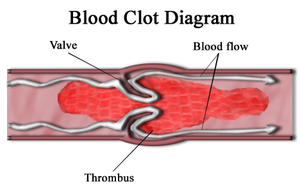
Specifically, a thrombus is the inappropriate activation of the hemostatic process in an uninjured or slightly injured vessel. A thrombus in a large blood vessel will decrease blood flow through that vessel (termed a mural thrombus). In a small blood vessel, blood flow may be completely cut-off (termed an occlusive thrombus) resulting in death of tissue supplied by that vessel. If a thrombus dislodges and becomes free-floating, it is termed as an embolusEmbolism
In medicine, an embolism is the event of lodging of an embolus into a narrow capillary vessel of an arterial bed which causes a blockage in a distant part of the body.Embolization is...
.
Some of the conditions which elevate risk of blood clots developing include atrial fibrillation
Atrial fibrillation
Atrial fibrillation is the most common cardiac arrhythmia . It is a common cause of irregular heart beat, identified clinically by taking a pulse. Chaotic electrical activity in the two upper chambers of the heart result in the muscle fibrillating , instead of achieving coordinated contraction...
(a form of cardiac arrhythmia), heart valve replacement, a recent heart attack
Myocardial infarction
Myocardial infarction or acute myocardial infarction , commonly known as a heart attack, results from the interruption of blood supply to a part of the heart, causing heart cells to die...
(also known as a myocardial infarction
Myocardial infarction
Myocardial infarction or acute myocardial infarction , commonly known as a heart attack, results from the interruption of blood supply to a part of the heart, causing heart cells to die...
), extended periods of inactivity (see deep venous thrombosis), and genetic or disease-related deficiencies in the blood's clotting abilities.
Formation
Platelet activation can occur through different mechanisms such as a vessel wall breach that exposes collagenCollagen
Collagen is a group of naturally occurring proteins found in animals, especially in the flesh and connective tissues of mammals. It is the main component of connective tissue, and is the most abundant protein in mammals, making up about 25% to 35% of the whole-body protein content...
, or tissue factor
Tissue factor
Tissue factor, also called platelet tissue factor, factor III, thrombokinase, or CD142 is a protein present in subendothelial tissue, platelets, and leukocytes necessary for the initiation of thrombin formation from the zymogen prothrombin. An incorrect synonym is thromboplastin...
encryption. The platelet activation causes a cascade of further platelet activation eventually causing the formation of the thrombus.
Treatment
Blood clot prevention and treatment reduces the risk of strokeStroke
A stroke, previously known medically as a cerebrovascular accident , is the rapidly developing loss of brain function due to disturbance in the blood supply to the brain. This can be due to ischemia caused by blockage , or a hemorrhage...
, heart attack
Myocardial infarction
Myocardial infarction or acute myocardial infarction , commonly known as a heart attack, results from the interruption of blood supply to a part of the heart, causing heart cells to die...
and pulmonary embolism
Pulmonary embolism
Pulmonary embolism is a blockage of the main artery of the lung or one of its branches by a substance that has travelled from elsewhere in the body through the bloodstream . Usually this is due to embolism of a thrombus from the deep veins in the legs, a process termed venous thromboembolism...
. Heparin
Heparin
Heparin , also known as unfractionated heparin, a highly sulfated glycosaminoglycan, is widely used as an injectable anticoagulant, and has the highest negative charge density of any known biological molecule...
and warfarin
Warfarin
Warfarin is an anticoagulant. It is most likely to be the drug popularly referred to as a "blood thinner," yet this is a misnomer, since it does not affect the thickness or viscosity of blood...
are often used to inhibit the formation and growth of existing thrombi; the former binds to and activates the enzyme inhibitor antithrombin III
Antithrombin
Antithrombin is a small protein molecule that inactivates several enzymes of the coagulation system. Antithrombin is a glycoprotein produced by the liver and consists of 432 amino acids. It contains three disulfide bonds and a total of four possible glycosylation sites...
, while the latter inhibits vitamin K epoxide reductase
Vitamin K epoxide reductase
Vitamin K epoxide reductase is an enzyme that reduces vitamin K after it has been oxidised in the carboxylation of glutamic acid. Its C1 subunit is the target of anticoagulant warfarin.- See also :* Oxidoreductase...
, an enzyme needed to synthesize mature clotting factors.
Presentation
Virchow's triadVirchow's triad
Virchow's triad describes the three broad categories of factors that are thought to contribute to thrombosis.*Hypercoagulability*Hemodynamic changes *Endothelial injury/dysfunction...
describes the pathogenesis of thrombus formation:
- Endothelial injury (injury to the endothelial cells that line enclosed spaces of the body, such as the inside of blood vessels) (e.g. trauma, atheromaAtheromaIn pathology, an atheroma is an accumulation and swelling in artery walls that is made up of macrophage cells, or debris, that contain lipids , calcium and a variable amount of fibrous connective tissue...
) - Abnormal blood flow (loss of laminar flowLaminar flowLaminar flow, sometimes known as streamline flow, occurs when a fluid flows in parallel layers, with no disruption between the layers. At low velocities the fluid tends to flow without lateral mixing, and adjacent layers slide past one another like playing cards. There are no cross currents...
resulting from stasisStasisThe term stasis may refer to* A state of stability, in which all forces are equal and opposing, therefore they cancel out each other....
in veins or turbulenceTurbulenceIn fluid dynamics, turbulence or turbulent flow is a flow regime characterized by chaotic and stochastic property changes. This includes low momentum diffusion, high momentum convection, and rapid variation of pressure and velocity in space and time...
in arteries) (e.g. valvulitis, aneurysmAneurysmAn aneurysm or aneurism is a localized, blood-filled balloon-like bulge in the wall of a blood vessel. Aneurysms can commonly occur in arteries at the base of the brain and an aortic aneurysm occurs in the main artery carrying blood from the left ventricle of the heart...
) - Hypercoagulability (e.g. leukaemia, Factor V mutation (Leiden))
Disseminated intravascular coagulation
Disseminated intravascular coagulation
Disseminated intravascular coagulation , also known as disseminated intravascular coagulopathy or consumptive coagulopathy, is a pathological activation of coagulation mechanisms that happens in response to a variety of diseases. DIC leads to the formation of small blood clots inside the blood...
(DIC) involves widespread microthrombi formation throughout the majority of the blood vessels. This is due to excessive consumption of coagulation factors and subsequent activation of fibrinolysis
Fibrinolysis
Fibrinolysis is a process that prevents blood clots from growing and becoming problematic. This process has two types: primary fibrinolysis and secondary fibrinolysis...
using all of the body's available platelets and clotting factors. The end result is hemorrhaging and ischaemic necrosis of tissue/organs. Causes are septicaemia, acute leukaemia, shock, snake bites, fat emboli from broken bones, or other severe traumas. DIC may also be seen in pregnant females. Treatment involves the use of fresh frozen plasma to restore the level of clotting factors in the blood, platelets and heparin to prevent further thrombi formation.
Prognosis
Thrombus formation can have one of five outcomes: propagation, embolization, dissolution, organization and organization with recanalization.- Propagation of a thrombus occurs towards the direction of the heart. This means that it is anterograde in veins or retrograde in arteries.
- Embolization occurs when the thrombus breaks free from the vascular wall and becomes mobile. A venous emboli (most likely from deep venous thrombosis in the lower extremities) will travel through the systemic circulation, reach the right side of the heart, and travel through the pulmonary artery resulting in a pulmonary embolism. On the other hand, arterial thrombosis resulting from hypertension or atherosclerosis can become mobile and the resulting emboli can occlude any artery or arteriole downstream of the thrombus formation. This means that cerebral stroke, myocardial infarction, or any other organ can be affected.
- Dissolution occurs when fibrinolytic mechanisms break up the thrombus and blood flow is restored to the vessel. This may be aided by drugs (for example after occlusion of a coronary artery). The best response to fibrinolytic drugs is within a couple of hours, before the fibrin meshwork of the thrombus has been fully developed.
- Organization and recanalization involves the ingrowth of smooth muscleSmooth muscleSmooth muscle is an involuntary non-striated muscle. It is divided into two sub-groups; the single-unit and multiunit smooth muscle. Within single-unit smooth muscle tissues, the autonomic nervous system innervates a single cell within a sheet or bundle and the action potential is propagated by...
cells, fibroblastFibroblastA fibroblast is a type of cell that synthesizes the extracellular matrix and collagen, the structural framework for animal tissues, and plays a critical role in wound healing...
s and endotheliumEndotheliumThe endothelium is the thin layer of cells that lines the interior surface of blood vessels, forming an interface between circulating blood in the lumen and the rest of the vessel wall. These cells are called endothelial cells. Endothelial cells line the entire circulatory system, from the heart...
into the fibrin-rich thrombus. If recanalization proceeds it provides capillary-sized channels through the thrombus for continuity of blood flow through the entire thrombus but may not restore sufficient blood flow for the metabolic needs of the downstream tissue.
See also
- EmbolismEmbolismIn medicine, an embolism is the event of lodging of an embolus into a narrow capillary vessel of an arterial bed which causes a blockage in a distant part of the body.Embolization is...
- ThrombolysisThrombolysisThrombolysis is the breakdown of blood clots by pharmacological means. It is colloquially referred to as clot busting for this reason...
("Destruction of clot") - ThrombogenicityThrombogenicityThrombogenicity refers to the tendency of a material in contact with the blood to produce a thrombus, or clot. It not only refers to fixed thrombi but also to emboli, thrombi which have become detached and travel through the bloodstream. Thrombogenicity can also encompass events such as the...
(the tendency to clot) - National Blood Clot Alliance
- http://www.attract.wustl.edu Blood Clot in Leg - Study
External links
- Treatment and Symptoms of Blood Clots -- MDhealthnetwork.org, Medical Information Resource, 1999
- North American Thrombosis Forum - NATF is a nonprofit organization dedicated to promoting thrombosis research, prevention and education, public policy, and advocacy outreach.
- Muscle Relaxing Drugs Can Reduce Lethal Blood Clots
- Air Pollution Triggers Blood Clots - US Study.
- The National Alliance for Thrombosis and Thrombophilia - has extensive stories from patients and family members on living with Thrombosis and Thrombophilia, assembled frequently asked questions and created publications addressing specific blood clot issues.