

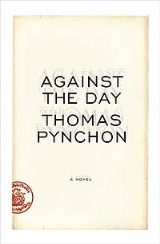
Against the Day

Encyclopedia
Against the Day is a novel
by Thomas Pynchon
. The narrative
takes place between the 1893 Chicago World's Fair
and the time immediately following World War I
and features more than a hundred characters spread across the United States
, Europe
, Mexico
, Central Asia
, and "one or two places not strictly speaking on the map at all," according to the book jacket blurb written by Pynchon. Like its predecessors, Against the Day is an example of historiographic metafiction or metahistorical romance
, and at 1,085 pages it is the longest of Pynchon's novels.
(2 Peter
3:7) reading "the heavens and the earth ... [are] reserved unto fire against the day of judgment and perdition of ungodly men."
William Faulkner
, whose diction frequently echoes the King James Bible, liked the phrase, and many reviewers have traced it to a speech of Faulkner's against racism. Perhaps as relevant is a passage in Absalom, Absalom!
in which Sutpen, a Faustus character of the sort that Pynchon deploys everywhere, seeks "a wife who not only would consolidate the hiding but could would and did breed him two children to fend and shield both in themselves and in their progeny the brittle bones and tired flesh of an old man against the day when the Creditor would run him to earth for the last time and he couldn't get away." The Creditor there is Mephistopheles, to whom Faustus/Sutpen would owe his soul. (The passage in Gravity's Rainbow
about the "black indomitable oven" with which the witch-like Blicero, another Faustus character, is left once the Hansel-and-Gretel-like children have departed, alludes to another passage in Absalom, Absalom!.)
Non-literary sources for the title may also exist: Contre-jour
(literally "against (the) day"), a term in photography
referring to backlighting. There are also two uses of the phrase "against the day" in Pynchon's Mason & Dixon
.
A 1998 children's novel by Michael Cronin uses the same title: it tells an alternate history of a Britain occupied by Nazis.
Last but not least, the novel's epigraph from Thelonious Monk
would appear to comment on the title: "It's always night, or we wouldn't need light."
, who said he assisted Pynchon in researching "a Russian mathematician [who] studied for David Hilbert
in Göttingen
", and that the new novel would trace the life and loves of mathematician and academic Sofia Kovalevskaya
. Kovalevskaya briefly appears in the book, but Pynchon may have partly modeled the major character Yashmeen Halfcourt after her.
's page for the novel, only to vanish a few days later. Readers who had noticed the synopsis re-posted it.
This disappearance provoked speculation on blog
s and the PYNCHON-L mailing list
about publicity stunts and viral marketing
schemes. Shortly thereafter, Slate
published a brief article revealing that the blurb's early appearance was a mistake on the part of the publisher, Penguin Press. Associated Press
indicated the title of the previously anonymous novel.
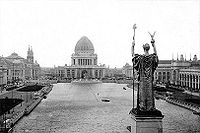 Pynchon's synopsis states that the novel's action takes place "between the 1893 Chicago World's Fair
and the years just after World War I
". "With a worldwide disaster looming just a few years ahead, it is a time of unrestrained corporate greed, false religiosity, moronic fecklessness, and evil intent in high places. No reference to the present day is intended or should be inferred." Pynchon promises "cameo appearances by Nikola Tesla
, Bela Lugosi
and Groucho Marx
", as well as "stupid songs" and "strange sexual practices".
The novel's setting
Like several of Pynchon's earlier works, Against the Day includes both mathematician
s and drug
users. "As an era of certainty comes crashing down around their ears and unpredictable future commences, these folks are mostly just trying to pursue their lives. Sometimes they manage to catch up; sometimes it's their lives that pursue them."
The synopsis concludes:
The published jacket-flap of the book featured an edited-down version of this text, omitting the last three sentences, references to specific authorship (as well as misspelling Nikola Tesla
's first name as "Nikolai"; Pynchon had previously spelled it correctly).
in The New Yorker
gives a simple description:
As to the multitude of plot dead-ends, pauses and confusing episodes that return to continue much later in the narrative, Menand writes:
identifies four "story clusters", each with one or more prose-styles mimicking a popular fiction genre in the style used before the end of World War I:
Examples: "boys' adventure fiction, from the [contemporary] Airship Boys tale by Michael Moorcock
to Horatio Alger; the Dime Novel in general; the British school story in general ... the future war novel"
Examples: Edward S. Ellis, Bret Harte
, Jack London
, Oakley Hall
Examples: "the Lost Race novel; the Symmesian
Hollow Earth tale; the Tibetan Lama or Shangri-La
thriller; the Vernean
Extraordinary Journey; the Wellsian
scientific romance; the Invention tale and its close cousin the Edisonade
..."
Examples: "the European spy romance thriller a la E. Phillips Oppenheim
; the World Island spy thriller a la John Buchan; the mildly sadomasochistic soft porn tale as published by the likes of Charles Carrington
in Paris around the turn of the century." [Clute may mean to include "the Zuleika Dobson
subgenre of the femme fatale
tale in particular" in this cluster.]
Clute sees (but does not specifically categorize) another style mimicked in the book: "the large number of utopias influenced by Edward Bellamy
and William Morris
".
:
New York Times reviewer Michiko Kakutani
writes of the characterizations: "[B]ecause these people are so flimsily delineated, their efforts to connect feel merely sentimental and contrived."
In some of the reviews to his previous works, Pynchon had been called a cold, lapidary writer. Poet L. E. Sissman, from The New Yorker
, instead praised and defended him, saying
As a complement to Miller's criticism about tragedy, Adam Kirsch sees comedy as undercut as well, although parody remains:
sees an organizing theme of the book as
Menand states that this theme also appeared in Pynchon's Mason & Dixon
and that it ties in with a concern present in nearly all of Pynchon's books:
Steven Moore, in a Washington Post book review, writes:
Jazz
(or, as Pynchon refers to it in one variant spelling of the novel's time period, "Jass") provides a non-hierarchical model of organization that the author relates to politics about a third of the way through the novel, according to Leith, who quotes from the passage, in which ‘Dope’ Breedlove, an Irish revolutionist at a Jazz
-bar makes the point. Breedlove characterises the Irish Land League as "the closest the world has ever come to a perfect Anarchist organization".
In a Bloomberg News review, Craig Seligman identifies three overarching themes in the novel: doubling, light and war.
, valued for its optical quality of double refraction
; in Pynchonland, a magician can use it to split one person into two, who then wander off to lead their own lives", Seligman writes.
 Sam Leith identifies the same theme:
(1912–1913) and the Mexican Revolution
(1910–1920), it dispatches World War I
after a few pages. But during most of the book the Great War
"looms as an approaching catastrophe", according to Seligman. This theme might form part of what Menand describes above as the struggle between power-pursuers and power-transcenders.
Reviewer Adam Kirsch criticizes Pynchon's overall treatment of political violence:
Light appears as a religious symbol or element and as a scientific phenomenon, as Peter Keouge, in his Boston Phoenix review points out:
In his Bloomberg News review, Craig Seligman portrays the book as "overstuffed with wonders" often related to light, including a luminous Mexican beetle and the Tunguska Event
of 1908 that leaves the native reindeer soaring and "stimulated by the accompanying radiation into an epidermal luminescence at the red end of the spectrum, particularly around the nasal area" (reminiscent of the luminescence of a certain fictional reindeer
). "[T]he novel is full of images of light, like those beetles and those noses (and the title)", Seligman reports.
Reviewer Tom Leclair notes light in various flashy appearances:
Scott McLemee sees connections between light, space-time and politics:
It remains unclear whether Pynchon himself regards such escape or transcendence as really possible.
reported the book had an average score of 68 out of 100, based on 25 reviews.
Novel
A novel is a book of long narrative in literary prose. The genre has historical roots both in the fields of the medieval and early modern romance and in the tradition of the novella. The latter supplied the present generic term in the late 18th century....
by Thomas Pynchon
Thomas Pynchon
Thomas Ruggles Pynchon, Jr. is an American novelist. For his most praised novel, Gravity's Rainbow, Pynchon received the National Book Award, and is regularly cited as a contender for the Nobel Prize in Literature...
. The narrative
Narrative
A narrative is a constructive format that describes a sequence of non-fictional or fictional events. The word derives from the Latin verb narrare, "to recount", and is related to the adjective gnarus, "knowing" or "skilled"...
takes place between the 1893 Chicago World's Fair
World's Columbian Exposition
The World's Columbian Exposition was a World's Fair held in Chicago in 1893 to celebrate the 400th anniversary of Christopher Columbus's arrival in the New World in 1492. Chicago bested New York City; Washington, D.C.; and St...
and the time immediately following World War I
World War I
World War I , which was predominantly called the World War or the Great War from its occurrence until 1939, and the First World War or World War I thereafter, was a major war centred in Europe that began on 28 July 1914 and lasted until 11 November 1918...
and features more than a hundred characters spread across the United States
United States
The United States of America is a federal constitutional republic comprising fifty states and a federal district...
, Europe
Europe
Europe is, by convention, one of the world's seven continents. Comprising the westernmost peninsula of Eurasia, Europe is generally 'divided' from Asia to its east by the watershed divides of the Ural and Caucasus Mountains, the Ural River, the Caspian and Black Seas, and the waterways connecting...
, Mexico
Mexico
The United Mexican States , commonly known as Mexico , is a federal constitutional republic in North America. It is bordered on the north by the United States; on the south and west by the Pacific Ocean; on the southeast by Guatemala, Belize, and the Caribbean Sea; and on the east by the Gulf of...
, Central Asia
Central Asia
Central Asia is a core region of the Asian continent from the Caspian Sea in the west, China in the east, Afghanistan in the south, and Russia in the north...
, and "one or two places not strictly speaking on the map at all," according to the book jacket blurb written by Pynchon. Like its predecessors, Against the Day is an example of historiographic metafiction or metahistorical romance
Metahistorical romance
Metahistorical Romance is a term describing postmodern historical fiction, defined by Amy J. Elias in Sublime Desire: History and Post-1960s Fiction. Elias defines metahistorical romance as a form of historical fiction continuing the legacy of historical romance inaugurated by Sir Walter Scott but...
, and at 1,085 pages it is the longest of Pynchon's novels.
Title
Besides appearing within the book itself, the novel's title apparently refers to a verse in the BibleBible
The Bible refers to any one of the collections of the primary religious texts of Judaism and Christianity. There is no common version of the Bible, as the individual books , their contents and their order vary among denominations...
(2 Peter
Second Epistle of Peter
The Second Epistle of Peter, often referred to as Second Peter and written 2 Peter or in Roman numerals II Peter , is a book of the New Testament of the Bible, traditionally ascribed to Saint Peter, but in modern times NT scholars regard it as pseudepigraphical.It is the first New Testament book...
3:7) reading "the heavens and the earth ... [are] reserved unto fire against the day of judgment and perdition of ungodly men."
William Faulkner
William Faulkner
William Cuthbert Faulkner was an American writer from Oxford, Mississippi. Faulkner worked in a variety of media; he wrote novels, short stories, a play, poetry, essays and screenplays during his career...
, whose diction frequently echoes the King James Bible, liked the phrase, and many reviewers have traced it to a speech of Faulkner's against racism. Perhaps as relevant is a passage in Absalom, Absalom!
Absalom, Absalom!
Absalom, Absalom! is a Southern Gothic novel by the American author William Faulkner, first published in 1936. It is a story about three families of the American South, taking place before, during, and after the Civil War, with the focus of the story on the life of Thomas Sutpen.-Plot...
in which Sutpen, a Faustus character of the sort that Pynchon deploys everywhere, seeks "a wife who not only would consolidate the hiding but could would and did breed him two children to fend and shield both in themselves and in their progeny the brittle bones and tired flesh of an old man against the day when the Creditor would run him to earth for the last time and he couldn't get away." The Creditor there is Mephistopheles, to whom Faustus/Sutpen would owe his soul. (The passage in Gravity's Rainbow
Gravity's Rainbow
Gravity's Rainbow is a postmodern novel written by Thomas Pynchon and first published on February 28, 1973.The narrative is set primarily in Europe at the end of World War II and centers on the design, production and dispatch of V-2 rockets by the German military, and, in particular, the quest...
about the "black indomitable oven" with which the witch-like Blicero, another Faustus character, is left once the Hansel-and-Gretel-like children have departed, alludes to another passage in Absalom, Absalom!.)
Non-literary sources for the title may also exist: Contre-jour
Contre-jour
Contre-jour, French for 'against daylight', refers to photographs taken when the camera is pointing directly toward a source of light. An alternative term is backlighting....
(literally "against (the) day"), a term in photography
Photography
Photography is the art, science and practice of creating durable images by recording light or other electromagnetic radiation, either electronically by means of an image sensor or chemically by means of a light-sensitive material such as photographic film...
referring to backlighting. There are also two uses of the phrase "against the day" in Pynchon's Mason & Dixon
Mason & Dixon
Mason & Dixon is a postmodernist novel by American author Thomas Pynchon published in 1997. It centers on the collaboration of the historical Charles Mason and Jeremiah Dixon in their astronomical and surveying exploits in Cape Colony, Saint Helena, Great Britain and along the Mason-Dixon line in...
.
A 1998 children's novel by Michael Cronin uses the same title: it tells an alternate history of a Britain occupied by Nazis.
Last but not least, the novel's epigraph from Thelonious Monk
Thelonious Monk
Thelonious Sphere Monk was an American jazz pianist and composer considered "one of the giants of American music". Monk had a unique improvisational style and made numerous contributions to the standard jazz repertoire, including "Epistrophy", "'Round Midnight", "Blue Monk", "Straight, No Chaser"...
would appear to comment on the title: "It's always night, or we wouldn't need light."
Speculation prior to publication
As Pynchon researched and wrote the book, a variety of rumors about it circulated over the years. One of the most salient reports came from the former German minister of culture, and before that, the publisher of Henry Holt and Company, Michael NaumannMichael Naumann
Michael Naumann is a German politician, publisher and journalist. He was the German secretary of culture from 1998 until 2001. He is married to Marie Warburg, daughter of Eric Warburg and granddaughter of Max Warburg....
, who said he assisted Pynchon in researching "a Russian mathematician [who] studied for David Hilbert
David Hilbert
David Hilbert was a German mathematician. He is recognized as one of the most influential and universal mathematicians of the 19th and early 20th centuries. Hilbert discovered and developed a broad range of fundamental ideas in many areas, including invariant theory and the axiomatization of...
in Göttingen
Göttingen
Göttingen is a university town in Lower Saxony, Germany. It is the capital of the district of Göttingen. The Leine river runs through the town. In 2006 the population was 129,686.-General information:...
", and that the new novel would trace the life and loves of mathematician and academic Sofia Kovalevskaya
Sofia Kovalevskaya
Sofia Vasilyevna Kovalevskaya , was the first major Russian female mathematician, responsible for important original contributions to analysis, differential equations and mechanics, and the first woman appointed to a full professorship in Northern Europe.She was also one of the first females to...
. Kovalevskaya briefly appears in the book, but Pynchon may have partly modeled the major character Yashmeen Halfcourt after her.
Author's synopsis/book jacket copy
In mid-July 2006, a plot-synopsis signed by Pynchon himself appeared on Amazon.comAmazon.com
Amazon.com, Inc. is a multinational electronic commerce company headquartered in Seattle, Washington, United States. It is the world's largest online retailer. Amazon has separate websites for the following countries: United States, Canada, United Kingdom, Germany, France, Italy, Spain, Japan, and...
's page for the novel, only to vanish a few days later. Readers who had noticed the synopsis re-posted it.
This disappearance provoked speculation on blog
Blog
A blog is a type of website or part of a website supposed to be updated with new content from time to time. Blogs are usually maintained by an individual with regular entries of commentary, descriptions of events, or other material such as graphics or video. Entries are commonly displayed in...
s and the PYNCHON-L mailing list
Electronic mailing list
An electronic mailing list is a special usage of email that allows for widespread distribution of information to many Internet users. It is similar to a traditional mailing list — a list of names and addresses — as might be kept by an organization for sending publications to...
about publicity stunts and viral marketing
Viral marketing
Viral marketing, viral advertising, or marketing buzz are buzzwords referring to marketing techniques that use pre-existing social networks to produce increases in brand awareness or to achieve other marketing objectives through self-replicating viral processes, analogous to the spread of viruses...
schemes. Shortly thereafter, Slate
Slate (magazine)
Slate is a US-based English language online current affairs and culture magazine created in 1996 by former New Republic editor Michael Kinsley, initially under the ownership of Microsoft as part of MSN. On 21 December 2004 it was purchased by the Washington Post Company...
published a brief article revealing that the blurb's early appearance was a mistake on the part of the publisher, Penguin Press. Associated Press
Associated Press
The Associated Press is an American news agency. The AP is a cooperative owned by its contributing newspapers, radio and television stations in the United States, which both contribute stories to the AP and use material written by its staff journalists...
indicated the title of the previously anonymous novel.
World's Columbian Exposition
The World's Columbian Exposition was a World's Fair held in Chicago in 1893 to celebrate the 400th anniversary of Christopher Columbus's arrival in the New World in 1492. Chicago bested New York City; Washington, D.C.; and St...
and the years just after World War I
World War I
World War I , which was predominantly called the World War or the Great War from its occurrence until 1939, and the First World War or World War I thereafter, was a major war centred in Europe that began on 28 July 1914 and lasted until 11 November 1918...
". "With a worldwide disaster looming just a few years ahead, it is a time of unrestrained corporate greed, false religiosity, moronic fecklessness, and evil intent in high places. No reference to the present day is intended or should be inferred." Pynchon promises "cameo appearances by Nikola Tesla
Nikola Tesla
Nikola Tesla was a Serbian-American inventor, mechanical engineer, and electrical engineer...
, Bela Lugosi
Béla Lugosi
Béla Ferenc Dezső Blaskó , commonly known as Bela Lugosi, was a Hungarian actor of stage and screen. He was best known for having played Count Dracula in the Broadway play and subsequent film version, as well as having starred in several of Ed Wood's low budget films in the last years of his...
and Groucho Marx
Groucho Marx
Julius Henry "Groucho" Marx was an American comedian and film star famed as a master of wit. His rapid-fire delivery of innuendo-laden patter earned him many admirers. He made 13 feature films with his siblings the Marx Brothers, of whom he was the third-born...
", as well as "stupid songs" and "strange sexual practices".
The novel's setting
- "moves from the labor troubles in ColoradoColoradoColorado is a U.S. state that encompasses much of the Rocky Mountains as well as the northeastern portion of the Colorado Plateau and the western edge of the Great Plains...
to turn-of-the-century New York CityNew York CityNew York is the most populous city in the United States and the center of the New York Metropolitan Area, one of the most populous metropolitan areas in the world. New York exerts a significant impact upon global commerce, finance, media, art, fashion, research, technology, education, and...
, to LondonLondonLondon is the capital city of :England and the :United Kingdom, the largest metropolitan area in the United Kingdom, and the largest urban zone in the European Union by most measures. Located on the River Thames, London has been a major settlement for two millennia, its history going back to its...
and GöttingenGöttingenGöttingen is a university town in Lower Saxony, Germany. It is the capital of the district of Göttingen. The Leine river runs through the town. In 2006 the population was 129,686.-General information:...
, VeniceVeniceVenice is a city in northern Italy which is renowned for the beauty of its setting, its architecture and its artworks. It is the capital of the Veneto region...
and ViennaViennaVienna is the capital and largest city of the Republic of Austria and one of the nine states of Austria. Vienna is Austria's primary city, with a population of about 1.723 million , and is by far the largest city in Austria, as well as its cultural, economic, and political centre...
, the Balkans, Central Asia, SiberiaSiberiaSiberia is an extensive region constituting almost all of Northern Asia. Comprising the central and eastern portion of the Russian Federation, it was part of the Soviet Union from its beginning, as its predecessor states, the Tsardom of Russia and the Russian Empire, conquered it during the 16th...
at the time of the mysterious Tunguska EventTunguska eventThe Tunguska event, or Tunguska blast or Tunguska explosion, was an enormously powerful explosion that occurred near the Podkamennaya Tunguska River in what is now Krasnoyarsk Krai, Russia, at about 7:14 a.m...
, Mexico during the Revolution, postwar Paris, silent-era Hollywood, and one or two places not strictly speaking on the map at all."
Like several of Pynchon's earlier works, Against the Day includes both mathematician
Mathematician
A mathematician is a person whose primary area of study is the field of mathematics. Mathematicians are concerned with quantity, structure, space, and change....
s and drug
Drug
A drug, broadly speaking, is any substance that, when absorbed into the body of a living organism, alters normal bodily function. There is no single, precise definition, as there are different meanings in drug control law, government regulations, medicine, and colloquial usage.In pharmacology, a...
users. "As an era of certainty comes crashing down around their ears and unpredictable future commences, these folks are mostly just trying to pursue their lives. Sometimes they manage to catch up; sometimes it's their lives that pursue them."
The synopsis concludes:
- If it is not the world, it is what the world might be with a minor adjustment or two. According to some, this is one of the main purposes of fiction.
- Let the reader decide, let the reader beware. Good luck.
The published jacket-flap of the book featured an edited-down version of this text, omitting the last three sentences, references to specific authorship (as well as misspelling Nikola Tesla
Nikola Tesla
Nikola Tesla was a Serbian-American inventor, mechanical engineer, and electrical engineer...
's first name as "Nikolai"; Pynchon had previously spelled it correctly).
Plot summary
Nearly all reviewers of the book mention the Byzantine nature of the plot. Louis MenandLouis Menand
Louis Menand is an American writer and academic, best known for his Pulitzer Prize-winning book The Metaphysical Club , an intellectual and cultural history of late 19th and early 20th century America....
in The New Yorker
The New Yorker
The New Yorker is an American magazine of reportage, commentary, criticism, essays, fiction, satire, cartoons and poetry published by Condé Nast...
gives a simple description:
- "[T]his is the plot: An anarchist named Webb Traverse, who employs dynamite as a weapon against the mining and railroad interests out West, is killed by two gunmen, [...] who were hired by the wicked arch-plutocrat Scarsdale Vibe. Traverse's sons [...] set out to avenge their father’s murder. [...] Of course, there are a zillion other things going on in Against the Day, but the Traverse-family revenge drama is the only one that resembles a plot [...] that is, in Aristotle’s helpful definition, an action that has a beginning, a middle, and an end. The rest of the novel is shapeless [...]"
As to the multitude of plot dead-ends, pauses and confusing episodes that return to continue much later in the narrative, Menand writes:
- "[T]he text exceeds our ability to keep everything in our heads, to take it all in at once. There is too much going on among too many characters in too many places. [...] This [including tone shifts in which Pynchon spoofs various styles of popular literature] was all surely part of the intention, a simulation of the disorienting overload of modern culture."
Writing styles
Many reviewers have commented on the various writing styles in the book that hark back to popular fiction of the period. John CluteJohn Clute
John Frederick Clute is a Canadian born author and critic who has lived in Britain since 1969. He has been described as "an integral part of science fiction's history."...
identifies four "story clusters", each with one or more prose-styles mimicking a popular fiction genre in the style used before the end of World War I:
- "The Airship Boys cluster, which is told in a boys' adventure idiom."
Examples: "boys' adventure fiction, from the [contemporary] Airship Boys tale by Michael Moorcock
Michael Moorcock
Michael John Moorcock is an English writer, primarily of science fiction and fantasy, who has also published a number of literary novels....
to Horatio Alger; the Dime Novel in general; the British school story in general ... the future war novel"
- "Western Revenge cluster, which is told through an array of western narrative voices…"
Examples: Edward S. Ellis, Bret Harte
Bret Harte
Francis Bret Harte was an American author and poet, best remembered for his accounts of pioneering life in California.- Life and career :...
, Jack London
Jack London
John Griffith "Jack" London was an American author, journalist, and social activist. He was a pioneer in the then-burgeoning world of commercial magazine fiction and was one of the first fiction writers to obtain worldwide celebrity and a large fortune from his fiction alone...
, Oakley Hall
Oakley Hall
Oakley Maxwell Hall was an American novelist. He was born in San Diego, California, graduated from the University of California, Berkeley, and served in the Marines during World War II. Some of his mysteries were published under the pen names "O.M...
- "The Geek Eccentric Scientist cluster, which is told in an amalgam of styles."
Examples: "the Lost Race novel; the Symmesian
John Cleves Symmes, Jr.
John Cleves Symmes, Jr. was an American army officer whose 1818 Hollow Earth theory, expounded on the lecture circuit, gained him considerable notoriety.-Biography:...
Hollow Earth tale; the Tibetan Lama or Shangri-La
Shangri-La
Shangri-La is a fictional place described in the 1933 novel Lost Horizon by British author James Hilton. Hilton describes Shangri-La as a mystical, harmonious valley, gently guided from a lamasery, enclosed in the western end of the Kunlun Mountains...
thriller; the Vernean
Jules Verne
Jules Gabriel Verne was a French author who pioneered the science fiction genre. He is best known for his novels Twenty Thousand Leagues Under the Sea , A Journey to the Center of the Earth , and Around the World in Eighty Days...
Extraordinary Journey; the Wellsian
H. G. Wells
Herbert George Wells was an English author, now best known for his work in the science fiction genre. He was also a prolific writer in many other genres, including contemporary novels, history, politics and social commentary, even writing text books and rules for war games...
scientific romance; the Invention tale and its close cousin the Edisonade
Edisonade
"Edisonade" is a modern term, coined in 1993 by John Clute in his and Peter Nicholls' The Encyclopedia of Science Fiction, for stories based around a brilliant young inventor and his inventions, many of which would now be classified as science fiction...
..."
- "The Flaneur Spy Adventuress cluster, told in any style that comes to hand, from the shilling shocker to HuysmansJoris-Karl HuysmansCharles-Marie-Georges Huysmans was a French novelist who published his works as Joris-Karl Huysmans . He is most famous for the novel À rebours...
." Clute writes that this cluster gradually comes to dominate the second half of the book, just as the Western cluster dominates the first half.
Examples: "the European spy romance thriller a la E. Phillips Oppenheim
E. Phillips Oppenheim
Edward Phillips Oppenheim , was an English novelist, in his lifetime a major and successful writer of genre fiction including thrillers.-Life:...
; the World Island spy thriller a la John Buchan; the mildly sadomasochistic soft porn tale as published by the likes of Charles Carrington
Charles Carrington
Charles Carrington was a leading British publisher of erotica in late-19th and early 20th century Europe. Born Paul Harry Ferdinando in Bethnal Green, England on 11 November 1867, he moved in 1895 from London to Paris where he published and sold books in the rue Faubourg Montmartre and rue de...
in Paris around the turn of the century." [Clute may mean to include "the Zuleika Dobson
Zuleika Dobson
Zuleika Dobson, full title Zuleika Dobson, or, an Oxford love story, is a 1911 novel by Max Beerbohm, a satire of undergraduate life at Oxford. It was his only novel, but was nonetheless very successful...
subgenre of the femme fatale
Femme fatale
A femme fatale is a mysterious and seductive woman whose charms ensnare her lovers in bonds of irresistible desire, often leading them into compromising, dangerous, and deadly situations. She is an archetype of literature and art...
tale in particular" in this cluster.]
Clute sees (but does not specifically categorize) another style mimicked in the book: "the large number of utopias influenced by Edward Bellamy
Edward Bellamy
Edward Bellamy was an American author and socialist, most famous for his utopian novel, Looking Backward, set in the year 2000. He was a very influential writer during the Gilded Age of United States history.-Early life:...
and William Morris
William Morris
William Morris 24 March 18343 October 1896 was an English textile designer, artist, writer, and socialist associated with the Pre-Raphaelite Brotherhood and the English Arts and Crafts Movement...
".
Characterization
Some reviewers complain that Pynchon's characters have little emotional depth and therefore don't excite the sympathy of the reader. For example, Laura Miller in Salon.comSalon.com
Salon.com, part of Salon Media Group , often just called Salon, is an online liberal magazine, with content updated each weekday. Salon was founded by David Talbot and launched on November 20, 1995. It was the internet's first online-only commercial publication. The magazine focuses on U.S...
:
Time doesn't exist, but it crushes us anyway; everyone could see World War I coming, but no one could stop it — those are two weighty paradoxes that hover over the action in "Against the Day" without truly engaging with it. This is the stuff of tragedy, but since the people it sort of happens to are flimsy constructions, we don't experience it as tragic. We just watch Pynchon point to it like bystanders watching the Chums of Chance's airship float by overhead.
New York Times reviewer Michiko Kakutani
Michiko Kakutani
is an American Pulitzer Prize-winning critic for The New York Times and is considered by many to be a leading literary critic in the United States.-Life and career:...
writes of the characterizations: "[B]ecause these people are so flimsily delineated, their efforts to connect feel merely sentimental and contrived."
In some of the reviews to his previous works, Pynchon had been called a cold, lapidary writer. Poet L. E. Sissman, from The New Yorker
The New Yorker
The New Yorker is an American magazine of reportage, commentary, criticism, essays, fiction, satire, cartoons and poetry published by Condé Nast...
, instead praised and defended him, saying
I do not find him to be one. Though his characters are not developed along conventional lines, they do, in their recalcitrant human oddity, live, and they do eventually touch the reader more than he at first thinks they will.
As a complement to Miller's criticism about tragedy, Adam Kirsch sees comedy as undercut as well, although parody remains:
The gaudy names Mr. Pynchon gives his characters are like pink slips, announcing their dismissal from the realm of human sympathy and concern. This contraction of the novel's scope makes impossible any genuine comedy, which depends on the observation of real human beings and their insurmountable, forgivable weaknesses. What replaces it is parody, whose target is language itself, and which operates by short-circuiting the discourses we usually take for granted. And it is as parody — in fact, a whole album of parodies — that Against the Day is most enjoyable.
In alphabetical order by last name
- Lew Basnight, a "Psychical Detective."
- Estrella Briggs, a young pregnant woman found in Nochecita (ATD, p. 200)
- The Chums of Chance (the crew of the skyship Inconvenience):
- Miles Blundell, the jocular cook
- Chick Counterfly, scientific officer
- Lindsay Noseworth, second-in-command, "Master-At-Arms, in charge of discipline aboard the ship" (ATD, p. 4)
- Pugnax, a dog rescued from a fight in Washington, D.C. by the Chums of Chance, he reads and can communicate with humans via "Rff-rff" sounds
- Randolph St. Cosmo, ship commander (ATD, p. 3)
- Darby Suckling, "baby" of the crew, (ATD, p. 3) and later legal-officer of the ship.
- Ruperta Chirpingden-Groin, aristocratic English traveler
- Sloat Fresno, one of the murderers of Webb Traverse, along with Deuce Kindred
- Rao V. Ganeshi, academic from India
- Yashmeen Halfcourt, "the stunningly beautiful ward of a British diplomat in Central Asia", and "polymorphous mathematical prodigy", ward of the T.W.I.T., entrusted to the group by her adopted father, Colonel Halfcourt
- Kieselguhr Kid, freedom-fighter/terrorist. A gun fighter who uses dynamite instead of guns (the original recipe for dynamite involved mixing nitroglycerin with Kieselguhr — porous dirt containing silica)
- Deuce Kindred, one of the murderers of Webb Traverse, along with Sloat Fresno
- Cyprian Latewood, "a homosexual twit possibly modeled on Evelyn Waugh'sEvelyn WaughArthur Evelyn St. John Waugh , known as Evelyn Waugh, was an English writer of novels, travel books and biographies. He was also a prolific journalist and reviewer...
Sebastian Flyte" - Al Mar-Faud, a minor character who mispronounces his Rs as Ws (homonym for Elmer Fudd of Bugs Bunny fame) http://en.wikipedia.org/w/index.php?title=Against_the_Day
- Mouffette, the name of a papillon lap-dog (mouffette in FrenchFrench languageFrench is a Romance language spoken as a first language in France, the Romandy region in Switzerland, Wallonia and Brussels in Belgium, Monaco, the regions of Quebec and Acadia in Canada, and by various communities elsewhere. Second-language speakers of French are distributed throughout many parts...
= "skunk") - Hunter Penhallow, son of Constance Penhallow who goes to the U.S. with the Vormance expedition
- Professor Renfrew, British professor with a bitter personal rivalry with one Professor Werfner ("Renfrew" spelled backwards)
- The Rideouts:
- Dahlia (or "Dally") Rideout, Merle Rideout's (adoptive) daughter
- Erlys Rideout, Merle Rideout's ex-wife, who has run off with Zombini, a magician
- Merle Rideout, an itinerant photographer and scientific inventor
- Captain Sands, inspector in London
- Lionel Swome, T.W.I.T. (see below)
- Nikola TeslaNikola TeslaNikola Tesla was a Serbian-American inventor, mechanical engineer, and electrical engineer...
, the celebrated SerbiaSerbiaSerbia , officially the Republic of Serbia , is a landlocked country located at the crossroads of Central and Southeast Europe, covering the southern part of the Carpathian basin and the central part of the Balkans...
n inventor and investigator of electrical phenomena, rival of Thomas EdisonThomas EdisonThomas Alva Edison was an American inventor and businessman. He developed many devices that greatly influenced life around the world, including the phonograph, the motion picture camera, and a long-lasting, practical electric light bulb. In addition, he created the world’s first industrial... - The (traversing) Traverses:
- Frank Traverse, an engineer; son of Webb and brother of Reef, Kit and Lake
- Kit Traverse, youngest son of Webb and brother of Frank, Reef and Lake; he studies mathematics at Yale (and studies with the physicist Willard Gibbs, whose work is preparing the way for 20th-century thermodynamicsThermodynamicsThermodynamics is a physical science that studies the effects on material bodies, and on radiation in regions of space, of transfer of heat and of work done on or by the bodies or radiation...
) and at Göttingen - Lake Traverse, daughter of Webb and sister of Frank, Reef, and Kit. Became Lake Kindred after marrying Deuce Kindred.
- Mayva Traverse, wife of Webb and mother of his children
- Reef Traverse, a cardsharp; son of Webb and brother of Frank, Kit and Lake
- Webb Traverse, "a turn-of-the-century ... miner" and "an anarchist familiar with dynamite, and he might or might not be the elusive mad bomber who destroys railroad bridges and other mine property"; father of Frank, Reef, Kit and Lake; killed by Sloat Fresno and Deuce Kindred
- Trespassers, "who appear to be dead people from the future"
- Miss Umeki Tsurigane, a QuaternionQuaternionIn mathematics, the quaternions are a number system that extends the complex numbers. They were first described by Irish mathematician Sir William Rowan Hamilton in 1843 and applied to mechanics in three-dimensional space...
theorist who was educated at the Imperial University of Japan (ATD, p. 531) - Professor Heino Vanderjuice of Yale University, associate of the Chums of Chance,
- The (bad) Vibes:
- Colfax Vibe
- Cragmont Vibe
- Dittany Vibe
- Edwarda Vibe, née Beef,
- Fleetwood Vibe
- Scarsdale Vibe, "the most ruthless of the mine owners"
- Wilshire Vibe, Scarsdale's brother
- Foley Walker, Scarsdale Vibe's special assistant
- Professor Werfner, German professor with a bitter personal rivalry with one Professor Renfrew ("Werfner" spelled backwards)
- Luca Zombini, a travelling magician.
- Erlys Rideout, his wife, Merle Rideout's ex-wife, and Dahlia's mother.
- Cici, Dominic, Nunzison, his sons.
- Bria, Concetta, Lucia, his daughters.
Notable organisations
- Chums of Chance, Five "cheerful young balloonists who drop into the story at critical moments and who seem capable of time travel", all aboard the skyship Inconvenience
- T.W.I.T., True Worshippers of the Ineffable TetractysTetractysThe tetractys , or tetrad, is a triangular figure consisting of ten points arranged in four rows: one, two, three, and four points in each row...
(T.W.I.T.), "a covert London group fighting the powers of darkness".
Themes
Critic Louis MenandLouis Menand
Louis Menand is an American writer and academic, best known for his Pulitzer Prize-winning book The Metaphysical Club , an intellectual and cultural history of late 19th and early 20th century America....
sees an organizing theme of the book as
something like this: An enormous technological leap occurred in the decades around 1900. This advance was fired by some mixed-up combination of abstract mathematical speculation, capitalist greed, global geopolitical power struggle, and sheer mysticism. We know (roughly) how it all turned out, but if we had been living in those years it would have been impossible to sort out the fantastical possibilities from the plausible ones. Maybe we could split time and be in two places at once, or travel backward and forward at will, or maintain parallel lives in parallel universes. It turns out (so far) that we can’t. But we did split the atom — an achievement that must once have seemed equally far-fetched. Against the Day is a kind of inventory of the possibilities inherent in a particular moment in the history of the imagination. It is like a work of science fictionScience fictionScience fiction is a genre of fiction dealing with imaginary but more or less plausible content such as future settings, futuristic science and technology, space travel, aliens, and paranormal abilities...
written in 1900.
Menand states that this theme also appeared in Pynchon's Mason & Dixon
Mason & Dixon
Mason & Dixon is a postmodernist novel by American author Thomas Pynchon published in 1997. It centers on the collaboration of the historical Charles Mason and Jeremiah Dixon in their astronomical and surveying exploits in Cape Colony, Saint Helena, Great Britain and along the Mason-Dixon line in...
and that it ties in with a concern present in nearly all of Pynchon's books:
- [Pynchon] was apparently thinking what he usually thinks, which is that modern history is a war between utopianism and totalitarianismTotalitarianismTotalitarianism is a political system where the state recognizes no limits to its authority and strives to regulate every aspect of public and private life wherever feasible...
, countercultureCountercultureCounterculture is a sociological term used to describe the values and norms of behavior of a cultural group, or subculture, that run counter to those of the social mainstream of the day, the cultural equivalent of political opposition. Counterculture can also be described as a group whose behavior...
and hegemonyHegemonyHegemony is an indirect form of imperial dominance in which the hegemon rules sub-ordinate states by the implied means of power rather than direct military force. In Ancient Greece , hegemony denoted the politico–military dominance of a city-state over other city-states...
, anarchismAnarchismAnarchism is generally defined as the political philosophy which holds the state to be undesirable, unnecessary, and harmful, or alternatively as opposing authority in the conduct of human relations...
and corporatismCorporatismCorporatism, also known as corporativism, is a system of economic, political, or social organization that involves association of the people of society into corporate groups, such as agricultural, business, ethnic, labor, military, patronage, or scientific affiliations, on the basis of common...
, natureNatureNature, in the broadest sense, is equivalent to the natural world, physical world, or material world. "Nature" refers to the phenomena of the physical world, and also to life in general...
and techneTechneTechne, or techné, as distinguished from episteme, is etymologically derived from the Greek word τέχνη which is often translated as craftsmanship, craft, or art. It is the rational method involved in producing an object or accomplishing a goal or objective...
, ErosEros (love)Eros is one of the four words in Ancient Greek which can be rendered into English as “love”. The other three are storge, philia and agape...
and the death drive, slaves and masters, entropyEntropyEntropy is a thermodynamic property that can be used to determine the energy available for useful work in a thermodynamic process, such as in energy conversion devices, engines, or machines. Such devices can only be driven by convertible energy, and have a theoretical maximum efficiency when...
and order, and that the only reasonably good place to be in such a world, given that you cannot be outside of it, is between the extremes. "Those whose enduring object is power in this world are only too happy to use without remorse the others, whose aim is of course to transcend all questions of power. Each regards the other as a pack of deluded fools," as one of the book’s innumerable walk-ons, a Professor Svegli of the University of Pisa, puts it. Authorial sympathy in Pynchon’s novels always lies on the "transcend all questions of power," countercultural side of the struggle; that’s where the good guys — the oddballs, dropouts, and hapless dreamers — tend to gather. But his books also dramatize the perception that resistance to domination can develop into its own regime of domination. The tendency of extremes is to meet, and perfection in life is a false GrailHoly GrailThe Holy Grail is a sacred object figuring in literature and certain Christian traditions, most often identified with the dish, plate, or cup used by Jesus at the Last Supper and said to possess miraculous powers...
, a foreclosure of possibility, a kind of death. Of binaries beware.
- [...] Science is either a method of disenchantment and control or it is a window onto possible worlds: it all depends on the application. [...] [T]he relevant science [in this book] [...] is mathematics, specifically, the mathematics associated with electromagnetismElectromagnetismElectromagnetism is one of the four fundamental interactions in nature. The other three are the strong interaction, the weak interaction and gravitation...
, mechanicsMechanicsMechanics is the branch of physics concerned with the behavior of physical bodies when subjected to forces or displacements, and the subsequent effects of the bodies on their environment....
, and opticsOpticsOptics is the branch of physics which involves the behavior and properties of light, including its interactions with matter and the construction of instruments that use or detect it. Optics usually describes the behavior of visible, ultraviolet, and infrared light...
— with electric light, the movies, and, eventually, weapons of mass destruction.
Steven Moore, in a Washington Post book review, writes:
Pynchon is mostly concerned with how decent people of any era cope under repressive regimes, be they political, economic or religious. [...] 'Capitalist Christer Republicans' are a recurring target of contempt, and bourgeois values are portrayed as essentially totalitarian."
Jazz
Jazz
Jazz is a musical style that originated at the beginning of the 20th century in African American communities in the Southern United States. It was born out of a mix of African and European music traditions. From its early development until the present, jazz has incorporated music from 19th and 20th...
(or, as Pynchon refers to it in one variant spelling of the novel's time period, "Jass") provides a non-hierarchical model of organization that the author relates to politics about a third of the way through the novel, according to Leith, who quotes from the passage, in which ‘Dope’ Breedlove, an Irish revolutionist at a Jazz
Jazz
Jazz is a musical style that originated at the beginning of the 20th century in African American communities in the Southern United States. It was born out of a mix of African and European music traditions. From its early development until the present, jazz has incorporated music from 19th and 20th...
-bar makes the point. Breedlove characterises the Irish Land League as "the closest the world has ever come to a perfect Anarchist organization".
- "Were the phrase not self-contradictory," commented ‘Dope’ Breedlove.
- "Yet I’ve noticed the same thing when your band plays — the most amazing social coherence, as if you all shared the same brain."
- "Sure," agreed ‘Dope’, "but you can’t call that organization."
- "What do you call it?"
- "Jass."
In a Bloomberg News review, Craig Seligman identifies three overarching themes in the novel: doubling, light and war.
Doubling
"Pynchon makes much of a variety of calcite called Iceland sparIceland spar
Iceland spar, formerly known as Iceland crystal, is a transparent variety of calcite, or crystallized calcium carbonate, originally brought from Iceland, and used in demonstrating the polarization of light . It occurs in large readily cleavable crystals, easily divisible into rhombs, and is...
, valued for its optical quality of double refraction
Birefringence
Birefringence, or double refraction, is the decomposition of a ray of light into two rays when it passes through certain anisotropic materials, such as crystals of calcite or boron nitride. The effect was first described by the Danish scientist Rasmus Bartholin in 1669, who saw it in calcite...
; in Pynchonland, a magician can use it to split one person into two, who then wander off to lead their own lives", Seligman writes.
- "The book is shot through with doubling, or surrogacy. There are the palindromic rival scientists Renfrew and Werfner. [...] Events on one side of the world have an occult influence on those on the other. 'Double refraction' through a particular sort of crystal allows you to turn silver into gold. Mirrors are to be regarded with, at least, suspicion. It gets more complicated, and sillier. We’re introduced to the notion of ‘bilocationBilocationBilocation, or sometimes multilocation, is a term used to describe the ability/instances in which an individual or object is said to be, or appears to be, located in two distinct places at the same instant in time...
’ — where characters appear in two places at once — and, later, to that of 'co-consciousness', where someone’s own mind somehow bifurcates. 'He wondered if he could be his own ghost,' Pynchon writes of one character."
War
Although the novel directly portrays the First Balkan WarFirst Balkan War
The First Balkan War, which lasted from October 1912 to May 1913, pitted the Balkan League against the Ottoman Empire. The combined armies of the Balkan states overcame the numerically inferior and strategically disadvantaged Ottoman armies and achieved rapid success...
(1912–1913) and the Mexican Revolution
Mexican Revolution
The Mexican Revolution was a major armed struggle that started in 1910, with an uprising led by Francisco I. Madero against longtime autocrat Porfirio Díaz. The Revolution was characterized by several socialist, liberal, anarchist, populist, and agrarianist movements. Over time the Revolution...
(1910–1920), it dispatches World War I
World War I
World War I , which was predominantly called the World War or the Great War from its occurrence until 1939, and the First World War or World War I thereafter, was a major war centred in Europe that began on 28 July 1914 and lasted until 11 November 1918...
after a few pages. But during most of the book the Great War
World War I
World War I , which was predominantly called the World War or the Great War from its occurrence until 1939, and the First World War or World War I thereafter, was a major war centred in Europe that began on 28 July 1914 and lasted until 11 November 1918...
"looms as an approaching catastrophe", according to Seligman. This theme might form part of what Menand describes above as the struggle between power-pursuers and power-transcenders.
Reviewer Adam Kirsch criticizes Pynchon's overall treatment of political violence:
- This is a novel, after all, in which most of the heroes are proud terrorists [...] [H]is attitude towards violence is childishly sentimental, and ruthless in a way only possible to a writer whose imagination has never dwelt among actual human beings. Mr. Pynchon's heroes (the poor, the workers, AnarchistsAnarchismAnarchism is generally defined as the political philosophy which holds the state to be undesirable, unnecessary, and harmful, or alternatively as opposing authority in the conduct of human relations...
) assassinate and blow up his villains (mine owners, PinkertonPinkerton National Detective AgencyThe Pinkerton National Detective Agency, usually shortened to the Pinkertons, is a private U.S. security guard and detective agency established by Allan Pinkerton in 1850. Pinkerton became famous when he claimed to have foiled a plot to assassinate president-elect Abraham Lincoln, who later hired...
thugs, the bourgeoisieBourgeoisieIn sociology and political science, bourgeoisie describes a range of groups across history. In the Western world, between the late 18th century and the present day, the bourgeoisie is a social class "characterized by their ownership of capital and their related culture." A member of the...
) with no more qualms than the Road RunnerWile E. Coyote and Road RunnerWile E. Coyote and The Road Runner are a duo of cartoon characters from a series of Looney Tunes and Merrie Melodies cartoons. The characters were created by animation director Chuck Jones in 1948 for Warner Bros., while the template for their adventures was the work of writer Michael Maltese...
has about dropping an anvil on the Coyote. In the novel as in the cartoon, good and evil are unproblematic, death is unreal, and sheer activity takes the place of human motive.
Light
Light becomes a "preoccupation [...] to which everything, finally, returns", according to reviewer Sam Leith.Light appears as a religious symbol or element and as a scientific phenomenon, as Peter Keouge, in his Boston Phoenix review points out:
- Here is where some familiarity with pre-Einsteinian theories of light (the discredited concept of ÆtherLuminiferous aetherIn the late 19th century, luminiferous aether or ether, meaning light-bearing aether, was the term used to describe a medium for the propagation of light....
is vindicated) and mathematical controversies around the turn of the last century pays off. Kit, for example is a Vectorist. He will later get cozy with Yashmeen, herself an exotic orphan. She’s a Quarternionist (cf. William Rowan Hamilton’sWilliam Rowan HamiltonSir William Rowan Hamilton was an Irish physicist, astronomer, and mathematician, who made important contributions to classical mechanics, optics, and algebra. His studies of mechanical and optical systems led him to discover new mathematical concepts and techniques...
formula i² = j² = k² = ijk = -1, which somehow, I suspect, relates to the structure of the book, each term in the equation applicable to each of the novel’s five sections) obsessed with the Zeta function of G.F.B. RiemannBernhard RiemannGeorg Friedrich Bernhard Riemann was an influential German mathematician who made lasting contributions to analysis and differential geometry, some of them enabling the later development of general relativity....
. In addition, she has ties to the True Worshippers of the Ineffable Tetractys (T.W.I.T.), a covert London group fighting the powers of darkness through PythagoreanPythagorasPythagoras of Samos was an Ionian Greek philosopher, mathematician, and founder of the religious movement called Pythagoreanism. Most of the information about Pythagoras was written down centuries after he lived, so very little reliable information is known about him...
beliefs and the tarotTarotThe tarot |trionfi]] and later as tarocchi, tarock, and others) is a pack of cards , used from the mid-15th century in various parts of Europe to play a group of card games such as Italian tarocchini and French tarot...
.
In his Bloomberg News review, Craig Seligman portrays the book as "overstuffed with wonders" often related to light, including a luminous Mexican beetle and the Tunguska Event
Tunguska event
The Tunguska event, or Tunguska blast or Tunguska explosion, was an enormously powerful explosion that occurred near the Podkamennaya Tunguska River in what is now Krasnoyarsk Krai, Russia, at about 7:14 a.m...
of 1908 that leaves the native reindeer soaring and "stimulated by the accompanying radiation into an epidermal luminescence at the red end of the spectrum, particularly around the nasal area" (reminiscent of the luminescence of a certain fictional reindeer
Rudolph the Red-Nosed Reindeer
Rudolph the Red-nosed Reindeer is a fictional reindeer with a glowing red nose. He is popularly known as "Santa's 9th Reindeer" and, when depicted, is the lead reindeer pulling Santa's sleigh on Christmas Eve. The luminosity of his nose is so great that it illuminates the team's path through...
). "[T]he novel is full of images of light, like those beetles and those noses (and the title)", Seligman reports.
Reviewer Tom Leclair notes light in various flashy appearances:
God said, 'Let there be light'; Against the Day collects ways our ancestors attempted to track light back to its source and replaced religion with alternative lights. There is the light of relativityTheory of relativityThe theory of relativity, or simply relativity, encompasses two theories of Albert Einstein: special relativity and general relativity. However, the word relativity is sometimes used in reference to Galilean invariance....
, the odd light of electromagneticElectromagnetismElectromagnetism is one of the four fundamental interactions in nature. The other three are the strong interaction, the weak interaction and gravitation...
storms, the light of the mysterious Tunguska event of 1908, when a meteorite struck Siberia or God announced a coming apocalypse. [...] the dynamite flash, the diffracted light of Iceland spar, the reflected light of magicians' mirrors, the 'light writing' of photography and movies, the cities' new electric lighting that makes the heavens invisible at night.
Scott McLemee sees connections between light, space-time and politics:
- The "mythology" governing Pynchon's novel (enriching it, complicating it, and giving the untutored reader a headache) involves the relationship between the nature of light and the structure of space-time. It's an effort, perhaps, to imagine something beyond our familiar world, in which "progress" has meant a growing capacity to dominate and to kill.
- "Political space has its neutral ground," says another character in what may be the definitive passage of the novel. "But does Time? is there such a thing as the neutral hour? one that goes neither forward nor back? is that too much to hope?" (Or as JoyceJames JoyceJames Augustine Aloysius Joyce was an Irish novelist and poet, considered to be one of the most influential writers in the modernist avant-garde of the early 20th century...
has Stephen Dedalus say in "Ulysses": "History is a nightmare from which I am trying to awake.")
It remains unclear whether Pynchon himself regards such escape or transcendence as really possible.
Critical reception
The book received mostly positive reviews from critics. The review aggregator MetacriticMetacritic
Metacritic.com is a website that collates reviews of music albums, games, movies, TV shows and DVDs. For each product, a numerical score from each review is obtained and the total is averaged. An excerpt of each review is provided along with a hyperlink to the source. Three colour codes of Green,...
reported the book had an average score of 68 out of 100, based on 25 reviews.
Secondary Bibliography
- St. Clair, Justin. "Borrowed Time: Thomas Pynchon's Against the Day and the Victorian Fourth Dimension". Science-Fiction Studies #113, 38:1, March 2011, 46-66.